




Abstract
Can haze pollution effectively influence local government debt? This study uses data from 285 Chinese cities at the prefecture level or above from 2006 to 2019, and uses annual average sunny days as an instrumental variable to systematically analyze the impact of haze pollution on local government debt from both theoretical and empirical perspectives. The main conclusions of this study are: (1) there is a positive correlation between haze pollution and local government debt; (2) sub-sample analysis suggests that the impact of haze pollution on local government debt shows heterogeneous effects in different cities and at different times; and (3) the analysis of the relevant mechanism suggests that haze pollution can promote local government debt through industrial structure upgrading and green technology innovation. The research conclusions provide policy references for Chinese local governments to effectively respond to haze pollution.
Introduction
Over the 45 years since China’s economic reforms and opening-up of markets, the Chinese economy has continued to grow, making record achievements on a global scale. However, excessive pursuit of economic growth has brought about increasingly severe environmental pollution, in particular, haze pollution, which has had a great impact on everyone’s lives. The 19th National Congress of the Communist Party of China (CPC) expressly took pollution prevention and control as one of the three major themes on which to build a moderately prosperous society in all aspects. Specifically, it was deemed urgent to solve China’s noticeable environmental problems, to take continuous action to prevent and control air pollution, to defend the blue sky, and to promote green development. The Fourth Plenary Session of the 19th CPC Central Committee resolved to implement the strictest environmental protection system. For example, it resolved to develop a stationary pollution source regulatory system centered on the pollutant discharge licensing system, improve the regional linkage mechanism for pollution prevention and control, as well as the sea-land integrated system for environmental governance, and perfect the legal system for environmental protection and the judicial system for law enforcement. Fiscal expenditure occurs inevitably, regardless of which economic activities local governments are engaged in. In other words, the prevention and control of haze pollution need to be financially supported.
The endogenous economic growth model provides a theoretical foundation for studying the relationship between haze pollution and local government finance. Incorporating environmental variables into the production function for research (Bovenberg & Smulders, 1995; Romer, 1990) has fully expanded the endogenous economic growth model based on fiscal expenditure variables, and has also laid an important theoretical foundation for subsequent studies involving the relationship between the two (Stokey, 1998; Zhang & Zou, 2001). There are mainly three aspects of empirical research on the relationship between finance and haze pollution: first, the relationship between environmental pollution externalities and sustainable economic growth is studied by extending the Romer (1990) model (He et al., 2016; Stokey, 1998); second, the relationship between fiscal decentralization and haze pollution is analyzed by city-level data (Pan et al., 2017; Wu & Bai, 2019); third, the relationship between haze pollution and finance is studied from the perspective of innovation policy (Lin & Zhou, 2018; Yang & Lin, 2015).
Although scholars at home and abroad have conducted detailed theoretical and empirical research on haze pollution and government debt, there is still room for expansion in related research. First of all, in terms of research perspective, this paper is different from most literature that focuses on the impact of fiscal expenditure on haze pollution (Jiang et al., 2022; Zhao et al., 2019), but rather studies the impact of haze pollution on local government debt. Secondly, in terms of research methods, this paper differs from other authors who have neglected the necessity of evaluating the quality and reliability of existing research, or who have not fully considered the limitations of methods adopted for endogeneity problems (Gao et al., 2021). In order to alleviate the adverse effects of endogeneity problems on research results, in addition to controlling a series of urban characteristic variables, fixed effects, and considering omitted variable problems as much as possible, this paper also uses sunny days as an instrumental variable based on the sunshine hours in each place. Finally, in terms of research content, combing domestic and foreign literature, relevant research mainly focuses on fiscal decentralization (Wu & Bai, 2019), high-quality development (Chen & Chen, 2018), and financial bonds (Tan et al., 2022). This paper directly studies the endogenous relationship between haze pollution and local government debt, trying to make useful breakthroughs in theory and empirics.
This study may makes the following contributions to the literature. First, within the literature on the impact of fiscal behavior on haze pollution, this study systematically analyses the impact of haze pollution on local government debt. Second, this study performs an economic analysis on the panel data of China’s 285 prefecture-level (or above) cities from 2006 to 2019, combined with the data on PM2.5 concentration. To date, few studies have used such diverse data. Third, the annual average number of sunny days is used as an instrumental variable to alleviate the endogeneity problem effectively.
In summary, this paper will study the endogenous relationship between haze pollution and local government debt from both theoretical and empirical perspectives. Apart from the introduction in Chapter 1, Chapter 2 presents the theoretical model, Chapter 3 conducts empirical tests, Chapter 4 provides further analysis, and Chapter 5 concludes with suggestions.
Theoretical Model
The theoretical model used in this study is based on the research findings of Barro (1988) and Greiner and Semmler (2000). Innovatively, haze pollution is introduced into the production function, and government expenditure is classified into central government expenditure and local government expenditure. Furthermore, local government debt is considered and introduced into the production function and utility function. Accordingly, this study analyses the relationship between haze pollution and local government debt within the framework of endogenous economic growth.
Production Function
Under the assumption that the output level of a social producer is y, its production function is in line with the form of the Cobb–Douglas production function. The production function comprises the material capital stock (k), central government fiscal expenditure (f), local government fiscal expenditure (s), and haze pollution concentration (z). Therefore, the production function (y) is expressed as follows:

where A denotes the rate of technological advance;


Consumer Behavior
The endogenous growth theory concerns the path of balanced economic growth in the long term and generally assumes that there is unlimited demand among consumers, who determine their current consumption based on budget constraints and maximizing the total utility level. Regarding the form of the utility function, Barro (1988) introduced government expenditure to the classical constant relative risk aversion utility function, and Greiner and Semmler (2000) further classified government expenditure into central government expenditure and local government expenditure. Using the methods of Gong and Zou (2002) for reference, this study introduces central government expenditure and local government expenditure into the utility function.
Under the assumption that consumers’ total utility function (u) comprises per-capita household consumption (ct), central government expenditure (ft), and local government expenditure (st),

Consumers choose a consumption path under governmental and their own budget constraints to maximize their discounted utility; then, the utility function is expressed as follows:

where ρ denotes the time preference rate (
The budget constraint of representative consumers is expressed as follows:

where q is equal to the sum of material capital (k) and government debt (d), that is,
Government Behavior
This study assumes that all of the central government’s fiscal revenue is sourced from tax revenue and that the central government’s fiscal expenditure includes its public expenditure and fiscal transfer payment to local governments. To attain a revenue–expenditure balance, the central government’s budget constraint is expressed as follows:

Local government revenue is sourced from tax revenue, central fiscal transfer payment, and net borrowed debt, and local government expenditure includes local government public expenditure and the accrued interest of existing debt. To attain a revenue–expenditure balance, the central government’s budget constraint is expressed as follows:

where
Solution to Competitive Equilibrium
According to the analysis in this section, this study constructs a dynamic optimization problem under the condition of consumers’ utility maximization. The problem can be expressed as follows:
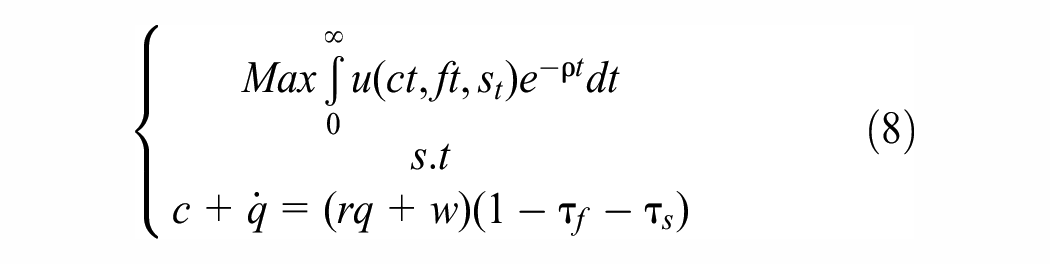
To solve the optimization problem, a Hamilton equation can be constructed for equation (8), as follows:

where λ denotes the Hamilton multiplier. According to the optimized first-order condition, the following equation can be obtained:

The economic growth rate in the equilibrium path can be expressed as follows:

In the equilibrium growth path, all production factors can be considered to share the same growth rate, that is,

According to equation (7), the following equation can be obtained:
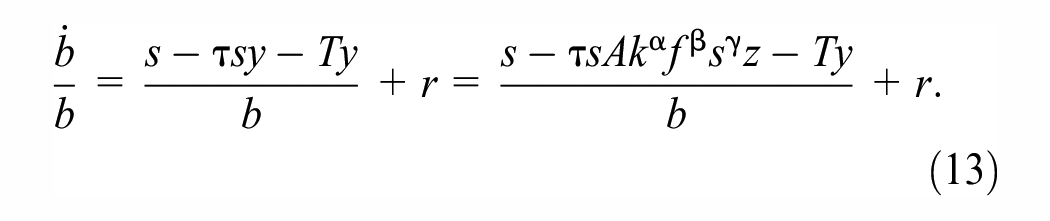
Then, the relationship between local government debt and haze pollution can be expressed as follows:

Main Conclusions
According to equation (14), the derivative of z is calculated. Then, the following equation is obtained:

In equation (15), the numerator is negative; in the denominator
Results
Basic Model and Data Description
The subject of this study is haze data, which is a difficult variable to obtain. Existing economic studies of China’s haze pollution mainly concentrate on conventional pollutants (e.g., industrial wastewater, industrial sulfur dioxide emissions, and air pollution index). As the primary cause of haze pollution, particulate matter (PM) 2.5 has received increasing attention in academia in recent years, and economic studies based on PM2.5 concentration are universally accepted in academia. Based on the data released by the China Meteorological Data Service Center, this study analyses the PM2.5 concentration in China’s prefecture-level (or above) cities from 2006 to 2019, thereby enabling researchers to investigate the relationship between haze pollution and local government debt from a city perspective.
In this study, the explained variables are selected from existing data in the China City Statistical Yearbook from 2006 to 2019, which are duly constructed and cleaned. Large volumes of data for some cities (e.g., Shannan) are missing; data for some cities (e.g., Chaohu) are not continuously available because of subsequent administrative division adjustment; some cities (e.g., Sansha) are newly established with a short history, and thus, their data cover only a few years. To ensure the availability and integrity of the data, these cities are excluded. Compared with the data on carbon dioxide emissions, sulfur dioxide emissions, and emissions of industrial wastewater, exhaust gas, and solid waste used in most studies of environmental pollution, the core explanatory variables of this study are satellite-monitored PM2.5 data, which are released by the Socioeconomic Data and Application Center, Columbia University. Satellite-monitored PM2.5 data are internationally recognized monitoring data and can objectively reflect the environmental pollution status of a region. To date, China has built a PM2.5 monitoring network that covers all domestic cities. Therefore, PM2.5 monitoring data can be used to analyze the relationship between environmental pollution and local government debt. This not only ensures the objectivity and authenticity of the empirical analysis but is also of practical significance to decision-making. Among the control variables, the data on land finance are from the data on land conveyance fees contained in the China Land and Resources Statistical Yearbook. Among the instrumental variables, the weather data are from the China Meteorological Data Service Center and can be accessed upon member registration. Using the data cleaning method of explained variables, these two groups of data are matched to retain the complete panel data of China’s 285 prefecture-level (or above) cities from 2006 to 2019.
Based on related data of China’s 285 prefecture-level (or above) cities over a period of 14 years (2006–2019), this study empirically examines the impact of haze pollution on local government debt and further analyses the impact of the transmission mechanism on local government debt. The following benchmark model is constructed to examine the impact of haze pollution on local government debt:

where
Descriptive Statistics of Variables
In this study, the explained variable is local government debt. In light of the argument of Wang (2016), the final account of the current-level fiscal revenue–expenditure balance is used in this study to measure the fiscal revenue pressure of local governments. Inevitably, the local government revenue–expenditure balance needs to be offset by local government debt. Moreover, this study argues that the relative amount of local government debt can reflect the risk of local government debt more objectively than the absolute local government revenue–expenditure balances. Therefore, the debt level of the local government is measured in terms of the ratio of local government debt balance to local GDP:

In the benchmark regression analysis, a group of variables of urban characteristics is controlled to alleviate the omitted variable bias as much as possible. These variables include the following: (1) fiscal decentralization (fd), measured in terms of the ratio of per-capita local government expenditure to per-capita central government expenditure; (2) population growth rate (pop index), measured in terms of the annual natural population growth rate; (3) per-capita science and education expenditure (peredu), measured in terms of the science and education expenditure per person; (4) labor productivity (labor), measured in terms of the ratio of social employed population to local total population; and (5) land finance (churang), measured in terms of land conveyance fees. In addition, the gross national product of the secondary industry (industry) is controlled, because it may affect both environmental pollution and local government debt. Table 1 provides a data description and the descriptive statistics of all the variables.
Data Description and Variable Statistics.

Source. China City Statistical Yearbook, China Land and Resources Statistical Yearbook, China Meteorological Data Service Center, and Columbia University.
Basic Regression Model
Table 2 lists the results of the regression analysis for the benchmark equation (16). Model 1 shows a significant positive correlation between haze pollution and local government debt after controlling for a number of urban characteristic variables and fixed effects. Considering that industrial production both affects and is affected by haze pollution, this variable is introduced to alleviate the omitted variable bias effectively, thereby increasing the reliability of the study results. Model 2 reflects the impact of industrial production as a variable. The regression results show that haze pollution still has a significant impact on local government debt, and there was no obvious change in the positive correlation between them. Finally, the haze pollution of the current period has a weak impact on the historical local fiscal condition. To alleviate the reverse causality bias, Models 3 and 4 introduce the haze pollution variable of the first lag period to measure the explanatory ability of lagging haze pollution to local government debt. The regression results show that the positive correlation between haze pollution and local government debt still exists, and the haze pollution of both the current and first lag periods explain the positive correlation between haze pollution and local government debt at the 1% significance level. Overall, the related results theoretically verify the positive correlation between haze pollution and local government debt.
Correlation Between Haze Pollution and Local Government Debt: Basic Regression Results.

Note. L is the first lag period factor. The same applies to the rest of the tables.
p < .10. **p < .05. ***p < .01.
Mechanism Verification
The above research results indicate that haze pollution has a positive impact on local government debt. In the following analysis, we attempted to investigate the transmission paths of haze pollution’s impact on local government debt. This study constructed a three-stage least squares model using formula (16) to analyze the mechanism of the effect of haze pollution. The specific model is as follows:


In this section, IM represents the mechanism variable. If the coefficients
On the one hand, haze pollution can exert structural effects by promoting a decrease in the proportion of heavily polluting industries in the region, optimizing and adjusting the industrial structure, and promoting advanced development of the economic structure, thus promoting local government debt. This study constructed an index of advanced industrial structure to measure the “structural effect.”Table 3, Models 5 to 7, describe the results of the structural effect mechanism, in which the coefficients of advanced industrial structure (IMA) are all significantly positive, while the coefficients of haze pollution (PM2.5) and instrumental variables are significantly negative. This indicates that haze pollution can promote the transformation of the industrial structure to a more advanced level, thereby improving the level of local government debt and verifying the structural effect of haze pollution.
Mechanism Test I: Upgrading Industrial Structure.

p < .05.
On the other hand, haze pollution can also play a technological effect by guiding and encouraging enterprises to develop and use environmentally friendly new technologies, promoting the development of green innovative technologies, improving resource utilization efficiency, and achieving dual improvement of economic benefits and environmental protection and energy conservation. Based on this, this study obtained the number of green patent technologies (PTA) to measure the development of green technologies. Table 4, Models 8 to 10, describe the results of the technological effect mechanism, in which the coefficients of green patent technology (PTA) are all significantly positive, while the coefficient of haze pollution (PM2.5) is significantly negative. This indicates that haze pollution can promote the development of green technologies, thereby promoting local government debt, and there is a clear technological effect.
Mechanism Test II: Green Patent Technology.

p < .01.
In summary, the governance of haze pollution can promote local government debt through upgrading industrial structure and green technology innovation.
Further Analysis
Endogeneity and Instrumental Variables
Within the framework of endogenous growth theory, a benchmark model is constructed to directly analyze the impact of haze pollution on local government debt. The endogeneity problem of the haze pollution variable is unavoidable. On the one hand, haze pollution may change the level of local government debt by affecting the public services of local governments (e.g., healthcare and education). On the other hand, local government debt may also affect haze pollution owing to fiscal distress or increased expenditure on polluting industries. To alleviate the endogeneity problem, an effective solution would be to find an appropriate instrumental variable for the core explanatory variable PM2.5. According to general rules, the instrumental variables should be highly correlated with the endogenous variable (PM2.5 concentration) without directly affecting the explained variable (i.e., local government debt level). Considering that haze pollution is related to weather, this study constructs the annual average number of sunny days and number of non-sunny days in a certain region, based on the data from the China Meteorological Data Service Center, along with relevant geographic knowledge. Here, it should be noted that the basic data are the annual sunshine duration of a region. According to geographic knowledge, the daily average sunshine duration is 12 hours. Therefore, the annual average number of sunny days and the annual average number of non-sunny days can be calculated accordingly.
The annual average number of sunny days can be used as an instrumental variable of haze pollution for two reasons. On the one hand, the larger its value, the more sunny days there are in a year and the more easily haze pollution is dissipated, thereby reducing PM2.5 concentration. Therefore, this instrumental variable is negatively correlated with haze pollution. On the other hand, regional weather factors are determined by natural conditions (e.g., the Earth’s rotation, revolution, and latitude), which supports the hypothesis of exogeneity of effective instrumental variables. As an instrumental variable, the annual average number of sunny days also has the following advantage: it varies in both the cross-section and time dimensions and thus identifies the impact on haze pollution at the city level.
In summary, a two-stage least squares (2SLS) model is constructed to analyze how an instrumental variable alleviates the endogeneity problem:


where
Regression Results of Instrumental Variables
Using the annual average number of sunny days as an instrumental variable, this study further estimates the impact of haze pollution on local government debt within the unified framework of 2SLS. Table 5 lists the results of equations (19) and (20). Compared with Models 13 and 14, Models 11 and 12 consider the impact of omitted variable bias and introduce the industrial production variable. Considering the impact of reverse causality, the core explanatory variables are deferred by one period in Models 12 and 14. Evidently, instrumental variable regression not only can alleviate the potential endogeneity of the benchmark regression, it also can help to evaluate the impact of haze pollution on local government debt.
Correlation Between Haze Pollution and Local Government Debt: Estimation of Instrumental Variables.

p < .10. **p < .05.
Overall, the results of the first-stage regression in Table 5 show that regardless of whether omitted variables and reverse causality are considered, the instrumental variable reduces haze pollution at the 5% significance level. In the first stage, the F-test values are all greater than the empirical value of 10, indicating that the weak instrumental variable problem can be significantly excluded. The results of the second-stage regression show that in terms of both directions and significance, the impact of haze pollution on local government debt is consistent with the benchmark regression results in Table 2. This further proves the positive impact of haze pollution on local government debt. From a quantitative perspective, the absolute numbers of estimated values of haze pollution here are all greater than those in the benchmark regression model. Evidently, the potential endogeneity problem tends to cause a positive impact from haze pollution on local government debt.
The regression results in the first column of Table 5 show that each 1-day increase in the annual average number of sunny days reduces PM2.5 concentration by 0.42%. The corresponding results of the second-stage regression show that each 1% increase in PM2.5 concentration increases local government debt level by 15.86%. The core explanatory variable in the first lag period in Model 12 shows a reduction in the impact of haze pollution on local government debt. Models 13 and 14 do not consider the omitted variables; there is a significant increase in both the impact of the instrumental variable on haze pollution and the impact of haze pollution on local government debt.
Heterogeneity Analysis
Models 15 to 18 in Table 6 reflect the relationship between haze pollution based on time heterogeneity and local government debt. The overall sample is divided into two subsamples, each of which covers 7 years equally. The objective of this study is to investigate the impact of haze pollution in the recent 7 years on local government debt. The results of the comparison show that the haze pollution from 2013 to 2019 affected local government debt more significantly than from 2006 to 2012. This may be because Chinese governments took more stringent environmental supervision measures and attached greater importance to environmental governance after 2013. In addition, Models 16 and 18 in Table 6 consider the omitted variables. The regression results do not change significantly.
Correlation Between Haze Pollution and Local Government Debt: Temporal Heterogeneity.

p < .10. ***p < .01.
To analyze different cities, it is necessary to investigate the changes across different economies. This study analyses the heterogeneity between China’s 70 large and medium-sized cities. The regression results are listed in Models 19 to 22 in Table 7. The results show that the impact of haze pollution on local government debt in large and medium-sized cities is significantly slighter than that in small cities. After the omitted variables are considered, the regression results remain unchanged. In other words, it is more difficult to control haze pollution in small cities than in large and medium-sized cities. Specifically, small cities can alleviate the risk of local government debt more effectively through haze control than large cities can. This may be because small cities are small, the cause of haze in small cities is relatively singular, and haze regulation is timelier and more effective.
Correlation Between Haze Pollution and Local Government Debt: Urban Heterogeneity.
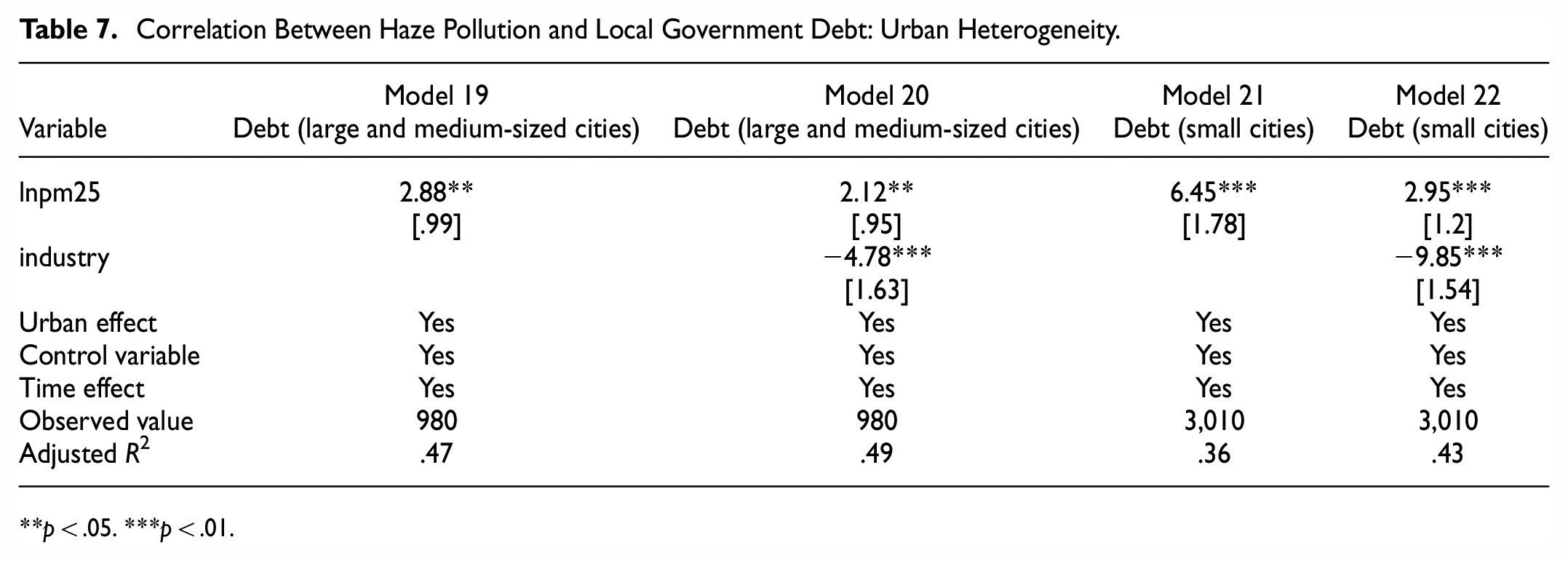
p < .05. ***p < .01.
China’s geographic environments are complex and diverse, comprising vast oceans and broad lands. The diversity of geographical environments results in regional heterogeneity. Hence, it is necessary to investigate the impact of regional differences on the relationship between haze pollution and local government debt. In this study, the overall sample is divided into inland cities and coastal cities. Here, coastal cities refer to prefecture-level (or above) cities whose regional boundaries include coastlines. To ensure the availability of data, 44 coastal cities are finally retained. Models 23 to 26 in Table 8 list the related regression results, which show that the impact of haze pollution on local government debt in inland cities is significantly stronger than that in coastal cities. After the omitted variables are considered, the regression results remain unchanged. A non-negligible reason is that the haze pollution level in coastal cities is significantly lower than that in inland cities. Due to geographic locations and natural conditions, coastal cities are not under great pressure for pollution prevention and control. By contrast, it is an unavoidable fact that inland cities must prevent and control haze pollution to protect their air quality.
Correlation Between Haze Pollution and Local Government Debt: Regional Heterogeneity.

p < .10. ***p < .01.
Robustness Analysis
To further verify the reliability of the study results, Model 11 in Table 5 is used as the benchmark model to perform a series of robustness tests. The test results are listed in Models 27 to 30 in Table 9.
Correlation Between Haze Pollution and Local Government Debt: Robustness Test.

p < .10. **p < .05.
First, the core explanatory variable (i.e., PM2.5 concentration) is closely correlated with the three types of industrial waste (i.e., industrial wastewater, industrial sulfur dioxide, and industrial dust), and the three industrial waste types are related to the expanded industrial production based on local government debt, thereby generating the omitted variable bias. In this study, the impact of the three industrial waste types was further controlled. Model 27 reflects the related regression results. The regression coefficients and significance in Model 27 remain basically unchanged from those in Model 11. Second, the instrumental variable mentioned above focuses only on the core explanatory variable, and an associated concern is that the control variables may face the endogeneity problem arising from reverse causality. To eliminate the adverse effect, all control variables in Model 28 in Table 9 are deferred by one period. The regression results remain unchanged. Third, to eliminate the effect of outliers of haze pollution on the regression results, the 1% sample cities with the highest and lowest PM2.5 concentrations are removed. The regression results do not change significantly. Fourth, to ensure the comparability of sample cities, the municipalities and sample cities of the sub-provincial level or above are removed. Compared with the regression results in Model 11, those in Model 30 are still not changed.
Conclusions and Recommendations
The relationship between environmental protection and local government behavior is an issue that deserves attention. On the one hand, local governments tend to pursue economic growth but ignore environmental governance; on the other hand, the accumulated environmental pollution problem cannot be solved through short-term local government behavior. Does haze pollution, as an important indicator of regional environmental quality, affect local government behavior? This study conducts an in-depth analysis of the relationship between haze pollution and local government debt. This study was conducted based on unique haze pollution data (i.e., PM2.5 concentration) of China’s 285 prefecture-level (or above) cities over a period of 14 years (2006–2019). In this study, the local government debt level is measured in terms of the ratio of local government debt balance to local GDP. Within the framework of endogenous growth theory, this study first theoretically and then empirically provides a systematic analysis of the impact of haze pollution on local government debt. Innovatively, the annual average number of sunny days is used as an instrumental variable to alleviate the endogeneity of haze pollution. Within the unified framework of 2SLS, this study estimates the impact of local governments’ environmental governance on local government debt. The main conclusions are summarized as follows. (1) Haze pollution is positively correlated with local government debt; therefore, local governments must actively perform environmental governance and reduce environmental pollution, thereby alleviating the pressure of local government debt. (2) The impact of haze pollution on local government debt from 2013 to 2019 is significantly stronger than that from 2006 to 2012; foreseeably, haze pollution regulation can alleviate the pressure of local government debt more effectively. (3) The impact of haze pollution on local government debt in large and medium-sized cities is significantly lower than that in small cities; it is more difficult to control haze pollution in small cities than in large and medium-sized cities. In other words, small cities can alleviate the risk of local government debt more effectively through haze control than large cities can, and the impact of haze pollution on local government debt in inland cities is significantly stronger than that in coastal cities.
These conclusions have important policy implications. First, haze reduction inevitably has a profound impact on the behavior of local governments (e.g., alleviating the pressure of local government debt). Therefore, local governments must perform environmental governance actively, to achieve a virtuous cycle between environmental governance and local economic growth. Second, environmental supervision and environmental governance have been highly effective in recent years. Therefore, it is advisable to further increase investment in environmental protection and to maintain a high intensity of environmental supervision, so that environmental governance can continue to inject new impetus into economic growth in the future. Third, this study has found a clear path through which to address the risk of local government debt, that is, to perform environmental governance continuously, reduce the intensity of haze pollution, and pursue economic growth while considering environmental protection. Fourth, it is easier to achieve a virtuous cycle between economic growth and environmental protection in small cities, than in large and medium-sized cities. Small cities should be more far-sighted in urban development, refrain from economic growth at the cost of pollution, and invest more local fiscal resources in environmental protection, to produce better economic benefits. Fifth, increasing environmental protection investment in cities with severe haze pollution can reduce pollutant emissions, lower governance costs, improve the city’s image, and enhance residents’ quality of life. In addition, in cities with low levels of haze pollution, policy guidance, and market mechanisms can be used to encourage enterprises to transform and upgrade from traditional to high-end industries, promote sustainable economic development, and improve environmental quality. Sixth, coastal cities can develop clean energy mainly because they have abundant natural resources such as wind and solar energy, and developing clean energy can reduce pollutant emissions. Environmental protection policies can also be implemented because coastal cities have a developed economy and a high level of environmental awareness, which can effectively control pollutant emissions. In contrast, inland cities may take the following measures: first, promoting clean energy as resources are relatively scarce, and developing clean energy can reduce energy costs and pollutant emissions. Second, improving industrial structure as the proportion of industry in inland cities is relatively high, and industrial production is prone to emit pollutants. Improving industrial structure can reduce pollutant emissions.
Footnotes
Availability of Data and Materials
The datasets used and/or analyzed during the current study are available from the corresponding author on reasonable request.
Author Contributions
Conceptualization, X.H, and X.K.; methodology, X.H.; formal analysis, Z.X.; writing—original draft preparation, X.H.; supervision, Z.X.; critical revision, J.H; Correspondence: Z.X. All authors have read and agreed to the published version of the manuscript.
Declaration of Conflicting Interests
The author(s) declared no potential conflicts of interest with respect to the research, authorship, and/or publication of this article.
Funding
The author(s) received no financial support for the research, authorship, and/or publication of this article.