




Abstract
This study aimed to examine the online information behavior of informal caregivers of persons with dementia (PWDs). We examined caregivers’ posts (N = 401) in two subgroups on the social media platform Reddit. Content analysis and correlational analysis techniques were used to analyze the data. Over half of caregivers (57%) posted health information for the purposes of both sharing and seeking information, whereas the remaining caregivers posted information for the purpose of sharing only. The three most commonly exchanged types of health information were information about psychosocial issues, daily care for a patient at home, and characteristics of dementia. The more types of health information that a post contained, the greater number of peers who participated in discussions. These findings show that caregivers use social media as a tool for health information support—to seek health information from other caregivers rather than rely on health care professionals or support groups.
Background and Objectives
Currently, more than 55 million people are living with dementia worldwide, with an estimated 78 million people who will have dementia by 2030 (World Health Organization, 2021). This increase in dementia prevalence will continue to place increasing demands on informal caregivers for persons with dementia (PWDs)—family members or friends who take on the challenging responsibilities of caring for their relatives or friends (Chiao et al., 2015). In the U.S., the number of informal caregivers has already shown an increase from 43.5 million in 2015 to 53 million in 2020 (National Alliance for Caregiving & AARP, 2020; National Alliance for Caregiving & AARP Public Policy Institute, 2015). Of the 53 million informal caregivers in the U.S. in 2020, 11% were caregivers for PWDs (National Alliance for Caregiving & AARP, 2020).
Caregivers for PWDs take on a wide range of tasks in providing care, which include but are not limited to providing emotional and social support; assistance in both instrumental activities of daily living (e.g., grocery shopping, providing transportation) and activities of daily living (e.g., eating, bathing); and coordinating and advocating for the PWDs’ health care (Schulz & Eden, 2016). The challenges that caregivers face are exacerbated due to the debilitating presence of PWDs’ neuropsychiatric symptoms (Shim et al., 2016). Caregivers are also often asked to help PWDs make decisions about their care, thus serving as advisors or surrogate decision makers (Schulz & Eden, 2016). Such help with decision making is often difficult because of uncertainty in deciding how to approach a situation according to the PWD’s personal values and preferences, and especially when the caregiver lacks information about options, clarity in what matters to PWDs, and support in making decisions (O’Connor, 1993/2010).
Caregivers and Social Media
As the caregiver population continues to increase, so does the use of social media by all age groups in the U.S. (Pew Research Center, 2021). Internet-based platforms such as Facebook, Twitter, Reddit, Instagram, and blogs are facilitating communication and the exchange of ideas, fostering online communities in which individuals build relationships online by sharing experiences and exchanging information (Baruah, 2012; Kaplan & Haenlein, 2010). In recent years, the user base of social media platforms has broadened, with increasing popularity among adults (Pew Research Center, 2021). In 2021, 81% of Americans aged 30 to 49 years and 73% of those aged 50 to 64 years reported that they used at least one social media platform (Pew Research Center, 2021). Given this context, it should be noted that the average age of caregivers was 49.4 years in the U.S. in 2020, with one out of five U.S. caregivers relying solely on social media and websites as their source for health care information (National Alliance for Caregiving & AARP, 2020).
Many social media communities are designed to bring PWDs’ caregivers together online. These communities employ platforms such as Facebook, Reddit, Twitter, and blogs. A quick search through Facebook alone offers over 100 separate communities, private and public, for both PWDs’ caregivers and dementia patients. In recent years, there has been increasing interest in understanding the use of social media among PWD caregivers. Earlier studies have examined social media as a way to recruit dementia caregivers, and use of blogs by family caregivers. Several studies of caregivers for PWDs have used these online communities to recruit caregivers and PWDs as study participants (Alanazy et al., 2019; Amado & Brucki, 2018; Beattie et al., 2018; Britton et al., 2018; Chapman et al., 2019; Isaacson et al., 2018). Other studies have mostly considered blogs (Anderson et al., 2017; Anderson, Eppes, et al., 2019; Anderson, Hundt, et al., 2019). These studies showed that the caregivers used such media for purposes that include social support and information gathering. Still, although blogs are a form of social media, they differ from other social media such as Facebook and Reddit, which offer larger platforms with greater numbers of authors and commenters who communicate on given topics. Research conducted with the narrow examination of decentralized blogging websites that present single main speakers and their communities of readers may not necessarily translate to other larger social media platforms (Schmidt, 2007). More recent studies, however, have examined the use of social media such as Facebook, Twitter and Reddit. Two studies analyzed Facebook discussions to explore caregiving tasks and emotional experiences among dementia caregivers (Bachmann, 2020; Bachmann & Hruska, 2022). One study analyzed large publicly available datasets that included the content and location of tweets of Twitter, a social media website, to document reasons for discussing dementia among general public or professionals (T. Y. Cheng et al., 2018) while one study analyzed Reddit posts concerning experience of dementia diagnoses and its impact on individuals and their family (Gkotsis et al., 2020).
The Present Study
Understanding the types of health information that caregivers exchange on social media and the types of posts that prompt peer discussions can inform the development of interventions that enable caregivers’ access to and use of accurate health information. However, few studies have systematically examined how caregivers use social media to obtain health information. In the present study, we therefore examine the types of health information that PWDs’ caregivers seek and share on social media by analyzing data from Reddit, a free and widely used public social media platform that allows anonymous online information exchange. Reddit users are able to communicate about specific topics in forums called “subreddits.” These subreddits serve to bring together groups of users with similar interests or demographics to ask for and share information (Shatz, 2017). Our study focused on two relevant subreddits (see Study Sample below for more information). Our research questions were:
RQ1: What is the main purpose of posting by caregivers—information sharing only, or information sharing and seeking?
RQ2: What types of health information do caregivers exchange online?
RQ3: What are the characteristics of online posts that receive more attention from peers?
This investigation of the types of health information exchanged among caregivers is guided by the Health Information Wants (HIW) framework (Nie et al., 2016; Xie et al., 2011, 2013, 2014), which features a patient-centered, bottom-up approach to understanding individual preferences for different types and amounts of health information. The HIW framework was developed in contrast to the conventional top-down approach in which health care professionals focus on information that they think their patients need to know (typically to ensure compliance). The HIW framework informed the development of our HIW Questionnaire (HIWQ) through a multistage process that took place over 2 years, which included extensive content validity testing, cognitive testing, a pilot study, and testing among younger and older adult populations. Empirical evidence from various populations, including patients with cancer and diabetes and their family caregivers, shows that the HIWQ has excellent validity and reliability (Xie et al., 2011, 2013, 2014). The HIWQ includes seven types of health information commonly wanted in health care encounters. For the present study, we modified these types for the characteristics of the study’s population, as we detail in the Methods section.
Research Design and Methods
Study Sample
We focused on users of two subreddits of most relevance to the scope of this study: r/dementia (https://www.reddit.com/r/dementia) and r/Alzheimers (https://www.reddit.com/r/Alzheimers). As of August 3, 2022, these two subreddit communities had over 19,500 and 10,200 members, respectively.
Data Collection
We created Pushshift API calls to identify and gather Reddit posts in the r/dementia and r/Alzheimers subreddits from March through May 2019. Pushshift is a database that contains copies of all publicly available Reddit objects including comments; it is updated in near-real time, approximately once per second (Baumgartner et al., 2020). In total, we extracted 135 posts from the r/Alzheimers subreddit and 266 from r/dementia, for a total of 401 posts from PWDs’ caregivers. The numbers of words in the posts varied greatly, ranging from as few as 10 to as many as 1,738, averaging approximately 232 words per post. Reddit users’ usernames were anonymized with alphanumeric codes. The study protocol was reviewed and approved by the Institutional Review Board at the University of Texas at Austin (Approval #2019-12 0116).
Data Analysis
Types and Purposes of Health Information Posted on Subreddits
To categorize the types of health information posted on subreddits, we coded and analyzed all posts in our sample using content analysis with predetermined codes based on the modified HIW framework. The initial coding structure was developed by two co-authors with expertise in caregiving and HIW, through iterative deduction. We adapted an earlier version of the HIW framework (Nie et al., 2016) to account for the unique characteristics and needs of PWDs and their caregivers (Wang et al., 2021). The modified HIW framework used in this study included the following information types: (1) treatment/prevention, (2) characteristics of the health condition, (3) laboratory tests/medical tests/diagnostic procedures, (4) daily care for a patient, (5) care transition and coordination (between home and facility), (6) end-of-life care, (7) care for a caregiver, (8) psychosocial care, (9) health care provider/facility/resources, (10) legal/financial planning/insurance, (11) scientific updates. Under each health information type, specific examples were also used to inform the coding. For example, for the treatment/prevention category, specific examples included medications, complementary or alternative medicine, and disease prevention. (See Table 1 for a complete list of information types with examples.)
Health Information Wants Categories and Examples (HIW) of ADRD Patients and Caregivers.

We measured the multiplicity of a post’s HIW types (i.e., the number of HIW types included in a post). It was coded as 0 if the post contained no more than one HIW type and 1 if it contained at least two.
We also categorized posts according to their purpose, as information sharing only or as information sharing and seeking. Sharing-only posts were those that shared information simply for the purpose of socializing or venting, without asking an identifiable question. Information sharing and seeking posts were those that each contained at least one identifiable question regarding an information want (because users who were seeking specific information or advice typically also shared information regarding their situation in order to provide the contexts of their questions, we named this type of posts “information sharing and seeking posts”).
Two authors independently coded the same selected group of subreddits’ data. Once coding was complete, the two authors compared the text coded under each information type and resolved differences in coding through discussion. This process was repeated until they reached consensus. Periodic peer debriefing and discussion with other coauthors and auditing (documentation of decisions made during data collection and analysis) were used to enhance analytic rigor and trustworthiness.
Attention to Specific Types of Health Information
In this study, we define attention as the action a social media user takes with respect to a post. Strictly speaking, if the user chose to read the post or even laid an eye on it, one could argue that the user has paid attention to the post. Indeed, web researchers have used metrics such as the user’s browsing logs, the average reading speed on a page, and the number of page views a web page has received to measure users’ attention to the page (Yang & Zhang, 2010). Some research studies even use eye tracking devices that measures one’s eye movement to measure how much attention the individual gives to a piece of information on the computer screen (Vraga et al., 2016). The eye tracking device is often used in an experimental study where subjects are invited to a lab to participate in predefined tasks. This is not applicable in our study. Additionally, Reddit does not keep track of the number of views a post has received so that information is unavailable to us. On the other hand, Reddit records the number of votes and comments a post has received. In a Reddit discussion, one can choose to cast a vote on a post to express their opinion besides providing written comment(s). We recognize that a voting action can be interpreted differently, for example, an upvote may indicate that the user agrees with the viewpoint in the post or simply shows the support of posting in this discussion forum. Nonetheless, the action of voting and commenting signals that the user has paid attention to the post. To measure the amount of attention a post has received, we therefore measured two attributes of each post: voting participation ratio and commenting participation ratio. A post’s voting participation ratio was calculated as the total number of votes on the post divided by the number of members in the subreddit community. The commenting participation ratio was calculated as the total number of unique commenters in the discussion divided by the number of members in the subreddit community. Each of these two metrics provided an indication of the percentage of community members engaged with that post.
Relationships Among Variables
To explore the relationships among voting participation ratio, commenting participation ratio, the purposes of HIW posts, and the multiplicity of posts’ HIW types, we conducted a series of descriptive and correlational analyses. We conducted descriptive statistics for frequency, central tendency, and variability for all key variables. Then we examined correlations between the voting participation ratio and the commenting participation ratio, and how each of these ratios correlated with the multiplicity of posts’ HIW types and purposes of posts (sharing only or sharing and information seeking). All correlational analyses were conducted with SPSS.
Results
Types of Information Sought and Shared on Subreddit
All posts on both the r/dementia and r/Alzheimers subreddits shared ideas, opinions, experiences, and questions about a health topic to some degree (Table 2). Over half of users (57%) posted a type of health information in order to both share and seek information; 43% of users posted information for the purpose of sharing only. Many posts included multiple HIW types. Compared with posts in r/Alzheimers, it was more common for posts in r/dementia to contain two or more HIW types (Figure 1). On the other hand, although posts in r/dementia had up to five HIW types, the maximum was seven in r/Alzheimers posts.
Major Health Information Wants Sought and Shared in r/dementia and r/alzheimers.
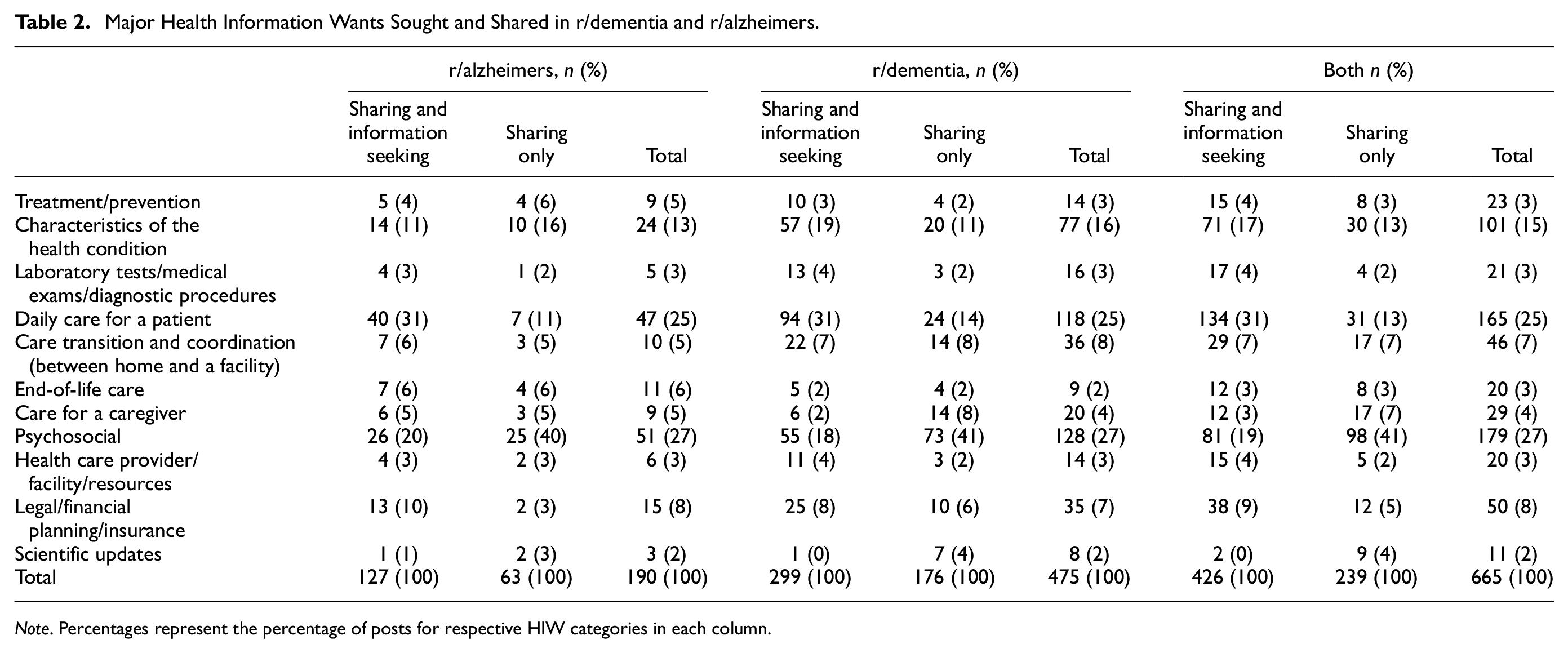
Note. Percentages represent the percentage of posts for respective HIW categories in each column.

Frequency distribution of the number of HIW category in a post.
The three most commonly posted HIW types in r/dementia and r/Alzheimers subreddits were (1) psychosocial—information related to assistance and social support in dealing with one’s emotions and concerns (27%); (2) daily care for the patient at home—information related to caring for the PWD on a daily and regular basis, excluding any care information regarding psychosocial care (25%); and (3) characteristics of the health condition—information about specific characteristics of dementia, including its definition, prognosis, and causes (16%).
Types of HIW posted differed between information-seeking-and-sharing and sharing-only. Psychosocial posts, for example, accounted for 41% of sharing-only posts but only 19% of information-seeking-and-sharing posts, whereas daily care for a patient constituted 31% of information-seeking-and-sharing posts but only 13% of sharing-only posts. The prevalence of posts for characteristics of the health condition was similar for information seeking and sharing (17%) and sharing only (13%). These three HIW types were often mentioned together in a single post. For example, posts coded as psychosocial overlapped with characteristics of the health condition (17%) and daily care for a patient (21%).
In posts for psychosocial information, the acceptance of relatives’ memory loss and diagnosis as well as related grief and loss were common. Among posts for information about daily care for the patient, many were about caregiving for patients who were not at facilities. These PWD caregivers sought information about hands-on caregiving skills, daily routines, speaking with and understanding the PWD’s thoughts and intentions, helping the PWD control anger or frustration at home, and using devices, equipment, or software designed to help PWDs in their daily functions at home. Many posts about characteristics of dementia concerned behavioral symptoms of dementia, cognitive and memory impairment, and dietary changes.
Information Behavior and Attention
Spearman correlations between the voting participation ratio and the commenting participation ratio showed positive relationships but they are moderate (r/Alzheimers: r = .410, p < .001; r/dementia: r = .357, p < .001; Table 3). This indicates that people who vote do not always comment and vice versa. Therefore, we used both metrics in our subsequent analysis to help us understand how the amount of attention a post receives correlates with the content of the post.
Voting and Commenting Participation Ratios for r/Dementia and r/Alzheimers.

Our analysis shows that the purpose of a post (sharing information only, or sharing and seeking information) and the number of HIW types included in the post affect the amount of attention it receives. Mann Whitney U tests showed the impact of the posts’ purposes on the likelihood of voting and commenting: Information-seeking-and-sharing posts were less likely than sharing-only posts to have people vote on them (r/Alzheimers: mediansharing = 0.002174, mediansharing&seeking = 0.001255, p < .001; r/dementia: mediansharing = 0.001163, mediansharing&seeking = 0.000814, p = .013) but more likely to have people comment on them (r/Alzheimers: mediansharing = 0.000334, mediansharing&seeking = 0.000557, p = .01; r/dementia: mediansharing = 0.000466, mediansharing&seeking = 0.000466, p < .001) (See Table 4).
Voting Participation Ratio and Commenting Participation Ratio by the Purpose of the Post.

Note. ES means effect size.
Mann Whitney U tests (Table 5) also showed that whether or not a post contained more HIW types affected whether or not others would participate in discussions (i.e., the commenting participation ratio). If a post contained more types of HIW, peer caregivers were more likely to comment on the post: r/Alzheimer subreddit: medianHIW = 1 = 0.000334, medianHIW > 1 = 0.000668, p < .001; r/dementia: medianHIW = 1 = 0.000466, medianHIW >1 = 0.000582, p < .001.
Commenting Participation Ratios by Number of HIW Categories per Post.

Discussion and Implications
Caregivers of PWDs often experience social isolation and lack sufficient information from health care professionals as they navigate our complex health and long-term care systems to coordinate and provide necessary care for their loved ones (Chan et al., 2020; Isik et al., 2019; National Alliance for Caregiving & AARP, 2020). The use of social media to seek and share health care information suggests the potential of social media as an important mechanism to provide relevant information and social support for these caregivers. Studies of PWDs’ caregivers have used social media primarily as a method of recruitment, acknowledging the importance of social media among them (Alanazy et al., 2019; Amado & Brucki, 2018; Beattie et al., 2018; Britton et al., 2018; Chapman et al., 2019; Isaacson et al., 2018). Only a few studies have examined how caregivers of PWDs actually use social media (mostly blogs; Anderson et al., 2017; Anderson, Eppes, et al., 2019; Anderson, Hundt, et al., 2019). Addressing these gaps in the literature, in the present study, we have examined these caregivers’ social media use on Reddit—the purposes of their posts, the types of health information that they seek most often, and characteristics of posts that attract the attention of their peers.
The majority of the caregivers of PWDs in this study posted for the dual purpose of sharing and seeking information. This finding is consistent with those of the prior studies of social media (mostly blogs) use among PWDs’ caregivers (Anderson et al., 2017; Anderson, Eppes, et al., 2019; Anderson, Hundt, et al., 2019; Wang et al., 2021). Because each caregiver’s post must share information to provide a context for seeking information, all posts in the present study that sought information shared some type of health information. When caregivers shared information only, without directly seeking information, they did so either to express their emotions and situations (i.e., venting) or to share advice based on their own experiences as potentially useful guidance for other caregivers. Caregivers also frequently sought information about their own health care needs in the subreddits. The dual purposes that social media provide for the caregivers—to seek and to share health information—show that social media are an important source that caregivers of PWDs use to meet their health care information needs. They suggest that health care and social service providers should recognize social media as constituting support groups and health informational tools for PWDs’ caregivers. The information caregivers receive from peers via social media may, or may not, be evidence-based, but it may nonetheless be used by caregivers and have effects on the lives of PWDs and caregivers alike. As such, professional providers need to be proactive in exploring ways to maximize the power of social media while avoiding potential pitfalls.
The three most common types of HIW in the caregivers’ posts were psychosocial care, daily care for a patient, and characteristics of the health condition. Indeed information seeking was the purpose of many of the posts, including these types of HIWs. Among caregivers’ shared experiences were the PWDs’ progressive loss of memories, cognitive and communicative function, and the unpredictable changes in symptoms associated with dementia. The acceptance of PWDs’ memory loss and diagnosis, along with related grief and loss, was common. Reddit provides support groups not only for patients but also for caregivers to express their grief as the PWD’s memory declines with loss of control and identity (Robinson et al., 2005; Xanthopoulou & McCabe, 2019). The caregivers’ use of Reddit posts to share and seek information about assistance and social support in dealing with their emotions and concerns, as well as information about how to communicate and adjust to PWDs’ changing needs and provide care for PWDs safely at home, is not surprising. The negative emotional and physical effects of caregiving have been extensively documented: caregivers of PWDs have reported burden, depressive symptoms, and weakened immune systems, with increased risk for the PWDs’ institutionalization (S.-T. Cheng, 2017; Chiao et al., 2015; National Alliance for Caregiving & AARP, 2020; Toot et al., 2017). Thus, extensive public education via social media may be warranted, especially education about characteristics and behaviors associated with dementia as well as how to be the caregiver for such unique patients.
The sharing-only posts included a large number of psychosocial posts. Many caregivers become increasingly isolated from the world to become around-the-clock caretakers for PWDs, and social media may be their only outlet to express grief and emotions (Cherak et al., 2020). Many caregivers may not be able to afford or make time to attend in-person support groups, and social media can provide a support group as well as an information source (Moorhead et al., 2013; Smailhodzic et al., 2016).
Social media groups constituted by subreddits comprise two classes of users: the authors and the viewers of posts. The viewers of posts in r/dementia and r/Alzheimers can participate anonymously by commenting or voting on posts. In our earlier analysis (Flynn et al., 2021), we find that high attention posts tend to be more intense and negative in emotion and focus on sharing narratives and seeking support whereas posts with positive emotion tend to receive less attention and have a focus on information seeking and symptoms. In the present study, our analysis further supports that the attention that posts received differed significantly depending on the content of the posts. Specifically, the occurrence of multiple HIW types in single posts led to greater attention among caregivers than did posts with a single HIW type. A likely reason is that the greater the number of HIW types in a post, the more likely it is that a caregiver may find a relevant topic of personal interest.
The amount of attention posts received from peers also differed between the posts for information seeking and sharing and those for sharing only. Posts for information seeking and sharing received greater attention through commenting and discussion but less attention through voting than those for sharing only. Inherent in any post for information seeking and sharing is a direct question for the subreddit audience to answer, so it is likely that when caregivers enter the discussions of these posts, they do so to answer authors’ questions and concerns about personal experiences. For sharing-only posts, on the other hand, the intention is to inform the participants as opposed to asking for input. Therefore, participants are more likely to vote to express their opinion on the shared information (i.e., to show that they agree or disagree with the information, or they support or disapprove the idea of sharing such information in the forum) than to leave comments.
Posts with the psychosocial type of HIWs contributed the most to posts’ voting participation ratio. Psychosocial posts made up a greater portion of sharing-only posts (41%) than of information-seeking-and-sharing posts (19%), perhaps because of the prevalence of psychosocial information. Because many caregivers use the subreddits as an alternative to support groups, their psychosocial posts with the purpose of sharing only may receive more votes from other caregivers who are going through or have gone through similar experiences. The high prevalence of psychosocial information posted by caregivers suggests social media’s use as an alternative to support groups, owing to social isolation, anonymity, and financial burden. Nevertheless, because social media platforms such as Reddit are vulnerable to negative behavior from anonymous internet users, social media platforms may become a potential threat leading to negative outcomes for caregivers who use social media as a means of social support. Further development of secure, online support groups hosted by trained support group facilitators may be helpful (which would require policy and institutional changes in, fo example, health insurance coverage). Also, future studies are needed to examine the effects of social media as providing support groups in comparison with conventional in-person support groups hosted by trained facilitators and/or therapists.
Daily care for a patient made the greatest contribution to the commenting participation ratio of posts. Daily care for a patient also made up a greater percentage of information-seeking-and-sharing posts (31%) than of sharing-only posts (13%). This suggests that caretakers of PWDs are more likely to participate in discussions to help other caregivers answer their questions especially when the questions involve daily care for a PWD, because caregivers may have better knowledge and confidence to answer those questions. At the same time, this finding suggests the possibility of general confusion and lack of education and preparation among many PWD caregivers, such that more accessible public education is needed to provide practical information to assist caregivers with day-to-day care.
Limitations
This study has some limitations. For this project, we used one specific social media platform Reddit, which in 2019 was reported to be used by 11% of U.S. adults; and the data were limited to 3 months of subreddit posts. The findings are thus limited to the experiences of Reddit users at the time of data collection and may not be generalized across different time points or other social media platforms such as Facebook or Twitter.
Prior studies have shown that the length of a social media post can affect its attraction to the audience, but the findings are inconclusive (She et al., 2022;). For instance, She et al. (2022) and Hudson (2016) found that the longer the post the less attractive to the readers and speculated that the comprehension challenge being an important reason. Antoniadis et al. (2019) analyzed retail brand pages on Facebook and found that the length of a post has a weak positive effect on the post’s popularity. Therefore, in our study the post’s length may affect the amount of attention it receives hence imposing as a confounding factor in our analysis of the correlation relationships between the amount of attention a post receives and its intention (e.g., for information seeking, sharing, etc.) and the kinds of HIW it contains.
Finally, our study used two variables to compare the amount of attention users paid to different posts: voting participation ratio and commenting participation ratio. While posting a comment is clearly indicative of user attention, clicking (i.e., the action of upvoting or downvoting) might be less so. Further, it is difficult to infer from the clicking behavior alone if and how the content might be meaningful for the user. While the risk of fraud (e.g., manipulating the up- and downvotes to gain attention for commercial interests) is low on a site such as a dementia subreddit, still, it may be worth examining in future research the intentions behind clicking.
Conclusions
Caregivers of PWDs use social media as a tool for health information support—to seek health information from other caregivers rather than rely on health care professionals or offline support groups. This calls for a need to develop programs that enable caregivers’ access to the information provided by health professionals through formal channels to prevent misinformation being disseminated. As dementia cases continue to increase and place increasing demands on caregivers, it is important for free, public education to address the common types of HIW expressed by caregivers, including needs for information about characteristics of the disease and about daily care of the PWD. In addition, further research must evaluate the effects of social media as health information support for the growing number of caregivers of PWDs.
Footnotes
Acknowledgements
The authors wish to thank Dr. John Bellquist in the University of Texas at Austin School of Nursing Cain Center for his professional proofreading of this manuscript.
Author’s note
We previously submitted a 192-word abstract to the annual conference of the Gerontological Society of America (GSA), who then “published” our abstract online in the conference proceedings (Innovation in Aging, which is run by the GSA). We only count such an abstract as a conference presentation and do not count it as a “publication.” The conference only requires abstracts, with NO full text. Thus we didn’t submit our full manuscript there. There is no full article published anywhere, as of now. So I can reconfirm that this manuscript has NOT been published anywhere and is not currently under review elsewhere.
Declaration of Conflicting Interests
The author(s) declared no potential conflicts of interest with respect to the research, authorship, and/or publication of this article.
Funding
The author(s) received no financial support for the research, authorship, and/or publication of this article.
Ethics
This study was approved by the the Institutional Review Board at the University of Texas at Austin (Approval #2019-12 0116).
