




Abstract
The present study sought to investigate the effects of narrow reading and a combination of narrow reading and morphological awareness training on intermediate Chinese college English learners’ vocabulary acquisition and retention. To these ends, 54 Chinese college English as foreign language learners (EFL) were randomly divided into three groups—a narrow reading group (NR group); a narrow reading plus morphological intervention group (NRMI group), and a control group (CR group). The two experimental groups read the same five thematically-related expository passages over 5 weeks with the NRMI group receiving extra morphological training; while the CR group read five texts on different topics over the same period of time. Linear mixed model analysis results indicated that while two treatment groups performed significantly better than the CR group on both receptive and productive vocabulary tests, the NRMI group improved the most in vocabulary learning.
Keywords
Introduction
Reading has been proven to be an important source of vocabulary acquisition (Pigada & Schmitt, 2006; Waring & Nation, 2004). However, an important prerequisite for vocabulary learning to occur in reading is sufficient repetition of the words being learned (Rott, 1999). Narrow reading, reading texts organized under the same theme or written by the same author (Gardner, 2008; Schmitt & Carter, 2000), has the advantage of high word reoccurrence rate as compared with extensive reading in general, thus providing more favorable conditions for vocabulary learning (Krashen, 1994). Another clear advantage from narrow reading is that the texts on the same topic will familiarize readers with the topic, thus providing them a better background knowledge for future texts (Schmitt & Carter, 2000). Thus, narrow reading will increase the chance for readers to acquire more English words as what they read becomes more comprehensible. Despite potential benefits of narrow reading on promoting word learning, empirical evidence proving narrow reading’s positive role in lexical growth among EFL learners is extremely insufficient. Furthermore, previous research solely focused on one-dimensional vocabulary knowledge (i.e., passive vocabulary gains in form and meaning) out of reading theme-related narratives while ignoring learners’ possible development of other aspects of vocabulary knowledge (i.e., active vocabulary knowledge )from reading other genres of texts. Therefore, there is a need for more effort to investigate how narrow reading of non-narrative texts might aid EFL learners in their multi-dimensional vocabulary acquisition.
In addition to incidental vocabulary acquisition via narrow reading, vocabulary can also be acquired intentionally. In fact, it is generally agreed that a combination of both narrow reading (incidental approach) and explicit vocabulary instruction (intentional approach) could lead to more effective lexical development (Hunt & Beglar, 2005); however, most vocabulary studies only investigated the two approaches in isolation (Reynolds & Teng, 2021). The evidence base in the joined effects of narrow reading plus explicit instruction on lexical knowledge is much sparser. On that account, more studies targeting at the combined effects of narrow reading and explicit instruction on vocabulary development are needed.
To address the above-mentioned gaps, the current study aims to investigate the effects of reading theme-related expository texts on EFL learners’ multi-dimensional vocabulary development. It also tends to compare narrow reading to the combination of narrow reading and morphological awareness training, an explicit vocabulary instruction approach in promoting learners’ active engagement with word learning (Carlisle, 2003), on EFL learners’ vocabulary learning. We aim to determine which approach is most beneficial for vocabulary acquisition and retention. Furthermore, we intend to provide pedagogical implications for language teachers to find the most effective vocabulary instruction approach in EFL context.
Literature Review
Vocabulary Gains in Narrow Reading
The theoretical motivation behind vocabulary acquisition in narrow reading draws from the L2 acquisition framework proposed by Gass (1988). The framework outlines five stages in a learner’s input transformation to output. The first stage is apperceived input which refers to the noticing of some novel L2 input data. The apperceived input stage serves as the basis for the following stages (i.e., integration) to occur. In other words, the input information needs to be noticed before it can be processed further.
According to Gass (1988), frequency plays a crucial role in the apperceived input stage-something that occurs at a more regular rate is more likely to be noticed. Another important mediating factor in determining whether new language data will be apperceived has to do with prior knowledge. As learning is based on integration of previous knowledge with new knowledge, novel language data that triggers one’s prior knowledge becomes meaningful, thus more likely to be noticed. In view of the fact that narrow reading has a higher occurrence rate of theme-related words (frequency factor) and a running theme that is easy for readers to associate with (prior knowledge factor), it provides a more favorable condition for vocabulary acquisition.
Some corpus-based studies have indicated that reading thematically-related materials can facilitate second language vocabulary learning by providing language learners with multiple exposures to the same key words or specialized words (Gardner, 2008; Schmitt & Carter, 2000; Sutarsyah et al.,1994). For example, Gardner (2008) compared the occurrence of specialized words in two types of expository collections: theme-based expository collections and the one with no thematic relationship. He found that the former recycle content words considerably more efficiently than the latter, thus giving language learners more chance to familiarize themselves with those items for potential acquisition. Schmitt and Carter (2000) analyzed vocabulary differences in running stories and unrelated, random stories. The analyses suggested that the total number of occurrences of frequently-used content words in running stories was 77% higher than that in unrelated stories.
Narrow reading’s benefits on vocabulary gains have also been proved in some empirical studies. For example, Cho and Krashen (1994) investigated the vocabulary development of four adult second language learners in reading the Sweet Valley series. A list of previously unknown words from the series underlined by participants was used for a post vocabulary test. The percentage of correct words was remarkable, ranging from 43% to the highest of 80%. The results shed light on the substantial amount of vocabulary readers might acquire by reading theme-related texts. Narrow reading also aids vocabulary acquisition for participants at younger age. Cho et al. (2005) asked 37 fourth grade primary school students to read the Clifford book series over a period of 12 weeks. The posttest on L2 vocabulary items revealed significant increased vocabulary knowledge of the students.
In a study by Kang (2015), the effects of narrow reading on L2 vocabulary learning by 61 high school Korean students were tested. The findings showed that the students who engaged in narrow reading performed substantially better than those who took part in random reading on both receptive and productive vocabulary tests at the end of the study. In another study, Chang and Renandya (2021) explored in detail the effects of narrow reading on three dimensions of vocabulary: form-meaning recall, sources, and use. Different from Kang’s (2015) study, in Chang and Renandya’s (2021) study, there were no significant differences found with regards vocabulary gains in related and unrelated texts. They contributed this to the fact that the reading materials from two conditions (narrow reading vs. random reading) are both interesting stories matching the students’ language level and interest might play a bigger role than reading related texts for reading-based vocabulary acquisition to occur.
Contrary to the aforementioned studies, the efficiency of narrow reading in promoting vocabulary development was questioned by Min (2008). In her study, reading plus vocabulary-enhancement exercises was found to be a more effective approach to narrow reading in enhancing both vocabulary acquisition and retention. The study concluded that vocabulary exercises were more suitable than reading activities for students who were expected to acquire and retain vocabulary to cope with subsequent tests within a relatively short period of time.
To summarize, the empirical evidence on narrow reading’s comparative advantages over reading unrelated texts is still limited and mixed. In addition, most of the studies on narrow reading focused on graded readers, while research on other types of text genres is sparse. Graded readers are narrative in nature, featured with engaging storylines and simple language. As Chang and Renandya (2021) noted, due to the above-mentioned features, graded readers, whether under the same theme or randomly organized, would both greatly stimulate readers’ interest and facilitate their vocabulary learning. Therefore, using other text genres could have provided a clearer insight on the possible benefits of narrow reading on vocabulary acquisition.
In addition, apart from receptive vocabulary knowledge in word form and meaning, vocabulary gains and retention in other aspects of word knowledge (i.e., word use) via narrow reading has until now been ignored. For example, previous studies which have measured the effects of reading thematically-related non-narrative texts on the acquisition and retention of both receptive and productive vocabulary are relatively sparse. However, vocabulary knowledge involves much more than form and meaning (Webb, 2007) and despite the significant role receptive vocabulary plays in reading and listening, the ability to use a word in speaking and writing (productive vocabulary) is equally important (Webb, 2008).
Vocabulary Gains in Morphological Awareness Training and Narrow Reading
An important learner variable closely associated with vocabulary gains is morphological awareness, which is defined as the ability to interpret and decode a word based on its morphological structure (Carlisle, 2003). The lexical quality hypothesis proposed by Perfetti (2007) provides ground for the important role of morphological awareness in vocabulary reading. According to the theory, high quality lexical representation, which leads to rapid and stable meaning retrieval, is determined by how tightly orthographic, phonological and semantic constituents are bound. Morphological knowledge, however, serves as a “ binding agent” in connecting all those three dimensions of word knowledge to result in high quality lexical representations (Bowers & Kirby, 2010) .
Based on this principle, a number of studies began to examine the effects of training learners’ morphological awareness on their vocabulary outcomes. The positive effects of morphological intervention on word learning for native young English speakers were well documented. For example, Baumann et al (2003) found morphological awareness training in the form of prefix instruction could help fifth-graders improve their lexical inferencing ability. Similarly, Kirby and Bowers (2018) reported that students receiving morphological word structure training were better able to use what they have acquired to learn untaught words. Along the same line of inquiry, a small but growing number of studies lend experimental evidence to the benefits of morphological training on L2 learners (Davidson & O’Connor, 2019; Ke et al., 2021; Li & Chen, 2016). Compared with morphological intervention studies, studies on the joined effects of narrow reading and morphological awareness training were rather scarce. The theoretical support for combining narrow reading with morphological awareness training comes, in part, from Craik and Lockhart’s (1972) depth processing hypothesis. Craik and Lockhart’s (1972) maintain that the retention of new information is determined by the degree of depth with which it is initially processed. For example, a sentence being semantically processed is better recalled than nonsemantically processed sentence. Another rationale for providing extra morphological intervention for narrow reading comes from the involvement load hypothesis (Hulstijn & Laufer, 2001). Based on the hypothesis, higher involvement load (i.e., more elaborate processing) leads to more effective vocabulary acquisition. Logically, reading plus activities involving a lexical focus, due to its higher degree of involvement load, would lead to better vocabulary outcomes than reading alone.
Despite the potential advantage of narrow reading plus morphological awareness training over narrow reading alone, only a few classroom research explored the issue (Carlo et al., 2004; Lesaux et al., 2010). Although all these studies revealed that combining morphological awareness training with narrow reading could greatly promote word growth, participants in all of the studies were engaged in various activities along with morphological intervention and narrow reading, including contextual inferencing, cloze tasks, group discussion. This makes it difficult to identify the individual contribution of narrow reading plus morphological intervention to vocabulary gains.
The Present Study
To summarize, past research suggests that there is still insufficient knowledge on the effects of narrow reading with non-narrative text structures on multiple dimensions of vocabulary growth in the EFL context. Furthermore, how would additional morphological intervention aid EFL learners in the context of narrow reading has until now been unexplored. As a first step toward presenting a more thorough understanding in this regard, the current study hence aims to explore learners’ multidimensional vocabulary gains through reading related expository texts. In addition to measuring receptive word knowledge (form and meaning), it also examines more in-depth productive word knowledge (word use) and the retention of the two above-mentioned dimensions of word knowledge. Importantly, the present study has taken into consideration the potentially superior effect brought by morphological awareness to further enhance vocabulary acquired via narrow reading. Accordingly, the study is guided by the following research questions:
Will narrow reading lead to gains in L2 learners’ acquisition and retention of receptive vocabulary knowledge?
Will narrow reading lead to gains in L2 learners’ acquisition and retention of productive vocabulary knowledge?
Which experimental condition will yield a better effect (narrow reading vs. combination of narrow reading and morphological awareness training) on L2 learners’ acquisition and retention of receptive and productive vocabulary knowledge?
Methodology
Participants
Two intact parallel classes with similar English proficiency level in grade 2 majoring in civil engineering from a university in mainland China were chosen as participants(N = 54). A background information questionnaire revealed that they all started learning English from grade 3 and had a history of 14 years of English learning, and none of them had traveling or learning experiences in any English-speaking countries. All the participants had intermediate-level English proficiency based on their College English Test score band 4 (CET4; ranged from 450 to 500). They received 180 minutes of English class instruction per week. The instruction was mainly composed of vocabulary learning and text reading comprehension. All participants were randomly assigned to three reading groups: a narrow reading group(NR group) where 18 participants read a series of theme-related expository texts for a period of 5 weeks; a narrow reading plus morphological intervention group (NRMI group)where 18 participants receive morphological intervention in addition to reading the same series of texts as the narrow reading group; and a control group(CR group) where the left 18 participants read a series of unrelated expository texts for the same length of time. To control for the possible influence of pre-experiment English proficiency differences between all groups, their final English exam scores of the preceding term were compared and no significant differences were found in three groups’ English proficiency.
Reading Materials
Main Text
The main text under the theme of global warming was selected from an online news article source collection website for EFL learners. All target words appeared in the main text and were highlighted in red. The purpose for making the target words salient was to ensure the apperception of them among all groups (Gass, 1988). All three groups read the main text in the initial stage of the experiment.
Thematically Related Texts
The thematically related texts for both the NR and NRMI group were a series of five expository articles on the topic of global warming and its effects. The five articles share similar content, length, structure, and difficulty. The average length for each article was approximately 500 words. Each target word occurred three to four times in the thematically related texts.
Unrelated Texts
Another five expository articles with different topics were chosen from the CR group. The average length for each article was around 500 words. The five articles were comparable to the thematically related texts in length, structure, and difficulty.
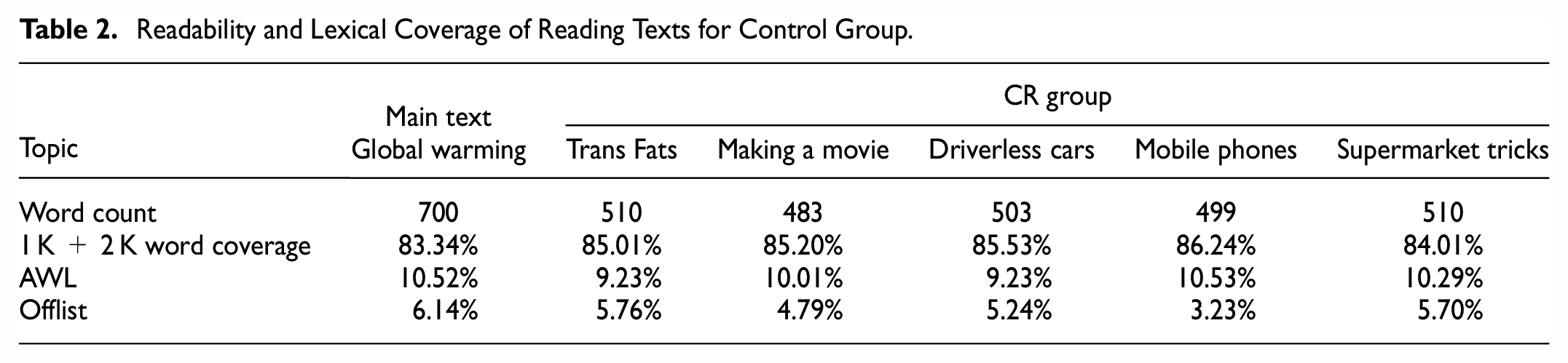
All the chosen texts were analyzed with Cobb and Free (2004)’s free lexical profiling tool (available at www.lextutor.ca) which can provide information regarding the proportion of words contained by a chosen text from three categories: Laufer and Nation’s (1995) 2,000 most frequent words; Coxhead’s (2000) academic word list (AWL); an off-list where words are beyond the two categories. According to the analysis, nearly 85% of the words fall within the 2,000 most frequent words category (see Tables 1 and 2).
Readability and Lexical Coverage of Reading Texts for Experimental Groups.

Readability and Lexical Coverage of Reading Texts for Control Group.
Target Words
Initially, a list of 20 potential target words was selected from the reading materials. An overriding concern was that the majority of the target items were unfamiliar to the participants. To this end, all 20 target words were pilot-tested with another 30 students with similar English proficiency. Four words were eliminated as all participants demonstrated full knowledge of them. Another Four words which most participants showed partial knowledge were kept to encourage the participants to finish the pre-test and post-test (Webb & Chang, 2015). The final list of 16 words (as shown in Appendix A) consisted of nouns, verbs, and adjectives as they were the most common part of speech found in authentic texts (Webb, 2008). As indicated by Cobb and Free’s (2004) lexical profiler, all the target words were beyond the level of the 2,000 most frequent words
Vocabulary Assessment Measures
Two types of vocabulary tests were developed to measure participants’ vocabulary knowledge in both receptive and productive dimensions. The receptive vocabulary knowledge test assesses participants’ recognition of target words. In the test, the participants were asked to provide L1 translations of each given target word. The productive vocabulary knowledge test focuses on participants’ use of the target words. A sentence-making task was administered where participants were required to produce an original sentence with each given target word. The reliability of the receptive vocabulary knowledge test and the productive vocabulary knowledge test was .90 and .85 respectively (Cronbach’s alpha).
Procedure
The study was composed of four stages-pretest, intervention, immediate posttest, and delayed posttest. The same vocabulary assessment measures were applied in pre-test, immediate post-test, and delayed post-test with different order of items. In the first week, both receptive and productive knowledge of 16 target words were measured in the form of pretest. One week after the pretest, all participants read the main text and were required to finish three attached comprehension questions based on the reading.
The purpose of the reading comprehension questions was to encourage the participants to focus their attention on understanding what they read. Then, the NR group continued to read five thematically related text on global warming and its effects throughout the following 5 weeks; the NRMI group read the same thematically related text while receiving extra morphological intervention. The intervention focused on the meaning of the morphemes which appeared in a target word and the logical connection between separate morpheme meanings and the target word meaning. For example, participants were taught the target word “conservation” was composed of a prefix “con” meaning to strengthen, a root “serv” meaning to keep and a suffix “ation” meaning an action, state or process. Thus the general meaning of “conservation” was the action, state or process of keeping something. Other words containing learned morphemes were also introduced to consolidate participants’ understanding of the morphemes they had learned. At the same time, the CR group read five unrelated texts on various topics over the same 5 weeks. For all three groups, questions targeting at the general understanding of each reading text were also provided along with each reading passage. The researcher was present in all three conditions to ensure participants’ active participation in comprehending the reading passages.An immediate posttest was administered in the sixth week when all three groups have just finished all the acquired reading. One week later, all participants received the delayed posttest. Each learner’s vocabulary gains in receptive and productive dimensions at different time points were measured and compared. The specific procedure was shown in Table 3.
Specific Procedure for All Groups.

Scoring
The receptive vocabulary test was scored dichotomously, with 1 point given to the correct L1 translation of the given target word. Considering the possibility that some target words might contain multiple meanings, 1 point was awarded as long as any possible meaning of a given target word was provided. For example, the word “emission” means the act of emitting, it can also refer to the substance that is being emitted. In contrast, 0 point was assigned for the wrong L1 translation. For example, the word “humidity” was misunderstood as “human” given to some degree of similarity in spelling. The maximum score for the receptive vocabulary test was 16 points.
For the productive vocabulary test, 1 point was given for both grammatically and semantically correctly used target word. Since the aim of the test was to examine the productive use of target words, the errors in other parts of the sentence would not affect scores. For instance, the sentence “Glaciers are melting faster than they do 10 years ago” was awarded 1 point despite the wrong verb tense of the nontarget word “do.” A partial point of 0.5 was awarded for semantically correct but grammatically incorrect productive usage of a given target word. For instance, 0.5 point was given to the sentence “The droughts lasted for a month” in which the target word “drought” should be singular, despite it was semantically correct. No point was given for semantically incorrect usage of a target word even if it is grammatically correct. In the following sentence “Glacier can think faster than animals,” no point was given as the target word “glacier” was semantically incorrect despite the absence of grammatical error. The maximum score for the receptive vocabulary test was 16 points.
Interrater Reliability
To minimize subjectivity or bias in scoring, the researcher, along with two College English lecturers, served as three raters. Each rater independently rated each participant’s receptive and productive vocabulary test based on the above-mentioned scoring criteria. Interrater reliability achieved .98, .99, and .98 for pretest, immediate posttest, and delayed posttest respectively (Kendall’s W).
Data Analysis
Taking into consideration the possible influence from participants differences on the learning outcome, a linear mixed-effects model (LMM) was applied. The LMM was chosen over ANOVA for its advantages in dealing with non-linear, individual characteristics (Krueger & Tian, 2004). The lme4 package in Rstudio was used to build the LMM. The fixed effect variables included modes of reading (narrow reading vs. narrow reading plus morphological intervention vs. unrelated reading), vocabulary dimensions (receptive, productive), time (pretest, immediate posttest, and delayed posttest) and their three-way interactions. Participants were treated as random effect variables. Participants’ scores in two types of vocabulary tests (receptive vs. productive) and two time points (posttest vs. delayed posttest) acted as dependent variables. In order to obtain the p-value, the lmer test package was used (Kuznetsova et al., 2017). To measure and compare the magnitude of effect size of two treatment groups, we used Hedges’g instead of Cohen’s d to correct for biases caused by small sample sizes (Hedges & Olkin, 1984). The effsize package in Rstudio was run to calculate the effect size.
Results
Research Question 1
To test whether the test scores of the three groups in both the receptive and productive vocabulary knowledge pretests were comparable, a series of one-way ANOVA were conducted. No significant differences were found among the three groups in both receptive (F = 0.025, p = .975) and productive vocabulary pretest performance (F = 0.014, p = .986), proving initial matching of all groups.
The first research question focused on the effects of narrow reading on L2 learners’ acquisition and retention of receptive vocabulary knowledge. To answer this question, we ran a series of LMM models. For the effects of narrow reading on the acquisition of receptive vocabulary knowledge, the results of LMM model (as indicated in Table 4) suggests that from pretest to immediate posttest, both the main effects of time and group and their interaction were significant (p < .001). Pairwise comparison with emmeans package were run to compare NR and CR groups’ pretest and immediate posttest scores (as indicated in Table 5). Results suggested that there was a significant improvement of the receptive vocabulary knowledge scores for the NR group (pretest-immediate posttest: estimate = -6.111, SE = 0.515, p < .0001) In contrast, no significant differences were found between the pretest and immediate posttest scores for the CR group (pretest-immediate posttest: estimate = -0.222, SE = 0.515, p = .6682). These results proved that narrow reading yielded positive results for receptive vocabulary acquisition.
LMM Results for Receptive Vocabulary Acquisition.

Signif. codes: 0 “***” .001 “**” .01 “*” .05 “.” .1 “’”1.
Three Groups’ Performance on Receptive Vocabulary Acquisition and Retention.

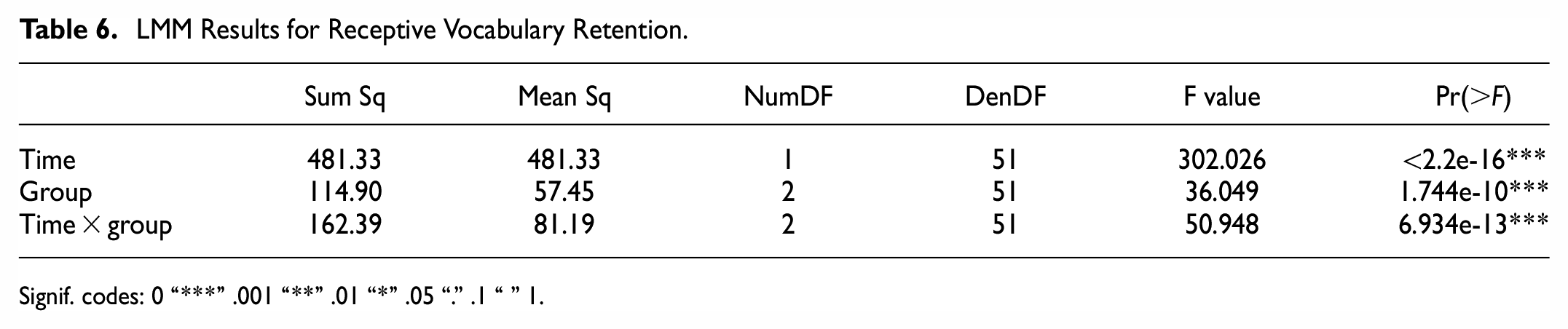
Regarding the effects of narrow reading on the retention of receptive vocabulary knowledge, we ran another LMM model (as indicated in Table 6). The results revealed significant main effect for both group and time as well as their interaction (p < .001). The pairwise post-hoc tests further revealed significant improvement for the NR group (pretest-delayed posttest: estimate = -5.278, SE = 0.421, p < .0001). No significant improvement was found for the CR group (pretest-delayed posttest: estimate = -.833, SE = 0.421, p = .0531). The results demonstrated that participants benefited from narrow reading in retaining receptive vocabulary knowledge.
LMM Results for Receptive Vocabulary Retention.
Signif. codes: 0 “***” .001 “**” .01 “*” .05 “.” .1 “” 1.
Research Question 2
Regarding the effects of narrow reading on L2 learners’ acquisition and retention of productive vocabulary knowledge (research question 2), we ran a series of LMM models. We first looked at the acquisition of productive vocabulary. According to the LMM model (as indicated in Table 7), both the main effects of time and group and their interaction were significant (p < .001). Pairwise comparison with emmeans package were run to compare two groups’ pretest and immediate posttest scores at a time (as indicated in Table 8). Results suggested that there was a significant improvement of the productive vocabulary knowledge scores for the NR group (pretest-immediate posttest: estimate = -4.111, SE = 0.316, p < .0001). In contrast, no significant differences were found between the pretest and immediate posttest scores for the CR group (pretest-immediate posttest: estimate = -.417, SE = 0.316, p = .2985). These results demonstrated the benefits of narrow reading on productive vocabulary acquisition.
LMM Results for Productive Vocabulary Acquisition.

Signif. codes: 0 “***” .001 “**” .01 “*” .05 “.” .1 “” 1.
NR Group and CR Group’s Performance on Productive Vocabulary Acquisition and Retention.
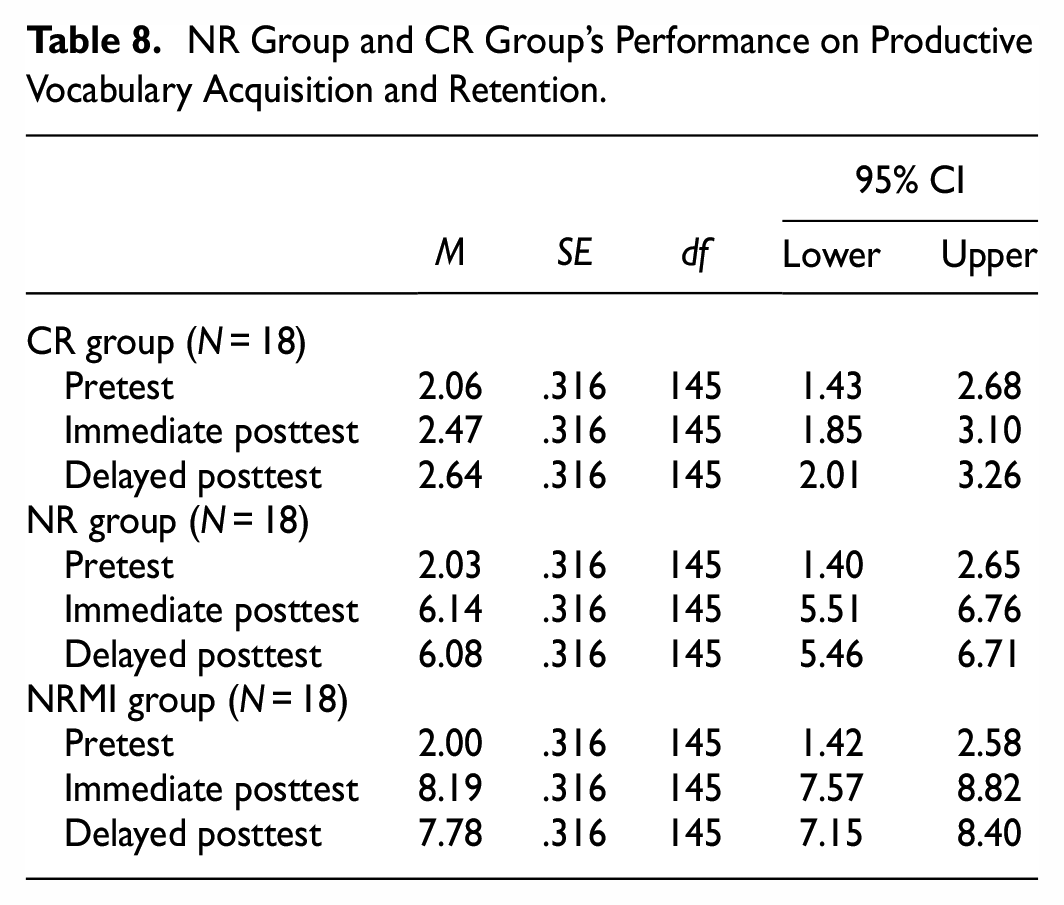
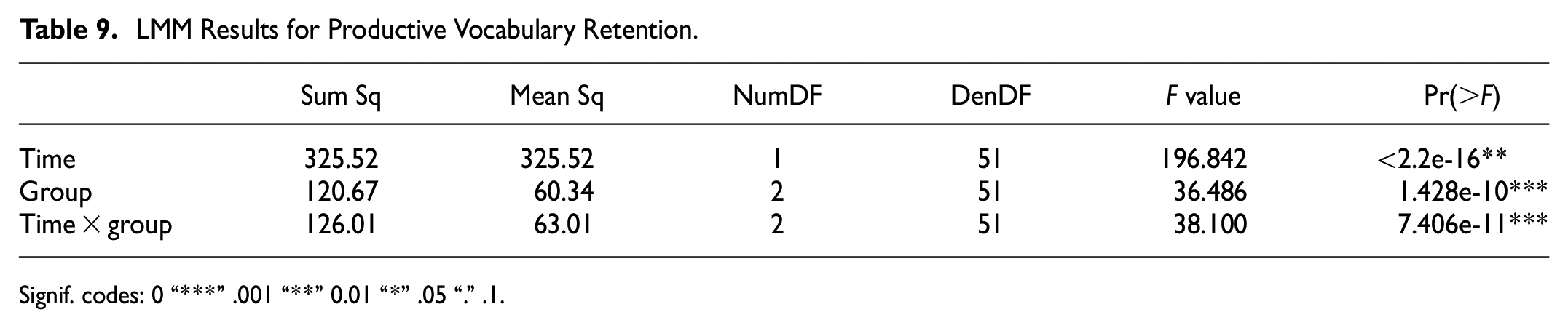
To investigate the effects of narrow reading on L2 learners’ retention of productive vocabulary, another LMM model was run. Results indicated that (see Table 9) main effects for both group and time as well as their interaction were significant (p < .001). The pairwise post-hoc tests further revealed significant improvement for the NR group (pretest-delayed posttest: estimate = -4.056, SE = 0.429, p < .0001). No significant improvement was found for the CR group (pretest-delayed posttest: estimate = -.583, SE = 0.429, p = .1795). The results suggested that narrow reading promoted participants’ productive vocabulary development.
LMM Results for Productive Vocabulary Retention.
Signif. codes: 0 “***” .001 “**” 0.01 “*” .05 “.” .1.
Research Question 3
The third research question focused on the relative effectiveness of narrow reading and a combination of narrow reading and morphological awareness training on the acquisition and retention of receptive and productive vocabulary knowledge. Pairwise comparison showed the combination of narrow reading and morphological awareness training yielded significant positive results for both the acquisition (pretest-immediate posttest: estimate = -7.944, SE = 0.515, p < .0001) and retention (pretest-delayed posttest: estimate = -6.556, SE = 0.421, p < .0001) of receptive vocabulary and the acquisition (pretest-immediate posttest: estimate = -6.194, SE = 0.397, p < .0001) and retention (pretest-delayed posttest: estimate = -5.778, SE = 0.429, p < .0001) of productive vocabulary.
We then looked at the effect sizes of two treatment groups for different types of vocabulary knowledge tests (see Table 10). For the NR group, the effect size for the receptive vocabulary knowledge test was large for both immediate posttest (Hedges’g = 3.06) and delayed posttest (Hedges’g = 3.18). For the productive vocabulary knowledge test, the effect size for the NR group was large for both immediate posttest (Hedges’g = 2.33) and delayed posttest (Hedges’g = 1.96). For the NRMI group, the effect size for the receptive vocabulary knowledge test was large for both immediate posttest (Hedges’g = 5.89) and delayed posttest (Hedges’g = 4.47). For the productive vocabulary knowledge test, the effect size for the NRMI group was large for both immediate posttest (Hedges’g = 4.58) and delayed posttest (Hedges’g = 4.57). It is clear that the NRMI group had a larger effect size compared to the NR group at each vocabulary test.
Effect Size of Treatment Groups.

To further illustrate the relative effectiveness of the NRMI group over the NR group, we calculated the relative effect size using the NR group as the control group on the suggestion of Durlak (2009). The results indicated that for the receptive vocabulary test, the relative effect size of NRMI group over the NR group was large for both immediate posttest (Hedges’g = 1.03) and delayed posttest (Hedges’g = 1.00). For the productive vocabulary test, the relative effect size of NRMI group over the NR group was large for both immediate posttest (Hedges’g = 1.22) and delayed posttest (Hedges’g = 0.87). The results clearly demonstrated the obvious advantage of the combination of narrow reading and morphological awareness training over narrow reading in promoting vocabulary learning.
Discussion
Research Question 1
Research question 1 asked the effects of narrow reading on the acquisition and retention of receptive vocabulary knowledge. LMM model results indicated that NR group made significant gains from receptive vocabulary pretest to immediate and delayed receptive vocabulary posttest, thus providing evidence that narrow reading could enhance L2 learners’ receptive vocabulary acquisition and retention.
The results of the study provides empirical support for Gass’s (1988) L2 acquisition framework, proving that novel L2 words in narrow reading, which tend to occur more frequently, are more likely to be noticed in the initial L2 acquisition process. Further, related or repeated themes characterizing narrow reading aids in learners’ understanding of background knowledge, which mediates the learning of new L2 vocabulary items.
The study also substantiates findings of previous corpus-based studies that demonstrated the frequent word-reoccurrence rate in narrow reading (Gardner, 2008; Schmitt & Carter, 2000; Sutarsyah et al.,1994). The significant gains found in two recepetive vocabulary tests in the present study further indicates that reading of theme-related texts with the aforementioned lexical benefits have the potential to promote the receptive aspect of vocabulary knowledge. It is interesting to note that Gardner (2008) pointed out that how narrow texts were chosen (i.e., under the same theme or by the same author) and narrow text genre (i.e., narrative or expository) needed to be matched for maximum lexical recycling to occur. According to him, a common theme worked best for expository collections and single authorship for narrative collections. Thus, the expository texts under the same theme in the current study might provide best condition for the recycling of theme-specific vocabulary.
Research Question 2
Research question 2 asked the effects of narrow reading on the acquisition and retention of productive vocabulary knowledge. Similar to receptive vocabulary test performance, LMM model results indicated that NR group made significant gains from productive vocabulary pretest to immediate and delayed productive vocabulary posttest, thus proving that narrow reading could enhance L2 learners’ productive vocabulary acquisition and retention.
The current study highlights the positive connection between multiple word encounter and productive vocabulary acquisition. According to Schmitt and Carter (2000), productive word learning is an incremental process and the mastery of word use is based on many subskills like syntax, grammatical functions and association. It is impossible to acquire all these above-mentioned subskills in a single or even a limited number of encounters. Therefore, a wide variety of contexts of the same word is necessary for the successful command of productive vocabulary. The result also corroborates with previous studies which found narrow reading contributed to the use of vocabulary knowledge (Chang & Renandya, 2021; Kang, 2015). The positive connection between narrow reading and vocabulary use could also be explained from the thematic network perspective. According to Kang (2015), abundant repetition of the thematic concept helped learners build semantic networks around the target words. In the present study, learners reading the collection of texts on global warming might develop a network of theme-related vocabulary. These vocabulary might be directly used or provide a usable context for learners in the productive vocabulary tests.
Research Question 3
The third research question investigated the relative effectiveness of narrow reading versus a combination of narrow reading and morphological awareness training on the acquisition and retention of receptive and productive vocabulary knowledge. The results showed the NRMI group outperformed the NR group in every vocabulary test with large effect size.
The results of the current study lend support to the depth processing hypothesis proposed by Craik and Lockhart (1972). In the present study, the extra morphological training received by the NRMI group guided them to analyze target word structure on a much more in-depth level as compared to the NR group. This deeper level of word encoding might give them the advantage in words memory and retention. According to the depth processing hypothesis, memory retention is dependent on the depth of processing, which refers to the degree of semantic or cognitive analysis. Deeper levels of analysis or encoding leads to longer and stronger memory trace.
The better performance of the NRMI group over the NR group in the acquisition and retention of both receptive and productive word knowledge could also be explained by the involvement load hypothesis (Laufer & Hulstijn, 2001). The hypothesis contributes word learning effects to involvement load, the degree of involvement in word processing. For the current study, the NRMI group were trained to analyze and compare meanings of target words and words sharing same morphemes, an act that fits the definition of Laufer and Hulstijn’s (2001) one major source of cognitive dimensions of involvement: evaluation.
The results of this study also demonstrated the contribution of morphological awareness to the development of receptive vocabulary. The finding is consistent with previous research which suggested that morphological awareness training led to receptive vocabulary gains (Carlisle, 2003). Based on past studies, a close relationship was found between morphology and multiple receptive dimensions of vocabulary including spelling, word decoding ability, and definitional knowledge (Baumann et al., 2003; Bowers & Kirby, 2010). This might explain the benefits brought by morphological awareness intervention on receptive vocabulary growth.
Conclusion
The current study inevitably suffered from some limitations. First, each group consisted of a small number of participants. Second, the study only investigated participants with similar English proficiency. Future research could investigate a bigger sample with varying English proficiency levels to provide more robust results. Third, the intervention only lasted for 1 month; such a relatively short period of time led to limited conclusions concerning learners’ vocabulary knowledge. It is therefore suggested that future research adopt longer intervention to investigate students’ long-term word knowledge development.
Despite its limitations, the present study has important contributions to L2 vocabulary learning research. Firstly, it has proven that theme-linked expository texts were suitable narrow reading materials for boosting both receptive and productive vocabulary use in an EFL context. Secondly, the superior effects of narrow reading combined with morphological intervention over narrow reading alone in promoting multiple dimensions of vocabulary growth show that word structure awareness training in contextual reading might be a more effective approach for vocabulary acquisition and retention.
Based on the results of the study, there are clear pedagogical implications for vocabulary instruction in the EFL setting. The first implication is that teachers should consider narrow reading as an important supplementary approach to direct vocabulary teaching considering the benefits and efficiency of narrow reading in promoting multi-dimensional word knowledge. The second implication is to include explicit instruction of morphological knowledge in vocabulary lesson and to raise their awareness of morphological structure of complex academic words. Finally, given the superior effects of joined incidental and intentional vocabulary teaching, it is important for teaching practitioners to combine morphological training with theme-linked reading to boost learners’ effective lexical development.
Footnotes
Appendix A
Declaration of Conflicting Interests
The author(s) declared no potential conflicts of interest with respect to the research, authorship, and/or publication of this article.
Funding
The author(s) disclosed receipt of the following financial support for the research, authorship, and/or publication of this article: We wish to acknowledge Department of Education of Hunan Province for their funding (Grant number 20C0166).
Ethical Statement
The current study is not an animal or human study.
