




Abstract
An English reading class of 10th graders (N = 50) was asked to self-construct English word cards for unknown vocabulary incidentally encountered when completing textbook readings. The students were assigned this task to determine what linguistic and nonlinguistic elements they would self-select to include on the cards and whether the appearance of those particular self-selected elements affect English vocabulary growth. Learners’ second language (L2) vocabulary size was assessed before and after the investigation, and learners’ self-constructed word cards were subjected to qualitative analysis uncovering additional “elements” included on the cards that were not suggested by the classroom teacher. Among the uncovered “element” themes (i.e., Formulaic Language, Word Formation, Additional Language Features, Creativity, Misunderstanding, and Carelessness), Word Formation was found to correlate significantly with L2 vocabulary growth. A multiple regression model accounted for 15.8% of the variance in vocabulary growth of which word formation explained the most variance, yielding a medium effect. A critical discussion of findings is provided in connection with previous literature to elucidate the feasibility of incorporating word card construction into L2 classroom instruction while also providing teachers suggestions on implementing a word card construction component into their classes.
Introduction
Effectual vocabulary acquisition has become a matter of great concern and has aroused considerable interest in English language teaching and applied linguistics research (Bogaards & Laufer, 2004). Successful vocabulary learning requires concerted effort by both instructors and learners. More specifically, instructors should assume responsibility for designing adequate course components to enhance learners’ vocabulary knowledge, while learners’ primary concerns should be in adopting responsible attitudes toward learning and exploiting strategies that encourage vocabulary growth (Nation, 2008). During instruction, learners should be taught an assortment of learning strategies and given the opportunity to choose the learning strategies that are appropriate to their specific needs (Schmitt & Schmitt, 1995). Moreover, both depth and breadth of vocabulary knowledge can be increased through instructors initiating and continually encouraging learner involvement in various vocabulary learning activities (Nation, 2013b). This is because a higher level of learner engagement in tasks will lead to a more impressive vocabulary learning outcome (Schmitt, 2008). However, learners’ successful use of language learning strategies requires encouragement from instructors to improve vocabulary knowledge; some determining factors should be considered by instructors before deciding on which strategies to teach—even ideal teaching may need to be adjusted according to individual differences (Leeke & Shaw, 2000).
Theoretical Framework
As it is one of the language teacher’s jobs to inform learners of appropriate vocabulary learning strategies (Nation, 2013a), it is important for teachers to first analyze a strategy before administering any type of training in the strategy (Nation & Webb, 2011). Although there are many ways to go about this, the most commonly applied is Laufer and Hulstijn’s (2001) involvement load hypothesis. The hypothesis includes three motivational and cognitive dimensions, namely, need, search, and evaluation. Laufer and Hulstijn (2001) explain these three components as follows: The Need component is the motivational, non-cognitive dimension of involvement. It is concerned with the need to achieve . . . based on drive to comply with the task requirements, whereby the task requirements can be either externally imposed or self-imposed . . . is the attempt to find the meaning of an unknown L2 word or trying to find the L2 word form expressing a concept . . . by consulting a dictionary or another authority . . . Evaluation entails a comparison of a given word with other words, a specific meaning of a word with its other meanings, or combining the word with other words in order to assess whether a word . . . does or does not fit its context. (p. 14)
Thus, a teacher can examine a vocabulary learning strategy and decide whether these three components are present or absent. Furthermore, each component can be given a numerical score to measure the involvement load. For example, 0 can be used to indicate that the component is absent, 1 can be used to indicate that the component is present but with moderate strength, and 2 can be used to indicate that the component is present and with full strength (Nation & Webb, 2011). The basic claim of the involvement load hypothesis is that the greater the involvement load, the greater the vocabulary learning outcome. Thus, execution of a vocabulary learning task in which all three components are present and with full strength should result in robust learning outcomes.
Factors Affecting Vocabulary Acquisition
In addition to the joint effort of teachers and learners and involvement load induced by tasks, the techniques employed to improve vocabulary knowledge have been widely discussed in the literature. For example, Laufer and Shmueli (1997) found better recall of vocabulary items that were presented to learners in lists or isolated sentences than those presented within texts. However, words presented in texts glossed in the learners’ native language (L1) were learned better than words presented in texts that were glossed in the second language (L2). L2 vocabulary acquisition can be enhanced through decontextualized tasks that incorporate the use of the L1. Although research has shown context, nevertheless, does not necessarily yield significantly more vocabulary knowledge, Dempster (1987) cautioned that this result should not be interpreted so that contextualized vocabulary learning is considered less important than decontextualized vocabulary learning. Instead, the provision of context should be viewed as one of the most efficient ways to learn one specific meaning for a polysemous word. This is because without context, learners are unable to determine which meaning should be targeted for learning a polysemous word.
When evaluating factors that may affect vocabulary learning, phonological and semantic aspects of lexical items should also be taken into consideration. Ellis and Beaton (1993) reported that the similarity of sounds and spelling between L1 and L2 facilitates the learning of foreign words, which is also affected by their imageability (i.e., concreteness). Examining the effect of semantic relatedness on foreign vocabulary learning, Erten and Tekin (2008) revealed that learners memorizing a set of nonsemantically related words performed much better than when memorizing a set of semantically related words, which might be due to the increased learning load caused by interference that happens as the learner works through a process of meaning discrimination for semantically related words. As explicated by Nation (2000), interference caused by learning words that belong to the same semantic category could be reduced by raising learners’ awareness and by presenting each word in context, to draw learners’ attention to the information conveyed by a particular context. It is only when all the vocabulary items in a lexical set can be clearly defined by learners that one can assume that the semantically related words in the set have been acquired.
Once vocabulary items have been learned, review is needed for retention. That is, recalling what has been learned at regular intervals during appropriate activities can help consolidate vocabulary knowledge (Pimsleur, 1967). In other words, memorization of vocabulary benefits from learning through increasingly repeated practice that occurs at regular intervals (Dempster, 1987; Mondria & Mondria-De Vries, 1994; Nation, 2008).
Judging from the previous research findings, intentional learning of vocabulary will promote retention of foreign words more than incidental methods. Bearing this in mind, language teachers should be aware that “activities involving incidental learning can be a good source of vocabulary for deliberate study and can enrich and strengthen words that were deliberately learned” (Nation, 2008, p. 105). Moreover, deliberate vocabulary learning should be regarded as a complement to incidental vocabulary learning (Nation, 1982, 2008). For example, a learner that happens to read an article for content knowledge and incidentally comes across an unknown word can then make the decision to employ a number of intentional vocabulary learning strategies to enhance the knowledge and understanding of the encountered unknown word. One such strategy is to record the word in a notebook or on a word card for later review. Considering the efficiency of intentional vocabulary learning, several training schemes incorporating word cards and notebooks to encourage vocabulary acquisition have been devised (Nation, 2008). The main difference between vocabulary notebooks and vocabulary word cards is how targeted vocabulary are presented. While in vocabulary notebooks words are recorded in lists alongside their corresponding meanings, vocabulary word cards usually have the target word on one side and the corresponding meaning on the other side. The study of vocabulary word cards requires the recall of vocabulary form and meaning, a sort of test-like condition that may not always occur with the use of vocabulary notebooks. Below, the practicality and the feasibility of vocabulary notebook and word card use for vocabulary learning is reviewed.
Vocabulary Notebooks
Vocabulary notebooks, as the name suggests, denote any type of notebook where target vocabulary and the relevant information about the vocabulary is recorded (Bozkurt, 2007; Fowle, 2002; McCrostie, 2007; Schmitt & Schmitt, 1995; Walters & Bozkurt, 2009). The major reason for incorporating vocabulary notebooks into a language learning regime is their positive effects on vocabulary acquisition and retention. Substantial improvement in the receptive and productive knowledge of vocabulary has been shown when learners record lexical items in vocabulary notebooks; compared with learning words without vocabulary notebooks, learning with vocabulary notebooks resulted in higher vocabulary gains (Bozkurt, 2007; Walters & Bozkurt, 2009). In spite of the fact that the application of vocabulary notebooks has been found to be advantageous, learners should still be properly trained to use vocabulary notebooks through adequate instruction (Bozkurt, 2007; McCrostie, 2007). In addition, strategic planning is essential to use vocabulary notebooks to their fullest. As illuminated by Liu et al. (2017), dissimilar organization formats facilitate vocabulary learning in different ways, with an outline format prominently contributing less to the advancement of learning performance than an association format. To be more specific, classifying words according to their relationship with other words helps learners to recall vocabulary items more efficiently than simply listing words (Liu et al., 2017).
Although favorable attitudes toward the integration of vocabulary notebooks into word learning activities have been observed, a study by D’Onofrio (2009) failed to show a significant difference between learning words with or without the use of vocabulary notebooks. This lack of effect for vocabulary notebook use might have been caused by the instructor’s deliberate decision to select the target words for the learners to record in their notebooks and by the participants’ limited opportunities to review the lexical items noted down in their notebooks. Therefore, any substantial vocabulary growth claimed to be due to the use of vocabulary notebooks is likely on account of teachers integrating the use of vocabulary notebooks into regular language instruction and providing extensive support in how to become independent vocabulary learners (Bozkurt, 2007; Walters & Bozkurt, 2009). Bozkurt, for example, found a lack of learner autonomy when vocabulary notebooks were used, indicating additional class time and effort on the teachers’ behalf may be needed to increase learners’ independent study of their notebooks’ contents. However, this needs to occur without learners’ overreliance on instructors’ encouragement during the learning process. Walters and Bozkurt also pinpointed deficient motivation as a major reason for the absence of self-directed learning when vocabulary notebooks were used. However, Fowle (2002) discovered when learners were made aware of the importance of vocabulary learning, they experienced a growth in enthusiasm for language learning which led to a growth in their ability to learn independently and thereby encouraging self-assurance and self-confidence.
Vocabulary Word Cards
Royer (1973) showed that better retention of vocabulary could be attained using index cards with L2 words on one side and the equivalent L1 word on the other side, compared with having the L1 and L2 words on the same side. It could be that the addition of the corresponding L1 word on the opposite side of the card serves as a test trial, enhancing a deep understanding of the target word due to forced retrieval from memory. In view of the benefits of the test-like condition, Royer concluded that incorporating self-testing in the learning process might augment the retention of words and as a result increase retention of vocabulary. Similarly, Mondria and Mondria-De Vries (1994) claimed the use of word cards with target words on one side and the L1 translations on the other encourages learning that mimics mental processing that happens during testing. In other words, learners are encouraged to think about word meanings and make predictions before flipping the cards over. They also highlighted several advantages to learning vocabulary using word cards, including: more attention can be paid to unknown words while giving less attention to known words; cards can be mixed or randomized; writing down the words on the cards may in itself boost memory of the words; repetitive assessment of vocabulary knowledge can happen through increasingly larger time intervals that are easily scheduled; and more involvement with learning activities occurs when word cards are used.
Although strong claims for the use of traditional paper word cards in the English as a foreign language (EFL) classroom have been made (Nation, 2013c), students still need to be taught the strategies to use the word cards for effective learning outcomes and long-term retention (Nation, 2013a, 2013b). In learning environments where mobile devices are permitted, technology can help to streamline some of this training. Technology assists students to interact with peers wirelessly to distribute digital word cards for teachers to supervise as they practice recalling the meaning and/or form of targeted vocabulary (Yu et al., 2016). Digitalized word cards can also be preserved and incorporated into other types of tasks (i.e., games) more easily, requiring less teacher planning time (Yu et al., 2016). Still, the use of digital word cards requires caution as teachers should not expect that their use will always lead to better learning outcomes than more traditional methods such as using pen and paper. For example, in a study comparing the use of engagement with gesture-based technology with traditional word cards by very young 4- to 6-year-old EFL learners in Taiwan, the researchers found learners that used traditional paper words cards learned more alphabetic letters and characters than the learners that used the gesture-based technology (Wu et al., 2017). This is a rather surprising result considering that the targeted vocabulary were body parts that were moved and activated during the gesture-based practice. A recent survey by Wilkinson (2017) further elucidated the efficiency of paper word cards for vocabulary learning, highlighting that paper word cards are easy to use, and their use ensures active repetitive recall of lexis. The merits, however, could be restricted by learners’ study methods, implying that more training in word card usage may need to be provided to ensure vocabulary acquisition.
Problem Statement and Research Questions
If designed and used appropriately, word cards can be incorporated into both intentional and incidental vocabulary learning. Specifically, learners completing a word card learning task that induces a maximum involvement load should result in robust L2 vocabulary learning outcomes. Word cards, for example, can also be used for contextualized and decontextualized vocabulary learning and provide learners with repeated exposures to targeted words that can be randomized to avoid learning semantically related sets. If pictures or drawings are incorporated into their construction, word cards can assist in making abstract words more concrete for learners. Using L1 synonyms on the cards ensures a clear connection between L1 and L2. Unlike vocabulary notebooks, word cards can be shuffled, thereby mixing up the order of the vocabulary studied. Word cards also encourage self-testing and retrieval of meaning simply by turning the cards over. Due to their convenience, versatility, and effectiveness in encouraging vocabulary growth, the current study was constructed to gauge the practicality of incorporating word card use as a vocabulary learning strategy in a skill-based English reading course in Taiwan. When students incidentally encountered unknown words while reading, they constructed word cards for later review. Unlike previous studies that focused exclusively on the progress of learners’ ability to memorize specific target words or simply aimed to gather teachers’ or learners’ perceptions of the use of word cards for vocabulary memorization, this study intended to fill a gap in the literature by examining learner constructed word cards to explore whether there exists any connection between the linguistic and nonlinguistic elements learners include on the cards and L2 vocabulary growth. As a final point, we hope to shed some light on the significance of word cards in vocabulary learning and to offer constructive suggestions for teachers who wish to incorporate the use of word cards in language instruction. The following research questions were addressed to guide this study:
Method
This study followed a mixed-methods design. The qualitative analysis that uncovered the linguistic and nonlinguistic elements (i.e., the independent variables or explanatory variables) that learners incorporated into their self-constructed word cards was used to inform the quantitative analysis of the growth in the learners’ English vocabulary sizes (i.e., the dependent variable or response variable).
Participants
Tenth-grade Taiwanese 16- to 17-year-old learners of English (male N = 8; female N = 42) majoring in Accounting and Information Systems in the first year of a 5-year junior college of business were recruited as participants. At the time the data were collected, they were studying in a general English required course. They had 8.5 years of previous English learning experience. According to institutional English language exam scores, most of the participants’ English abilities were at the A1 level (i.e., Common European Framework for Languages).
Instruments
The Vocabulary Size Test
The Vocabulary Size Test (VST) assesses a test taker’s L2 English receptive vocabulary knowledge (Nation & Beglar, 2007). As the VST is a multiple-choice test, it can be considered as a sensitive test (Nagy et al., 1985) that can be used reliably (Beglar, 2010) to assess the receptive knowledge of vocabulary that is necessary for English language reading (Nation, 2013a). There have been some criticisms (Gyllstad et al., 2015; Kremmel & Schmitt, 2016) of the VST in recent years, with researchers encouraging delimiting conclusions drawn from the use of the test only to written receptive vocabulary knowledge (Nation, 2013b). The 140-item 14-level Chinese options version of the test was given to the participants at Week 1 and Week 18 of the study. The VST consists of 10 sampled target words from each of the 1,000-level word family lists (Nation, 2006) created for the first 14 1,000-word families extracted from the 100,000,000 token British National Corpus; however, it should be noted that the order of the targeted items was slightly reorganized based on the 10 million token spoken section of the British National Corpus (Beglar, 2010). As each item on the VST represents 100 word families, a test taker’s L2 English vocabulary size can be computed by multiplying the total items correct by 100 (Nation & Beglar, 2007). The Cronbach’s alpha for the VST was computed: the pretest result was .741 and posttest result was .805, both indicating a reliable internal consistency (Field, 2005; Nunnally, 1978). A sample question from the VST is provided below:
soldier: He is a
a. 商人
b. 學生
c. 金屬工藝製造者
d. 士兵
Instructional Intervention and Word Card Construction
Textbook
Real Reading 1: Creating an Authentic Reading Experience (Bonesteel, 2010), a reading and vocabulary skill-based textbook, was selected by the teacher of the course. The participants read a total of 10 articles. The average size of the articles were 304 words (i.e., tokens). Analysis using the Compleat Web VP gave an indication that more than 92% of words occurred in the most frequent 4,000 words of English. The textbook emphasized fluency in reading as well as several vocabulary learning skills. The participants completed all textbook exercises related to the readings; the exercises were completed independently in class and counted as course credit.
Language Assessments
The classroom teacher designed and administered four vocabulary quizzes, a mid-term, and final exam. The quizzes required the participants to translate vocabulary from Chinese to English and from English to Chinese. The mid-term and final exams required the participants to complete vocabulary (i.e., fill-in-the blank, word form, sentence completion) and reading exercises (i.e., comprehension questions). These quizzes and exams were a requirement of the curriculum that was already in place prior to the start of this study. The results of these language assessments were not analyzed as part of the current study.
Instruction
The teacher of the course mainly followed the textbook, teaching the course as a reading and vocabulary skill-based course. The teacher gave the participants instruction on what they should do at the pre-reading, during-reading, and after-reading stages. The teacher used the student’s first language, Mandarin, as the medium of instruction. They met the teacher twice a week, each time for 2 hr for a total of 18 weeks.
Homework
Homework was assigned by the teacher after each 2 hour lesson. At the beginning of each class, the teacher would quickly check the word cards and mark completion of the cards as credit for the course. For each of the 10 readings covered in the textbook, the participants were required to create 10 vocabulary cards—they should have created 100 cards by the end of the course. The vocabulary they selected to include on the cards should be words they did not know. Moreover, all the words targeted for word card creation were selected by the participants and not the teacher. During a beginning of the semester training session, the teacher asked the participants to include the following on each of the card’s front side: the target word, a word related to the target word, and a picture. The teacher asked the participants to include the following on each of the card’s back side: an L1 translation and an example sentence. It should be noted the participants had the option to include other linguistic and nonlinguistic elements if they wished. The teacher asked participants to use a dictionary of their choosing to locate information necessary to create the cards. Previous research has shown that the use of a related L1/L2 word (Bird & Jacobs, 1999), images (Gruneberg & Pascoe, 1996), use of the L1 (Laufer & Shmueli, 1997), and sentence writing (Folse, 2006) can have a positive effect on vocabulary meaning recall. Figures 1 and 2 provide a card front and back example.

Sample word card front.

Sample word card back.
This vocabulary learning task (i.e., constructing vocabulary word cards for unknown words incidentally encountered while reading a class textbook) was evaluated using Laufer and Hulstijn’s (2001) involvement load hypothesis to calculate involvement load; involvement load was 6 out of a possible 6. Need received 2 because the task required learners to create word cards for the words they encountered incidentally by locating relevant information in their personal dictionaries. If the learners had instead been asked by the teacher to create word cards for teacher selected words, then the need to use and understand the words would have been reduced, resulting in Need receiving a score of 1. As the learners are the ones initiating the need to understand the unknown words incidentally encountered during reading class texts, then Need is 2. Although learners did not have to retrieve the word form as the word forms were encountered incidentally while reading classroom texts, the learners were required to locate the meaning of the words in their dictionaries so that this information could be placed on the word cards. Furthermore, as the word cards were used for both receptive leaning (the learners looked at the L2 word forms and tried to recall the L1 translations) and productive learning (the learners looked at the L1 translations and tried to recall the L2 word forms), Search received 2. If the learners had only created the word cards and not used the cars for the practice of form and meaning retrieval, then Search would have received 1. Learners were required to look up in their personal dictionaries the words incidentally encountered and then were required to select among all the definitions listed for the target word the meaning used in the sentence context from their textbooks. This required the learners to compare multiple meanings of a word and then choose the most suitable to add to their card. Then, the learners used this meaning of the word to write a sentence on the word card (i.e., generative use). As the learners were comparing multiple meanings of the words and writing sentences for these words, Evaluation received the score of 2.
Qualitative Data Analysis and Results
Word Card Coding
At the end of the academic semester, all learners’ word cards were collected for qualitative analysis. The qualitative analysis followed the advice provided by Creswell (2014)—organizing and inspecting the data, coding each item, and establishing (sub)categories and broad themes through grouping. Considering the qualitative nature of the data collected, the two researchers opted to take the recommendation of Saldaña (2013) and subject the data to two cycles of coding, with the first cycle intending to aid in uncovering (sub)categories (i.e., holistic coding) and the second cycle to aid inbuilding a classification of themes (i.e., focused coding). With the aim of obtaining more credible findings, a third coder was recruited to assist in crosschecking both cycles of coding (Miles et al., 2014). In the first cycle, the researchers explored all word card information by recording every detail found on each card (i.e., holistic coding). First, the researchers made note of the target words selected by participants and whether the cards contained self-drawn illustrations, printed graphics, or a combination. Next, all linguistic and nonlinguistic elements found on the cards other than those suggested by the teacher for inclusion were noted and served as subcategories (see Table 1). Figure 3 summarizes the first coding cycle.
Word Card Elements.

Note. * = signifies ungrammatical or non-idiomatic expressions and misspelled or misused words or expressions.

First cycle coding process.
After scrutinizing and arranging the card information, the researchers progressed to the second cycle of coding by further grouping the additional word card linguistic and nonlinguistic elements according to their defining characteristics (i.e., focused coding). The additional linguistic and nonlinguistic elements were repeatedly reviewed to uncover similarities and differences to build themes that were more encompassing (see Table 1). This began by grouping the additional linguistic and nonlinguistic elements that shared similar qualities (i.e., subcategories) into broad types (i.e., themes). Afterward, the themes were grouped into Additions (i.e., distinctive additional linguistic and nonlinguistic elements with the potential to enhance vocabulary acquisition and retention) and Mistakes (i.e., misunderstandings and carelessness in card construction). The classifications were agreed upon by the two researchers to ensure reliability of the analysis (Brown & Rodgers, 2002). A good to excellent degree of interrater reliability was found between the two raters’ classification of the data collected from the participants’ word cards. The average measures of interclass correlation coefficient showed the following results: Formulaic Language (intraclass correlation [ICC] = 1.0), Word Formation (ICC = 1.0), Additional Language Features (ICC = .971, 95% CI = [.947, .984]), Creativity (ICC = .845, 95% CI = [.722, .914]), Misunderstanding (ICC = .716, 95% CI = [.486, .843]), and Carelessness (ICC = .881, 95% CI = [.778, .936]). In case of any ambiguity or confusion, the researchers consulted with each other until an agreement was made. The development of subcategories, groupings, and themes is illustrated in Figure 4.
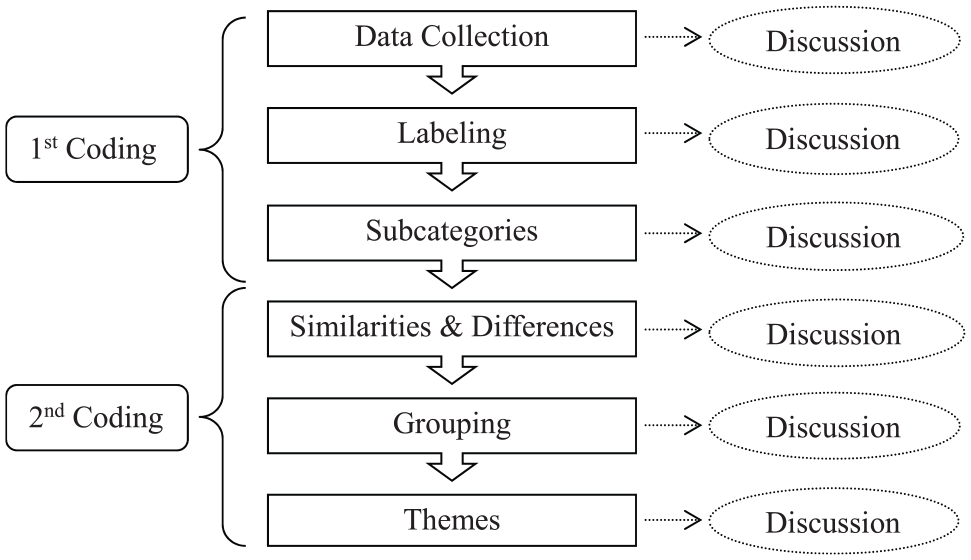
Second cycle coding process.
Descriptive Statistics for Word Cards
The qualitative data analysis of the participants’ (N = 46) word cards revealed four themes (i.e., Formulaic Language, Word Formation, Additional Language Features, and Creativity) under the “Additions” group and two themes (i.e., Misunderstanding and Carelessness) under the “Mistakes” group. The groups and themes are introduced below with examples of each subcategory under each theme provided in Table 1.
Participants that selected phrases instead of individual words as targets for word card construction (i.e., verb phrases; noun phrases; adverbial phrases; prepositional phrases; adjectival phrases; proper nouns; noun compounds; adjective compounds; idioms; and phrases including target word and related English word) were coded as having used Formulaic Language. When the participants added an affix to the target word (i.e., inflected and derived forms), this strategy was coded as Word Formation. If participants’ word cards were supplemented with additional language features not suggested by the instructor (i.e., Chinese writing appearing in their drawings; parts of speech provided; translation for a related English word given; translation for the example sentences provided; polysemy noted; and multiple related English words with Chinese translations given), these participants were considered as having incorporated Additional Language Features. When a participant’s word cards included unique or distinctive features (i.e., highlighting or unique sentences), they were considered has having used their Creativity to produce the word cards.
Participants were considered to have incorporated Misunderstandings in the construction of their word cards when they were confused about the meaning of the target words (i.e., the wrong translation for the target word was used, a homonym was used, or a grammar error appeared in an example sentence). Participants that made mistakes due to inattention or failure to follow the instructor’s directions were considered to have made these mistakes due to Carelessness (i.e., wrong Chinese character used in translation, wrong spelling of the target word, wrong form of the target word in example sentences, repetition of the same word on more than one card, foreign words other than English used as the definitions, inconsistency in translation, inconsistency in capitalization, or wrong spelling used in the example sentences or related words).
The number of participants incorporating “Additions” to their word cards were as follows: Formulaic Language (N = 34, 73.91%), Word Formation (N = 26, 56.52%), Additional Language Features (N = 12, 26.09%), and Creativity (N = 5, 10.87%). The number of participants found to have made “Mistakes” on their word cards were as follows: Misunderstanding (N = 6, 13.04%) and Carelessness (N = 24, 52.17%).
Quantitative Data Analysis and Results
Descriptive Statistics for L2 Vocabulary Growth
As shown by the VST pretest results, the participants (N = 50) had an average L2 vocabulary size of 5,422 word families (SD = 985, Mdn = 5,550) before taking part in the study. After the intervention, the posttest results of the VST indicated that the participants had an average L2 vocabulary size of 5,632 word families (SD = 1,148, Mdn = 5,850). This is a mean growth of 210 word families.
Inferential Statistics on L2 Vocabulary Growth
The difference in the VST from the pretest (M = 54.22; SD = 9.85) and posttest (M = 56.32; SD = 11.48) was tested with a paired-samples t-test. Results show a small effect size (d = .25) and a statistical effect (N = 50, t = 51.69, p < .001, df = 99) for difference between the testing times.
Multiple Regression
A multiple regression model of the quantitative data was found using the method of standard regression. First, Vocabulary Growth—the response variable—was calculated by subtracting the learners’ VST pretest scores from the VST posttest scores. The response variable and the explanatory variables—vocabulary word card linguistic and nonlinguistic elements found during the qualitative analysis (i.e., Formulaic Language, Word Formation, Additional Language Elements, Creativity)—were entered as binary explanatory variables. In other words, each participant was coded as having incorporated or not having incorporated the linguistic and nonlinguistic elements into the word cards.
Table 2 shows the correlations between the response and explanatory variables. The only explanatory variable found to correlate significantly with the response variable was Word Formation (p = .033). The appearance of word formation elements on vocabulary word cards had a medium effect on vocabulary growth (r = .274). Statistically significant correlations between Formulaic Language and Word Formation (p = .031), and Word Formation and Creativity (p = .042) were also found.
Correlations Between Variables (N = 46).

p < .05.
The multiple regression model (see Table 3) including all four explanatory variables accounted for 15.8% of the variance in vocabulary growth (r2 = .158) yielding a medium effect size (r = .398). Word formation explained the most variance in the multiple regression model.
Multiple Regression Model.

Discussion and Implications
Vocabulary word cards can be used by learners to quickly and efficiently master vocabulary through repeated exposure and retrieval of meaning. Unlike other studies where researchers selected target words for learners, this study took a more ecologically valid approach with the classroom teacher handing this responsibility over to the learners. During their normal assigned classroom readings, learners selected unknown incidentally encountered vocabulary for word card construction. This activity combined incidental, intentional, contextualized, and decontextualized word learning. Based on sound theory, the instructor advised the students to space the review of the word cards, regularly shuffle the cards, and study smaller sets of difficult words; however, the results of this study are still limited in that no data were collected on the learners’ actual study habits. A future study could address this limitation by asking learners to record their study habits and by conducting qualitative semi-structured interviews to obtain information on study habits after self-construction of the word cards. Still, the main purpose of this study was realized as findings regarding the linguistic and nonlinguistic elements included on the cards and effects of said elements on vocabulary growth were uncovered. The implications of these results are discussed below.
In addition to the guidelines introduced by the instructor, the qualitative data analysis revealed learners incorporated the use of Formulaic Language, Word Formation, Additional Language Features, and Creativity into their word cards. These additional card linguistic and nonlinguistic elements were able to explain 15.8% of the variance in vocabulary growth. However, it must be acknowledged that the participants also had exposure to vocabulary through the reading of the class texts and the reading-skills activities that were conducted in class.
A variety of formulaic language was selected as the targets for word card construction. Using formulaic language as targets can play a facilitative role in vocabulary learning because the formulaic language contextualizes the learning of the single words (Laufer & Shmueli, 1997). Although it may be possible that exposure to target words in phrases or sentence long contexts may be helpful in increasing some aspects of word knowledge (Joe, 1998), studies do not always support the view that context has a robust effect on learners being able to recall a word’s definition (Dempster, 1987). Thus, learners may benefit from the contextualized support provided by a phrase or sentence only if they have the skills to use the context to help decipher word meaning (Webb, 2007). Still, if learners wish to use formulaic language as targets, this should not necessarily be discouraged by instructors because previous research has shown similar learning gains when formulaic language or single words are the learning targets (Steinel et al., 2007).
Learners were also shown to include word formation elements in their word cards. Specifically, learner knowledge of inflected and derived forms for base forms of target words was shown. Although previous research has indicated learners may have difficulty in making the connection between inflected and derived forms encountered incidentally while reading (Reynolds, 2015), the task of creating word cards for words encountered incidentally through reading may have helped raise awareness of related inflected and derived forms. The textbook covered concepts such as word families and affixes and the teacher’s instruction could have led to the learners’ further heightened awareness of word form relations. Nation (2013b) claims drawing learners’ attention to word parts by teaching learners the most frequently occurring affixes will equip learners with the knowledge to recognize regular occurring affixes in language input which will assist in the ability to analyze and infer the meaning of future encountered unknown words. In fact, Word Formation information provided on the word cards was the only variable found to have a statistical effect on learners’ vocabulary growth. A positive correlation was also shown between the appearance of Word Formation and Formulaic Language elements, further suggesting learners that were aware of recurring patterns within words (i.e., affixes) were also aware of recurring patterns surrounding words (i.e., formulaic language).
A negative correlation was shown between Word Formation and Creativity. Creativity was operationalized in this study as either the highlighting of card features or the writing of unique sentences incorporating the words targeted for word card creation. The negative correlation suggests that students that spent more time on creative elements spent less time as language analyzers, meaning their attention was not turned to the recurring patterns within and surrounding words. Previous research has shown that highlighting of target words in texts read by learners will increase salience and thus draw learners’ attention to the targeted words (Boers et al., 2017). This increased attention will result in a stronger link between form and meaning. Unlike highlighting that will encourage learners to focus on the form, learners also wrote unique sentences that encourages a focus on the meaning of words. Writing sentences induces a higher involvement in the task, as learners must focus on multiple aspects of vocabulary knowledge to construct an appropriate sentence. Laufer and Hulstijn (2001) claim a higher involvement load will lead to better learning gains because the learners are focused on the meaning of the target words; however, Barcroft (2015) claims the opposite, claiming a focus on form leads to better results. Although incorporating an example sentence on word cards may be fine, it is probably better for learners to keep the cards simple and learn words receptively before trying to learn the words productively (Nation, 2013a).
Learners were also shown to include a number of other additional linguistic and nonlinguistic elements on their vocabulary word cards not suggested by the instructor. Many of these elements incorporated the use of L1 Chinese or translation—incorporating Chinese into the drawings or pictures, translating the related English word or words, and translating the example sentence. Translating L2 words into the L1 is an elaboration process, where learners gain experience in connecting the L2 word to the L1 meaning (Hummel, 2010). Although there are many methods for writing the meaning of L2 words on cards, the most effective is an L1 translation (Laufer & Shmueli, 1997). This is probably because L1 meanings are usually written as synonyms, which are more straightforward and easier to understand than L2 definitions (Nation & Webb, 2011). When creating and using word cards for the study of vocabulary, learners should be encouraged to use L1 translations instead of L2 definitions.
The word card analysis also highlighted a number of misunderstandings that learners had about some of the target words they selected. Although a number of the misunderstandings were simple grammar mistakes, the most common misunderstandings were because of “confusable words.” Laufer (1989, p. 13) refers to these type of errors as “synform” errors or “similar lexical form” errors in which two words are confused because of their similarity in sound and form, for example, conceal/cancel. Homonyms also caused misunderstandings when a target word’s definition did not match the example sentence on a word card. Unfortunately, these misunderstandings were not caught until the end of the study. Future instructors that incorporate word cards into instruction are suggested to remind students to check for whether the target word is a homonym or a possible synform by consulting a dictionary. Previous research has shown learners that used dictionaries for word learning relied heavily on example sentences to confirm meaning of partially known words (Harvey & Yuill, 1997). The students in this study used dictionaries to confirm target word meaning or to retrieve example sentences and receiving instruction in dictionary skills may have prevented these misunderstandings (Nation, 2013b; Nation & Webb, 2011).
A sizable amount of careless behavior was also found. Target words were misspelled or the example sentences, even those copied from the textbook or dictionaries, contained misspelled words. Some L1 translations used incorrect Chinese characters. There were instances where learners created two cards for the same word. A few students also were shown to be inconsistent in card elements, for example, only providing L1 translations for some of the related words. Although the learners were well equipped at incorporating useful elements for vocabulary learning, the cards may have required some additional checks. With the number of learners in the class, it would have been difficult for the instructor to check every card for every learner; however, we suggest future instructors to encourage peer editing and sharing of their vocabulary word cards. Finally, there was one case of copying—two students had almost similar looking cards. When questioned, the students claimed they worked on the cards together and reviewed the cards independently. This then brings up the possibility of whether co-constructing cards and independent or paired practice may lead to more robust vocabulary gains. This essentially unexplored issue deserves more attention in future research. Nation (2013a) has suggested that for young and beginning learners, word card activities completed during class in dyads can be very successful in quickly increasing learners’ knowledge of the most frequent words in a target language.
Conclusion
Unlike most of the previous studies that have investigated the effectiveness of word cards for vocabulary learning, this study did not use preselected words as targets. Instead, the learners were given the freedom to choose words they felt were helpful for their learning that were encountered incidentally during reading. In addition to some guidelines provided by the language teacher, learners were free to incorporate any elements that they felt would be helpful. Although the results indicated the learners incorporated a number of effective elements, there were also some misunderstandings and careless behavior that could be addressed with both peer and teacher feedback of the cards. Teachers who wish to incorporate word card strategies into their L2 classrooms should consider keeping the following in mind. Dictionary use should be reviewed so that learners can select appropriate example sentences using the targets and do not confuse synforms or homonyms. Pre-teaching of affixes should be considered as this knowledge may enhance learners’ understanding of unknown words. Learners should be allowed to select both single words and phrases/multiword units as targets to be written on one side of the cards with a simple L2 translation on the backs. Teachers should seriously consider incorporating pair work into the class if unable to review and provide feedback on all the cards created by the learners. This study has shown vocabulary word cards to be a helpful strategy for individualized vocabulary learning that resulted in an increase in learners’ L2 vocabulary size. To provide a more comprehensive view of the effectiveness of word cards for vocabulary learning, future studies should now examine the study habits of the learners once their vocabulary word card construction has been completed.
Footnotes
Acknowledgements
The authors would like to acknowledge the data coding assistance provided by Jolin Lee.
Declaration of Conflicting Interests
The author(s) declared no potential conflicts of interest with respect to the research, authorship, and/or publication of this article.
Funding
The author(s) disclosed receipt of the following financial support for the research, authorship, and/or publication of this article: This research was supported by the University of Macau under research grant MYRG2019-00030-FED.
