




Abstract
YouTube product review videos are popular sources of information for consumers when making purchase decisions. This study examines how sensory marketing cues in these videos affect consumers’ parasocial interaction with content creators. This interaction leads to hedonic motivations (perceived transparency and enjoyment) and utilitarian motivations (credibility and informativeness), which ultimately influence purchase intention. Data was collected from 343 consumers who bought electronic devices after watching YouTube product reviews. The data was analyzed using partial least square structural equation modeling (PLS-SEM). The results show that visual cues significantly influence parasocial interaction. Moreover, parasocial interaction has a significant impact on perceived transparency, perceived enjoyment, credibility, and informativeness. Perceived transparency, credibility, and informativeness also significantly affect purchase intention. However, the study found that auditory cues do not significantly influence parasocial interaction. Similarly, perceived enjoyment does not significantly affect purchase intention. These findings have some contributions to both theory and practice for researchers, social media influencers, retailers, and marketing managers of electronic devices in planning and producing product review content that encourages consumer purchases.
Plain Language Summary
This study examines how YouTube product reviews affect consumers’ intention to purchase electronic devices. This study developed and tested a model that considers various factors, including visual and auditory cues, viewer-reviewer relationships, perceived transparency, enjoyment, credibility, and informativeness. Data was collected from 343 Vietnamese adults who have purchased electronic devices after watching YouTube reviews. The findings provide insights into how sensory marketing in YouTube product reviews influences consumers’ purchase intention for electronic devices. This research offers valuable guidance to retailers and marketing managers of electronic device brands on leveraging YouTube product reviews to boost sales. The study is useful for both researchers interested in consumer behavior and businesses seeking to enhance their social media marketing strategies.
Keywords
Introduction
In recent years, there has been a significant increase in the use of social networking platforms. Social media has become an integral part of people’s lives in the digital era. Many companies and brands recognize the importance of social media marketing and utilize it to promote their products and services due to the widespread use and popularity of social media (Yuan & Lou, 2020). Nowadays, consumers rely more on online reviews from social media platforms like YouTube or Facebook to gather information about products and brands, instead of traditional media such as television and radio (Hu et al., 2017). Through these social media platforms, users can share their opinions and thoughts on various products and services (Hazari et al., 2017). Some online content creators on these platforms have gained a significant following and become social media influencers or online celebrities (Weismueller et al., 2021).
Among the different social media platforms, YouTube stands out as a popular video-sharing site. It allows reviewers to upload audio-visual content format, enabling consumers to have a more immersive experience with the reviewed products. These reviews often combine educational and entertaining elements (Huang et al., 2022; Silaban et al., 2022). YouTubers, who create and upload videos to their channels, engage in informal communication with their audience and establish parasocial relationships, creating a sense of intimacy (Fägersten, 2017; Sokolova & Kefi, 2020). Companies are increasingly interested in collaborating with YouTubers to promote their products and services, as these influencers have gained the trust of their audience via frequent interactions when it comes to shopping and purchasing decisions (Rybaczewska et al., 2020).
Previous research has focused on the credibility of content creators or the quality of the content itself in YouTube product reviews (Fitriani et al., 2020; Luong & Ho, 2023; Manchanda et al., 2022). However, there is limited research on the specific characteristics of YouTube and its influence on consumers. Unlike other social media platforms, YouTube product reviews often feature the content creators themselves, speaking directly to the camera and sharing their experiences. To make their videos more engaging, YouTubers incorporate sensory elements such as visuals and voiceovers (Petit et al., 2019). These sensory marketing experiences can capture the audience’s attention and influence their decision-making process (Hung et al., 2017).
Existing research has extensively examined the impact of YouTube product reviews on consumer decision-making in the travel, food, and beauty industry (Le & Hancer, 2021; Mainolfi et al., 2022; Manchanda et al., 2022) due to the high risks and uncertainties associated with these products and services (Chi et al., 2024). However, there is a lack of studies focusing on the influence of YouTube product reviews on consumers’ purchase decisions regarding electronic devices. Filieri et al. (2023) highlighted that factors influencing consumer behavior may differ across product categories. Electronic product reviews are among the most prevalent types of video content. A significant 64% of consumers shopping for electronics view YouTube review videos within a week of making their purchases (Park et al., 2023). Despite the widespread use of electronic devices worldwide (Statista, 2023), consumers may still perceive their purchase as uncertain due to difficulties in decision-making and predicting future product performance (Nugroho & Wang, 2024). Consequently, consumers may turn to YouTubers for recommendations to alleviate their uncertainties (Nugroho & Wang, 2024). Therefore, it is important to understand how YouTube product reviews can impact consumers’ choices when it comes to electronic devices.
To address the research voids concerning the impact of sensory experience through YouTube videos on consumer behavior toward electronic devices, this study aims to investigate how sensory marketing experiences influence parasocial interactions between consumers and YouTubers, and how these interactions shape consumers’ hedonic and utilitarian motivations, ultimately affecting purchase intention. The research is anchored on an integration of sensory marketing cues, parasocial interaction, hedonic, and utilitarian motivations into the stimulus-organism-response (SOR) theory to comprehend how visual and auditory cues in YouTube product reviews act as environmental stimuli, influencing consumers’ internal conditions and leading to favorable responses. The following research questions are raised:
This study offers numerous significant contributions to both theoretical understanding and practical application. First, it goes beyond existing literature that focuses on the source credibility of YouTubers or the content quality of YouTube videos (Mainolfi et al., 2022; Manchanda et al., 2022; Muda & Hamzah, 2021; Sokolova & Perez, 2021). Instead, it examines the impact of sensory marketing experienced through YouTube product reviews on consumers’ purchase behavior of electronic devices, an area that has received little scholarly attention. Second, it provides fresh insights into how YouTubers can leverage sensory marketing experiences to foster customer interactions, subsequently influencing online review acceptance. These findings not only enhance the sensory marketing literature but also broaden the understanding of parasocial interaction’s antecedents and consequences in the context of electronic device product review videos. Third, the study’s results offer valuable guidance to retailers and marketing managers in selecting influential YouTubers for their products. They also suggest strategies for social media influencers to enhance their content’s impact on viewers.
The rest of the paper is organized as follows. The second section presents the theoretical foundation and develops hypotheses. The third section discusses sample data and analytical methods. Empirical results are analyzed in section four. The last section concludes the paper with a discussion of implications, outlines limitations, and proposes avenues for future studies.
Theoretical Background and Hypotheses Development
Stimulus-Organism-Response Theory
The current study draws on the Stimulus-Organism-Response theory (SOR) (Mehrabian & Russell, 1974), which proposes that environmental stimuli can evoke an individual’s internal reactions, leading to certain behavior. The SOR theory comprises three components, namely, stimulus, organism, and response. The stimulus is external to the person and consist of various elements in the physical atmosphere (Jacoby, 2002). The organism, the second element of the SOR, encompasses cognition and internal emotional states, which subsequently influence consumer responses (Jacoby, 2002). In the context of social commerce, positive responses often manifest as purchase intention or purchase behavior (Huang et al., 2022; Nguyen et al., 2024). Originating from environmental psychology, this theory has been applied in numerous consumer and influencer marketing studies to predict consumers’ perceptions, emotional responses, and behaviors toward various types of YouTube content, including video blogging (B. N. Le et al., 2024; Nguyen et al., 2024), mukbang (Song et al., 2023), and food tourism videos (Chi et al., 2024). This research employs the SOR theory as the theoretical framework to explain how consumers react to environmental stimulus while watching product review on YouTube. In this study, visual cues and auditory cues are designated as external influences that shape consumers’ internal states, represented by parasocial interaction, perceived transparency, perceived enjoyment, credibility, and informativeness, ultimately affecting purchase intention.
Huang et al. (2022) applied the SOR framework to uncover that YouTubers who review products can effectively convey the sensory appeal of a product, thereby influencing the parasocial interaction experienced by the audience toward the YouTubers. This, in turn, will prompt consumers to respond quickly with purchase intention. In accordance with the SOR framework, this study proposes that sensory cues, representing environmental stimuli, can stimulate viewers to form relationships with content providers. These stimulated viewers may develop parasocial relationships with content providers, and through these parasocial interactions, they can perceive the utilitarian and hedonic value of product reviews. Ultimately, this can increase viewers’ intention to purchase the recommended electronic devices. The relationship between these variables will be further discussed in the next section.
Sensory Marketing
As described by Krishna (2012), sensory marketing is a marketing approach that appeals to consumers’ senses to impact how individuals perceive, judge, and behave. The theory of embodied cognition posits that cognitive processes are deeply rooted in physical experiences and sensory processing systems (Barsalou, 2008). This concept suggests that consumer experiences are fundamentally shaped by the integration of various sensory inputs, which influence judgment and behavior (Krishna, 2012). Consequently, sensory marketing strategies that effectively engage multiple senses have the potential to influence consumer decision-making processes in retail environments (Krishna et al., 2017). In traditional brick-and-mortar retail, sensory marketing has been a powerful tool, allowing consumers to make hedonic decisions based on their ability to experience products through all five senses (Kaushik & Gokhale, 2022). The rise of digital marketing has challenged marketers to adapt sensory elements for digital platforms (Kaushik & Agrawal, 2021). Visual and auditory cues have emerged as the primary means of creating a tangible product experience for consumers who cannot physically interact with items (Kaushik & Gokhale, 2022). Existing studies have focused on the use of visual and auditory cues, which include product appearance, design, color, content creator’s body gestures, background music, and descriptive language, as sensory marketing tools in YouTube product reviews (Huang et al., 2022). The choice of visual cues and auditory cues as sensory stimuli in this study is also supported by the dual coding theory (Sadoski & Paivio, 2007), which suggests that people process verbal stimuli and pictures using two independent cognitive subsystems, enhancing viewers’ memory (Sadoski & Paivio, 2007). Consumers can better comprehend an object or a subject when presented with verbal and visual information (Filieri et al., 2021). Through the sensory cues for the products demonstrated by YouTubers, for example, images of the products or verbal descriptions of their features, consumers gain experience with the product, which will give them a better evaluation of the products because sensory information is converted into product knowledge needed for the decision-making process (Huang et al., 2022).
Sensory Marketing and Parasocial Interaction
Parasocial interaction refers to the psychological phenomenon where an audience develops a perceived relationship with media celebrities, despite only receiving one-sided communication (Horton & Wohl, 1956). This phenomenon is often described as a “friendship” with a media personae, leading media users to seek advice from these personalities as if they were friends (Perse & Rubin, 1989; Rubin & McHugh, 1987). Once the audience becomes engaged with a media persona, they pay attention to and respond to the actions of the media figure as expected (Horton & Wohl, 1956). Initially, parasocial interaction was used to describe the relationship between audience and media celebrities in traditional platforms like television, radio, and movies. However, with the rise of social media influencers, such as YouTube personalities, parasocial interaction can also be applied to the relationship between YouTube personalities and their fans (Stever & Lawson, 2013). The interaction between social media influencers and their followers on social media platforms is not entirely reciprocal. While followers can comment on and discuss content, and influencers have the option to respond, the sheer volume of followers and interactions often prevents influencers from engaging in meaningful dialogue with each individual. Consequently, the notion of a truly two-way, authentic relationships between an influencer and a follower is often more of an illusion than a reality (Lee & Watkins, 2016; Sokolova & Kefi, 2020).
In videos, YouTubers can utilize sound effects and background music to capture the viewers’ attention, which can be considered auditory cues (Huang et al., 2022). Additionally, visual cues are derived from various sources, such as the product appearance, the background, the presence of media figures, and animation effects (Luo et al., 2016). Huang et al. (2022) found that consumers are more likely to perceive parasocial interactions when they are provided with visual and auditory cues from YouTube product reviews. This could be attributed to the fact that consumers are attracted to YouTube review videos through visual cues like design, color, packaging, and display, as well as auditory cues like the sound of the products. Since YouTubers typically control the visual and auditory aspects of their videos and appear in them, their physical expression, body gestures, and language can attract consumers. YouTube videos not only provide viewers with the YouTubers’ experiences and opinions but also a glimpse into their personal lives (Lee & Watkins, 2016). Viewers feel like they have a certain level of familiarity with the YouTubers through their exposure to their videos. Consequently, repeated exposure to a YouTuber can lead to a sense of connection between the viewers and the YouTuber (Nugroho & Wang, 2024). Based on the aforementioned arguments, the following hypotheses are proposed:
Parasocial Interaction and Hedonic Motivation
Motivation is a dynamic process that influences an individual’s engagement in a particular behavior (Fitriani et al., 2020). It represents the underlying reason for an individual’s action. Holbrook and Hirschman (1982) categorized consumers as either problem solvers focused on functionality or those seeking enjoyment from shopping through fun, fantasy, and sensory experiences. In retail, this has been framed as viewing shopping as work versus seeing it more positively as fun (Babin et al., 1994). Several studies have confirmed the existence of both functional benefit and emotional satisfaction as core influences shaping people’s online shopping behavior (Fitriani et al., 2020; T. M. Le et al., 2024; Moon et al., 2017).
Li and Mao (2015) classified hedonic shopping experiences in terms of transparency and enjoyment, while defining utilitarian shopping experiences through credibility and informativeness. Perceived transparency refers to the extent of information provided in review videos regarding a product (Silaban et al., 2022). YouTubers are considered transparent based on the information presented in their review videos. Consumers are typically goal-oriented when seeking product information on electronic devices from YouTube reviews, looking for explicit details about the product’s price, features, and specifications (Hazari et al., 2017). It could be safely assumed that the more responsive content creators are to consumers, the more product information consumers can glean. Content creators who can provide trustworthy information are usually perceived as more credible by consumers (Manchanda et al., 2022).
Conversely, content providers often create an emotional connection with viewers by “looking” at them through the screen, making viewers more likely to support them (Song et al., 2023). YouTubers enhance this connection by producing visually appealing videos with personalized music, presenting themselves attractively, and exhibiting a sense of social presence. They also employ advanced video-editing techniques to create innovative content (Shin et al., 2019). As a result, consumers who are motivated by the pleasure of shopping find enjoyment in watching YouTube videos featuring product reviews (Silaban et al., 2022). Based on the aforementioned arguments, the following hypotheses are developed:
Parasocial Interaction and Utilitarian Motivation
Prior research has evidenced the positive relationship between parasocial interactions and utilitarian shopping values in product reviews (Silaban et al., 2022). Utilitarian shopping value, in response to product-review content on YouTube, focuses on the task of achieving shopping goals and assessing the usefulness of information provided by YouTubers. Li and Mao (2015) proposed credibility and informativeness as two dimensions of utilitarian motivations. Credibility is defined as the extent to which the source of information, in this case, YouTubers, is believable or worthy of trust (Ohanian, 1990). Credibility has long been a crucial research topic for digital marketing tools (Lin & Huang, 2009). In the case of YouTube product review videos, the reviewers are essentially strangers to their audience (Ionescu et al., 2023), which heightens the importance of establishing credibility. However, viewer comment and reactions to review opinion can serve as evidence of the reviewers’ trustworthiness and the validity of their evaluations (Filieri, 2016). Research has shown that two-way interactions between influencers and viewers can enhance the persuasiveness of advertised products (Yuan & Lou, 2020).
Informativeness refers to consumers’ pursuit of specific objectives while watching videos, such as obtaining product information, assessing authenticity, clarity of explanations, product quality, product functionality, and observing how the product is used by YouTubers. Personal technology devices are usually classified as utilitarian products, requiring a higher level of informativeness, as consumers tend to trust expert and knowledgeable reviewers (Filieri et al., 2023). Previous research has suggested the perceived relationships between YouTubers and their audience can positively influence consumers’ perception of the information usefulness in the reviews (Yuan & Lou, 2020). Based on these discussions, the following hypotheses are proposed:
Parasocial Interaction and Purchase Intention
Russell et al. (2006) examined product placement in television sitcoms and uncovered that viewers’ parasocial bonds with TV characters can heighten attention and favorably shape brand preferences and purchase decisions. In a similar vein, prior studies have highlighted that YouTube’s online product reviews usually constitute the use of persuasive communication, down-to-earth language, vivid images, and animation effects to enhance the desirability of the products reviewed by the YouTubers for the audience (Dekavalla, 2020). The relationship between YouTubers and their audience on YouTube has paved the way for parasocial interactions to have an impact on consumers’ intention to make purchases (Sokolova & Kefi, 2020). YouTubers can help disseminate product information to consumers, thereby cultivating the relationship between the brand and consumers, thus influencing their purchase preferences (Farahdiba, 2022). For instance, Bhattacharya and Dhingra (2023) found that when social media influencers showcase a product’s functionality and new features through unboxing videos on YouTube, they are seen as retail store sales representatives and the unboxer-viewer relationship can facilitate purchase behavior. The following hypothesis is formulated:
Hedonic Motivation and Purchase Intention
Fitriani et al. (2020) unveiled the positive effect of hedonic and utilitarian motivation on consumers’ engagement with the communication channel. In this research, hedonic motivation is represented by perceived transparency and perceived enjoyment (Fitriani et al., 2020). Perceived transparency refers to the clarity and comprehensibility of communicator or behavior between individuals (Schnackenberg & Tomlinson, 2016). It encompasses how easily one person’s actions or messages can be understood by others. As engagement is the process of focusing on new information, demanding cognitive effort and a deep understanding of the presented context, the clearer the information, the easier it becomes for individuals to fully engage and connect with the content (Fitriani et al., 2020). Enjoyment represents a positive emotional response, defined as the degree to which an individual finds an activity pleasurable or satisfying (Davis et al., 2006). If a person experiences happiness while viewing video reviews on a specific channel, they are likely to become easily engaged with that channel. Furthermore, Malthouse et al. (2016) reported that consumer engagement with social networking sites such as YouTube can trigger buying intention. Therefore, the following hypotheses are proposed:
Utilitarian Motivation and Purchase Intention
Early research on message source credibility and persuasion found that speakers perceived as more credible are generally more persuasive than those seen as less credible (Hovland et al., 1953). Studies have shown that a source’s credibility is crucial when evaluating a communicator’s impact on the effectiveness of persuasive messages (Hovland & Weiss, 1951). The link between credibility and purchase intention is supported by source credibility theory, which posits that a media personality’s authority and influence depend on the audience’s perception of them as an information source (Hovland et al., 1953). This theory argues that individuals may change their opinions when presented with information from a highly credible source. Recent studies have demonstrated the influence of social media influencers’ reliability and trustworthiness on consumers (Dos Santos et al., 2023; Weismueller et al., 2021). Based on these insights, the following hypothesis is developed:
Extant literature on consumer behavior reported inconsistent findings concerning the relationship between informativeness and consumers’ intention to purchase the recommended products (Fitriani et al., 2020; Song et al., 2023). On the one hand, viewers who are motivated to pursue information received from online videos tend to form favorable towards these videos as they perceive the information obtained is useful, which motivates them to watch more, and later convert into stronger purchase intention (Song et al., 2023). However, this finding contradicts with the earlier work of Fitriani et al. (2020), which reported that informativeness of the YouTube channel did not drive users toward channel engagement. A possible explanation could be that the measures of informativeness failed to account for the varying information needs of each user. Given that one of the main motivations of users when using social networks is to exchange information (Logan et al., 2012), this study expects that if YouTubers can meet consumers’ information needs by providing adequate and valuable product information, this will boost their intention to purchase. The hypothesis is thus proposed as:
Figure 1 illustrates the research framework in this study.

Research model.
Research Methodology
Measures
The measurement items were adapted from existing validated scales in the literature and modified to fit the study’s context. Visual cues were measured using three items from Huang et al. (2022), while auditory cues were gauged with five items from the same source. Parasocial interaction was also measured using five items from Huang et al. (2022). Li and Mao’s (2015) scales were used to measure perceived transparency (5 items), perceived enjoyment (3 items), credibility (4 items), informativeness (5 items). Lastly, three items from Silaban et al. (2022) were used to measure purchase intention. The survey questionnaire was developed following a forward-backward translation approach (Behr, 2017). One author initially translated the questionnaire from English to Vietnamese, then another researcher used the back translation method to translate it back to English. As suggested by Lim (2024), the survey questionnaire was pretested with five marketing lecturers and researchers to ensure its content validity. Subsequently, a pilot test was carried out with 30 selected consumers in Hanoi to ensure the quality of wordings and meanings of items on the questionnaire. Based on the pilot test results, minor adjustments were made to the items and the questionnaires. All items were measured with a 5-point Likert scale (1 = strongly disagree, 5 = strongly agree). Table 1 presents the constructs and items.
Measures of Variables.

Data Collection and Sample
The respondents in this study were Vietnamese citizens aged 18 and over who purchased electronic devices as due to product-review content on YouTube. Respondents unqualified for the study were eliminated using screening questions. Since it was not possible to obtain an appropriate sampling frame of actual electronic device consumers, this study used convenience sampling. This sampling method is commonly used to study consumer behavior in an online context (B. N. Le et al., 2024; Weismueller et al., 2021). An online questionnaire survey was created and distributed via Gmail, Facebook, and WhatsApp for self-administration.
The survey yielded 343 valid responses, surpassing the previously mentioned criteria. Although the literature does not specify an ideal minimum sample size for the structural equation modeling (SEM) approach, Kline (2015) suggests a median sample size of 200 in various research areas. Hair et al. (2018) propose a minimum sample size ranging from 100 to 500, depending on the complexity of the model and the characteristics of the measurement model. In essence, this study’s sample size exceeded the minimums suggested by Kline (2015) and Hair et al. (2018). Furthermore, with a typical requirement of five observations per indicator (Bentler & Chou, 1987; Hair et al., 2010), the research data showed a ratio of 9.5 observations per indicator, confirming sufficiency. The respondents consisted of 183 males and 160 females. Among them, 124 were aged 18 to 25, 111 were aged 25 to 35, 45 were aged 35 to 45, and 63 were over 45. The sample’s demographic characteristics align with previous research on YouTube review video’s impact on consumer responses, with young individuals constituting the majority of respondents (Bhattacharya & Dhingra, 2023; Nguyen et al., 2024).
Analysis Methods
The proposed research model was tested using partial least squares structural equation modeling (PLS-SEM). The study opted for PLS-SEM over covariance-based structural equation modeling (CB-SEM) for three reasons. First, PLS-SEM exhibits greater statistical power than CB-SEM under comparable conditions (Reinartz et al., 2009). PLS-SEM, a non-parametric method relying on ordinary least squares regression, is designed to maximize explained variance (Ringle et al., 2012). Second, PLS-SEM does not demand a large sample size and can accurately estimate parameters even with a limited sample (Ringle et al., 2012). Third, PLS-SEM is beneficial for exploratory research that seeks to expand on existing theories, fitting the nature of this study (Reinartz et al., 2009). By incorporating visual cues and auditory cues into the stimulus stage with hedonic and utilitarian motivation into the organism stage, this study extends the SOR theory, rather than simply confirming an existing one.
Results
Construct Reliability and Validity
As presented in Table 2, three items (AC2, AC5, and PT2) were eliminated due to their outer loadings falling below the threshold of .70 (Hair et al., 2018). The values of composite reliability (CR) ranged from .879 to .943, exceeding the threshold of .70. Moreover, Cronbach’s alpha value of each construct surpassed the threshold of .70 (Hair et al., 2018). The average variance extracted (AVE) values ranged from .601 to .804, which surpassed the threshold of .50 (Fornell & Larcker, 1981). These results confirm satisfactory convergent validity for variables in this study.
Reliability and Validity Analysis.

Table 3 shows that all the coefficients between variables were lower than the square roots of AVE on the corresponding rows and columns, providing preliminary evidence for discriminant validity. Additionally, HTMT values were computed and presented in Table 4. All HTMT values fell below the threshold of .85 (Henseler et al., 2015), validating satisfactory discriminant validity for scales in this study.
Fornell–Larcker Criterion.

Note. Square root of AVE is on the diagonal.
Heterotrait–Monotrait Ratio.

Hypotheses Testing
The variance inflation factor (VIF) is one of the most popular tools to diagnose multicollinearity (Salmerón-Gómez et al., 2024). Based on Table 5, the inner VIF values ranged from 1.000 to 1.629, which were below 3, indicating minimal concern for multicollinearity among the predictor constructs in the structural model (Hair et al., 2018). Table 5 also summarized the PLS-SEM results. Visual cues were positively related to parasocial interaction (β = .101; p < .05), supporting H1a. Auditory cues were insignificantly associated with parasocial interaction (β = .066, p > .1). Hence, H1b was not supported. Furthermore, parasocial interaction was positively related to perceived transparency (β = .520, p < .001), perceived enjoyment (β = .271, p < .001), credibility (β = .373, p < .001), and informativeness (β = .288, p < .001), providing support for H2a, H2b, H3a, and H3b. Moreover, parasocial interaction was positively related to purchase intention (β = .189, p < .01), supporting H4. In addition, perceived transparency was positively related to purchase intention (β = .220, p < .001), supporting H5a. Perceived enjoyment was insignificantly associated with purchase intention (β = .087, p > .05). Thus, H5b was not supported. Credibility (β = .213, p < .001) and informativeness (β = .122, p < .05) were also significantly associated with purchase intention. Therefore, findings confirm that H6a and H6b were supported. In addition, the coefficient of determination adjusted (R2-Adjusted) for purchase intention is .348, indicating that the combined influence of the three variables, including perceived transparency, credibility, and informativeness, explains 34.8% of the variation in purchase intention (Hair et al., 2019). Using cross-validated redundancy, the blindfolding technique indicated that each Q2 value exceed 0, demonstrating the sufficient relevance of the proposed model (Hair et al., 2019).
Hypotheses Results.

Indirect Effect Analysis Result
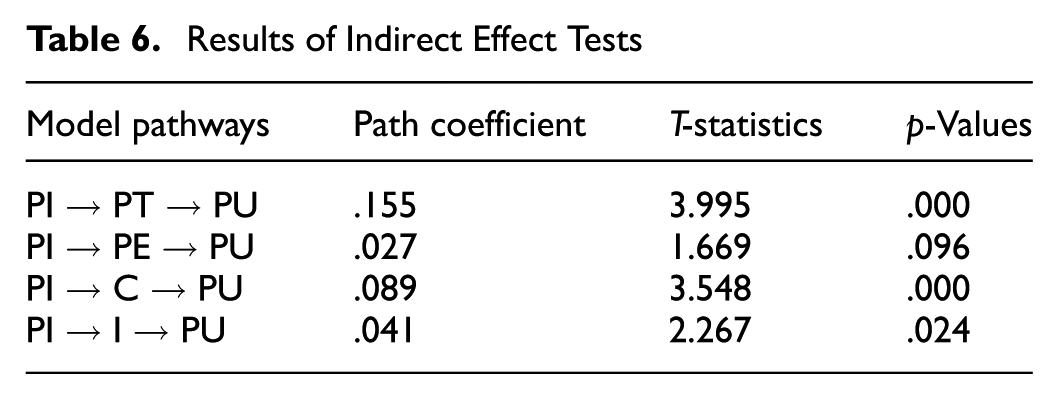
Indirect effects were tested to gain in-depth insights into the mechanism in the link between parasocial interaction and consumers’ purchase intention. The mediating effects of perceived transparency, perceived enjoyment, credibility, and informativeness were evaluated. Results revealed that parasocial interaction had significant indirect effects on purchase intention through perceived transparency (β = .155, p < .001), perceived credibility (β = .089, p < .001), and perceived informativeness (β = .041, p < .05; Table 6). Given that the direct effect of parasocial interaction on purchase intention is significant, it can be concluded that perceived transparency, credibility, and informativeness partially mediate the effect of parasocial interaction on intention to purchase (Demming et al., 2017). Furthermore, as the mediated and direct effects point in the same direction, the mediation effects are classified as complementary mediations (Nitzl et al., 2016). In contrast, parasocial interaction had no significant effect on purchase intention through perceived enjoyment (β = .027, p > .05).
Results of Indirect Effect Tests
Discussion and Conclusions
Summary of Main Findings and Theoretical Implications
This study aims to comprehend consumer behavior within a social media marketing setting by investigating the influence of sensory marketing (visual and audio cues), parasocial interaction, perceived transparency, perceived enjoyment, credibility, informativeness, and purchase intentions. Overall, this study advances the current literature by extending the SOR theory to investigate the impact of sensory marketing cues in YouTube review videos on consumers’ intention to purchase recommended electronic devices. This is done through parasocial interaction and both hedonic and utilitarian motivation. The findings of this study constitute important theoretical contributions and implications.
First, this study indicates that visual cues exert a positive effect on parasocial interaction. This finding is in line with Huang et al. (2022), who pointed out that product reviews on YouTube could augment parasocial interactions in the Indonesian market. Consumers are attracted to aesthetic aspects such as composition, design, patterns, colors, packaging, and display in YouTube product reviews. They also form perceptions based on YouTubers’ visual cues, including physical attributes, product presentation styles, body language, and facial expressions. Interactive and engaging visual cues from YouTube can provide a near-real product experience, potentially reducing consumers’ intention to return products (Nugroho & Wang, 2024). Interestingly, auditory cues showed no significant effect on parasocial interaction. This may be because visual cues dominate in electronic device reviews, which typically focus on demonstrations, specifications, and visual comparisons. Consequently, auditory elements like voice tone or background music have less impact on the reviewer-viewer relationship. This finding builds on prior work by Weismueller and Harrigan (2021), which emphasized that a YouTuber’s presence in the thumbnail is more likely to capture audience attention, underscoring the crucial role of visual cues. The findings also corroborate with earlier work by Park et al. (2023), which found that consumers perceive review videos featuring reviewers who express positive facial emotions as more helpful.
Second, this study provides a more profound comprehension of the relationship between parasocial interaction and the intention to make a purchase. Based on the research results, consumers are inclined to buy products that have been reviewed by YouTubers when they feel a sense of parasocial interaction with them. Increased engagement with YouTubers enhances consumers' likelihood of perceiving parasocial interaction, thereby fostering trust. The research result is consistent with prior research that identified a positive correlation between the audience’s perceived parasocial interaction and purchase intention (Farahdiba, 2022; Sokolova & Kefi, 2020).
Third, this study reveals that as the illusory relationship between the viewers and the YouTubers grows, the viewers will perceive a higher level of transparency, followed by credibility, informativeness, and enjoyment. This finding supports the previous work of Silaban et al. (2022), who stressed the critical role of parasocial interaction in forming hedonic and utilitarian motivation.
Fourth, this study highlights that hedonic (perceived transparency) and utilitarian (credibility and informativeness) motivation arising during the parasocial interaction with YouTubers had a significant effect on purchase intention. However, perceived enjoyment had no significant influence on purchase intention. This could be attributed to the fact that the purchase of electronic devices is a high-involvement purchase which may be characterized as high risk, thus consumers are more affected by informational content. This extends the previous work of Tellis et al. (2019), who found that the positive effect of informational advertisements on consumers seems to be more prominent when products or services are high-risk.
Practical Implications
This study examined the discourse surrounding YouTube product evaluations by integrating sensory marketing (visual and auditory cues), parasocial interactions, perceived transparency, perceived enjoyment, credibility, and informativeness. The objective was to acquire a profound understanding of consumer behaviors within the domain of social media marketing. Marketing managers can employ the findings of this study as a reference to effectively utilize product reviews as marketing instruments to enhance sales. As a result, several practical recommendations have outlined for managers considering the utilization of YouTube product reviews as marketing tools in social commerce environments.
The impact of sensory marketing on consumers’ perceptions of parasocial interaction with YouTubers is heightened. The study aimed to analyze the visual and auditory sensory components. The study’s findings suggest that visual cues alone have a substantial influence on consumers’ perceptions of parasocial interaction. Consumers form a personal bond with YouTubers when watching review videos, as they observe and are influenced by the YouTubers’ physical appearance, style, and attractiveness. When YouTubers integrate products into their review videos, consumers establish a sense of familiarity and perceive them as acquaintances. Therefore, retailers and marketing managers should evaluate YouTubers based on their appeal, visual aesthetics, and content creation expertise, ensuring alignment with the product.
Moreover, the transparency, credibility, and informativeness of the review content are essential to stimulate consumers’ purchase intention. For aspiring social media influencers, it is not just about incorporating visual and auditory cues, like eye-catching images and persuasive language. They also need to provide in-depth product knowledge to their viewers. Influencers receiving brand sponsorships must ensure the trustworthiness of their content.
The practical importance of product-review content is vital in evaluating consumer buying behavior. Although the level of enjoyment did not greatly affect the intention to make a purchase, the interaction between viewers and YouTubers had a notable impact on transparency, enjoyment, credibility, and informativeness. These findings suggest that consumers who respond to reviews perceive the information presented as comprehensive and accurately reflecting the facts about the product. Marketing managers should acknowledge that when assessing products, YouTubers ought to provide information grounded in their evaluation, as consumers perceive this as trustworthy and open, resulting in increased viewership of the review. This study emphasizes the capacity of marketing managers to strategically employ social media influencers, such as YouTubers, to endorse products that necessitate a focus on precise information. The study's findings illustrate the substantial influence of this approach on the credibility and informativeness of the marketing strategy.
Limitations and Avenues for Future Research
This study has certain shortcomings that need to be addressed in subsequent studies. First, this study examined the research model with individuals who purchased electronic devices after watching product review videos on YouTube. To improve the generalizability of the research model, future research should involve other product categories like beauty or food products. It would be useful to examine whether consumers of different product categories respond differently to sensory marketing cues in YouTube review videos.
Second, the use of cross-sectional data may limit ability to establish causal relationships between variables. Future research should overcome this limitation by collecting longitudinal data to examine these relationships over time. Additionally, the use of non-probability sampling, while appropriate given the lack of a suitable sampling frame, may have limited the sample’s representativeness. To address this, future studies should consider probability sampling techniques to improve data collection and enhance the generalizability of results. Furthermore, while the sample size (N = 343) exceeded recommended criteria, increasing it in future studies would enhance the research’s external validity.
Next, as data were collected solely from Vietnamese consumers, the generalizability of the results may be limited. Future scholars should scrutinize the research model in other emerging countries, such as China, and India. They should also consider exploring the impact of demographic characteristics like education and income level on consumers’ purchase intentions after watching YouTube product reviews.
Finally, this study focused exclusively on YouTube video product reviews. Given the growing popularity of review content across social media platforms, future research should examine different content formats, such as Instagram photos or TikTok short videos, to provide a more comprehensive understanding of influencer and social media marketing.
Footnotes
Acknowledgements
The authors would like to thank the International School, Vietnam National University (VNU), Hanoi, Vietnam and the Posts and Telecommunications Institute of Technology (PTIT) for providing research assistance.

Funding
The authors received no financial support for the research, authorship, and/or publication of this article.
Declaration of Conflicting Interests
The authors declared no potential conflicts of interest with respect to the research, authorship, and/or publication of this article.
Data Availability Statement
The data set is available upon request from the authors.