




Abstract
This study investigates the factors that affect traffic safety in the Qassim region. A questionnaire was developed on the basis of the Handbook of road safety and consisted of 85 items measuring seven dimensions: area-wide traffic calming (22 items), vehicle design and protective devices (26 items), road design (24 items), road maintenance (three items), traffic education (four items), police campaigns and sanctions (three items), and post-accident care (three items). A sample encompassing 1,500 Qassim University students, and visitors was randomly selected to collect data. A total of 1,500 questionnaires were distributed to students, and visitors of which 1,053 were retrieved. The elimination of data outliers resulted in a sample of 909 subjects. The results pointed out a moderate level of traffic safety in the Qassim region. Furthermore, 10 leading causes of road traffic accidents emerged, namely, excess speed, irregular bypasses, irregular rotations, lack of prioritization of other drivers, irregular stops, lack of road readiness, driver carelessness, use of a mobile phone while driving, noncompliance with traffic signals, and, finally, nonuse of seat belts. On the basis of these results, conclusions and policy implications were provided.
Introduction
According to the 2018 report from the World Health Organization (WHO, 2018) on road safety, traffic accidents caused 1.35 million deaths in 2016. This trend shows that the number of traffic deaths is well above the sustainable development goals (SDGs) set forth by the United Nations.
Road traffic accidents have also been ranked among the 10 main causes of death worldwide and come immediately after diabetes mellitus. Vulnerable road users account for 50% of the deaths (WHO, 2018). Saudi Arabia is a high-income country with a high vehicle ownership rate per 1,000 habitants.
Road fatalities in the Kingdom of Saudi Arabia (KSA) are a cause of concern. In 2016, more than 9,000 road fatalities were recorded in Saudi Arabia (WHO, 2018), meaning that, in the kingdom, one person dies per hour due to traffic accidents. Traffic accidents cause not only fatalities but also disabilities and economic losses (Al-Jadid, 2013; DeNicola et al., 2016; Xu et al., 2020). They have been deemed to be the key contributor to fractures (Abdullah et al., 2013; Al-Bokhamseen & Al-Bodbaij, 2019; AlGhadouni et al., 2019; Babu & Vedagiri, 2018). Moreover, the effects of these accidents touch not only the drivers but also their family and society (Gad et al., 2010). In 2010, in the Qassim region alone, more than 4,232 injuries and 1,054 deaths occurred (Barrimah et al., 2012). In 2016, the number of deaths and injuries reduced, as shown in Table 1.
Record of Road Accidents in the Qassim Region in 2016.

The distribution of road accidents across the weekdays is presented in Figure 1 (Qassim Traffic Department, 2018). The data show that Thursdays have the highest number of road accidents, followed by Saturdays and Fridays. The chief reason is that Thursday is the end of the week in Saudi Arabia and most families travel to spend the weekend in their favorite locations. On Saturday, people travel home and prepare for the start of the week.

2016 The number of road accidents distributed across weekdays.
Traffic accidents in Saudi Arabia have been the focus of numerous studies (e.g., Abdullah et al., 2013; Al-Bokhamseen & Al-Bodbaij, 2019; AlGhadouni et al., 2019; Al Orf et al., 2018; Alshammari et al., 2017; Al Turki, 2014; Barrimah et al., 2012; DeNicola et al., 2016; Gad et al., 2010; Khan et al., 2010; Mansuri et al., 2015; Stevenson et al., 2016). Those studies were concerned with a critical issue, road safety. Generally, the aim of prior researches carried out in this context was to contribute to the achievement of the desired level of road traffic safety. A great effort was made by the researchers to enrich these studies, which highlighted many important results. This study aimed to complement the previous studies and address various dimensions of road safety using a lengthy scale covering important aspects such as area-wide traffic calming, vehicle design and protective devices, road design, road maintenance, traffic education, police campaigns and sanctions, and post-accident care in a region where vehicle accidents are prevalent which at the same time has not received sufficient attention from researchers.
The objectives of the present study are to diagnose the reality of traffic safety in the Qassim region to develop it in a way that contributes to reducing this phenomenon and hence to present a proposed vision for its development. The research problem lies in answering the main research question: What is the reality of traffic safety and which critical factors affect traffic safety in the Qassim region?
The rest of the article is organized as follows. Section “Literature Review” reviews the related work. Section “Method” describes the methodologies used in this research work. Sections “Results” and “Discussion” present the results and a discussion. Section “Conclusion and Policy Implications” provides the conclusion. Finally, Section “Limitations and Future Work” presents future directions for research.
Literature Review
Prevalence of Road Traffic Accidents
Prior researchs on numerous regions in the KSA has strongly agreed that road accidents in the kingdom constitute a problem that must be tackled. A recent study covering a 10-year period carried out by Al-Bokhamseen and Al-Bodbaij (2019) found that road accidents are the main cause of fractures. Similar results obtained by Abdullah et al. (2013) showed that traffic accidents were the major cause of fractures in patients aged 10 to 29 years between 2007 and 2011. In a study conducted at the King Fahad Specialist Hospital, in the Qassim region, AlGhadouni et al. (2019) indicated that road traffic accidents were the leading cause of maxillofacial fractures. A survey by Gad et al. (2010) in Riyadh city showed that road traffic accidents were the second leading cause of child and adolescent injuries after falls.
Using a sample of drivers in Arar, Northern Saudi Arabia, to determine the factors affecting road traffic accidents, Alshammari et al. (2017) found differences in road traffic accidents due to drivers’ age. According to their results, drivers below 20 years of age accounted for the largest proportion of accidents, whereas those above 50 years of age had a low level of accidents. The authors identified three likely places for accidents, which were main roads, crossroads, and traffic lights. Al Orf et al. (2018) reviewed the records of road traffic accidents of patients at the radiology department of the King Fahad Military Medical Complex for 3 years (2014–2017) and found that most drivers involved in road traffic accidents were unrestrained young male drivers.
At the international level, numerous studies have been conducted. In Qatar, the work conducted by Timmermans et al. (2019) focused on studying the unsafe behavior of professional drivers. The results obtained through a questionnaire showed that professional drivers are likely to break the law near schools and can easily be distracted by their phone. Ultimately, the authors suggested the need to establish hazard-based training for this driver category. In China, it has been observed that road fatalities decreased until 2015. The analysis conducted by Wang et al. (2019) examined a national database of road accidents. Using a severity index (human damage and case fatality rate), it was concluded that the severity of road accidents is increasing despite the decline in the number of traffic accidents. This phenomenon is attributed to speeding, night-time driving, a small safety margin, freight vehicle accidents, and road design. The impact of the traffic environment on traffic safety has been examined in numerous reports (Gao et al., 2019). A review paper on this topic was contributed by Harith et al. (2019).
The use of smartphones to improve road safety was investigated by Cardamone et al. (2016). The authors developed a questionnaire to measure the willingness of drivers to share and receive information about roads. This information is accessible through the M2M (mobile to mobility) platform established by a research project funded by the Italian Government. M2M measures the adequacy of paving, margins/roadway barriers, horizontal/vertical signs, and road lighting. It can also measure other important parameters, such as urban planning obstacles, the presence of obstacles, and roadworks.
Human factors are the leading contributors to traffic accidents. The factors include risky driving, violating traffic rules, disrespecting safe distances, and dangerous overtaking. In addition, the psychology and physiology of the driver affect the road safety. To this extent, five classes of drivers have been elaborated: aggressive, impatient, hesitant, slow, and highly cautious. Oña et al. (2014) investigated the factors that determine drivers’ perception of accident risk. An ordered probit model was used to analyze the stated preferences. The experiment was conducted in Italy and Spain, and the results showed that both Spanish and Italian drivers perceive the violation of overtaking rules as highly risky behavior.
Causes of Road Traffic Accidents
To facilitate the review of the theoretical literature and identify the causes of accidents, previous studies published after 2000 were considered. The studies confirmed that excess speed was behind a large proportion of accidents (Barrimah et al., 2012; Gharaibeh & Abdo, 2011; Khan et al., 2010). In a study carried out in 2013–2014, in the Department of Family and Community Medicine at Taibah University, Mansuri et al. (2015) reviewed the related literature that had been published 25 years ago and found that excess speed was the most common cause of road accidents.
Al Turki (2014) regarded excess speed and running red lights as major contributors to traffic accidents. Ghaffar and Ahmed (2015) mentioned excess speed and/or drivers disobeying traffic signals as key factors of road traffic accidents. The law on violations of noncompliance with the use of seat belts issued in 2000 affected the behavior of drivers and passengers and reduced the percentage of noncompliance. However, low use of seat belts has been reported in the literature (Gharaibeh & Abdo, 2011). Not using seat belts has been considered to be one of the most important reasons for injuries in Saudi Arabia (e.g., Al Orf et al., 2018).
On the other hand, the increase in the number of cars in some areas in the kingdom is a major cause of the increase in car accidents. A study conducted in the eastern region of Saudi Arabia by Khan et al. (2010) reported the common and uncommon reasons for road traffic accidents. The common reasons included excess speed, disobeying traffic laws, carelessness, and fatigue, whereas the uncommon causes included a lack of driving schools, underage driving, having children in laps when driving, the use of mobile phones, and a lack of patience. Issa (2016) examined the factors that contributed to road accidents in Tabuk city and found that drivers’ age and educational level are related to traffic accidents, that is, young drivers and highly educated drivers were highly involved in accidents. The study conducted in Aboudhabi, UAE, by Alkheder (2016) revealed that speed is the major cause of accidents, whereas seat belts are the primary human factor that causes accident manifestation. A study conducted in Arar (Saudi Arabia) revealed that youngsters (below 20 years old) have the highest accident rate. The contributing factors to road accidents, in ascending order, are running red lights, illegal parking, and speeding (Alshammari et al., 2017).
Recommended Solutions in the Literature
Numerous recommendations have been put forward in the literature on road traffic accidents to tackle this phenomenon. Examples include public education campaigns, an intersection geometry review, and law enforcement strategies. Effective coordination between Saudi ministries and the WHO as well as a strategic prevention plan by competent authorities, such as health, police, transport, and education, should be implemented (Al Turki, 2014), focusing on starting traffic safety awareness at an early age and using TV programs to promote traffic safety issues (Gharaibeh & Abdo, 2011), school-based traffic safety education (Gad et al., 2010; Naeem, 2010), stricter traffic rules (Abdullah et al., 2013), monitoring of compliance with road traffic regulations, intensified awareness campaigns on using seat belts, collaboration between government agencies and citizens (DeNicola et al., 2016), raising public awareness, and educating drivers on traffic safety (Ghaffar & Ahmed, 2015; Issa, 2016). Lee and Al-Mansour (2020) proposed new traffic safety education material for future drivers in the kingdom.
The Internet of Things (IoT) and intelligent vehicles have great potential for increasing road safety and preventing accidents (Dhaou, 2012; Moravčík & Jaśkiewicz, 2018). Dedicated short-range communication (DSRC) is a wireless communication protocol designed to support safety and nonsafety application. On the safety side, DSRC is a promising technology for collision avoidance, blind spot warning, rollover warning, safety inspection, and so on (Kenney, 2011).
Education and training are yet another area that can significantly reduce traffic accidents. It is a common practice that, in all countries, a driving license is issued after proper training and education. Behind-the-wheel training programmes are offered by driving schools. In the United States, the driving license is issued after the candidate has completed a minimum number of training hours (30 hr of theory and 6 hr of in-car training) and passed a two-stage test (Peck, 2011). In some countries, such as Sweden, learners should attend a hazard lesson that aims to give them the skill to cope with risky situations on the road. The European Union (EU) has established goals for driver education (GDE) with the aim of graduating drivers who are technically competent and safe through a focus on both their emotions and their personality. Al-Tit (2020) found that personality traits had significant effects on drivers’ risky behaviors and that the most significant factor affecting drivers’ behavior was sensation seeking, followed by altruistic driving, aggressive driving, anxious driving, and normlessness driving. The GDE matrix has subsequently been used to measure the effectiveness of the driving education curriculum (Kiss, 2016; Molina et al., 2014). The significance of the driver training program for the reduction of traffic violations and crashes has been investigated in many reports. The recent study conducted by Peck (2011) in North America revealed that training programs do not reduce crashes. Instead, the author proposed to develop a program for changing the attitude of youngsters. Those findings are also in agreement with the work of Raymond C. Peck (2011).
Measures of Traffic Safety
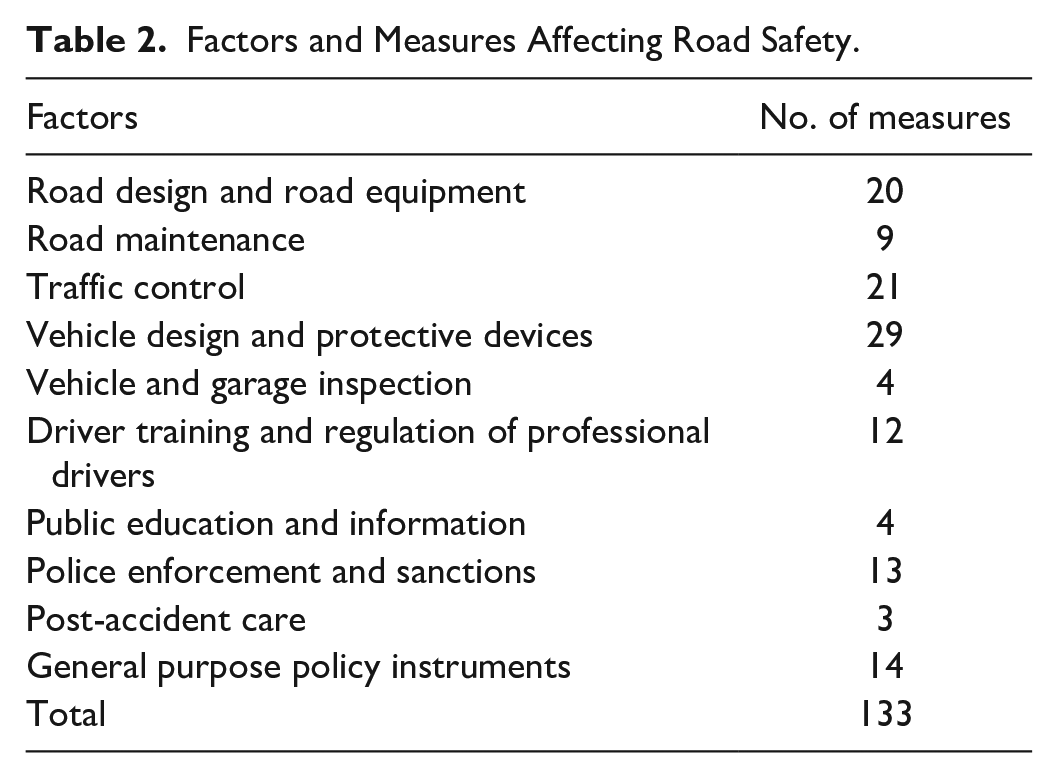
In their The Handbook of road safety measures, Elvik et al. (2009) introduced 10 pillars that affect road safety. For each pillar, a number of measures were elaborated. Table 2 presents the names of the pillars and the associated number of road safety measures.
Factors and Measures Affecting Road Safety.
Area-wide traffic calming is one of the dimension of traffic safety (more details for other dimensions are given later) used as an intervention to reduce accidents. Examples include road humps, roundabouts, raised crosswalks, reduced speed limit zones, and the creation of one-way streets. Another way to reduce road traffic accidents is through vehicle design and protective devices. This dimension can be studied in terms of tires, antilock braking systems (ABSs), daytime running lights, steering, suspension and vehicle stability, speed limiting, and electronic stability control (Elvik et al., 2009). Car safety can be increased by using ABSs, traction control systems, electronic stability programs, and electrohydraulic brake systems (EHBs). Seat belts have been found to be a key factor in reducing traffic injuries (Savenkova & Efimov, 2019). According to Usman et al. (2010), the road surface is a very important factor in accidents’ occurrence. It is noteworthy that traffic awareness campaigns are still below the required level, especially in light of the high rate of accidents. Injuries that result from road accidents can be reduced through the improvement of post-accident medical care (Goniewicz et al., 2016).
Method
Data Collection
This study adopted the survey method due to the low cost per respondent, the ease (four advantages) of describing the characteristics of a large population, the flexibility in data collection, and the possibility for respondents to provide more candid and valid answers. In addition, this study used the survey method because its aim was to generalize the findings of the sample to the population.
The population of this study consisted of 72,392 students (Ministry of Education, 2018). In addition, university visitors are considered part of the population. Based on Krejcie and Morgan’s table for determining sample sizes, a sample size of 382 was needed to represent a cross-section of this population (Sekaran & Bougie, 2016). A simple random sample consisted of licensed student drivers who used parking facilities at Qassim University distributed among the various faculties (Science and Humanities). Data were collected over 16 weeks from September to December 2018, and student drivers were asked to fill in a questionnaire. The questionnaires were handed to the respondents in paper form after we explained the importance of the study. We followed the university policy in gathering the data (confidentiality, anonymities, and volunteering). Data were collected from 1,500 students, covering the entire Qassim region. A total of 1,053 questionnaires were retrieved, where invalid questionnaires were excluded due to incomplete answers, or the answers were illogical according to the output of the questionnaire scanning. After the elimination of outliers, the number of questionnaires reached 909. Table 3 shows the demographic characteristics of the respondents.
Demographic Characteristics of the Respondents.

The results showed that nearly half of the respondents were from the age group 20–29 years (49.4%), followed by those who were below 20 years of age (36%). In terms of the participants’ marital status, it was noted that most of them were single (67.1%), whereas some were married (22.4%) or divorced (10.5%). About half of the sample (50.6%) had a secondary qualification, and the rest (49.4%) were distributed among undergraduate and postgraduate students. Regarding nationality, the sample was distributed across three groups: Saudis (83.7%), Arabs (8.1%), and foreigners (8.1%). The majority of the respondents (74.4%) were students, and there were percentages of business owners (3.9%), public sector employees (15.6%), and private sector employees (4.2%). On the other hand, the place of residence in the Qassim region indicates that the largest proportion of respondents were from the areas of Buraidah (30.7%), Al Bukairyah (20.4%), Riyadh Al Khubaraa (15.25), and Unaizah (8.5%) (see Figure 2).
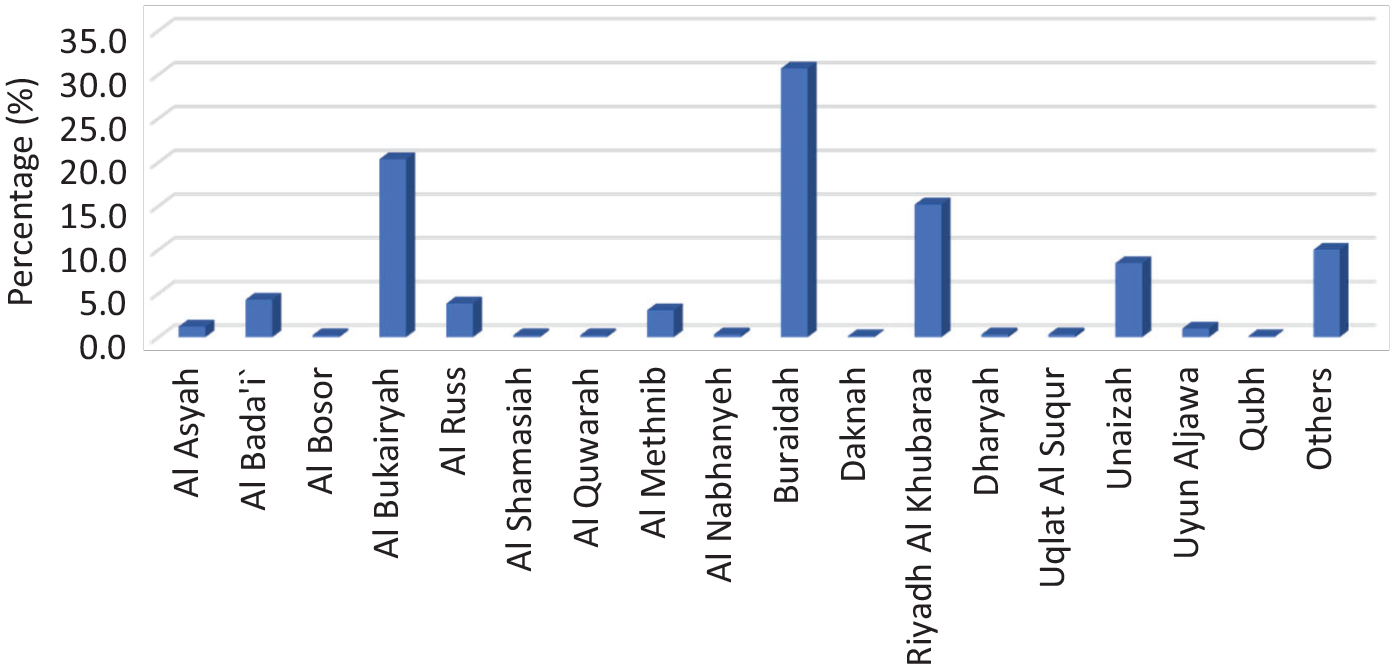
Percentage of respondents according to place of residence in the Qassim region.
The results are shown in Table 4. The majority of the respondents have a driving license (75.7%), of which 10.9% are public driving licenses and 88.2% are private driving licenses. The majority of the respondents have already experienced a traffic accident (63.4%), whereas the rest have never had such an accident (36.6%). The majority of respondents (70.6%) did not cause the incidents mentioned previously, but the rest (29.4%) did so. In terms of the magnitude of traffic accidents, the results showed that the largest percentage of accidents (79.5%) resulted in damage, followed by accidents that led to injuries (18.58%) and accidents that led to deaths (1.92%).
Factors Related to Road Traffic Safety.
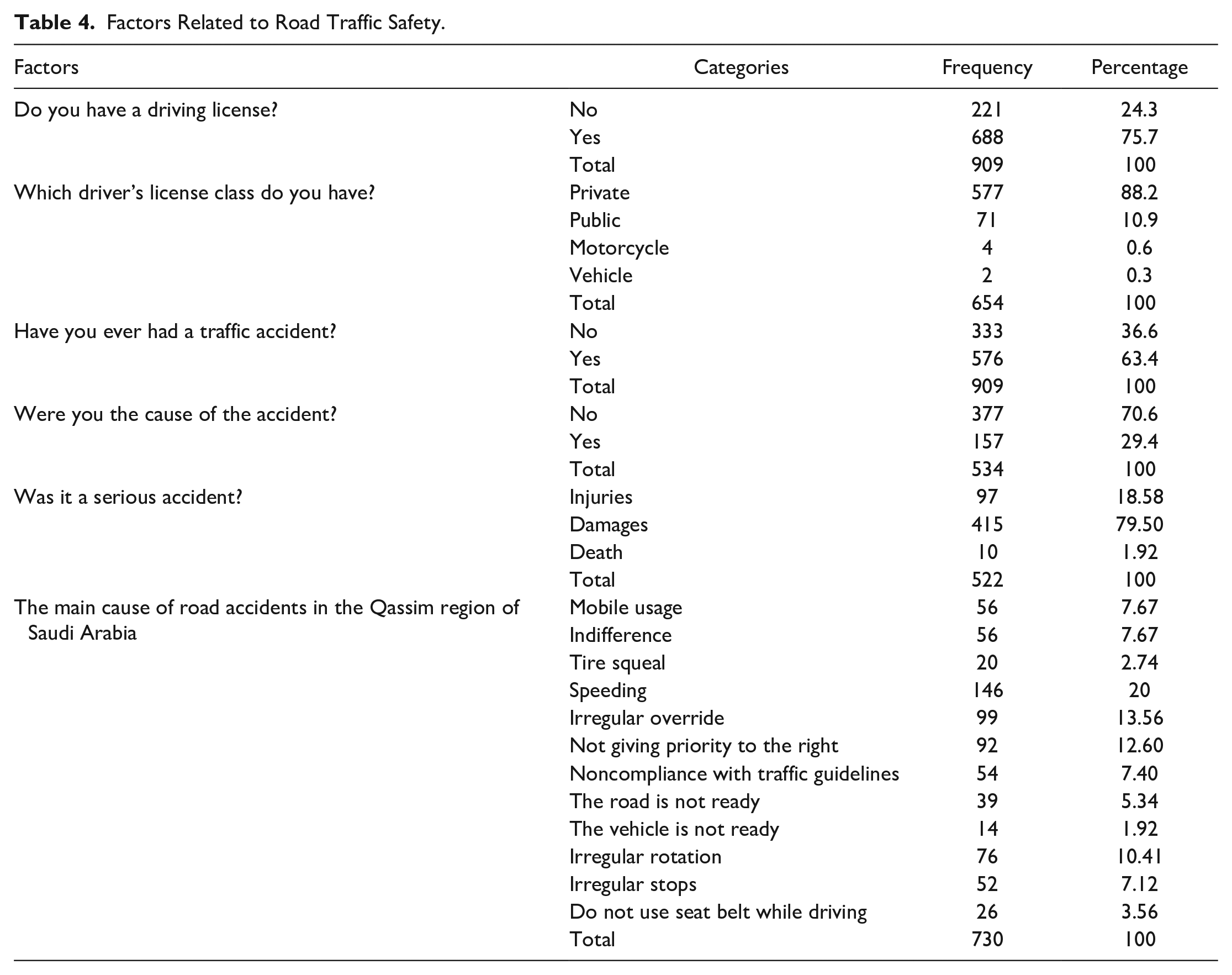
The main cause of road accidents in the Qassim region of Saudi Arabia, as shown in Table 4 and Figure 3, is speeding (20%), followed by irregular override (13.56%), priority violation (12.6%), and irregular rotation (10.41%).

Percentage of the main cause of road accidents in the Qassim region of Saudi Arabia.
Instrument
In their handbook, Elvik et al. (2009) elaborated comprehensive road safety measures that have an impact on road safety, commuter time, and the environment. A total of 128 measures were obtained using a systematic literature review. The data were collected, for instance, from databases, scientific works, and reports from 21 research institutions. These measures are useful for reducing road fatalities, determining the cost of traffic safety, and establishing the prevalent traffic safety factors.
A questionnaire-based survey was developed by the researchers to collect data on the basis of the The Handbook of road safety measures (Elvik et al., 2009) as well as the study by Yannis and Cohen (2016). The questionnaire consisted of two sections. The first section was used to collect the demographic data of the sample members, such as their age, marital status, educational level, job, place of residence, owning a driving license, license type, and cause of accidents.
The second section aimed to gather data on the perspectives of participants about traffic safety dimensions. It consisted of 85 items distributed among seven dimensions: area-wide traffic calming (e.g., the use of speed bumpers [bumps] facilitates traffic, speed reducers are placed randomly, and speed reducers are placed wisely in appropriate places), vehicle design and protective devices (e.g., I periodically inspect the tire pressure in the tire, I ensure the quality of the tires when I buy them, and I rely on the price of tires when I buy them), road design (e.g., highways are regularly maintained, the maximum speed of 120 km/h is appropriate, and heavy trucks are committed to the specified speed on highways), road maintenance (e.g., roads are regularly maintained, I have difficulty driving because of cracks or flaws in the road, and measures are taken to protect road users when maintaining them), traffic education (e.g., the school contributes to the promotion of traffic awareness among students, the curriculum contributes to the promotion of traffic awareness among students, and the university contributes to the promotion of traffic awareness among students), police campaigns and sanctions (e.g., the Saher system contributes to the drivers’ adherence to the speed limits on the roads, I support the deployment of Saher cars on vital roads and in dangerous places, and I have reservations about traffic fines), and post-accident care (e.g., traffic accidents are handled efficiently and quickly, traffic accident victims are quickly transferred to an emergency department, and I have taken first aid courses). All the items were anchored using a five-point Likert-type scale ranging from 1 (strongly disagree) to 5 (strongly agree).
Validity and Reliability
The face validity of the questionnaire was confirmed, as it was presented to seven raters specializing in traffic safety to determine whether the questionnaire items measure what they were set to measure to verify their face validity. The comments of the raters were noted for some items, and the authors did not delete or add items to the questionnaire.
Reliability, as shown in Table 5, was assessed using composite reliability (CR) and Cronbach’s alpha (α) coefficient, and validity was evaluated through convergent and discriminaby validity (Al-Tit & Nakhleh, 2014; Chen & Chen, 2011). It was revealed that the standardized factor loadings ranged between 0.58 and 0.88, which were greater than 0.50, the average variance extracted (AVE) values were higher than 0.50, and the square roots of the AVE value of each construct were higher than the correlation coefficient of the same construct with other variables. On the other hand, the CRs and Cronbach’s alpha values were greater than .70.
Reliability and Validity Results.

Note. AVE = average variance extracted; CR = composite reliability.
Analytical procedures
The analyses of the data study were evaluated with SPSS 25, frequency and percentage analyses were performed, and the AVE and CR values were used to test the validity and reliability. Means and standard deviations were used to answer the study question.
Results
The results of this study were extracted based on the mean (M) and standard deviation (SD) values of the respondents’ estimations of the scale dimension items to answer the research question “What is the reality of traffic safety and which critical factors affect traffic safety in the Qassim region?” The total values for each dimension and the total mean of the scale are reported in Table 6.
Means and Standard Deviations of the Responses to Traffic Safety Items.

First, it was found that the total mean of the traffic safety dimensions was moderate (M = 3.24, SD = 0.58). Area-wide traffic calming was ranked first (M = 3.54, SD = 0.53), so this is a critical factor affecting traffic safety, followed by vehicle design and protective devices (M = 3.41, SD = 0.57), road design (M = 3.41, SD = 0.58), police campaigns and sanctions (M = 3.32, SD = 1.02), road maintenance (M = 3.23, SD = 0.88), post-accident care (M = 3.21, SD = 0.89), and finally traffic education (M = 3.14, SD = 0.95).
On the other hand, the results showed participants responded to an open question the most common cause of road accidents is excess speed (9.1%), irregular bypasses (6.8%), irregular circulation (4.5%), lack of prioritization of other drivers (4.2%), irregular stopping (2.8%), lack of readiness of the road (2.5%), carelessness (1.5%), use of a mobile while driving (2%), and noncompliance with traffic signals on the road (1.2%).
Discussion
In relation to area-wide traffic calming, the participants moderately agreed that road humps play a significant role in facilitating traffic and that these humps are placed wisely. However, others stated that they were randomly placed. In agreement with our results, T. Hasan et al. (2014), in their study on unsafe driving behaviors, used a sample consisting of 300 drivers from Jeddah and highlighted the importance of road humps in reducing these behaviors. In terms of road circles, our results indicated that they have moderate importance in the traffic flow. Arkatkar (2018) explained the importance of the knowledge of traffic flow features as a requirement for the planning, operation, and analysis of roadway systems and traffic safety in general.
The responses concerning the environment of streets were moderate but closer to weak. The study by Al-Ghonamy (2010) in Al-Dammam city found that residents were highly exposed to noise due to road traffic. The respondents also moderately agreed on the priority controls. The sample members held the moderate opinion that traffic priority signs are available in a clear place, which is commensurate with the traffic density, but also respected the signal “stop” to a moderate degree. Excess speed has been regarded in the Saudi literature as a main contributor to road traffic accidents (Al Turki, 2014; Barrimah et al., 2012; Ghaffar & Ahmed, 2015; Mansuri et al., 2015).
Concerning vehicle design and protective devices, tires, ABSs, daytime running lights, steering, suspension and vehicle stability, seat belts, speed limiting, and electronic stability control were all investigated. The results related to vehicles’ tires showed that the sample members agreed to a large extent with changing tires during the specified period. They checked the air pressure in the tires periodically and checked the quality of the tires when purchasing them. The IoT can also be used to warn drivers about the health of their tires (N. Hasan et al., 2011).
The results of the study did not show the exposure of individuals to car accidents due to poor tires, explosions, or a lack of suitability for the weather or wet streets. The respondents’ answers concerning the ABSs and their importance in reducing accidents were moderate. Furthermore, the results showed that the importance of daytime running lights was moderate. The results of the study showed a medium degree of approval of the need to reduce the speed of the vehicle when following a curved road.
In the context of using the seat belt during driving, the respondents indicated a moderate degree of commitment to using seat belts for drivers or children, exposure to a sanction due to nonuse, and campaigns regarding the importance of their use. These findings confirmed that the use of seat belts is still one of the causes of accidents’ severity, and this is consistent with previous studies (Al Orf et al., 2018; Gharaibeh & Abdo, 2011). The results confirmed the existence of moderate knowledge of the sample regarding the system of car speeding, and a smaller number of vehicles are equipped with such a system. The responses regarding the electronic stability control system showed moderate knowledge of how the system works and its availability in the vehicle as well as moderate importance of the periodic checking of the vehicle.
In general, the results showed a moderate level of road design in terms of motorways, circular roads, main roads, junctions, roadside rest and service areas, roadside safety, black spots, and road lighting. The responses of the sample respondents were moderate for the items regarding motorways in terms of the number of lanes being suitable for the traffic density on the road, the road being maintained periodically, the maximum speed specified being appropriate, the adherence of trucks to the specified speed, the use of mobile phones while driving on motorways, the use of speed limit control, and the presence of clear traffic signals on the highways. The moderate responses concerning police campaigns and sanctions indicated that the Saher system moderately contributes to drivers’ adherence to speed limits on the roads as well as the participants’ agreement with the deployment of Saher cars on vital roads and in dangerous places. This result is logical, because the Saher system focuses on particular causes of road accidents, not all of the causes, which are speeding and running red lights (Al Turki, 2014, cited in DeNicola et al., 2016). Road maintenance was evaluated moderately by the respondents in terms of the regular maintenance of roads and difficult experience of driving because of cracks or flaws in the road.
Regarding post-accident care, the participants showed moderate agreement concerning traffic accident treatment and the quick transfer of victims to hospitals. It was noted that a low percentage of respondents have taken training courses on first aid. Finally, the results pointed out the moderate significance of traffic education in terms of schools, curriculum, and university roles in the promotion of traffic awareness among students as well as the traffic department’s implementation of traffic awareness programs for community members. Lee and Al-Mansour (2020) identified traffic education campaigns as an urgent need.
On the other hand, the results showed that the most common causes of road accidents are excess speed, irregular bypasses, irregular circulation, and a lack of prioritization of other drivers. Similar results have been detected in the literature (e.g., Al Orf et al., 2018; Al Turki, 2014; Barrimah et al., 2012; Ghaffar & Ahmed, 2015; Gharaibeh & Abdo, 2011; Khan et al., 2010; Mansuri et al., 2015).
Conclusion and Policy Implications
The aim of this study was to explore traffic safety in the Qassim region, Saudi Arabia, and to identify the causes of road traffic accidents in this region. Al-Qassim region has a moderate level of traffic safety. The traffic safety situation in the region is no better than in other regions of the kingdom and that the causes of accidents in the different regions are almost the same.
To increase road safety in Qassim region, policymakers and stakeholders are advised to review the strategy to reduce road accidents and to achieve a good level of traffic safety. It is necessary to find new ways to deal with this problem by encouraging young drivers to abide by the traffic rules by rewarding, via monetary and nonmonetary prizes, those who abide by traffic rules in a national campaign that includes the whole region and the provinces. New campaigns should also put in place to increase the awareness among drivers on the importance of using seat belts, the respect of safety distance, and the danger of using mobile phones. Driver training centers should further be used to provide novice drivers with cognitive skills to deal with road hazards. Finally, emerging and new technologies should be put in place to increase road safety, discourage road users from violating traffic rules, and improve driving conditions. Intelligent transportation systems (ITSs) and IoT offer a new direction in the transportation sector designed to increase the safety on roads, improve the efficiency of the transportation sector, and reduce greenhouse gas emissions.
Limitations and Future Work
One of the most important limitations of this study is the use of a sample of Qassim University students, and visitors as students represent all the governorates of the region. In addition, samples of residents and drivers from the same governorates should be used. The researchers suggest conducting future studies in each area in the Qassim region to identify the traffic situation. Because of the size of the area, it is necessary to work on the traffic issues at the governorate level and find solutions for each problem concerned. In addition, future studies should incorporate female drivers, as the new rules, established in 2018, granted women in Saudi Arabia the right to drive.
Many entities are responsible for traffic safety in Saudi Arabia, such as traffic management, road security management, municipalities and Najm company, which have led to differences in the way in which traffic situations are approached in the kingdom, whether in terms of evaluation, treatment, prevention, or future plans. The researchers strongly recommend that policy- and decision-makers, designers, and planners in these entities should increase their level of coordination and cooperation and develop future plans taking into consideration the need to create a joint entity that unites the efforts of these separate entities in the development of traffic safety in the kingdom.
Footnotes
Acknowledgements
This research work has been performed in collaboration with Qassim traffic authorities.
Authors Note
Declaration of Conflicting Interests
The author(s) declared no potential conflicts of interest with respect to the research, authorship, and/or publication of this article.
Funding
The author(s) disclosed receipt of the following financial support for the research, authorship, and/or publication of this article: This study has been funded by the Deanship for Scientific Research, Qassim University.
