




Abstract
Drawing on social exchange theory and stakeholder responses to corporate social responsibility model, this study aimed to examine if the cross-level impacts of perceived investment in green employee development climate (PIGED) on environmental commitment (EC) and green well-being (GWB) were mediated by green person-job fit and green growth need strength. We collected a total of 412 employees and 80 operating units from a leading palm-oil company in Malaysia. The multilevel regression analysis found the cross-level effects of PIGED on EC and GWB that were partially mediated by green person-job fit and green growth need strength. Due to incomplete understanding of more dynamic relationships at the cross-level analysis, this study contributes a nuanced understanding of psychological mechanism of PIGED and its beneficial values for employees to develop quality of relationships between organizations and employees. Human resource professionals can leverage on PIGED across units at multiple locations to create beneficial values to employees’ jobs and their personal growth desire which can promote EC and GWB.
Keywords
Introduction
The palm oil industry is one of the largest and most important agricultural industries in the world (OECD/FAO, 2021), but it is also associated with a range of environmental and social challenges (Ayompe et al., 2021). Implementing sustainability practices throughout the supply chain, from the plantation to the market, is crucial for ensuring long-term environmental sustainability and social responsibility (Lyons-White & Knight, 2018). Investing in green employee development is an essential component of this effort, as it helps to develop the core competencies needed to implement sustainability practices (Amrutha & Geetha, 2021; Paillé & Valéau, 2021; Pham et al., 2020) such as responsible water management through reduced pesticides and promoting biodiversity in the palm oil industry (Tang & Al Qahtani, 2020). Despite its importance in the industry, the level of employees’ knowledge and awareness, incentives and resources provided by organizations as well as segregated departments in different locations have been reported to be challenging to implement sustainability practices (Lyons-White & Knight, 2018). Addressing these challenges require concerted efforts by both organizations and employees to prioritize sustainability and invest in green employee development programs, which may include providing employees with the necessary time and resources to attend training and engage in developmental activities (Xie et al., 2020). In light of this, the current study utilized multilevel regression analysis and identified cross-level impacts of perceived investment in green employee development climate on environmental commitment and green well-being, with mediation through green person-job fit and green growth need strength. These findings suggest that organizations operating in the palm oil industry can prioritize investment in green employee development climate across all units and locations to promote sustainability practices and improve overall sustainability efficiency.
Although there is increasing attention given to sustainability practices in the palm oil industry, the role of perceived investment in employee development climate in promoting sustainability remains under-explored. According to the original definition, perceived investment in employee development climate refers to employees’ shared judgment on organizations’ long-term and continuous obligations to equip members with necessary skills and competencies to meet current needs and future responsibilities (Lee & Bruvold, 2003). The investment in green employee development climate is reflected in policies, procedures, and practices such as environmental training, employee participation, and performance appraisal for sustainability initiatives (Ehnert et al., 2014). Based on the review of the literature, there are two important research gaps that bring about the need for the current study.
First, previous studies have examined how environmental training and development programs can affect employees’ behaviors toward sustainability practices (Aftab et al., 2023; Ahmad et al., 2022; Amrutha & Geetha, 2021; Kim et al., 2019; Luu, 2023; Paillé & Valéau, 2021; Pham et al., 2020; Pinzone et al., 2019), but they have mainly focused on single-level analysis at the organizational or individual level in varying contexts, ranging from information technology (Amrutha & Geetha, 2021), healthcare (Pinzone et al., 2019), hotels (Pham et al., 2020) to manufacturing (Xie et al., 2020). Due to its unique characteristics, the palm oil industry is comprised of numerous operating units, which are often geographically scattered and segregated (Lyons-White & Knight, 2018). As a result, past studies have overlooked the potential cross-level impacts of organizations’ obligations to provide green training and development programs on employees’ behaviors to sustainability practices. This leaves an important research gap on how perceived investment in green employee development climate (PIGED) across units can be leveraged to promote sustainability practices in the palm oil industry. Therefore, this study bridges the gap by examining cross-level impacts of PIGED on green work outcomes.
Second, the literature on green human resource management suggests that the relationships between green human resource practices and green work outcomes are inconsistent, with some studies finding positive relationships (Dumont et al., 2017; Luu, 2018; Pinzone et al., 2019) while others finding no significant results. For instance, Kim et al. (2019) found direct positive relationships between green human resource management and employees’ green behaviors in non-green certified hotels, but not in green certified hotels. While learning sustainability practices through training is important for employees to meet increasing green demands, their ability to apply newly gained knowledge in their job performance and subsequent career growth is often hindered by competing demands and expectations at work (Xie et al., 2020). However, there is a lack of research on how organizations can manage these challenges and promote the development of core competencies that benefit subsequent jobs and individual growth desires. To fully understand the underlying mechanisms that explain the cross-level impacts of PIGED on individual needs like green person job-fit and personal green growth desires, further research is necessary.
Hence, filling both gaps are important to gain a deeper understanding of the role of PIGED, and whether such climate can benefit employees’ fit with their jobs and their desires to grow to support employee well-being and commitment to sustainability practices. As such, the current study aims to collect data with two main objectives: (1) to investigate the cross-level influence of PIGED on environmental commitment and green well-being and (2) to ascertain whether green person-job fit and green growth need strength mediate these relationships. Drawing on the social exchange theory and Bhattacharya et al.’s (2009) stakeholder responses to corporate social responsibility (STR-CSR) model, it provides the theoretical framework that explains the underlying mechanisms of employee attitudes toward sustainability practices.
There are three important areas where this study can make original contributions. First, this study adds to the existing literature on green human resource management by specifically examining the cross-level impacts of PIGED in the palm oil industry, where employees often experience limited developmental opportunities due to segregated locations in the palm oil industry (Lyons-White & Knight, 2018). Because of this, they experience intense stress (Asamoah-Appiah & Aggrey-Fynn, 2017). By exploring the utility value of PIGED, this study contributes to our understanding of how PIGED across units can lead to positive green outcomes such as environmental commitment and green well-being.
Second, Hackman and Oldham (1974) characterized growth need strength as an intense desire for personal achievement and growth. Investments in employee development for sustainability initiatives are crucial to meeting higher order needs and thereby enhancing well-being (Bhattacharya et al., 2009). Despite the conceptual recognition of the relationship between sustainability initiatives and employees’ personal growth desires (Bhattacharya et al., 2009; Dao et al., 2011), empirical studies examining this relationship are limited. Hence, the current study can address the previously unexplored cross-level influence of PIGED on green growth need strength.
Finally, despite the growing interest in green human resource management and its impacts on green outcomes, previous studies have reported inconsistent findings due to competing demands and expectations placed on employees to learn and perform sustainability practices (Dumont et al., 2017; Kim et al., 2019; Luu, 2018; Xie et al., 2020). Our study represents a step forward by examining the cross-level effects of PIGED on employees’ green well-being and environmental commitment mediated by green person-job fit and green growth need strength. By investigating the psychological mechanisms involved in the sustainability process, our study can help to determine whether or not employees are provided with the necessary abilities, motivation, and opportunities to develop their skills and personal growth desires in order to promote employees’ well-being and commitment (Appelbaum et al., 2000; Bhattacharya et al., 2009). We apply the social exchange theory and Bhattacharya et al.’s (2009) stakeholder responses to corporate social responsibility (STR-CSR) model to explain why the employees are satisfied with and committed to environmental sustainability practices.
Our article will be structured so that we can first discuss theoretical framework, and hypothesis development using the combined SET and STR-CSR model. Then, we will describe the methods, findings, discussion, and implications.
Theoretical Framework and Hypothesis
Social Exchange Theory and Stakeholder Responses to Corporate Social Responsibility Model
Social exchange theory (SET) (Blau, 1996) explains the social-psychological process of exchanging favors between two parties. Favors can be expressed in tangible or intangible form, and each party is obliged to return the favors that are beneficial to fulfill the needs and demands of the other party. The norms of reciprocity are used to build relationships by satisfying and committing to the expectations and interests of the parties in order to maintain social relationships (Blau, 1996). Three main components are derived from SET to support the current study: (a) the favors expressed in the form of activities rendered by the employers and experienced by the employees, such as PIGED; (b) the benefits gained by the employees to meet their demands and needs (green person-job fit and green growth need strength); and (c) felt obligations to return the favors to build the relational exchange that requires commitment to the relationship (environmental commitment) and overall satisfaction with the met needs (green well-being) (Blau, 1996).
Green human resource management is a component of corporate social responsibility (CSR) initiatives that provide green developmental aspects to employees to achieve green performance (Kim et al., 2019). According to Bhattacharya et al.’s (2009) stakeholder responses to corporate social responsibility (STR-CSR) model, investing in an internally focused CSR program that develops employees’ skills can strengthen the quality of the relationship between organizations and employees by providing beneficial values to employees who have diverse needs and values (Bhattacharya et al., 2008). For example, internally focused CSR for employees during the implementation stage, such as CSR training, promotion, and performance appraisal, supports employees in identifying with their organizations’ sustainability initiatives in order to help others achieve the initiatives together, under which reciprocal norms of returned favors are expected (Shen & Benson, 2016). Such identification develops good quality relationships between organizations and employees. It indicates that the investment in sustainability initiatives for skill development is beneficial in that it fulfills employees’ internal and external needs simultaneously. The internal needs refer to personal growth desires, while the external needs refer to the fulfillment of job needs and demands. That means, organizations align their investment in sustainability initiatives with individual growth value and to provide tangible work (or functional) benefits to fulfill employees’ job demands and needs (Bhattacharya et al., 2009). When their needs are met, employees become committed and satisfied (Bhattacharya et al., 2008). Hence, this proposed STR-CSR model enables us to comprehend the PIGED implemented at each unit and its beneficial green effects on individuals and work functions for green outcomes among the current study’s participants.
With the combined SET and STR-CSR model, we argue that perceived investment in sustainability activities influences the work benefits and value obtained by the employees and the subsequent relational exchange in the form of employee satisfaction and commitment. In this study, Figure 1 displays a conceptual model of PIGED and its effects on tangible work benefits (green person-job fit) and values (green growth need strength) to promote the relational exchange of green well-being and environmental commitment.

Conceptual model and hypotheses.
PIGED, Green Person-Job Fit, Green Growth Need Strength, and Green Outcomes
PIGED indicates the employees’ experiences with the implementation of training and developmental practices in a work unit (Dysvik & Kuvaas, 2012). It is the high-commitment strategy for employee development that is provided to meet job demands, job needs, and personal growth in order to produce emotional attachment to organizations and job satisfaction (Lee & Bruvold, 2003). Employees form shared judgments about the policies, procedures, and practices of the focused agenda and with whom they can align and contribute to the agenda (Schneider et al., 2013). Applying the SET and STR-CSR model in the PIGED context, organizations are committed to providing green human resource practices like green training to build the relational exchange for developing employees’ green attitudes and behaviors (Kim et al., 2019; Paillé & Valéau, 2021). The investment of green training in alignment with other green human resource practices is important to develop employees’ core green skills, knowledge, and abilities to reduce the impacts of operational products, processes, and practices to the natural environment (Jabbour, 2013). The implementation of PIGED depends on the managers. Managers can support developmental opportunities by developing a green plan with the employees. They can identify useful developmental activities like mentoring and site visits, and give the employees sufficient time to learn and practice the skills (Ramus, 2002). When trained employees have higher self-efficacy, they can perform better at work with the necessary skills acquired from the green training and thereby contribute to their career advancement (Xie et al., 2020). Hence, PIGED reflects employees’ experiences of the attributes of green employee development practices at the unit level. In other words, managers who consistently implement PIGED at the unit level can benefit individual values and their work for valuable work outcomes.
The person-job fit is the subjective judgment of congruence between an employee’s ability, needs, skills, and values and the demands and requirements of a job (Cable & DeRue, 2002). Person–job fit can be categorized into needs–supplies fit (i.e., fit between employees’ services to organizations and rewards/return for their services) and demands–abilities fit (i.e., fit between the demands of a job and individual abilities) (Cable & DeRue, 2002). Taking the perspective of Ehrhart (2006), person-job fit is a subjective evaluation of the extent to which a person can fit with a particular job. From Bhat and Rainayee’s (2019) view, the change in global demands on environmental sustainability requires employees to constantly upkeep their green knowledge, skills, and abilities to meet green job demands through green developmental opportunities. Simply put, it is a match between the person’s and the job’s characteristics for environmental sustainability. According to the SET and STR-CSR model, organizations’ sustainability initiatives are beneficial in meeting functional needs and demands by developing employees’ competencies (Bhattacharya et al., 2009). Employees who participate voluntarily in the CSR program acquire skills and applied the relevant learning back to their jobs to meet the job demands and needs (Bhattacharya et al., 2008, 2009).
Accordingly, the SET and STR-CSR model are applied to the relationship between PIGED and green person-job fit. The environmental sustainability strategy and other related stakeholders of green companies highlight the importance of green jobs and the needs and expectations for acquiring green skills and knowledge (Jabbour, 2013). The human resource functions form a strategic partnership with the environmental sustainability unit, in which the environmental sustainability unit must align with the human resource functions and thereby emanate from the person-job fit (Haddock-Millar et al., 2016; Jabbour, 2013). Employees demonstrate their contextual green abilities by learning through on-the-job training while giving feedback to environmental sustainability managers for continuous improvement at work (Haddock-Millar et al., 2016). Unfavorable employee experiences with green human resources detach employees from their work to contribute toward environmental sustainability (Haddock-Millar et al., 2016; Renwick et al., 2013). Indeed, employee involvement in environmental sustainability is critical, as they are directly involved in daily operational matters, and therefore their contextual knowledge and skills are needed for environmental innovation (Renwick et al., 2013). Hence, PIGED promotes compatibility between a person’s and a job’s characteristics.
Green growth need strength is important in the sustainability strategy for employees (Kira & Lifvergren, 2014). While growth needs strength refers to “an individual’s desire to grow and develop within his/her job” (Shalley et al., 2009, p. 489), green growth need strength emphasizes green interests and needs that indicate biosphere value (Wesley Schultz, 2001). These needs are a sense of personal fulfillment that is supported by the organization to influence employee commitment to the natural environment at work (Davis et al., 2009). According to the SET and STR-CSR model, values are intrinsically motivated to engage in the reciprocation of favors (Bhattacharya et al., 2009; Blau, 1996). The benefits of sustainability initiatives derived by employees must be consistent with their values for them to participate (Bhattacharya et al., 2009). Organizations provide opportunities for employee involvement in sustainability activities by integrating sustainability activities as part of their meaningful work and career advancement (Bhattacharya et al., 2009). Accordingly, organizations continuously provide green resources such as developmental activities to support employees’ green identity, values, and interests (Kira & Lifvergren, 2014). The greater an organization’s concern for and provision for its employees’ needs, the more its values align with those of its employees (Dumont et al., 2017). Hence, PIGED is important to support green growth need strength in organizations.
Using the SET and STR-CSR model to generate green well-being and environmental commitment indicates the trustworthy relationships between both parties (Bhattacharya et al., 2009; Blau, 1996). Internally focused human resource management that fosters closer relationships among employees in various locations commits employees to sustainability initiatives (Bhattacharya et al., 2008). Accordingly, organizations foster employee environmental commitment through organizational support and training (Paillé & Valéau, 2021). Environmental commitment, defined as “a frame of mind denoting both a sense of attachment and responsibility to environmental concerns in the workplace” (Raineri & Paillé, 2016, p. 133), can serve as a link between environmental training and green job performance (Pham et al., 2020). The favorable green human resource practices promote the employees’ attachment to the organizations (Kim et al., 2019). For example, organizations that invest in green training to promote environmental awareness and green competencies are perceived as environmental friendly (Renwick et al., 2013). This can help to improve their environmental commitment, particularly for employees who are beginning to support the green agenda (Paillé & Valéau, 2021).
Employee well-being can be viewed as the quality of their work-life and psychological domains (Siegrist et al., 2007). It is the integral of one’s satisfaction with three main domains of life, work, and psychological extending from work to non-work domains (Zheng et al., 2015). From a sustainability point of view, an organization’s green agenda promotes different aspects of the employee’s green work-life domains (Ayompe et al., 2021). It is the symbiotic relationship between humans and nature in which humans coexist with nature. Their needs are fulfilled in aspects of their responsibilities to live and use the resources in the ecosystem, work meaningfully by engaging in environmental sustainability activities, and be able to connect with others and the natural environment (Helne & Hirvilammi, 2015). Based on the definition above, this study defines green well-being as the subjective evaluation of one’s satisfaction with life, work, and psychology that are connected to environmental sustainability in both work and non-work domains.
Past studies have found a positive relationship between green training, work and life well-being (Amrutha & Geetha, 2021; Pinzone et al., 2019; Zhao et al., 2020). Organizations’ provision of skills and career development opportunities as part of their sustainability strategy can have an impact on job satisfaction (Zink, 2014). Moreover, the right green knowledge, skills, and abilities acquired by the employees can increase their participation in numerous green activities that eventually promote their job satisfaction (Renwick et al., 2013). Thus, we propose that:
H1: PIGED positively influences (a) green person-job fit, (b) green growth need strength, (c) environmental commitment, and (d) green well-being.
According to the SET, the individual is obligated to return the favors to build and maintain durable and stable relationships with the other party (Blau, 1996). As a result, organizations provide CSR activities to motivate employees through meeting their developmental needs (e.g., training and development), leading to better job satisfaction (Du et al., 2015; Helne & Hirvilammi, 2015). From the environmental sustainability perspective, demands-abilities fit enhance in-role behaviors while needs-supplies promote extra-role behaviors. The more employees feel emotionally connected with the organization due to needs being met by the organizations’ supplies, the more they engage in their green extra-role behaviors. However, the more employees feel transactional in their relationships with organizations due to meeting demands with their abilities, the more they engage in their green in-role behaviors (Mi et al., 2020). As such, person-job fit has been linked to green behaviors particularly employee well-being (Zink, 2014) and environmental commitment (Haddock-Millar et al., 2016). This is because employees with a positive perception of person-job fit are more devoted to their organization and are less likely to experience stress, exhaustion, and worry (Bohlmann et al., 2018; Choi et al., 2017). Thus, this leads to the following hypothesis:
H2: Green person-job fit positively influences (a) environmental commitment and (b) green well-being.
Growth need strength plays an important role in motivating employees to drive themselves and persevere through challenges (Shalley et al., 2009). Based on the SET and STR-CSR model, the quality of the relationship between two parties is determined by the organizations’ fulfillment of their individual value (Bhattacharya et al., 2009). Accordingly, growth need strength can affect attitudes toward environmental sustainability by (a) connecting individual value to the natural environment, (b) identifying concerns and needs for the natural environment, and (c) stimulating employees to stay healthy and productive in extremely demanding contexts (Wesley Schultz, 2001). The more employees are able to identify with their organizations’ values, the more they engage in green behaviors (Dumont et al., 2017; Mi et al., 2020). Such positioning triggers top-down commitment to environmental sustainability (Haddock-Millar et al., 2016). Renwick et al. (2013) express a similar viewpoint, mentioning broadening employee involvement in environmental sustainability beyond the top management level by embedding green values into the culture of the organizations. This helps employees commit to environmental sustainability. Meeting employees’ personal growth needs for the sustainability agenda is also important to promote better well-being (Dao et al., 2011; Zink, 2014). The ability to find one’s growth needs helps employees grow to their full potential through searching for the meaning of life, work, and connection to self and others (Mirvis, 2012). Thus, this study proposes that:
H3: Green growth need strength positively influences (a) environmental commitment and (b) green well-being.
Mediating Effects of Green Person-Job Fit and Green Growth Need Strength
Applying the STR-CSR model in the current study, employees are satisfied with the tangible work benefits offered by investments in sustainability initiatives. In exchange, they are motivated to commit to the organization’s expectations and interests (Bhattacharya et al., 2009; Blau, 1996). Tangible work benefits and values are critical psychological mechanisms that explain stakeholders’ perceptions of a company’s beneficial CSR initiatives in relation to their commitment and satisfaction with the CSR agenda (Bhattacharya et al., 2009). Accordingly, the current study focuses on two mediators: green person-job fit and green growth need strength. The psychological mechanism here is important to drive employees’ motivation to react positively to the sustainability initiatives that are embedded in human resource functions and practices (Haddock-Millar et al., 2016; Jabbour, 2013). It is an internal marketing tool to build relationships with the employees to promote both satisfaction and commitment (Bhattacharya et al., 2009).
Strategically focused human resource practices in sustainability initiatives encourage employees to voluntarily participate in the sustainability program in order to use the right skills to address community issues (Mirvis, 2012). When the organizations help the employees fulfill their job needs as part of sustainability initiatives for their career growth, the needs fulfillment increases employees’ job satisfaction and reduces employees’ turnover intentions (Du et al., 2015). Contrarily, poor person-job fit to meet international environmental standards and demands can reduce employee well-being (Zink, 2014). Hence, developmental activities are one of the important elements in designing jobs in green projects to promote employees’ job satisfaction (Zhao et al., 2020). Increased support and opportunities for green developmental activities provide employees with the knowledge, skills, and abilities required to meet the job requirement for environmental sustainability, increasing employees’ job satisfaction at work and beyond (Pinzone et al., 2019). Such green resources enhance employees’ motivation because they have a greater fit to their work and, thus, are more environmentally committed (Cop et al., 2020). The support received to meet different employees’ needs through green training facilitates employees’ identification with their green goals (Paillé & Valéau, 2021). Thus, we expect that:
H4: Green person-job fit mediates the relationship between: (a) PIGED and environmental commitment and (b) PIGED and green well-being.
As the employees experience the overall sustainability initiatives, the organizations go beyond their functional benefits to satisfy the employees’ values. This strengthens the relationship with the employees regarding the sustainability strategy. Without the satisfaction of personal desires to grow, organizations can fail to commit employees to fulfill their expectations and interests in sustainability initiatives (Bhattacharya et al., 2009) and thereby their well-being (Bhattacharya et al., 2008). That means that the person’s and organization’s values on environmental sustainability need to be compatible to increase job satisfaction (Mirvis, 2012; Spanjol et al., 2015) and environmental commitment (Bhattacharya et al., 2009; Mirvis, 2012). Deriving from the STR-CSR model, we argue that employees experience PIGED positively to benefit their green person-job fit as a foundation for activating green well-being. Positive PIGED experiences that go beyond green well-being must fulfill not only the green person-job fit but also the green growth need strength in order to build both green well-being and environmental commitment. Thus, this leads to:
H5: Green growth need strength mediates the relationship between: (a) PIGED and environmental commitment and (b) PIGED and green well-being.
Methods
Background of the Study
Malaysia is the world’s second-largest exporter of palm oil (Oosterveer, 2015; Toh, 2022), with a total export of USD 14.65 billion in 2021, making it the country’s fourth largest export after electrical and electronic, petroleum, and chemical products (MATRADE, 2022). To support the increasing demand for sustainable palm oil products, there are two common institutions that provide certifications and training programs for palm oil companies and their employees in Malaysia. They are Roundtable on Sustainable Palm Oil (RSPO), and Malaysia Sustainable Palm Oil (MSPO). Both institutions provide guidelines and standards to promote sustainability practices in the production, processing, and distribution of palm oil products (RSPO, 2023; SIRIM QAS International, 2023). In 2023, 5.4 million hectares of total planted palm oil areas and 581 mills, refineries, and processing facilities have been certified by MSPO (MSPO Trace, 2023). Hence, the evolvement of the palm oil industry requires companies and their employees to promote responsible and sustainable practices.
To attain certification for sustainable palm oil production in Malaysia, companies must meet the sustainable agriculture standards. The company selected for this study has established a training center to equip employees in each operating unit with the necessary competencies. In the same survey distributed to the participants in the current study, an open-ended question was added to describe the sustainable agricultural practices applied at work following their participation in training and developmental activities. Based on the data collected, the employees showed that they applied sustainable agriculture practices like replanting the cover crop on the hill to avoid soil erosion, not dumping oil into rivers or drains, using recycled and reused materials, not burning, cleaning up the line site, using lamps to control pests to cut down on the amount of chemicals used, building an oil trap for the workshop to stop leaking oil from going into rivers and soil, and continuously monitoring and recording the plantation water.
Participants
The first author invited seven leading palm oil companies in Malaysia to participate in the study. One sustainable palm oil certified company agreed to participate with 412 employees and 80 operating units across multiple locations taking part in the survey. The human resources manager invited the voluntary participants to participate in the survey. Each completed questionnaire was returned in a sealed and signed envelope by the respondent. The first author then collected the questionnaires in sealed and signed envelopes from the human resources department. The confidentiality of the participants was protected by the Institutional Review Board’s approved procedures. At the end of the period for collecting data, 296 employees from 59 operating units returned the questionnaires. This was a 71.8% response rate. Thirteen respondents were disqualified because they returned blank questionnaires, and we further excluded 10 respondents who did not indicate which unit they belonged to. Finally, we excluded units with three or fewer employees who had responded to the questionnaires from the analysis, resulting in eight responses being excluded. For the final analysis, 265 respondents from 55 operating units with an average of 4.82 unit size were included, yielding a final response rate of 64.3%. Of the respondents, 84.5% were men. 53.2% of respondents had worked for the current organization for more than 5 years, and 50.2% of respondents were between the ages of 30 and 49 years old. About 84.1% were non-managers, and 57.4% had at least high school or equivalent certificates.
Measures
The content validity of the questionnaire was examined before the collection of data began. To verify the readability, clarity, feasibility, and representativeness of the items within the context of the palm oil industry, a group of 10 managers from the sector had been invited. With the exception of the environmental commitment, all of the measures had been slightly modified based on similar cases in previous studies (Amrutha & Geetha, 2021; Dysvik & Kuvaas, 2012). This was because this study investigated environmental sustainability and there was a lack of appropriate scales to measure the variables examined in this study. “Environmental sustainability” or “green” was added to the original items. The translation of English into the Malay language (the local language) was recommended given that the employees in this industry were not native English speakers.
To assure the equivalence and consistency of the English and Malay versions, we followed the recommended translation and reverse-translation method (Brislin, 1970). The first author translated from the English version to the Malay version, and an academic staff member with a doctoral qualification was invited to translate the Malay version back to the English version to check for meaning compatibility. This process continued until both versions had equivalent meanings.
To measure PIGED, we adapted the shortened version of the seven-item using a 5-point Likert scale (1 = strongly disagree; 5 = strongly agree) (Dysvik & Kuvaas, 2012) based on Lee and Bruvold’s (2003) version. For green person-job fit, six items were selected from the person-job fit scale on a 7-point Likert scale (1 = strongly disagree; 7 = strongly agree) (Cable & DeRue, 2002), which consisted of two dimensions: needs-supplies fit and demands-abilities fit. To assess green growth need strength, we adapted the shortened version of the six-item from Shalley et al. (2009) using a 5-point Likert scale (1 = not at all important; 5 = very important), based on Hackman and Oldham (1974). On a 6-point Likert scale (1 = strongly disagree; 6 = strongly agree), we also measured environmental commitment with the seven-item scale used by Raineri and Paillé (2016). Green well-being was measured using Zheng et al.’s (2015) 18 items rated on a 7-point Likert scale (1 = strongly disagree; 7 = strongly agree). See Appendix for all the items used in this study.
We tested the regression model using gender, age, education, and organizational tenure because these control variables have been shown to be associated with green work outcomes (Lamm et al., 2015; Raineri & Paillé, 2016). The results indicated that there was no significant relationship between the control variables and the dependent variables except for organizational tenure. According to Becker (2005), it is possible to rule out the possibility that the control variables could explain the findings by not include them when running and reporting the hierarchical linear modeling results. Since all control variables were calculated at the individual level, we decided to test the control variables only at the individual level and not at the group level.
Convergent and Discriminant Validity
To verify the validity of the measurements, we examined composite reliability (CR), average variance extracted (AVE), maximum shared variance (MSV), and maximum H reliability (MaxR (H)) values (see Table 1). The CR and AVE values are anticipated to exceed 0.70 and 0.50, respectively (Hair et al., 2014). If the AVE value exceeds 0.50, it indicates that the variables are sufficiently represented with the factors, while a CR value above 0.70 suggests that the factors exhibit strong internal consistency (Fornell & Larcker, 1981). The discriminant validity was supported due to the MSV value being less than the AVE value and the MaxR (H) value being greater than the CR value.
Item Loading, CR, AVE, MSV, and MaxR (H) Results.
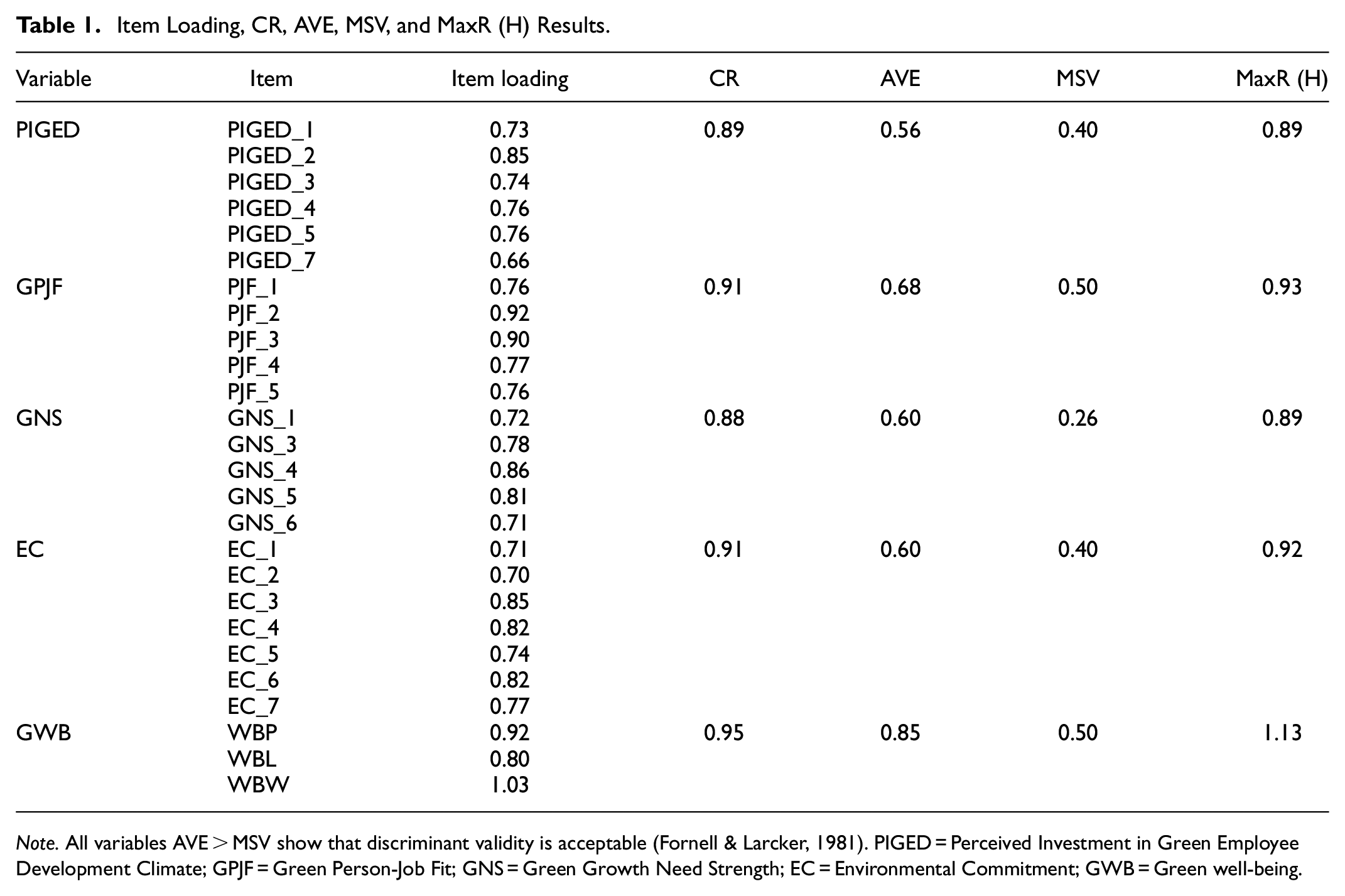
Note. All variables AVE > MSV show that discriminant validity is acceptable (Fornell & Larcker, 1981). PIGED = Perceived Investment in Green Employee Development Climate; GPJF = Green Person-Job Fit; GNS = Green Growth Need Strength; EC = Environmental Commitment; GWB = Green well-being.
Considering all studied measures originated from the same pool of respondents, a series of confirmatory factor analyses (CFA) was performed to determine the discriminant validity of the scales. First, we examined the discriminant validity of the five key variables: PIGED, green person-job fit, green growth need strength, environmental commitment, and green well-being using AMOS 18.0. The CFA analysis results indicated (see in Table 2) that the five-factor model revealed the best fit (χ2(1265) = 1265.01, RMSEA = 0.057, TLI = 0.911, CFI = 0.917, IFI = 0.918) among all other alternative models. These findings indicated empirical distinctions among the variables studied.
Confirmatory Factor Analysis Results.

Note. Five-factor model: perceived investment in green employee development climate, green person-job fit, green growth need strength, environmental commitment, and green well-being. Four-factor modela: perceived investment in green employee development climate and environmental commitment were combined into one factor. Four-factor modelb: perceived investment in green employee development climate and green well-being were combined into one factor. Three-factor model: green person-job fit, green growth need strength, and environmental commitment were joined into a single factor. One-factor model: all five factors were added into one factor.
p < .001.
Data Analysis
In our study, PIGED was measured at the group level, and green person-job fit, green growth need strength, environmental commitment, and green well-being were measured at the individual level. While the unit-level employees had similar perceptions of their unit climate, we adopted the aggregated scores from 55 operating units, ranging from four to five employees in each unit. Following the recommended procedure for hierarchical linear modeling (HLM) suggested by Preacher and Hayes (2004), we used four distinct hierarchical models at varying levels of analysis to test our hypotheses. These models included the null model, the random intercepts model, the intercept-as-outcome model, and the intercept- and slope-as-outcome model. In the study, a hierarchical regression equation was computed for each Level-1 individual. At Level-2, the level-1 intercept and slope scores served as dependent variables at Level-2. An individual-level effect was indicated by a significant parameter estimate for the Level-1 predictor, while a group level effect was indicated by a significant parameter estimate for the Level-2 predictor of the Level-1 intercepts and slopes. And in our study, we followed the recommendations of Hofmann and Gavin (1998) and centered the individual-level variables on the group-level mean, while centering the group-level means on the grand-level means.
In the study, we examined the cross-level main effect of PIGED on employee’s environmental commitment and green well-being and tested the mediating effect of green person-job fit and green growth need strength in these relationships. To test our cross-level hypotheses, we used Mathieu and Taylor’s (2006) mediation analytical technique. Mathieu and Taylor’s mediation approach combines four steps from Baron and Kenny’s (1986) mediation test. First, we tested the relationships between PIGED and environmental commitment, and PIGED and green well-being, which provided a total effect and met the prerequisite for a full mediation test. Second, we looked at how PIGED was related to the green person-job fit and green growth need strength (mediators). Third, we examined how PIGED changed the relationships between green person-job fit and green growth need strength (mediators) and environmental commitment and green well-being (dependent variables). Finally, we determined if our model supported a partial or full mediation model. To confirm the mediating effect, we employed Sobel’s test approach.
Results
Descriptive Statistics
The results of mean, standard deviation, reliabilities, and correlation coefficients are exhibited in Table 3. At the individual level, green person-job fit was positively correlated with green growth need strength, environmental commitment and green well-being (γ = 0.34, 0.48, and 0.70, p < .01). Green growth need strength was positively correlated to environmental commitment and green well-being (γ = 0.57, and 0.48, p < .01). Environmental commitment was also positively related to green well-being (γ = 0.55, p < .01) (See Table 3).
Descriptive Statistics and Correlations.

Note. Age, gender, educational level, and organizational tenure as control variable are tested in individual level. We controlled for gender (1 = male, 2 = female), age (1 = under 30 years, 2 = 30–39, 3 = 40–49, 4 = 50–59, 5 = 60 years or over), education (1 = high school, equivalent or less, 2 = undergraduate degree, 3 = post-graduate degree), Organizational tenure (1 = 1 year or less, 2 = 1–5, 3 = 6–9 years years, 4 = more than 10 years). Cronbach alphas for all measures are presented in the diagonals.
n =255 for level 1 variables and 53 for level 2 variable.
p < .05. **p < .01.
Data Aggregation
Before testing the study’s hypotheses, we conducted a pre-test for the variable within and between teams to ensure the data collected was appropriate for cross-level analysis. We tested the within-team agreement for PIGED by calculating rwg, and the rwg for PIGED ranged from 0.84 to 1.0 (mean = 0.960, median = 0.964), reflecting a high level of uniformity inside the group. Then, we directly aggregated the PIGED at the team level. Furthermore, we calculated the intraclass correlation coefficient (ICC(1)) to test if our dependent variables were subject to systematic between-group variance. In order to estimate four models—green person-job fit, green growth need strength, environmental commitment, and green well-being—we adopted null models with no predictors and examined the differences between the groups.
The ICC(1) of green person-job fit, green growth need strength, environmental commitment, and green well-being were 0.30, 0.13, 0.23, and 0.24. Meanwhile, we also calculated ICC(2) for estimating the reliability of the aggregated scores. The ICC (2) estimate was 0.67 for green person-job fit, 0.42 for green growth need strength, 0.58 for environmental commitment, and 0.60 for green well-being. According to established criteria for assessing data aggregation problems (e.g., Campion et al., 1993), the results are consistent and reliable. Thus, the responses to aggregating the data at the team level were adequate.
Hierarchical Linear Modeling
From hierarchical linear modeling (HLM) analyses (see Tables 4 and 5), the significant variance in PIGED can be accounted at the group level, according to our hypothesis. Firstly, we tested the direct effect of PIGED on environmental commitment, green well-being, green person-job fit, and green growth need strength. We conducted separate intercept-as-outcome models for each of these, using PIGED as a group-level predictor and the individual-level outcomes for environmental commitment, green well-being, green person-job fit, and green growth need strength. Table 4 shows that the PIGED had positive significant relationships with environmental commitment (γc101 = 0.95, p < .001, χ2 = 40.15; Model 1), green well-being (γc201 = 1.00, p < .001, χ2 = 57.70; Model 2), green person-job fit (γa101 = 1.15, p < .001, χ2 = 79.78; Model 3) and green growth need strength (γa201 = 0.61, p < .001, χ2 = 46.76; Model 4). Thus, H1a, H1b, H1c, and H1d were supported.
Multilevel Direct Effect Model Results.

Note. PIGED = Perceived Investment in Green Employee Development Climate; EC = Environmental Commitment; GWB = Green well-being; GPJF = Green Person-Job Fit; GNS = Green Growth Need Strength.
p < .001.
Multilevel Mediation Effect Model Results.

Note. PIGED = Perceived Investment in Green Employee Development Climate; EC = Environmental Commitment; GWB = Green well-being; GPJF = Green Person-Job Fit; GNS = Green Growth Need Strength.
p < .001.
Second, we tested the direct effect of green person-job fit on environmental commitment and green well-being, and the direct effect of green growth need strength on environmental commitment and green well-being; we tested these using a random coefficients model. The HLM results showed that green person-job fit was positively related to environmental commitment (γb110 = 0.33, p < .001, χ2 = 80.01; Model 5) and green well-being (γb210 = 0.60, p < .001, χ2 = 66.54; Model 6). Thus, H2a and H2b were supported. Additionally, green growth need strength was positively related to environmental commitment (γb310 = 0.66, p < .001, χ2 = 80.40; Model 7) and green well-being (γb410 = 0.56, p < .001, χ2 = 57.05; Model 8). Thus, H3a and H3b were also supported.
Recommended by Mathieu and Taylor (2006), we used the mediation steps and first tested the mediation effect of green person-job fit between PIGED and environmental commitment. PIGED had a significant effect on environmental commitment, as shown in Model 9 (see Table 5), when green person-job fit was introduced as the individual-level predictor to the same regression model, (γc1′01 = 0.69, p < .001, χ2 = 50.44, which reduced from the value of 0.95, p > .5; see Model 1). Green person-job fit partially mediated the relationship between PIGED and environmental commitment.
We next examined the mediation effect of green person-job fit on PIGED and green well-being. After entering green person-job fit into the same regression model (see Model 10 in Table 5), PIGED had a significant effect on green well-being (γc2′01 = 0.38, p < .001, χ2 = 50.10, which reduced from the value of 1, p > .5; see Model 2). There was a partial mediating effect of green person-job fit on the relationship between PIGED and green well-being. Thus, H4a and H4b were supported. Furthermore, Sobel’s test of the indirect cross-level effect of PIGED on environmental commitment (Sobel’s z = 4.74, p < .001) and green well-being (Sobel’s z = 6.24, p < .001) were both significant.
Furthermore, we tested the mediation effect of green growth need strength between PIGED and environmental commitment. After entering green growth need strength into the same regression model (see Model 11 in Table 5), PIGED had a significant effect on environmental commitment (γc3′01 = 0.63, p < .001, χ2 = 67.14, which reduced from the value of 0.95, p = .06; see Model 1). Green growth need strength partially mediated the relationship between PIGED and environmental commitment. Finally, we examined the mediation effect of green growth need strength on PIGED and green well-being. As shown in Table 5 (Model 12), when green growth need strength was introduced as the individual-level predictor to the same regression model, PIGED had a significant effect on green well-being (γc4′01 = 0.72, p < .001, χ2 = 61.07, which reduced from the value of 1, p = .16; see Model 2). Green growth need strength partially mediated the relationship between PIGED and green well-being. Thus, H5a and H5b were supported. The Sobel’s test of the indirect cross-level effect from PIGED on environmental commitment (Sobel’s z = 4.56, p < .001) and green well-being (Sobel’s z = 4.36, p < .001) were both significant.
Discussion and Conclusion
This study aimed to: (1) investigate the cross-level influence of PIGED on employee’s environmental commitment and green well-being and (2) ascertain whether green person-job fit and green growth need strength mediated these relationships. Using multilevel analysis of data from 265 employees across 55 operating units at a Malaysian sustainable certified palm oil company, we found support for all five hypotheses. Specifically, we emphasized the cross-level PIGED on environmental commitment and green well-being, and identified cross-level relationships between PIGED and green outcomes that were mediated by green person-job fit and green growth need strength.
Theoretical Implications
Although the relationships between green human resource practices and green outcomes have been found to be inconsistent in past studies (Dumont et al., 2017; Kim et al., 2019; Luu, 2018; Pinzone et al., 2019; Xie et al., 2020), this inconsistency may be due to the complex organizational factors that influence the learning and application of green learning at work. Specifically, when competing priorities exist between green training and individual abilities to apply new learning, this tension can influence subsequent work behaviors (Xie et al., 2020). Past studies have examined the relationship between green human resource practices and green work outcomes at the single level of analysis (Aftab et al., 2023; Ahmad et al., 2022; Amrutha & Geetha, 2021; Kim et al., 2019; Luu, 2023; Paillé & Valéau, 2021; Pham et al., 2020; Pinzone et al., 2019), which may have contributed to these contradictory findings. The situation is worsened when the palm oil industry is comprised of numerous operating units, which are often geographically scattered and segregated, making cross-level analysis particularly important. While the cross-level linkages of investments in sustainability initiatives are conceptually linked to relational work outcomes through employee benefits (Bhattacharya et al., 2009), these linkages have not been confirmed empirically.
Instead of a single level of analysis, our study fills in this gap by demonstrating the cross-level impacts of PIGED in the current study. It provides an alternative way to assess PIGED in which the strong and uniform climate can influence green well-being and environmental commitment. This climate signifies the consistency of the immediate supervisors enacting the green human resource practices in each work unit during the implementation process (DuBois & Dubois, 2012), and its influences on individual employee psychological processes (Ostroff & Bowen, 2000). The PIGED in the current study provides a critical cue to employees to facilitate the environmental sustainability initiatives. This is in line with the social exchange theory and Bhattacharya et al.’s (2009) stakeholder responses to corporate social responsibility (STR-CSR) model. According to social exchange theory, employees reciprocate perceived investments made by the organization, such as PIGED, by displaying positive attitudes (Blau, 1996) that support environmental sustainability initiatives. Bhattacharya et al.’s (2009) STR-CSR model suggests that organizations have a responsibility to consider the interests of employees in their efforts toward sustainability by developing quality of relationship between organizations and employees through beneficial CSR initiatives for employees. Creating PIGED in the organization can foster a sense of reciprocity and mutual benefits, resulting in higher levels of environmental commitment and green well-being. Hence, this adds a new perspective on the importance of strong employee attributions on PIGED at the unit level that bring beneficial values to promote environmental commitment and green well-being, particularly in the context of the palm oil industry.
Furthermore, our study found that when employees are given the opportunity to benefit from PIGED across multiple units, they derive the benefits to fulfill green person-job fit and green growth need strength to produce environmental commitment and green well-being. The cross-level linkages reflect an underlying relationship of a social exchange relationship based on trust between employees and the organization (Blau, 1996), where employees believe that the organization is committed to their development and well-being, and thus reciprocate by contributing to the organization’s sustainability efforts. As delineated in Bhattacharya et al.’s (2009) STR-CSR model, providing beneficial PIGED to employees fulfill their external needs of green person-job fit, and internal needs of green growth need strength. These subsequently develop a higher quality of relationship with the organization as the employees are satisfied with and committed to the sustainability initiatives. Aligning green human resource practices with employees’ personal growth desires, job needs, and demands can demonstrate that organizations recognize and value their employees (DuBois & Dubois, 2012). This alignment fosters a strong workplace partnership based on interdependence and trust for a long-term exchange relationship (Tsui et al., 1997) toward sustainability initiatives. Using the SET and STR-CSR model, we shed light on a psychological mechanism underpinning employees’ satisfaction with and commitment to the environmental sustainability of their firm. Hence, this study confirms the links between stakeholder perceptions of CSR initiatives and their commitment and satisfaction through personal values and functional benefits, as proposed in the STR-CSR model (Bhattacharya et al., 2009). This study demonstrates how PIGED can benefit employees by fulfilling their needs for green person-job fit and green growth need strength and thereby, shaping their environmental commitment and green well-being.
In conclusion, drawing on the SET and STR-CSR model, our study illuminates a more nuanced understanding of the valuable PIGED through the psychological mechanisms of green growth need strength and green person-job fit to build relational exchange in the form of environmental commitment and green well-being.
Implications for Practice
Several implications can be learned by practitioners from this study to help employees in multiple locations to focus on their key competencies benefited from the training and developmental policies, procedures, and practices, and to increase beneficial values derived from PIGED. First, our findings suggest that human resource professionals could play a pivotal role in providing PIGED to help employees cultivate their green competencies and capabilities. By implementing appropriate green interventions for employee development (e.g., training and workshops on RSPO practices, integrated pest management, and pollution prevention) that align with employees’ green growth need strength, human resource practitioners and managers could promote a green developmental climate and assist employees to develop and improve necessary green skills and competencies to meet current and future responsibilities about environmental sustainability (Tey et al., 2020, 2021). This green organizational climate could encourage employees to develop their green learning needs, be environmentally committed to their work, and improve the quality of their green work-life domains (Abdullah et al., 2017).
Second, the findings highlight the important links between PIGED, environmental commitment and well-being through employees’ perceptions of green person-job fit. To make these links stronger, human resource professionals could develop a set of tools, resources and materials for supervisors in each unit to implement sustainability initiatives. For example, supervisors in each location could be involved in the board of directors’ decision-making process. The inclusive and transparent participation could give the supervisors a better understanding of the company’s sustainability goals and priories, align their unit-level goals and activities with the company’s overall sustainability agenda, and communicate it effectively to their subordinates. In the meantime, the subordinates could meet the environmental sustainability standards by working closely with the sustainability unit such as participation in the meetings to discuss ways that the subordinates could contribute to these efforts. Such participation increases the units’ alignment with employees’ job and subsequent sustainability initiative outcomes (Thomas et al., 2012). Additionally, rewarding employees for their contribution to sustainability initiatives and integration of sustainability metrics into performance appraisals could provide psychological reinforcement by sending a strong signal of fit between employees’ jobs and their skills and abilities that subsequently commit to sustainability initiatives (Pham et al., 2023). Finally, human resource professionals could also use green recognition programs to enhance the connections to employees’ current and upcoming green jobs, which may help them examine green person-job fit, current or required green knowledge and skills to improve, additional opportunities for green self-development and how such participation can help employees to make their contribution to sustainability initiatives (Thomas et al., 2012).
Limitations and Future Research
The current study has three limitations. First, this study used cross-sectional design. Although multi-level data have been included, single source data collected from a single point of time are limited in their ability to reveal causality. In the future, alternative data sources could be used to overcome the weakness of cross-sectional data during the data collection stage. For example, multi-source ratings like peers, and subordinates could be invited to rate individuals’ environmental commitment. Second, it should be noted that the findings from this study are specific to the context of Malaysian palm-oil producers. However, other companies can still learn the knowledge gained in this study and adapt it to their own context. Moreover, the current research model could be replicated in other industry sectors in the future. Finally, future research could use longitudinal data to observe changes in perceived environmental commitment and well-being. With these additional quantitative recommendations, qualitative approaches could be considered to observe employees’ in-depth experience and perception. For example, phenomenology could be adopted to investigate employees’ lived experiences in relation to PIGED, green person-job fit, green growth need strength, environmental commitment, and employee well-being. By combining qualitative and quantitative methods, researchers could employ mixed methods to delve deeper into the interplay between the many factors under consideration.
Footnotes
Appendix
Declaration of Conflicting Interests
The author(s) declared no potential conflicts of interest with respect to the research, authorship, and/or publication of this article.
Funding
The author(s) disclosed receipt of the following financial support for the research, authorship, and/or publication of this article: This work is supported by Monash University Malaysia [research grant B-5-18]. We would like to thank Monash University Malaysia for supporting this research.

Data Availability
The datasets generated during and/or analyzed during the current study are available from the first author on reasonable request.