




Abstract
This study examined the moderating role of gender and living arrangements in the relationship between generativity and subjective well-being among Malaysian old adults. The descriptive survey research design was utilized for this study. The target population was healthy old adults aged 60 and above in Ipoh, Malaysia with healthy cognitive ability. Using a purposive sampling technique, 441 old adults were recruited from public places to participate in the study. They responded to a validated questionnaire administered via structured interviews. Instruments include measure of generativity and subjective well-being. The study employed an independent sample t-test and Pearson correlation to find the differences and associations between understudied variables. Hayes Process was used to test the moderation effect of gender and living arrangement. The main results of the analysis show significant correlation between all variables. Specifically, the study suggests that gender and living arrangement moderate the association of generativity and old adults’ SWB. However, gender as a single variable does not moderate the association. Hence, this paper concludes that by contributing to others, the subjective well-being of older adults could be improved. The findings are useful for all relevant parties to develop necessary actions for promoting successful aging among senior citizens.
Introduction
Globally, we are facing a demographic shift and an alarming increase in the senior citizen population (He et al., 2016). The old adult population over the age of 60 has reached 760 million now and is predicted to reach 2 billion by 2,050 in developing countries (Chand, 2018; Seo, 2017). As such, United Nations (2019) predicted that Malaysia will be transformed into an aged nation by 2030 where the old adult population will be 15% of the overall population. If this phenomenon were not properly addressed, the rising number of older adults could result in problems, especially in future health-related issues (Chand, 2018).
The growing aging population may also bring some social challenges, for example with regards to health status, financial stability, and others. In light of the population transitions, it is imperative to focus on this age group. Henceforth, to be aligned with the growing number of old adults and to reduce future social challenges, greater efforts need to be taken and implemented in managing their subjective well-being (SWB). Ensuring well-being is helpful to mold a better future for this group of population (Liu et al., 2017).
SWB refers to a dual construct that is used for self-appraisal of one’s overall life situation. The first construct involves cognitive judgment related to one’s satisfaction with his or her own life. The second construct involves the affective component that evaluates the emotions or moods one experiences in own’s overall life (Diener et al., 2018). The concept of SWB has been built upon a hedonic perspective. There is much research work done to investigate the factors contributing to SWB (Diener & Ryan, 2009) and the study has also pointed out that the factors may vary according to a person’s age group and gender. Better understanding about factors that can predict SWB can increase our chance to develop a healthy aging society, thus fostering more optimism for aging nations. This study focuses on finding the association between generativity and SWB of old adults besides determining the moderating role of gender and living arrangement in the above-said association.
Generativity and SWB
Generativity refers to a psychological need to contribute to the next generation in any form. It is vital for providing meaningful satisfaction to others. The term was first coined in Erikson’s theory whereby generativity was part of humankind’s eight stages of psychosocial development. Erikson viewed generativity, which primarily involves concern and care for others, as the critical developmental task of midlife people aged between 45 and 60. Individuals in middle and old age develop an interest in guiding the next generation by focusing more on the well-being of others than their own. The concern for the good of others brings out a sense of gratification and improves SWB of their own. Erikson’s theory also indicates well-being in old age that might result from successful psychosocial development across the whole life course. Hence, achievement of midlife generativity was assumed to increase the likelihood of attaining SWB in old age (Ardelt et al., 2018).
Many researchers have examined the positive relationship between generativity and SWB. For example, Newton et al. (2020) conducted research among 204 female participants aged between 60 and 75 and found a significant positive association between generativity and both construct of SWB (life satisfaction and affective component). Although research has constantly shown positive direct correlations between generativity and SWB (Grossbaum & Bates, 2002; Huta & Zuroff, 2007; Newton et al., 2019), the mechanism behind the association is unclear (Cox et al., 2010; Grossbaum & Bates, 2002; Morfei et al., 2004). The present study, thus aimed to determine the mechanism behind the association between generativity and SWB.
Gender and SWB
In Malaysia, the population of female old adults are higher than male old adults (Hamid, 2015). A census survey in 2016 witnessed old adult population whereby there are 54.5% female (1,400,237 million) and 45.2% male (1,170,063 million) (National Population and Family Development Board Malaysia, 2016).
Just as there is a slight difference by gender in terms of number, earlier studies also indicate that there was a gender difference in terms of the SWB level of old adults. A study in China with adult samples drawn from the Chinese Family Panel Study (CFPS) from 25 provinces in China revealed that females exhibit higher SWB (Zhou & Peng, 2018). One possible explanation for the lower SWB of males is that males are typically expected to support their families. This could add additional responsibility and pressure which in turn impacts their SWB (Cao & Chai, 2008). Then again, there was also a study done among 150,000 samples with a combination of adults and old adults. The study indicates that for adult samples, females reported higher SWB levels, as for old adult samples, males reported better levels of SWB (Inglehart, 2002).
On the other hand, some studies reported no gender differences among SWB of old adults. Zuckerman et al. (2017) proved that there were no gender differences in SWB in their study. These inconsistent and conflicting findings of past studies highlight the need to find out the real impact of gender on one’s SWB.
Living Arrangement and SWB
Living arrangement refers to the residential space the elderly choose to live in; either to live independently with their spouse or to live with their adult children. Initially, adult children and old parents living together under the same roof was quite a norm, especially in Asian culture. The adult children- elderly parent co-residence was quite a custom that many families tend to conform to the social norm (Hsu, 1998). However, as young adults chasing their career betterment, some of them had to move out and live in their nuclear families and leave the old adult as empty nesters. Several studies reveal that the proportion of empty-nest older people who live alone or with a spouse only is rapidly increasing to over 50% (Cheng et al., 2015; Liu et al., 2014).
Amid rapid globalization, the living arrangement trend now is changing again. The deteriorating economy makes it more difficult for some people to set up a new home and this causes adult children to move back into their parents’ homes for parental support (Tosi & Grundy, 2018). Yet, the impact of this changing living arrangement is yet to be studied. Some elderly reported having a better quality of life when they live alone and independently. Older adults seem to benefit from living alone by having more privacy which gives them more autonomy in their own house. Co-residing with their adult children always gives an impression of being a burden to the rest (Tan, 2018).
From another point of view, the advancement of medicine improves the health condition and autonomy of old adults. On that note, adult children no longer perceive their old parents as burdens, but rather as a significant source of support. Therefore, the trend of old adults’ co-residence with children has grown (Herrera et al., 2022). Many studies highlight intergenerational co-residence improves old parents’ quality of life and SWB. A recent longitudinal survey among older people aged 60 years or above in 22 Chinese provinces indicates that co-residence wields a higher life satisfaction and happiness among the elderly’s SWB (Yuan et al., 2021). This study aims to find the role of living arrangements as a moderator in the association between generativity and SWB (Figure 1).

Conceptual framework of moderation effect of gender and living arrangement on the relationship between gender and SWB.
Method
Participants
The participants in this study were old adults from Ipoh, Malaysia. The participant was first randomly selected from public places (e.g., park, market) and then chain-referral method was used to get more samples. For this study, the analytical sample was limited to old adults aged 60 and above (N = 441, M age = 66.6). The sample comprised old adults from various ethnicities: Chinese (51.0%), Malay (31.5%), and Indians (17.5%). Of the sample, 50.1% were female and 49.9% were male. Two-thirds (n = 385, 78.2%) were married and still with their spouse, 16.1% were widows/widowers and the remaining 5.7% are divorced/separated. For living arrangements, 52.4% of old adults reported that they co-reside and live under the same roof as their adult children.
Procedures
The study design was approved by the Research Ethical Committee Board of a higher education institute. Targeted participants (old adults) were recruited by snowball sampling. Enumerators were assigned to conduct survey interviews with the participant and tokens of appreciation were offered for participation. A cash token worth Malaysian Ringgit (MYR) 5.00 was given to the participant who completed the questionnaire via e-wallet transfer (Touch N Go E-Wallet). The participant’s informed consent was obtained, and they were pre-screened with the Short Portable Mental Status Questionnaire (SPMSQ) to ensure that the participant is healthy in terms of cognitive ability. Qualified participants were the ones who fulfill the criteria of being physically healthy without any serious illness (e.g., stroke, bedridden) and having a good cognitive ability. Once the data was collected, the participants were then debriefed about the study.
Measures
As this study focuses on older adults, the questionnaires were made available in four main languages in Malaysia (Malay, English, Mandarin and Tamil) for the convenience of participants. Back translation procedures techniques were employed. To ensure the accuracy of the translation, skilled translators with a psychology background (educators with psychology major) were hired to translate. The questionnaire consists of a few validated scales as stated below:
Pre-screening
The Short Portable Mental Status Questionnaire (SPMSQ) was used to determine the cognitive ability of the participant. There was a total of 10 items on this scale. A score of 8 and above indicates good mental ability. Scores below 8 are classified as poor intellectual ability. Only participant who manage to get a score above 8 was allowed to participate in this study.
Generativity
The six-item Reduced Loyola Generativity Scale (LGS; Keyes & Ryff, 1998) (each item scored ranging from 1 = not true, to 4 = mostly true) was used to evaluate respondents’ perceptions of their contribution to society, giving back to the next generation, and passing on knowledge and skills to others. The total score ranges from 4 to 24, whereby the higher score indicates higher level of generative acts.
Subjective Wellbeing
In the 7-point Likert Satisfaction with Life Scale (SWLS; Diener et al., 1985) with scores ranging from 5 to 35 in the five items, a higher score indicates a higher level of the cognitive domain of SWB. Positive Affect and Negative Affect Scale (PANAS-SF; Thompson, 2007) has 10 items; five items measure positive experiences, and five items measure negative experiences. It is used to measure the affective domain of SWB as it reflects SWB as defined by Diener et al. (2018) (i.e., Haslam et al., 2009; Whillans et al., 2016). A composite measure of SWB was constructed by standardizing the SWLS and the PANAS-SF scales and combining them with the formula (SWB = SWLS + PA − NA). It has been used as a reliable measure in several earlier studies involving various age groups of respondents (Haslam et al., 2009; Whillans et al., 2016).
Data Analysis
The data was analyzed by using Statistical Package for Social Sciences (SPSS) version 25 and Process Macro version 4.0. Descriptive analysis was used to figure out the background of the participants and the general distribution of the variables. Pearson correlation analyses were used to find the correlation between the variables studied. Finally, double moderation analyses (Model 2) were used to determine the moderating effect of gender and living arrangement. Hayes’s (2013) SPSS macro-PROCESS with 10,000 bootstrapped samples was used for moderation analysis.
Results
Correlation Between Generativity and SWB
A Pearson correlation analysis was conducted to examine the relationship between generativity and subjective well-being. The analysis indicates that there was a significant positive correlation between generativity (M = 17.02, SD = 4.12) and SWB (M = 30.58, SD = 9.88) with r(439) = .607, p < .01. The findings give empirical evidence that being generative results in higher SWB.
Gender and Living Arrangement as Moderator
In SPSS Process by Hayes (2012), we have selected model 2 to test moderation and the output is shown in Tables 1 and 2. Table 1 shows that zero does not lie between the lower limit of confidential interval (LLCI) and upper limit of confidential interval (ULCI) of “Generativity × LA” which indicates living arrangement has a moderating effect on the relationship between generativity and SWB.
Moderation Effect of Living Arrangement and Gender in Association With Generativity and SWB.
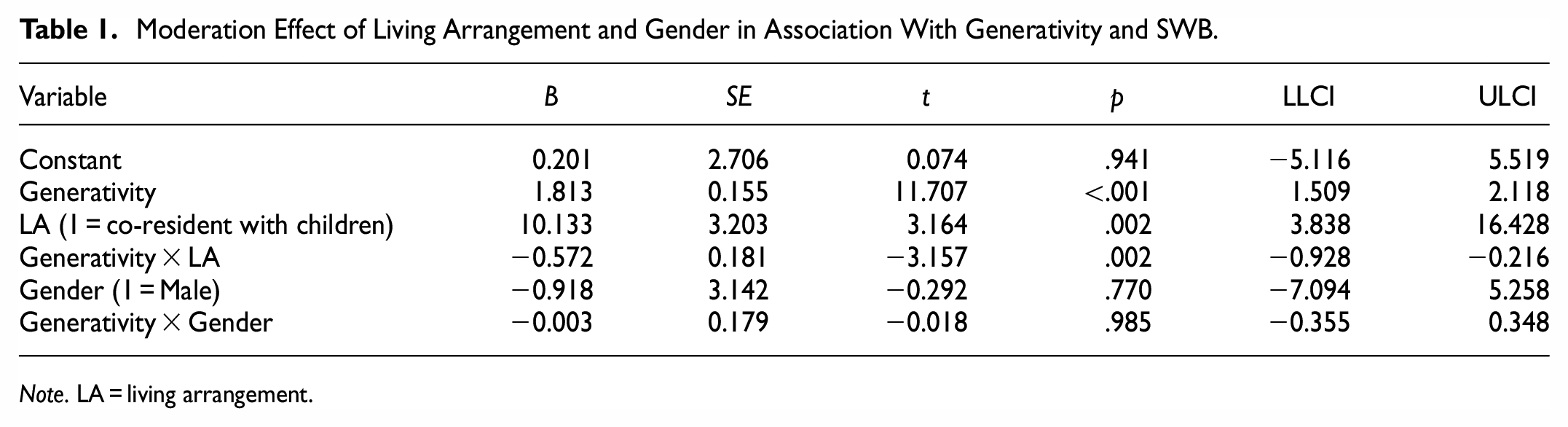
Note. LA = living arrangement.
Moderation Analysis Output.

Note. LA = living arrangement.
On the other hand, the results shown in Table 1 indicate that zero does not occur between the lower limit of confidential interval (LLCI) and upper limit of confidential interval (ULCI) of the “Generativity × LA” relationship, which indicates that living arrangement has a moderating effect on the relationship between generativity and SWB. Next, with the inclusion of both moderators (gender and living arrangement), the interaction is significant (refer to Table 2).
To test how the different gender and living arrangements influence the relationships, a graph was plotted (Figure 2) from the SPSS process output. According to Figure 2, we can confirm that when the generativity level is low, females who reside with their children (co-residing) has higher SWB than females that live separately with their children (non-co-residing). When the generativity is high, non-co-residing female samples have higher SWB than co-residing females. On the other hand, when the generativity level is low, non-co-residing males have a low level of SWB while male who co-reside with children has higher SWB.

Interaction plot of gender-living arrangement in the association of generativity and SWB.
Discussion
Due to the silver tsunami in Malaysia, improving older adults’ SWB is becoming increasingly important. There are multiple operational definitions concerning SWB, nevertheless, this study has adopted the definition of SWB that encompasses three distinct components proposed by Diener et al. (2018), which entail life satisfaction, positive affect, and negative affect. This study aimed to examine the relationship between generativity and SWB of Malaysian older adults in Peninsular Malaysia. Specifically, this study also intended to examine the moderating role of gender and living arrangements in the association of generativity and SWB of older adults. Pearson correlation and Hayes Process Macro moderation analysis were utilized to fulfill the research objective.
The main results of the study show that generativity has a positive significant correlation with the SWB of the old adult, which is consistent with previous findings that the higher the level of generativity, the higher the level of SWB (Becchetti & Bellucci, 2021; Moieni et al., 2020; Muñoz-Rodríguez et al., 2019). For instance, a study conducted among 73 older women reported that individuals with more generative acts experience lower loneliness and higher SWB. The generativity or social usefulness added meaning to the lives of older people and subsequently increased their well-being (Moieni et al., 2020). From a theoretical perspective, these results correspond to Erikson’s theory that proposed achievement in generativity facilitates the eighth psychosocial development (ego integrity vs. despair) where old adults learned to accept their lives instead of dwelling on their past. This acceptance results in wisdom which subsequently results in greater well-being as a sense of despair is overcome (Ardelt et al., 2018). This implies that the prospect of feeling useful to others, or the generative acts represents an aspect that makes one identify their life as useful (Becchetti & Bellucci, 2021). Another theoretical explanation behind the positive link between generativity and SWB can be partly framed by the socioemotional selectivity theory. In the means to live a meaningful life, older adults may be driven to adopt generative actions as a stepping stone to a positive sense of identity (Chen et al., 2022). This positive sense of identity added meaning to their life which eventually contribute to their SWB (Ackerman et al., 2000; Chen et al., 2022).
Although there are extensive studies on generativity and SWB of older adults (Becchetti & Bellucci, 2021; Herrera et al., 2022; Kruse & Schmitt, 2012), the association can vary by time and may be shaped by other factors. In accordance with that, the current paper tested the role of gender and living arrangements as moderators in the relationship between generativity and SWB. The moderation analysis in the current study confirms the significant role of gender and living arrangements in the relationship between generativity and SWB. The results conclude that when the generativity is low, both male and female older adults who live with their children (co-residing) experience higher SWB than the non-co-residing older adults. Both males and females who live separately from their children (non-co-residing) experience higher SWB than the co-residing parents only if they performed more generative acts. Numerous studies have examined the role of social context in generative acts (Cheng, 2009; Chen et al., 2022). Among the most salient social context variable tested are gender differences due to the different expectations and norms that society imposes on men and women during their formative years (Cheng, 2009). Research among 348 older adults across 10 villages in India found that overall generativity was slightly higher among men than women. The same study demonstrated that high generativity further contributes to the higher quality of life and SWB of participants (Østbye et al., 2018). On the other hand, Sagara and Ito (2017) in their article stated that generativity can be looked at in two dimensions, namely the consciousness toward generativity and the willingness to contribute. The study took place in Japan and found that both genders have equivalent interest in generativity whereby males had higher consciousness toward generativity and females had higher will toward generativity.
Besides that, the third substantial findings from the moderation analysis indicate that non-co-residing elderly had higher SWB compared to co-residing elderly when the generativity is high. The possible explanation for the results could be because elderly who lives independently have to rely more on generative acts to overcome the empty nest syndrome and to gain the satisfaction of being meaningful. On the other hand, older adults who live alone regardless of gender need to do something that will outlive them and that will be the turning point for them to do something for others. The failure to be generative will lead the old adults, especially the empty nesters, to feel a sense of stagnation and disconnection as proposed by Erik Erikson (Ren et al., 2022). On the other hand, generativity is also important for the elderly who stay with family, but its need is not crucial. For the elderly co-residing with their children, staying under the same roof could give them the opportunity to be generative to their child and grandchild by default. They could compensate for generativity with the quality time spent with their lineage family. Time spent with the children and grandchildren could make their life more meaningful, thus leading them to be less dependent on generativity (Pratt et al., 2008). In parallel to that, an earlier big scaled qualitative study among 3,289 elderly parents in China indicates that parents who live together with their child and grandchild reported better SWB (Ye et al., 2017).
Lastly, a finding worth mentioning here is there is no significant difference in gender in the level of SWB of the older adult. The results are consistent with a recent study among 436 older adult learners in China also reported no gender difference found in their SWB (Shi et al., 2022). Not only that, a report from a meta–analysis done with 21 research articles supported the latter results of no significant gender difference in older adults’ SWB (Ren et al., 2010). However, there is also some empirical evidence that provided contradicting results. For instance, several studies reported that older men experience higher SWB compared to older women (Li et al., 2007; Wang, 2015; Wang et al., 2015). A study among older adults in Anhui Province, China stated that the SWB of older women are in the intermediate level but rather lower compared to older men. On the other hand, a study among 732 older adults in Nigeria found older males reported better SWB than their counterparts. The results were further explained by the patriarchal culture they hold that gives more importance to the male (Abdullahi et al., 2020). These mixed findings highlight that different geographic locations may also impact the contribution of gender to SWB.
In our view, the reported results of our research elucidate that both generativity and living arrangement as a significant contributor to older adults’ SWB. In the future, it would be particularly interesting to replicate this study with a qualitative method. A qualitative approach might be useful to derive richer information on how the variables can exactly contribute to an old adult’s SWB.
Limitations
Although this paper improves our understanding of how gender and living arrangement affect the association between generativity and SWB in old adults, it is not without limitations. This study analyzed data only from old adults from Ipoh, Malaysia, and due to it, the results may not be generalized to overall Malaysian old adults. The data collected from a city may not represent the population from the more rural areas and the experience of old adults in this location may be different compared to other states. To improve the ability to generalize research findings to other Malaysian samples, future studies should include the older adult population from all 14 states and both urban and rural locations.
Secondly, this study demonstrated the contribution of a few variables (generativity, gender, and living arrangement) to the SWB. However, because of the operational definition of SWB that was utilized, the results may not be collective or universal. The current study regards SWB as a dual component construct that includes cognitive and affective domains as defined by Diener et al. (2018). However, many other definitions of SWB are also commonly used by social science researchers. As a result, the current findings might not have been the same if SWB had been operationalized differently.
Thirdly, the fact that the study was quantitative added another constraint. It gave the researcher the scant information they needed. Using a mixed method that combines a quantitative and qualitative approach may yield rich information on the investigated variables. Despite these drawbacks, the study offers a piece of decent information regarding associations between generativity and SWB, together with the moderator roles of gender and living arrangements.
Implication
This study has a few important implications. First, the findings of this study confirmed that conceptualizing subjective well-being in both cognitive and affective domain can also be applied in the context of older adults. Most research using this conceptualization tends to focus on general population rather than old adults per se. Hence, this study helped to fill up the knowledge gap and contribute to the field of gerontology. This study also can be an important reference for future studies related to SWB, generativity, and living arrangement among older adults. This study also brings evidence of the vital role of living arrangements and generativity. Stakeholders such as authorities and local ministries can use the finding to organize programs for older adults that could nurture generative acts. Lastly, the results of this study can be used to understand the critical roles of the understudied variable and to tailor an effective intervention to promote the overall SWB of older adults.
Conclusion
With the population of old adults upsurging and the potential of the silver tsunami occurring, more research should focus on older adults and their well-being. This study highlights the significant role of generativity and living arrangement in contributing to an older adult’s life experience and subjective well-being. Any effort to improve and optimize the well-being of older adults should provide more opportunities for them to participate and contribute thus increasing their generativity.
Footnotes
Declaration of Conflicting Interests
The author(s) declared no potential conflicts of interest with respect to the research, authorship, and/or publication of this article.
Funding
The author(s) disclosed receipt of the following financial support for the research, authorship, and/or publication of this article: The research has been funded by Universiti Tunku Abdul Rahman through Universiti Tunku Abdul Rahman Research Grant (UTARRF) (Reference number: IPSR/RMC/UTARRF/2020-C2/S02).
Ethical Approval
All procedures performed in this study involving human participants were in accordance with the ethical standards of the Human Research Ethics Committee of Universiti Sains Malaysia (Approval code: USM/JEPeM/21010078) and Research Ethic Boards of Universiti Tunku Abdul Rahman (Approval code: U/SERC/03/2021) before the data collection.
Informed Consent
Informed consent was obtained from all the participants.
