




Abstract
The study investigates the metaphorical images of English teachers formulated by English for Academic Purpose (EAP) teachers and postgraduate students in a Chinese Sci-tech University. Student Participants (n = 171) and teacher participants (n = 51) completed questionnaires including the metaphor-eliciting prompts to express their perceptions of English teachers. The results revealed a similar three-level categorization (information, disposition, and status) of teachers’ features from the two groups, as well as similarities and discrepancies in the perceptions of certain conceptual teacher metaphors. Based on the comparison, implications for EAP teaching and EAP teachers’ identity development in China are discussed.
Introduction
Identity can be understood as a set of meaning systems that controls a person’s cognition, emotion, and action in his or her interactions with the world (Han, 2017). According to this definition, the study of identity can be accessed through one’s cognitive activities, emotions, and behaviors in the socialization process. However, the research difficulties lie in the fact that the indicators of identity are usually elusive, unquantifiable, and inter-wined with each other, making identity study a multilevel, dynamic, and systemic task (Varghese et al., 2005). This article intends to investigate the identity development of Chinese EAP teachers by revealing the dissonance and similarities in the perception of English teachers by comparing teacher metaphors provided by postgraduate students and EAP teachers.
Ever since the reinterpretation of metaphor as a cognitive tool in linguistics (Lakoff & Johnson, 1980; Ortony, 1993), metaphor has become a popular approach to studying identity since it can reflect people’s perceptions of themselves based on their prior knowledge and experience. In the last decade, there has been a growing body of research devoted to the analysis of how teachers view themselves through analyzing teacher metaphors (Alsup, 2006; Mahlios et al., 2010; Nguyen, 2016; Beauchamp & Thomas, 2011; Thomson, 2016). One line of research investigates teachers’ meaning-making process by revealing the connections between metaphors and the cognitive conceptualization of teacher images (Poom-Valickis, Oder & Lepik, 2012; Ó Gallchóir et al., 2018); while the second group of studies focus on how internalized teacher metaphors influence teaching activities and teacher-student interactions (Maxwell, 2015). Both lines of research attached importance to the cognitive activities of teachers, and the majority of studies focused either on teachers’ personal growth or on how teachers’ self-perception affects students’ performance (Alger, 2009; Berliner, 1990; Erickson & Pinnegar, 2016; Farrell, 2016).
As the goal of language teaching diversifies, a critical issue in language education today is the match between teachers’ and students’ perspectives of language teaching and learning (Ladson-Billings, 1995). A clear understanding of how teachers and students conceptualize teacher image in their minds is critical for teachers to develop a context-based dynamic teacher identity that resides in their interactions with students. However, fewer identity studies have taken teacher-student interactions and their mutual influence into account. As a group of essential participants in teaching, students have not been considered active agents in teacher identity formation (Beijaard et al., 2004). From a social psychological perspective, the self-concept and social context combined make up who we are. Andersen and Chen (2002) argued that “self” changes during interactions with different people and social activities help define the boundaries of self-identity (Andersen & Chen, 2002). According to Mead (1934, p. 225), “self can arise only in a setting where there is social communication.” Therefore, given that teacher identity development is a dynamic process, in which conceptualized teacher’s role undergoes conflicts during interactions with students, students’ conceptualizations of teachers are of paramount importance in teacher identity development and require further investigation.
The following part of the article is structured as follows: the second section reviews studies on teacher identity studies involving the use of metaphors, and introduces the traditional teacher image in the Chinese sociocultural context; the third section presents the research methodology, which includes questionnaire designing, data collection, description of the participants, as well as the model for data analysis; the fourth section presents the results of categorized conceptual teacher metaphors and the fifth section compares the metaphors from students and teachers, analyzes the similarities and discrepancies in the conceptualizations of EAP teachers, and discusses the possible reasons for the similarities and discrepancies as well as how do they influence Chinese EAP teacher’s identity development. The last section summarizes the research and provides the implications for Chinese EAP teaching and EAP teachers’ personal development.
Literature Review
Metaphor as an Effective Lens in the Understanding of the Teacher’s Role
Prominent early researches using metaphors to examine teacher identity include Clandinin’s (1985) study on teacher images and the study carried out by Bullough and Gitlin (2001). Saban (2006) identified ten functions of metaphors in teacher education, which set an impetus for researchers to examine how metaphors play out in the dynamic evolution of teachers’ beliefs and identities. Teacher education researchers have long recognized the intimate relationship between metaphors and teacher identity construction (Farrell, 2016; Martinez et al., 2001; Pinnegar et al., 2011; H. Zhao et al., 2010) and pointed out that metaphors could reduce teachers’ complex educational philosophies and actions to comprehensible images.
Metaphor has proven itself a potent approach to reveal teachers’ and students’ underlying interpretations of a prototypical teacher image. Asking the students to describe their English teachers using metaphors can stimulate their imagination and encourage them to use an analogy to vividly express their abstract conceptualizations of a teacher. More importantly, careful examinations of teacher metaphors provide leverage points for teachers to change and develop (Erickson & Pinnegar, 2016), which plays an essential role in teachers’“self-knowing” process (Rahmawati & Taylor, 2018). Nguyen (2016) also emphasized that teachers might find metaphors useful to the formation of their own identity, teaching beliefs, and pedagogy.
Traditional Teacher Images in Chinese Sociocultural Context
It has been proven that different sociocultural settings can have highly differing impacts on the perception of schooling and teachers (Zeichner et al., 1990), and teacher identity results from their engagements and interactions with the sociocultural contexts (Nguyen, 2016). In the traditional Chinese sociocultural context, popular teacher metaphors are the ones that highlight the selflessness, sacrifice, and omnipotence of teachers (Ma & Gao, 2017; Tang & Li, 2012). These metaphors reflect an idealized and even deified teacher image in traditional Chinese culture. As a more traditional and culturally homogeneous society, a paternalistic view on education and teachers is popular in China (Carr, 1993), which considers moral education as the predominant aim of education and teachers as authoritative custodians of higher wisdom, virtues, and appropriate values.
Chinese Postgraduates’ Perceptions of EAP Teachers
Within the Chinese sociocultural context, the study also differs from most previous work by focusing on non-English major postgraduates rather than undergraduates. Currently, studies on EAP teaching for postgraduates are much fewer than those devoted to College English teaching for undergraduates. A similar comparative study about English teachers’ role perception between teachers and students was conducted by Wan et al. (2011) between English Major undergraduates and their English teachers, which confirmed the existence of cognitive discrepancy and analyzed the influence of this mismatch. Different from Wan’s study, the current investigation is conducted among postgraduates. According to previous studies, the English learning motivation of Chinese postgraduates is more pragmatic compared with that of undergraduates (Xu & Gao, 2011; Kong, 2014; X. Q. Zhao et al., 2017). The current study is expected to reveal some new insights into the perception of English teachers from the perspective of postgraduate students.
Besides, one limitation of Wan’s research is that a focused comparison between students and teachers may not be obtained due to the lack of common ground for comparison if the two groups have formed metaphors of completely different categories. The questionnaire administered to teachers in this study has been devised based on metaphors collected from students. Images abstracted from dominant thematic metaphors from the metaphors given by students are added to the questionnaire for teachers to rank. The results can thus better reflect the potential incompatibilities between teachers’ and students’ evaluation of the same teacher features.
Research Questions
A thorough review of the literature has further proven the significance of investigating Chinese EAP teachers’ identity development and the advantage of using metaphors as a tool to disclose the underlying conceptualizations, the current research plans to achieve its purposes by answering the following research questions:
RQ1: What are the similarities and differences between the themes of teacher metaphors provided by students and teachers?
RQ2: What are the similarities and discrepancies in the conceptualizations of EAP teachers’ images between students and teachers?
RQ3: What are the possible reasons for the similarities and discrepancies in students’ and teachers’ conceptualizations of EAP teachers, and how do they influence EAP teacher’s identity development?
Methods
To answer the above three research questions, both quantitative and qualitative methods are employed. We first conducted a quantitative comparison between two groups of teacher metaphors provided by students and their EAP teachers through the same metaphor-eliciting sentence embedded in two sets of questionnaires, paying special attention to the frequency of thematic metaphors used by the two groups. Secondly, to carry out a more focused comparison of teacher conceptualizations between students and teachers, pictures representing thematic teacher metaphors given by students are added to teachers’ questionnaires together with the metaphor-eliciting sentence. In addition to filling up the sentence, teachers are also asked to score the pictures with different teacher images on a 1 to 10 scale according to their degree of agreement. The design of the questionnaires, data collection, description of participants, and the data analysis model will be presented in the following part of this section.
Design of Questionnaires with Metaphor-Eliciting Sentence
According to identity research in social psychology, the formation and development of teachers’ identity is under the heavy influence of teachers’ self-recognition of the current and possible selves, as well as students’ perception of teachers and the ideal teacher image in students’ minds (Inglehart et al., 1989; Markus & Nurius, 1986; Markus & Wurf, 1987). Thus, to reveal how the “should be” teacher images influence the conceptualizations of English teachers, the metaphor eliciting prompts employed in this research is not the traditional “English teacher is like…,” but “English teacher should be like…,”“Students are like…,” and“because…”. The second prompt, “students are like…,” intends to draw teacher-student relationship metaphors from students; the third prompt “because…” provides explanations of the metaphors.
The first set of questionnaires with basic demographic questions and the metaphor-eliciting sentence is designed for the students. Then based on the categorization of metaphors collected from students, visual images representing the thematic teacher metaphors are added to the set of questionnaires for teachers. The visual representation of teachers can provide a stronger stimulus for teachers’ self-reflection in teaching, which is believed to be an essential part of their professional development (Freeman, 1989; Glatthorn, 1995; Kalantzis et al., 2016).
Data Collection
The data were collected between October 2017 and January 2018. All participants gave their informed consent to participate in the study, which had university ethics approval before its administration; students’ identities were held in the strictest confidence. The student participants of this study were first-year postgraduates from non-English majors in a Sci-tech Chinese university, and the majority of the students specialize in Science, Technology, Engineering, and Mathematics (STEM) subjects. The teacher participants were their English teachers for EAP classes. The contrast in the educational background between English teachers and STEM students increases the difficulties in effective and efficient communication during teaching, which makes the research on the perception of teachers from both sides more significant. Online questionnaires were distributed to the students and were completed during one of the English classes at the end of the semester. After the metaphors given by students were coded and analyzed, the revised questionnaires with visual images representing the thematic teacher metaphor given by students were distributed among their English teachers afterwards.
Description of Participants
Table 1 presents basic student information, from which we can see that the majority of them are male students (71.4%) and 90.1% specialize in STEM subjects. Most of the students (77%) had passed College English Test Band-6 (CET-6), the highest English level certificate for non-English Major Chinese college students, which indicates a relatively advanced English level of the students.
Information of the Student Participants.

Table 2 provides the demographic information of teachers, as well as teaching hours per week. All teacher participants are EAP teachers, and the majority (64.7%) of them have worked as teachers for more than 6 years. Altogether 51 questionnaires were collected from English teacher participants.
Information of the Teacher Participants.

Data Analysis
We first compare the top-ranking teacher metaphors collected from students and teachers and analyzed the similarities and differences in the choice of metaphors between students and teachers in combination with the educational and sociocultural context in China. After that, to have a holistic understanding of the teacher’s role perception and to shed light on the underlying reasons for the perceptual variance, the thematic metaphors provided by students are further categorized into three kinds within the teacher metaphor analysis model presented by Erickson and Pinnegar (2016), based on which metaphors are categorized into Information, Disposition and Status (IDS).
The same groups of thematic metaphors are reranked within this model according to the teacher’s scoring of correspondent teacher images. The scores for thematic metaphors within each category are added up and the percentage of the category score in the total score is set in contrast with the proportion of metaphors within each category from the students’ side. Then by integrating the three-category model (IDS) and the correspondent teacher identity analysis framework proposed by Beijaard et al. (2000), the contrast in metaphor distribution within the model can demonstrate the similarities and discrepancies in the overall conceptualization of EAP teachers between teachers and students. After that, we analyze the reasons for the perceptual similarities and variance of EAP teachers’ image within China’s sociocultural context, intending to better understand the negative impact of the perceptual discrepancies on Chinese EAP teachers’ identity development.
Results
Teacher Metaphors Collected From the Students and Teachers
Altogether 171 students answered the questionnaire, among which 117 well-articulated metaphorical images were identified and categorized into 11 main conceptual themes. To guarantee inter-rater reliability, the author asked another colleague to filter the questionnaire for metaphors and re-match the metaphors to the 11 themes.
The two raters have the same categorization of teacher metaphors in the first nine themes listed in Table 3, ranging from “Nutrition provider” to “Expert.” The disagreements only reside in the classification of four metaphors included in the “Entertainer” and “Center” themes, including “playground guide,”“sun for sunflowers,”“English Classics,” and “actor and audience,” the choices of the two raters are provided in Table 3.
Teacher Metaphors That Are Categorized Differently Among Two Raters.

To ensure a complete agreement on the classification, the four metaphors listed in Table 3 were reexamined by the two raters within the contexts. After discussion, complete agreement on their classifications was reached. The final thematic classification of 117 teacher metaphors given by the students is displayed in Table 4.
Thematic Classification of Teacher Metaphors Collected From Students.

The same metaphor-eliciting sentence was also attached to the questionnaire for teachers. Among the 51 questionnaires, 45 valid teacher metaphors were identified, filtered, and categorized by the author and the other colleague into seven conceptual themes through the same coding procedure. The categorization of the 45 metaphors is summarized in Table 5.
Thematic Classification of Teacher Metaphors Collected From Teachers.

Teacher’s Scoring of Teacher Images Based on the Thematic Metaphors Given by the Students
To conduct a targeted comparison between teachers’ and students’ conceptualizations of EAP teachers, the 11 major conceptual themes summarized from metaphors given by students were presented to teachers in visual images. With the teacher-student interaction in mind, teachers were asked to rank the images according to their degree of agreement on a 1 to 10 scale, and the average scores are presented in Table 6.
Teachers’ Ranking of Teacher Images Drawn on Metaphors Given By Students.


Findings
Similarities and Differences between Thematic Teacher Metaphors from Students and Teachers
The main thematic teacher metaphors from postgraduate students and teachers are listed in the above Tables 4 and 5. In the following section, we will compare the most frequent teacher metaphors from the two sides. Typical sample sentences will be provided to show the context of the thematic teacher metaphors given by students and teachers.
Similarities: Both Students and Teachers Favor the “NAVIGATOR” Metaphor
The metaphors collected from students were grouped into 11 categories according to the themes shown in Table 4. The top three frequent conceptual metaphors are NUTRITION PROVIDER (27%), NAVIGATOR (21%), and COMMUNICATOR (9%). Meanwhile, Table 5 shows the categorization of metaphors given by EAP teachers. Similar to what’s demonstrated in Table 4, a large proportion of metaphors were also found under the NAVIGATOR theme (33%), revealing teachers’ agreement with students on “being the guide” as the fundamental role teachers should play.
Being a “navigator” stresses the teacher’s guide for the students, which is a widely accepted teacher metaphor in China. The origin of it dates back to the famous definition of teacher in Shi Shuo, a well-known essay about teaching and teachers written by Hanyu in the Tang dynasty (618 A.D–907 A.D). Here are several sample metaphors under the NAVIGATOR theme from students:
St 23: Teachers are like the lighthouse in the sea, and students are the ships because students always need the guidance of the teachers.
St 68: Teachers are like the river course, and students are like the river because the river has to follow the river course to finally reach the ocean.
St 34: Teachers are like the navigator in the boat, and students are like the crew, and you need to listen and internalize the guidance of the navigator to sail safely to the harbor.
The “Lighthouse” metaphor also belongs to the NAVIGATOR theme. The teacher’s role as a “navigator” is even more emphasized nowadays due to the knowledge explosion brought about by information technology reform (Belyakova & Zakharova, 2019). Compared with NUTRITION PROVIDER (27%), metaphors under the theme NAVIGATOR (21%) demonstrate more initiative in English learning. Especially in the metaphor given by St34, the metaphorical image used to describe students is the “crew” in the boat. Differing from “flower” or “plants,”“crew” have to sail the boats themselves under the guidance of the NAVIGATOR. It’s shown in the metaphor classification that NAVIGATOR is a frequent metaphor from both students and teachers. However, while NAVIGATOR ranked first among metaphors from teachers, metaphors provided by students under the NAVIGATOR(21%) theme are less than those of NUTRITION PROVIDER (27%), which alludes to the fact that there are more passive learners than students who are proactive in learning.
Differences Between the Thematic Teacher Metaphors From Students and Teachers
Nutrition Provider Versus Director
As shown in Table 4, NUTRITION PROVIDER (27%) ranked first among the top three frequent conceptual metaphors from students. Interestingly, the teacher metaphors given by the Chinese postgraduates are similar to the pastoral metaphors provided by the Chinese pre-service language teachers in another study carried out by Zhu and Zhu (2018). This suggests that both postgraduate students and student teachers tend to idealize teachers. Below are some sample metaphors from the NUTRITION PROVIDER theme:
St5: Teachers should be like water, and students are like flowers, and flowers rely on the irrigation of water to grow.
St8: Teachers should be like sunshine, and students are like plants, and the plants have to absorb energy from sunshine to grow.
St13: Teachers should be like the spring rain, and students are like little seedlings, and the seedlings won’t be able to become trees without the nutrition provided by the spring rain.
The above metaphors show that students expect teachers to give them “nutritious” knowledge to help them grow. Significant emphasis is placed on the teacher’s critical role in teaching, and the agency of students is downplayed. Different from students’ emphasis on NUTRITION PROVIDER (27%), also contradicting the metaphors from pre-service teachers (Zhu & Zhu, 2018), only 8.9% of in-service EAP teachers chose NUTRITION PROVIDER metaphors, while DIRECTOR (24.4%) is the second most frequently used conceptual metaphor from teachers (Table 5). Here are several examples of metaphors under the theme of DIRECTOR:
T3: Teachers should be like directors, and the students are actors because they are the heroes and heroines in the film.
T8: Teachers should be like directors, and students are actors, directors should guide the actors to realize their potential.
T20: Teachers should be like directors, and students are heroes or heroines because students can only learn through participating and practicing.
In the sample metaphors of the DIRECTOR theme, the teacher is considered the director behind the scene, while students are the main actors on the stage. We can infer from statements such as “guiding students to realize their potential” that teachers are laying more emphasis on “shaping” the students in an all-around way, rather than simply providing “nutrition” to “cabbages.” The changes in teachers’ views of teaching are probably related to the widespreadness of student-centered teaching in China. Since the introduction of flipped classroom teaching model to China by J. L. Zhang et al. (2012), the number of applied researches on flipped-classroom in English teaching in Chinese colleges have increased very quickly (Deng, 2016). Student-centered pedagogy has also been found as a popular belief among Chinese teachers who teach Chinese as an international language (Yang, 2019).
Communicator Versus Connector
The third most frequent theme from students is COMMUNICATOR (9%), which attaches more importance to teachers as “partners,”“peer friends,”“senior siblings,” and those who can listen to them and give sincere feedback. Different from the professional knowledge and guidance implied by the above two metaphors, COMMUNICATOR reveals students’ psychological needs, such as being appreciated or acknowledged by teachers. Another factor revealed by the COMMUNICATOR metaphor is the change in the positioning of teachers and students (Harré & van Langenhove, 1999). In the traditional Confucianism-oriented Chinese culture, a teacher is usually compared to a “father,”“judge,” or “leader,” thus unilateral respect, obedience, and compliance from students are commonly considered necessary (Wang & Wang, 2015). The fact that the COMMUNICATOR metaphor is one of the key themes in teacher metaphors reflects students’ more equal conceptualization of the teacher-student relationship.
From the metaphors given by teachers, we can identify that compared with COMMUNICATOR metaphors, teachers value CONNECTOR (17.8% vs. 6%) more, and position themselves as those who teach students knowledge and skills and get them “connected” with the knowledge database. Conversely, students’ preference for the COMMUNICATOR (9%) metaphor shows their eagerness to exchange opinions and feelings with teachers. The specific metaphors used by students such as “peer friends,”“partners,”“sisters,” and “brothers” reveal their high demands for emotional bonds. The emphasis on emotional connections from students is in line with the claim that modern education is neglecting emotion as an essential influencing factor in effective and successful education (Pekrun & Frese, 1992).
Differences in metaphor usage between teachers and students reflect their nonsynchronous acceptance of the changes in educational beliefs. The specific metaphors given by the students further confirmed this argument. It seems that students are more accustomed to being good “listeners” rather than active “speakers” in an English class. Students still position themselves as the “little birds,” waiting to be fed by the “mummy birds,” or the “flowers” or “trees,” waiting passively to be watered by the diligent “gardeners.” However, teachers tend to perceive themselves as “directors” behind the scene, hoping students can be the “actors” on the stage. Besides, when students are looking for more emotional feedback from teachers, stressing teachers being “communicators,” teachers attach more importance to being “connectors” who connect the students to more knowledge.
Cross-Case Analysis of the Overall Conceptualized Teacher Images Elicited From Students and Teachers
The themes of teacher metaphors were further classified into three categories based on three common focuses of teacher metaphors: self-identity, view of knowledge, model of pedagogy (Erickson & Pinnegar, 2016); the three focuses can be summarized as “Status, Information, and Disposition” respectively. The categorization is shown in Table 7. Besides, to better compare the attention distribution between the three categories of teacher metaphors, the number and proportion of specific teacher metaphors provided by students devoted to each category are calculated. Meanwhile, teachers’ average scores for teacher images representing the thematic metaphors in Table 6 are added up for each category, and the percentage of each category is also calculated, as shown in the following Table 7.
Categorization and Contrast of Metaphor Ranking Between Students and Teachers.
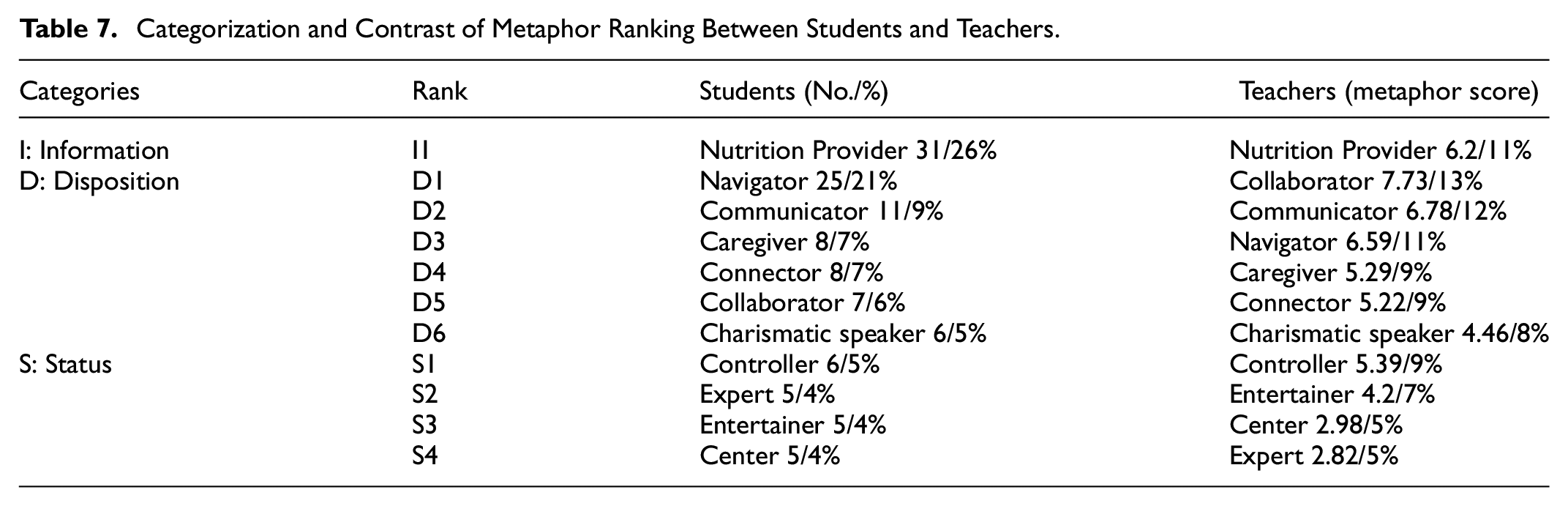
Table 7 classifies conceptual metaphors from both students and teachers into a three-category ranking system (IDS), which is consistent with the teacher identity model developed by Beijaard et al. (2000). The teacher identity model breaks down teacher expertise into subject-matter expertise, pedagogical knowledge, and didactic expertise, as shown in Table 8. According to this categorization, metaphors in Category I-Information share an equal emphasis on teachers’ subject-specific expertise. Metaphors included in Category D-Disposition (“controller,”“connector,” and “ignitor”) correspond to the combination of didactic and pedagogical expertise, emphasizing the influence of teachers’ emotions and characteristics on teaching. Metaphors in Category S-Status, including metaphors like “strict supervisor,”“independent facilitator,” or “charismatic speaker” are closely associated with the pedagogical expertise of the model, stressing the values, and moral aspects of teaching (Poom-Valickis et al., 2012).
The Categorization of Teacher Metaphors Versus the Three-Parameter Teacher Identity Model.

Similar Highlight on Dispositional Qualities of Teachers and the Low Recognition of Authoritarian Teacher Images
The proportions of metaphors in the above three IDS category calculated in Table 7 is visually demonstrated in the following Figure 1, from which we can see that more than half (63%) of teacher metaphors produced by teachers is related to disposition, meaning that teachers also wish to be more emotionally involved with students. The result contradicts the claim about the neglect of emotions in modern education from Pekrun and Frese (1992), but it’s in line with a more recent study which confirms Chinese English teachers’ recognition of the importance of emotional factors in teaching (Qin & Hu, 2010; Zhang & Zhao, 2020). However, the fact that a large number of students still emphasize teachers’ dispositional characteristics (56%) reminds us that being aware of the importance of emotions in teaching is not enough, further studies need to be performed on the effective transmission of positive emotions in teaching, taking into account the factors that the affection from teachers may be filtered or blocked by other disturbance.

The Comparison of Metaphor Distribution within the Three-category Framework.
The highlight of dispositional qualities from both teachers and students suggests the rejection of the traditional authoritarian image of teachers. It can be seen from Table 7 that CENTER and EXPERT rank as the least favorable ones among teachers as well as students. The disfavor of the CENTER metaphor shows that both students and teachers are aware of the need for a more “democratic” atmosphere in classes, where students are free to interrupt their teachers, and there is mutual acceptance for students to raise critical questions that might endanger the teacher’s authority.
Discrepancies in Teacher Conceptualizations
After the overall comparison between the categorization and ranking of teacher metaphors from students and teachers (Table 7), we have identified several teacher images that are ranked very differently between students and teachers.
COLLABORATOR Versus NUTRITION PROVIDER
COLLABORATOR and NUTRITION PROVIDER are the two conceptual themes that reveal the most significant disagreement between students and teachers. NUTRITION PROVIDER ranks as the most favorable teacher metaphor for students, while it merely occupies the fourth place on the teacher’s side (Table 7). The clear contrast between COLLABORATOR and NUTRITION PROVIDER is also demonstrated in the following Figure 2.

The Perceptual Contrast in Certain Teacher Metaphors between Students and Teachers.
The clear contrast between COLLABORATOR and NUTRITION PROVIDER indicates that students still want to rely more on teachers to feed them with selected nutritious English knowledge whereas teachers have higher expectations for students’ independent learning competence. The result that Chinese postgraduates are hoping teachers to “take more care of them” is also in line with the research results from a similar survey conducted by Bozlk (2002, p. 148) among undergraduates in the United States, of which the students also described themselves as passive learners, as “sponges to be soaked in the knowledge provided by teachers.” In contrast to the NUTRITION PROVIDER metaphor, the COLLABORATOR metaphor favored by the teachers prioritizes students’ learning initiative and mitigates the role of the teacher as the pivot figure in the class. To summarize, the comparison shows that teachers deem “collaborating” as the most important variable for successful learning, while students tend to privilege “caring.”
Paradoxical Choice of both COLLABORATOR and CONTROLLER from teachers
It can also be seen from Figure 2 that while the COLLABORATOR metaphor accounts for 13% of all the metaphors given by teachers, there are still 9% of metaphors that belong to the CONTROLLER theme. The fact that teachers still attach importance to being the controller of the class appears at odds with their high expectations for students to be more cooperative. Being a controller of the classroom can bring order to the learning process, but it also inhibits student’s eagerness to share their thoughts; that is, a controlled class cannot create the “democratic” atmosphere needed for students to think independently and become qualified collaborators (Nguyen, 2016). Being in control is contradictory to being exploratory. A controlled classroom is indeed more well-organized, but it is not conducive to advancing the inherently ugly messy learning process.
Reasons for the Similarities and Discrepancies in Teachers’ and Students’ Conceptualization of Teacher and the Influence on EAP Teacher Identity
The categorized comparison of teacher images in the above section has revealed further similarities and discrepancies in the conceptualizations of English teachers. In this section, we will analyze the reasons for the similar and different perceptions, as well as how they influence EAP teacher identity.
Reasons for the Low Recognition of EXPERT Metaphor from Both Sides
The low recognition of EAP teachers as EXPERTs by both students and teachers requires further explanations. The EXPERT metaphor has long been criticized for ignoring the importance of inquiry teaching (Maxwell, 2015). It’s been found that students tend to prefer individual feedback from the teachers rather than listening to professional lecture all the time (Tabak, 2004). Against this background, English teachers tend to connect being EXPERTs with teaching in narrowly instructional terms. In addition, the popularization of the student-centered teaching mode advocates that teachers should refrain from viewing themselves as the pivot figures in the class, such as the EXPERTs.
Apart from the external reasons for teachers’ reluctance in referring to themselves as EXPERTs, the internal reason may go to the insecurity and lack of confidence of EAP teachers in teaching STEM postgraduate students (Wang & Wang, 2015). According to a survey of the academic research capability of College English Teachers, about 87.5% of lecturers claim that they have never carried out any academic research, and 92.3% of full and associate professors declare only have one or two ongoing research projects or are merely members in certain projects (H. Q. Zhang &Wang, 2008). Along with the STEM postgraduate students’ increasing demand for guidance in English academic publications, the lack of academic research experience also contributes to the EAP teachers’ lack of confidence in teaching.
Reasons for the Discrepancies in Teacher Conceptualizations
The reasons for the discrepancy between NUTRITION PROVIDER and COLLABORATOR are multifold. One of the important reasons mentioned above is that students are to some degree left behind during the shift in educational philosophy from behaviorist to constructivist in English classes at Chinese universities. Teachers are more influenced by student-centered pedagogy and are under more pressure to organize collaborative teaching in their classes. Therefore, EAP teachers’ conceptualizations of good EAP teachers tend to be the ones who treat students as collaborators and give more credit to students’ independent thinking and proactivity. However, from the student’s side, they don’t have many ideas to contribute and are not used to being the main actors in the classes, which makes it hard for teachers to organize collaborative teaching activities. When teachers tried hard to encourage students to participate in the learning process, students still attach more value to the concrete “nutritious” results they received from the teachers and use this as the standard to evaluate teachers.
As for the seemingly paradoxical choice of both COLLABORATOR and CONTROLLER from teachers, it demonstrates that teachers have not fully embraced the idea that collaboration cannot be developed without mutual trust and reciprocity in learning. Teachers don’t trust that students have enough motivation in English learning, so although they want to treat students as COLLABORATORS, the idea that students need to be disciplined in learning is deep-rooted. On the other hand, most students are used to being told what to do and don’t have enough faith in collaborative teaching and learning. In terms of learning English well, many students neither trust English teachers nor themselves due to their long and arduous English learning experience in primary, secondary, and college education. Thus it’s an easy way for EAP teachers to keep being the controller in an English class, even collaborative activities are designed within the overall control of teachers. Students are expected to contribute, but teachers would always make the final call as planned. Unexpected situations and a change of direction in the middle of teaching are to be avoided. This paradoxical mindset of Chinese EAP teachers reduces the dynamicity and elasticity of the teacher identity development, which makes it harder for teachers to keep balanced in their meaning-making processes and can hardly benefit from their interactions with students.
Discussion
In this section, we will further discuss the revealed similarities and differences in the choice of teacher metaphors and the overall conceptualizations of teachers between students and teachers within the Chinese sociocultural context. An in-depth analysis of the possible reasons for the similarities and discrepancies in teacher conceptualizations, and suggestions to facilitate EAP teachers’ identity development are also included.
Dilemma in student-centered EAP Teaching: Teachers Stepped Back While Students are Reluctant to Step Forward
This clear contrast between students’ preference for the NUTRITION PROVIDER metaphor and teachers’ favoring of the DIRECTOR metaphor is a reflection of the difference in the conceptualizations of the teacher image. When students are still willing to be told which “food” is “more nutritious,” teachers no longer favor the most “obedient learners.” While teachers are emphasizing that learning is an interactive process, students are still used to learning guided by the behaviorist principle, treating learning as a process of knowledge reinforcement (Martinez et al., 2001).
The fact that students and teachers have different views of teaching and learning is related to both the students’ studying experience and the working environment of teachers. For Chinese students, during their 12 years highly competitive learning experience in elementary and secondary schools, mechanic memorization and multiple reinforcements in a disciplined manner are critical in guaranteeing high grades (Xiang, 2018), which contributes to students’ prone behaviorist understanding of education. On the other hand, college teachers are more directly influenced by the rise of constructivism in teaching (Piaget, 1970; Rogers, 1986), and Chinese college English teachers are constantly encouraged, even pushed to shift from the behaviorist principle to constructivism in teaching by government educational departments through top-down instructions (Lin & Song, 2014; Zhou, 2015).
According to a survey on College English teachers’ acceptance of flipped classrooms conducted by Y. Zhang and Xu (2018), the majority of teachers consider student-centered teaching an advanced and more innovative pedagogy. Chinese EFL teachers, including EAP teachers, were advised by both the educational departments and the academic authorities to refrain from being the focus of the class and give the floor to students (Mazur 1997; Zhou, 2015). However, 65% of English teachers claim that it’s hard for the students to accept being the center of the classroom. To encourage students to take initiative in learning, more efforts are required in conveying the latest educational ideas to the students in the process of teaching.
The Negative Influence of Different Teacher Conceptualizations: Frustrated Teachers and Confused Students
Given the discrepancy in conceptualizing a good EAP teacher, when teachers give themselves credit for designing various classroom activities so that more students can collaborate, students may feel confused and unmotivated since they are expecting answers from teachers. Therefore, teachers are likely to feel frustrated when students are not giving positive feedback despite that they have devoted a lot of time to designing the class activities. The frustration may lead to self-questioning and even burnout at work, disrupting the stability of teachers’ identity development.
To mitigate teachers’ frustration at work, apart from equipping students with more up-to-date educational ideas, more research on the balance between knowledge transmission and competence cultivation are needed. Especially when the students are in lack of fundamental language skills, knowledge-based scaffolding is necessary for the gradual process of language competence improvement. In other words, when teachers ask students to participate in collaborative class activities, it’s better to provide directions or several prepared answers for students to choose from, reducing the challenges in the preliminary stage. When students feel that they are up to the challenge with just a little bit more courage and effort, they are more willing to face up to it and take initiative.
Chinese EAP Teachers’ Insecurity and Anxiety in Identity Development Against the Changing Contexts
According to the categorized contrast of metaphor ranking between students and teachers in Table 7, EXPERT ranks as the least-favored teacher image from both sides. As mentioned in the introduction, teachers enjoyed a relatively high social status in traditional Chinese culture. However, the fact that both students and teachers refrain from conceptualizing EAP teachers as EXPERTS implicates a shift in both internal and external contexts for those teachers. A changing factor brings uncertainties to teachers’ identity construction, which means teachers are required to adapt to the changed contexts in their dynamic meaning-making process. Both recognizing the changed context and the adaptation pose new challenges. Therefore, more guidance should be given to those teachers in their adaptations to the changed contexts to avoid anxiety, burnout, and even depression.
The emergence of Content Language Integration (CLI) may serve as a possible direction for the long-term personal development of EAP teachers (Chang & Zhao, 2010; Richards & Rodgers, 2014). By enriching the knowledge about certain specialized disciplines, EAP teachers would be able to design content-based English teaching, which can not only meet the demands of the postgraduates in the corresponding majors but also boost the confidence of EAP teachers. In this way, the anxiety about not being able to provide useful knowledge and proper guidance for postgraduates can be eased, which will facilitate EAP teachers’ identity development.
Real Collaboration Builds on Mutual Trust and Tolerance
The paradoxical choice of both COLLABORATOR and CONTROLLER from teachers demonstrates the lack of mutual trust between students and teachers, which brings out the key obstacle in the way of Chinese EAP teachers’ meaning-making process. To enhance mutual trust between teachers and students, teachers should not be afraid of “losing control,” letting down their guards, and exposing vulnerability and fallibility (Tabak, 2004). The traditional deification of teachers in Chinese culture may obstruct the realization of a “loosen-up” class since it stresses teachers being the knowledge authority. However, if English teachers want students to be COLLABORATORs in classes, they need to be more prepared and willing to embrace a “messy” class, and also be open to situations that are “out of control.”
The perceptual difference between teachers and students, as well as the paradoxical conceptualization of teachers, can be unified by paying more attention to the process of constructing collaboration rather than the concrete results after collaboration. When collaboration is viewed as a dynamic process, the genuine communication between teachers and students, as well as within students is the purpose of teaching and learning. Without the pressure of getting some concrete results, both teachers and students can be more relaxed in contributing more caring and affection in collaborative classroom activities. Moreover, when attention is paid to the teaching and learning process rather than the results, it’s easier for teachers to tolerate the seemingly “out-of-control” situation in classes. Besides, giving students credits for their contribution to the class rather than the high score they can get on the exams can also help them better adapt to a collaborative classroom.
Conclusions
The study carried out a comparison between teacher metaphors given by postgraduate students and those provided by EAP teachers, which is under-researched in the prior studies. Through the preliminary comparison of teacher metaphors collected from postgraduates and EAP teachers in one Chinese Sci-tech university, we have found that both students and teachers favor the NAVIGATOR metaphor, laying stress on the guidance teachers should provide. However, when students prefer to view EAP teachers as NUTRITION PROVIDERs and themselves more as passive learners to be fed with “nutritious knowledge,” teachers are inclined to view themselves as DIRECTORs, who are only directing the “students actors” behind the scene. Moreover, students are attaching more importance to EAP teachers being COMMUNICATORs who can listen to them and talk to them like friends, demonstrating the psychological and emotional needs of students; meanwhile, teachers are paying more attention to their role as CONNECTORs, who connect students with more information and knowledge.
Apart from the preliminary comparison, the comparison of the categorized and ranked teacher metaphors within the IDS framework and teacher’s identity model demonstrates that both students and teachers acknowledge the more equal status between teachers and students, with images like CENTER and EXPERT that stress teacher’s authority as the least favorable ones from both sides. Another similarity lies in the emphasis on the dispositional characteristics of teachers, highlighting teachers’ pedagogical knowledge including emotions and moral values more than teachers’ subject expertise.
The discrepancies in students’ and teachers’ conceptualizations of teachers are reflected by the conflicts in the choice of teacher images such as NUTRITION PROVIDER, COLLABORATOR, and CONTROLLER. The difference in the emphasis on NUTRITION PROVIDER and COLLABORATOR reveals the conflict between students’ lack of English learning initiative and teachers’ high expectations for students to learn and cooperate actively. Besides, EAP teachers’ self-contradictory conceptualization of teachers as COLLABORATOR and CONTROLLER reflects the lack of mutual trust and tolerance between teachers and students, which not only makes students reluctant to participate in classroom activities but also renders EAP teachers afraid of “losing control,” reducing the dynamicity and elasticity of teacher identity development.
Implications
The teacher metaphor comparison between students and teachers would either confirm certain teaching beliefs teachers hold or trigger more critical thinking and reflection about the original pedagogy, enhancing teachers’ awareness of the perceptual variance between students and teachers, which is generally conducive to the dynamic development of Chinese EAP teachers’ identity. Specifically, the comparison between teacher metaphors provided by postgraduate students and EAP teachers illuminates the internal and external contexts for EAP teaching, especially the challenges faced by EAP teachers in teacher-student interactions when the two sides have different teacher conceptualizations, and points out the directions for mitigating the conflicts caused by perceptual variance.
The discrepancies in teacher conceptualizations demonstrate that the nonsynchronous acceptance of constructivist pedagogy is one of the dominant reasons for the dilemma in student-centered teaching. The finding can relieve EAP teachers of their frustration and anxiety when confronted with students’ lack of motivation to participate in classroom activities. Besides, it also draws our attention to the balance between knowledge transmission and competence cultivation in English teaching, highlights the necessity of providing appropriate knowledge-based scaffolding for students in more demanding collaborative classroom activities, and emphasizes the importance of updating not only teachers’ educational philosophy but also students’ understanding of education.
Based on the reason analysis for the self-contradictory conceptualization of teachers, the study suggests that exploratory and collaborative teaching starts with teachers tolerating the idea of a “disordered” classroom and students embracing a fallible teacher image. The establishment of mutual trust and tolerance between EAP teachers and students both facilitates collaborative teaching and contributes to constructive student-teacher interactions, which can provide a positive environment for EAP teachers’ identity development. In addition, Chinese EAP teachers are encouraged to enrich themselves with more specialized knowledge along with the students, in this way they can better meet students’ demands by designing content-based English teaching and gain more confidence in teaching academic English to postgraduate students, which also helps to ease the anxiety in their meaning-making process against the changing context.
Future studies should also pay more attention to the impact of EAP teachers’ dispositional characteristics on students’ motivation in English learning, and the pedagogy that better meets students’ emotional needs. Besides, more educational discourse analysis based on metaphors should be carried out to deepen our understanding of the cognitive reasons behind ineffective communication, which can help establish mutual trust and tolerance between teachers and students.
Footnotes
Declaration of Conflicting Interests
The author(s) declared no potential conflicts of interest with respect to the research, authorship, and/or publication of this article.
Funding
The author(s) disclosed receipt of the following financial support for the research, authorship, and/or publication of this article: This research is funded by the Youth Fund Project of Humanities and Social Science Research, Ministry of Education in China (Project No. 22YJC740049), and Jiangsu Provincial Department of Education (Project No. is 2020SJZDA013).
Informed Consent
Formal consents were obtained from all the participants of the survey.
