




Abstract
The study of prosocial behavior, from the cognitive-evolutive approach, has indicated that moral reasoning is the basis of prosocial decisions. Advances in the study of decision-making have shown that there are other factors associated with rational capacity that affect prosocial decision-making. The role of rational decision-making is an aspect that has received little attention from this perspective and could be relevant to explaining prosocial behaviors. This study examines whether rational decision-making is a potential mediator between empathy and prosocial behavior in offenders adolescents. A total of 413 Colombian adolescent offenders aged 14 to 18 years (Mage = 16.67, SD = 1.05, 17.4% were girls) participated in the study. They belonged to Colombia’s four regions (Antioquia, Caldas, Cundinamarca, and Bogotá, the Capital District). Empathy, decision-making, and prosocial behavior were assessed with self-reports. Confirmatory factor analysis of the scales used, descriptive, correlational, predictive, and mediation analyses were performed. The results indicated positive relationships between the variables empathy, rational decision-making, and prosocial behavior. In the mediation analyses, empathic concern and personal distress were the background variables with the greatest effect on prosocial behavior when mediated by rational decision-making. The results indicate that having greater rational decision-making ability may help adolescent offenders display prosocial behaviors. Results, limitations, and practical implications for adolescent counseling are discussed, and future research suggestions are made.
Introduction
This study examines whether rational decision-making is a potential mediator between empathy and prosocial behavior in adolescent offenders. Prosocial behavior is a multidimensional construct that has been analyzed from biological, social, cultural, and contextual perspectives, and its study is relevant because of its impact on individual and social development (Padilla-Walker & Carlo, 2014). Prosocial behavior has been defined as voluntary acts that benefit others (Eisenberg et al., 2015), and there is considerable evidence associating it with biological, environmental, socio-cognitive, and emotional factors (Padilla-Walker & Carlo, 2014). This knowledge has helped to understand the dynamics implicated, recognize associated factors, and develop prosocial behavior programs for specific groups (Stürmer & Snyder, 2010; Yeager, 2017).
Knowing how to promote prosocial behavior in offending adolescents is a topic of current interest because of the possibilities for individual development and the benefits for institutions and the community (Barroso-Hurtado & Bembibre-Serrano, 2018). These benefits have been observed when implementing prosocial behavior programs in normative adolescents (Mesurado et al., 2019). Prosociality is considered a desirable factor among adolescents because more prosocial individuals demonstrate greater self-regulation, empathy, improved interpersonal relationships, cooperation, and helping attitudes (Gaesser et al., 2018; Padilla-Walker & Carlo, 2014; Taylor et al., 2020).
Various theories have been proposed to explain prosocial behavior from the biological perspective, the cognitive-evolutive approach, learning theories, cultural and contextual theories, and the neuroeconomic theory of prosocial behavior (Declerck & Boone, 2016; Eisenberg et al., 2015; Padilla-Walker & Carlo, 2014). In this study, the cognitive-evolutive approach to prosocial behavior has been chosen as a framework because it situates it from a lifespan developmental perspective; moreover, it has delved into the relationships between empathy and prosocial behavior. The cognitive-evolutive approach has limitations; for example, it lacks explanations of decision-making, an advance that the neuroeconomic theory of prosocial behavior has achieved (Declerck & Boone, 2016). However, the cognitive-evolutive approach has been able to explain more variables that help the development of prosocial behavior in the life process (Eisenberg et al., 2015; Spinrad & Eisenberg, 2019).
The cognitive-evolutive approach is considered to provide the appropriate framework for understanding prosocial behavior because it links it to the individual’s cognitive and moral development, where the greater the development, the greater the likelihood of the emergence of prosocial behavior (Eisenberg et al., 1983; Kohlberg & Hersh, 1977; Piaget, 1984; Spinrad & Eisenberg, 2019). From this approach, prosocial decisions have been related to moral judgment development, including emotions and moral cognitions (Eisenberg et al., 2002; Spinrad & Eisenberg, 2019). It has also been indicated that prosocial behavior presents greater development if the educational emphasis is on moral emotions (Van der Graaff et al., 2018).
From the cognitive-evolutive approach, evidence indicates that prosocial behavior is associated with emotional development that favors moral feelings, sympathy, and compassion (Breithaupt, 2012). It is also related to cognitive development that facilitates, among other capacities, altruistic decision-making (Fromell et al., 2020). In this sense, it should be considered that cognitions and the decision-making process are also important in prosocial behavior. The contributions of studies that analyze prosocial decision-making, from a sociobiological perspective indicate that rationality helps prosocial behavior and provides the individual with analytical elements to decide (Declerck & Boone, 2016). This approach suggests that prosocial behavior is influenced by contextual factors (such as extrinsic incentives, threat cues, and trust), brain processes (cognitive control, social cognition, and the reward system), and manifestation in behavior (prosocial responding) (Declerck, 2021; Declerck et al., 2013). Among other conditions, prosocial behaviors and helping behaviors depend on cooperative incentives, social cues, relatedness to others, and trust (Declerck, 2021; Declerck & Boone, 2016). From the cognitive-evolutive approach, it has been established that empathy predicts prosocial behavior; in this study, we will analyze whether rational decision-making favors this relation.
Literature Review and Hypotheses
Factors Influencing Prosocial Behavior, Empathy, and Rational Decision-Making
Research has shown that different biological, cognitive, emotional, and social factors influence adolescents’ empathy, prosocial behavior, and rational decision-making. Available evidence suggests that prosocial behavior is inherent to the human condition and, in the evolutionary process, has contributed to species survival and social construction (Declerck & Boone, 2016). Prosocial behavior encompasses motivations, behaviors, and mechanisms such as sociomoral evaluation, preferences, affection, strategies to offer solace and comfort, helping, and cooperation that together represent important adaptive processes for social cohesion and cooperation (Decety & Steinbeis, 2020). Prosocial behavior is related to rational decision-making, and the decision to cooperate or not will depend on factors such as trust, motivation, resource availability, and incentives (Declerck et al., 2013).
To explain prosocial decisions Declerck and Boone (2016) suggest that the decision system “is supported by heuristics that are shaped by life experiences and are sensitive to environmental cues to resolve behavioral conflict derived from the brain’s motivational-emotional systems” (p. 28). If heuristics obey cost-benefit (economically rational) principles, extrinsic incentives are consistent with self-interest. If heuristics lead to disinterested decisions (socially rational), “decisional contents are influenced by reflection, trust, and affect” (p. 29). In the decisional process, at the biological level (neural) the decision is valued adaptively and moderated by external incentives, culturally established social norms, and social cues (Declerck, 2021; Declerck & Boone, 2016).
According to neuroeconomic theory, prosocial behavior is related to rational decision-making; it can be economically rational when the individual cooperates out of individual interest if his or her own goals coincide with those of the collective and can achieve rewards, synergies, accumulation of benefits, reciprocity, and high reputation. It is socially rational when the subject strives to achieve inclusion, reinforce belonging, and build social networks (Declerck & Boone, 2016). It has been observed that prosocial behavior seeks to favor social cohesion and improve the conditions of belonging groups, so there are different forms of expression in prosocial behavior that articulate with the conditions of the context (Hawley, 2015). Laboratory and cultural studies with children from diverse regions of the world show that there are common prosocial behaviors among people; for example, when assessing considerations of what is fair, it has been observed that humans naturally favor fair distributions and not equitable ones (Decety & Steinbeis, 2020; Huppert et al., 2019; Starmans et al., 2017).
Regarding gender, the studies consistently indicate that females manifest greater prosocial behavior than males; however, it has been noted that there may be differences in prosocial behaviors by gender depending on the prosocial behaviors assessed and the instruments used (Silke et al., 2018). It has also been suggested that prosocial behavior may be encouraged and that males who show high empathy may be as prosocial as females (Kamas & Preston, 2021). Prosocial behavior and empathy are closely related, and empathy is considered a predictor of prosocial behavior (Van der Graaff et al., 2018). Factors that influence prosocial behavior are personality traits, values, moral development, self-esteem, emotion management, social skills, relationships with parents and family members, peer relationships, education, and culture, in addition to the influence of the media and participation in sports, religious and cultural activities, among others (Padilla-Walker & Carlo, 2014; Silke et al., 2018). It has also been established that biological and genetic factors are associated with prosocial behavior (Padilla-Walker & Carlo, 2014). In addition, brain structures and hormones related to prosocial and cooperative decisions have been observed (Declerck, 2021; Declerck & Boone, 2018).
Evidence also shows that women are more empathic than men (Kamas & Preston, 2021). The development of empathy is influenced by, among others, early social and moral evaluations, personality traits, moral and social upbringing, cultural beliefs and practices, family environment, and exposure to aggression (Silke et al., 2018). Women’s higher empathy performance is related to biological, cognitive, emotional, educational, cultural, and social factors (Decety & Steinbeis, 2020; Moya Albiol et al., 2010).
Several theories address decision-making; among them, normative theories explain how people are oriented to evaluate losses and benefits rationally (Fishburn, 1970). Other theories, prescriptive theories, indicate how people should decide (Pande et al., 2021), and descriptive theories, with more scientific evidence, assess how people actually decide (Kahneman, 2013; Reyna, 2018). All normative, prescriptive, and descriptive theories agree that rational decisions are indicated to achieve better results. Rational decision-making involves complex biological, neurological, cognitive, social, cultural, and emotional factors that facilitate adaptation and behavioral direction (Altman, 2017). Rational decision-making is useful for reducing uncertainty, minimizing risky behaviors, solving problems, planning, reducing adverse situations, and managing uncertainty and ambiguity (Minda, 2015). Evidence shows that adolescents tend to make more risky decisions, have less development of intuition, and have less foresight in the outcome of decisions (Reyna, 2018). In adolescents, rational decision-making is also affected by nurture, cognitive development, moral development, experience, heuristics, memory storage, and retrieval processes of information (Kahneman, 2013; Reyna, 2018; Reyna & Panagiotopoulos, 2020).
Relationship Between Prosocial Behavior, Empathy, and Rational Decisions
Social rationality in prosocial decisions (Declerck & Boone, 2016), is consistent with the cognitive-evolutionary approach in which empathy has been associated with prosocial behavior (Bailey et al., 2020; Batson, 2009; Davis, 2015; Van der Graaff et al., 2018). Empathy can be defined as a relational process (Yaseen & Foster, 2019) that involves knowing the internal state, thoughts, and feelings of other people, matching neural responses when observing another person, intuiting or projecting oneself into another’s situation, besides feeling distress and compassion for someone who is suffering (Batson, 2009). These empathy characteristics favor prosocial behaviors with voluntary actions that benefit others; these can be family members, friends, and even, strangers (Yang et al., 2018). In empathy, emotional experience is necessary to understand another person’s thoughts, feelings, and points of view (Batson, 2009; Singer & Tusche, 2015). Also, emotional experience facilitates understanding others’ emotions and situations and thus would play an important role in decision ethics (Higgs et al., 2020).
Recent theories in decision-making (e.g., prospect theory and fuzzy trace theory) propose dual cognitive processes with intuitive components that work by association and rational components with greater cognitive control and analytical processes (Kahneman, 2013; Reyna, 2018). It has also been indicated that the emotions experienced affect the decision’s outcome (Lerner et al., 2015; Phelps et al., 2014). Decision-making theories agree that rational decisions are the ones that best help individuals manage their activities and achieve their goals (Chick, 2019). Rational decisions are characterized by evaluating the different options, weighing the pros and cons, seeking information, and developing strategies to execute the decision (Cotrena et al., 2018; Janis & Mann, 1977; Mann et al., 1997). These rational processes in decision-making force the individual to use complex analysis processes in the cognitive system (Kahneman, 2013; Reyna, 2018).
Empathy in the rational decision process is not neutral; it is subjective, and it operates with available information and emotions. It is associated with social practices activated when necessary and makes the subject take sides, not necessarily in a rational or properly analyzed way, which means that being empathic does not guarantee the right or the better decision (Breithaupt, 2012; Hein et al., 2010). Empathy in humans is assisted by perceptual, linguistic, and executive function processes that promote altruism and prosocial behaviors (Decety, 2011). This condition suggests that prosocial behavior requires being empathic and, besides, rational decision-making processes that facilitate and enhance the level of success. In this sense, evidence indicates that when prosocial (altruistic) decisions are made, a conciliation between intuitive and rational analytical mechanisms may occur (Fromell et al., 2020).
The studies consulted indicate that multiple conditionsdetermine prosocial decision-making, but social values are the compass that guides behavior and are expressed in each individual’s contexts and reality (Declerck & Boone, 2016). For educational purposes, it has been proposed that decision-making is more accurate with a framework of principles and values (Blalock & Reyna, 2016; Reyna, 2018) and empathy must be developed and integrated with interpersonal emotional regulation (Zaki, 2020).
Consequently, prosocial decision-making is influenced by individual conditions and characteristics (Nash et al., 2014). Also by biological and neural factors, extrinsic incentives, threat cues, trust, cognitive control, social cognition, emotional processes, and affect (Boone et al., 2010; Declerck, 2021; Lambert et al., 2017).
Empathy, Prosocial Behavior, and Decision-Making in Offenders Adolescents
The manifestation of prosocial behavior is also affected by different degrees of development in socioemotional factors; for example, adolescents with delinquent behaviors show less empathy than their normative peers (Jolliffe & Farrington, 2004) as well as less prosocial behaviors (Llorca-Mestre et al., 2017). Besides, low empathy has been related to delinquent behavior (O’Neill, 2020). In adolescent offenders, decision-making has been observed to be influenced by the expectation of emotional and social outcomes (Fontaine et al., 2009). Also affecting adolescent offenders’ decisions are executive function difficulties, lack of self-control, lack of moral commitment, and rewards for offending (Altikriti, 2021). Offenders have been observed to use intuitive reasoning to judge the risks, costs, and rewards of crime (Pogarsky et al., 2018), and use rational decision strategies, such as cost/benefit, to decide whether to engage in assaults and robberies (Zhao et al., 2021). For intervention purposes, decision skills can help promote adolescent offenders’ reflection, analyze emotions and thoughts, and make better decisions in context (Andrews & Bonta, 2017; Heller et al., 2017; Pogarsky et al., 2018). It is also important to promote the socio-emotional development of adolescent offenders; studies with normative populations have shown that individuals with positive emotional states refrain from making decisions that lead to punishment and risk of incarceration (Pogarsky et al., 2018; Van Gelder & de Vries, 2014). Whereas experiencing negative emotional states such as anger, fear, stress, and impulsivity may favor criminal acts ( Van Gelder, 2017). In addition, offenders are less able to manage negative emotional states and ambiguity when making decisions (Jacobs & Cherbonneau, 2017).
Objective and Hypotheses
Moral, emotional, and cognitive components have been indicated to play an important role in individuals’ decision-making with criminal behavior ( Van Gelder et al., 2013). Studies indicate that moral, emotional, and cognitive development affect prosocial behavior (Breithaupt, 2012; de la Barrera et al., 2019; Fromell et al., 2020). Moreover, it has been suggested that understanding emotional mechanisms, including empathy, may aid in decision-making, and maybe the emotional aspects will be more critical for intervention than traditional rational deterrence to get the change (Tibbetts, 2014).
Previous evidence indicates that empathy is a predictor of prosocial behavior in adolescents (Van der Graaff et al., 2018) and that biological, emotional, cognitive, and contextual mechanisms influence rational helping or cost/benefit decision-making (Declerck & Boone, 2016). In adolescent offenders, it has been observed that they show less empathy, prosocial behavior, and decision-making ability (Altikriti, 2021; Jolliffe & Farrington, 2004; Llorca-Mestre et al., 2017).
It is suggested that adolescent offenders with greater empathy and rational decision-making skills could express greater prosocial behavior; thus, this study aimed to analyze whether rational decision-making is a potential mediator between empathy and prosocial behavior in adolescents with delinquent behavior. The results could be useful in the behavioral and socioemotional intervention processes of adolescent offenders.
The hypotheses posed are: (1) The variables prosocial behavior, empathy, and rational decision-making style are related; and (2) Rational decision-making style is a potential mediator between empathy variables and prosocial behavior in adolescents with delinquent behavior (Figure 1).

The statistical plot of a simple mediation model for a study of prosocial behavior with three covariates.
Method
Participants
A total of 413 Colombian adolescent offenders aged 14 to 18 years (Mage = 16.67, SD = 1.05, 17.4% were girls) participated in the study. The adolescents were in judicial and socio-educational measures of the System of Criminal Responsibility for Adolescents (SRPA). They belonged to four regions of Colombia: Manizales, Caldas (22%, n = 91). Cajicá, Cundinamarca (18.7%, n = 77). Medellín, Antioquia (21.1%, n = 87) and Bogotá, Capital District (38.2%, n = 158). They were prosecuted for crimes against property 50.9% (n = 210); crimes against personal integrity (physical injury and attempted homicide) 8.3% (n = 34); crimes against public health (manufacture, trafficking, and sale of drugs) 20.1% (n = 83); sexual crimes 4.3% (n = 18); homicide 3.1% (n = 13), and other crimes 13.3% (n = 55). All were enrolled in secondary education (high school between sixth and eleventh grades in the Colombian school system).
Procedure
The procedures used for data collection were performed following the Declaration of Helsinki (World Medical Association, 2013). The research was approved by the Universitat de Valencia’s Ethics Committee (N0 1102812-07 /11/2019), and authorized by the National Headquarters of the Colombian Institute of Family Welfare-ICBF (SRPA) (SIM 17615328-37, 08/13/2019). The sample was obtained by availability and convenience because centers with many adolescent inmates were specifically chosen; the sample was not random and included adolescents who voluntarily wished to participate.
Written permissions and informed consents were requested from the adolescents, parents, lawyers, and legal guardians. The adolescents were informed about the research and participated voluntarily, anonymously, and free of charge. The investigators conducted the assessment, which lasted approximately 50 min, and paper questionnaires were used.
Instruments
Empathy was assessed with the Interpersonal Reactivity Index-IRI (Davis, 1980; Mestre-Escrivá et al., 2004). This scale assesses cognitive and emotional factors of empathy and is composed of 28 items distributed in four subscales, each with seven items: Perspective Taking, Fantasy, Empathic Concern, and Personal Distress. Perspective taking is understood as the subject’s cognitions when he/she tries to put in the other’s place without necessarily experiencing an affective response. It presents elements such as, “I often find it difficult to see things from another person’s point of view.”Fantasy refers to the subject’s tendency to identify with and take the place of fictional characters in movies, television, or books through imaginative ability (e.g., “After watching a movie or a play, I feel as if I had been one of the characters”). Empathic concern refers to the subject’s response with feelings of compassion, appreciation, pity, and affection toward others, especially when they are in difficulty (e.g., “I often feel tenderness and concern for people less fortunate than myself”). Personal distress assesses the feelings of anxiety and emotional discomfort that the subject experiences when faced with adverse situations that happen to other people (e.g., “In emergencies I feel apprehensive and uncomfortable”) (Carrasco Ortiz et al., 2011). It presents five response options: does not describe me well (1); describes me a few (2); describes me more or less (3); describes me well (4); describes me very well (5). Higher scores indicate a higher degree of empathy. Reliability for the total scale and subscales with the current sample was adequate (α = .88), Perspective taking (α = .66), Fantasy (α = .67), Empathic concern (α = .68), and Personal distress (α = .70), similar reliability values have been observed in other studies with adolescents (Mestre-Escrivá et al., 2004).
The vigilance subscale of the Melbourne Decision Making Questionnaire-MDMQ (Mann et al., 1997) was used to assess rational decision-making. It consists of six items and has three response options: “Very true for me” (score 2), “Somewhat true for me” (score 1), and “Not at all true for me” (score 0). In this scale, the rational decision-making style implies a careful, impartial, exhaustive and rational evaluation of alternatives, search for information and assess pros and cons. Some items are: “I try to be clear about my objectives before making a decision,”“When making decisions, I like to gather a good amount of information,” and “I like to consider all alternatives when making a decision” (Cotrena et al., 2018). The reliability for the subscale was α = .70.
The Prosocial Behavior Scale (PBS) was used to assess prosocial behavior (Caprara & Pastorelli, 1993; Del Barrio et al., 2001). It consists of 15 items with three response alternatives: never (1), sometimes (2), and often (3). The items refer to helping, sympathetic, and trusting behaviors (e.g., “I try to help others,”“I trust others,” and “I am kind”). Higher scores indicate a greater degree of prosocial behavior. The reliability of the scale was α = .71.
Data Analysis
Descriptive analyses were performed, identifying the mean and standard deviation and reliability analysis of the scales for the current sample using the Statistical Package for the Social Sciences SPSS V.25 program. Confirmatory factor analysis (CFA) of the current sample scales was also performed using the AMOS v.24 program. The estimation was developed using the Maximum Likelihood method (ML).
The variables did not have a normal distribution. The rank of each of the factors was compared according to the gender variable to evaluate possible differences. Spearman correlations and hierarchical regression were also performed to examine the relationships between the empathy variables, rational decision-making, and prosocial behavior. Bootstrapped mediation analyses (10,000) were conducted using the SPSS PROCESS V3.0 macro with 95% confidence intervals (CI) to examine the effects of rational decision-making between empathy and prosocial behavior. According to Rucker et al. (2011), mediations occur and are significant when the CIs do not cross zero. The effect size of mediation is reported through the beta value (Wen & Fan, 2015). The use of bias-corrected bootstrapping is considered a robust method and allows an estimate of indirect effects to be made regardless of the presence of significant total or direct effects and can be successfully applied even if the data do not have a normal distribution (Williams & MacKinnon, 2008).
The simple mediation model in PROCESS, uses ordinary least squares (OLS) regression-based paths to analyze “how the effect of an antecedent variable (X) acts on a consequent or final variable (Y), generating two paths of influence, direct and indirect” (Hayes, 2018, p. 85). There is a risk of realizing an epiphenomenal association in mediation models that constitutes a severe threat to the validity of causal inference. According to Hayes (2018), “epiphenomenal association occurs when X affects some other variable that is not in the model, and that other variable affects Y, but because M correlates with that other variable, it appears that M is the variable through which the effect of X on Y occurs” (p. 121). To control for the epiphenomenal association, one can either randomize the values of X or introduce covariates. In this study, we include three covariates: age, gender, and schooling. If the indirect effect persists, despite controlling for covariates, the causal claim remains viable.
Results
Factorial Validity of the Measures
Confirmatory factor analyses (CFA) were performed to verify the scales’ factor structure for the current sample (n = 413). Goodness-of-fit was based on the following indicators: the general goodness-of-fit index (GFI), the comparative fit index (CFI), the incremental fit index (IFI), and the Tucker-Lewis index (TLI); values above 0.90 indicate a good fit (Brown, 2015). The root mean square error of approximation (RMSEA) was calculated to analyze the discrepancy between the hypothesized model and the covariance matrix of the data. Values below 0.05 indicate a good fit and between 0.05 and 0.08, a moderate fit (Harrington, 2009).
The results of the CFA for the IRI did not show satisfactory indices (Table 1). However, the observed values are congruent with previous CFAs of the scale (Carrasco Ortiz et al., 2011; Pérez-Albéniz et al., 2003; Pineda et al., 2013). Previous research on the scale’s psychometric properties has indicated that it does not achieve optimal fit indices in many CFAs. However, it has been recommended to use Davis’ (1980) four-factor structure for empathy assessments (Chrysikou & Thompson, 2016). The results of the AFC with the current sample for the prosocial behavior scale (PBS) and decision-making (MDMQ) showed satisfactory indices (Table 1).
Fit Index of the Confirmatory Factor Analysis of the Measures Used in This Study.

Note. χ2 = Chi-square; df = degree of freedom; GFI = good fit index; CFI = comparative fit index; TLI = Tucker-Lewis index; IFI = incremental fit index; RMSEA = root mean squared error of approximation.
Descriptive Results
The mean of the study variables was compared according to gender. Comparisons were made using the Mann-Whitney U test due to the difference in sample size between boys and girls and the non-normality of the variables. The difference was only observed in prosocial behavior, indicating that girls (Rank 239. 92) showed greater prosociality than boys (Rank 200.05) (U(72. 341)=9,905.500, Z = −2.586, p = .01, d = 0.30).
Descriptive and correlation analyses were performed. The results show positive and statistically significant correlations between rational decisions, prosocial behavior, and empathy variables (Table 2).
Descriptive Statistics and Correlations of Spearman for Study Variables (n = 413).

p < .01.
A hierarchical regression model was performed to evaluate the effect of empathy variables and rational decision-making style on prosocial behavior (Table 3). The model was evaluated in three steps. In the first step, sociodemographic variables were introduced: gender, age, and schooling. In the second step, empathy variables, and in the third step, rational decision-making.
Hierarchical Regression Results for Prosocial Behavior.

Note. CI = confidence interval; LL = lower limit; UL = upper limit.
p < .05. **p < .01. ***p < .001.
In the first step, the sociodemographic variables model was significant (R2 = .02; F = 2.816; p = .04), but only the gender variable contributed to the variance explained (β = .11; t = 2.315, p = .02). In the second step, the model is significant when adding the IRI dimensions (R2 = .27; F = 21.619; p < .001); perspective taking and fantasy contributed significantly to the explained variance (perspective taking: β = .40; t = 6.832, p < 001; Fantasy: β = .15; t = 2.686, p = .008). In step 3, the regression remained significant (R2 = .27; F = 18.896; p < .001); however, the rational decision-making variable was not statistically significant (β = −.02; t = 0.394, p = .694).
Direct and Indirect Effects of Empathy, Rational Decision-Making, and Prosocial Behavior Variables
Four mediation models were evaluated to establish whether rational decision-making is a potential mediator between empathy variables and prosocial behavior; gender, age, and school grade were included as covariates. Simple mediations are found in Figures 2 to 5 and summarized in Table 4.
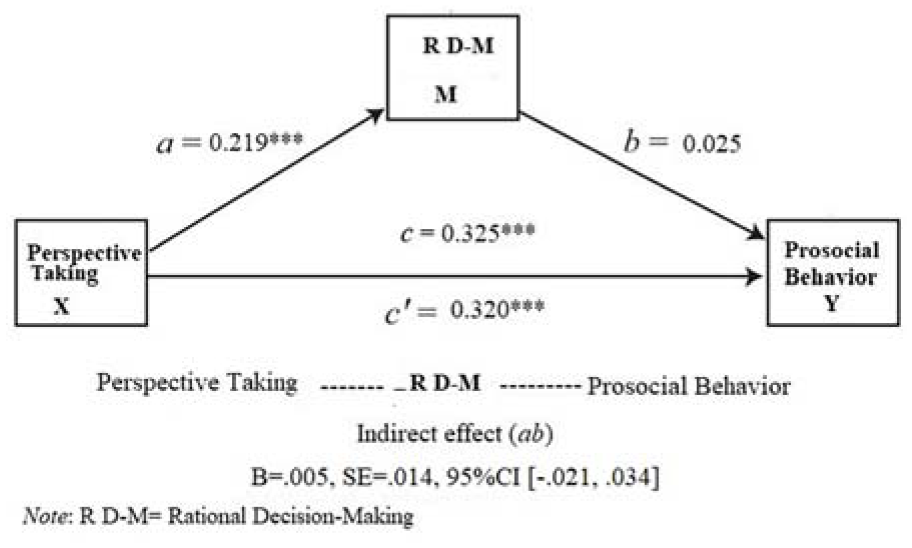
Simple mediation model of rational decision-making between perspective taking and prosocial behavior.

Simple mediation model of rational decision-making between fantasy and prosocial behavior.

Simple mediation model: Rational decision-making mediating between empathic concern and prosocial behavior.
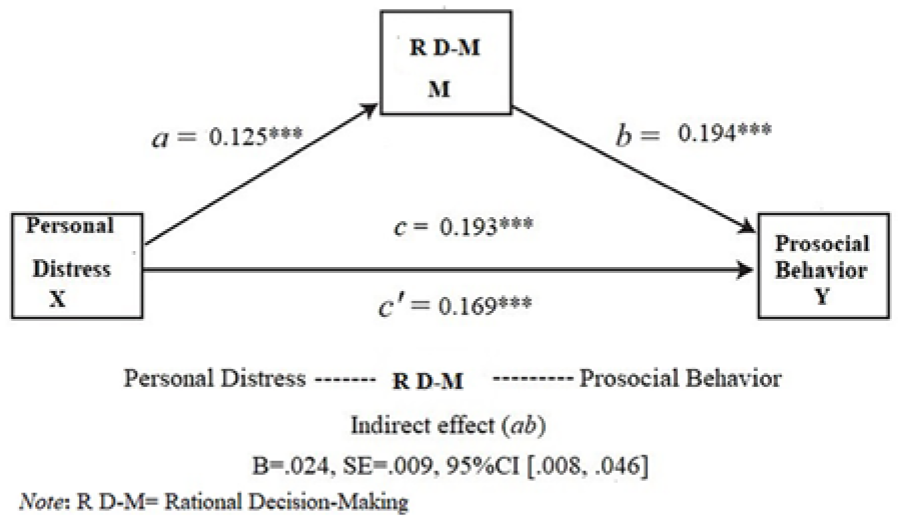
Simple mediation model: Rational decision-making mediating between Personal distress and prosocial behavior.
Coefficients of the Simple Mediation Model for Prosocial Behavior With Three Covariates.

Note. X = antecedent variable; M = mediating variable; Y = consequent variable; a = effect of X on M; b = effect of M on Y; c′ = direct effect; C1,2,3 = covariates; f1,2,3 = effect of covariates on a; g1,2,3 = effect of covariates on b; R2 = explained variance.
The Perspective Taking
The effect of perspective taking on rational decision-making proved to be significant (β = .219, p < .001), but not the effect of rational decision-making on prosocial behavior (β = .025, p = .06). The direct effect of perspective taking (β = .320, p < .001) is explained as the estimated difference between the degree of prosocial behavior of adolescents experiencing the same level of rational decision-making but differing in reported perspective taking. The coefficient is positive, meaning that adolescents who show greater perspective taking, and at the same time, exhibit greater rational decision-making, are estimated to have a higher level of prosocial behavior at 0.320. This effect is statistically different from zero, t(413) = 10.142, p < . 001, 95% CI [0.258, 0.382].
The total effect of the perspective taking on prosocial behavior, which is explained because of the sum of direct and indirect effects, is significant (β = .325, p < .001). Adolescents with higher perspective taking are estimated to differ by 0.325 degrees in their reported prosocial behavior. The positive sign indicates that adolescents reporting greater perspective-taking have greater prosocial behavior. This effect is statistically different from zero, t(413) = 11.348, p < .001, 95% CI [0.269, 0.382].
The indirect effect (β = .005) was not statistically different from zero 95% CI [−0.021, 0.034]. No indirect effect was observed due to the mediation of rational decision-making between perspective taking and prosocial behavior. Regarding covariates, gender was significant for prosocial behavior (t(413) = 2.523, p = <.01, 95% CI [0.20, 1.68], indicating greater prosocial behavior in girls (Mgirls 23.51; Mboys 22.50). Figure 2. shows the statistical plot of the simple mediation model of rational decision-making between perspective taking and prosocial behavior.
Fantasy
The effect of fantasy on rational decision-making was found to be significant (β = .106, p < .001); similarly there was a positive effect of rational decision-making on prosocial behavior (β = .180, p = .002). The direct effect of fantasy (β = .201, p < .001) indicates that adolescents who show greater fantasy, and at the same time present greater rational decision-making, are estimated at 0.201 with a higher degree of prosocial behavior (t(413) = 7.260, p < .001, 95% CI [0.146, 0.255]).
The total effect of fantasy on prosocial behavior is significant (β = .220, p < .001). Adolescents with higher fantasy are estimated to differ by 0.220 degrees in their reported prosocial behavior. Adolescents reporting higher fantasy show a higher degree of prosocial behavior (t(413) = 8.074, p < .001, 95% CI [0.166, 0.237]). Regarding covariates, in the total effect, gender was significant for prosocial behavior (t (413) = 2.176, p = .03, 95% CI [0.08, 1.66], indicating greater prosocial behavior in girls (Mgirls 23.51; Mboys 22.50).
The indirect effect (β = .019) resulted different from zero and is statistically significant at 95% CI [0.006, 0.038]. It can then be estimated that adolescents differ to a degree of 0.019 due to the mediation of rational decision-making between fantasy and prosocial behavior. Figure 3. shows the statistical plot of the simple mediation model of rational decision-making between fantasy and prosocial behavior.
Empathic Concern
The effect of empathic concern on rational decision-making was found to be significant (β = .146, p < .001); likewise there was a positive effect of rational decision-making on prosocial behavior (β = .159, p = .009). The direct effect of fantasy (β = .199, p < .001) indicates that adolescents who show greater empathic concern, and at the same time present greater rational decision-making, are estimated at 0.199 with a higher degree of prosocial behavior (t(413) = 6.649, p < .001, 95% CI [0.140, 0.258]).
The total effect of empathic concern on prosocial behavior (β = .222, p < .001) shows that adolescents with higher empathic concern differ by 0.222 degrees in their reported prosocial behavior. Adolescents reporting higher empathic concern show a higher degree of prosocial behavior (t(413) = 8.074, p < .001, 95% CI [0.165, 0.279]).
The indirect effect (β = .023) resulted different from zero and is statistically significant at 95% CI [0.005, 0.046]. It can then be estimated that adolescents differ to a degree of 0.023 because of the mediation of rational decision-making between fantasy and prosocial behavior. None of the covariates were significant. Figure 4. shows the statistical plot of the simple mediation model of rational decision-making between empathic concern and prosocial behavior.
Personal Distress
The effect of personal distress on rational decision-making was found to be significant (β = .125, p < .001), likewise there was a positive effect of rational decision-making on prosocial behavior (β = .194, p < .001). The direct effect of personal distress (β = .169, p < .001) indicates that adolescents who show greater personal distress, and at the same time present greater rational decision-making, are estimated at 0.169 with a higher degree of prosocial behavior (t(413) = 5.517, p < .001, 95% CI [0.108, 0.228]).
The total effect of personal distress on prosocial behavior is significant (β = .193, p < .001). Adolescents with greater personal distress are estimated to differ by 0.193 degrees in their reported prosocial behavior. Adolescents reporting greater personal distress show greater degrees of prosocial behavior (t(413) = 6.443, p < .001, 95% CI [0.134, 0.251]).
The indirect effect (β = .024) resulted different from zero and is statistically significant at 95% CI [0.008, 0.045]. It can then be estimated that adolescents differ to a degree of 0.024 because of the mediation of rational decision-making between personal distress and prosocial behavior. None of the covariates were significant. Figure 5. shows the statistical plot of the simple mediation model of rational decision-making between personal distress and prosocial behavior.
Discussion
Prosocial behavior is a multidimensional construct that can hardly be explained from a single theory. There is evidence for related biological, environmental, socio-cognitive, and emotional factors that contribute to explaining prosocial behaviors (Padilla-Walker & Carlo, 2014). However, some theories, such as the cognitive-evolutionary one, have made essential advances useful for understanding prosocial development. This approach has shown the importance of empathy, moral emotion, and moral cognition in prosocial behavior (Eisenberg et al., 1983; Kohlberg & Hersh, 1977; Piaget, 1984; Spinrad & Eisenberg, 2019). Empathy is a predictor of prosocial behavior, and considering that recent research on prosocial decision-making has highlighted the importance of rationality in helping and cooperative behaviors (Declerck, 2021; Declerck & Boone, 2016). This study aimed primarily to analyze whether rational decision-making is a potential mediator between empathy variables and prosocial behavior in adolescents with delinquent behavior. It is fundamental to consider that adolescent offenders manifest less prosocial behaviors, empathy, and greater difficulty in making reasoned decisions (Altikriti, 2021; Jolliffe & Farrington, 2004; Llorca-Mestre et al., 2017). This study showed positive and significant relationships between the variables, and it was observed that rational decision-making could mediate the relationship between empathy variables and prosocial behavior in adolescent offenders.
Correlation Between Prosocial Behavior, Empathy, and Rational Decision-Making
The first hypothesis was confirmed. A positive relationship was observed between empathy variables, prosocial behavior, and rational decision-making. The relationship between prosocial behavior and empathy has been widely documented (Bailey et al., 2020; Batson, 2009; Davis, 2015; Van der Graaff et al., 2018). However, the role of empathy in prosocial decision processes has been controversial due to the bias and subjectivity of the empathic person that may lead to erratic decisions (Breithaupt, 2012; Hein et al., 2010). Therefore, some social-biological theoretical approaches have been proposed to analyze the role of rationality in prosocial decisions (Declerck, 2021; Declerck & Boone, 2016).
This study’s results seem to indicate that the cognitive and emotional empathy factors of IRI (Davis, 1980; Mestre-Escrivá et al., 2004) influence the prosocial behavior of adolescent offenders. Empathic concern and personal distress were enhanced and positively affected prosocial behavior when they were mediated by rational decision-making. Concerning perspective taking and fantasy, the neuroscientific model (Preston & de Waal, 2002), has provided evidence indicating that using imagination and fantasy can intuit the experience, emotions, and even pain of others (Singer & Tusche, 2015). In this sense, Gaesser et al. (2018), observed that when people imagine future episodes helping people in need, there is an increase in actual prosocial behavior. This can be used in intervention with adolescent offenders through strategies and methods that use imagination and fantasy with prosocial scenes.
The Mediating Role of Rational Decision-Making Between Empathy and Prosocial Behavior
The second hypothesis was also confirmed. In all the mediation models tested, the empathy variables showed positive effects on rational decision-making; the same was true between rational decision-making and prosocial behavior, except in the model with the perspective-taking variable as antecedent. This model was also the only one in which indirect effects were not significant. We observed statistically significant direct, total, and indirect effects in the remaining three models. The first implication of these results is that adolescents who exhibit criminal behaviors show different prosocial behaviors, and it is essential to know what contextual factors, biological processes, and culturally mediated responses may affect prosocial responding (Declerck et al., 2013). Similarly, it may be essential to analyze social conditions, heuristics, incentives, relatedness, and trust for their possible effects on the development of prosocial behavior (Declerck, 2021; Declerck & Boone, 2016).
The second implication is the need to explore how to foster empathy in adolescents with delinquent behavior. Evidence suggests that empathy is primarily manifested with emotionally close people (Singer & Tusche, 2015) and those belonging to affiliative groups (Hein et al., 2010). These observations on the development of empathy with emotionally close people and affiliative groups indicate that empathy could be fostered through intervention with educational groups and with peers in correctional settings, family members, and other emotionally close people. These possibilities are important because they may contribute to adherence to recovery and change processes, strengthening support networks, improving prosocial decision-making, and social adjustment. Empathy could transcend its effect beyond affiliative groups; for example, it has been observed that by developing it, people can show prosocial behaviors and attitudes even with ideologically diverse groups (Taylor et al., 2020).
The third implication is the need to favor socioemotional competencies, empathy, and decision-making in adolescents with delinquent behavior. Previous evidence indicates that adolescents in correctional systems show lower performances in empathy (Jolliffe & Farrington, 2004), and prosocial behavior (Llorca-Mestre et al., 2017). They also show difficulties in executive function, lack of self-control, lack of moral commitment, and decisions associated with cost/benefit in rewards associated with crime (Altikriti, 2021). It is advisable to intervene in these aspects in adolescents with delinquent behaviors, and favoring socioemotional competencies and empathy can help optimal adaptation and well-being as has been observed in the normative population (de la Barrera et al., 2019; Mesurado et al., 2019).
Intervention in the socio-emotional domain is important because of the benefits observed in prosociality, for example, greater self-regulation and empathy, improved interpersonal relationships, cooperation, and helping attitudes (Gaesser et al., 2018; Padilla-Walker & Carlo, 2014; Taylor et al., 2020). Evidence from studies with normative populations indicates that people with positive emotional states, for example, greater self-control and satisfaction, and those who show greater morality and risk perception, are likely to refrain from offending because they judge differently the heuristics associated with the likelihood of incarceration and severity of punishment (Pogarsky et al., 2018;Van Gelder & de Vries, 2014). The opposite is true for negative emotional states, for example, anger, fear, stress, and impulsivity that may favor criminal acts ( Van Gelder, 2017). Studies with offender populations show that offenders are less adept at using strategies to manage emotional agitation, ambiguity, and negative thoughts and emotions, which disfavors social adjustment and decision-making (Jacobs & Cherbonneau, 2017).
The fourth implication is the possibility of helping adolescent offenders and potential offenders, to use deliberative skills characteristic of rational decision-making (Kahneman, 2013) that help “to analyze the negative consequences of offending” (Pogarsky et al., 2018, p. 399) and to value the advantages of prosocial behavior (Taylor et al., 2020). Evidence has been shown in favor of decreased delinquency when decision speed is reduced, reflection on automatic thoughts and behaviors is increased, and contextual decisions are guided (Heller et al., 2017).
Predictors of Prosocial Behavior, Empathy, and Rational Decision-Making in Offending Adolescents
Studies consistently state that empathy is a predictor of prosocial behavior (Van der Graaff et al., 2018), and in this study, we ratify this influence. Furthermore, we observed that rational decision-making favorably mediates the influence of cognitive and emotional empathy on adolescent offenders’ prosocial behavior.
It is suggested that it is important to promote the development of empathy, prosocial behavior, and rational decision-making in adolescents. It has been indicated that humans have biological resources to respond cooperatively or competitively in an adaptive manner depending, among others, on contextual conditions (Declerck, 2021; Declerck & Boone, 2016). Enhancing cooperative responses is necessary to improve self-regulation, interpersonal relationships, social adjustment, sense of belonging, and prosocial behavior (Gaesser et al., 2018; Padilla-Walker & Carlo, 2014; Taylor et al., 2020). We observed in this study that adolescent offenders can benefit from rational decision-making to improve prosocial responding; this is important due to the interest in improving social adjustment with the prison population (Barroso-Hurtado & Bembibre-Serrano, 2018).
Regarding gender, the results of this study show that girl offenders perform better in prosocial behavior and empathy than men; similar results have been observed in the normative population (Kamas & Preston, 2021; Moya Albiol et al., 2010; Silke et al., 2018). This study showed that gender is a covariate affecting the mediation between cognitive empathy (perspective taking and fantasy) with prosocial behavior performance in favor of girls. These results indicate that girls perform better on the prosocial behavior assessed, and their performance positively affects the mediation exerted by rational decisions. In addition, some studies have indicated that prosocial behavior may be encouraged and that males who show high empathy may be as prosocial as females (Kamas & Preston, 2021). However, it has been suggested that it is important to establish gender-differentiated measures of prosocial behavior (Silke et al., 2018).
In adolescent offenders, risk factors that may affect the development of empathy, prosocial behavior, and decision-making are increased. Risk factors associated with delinquent behavior affect adolescent offenders’ well-being, physical and mental health, and social adjustment (Andrews & Bonta, 2017). It is important to determine how factors predictive of prosocial behavior have been affected in the life cycle of adolescent offenders and to seek strategies to intervene them; among them, psychological, social, and cultural factors such as personality traits, values, moral development, self-esteem, emotion management, social skills, relationships with parents and family members, peer relationships, education and culture (Padilla-Walker & Carlo, 2014; Silke et al., 2018). Similarly, it is important to address factors that affect empathy development and prosocial development, including early social and moral evaluations, personality traits, moral and social upbringing, cultural beliefs and practices, family environment, and exposure to aggression (Silke et al., 2018). Similarly, it is important to analyze gender differences in factors affecting empathy among adolescent offenders (Decety & Steinbeis, 2020).
Adolescent offenders are more likely to make risky choices that affect their developmental and social adjustment, health, and well-being outcomes. Therefore, it is important to address decision-making and help manage the negative effects of risky decisions; this involves intervening in aspects of decision-making that have been affected across the lifespan, including cognitive, moral, and socioemotional development, experiences, exposure to risk factors, heuristics associated with antisocial behavior, and psychological processes such as memory and perception (Andrews & Bonta, 2017; Kahneman, 2013; Reyna, 2018; Reyna & Panagiotopoulos, 2020).
Practical Implication
Given the above discussion and analysis, this study suggests that empathy, prosocial behavior, and decision-making are important for adolescents’ social adjustment. Furthermore, the development of rational decision-making skills may favor the relationship between empathy and prosocial behavior in adolescents with criminal behavior. Therefore, we propose the following recommendations for the care of adolescents in penitentiary establishments:
First, it is important to carry out interventions that favor empathy, prosocial behavior, and decision-making. It has been observed that a lack of empathy favors aggression and the violation of the rights of others; in contrast, a higher degree of empathy helps to understand the point of view of others, their thoughts, feelings, and emotions, decreases aggression, and increases prosocial behavior (Batson, 2009; Singer & Tusche, 2015; Yang et al., 2018). Given that lack of empathy is one of the most critical factors favoring antisocial behavior, it is important to develop intervention processes that lead adolescents to respect people, social boundaries, and the rights of others. It is relevant to address errors in social and moral evaluations, favor moral education, cultural beliefs and practices, deficiencies in family education, and the consequences of exposure to aggression that are predictors in the development of empathy (Silke et al., 2018).
Prosocial behavior should also be favored in intervention processes. It is recommended to identify various prosocial and altruistic behaviors that adolescents can practice in institutions, with family and others in their environment, demonstrate the benefits of prosocial behavior, and intervene in educational deficiencies and factors that affect the development of prosocial behavior. Evidence shows that implementing programs that incentivize prosocial behavior improves helping behavior and altruism in adolescents (Barroso-Hurtado & Bembibre-Serrano, 2018; Mesurado et al., 2019). Prosocial behavior can be intervened by developing social skills, guidance in relationship management, and participation in cultural, recreational, and psychoeducational activities (Padilla-Walker & Carlo, 2014; Silke et al., 2018).
It is also important to educate adolescents in decision-making strategies. Evidence shows that false premises, individual experiences, and educational factors, among others, guide people’s decision-making (Kahneman, 2013). Adolescents with behavioral problems present higher cognitive distortion, negative experiences, and greater difficulty making rational decisions. Hence, they should be offered guidance, and for this purpose, it has been recommended to guide them toward the construction of objectives adjusted to the adolescent’s reality and formulate goals focused on ethical, personal, and social values (Reyna, 2018).
Secondly, it is important to guide adolescents in prosocial decision-making. According to the results of this study, rational decision-making can mediate the relationship between empathy and prosocial behavior; these observations are evidence that rationality can contribute to social adjustment and interpersonal relationships. Rational decisions are not always prosocial and may be oriented only to self-benefit and may even aim to affect others; therefore, it is important to educate adolescent offenders toward decision-making that contributes to positive development, helpfulness, and altruism (Declerck & Boone, 2016; Eisenberg et al., 2015; Padilla-Walker & Carlo, 2014).
Limitations and Future Directions
This study has some limitations that should be mentioned. First, it constitutes a cross-sectional exploratory study that does not guarantee verification of the stability of the data with several measurements. Also, its cross-sectional nature does not allow causality to be inferred. Second, self-reports were used, and the data may be biased by factors such as social desirability. The participants in this study comprise a group of adolescents with delinquent behavior; therefore, the results may not be generalizable to other populations. Boys in the sample are overrepresented, and gender-related results may be affected. Future research may develop longitudinal measures that can include other factors associated with prosocial decision-making, such as the role of the peer group, trust, incentives, heuristics, cognitive distortions, emotions, and specific prosocial behaviors expected of adolescents with delinquent behavior. In line with recent studies, mediation analyses can be developed within the prospect theory framework (Kahneman, 2013), and fuzzy trace decision theory that addresses adolescent decision-making (Reyna, 2018).
Conclusion
In this study, we observed that empathy, rational decision-making, and prosocial behavior are related variables, and rational decision-making is a potential mediator between empathy and prosocial behavior. Empathy is not a relationally neutral process (Breithaupt, 2012; Hein et al., 2010), and the degree of development to make rational decisions could affect prosocial behaviors. Therefore, empathy and prosocial behavior may be aided by rational decision-making, not only to execute the prosocial activity but also to detect the heuristics, biases, and prejudices involved. In line with recent theories on decision-making and empathy, it is crucial to teach decision-making by developing a framework of principles and values (Blalock & Reyna, 2016; Reyna, 2018), and integrating empathy with interpersonal emotional regulation (Zaki, 2020).
Footnotes
Acknowledgements
The authors are immensely grateful to the Instituto Colombiano de Bienestar Familiar for giving its endorsement and permission for the study, the authorities and legal guardians who signed the consent, the institutions that provided their support when applying the instruments, and above all, to the participating adolescents who donated their time and provided the information.
Data Availability Statement
The data that support the findings of this study are available with request to the corresponding author Inmaculada Montoya-Castilla. The data are not publicly available due to restrictions of Instituto Colombiano de Bienestar Familiar, the containing information could compromise the privacy of research participants (Share upon Request).
Declaration of Conflicting Interests
The author(s) declared no potential conflicts of interest with respect to the research, authorship, and/or publication of this article.
Funding
The author(s) disclosed receipt of the following financial support for the research, authorship, and/or publication of this article: This research was supported by grants from the Spanish Ministry of Science, Innovation, and Universities, the State Agency of Research, and the European Regional Development Fund (FEDER) from the European Union (PSI2017-84005-R).
Ethics Declarations
The procedures were carried out following the guidelines of the Declaration of Helsinki (World Medical Association, 2013). The study was approved by the Ethics Committee of the University of Valencia (N0 1102812-07/11/2019), and the permission of the Dirección de Planeación y Control de la Gestión, Subdirección de Monitoreo de Evaluación Pública del Instituto Colombiano de Bienestar Familiar (ICBF), Sistema de Responsabilidad Penal para Adolescentes (SRPA) (SIM 17615328-37, 08/13/2019).
