



Abstract
Following the need for more recent rigorous empirical evidence on the role of institutions at sectoral level as well as the conflicting empirical evidences on the institutions-growth relationship in Africa, this study investigated the sectoral impacts of institutional quality in Sub-Saharan Africa (SSA). The study also revisited the role of institutions in the aggregate economy. The system GMM estimation procedure and a panel of 42 SSA countries were used over the period 2010 to 2018. The results indicate that contrary to the widely held view that institutions foster growth and development, the role of institutional quality in sectoral and aggregate economic performance in SSA generally remained muted. However, the results indicate that initial level of real GDP and labor are robust drivers of growth, particularly in the aggregate economy. The study therefore concludes that the sub-region requires institutional reform, enhanced human capital development and capital accumulation to drive sectoral and aggregate economic performance in SSA.
Introduction
Institutional quality and economic performance are becoming interesting topics for scholars in both first and third world countries. This is due to the dictum “no economy exists in vacuum.” Some factors play vital role in every economy’s growth process. An example, poor government regulations, no regard to rule of law and civil liberty, rights to worship, movement, education etc (Siba, 2008). Evidence from the literature has shown that Sub Saharan African (SSA) countries experience slow growth when institutions are weak (Egbetunde & Akinlo, 2015). Benyah (2010) sees institutional quality as those factors like regulatory control, rule of law etc that attracts investors into an economy and also enable access to funding by investors. Institutional quality involves observance of legal rule, right to property and regulation for business to thrive (Levine, 1998). Institutional quality revolves around rule of law, right of persons and quality control by the government and its services (Bruinshoofd, 2016). Good institutions are essential for sustained progressive economic performance. Easterly (2013) explained that non-ephemeral economic progress must be built on respect for the rights of individual and that sustainable economic progress is always and everywhere a function investment.
It has been observed that most countries in SSA have recorded very poor institutional performance. For instance, institutional failure has been widely blamed for its level of high corruption and poor management of public assets and the recurrent problem of extra-budgetary spending in Nigeria. Word Governance Indicators (WGI, 2020) reported that countries in SSA scored low in terms of corruption control, voice and accountability, absence of violence, rule of law and government effectiveness. This makes it imperative for policymakers and governments in the sub-region to understand the sectoral effects of institutional quality within the sub-region. Unfortunately, current literature have generally focused on aggregate institutions and growth nexus (Abubakar, 2020; Iheonu et al., 2017; Iyoboyi & Pedro, 2014; Nathan & Okon, 2013; Okoh & Ebi, 2013). This means that there is dearth of extant studies on institutional quality effects at sectoral level in the SSA sub-region. It is the goal of this research to fill the vacuum in the extant studies.
Hence, the main objective is to evaluate the sectoral effects of institutional quality in SSA. The specific objectives include; (i) to evaluate the impact of institutional quality on sectoral performance in SSA; (ii) to find out if institutional quality impact on aggregate economic performance in SSA. To achieve these objectives, system GMM estimation and a panel of 42 SSA countries from the year 2010 to 2018 will be used. This period was used simply to find out the shock effect after the 2008 to 2009 Global Financial Crisis and to advise further on the post covid effects. As a result, the study focused on the two major crises. Interestingly, the outcomes showed that in contrast to opinions that institutions foster growth and development, the role of institutional quality in sectoral and aggregate economic performance in SSA generally remained insignificant. However, initial level of real GDP and labor were found to contribute significantly to growth. The other parts of this paper include section 2; literature review, section 3; methodology; section 4 data presentation and section is the conclusion.
An Overview of the Literature
From theoretical perspective, some institutional and growth theories are considered relevant in this study. Rational choice institutionalism theory posit that economic agents use utilizes institutions, while sociological institutionalism explains that culture is a form of institution that defines what economic agents can and cannot do in a given circumstance (Hall & Taylor, 1996). Transaction cost theory explains that transaction cost is the channel through which the incentives and constraints created by formal and informal institutions influence economic behavior (North, 1991). The institutional theory of methodological individualism explains that to appreciate the institutional characteristics of an economy, it is vital to understand individual characteristics as they consist of the institutions in an economy (Hodgson, 1993). This theory, therefore, recognizes the individual as the building block of an economic system. Besides, the new institutional theory explains that institutions like norms, beliefs, and routines clarify the link between economic agents and firms by constraining or enabling the actions of economic agents (Lang, 2018). Overall, these institutional theories emphasize the fact that institutions influence the activities of economic agents, thereby impacting on both aggregate and sectoral economic performance. Thus, this study concentrates on the sectoral impacts of institutional quality in Sub-Saharan Africa.
Some economic growth theories also lend support to this study. The classical growth theory holds that the path to economic growth is through increases in productive activities caused by technological advancement and population growth (Malthus, 1820; Ricardo, 1951; Smith, 1776), while the Harrod–Domar growth theory emphasized that growth rate of an economy is mainly determined by the level of national saving and the productivity of capital investment such that more investment results in more economic growth (Domar, 1946; Harrod, 1936). The neoclassical growth theory used the aggregate production function to explain that economic growth takes place in an economy by combining technology, labor and capital (Solow, 1956; Swan, 1956). The endogenous growth theory emphasized that economic growth is mainly driven by internal forces rather than external forces as seen in the neoclassical growth theory. Hence, the theory made the rate of technological advancement and population growth rate endogenous factors within the growth model, and stressed the roles of human capital in the growth process (Lucas, 1988; Romer, 1986). Clearly, these growth theories generally emphasized the roles of technological progress, labor, and capital as important drivers of growth in an economy. As we shall soon see, the underlying model for this study is a cross-country growth model that includes capital, labor, institutional and other control variables as regressors.
From empirical perspective, we observed that there is a growing empirical study on the role of institutional quality as an important requirement for economic performance in Africa. While some of such empirical studies in Africa are cross-country, others are country-specific. Furthermore, findings from such empirical studies have also been mixed since some studies established that the role of institutional quality in Africa is positive and significant while other found negative and insignificant effects, thereby indicating that further investigations are required for more comprehension on importance of institutional quality at both sectoral and aggregate levels. For example, Diop et al. (2010) found that rule of law, property rights, the regulatory burden, political violence, and government ineffectiveness impede growth in the Economic Community of West African States (ECOWAS) while in a panel study of 50 African countries over the period 1990 to 2014, Abubakar (2020) used an ordinary least squares (OLS) model to establish that economic growth responds positively and significantly to institutional quality in Nigeria over the period 1979 to 2018. It is the goal of this study to fill these gaps in the extant literature by investigating the impacts of institutional quality at both sectoral and aggregate economic levels in Sub-Saharan African (SSA). This is particularly important given that sectoral level evidence will ensure that policies are targeted at specific sectors in SSA. To see these points clearly, let us consider some of the recent empirical evidences in the literature.
Shah et al. (2016) used the ARDL technique to investigate sectoral level foreign direct investment and institutional quality in Pakistan. The findings revealed a cointegration between sectoral level foreign direct investment and institutions. The causality is also bidirectional. Also, they also found out that cointegration does not exist between quality of institutions and foreign direct investment inflows especially in the extractive industry. The findings also showed that bidirectional causality holds between total foreign direct investment and institutional quality. Thus when institutions are strong, there is increase in inflow of foreign direct investment especially in the secondary sectors and in the third sector of the economy which is services. Again, the outcome indicates that in the short run, quality of institutions and manufacturing foreign direct investment exhibit a bidirectional causality while also a causal relationship exists in the short run between institutional quality and FDI both in extractive and services sectors.
Aluko and Ibrahim (2020) analyzed the impact institutions have on both financial institutions and economic growth in SSA. The sample splitting technique without exogenous quadratic term was used. The outcome indicates unequal effect of finance with different levels of institutional quality. Countries with higher growth and finance are associated with higher levels of institutional quality when variables are selected from international country risk guide ICRG. However, using WGI data as proxy for institutions, the study finds financial development to be of a significant effect, whether a country is below or above the threshold. The study concludes that when compared to high-institution countries, countries with low quality institutions usually have enhanced growth effect in finance. Therefore, financial sectors that are well developed may carry out institutional responsibilities and eventually influence growth. This study will source its data from WGI (2020) due to its reliability and wide acceptance.
Furthermore, Kamal et al. (2020) used the system GMM technique to study 84 countries from 2009 to 2015. The study found that institutional quality significantly affects Chinese outbound foreign direct investment (FDI) in nonfuel natural resource-rich nations, while its role is insignificant in fuel resource-rich nations. Just as in our study, Kamal et al. (2020) adopted the system GMM technique because their panel data consists of more cross sections and short time periods (N > T). Kaleem et al. (2018) used an ARDL model over the period 1984 to 2012 to find that infrastructure and institutional quality share a positive correlation with industrial growth in Pakistan; while Ahmad et al. (2018) also used ARDL co-integration technique to establish that in the long-run, institutional quality matters in attracting substantial FDI to the manufacturing and services sector of Pakistan. Akpo and Hassan (2015) established that institutional quality impacts significantly on FDI inflows in Nigeria in the long-run. Esew and Yaroson (2014) used a VEC model to show that from 1980 to 2011, corruption and instability in politics are major determinants of FDI inflows to Nigeria. Nathan and Okon (2013) used “difference-in-differences” and OLS methods to establish that the major differences in growth between Canada and Nigeria is the level of corruption that exists in both countries. At this point, it can be seen that even though these studies have generally underlined the important role of institutions in African economies, not many of these studies have used the system GMM technique and not many of them have focused on the sectoral effects of institutions on the continent. This study adds to the body of knowledge.
Contrary to the foregoing empirical evidences, Fagbemi and Ajibike (2018) used the ARDL framework to establish that institutional factors do not significantly affect financial development in Nigeria in the period 1984 to 2015. Similarly, Nadarajah and Flaaten (2017) used the OLS estimation technique and found no significant relation between institutional variables (such as governance, corruption and competitiveness) and aquaculture growth in a panel of aquaculture-producing countries from the continents (Asia, Africa and Oceania), the America and Oceania over the period 1984 to 2013. Furthermore, Sulaiman et al. (2017) used a dynamic GMM model over the period 2005 to 2013 and reported that control of corruption and governance negatively affects forest degradation in sub-Saharan Africa. Ifere et al. (2015) used OLS method and found that domestic institution did not impact significantly on development indices in Nigeria in the period 1995 to 2013. Iyoboyi and Pedro (2014) used a vector error correction model to demonstrate that in the period 1961 to 2011, institutional quality has a negative relationship with macroeconomic performance in Nigeria. Olarinde and Yahaya (2018) used the system GMM technique to find that ineffective institutions impact negatively on growth. Oladapo et al. (2021) also used the system GMM technique from 1996 to 2019 to study the effect of quality institutions on foreign direct inflows in 25 African countries drawn from five African regions. The results indicate that institutional quality does not determine FDI inflows in the five African regions.
The foregoing paragraphs indicate that there are conflicting empirical evidences in the literature on the role of institutions in Africa. This, in turn, shows that there is need to further examine the role of institutions in Africa. Besides, the empirical evidence on the role of institutions at sectoral level in Africa appears quite scanty. Such sectoral level evidence will facilitate the formulation of policies targeted at specific sectors in the sub-region. This research is expected to add value.
Methodology and Model Specification
This study investigated 42 SSA countries, chosen strictly on availability of data from 2010 to 2018. Recall covid 19 occurred after this period. In other words, this study focuses on the period between the two crises episodes so that the knowledge gained can then be used to plan for the post-African Continental Free Trade Area (AfCFTA) era. The countries included in the study are listed in Appendix 1.
Recall that the goal of this study is to investigate the impacts of quality of institutions on both sectoral and aggregate economic performances in SSA. To achieve this, we present a logarithmic dynamic panel model in a Generalized Method of Moments framework following Arellano and Bond (1991), since our panel data has considerable sample size in the cross-section (N) whereas the number of observations in the time series (T) is just nine (i.e., a single-digit number). Kiviet (1995) explained that if a panel data model includes lagged dependent variable as an independent variable, then the usual estimation techniques will be asymptotically valid only if the number of observations in the time dimension gets large. However, Arellano and Bond (1991) documents that the system GMM estimator is not only consistent and asymptotically efficient for panels with large number of cross-sections and small number of time periods but also accounts for endogeneity problems, while Blundell and Bond (2000) explained that this improves precision and reduces the finite sample bias in the difference GMM estimator.
The institutional quality variables, which are taken from the World Bank’s Worldwide Governance Indicators (WGI, 2020) are six in number. We measured these institutional variables using their percentile ranks, which ranged between 0 and 100. Kaufmann et al. (2011) provided the definitions of these institutional quality variables, which are also defined in WGI (2020).
Following Arellano and Bond (1991), we model the sectoral economic performances (agricultural, agric; manufacturing, manu; and services, serv) and the aggregate economic performance (gdp) with one-way error component. To do this, let us denote the cross-sectional units by
Let

where
In terms of estimation, Arellano and Bond (1991) suggested the Sargan test of over-identifying restrictions, which follows a chi-square distribution with
Given the attenuation bias associated with the first-difference GMM estimator of the coefficient matrix (
The reviewed literature already written in section 2 indicates mixed findings on the direction of impacts of institutional quality factors on economic performance. While some studies found positive and significant impacts (Abubakar, 2020; Ahmad et al., 2018; Akpo & Hassan, 2015; Kaleem et al., 2018), others found insignificant and/or negative impact (Fagbemi & Ajibike, 2018; Ifere et al., 2015; Okoh & Ebi, 2013). However, following economic theory, this study expects a direct relationship between institutions and economic performance since strong institutions usually lead to better economic performances. Furthermore, rainfall is expected to show significant and positive impact (Ogbuabor, Orji, Manasseh, & Orji, 2020); while labor, official aid, bank credit to the private sector, and FDI are expected to be positive (Iheonu et al., 2017; Ogbuabor et al., 2019; Tumwebaze & Ijjo, 2015). The impact of temperature is expected to be negative (Ogbuabor, Orji, Manasseh, & Orji, 2020), while the impact of trade can be positive or negative (Iheonu et al., 2017; Ogbuabor et al., 2019; Tumwebaze & Ijjo, 2015).
Table 1 shows that among the institutional quality variables, voice and accountability (vac) recorded the highest mean value of 34.64 in SSA, while government effectiveness recorded the least mean value of 28.63. Clearly, these mean values, which are considered low, indicate the prevalence of weak institutions in the sub-region. Indeed, these average values reflect the extent of underperformance of institutions in SSA. The statistics indicate that government effectiveness is the most underperformed institutional variable in SSA, meaning that the quality of public services and civil services are abysmal in the sub-region. Overall, the statistics indicate that all the variables in this study exhibited some level of variability both between and within.
Descriptive Statistics of the Variables in the Study.

Source. Authors.
Notes. Between and Within denote between and within standard deviations. var is voice and accountability; pvr is political stability and absence of violence/terrorism; ger is government effectiveness; rqr is regulatory quality; rlr is rule of law; ccr is control of corruption; bcps is bank credit to private sector (measured in percentage of GDP) used as proxy for capital; labor is labor force measured as the working population aged 15 to 64 years; temp is average annual temperature measured in degree Fahrenheit; rainfall is average annual rainfall measured in millimeters; trade is trade in percentage (%) of GDP; aid is net official development assistance and official aid received (measured in constant 2015 US$); fdi is foreign direct investment net inflows (measured in percentage of GDP); agric is agricultural sector value-added measured in constant 2010 US$; manu is manufacturing sector value-added measured in constant 2010 US$; serv is services sector value-added measured in constant 2010 US$; and gdp is gross domestic product measured in constant 2010 US$. The institutional quality variables (var, pvr, ger, rqr, rlr, and ccr) are measured in percentile rank (0–100).
Results and Discussion
The dataset for this study consists of a large number of cross-sectional units (
Results of Tests for Cross-Sectional Dependence.

Source. Authors.
Note. The values reported are the p-values for the tests based on Pesaran and Friedman while alpha values are reported for the Frees’ equations. Average absolute values are reported in parentheses. CID denotes Cross-sectional independence.
Bond Test Results for Choice of GMM Estimator.
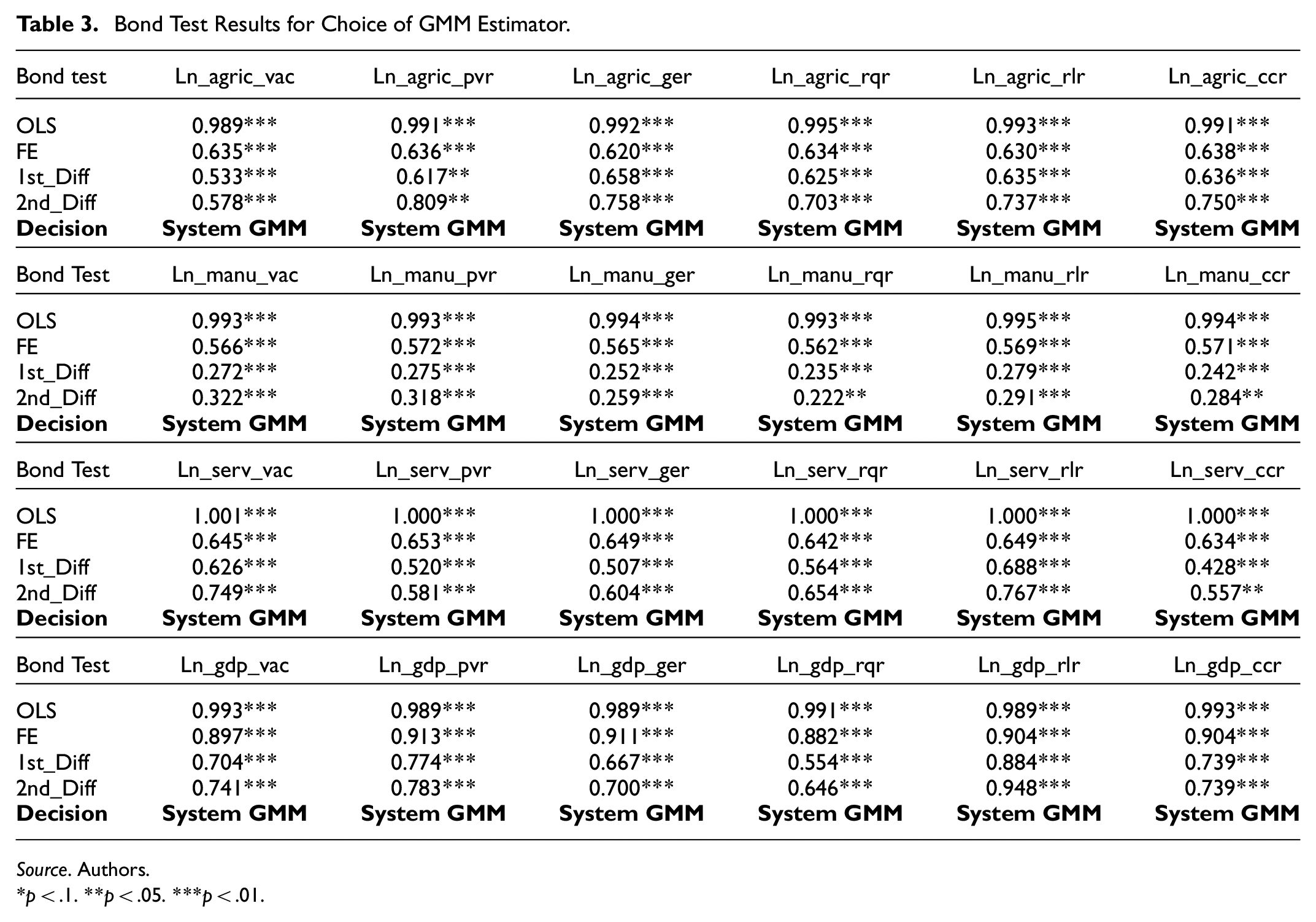
Source. Authors.
p < .1. **p < .05. ***p < .01.
The system GMM regression results for this study are presented in Table 4. Panel 1 reports for the agricultural sector; Panels 2 and 3 report for the manufacturing and services sectors, respectively; while Panel 4 reports for the aggregate economy. All the results in Table 4 satisfied the Hansen test for over-identifying restrictions and also showed that there is no problem of second order serial correlation. A closer look at Table 4 reveals clear patterns in the results. In what follows, we highlight these patterns and relate them to the extant literature. To begin, let us focus on how the various sectoral output growths as well as the aggregate output growth respond to changes in their respective lagged values. We find that the lagged values of output growth of the various sectors (agricultural, manufacturing and services) as well as the lagged values of the aggregate economic performance in SSA share statistically significant positive relationships with their respective present values. These results indicate that the initial levels of economic performance at both sectoral and aggregate economic levels impact positively and significantly on the respective current sectoral and aggregate economic growth in SSA, which is consistent with Ogbuabor et al. (2019) and Tumwebaze and Ijjo (2015). In a panel study of 15 West African countries for the period 2000 to 2015, Ogbuabor et al. (2019) found that initial level of real GDP per capita was important in explaining GDP per capita growth. For a panel of COMESA member countries from 1980 to 2010, Tumwebaze and Ijjo (2015) also established that initial per capita GDP growth impacts positively on current real per capita GDP growth, though the impact was not statistically significant. These results are however contrary to Zghidi et al. (2016), which investigated a panel of four North African countries from 1980 to 2013 and found that initial per capita GDP impedes growth. Thus, our results did lend support to the convergence hypothesis, which predicts a negative relationship between the initial real GDP per capita growth and the long-run growth rate of real per capita GDP.
System GMM Regression Results.

Note.
Source. Authors.
p < .1. **p < .05. ***p < .01.
We find that the role of institutional quality in the various economic sectors (agriculture, manufacturing and services) is generally mute. The results indicate that apart from the agricultural equation where the role of regulatory quality is seen to be significant but negative, other institutional quality variables did not play significant role in any of the three sectors under investigation. This finding is consistent with Fagbemi and Ajibike (2018) and Ifere et al. (2015), which found institutional quality to be insignificant for the development indices in Nigeria. It is also consistent with Nadarajah and Flaaten (2017), which did not find any significant relationship between institutional variables (such as governance, corruption and competitiveness) and aquaculture growth in a panel of aquaculture producing countries from Africa, Asia, the America and Oceania. This finding is also consistent with WGI (2020), which explained that recent statistical records indicate that SSA countries are characterized by weak institutional quality indicators. Further, the finding on the impact of regulatory quality on the agricultural sector is also consistent with that of Dwumfour (2020) who found that, merely regulating business activities and closure, such as those that concern getting electricity, protecting minority interest, paying taxes and resolving insolvency as a welfare improvement strategy would not work, unless done within a purview of sound policies and institutions.
The foregoing finding which indicates that the role of institutions in SSA’s sectoral and aggregate economic performance is negligible has far reaching implications for sustainable socio-economic, socio-political and environmental development of the region. This is because economies do not exist in a vacuum; they exist within certain institutional frameworks that in turn influence the activities of economic agents. Indeed, Egbetunde and Akinlo (2015) and Ogbuabor, Orji, Manasseh, and Anthony-Orji (2020) agree that SSA countries cannot experience sustainable economic growth and development with the prevalence of weak institutions in the region, while Nyiwul (2017, 2019) highlighted institutional constraints as one of the barriers to renewable technologies, renewable energy development and use, and climate change mitigation and adaptation in SSA. Nyiwul (2016) further explained that growth in Africa characterized by weak institutional environment carries health and environmental risks. Thus, our finding of a weak empirical link between institutions and sectoral economic performance in SSA indicates that policymakers and leaders in SSA have a lot of work to do in order to ensure that institutions in the sub-region are able to impact positively and significantly on sectoral output growth. For the aggregate economy, the results in Panel 4 reaffirm our earlier finding, except for voice and accountability and political stability, which showed significant influence at the 5% level. On the whole, therefore, we find that the role of institutional quality in sectoral and aggregate economic performance in SSA overwhelmingly remained negligible in the period 2010 to 2018, thereby reflecting the weak institutional frameworks prevailing in the sub-region.
Contrary to economic expectation, bank credit to the private sector (which we used as proxy for capital) showed an overwhelming negative and significant impact on the services sector. This is consistent with Golit and Adamu (2014) which had suggested that African economies should evolve policies toward the provision of adequate stock of physical capital to drive growth and development on the continent. This outcome is, however, in contrast with Iheonu et al. (2017) and Ogbuabor et al. (2019), which showed that capital impacts positively on the aggregate economy. It may be argued that our results may have been influenced by the choice of proxy for capital and that using gross fixed capital formation following Iheonu et al. (2017) may have yielded a different result. This argument appears quite plausible. However, the use of bank credit to the private sector as a proxy for capital in this study is consistent with Ogbuabor et al. (2019). This choice of proxy was based on data availability, which in turn enabled us to include many SSA economies in the study. Doing otherwise would mean that our analysis would not have sufficiently accounted for the dynamics of this region. From Panel 4 of Table 4, we find that labor impacts positively and significantly on the aggregate economy, which is consistent with theoretical expectation and the bulk of the extant literature such as Iheonu et al. (2017) and Ogbuabor et al. (2019). However, this finding is contrary to Tumwebaze and Ijjo (2015), which found that human capital growth impedes growth in real per capita GDP for a panel of COMESA economies.
Conclusion and Policy Implications
Absence of empirical evidence on the role of institutions at sectoral level in Africa as well as the conflicting empirical evidences on the institutions-growth relationship, this study investigated the sectoral impacts of institutional quality in SSA. The study also revisited the role of institutions in the aggregate economy. The study used the system GMM estimation technique and a panel of 42 SSA countries over the period 2010 to 2018. The study employed a range of institutional quality variables, including voice and accountability, political stability, government effectiveness, regulatory quality, rule of law and control of corruption. The results indicate that contrary to the widely held view that institutions foster growth and development, the role of institutional quality in sectoral and aggregate economic performance in SSA generally remained muted. Nonetheless, the results indicate that initial level of real GDP and labor are robust drivers of growth, especially in the aggregate economy.
The foregoing findings have implications for institutional reforms in SSA. Policymakers and leaders in SSA countries should intensify efforts toward improving voice and accountability, political stability, government effectiveness, regulatory quality, rule of law and control of corruption. For instance, governments in SSA countries should be more democratic in terms of enforcing human rights, equal citizenship, economic and socio-political inclusion so that citizens can associate freely and productively. They should also improve and strengthen the quality of public administration underlined by a transparent and merit based employment into the public sector in order to have competent workers in the public service. Furthermore, the governments of SSA countries should employ every means possible to curb petty and grand corrupt practices. This can be done by strengthening institutions saddled with the responsibility to fight corruption like the Economic and Financial Crimes Commissions (EFCC) and the Independent Corrupt Practices Commission (ICPC) in Nigeria. Thus, there is need to evolve policy reforms that will enhance the institutional frameworks in SSA.
The results also have policy implications for human capital development and accumulation of capital, which are important in driving the structural transformation of SSA countries to make them more productive. This means that policymakers and leaders in SSA should favor policy reforms that can improve the socio-political and economic environment in the sub-region in order to get higher levels of investment and increase the quality of the working population. This needs deliberate effort to make the sub-region more appealing to potential investors. It also requires deliberate effort to enhance the amount and quality of government spending in the education and health sectors in the sub-region. Overall, this study indicates that institutional policy reforms, increased human knowledge and accumulation of capital are required to drive sectoral and aggregate economic performance in SSA.
Footnotes
Appendix 1
List of Countries Included in the Study.

| S/no. | Country |
|---|---|
| 1 | Algeria |
| 2 | Angola |
| 3 | Benin |
| 4 | Botswana |
| 5 | Burkina Faso |
| 6 | Burundi |
| 7 | Cabo Verde |
| 8 | Cameroon |
| 9 | Chad |
| 10 | Congo Democratic Republic |
| 11 | Congo Republic |
| 12 | Cote d’Ivoire |
| 13 | Egypt |
| 14 | Equatorial Guinea |
| 15 | Eswatini |
| 16 | Gabon |
| 17 | Gambia |
| 18 | Ghana |
| 19 | Guinea |
| 20 | Guinea-Bissau |
| 21 | Kenya |
| 22 | Lesotho |
| 23 | Madagascar |
| 24 | Malawi |
| 25 | Mauritania |
| 26 | Morocco |
| 27 | Mozambique |
| 28 | Namibia |
| 29 | Niger |
| 30 | Nigeria |
| 31 | Rwanda |
| 32 | Sao Tome and Principe |
| 33 | Senegal |
| 34 | Seychelles |
| 35 | Sierra Leone |
| 36 | South Africa |
| 37 | Tanzania |
| 38 | Togo |
| 39 | Tunisia |
| 40 | Uganda |
| 41 | Zambia |
| 42 | Zimbabwe |
Source. Authors.
Availability of Data and Materials
The author will provide all datasets based on requests.
Declaration of Conflicting Interests
The author(s) declared no potential conflicts of interest with respect to the research, authorship, and/or publication of this article.
Funding
The author(s) received no financial support for the research, authorship, and/or publication of this article.
