




Abstract
Cooking class travel (CCT) is a special form of food economy that is emerging worldwide, especially in Southeast Asian countries, such as Thailand. CCT is a touristic activity with strong value co-creation characteristics, but it is scarcely investigated on how tourists and hosts can work together to co-create the experience and value in CCT. Thus, based on value co-creation theory, this study adopts a rigorous content analysis approach to inspect the value co-creation mechanism of CCT in Thailand. Results reveal a value co-creation framework for CCT—from resources to practices to the final outcomes—offering academia and practitioners an in-depth insight into this fast-developing type of tourism economy and extending value co-creation theory to a new research area.
Introduction
Food tourism or culinary tourism is one of the world’s most dynamic and rapidly expanding niche sectors in the highly competitive tourism market and has received growing attention from academia and the industry (Timothy, 2016; Walter, 2017). Its importance is evident given that food is increasingly acknowledged as a fundamental element in any culture and a major component of the intangible heritage of any place (UNWTO, 2015). Thus, food plays a pivotal role in tourism and destination development (Agyeiwaah et al., 2019; Nelson, 2016). Various studies have verified the positive relationship between food tourism and the overall image of a destination (Alonso & Liu, 2010; Suntikul, 2017).
Following this global attraction toward food tourism, the Thai government launched a campaign to promote Thai food to the international market in 2002. Thai food is being developed as one of Thailand’s key tourism attractions. Food festivals, international cooking schools, and walking tours at local food markets and stalls have been prospering, further enhancing the attraction of Thai food (Lertputtarak, 2012). Thus, the Thai government invested in another campaign to promote tourism. Cooking schools were opened throughout the country to accommodate tourists who desire to acquire Thai cooking skills (Tourism Authority of Thailand, 2015). Since then, Thai cooking classes offered by cooking schools specifically for tourists have captured attention worldwide. Cooking classes offer visitors an opportunity to experience a novel and exotic aspect of the destination (Kivela & Crotts, 2006). Moreover, cooking classes are a participatory form of travel in which visitors need to engage fully in the process (Walter, 2017).
Most food tourism studies have focused on understanding tourists’ motivation to participate in food tourism and its influence on tourists’ satisfaction and loyalty. The key food tourism activity involves tasting local delicacies offered in different restaurants, street stalls, or local markets (Agyeiwaah et al., 2019; Boesen et al., 2017; Q. Chen & Huang, 2019). However, scant research has investigated a special food tasting practice that involves food cooked by tourists at cooking classes (Agyeiwaah et al., 2019). In a cooking class, visitors are customers and producers of food, indicating their active role in creating the travel experience. Although research on value co-creation is booming in the hospitality and tourism field (Dolan et al., 2019; Mijnheer & Gamble, 2019; Wong & Lai, 2019), a gap exists regarding the understanding of how value is co-created in food tourism, especially in cooking class travel (CCT) with strong co-creation elements.
Against this backdrop, the present study mainly investigates how tourists and hosts can co-create the experience and value in CCT, thereby extending value co-creation theory to this prospering area. Moreover, this study portrays a complete framework on the resources and practices necessary to achieve value co-creation in CCT, together with the resulting outcomes. Thus, this study contributes to the development of value co-creation theory by incorporating the perspective of food tourism. The findings of this study can help practitioners and destination marketing organizations allocate their resources to design and market CCT for the sustainable development of a destination with distinctive food culture. The findings may elucidate other destinations with passion or plan to develop food tourism. Managerial implications can be generated from this perspective as well.
Literature Review
Food Tourism
Hall and Mitchell (2001) provided an excellent preliminary understanding of food tourism and proposed food as a major motivation in tourism. They described food tourism as “visitation to primary and secondary food producers, food festivals, restaurants, and specific locations for which food tasting and/or experiencing the attributes of specialist food production region are the primary motivating factor for travel” (p. 308). As food tourism research has entered a fast development period, the field experienced a shift, that is, a “cultural turn” from early management-focused studies to incorporating cultural elements in forming a robust framework to investigate food tourism (Everett, 2012). The frequency or volume of the studies and the variety of research approaches and concepts being explored significantly increased. Some researchers adopted a quantitative methodology, including structural equation model (Chien et al., 2018; Tsai & Wang, 2017) and self-classification measure (Ying et al., 2018). Most studies have adopted the qualitative methodology, such as netnography (Mkono et al., 2013), inductive phenomenological approach (Kim et al., 2019), and content analysis (de Albuquerque et al., 2019; Kim & Iwashita, 2016).
Food tourism is a presentation of history and place. It is a cultural experience; thus, the importance of authenticity is paramount (Ellis et al., 2018). Previous studies have illustrated the nuanced nature of food experiences, including tourists’ interest in authenticity, as well as food neophilia and food neophobia (Mkono et al., 2013). Experiential value was proven to enhance significantly a place’s food image (Tsai & Wang, 2017). In summary, the desire for new experiences is regarded as representing a new tourist motivation that can be witnessed in food tourism, including participation in cooking classes, food, and wine trails, and simply performing the ritual of a must-eat food at a destination.
Tourism websites are confirmed to be important platforms for promoting a destination’s exciting cuisine and food culture (Horng & Tsai 2010). Horng and Tsai (2010) established a virtual experience framework for tourists to sense the food of a destination online. Yousaf and Xiucheng (2018) examined the use of the Internet to promote cuisines and culinary tourism through a content analysis of tourism websites regarding how this practice was done in different destinations. The study also considered the potential of a community to be a preferred food tourism destination. Based on the analysis, tourism websites serve as a crucial medium for shaping the culinary cultural image of a country, region, or locality for its visitors. Moreover, visitors’ comments on these websites are a vital source for investigating their experience in food tourism.
Value Co-Creation in Tourism
Service-dominant (S-D) logic conceptualizes value co-creation as the outcome of interactive processes between customers and service providers (Vargo & Lusch, 2004). It emphasizes the importance of services and highlights that enterprises change from producing products to providing services. An enterprise launches the value proposition process, and customers participate in subsequent product design, production, delivery, and consumption (Vargo & Lusch, 2008). Customer-dominant (C-D) logic further develops the S-D logic’s view of value as a phenomenological construct (Helkkula et al., 2012) and emphasizes that customers constantly incorporate the value derived from their previous experiences into their ongoing social practices and experiences to create new value (Rihova et al., 2013). Thus, value co-creation theory emphasizes the role of customer experience and highlights tourists as active co-creators of tourism experiences rather than passive consumers of predetermined experiences (Binkhorst & Dekker, 2009).
Value co-creation theory has been widely adopted in service research and has received increasing focus in the tourism domain. Participating in value co-creation can meet tourists’ needs and improve the value of their experience (Prebensen & Xie, 2017) because tourists could provide feedback to the service providers of tourism or hospitality industries regarding their needs, opinions, and suggestions (Casais et al., 2020; Xu et al., 2018). Service providers could use such important information to improve their products and services to meet customers’ requirements. By taking part in value co-creation, visitor satisfaction could also be enhanced through empowerment, feelings of well-being, and loyalty (Dekhili & Hallem, 2020; Luo et al., 2019). Moreover, the related brand value of service providers could be improved simultaneously (Ahn et al., 2019). Furthermore, the value co-creation process highlights the importance of the value formed when tourists co-create with one another in tourism settings (Rihova et al., 2018). In other words, the interaction among tourists is an important component of value co-creation. However, appropriate countermeasures should be taken to avoid guest complaints on social media, which may lead to co-destruction (Dolan et al., 2019).
Johnson and Neuhofer (2017) proposed a framework involving three dimensions, namely, co-creation resources, practices, and outcomes, to unveil the co-creation of experience in the context of Airbnb. Later on, many studies have followed this basic framework to explore value co-creation mechanism in different domains of tourism. For example, the study on tourism place branding emphasizes the role of local community as an important resource and agent in value co-creation (Leal et al., 2022). Other studies focus on investigating the productive role of tourists in the value co-creation process, leading to the invisible promotion of destination image and brand as an outcome (Rihova et al., 2015; Van Limburg, 2009). Overall, it proves that the framework developed by Johnson and Neuhofer (2017) can be a good foundation for exploring value co-creation in tourism, but while it is applied in different domains of tourism, new exploration is needed to establish an adjusted framework in order to illustrate the specific value co-creation mechanism in this domain.
In summary, food-related experiences at a destination have been verified as a crucial element that makes visitors attribute experiential value toward a destination. Thus, they merit much in-depth research to market a destination well and improve its marketing. With the proliferation of value co-creation theories in tourism, various studies have been conducted to explore value co-creation in different tourist activities. However, value co-creation has not been examined in the highly emerging area of food tourism. Moreover, qualitative research has been verified as the major approach in investigating different elements of food tourism, and information from tourism websites remains as an important source to examine different phenomena in tourism. The present study attempts to bridge the identified research gap by unveiling how value is co-created in food tourism, specifically in CCT, using a qualitative analysis of information from websites.
Methodology
The present study adopted netnography as the method to achieve the main research objective, which is to reveal the complete value co-creation mechanism in CCT. Netnography was used to observe and analyze visitors’ experiences (from their perspective) in CCT. This method was regarded suitable mainly because the text written by visitors are not considered as mere “content,” but rather as a constructive interaction, and the words can be analyzed to unveil elements in addition to the literal meaning. Moreover, netnography has been validated in various studies to be a robust method for investigating customers’ experience in tourism and has been widely adopted accordingly (Ko et al., 2018; Liu & Park, 2015).
Three cooking classes in Chiang Mai were selected to collect visitors’ online comments in TripAdvisor in January 2020. Chiang Mai is a major city in northern Thailand endowed with excellent natural and cultural beauty. The city offers a wide range of cooking classes for visitors who intend to learn about Thailand’s culinary culture and cooking skills; these classes make the city a popular destination for educational Thai food tours (TripAdvisor, 2018). Therefore, cooking classes in Chiang Mai can be considered representative for purpose of examining food tourism and the related value co-creation activity. One class is chosen for its best rating among all cooking classes in Thailand (Best Thai Cookery School), one class is chosen because it receives the largest number of comments from customers (Thai Farm Cooking School), and one class is chosen given that the comments it receives include customers’ reviews and owners’ responses, which are quite useful for analyzing the reciprocal co-creation practice. The detailed information for the three cooking classes can be seen in Table 1.
Information About the Examined Cooking Classes.

Content analysis is an analytical skill used to gain an in-depth understanding of the content derived from research data to unveil the underlying factors of an examined phenomenon. This skill has been frequently applied in tourism studies (Jiang & Yu, 2020). Krippendorff (2004) stated that content analysis is rooted in the theory used to explore empirically, predict, or make deductions during the whole research process based on a specific research objective. Given the ambiguity of textual data, researchers normally propose a research question or proposition at the beginning of the study. Then, they analyze, code, categorize, and interpret the content from the data to answer the research question. The present study raises the research question in the introduction, which is to investigate how tourists and hosts can co-create the experience and value in CCT. Raw data was fully analyzed with the purpose of identifying the main features of the researched phenomenon, and obtained information was grouped into categories and subcategories which were subsequently coded into different dimensions and attributes under the framework (John and Neuhofer’s framework on value co-creation experience). During this process, the overlapping information was reevaluated and redefined, and only information that is closely relevant to value co-creation was taken into consideration. Finally, the researchers worked together to interpret the results for a full picture of how value co-creation is achieved in CCT. The analytical process ensures the main mechanism of value co-creation in CCT can be identified from the online textual data. Table 2 is used to display the coding mechanism in a clearer way.
Coding Mechanism for the Online Textual Data.

According to Potter and Levine (1999), reproducibility is considered the strongest realistic method in testing the reliability of content analysis. To demonstrate the reliability of the study, two researchers were invited to code the data 1 month after the initial coding result was achieved. The outcome is that the coding patterns from the two rounds of coding are almost the same. Meanwhile, the coding process is theory driven with predefined categories and clear definitions, which also improves the reliability of the result. To guarantee the validity of the coding results, two researchers first coded independently and compared their results after that. Whenever differences appeared, coders held intense discussions to address the differences, which enhance the internal validity of the findings (Avenier, 2010).
Findings and Discussions
Following the framework proposed by Johnson and Neuhofer (2017) when they investigated value co-creation experience in the context of Jamaica’s Airbnb, the present study identifies themes and categorizes them into the value co-creation framework, including value co-creation resources, practices, and outcomes (see Figure 1). As a qualitative study, the study grouped the themes and category based on the research objective which is to explore value co-creation mechanism in CCT. Hence, under the guidance of Johnson and Neuhofer (2017), the study identifies resources and practices needed to conduct the value co-creation process together with the concrete expression of the value co-creation outcome. The following section provides a detailed presentation and discussion of how each component (i.e., theme and category) contributes to the value co-creation process.
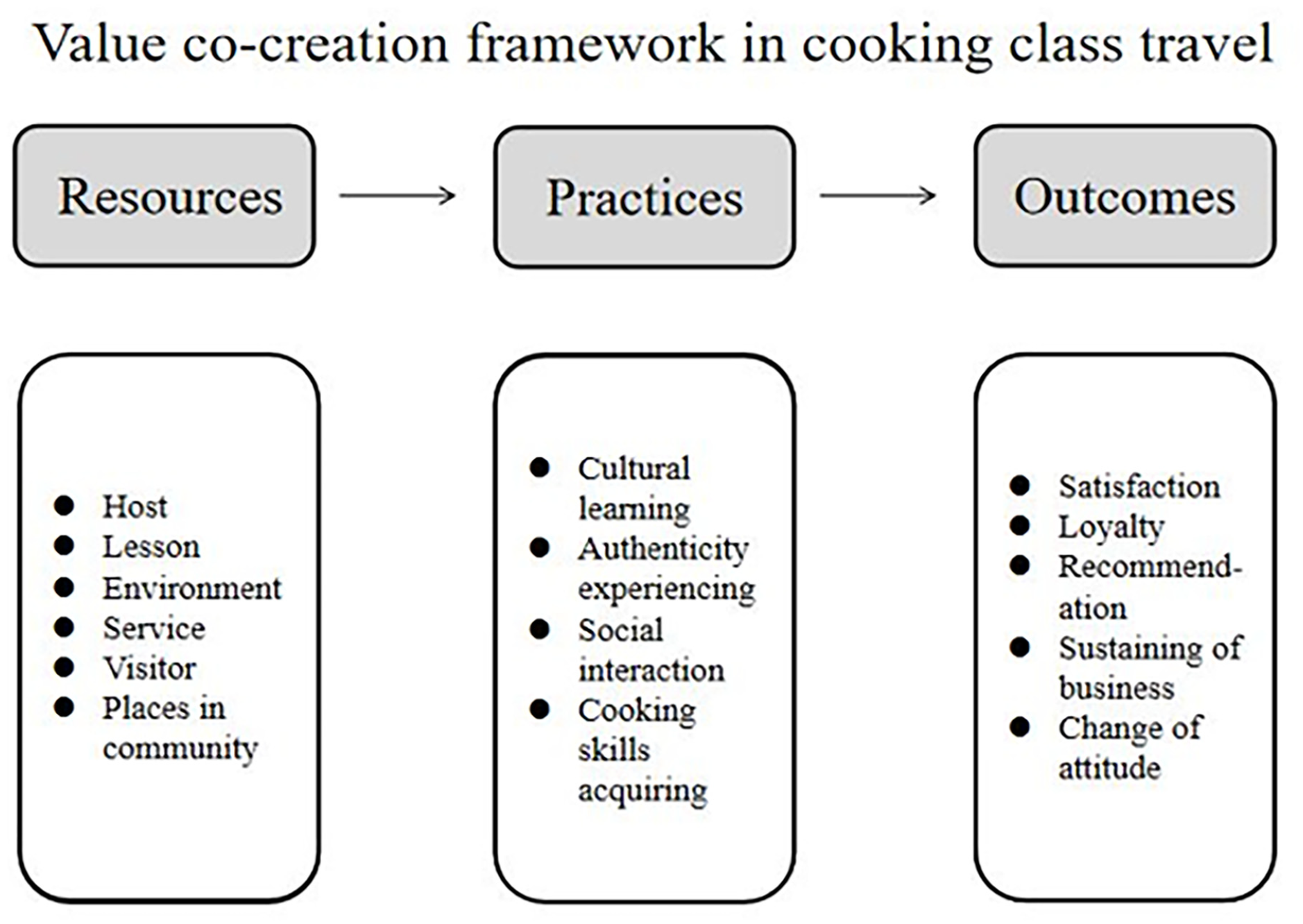
Value co-creation framework in cooking class travel.
Value Co-Creation Resources
Host
The host is the key to all resources given that he/she initially plans and organizes everything. This feature has been verified in multiple tourism studies that focused on the host–guest interaction (Bimonte & Punzo, 2016; Moon et al., 2019). Being professional and knowledgeable in cooking is a prerequisite for the host of a cooking class because visitors attend a cooking class as a travel activity. These visitors are willing to spend time on the class and keen to learn useful cooking skills.
The owners were super friendly and very knowledgeable.
Very professional, they paid attention to details and provided a very friendly atmosphere, almost like cooking with friends.
Lesson
The lesson is the main attraction and the second key resource because other activities are planned to contribute to the success of the lesson. For modern citizens, a convenient way to learn cooking skills is to watch a cooking lesson on TV or social media and then follow the cooking process (Folkvord et al., 2020). The cooking class in this research context is concerned about the teachers’ expertise in hands-on presentation and on-site problem-solving. Thus, visitors can learn well.
Vasin and Pom did an excellent job of explaining everything from ingredients to techniques and secrets on how to make our dishes as delicious as they turned out to be.
They enthusiastically answered our questions and expertly guided us through the process of preparing dishes.
Environment
The learning environment is found to be a crucial facilitator of a class in terms of the learning process and mindset (Hemmati & Mahdie, 2014). Consistent with this finding, the environment also receives due attention in CCT. In the present study, the environment refers to the design and arrangement of facilities, along with the classroom setting.
Their classroom is excellent. The seating is good. Their workspace is well organized. The well-placed mirrors allow us to see what they do easily.
The setting is lovely. It is in a village away from the bustle and heat of Chiang Mai. The place is nice to escape to on Chinese New Year.
Service
Service quality significantly influences customers’ rational and emotional perception of a tour (Berry et al., 2006); the service commences right after a customer purchases a travel product and lasts throughout the whole travel process (Spenceley et al., 2019). Service quality in CCT involves excellent teaching and incorporates other elements. Some simple acts of service may create unimaginable effects.
We ate each course after preparing it. The kitchen was ‘magically’ cleaned and readied for our next dish.
I accidentally left my watch in the van that dropped us off at the end of the day. The cooking school found it and sent it to my hotel in Bangkok free of charge! This was just a small example that embodies the school’s high quality of service.
Visitor
At the other end of the host–guest relationship, the visitor must play his/her role in this value co-creation process, especially with the advancement of the experience economy. Studies have verified that value cannot be created simply by the service provider’s effort; value requires a joint effort from the provider and the customer (Cova et al., 2011; Vargo & Lusch, 2004). Without the visitor’s initiative to attend the cooking class and active participation in travel, value co-creation cannot exist.
One of the reasons I went to Thailand was for the food, and the opportunity to cook by myself was something I was very excited to do.
Place in Community
In addition to the cooking classroom, multiple places in the community also play a role in the value co-creation process. Places outside Airbnb homes offer tourists the chance to experience authentic local culture and life (Johnson & Neuhofer, 2017), which is found to apply to CCT as well. The market and the places visitors pass by on their way to the classroom are important places. Different from the guided tours offered by tour agencies, the experience gained in visiting such key places is distinctive.
They drove us to the market, highlighting different areas of Chiang Mai as we drove.
The market where we shopped was a treat for our kids—authentic and very educational.
Value co-creation resources are threefold. First, the lesson and the host are key resources, including how they serve visitors and how they set the learning environment. The role of the host as the teacher may suggest his/her superior position in the interactive process. However, in the tourism industry, the service provider must care much about his/her visitors by elaborately presenting from the preparation to the end of the class. Thus, the host dominates the cooking class, which is a similar scenario in most traditional classrooms (Knight, 2002); however, the host is concerned about more than the learning outcome and pays special attention to facilitating a happy and satisfactory learning process. This effort is in accordance with the latest education philosophies, namely, learning by doing (Bell & Morse, 2013) and happiness cultivated by education (Noddings, 2003). Second, the visitor is a special type of student. Without a group of visitors, CCT cannot exist. The findings in the subsequent section reveal that, in practice, visitors are active value co-creators. Third, the local community is a travel resource and accordingly acts as a value co-creation resource. It is unlike traditional classes where lessons are conducted only in the classroom.
Value Co-Creation Practices
Cultural Learning
The main cultural element in any form of culinary tourism is learning about the destination’s specific food culture (Ellis et al., 2018). Specifically, the food production, cuisine style, and representative dishes of a destination are shown to introduce the destination’s food culture (Cianflone et al., 2013) to tourists. Cultural learning is also a direct outcome of attending a cooking class. However, taking this travel activity can offer more than cultural learning; it gives visitors a chance to explore the destination’s culture deeply, including the behavior, knowledge, and customers of a place. Thus, visitors can have a strong perception of destination identity.
They both have a lot of local knowledge, and we found out a lot about Chiang Mai and the Thai culture.
Exploring the local market and shopping for ingredients were a cultural experience.
This learning can also take place directly in the classroom through the hosts’ teaching activities.
Both Vasin and Pom were brilliant in teaching us how to cook delicious Thai meals quickly and in providing lots of background information on Thai culture and food.
Authentic Experience
According to MacCannell (1973), authenticity, a long-established factor that justifies tourists’ experience, is reflected in the tourists’ pursuit of otherness when traveling. In culinary tourism, food acts as the medium for tourists to experience this otherness (Nyman, 2003). However, CCT, with the host’s elaborate arrangement, extends authenticity from the food level to the destination level. Thus, tourists are more likely to experience authenticity in the destination rather than simply being immersed in purely tourist areas. This concept is similar to touring like locals, as found in other experience studies of tourism (Johnson & Neuhofer, 2017; Salazar, 2006).
We enjoyed the experience with Pom and Vasin more than anything else in Chiang Mai, including seeing the wats and the night bazaar.
It was really cool to get outside of the tourist areas and see the ‘real’ Thailand and how the people go about their day, including shopping for groceries.
Given such a pleasing authentic experience, visitors’ insight into the destination can be enhanced. For example, after the host took a visitor to the local market and a nearby farm, the visitor commented,
I learned more about the Thai people, farmers, and life in this half day experience than in my last six days in Thailand.
Social Interaction
Interaction exists in almost any human-to-human activity, and host–guest interaction is a vital element in tourism (Smith & Brent, 2001). In traditional package tours, this interaction happens mainly among tour guides, tourists, and people in tourist areas. Although those who work for tourism constantly improve their service level at work, establishing a friendship or long-term relationship among the said three parties remains difficult for multiple reasons (Capistrano & Weaver, 2018). However, in CCT, the host also plays the role of a teacher, and the classroom serves as the host’s home. Therefore, having social interaction while teaching and learning is easy, especially when some locals are invited to participate as well. This practice features the intimacy and sincerity between hosts and guests, which help realize “existential authenticity,” a concept raised by some scholars (Conran, 2006; Taylor, 2001).
They pick us up at our hotel, take us to the market, and laugh while teaching and cooking. They make you feel like a member of the family.
You learn so much, not just about cooking, which you can only get by interacting with the locals.
The tour group was fun, and we enjoyed meeting people.
Acquiring Cooking Skills
The last practice, which is also indispensable, is imparting cooking skills to visitors. In CCT, visitors play three roles simultaneously, namely, customers, producers, and performers (Walter, 2017). However, these roles cannot be successfully performed without the cooking practice, signifying its importance. Thus, the host, who is also the teacher, carefully designs everything and makes the process of acquiring cooking skills easy and enjoyable.
We made curry, pad Thai, cashew chicken, tom yum, and sticky rice, and everything tasted excellent.
I had the most fun preparing Thai food at this cooking school, and I made the best Pad Thai so far in Thailand.
Food tourism offers tourists a way to learn about the food culture in a destination (Ellis et al., 2018; Horng & Tsai 2010). However, the practice involved in value co-creation in CCT moves beyond that. The present study verifies that visitors also learn the culture of a destination, which is a worthwhile contribution to the current literature. Moreover, the destination is presented to visitors authentically, and they assimilate or experience its cultural elements. Such experience is what seasoned tourists look for (Jyotsna & Maurya, 2019), which is another merit of CCT. Although these points can be found in conventional travel activities, the experience level for tourists is further advanced in CCT. Moreover, a highlight for the value co-creation practice is the social interaction conducted during travel. Social interaction has been verified as an important antecedent of tourists’ satisfaction and loyalty toward a destination (H. Chen & Rahman, 2018). Within package tours, socializing with either the tour guide or newly acquainted group members is difficult; the guide needs to take care of a large group, and tourists may have difficulty deciding who to socialize with (Hansen & Mossberg, 2017). However, CCT enables visitors to socialize smoothly with different people, including the host, locals, other participants, and their companions. Acquiring some cooking skills is an indispensable practice given that it is the core practice in CCT.
Value Co-Creation Outcomes
Satisfaction
In tourism, satisfaction refers to the degree to which visitors’ post-visit experience meet their pre-visit expectations (Asmelash & Kumar, 2019). Given that satisfaction has many positive outcomes, including loyalty, profits, and recommendation, it has generated interest from researchers and practitioners (Zeithaml et al., 2013). In CCT, visitors’ satisfaction reaches high levels, as shown in their use of superlatives or comparisons to express their highly positive emotion.
A FABULOUS meal that was among the best, freshest, traditional Thai meals we ever had, rivaling any of the fine restaurants we dined in.
I would rate this class as the number 1 experience of my recent Thailand visit.
Loyalty
Loyalty is frequently represented by the repeated purchase of certain products or services by customers in most industries (Kanakaratne et al., 2020), which can also be applied to a tourism destination. As a key objective of tourism, loyalty among visitors is pursued by all tourist activities. However, in international tourism, making tourists come back and visit repeatedly, especially long-haul tourists, is challenging for a destination. Attending a cooking class has been identified as one way to address this problem because it can encourage visitors’ loyalty to this activity first and later indirectly foster their loyalty to a destination.
I will certainly go again next time I am in Chiang Mai.
Loyalty can also be cultivated among business owners who offer this tourist activity. They frequently show their willingness to keep the business and their continuous devotion to service quality. This type of loyalty can be regarded as an expression of their job commitment.
Your comment is important to us, and we promise to keep doing our best to share our family recipes to everyone who loves Thai food.
Your comment really inspired us to work harder for those who love Thai food.
Recommendation
With the advancement of information technology, computerized recommendation systems have become a new medium for visitors to acquire travel-related information. However, recommendations from previous tourists are confirmed to be highly convincing and powerful in the actual recommendation system (Alrawadieh et al., 2019). Different from satisfaction and loyalty, a recommendation is what visitors provide to influence future visitors. Thus, it is what a destination attempts to obtain after its visitors’ tour experience. Moreover, satisfied visitors offer their recommendation and give detailed information to help prospective visitors make travel decisions.
I highly recommend this for families, students, and team-building events.
Hold the phone and cancel all your other bookings. If you will do only one thing in Chiang Mai, make it this class.
Sustaining the Business
For the hosts who organize CCT in the tourism industry, sustaining the business is a major goal. This activity cannot survive without profit. The success of CCT as a co-creation practice is demonstrated by the visitors’ feeling of having spent their money well, as expressed in the following comment.
It is a great little farm, and all the dishes are typical and delicious. Good value for money.
Value for money has been confirmed as an influential factor with regard to tourists’ decision making and purchasing behavior, which in return affects the tourism industry’s financial performance (Williams & Soutar, 2009). In other words, when tourists perceive that an activity is good value for money, they become more willing to spend their money on that activity. Thus, business performance and the business itself can be sustained.
Change of Attitude
Knowledge acquisition is a goal of any learning activity, but the ultimate goal is to change the learners’ attitude for them to become active learners and participants (Lee & Bong, 2019). A cooking class gives visitors an opportunity to learn cooking skills during class time, but this activity may exert a highly significant influence on visitors’ post-visit life. Specifically, this experience may be lasting enough to affect visitors’ future attitude toward cooking or life in general.
The experience was amazing. The kids loved the cooking experience and were keen to try their new skills back home.
I really did not like cooking before, but this cooking class changed my view.
Excelling at cooking or at least knowing how to cook is a merit for people in this modern life given that people are becoming busier at work and consider cooking a useless skill. Thus, this learning experience gives them a chance to revisit cooking and adds some color to their daily life. Moreover, this positive learning experience may further influence their attitude toward other learning activities in life.
In summary, the conventional outcomes identified in different studies have also been confirmed in CCT, including satisfaction, loyalty, and recommendation (Almeida-Santana & Moreno-Gil, 2018; Alrawadieh et al., 2019; C. Chen et al., 2016). Satisfaction and loyalty are what the industry and destinations intend to create for their incoming tourists. Only in this way can they sustain their own business and the long-term development of the destination. In CCT, visitors acquire satisfaction and loyalty, which also support the development of the business and, indirectly, the destination. This observation has been verified in the present study from the host’s perspective. Visitors with a high satisfaction level would recommend their peers to try CCT. Thus, a complete, desirable outcome for this type of travel has been identified. However, CCT helps change visitors’ attitude toward cooking and their “post-visit life,” which is a high-level outcome that tourism can bring to the general public (Woo et al., 2019). Thus, the five types of value co-creation outcomes are confirmed to exist in CCT.
Conclusions
Drawn on value co-creation theory, this study utilizes a qualitative approach to investigate the value co-creation experience in the context of CCT. Reviews and responses from three representative cooking classes in Thailand are collected to form the research dataset. A rigorous content analysis method is utilized to investigate the data and answer the research question. Through careful analysis and interpretation, the study successfully achieves the research objective, which is to scrutinize what resources are involved in the creation process, what practices have been done during the process, and what outcomes have been achieved accordingly. Thus, a complete framework can be established to showcase the value co-creation mechanism in CCT.
Theoretical Contributions
With continuous attention on value co-creation theory and the related practice in multiple contexts, the call for research to extend value co-creation to food tourism is important. Such research can elucidate how tourists play the roles of experiencers and suppliers in food tourism. To the best of the researchers’ knowledge, the present study is among the early ones to conduct such an exploration. To develop a good understanding of value co-creation in CCT together with the resulting outcomes, this study attempts to fill the gap by linking CCT with a theoretical framework based on value co-creation theory, food tourism practices, and authentic tourist experiences. By doing so, this study extends the contemporary S-D and C-D logic discourses (Johnson & Neuhofer, 2017; Vargo & Lusch, 2016) to demonstrate what resources and practices contribute to value co-creation in the course of CCT and the important benefits CCT can bring to the industry. Thus, this study validates the robustness of using value co-creation theory to investigate CCT and specifies the elements involved in the whole value co-creation process of CCT from the initial resources to the final outcomes. This study lays a foundation for future studies to explore value co-creation in food tourism, as well as other types of tourism.
Managerial Implications
The pursuit of food culture is what every visitor wants from cooking classes. Therefore, tourists would appreciate if hosts integrate cultural elements into food courses to help them gain a deep understanding of the food culture based on the origin of the dishes, the selection of raw materials, and the diet history of the locals. All these elements comprise the basic value co-creation resources and practices that focus on food. As organizers of food classes, hosts should design interesting activities or give tourists authentic experiences, such as an in-depth tour in local communities or markets, and interactive teaching processes. Thus, participating in cooking classes fulfills learning and tour functions simultaneously. An intimate or close interaction (i.e., among the tourists or tourists and hosts) can also contribute to value co-creation.
As the key objectives of tourism, customer satisfaction and loyalty are important for every service supplier. If visitors obtain much satisfaction from their cooking classes and consider them as value for money, they will repeat and recommend the experience to their friends or relatives, which represent a huge potential market. Thus, previous visitors’ words can serve a positive advertisement. Even when visitors return home, the nutritional knowledge and cooking skills acquired from a cooking class can have an impact on their lifestyle. In this sense, more value is created for visitors after attending cooking classes, which will, in turn, benefit hosts and destinations. The confirmed observation that tourists are participants in the tourism process and value creators indicates that value co-creation is an eminent feature of CCT. Thus, considering this feature to promote food tourism is worthwhile for most destinations.
By developing a good understanding of the value co-creation proposition, this study provides implications for policymakers and the local community. With the increasing demand for food tourism services, the corresponding effects on the socio-economic condition of the local community can be witnessed through earnings, employment, and socio-cultural exchanges. Given that this study provides insights into the value co-creation framework of CCT, destinations and local communities can benefit more from this type of travel if they can properly arrange their resources and practices.
Footnotes
Acknowledgements
Not applicable.
Author Contributions
Conceptualization, J.Q., P.L.; Data acquisition, J.Q., P.L.; Analysis, J.Q., P.L., K.N.; Interpretation, J.Q., J.W., T.L.; Writing-original draft, J.Q., P.L.; Writing-review and editing, J.Q., P.L., J.W., T.L., K.N.
Declaration of Conflicting Interests
The author(s) declared no potential conflicts of interest with respect to the research, authorship, and/or publication of this article.
Funding
The author(s) disclosed receipt of the following financial support for the research, authorship, and/or publication of this article: This research was supported by Hangzhou Social Science Project, grant number 21NHZX29.

Data Availability Statement
The data presented in this study are available on request from the corresponding author.