




Abstract
The link between access to better libraries and students’ achievement has long been proven. But to residents in the Asante Akyem North Municipality, the benefits libraries offer remain illusory because of limited access. Using cross-sectional research design, the article examines staffing, collections, funding, library facilities, user perceptions, and the extent of utilization of the few libraries in the municipality. The author finds an indescribable deficit in the provision of library and information services, and attributes this primarily to an apparent lack of recognition of the important place libraries occupy in education delivery and knowledge acquisition.
Introduction
Libraries provide numerous benefits. These include promoting literacy, a reading culture, and knowledge acquisition, among others. Libraries are also critical contributors to knowledge generation (Tise, Raju, & Masango, 2008). For these reasons, governments worldwide have made efforts to extend library services to the public. Nevertheless, many areas lack and continue to endure years of limited or no access to library and information services.
As it is widely acknowledged, better resourced libraries are imperative for reading and learning because of the promotive ambience they provide. And although it is practically difficult for everyone to acquire all the reading materials they may need, it is also impossible for an individual to have sufficient knowledge about all reading materials that are available on all topics of interest. Libraries are therefore necessary to provide substantial volumes of information required by the public, by providing unhindered access to resources and knowledge for economic and cultural advancement (International Federation of Library Associations and Institutions [IFLA], 2003b). Perhaps a much more cogent argument for public libraries in particular is the right of equitable access to information (Bourke, 2007). Public libraries thus represent the building in a town that all may use—both the smallest child and oldest senior citizen (Anderson, 1994).
Reading and learning are two intertwined activities fundamental to scholarship. And as Bundy (2008) has remarked, reading is critical to society because, without it, no true educational revolution can occur. This viewpoint somewhat reinforces the axiom that a reading child becomes a knowledgeable adult. Libraries thus play a significant role in promoting early childhood development. And aside from inculcating lifelong reading habits, libraries encourage children to put their leisure periods into productive use, thereby reducing their indulgence in reprehensible and antisocial activities, most of which are consequences of desolation and boredom. Moreover, the human capital needed for national development is very much rooted in solid academic foundations, in which good libraries play significant roles.
Knowledge is generally regarded as power, a valuable resource and often considered as a criterion of brightness. This explains why acquisition of knowledge has become the primary objective of educational curricula worldwide. Therefore, according to Chan and Costa (2005), access to knowledge is essential in a development process, and in the opinion of Sen (2005), it is the heart of the knowledge society. The consequences of lack of knowledge are therefore incalculable. For this reason, society is duty bound to expose and train children in particular to espouse reading and learning by providing them with better resourced, adequately funded, and well-managed libraries.
This is because the potential benefits of libraries are invaluable and exponential. Ironically, public libraries in Africa have shown little success according to Mostert and Vermeulen (1998, as cited in Dent & Yannotta, 2005). Evidence of this is found in a global library statistics in which Africa lagged behind the other continents in all the indicators examined (IFLA, 2003a). A World Bank (2008) study on textbooks and school library provision in secondary education in sub-Saharan Africa also came to similar conclusions.
Objectives of the Study
This article focuses on the erstwhile Asante Akyem North Municipality—a local government area in Ghana. It examines the library landscape, explores the conditions of existing libraries, determines the extent of library usage, and gauges user satisfaction. The aim is to identify the case for library improvements in the municipality and to consider how they might be successfully implemented in a way that could be a model for adaptation in other parts of Ghana.
Public and School Libraries in Africa: A Review of Related Literature
In a study of public libraries in California, majority of respondents “felt that public libraries play an essential role in the education of children and are essential to the quality of life of their community” (Meta Information Service, 1999, p. 18). This is because public libraries are “well-positioned to expose children to great quantities of print and meaningful language opportunities during the crucial preschool and elementary school years” (Celano & Neuman, 2001, p. 9). They also tend to have the most heterogeneous clientele (Opara, 2008). Public libraries therefore provide both formal and informal educational opportunities. They also provide information needs of the public and, in so doing, help enrich their knowledge base.
In spite of this, public libraries in Africa attract the lowest public funding (Mchombu & Cadbury, 2006), and their role in creating knowledge societies generally underestimated. Library use in Africa is thus trifling, a situation cognoscenti attribute to high illiteracy, inappropriate collections and services, lack of funding, inadequate needs assessment surveys, and skilled librarians (Afolabi, 1998; Issak, 2000; Mostert, 2001; Nawe, 1993). The state of libraries in Africa is thus bleak, and library resources no longer meet the basic needs of users (Rasmussen, 1998). Collections in public libraries in Africa are often sparse and irrelevant, reflecting inappropriate acquisition policies and a lack of financial support by governments (Stringer, 2000). Libraries in Botswana for instance faced chronic shortage of manpower, which resulted in shorter working hours (Baratedi, 2000). Similarly, many libraries in Kenya had leaking roofs and broken furniture. And for 10 years, public libraries in the Nairobi City Council purchased no books, relying on donations (Kimani, 2000).
A decade ago, Alemna (2000) aptly described public libraries in Ghana as follows: Public library services in Ghana have been very poor of late. This is due mainly to inadequate provision of resources such as finance, manpower and library materials. As a result of the poor funding, very little is coming in the form of new books. Low salaries have also affected the recruitment of new staff and the retention of older ones. Most of the public libraries, especially in the rural areas, have become reading rooms. (p.130)
Although revealing, Nyana (2009) contended that the need for improvements is not new. Manifestly, many African countries have few public libraries. The IFLA/FAIFE (Free Access to Information and Freedom of Expression) world report series (Bothma, 2007) provides staggering statistics of public libraries in some African countries: Ghana (62), Namibia (69), Uganda (22 public and 11 communities), Côte d’Ivoire (9), Ethiopia (249), Burkina Faso (60), Mali (87), Mozambique (11), Zimbabwe (28), Egypt (1,257), Algeria (2,000), and South Africa (1,800). Rosenberg (1993a) reported that the national public library services of East, West, and Southern Africa began in the era of Africa’s political independence. However, 30 years later, these library services are generally in decay and disarray; they are least prioritized, and government funding is made grudgingly, if at all. She concludes that the public library movement in Africa cannot be deemed a success.
Regarding school libraries, the World Bank (2008) reported that very few secondary schools had a library or a resource center in Togo. Secondary school libraries were virtually nonexistent in Cameroon. The report further reveals that in Rwanda, high priority was not given to secondary school libraries in rebuilding the education system following the 1994 genocide. Côte d’Ivoire in the 1990 economic crisis also converted about 70% of secondary school libraries into classrooms, leaving only about 10% of secondary schools in the country with school libraries. Although Mali, Burkina Faso, and Senegal had received donor assistance, the Bank concludes that all had poorly developed secondary school libraries.
A substantial body of research findings has established a positive correlation between access to good school libraries and students’ achievement (Loertscher, 2007). According to Haycock (1995a, 1995b) in Lonsdale (2003), more reading occurs when there is a school library. Haycock further notes that students in schools with good libraries and services of a school librarian perform better on tests for basic research skills, reading comprehension, and use of reference materials than in schools with minimal or no library services. And according to Wheelock (1999, p. 14) quoted in Lonsdale (2003), “instead of being limited to classroom lectures and textbook assignments, by using library resources—books, CD-ROMs and the internet, students were able to explore topics in more depth.”
A Massachusetts study also found that the “highest achieving students attended schools with good school libraries” (Baughman, 2000, quoted in Lonsdale, 2003). Extrapolating this trend in a study of 39 effective school libraries across Ohio State, Todd and Kuhlthau (2004) portrayed “effective school libraries across Ohio as dynamic agents of student learning and achievement” (p. 1) and further described effective school libraries as both informational and transformational. Burgin, Bracy, and Brown (2003) established similar relationships in North Carolina. Libraries are also beneficial to teachers. In a “Library Power Initiative,” Pharr (2002) reported that a teacher with the highest rate of library usage had the highest test scores and vice versa.
Libraries also “play a very special role in providing enrichment to those students who come from economically disadvantaged backgrounds and who need additional help to develop the skills they will need to succeed” (Smith, 2001, p. 3, quoted in Lonsdale, 2003). Gniewek (1999) supported this view and argued that the “less developed countries with better school libraries were closer to the test scores of affluent countries, suggesting that a good school library can make up part of the gap between the rich and poor in literacy development” (p. 2). According to Bristow (1992), school libraries are the first places rural children get access to reading materials. A study undertaken for the Ontario Library Association found that public libraries equalize opportunities for success to all students (Queen’s University and People for Education, 2006).
The Scholastic Research Foundation (2008) averred a similar position and indicates that a “school library program that is adequately staffed, resourced and funded can lead to higher student achievement regardless of the socioeconomic or educational levels of the community” (p. 10). Finally, Evans, Kelly, Sikora, and Treiman (2005), using data from 27 countries taken from the World Inequality Study, found that “children growing up in homes with many books get three more years schooling than children from bookless homes, independent of their parents’ education, occupation and class” (p. 2).
The significance of school libraries brought schoolteachers, librarians’ associations, and institutions from eight European countries together in Amsterdam in March 2003. The outcome is what became known as the Amsterdam Statement on School Libraries and Information Literacy. According to Marquardt (2008), a school library is found in most schools in Europe, although they vary greatly in sizes, quality of services, and recognition.
Materials and Method
A two pronged approach was assumed. The first was by eliciting the perspectives of students in selected schools and second by interviewing library users and staff of public and community libraries in the municipality. Questionnaires were administered to 127 students from 47 basic schools (primary and Junior High School [JHS]) across 17 settlements ensuring gender parity and rural–urban representation. Basic schools that participated in the study were selected through simple random sampling, while in each of the basic schools selected, systematic sampling was used to select respondents. Only pupils in upper primary were interviewed. This ensured that pupils who understood the exercise participated.
Three Senior High School (SHS) libraries, a College of Education, and two each of public and community libraries were included in the study. The four public/community libraries were purposively selected because they were the only ones in the municipality. Similarly, the three SHSs were hand-picked using criteria such as period of existence, student population, and location (rural/urban). The only College of Education—the Agogo Presbyterian College of Education—earned automatic selection. Other respondents were seven senior most library staff in charge of the public/community and school libraries, bringing the total number of all people interviewed to 252.
User satisfaction was also examined. The response rate was 78%. A library user in this context refers to a member of the public or student who visited the libraries investigated during the study period. Users’ perspectives were gathered on daily basis up to 30 days using a matrix questionnaire. Respondents were requested to thoroughly read through given statements and choose from a 5-point scale the one which in their best judgments accurately described the true situations of the libraries they visited. The following interpretations and weights were assigned to the 5-point scale: poor (1), fairly good (2), good (3), very good (4), and excellent (5). The sum of the weighted average responses from “poor to excellent” on the scale constituted the total score for each of the statements. The mean scores for each of the statements were subsequently ranked. Higher mean score indicated higher degree of satisfaction and vice versa. This was complemented by critical incident techniques specifically drawing out the views of respondents on what they considered as challenges in using the libraries, as well as eliciting their proposals for remedial actions. Respondents remained anonymous and their responses reported in the aggregate.
A mix of data collection instruments was used. These included a simple checklist assessment tool (Facility Enumeration Form) used to assess the presence or otherwise of facilities in the libraries. Structured questionnaires were used to collect primary data. Secondary data were obtained through sources such as the Internet and textbooks. It is, however, important to note that evaluation of the nature of services provided by libraries in the municipality relative to any standards was beyond the scope of this study.
Analysis of field data was descriptive and explanatory. Descriptive analysis gave situational account of libraries in the municipality. Whereas description was used in analyzing trends and patterns, explanatory delved into the rationale for certain occurrences and trends. The interpretive analyses thus went beyond graphic descriptions to unravel the underlying reasons for certain observable patterns of the library landscape. Analyses of the qualitative field data involved assembling, aggregating, and categorizing the data into themes, while manual tallying and excel computer program were applied in analyzing quantitative data.
The interpretive analyses looked mainly into causative factors, that is, evidence causality through attribution. This was complemented by reasoned argument, which had inclination to qualitative data such as quotations by respondents. The themes that emerged from distillation and organization of the data gathered were used as the frame of reference in presenting the outcome of the investigations. Finally, the outcomes from the study were presented as part of the research method to the assembly members (councillors) of the municipal assembly and their comments invited.
The Asante Akyem North Municipal area occupied a land area of 1,160 square kilometers. It had a population of 140,694 (2010 population census) with 52% being female and 48% male. About 57% of the residents are urban dwellers. The municipality is governed by a local government made up of elected and appointed assembly members (councillors). It is financed from local taxes, levies, and quarterly subventions from the central government called the District Assemblies Common Fund. Public libraries in the municipality are governed by Ghana Library Board, whereas the Municipal Directorate of Education oversees school libraries.
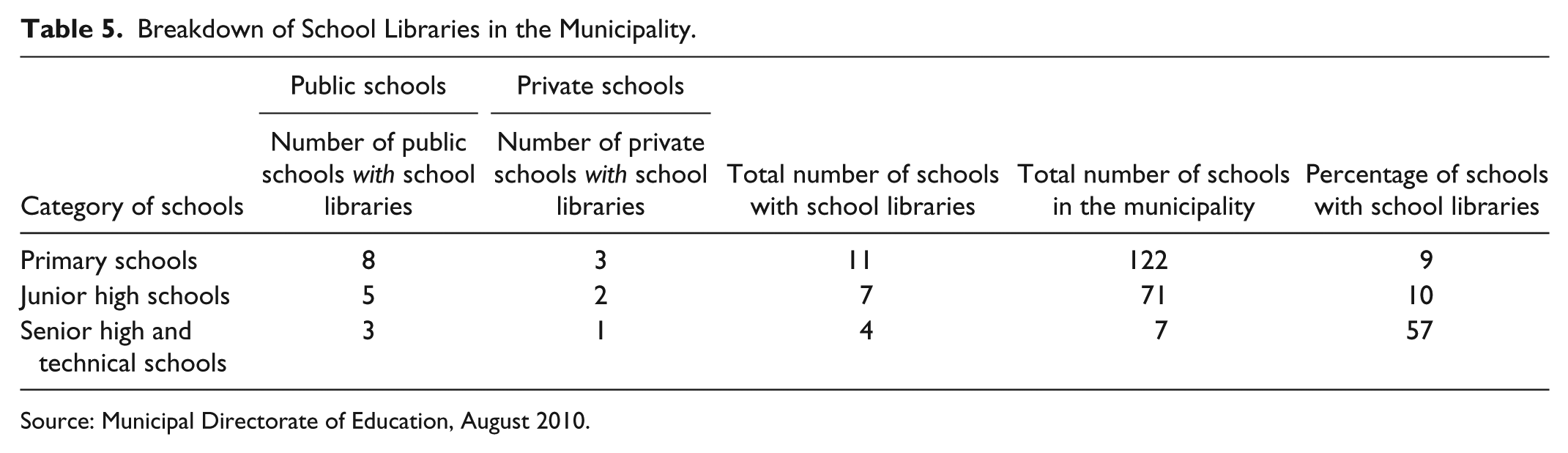
The municipality had 200 schools. About 9%, 10%, and 57% of primary, JHSs and SHSs, respectively, had school libraries (see Table 5). The investigation was prompted by a meeting of students’ union of Domeabra Township to deliberate on ways to improve standards of education in that community. Readers must, however, note that the Asante Akyem North Municipality has been split into Asante Akyem Central Municipality and Asante Akyem North District since the study was conducted.
Results and Discussion
This section presents the state of affairs of libraries in the municipality: where they were, how they looked, and how they were used. Public, community, and SHS libraries are first discussed followed by findings from basic schools. Before the detailed results of the study are presented, here are a few conceptual clarifications. Access to library services is construed as the availability, fair distribution, and unlimited opportunity to the use of adequately stocked, well-staffed, properly furnished, roomy, and ably managed libraries with the necessary facilities and environments that promote reading and learning. Implicit in this contextualization of access are three key elements: availability, convenience, and satisfaction. Although there are various specialities and hierarchies of librarians, all people working in the libraries except janitors and security persons are collectively referred to as library staff in this article.
What Is There: Are There Enough Libraries in the Municipality?
Out of an estimated 117 communities making up the municipality, 4 had public/community libraries. These were found in the following communities: Konongo-Odumase (municipal capital), Patriensa, Agogo, and Pekyerekye. The libraries at Konongo-Odumase and Patriensa are public- and state-funded, whereas the community library at Agogo was a donation to the Presbyterian Church at Agogo by a philanthropist in memory of a deceased son (George Osei-Tutu), hence the name George Osei-Tutu Memorial Library. Likewise, the Pekyerekye Community Library was provided through the benevolence of a development chief—Nana Antwiwaah Boasiako I. The public libraries at Konongo-Odumase and Patriensa were inaugurated in 1959 and 2002, respectively. The libraries at Agogo and Pekyerekye also became operational in Year 2004. The Pekyerekye Community Library opened between 7.00 p.m. and 9.00 p.m. on weekdays. It was, however, inoperative at the time of the study because of staffing problems and a power cut due to unpaid electricity bills. This observation is in sync with the findings of Opara (2008) on public libraries in Nigeria, in which he intimates that one public library was so cash-strapped that it was cut off from the public power supply due to unpaid energy bills. The community library at Patriensa had also become moribund because of staffing problems. A national service person was in charge of the library at the time of study. The library at Patriensa has been converted to a different use—a health post—since the study took place. The fewer numbers of libraries in the municipality correspond with the findings of Kevane and Sissao (2008) in neighboring Burkina Faso where majority of villages have neither libraries nor bookstores.
Aside from having fewer numbers, libraries in the municipality also had limited seating capacities. The public library at Konongo-Odumase had 32 seats after 51 years of its existence compared with a population of 48,990 (2010 estimates). So although the population of the township and potential library users was increasing, seating capacity of the library had remained unchanged. As a respondent remarked, “there is not enough furniture here, at times when you come here you have to wait for someone to go before you can get a seat, this won’t help to improve my coming into the library.” A 30-day survey recorded a daily average of approximately 20 people visiting the Konongo-Odumase Public Library. However, the study took place at a time both first and second cycle schools were in session. Visits to the library could therefore be higher when schools are on recess as some days recorded 40 visits. These could be one of those moments the respondent decried.
As a higher order settlement, the municipal capital was expected to perform higher order functions. Hence, the Konongo-Odumase Public Library was expected to have bigger floor space, provided diversified services, stocked much comprehensive library materials, and performed additional functions and services unavailable in the other lesser libraries in the municipality. But the contrary was the case. The George Osei-Tutu Library had a seating capacity of 28 against 38,882 (2010 estimates) residents of the Agogo Township, whereas the Patriensa Community Library had seats for 60 users compared with 6,812 residents (2010 estimates).
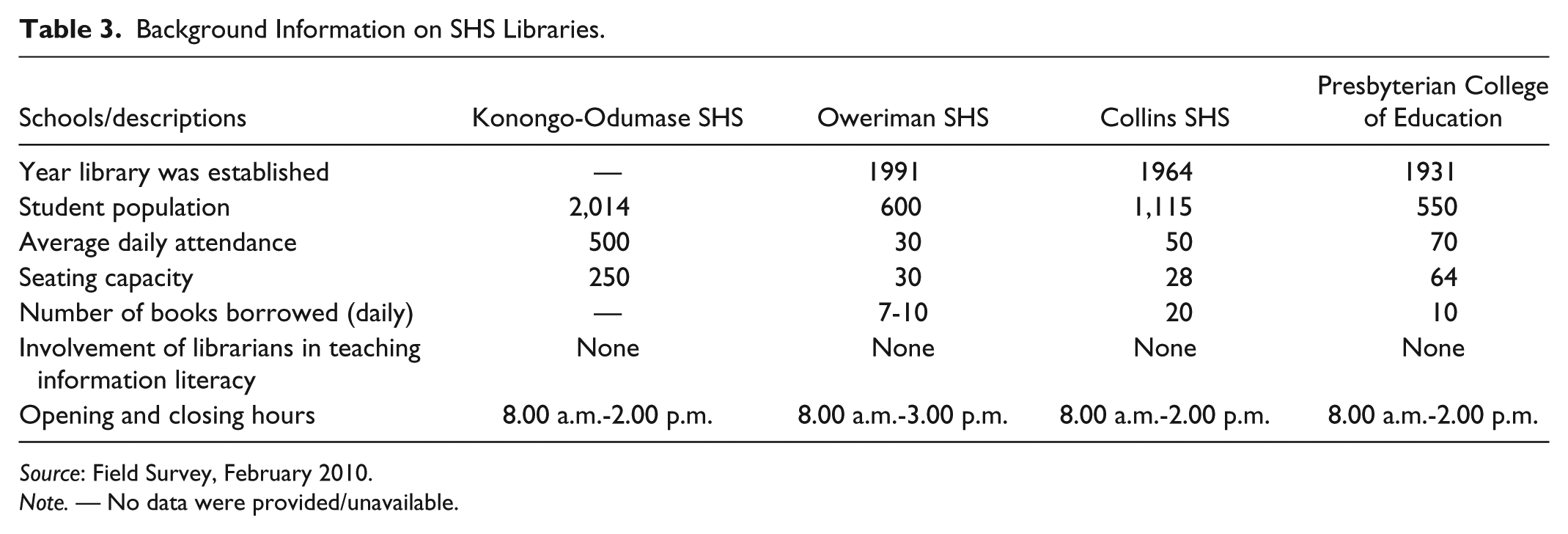
Libraries of SHSs in the municipality were not different. With a student population of 1,115, Collins SHS library had only 28 seats, whereas the Oweriman SHS library had seats for 30 students as against 600 students enrolled. The Agogo Presbyterian College of Education library could accommodate 64 students compared with 550 enrollments. Overcrowded libraries were therefore a common phenomenon in almost all the SHSs visited with the situation becoming worse during compulsory library periods. A student described the acute congestion in one SHS library in the following: . . . moreover overcrowding in the library, let me take our class for example, if it is time for us to go there [library], we must divide ourselves into two else we can’t, and by the time that one batch will finish, another batch cannot continue because the time is too small.
The exception was found at the Konongo-Odumase SHS whose library had 250 seating capacity for its 2,014 students. The school benefited from a government policy of upgrading one SHS in each district, and a new school library was one of the additional facilities provided.
Besides the limited seating capacities, library furnishings were also poor. Furnishings at the George Osei-Tutu Memorial Library were fairly good; perhaps, because it was the newest, although the chairs were bare wood. Conversely, chairs and tables at the Konongo-Odumase Public Library looked very old, frail, and uncomfortable for any intense academic endeavors. A respondent commented on the library chairs as follows: “It is very difficult to study for many hours by using the wooden furniture in the library.” Tables in this library also had no partitions as each egg-shaped table is surrounded by eight chairs making users susceptible to distractions. Furnishings in the public library at Patriensa comparatively looked better because they were partially padded except that one chair was built to contain three people- a design that is likely to inconvenience library users who sit at both ends of the chair, anytime a library user sitting at the middle intends to leave or take a stroll. Furnishings in the SHS libraries were no different from those found in the public libraries. Altogether, chairs that offered minimal sitting comfort to library users were missing in all school, public, and community libraries visited.
It was further observed that the Konongo-Odumase Public Library is situated in close propinquity to a major thoroughfare that records heavy volumes of vehicular traffic including those transiting to neighboring landlocked countries. Library users are therefore not spared from tooting horns and deafening screeches of passing vehicles. Although proximity to transport networks and economic activities are idealized locations for libraries, user anxiety and remonstration were rife. Thirty-nine percent of respondents in this library complained about the intensity of noise generated by passing vehicles and suggested a possible relocation.
Moreover, no community/public library in the municipality had separate sections for the exclusive use of adults and children. Neither were there different libraries for children and adults. Both adults and children thus competed for the same space and library resources, when in reality, the needs and purposes for which adults use a library may be quite distinct from that of children. This is against the backdrop that about half of library users are children (Levy, Meltsner, & Wildavsky, 1974), and also inconsistent with the prescription of IFLA/UNESCO Public Library Guidelines (Gill, 2001) that although access to libraries is not based on age, physical, and socioeconomic circumstances, libraries owe special responsibilities in meeting the needs of children and young adults. The guidelines thus recommend that libraries must have designated spaces providing services for specific age groups. The State Library of Queensland (2010) also recommends the need to develop library services, which meet the recreational and information needs of young people. The nonexposure of children in particular to libraries is likely to negatively affect educational development in the municipality.
Opening and Closing: Do Libraries in the Municipality Have Flexible Working Hours?
Public and community libraries in the municipality opened from Mondays through Fridays between 9.00 a.m. and 5.00 p.m. Libraries are not opened on public holidays. As a result, residents whose working hours and days coincided with those of the libraries are denied access to the use of the libraries. This contrasts with the situation in Singapore where public libraries open 7 days in a week and for long hours into the evening and on weekends. The hours that public libraries in the municipality operated thus contravenes a principle that public libraries open at times convenient to those who live, work, and study in their catchment areas (Gill, 2001).
Libraries in the SHSs opened for even shorter duration—8.00 a.m. to 2.00 p.m. on weekdays only. Hence, apart from the mandatory library periods on students’ timetable, senior high students had no access to their school libraries except when a teacher is absent from a class. In addition, senior high students are denied access to their school libraries for evening studies (preps). The hours the school libraries operated thus seemed inflexible. This was succinctly captured by a student as follows: The working hours and days are not sufficient. For example, a teacher may give an assignment on Friday and demand it on the following Monday, and because the library is not opened on Saturdays we will have to use our lesson periods for the assignment.
From the quotation, senior high students in some schools in the municipality may have to sometimes sacrifice their lesson periods to visit the libraries before weekends. In one school, a library prefect oversees the library’s operations after the library staff had closed from work. This arrangement in itself was a tacit admission that the normal hours that the library opened were unfavorable and unsatisfactory to students.
Traffic and Use Patterns: How Well Do Residents Use Libraries in the Municipality?
Library use in the municipality was unimpressive. Table 1 shows the results of a survey of library visits to three of the four public/community libraries in the municipality.
Library Visits.

Source: Field Survey, February-March 2010.
From Table 1, the average daily visits of about four people to the George Osei-Tutu Library reinforce an observation that 75% of basic school students interviewed at the selected schools in the Agogo Township had never been to that library before. So although the George Osei-Tutu Library had a limited seating capacity, it was underutilized. The public library at Patriensa was the least patronized of all the three public/community libraries examined. In 8 out of 22 days the survey took place in that library, attendance was 0. Patrons of the public library at the Konongo-Odumase were predominantly juveniles. Their ages ranged from 11 to 34 with a mean age of 21 (SD = 5.2). About 94% of those who visited this library during the survey period were within 15 to 34 age cohort with 6% of them below 15 years. There were more 13-year-olds than any other age group. More males (58%) visited the libraries compared with females (42%). Senior high students were highest among users of that library. The educational backgrounds of respondents at the Konongo-Odumase Public Library were SHS (49%), tertiary (30%), JHS (16%), primary school (3%), and technical (2%).
Library use is obviously contingent upon the attractiveness, convenience, and the breadth of collections libraries possess. The contentment users derive is therefore the overriding consideration. However, nearly all the libraries investigated looked disorganized and stocked with antiquated collections. Apart from libraries in the municipality lacking good physical appeal, none had directional signs. Only the Konongo-Odumase and the George Osei-Tutu libraries had exterior markings. The other libraries without any exterior markings could therefore easily be mistaken by any passerby for residential properties. The absence of directional signs is irreconcilable with the recommendations of Queensland Library Standards and Guidelines (2006). The guidelines among other things state that a public library should have clear and prominently displayed exterior signage, and directional and interior signage that indicate collections and services. Directional signs as widely acknowledged are the basic forms of libraries’ publicity and way finding. The location, size, and appearance of libraries are also important in determining their use. But “a major factor influencing use of a library is the building itself” (Levy et al., 1974, p. 209). The physical appearances of libraries in the municipality could therefore possibly explain in part their low usage. These findings are consistent with observations by Levy et al. (1974) in the following: The physical appearance of the branches is nondescript or worse. There are no distinguishing characteristics to attract the passerby, no prominent signs or window displays. Inside the branches are institutional and uninviting. Many have inadequate space. Improvements in atmosphere and physical setting would make the library a more pleasant place to be and might encourage use. (p. 189)
The combined effects of the physical states of libraries, lack of marketing and publicity, and other weaknesses such as limited floor spaces, poor furnishings, outdated collections, and of course, the sociocultural disposition of residents accounted for the low use of libraries in the municipality. A phrase like “students in this community are uninterested in learning/reading” emerged in almost all the basic schools visited.
Library visits in the SHSs were also observed to be highest during the mandatory library periods. Beyond these periods, library visits only peaked when examinations drew nearer. Likewise, Onuoha, Unegbu, and Umahi (2013) in a study of reading habits and library use in Babcock University, Nigeria, affirmed that visits to the library were not a popular activity among students of information resources management. Although libraries in the municipality were underutilized, it was noted that no strategy had been put in place to promote their use. This contrasted with the Queensland guidelines, which require libraries to be proactive in promoting their resources and services by using effective marketing strategies to attract new users while maintaining existing ones. Libraries should therefore publicize their presence and the range of the services they provide (Gill, 2001). Nyana (2009) is also of the view that African libraries operate in isolation and their roles not explained to the rural communities, and recommends marketing of library services as way of addressing the low library usage.
Personnel, Materials, and Funding for Public, Community, and SHS Libraries
The Konongo-Odumase Public Library had one library staff assisted by a national service person. The SHSs and the College of Education studied also had two library staff each. The Patriensa, Pekyerekye, and the George Osei-Tutu public/community libraries had no staff. Most of the library staff in the SHSs had long working experience of up to 29 years in some cases. However, only the College of Education had a qualified librarian. This possibly explained why no one engaged in the teaching of information skills in the schools. Acquiring new skills and knowledge on emerging trends and issues in librarianship is not in dispute. However, library staff in the municipality rarely attended any training courses. While some had never attended any professional development courses since working with the libraries, others did so long ago. A classic example is a library staff who had attended only one training course in 27 years of being in active employment. Gill (2001) has argued that professional and continuing education is indispensable in ensuring adequate services. Librarians must therefore undergo regular training to update their skills and be abreast with advances and new developments in the field (State Library of Queensland, 2010).
The staffing situation of libraries in the municipality conforms to observation by Alemna (2000) that low salaries in Ghana have affected recruitments of new staff and the retention of older ones. The School Library Association in the Republic of Ireland (2004), however, believes that until there is official provision for the employment of qualified librarians to serve all schools, school libraries will be unable to properly fulfill their central and crucial role. It concludes that it is vital for every school, both primary and postprimary, to have access to the services of a qualified librarian. Giving library assistants the requisite on-the-job training and constant upgrading of their knowledge in information science can partially address the staffing situation in the municipality.
The attitudes of library staff toward library users were also examined. Users of the Konongo-Odumase Public Library and the Agogo College of Education lauded the behavior of staff of these libraries. Students in the SHSs were, however, highly opprobrious of the misdemeanors of their library staff. They particularly detested behaviors like lateness to work, closing before official closing time, disturbances with mobile phones, and yelling at students whenever they ask about books they could not locate.
Proper and up-to-date inventory is rarely kept by the libraries in the municipality. Data on the volumes and categories of collections were scanty (see Table 2). This validates weaknesses in the inventory and cataloging systems of the libraries, a situation that can potentially affect planning for weeding and restocking. In some of the SHSs, inadequate shelve space had compelled library staff to stack library materials on the floor and top of bookshelves. But altogether, collections in all libraries in the municipality were found to be inadequate, and often described as irrelevant, outdated, or simply uninteresting. These findings conform to the observation by Kevane and Sissao (2008) that collections in libraries in Burkina Faso were older materials. They are also in line with revelation by Saleh and Lasisi (2011) that public libraries in North Eastern Nigeria lacked adequate and qualified personnel, stocked outdated materials, and lacked Information Communication Technology (ICT) infrastructures and services.
Collections and Expenditures of Selected School Libraries.

Source: Field Survey, February 2010.
Note. — No data were provided/unavailable.
Complaints of limited library materials echoed in all the SHSs examined. For instance, it was found that some SHSs libraries stocked more books on few subjects. Moreover, lots of the collections had no relevance to the programs of study students pursued. This revelation contradicts briefing by some library staff that teachers are involved in selecting materials for their school libraries. A respondent described the situation in one school library in the following way: “A teacher may give assignment to us to make our own research, the only place to make that research is the library, but when you come, you may not find it.” Likewise, 58% of library users at the Konongo-Odumase Public Library mentioned stocking of old fashioned books, difficulties in searching for materials, and unavailability of books as some of the problems they encountered in using the library. One respondent rightly described the situation of library materials in the Konongo-Odumase Public Library as follows: There are a lot of old-fashioned books in the library which at times when consulted gives problems. In case of researching, you do not get the correct variety of books for your research as the range of materials in this library is very limited.
The findings of limited range and outdated materials in the libraries investigated corroborate the observation by Stringer (2000) that collections in public libraries in Africa are often sparse and irrelevant. According to Dent and Yannotta (2005), an imperative to providing relevant library services lies in the ability to determine the type of collections and services needed by the community members through needs assessments. However, this is rarely done in most public libraries in Africa because of inadequate funding and research skills.
Of all the libraries examined, only the Konongo-Odumase Public library used time-worn catalog system. Because there are no cataloging systems, subject titles are labeled on bookshelves. In some cases, no subject labels were displayed on the shelves making book search difficult and time-consuming. “Sometimes you find it very difficult to find the specific book you are looking for, the arrangement of the books isn’t good enough.” That is how a respondent at the Konongo-Odumase Public Library commented on cataloging at the library. Collections at all the libraries studied came from one of the following sources: old students associations, school authorities, and supplies from the Ghana Library Board in the case of the public libraries. The single most important source of materials to libraries in the municipality came from World Vision (nongovernmental organization [NGO]). This perhaps explained the inappropriateness of most of the collections to the programs studied in the SHSs. Strikingly, the responsibility for providing library books was being relinquished by the traditional source.
Libraries in the municipality also lacked basic facilities such as restrooms, which are necessities in all public places including libraries. Only the library at the Konongo-Odumase SHS had restrooms. The public libraries at Konongo-Odumase and Patriensa had urinal in an outbuilding but without toilet facilities. All other libraries examined had no restrooms. Besides, no library in the municipality had any of the following facilities: computers, Internet connection, eating/snack areas, music listening (audiovisual) rooms for films and storytelling, carrels, photocopiers, and printers, although most were connected to electricity. Media formats like microfilms/microfiche, CD-ROM, and digital or virtual libraries were also completely missing. In South Africa for instance, the problem of lack of Internet connections had been addressed by providing space for information kiosks and telecenters, while open access Internet points have been established in public libraries in Estonia (Gill, 2001). Finally, except the Patriensa Public Library, all other public/community and SHSs libraries subscribed to newsprints or at least a copy for the schools’ or the churches’ eventually ended in the libraries.
As sustainable provision of library services partly depends on adequate funding, financing options for libraries in the municipality were investigated. This was an area of the study that recorded the highest nonresponse rate. None of the school libraries provided data on yearly collection expenditures per student. Library fees were the most predictable source of funding to the SHS libraries. A termly library fee of 50 Ghana pesewas per capita was, however, noted to be uneconomic relative to the prevailing market prices of books. Kargbo (2000) also found that minimal library fees are charged by schools in Sierra Leone, but these fees are often used for other purposes. Other sources of incomes for school libraries in the municipality included support from old students’ associations and the Ghana Education Service. School libraries were therefore funded mainly from library fees paid by students. The question, however, is if senior high students paid termly library levies, what then accounted for the poor state of libraries in the schools? Additional information on expenditures and collection volumes is provided in Table 2.
Public libraries, however, depended on funding from the Ghana Library Board and other philanthropist. However, inadequate funding was found to be the biggest challenge to public libraries in the municipality. This compares with findings by Mchombu and Cadbury (2006) that public libraries attract the lowest public funding in Africa and also reinforces remarks by Witbooi (2007) that South African public libraries are experiencing shrinking budgets and limited resources. Libraries in the municipal area were in effect microcosms of the regional library. Agyen-Gyasi and Atta-Obeng (2010) reported that the Ashanti Regional Library faced similar challenges of poor funding, inadequate book stocks and seats, lacked photocopiers, and few qualified staff. Opara (2008) and Ajegbomogun and Salaam (2011) also arrived at similar conclusions on libraries in Nigeria. Finally, it was revealed that no local arrangements for funding public and community libraries existed.
Further information on libraries in the SHSs investigated, such as the year in which the school libraries were established, student population, daily average library attendance, and so on, is shown in Table 3. From the table, the oldest school library is the Presbyterian College of Education. Konongo-Odumase SHS had the largest seating capacity, no librarian teaches information literacy, while the closing and opening hours are similar for all the schools studied.
Background Information on SHS Libraries.
Source: Field Survey, February 2010.
Note. — No data were provided/unavailable.
Users’ Perceptions
The perceptions patrons had about libraries in the municipality are shown in Table 4. From the table, the conducts and attitudes of library staff were highly rated among library users. On the contrary, inability of users to find books of interests was the least rated. Book borrowing procedures, book search and cataloging systems, furnishings, limited range, and unavailability of books in that sequence attracted the least ratings by users. The five lowermost rated issues, however, constitute the foundation of any functional library.
Rank Order of Library Users’ Perceptions.

Source: Field Survey: February 2010.
Basic School Libraries in the Municipality: Are They Any Better?
The final lap of the study examined libraries in the basic schools. Foremost, the dreamed professions and academic aspirations of basic school students aged between 10 and 17 years are discussed. Thirty-one percent of respondents wanted to become medical officers. The rest are nurses (18%), teachers (10%), and bank managers (7%) with 5% desiring to join the security services, and the remainder opting for various professions. Three respondents audaciously hoped to become Presidents of the Republic of Ghana and another two Ministers of State. Two percent of the respondents were, however, ambivalent. The results showed that even at the basic school level, students exuded confidence and high hopes, and were quite pertinacious in becoming professionals in future, no matter their socioeconomic circumstances.
The realization of these dreams, however, largely depends on the attainment of higher education, which better school libraries can potentially leverage. The craving of 75% of respondents to receive university education confirms the need for higher education. Eighty-one percent of basic students interviewed had literate parents. Out of this, only 7% and 2% of fathers and mothers, respectively, had received university education. Parents’ educational status can influence their children’s reading habits. Kevane and Sissao (2008) found a connection between the number of books read by pupils and the educational attainment of parents in Burkina Faso.
About 47%, 32%, and 21% of respondents lived in either extended family houses, houses built by parents (owner occupied), or rented houses. Compound houses that are noted for their high occupancy rates and unbearable decibels are the major housing types in the municipality. Only one student interviewed in the basic schools claimed to have a home library. So with no home libraries, majority of students interviewed studied sitting at verandas, in sleeping rooms and well-illuminated open spaces . Some respondents trek to homes of relatives or friends that are connected to electricity to study in the night after closing from school and while on vacations. Others also go back to the few schools connected to electricity to study in the evenings. About 31% of respondents had no electricity in their homes. Likewise, 51% had no writing tables and chairs. Dronkers (1992, quoted in Evans et al., 2005) argued that a home in which books are integral part of the way of life will encourage children to read for pleasure and provide them with information, vocabulary, and imaginative richness. Implicit in Dronkers’s observation is that children in the municipal area will be disadvantaged scholarly as nearly all households had no home libraries.
This challenge creates the impetus to provide public libraries, because public libraries provide study facilities for students who have inadequate or no access to these facilities in their homes. In South Africa, for example, public libraries provide basic facilities like light, tables, and chairs to places where many people have inadequate living spaces and no access to electricity to enable them study (Gill, 2001). Similar situation existed in the Amazonas State in Venezuela where there were no school libraries (Gill, 2001). Public libraries have therefore proven to be worthy substitutes in places where there are no school libraries.
Of the basic school students interviewed, 45% had never seen a library. Nevertheless, 66% had adequate knowledge about what a library is. Of the number who had seen libraries before, 72% saw them in the same communities they lived, 15% within the municipality, and 13% outside the municipality. Forty-nine percent of respondents had never entered or used a library before. Overwhelmingly, respondents who had been to libraries went there to read. Others also had the opportunity of visiting a library during excursions, and these were mostly students who entered a library outside the municipality. On the whole, 71% of the basic schools visited had no school libraries. Although some six newly constructed school blocks had school libraries, the problem of limited spaces, poor furnishings, and inadequate collections that characterized the other libraries were also found in these new schools. Table 5 gives a breakdown of school libraries in the municipality.
Breakdown of School Libraries in the Municipality.
Source: Municipal Directorate of Education, August 2010.
From Table 5, more SHSs had school libraries than basic schools, perhaps because SHSs were fewer—7 compared with the 193 basic schools. The basic schools that had school libraries had no teacher-librarians. The absence of school libraries had also compelled school authorities to keep books meant for school libraries in storerooms. In one primary school visited, students are denied entry into the school’s library during library periods because of limited space. Instead, they borrowed library books from the school library and went back to their classrooms to read. Going to the school library to pick a book during library periods was, however, at a students’ volition. In one JHS, it was noticed that the supposed school library also served as staff common room and a computer room.
The few school libraries in the municipality agree with the findings of Kevane and Sissao (2008) in rural Burkina Faso. For example, in the Tuy province of south-western Burkina Faso, they found that no primary and secondary school had a school library except perhaps a shelf of books used by teachers. Similarly, an audit of school facilities estimated that 8 million out of 12 million South African learners did not have access to libraries in their schools (Hart & Zinn, 2007). This is corroborated by the findings of school library survey conducted for the South African Human Sciences Research Council at the government’s request, which also established that 32% of schools nationwide had an “on-site library,” and another 12% had some sort of “library collection/box service” (Human Sciences Research Council, 1999).
In communities that had community/public libraries, 32% of respondents in the basic schools confirmed to have never visited those libraries, whereas 19% of them were oblivious of whether the very communities they lived had public/community libraries or otherwise. For those who visit the public/community libraries, they do so 3 times weekly on the average. In Year 2009, 26% of respondents in the basic schools studied read no storybooks, whereas 38% read up to two books. Predictably, parents acquired some of these storybooks for their wards. Others also borrowed the storybooks they claimed to have read from friends, teachers, or from library books usually kept in storerooms. Many respondents could, however, not recount the titles and especially authors of some of the books they averred to have read. This poor reading culture among respondents in the municipality conforms to the findings of other studies. In neighboring Burkina Faso, Kevane and Sissao (2008) found reading among a group of Burkinabe students to be low. Similarly, Ifedili (2009) also noticed a decline in reading culture in Nigeria, whereas Fabunmi and Folorunso (2010) attributed poor reading culture of secondary school students in Nigeria to the poor educational system. Last, Kargbo (2013) also reports of a dearth of reading culture in schools and intimates that this cuts across the fabric of the Sierra Leonean society.
Collectively, basic students interviewed owned 231 storybooks and 172 textbooks with a median of 1 storybook and an average of 1.3 textbooks. About 34% and 55% of interviewees, respectively, had no storybooks and textbooks of their own. This implied that except the few textbooks that are made available to students during school hours which they could sometimes take home, basic school pupils in the municipality generally had little or no access to text and storybooks after closing from school or while on holidays. The limited access to books in the municipality agrees with the finding by Michaelowa (2002) in Kevane and Sissao (2008) of very low ratios of textbooks to students in West Africa. Also, TNS Research Surveys (n.d.) found that more than half (51%) of households in South Africa had no books.
“My parents do not have money,” “when I told my parents to buy books for me they failed,” and analogous responses were the issues that emerged when students were inquired to enunciate the reasons why they had no personal copies of recommended textbooks. Lack of or inadequate funding emerged as a fundamental challenge to students’ acquiring books. Opportunity, however, existed for pupils to access library books often kept in the storerooms of the schools, but not until an undertaking by parents/guardians to return all borrowed books and in good conditions. This proviso deters parents/guardians from accessing such books for their wards. In Burkina Faso, Kevane and Sissao (2008) established that the cost of schoolbooks had compelled schoolchildren to rely on copying lessons from the blackboard. These also compare with the situation in Sierra Leone. According to Kargbo (2000), many school libraries in Sierra Leone had serious shortcomings such as lack of funds and irregular releases of library grants by government. For these reasons, collections are inadequate, obsolete, and irrelevant to the needs of pupils, teachers, and the curriculum, and above all, they depended on book donations.
The limited access to functioning school and public libraries in the municipality poses great challenge to the academic pursuits of pupils and more crucially to the realization of their cherished professions because of the influence libraries have on students’ achievement. Distant learners in the municipality also have to endure the absence of functioning libraries just as this study suffered. Although poverty might have stymied parents/guardians from procuring books for their wards, their inclinations and most importantly that of officialdom toward the value of books and libraries cannot be underestimated. On the whole, findings from the basic schools supported the view that library and information services in the municipality are underdeveloped. And as a natural sequel, reading culture among students is also low. I conclude this section by paraphrasing Levy et al. (1974) in stating that the Asante Akyem North Municipal area had too few physically unattractive school and public libraries, with too few but aging books, too few and poor furnishings, fewer qualified librarians, smaller library spaces with no facilities, and serving too few people. Rosenberg (1993b) painted a gloomy picture of rural libraries in Africa in the following: Originating from the initiative of a group from the community or an aid agency, their birth is followed by a year or two of rapid growth and a good deal of local publicity and attention. This is followed by a period of slow decline, accompanied by theft, the departures of initiators, loss of interest among staff and user—the library still exists but signs of life are barely discernible. Sometimes this period continues indefinitely, but often a final stage is reached when all remaining books are removed, stolen, or damaged beyond repair and the premises and staff are allocated to another activity. (p. 30)
Rosenberg’s observation of the life cycle of rural African libraries is graphic, though what appear missing are the conditions that give rise to the eventual demise of rural African libraries. Three issues readily come into mind: Do rural African libraries usually have in place library management committees or advisory boards? Are there dedicated sources of funding for maintaining rural libraries in Africa? And are library services vigorously marketed in rural Africa? If responses to all questions are in the negative, then Rosenberg’s accounts of the life cycle of rural African libraries are bound to happen.
In summary, there was apparent lack of recognition among the municipal authorities and the public of the bearing libraries have on education. Consequently, no governing body or a subcommittee of the municipal assembly existed to spearhead library development and oversee their management. The library staff also owed allegiance to their employers, that is, the Ghana Library Board. Communities that had public/community libraries had no local library management committees, and aside from the absence of a dedicated funding scheme to support public libraries, home libraries were conspicuously missing. Conditions in many homes were also generally not propitious for reading and learning. In brief, there was an indescribable deficit in the provision of library services in the municipality owing to prolonged periods of neglect. Consequently, only a minuscule proportion of residents in the municipality had minimal access to a few but poorly resourced libraries.
Recommendations
As the article had established, residents of the municipal area had limited access to library and information services, and even though poverty hindered acquisition of books, lack of bookstores also aggravated general access to books. The few libraries in the municipality thus existed only in name rather than function. Implicit in the theme of the article is how limited access to libraries could affect students’ achievements in the municipality. The onus therefore lies on the municipal assembly as the highest development authority to enhance public access to library and information services.
Foremost, the municipal assembly may consider setting up a body/sub-committee plenipotentiary to oversee the development of library and information services in the municipality by preparing a municipal library development blueprint, and be responsible for planning, marketing, monitoring, procurement, and distribution of materials to libraries in the municipality, and, most importantly, look for sustainable sources of library funding.
The municipal assembly may also consider enacting a bylaw that will compel all would-be homeowners to include home libraries in their housing designs before issuance of building permits. This will ensure that many homes in the municipality will have home libraries. Together with the municipal directorate of education, the municipal assembly must insist that every newly constructed or refurbished basic school has appropriate school library. Furthermore, the municipal assembly may consider offering incentive packages to encourage the business community to operate bookstores in the municipal area. These may include a weaver or rebate of local taxes and levies, and discounted rental charges for using the assembly’s commercial properties.
A “Municipal Chief Executive’s Library Project” is recommended as another way of promoting public access to library services. This will require all municipal chief executives with the approval of the general assembly to construct or refurbish at least one library during their tenure of office. Naming newly constructed libraries after municipal chief executives during whose tenure such libraries were constructed, or fixing a plaque in their honor, may serve as a token recognition of their contributions to library development in the municipality. This may encourage them to do more toward development of libraries in the municipality. Incorporation of library studies into the curricula of colleges of education is also suggested. This will ensure that at least each professional teacher will be imbued with the fundamentals of librarianships. At best, the colleges of education nationwide must begin the training of teacher-librarians who will be solely in charge of school libraries. The municipal assembly and the municipal directorate of education working in concert with other civil society organizations can also design and implement a reader development program to revive the low reading habits in the municipality. This will ensure that students in particular will take “out of school reading” or “reading-outside-of-school assignments” more seriously. But as Opara (2008) opined, only legislation can define the functions of the providing authority and create the conditions in which it may achieve those functions. In this respect, legislation is a prerequisite.
Conclusion
I finally conclude on this note. In places where home and school libraries are least developed or nonexistent, providing well-resourced public libraries seems the likely option to increasing public access to library and information services. As Peterson (2000) postulated, “we will depend more on public libraries to provide access to people of all social and economic circumstances” (p. 21). What the Asante Akyem North Municipal Assembly and the public must not lose sight of is that what young people learn today will largely determine their future, and the best investment in young people is perhaps investing in areas that nourish their acquisition of knowledge. This is where access to libraries becomes handy.
Footnotes
Declaration of Conflicting Interests
The author(s) declared no potential conflicts of interest with respect to the research, authorship, and/or publication of this article.
Funding
The author(s) received no financial support for the research and/or authorship of this article.