




Abstract
In this modern world with the growing trend of globalization, cultural and environmental changes, and the increased pace of technological advancements, new challenges have appeared in a tremendous manner. In the wake of these recent trends and complexities alongside the worldwide pandemic (COVID-19), organizations are working to provide a self-motivated and highly engaging environment for employees. The study intends to explore the relationship between Transformational Leadership (TFL) and Work Engagement (WE) with the mediating role of Structural Empowerment (SE) and Process Innovation (PI) during COVID-19. The quantitative research methodology was utilized and a simple random sampling technique was used for collection of data from 360 supervisors of banks in Pakistan using questionnaires. Hypotheses are tested with the help of Structural Equation Modeling (SEM) by using AMOS. By using SEM, confirmatory factor analysis revealed a statistically significant model. Outcomes showed a significant connection among TFL, WE, and PI. However, SE only significantly relates to TFL. Partial mediation through PI was discovered with the presence of a significant indirect path between TFL and WE. In contrast, the mediation of SE is not ascertained due to insignificant indirect effects. The digitally evolving banking industry in Pakistan requires engagement at workplace. The organization must be very much aware of the crucial job of leaders for WE as well as for PI just as the SE of employees. The findings of the study also highlight the importance of best HR practices that should work for creating intangible motivators for boosting WE level.
Introduction
COVID-19 has affected different economic sectors worldwide and banking sector has no exception. The changes in customer preferences for the banking transactions are the driving forces behind the digital transformation. Clients are progressively going with the internet banking transaction while decreasing conventional transactions. This transformation of preferences is speeding up as the world enters in the time of the Covid-19 pandemic. Banking leaders make changes by empowering the digital transformation as radical changes, changing the whole operational cycle, carrying out new machines and applications and improving the nature of Human Resources (Winasis et al., 2021). When the world is transforming and there is uncertainty and instability in the business environment, leaders with elevated Work Engagement (WE) play an important role in implementation of this transformation (Islam et al., 2020).
Jobs in banks are usually recognized as identifiable job offerings to the employees with significant tasks, autonomous decision-making, and continuous feedback. The working of banks has witnessed major transformation in operations as well as the displacement of staff to work from home set up. These changes and the new demand for the job emotionally affect employees (Winasis et al., 2021). According to Gallup survey, after a consistent ascent throughout the last decade, engagement at workplace reduced around the world by 2%, from 22% in 2019 to 20% in 2020 (Gallup, Inc., 2021). Since, the work engagement aids in increasing satisfaction of job and commitment toward the organization (Rai & Maheshwari, 2021), therefore, the banks should focus on the progression of positive insights among employees toward job design.
Due to the increasing significance of frontline employee’s performance in the competitive banking industry, scholars have long been trying to find its predictors. And this pandemic induced transformation has created a great challenge for leading the business as well as managing employees (Bartsch et al., 2020). Precisely, a transformational leader motivates its followers to identify their organizational goals and work beyond expectations. Engagement being a vast concept but the paramount objective here is to scrutinize the determinants of engagements concerning leadership in this digitally transforming industry of Pakistan under the umbrella of pandemic.
The growth in digitization has also enabled banks to provide a new set of job opportunities, process improvements, enhanced customer experience, and efficiency, thus, requiring the need for an engaged team as well as effective leaders. According to Kawiana et al. (2021), banking industry needs true leadership under times of digitization as without effective leadership, desired growth in banking sector may not be achieved.
There are several studies on transformational leadership style and work engagement (WE), but only a very few explain the relationship amid innovation, empowerment, and TFL during Covid-19 pandemic. Furthermore, Monje Amor et al. (2020) while studying the role of SE among the relationship of TFL and WE explained that the data was collected from the tourism sector only, and this might open the horizon for banking sector too. They encouraged researchers to examine the interaction among these constructs in diverse countries and sectors. Considering the fast-moving digital transformation of the banking industry, this study aimed to bridge the gap and witness the responses obtained from the banking sector employees of Pakistan to review their behavior in global crisis, that is, COVID-19.
For providing rigor to the model, this study has included two mediators, that is, Structural Empowerment (SE) and Process Innovation (PI). The involuntary move to “Work from home” (WFH) during pandemic is the biggest shock in the lifetime of organizational structure. Cooperation and correspondence drive innovative conduct. Will creativity endure as a side-effect of WFH? This question instigates the researchers to investigate the influence in light of process innovation. Also, the inclusion of additional constructs aids in building a comprehensive model.
Process Innovation (PI) focuses on swift and efficient dissemination procedures for the issuance of these products or services (Al-Ahmad Chaar & Easa, 2021). Kanter (1993) defined Structural Empowerment (SE) in the form of two factors; power and opportunity. Power encompasses access to resources, support, and information, whereas, opportunity derives access to challenges, progression, and development. The Coronavirus lockdown has sharpened our shared awareness to the requirement for innovation in technology and business to battle environmental change and advance structural empowerment (George et al., 2020).
Considering the present organizational challenges owing to pandemic and the potential characteristics of Transformational Leadership, this study opens doors for other researchers for the development of such complex relationships for managerial implications. Moreover, this study also opens the horizons to review the influences among the variables under study, regarding the theories on the concerned variables, for example, social exchange theory, and transformational leadership theory.
This study aims to understand the level of engagement among leaders, the involvement of TFL, and outcomes of SE and PI as a mediator in the banking sector. Accordingly, there is also a need for persistent research that can thoroughly evaluate how TFL affects WE of banking sector and what are those factors that influence leaders’ and follower’s relationship. Hence, the objectives of the study are summarized as (i) to understand the relationship between Transformational Leadership (TFL) and Work Engagement (WE) during COVID-19 and (ii) to investigate the mediating role of Structural Empowerment (SE) and Process Innovation (PI) upon TFL and WE during COVID-19.
Literature Review and Theoretical Underpinnings
Leaders influence employees by way of changing employees’ work conditions. They can also inspire employees through motivation, support, connection, and by providing strength (Decuypere & Schaufeli, 2020). The presence of theoretical models clarifying engagement from various points ought to be viewed as critical. In the theory of engagement, Kahn (1990) has identified three psychological settings that are essential to attain engagement. The first, Psychological meaningfulness is defined when the person is getting a return on investment upon his physical exertion and cognitive or emotional energy.
The second identified condition according to Kahn’s theory is psychological availability. It is defined as the perceived availability of psychological, emotional, or physical sources required for a personal engagement at a particular moment. The third identified condition psychological safety is a person’s willingness to come out without any fear of negative consequences upon career, self-image, or status. Leaders can enhance engagement by influencing these characteristics addressed by Kahn’s theory.
Burns (1978) first proposed the transformational leadership theory, his motive was to identify and differentiate among the leaders who have a persuasive relationship with their followers and attention in exchange with TFL collaboration to get the optimum yield. TFL is a cognizant, ethical and transcendent process of equivalent powers between leaders and followers with a motive to achieve a common goal or real transformation. Inspirational motivation, idealized influence, individualized consideration, and intellectual stimulation (encouragement of creativity and innovation) are considered as four behaviors (4Is) of TFL. Bass (1985) further added psychological notion to the theory and identified that transformational leaders exceed performance expectations of followers through inspiration and motivation. Charisma, vision, inspiration, and developing follower’s skills are the characteristics of transformational leaders that influence follower’s engagement.
Kanter’s (1993) theory of Structural Empowerment (SE) discuss about the advancement of empowerment in the working environment gives access to opportunity (growth within the organization), access to resources (ability to acquire means of work), access to information (formal and informal knowledge for workplace effectiveness), and access to support (guidance from colleagues and superiors).
For stipulating theoretical base, social exchange theory explicates how the acceptance of leadership style and Structural Empowerment (SE) can associate with Work Engagement (WE) (Monje Amor et al., 2020). According to social exchange theory relationship between employee and supervisor is sustained by an interdependence state where employee and supervisor are perceived to reciprocate work, favor, and support (Decuypere & Schaufeli, 2020). If employees are provided with resources, access to information, that is, Structural Empowerment (SE), they are also constrained to respond with a high level of engagement. The COVID-19 pandemic has uncovered numerous concern of inadequate leadership capacity during crisis. An overall absence of research on the blend of organizational crisis management and the leadership theory stimulate the researcher for further study.
Transformational Leadership (TFL)
The most cited (Gong et al., 2009; Lee, 2020; Milhem et al., 2019), Multifactor Leadership Questionnaire (MLQ) defines Transformational Leadership (TFL) as “within transformational leadership, leaders emphasize higher motive development, and arouse followers’ motivation and positive emotions through creating and representing an inspiring vision of the future” (Rowold, 2005, p. 5). In any organization, leadership is an essential factor for the organizational environment as well as employees’ perceptions. Transformational leadership is considered as a process where an ordinary person brings out the best not for himself but for the others too. They work on follower’s development. It’s the behavioral and idealized charisma that makes people identify their leader (Jyoti & Bhau, 2015).
Nikezi et al. (2012) stated that transformational and transactional leadership are the new prototypes encouraging the roles and responsibilities creation and process of the organization due to quality effects. Ghasabeh and Provitera (2017) found a positive relationship between TFL and organizational knowledge along with mediating role of organizational culture. Liu and Li (2018) studied that TFL creates a positive influence on employee knowledge-sharing behavior and impacts perceived team identification and goal commitment. So today, when the entire world is standing up to worldwide health emergency of Covid-19, transformational leader is widely accepted as a valuable source of continuing organizational activities by working with the employees and supporting business techniques (Khalid & Ali, 2020).
Work Engagement (WE)
Schaufeli and Bakker (2004) defined WE in Utrecht Work Engagement Scale (UWES) as “Engagement is a positive, fulfilling, work-related state of mind that is characterized by vigor, dedication, and absorption. Vigor is characterized by high levels of energy and mental resilience while working, the willingness to invest effort in one’s work, and persistence even in the face of difficulties. Dedication refers to being strongly involved in one’s work and experiencing a sense of significance, enthusiasm, inspiration, pride, and challenge. Absorption is characterized by being fully concentrated and happily engrossed in one’s work, whereby time passes quickly and one has difficulties with detaching oneself from work” pp. 4–5 as cited by Gözükara & Şimşek (2015) and Milhem et al. (2019).
Kahn (1990) among the first proponents of work engagement described that WE tie employees including leaders toward their job roles; he further discussed that engaged employees/leaders illustrate dedication, rationality, concreteness, passion and physical devotion, emotion, and intellectual devotion while performing their jobs. Research has also found a positive relationship between Work Engagement (WE) and work performance (Salanova et al., 2005), and organizational citizenship behavior (Saks, 2006). Unlike exhausted and disengaged disgruntled employees, engaged leaders & show increased enthusiasm for work, they take initiatives at work and relish their time at work (Bakker et al., 2008). Inam et al. (2021) highlights that organization intentions toward engagement and support of employees can create positive attitude among employees. It aids in doing their job uniquely as they feel valued and being cared. Hence, the organization should provide psychological support to the employees which in return enhances the engagement and creativity.
Structural Empowerment (SE)
Widely accepted research tool Conditions for Work Effectiveness (CWEQ) used by Orgambídez-Ramos and Borrego-Alés (2014) and Aggarwal et al. (2018), defines Structural Empowerment (SE) as “the extent to which employees feel they have access to these structures in their work settings” (Laschinger, 2012, p. 2). Kanter (1993) among the earliest advocates of SE emphasized that it is the characteristics of an organization that determines empowerment.
Aggarwal et al. (2018) showed that while the relationship exists between various elements of SE and affective commitment, women’s psychological empowerment likewise intervenes in the connection between the two. A multilevel study by Laschinger et al. (2009) discovered the causal relationship between SE at the group level, psychological empowerment, and organizational commitment at the individual level.
Process Innovation (PI)
Process Innovation (PI) is defined as “new elements introduced into an organization’s production or service operations” (Damanpour, 1991, p. 561). PI aids in creating new ideas and concepts and implement these methods in manufacturing companies (Shahzad et al., 2012).
While having different reasons for encouraging PI, one of the most ordinary motives is a rivalry with the competitors producing identical or alike products (Arshad et al., 2012). PI provides a competitive advantage (Cavaco & Crifo, 2014) in terms of cost-efficiency, production speed, and consistent quality and also handles the situation well under high competition. Doran and Ryan (2014) resolved that when focus groups in an organization identify areas of improvement for PI, introducing new products might be an opportunity for an organization to improve their products as well.
Hypotheses Development
Ghadi et al. (2013) in their study show that the TFL style induces follower’s characteristics of work engagement with the partial mediation of employee’s perception of the meaning of work. It leads to a positive vision among employees, they are challenged yet optimistic to achieve their goals and success in work (Hayati et al., 2014). Zhu et al. (2009) found the moderating role of followers’ characteristics upon the relationship of TFL and WE.
A study finding shows that TFL style affects engagement and full mediation of leaders’ emotional intelligence (Milhem et al., 2019). Islam et al. (2020) revealed that Transformational leadership (TFL) enriches Work Engagement (WE) considering the significant organizational change in the banking sector of Bangladesh. Study has also found that day level work engagement can be enhanced by pursuing day level transformational leadership among the employees along with optimism as a full mediator in the relationships. The study is among the few who found the relationship between transformational leadership style and work engagement level with the help of improvement in personal resources (Tims et al., 2011).
Balwant et al. (2019) discovered a positive relationship between TFL and WE, where job resources play moderating role. Gözükara and Şimşek (2015) appraised the effect of TFL on WE through Job autonomy. Wu and Lee (2020) advocate that employees’ internal resources; WE and Knowledge Sharing are positively related and increase the motivation level of employees. Similarly, external resources, TFL facilitate the promotion of knowledge sharing.
A study has also found a significant positive relationship of transformational leadership environment on engagement in Indonesian Banks during the time of digital transformation augmented by Covid-19 (Winasis et al., 2021). Another finding showed that transformational leadership, communication quality, and Leaders engagement fundamentally affected perceived effectiveness of organization during the crisis (COVID-19). Transformational leadership and communication quality emphatically impacted engagement level of employees. There was likewise a positive effect on engagement to retention. This study adds to the literature on crisis management and leadership (Dwiedienawati et al., 2020).
According to Hayati et al. (2014), various researchers have assessed the leadership and engagement relationship, but there are very few who have tried to review the connection between multidimensional concepts of TFL and WE. Despite the presence of various studies supporting the relationship between TFL and WE, but empirical evidence of the same is scarce. Hence, call for more research on different demographic, sector and state during the time of pandemic to complement existing literature.
Given the above literature findings, the first hypothesis is formulated as;
Hypothesis 1: Positive relationship exists between Transformational Leadership and Work Engagement.
Boonyarit et al. (2010) discover that a positive relationship exists between the perceived Transformational Leadership (TFL) of direct supervisors and teacher’s psychological empowerment, Structural Empowerment, job satisfaction, and organizational commitment. Putri and Djastuti (2019) study revealed the positive relationship between service-oriented organization citizenship behavior and structural empowerment (SE) along with the mediating role of innovativeness.
García-Sierra and Fernández-Castro (2018) uncover that there is an immediate positive impact of TFL on SE. Charismatic leaders instigate a sense of ownership, harmonious and trustworthy climate that fosters teamwork by offering their vision and reinforce employee empowerment initiatives (Ashforth et al., 2008). Wang and Lee (2009) have also illustrated the positive influence of TFL has on employee empowerment. A continuous conscientiousness by top management to SE is a fundamental condition for merging the positive job of psychological security as a vital condition for (maintaining) empowerment. To begin with, SE emphatically influences organizational resilience, yet in addition SE is dependent upon an environment of psychological wellbeing during times of Covid-19. The beneficial outcome of SE on resilience is moreover dependent upon top administration’s obligation to structural empowerment. The latter directly influences any(emerging) underlying empowerment practice, but also in an indirect way by means of its impact on psychological safety. This study features benefit of engagement in nontrivial choices that move past the work unit (van Den Berg et al., 2021).
Harter et al. (2002) stated that when leaders and organizations fulfill the basic needs of employees, they feel more engaged at work. SE has a beneficial influence on engagement through territories of work-life incorporating control, esteem, rewards, compatibility, congruence, and decency (Laschinger & Finegan, 2005).
SE directly influences engagement and also works as a mediator among the relationship of TFL and the engagement of nurses (García-Sierra & Fernández-Castro, 2018). Furthermore, Boamah and Laschinger (2015) found in their study that psychological capital and empowerment enriches the engagement level. Laschinger et al.’s (2009) study revealed a strong positive influence of SE upon WE. These studies emphasize the significance of structural empowerment in organizations and providing such an environment for the promotion of WE.
Cziraki and Laschinger (2016) study disclosed that SE partially mediates the relationship of leader empowering behavior and WE. Choi et al. (2016) unearthed a significant positive connection between TFL and job satisfaction with the intervention of empowerment. Monje Amor et al. (2020) discovered that the SE partially mediates the relationship of TFL and WE in tourism sector. A study revealed that implementing the dimension of empowerment had a medium rate among staff, as the SE was applied more than the psychological empowerment. The outcomes demonstrated that there was a critical factual effect by structural and psychological empowerment on physical engagement and cognitive engagement, while there was no huge measurable effect made by structural empowerment on emotional engagement contrasted with psychological empowerment, which genuinely affected it during challenging times (Alhozi et al., 2021).
Considering the scarcity of literature on SE in the time of crisis, this study is one of the first to analyze the mediating impact of SE upon the relationship of TFL and WE in the banking sector consequently during pandemic, it likewise opens possibilities for different researchers.
Given the above literature the second hypothesis is stated as;
Hypothesis 2: Structural Empowerment mediates the relationship between Transformational Leadership and Work Engagement.
To create urge in followers in engaging creative course of action, leaders are considered as the key role player in work context. The researchers are also keen toward bridging the gap between transformational leadership and emergence of the creativity among the followers (Qu et al., 2015) Leaders who provide a conducive and supportive environment to their followers and empower their cognitive skills to increase the follower’s creativity (Oldham & Cummings, 1996). By urging employees to re-examine and allowing them to accept that their ideas will be considered significant, the leaders will perhaps think of innovative thoughts that may improve product and process innovation (Bass & Riggio, 2006). Sarros et al. (2008) emphasized that it is a leader’s vision that can bring cultural change and develop an environment that is conducive to innovation.
Hussain et al. (2014), discovered a strong relationship between TFL and PI leadership and suggested that leaders incite creativeness and incorporates the innovative organizational environment. Although several pieces of research have been done between TFL and innovation, only a few have studied the interrelationship between TFL and PI.
Salanova and Schaufeli (2008) by considering WE similar to intrinsic motivation recommended that intrinsic motivation generates creativity among the individual and creativity is itself a constituent of the innovation process, thus intrinsic motivation leads to the innovation process. Also, Leiter and Bakker (2010) showed that when an engaged individual work on their full capacity, they utilize their ability for problem-solving, making a strong connection with people, and developing innovation. Thus, resolved that engaged individuals are more likely to be innovative.
Gorgievski et al. (2010) also proposed that WE has a significant positive impression on the creative competencies of personnel. Considering the literature, it is certain that WE brings innovation. However, there are very limited studies available upon the interrelationship of WE and PI. Hence, there is still room for further analysis to explore this relationship. Innovative conduct, TFL, and WE are among the crucial variable that ought to be the fundamental focal point of each organization in this time of technological advancement. Ariyani and Hidayati (2018 found in their investigation that there is a critical positive impact of TFL and WE on innovative behavior along with Work Engagement WE) as mediators. Empowering behavior promotes a sense of significance and creates challenges at their workplace and promotes their dedication toward workplace innovation (Deci & Ryan, 2000).
TFL is discovered to be the most overwhelming sort of leadership style compellingly affecting followers’ commitment in creative processes and innovative pursuits. The factual results of study bring up that TFL decidedly impacts creative process engagement, and innovative self-adequacy part of the way intervene the connection among TFL and Creative process engagement. Employees feel secure to participate in inventive exercises when they notice their leader guides, mentor, motivates, and furnishes them with valuable criticism on their activities during uncertain times. These backings from TFL fortify their self-viability conviction and lead them to get more engaged with inventive exercises (Azim et al., 2019).
Gomes et al. (2015) investigation revealed a significant positive relationship between self-leadership, WE, and individual innovation with mediating effect of WE. Gupta et al. (2017) found in a study that WE has a positive impact on innovative work behavior and innovative performance. There was a critical aberrant impact of leaders’ behavior on inventive work conduct and innovative performance through WE. However, the total effect of leadership on innovative performance was insignificant. Since the outbreak of pandemic has increased the need of innovation particularly in service sectors like banking, therefore, it is more interesting to consider and study the role of process innovation in the TFL and WE relationship.
Given the above literature the third hypothesis is stated as;
Hypothesis 3: Process Innovation mediates the positive relationship between Transformational Leadership and Work Engagement.
In the light of the literature review and theoretical framework, a model is developed which elicits the relationship between the study variables in Figure 1.

Conceptual model.
Materials and Methods
The study uses the quantitative research approach and survey method. Looking at time constraint and pandemic situation, this study has obtained data from seven banks instead of Pakistan. The reason for the selection of these banks is that these banks have undergone a major digital transformation in the past 3 to 4 years and are still on the road to innovation for becoming competitive and are performing top notch from past few years as per State Bank of Pakistan (SBP).
By taking the population as 18,900 as per SBP and level of precision as ±5%, the sample is calculated as 392 as per Yamane (1967) formula for the known population. About 400 survey questionnaires were forwarded to respondents out of which 360 were found to be valid with the response rate of 90%. The sampling technique utilized is simple random sampling and self-report structured questionnaires were distributed to different branches of the selected banks, where employees with supervisory role were randomly selected.
Nilwala et al. (2017) 10 items scale developed from Multifactor Leadership Questionnaire (MLQ) is adapted in this study. Sample items are “I help others develop themselves, Others have complete faith in me.” A shortened nine-item version of the Utrecht Work Engagement Scale (UWES) created by Schaufeli and Bakker (2004) is adapted. Sample items are “When I get up in the morning, I feel like going to work, I do not get carried away when I’m working.” Structural empowerment is measured by 12 item scale by Laschinger (2012) Conditions for Work Effectiveness Questionnaire-II (CWEQ). Sample items are “How much of each kind of opportunity do you have in your present job? Challenging Work etc.” Process innovation scale is adapted from the six (6) item scale developed by Wang and Chung (2020) where sample items are “Our cost tends to be lower as a result of process innovation, we are pioneer in introducing new processes.”
Data Analysis
In this study, researchers first extracted descriptive statistics using SPSS followed by inferential analysis through AMOS.
Descriptive Analysis
Table 1 depicts the demographics that are subdivided into two (2) parts, that is, Gender and Salary. There are 360 respondents out of which 288 (79.4%) are males and the remaining 74 (20.6%) are females. Salary slabs and their respective population percentage is also presented in the table.
Demographics.

Table 2 illustrates the mean and standard deviation of data against four observed variables. The Mean value of all the variables is above 3.5 which mean that most of the respondents agreed with the statements on average. Similarly, the standard deviation value of variables shows that the data is closed to its mean.
Mean and Standard Deviation.

Inferential Analysis
Two measurement models have been drawn, the first model could not be found to be fit due to low factor loadings, hence the items with small factor loadings were deleted to make the model fit for further analysis. After achieving thresholds of Model fit indices, the reliability and validity of the model are tested and finally, the structural model is prepared for hypotheses testing.
Measurement model
In the first model, factor loadings of some items were below 0.50 as according to Hair et al. (2016) items with less than 0.50 factor loadings should not be retained in the model, the second measurement model was formed by removing such variables (TFL3, TFL5, TFL7, SE2, SE3, SE6, SE9, WE5, WE6, and WE9).
Several fitness indices indicate model fitness for the data at hand. The model chi-square value is 689.009, degrees of freedom stands at 283 and p-value is .000, illustrating model significance. CMIN/df shows a value of 2.435 and represents reasonable model fit, that is, index value less than 5 (Wheaton et al., 1977). Root Mean Square of Error Approximation (RMSEA) is 0.065 and according to Browne and Cudeck (1992), any value less than 0.08 are considered acceptable. The value Comparative Fit Index (CFI) is 0.947 meeting the threshold value of 0.940, Goodness of Fit Index (GFI) is 0.961 above the threshold value of 0.90, Adjusted Goodness of Fit Index (AGFI) is 0.928 above the threshold value of 0.90, Tucker-Lewis Index (TLI) is 0.939 and Normed Fit Index (NFI) is 0.915 and all values are well under the acceptable range of 0.90.
Reliability and convergent validity
For measuring reliability, the composite reliability of the model was calculated by employing standardized factor loadings, error variance, and the R-square value of observed variables. In Table 3, it is illustrated that the Composite Reliability of TFL is 0.856, PI is 0.866, SE is 0.868, and WE is 0.90 which is greater than the minimum threshold of 0.70 and WE value is right on the edge as any value greater than 0.90 also falls out of the range (Nunnally & Bernstein, 1994). There are three convergent validity thresholds, this model justifies the first threshold of composite validity which says that factor loadings should not be less than 0.5. Furthermore, the model has already achieved second and third thresholds of validity such that the composite reliability and Average Variance extracted (AVE) of all items is greater than 0.70 and 0.50 (minimum threshold 0.50) respectively. Hence, these statistics show that the tool is reliable and has convergent validity in the context of Pakistan.
Composite Reliability and Convergent Validity.

Discriminant validity
Discriminant validity states that all the latent constructs are found to be distinct. As criteria states that all the correlations must be less than the square root of AVE. The square root of AVE for TFL is 0.753, WE is 0.784, PI is 0.722, and SE is 0.707. Whereas the maximum correlation value as illustrated in Table 4 is .611. This confirms the threshold for discriminant validity and illustrates the adherence of discriminant validity in the model.
Summary for the Discriminant Validity of the Constructs.
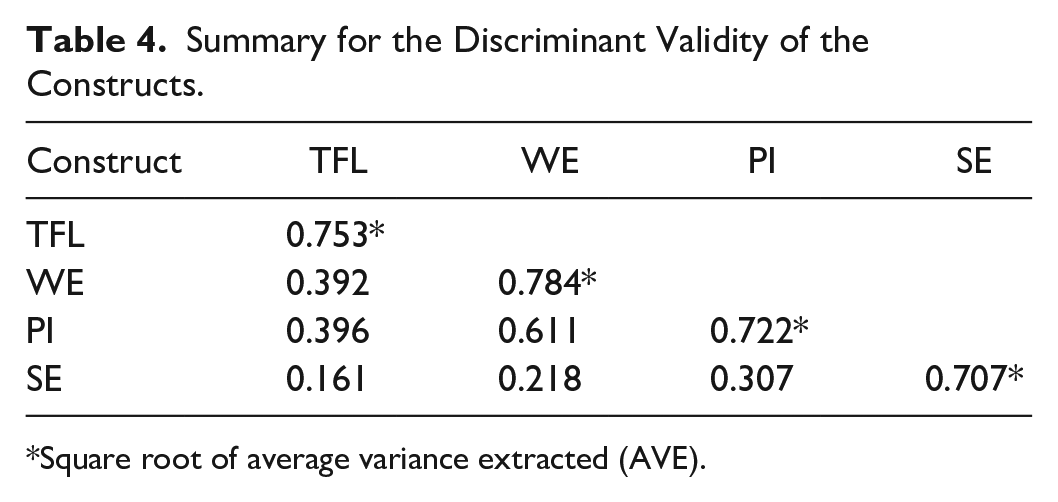
Square root of average variance extracted (AVE).
Common method bias
To the extent common method bias (CMB) is concerned, Harman Single Factor Test (HSFT) is used to check the influence of change in a single factor upon other factors in the data. The variance ought to be under 0.5 to escape CMB and in this research, the value of HSFT is 0.17, henceforth it tends to be inferred that data is liberated from CMB (Podsakoff & Organ, 1986). Nonetheless, some limitations in this procedure are also present (Podsakoff et al., 2003), accordingly, researchers have also utilized common latent factor (CLF) test through SEM. The test compares the Standardized regression weights (SRWs) with and without CLF and it is established that SRWs without CLF were higher than SRWs with CLF with differentiation of less than 0.05, subsequently inferring that data is free from CMB (Gaskin, 2012).
Structural Model
The structural model specifies the geographical representation of relationships between latent variables. Figure 2. represents the structural model illustrating the path of each variable. Table 5 represents the path coefficient of standardized regression weights for a causal effect of exogenous variable upon endogenous variable. Analysis here reveals that Transformational Leadership has a significant relationship with Work Engagement, confirming H1 of the study. Structural Empowerment represents the highest correlation with Transformational leadership and insignificant relationship with Work Engagement which leads to disconfirmation of H2. Whereas, Process Innovation shows the highest correlation with Work Engagement as well as Transformational Leadership. The aforementioned relationships lead to the indirect relationship of Process Innovation between Transformational Leadership and Work Engagement, hence confirms the H3.

The structural model.
Direct and Indirect Paths.

Significant at 1%
Discussion and Conclusion
The researchers tested the relationship between Transformational Leadership (TFL) and Work Engagement (WE) and discovered a positive significant relationship between them. The findings suggest that the leaders demonstrating high transformational leadership behaviors are more likely to bring engagement to the workplace. The result of the analysis is predictable with past studies on the relationship of TFL and WE (Balwant et al., 2019; Islam et al., 2020; Monje Amor et al., 2020). This study is important as it was conducted during times of pandemic namely Covid-19. Because of lockdown, the majority of the companies provide telecommuting (Work from Home) option to their employees. However, telecommuting is hard for employees as they do not feel the office environment at home, and due to absence of concentration and continuous intrusion of relatives; work–life struggle emerged. The vast majority of the employees feel insecure about job security and furthermore about their salaries. Resultantly, they could not think/center around their work, so there emerged the need for employee engagement. The obligation of an organization and leader is to deal with their employee’s well-being and draw in them appropriately. As engaged employees are the one giving 100% outcome (Chanana & Sangeeta, 2021).
Moving on, SE is significantly related to TFL, this reinforces the previous studies (Ashforth et al., 2008; Wang & Lee, 2009). As suggested by Bass (1985), to create a transformational leader is just a start to open possibilities for the development of empowering work conditions in the organization. This study also highlighted the consequence of transformational leadership on convinced empowering conditions promoting process innovation as elaborated in theories like transformational leadership theory, the theory of engagement, and social exchange theory. Such social edifice generates a high level of engagement at the workplace.
Referring to the next idea, an insignificant relationship of SE with WE was revealed in consistent with the finding of Alhozi et al. (2021) where the statistical relationship of SE is also not established with engagement. With the increasing competition in the banking industry of Pakistan and the rising need for process innovation due to pandemic, leaders focus more on innovation than the empowerment of employees. Moreover, in the work from home setting, it might be little difficult for a leader to provide employees with Structural Empowerment (access to information, opportunity, structure and most importantly resources). Amundsen (2014) recommends that the core of empowerment lies with power-sharing and the involvement of employees, but the growth of the banking sectors and corporate structure hinders the leaders to fully empower their subordinates. Instead, employees are encouraged to bring creativity and are provided with rewards and benefits but not with empowerment.
The aforementioned discussion leads to the insignificant indirect relationship of Structural Empowerment between TFL and WE. This finding opposes the one-of-a-kind study of Monje Amor et al. (2020) which identified the empirical link between structural empowerment, work engagement, and transformational leadership. This may be from the very fact that Amor’s study was based on the tourism sector where most of the organizations were of small size and it was conducted in normal circumstances. Similarly, studies on structural empowerment are mostly conducted in hospitals setting (Aggarwal et al., 2018) where no such corporate structure existed like banks and this study is based on banking sector employees working under stressful condition of pandemic. Therefore, leaders empowering behavior in a less hierarchal organization may differ from that of hierarchal organizations like banks.
When the banking sector of Pakistan is considered, this concept gains much hype owing to the fast-growing digitization need and innovation in the sector. The study found a significant positive relationship of PI with TFL and WE as done by previous study (Birasnav et al., 2013). In any case, leaders need to efficiently address development opportunities during the economic recuperation after the Covid-19 crisis. In this respect, the COVID-19 pandemic has featured the requirement for proceeding or accelerating the digitalization of business processes. Those organizations that generally had contributed considerably in digital transformation of their business exercises regularly had a critical upper hand during the financial slump and the start of the resulting recovery phase (Lichtenthaler, 2022). This implies that leaders promoting process innovation in the organization also enhances work engagement, which certainly is in line with the fact that the growing innovation demands of the sector also require leaders to come forward and drive innovative processes to remain competitive. Theories also indicate that transformational leadership behavior is fundamental at organizational change periods such as innovation practices (Bass, 1985; Bass & Riggio, 2006).
The significance of the study finding lies with the influence of PI in the relationship between TFL and WE as a mediator. The finding recommended that it is a critical factor for an organization to apply the transformational leadership style for fostering process innovation specifically at the time of crisis like pandemic. During this pandemic, leaders are advancing numerous innovative engagement exercises like online family commitment rehearses, virtual learning and advancement, online group building exercises, online courses, group meet-ups over video gathering for lunch, short web based game meetings, appreciation meetings, online courses managing stress, e-learning modules, and a lot more inventive learning meetings. Work from home based engagement activities are exceptionally productive for employees just as for the leaders and ultimately for the organization. This way employee feels dedicated to the organization and stay propelled during this difficult time of COVID-19 pandemic (Chanana & Sangeeta, 2021). This supports the notion of Hussain et al. (2014) that leadership incites creativity and an innovative organizational environment. The finding is in line with the current trend in the industry as the adoption of process innovation like Centralised Repeat Loan Processing unit (CRPLU), Central Processing Unit, Digital Field Automation (DFA), Real Time Gross Settlement (RTGS), mobile and internet banking has provided ease to the banking sector personnel.
It is fascinating to see how exogenous shocks like Covid-19 trigger the relationship between TFL and WE in the presence of PI and SE. Some pre-covid-19 studies has discovered the positive connection between TFL and WE (Balwant et al., 2019; Hayati et al., 2014; Islam et al., 2020; Prochazka et al., 2017). Various post-covid-19 discoveries are identical as far as the connection among TFL and WE (Anggiani, 2022; Chua & Ayoko, 2021; DeSilva, 2021; Nurlitasari et al., 2022). Monje Amor et al. (2020) tracks down the positive relationship between TFL and WE before pandemic. Notwithstanding, the study also discovered partial mediation of SE. But the research under discussion has found no mediation of SE on the linkage of TFL and WE. This can be due to the fact that during pandemic most of the workers undergone to work from home setting. Henceforth, access to data, opportunities, support and optimum resources was some way or the other missing under this new normal. Although the leaders remained consistent in creating the work engagement among their followers but allocation of resources remained troublesome during the early phase of pandemic and restrictions thereof. Presently, when the things are settling down, it would be interesting to study the impact of SE among TFL and WE under the new hybrid work environment, that is, work from home and work from office.
Limitation of the Study and Future Directions
The researchers have faced certain restrictions in the study that require to be addressed. One limitation is simply the utilization of self-reporting; this builds the danger of common method bias (Podsakoff et al., 2003), which has been negated by statistical analysis, however, for future studies, it is recommended to take account of both leader’s and followers’ perceptions at the time of collecting data. As most of the respondents under study have lower income, therefore, it is far advocated for future studies to take into consideration a similar analysis assuming higher income of leadership roles. Furthermore, the data collected from only two banks of Pakistan, for better generalizability of the results future researchers should collect data from all banks of Pakistan. It is also suggested that that future studies should take into account different sectors and countries to study the interplay between the constructs in different contexts as well the inclusion of other predictors of work engagement. Since the construct for TFL is adapted from MLQ, it has its own limitations; critiques note some potential flaws such as a problematic complex structure and its absence of association with the theory (Batista-Foguet et al., 2021). The future researchers should reconsider and enhance the validity of construct before adaptation. Similarly, CWEQ is a likert-type scale where no true answer exists. This implies that the likelihood of choosing a specific reaction (e.g., emphatically concur) would be subject to one’s general degree of SE (i.e., capacity) and thing trouble. Thing trouble relates to the degree of capacity that would be needed to embrace the right or, for this situation, the higher reaction choice (Havaei & Dahinten, 2017). Lastly, it is also recommended to incorporate mix-method research and the finding of the study should also be analyzed through qualitative analysis for the mitigation of potential risks.
Managerial Implications
Leaders’ work engagement brings profitability to the organization, engaged leaders are more innovative and creative in their work. Therefore, the digitally evolving banking industry requires engaged leaders as well as employees. Innovation can turn into the connection in the organization that will assist with enduring the crisis like Covid-19 and open up promising circumstances for investigation and testing new product and process. Essentially, the organization must be very much aware of the crucial job of leaders for engagement as well as for process innovation just like empowerment of employees. Lockdowns and telecommuting due to Covid-19 has made the horizon wide for the leaders to think out of the box to keep employees motivated and engaged. Thus, organizations should work for the development of transformational leadership training programs to remain competitive. The findings of the study also highlight the importance of best HR practices that should be employed creating intangible motivators for boosting employees’ work engagement level with the help of engaged leaders. Leaders on their part should provide support to their followers, acknowledge work, and provide development opportunities. The absence of structural empowerment as a mediator for work engagement also questions the fact that how leaders can provide the best support access to resources, power, help, and information to their followers to make them motivated and engaged while working from home.
Footnotes
Declaration of Conflicting Interests
The author(s) declared no potential conflicts of interest with respect to the research, authorship, and/or publication of this article.
Funding
The author(s) received no financial support for the research, authorship, and/or publication of this article.
