



Abstract
Blended learning (BL), which offers a learning ecosystem through a combination of face-to-face and online learning components, has positively impacted teaching and learning experiences. However, its role in facilitating employability skills remains underexplored. Drawing on evidence from a qualitative exploratory study based on a questionnaire survey, in-depth interviews, and observations of students’ engagement in a BL course at a Bangladeshi university, this study examines the effectiveness of BL in complementing traditional face-to-face and purely online learning, while facilitating students’ employability skills in the process. Findings reveal that BL decreases the shortcomings of both face-to-face and online learning by helping students overcome reticent behavior, time constraints, learning inertia, anxiety about engagement, and the risk of dropping out. Subsequently, it improves a range of recognized employability skills among the students, such as critical thinking skills, analytical and problem-solving skills, cognitive and meta-cognitive skills, communication (reading and writing) skills, teamwork skills, technological skills, and time management skills. Additionally, BL indirectly influences their adaptability and leadership attributes. This study provides valuable insights for designing and refining educational strategies that bolster employability among graduates. The paper concludes with an exhortation for further research on this relatively less-explored subject.
Introduction
Achieving successful “school-to-work transitions”—the passage of a young person from the end of schooling to the first stable or satisfactory employment (ILO, 2015)—has long captured the attention of educationalists, policymakers, and development experts alike. In recent decades, the concern has intensified due to the rising issue of “graduate unemployment”, especially in developing countries (ILOSTAT, 2019). The primary cause of this phenomenon is widely attributed to the deficiency of “employability skills”—the attributes that enable individuals to obtain and maintain employment throughout their careers (Harvey, 2001; Hillage & Pollard, 1998)—among graduates, who face intense competition in the modern job market (Goodwin et al., 2019; Ng et al., 2021; Taylor, 2005; Tymon, 2013).
Given that the educational system plays a crucial role in addressing youth’s transition challenges from school to work, the question arises regarding its capacity—particularly at the tertiary level—to equip students with skills aligned with employers’ expectations (ILO, 2024; ILO & UNICEF, 2020). Accordingly, graduate employability has emerged as a key measure of higher education outcomes (M. Cheng et al., 2022; Koseda et al., 2025; Tight, 2023; Tran, 2015). This necessitates an inquiry into the gaps between the pedagogical methods adopted by tertiary-level educational institutions and employers’ expectations.
While the education system is extensive in scope, the pedagogical approach remains at its core. Traditionally, classroom-based “face-to-face learning” has been the dominant pedagogical modality, whereas “online learning” has gained traction with the advent of Information and Communication Technologies (ICTs; Turbill, 2015). Considering the merits and demerits of each of these methods (e.g., Block, 2010; Cranmer, 2006; Park & Choi, 2009; Paul & Jefferson, 2019; Shankar & Robinson, 2024), Blended Learning (BL) has emerged as a novel method that integrates face-to-face and online learning components. Most studies recognize BL as an effective way to enhance teaching and learning experiences and to achieve the highest learning outcomes (e.g., Garrison & Kanuka, 2004; Islam et al., 2022; Perera et al., 2020; Qasem & Alasmari, 2025; Rovai & Jordan, 2004; Zhang et al., 2023). Although some studies examining BL’s effectiveness have occasionally highlighted its role in developing some types of employability skills (D. Bennett et al., 2020; Fearon et al., 2011; Jou et al., 2014; Russo et al., 2022; Tupe, 2021), the existing literature still lacks a systematic and comprehensive analysis of this issue, leaving important aspects underexplored.
Against this backdrop, in this study, we primarily investigate the effectiveness of BL in facilitating employability skills during the learning process by assessing students’ perceptions at a tertiary-level institution in Bangladesh. Notably, graduate unemployment in Bangladesh has steadily increased over the years, rising from 4 lakhs in 2017 to 8 lakhs in 2022 (BBS, 2018, 2023). Additionally, the International Labour Organization (ILO, 2021) ranked Bangladesh second among the 28 Asia-Pacific countries with the highest percentage of graduate unemployment. One of the most pressing causes behind this trend is the skills gap among graduates, indicating weaknesses in tertiary education (e.g., Ahmed, 2023; CPD, 2021; Hasan et al., 2024; Hoque et al., 2023; Uddin, 2021; World Bank, 2019). While adopting the BL pedagogical approach has recently been emphasized by Bangladesh’s University Grants Commission to address these educational challenges (UGC, 2022), only a few empirical studies (e.g., Hossain et al., 2024; Islam et al., 2022; Jannat Nipa & Hoque, 2025) on BL have been conducted in this context. In essence, two key factors motivated us to conduct this study: the lack of research into the role of BL in facilitating employability skills and the emerging issue of graduate unemployment alongside the prospects of BL in Bangladesh.
Therefore, we aimed to investigate (a) the efficacy of BL in complementing traditional face-to-face and purely online learning, and (b) the effectiveness of BL in facilitating employability skills during the learning process, which represents the key objective of this study. Specifically, the study addressed the following research questions:
How do respondents perceive and react to a modified learning environment?
Can the online component of BL enhance respondents’ learning experiences and, in turn, increase class participation by overcoming the shortcomings of classroom-based face-to-face learning and pure online learning?
What are respondents’ self-reported scores and perceptions regarding skills formation after completing the blended course?
Is there a notable connection between the self-reported benefits of BL and the development of employability skills?
Notably, the first two research questions were utilized to lay the foundation for moving toward the key objective of this study. To further clarify, these questions explore whether BL enhances the learning experience and outcomes by complementing face-to-face and online learning within the Bangladeshi context. Subsequently, we dive deep into the key purpose of the study by scrutinizing the last two research questions. In this regard, we have employed an exploratory qualitative research design, incorporating diverse data collection methods to effectively address the research questions.
This study is significant because it provides valuable insights for policymakers, scholars, educationalists, and university administrators to reconsider and redesign tertiary education to meet the demands of the contemporary labor market. Additionally, it contributes to the growing body of literature both on “blended learning” and “employability skills.” Importantly, we propose a BL model that effectively facilitates employability skills among learners. Furthermore, we identify metacognitive skills as a critical and distinct component of employability skills.
Literature Review
Face-to-Face Learning Practices
Classroom-based face-to-face learning is the most widely recognized method for delivering knowledge. It offers students and teachers opportunities for immediate give-and-take and in-depth discussion, which can make students more focused and engaged in the learning process, yielding improved outcomes (Auster, 2015; F. Chowdhury, 2019; G. Li et al., 2024; Qasem & Alasmari, 2025; Shi et al., 2021; Ye et al., 2023). Additionally, face-to-face instruction plays a vital role in promoting student development, offering support, encouraging social interaction, and fostering group accountability (Collopy & Arnold, 2009; Ghafar, 2020; Yusoff et al., 2017). Such interactions reduce intergroup anxiety and nurture prosocial behavioral intentions (Austin & Turner, 2020; Turner et al., 2007). Furthermore, it is argued that students develop their value system through direct interactions with teachers in the classroom, as a teacher’s personality and behavior can significantly influence a student’s mindset (F. Chowdhury, 2019).
However, face-to-face learning involves numerous challenges, including inadequate infrastructural support, teacher-centric learning, constrained program designs, and limited contributions to effective learning outcomes, among others (Cranmer, 2006; Garrison & Kanuka, 2004; Hasbullah et al., 2011; O’Flaherty & Phillips, 2015; Paul & Jefferson, 2019). Importantly, while participation is crucial for effective learning, Littlewood (2004) identified six factors that hinder participation in face-to-face classrooms: (1) tiredness, (2) fear of being wrong, (3) insufficient interest in the class, (4) insufficient subject matter knowledge, (5) shyness, and (6) insufficient time to formulate ideas. Consequently, the classroom environment can sometimes lead to low confidence, heightened anxiety, and reticent behavior, significantly interrupting students’ learning outcomes (Aghazadeh & Abedi, 2014; F. Chowdhury, 2019; Savaşçı, 2014). Specifically, Asian students’ reticent behavior is often driven by cultural settings, passive learning behavior, shyness, and a lack of confidence, resulting in an unwillingness to engage in dialectic and analytical discourse in a classroom setting (e.g., Harumi, 2011; Jackson, 2002; H. Li & Liu, 2011). Furthermore, this aged pedagogical practice has often been criticized for delivering content in a conventional, memorization-focused manner (Islam et al., 2022; Maria Josephine Arokia Marie, 2021). Overall, face-to-face learning imposes limitations on the construction of a wholesome learning environment, depriving students of improving their institutional and non-institutional skills (Lane, 2016). Nonetheless, face-to-face learning is still the dominant pedagogical method in educational institutions across various countries, including Bangladesh.
Fundamental Basis of Online Learning
In contrast to the face-to-face method, online learning has appeared as an alternative pedagogical approach with the advent of ICTs over the past several decades and gained immense popularity during the COVID-19 pandemic. This approach is argued to offer several advantages, including cost-effectiveness, reduced staff workload, student-centered, flexibility in terms of time and distance, and enhanced participation (Alexander, 2001; Dhawan, 2020; Halász & Kenesei, 2024; Qasem & Alasmari, 2025; Rajeh et al., 2021; Sarker et al., 2019). These factors not only contribute to teacher satisfaction (Yan et al., 2025) but also provide learners with a better learning experience (Abdullah et al., 2024; I. Jung et al., 2002; Waghid & Waghid, 2016) while also developing their job-specific soft skills (A. Singh & Singh, 2017). It is further argued that online courses can foster active learning environments by simultaneously ensuring the Community of Inquiry (CoI)—social, cognitive, and teaching—presence (Farrokhnia et al., 2025; Picciano, 2017).
However, online learning also has several setbacks. Specifically, it lacks direct interaction between teachers and students, fails to facilitate social connectedness, raises the likelihood of dropouts, and increases the “digital divide” among students (Block, 2010; Lenhoff & Singer, 2025; E. S. S. Lim & Choy, 2025; Liu & Zhou, 2024; Mathrani et al., 2022; Park & Choi, 2009; Ponzurick et al., 2000; Rostaminezhad et al., 2013; Sarkar et al., 2021; Tate & Warschauer, 2022). In Bangladesh, online learning is gaining popularity, but educational institutions are still in the early stages of adopting such technology (Khan et al., 2012; Sarker et al., 2019). For instance, Sarker et al. (2019) found that while most students well accept e-learning, there are significant institutional, administrative, and technological limitations. These limitations have been extensively recognized across countries, reducing the potential benefits of online learning (e.g., Alawamleh et al., 2022; Khalil et al., 2020; Mishra et al., 2020; Sarkar et al., 2021; Shrestha et al., 2022).
Blended Learning (BL)
Blended Learning (BL): Emergence, Effectiveness, and Challenges
As both face-to-face and online learning methods possess several merits and demerits, educational institutions have increasingly explored alternative models to improve teaching and learning experiences. In this context, BL has recently been identified as a promising solution (Prifti, 2020), which first emerged as a new pedagogical approach in the late 1990s (Alsalhi et al., 2019). Although the common theme of integrating virtual and physical learning underpins BL definitions (Table 1), there is no consensus on the types of courses or the extent to which online components should be integrated with face-to-face classes. Therefore, in this study, we adopt the definition of BL as a “thoughtful integration of classroom face-to-face learning experiences with online learning experiences” (Garrison & Kanuka, 2004).
The Blended Learning Approach, as Perceived by Previous Researchers.

Source. Compiled by authors.
Thus, the distinguishing aspect of BL is its ability to blur the boundaries between traditional face-to-face and pure online learning models (Shi et al., 2021). Accordingly, it addresses the limitations while combining the advantages of both models (Figure 1).

The complementary role of BL.
Overall, given the limitations of both face-to-face and online methods, BL as an alternative approach is expected to bring about a transformative shift in the nature and quality of education. In this regard, most empirical studies highlight that BL offers numerous advantages (Table 2). Meta-analyses and systematic reviews have also reported that BL exerts either a moderate (Means et al., 2013; Yu et al., 2025) or significant (Bernard et al., 2014; Liu et al., 2016) positive effect on student learning. Consequently, BL has gained increasing popularity over the years across Africa, Asia, Australia, Europe, and America (e.g., Adams et al., 2021; Gjestvang et al., 2021; Kanuka & Rourke, 2013; C. P. Lim & Wang, 2016; Protsiv & Atkins, 2016; Wang & Bhagat, 2025), especially in higher education (Ashraf et al., 2021; Cabauatan et al., 2021; Crew & Märtins, 2023; Graham et al., 2013; Hossain et al., 2024; N. Hughes, 2024; Islam et al., 2022; Okaz, 2015; Perera et al., 2020).
Benefits of BL.

Source. Compiled by authors.
However, the successful implementation of BL remains a major concern due to various challenges associated with this approach, such as the lack of IT infrastructure—particularly in resource-constrained and developing countries—insufficient institutional support, difficulties in preparing or motivating students and teachers to adapt to BL based on their competencies and needs, among others (Adams et al., 2021; R. Ali, 2025; Antwi-Boampong, 2020; Ashraf et al., 2021; Graham et al., 2013; Harris et al., 2009; Huang et al., 2022; Le et al., 2021; Moskal et al., 2013; Ocak, 2011; Pooja & Saxena, 2025; Porter & Graham, 2015; Rasheed et al., 2020; Saltan, 2016; Sareen & Mandal, 2024; Shaya et al., 2025; Tamim, 2018; Y. Yang, 2023). Crucially, the key challenge is linked to the course design (Boelens et al., 2017; Kintu et al., 2017; Sareen & Mandal, 2024), as it is essential to ensure that blended learning is appropriately blended through a suitable balance of online and offline delivery methods (Poon, 2012; Zgraggen, 2021) to make the course successful.
Blended Learning (BL) and Employability Skills
While exploring BL’s implications in higher education, we found that some studies sporadically highlighted issues related to skills formation in a blended environment (D. Bennett et al., 2020; Fearon et al., 2011; Guden & Safaeimanesh, 2024; Jou et al., 2014; Russo et al., 2022; Tupe, 2021). For instance, Fearon et al. (2011) observed improvements in communication and leadership skills while assessing students’ perceptions of BL’s value in university and workplace settings. The development of critical thinking skills is reported by Jou et al. (2014), whereas Russo et al. (2022) noted an enhancement in writing skills. Finally, Tupe (2021) identified BL’s role in developing entrepreneurial skills among women. Some of these skills are recognized as employability skills (as discussed in the following section); however, it is crucial to note that none of these studies specifically examined the role of BL in facilitating employability skills.
Overall, extant empirical studies on BL have broadly explored its effectiveness and associated learning outcomes as an alternative pedagogy to face-to-face and online learning. Nevertheless, there remains a lack of systematic and comprehensive studies on the impacts of BL on employability skills formation among learners. We intend to address this gap by conducting a systematic investigation in the Bangladesh context and reporting on students’ perceptions of BL’s effectiveness in enhancing their employability skills.
The Landscape of Employability Skills
Graduate employability has become a serious concern since there are broad mismatches between the acquired graduate skills from universities and the required skills by employers (Bonnard, 2020; Oliver, 2015; Osmani et al., 2015; Wahab et al., 2025). Employability is an umbrella term comprising a set of achievements, skills, and personal attributes that need to be embedded within graduate education (Yorke, 2005). Hillage and Pollard (1998) earlier defined employability from a broader perspective, describing it as:
… the capability to move self-sufficiently within the labour market to realise potential through sustainable employment depending on the individual’s knowledge, skills and attitudes they possess, the way they deploy those assets and present them to employers and the context (e.g., personal circumstances and labour market environment) within which they seek work.
Alternatively, it refers to a set of institutional and non-institutional attributes that enable an individual to “gain initial employment,”“maintain employment,” and “obtain new employment” (Chadha & Toner, 2017). For this study, we define employability as “a set of attributes that make graduates more likely to gain employment and be successful in their chosen occupations,” as proposed by Yorke and Knight (2006). Since the emphasis on employability has grown in tandem with the promotion of a skills-based approach, tertiary education now aims to equip graduates with a set of generic and transferable skills that allow them to adapt to a changing labor market (Bonnard, 2020; J. Jung et al., 2024).
However, there is hardly any consensus on what constitutes employability skills (Eimer & Bohndick, 2023), as various studies have identified different sets of skills (e.g., Andrews & Higson, 2008; R. Bennett, 2002; T. A. Chowdhury & Miah, 2019; Finch et al., 2013; Hoque et al., 2023; Rakowska & de Juana-Espinosa, 2021; Riebe & Jackson, 2014; Scott et al., 2019; Valas et al., 2024; Yeoh et al., 2024). For this study, we define core employability skills as critical thinking skills, analytical and problem-solving skills, cognitive skills, communication skills, teamwork skills, technological skills, time management skills, adaptability and flexibility skills, and leadership skills (Table 3), based on Osmani et al. (2015), Suleman (2017), and Tushar and Sooraksa (2023), who methodically identified graduate attributes through a systematic literature review. In essence, we identified the list of employability skills based on studies that provide a synthesized view of such skills. Table 3 outlines these skills and their corresponding behavioral descriptors, which are employed in the analysis of this study.
Key Employability Skills and Their Operational Definitions.

Source. Compiled by authors (adapted from Osmani et al., 2015; Suleman, 2017; Tushar & Sooraksa, 2023).
Transferring these skills (Table 3) to tertiary-level students is a complex issue, and doubts remain about whether they can be effectively developed through face-to-face or online learning alone or through BL. Therefore, in this study, we investigate whether and how BL can direct and facilitate the development of employability skills among tertiary-level students at a technology-focused private university in Bangladesh.
Methods and Materials
This exploratory study is qualitative in nature (Creswell, 2014; George, 2023; Patton, 2002) and aims to examine students’ engagement and experiences in a blended learning environment while also examining the development of employability skills among them. To maximize the generalizability of the findings, it is essential for an exploratory study to employ triangulation of descriptive statistics with qualitative information, rather than relying on inferential statistics (Stebbins, 2001). Accordingly, we employed data triangulation by integrating qualitative data from interviews and observations with descriptive statistics derived from questionnaire responses (Carter et al., 2014; Patton, 2002). This approach provided a deeper understanding of the research questions, as emphasized by Creswell (2014).
Study Design
This study employed a qualitative research design within the context of a bachelor-level credit course conducted over an academic term (January–June 2023) at an ICT-driven private university in Bangladesh. The university is renowned for its advanced digital infrastructure and commitment to blended learning (Business Inspection, 2023). It is recognized as the first complete digital university in the country and the only institute in Bangladesh to have a dedicated “Blended Learning Center,” established in 2013 (Islam et al., 2022). Our study was conducted within a General Educational Development (GED) course titled “Bangladesh Studies,” offered under the university’s Blended Learning Center.
The course design incorporated both synchronous and asynchronous learning components (Figure 2), combining face-to-face classroom sessions at the “Blended Learning Center” with online interactions via Google Classroom. The participants enrolled in the blended course were using Google Classroom for the first time, and their progress was monitored and assessed throughout the semester. Thus, participants engaged in multiple learning modes, including in-person lectures, real-time online discussions, and asynchronous weekly assignments.
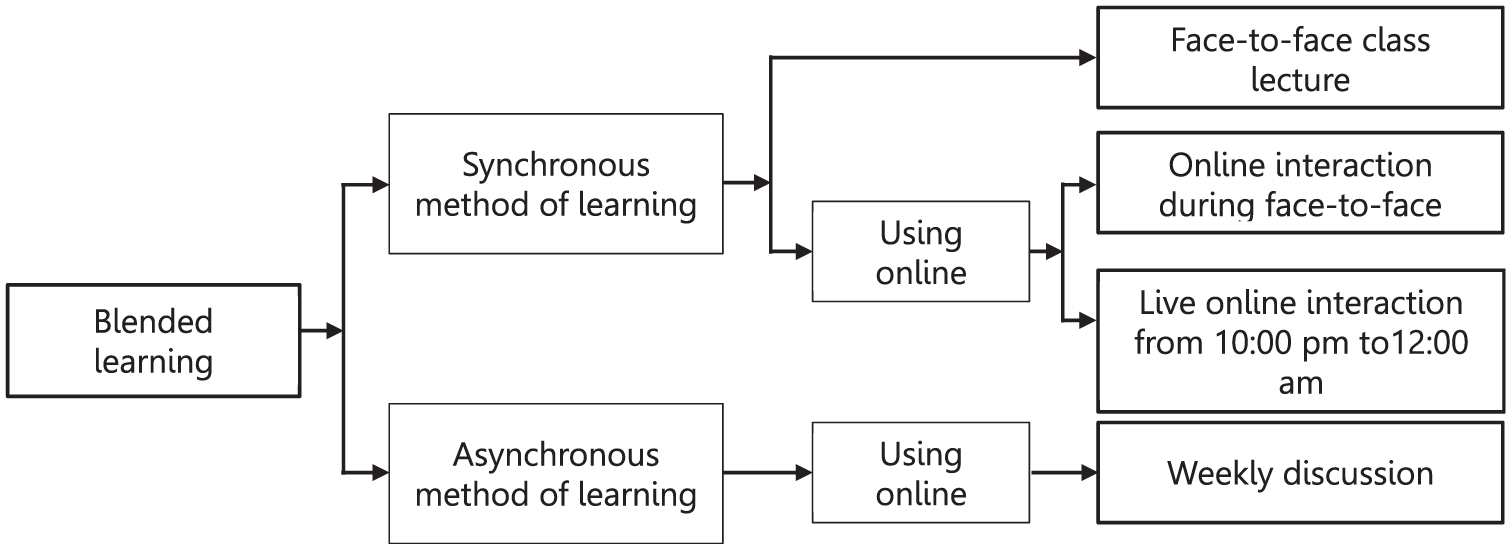
BL framework used for this study.
We conducted four different types of sessions, as shown in Figure 2. These sessions were administered as follows:
Data Collection Instruments and Procedures
To collect data, we relied on a questionnaire survey, individual interviews, and observation methods. We collected data during and after the end of the course. In the first phase, we surveyed students to evaluate their involvement, experiences, and learning behavior in synchronous and asynchronous learning modes. In the second phase, we conducted qualitative interviews to explore learners’ perceptions of the blended environment, the derived benefits of BL as a complement to the face-to-face mode, and its effectiveness in improving their employability skills. Additionally, we observed students’ online interactions throughout the course to gain qualitative insights. While we primarily relied on qualitative data collected through interviews and observations, descriptive statistics from questionnaire responses were used to enrich and refine the qualitative findings.
Sampling
The study respondents were sophomore undergraduate students from two departments: Computer Science and Engineering (CSE) and Textile Engineering (TE), which were more engaged in BL under the “Blended Learning Center” compared to other departments of the university. The total population consisted of 287 students, with 155 from the CSE department and 132 from the TE department. Using Yamane's (1973) sample size calculation formula, the minimum required sample size was determined to be 167 (see Equation 1):

where n represents the sample size, N the population size, and e the precision level (set at 0.05).
Through random sampling, we collected 181 responses. After excluding 11 incomplete responses (Creswell, 2014), survey data from 170 students were retained for analysis. Table 4 presents the demographic details of the participants included in the study.
Distribution of the Sample.

Source. Prepared by authors.
Furthermore, following Sandelowski (1995), a sample of 15 students (3 from each of the 5 sections) from those 170 students was selected for in-depth interviews.
Questionnaire Survey
A structured questionnaire was administered to students at the end of the semester to gather descriptive insights into their background, engagement, and learning behaviors. The questionnaire consisted of three main sections: (a) demographic information, (b) students’ engagement in different learning modes, and (c) perceptions of skills development. To report the scores of perceived skills formations, respondents answered eight questions on a five-point Likert Scale ranging from “strongly agree” to “strongly disagree.” The reliability of the questions was assessed by Cronbach’s alpha consistency test (Tavakol & Dennick, 2011), where the values were α = .82 and e = .32, indicating a good internal consistency. Moreover, the inter-item correlation matrix of the scale was also positive, meaning strong inter-relatedness among those eight items (after excluding less important factors and demographic information; Table 5). Thus, Table 5 demonstrates that the eight interrelated questions, consisting of students’ self-reported behavioral specifications, provide insights into addressing the research question.
Inter-Item Correlation Matrix.

Source. Prepared by authors.
Values are statistically significant at (p < .05).
Values are statistically significant at (p < .001).
Interviews
Interviews served as the primary data collection method, providing valuable insights into students’ perceptions of the blended learning environment (Koven, 2014). The in-depth interviews, although guided by a checklist of eight key questions, allowed for flexibility in responses, enabling the emergence of new themes and follow-up inquiries based on the interviewees’ perspectives. Each interview was audio recorded using a digital recorder (Berazneva, 2014) and lasted approximately 15 to 20 min, generating around 282 min of interview data. Afterward, the recordings were transcribed into English. To evaluate the reliability and validity of the interviews (Noble & Smith, 2015), an expert panel (N = 8) consisting of members from the ethical review committee was consulted based on the following metrics: (i) generalizability (ii) applicability (iii) reflection of the research objective (iv) trustworthiness, and (v) interview protocol (Table 6).
Validity and Reliability of the Interview.

Source. Prepared by authors.
Observations
Observations, as a data collection tool, refer to the process in which the researcher records detailed information on participants’ behaviors, activities, and conversations (Creswell, 2009, 2013). This method allowed for an in-depth understanding of student participation in both synchronous and asynchronous learning environments. The observations focused on classroom interactions, online discussions, and engagement patterns across different instructional modes. This tool was adopted to supplement the interview findings by capturing real-time student interactions and engagement in various learning sessions.
Data Analysis
We adopted thematic analysis to interpret qualitative data, following Braun and Clarke (2006) and Clarke and Braun (2016). The analysis involved identifying recurring themes within the interview transcripts and observational notes, using a combination of inter-case and within-case analysis. Selected interview excerpts with grammatical clarity were used to illustrate key findings and ensure contextual relevance (Patton, 2002). Additionally, descriptive statistics derived from the questionnaire survey were analyzed using SPSS for Windows (x86-64) to complement the qualitative analysis, providing numerical summaries of student engagement levels and perceptions. Overall, our investigation elucidates the nuanced phenomena of students’ perceptions qualitatively while explaining their engagement in learning through quantitative data, data visualization, and fundamental statistical analysis.
Ethical Consideration
We conducted all procedures involving human participants in accordance with the ethical standards set forth in the officially revised 2024 Helsinki Declaration. This study was approved by the concerned research ethics committee. We informed the study respondents about the purpose of this research and obtained their voluntary written consent to participate in this study. Confidentiality, anonymity, and data security were strictly maintained, and participants were assured that the data collected would be used exclusively for academic purposes.
Result
Background Information of the Respondents
The background information of the respondents is presented in Table 7. This study found that the respondents’ attendance rates significantly varied in the face-to-face classes, where 20.5% of the students were mostly regular, 29.4% were somewhat regular, 17.1% were moderately regular, and the remaining 33.0% were somewhat irregular. In contrast, during online sessions, the respondents were mostly available from 6:00 pm to 12:00 am (68.2%), followed by 12:00 am to 6:00 am (27.1%). Generally, the respondents (54.1%) used their laptops for online sessions, while others used desktop computers (20.6%) or smartphones (20.6%). However, a small proportion (4.7%) faced challenges keeping pace with the Blended Learning (BL) approach due to the lack of personally owned devices.
Background Information of the Respondents.

Source. Prepared by authors.
Level of Students’ Participation in the Blended Learning (BL) Approach
Because BL offers both synchronous and asynchronous learning, students can persevere with the class progress even if they miss classes. Figure 3 suggests that BL substantially increases students’ participation and the time they dedicate to learning. Their online participation rates (Figure 3a) indicate that 26.5% of the students participated daily, 40.6% at least once in 2 days, 24.1% at least once every 3 days, and 8.8% at least once a week.

Participation in the online platform (a) weekly hours of participation in the online platform (b).
Furthermore, we found that students spent a comparable amount of time on online synchronous and asynchronous learning (Figure 3b). Among 170 surveyed students, only 16 (9.4%) spent 1 to 2 hr per week in online sessions, whereas 59 (34.7%) spent 3 to 4 hr, 46 (27.1%) spent 5 to 6 hr, and 49 (28.8%) spent more than 6 hr weekly. This indicates that the blended mode reduces absenteeism and addresses time constraints by offering students comprehensive learning opportunities beyond face-to-face classes. Moreover, flexible learning allows students to prepare in advance on assigned topics using online resources, thereby increasing participation in both classroom and online settings. Notably, a respondent from the TE Department stated:
It was a new experience doing online interaction beyond the classroom environment. In a face-to-face class, our teacher delivers a lecture, and a few students participate in the class discussion. But, in online interaction, everyone gives comments; thus, it provides an excellent milieu for class participation.
This suggests that BL has created opportunities for spontaneous participation in discussions, which, in turn, has positively impacted students’ learning motivation. Highlighting the significance of online sessions in bridging the gaps of traditional face-to-face classes, another student remarked:
The virtual session allowed us to confidently speak our minds because we could take the time to get prepared for the lesson and use the online option to collect information, which is impossible in face-to-face classes. Moreover, we can ask those things that we missed in the class immediately in the Google Classroom. I would say that, along with face-to-face interaction, this kind of online session should be conducted often to fill the gaps.
In blended interactions, students remain engaged, which helps prevent boredom and further enhances their class participation. As one respondent mentioned:
On the online platform, when the topic is assigned, we can contribute specifically by commenting and giving feedback to each other. Besides, students become bored and dull by attending only traditional-type classes, while this kind of class helps remove monotony.
At present, as young people are more active online, they can easily adapt to such a learning method. Besides, they are often reluctant to study willingly while staying at home, but online learning platforms enable them to utilize their time more productively. In this regard, one male respondent said:
In this age of ICTs, we are almost addicted to social networking sites. We waste lots of time on them by gossiping. However, when this system of learning was presented to us, we were amazed by the fact that we could use the online platform to do our studies by sharing knowledge and thoughts. We shut down Facebook to attend this class, and this class turned out to be much more enjoyable.
Overall, BL has increased the students’ class participation by offering flexible learning options, alleviating monotony, and utilizing their preferred platforms.
Benefits of Blended Interactions Among the Students and the Teachers
Our findings suggest that Blended Learning (BL) has extinguished a passive learning culture by introducing student-centered learning, where students take on a central role and the teacher serves as a facilitator.
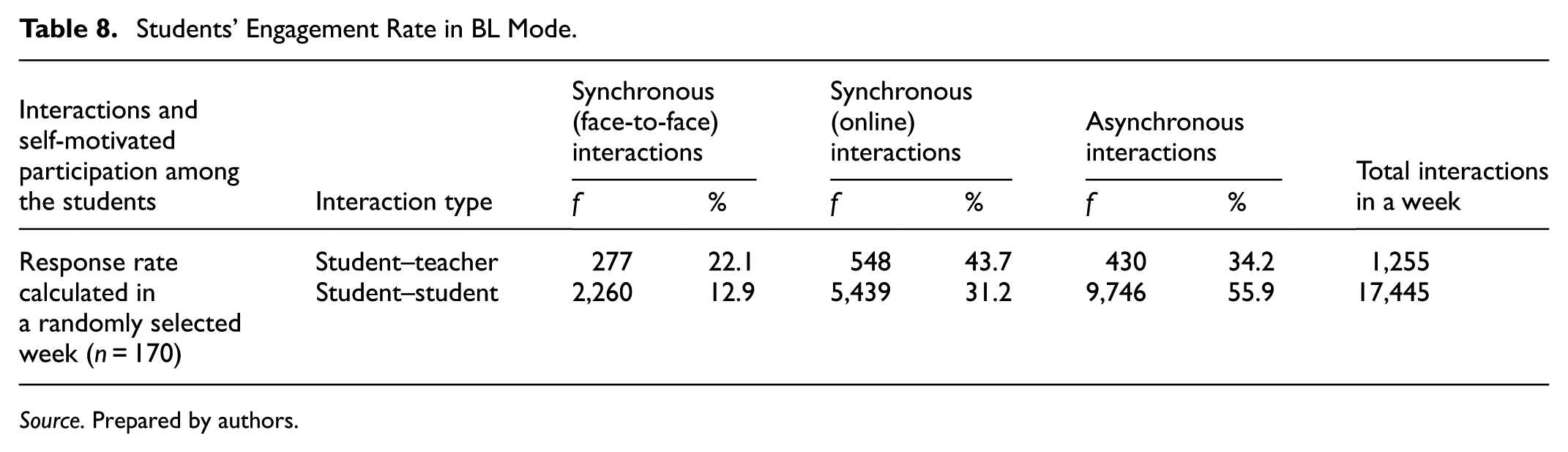
Table 8 provides a summary of students’ engagement with their teacher and peers across various modes of blended learning. Specifically, we calculated the frequency of interactions and instances of self-motivated participation, both among students and between students and the teacher, in different modes. It shows that students were less active in face-to-face mode, whereas a significantly higher number of interactions occurred in the online synchronous and asynchronous modes. In a randomly selected week, the results show that out of 1,255 interactions between students and teachers, only 277 (22.1%) interactions were recorded in the face-to-face mode, while 548 (43.7%) occurred in the synchronous mode and 430 (34.2%) in the asynchronous mode. Similarly, students-to-student interactions were notably higher in the online modes, with 5,439 (31.2%) interactions in the synchronous mode and 9,746 (55.9%) in the asynchronous mode, compared to 2,260 (12.9%) interactions recorded in the face-to-face mode out of a total of 17,445 interactions during the same week (Table 8).
Students’ Engagement Rate in BL Mode.
Source. Prepared by authors.
Moreover, this approach helps students overcome their reticent behavior. Table 9 presents students’ response rates, which signify that they are more responsive in the blended mode. In a randomly selected week, 48.2% of the students made online posts 1 to 5 times, 20.6% posted 6 to 10 times, 6.5% posted 11 to 15 times, and 1.8% posted more than 15 times. Although 22.9% of the students did not respond during the surveyed week, the majority (95.3%) preferred online sessions in combination with face-to-face classes. Among those participating in online class discussions, 77.6% also responded to their classmates as a part of sharing ideas and thoughts.
Students’ Response Rate.

Source. Prepared by authors.
Specifically, this learning model is beneficial for introverted students who feel hesitant to interact and share their thoughts with other students and the teacher in a classroom. As one male respondent from the CSE department noted:
I think the distance between teacher and student decreases in this blended interaction. Many students cannot interact spontaneously in face-to-face classes, whereas online interaction allows students to share their thoughts without hesitation in Google Classroom.
Similarly, a female respondent mentioned:
Online sessions, besides the face-to-face classes, offer shy or reticent students like me the opportunity to participate in class discussions with greater ease.
Besides, fear of attending examinations is a common trait among graduate students. BL is effective in alleviating this fear by fostering regular study habits. Notably, one respondent expressed with satisfaction:
Because of the regular question-answer sessions and interactions in both offline and online platforms, my study hours have automatically increased. Hence, the topic of the discussion became lucid to me. Even if I did not understand any question in Google Classroom, I could see what others answered, and then I could get an idea of what the question was asking. It also helped me understand my exam questions. As a result, it reduced my exam stress.
In this respect, another respondent stated:
From this course, one thing that I learned is punctuality. I learned that if I complete my lesson before the examination, then I can reduce exam stress. Earlier, when all the things I needed to study came in front of me just before the night of the exam, it created enormous stress in me. Now, I am automatically bound to study regularly, and so, I do not feel anxious about the examinations.
Occasionally, students need to consult with their teachers outside of class hours. Therefore, they seek appointments at a mutually convenient time. However, it makes the issue complex, and thus, students are most often reluctant to meet their teachers. Online sessions effectively eliminate this barrier by providing students with the flexibility to ask the teacher for any clarification about previously discussed topics at any time. Teacher, in turn, can also respond at their convenience. As a result, this approach not only saves time for both the teacher and the students but also makes the learning process complete and effective. As one female respondent stated:
I could even ask questions through a comment in Google Classroom in a particular thread and get answers to my queries. This made the mode of interaction much easier. Otherwise, if I had a problem that I needed to discuss with my course teacher, I had to wait for an appointment, which is sometimes a painful process.
Additionally, classmates can also clarify the queries of other students in the comments section. In this regard, one of the respondents shared:
We could learn from the thoughts of our classmates, which helped us a lot in understanding a topic properly.
Figure 4 further confirms students’ engagement and active participation in the blended learning mode. As presented in Figure 4, the translated codes of thematic analysis of 6,477 selected comments reveal that students actively support their peers by sharing and comparing thoughts, providing feedback or suggestions, and offering acknowledgment. Such a style of interactive engagement also supports them in forming a collaborative learning environment.

Grading of students’ learning behavior in synchronous and asynchronous modes (based on a thematic analysis of 6,477 selected comments).
Additionally, the teacher’s and classmates’ clarifications exist in the comments section for an extended period, allowing learners to revisit and review them later. This suggests that the method creates a flexible learning environment. As one respondent from the CSE department expressed:
The conversations and ideas that we shared always remain online. So, we could come back to them whenever we wanted.
Another TE male respondent said:
I could review lectures delivered in the classroom, discussions, explanations, and comments at any time. Hence, I could control my study time. So, it created a flexible learning environment for me.
Regarding flexibility, online sessions also provide a scope for learners to re-evaluate and deepen their understanding of topics covered in face-to-face classes. Accordingly, one respondent stated:
We could re-evaluate ourselves on what we learned in face-to-face classes. For example, if I misunderstood any topic, it would become clearer to me when I read and discussed it again on the online platform.
Overall, our findings indicate that the adopted BL approach offers significant benefits, particularly in promoting student-centered, flexible, and collaborative learning, thereby enriching the overall learning experience.
Blended Learning (BL) and Formation of Employability Skills
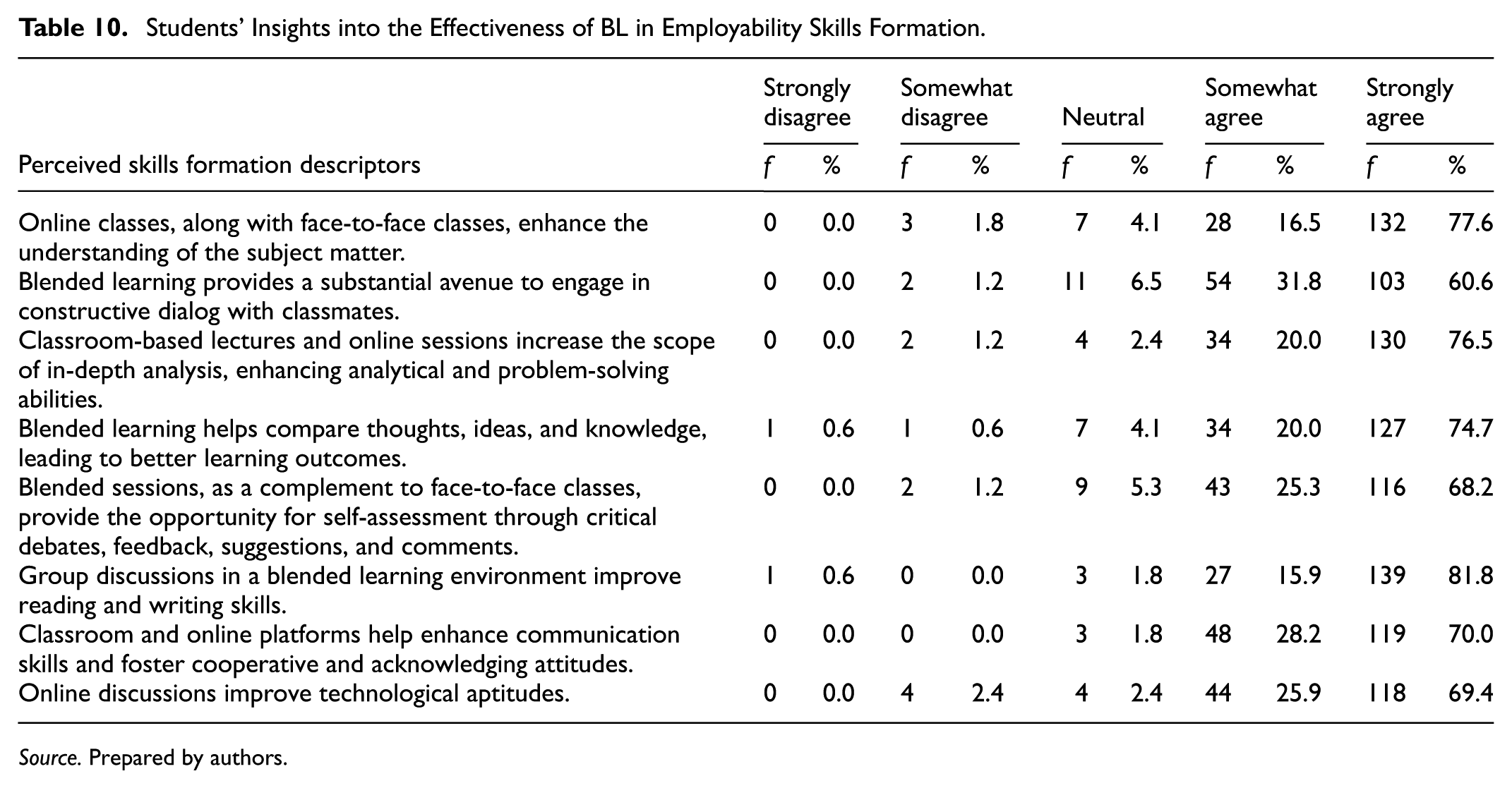
The key objective of our study is to examine BL’s role in facilitating employability skills. We found strong evidence that, through the enhanced learning experience described above, the respondents were able to develop such skills as reported by themselves (Table 10).
Students’ Insights into the Effectiveness of BL in Employability Skills Formation.
Source. Prepared by authors.
The findings reveal that a significant number (77.6%) of respondents strongly agreed that BL helped them rigorously understand the subject matter. In this process, BL provides a substantial avenue for enriching critical thinking skills by encouraging debates and constructive dialogs, as evident from the respondents, where 60.6% of them strongly agreed and 31.8% somewhat agreed. One respondent noted:
The teacher assigned us different questions and told us to discuss them among ourselves. The questions were thought-provoking, and to answer them, we were required to think critically. Again, analyzing other students’ answers improved our ability to hold arguments more logically.
It also aids in improving the learners’ analytical and problem-solving skills, as strongly agreed by 76.5% and somewhat agreed by 20.0% of the respondents (Table 10). Notably, a male respondent shared his view as follows:
Our problem-solving skills have developed because when we were given a problem in any particular lecture to solve in the classroom, we got less time and scope to analyze the problem, whereas, in the online session, we could access online resources, could get enough time for processing the solution, and could carry out an exchange of views.
The blended environment inculcates a competitive environment among the students by encouraging active participation. It motivates them to ask questions and develop innovative solutions through interactive discussions carried out by students and the teacher. The exchange of thoughts, ideas, and knowledge between the students and the teacher results in improved cognitive skills, as strongly agreed by 74.7% of the total respondents (Table 10). A respondent opined:
The online platform, as an integral part of the face-to-face class, helps one understand the topic, which sometimes we cannot understand in a face-to-face class. The main fact about this segment is that it makes our brains more productive. We can think deeply about the entire topic to answer. That is not possible in our face-to-face classes because of time constraints. I think this is a creative process that makes our brain very productive.
Notably, a TE student pointed out:
I followed the opinions of my friends. Therefore, I could learn from their ideas and thoughts and compare them with my own. This helped me re-evaluate and correct myself to reach a conclusion and have a concrete understanding.
This suggests that the learners not only enriched their cognitive abilities, such as thinking critically, comparing, and learning, but also developed a sense of self-assessment by reflecting on others’ ideas and thoughts shared in the comments section of the online platform. As a result, this process facilitated metacognitive learning, as strongly agreed by 68.2% and somewhat agreed by 25.3% of the respondents (Table 10).
The findings presented in Table 10 further show that the majority of respondents (81.8%) strongly agreed that group discussions during online sessions significantly improved their reading and writing capacities. They got ample opportunities to correct their grammatical errors with the help of fellow students. A female respondent from the CSE department stated:
While discussing a topic together, if any of us made a mistake, such as grammatical errors, or got any fact wrong, others corrected it instantly.
By articulating his own experience, a respondent shared:
When I started answering the weekly questions in the online mode, I directly copied from internet sources because of my fear of writing. Then I realized that this is a platform that I can use to improve my writing skills and my level of thinking. I shook off my fear of writing English. Hence, I started writing. However, my first writing was worthless. Bad – really bad! But, day by day, my writing skills started to improve. Today, I can write anything in correct English.
Moreover, before discussing a topic assigned by the facilitator or engaging in a debate with peers, the learners must adequately comprehend it. This required advanced reading ability to interpret and translate the abstract or nuanced ideas presented in the discussion section. As one learner noted:
If I failed to understand the issue or the thoughts of my classmates, I could not give my opinions. Also, I had to read many comments to write feedback on them. This practice increased my reading skills. I can now read English better than before.
Another learner exclusively highlighted the improvement of reading skills, by stating:
For this course, I searched a lot on the internet to find ideas related to a question. Hence, I had to read faster all the time to save time. So, I can say, yes, my reading skills have improved a lot!
Overall, this signifies that the method plays an instrumental role in helping students to read, think, and write more quickly, as multiple participants simultaneously engage in discussions. However, some students initially struggled to keep pace with the conversations, but they gradually adapted over time. One female respondent from the CSE department remarked:
This type of interaction helped me think and write fast. As too many people were interacting, it was often easy to lose track of the conversation. As a result, I often missed two or three questions. However, I think I could overcome this problem a lot over time.
As proficiency in the language is essential for effective communication, it can be argued that BL plays a significant role in facilitating communication skills, which is strongly agreed by the majority (70.0%) of the respondents (Table 10). In this regard, a male respondent stated:
The first condition of communication with others is to be able to express yourself. This course helped me share my thoughts. Moreover, with the interaction each day, I practiced and improved my command of the English language. Through this, I was able to express myself and improve my communication skills.
A female respondent said:
Participating in the weekly question-answer sessions, interacting through Google Classroom, and writing the assignments – all of these helped enhance my communication skills. Now, I can write a good email or paper.
It also strengthens students’ communication skills by addressing their inherent barrier of confusion about their capacity and self-worth. In this respect, the following observation can be noted:
The course has helped me overcome my inertia in communications. The hesitation that I had in thinking and speaking about a topic has been reduced. The fear of making mistakes, the fear of speaking English, and the fear of writing English have been reduced because of this course.
Similarly, BL assists learners in growing a sense of mutuality and adapting to teamwork through effective communication. A respondent remarked:
When I put my arguments, some of my friends shared similar thoughts, and we eventually became a team. Again, in the group tasks assigned by the teacher, one developed an idea, and others analyzed it through an interactive discussion. In this way, we developed the skills of working together, which was interesting and helpful.
BL also enhances students’ technological skills. A significant number of students – 69.4% strongly agreed and 25.9% somewhat agreed that their technological skills have improved (Table 10). A respondent reported:
By answering the questions through online interactions, I have improved my typing speed, including my writing skills.
ICT-based skills, another dimension of technological skills, are considered essential in today’s labor market. The blended method enabled the learners to develop expertise in ICT-based skills through regular use of online platforms for activities such as reading, writing, and searching for information. A respondent stated in this context: “The online platform is very effective. It has boosted our computer literacy.”
Our thematic analysis further suggests that students have improved their time management habits while cultivating a stronger sense of responsibility. A female respondent noted:
As we had to answer all the questions in the Google Classroom, we had to be careful about time. If we did not answer questions promptly, they would pile up. Answering all those questions at once is impossible. So, we had to be punctual. It built seriousness in me.
In line with these findings, during in-depth interviews, the respondents reached a consensus that the BL process builds a set of generic skills that employers require. They expressed confidence that these enhanced skills would help them in achieving their desired career goals. One female respondent confirmed:
It helped me improve my soft skills like writing skills (through posts and comments), reading skills (by reading peers’ posts and comments), time management skills (by submitting tasks within the deadlines), and analytical skills (by analyzing others’ views). Now, I feel empowered, and I hope these will help me when I prepare for a job interview.
With self-confidence, a male respondent further stated:
I learned about my limitations and mistakes, how to express my thoughts, how to argue in a constructive way, how to take output to the maximum level, and how to work under pressure and within the deadline. This course helped me know my potential and gave me the tools to tap into that potential. However, the most important thing that I learned from this course was how to handle negative criticism and go forward with courage and positivity.
Altogether, these statements signify that the students have developed a strong sense of confidence, which positively influences their adaptability and leadership attributes.
Finally, while the role of online synchronous and asynchronous learning is substantial, the respondents acknowledged the importance of face-to-face learning. They believed that online mode could not fully replace the importance of in-person interactions. In this regard, a CSE student stated:
It was difficult to escape the eyes of my teacher. If I remained silent in online classes, the teacher asked me about my difficulties in the classroom. Moreover, if I could not understand anything in online sessions because of the language barrier, I could ask in the classroom. Hence, the classroom has a similar importance for effective learning.
Another respondent pointed out:
Face-to-face classes are very effective in gathering knowledge, while an online platform helps us think out-of-the-box and increases our soft skills.
Overall, the respondents recognized the role of BL in harnessing the advantages of both face-to-face and online learning. They emphasized that this approach effectively enhances their employability skills while deepening subject-specific knowledge through enhanced learning experiences.
Discussion
Blended learning (BL) has gained significant attention from educational researchers in recent decades, particularly in the context of the “new normal” or the “post-pandemic” era (Dwi Lestari & Riatun, 2024; J. Singh et al., 2021; Wang & Bhagat, 2025). In this regard, this study provides critical insights into how BL addresses the challenges of traditional face-to-face learning and purely online learning, thereby improving learning outcomes and facilitating the development and transfer of employability skills.
Employers frequently report a skills gap among graduates. As a result, we aim to investigate the potential impact of the BL approach on the development of employability skills, as identified in graduate employability and work studies (e.g., R. Bennett, 2002; Hoque et al., 2023; Nghia, 2018; Oraison et al., 2019; Vargas-Saritama et al., 2024; Wahab et al., 2025). While earlier studies highlighted various benefits of BL in enhancing learning experiences, this study specifically examines whether BL, as a pedagogical strategy, can also foster the development of employability skills among graduates. The findings indicate that our adopted BL approach has effectively facilitated employability skills among tertiary-level students in a Bangladeshi university. Therefore, we advocate that this learning approach represents a viable and effective alternative for achieving the goals of tertiary education to address the unemployment problem, especially in the changing labor market context. The following discussion substantiates these findings through a cross-evidence-based analysis.
BL effectively addresses the shortcomings of pure face-to-face or online learning by integrating both learning approaches. The face-to-face component reduces the chances of online dropouts and keeps the scope open to provide direct feedback, whereas the online component helps mitigate issues such as dropouts, reticent behavior, and the monotony of traditional classrooms. Notably, the increased levels of interaction and access to limitless online resources reinforce students’ learning motivation. Thus, the blended method in our study has bridged learning gaps by creating a flexible and student-centered learning environment, consistent with findings from previous studies (e.g., Al-Qahtani & Higgins, 2012; Deperlioglu & Kose, 2013; Hossain et al., 2024; Li et al., 2020; López-Pérez et al., 2011; Owston et al., 2013; Wang & Bhagat, 2025; J. Yang et al., 2019). Recent studies also emphasize the importance of collaborative learning, comprising the elements of social, cognitive, and teaching presence for effective learning (Farrokhnia et al., 2025; Hilliard & Stewart, 2019; Law et al., 2019). The interaction patterns observed in our study indicate that students engaged collaboratively during class discussions. Overall, our findings centered on our first research objective suggest that BL effectively combines the strengths of both face-to-face and online learning to create a complementary and impactful learning experience.
In addition to enhanced learning outcomes, the study provides new insights into the formation of employability skills within the BL process concerning our key research objective. It demonstrates that the implementation of our BL design has improved a range of students’ capabilities that are difficult to facilitate through pure face-to-face or online learning. Specifically, we have found that the approach remarkably improves students’ employability skills, such as critical thinking skills, analytical and problem-solving skills, cognitive skills, communication skills, teamwork skills, time management skills, and technological skills, alongside an improvement in subject-specific knowledge. Among these, communication skills and analytical and problem-solving skills ranked among the top five most needed skills in the era of the Fourth Industrial Revolution (Kretchmer, 2020; Yeoh et al., 2024). While we have not found any direct impact on leadership skills, students exhibit a sense of confidence and independent thinking, both of which are attributes of leadership. Another notable finding is that the respondents develop metacognitive abilities in addition to cognitive skills. Metacognitive ability, first defined by Flavell (1976), accelerates self-awareness and higher-order thinking, which positively influences the development of other skills. Therefore, we advocate for recognizing metacognitive ability as a distinct category of employability skills, as it is overlooked in existing employability literature. Finally, the skills acquired in a changing learning environment suggest that the learners’ adaptability capacity also improves indirectly. Based on these findings, in the following section, we propose a model of BL designed to facilitate employability skills among learners.
Blended Learning and the Development of Employability Skills: A Proposed Model
Since there is no universally accepted Blended Learning (BL) model (Hrastinski, 2019; Sareen & Mandal, 2025), designing a BL course that effectively balances offline and online components to achieve a specific goal remains challenging (Boelens et al., 2017; Zgraggen, 2021). To address this, we utilized a structured and logically integrated BL course design that combines face-to-face and online learning elements under four distinct types of interactions to make it more comprehensive. As findings indicate the significant impact of this design on the development of essential employability skills among respondents, we propose that our adopted BL model can effectively facilitate employability skills (Figure 5).

A proposed BL model that facilitates employability skills.
The diverse synchronous and asynchronous interactions within the model (Figure 5) ensure that learners remain aligned with learning progress by providing a more flexible environment. On the one hand, the face-to-face component (synchronous) serves as the foundation of the learning process, enabling students to engage in classroom lectures where the teacher acts as a facilitator. Additionally, online interactions during these face-to-face sessions (synchronous) further enhance engagement, allowing students to participate in digital discussions, collaborate on projects, and access supplementary learning materials.
On the other hand, the online component comprises both synchronous and asynchronous learning. In synchronous learning, students engage in real-time virtual discussions and interactive sessions, where the teacher continues his or her role as a facilitator. This ensures continuous engagement and helps address drop-out issues in pure online learning. Meanwhile, asynchronous learning facilitated through Google Classroom tasks allows students to access recorded lectures, participate in discussion forums, and complete assignments at their own pace, thereby fostering independent learning habits. Crucially, the model emphasizes the role of teachers as facilitators, rather than traditional lecturers, throughout the process, ensuring students receive continuous guidance while transitioning between face-to-face and online components, leading to more effective outcomes.
The key outcome of our BL model is that students have developed a wide range of employability skills essential for professional success. Specifically, the model facilitates critical thinking skills, analytical and problem-solving skills, cognitive and metacognitive skills, communication skills, teamwork skills, time management skills, and technological skills, while indirectly influencing leadership and adaptability skills (Figure 5). The transfer of these skills was successful because our model offers a comprehensive mix of synchronous and asynchronous learning, which, as we argue, is the key to transferring skills to the learners.
Conclusion
Blended Learning (BL), a novel pedagogical method, has drawn significant attention from educational researchers and institutions. By combining the benefits of in-person and online learning, it overcomes the drawbacks of both, fostering a dynamic and adaptable educational setting. Meanwhile, employers report a persistent skills gap among graduates, which poses a serious challenge to achieving educational goals, particularly in tertiary education. In this respect, the findings of our study suggest that BL is not only an effective instructional approach but also a powerful learning method for transferring employability skills among higher education students. Specifically, our results demonstrate that BL has a positive and direct impact on a set of employability skills among Bangladeshi tertiary-level students, including critical thinking skills, analytical and problem-solving skills, cognitive and metacognitive skills, communication skills, teamwork skills, time management skills, and technological skills. Additionally, it indirectly contributes to the development of adaptability and leadership qualities. Notably, we identify meta-cognitive skills as an important aptitude, which has not been explored in the employability skills literature yet. This type of skill has a critical connection in augmenting other skills, offering a promising area for future research. Therefore, we argue that higher education institutions should consider implementing BL methods to enhance students’ readiness for the demands of the modern workforce.
However, we acknowledge certain limitations of our study. We conducted the research within two departments at a single university, focusing only on students’ perceptions under a specific bachelor-level credit course, thereby constraining the study’s scope. Experiences across different departments may vary regarding the effectiveness of BL in facilitating employability skills, which was beyond the scope of this study. Nevertheless, evidence suggests that studies can be conducted in such a limited context within a university and based on students’ perceptions (e.g., Al-Mekhlafi et al., 2025; Bonnard, 2025; Mielikäinen, 2022; Trujillo et al., 2016). Additionally, the sample size was small. Employing a larger sample would allow for inferential quantitative analysis to validate the qualitative findings. Therefore, we recommend further research to examine the applicability of our BL model and its sustained impact on employability skills, employing either an experimental or quasi-experimental design, for further generalization. Overall, we have tried to initiate the discussion on the nexus between blended learning and employability skills. Within its limited scope, as we believe, this study provides a solid foundation for further exploration of this relatively less-explored subject.
Footnotes
Acknowledgements
The authors are grateful to the respondents and the university authority involved in this study for their sincere assistance and support in conducting this research.
ORCID iDs

Ethical Considerations
We conducted all procedures involving human participants in accordance with the ethical standards set forth in the officially revised 2024 Helsinki Declaration. This study was approved by the concerned research ethics committee.
Consent to Participate
We informed the study respondents about the purpose of this research and obtained their voluntary written consent to participate in this study. Confidentiality, anonymity, and data security were strictly maintained, and participants were assured that the data collected would be used exclusively for academic purposes.
Author Contributions
Authors’ contributions have been acknowledged as per the order of authorship. All authors read and approve the final manuscript.
Funding
The authors received no financial support for the research, authorship, and/or publication of this article.
Declaration of Conflicting Interests
The authors declared no potential conflicts of interest with respect to the research, authorship, and/or publication of this article.
Data Availability Statement
Data will be made available on request.