




Abstract
As the years progress, blended learning has risen in popularity. In light of a lack of systematic research on the significant intertwined influence on English learners’ academic success, this empirical study attempted to reveal critical success factors of students’ English learning outcomes in the blended learning environment based on the extensive review of previous studies. This study developed a novel model to investigate and assess the key factors that affect students’ learning success. Accordingly, this study adopted a questionnaire survey as a research instrument. Based on the survey data from 1,478 university students in China, this study used structural equation modeling by AMOS (version 24.0) to analyze the survey data and validate the proposed model. The results of this study revealed that learner attitude, self-identity, and course design were the predominant factors for learners’ academic success. Besides, learning outcomes and self-identity could significantly impact learners’ learning intentions and behaviors.
Keywords
Introduction
Blended learning in language education originated in the late 1980s and has developed rigorously toward integration with face-to-face and network-assisted education settings (Maghfiroh et al., 2024
A vast amount of studies have reported that blended learning made English language learning more efficient (e.g., Y. F. Yang & Kuo, 2023; T. Yu et al., 2023). Especially over the last decade, blended learning approaches have benefited from the development of information and communication technology (Bokolo et al., 2020). Additionally, the impact of the pandemic cannot be entirely over in many countries. Blended learning will become more and more widely applied (Bizami et al., 2023). By combining the advantages of offline and online learning, blended learning can be the best choice for the English learning system, making learning more meaningful, and supporting students’ learning independence (Thahir et al., 2023). Meanwhile, blended learning can improve the English language learning process and students’ English learning outcomes (Y. F. Yang & Kuo, 2023).
Moreover, it is crucial to examine various factors that influence learners’ academic success to understand the impact of blended learning on English education in China. Blended learning has been shown to enhance learners’ experiences and improve English education (Peng & Fu, 2021). As a result, it is essential to investigate these factors in order to implement blended English learning approaches effectively. Previous research has identified several key factors contributing to learners’ academic success. Studies have highlighted the significance of students’ attitudes, engagement, and motivation in achieving positive learning outcomes (Banihashem et al., 2023; Cao, 2023; Nugroho et al., 2023). Furthermore, the roles of teachers and course design have been found to influence students’ learning outcomes in comparative studies (Bizami et al., 2023; T. Yu et al., 2023). Additionally, self-efficacy has been identified as a crucial factor in predicting learning outcomes (Guo et al., 2023). Cultural and social factors are essential considerations in blended learning environments. These factors can significantly impact students’ outcomes and experiences while engaging in blended English learning (Azizi et al., 2020).
However, the study of how blended learning affects students’ learning success has been explored but not fully explored. A lack of literature comprehensively summarized critical success factors influencing students’ English learning outcomes in blended learning environments and even less provided insights on current and future English instructional guidance (Azizi et al., 2020). Most research is limited to surveying the effects of one or several factors (Azizi et al., 2020; Z. Yu, 2015). The study conducts an empirical analysis to comprehensively investigate critical success factors that can boost English academic success within blended learning environments to fill the research gap.
In light of a lack of systematic research on the significant intertwined influence on English learners’ academic success, the study attempts to comprehensively reveal critical success factors of students’ English learning outcomes in the blended learning environment based on previous studies. Given the paucity of comprehensive understanding of the related research topic, this study aims to summarize the evidence related to learning success factors concerning blended English learning. Additionally, based on what is already known in this field, we put forth the following research questions: (1) Which factors influence students’ English learning outcomes? (2) Which critical factors may influence students’ learning behavior and intention? (3) How do the identified factors affect students’ learning outcomes and intentions?
To answer the above research questions, we investigated potential factors (learning engagement, learner self-efficacy, course design, teacher guidance, learning motivation, learner attitude, and self-identity) that may significantly influence English learning outcomes. Through empirical study, 14 hypotheses are proposed in this study that aim to predict critical success factors that may affect learners’ learning outcomes and behavior intention in blended English environments. Based on the empirical data, this study may guide academic staff in English language education to better implement blended learning approaches. Teachers and practitioners may employ this empirical evidence to develop appropriate blended learning strategies. Besides, the main findings of this study can help educators and policymakers better understand students’ perceptions toward blended learning and deploy the optimum policy to promote the long-term use of blended learning approaches from both students’ and pedagogical perspectives in English education.
Literature Review
Blended Learning
Blended learning has been recognized and widely defined as a combination of physical classroom learning and online learning instructional models (Garrison & Kanuka, 2004). It was a mixture of face-to-face learning activities supported by network-assisted technologies (Ginns & Ellis, 2007). Blended learning proved beneficial to learners’ academic development. Blended learning significantly improves learners’ grades and learning experience (Kling & Courtright, 2003). A blended environment could improve learners’ language acquisition, which helps them achieve learning outcomes in standard tests (Kember et al., 2010; Matzat, 2013; Méndez & González, 2010). Contrastively, rare evidence showed that a blended environment improved learners’ performance and learning outcomes. Learners were likely passive in blended English earning (Macdonald & Poniatowska, 2011). Therefore, we attempted to investigate learners’ degrees and performance in blended communities through the following factors.
Self-Directed Learning Theory
Self-directed learning is a form of study in which learners take responsibility for and control their learning activities and processes (Timmins, 2008). Self-directed learning is a learning procedure in which students set their own goals, evaluate their learning needs, choose learning materials, select appropriate learning techniques, and assess learning outcomes, with or without teachers’ assistance (Sriarunrasmee et al., 2015). Blended learning is closely related to self-directed learning, as both have interactive and autonomous characteristics. Students may have a good deal of self-directed learning experience in the blended learning environments (Sriarunrasmee et al., 2015). Besides, current literature suggests that blended learning prepares students for self-directed learning, enhancing psychology levels, promoting self-identities, and improving learning outcomes (Almulla, 2022).
Learner Attitude
Learners’ attitudes significantly influence their learning activities, directly leading to learning outcomes in a blended environment (Sabah, 2019). Specifically, attitude directs learners’ autonomous learning in blended learning. To some extent, learner attitude undertakes responsibility for their academic success (Ayasrah et al., 2022). Attitude shapes learners’ performance and grade level in blended English learning (Zuo et al., 2021). Learning attitude enhances learning performance in blended English learning sessions (T. T. Wu & Chen, 2022). In addition, English learners’ attitude indicates learners’ negotiations of self-feelings with their own or others in the blended learning environment (Nejabat et al., 2021). In addition, as one of the most significant learning components, learning motivation can be impacted by learners’ attitudes and affect learning outcomes in blended English learning (Yusoff et al., 2017). However, few empirical studies have examined the connection between learner attitude and successful learning outcomes in blended English learning (Ayasrah et al., 2022). Simultaneously, many studies have identified positive changes in learning outcomes in English; the assessment strategies vary (T. T. Wu & Chen, 2022). Therefore, the following alternative hypotheses are proposed in this study:
Learner Motivation
Motivation implies learners’ perceived origin or source of their behavior, which is more likely to lead to positive effects and adaptive learning outcomes (Nikou & Economides, 2017). Learner motivation has a meaningful impact on attaining a specific goal in accomplishing an English task (Lin et al., 2020; Zuo et al., 2021). The level of learners’ motivation determines their ability to succeed in academic achievements. Learner motivation profoundly affects successful English blended learning (Zuo et al., 2021). The blended learning environment is likely to attract learners’ attention to active English learning, so it can improve learners’ engagement and enhance their English learning performance (Tseng et al., 2019). However, more literature aims to analyze the impact of learning motivation as a mediated variable, examine the effects of learning attitude on learning outcomes, and measure the impact of learning motivation. Although there is evidence that learners’ motivation is a predictive factor affecting their learning outcomes, it is partly associated with negative learning performance (Sabah, 2019). Therefore, this study examined the influence of learners’ motivation on learning performance by proposing the following alternative hypothesis:
Learning Engagement
Learning engagement refers to learners’ effort and persistence in learning activities (Henrie et al., 2015). It ranged from learners’ metacognitive strategies, emotional involvement, and cognitive components (de Brito Lima et al., 2021). Learner engagement was a psychological investment in learning activities (Argyriou et al., 2022). There was a significant relationship between learning engagement and learners’ academic performance. Evidence shows that learning engagement potentially impacts grade level in the blended learning environment (X. Yang et al., 2022). Learners may experience more significant gains supposing their higher learning engagement in a blended English course (B. W. Gao et al., 2020). However, some literature illustrates that learning engagement is not necessarily connected with learning outcomes (Jiang et al., 2021). Whether learning engagement predicts learning outcomes with blended learning activities, the following alternative hypothesis was proposed:
Learner Self-Efficacy
Self-efficacy was related to the presumed thoughts, beliefs, and capabilities in directing learners to accomplish learning tasks (Bandura, 1997). It is the main predictor of enhancing learning outcomes (Pajares, 2002). Learners with high self-efficacy are more likely to improve their academic performance in the learning process (J. Chen & Zhang, 2019). They are inclined to achieve unexpected learning outcomes. Learning self-efficacy works as a strategy to improve English learning outcomes among learners (Lauermann & Ten Hagen, 2021). Since it influences learning outcomes, it is beneficial to investigate further the role of English learning self-efficacy in BEL. However, only some studies explored the influence of learning self-efficacy in the blended learning environment (R. Chen et al., 2022; Lian et al., 2021). Thus, we assumed the following alternative hypothesis:
Learner Online Participation
Online participation is the extent to which learners’ online learning activities can be integrated into the language learning process, which differs from learner engagement (Cai, 2022). The latter is mainly about psychological aspects, while online participation in this study focuses on using Web-based learning tools (Catalano et al., 2021). In China, adaptive English learning platforms could stimulate personalized learning and participation, as institutions tend to have large English classes (Cai, 2022). However, research indicated that participating online could not stand to support English learner learning achievements (Catalano et al., 2021). Moreover, research into online English learning presented learners’ lack of participation and significant individual variation among English learners (Catalano et al., 2021). This study highlighted here was guided by the following alternative hypothesis:
Course Design
Course design and organization meet all learners’ needs to learn more through scientific, systematic, and complete teaching strategies (Liu et al., 2021). Blended learning provides more availability and accessibility to online resources, which implies wider opportunities for academic achievements (Aristova et al., 2021). Similarly, the design and organization of the blended English course provided variations, so the English course in blended learning is closely linked to learners’ learning outcomes (Aristova et al., 2021). However, course design may not directly impact learning outcomes, and the two were not reasonably related (Liu et al., 2021). Course design in blended learning environments cannot significantly meet all learners’ needs, which are elements for adequate provision in blended learning (Aristova et al., 2021). Therefore, we demonstrated the connection between course design and outcomes of knowledge acquisition, and we proposed the following alternative hypothesis:
Teacher Guidance
The Teacher guidance level is the teacher’s ability to achieve teaching goals in a situational and cooperative learning context (Makemson, 2021). Teacher guidance level has a significant role in blended learning for second language learners, as they can use different instructional approaches to provide vital content for learners. Learners must accomplish in-class activities and get timely feedback in a prepared blended learning environment. A high level of teacher guidance positively affects instructor interaction in blended learning (Makemson, 2021). Meanwhile, developing the Teacher guidance level is a critical tool for language education, including learners and their learning performance (Makemson, 2021).
Similarly, the English teacher guidance level impacts English learners’ self-identity (F. Gao, 2012). The quality of the teacher guidance level contributes to identifying the learner’s self-identity, which directly affects learning outcomes and dropout rates in blended learning (Makemson, 2021). English teachers are critical in framing the classroom as a complex arena. In English teaching, English learners are likely to form a particular self-identity in interaction with target cultures (F. Gao, 2012). However, there needs to be sufficient empirical studies in current studies. Therefore, we proposed the following alternative hypothesis:
Learner Self-Identity
Self-identity is a stable individual characteristic that affects learners’ behavior and autonomous learning efforts (Gardner & Lambert, 1972). As a valuable factor, learners’ self-identity influences their learning strategies, which is essential to better academic performance (J. Yu & Geng, 2020). Enriching self-identity can boost learners’ intercultural knowledge in face-to-face teaching with online learning in English education (J. Yu & Geng, 2020). Moreover, learners actively seek practice experiences and skills through self-identified learning opportunities, leading to better learning outcomes (J. Yu et al., 2018). However, as a possible measurement tool, self-identity may not be correlated with academic performance (J. Yu et al., 2018).
Learning Intention
Learning intention can be considered a subconscious activity in learning (Abidin et al., 2021). It is a developmental process that can shape learner awareness of learning activities (Antwi-Boampong, 2020). If English learners achieve the desired learning outcomes, their willingness to learn will be significantly enhanced (Abidin et al., 2021). Indeed, learning outcomes can stimulate learners’ continuous intention to carry on with their deep understanding (Antwi-Boampong, 2020). Therefore, there is a need to investigate the relationship between the discrepancy between grades and learning intention (Antwi-Boampong, 2020). This study investigates the relationship between learner self-identity and learning intention in blended English learning.
Learning Behavior
Learning behavior refers to following lectures, finishing assignments, participating in learning voluntarily, and being ready to take the exam (Bruer, 1993). Learners’ learning outcomes and identities influence the anticipation of specific results in their behaviors (Shintani & Ellis, 2014). Active learning behaviors usually arise from academic improvements and positive self-identity (W. Wang et al., 2022). However, some learners are likely to detach themselves from classroom English learning (W. Wang et al., 2022). Furthermore, learners who study in isolation and communicate with instructors are usually regarded as troublemakers both in and after class (Shintani & Ellis, 2014). They are generally less active in class and more likely to drop out. This study attempts to propose the following alternative hypotheses:
Methods
This study adopted a questionnaire survey as the research instrument. A quantitative analysis was employed to test the 14 hypotheses in the antecedent sections.
Participants
The target participants of this study were those with experience with blended English learning in universities in China. The sampling population for this survey was from tier cities in China: Beijing and Nanjing. As they are representative levels of blended English learning in Chinese universities, the questionnaire survey could reflect the actual situation more. We sent online surveys via WeChat (China’s most influential social media). We collected data from September to October 2022. Overall, 1,498 surveys were returned.
Participants in this survey were voluntary. They could exit the survey at any time during the study. The submission of fewer than 4 min was identified as invalid to ensure the result’s credibility. In the end, a total of 1,478 valid responses were selected. Table 1 shows descriptive statistics about demographic information of the valid responses for further analysis.
Detailed Demographic Information of the Participants.

Research Instruments
The research instruments include scales to measure latent variables in the literature review part of the structural model. We conducted a questionnaire survey with two sections to test our theoretical model. The first section summarizes the participants’ demographics, including gender, grade level, major, previous online learning experience, and proficiency in mobile learning platforms (Table 1). The second section comprises 74 slightly modified questions intending to measure the variables. Each latent variable consisted of five related items to measure the variable and capture the actual phenomena. A five-point Likert scale was designed for each questionnaire item (strongly disagree, disagree, I do not know, agree, and strongly agree). The following depicted the variables and sources:
Attitude was measured using the items used by Davis et al. (1989) and Venkatesh et al. (2003). The researchers modified the original statement in light of the actual situation of English learning in a blended learning environment. Engagement was estimated based on the items used by Csizer and Dornyei (2005). Teacher guidance, online participation, and course design were assessed using the items developed by Y. T. C. Yang et al. (2013). Motivation was measured with the items developed by Peng and Fu (2021). The items they used were most consistent with the viewpoints of this study. Self-identity was measured using the items developed by Fu et al. (2014). Learning intention and learning behavior were measured with the items used by Davis et al. (1989) and Venkatesh et al. (2003). Learning outcomes were tested with the items Gardner (1983) and Wen and Johnson (1997) used. Self-efficacy was tested with the items used by Artino and McCoach (2008).
Data Collection
The survey instrument was designed in English and Chinese to ensure all participants could understand the questionnaire. The researchers consulted authoritative experts (two in statistics and three in education) to review the questionnaire and ensure it could assess our intended concepts. The researchers further assessed the questionnaire to ensure its surface and content validity by inviting two renowned professors to amend and proofread it. Any vague question was rephrased to give all participants a clear understanding of the study.
Data Analysis
We analyzed the survey data using AMOS (version 24.0) and SPSS (version 26.0) software. First, we performed frequency and validity analysis with SPSS. The validity of each construct in the proposed conceptual model was determined by two kinds of validity: convergent and discriminant (Fornell & Larcker, 1981). The convergent validity was estimated using Factor Loadings (FL), Cronbach’s Alpha (CA), Composite Reliability (CR), and Average Variance Extracted (AVE). The discriminant validity was evaluated by comparing correlation coefficients between the constructs and their square roots of the AVE. Second, we performed confirmatory factor analysis (CFA) through Maximum Likelihood Estimation by AMOS to test the structure of the model (Fornell & Larcker, 1981). Lastly, we tested the proposed hypotheses of this study using structural equation modeling (SEM).
Ethical Considerations
This study was in line with the ethical requirements of the ethics committee of the researchers’ university. The participants were informed about the research objectives and consequences following the ethical guidelines. Also, the researchers obtained informed consent from the participants. Additionally, all responses in the survey were kept anonymous to avoid any form of bias. All research ethical rules were observed in data coding, analysis, and reporting.
Results
In analyzing the data, this study adopted a two-step procedure (Anderson & Gerbing, 1988):
(1) evaluation of the fitness of the proposed measurement model;
(2) assessment of the proposed structural model.
Evaluation of Reliability
The study adopts Cronbach’s α value to assess the reliability of the data. Cronbach’s α represents the internal consistency of each item for each construct. Besides, all multi-item constructs should meet the guidelines of greater than 0.70 (excellent (.90 ≤ α), good (.80 ≤ α ≤ .90), acceptable (.70 ≤ α ≤ .80), questionable (.60 ≤ α ≤ .70), poor (.50 ≤ α ≤ .60), and unacceptable (α ≤ .50; Cronbach, 1951). This study’s threshold of Cronbach’s α value is ≥.7 (Cronbach, 1951). The reliability statistics of the data are shown in Table 2. Table 2 shows the reliability of each construct obtained by performing reliability statistics with SPSS 27.0 software. The Cronbach’s α value of model measurement is .942, suggesting a good level of reliability.
Convergent Validity Testing Results.

Convergent Validity
Convergent validity is adopted to assess the validity of specific constructs to minimize random errors (Fornell & Larcker, 1981). We measure the scales using three criteria: item factor loadings (k; ideal if > 0.70), composite reliabilities (CR; ideal if > 0.50), and the average variance extracted (AVE; ideal if > 0.50; Fornell & Larcker, 1981; see Table 2). Besides, AVE is between 0.36 and 0.50 is acceptable in Humanity and Social Sciences Research (W. Chen et al., 2016; Cheung & Wang, 2017; Fornell & Larcker, 1981). Thus, the construct online participation does not meet the ideal level of AVE; however, its composite reliability is higher than 0.60, and therefore the convergent validity of the construct is still adequate (Cheung & Wang, 2017; Fornell & Larcker, 1981). According to the recommended values of factor loading, Cronbach’s α value, CR value, and AVE value, the selected measuring items (Table 2) show good reliability and validity of the proposed model.
Discriminant Validity
Discriminant validity is tested based on the squared correlations between variables and their extracted respective average variance (Fornell & Larcker, 1981). The shared variance should be lower than the average variance shared between a construct and its measures (Fornell & Larcker, 1981). This study adopts AMOSS 24.0 software by choosing “draw covariance” and “Validity and Reliability Test (MasterValidity V2.dll) methods to calculate discriminant validity (see Table 3). Table 3 shows that the square roots of AVEs of the reflective variables are consistently more significant than the off-diagonal squared correlations, suggesting acceptable discriminant validity among variables in the proposed model (Fornell & Larcker, 1981).
Discriminant Validity Testing Results.

Note. Bold on the diagonal line indicates the square roots of AVE values of the corresponding variables. AT = attitude; EG = engagement; TG = teacher guidance; MO = motivation; SI = self-identity; LI = learning intention; CD = course design; LB = learning behavior; LO = learning outcomes; OP = online participation. SE = self-efficacy.
Correlation is significant at the .01 level (two-tailed).
Model Fit Index
The data Confirmatory factor analysis (CFA; Table 4) shows that the structural model has reached the goodness of fit in this study (Cangur & Ercan, 2015; B. Wu & Chen, 2016). Chi-square/degree of freedom (CMIN/DF) is 2.830 (ideal if ≤ 5); The goodness of fit index (GFI) is 0.923 (ideal if ≥ 0.90); The adjusted goodness of fit index (AGFI) is 0.906 (ideal if ≥ .90); the comparative fit index (CFI) is 0.966 (ideal if ≥ 0.90); The root mean square residual (RMR) is 0.162 (ideal if ≤ 0.10); The Normed fit index (NFI) is 0.949 (ideal if ≥ 0.90); The root mean square residual (RMSEA) is.035 (ideal if ≥ 0.90); the Tucker-Lewis index (TLI) is 0.960 (ideal if ≥ 0.90). In SEM statistical determinations, the following indicators must be comprehensively considered (Cangur & Ercan, 2015). As long as most indicators are within the reference range, it is considered that the theoretical model is acceptable (Blunch, 2012; Kunnan, 1995; Purpura, 1999; H. C. Xu, 2019; H. Xu & Gao, 2014).
Overall Model t Indices for the Research Model.

The Structural Model Effects
It is estimated that the predictors of learning outcomes and self-identity explain 79.6% of their variance (Table 5). In other words, the error variance of learning outcomes and self-identity is approximately 20.4% of the variance of learning outcomes and self-identity. It is estimated that the predictors of learning outcomes and self-identity explain 86.3% of their variance (Table 5). In other words, the error variance of learning outcomes and self-identity is approximately 13.7% of the variance of learning outcomes and self-identity. Standardized total effects reveal that this structure model is statistically supported (Table 5; Chin, 1998).
The Effects of the Model.

Based on the explanatory powers of the model, the established model proposed a substantial explanatory power for learning behavior and intention (Cohen, 2013). Percentages (R-squared values in Table 5) suggest that learning outcomes and self-identity explained 79.6% of the variance in learning behavior. Meanwhile, learning outcomes and self-identity explained 86.3% of the variance in learning intention. However, according to Ozili’s (2023) criteria for R-squared values in social science research, the small percentages may still be significant given the complex mechanisms of constructs in social sciences.
Hypotheses Testing
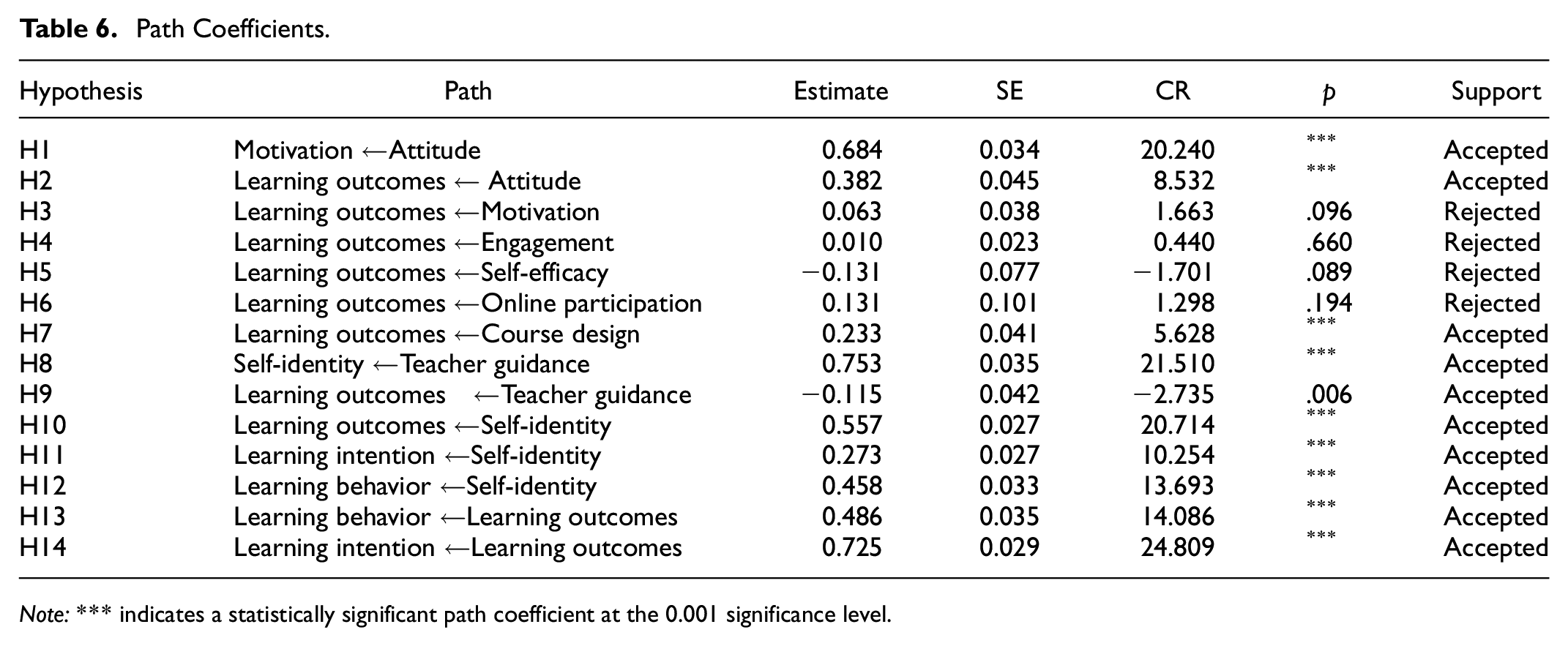
The standardized path coefficients reveal the correlations among the 14 hypotheses (Table 6, Figure 1). Hypotheses H1 (β = .034, p < .01), H2(β = .045, p < .01), H7(β = .041, p < .01), H8(β = .035, p < .01), H10(β = .027, p < .01), H11(β = .027, p < .001), H12(β = .033, p < .001), H13 (β = .035, p < .001), and H14 (β = .029, p < .001) are accepted at the significant level of p < .001. The hypothesis H9 (β = .042, p = .006) is accepted at the significant level of p < .05. However, hypotheses H3 (β = .038, p = .096), H4 (β = .023, p = .660), H5 (β = .077, p = .089), and H6 (β = .101, p = .194) are not accepted in path analyses. The p values of H3, H4, H5, and H6 are more than .05, which fails to meet the threshold of being less than .05, leading to unsupported results. Thus, the following 10 hypotheses are accepted except for H3, H4, H5, and H6.
Path Coefficients.
Note:*** indicates a statistically significant path coefficient at the 0.001 significance level.

Standardized path analysis.
Hypotheses testing yield the following key results: (1) The variables of attitude, course design, and self-identity can positively and significantly predict learning outcomes; (2) Learning outcomes and self-identity can positively and significantly predict learning intention; (3) Learning outcomes and self-identity can positively and significantly predict learning behavior. In contrast, (4) motivation, engagement, self-efficacy, online participation, and teacher guidance cannot significantly predict learning outcomes. Furthermore, attitude can positively and significantly predict motivation. According to the standard estimate values of the significant paths (Cohen, 2013; Kraft, 2020), H1, H8, H10, and H14 have large effect sizes. H2, H12, and H13 have moderate effect sizes. In addition, H7 and H11 demonstrate small effect sizes.
Discussion
Understanding the critical success factors influencing English learning outcomes in the blended English learning environment is vital for efficiently teaching-learning process and evaluating the scientific quality. The success of blended English learning depends on the learners’ learning intention and finally accomplishing the desired outcomes.
Attitude and Learning Outcomes
Learner attitude significantly impacts learning outcomes within a blended learning environment. The results of this study indicate significant differences when the extent of attitude is taken as a variable of interest in academic achievement in blended English learning on the degree of their attitude (Stefanovic & Klochkova, 2021). Various factors have influenced learners’ poor performance in language learning. Attitude is one of the factors closely related to the accomplishment of learning tasks in the blended learning environment (Ja’ashan, 2015). Moreover, it substantially affects learners’ motivation (Stefanovic & Klochkova, 2021). The attitude in English learning activities increases learners’ likelihood of setting goals and investing time and effort to achieve them in blended learning. Therefore, attitude seems to be one of the leading variables in psychological and personal situations (Stefanovic & Klochkova, 2021). To improve learners’ attitudes toward learning activities and affective learning outcomes in the English language, instructors and educators can continue to search for variables (school environment and individual) that could be manipulated to favor learning gains, such as personal motivation. Table 6 shows that learners’ attitude positively impacts learning motivation in blended English learning (Figure 2). However, there is no significant relationship between motivation and learning outcomes (Table 6).

learners’ attitude toward the blended English learning (created with www.wjx.cn).
Course Design and Learning Outcomes
Course design is a critical success factor influencing English learning outcomes in blended English learning. As measured in this study, improving course design can enhance course outcomes (see Table 6). The course designs and curriculum development framework provide an organized way to explain learners’ academic gains (Aristova et al., 2021). Instructors and educators must understand how the characteristics of English course design relate to learning outcomes, which helps provide meaningful pedagogical development and concrete procedures for blended English learning (Liu et al., 2021). Explicitly, as shown in Figure 1, the positive effects of course design may enable curriculum and course developers to be familiar with the blended learning model’s implementation process and gain a holistic understanding of the influence of course design on learners’ learning outcomes.
Teacher Guidance
Teacher guidance can positively impact learner self-identity in the blended English learning environment. Teacher guidance and learners’ self-identify are considered an interacting system of effective language learning. Teacher guidance based on learner-centered instruction in blended English learning is essential to promote the positive identity of learners in taking an active role in the learning process rather than being passive recipients of information from the instructor (Lin et al., 2020). Targeted and effective guiding is mainly positive in improving affective and cognitive aspects of learner self-identity, which can often bring academic success. Instructors and educational psychologists may develop various student-centered instructional approaches to enhance learner self-identity practically (Lin et al., 2020). We find, quite interestingly, that teacher guidance cannot directly influence the English learning outcomes of learners in the blended English learning environment. Not only that but what may be even more surprising is that teacher guidance hurts learning outcomes (see Table 6). The influence of teacher guidance may be watered down in encouraging and accepting learner autonomy in blended English learning. As shown in Figure 1, teacher guidance is less critical in providing direct instruction focused on learners’ academic achievements (Keiler, 2018).
Self-identity
Learner self-identity positively impacts learners’ learning outcomes in the blended English environment. As shown in Figure 1, learner self-identity can exert the most influential impact on learning outcomes. The core beliefs of learner self-identity are about learning and being a learner by constantly adapting and evolving based on individual learning experiences, which can guide their commitment and actions to accomplish learning tasks and obtain learning gains (Gee, 2000). Developing learner self-identity can better let learners realize who they are and who they are to become in the language learning process (Yusoff et al., 2017). Meanwhile, forming learner self-identity helps learners promote knowledge and achievements in the BEL. Indeed, the exploration of learner self-identity involves enhancing knowledge and professional skills.
Another contribution of learner self-identity is recognized as the positive impact of learner self-identity on learning intention in blended English learning, which can effectively reduce dropout rates of language learning (see Table 6). The potential or actual identities can help learners realize the charm of the communities of learners and practice in the blended English learning environment (Gee, 2000). A high sense of self-identity can enhance learners’ learning intention. Learners behave actively and are compatible with solid learning intentions, naturally leading to a fall in dropout rates. Instructors and educators may explore and construct learners’ self-identity to promote their readiness and capacities for language learning (Yusoff et al., 2017).
Learning Behavior
As shown in Figure 1, learning outcomes positively influence learning behavior in the blended English learning environment. Learners’ academic success can potentially detach them from learning in a blended English environment (Hsu et al., 2021). More nearly all, the blended learning approach combines self-paced learning and a comfortable atmosphere, which contributes to better academic performance in learning activities and results in excellent learning (Panigrahi et al., 2018). Furthermore, the blended English learning model may attract more learners, especially underachievement learners, as it will likely improve their performance (Hsu et al., 2021). The results of this study have revealed that learners’ higher level of learning outcomes is correlated with more positive learning behavior.
Learning Intention
Learning intention can positively impact learners’ learning outcomes in a blended English environment (N. Wang et al., 2021). Learning outcomes can significantly predict continuation learning intention (see Table 6). Learners’ continuance intention to learn and develop in blended English learning is essential in ensuring a successful teaching-learning process and achieving the maximum benefits (Zhang, 2021). The result suggests that educational sectors might implement blended English learning in English education. Besides, instructors can define appropriate language learning goals to achieve learners’ expected academic achievements since learning outcomes are significantly related to their learning intention (Zhang, 2021). Thus, instructors are recommended to obtain immediate feedback on the success of blended English learning (N. Wang et al., 2021).
Conclusion
Major Findings
This study uses structural equation models to investigate critical factors influencing learners’ academic success in blended English learning environments. The main contribution is that this study proposes 14 hypotheses to testify to the critical factors for successful learning outcomes in blended English learning environments based on the prior studies. The hypotheses testing results of the present study generally reinforce most of the assumptions presented in the research model. Consistent with the prior literature on blended English teaching and learning, this study identifies learner attitude, self-identity, course design, and teacher guidance that can significantly and positively predict learning outcomes. In contrast to extant research, learners’ motivation, engagement, and self-efficacy cannot significantly influence their learning outcomes. Besides, this study demonstrates that learners’ learning outcomes and self-identity significantly and positively impact their learning behavior and intention to adopt blended English learning. Thus, learners may use blended English learning when they find it helpful, simple, and enjoyable.
The study’s findings present the key factors affecting students’ learning outcomes in blended learning environments and corroborate the inseparable correlation and mutual influence of these factors with academic achievements in blended learning environments. Several research findings concern students’ attitudes, engagement, motivation to learn, online participation, self-identity, self-efficacy, intention to use blended learning, or actual use (e.g., Almulla, 2022). This study’s conclusions indicate how students are prepared to improve their blended learning. In addition, the results indicate that teachers should consider students’ learning effectiveness and learning needs, following the critical factors contributing to students’ successful learning performance. The most important question is how teachers and practitioners can embrace blended learning as an efficient method to improve language teaching.
Practically, this study offers some implications for course designers, faculties, and institution administration, helping them elucidate their vision for using blended learning. The developed model provides insights into how course designers and faculties examine the most influential factors in blended learning usage. Course designers and faculties can employ the model to enhance current blended learning activities concerning pedagogy, course content, and technology use. The model can also be a reflective tool to support an in-depth analysis approach for institution administration to improve teachers’ teaching practice in the blended learning environment.
Although blended learning is essential to developing students’ self-directed learning abilities and places them at the center, teachers play a vital role in providing motivation and guidance and inspiring students’ participation and thinking. Meanwhile, this study’s conclusion is insightful for blended learning designers and teachers to consider students’ emotional needs and explore methods to enhance their adaptability and learning performance, which can lead to students’ higher use intention in the blended learning process. Therefore, the factors in this study can be employed as a checklist for teachers to implement blended learning approaches best and improve students’ learning outcomes.
Theoretically, this study’s findings provide some implications for English learning in blended learning environments. This study outlined several associated factors (attitude, engagement, motivation, self-efficacy, course design, teacher guidance, and self-identity) to investigate students’ learning success and interrelationships using structural equation modeling. In addition, this study develops a model that demonstrates that changes in students’ personal attributes and learning environment can incite students’ adaptive response to learning intention. Besides, the proposed model of this study offers a comprehensive understanding of the blended learning adoption framework. Specifically, teachers, educational management, and researchers can better identify teaching strategies based on variables and relevant factors to determine their priorities in applying blended learning programs.
Furthermore, this study’s findings offer some theoretical implications for self-directed learning theory. Educators and teachers can adopt the proposed model to improve students’ self-directed learning experiences. Blended learning approaches encourage students to be active and engaged in the contents, enhancing their responsibility for English learning. Besides, blended learning approaches allow students to access various ways and serve various learning styles, enhancing students’ learning management and abilities. Accordingly, students are more likely to succeed in blended learning environments. This study may shed light on blended learning from the self-directed learning perspective.
Limitations and Future Research Directions
Several limitations in this study should be considered. First, the sample size needed to be increased, and female students accounted for too much of the proportion. Although the sample size is relatively large, the research findings might need more generalizability. The researchers also collected data from several universities in Beijing and Nanjing, China. Data might not reflect the actual situation due to gender, age, and other factors that may impact the fitness and other indices of the structural equation model. Moreover, to a certain degree, the data from female students is better than the data from female students. Although we conducted a rigorous and comprehensive study, the data collected might influence the confirmatory factor analysis (CFA).
Second, the researchers have made considerable logical judgments with the English discipline and professional knowledge. It is still worth noting that in SEM statistical decisions, even if the theoretical model can be acceptable, we cannot determine that this theoretical model is the only best. Other models may also get the same batch of data support, which might be acceptable. In addition, we comprehensively considered the fitness index and found that most of the indexes were within the reference range so that the theoretical model could be acceptable. Besides, the convergent validity is sufficient to establish factor validity for competency, except for several incompetent indicators in this study.
Future studies would adopt devised scales to carefully and scientifically assess related variables and explore their influence on learners’ learning outcomes. Based on previous literature, the associated variables might be classified into emotional, psychological, and environmental variables. Because of the validity and reliability of the tools, we would measure and estimate each item loading to make sure what kind of variables can be appropriately chosen as the segmentation dimensionality because these have an essential effect on the results. Additionally, the variance of the model fit is good, but some previous studies have proved to have no statistically significant relationships, which requires further research.
Future studies would conduct empirical analyses on course design and particular ways of curriculum development impacting learning outcomes (Guo et al., 2023). The researchers would provide sufficient examples of English course design in the blended English learning environment based on empirical analyses. Unlike face-to-face course design and organization, blended learning has transformed learning models and evaluation. Instructors and learners interact and collaborate, directly influencing the effect of knowledge transfer. Thus, we would conduct an empirical study to investigate a more generally accepted course design to accomplish the overarching goal of English reading, activities, and assignments. Moreover, course design must be based on learners’ actual English learning needs. Furthermore, it is necessary to provide a systematic assessment of course design.
Future studies would explore reducing high dropout rates in blended English learning. We would examine psychological, environmental, and English course-related factors (Maghfiroh et al., 2024). We occasionally witness a student suddenly become hostile toward the English course or the instructor, or we encounter the disengagement of learners from English learning activities, which can be considered a lack of self–identity. Learners’ social presence and teacher identity may significantly predict the dropout rates of English classes. With an increasing number of English learners in China, the issue of reducing their high dropout rates has become crucial.
Footnotes
Author Contributions
Li Ming: Methodology, Investigation, Editing, and Writing-Original Draft. Zhonggen Yu: Funding Obtained.
Ethics Approval Statement
The study was approved by the institutional review board of Beijing Language and Culture University. All researchers can provide written informed consents.
Declaration of Conflicting Interests
The author(s) declared no potential conflicts of interest with respect to the research, authorship, and/or publication of this article.
Funding
The author(s) disclosed receipt of the following financial support for the research, authorship, and/or publication of this article: This work is supported by the project “A Study on the Interactive Mechanism and Strategies of the Relationship Between Artificial Intelligence and Students' Abilities during Foreign Language Learning” funded by the University-Level Research Fund Project of Nanjing Institute of Technology (YKJ202470).

Availability of Data and Material
We make sure that all data and materials support our published claims and comply with field standards.