



Abstract
Previous studies have suggested the importance of sustainability in all organizations; however, their application to schools as an organization is limited. This study aims to characterize sustainability in primary and secondary catholic schools. The theoretical framework is based on the theories of resources, capabilities and stakeholders because they relate most directly to organizational sustainability. The method consists of three interrelated parts. First, a bibliometric analysis with four clusters was obtained in the first model of understanding (1.0). The second stage consisted of a content analysis, which elicited meanings by screening2,710 records and deepening 200 research studies with the model (2.0). Then, in the third stage, an exploratory analysis was carried out through interviews with a group of Latin American education experts who manage almost 300,000 students in Mexico, Colombia, Venezuela, Ecuador, Brazil, and Chile; the data were analyzed using the text mining technique with discourse analysis. The results validated five categories: Management, Campus Operation, Well-being, Education for Sustainable Development, and Associativity. This study concluded that associativity in these Catholic organizations is fundamental to guaranteeing their sustainability over time and that the wellbeing category implies social and political transformation processes. Therefore, it is proposed for future research to measure these categories and systematize them as a model of sustainability management in the school as a whole and as a strategy for managing sustainability processes in the whole school.
Keywords
Introduction
For sustainability to be viable in education systems worldwide, formal education and school education must play a leading role (Timm & Barth, 2021). Education for sustainable development in schools (ESD for its acronym in English) seeks to integrate high standards of performance and behavior with the goals of healthy and sustainable living, environmental awareness and community participation as citizenship (Gough, 2005). ESD is implemented from the student’s vision in the acquisition of competencies for sustainability (Olsson et al., 2022; Yuan et al., 2021) from the teacher’s vision in their level of qualification (Hunter & Jordan, 2022; Sund & Gericke, 2021) or from the environmental, economic and social sustainability dimensions (Berglund & Gericke, 2016). This integration of ESD is mainly visualized in understanding environmental issues (Boca & Saraçlı, 2019; Dovros & Makrakis, 2012) and the integration of sustainability in the curriculum (Timm & Barth, 2021). This variety of concepts makes it difficult to articulate them in a single proposal.
Unfortunately, these sustainable and green schools, in their desire to generate a positive environmental impact, forget the sustainability of the whole school (Henderson & Tilbury, 2004) or the whole institution (Kapitulčinová et al., 2018), which involves not only the student level, or the classroom, but the organizational level (Verhelst et al., 2020). This way, concepts such as sustainable schools (Zachariou & Kadji-Beltran, 2009), green schools (Olsson et al., 2019), and eco-schools (Boeve-de Pauw & Petegem, 2013; Schröder et al., 2020) are generated. However, all these concepts have been criticized for specifying standards and targets in advance, which hinders the ability to adapt to contexts (Mogren & Gericke, 2019) and for their limited positive impact due to the unconnection between environmental education and personal responsibility (Kioupi & Voulvoulis, 2020).
Consequently, ESD is perceived to be directed toward elements of sustainability or aspects of sustainability rather than an organizational understanding. School organization is defined as the human endeavors and material equipment that help students learn or hinder it and has multiple perspectives, for example, cultural, structural, political, transformational, and thinking (Morgan, 1999). However, it shows some gaps in the research as it does not address in-depth organizational models of sustainability in schools. (Mogren & Gericke, 2017a, 2017b; Verhelst et al., 2023). School organization helps implement ESD (Nikel & Lowe, 2010). Still, few studies show the characteristics of a sustainable school organization (Verhelst et al., 2020), and almost none of the faith-based organizations (Leal Filho et al., 2019).
The school is an organization that teaches and produces learning and structures (Păun, 1999). This purpose makes it operate in a duality in its administrative and pedagogical activity, differentiating it from other organizations (Onaga, 2020). The school comprises two aspects, the political, which includes school legislation and administration, and the pedagogical, which focuses on technical-teaching elements, school cycles, educational content, teaching materials and timetables (Nassif, 1963). According to Hernández-Diaz et al. (2021) the educational organization has two subsystems: the academic one, which refers to teaching, learning, research and extension and the administrative one. Furthermore, one comprises campus operations, networks, strategy—structure and governance. Besides, school organization includes processes that transcend the classroom and individual student and teacher levels and are understood as organizational features (Verhelst et al., 2020). In brief, school organization is to understand how schools are structured.
Catholic school organizations guarantee evangelical values—spirituality, the dignity of the person—equality (development of intellectual, physical, and artistic skills) and community (Slee et al., 1998). Therefore, maintaining a competitive advantage with credible commitment, inimitable resource sources, market segmentation, and product positioning (Miller, 2002). These organizations need to implement value-creation strategies (Hamadamin & Atan, 2019) to achieve sustainable competitive advantage (Emeagwal & Ogbonmwan, 2018) and differentiate factors to be noticed, such as humanistic approach, truth, beauty, ethics, and compassion (Ojeda Ortiz et al., 2020). In addition, they implement corporate sustainability strategies to guarantee their effectiveness and market position (Abdulhafedh, 2021; Engert & Baumgartner, 2016; Hernández-Diaz et al., 2021; Rodrigues & Franco, 2019). These organizations, seeking to ensure their permanence over time, incorporate corporate Sustainability as a strategy to guarantee desirable future performance and voluntarily contribute to sustainable development (Polanco López de Mesa, 2014).
Several authors have suggested incorporating sustainability into various integration models (Rodríguez-Olalla & Avilés-Palacios, 2017). For example, sustainability in school dynamics (Kuzmina et al., 2020) impacting all school functions (Casarejos, Frota, & Gustavson, 2017) and in the strategic plans (Aleixo et al., 2018). Also, from the level of effectiveness (Jarl et al., 2021). And organizational sustainability as ESD effectiveness (Verhelst et al., 2020). In addition, from understanding the characteristics of the school organization (Mogren et al., 2019) and with tools to map their organizational characteristics that influence the effectiveness of their schools toward sustainability (Verhelst et al., 2022). And Catholic schools through the integration of organizational leadership, strategic management, and efficient operations (Adhanom, 2016).
Considering that there is a gap in the research on the absence of a school sustainability model in Catholic primary and secondary schools, we wonder: What are the characteristics of organizational sustainability in the primary and secondary educational institutions of the La Salle Network in Latin America? This organization is essential and representative because it is the third largest and most widespread network of Catholic religious institutions with a presence on all continents. The results were analyzed by text mining with Phyton algorithms and artificial intelligence to predict the characteristics of sustainability that can be considered in a Catholic school. The added value of this research is that it is the first research from Latin America that theoretically presents dimensions of sustainability from an organizational perspective in Catholic schools.
Therefore, this study consists of three interrelated parts to answer the question. The first part presents a literature review on the characterization of organizational sustainability in primary and secondary catholic schools, and a first model of understanding is obtained (1.0), Figure 1. In the second part, content analysis is conducted, from which four categories and 12 subcategories emerge, allowing us to obtain the model (2.0), Figure 2 of understanding. Finally, the third part proposes the model of organizational sustainability in Catholic schools in the La Salle network model (3.0). Furthermore, it develops an exploratory analysis (Myatt, 2007), transnational with experts from Latin American countries (Mexico, Colombia, Brazil, Venezuela, Chile, and Ecuador).
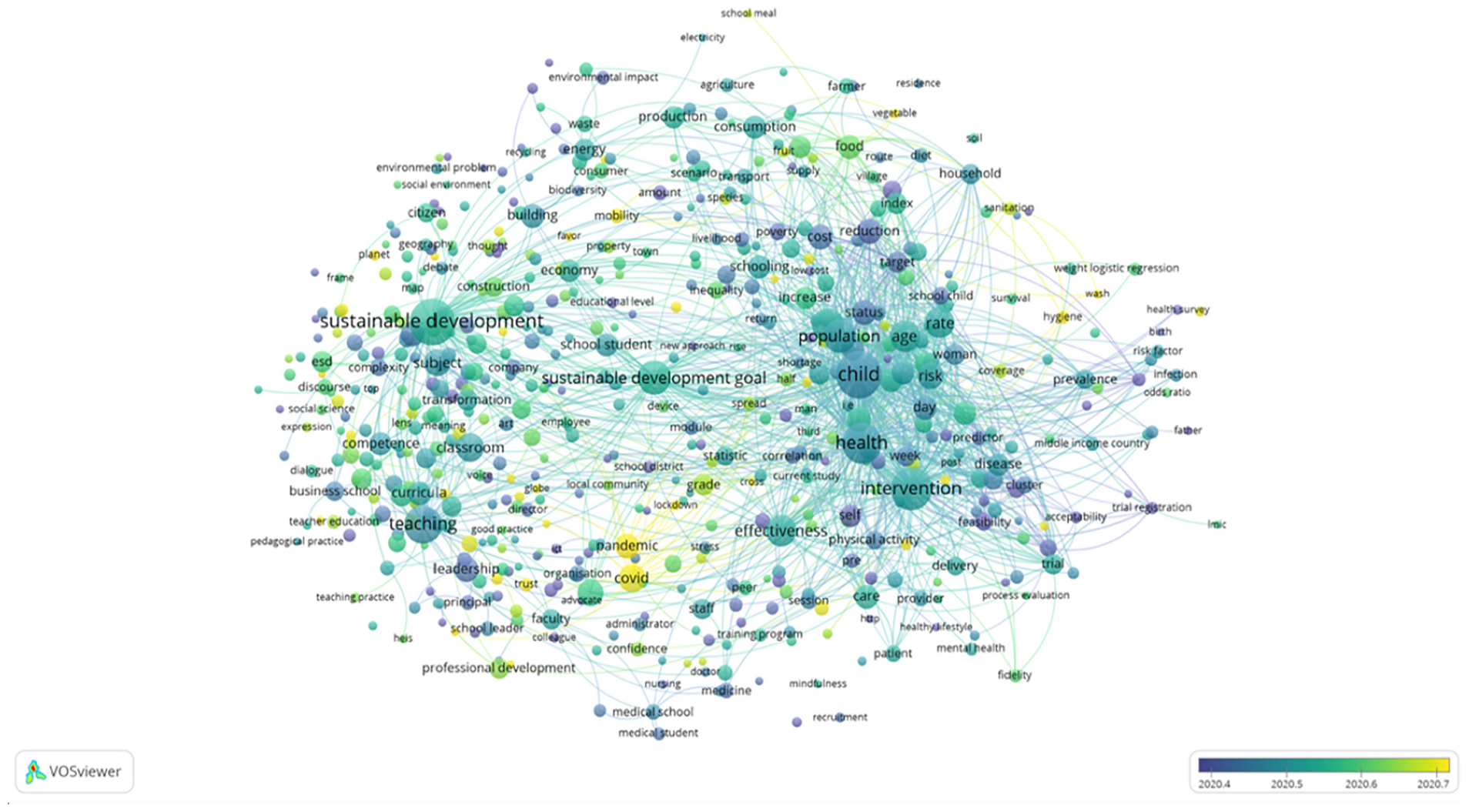
Sustainability knowledge map for primary and secondary education, Model (1.0).

School organizational sustainability model. Model (2.0).
Theoretical Framework
Sustainable change requires a holistic perspective (Linnenluecke et al., 2009; Lozano & Huisingh, 2011). This theory proposes interacting sustainability dimensions over time to ensure current and future performance (Polanco López de Mesa, 2014). Other theories of the concept of sustainability are related to environmental economists, non-environmental degradation, and the integrative perspective that includes the economic, environmental and social dimensions (Lozano, 2008a). However, many approaches now forget the four dimensions of sustainability and present themselves only as technocratic solutions (Lozano, 2015). In contrast, the integration of sustainability must address its four dimensions holistically, as well as the technical, managerial, and organizational aspects and the organization stakeholders (Lozano & Garcia, 2020).
Organizational sustainability is seen as an approach which combines economic, ecological, and social concerns within a coherent business strategy to move toward a more sustainable economy and society (Schneider & Meins, 2012). Organizational sustainability seeks economic, environmental, and social performance (Elkington, 1998) and projects simultaneous business performance. When sustainability is incorporated into the organization, the strategy is driven by a rational approach to higher economic profits and an organizational approach (Polanco López de Mesa, 2014), and it should generate organizational learning that impacts all the institution’s practices (Lăzăroiu, 2017). From this perspective, sustainability is not reduced to a single initiative but is articulated within the entire corporate system (Lozano, 2012). In other words, any incorporation of sustainability must be integrated into the strategy, structure, and culture. From this perspective, the concept of corporate sustainability used in this research implies a commitment to sustainability and ensuring its stakeholders’ present and future outcomes (Swarnapali, 2017).
In addition, organizational sustainability is underpinned by several management theories (Lozano et al., 2015), such as of resources-based view (RBV) theory which establishes the firm as more than an administrative unit and understands it as a grouping of the firm’s productive resources (Barney et al., 2001; Conner & Prahalad, 1996). In the case of an educational organization this theory underpins how knowledge is a source of competitive advantage (Halawi et al., 2005) and therefore crucial to sustainable schools. The main dimensions on which this theory focuses is the social and temporal dimension, which seeks to manage and develop resources over time (Lozano et al., 2015). Moreover, the stakeholder theory since any organization has to comply with the duties of internal and external stakeholders (Freeman, 1984). Consequently, the social, environmental and economic dimensions are affected. Table 1 shows from the perspective of Lozano et al. (2015) to what extent the theories of resources and capabilities and the stakeholder theories account for the most critical dimensions of sustainability, which are environmental, social, economic, and temporal (Elkington, 1998)—furthermore, the contributions these theories make to the world of education.
Theories of the Firm That Contribute to the Dimensions of Sustainability.
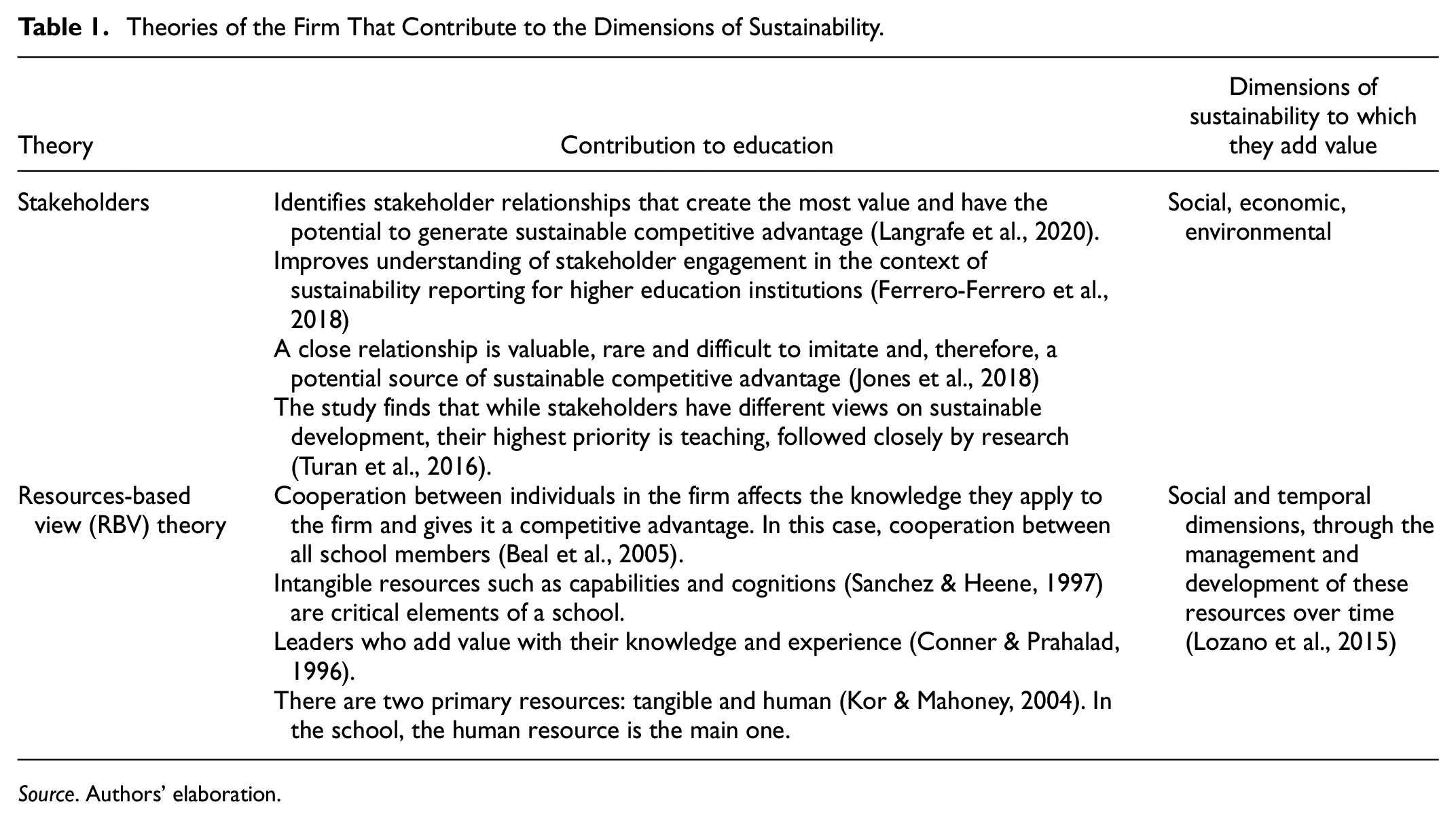
Source. Authors’ elaboration.
The administrative theories underpinning dimensions of organizational sustainability relate best to the administrative processes of the educational organization (Hernández-Diaz et al., 2021). However, the concept of school sustainability for Catholic schools (SE) is not exhausted under organizational sustainability but relates to the school’s main activity, educating in a formal or essentially pedagogical way (Nassif, 1963). In other words, what pedagogical approaches make it possible to generate sustainability competencies (Lozano et al., 2017)? Furthermore, these pedagogical approaches are implemented in didactic strategies that involve new ways of actively approaching teaching processes (Tejedor et al., 2019).
Pedagogical perspectives allow us to understand from which perspective the student and the teacher are placed in the teaching-learning process (de Zubiría, 2011). Unfortunately, there have only been two main pedagogical models throughout history: heterostructural and self-structuring (Not, 1979). The heterostructural ones understand that the creation of knowledge takes place outside the school and that human culture must be transmitted to future generations, where the child has all the necessary conditions to mark his or her development and is, therefore, the center of the educational process (de Zubiría, 2011). Another way of classifying pedagogical models is in three groups: traditional pedagogy, active pedagogy and cognitive pedagogy (de Zubiría, 1994). Traditional relates to knowledge transmission processes (Ottaway, 2010). Active pedagogy defends action as a condition and guarantee of learning (Beichner, 2014). Moreover, cognitive pedagogies better understand the genetic processes involved in learning (Lefmann & Combs-Orme, 2013).
Among the pedagogical approaches, the most relevant for integrating sustainability in schools are those that allow students to be the protagonists of their learning (Lozano et al., 2017). Experiential, problem-solving, community, relationships, project and participatory skills are the most appropriate pedagogical approaches to developing educational sustainability (Lozano et al., 2019). In addition to strategies that reinforce the importance of student centrality, service-learning, problem-based learning, project-oriented learning, simulation games and case studies (Tejedor et al., 2019). As a sustainability strategy, the partnership is part of various pedagogical tools to foster the development of participatory community processes (Cañabate et al., 2020).
These condensed theories allow us to understand how sustainability concepts developed in the first instance, how this research is understood holistically, and how this sustainability is positioned in organizations as a possibility to generate financial results and respond to long-term economic, social, and environmental results. Moreover, management theories enhance this organizational sustainability. The two are closest to the school education field and are related to stakeholders’ and resource-based view (RBV). However, the concept of (SE) has another important aspect concerning pedagogical approaches. This research understands that self-structuring and active pedagogies are the most related to sustainability. Based on these theories, the following methodology is presented to determine the characteristics of the concept of (SE) in Catholic schools.
Materials and Methods for Analysis
For the research on sustainability in religious schools of the La Salle network in Latin America, a mixed sequential analysis was carried out using a “step-by-step” methodology (Escobar-Sierra et al., 2021). The procedure was carried out in three interdependent parts. The first stage involved a (1) bibliometric analysis that allowed the identification of the literature corpus within a given thematic area (Ellegaard & Wallin, 2015). The second stage (2) consisted of a content analysis that allowed for reading, interpreting and deriving meanings (Krippendorff, 2018). Finally, in the third stage, the (3) exploratory analysis was conducted with a group of experts through semi-structured interviews as the power of discourse in structuring the school is recognized (Lazaroiu, 2013). These stages made it possible to reach a model that defines school sustainability in these schools.
The first stage used a quantitative approach and consisted of (1) bibliometric analysis using the VOS viewer® software, version 1.6.17 (Shah et al., 2019; van Eck & Waltman, 2011). The strategy used was simulation by using algorithms, and the variables found are the categorical variables of concurrent terms. The Citation Pearl Growing technique (Norton, 2005) was used to construct the search equation. The following formula was arrived at: (“sustainable*”) and (“organizational” or “organizational”) and (“education” or “school” or “educational institution” or “secondary education” or “basic education” or “elementary education” or “religious school” or “primary school” or “denominational school”). These results showed from 1970 to 2021, about2,710 records that have been discussed around the topic. The data export technique could obtain the most relevant relationships and clusters. The second part of this research used a qualitative approach and consisted of (2) content analysis. Two hundred research studies were examined in depth and resulted from the PRISMA methodology (Moher et al., 2009). The content analysis technique reached the research model 1.0, Figure 2. For the third part (3), an exploratory analysis (Myatt, 2007) was carried out using data mining with a quantitative approach. For this third stage, educational experts from Mexico, Colombia, Venezuela, Brazil, Ecuador and Chile were interviewed, and a model of organizational sustainability for Catholic schools was constructed Figure 5. The choice of the leading participants met three criteria: they lead 80% of the students of the La Salle Network in Latin America, the ability to access information, and the hierarchical level in management, the decision-makers of each country were chosen. Each country’s leadership team has four leaders who fulfill administrative functions, the Visitor (legal representative), the Bursar (responsible for finances), the Secretary of Education (educational processes), and the Youth and Vocation Ministry (in charge of youth work).
Analysis Results
In the first phase of the analysis, organizational sustainability characteristics are introduced from the bibliometric algorithms and the established relationships. For the second phase, a process of interpretation of the categories resulting from the reading and prioritization of the categories was carried out to carry out then the triangulation process with the Latin American experts.
Results of the First Phase of the Quantitative Analysis, (1) Bibliometric Analysis
The bibliometric analysis presented here summarizes the significant clusters in which research on educational sustainability in schools is being carried out.
Based on the review of co-occurring terms, five clusters were generated. The first group presents governance, communication, people, resources, inequality, human capital, and sustainable development goals. The second group includes consumption, energy, waste, energy efficiency, energy reduction, water, transport, pollution, habits, and mobility. The third group shows the theme of education for sustainable development, class, teaching, curriculum, pedagogy, transformation, educational policies, and leadership. The fourth group presents the themes of health, psychological care, mental health, exercise, well-being, and community. Finally, a fifth tiny group shows the themes of care, covid, pandemic, and patient; these themes are presented as the most recent themes, and by methodological determination, this tiny cluster will be joined with the third cluster. This first problem compression is understood as the model (1.0), Figure 1.
Results of the (2) Content Analysis
The second part of the research (2) of the content analysis used a qualitative approach using the Prisma technique (Moher et al., 2009). We found 2,710 investigations since 2017. They then allowed us to have a total record of 634 research studies. First, we reviewed the abstracts and selected 170 studies most directly related to the topic in the abstract and title. In addition to these 170 studies, 30 studies with a past and future snowball were selected. The research was then read in-depth to construct a model for characterizing sustainability in Catholic schools (Appendix). This analysis presents four categories to be substantiated: management, operation, ESD, and well-being.
The first cluster that emerges from the bibliometric analysis mentions elements that can be grouped into the management concept; strategies aimed at promoting sustainability arise primarily from two activities, the academic field and management (Fuchs et al., 2020). Within management, this research groups four categories to manage. Governance is presented as the first category and addresses from the political view, the following conditions: being longstanding and with inclusive language, anti-corruption, as part of the structure that guarantees sustainability, as commitment and strategies, as part of the operation at all levels, as a fundamental element of the services (Bauer et al., 2020; Drahein et al., 2019; Niedlich et al., 2020; Pizzutilo & Venezia, 2021; Villena et al., 2021, however, they also understand it as the guarantor of the mission and vision (Drahein et al., 2020; Du et al., 2020; Pizzutilo & Venezia, 2021), as responsible for transparency through accountability, or ethical compliance with legal standards (Drahein et al., 2020; Leal Filho et al., 2021); and finally, educational governance is understood as enabling trustworthy organization in elements such as: structure, gender equity, status and strategies, processes, programs to foster sustainable behavior (Bauer et al., 2020; Drahein et al., 2020; Du et al., 2020; Fourati-Jamoussi et al., 2015; Niedlich et al., 2020).
The second category within management represents the issue of communication, which should integrate regular reporting capacity and channels to reach customers and suppliers (Villena et al., 2021). Commitment to communication to avoid problems in implementing sustainability (Mazon et al., 2020). The family relationship through communication needs to generate better results from dialog and trust (H. M. Alshuwaikhat & Abubakar, 2008; Cebrián, 2018; Hoover & Harder, 2015; Menon & Suresh, 2020; Villena et al., 2021). Communication contributes to the climate in which learning from others’ experiences, views and arguments is encouraged and facilitated (Verhelst et al., 2020). In a school organization, communication is fully integrated and well-functioning and always has open communication channels (Leo & Wickenberg, 2013; Mogren & Gericke, 2017a).
Furthermore, human being under the category of management is approached from the commitment that that they should have and we should maintain with them (Cebrián, 2018; Cebrián et al., 2013; Lee & Schaltegger, 2014) from the knowledge of their characteristics and leadership (Cebrián et al., 2013; Hoover & Harder, 2015). Furthermore, from identification, cohesion and participation with the organization (Hoover & Harder, 2015; Pizzutilo & Venezia, 2021) and good practices, such as respect for privacy, listening to people and evaluation (Drahein et al., 2019). In addition, Catholic school emphasizes equal opportunities, multicultural commitments and respect, regardless of social class, race, gender or capacity (Slee et al., 1998). Moreover, the Global Education Compact has, among its seven commitments, to put the person at the core (Francisco, 2020).
The fourth category of management refers to resources in the financial aspect. The first element that appears is the matter of efficiency in educational organizations, especially concerning their performance and whether the school organization demonstrates a commitment to managing these resources (Aleixo et al., 2018). Financial rationality efficiency and the demonstration of not seeking success through the pursuit of accumulation (Modugno & di Carlo, 2019). The search for financial stability, generating new sources through knowledge production, faces uncertainty and volatility (Sherstobitova et al., 2020). We find that school resources involve three components: time management, professional structure, and physical structure (Verhelst et al., 2020).
The second cluster obtained from bibliometrics has been worked on as the operation, which allows for ensuring sustainability, particularly in the (1) Campus operation, (2) Water—energy and (3) Waste. At (1) Campus level, the level of efficiency is particularly taken care (H. Alshuwaikhat et al., 2016; Pereira Ribeiro et al., 2021; Ulmer & Wydra, 2020) through infrastructure (Adenle et al., 2021; de Vrieze & Moll, 2017; Houghton & Castillo-Salgado, 2017), and through sustainable transport (Adenle et al., 2021; H. Alshuwaikhat et al., 2016; Pereira Ribeiro et al., 2021). In addition, the (2) water-efficiency indicators are operated and audited to ensure that there is an energy plan and awareness campaigns (Casarejos, Frota, & Gustavson, 2017; Casarejos, Gustavson, & Frota, 2017; Drahein et al., 2019; Filho et al., 2021; Horan & O’Regan, 2021). And the operation of (3) waste, with efficiency and commitment indicators (Abdulghaffar & Williams, 2021; Longoria et al., 2021; Zhang et al., 2011).
The third cluster presented by bibliometrics focuses on education for sustainable development through (1) curriculum and (2) educational approaches. At the curriculum level, the economic, social, environmental, and other cross-cutting dimensions that enable sustainability is addressed (Berríos-Villarroel et al., 2021; Jimenez et al., 2021; Lozano et al., 2019; Nguyen et al., 2020). Regarding educational approaches, the literature shows an interest in participatory pedagogies, action-oriented learning and the development of sustainability competencies (Carrapatoso, 2021; de Sousa, 2021; Filho et al., 2021; Wals, 2014). Within these approaches, pedagogies of creative problem-solving and enquiry learning focused on child, and adolescent leadership were also envisioned (Green & Somerville, 2015).
The fourth cluster, which starts from the bibliometric cluster, relates to well-being too (1) Food, (2) Health, and (3) Community. Some researchers present health and good relationship care indicators of an organization well-being (Algan & Ummanel, 2019). Other models present health status, means of achievement, social relations and school conditions (Konu & Rimpelä, 2002). In this case, well-being is understood from (1) Food, referring to the food offered at school, students’ nutrition and eating behavior (Blondin et al., 2022; Drahein et al., 2020; Filho et al., 2021; Longoria et al., 2021; Oostindjer et al., 2017). The care that must be taken with restaurants and sustainable catering concerns the quality and quantity of products students consume (Leal Filho et al., 2021). (2) health is the constant search for happiness and a proactive attitude toward life, the permanent concern for physical and mental well-being, and the search for a good quality of life (Algan & Ummanel, 2019; Ampuero et al., 2015). The (3) community is presented as the approach that enables the school organization to fulfill its social dimension of sustainability (Novo-Corti et al., 2015). Consequently, the organization becomes an inclusive space that integrates students with social issues and infrastructure serving all (Al Ghifary Slamet et al., 2020; Du et al., 2020)—creating links with the community (Aleixo et al., 2018).
The following explicative model of sustainability in primary and secondary schools (2.0) in Figure 2. graphically presents the understanding of the four categories analyzed.
This explanatory model results from the analysis of other studies that have tried to explain the organizational framework to schools and high schools. This explanatory model is the result of the analysis of other studies that have attempted to explain the organizational framework to schools, such as the conceptual framework for an effective organization in terms of sustainability, which proposes eight categories, of which three coincide with this model: communication, community, resources, and governance (Verhelst et al., 2020). Other explanatory models account for two subsystems academic and administrative (Hernandez-Diaz et al., 2021); in this case, within the subcategories, many of them coincide with this model, although the vision is from the university vision, for example, teaching, campus, governance, extension, which for this research is the community. Another explanatory model approaches the subject from four categories: academic, operational, social, and administrative (Casarejos, Frota, & Gustavson, 2017). The four-category model includes well-being, education and research, social engagement and efficient environmental operations (Ikegami & Neuts, 2020). Finally, the 12-criteria model for integrating sustainability matches the elements of governance, curriculum, funding, community, and people (Pizzutilo & Venezia, 2021).
These Figure 2 models helped visualize the proposal (2.0), which has four categories explained by the subcategories they represent. Of all the literature consulted it is perhaps one of the few organizational models that characterize sustainability from the primary and secondary school educational field in religious organizations. However, many sources are from the university field.
Results of the (3) Exploratory Analysis With Latin American Experts
For the third part, we had a base of previous knowledge (Louise Barriball & While, 1994) employing content analysis from the four categories found and presented in Model 1.0 (Management, Operation, Education for sustainable development and well-being). A list of questions was then drawn up to guide the interview (Cridland et al., 2015), and an interview guide was drawn up to achieve deep, spontaneous and vivid responses from the interviewees (Kallio et al., 2016), which would allow for an understanding of the topic. According to Magaldi and Berler (2020), semi-structured interviews were then conducted, allowing for discovery, exploration and the creation of meaning to understand the complexity of the topic being addressed. The interview guide is presented in Table 2.
Guidelines for Questions to Latin American Leaders.

Source. Authors’ elaboration.
According to Gunnar and Scherp (2003) educational leaders have a more profound knowledge of school organization. They mediate school administration, curriculum, educational laws, governance, and school reforms. In the case of this research, the school leaders are members who head formal education networks. In addition, these leaders are religious leaders who impact 277,500 students in Mexico, Venezuela, Colombia, Ecuador, Brazil, and Chile. Interviews were conducted and transcribed between October 2021 and January 2022, 90 min each, via Zoom.
This analysis consists of identifying patterns and trends to consolidate a corpus of data that allows similar patterns and responses to be identified (Downey, 2014; Myatt, 2007; Peng, 2012). The questions were asked based on content analysis, for which these leaders were selected to identify emerging categories of the sustainability model using the methodology recommended by Myatt (2007), which proposes four stages: (3. 1.3.1) Problem definition, (3.1.3.2) Data presentation, (3.1.3.3) Analysis phase, (3.1.3.4) Results.
Problem Definition
The problem of this research is the characterization of sustainability in primary and secondary education institutions of the La Salle network in Latin America.
Presentation of Data
All the leaders in Mexico, Colombia, Venezuela, Ecuador, Brazil, and Chile, who manage a student population of 277,500 students, were interviewed. These leaders manage these educational organizations for 4 to 8 years and are elected by elections. The interviews were conducted between 60 and 90 min in November and December via the Zoom platform.
Automatic data mining was performed to obtain new and previously unknown information (Gaikwad et al., 2014), using Phyton as a programing language and processed through Ide, Anaconda Navigator 2.1.1—Jupyter Notebook 6.4.5 as processing interface. The questions were triangulated with the theory from the content analysis, with the responses of the educational administration experts and processed through a text-mining approach.
As a first stage, standardizing lower and capital letters and accents was carried out, and text strings were eliminated. On the other hand, special characters were cleaned, numbers were removed, all interviews were lemmatized, elements were tokenized, and irrelevant words were removed. These steps are part of the text’s cleaning process to find connections (Hofmann & Chisholm, 2016).
Analysis Phase With Text Mining
Some analyses were conducted to allow automatic processing of the text content (Agarwal & Mittal, 2013) and used computational analysis (Pang & Lee, 2008) to determine the judgments of the interview response.
One of the advantages of the violin diagram (Figure 3) is that in a single visualization, it shows synergistically five characteristics of a variable: (a) center, (b) dispersion, (c) asymmetry, (d) outliers, and (e) the density plot (Hintze & Nelson, 1998), in the case of this research, the results of the 10 questions Table 3 with which the issue of sustainability was addressed, are reflected.

Violin graph of interviews with leaders of the La Salle Latin America network.
Leaders Were Interviewed and the Characteristics of Their Country of Origin.

Source. Authors’ elaboration.
Through this graph, we discovered that question 3, on communication and question 10, on the essentials in school, was a lower level of variability in the data and the lowest level of words answered; this may represent the lack of knowledge of the subject or that the proposal made from the content analysis is complete. In addition, we discovered that questions two on governance and four on people are the questions with the most prominent response extensions, which speaks of the importance these leaders give to these issues and their ability to argue more about them. It was found that question 9 had a low number of words answered; this may show that the model presented includes essential elements around the topic of organizational sustainability, according to Gries (2020) dispersion, the appearances of a word are distributed evenly or unevenly, in the case of questions 2, 4, and 6, show a level of uneven dispersion; questions 2, 4, and 6 show varying levels of dispersion; this allows us to discover the level of mastery of the subject or also the diversity and differences of the respondents. Questions 3, 9, and 10 show an even distribution, which can be interpreted as a lack of knowledge of the subject.
Regarding dispersion, some leaders with previous roles in higher education respond with more arguments on sustainability. However, it can also be observed that the leaders do not master sustainability holistically but mainly from an ecological and doctrinal viewpoint, coinciding above all with the position of the Church (Francisco, 2016).
Word clouds allow a text to be presented simply and visually appealingly (Heimerl et al., 2014), and the most co-occurring words in the text are easily identified (Oesper et al., 2011) in Figure 4. Below, we present the word cloud for each of the consolidated responses of the Latin American leaders.

Word cloud of interviews with the La Salle Network leaders in Latin America.
The word cloud revolves around the categories the interviewees have been asked to analyze; however, we discovered the importance of the subject’s dignity and care as a condition of the school. A second element we discovered was identity, represented in words such as values, Lasallian, identity and Salle. Finally, elements such as community, family, integration and sharing form an additional construct which gives an essential differentiating value to this type of organization.
The word clouds help us to get an insight. However, to get closer to the interpretation of the interviews, we will present in Table 4 the nouns found before and after the sustainability text strings. According to Wierzbicka (1996), there are at least two crucial and interrelated semantic differences between nouns and adjectives. First, nouns designate classes of things endowed with specific properties, while adjectives designate properties as such. Secondly, Jespersen (2013) states that nouns represent many properties and adjectives designate a single property.
Nouns Before and After the Word Sustainability.
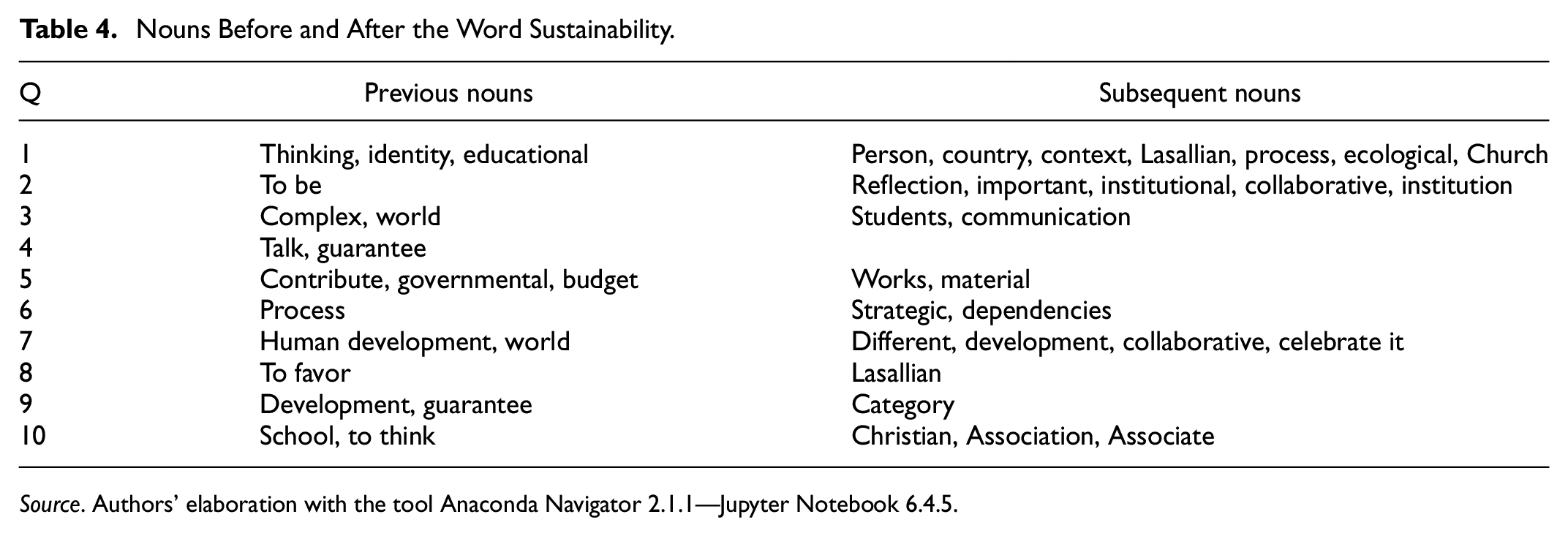
Source. Authors’ elaboration with the tool Anaconda Navigator 2.1.1—Jupyter Notebook 6.4.5.
In the case of this research, each word will be taken as chromate, as the one that allows us to perceive the details with which sophisticated information is written and circulated, which enables access to universal culture, written with a wide variety of codes and shades (De Zubiriäa, 2007). Furthermore, although all words found in Table 4 are not nouns, because there are verbs and adjectives, they function as chromates or predicates something of sustainability.
Question 1 puts people and ecology at the center. Question 2 shows that governance is essential, that the Self does the work and is collaborative and institutional. Question 3 reveals the importance of communicating in a complex world. Question 5 shows us that resources, through budgets, make it possible to maintain the works. In question 6, we discovered that discussing campus operations is a strategic process. Question 7 showed us that sustainability is collaborative, human and celebratory. Question 8 shows us identity, which in this case concerns Lasallian identity. Finally, questions 9 and 10 tell us about differentiating elements such as the Christian vision, the association, the associate and thinking about the school.
According to Akyokus et al. (2009) unigrams make it possible to extract features, which by using algorithms, can help the researcher to overcome the difficulty of analyzing open-ended questions. Although we were only looking for critical keywords in many cases, the unigram method uses the training model that gives rise to different semantic spaces, which, according to Landauer et al. (1997) helps us to make more sense of the answers. In Table 5 we present the unigrams of text mining.
Unigrams of Organizational Sustainability in Primary and Secondary Catholic Schools.

Source. Authors’ elaboration with the tool Anaconda Navigator 2.1.1©—Jupyter Notebook 6.4.5. ©
We discovered that one of the words repeated with force is “the community”; this is understandable because Catholic schools give much importance to understanding from collegiate groups. Furthermore, we discovered it is a project within the Lasallian institution. First, however, we analyzed the interviews employing bigrams and trigrams to understand the data better. Some authors, such as Tan et al. (2002) found that bigrams add additional features to the bag of words formed by unigrams. For Mikolov et al. (2013) bigrams help to capture meanings further using a collection of individual words, which, when considering adjacent sequences, enrich the semantics of the text presentation. In the case of this research, the following bigrams are presented in Table 6.
Organizational Sustainability Bigraphs in Catholic Schools and High Schools.

Source. Authors’ elaboration with the tool Anaconda Navigator 2.1.1©—Jupyter Notebook 6.4.5. ©
The words that co-occur are related to the educational project or life project, which shows that everything revolves around an educational proposal. In addition, the co-occurrence of sustainable development is seen as a fundamental concept in the experts’ understanding. In this context and to further deepen the answers, we present the trigrams in Table 7 For Ranjan et al. (2021) the trigrams often provide higher yields for the text analysis.
Organizational Sustainability Charts in Catholic Schools and High Schools.

Source. Authors’ elaboration with the tool Anaconda Navigator 2.1.1©—Jupyter Notebook 6.4.5. ©
When analyzing these trigrams, we find that it helps to provide spaces of peace. In addition, a relevant element is the time to pray, to be in the chapel, and the spiritual time. Another result presented by the trigrams when talking about sustainability is the commitment to the institution. These characteristics of the bigrams and trigrams make it possible to construct a model of organizational sustainability for Catholic schools.
Deployment of Results Through the Catholic Schools and Organizational Sustainability Model (3.0)
In model (1.0) Figure 1. the categories that emerged from the bibliometric analysis were presented; after the content analysis, model (2.0) Figure 2. constructed four categories and were presented as the fundamental elements of the characterization: management, campus operation, (ESD) and well-being. Based on these two models, triangulation with the Latin American educational leaders led to this model (3.0) Figure 5. This model follows the proposal of Verhelst et al. (2020), in which they characterize a school organization (ESD). The characteristics, which explain the constructs and sub-constructs of the organizational sustainability model of Catholic schools, are shown in purple.
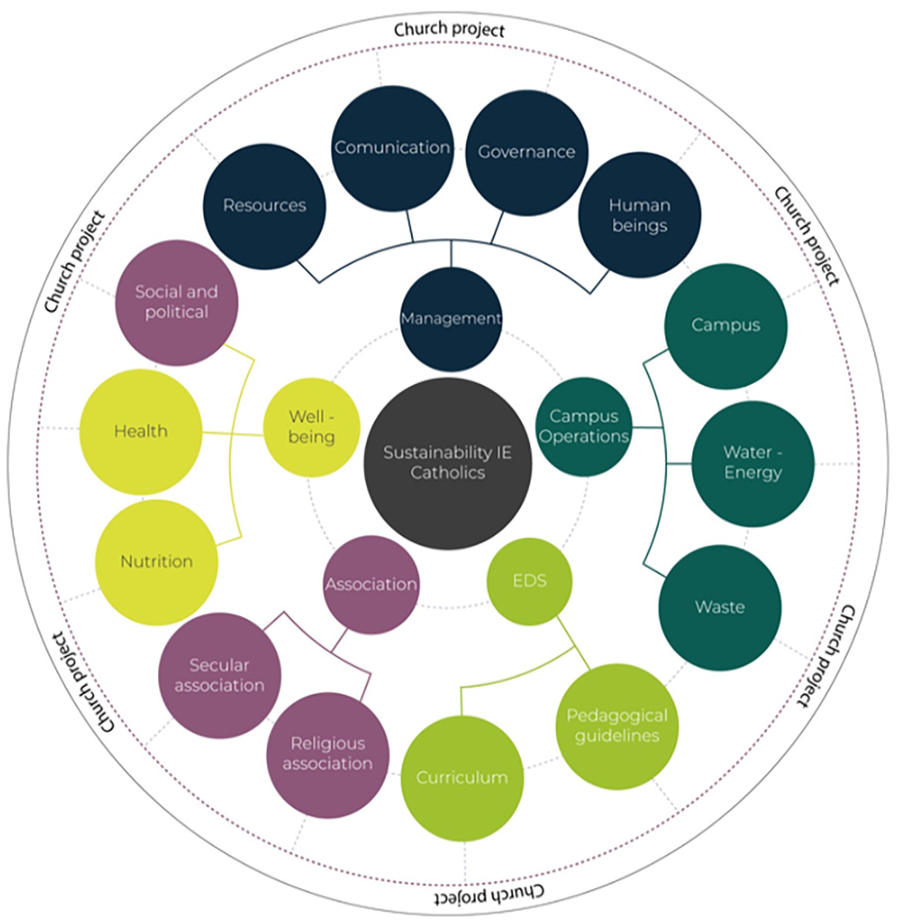
Organizational sustainability of Catholic Schools. Model (3.0).
The model of sustainability in Catholic primary and secondary school organizations (SOEEPS) responds in the first instance to a tacit integration of the environmental, economic, social, and temporal dimensions of sustainability (Gough, 2005; Lozano, 2008a, 2008b; Polanco López de Mesa, 2014). Furthermore, it articulates the dimensions of sustainability in an integrative and holistic proposal, where sustainability is visualized in all dimensions of the school (Henderson & Tilbury, 2004)—filling two gaps in educational research, presenting models disconnected from sustainability dimensions (Kioupi & Voulvoulis, 2020). Moreover, it takes a step toward understanding sustainability from the student or classroom level and a more organizational view of implementation (Verhelst et al., 2020). Furthermore, it proposes school sustainability in faith-based organizations, which fills another research gap (Filho, Dahms, & Consorte-McCrea, 2018).
The model integrates organizational features such as the management of resources, communication, governance (Verhelst et al., 2020), and in the area of people, the dignity of the human being. This management level is understood in other research as the administrative subsystem where governance and structure are highlighted (Hernández-Diaz et al., 2021). Furthermore, some studies conceptualize it as part of the culture, including governance and strategy (Pizzutilo & Venezia, 2021). Nevertheless, the management system is not understood in isolation and is part of the whole, that is, integrated with the campus operation, well-being, association, and academic subsystem. On the other hand, the model presents a first-order construct: campus operation, commonly attributed to the administrative level (Kapitulčinová et al., 2018); however, current studies place operation differently from administration (Budihardjo et al., 2021). Due to the importance given to the campus care (Montoya Durà, 2012), this model is placed as a construct of the first order.
The model also integrates an academic construct as an essential function of the school and has had the most research on sustainability in school organizations at the primary and secondary levels (Berríos-Villarroel et al., 2021). This integration occurs at the curriculum level (Jimenez et al., 2021; Nguyen et al., 2020) or the level of model approaches or didactic strategies (Bellini et al., 2019; Bürgener & Barth, 2018; Sipone et al., 2019). In (SOEEPS), priority is given to the educational issue because it is the purpose of the school. Therefore, everything should ensure that the school runs well (Alpago et al., 2013). Therefore, this construct is linked to all core constructs because we are convinced that the reason for the school is education.
As a fourth construct, well-being is presented as the state of health, means for the fulfilment, social relations and school conditions (Konu & Rimpelä, 2002). In the case of this research, this well-being credibly underpins the social and political approach to school and health care in all its dimensions and people’s inner life and healthy eating. The community construct is given from the Catholic understanding of the school sustained by it (Slee et al., 1998). The community is built from the processes of association, which take place within the framework of a “Church Project.” The association is a category that differentiates the model from other types of organizations because it allows people to identify with this type’s values and value proposition. In the case of this organization, there are two types of association, the one carried out by the laity, and the one carried out by the religious (Brothers of the Christian School, 2019).
Discussion
Many authors are concerned about integrating corporate sustainability into educational organizations, especially at the college level (Filho, Pallant et al., 2018; Kapitulčinová et al., 2018; Lozano & Garcia, 2020). However, these models have not descended into primary and secondary education processes (Mogren & Gericke, 2017a; Verhelst et al., 2020, 2022, 2023). Therefore, generating explanatory models for incorporating corporate sustainability in schools is vital. From this perspective, holistic sustainability dimensions are part of integration (Lozano, 2008a). However, it is not recommended to disconnect the dimensions as it does not support a complete understanding of the problem (Kioupi & Voulvoulis, 2020), nor does it help to understand the whole-school perspective (Henderson & Tilbury, 2004). Consequently, integrative models can provide better resources for addressing sustainability across the institution (Filho et al., 2021; Hernández-Diaz et al., 2021). This point is what has been presented in Figure 5.
On the other hand, integrating only dimensions of organizational sustainability from a purely administrative framework confuses the higher purpose of the school (Verhelst et al., 2020). It is essential to involve other dimensions that concern the academic field or the field of social transformation that the school may have. Each school has differentiating factors, and therefore the need to strengthen the community element and the person’s dignity (Francisco, 2020; Ojeda Ortiz et al., 2020).
There are models of school organizational sustainability (Hernández-Diaz et al., 2021; Holst, 2023; Verhelst et al., 2022), although they can be generalized to other schools and continents, do not have the specificity pursued by the Catholic school with a primary emphasis on the care of the person (Francisco, 2020) which is why the specificity of the theoretical dimensions in a first step coincides with other models but makes clear the value and differences in what is understood by sustainability. As we can see in the model (3.0), it shows us that school projects are collaborative and community-based, and they are shaped by engagement with others. Hence the constructs of well-being and community do not correspond to other models of sustainability integration, mainly because of the impacted customer (Budihardjo et al., 2021; Pizzutilo & Venezia, 2021). Therefore, these constructs are determining factors when understanding organizational sustainability in schools and colleges because the difference in care that a child or adolescent has about an adult is considerable.
Finally, the theories of the firm, especially the stakeholder and resource and capability theories, support understanding corporate sustainability and especially the impact on the dimensions of sustainability (Lozano, 2015). First, however, it is necessary to be clear about the differentiating elements of a Catholic school, the evangelical values—spirituality, dignity of the person—equality (development of intellectual, physical and artistic skills) and community (Slee et al., 1998).
Conclusion and Limitations
The research presented here proposed a characterization of sustainability in Catholic primary and secondary school organizations. After the content analysis, a model was obtained (2.0) Figure 2. which included four first-order constructs and 12 second-order constructs. The theoretical implications of this first result were the finding that a school has a strong management and academic component but that it has additional functions such as operation and welfare. In other words, the school has other functions that are substantive to it and related to caring and nurturing. These functions are reflected in the proposed model in the dimensions of well-being and the associated community of persons.
Another theoretical implication was the use of novel techniques for the research, especially in discourse analysis, such as the text mining technique, to find the relationships and concepts expressed in the interview of the Latin American leaders. Text mining was a very challenging exercise when it came to analyzing the results of the surveys, providing elements that might not have been exploited if they had been read in depth. This triangulation suggested two additional constructs: community and church projects, and two additional sub-constructs as Partnership, Politics and Society. Perhaps one of the great values of this research was to bring together the varied thinking of these people who impact almost 300,000 students in the region. The vision of these international experts from Mexico, Colombia, Venezuela, Ecuador, Chile, and Brazil made it possible to elaborate the model (3.0) Figure 5. which corresponds to an organizational vision from a Catholic school perspective.
As a guideline about the contribution to school management, two processes must begin to develop in this type of school, firstly, an awareness of the importance of sustainability and secondly, a gradual and systematic integration of these dimensions throughout the school. If the dimensions were to be prioritized, priority should be given to those of an identical nature, such as partnership and well-being, and those of management, especially in governance. We are convinced that the involvement of leaders in their organization commitment to sustainability already goes a long way toward achieving the desired results. However, this idea of school must be understood from the perspective of social commitment as a school on the move, that is, focusing on social transformation, which does not distance its students from the local reality but integrates them as subjects of social justice.
Further validation of this proposal is needed by verifying the findings with Latin American Catholic schools and colleges to ensure that these results can be partially or fully validated. The model (2.0) Figure 2. can give insight into other types of school organizations than Catholic schools or colleges. More research is needed on organizational sustainability in religious institutions. In the literature consulted, most of the research focuses on integrating it into the substantive functions of the university (teaching, mission, outreach), but few organizational models address the issue from the dimensions of sustainability and corporate sustainability. It can be seen that the main drivers of sustainability are usually related to the ecological dimension or the school curriculum.
A novelty of this model is the presentation of well-being and community as fundamental elements of organizational sustainability. From a future research perspective, further research on the care and safety of students is a priority. Validation and cross-cutting measurements are needed to identify with certainty what the priorities are around these constructs. In addition, as sustainability and ecology have become fashionable topics, it is imperative to be clear about conceptual differentiation and seminal assumptions to avoid the temptation to believe that anything goes into sustainability issues and that any proposal is viable. This research is perhaps one of the first to incorporate organizational sustainability in Catholic schools and colleges, so the research road is still long. However, we are aware that there are several limitations to the study. The first is that it focuses only on leaders and does not go down to the educational institutions, which can give us a bias because although they are the ones who generate the policies, they are not the leaders who are found day to day in the school. Moreover, the second limitation is the need to address the issue of sustainability with more school members than just the leaders.
The findings leave a framework of needs to be worked on in religious organizations: (1) what is the organizational sustainability model that best explains the reality of each school or college; (2) what are the dimensions of sustainability that are present in this model; (3) to what extent sustainability is beginning to become a need for the whole school; (4) what types of leaders are needed to implement sustainability processes in this type of organization; (5) how to provide greater well-being; (6) how to be more of a community that lives the exaggerated and contagious fraternity; and (7) how to be more of a community that lives the exaggerated and contagious fraternity.
This research can also impact other secular educational organizations, as there are elements of organizational sustainability that will be the subject of consensus and also of differences from each of their missions and visions and, above all, from their organizational culture.
Footnotes
Appendix
The Theoretical Foundation of the Model (2.0).

Source. Authors’ elaboration.
Declaration of Conflicting Interests
The author(s) declared no potential conflicts of interest with respect to the research, authorship, and/or publication of this article.
Funding
The author(s) received no financial support for the research, authorship, and/or publication of this article.
