




Abstract
There is a dearth of sport marketing research investigating the strategic potential of socially responsible sport marketing practices for organizations in the sport management industry. Despite the more recent focus on this the emergent topic within marketing literature, there is a lack of application of cause-related marketing (CRM) and social marketing (SM) strategies in the sport marketing context. Furthermore, these strategies are often confused with corporate social responsibility (CSR). The main purpose of this study was therefore to investigate the adoption of CRM and SM marketing strategies by professional sport organizations (PSOs) in South Africa. An interpretivist philosophy and qualitative approach was adopted for the study, which centered on in-depth interviews conducted with key individuals from six South African PSOs. The findings revealed encouraging evidence of South African PSOs engagement in CRM and SM activities. However, it also revealed that the strategic potential of these elements were not leveraged, mainly due to a lack of understanding of these concepts. The differences and similarities between CRM and SM are identified, according to practitioner understandings. The study contributes to sport marketing literature and practice by proposing a conceptual framework to guide the effective planning and execution of strategic CRM and SM campaigns by PSOs. This framework can assist PSOs to engage in social responsible marketing approaches to improve their marketing performance while maintaining socially responsible business practices.
Keywords
Introduction
The professionalization of the sport industry has led to increased commercialization. Commercialization is a phenomenon that occurs when organizations, set up for reasons other than making a profit, transform into profit-making organizations (Pedersen & Thibault, 2017). Researchers have attempted to identify the causes of this adaptation and the following reasons have been proposed: increasing competition in the market; a decrease in private and public funding; and a need for improved efficiency and self-sufficiency (Svensson et al., 2021).
Therefore, while sport was largely identified to be a social institution, it is argued that sport has been commercialized due to a lack of resources from institutions like governments. As the sport sector has become more professionalized over the years, it has also become more specialized (Clausen et al., 2018; Gammelsaeter, 2020; Nagel et al., 2015; Schyvinck et al., 2021a) and as such multiple sectors within the sport industry can be identified. For example, sport marketing, sport management, and professional sport organizations (PSOs) whose primary product or activity is sport and sometimes entertainment, the media, sponsorships and endorsements, and sport goods and services. Of interest to this study are the PSOs whose primary product is sport, as well as sport marketing (Pedersen & Thibault, 2017).
The bulk of the research conducted on the sport sector presents findings from the context of developed countries. Therefore, additional discourse is required in the context of a developing country, such as South Africa, to expand knowledge in this field (Boissel, et al., 2018; Moyo et al., 2021; Winand & Anagnostopoulos, 2019). Sport in South Africa (SA) has become increasingly professionalized since the country was re-admitted into international sport in 1992. South Africa was previously subject to apartheid law which led to the country’s ban from international sport until 1992 (Knott et al., 2016).
To date, soccer, cricket, and rugby are the most commercialized sports in the country and are identified as the major sport codes in the country (Department of Sport and Recreation SA, 2012). These are the most visible sport codes, meaning that they have the highest viewership, and enjoy the most media visibility compared to other sports. These sport codes also boast the highest sponsorships and the most professional leagues in the country (Murugen & Varachia, 2012; Sport Business, 2022). The commercialization of these three codes is the reason they are the focus of this study as they comprise the most professionalized sport organizations in the country. Hence, the findings of this study present a unique perspective from a developing country context.
Having acknowledged the professionalization of the sport industry, Mullin et al. (2014) and Richelieu (2021) proposed that the sport industry is aware that they are in competition with other industries, like the entertainment industry, for the consumer’s attention and money. Moreover, recent research proposed that sport has further evolved and has led to “sportainment,” which is sport designed for entertainment and must resultantly tailor marketing strategies to market sport as entertainment (Richelieu & Webb, 2021). However, it can be argued that the sport industry needs to be able to capture and keep the consumer’s attention. The process proposed to accomplish this is sport marketing.
While traditional marketing strategies are often met with criticism and are often identified as “not socially responsible” in their approach (Anwar & Elbasslouny, 2020), this study proposes that the adoption of social responsible marketing (SRM) practices by PSOs could provide strategic benefits in keeping with the perception of sport as a social good.
Recent studies in sport management have proposed that the purpose of sport is to engage in socially responsible business practices owing to the inherent socially good nature of sport (Carlini et al., 2021; Engert et al., 2016; Fifka & Jaeger, 2018). On the one hand, Duffy (2016) and Schyvinck et al. (2021a) posited that the sport industry has perhaps lost its purpose in the pursuit of profit and may be at risk of being left behind as the rest of the business world has moved toward a socially responsible approach to business engagement. This premise is supported by Barbu et al. (2022) who proposed that socially responsible business practices have a significant influence on the performance of PSOs and are essential for sustainable management in the sport industry.
Contrary to this argument, research has shown that PSOs remain socially relevant in spite of the increasing commercialization of the industry (Cegliński, 2020; François et al., 2019; Hills et al., 2019; Svensson et al., 2018; Zeimers et al., 2019). The social nature of sport appears to still be relevant in contemporary sport business. This study therefore questions how PSOs can engage socially responsible practices to maximize strategic outcomes.
While there have been studies conducted on social engagement by PSOs, the research appears to have focused on CSR engagements (Breitbarth & Harris, 2008; Robertson et al., 2019; Zeimers et al., 2021), as well as CSR outcomes and the related benefits for the PSOs (Fifka & Jaeger, 2018; Hamil et al., 2010; Moyo et al., 2020; Yu, 2020). Recent studies proposed that CSR was an important means for the sport organization to maintain relations with the fans as well as to keep communication active during the COVID-19 pandemic (Carlini et al., 2021; D. K. Smith & Casper, 2020). In fact, A. C. T. Smith and Skinner (2022) posited that sport fans expected greater social responsibility from PSOs, thus highlighting the important role of CSR for PSOs.
While CSR outcomes were identified in these studies as having marketing related implications, these studies did not identify or discuss specific marketing strategies that could be used in sport marketing. The current study addresses this gap by identifying two socially responsible marketing strategies, which can be engaged in sport marketing, viz. cause-related marketing (CRM) and social marketing (SM). This study endeavors to answer the following research question: How do PSOs in South Africa employ socially responsible marketing strategies (i.e., CRM and SM)? In answering this question, the study aimed to propose guidelines for the effective planning and execution of strategic CRM and SM campaigns.
Understanding Sport Marketing
Neferu (2017) proposes that sport marketing is the use of marketing tools to meet the needs of sport consumers through exchange processes. Exchange processes are the underlying foundations of marketing, which implies that sport marketing is a branch of the marketing discipline. Two major branches of sport marketing include: the marketing of sport; and marketing through sport (Fullerton, 2010; Shtudiner et al., 2022; A. C. T. Smith, 2012). The former denotes the use of marketing principles to market sport goods and services, while the latter denotes the marketing of non-sport goods through the medium of sport (e.g., through a sport sponsorship; Fullerton, 2010; Shtudiner et al., 2022). This study focuses on the marketing of sport, although the over-arching term of sport marketing is used in this paper.
Sponsorship and advertising have been proposed to be the most prominent strategies engaged in sport marketing; however, A. C. T. Smith (2012) and Jensen and Cornwell (2021) disclosed that sport marketing is more than just advertising. It also includes the identification and meeting of consumer needs.
There are multiple approaches to marketing, yet, researchers agree that “relationship marketing” is the approach that best suits sport marketing (Constatino et al., 2008; Königstorfer & Habitzreuter, 2018). The goal of relationship marketing is to build relationships with the consumers, thus making it a relevant discussion point for marketers. O’Malley and Tynan (2003) and Sinčić Ćorić and Špoljarić (2021) explained that relationship marketing was initially a point of contention in the marketing field, but it has since become analogous with marketing since it is not easy to perceive marketing problems that are not related to the foundation, maintenance, or destruction of a relationship. Without a doubt, relationships are very important in sport marketing.
The above discussion highlights the importance of sport marketing, but the nature of business requires a means to assess marketing performance in order to determine the effectiveness and efficiency of their marketing practices. Grønholdt and Martensen (2006) identified the marketing value chain designed, and proposed by Srivastava and Reibstein (2004), as a valid approach to assessing marketing value. The marketing value chain contains five outcomes, which are outlined in Figure 1.

The marketing value chain.
Customer relationship marketing makes sense as the goal of marketing is to communicate the brand or the product to the consumer; it follows then that to be effective in this regard there must be a relationship of some kind between the marketer and the consumer. Therefore, socially inclined marketing strategies are important, particularly in the sport industry, which has an undeniable social aspect in its fundamental structure. That being said, there are two socially inclined marketing strategies that sport marketing can use in promotion strategies, namely CRM and SM.
Cause-related marketing (CRM)
CRM was first identified in 1984 when American Express campaigned for the renovation of the Statue of Liberty, which was one of the earliest acts in which a company aligned itself with a worthy cause. There has since been a multitude of companies that have aligned themselves with worthy causes (Grau & Folse, 2007). CRM is defined as an activity where companies partner with a charity or cause to market an image or product for mutual benefit (Demetriou et al., 2009).
Pringle and Thompson (1999) proposed that CRM is an activity where a company builds a relationship with a cause for mutual benefit. They conceptualized CRM as a strategic positioning and marketing tool, which links a company or brand to a social cause or issue for mutual benefit. Meanwhile, Brønn and Vrioni (2001) added to these definitions by proposing that CRM is a communication tactic that can build brand reputation and increase customer loyalty. This premise is supported by Baek et al. (2020), McCullough and Trail (2022), and A. C. T. Smith and Skinner (2022) proposed that CRM influenced the sport fans’ perceptions of the sport organization.
Schyvinck et al. (2021b) identified two types of networks that are created through CRM relationships namely, “integrative” CRM networks, and “altruistic” CRM networks. They further proposed that the integrative network yields marketing benefits for the organization as it takes a more strategic approach compared to the altruistic network.
These definitions of CRM all concur that it is a marketing tool that has a socially focused approach to its implementation. They agree that there are two parties involved, one of which is the company or brand and the other is the cause that the company has chosen to partner with. Finally, all mention that the relationship is built or designed for mutual benefits. The characteristics of CRM derived from the various definitions can then be summarized into the following points: there must be long term benefits for both parties; the cause targeted by the company must be aligned with the company’s ideals and objectives; and the company’s employees must be convinced of the cause selected (Brønn & Vrioni, 2001; Demetriou et al., 2009; Grau & Folse, 2007; Natarajan et al., 2018; Pringle & Thompson, 1999).
It is imperative at this point to note that CRM campaigns have the potential to bring about benefits for the partnership if the campaign is properly implemented and marketed. On the contrary, a poorly managed CRM campaign can cause damage to the image of the company and the partner organization. Jahdi (2019) propose that CRM is one of the methods that companies can use to show that they are responsive to society’s expectations of responsible corporate behavior.
There is a dearth of research investigating how sport organizations can use CRM more effectively; what factors of the sport industry affect or are affected by CRM; and conceptualizing the role of CRM in the sport marketing field (Yuksel et al., 2016). It does not matter whether CRM is engaged in marketing through sport or the marketing of sport. Either way, CRM in sport does more to advance the selected cause (Yuksel et al., 2016).
Pharr and Lough (2012) agree that CRM is a good opportunity for PSOs to promote their brands and become good citizens in the process. Research has shown that consumers react positively to companies that they perceive to be socially responsible or good citizens (Duffett et al., 2018; Muruviwa et al., 2018; Nichols et al., 2016; Schyvinck & Willem, 2018). However, there is still a gap in knowledge to guide sport marketers on how to effectively plan and execute CRM campaigns.
Social marketing (SM)
SM uses marketing principles, technologies, and strategies to influence the behavior of the target market (Andreasen, 2018). The outcomes of SM are intangible (change of behavior and time spent) while the outcomes of commercial marketing tend to be tangible (sales and exchange of goods). The primary objective of SM is to change behaviors for the social welfare of the individual or the community and secondary outcomes include improved brand equity, brand awareness, and brand loyalty due to improved brand image (Chen et al., 2021; Lorgnier et al., 2022; Lough & Pharr, 2010; Ma & Kaplanidou, 2021).
SM should not to be confused with non-profit marketing, for example the marketing of hospitals and animal rescue charities. Non-profit marketing is often confused with SM because the objectives of the approaches and outcomes are often similar (Chen et al., 2021; N. R. Lee & Kotler, 2011). SM is consumer oriented and focuses on the exchange process, which is at the core of marketing fundamentals. To facilitate this process, marketers that utilize SM have to identify a cause that people are very interested in since the true nature of SM emphasizes voluntary behavior (N. R. Lee & Kotler, 2011; Teal et al., 2020). Most importantly, the objectives of the marketing campaign must be aligned with those of the organization, allowing synergy between the organization and the identified social concern.
Hastings and Elliot (1993) proposed that the SM process begins with a situation analysis, followed by market segmentation, targeting, goals, and strategy. The marketer can then select the marketing mix that best suits the target market and the strategy is implemented and evaluated (Hastings & Stead, 2017).
Distinguishing CRM, SM, and CSR
Demetriou et al. (2009) found that companies that engaged in CRM activities were viewed positively by society, and were able to enhance their brand reputation by demonstrating good brand values. However, Boulstridge and Carrigan (2000) revealed that the majority of their respondents did not find corporate behavior important, but acknowledged that a good reputation might provide a company with a competitive advantage. As CRM has a social approach, it is often confused with CSR and SM. CRM and SM are argued to be tools that companies use to implement CSR, but are not synonymous and have different strategies (Pharr & Lough, 2012). Their differences are summarized in Table 1. The examples indicated in the table are current programs run by selected PSOs in SA that the authors identified as embodying the two different concepts. While both CRM and SM can lead to the creation of CSR for an organization, they remain mutually exclusive marketing strategies.
Comparison of Social Marketing and Cause-Related Marketing.

Source. Adapted from Pharr and Lough (2012), with authors examples added.
There are innumerable definitions of CSR that have been proposed over the years by academics. However, once condensed, they all come down to a few important factors that bring out the basic idea of CSR. Firstly, Dahlsrud (2006) conducted a factor analysis on CSR approaches and concluded that CSR included voluntarily addressing specific functions, ethics, and regulatory frameworks that are pertinent to the development of business sustainability and behavior that society expects the business to demonstrate. Secondly, in order for businesses to rationalize CSR, it must include capacity to reduce cost and risk, build a reputation in the market, create a competitive advantage, act in a socially responsible manner, and build synergy across stakeholder groups through the creation of social capital (Hwang & Chung, 2020; Jamali & Karam, 2018; Kurucz et al., 2008; Painter et al., 2022; Raimo et al., 2021).
The discourse around CSR shifted in the 1990s toward demonstrating how its adoption by an organization might be linked to the organization’s marketing outcomes and measurable benefits (Baena, 2018; Jamali & Karam, 2018; M. P. Lee, 2008; Ma & Kaplanidou, 2021; Schreck & Raithel, 2018; Vogel, 2005).
Brønn and Vrioni (2001) proposed CRM as a means to communicate CSR in a marketing context thus putting forward a premise that CRM can be seen as a means to action CSR in marketing practice. Similarly, SM can be used to incorporate marketing principles to socially responsible company behavior (Andreasen, 2018), thus creating CSR in the marketing strategy of the organization. Taking into consideration the marketing value chain discussed above, this relationship is illustrated in the conceptual framework below (Figure 2).

A conceptual framework of socially responsible marketing strategies.
Methodology
This study adopted an interpretivist approach as it sought to incorporate perceptions, reasons, and attitudes. Moreover, the concepts under investigation were constructs of the human mind that can be influenced by human perceptions (Henning et al., 2004). As such, a positivist approach, which is more scientific and largely quantitative (Skinner et al., 2015, 2020), would not adequately measure the phenomena under investigation in this study. Therefore, a qualitative approach was adopted by this study and qualitative data collection methods were employed to collect data (Skinner et al., 2020). To select the sample for data collection, the study focused on the three major sport codes identified by the Department of Sport and Recreation South Africa (2012), namely soccer, cricket, and rugby.
As previously discussed, these sport codes are also the most commercialized sport codes in the country. Therefore, the research population was all of the PSOs in these sport codes. To reduce the population, criteria was designed to select PSOs in these sport codes. The main criteria for selection were: the organizations must be involved in social engagements; sport must be the primary product; and the organization must be involved in the highest level of competition in their respective code. For example, in soccer, the organizations must be part of the South African premier soccer league (PSL). Based on statistics from the PSL (2019), there are 16 top soccer organizations in the country, and according to Moyo (2020), there are 6 high-ranking cricket organizations and 9 professional rugby clubs in the country.
The study then identified six PSOs in SA that met the defined set of criteria. The PSOs that were selected include: Ajax Cape Town FC; Supersport United FC; Cape Cobras cricket franchise; Highveld Lions cricket franchise; DHL Stormers rugby franchise and the Sharks rugby franchise. Upon selecting the organizations, the key informant technique was used to select participants based on specific knowledge that they possess (Gratton & Jones, 2010). The participants were employed in the six PSOs and were directly involved in the social engagements of the organization. The PSOs had different organizational structures and there were different departments for marketing and CSR in some PSOs. However, in other PSOs the marketing department was responsible for all the marketing, CSR, and communication activities. Interestingly, in one PSO, there were separate departments and individuals responsible for each of these. This meant that the number of participants interviewed per organization was different depending on the organization’s structure. Though, this difference in number of participants per organization did not have an influence on the findings of the study.
The data collection tool was in-depth semi-structured interviews, which were developed to answer the research question. The interview questions were divided into four sections; the first section was the screening section where the questions were used to determine that the selected organization fit the selection criteria. The second section was designed to identify the marketing objectives of the organizations; the third section built on this by asking questions to identify CRM and SM in the PSO and opened by asking the interviewee of their understanding of the two strategies. The final section was designed to probe further into each of the organizations’ approach to engaging these strategies and the outcomes thereof. These sections were in line with the objectives set out by the study, to investigate CRM and SM marketing strategies and how they are incorporated in professional sport marketing in South Africa.
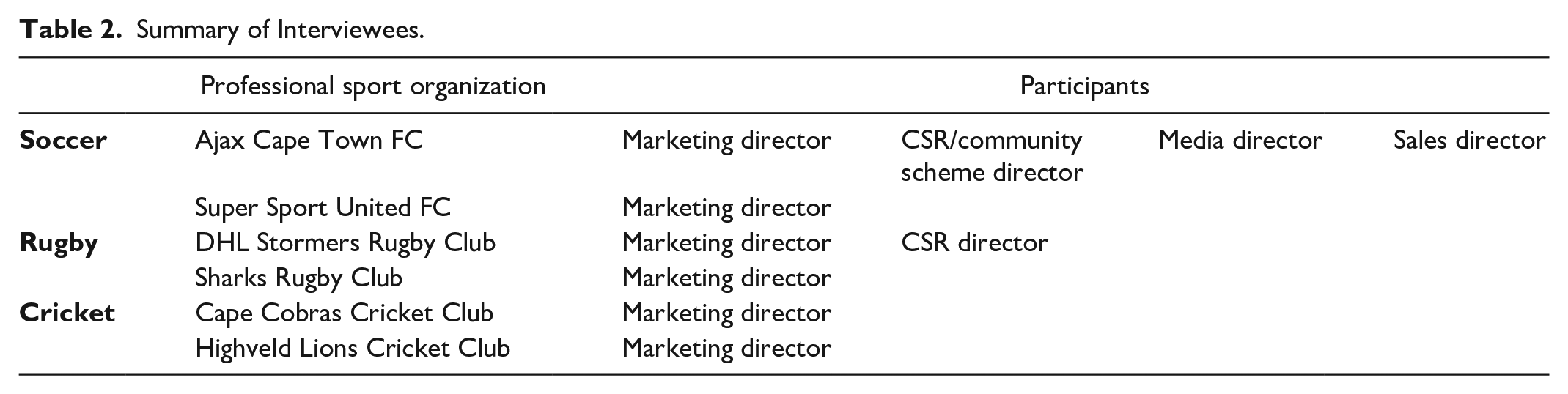
The interviewer conducted the interviews face-to-face with the interviewees and prompted in-depth responses from the respondents where necessary. Interviews were conducted until saturation point, where no new information could be elicited from further interviews (Haydam, 2011). Gratton and Jones (2010) proposed that a minimum number of five interviews are adequate in a qualitative research study. A total of 10 interviews were conducted across the six organizations as shown in Table 2 below, and with the informed consent of the interviewees, the interview sessions were recorded and transcribed (verbatim).
Summary of Interviewees.
The data was analyzed using coding software ATLAS.ti, which also confirmed the data’s reliability. The software enabled the researchers to create codes and separate the codes into code families. Under each code family, a code designed from the interview questions that fitted under that category. After the coding was completed, a single document showing all the codes and the quotations was generated. This document was then used to document the findings in a comprehensive manner and from there the conclusions could be drawn. In compliance with ethical requirements, the respondents’ identities remain confidential and responses are therefore referred to as R1 to R10. Moreover, written consent was obtained from all the interviewees prior to participation in the study. Ethical approval for the study was granted by the university’s ethics committee. Literature was used for the discussion of the data by following an inductive discourse (Shepherd & Sutcliffe, 2011) and conclusions were drawn from key findings identified in the discussion.
Findings and Discussion
Marketing Objectives of PSOs
Da Silva and Las Casas (2017) proposed that marketing objectives for PSOs are the basis of what will be done, and they can be considered as a guide to the performance of the organization. This idea emphasizes the importance of marketing objectives to the sport organization, thus the respondents were asked about the marketing objectives of their organizations.
All 10 of the respondents were able to respond to this question as it directly related to their responsibilities at the PSO. Four main points of marketing objectives are identified as expanding participation, encouraging public interest in sport, ensuring financial capability, and increasing the members of the organization (Barbu et al., 2022; Shilbury et al., 2009). The marketing objectives identified in the findings appear to align to those proposed by Shilbury et al. (2009)—refer to Table 3 that highlights this alignment.
Marketing Objectives for Professional Sport Organizations.

The alignment of marketing and organizational strategic objectives is exemplified in the following quotation:
Our marketing strategy document is aligned with the organisational strategies which are to have the best brands in the world; to have the best comments board; we need to constantly strive to be better, to be more innovative, to be more out there; and to catch and create role models in all communities. [R7]
The findings showed that most of the marketing objectives of the PSO were concerned with brand image and relationships with the consumers. Interestingly, the responses discussed below identify CRM and SM as key marketing strategies that can be used in upholding and maintaining the brand image of the PSOs. Additionally, one respondent gave the impression that socially inclined initiatives can be seen as a strategy to differentiate the brand of the organization from its competitors, as stated in the following quotation:
So, from a marketing point of view, we obviously want to be the strongest brand in South African cricket. We [are] a bit of a historical brand but we want to get it back to where it was in the beginning. We feel that [by] using campaigns like “spirited cricket” we want to be different. [R10]
This confirms the findings of Hamil et al. (2010) who conducted research on Barcelona FC, which concluded that their socially responsible activities could be seen as a strategy that differentiates the brand from its competitors. Similarly, Moyo et al. (2015) argued that Ajax Cape Town FC was a unique brand because of their community engagement activities. Nichols et al. (2019) also posited similar outcomes in rival teams in the Major league Baseball (MLB) and the National Basketball Association (NBA) of the USA.
Identifying CRM and SM Activities
The findings revealed encouraging evidence of South African PSOs engagement in CRM and SM activities, with a number of clear examples indicated by respondents (see Figure 3). However, the findings also revealed some confusion of the understanding of CRM, SM, and CSR. This was apparent when the respondents were asked about their understanding of CRM and SM. One of the respondents said:
I would imagine that one would not exist without the other, there would be some kind of crossover between them. [R2]
As mentioned previously, CRM and SM are socially responsible marketing strategies that sport organizations can engage for marketing of their organization’s products (Andreasen, 2018; Pharr & Lough, 2012; Schyvinck & Willem, 2018; Yuksel et al., 2016). Such responses highlight a lack of understanding of these two concepts by professionals in the sport industry, particularly the respondents that were not directly involved with marketing. Interestingly, when asked if they could identify some activities that are either SM or CRM, the respondents were able to give some examples that fit the descriptions for SM and CRM initiatives identified in literature (Baek, et al., 2020; Brønn & Vrioni, 2001; Demetriou et al., 2009; Grau & Folse, 2007; N. R. Lee & Kotler, 2011; Natarajan et al., 2018; Pringle & Thompson, 1999; Schyvinck, et al., 2021a, 2021b). Typifying this response, a respondent answered:
Our organisation engages in social marketing by introducing cricket to children in disadvantaged areas and providing coaching, facilities and opportunities for aspiring cricketers to achieve their dreams. [R6]
Similarly, another respondent explained:
We also do work with street kids, we also do work with the local police, trying to reduce crime in these areas by providing the kids with a football opportunity. So that’s the one strand of the community scheme. [R4]
The examples identified by the respondents are summarized in Figure 3.

Examples of CRM and SM activities of respondents.
Strategic Engagement in SRM
A further probe into the reasons for engaging in these activities revealed that the organizations did not strategically engage in these activities. They believed that they were fulfilling their social obligations, thus providing empirical evidence to the arguments presented in recent studies which suggested that the purpose of sport is to engage in socially responsible business practices (Engert et al., 2016; Fifka & Jaeger, 2018; Habitzreuter & Koenigstorfer, 2021). However, the lack of a strategic approach implies that the organizations did not maximize on the potential marketing benefits for their own organization through engaging in these activities. This was despite respondents acknowledging that they were aware of strategic marketing-related outcomes that could be attained from engaging in socially responsible activities.
When the respondents were asked about the outcomes of engaging in socially responsible activities, they supposed that the communities’ perceptions of their brand image were positively influenced by these activities. One of the respondents maintained that despite their objectives being completely altruistic, their engagement in these activities resulted in a positive change of perceptions by the community toward the organization. There was a clear indication of SM as the respondent placed emphasis on changing perceptions, which is a main element of SM (Andreasen, 2018; Pharr & Lough, 2012). To illustrate this, one of the respondents explained:
People see us as a club that cares; it’s the image we wanted to build and we have done it; we are seen as the protector of the communities. That is what the “Urban Warrior” stands for. We are the big brother that will protect the kids in the communities. So the football part is one thing but the community part is in there as well. [R1]
Another respondent implied that their brand was one that the community could relate to as the organization had close relations to the community. The respondent stressed:
I think it’s that we play for the fans, we’re relatable. The general Cape Cobra player is not necessarily a superstar who is unattainable. . . [R10]
One further respondent inferred that the brand appealed to a larger audience as it belonged to the community because of the community engagements. The following quotation highlights this perspective:
A community brand; a family brand; and we are a brand that appeals to a mass audience. It doesn’t matter who you are or where you are from, this brand speaks to you, the individual. [R9]
Brand loyalty is the ultimate goal of any marketing strategy (Yim et al., 2019). The responses quoted above give a strong indication of how the sport organizations are creating strong relationships with the communities they engage in through their socially responsible initiatives that are likely to foster brand loyalty. One respondent articulated this particularly well in their response below:
We like to portray an image of being the most supported club. Having the most passionate fans; we call them “the faithful”. We call them “the faithful” because they are the most passionate, the most loyal and the most knowledgeable fans in the world. And they believe that and that is why they go mad when the senior team loses but yet they still support [them]. That is why we put the most bums on seats, have the highest TV stats, and have the most loyal sponsors. From a brand viewpoint, we don’t try and create something that is not part of the fabric of the brand. . .. [R7]
On the other end of the spectrum, respondents gave responses that highlighted the phenomenon of BIRGing and CORFing (Brown et al., 2018; Wann & Branscombe, 1990). These studies disclosed that sport supporters do not show much loyalty and easily move from one team to the next depending on who is performing better on the field. Nonetheless, it can be argued that due to the strong relationships created through SRM, the influence of on-field performance can be reduced. One of the respondents argued that by ensuring the brand remains relevant in the market it will increase fan loyalty. This respondent asserted:
Well obviously if we are not doing well on the field it will affect our supporters because people will never want to be associated with a losing team, that’s one thing for sure. That’s why it’s important to make sure that the product which is football and the players are exciting and relevant in the market. [R5]
The relevance mentioned in this response can presumably be achieved by engaging in shrewd marketing strategies such as CRM and SM to strengthen relationships between the organization and the consumers. This conclusion is supported by ideas presented by Pharr and Lough (2012) who confirm that CRM is a viable prospect for PSOs to promote their brands and become good citizens in the process. Moreover, research has shown that consumers react positively to companies that they perceive to be socially responsible or good citizens (Lorgnier et al., 2022; Lu et al., 2020; Nichols et al., 2016; Schyvinck & Willem, 2018; Vanc & Masler, 2021;).
Conclusion and Implications
While the literature review revealed a gap in studies relating to CRM and SM within sport marketing, this study has shown that within PSOs in South Africa, there is clear evidence of CRM and SM activities in practice. However, the PSOs often confused CRM, SM, and CSR in their understanding of the theoretical differences between the terms. Despite this, they indicated a broad acknowledgement of positive marketing-related benefits of CRM and SM for their organization. Nonetheless, it still appears that the design and implementation of these activities was not linked to the achievement of strategic marketing outcomes. This paper therefore supports the literature in its call for organizations to take a more strategic approach to these initiatives to maximize their marketing potential (Engert et al., 2016; Kim et al., 2018).
Based on the findings of this inquiry, it is proposed that there is an opportunity for PSOs to engage in SRM activities. The sport marketing field has been constantly evolving and while PSOs employ the latest marketing strategies, there is no evidence of how market research or the lack of market research impacts on the marketing efforts of the PSOs. This is a gap in literature and practice that once addressed could encourage the growth of sport marketing. This study proposes that market research could be important for sport marketers to identify the value and role of SRM strategies, namely; CRM and SM, and to give them an opportunity to approach CRM and SM initiatives strategically in order to gain maximum benefits from them.
A number of scholars have called for market research to inform decision-making regarding marketing strategies (Arslan et al., 2020; Mihai, 2015), consequently substantiating the conclusions of this study. The findings strongly corroborated claims in literature (Engert et al., 2016; Fifka & Jaeger, 2018) that the purpose of sport is to engage in socially responsible business. Therefore, it follows that engaging in SRM practices could prove more beneficial for the sport brands. Conceptually, this study discussed at length the fundamentals of sport marketing (refer to Figure 1) and showed where CRM and SM fit in the model. Hence, the study answered the research question, since it revealed that PSOs use SRM strategies in their marketing strategies as a means to enhance good business practice engagement and the social aspect of sport.
The literature identified that there is a gap in terms of what factors could influence these SRM strategies. This study suggests that based on the fundamentals of sport marketing, the consumer, competitors, climate, and the company will also influence CRM and SM, which are factors that influence the marketing strategy. The study further suggests that for PSOs to successfully incorporate SRM in their marketing strategy, the marketing objectives must match the organizations’ objectives, thus reflecting the purpose of the organization (A. C. T. Smith & Stewart, 2015). From the findings it is apparent that the targeted communities form part of the “consumers,” thus giving further credence to this theory. However, further research is recommended to investigate how these factors can influence these marketing strategies within PSOs.
Furthermore, this study proposes that the “marketing value chain” (Srivastava & Reibstein, 2004) is a valid approach to assessing marketing value for PSOs. It is proposed that the marketing value chain can be adapted to incorporate SRM activities. Within this framework, sport marketers can use SRM strategies, such as CRM and SM, since their marketing actions are included at the beginning of the marketing value chain and used to assess their outcomes in relation to marketing processes. The findings indicated that PSOs believe that engaging in CRM and SM influences consumer perceptions and behavior. This is indicated in the conceptual framework proposed (see Figure 4).

The SRM value chain for PSOs.
This study concludes that PSOs should strategically incorporate social engagements in their marketing planning process to maximize their marketing performance. The study confirms that PSOs believe that CRM and SM have a positive influence on brand image, brand awareness, and brand loyalty for their organizations. However future studies could investigate the extent of this influence further, focusing on the consumer impact of SRM activities.
This study therefore contributes to sport marketing theory and practice by presenting compelling arguments for PSOs to practice socially responsible marketing. Two SRM strategies have been identified, namely CRM and SM. The study further highlighted the differences and similarities between SM and CRM, and identified where they belong in sport marketing literature. The paper has empirically established how PSOs should engage these approaches from a strategic marketing perspective, promoting good business practice, while also doing good for their consumers and communities.
Footnotes
Author Contributions
T.M., R.G.D., and B.K. contributed to the design and implementation of the research, to the analysis of the results, and to the writing of the manuscript.
Disclaimer
The views and opinions expressed in this article are those of the authors and do not necessarily reflect the official policy of any affiliated institution of the authors.
Data Availability Statement
The authors confirm that the data supporting the findings of this study are available within the article.
Declaration of Conflicting Interests
The author(s) declared no potential conflicts of interest with respect to the research, authorship, and/or publication of this article.
Funding
The author(s) received no financial support for the research, authorship, and/or publication of this article.
Ethical Approval
Informed signed permission was obtained from all the interviewees prior to participation in the study. All ethical requirements stipulated by Cape Peninsula University of Technology’s Faculty of Business and Management Sciences Ethics Committee approval (FBREC483) were met.
