




Abstract
This article explores how young people construct and express their consumer identities via their consumption styles on social media. The importance of commercial content on social media, such as the postings of social media influencers and advertisers, has been increasing during the past years. Framed by theories on social identity, social comparison and consumer socialization, we analysed focus group discussions with 15 to 19-year-old teenagers in Finland (N = 35). The results reveal that the participants had a clear understanding of their consumer identities: what kind of consumers they were and what they did not want to be. The consumption styles: luxury brand-oriented, trendy second-hand and sustainable, were heavily affected by social media, particularly by commercial social media influencers. Although our sample of young people was rather small, the results were consistent with other studies, and provided deeper understanding of the important role of commercial social media in young people’s consumption styles. Thereby, the research brings social media more tightly into the process of young consumers’ identity formation. For today’s young people, consumer identity is a major part of social identity which is greatly affected by social media. This is should be acknowledged by commercial actors, educators and consumer policy makers.
Keywords
Introduction
Young people are active social media users around the world, especially in Finland. Already in 2017, 85% of Finnish 15 to 19-year-olds reported using Snapchat, while 81% of them used Instagram (Statistics Finland, 2019). In 2020, almost all young people aged 16 to 24 (97%) reported watching YouTube videos (Statistics Finland, 2021). Social media works as an important social network for young people, but it is also highly commercialized. Social media includes multiple channels for advertising, marketing, and making purchases, and thereby it constantly creates new consumption styles and affects the ways consumer identities are created (Hwang & Jyväskylä, 2020).
Social media plays a crucial role in the creation of young peoples’ personal and social identities (Fujita et al., 2018; Mannerström et al., 2018). In their teenage years, young people are also particularly prone to social comparison (Festinger, 1954; Suls & Wheeler, 2000). Peer pressure, media, marketing, and brands have been recognized as important socialization agents for young people as consumers (Dotson & Hyatt, 2005). Studies suggest that being active on social media is related to brand purchases and materialistic values (Chu et al., 2016; Thoumrungroje, 2018; Tuominen et al., 2022), but also to sustainable consumption and political consumer activism (Bedard & Tolmie, 2018; Strähle & Gräff, 2017).
This article focuses on how consumer identities of Finnish teenagers are shaped and expressed on social media. As processes of consumption and advertising are being transferred to social media, a more comprehensive understanding of the role of social media activity in the creation of youth consumption styles and consumer identities is needed. By social media activity we mean participating in discussion groups, producing social media content, and following content posted by advertisers, social media influencers and private users. Social media influencers are regarded as people who use personal branding to create relationships with their followers on social media and who influence their knowledge, attitudes, and behavior (Dhanesh & Duthler, 2019; Pöyry et al., 2019; Reinikainen et al., 2020). Consumption styles are defined as material expressions of lifestyles (Chaney, 1996) and are measured by attitudes, values, material desires, and purchase behavior (Wilska, 2002). Consumer identities are built in reflexive processes that include expressions of one’s consumption styles, but also adaptation to the consumption styles of one’s peers (e.g., Bauman, 1988; Warde, 1994).
This study considers the role of social media in young people’s consumer identities by interviewing Finnish teenagers aged 15 to 19 in focus group discussions. The interview themes and interpretations are informed by theories of consumer socialization, social identity, and social comparison on social media.
Digital Technology and Youth Consumption Styles
At the turn of the Millenium, lifestyles of young people started to become increasingly commercialized and globalized (e.g., Schor, 2004). Simultaneously, the expansion of digital technology increased young people’s global significance as consumers, as young people were the first to adapt the new technologies such as mobile phones in their everyday lives (e.g., Turkle, 1996). Wilska (2003) and Wilska and Pedrozo (2007) revealed that young people’s consumption styles corresponded with the ways they used mobile phones, computers, and the Internet. Teenagers also started to spend money on virtual goods in online games such as Habbo Hotel or World of Warcraft (Lehdonvirta et al., 2009). In the early 2000s, global brands introduced online games and set up social media communities to extend their brand images (Molesworth, 2006). At the same time, online shopping started to increase globally, particularly among the youngest consumers (Ige, 2004; Lester et al., 2005), and just in 10 to 15 years, selling and advertising on social media platforms became the most effective ways of communicating with consumers (Alalwan et al., 2017).
Today, smartphones have made commercial social media communities omnipresent. Young people’s consumer behavior is also increasingly affected by social media influencers (e.g., YouTubers) who co-operate with commercial companies and whose content has been specifically targeted at young followers (Djafarova & Rushworth, 2017). The followers may become attached to the influencers and even regard them as their friends and idols (Reinikainen et al., 2020). The social media influencers can, for example, present luxurious lifestyles in their Instagram postings. There is evidence that following social media influencers is related to materialistic values and luxury consumption (Hwang & Jeong, 2020; Lou & Kim, 2019; Wilska et al., 2020), but recently many social media influencers have started to promote sustainability, too (Shrivastava et al., 2021). Recent research shows that social media effectively disseminates sustainable consumption styles (Bedard & Tolmie, 2018), such as second-hand consumption that has become popular in fashion, in particular (Sorensen et al., 2017; Turunen et al., 2020).
Social Identity, Consumer Identity, and Social Media
Consumption styles have been crucial elements of young people’s identities for many decades (Miles, 2000; Miles et al., 1998; Schor, 2004; Wilska, 2003). Children learn consumption values (e.g., materialistic, sustainable), and attitudes (e.g., price conscious, brand conscious) typically from peers, family, and media (Dotson & Hyatt, 2005). Digital media also contributes to the creation of self-identity (Mannerström et al., 2018). In teenage years, the power of peer pressure is high, and belonging to social groups is important (Cody, 2012; Miles et al., 1998). It is generally acknowledged that fitting in the aspired social groups demands “right” consumption styles and distinguishing oneself from the “wrong” ones (Croghan et al., 2006; Miles et al., 1998). That distinction requires economic resources and social and cultural capital (Bauman, 1988; Bourdieu, 1984). Research shows that young people’s consumer identities are thus always social, but also highly emotional and aspirational (Deutsch & Theodorou, 2010).
Social identity theory suggests that people identify themselves according to the features of a certain social category in social contexts (Tajfel & Turner, 1986) and behave accordingly. Social identity has cognitive, affective, and evaluative elements that are manifested in different social environments (Fujita et al., 2018). Cognitive social identity refers to how conscious people are of the membership of their social groups. Affective social identity is built by the emotional commitment and positive feelings the members experience in the group. Evaluative social identity is a member’s perception of how others see the group and its membership and is an important source of self-esteem (Fujita et al., 2018). Young people’s social identity creation contains all these elements. Identification in the aspired social groups is usually conscious, and due to peer pressure, social connections inside groups are typically evaluative and affective.
Social comparison theory suggests that people evaluate the accuracy of other peoples’ opinions and their own abilities in relation to others (Festinger, 1954; Suls & Wheeler, 2000). For example, people can determine their social status by comparing their material possessions to others (Richins & Dawson, 1992). Social media disseminates styles and brands simultaneously to large networks of people and youth are constantly exposed to idealized images of wealth, luxury, and brands (Ki & Kim, 2019). This creates a desire to deal with this feeling by obtaining more possessions. Research reveals that high social media activity disseminates materialistic values and encourages brand purchases (Kamal et al., 2013; Thoumrungroje, 2018).
Social media intensifies social comparison among young people (e.g., Lewallen & Behm-Morawitz, 2016) and also widens the gaps between social groups by forming social “bubbles” (or echo chambers) with interaction only between like-minded group members (Kaakinen et al., 2020). Certain online social groups strengthen their special characteristics due to social media platforms’ filtering technologies and limited information from other social groups (Kaakinen et al., 2020). Thus, we assume that social media may also create self-echoing youth consumption style bubbles. It is also obvious that economic and social resources play a key role in the creation of young people’s consumer identities and “right” consumption styles (Croghan et al., 2006).
Based on the theories above and previous research, we illustrate the role of consumption styles and consumer identity in young people’s identity formation in Figure 1.

Consumer identity and consumption styles as part of social identity.
There are undoubtedly also other building blocks in the social identity, but the role of consumer identity is not always fully recognized. We argue that consumer identities which are expressed by consumption styles, are essential components of young people’s social identities. The role of social media has become increasingly important in the creation and expression of social identity, which requires research for deeper understanding of those processes.
The research questions of this study are:
RQ1: How do young people (aged 15–19) express their consumer identities via self-perceived consumption styles?
RQ2: What is the role of social media in creating and expressing young people’s consumer identities?
Methodology
The research data consists of semi-structured focus group interviews with 15 to 19-year-old participants in winter and spring 2021. The focus group interviews were preceded by a nationally representative survey of 15 to 19-year-old teenagers in the winter of 2019 to 2020, and the results of that study guided the topics of the focus groups interviews ( Tuominen et al., 2022; Wilska et al., 2020;). Focus group interviews provide new information and insights through interactions between interviewees (Hennink, 2007), which is useful for this study as we focus on how young people think about and discuss social media and consumption styles. The focus group method has proven to be particularly good for studying shared meanings and collective norms (Marková et al., 2007), such as the “right” consumption styles and social media groups in this study. The 8 groups, in total 35 participants, were recruited from schools in a city in Southern Finland.
The focus groups composed a total of 18 boys and 17 girls. We chose participants from lower secondary schools (aged 15), upper secondary schools and vocational schools (aged 16–19) in low-income working-class areas, middle-class areas and from schools where students come from all over the city area: an upper secondary school specializing in arts, and an “elite” lower secondary school. Those schools only take students with the best grades or special artistic skills. Although income differences and social segregation in Finland are small, the majority of the elite school students have highly educated parents (Bernelius & Vaattovaara, 2016). The focus groups are described in Table 1.
Description of the Focus Groups.

Due to the Covid-19 pandemic, five of the eight interviews were arranged remotely via video call meeting. Three of the interviews were arranged face-to-face. Online interviews are acknowledged to be relevant and convenient means of data collecting, particularly for teenagers who are used to communicating in digital environments (Weller, 2017). Young people participated voluntarily, and they were informed about the purpose of the interview and issues related to their rights and privacy. According to the national guidelines, young people from the age of 15 are allowed to participate in studies without parental consent. We did not ask sensitive questions, and all participants were fully anonymized.
The interviews consisted of three thematic parts: the importance of social media in general, social media, and consumer behavior, and social media and social comparison. One researcher transcribed the recorded interviews and created pseudonyms for the participants. Then two researchers read and analysed the transcriptions. We analysed the data by theory guided content analysis, which is a research technique for making repeatable and well-founded conclusions from the original data (Krippendorff, 2018). It is based on qualitative data reduction that attempts to recognize the relevant meanings and consistencies (Patton, 2002). We coded the data by using the ATLAS.ti program. We used 20 different codes to group the participants’ diverse views, perspectives, and discourses on consumption and social media. The coding process was informed by the research project’s quantitative data, where Finnish young people showed polarized inclinations toward materialistic and sustainable consumption (Wilska et al., 2020). By familiarizing ourselves with the coded interview data, we eventually categorized three main consumption styles. The data was re-read in the light of these consumption styles, and the participants were categorized according to the styles. Only one of the 35 participants could not be categorized into any consumption style.
Results
Youth Consumption Styles
We identified three main consumption styles: luxury brand consumption style, trendy second-hand consumption style, and sustainable consumption style (Table 2). The luxury brand consumption style was dominant among the youngest participants aged 15. They were interested in popular and expensive brands as well as luxury and material possessions in general. They were also prone to peer pressure, and fitting into the group was particularly important (Cody, 2012; Croghan et al., 2006; Deutsch & Theodorou, 2010; S.Miles et al., 1998). Also, in our preceding survey study, which revealed three consumption styles: materialistic, thrifty, and sustainable styles, the perceived importance of the peers’ consumption styles was related to materialistic attitudes (Wilska et al., 2020).
Description of Consumption Styles.
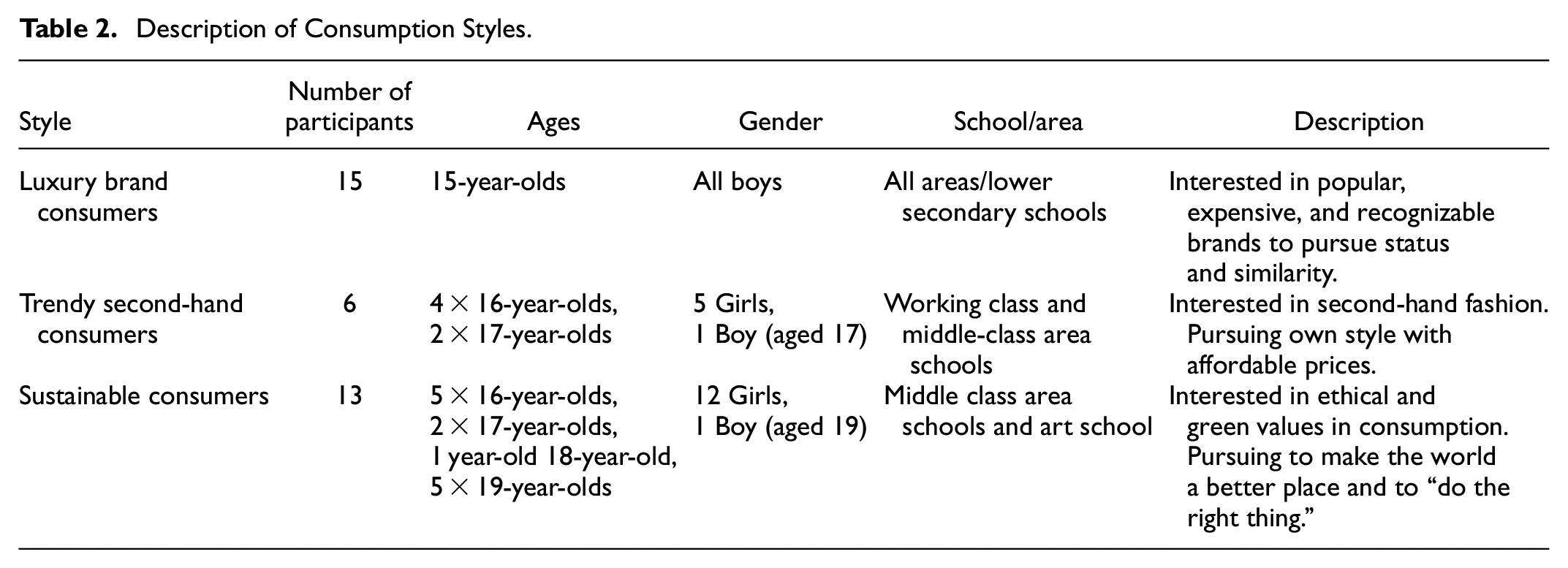
Luxury brands were of interest to all 15-year-olds from working class areas to elite school participants. The elite school participants valued traditional, classical brands for the image and respect they express, as one of them formulates: “–so that the others would get a better picture of you, as a person, just because of your clothes. –” (Tomas, 15). Also, participants from a working-class background regarded those expensive brands as “cool,” but because “it’s not always possible [to buy brand clothes],” they noted that “if it’s cheap but it looks good, it’s also good” (Hosan, 15). The participants used popular and highly valued brands either for status and luxury or as an easy and socially “safe” style. All luxury brand consumers were boys. Interestingly, in our preceding survey study, boys also had more materialistic attitudes and appreciation of luxury brands (Wilska et al., 2020). Boys appeared as more luxury—and status-oriented consumers than girls many previous studies (e.g., Wilska & Pedrozo, 2007), however girls may be more interested in specific luxury brand items such as handbags (Tifferet & Herstein, 2012). Nevertheless, in this study with a limited number of participants, it is not possible to conclude that the appreciation of luxury brands was more influenced by gender than age. As mentioned above, all luxury brand consumer boys were only 15 years old and more prone to peer pressure than older teenagers.
The trendy second-hand consumption style was dominant among participants aged 16 to 17 who were interested in fashion and current trends, such as vintage. Although there were various reasons for second-hand purchases (e.g., frugality and ecological consciousness), the young participants of this study were specifically trend-conscious and hunted for unique bargains (Sorensen et al., 2020; Turunen et al., 2020;), because as Nadia, 16, put it: “it’s maybe a bit pointless to spend so much money on just basic clothes all the time.” Trendy second-hand consumers no longer relied on expensive brands to gain respect among their peers. Instead, consumption and fashion seemed to be an individualistic project of their identity and self-production (Maguire & Stanway, 2008) and a way to express themselves esthetically. As an upper secondary school girl puts it: “–[on 9th grade] you like started to seek the real style of your own, for example from second-hand shops and somewhere.” (Miia, 17).
The third consumption style group, sustainable consumers, were also interested in second- hand purchases, but with the emphasis on ethically, politically, and ecologically sustainable values. Sustainable consumers perceived their consumption not only as social status or a project of identity, but as a political act of being “a good consumer” (e.g., Kadic-Maglajlic et al., 2019). Sustainable consumers considered the consequences and politics of their actions pursued to “do the right thing.” These participants typically went to prestigious schools (such as art school), and perceived themselves as morally aware and interested in the politics and power linked to consumption. They typically opposed luxury consumption. As Kim, 18, noted: “In our art school people are particularly into
Typically, the style-based consumer identities were clear, and the ways of describing the consumption styles also included social comparison (cf. Suls & Wheeler, 2000) and differentiation from other consumption styles, thus distancing their own social group form the others (cf. Bauman, 1988; Bourdieu, 1984). Sustainable and second-hand consumers typically regarded luxury brand oriented consumers as irresponsible and immature, and brand consumers criticized sustainable consumers as being too political and moralistic.
Social Media and Consumption Styles
All participants of this study reported actively using social media applications, such as Instagram, Snapchat, TikTok, and YouTube. Many participants admitted that social media content, particularly targeted advertisements on social media, were stimuli for impulse shopping and hard to resist (Aragoncillo & Orus, 2018). Postings of influencers and peers were regarded as even more tempting.
Luxury Brand Consumption
Luxury brands were very prominent in the social media appearances of the brand conscious youth. Many participants talked about their peers’ displaying clothes and accessories, for example, an expensive brand belt in their social media photos. This can still be done indirectly: – people don’t necessarily directly say [on their photo] that “I’m wearing this brand’s clothes”, but they let the viewer notice it by themselves, and let them think like “Ah, they are wearing these brands”, and then think that this must be a good thing, and that they wanna buy it, and so on. Elias, 15, elite school – if those [for whom the clothes are important in their social media photos] take photos, they probably wanna dress neatly, like nothing ugly, so that it shows that “Ah, they’ve [clothes] got some logo”, like a brand cloth. Abdi, 15, working class area school
For these participants, social media appears as an arena for intentional impression management (see also Tuominen et al., 2022), which is performed by using delicate behavior codes that are still commonly known by the users that are viewing their peers’ photos. Despite coming from different backgrounds, Elias and Abdi described very similarly the feeling one gets from seeing brand logos on their peers’ social media photos. Producing this feeling in one’s peers seems to seduce the youth to post photos with brand clothes on. This, in turn, normalizes brand consumption in general (Shaikh et al., 2017), as brand luxury gets personalized meanings on social media (Seo & Buchanan-Oliver, 2019). As mentioned above, social media influencers often co-operate with luxury brands (Lou & Kim, 2019). A girl participant (Iina, 16), who described herself as a sustainable consumer, remembered how in lower secondary school: “—it was somehow important for some to have certain stuff, brands, a certain amount of something.” She continues by saying: “I think it also affects you if you follow an influencer who has these products, so then you will more easily want those too.”
Here the influencers themselves act as brands, and they also advertise or display other brand’s products, thus creating desires. A young brand consumer boy described the influencers’ impact on brand consumption: And when one sees these celebrities, like some Instagram celebrities wearing those clothes, one can have this positive image, and then one may end up buying those brand clothes even if their quality wouldn’t be any different from some discount store clothes. Tomas, 15, elite school
For brand conscious youth, luxury brands and their logos represent social status and the role of particularly social media influencers was crucial. The feeling of social comparison and an urge for a luxurious and affluent lifestyle was apparently very strong (Thoumrungroje, 2018). Thereby, the consumer identities of these young consumers can be described as evaluative social identities (Fujita et al., 2018). Interestingly, though, many participants regarded brand consumption as a lower developmental stage of younger teenagers on the way to a more individualistic and sustainable consumption style. This also meant becoming less vulnerable to the effects of influencers and peers on social media.
Trendy Second-Hand Consumption
Trendy second-hand consumers were less inspired by peers’ postings on social media than luxury brand consumers. Social media influencers had an impact on trendy second-hand consumers, though. Many participants revealed that the influencers, who tell openly about their consumption style, play a big role in normalizing second-hand shopping: – those same [influencer] guys who made those [shoe and fashion] videos earlier - - also they have now moved on to find their clothes from some, just from some thrift stores and somewhere, from totally random places. They find their clothes and make videos about that. Aleksi, 17, middle class area school
Also, 17-year-old Sara from a middle-class area school, analyzed the popularity of this new second-hand trend: I think that social media has in fact had a big impact [on second-hand consumption], it has like … it’s been able to clean the reputation of thrift shops, because earlier they really used to have the reputation that they are only about granny clothes and stuff like that.
Social media and its popular influencers are effective removers of the stigma of second hand (Shrivastava et al., 2021). Mobile shopping applications were also important for trendy second-hand consumers. For example, Aleksi, 17, describes: – Those [online second-hand applications] are quite nice to scroll, you can find so much
The trendy second-hand consumers were expressing evaluative and affective social identities, as the impact of social media influencers and brands was high but, yet the consumers wanted to be unique in their styles (Fujita et al., 2018). In addition to pursuing a personal and trendy style, many second-hand consumers were also motivated by the affordable prices. Interestingly, although social media encourages luxury brand consumption, it seemed to work in another direction too. It was a repeating narrative among the participants that some social media influencers ditched the expensive brands and, instead, started to emphasize personality and creativity in the consumption styles they were displaying (Shrivastava et al., 2021).
Sustainable Consumption
In creating sustainable consumption styles, social media acts as an arena for learning and finding new information and taking a stand. The sustainable consumption style was mostly created by informative and political posts, for example, on Instagram. Katriina, 16, from art school, explained how “there can be some opinions visible [on social media], and that people are agreeing with them [on social media] when someone has said something there.” Although these political posts were less visible in the mainstream youth’s social media environment, they were influential in the social media groups of sustainable consumers. An upper secondary school graduate girl explained how social media made her want to avoid global brands that are seen as irresponsible: Well at least for me the reason I’m avoiding brands, or like popular brands, is maybe because only a few of them are that ethical — And then when you hear on social media — how they for example manufacture their products or something—, it might become — a little embarrassing to still use those brands. Anna, 19, middle class area school
The way Anna perceived the brands as embarrassing in the eyes of others signals how social media creates social norms and practises for sustainable consumers (Strahle & Gräf, 2017). Sustainable consumers thus represented cognitive and affective but also evaluative social identities (Fujita et al., 2018).
The significance of social media transmitted political information increases when the peers share political posts, and challenge others to think about these issues, too. These shared posts, which circulate on sustainable youth’s Instagram feeds and stories, can be originally made for example by influencers, theme accounts, NGO’s, and news sites. (Davidjants & Tiidenberg, 2022). The sustainable consumer participants mentioned, for example, working conditions and salary problems, alt-right supportive warehouses, and exploiting prison labor related themes to have gained visibility on their social media feeds recently.
The participants said they discuss the sustainable content with each other both on social media and in person. This is how also the less active social media users were indirectly influenced by social media. In addition to Instagram posts, the sustainable consumer participants were exposed to politically and ethically sustainable content on TikTok: – On TikTok people are doing some videos that “These companies’ owners support Trump, so boycott them,” so it’s like, I feel that boycotting is really popular nowadays. Vilma, middle class area school, 19 Yeah and about Cocopanda there was [on social media] that its owner supports anti-abortion activities so one should never buy from there. Sara, middle class area school, 19
For the 15-year-old boys from working class schools, whose consumption styles were luxurious and brand oriented, these political social media discussions seemed distant, yet recognizable. They had paid attention to their peers taking part in them and posting about their sustainable lifestyle on social media. The boys perceived sharing one’s sustainable lifestyle as an annoying showing-off. The image of sustainable consumption as female behavior was also apparent:
“It [sharing one’s sustainable consumption on social media] is kind of a girl thing.”
“Girls do it, not boys.”
“The girls who have artsy hobbies.”
“The girls who have all these hobbies and pretend they’re doing the right thing.”
Also, sustainable consumers themselves reflected different reasons for their community’s social media postings on sustainability. When thinking about some underlying reasons, a sustainable consumer Niklas pondered: —some [youth] might want to show off how ecological they are and think about nature, like: Everybody look how ecological a person I am, so ha ha ha, suck that. Although it’s of course in a way a good thing, but then when it’s sometimes used to show people how one would be in some way better than others, then it’s like what the fuck, sometimes. Niklas, 19, art school graduate
As the brand consumers Denis and Abdi also speculated, Niklas’s quote sheds light on how social comparison and competition is present in his sustainable consumption social media bubble. However, many sustainable consumer participants assumed that ethical and ecological values really are the driving factors for youth’s behavior. Despite the interviewer posing a slightly loaded question about “the real reason for sustainable youth consumers’ social media behavior,” many commented simply: “they will change the world”, “ambition to have an impact” and “a passion thing for them.”
It seems that righteous minds and politician personalities are likely to become sustainable consumers, and that social media has a very big impact on this, since it gathers like-minded peers and content that can be spread rapidly (Kaakinen et al., 2020). On social media it is easy for the youth to take their first steps in participating and taking a stand (Cortés-Ramos et al., 2021; de Zúñiga et al., 2014). This politicization of the youth’s social media could thus strengthen sustainable consumer identities.
The summary of young people’s consumer identities and the related activities on social media are presented in Table 3.
The Role of Social Media in Creating and Expressing Consumer Identities.

Conclusions and Discussion
This study examined with focus group interviews how Finnish teenagers’ (aged 15–19) consumer identities were built up and manifested by consumption styles on social media. The themes of the interviews were based on a preceding survey among teenagers that had revealed materialistic, thrifty, and sustainable consumption styles (Wilska et al., 2020). The interpretations of the analyses were mainly framed by theories on peer pressure and social comparison (Festinger, 1954), social identity (Fujita et al., 2018; Tajfel & Turner, 1986), and consumer socialization (Dotson & Hyatt, 2005).
We identified three consumption styles: luxury brand consumption style, trendy second-hand consumption style and sustainable consumption style. Social media activity, such as watching posts of peers, social media influencers, and advertisements on social media platforms, as well as using online shopping applications and discussing in social media groups were important in the creation and manifestation of all consumption styles. Luxury brand consumers were mostly influenced by peers’ photos, but also by social media influencers’ content, as it was important to make an impression of a brand-conscious consumer who is wealthier than others. This was in line with previous studies (Kamal et al., 2013; Thoumrungroje, 2018; Wilska et al., 2020). The consumer identities of luxury brand consumers were thus mainly evaluative social identities (Fujita et al., 2018). Luxury brand consumers were typically younger boys, but their social backgrounds varied.
Trendy second-hand consumers connected brands to more sustainable ideologies (Sorensen et al., 2017; Turunen et al., 2020), expressing thereby evaluative and affective identities (Fujita et al., 2018). An important motivation to buy second-hand products was also affordability. This suggests that also second-hand shopping may be motivated by social comparison; a means for achieving aspired styles with less resources. On social media, giving impressions of right styles has been proven to be particularly important for obtaining social capital (Tuominen et al., 2022). Sustainable consumption that included green and ethical consumption was inspired by politically oriented social media groups. Sustainable consumers’ groups were less visible in the mainstream social media environment, but instead preferred self-echoing social media “bubbles” (Kaakinen et al., 2020). Those groups had certain norms of what is sustainable and how one should consume (Strähle & Gräff, 2017). Many participants were promoting boycotts and taking a stand on ethical issues. They were most typically older, girls, and from middle class area schools or from art school. Sustainable consumers were very conscious of their styles, which included “doing the right thing,” thus representing cognitive and affective but also evaluative social identities (Fujita et al., 2018).
Interestingly, the participants’ narratives contained a lot of information about the styles the participants did not represent and instead what they recognized in their peers and in the social media discussion, thus consciously distancing their consumer identities from the others (Croghan et al., 2006). Particularly interesting was the way they illustrated their consumption history. Many participants recalled that when they were younger, they used to be more brand-conscious, less independent, more prone to peer pressure and easily seduced by fancy photos on social media (e.g., Cody, 2012). The participants interpreted that with age they became more conscious about sustainable consumption. Thus, they recognized a consumer socialization process from childhood materialism (Dotson & Hyatt, 2005; Schor, 2004) to adult responsibility. Simultaneously, their consumption styles were impacted by social media. On the other hand, many participants regarded the manifestations of sustainable ideologies on social media as hypocritical show-offs. (Kaakinen et al., 2020). “Real” sustainability included concrete political actions such as boycotting.
Despite the social diversity of the participants’ schools, social classes or economic resources were not visible in the narrations of the consumption styles, and the issue of social exclusion due to economic resources got little attention. Yet, gender and age appeared important. As boys were more materialistic and interested in luxury, sustainable consumption seemed to be a more “girly” thing. In our preceding quantitative study, gender explained both materialistic and sustainable consumption attitudes (Wilska et al., 2020), just like many other studies (Bedard & Tolmie, 2018; Brusdal & Berg, 2010; Wilska & Pedrozo, 2007). However, in this study, most male participants were only 15 years old and still going to lower secondary school. As young people’s identities and cognitive maturity develop between early and late adolescence (Mannerström et al., 2018), the boys’ interest in luxury and brand consumption is more likely to be related to younger age than gender.
There are several limitations in this study. First, we examined a rather small number of young people in one country. The focus groups did not represent all social and demographic groups, although we aimed at social variation when selecting the schools where the participants were invited to the research. Moreover, although the gender division was rather equal, gender was not divided equally between age groups and educational levels. Secondly, the period of the Covid-19 pandemic was exceptional. Due to social distancing, the role of social media may be overemphasized. Nevertheless, research shows that the importance of social media was increasing even before the Covid-19 pandemic.
Despite the limitations, this study opens new research avenues on the connection between social media and young people’s consumer identities. As social media will become even more commercialized with algorithmic marketing and personal influencing (Aragoncillo & Orus, 2018), consumer identities will probably become even more essential parts of young people’s social identities in the future. This poses a challenge for commercial actors, educators, and consumer policy makers. Future research should delve more deeply into young people’s identity processes specifically in social media environments. Social media is in constant change, and thereby identities built on social media are flexible and fragile. It is thus necessary to focus on young consumers and social media in multiple ways, using surveys and interviews, analyses of social media contents, and with experimental research in different social media environments.
Footnotes
Acknowledgements
We thank Nick Kirkwood and Julia Nuckols for language edits
Author contribution statement
All authors have contributed this article and agreed to the submission.
Declaration of Conflicting Interests
The author(s) declared no potential conflicts of interest with respect to the research, authorship, and/or publication of this article.
Funding
The author(s) disclosed receipt of the following financial support for the research, authorship, and/or publication of this article: This work was financially supported by The Academy of Finland [Grant number 320370] and The Strategic Research Council [Grant number 327237]. The funding source had no contribution to the writing process of this article.
Research Ethics
This study included only participants over the age of 15 while parental consents were not needed. Participants were not asked questions that could be perceived as a sensitive information.
Permission to Reproduce Material From Other Sources
The current study does not include any material from other or external sources.

Data Availability Statement
The data used in this article is owned by #Agents-project at the University of Jyväskylä and is available upon request from PI Terhi-Anna Wilska.