




Abstract
Studies on human papillomavirus (HPV) prevention education and its educational effects for elementary school students are necessary. This study aimed to examine the effects of human papillomavirus (HPV) prevention education on knowledge about cervical cancer, HPV, immunization, and attitude about immunization among girls in the sixth grade elementary school of South Korea. A quasi-experimental pretest-posttest control group design is used. The sample included 131 girls (Intervention: n = 65, Control: n = 66) in the sixth grade elementary school of South Korea. Human papillomavirus (HPV) prevention education included the contents of the definition of human papillomavirus, types of human papillomavirus, human-papillomavirus-related diseases, cervical cancer, human papillomavirus prevention methods, types of vaccines, vaccination effects, vaccination costs, vaccination frequency for 12-year-old girls, and recommended vaccination age. Human papillomavirus (HPV) prevention education was applied on the intervention group in a total of one 40-minute class in the classroom. There were statistically significant differences in knowledge about cervical cancer (t = 9.712, p < .001), knowledge about HPV (t = 9.638, p < .001), knowledge about immunization (t = 5.178, p < .001), and attitude about immunization (t = 3.113, p = .002) between the groups. This study suggests that human papillomavirus (HPV) prevention education was an effective intervention for improving knowledge about cervical cancer, knowledge about HPV, knowledge about immunization, and attitude about immunization. In public health education, human papillomavirus (HPV) prevention education can be implied for Korean girls in sixth grade elementary school.
Introduction
Recently, cancer, heart disease, pneumonia, and cerebrovascular disease are the major causes of death in South Korea (Korean Statistical Information Service, 2019). Cancer ranks first in the death rankings. From 1983 to 2018, the incidence of cancer in South Korea continues to increase, and by September 2018, 80,747 persons died from cancer, 157.4 per 100,000 population, an increase of 4.5% from the previous year (Korean Statistical Information Service, 2019). In the ranking of cancer death by age, the cancer mortality rate of young people is high in the order of people in their 40s, teens, 30s, and 20s (Korean Statistical Information Service, 2019). Cervical cancer is a female genital cancer that occurs at the entrance of the uterus, and it is classified into two types: squamous cell carcinoma, which accounts for 80% of all cervical cancer, and adenocarcinoma, which accounts for 10 to 20% (Liu et al., 2019). Looking at the domestic and international incidence of cervical cancer, WHO estimated that the incidence of cervical cancer is the fourth largest among women worldwide, with 570,000 cases of cervical cancer in the world in 2018, and more than 311,000 women will die from cervical cancer every year (World Health Organization [WHO], 2019). In 2017, there were 3,469 cases of cervical cancer in South Korea, accounting for 1.5% of all cancers and ranking seventh in cancers that affect women. By age, people in their 40s were the most common at 26.8%, followed by people in their 50s at 23.1%, and people in their 30s at 15.8%, thereby indicating that many young people are affected in their 30s (National Cancer Information Center, 2019). The cause of most cancers is not clearly identified, but human papillomavirus (HPV) is found in more than 90% of patients with cervical cancer. It is the most likely risk factor for developing cervical cancer, thus making cervical cancer preventable (Centers for Disease Control and Prevention, USA, 2019).
Literature Review
HPV is transmitted via direct contact with skin and mucous membrane, as well as sexual contact. It is the cause of cervical cancer, genital cancer, anal cancer, laryngeal cancer, and genital wart lesions in both men and women. Most of the people infected with HPV have no symptoms, and the virus may not cause health problems, as more than 90% of the virus disappears naturally within 1 to 2 years after infection. However, in the case of a persistent infection, it goes through cervical dysplasia and progresses to cervical cancer (Centers for Disease Control and Prevention, USA, 2019; WHO, 2019). The result of the analysis of the infection status of 60,775 women in South Korea from 2006 to 2011 showed that 49.9% of HPV-infected positive women aged 18 to 29 years old have shown a high incidence of infection among young people who begin their first sexual life (Korea Centers for Disease Control and Prevention, 2019; E. N. Lee et al., 2015). HPV has a low natural antibody production rate (WHO, 2019), and there is no way to cure the infection itself. Nevertheless, the infection can be prevented through a safe sex life, regular checkups, and vaccination.
HPV vaccines have been administered in the United States since 2006 in order to prevent cancer (WHO, 2019). Now, more than 100 countries, including Australia, the UK, and France, are also receiving HPV vaccination. HPV vaccine not only prevents more than 90% of cervical cancer, but it also demonstrates its efficacy and safety of preventing male and female cancers related to HPV infection (Centers for Disease Control and Prevention, USA, 2019; WHO, 2019). In 2007, the National Cancer Center and the Korean Society of Obstetrics and Gynecology in South Korea jointly recommended HPV vaccination for cervical cancer prevention. The available HPV vaccines are bivalent vaccines that can prevent HPV types 16 and 18, tetravalent vaccines that can prevent HPV types 16, 18, 6, and 11, and 9-valent vaccines that can prevent HPV types 16, 18, 6, 11, 31, 33, 45, 52, and 58. They have been approved by the Ministry of Food and Drug Safety, and they can be administered at medical institutions. WHO recommended women aged 9 to 14 years old before the first sexual contact as a priority target for HPV vaccination for cervical cancer prevention (WHO, 2019). The U.S. recommends vaccination for boys and girls aged 9 years old, two doses for boys and girls aged 11 to 12 years old, and three doses for boys and girls aged 15 years and older (Centers for Disease Control and Prevention, USA, 2019). In South Korea, two doses of vaccination are recommended for ages 9 to 13, and three doses of vaccination are recommended for ages 14 and older (National Cancer Information Center, 2019). Since 2016, as a first step in women’s health, two free vaccinations of Gardasil 4-valent and Cervarix 2-valent vaccines have been offered to female adolescents aged 12 years old (Korea Centers for Disease Control and Prevention, 2019). However, based on the nationwide inoculation rate of HPV vaccine in 2019, the first inoculation rate was low at 70.7% of those born in 2006 and 7.5% of those born in 2007 (Korea Centers for Disease Control and Prevention, 2019). Therefore, efforts to increase the HPV vaccine inoculation rate are deemed necessary. The school is suitable as a place of education as it has 12-year-old female students eligible for vaccination. Furthermore, schools are equipped with available facilities and human resources. The education of students can be an effective means because it affects vaccination practices by the members of the family, peer groups, and local communities (S. Y. Park, 2010).
Looking at domestic and international studies on education for HPV and cervical cancer prevention, the subjects were female college students (Bennett et al., 2015; Si et al., 2019), high school girls (Choi & Choi, 2013; Wegwarth et al., 2014), middle school girls (Hofman et al., 2013; K. Y. Park, 2018), male and female adolescents (Liu et al., 2019; Mareka et al., 2012), males and females aged 18 to 26 years old (Kester et al., 2014; Kwang et al., 2016), mothers of adolescent daughters (Odunyemi et al., 2018; Wegwarth et al., 2014), female North Korean defectors (An, 2016), and married migrated Vietnamese women (Koo, 2015). There was no domestic research on elementary school students, and most of the studies on adolescent male and female students were based on schools (K. Y. Park, 2018). In regard to educational effect, studies have shown an increase in the knowledge of cervical cancer and human papillomavirus (Liu et al., 2019; Odunyemi et al., 2018; Si et al., 2019), positive changes in attitude toward human papillomavirus vaccination (Liu et al., 2019; Si et al., 2019), vaccination behavior and vaccination rate (Odunyemi et al., 2018; K. Y. Park, 2018; Si et al., 2019), and vaccination acceptance of the patient’s family and surrounding persons (Kwan et al., 2011). In addition, studies have suggested a continuous and systematic expansion of education for elementary, middle, and high school students, as well as research for elementary school students (K. Y. Park, 2018). Then, this study was conducted in order to find out the effects of HPV prevention education in sixth grade elementary school girls of South Korea.
The aim of this study was to examine the effects on human-papillomavirus-related knowledge (cervical cancer, HPV, and vaccination) and vaccination attitude after providing education.
Hypotheses
Based on the above, the following hypotheses were generated:
(1) The HPV-related knowledge (cervical cancer, HPV, and vaccination) scores of the intervention group will be higher than them of the control group.
(2) The attitude score about immunization of the intervention group will be higher than that of the control group.
Methods
Design
A quasi-experimental pretest-posttest control group design is used.
Participants
The study sample included 131 girls (Intervention: n = 65, Control: n = 66) in sixth grade elementary school in South Korea. The participants were included with convenience sampling into this study, and they were randomly assigned to each group. The participants were female elementary students aged 12 years or older who agreed to take part in it with their parents’ agreement. They had no experience of the human papillomavirus (HPV) prevention education. Three girls with incomplete data were excluded in this study (Figure 1). Sample size adequacy (n = 64 in each group) using two-groups independent t-test with four variables and G*Power 3 analysis software was estimated based on an alpha level of 0.05, a medium effect size of 0.5, and a power of 0.80 (Faul et al., 2007). Therefore, the sample size in the study was adequate.

Flow diagram of subject progress.
Intervention
Human papillomavirus (HPV) prevention education as an experimental intervention included the definition of human papillomavirus, types of human papillomavirus, human-papillomavirus-related diseases, cervical cancer, human papillomavirus prevention methods, types of vaccines, vaccination effects, vaccination costs, vaccination frequency for 12-year-old girls, and recommended vaccination age. Education was conducted for both male and female students in a total of one 40-minute class in the classroom. The education provider was a health teacher at school, and the educational materials consisted of PowerPoint data and videos. Educational intervention was not carried out in the control group, and it only took place in the intervention group 2 weeks later from 18th to 20th of November, 2019.
Data Collection and Ethical Considerations
A pilot study was conducted from 24th to 31st of October, 2019. The study was conducted on 10 girls (Intervention: n = 5, Control: n = 5) in sixth grade elementary school for the appropriateness on contents of the human papillomavirus (HPV) prevention education and questionnaire items. They were used without modifications in this study. The pilot study of 10 girls was excluded from the main data.
The data collection period was from November 2019 to January 2020. A research assistant measured the survey of the study participant’s general characteristics, the questionnaire on knowledge about cervical cancer, knowledge about HPV, knowledge about immunization, and attitude about immunization in both groups before the application of the intervention. After that, the human papillomavirus (HPV) prevention education as intervention was applied on an intervention group in a total of one 40-minute class in the classroom. Control group was not applied by intervention. After 4 weeks from the application of the intervention, the research assistant measured the survey of the study participant’s general characteristics, the questionnaire on knowledge about cervical cancer, knowledge about HPV, knowledge about immunization, and attitude about immunization in both groups. The questionnaires were self-reporting in nature. Also, in order to prevent the error of the experimental diffusion effect, the study was first conducted on the control group, followed by the intervention group with 2-week intervals.
The ethical approval of the study was obtained from the Institutional Review Board of University in South Korea. In addition, the permission of the elementary school, where the study would be conducted, and the approval of the authors for using the measurement tools were obtained. The participants and their parents were informed that they can voluntarily take part in this study and withdraw from the study at any time. The participants were also informed of the confidentiality of the data. The researchers obtained completed written consent forms from the study participants and their parents.
Measures
General Characteristics of the Study Participants
It consisted of 8 items in total, namely, menarche, religion, economic level, boyfriend, immunization information acquisition, information acquisition route, health status, and cervical cancer or not around you.
Knowledge About Cervical Cancer
This questionnaire developed by Kim and Park (2009) was used to measure the degree of knowledge about cervical cancer. The contents of this scale included the incidence factors, incidence frequency, symptoms, diagnosis, and prognosis of cervical cancer. It consisted of a total of eight questions using 1 point (correct answer) and 0 points (incorrect or no answer). The range of score was 0 to 8 points. The higher the score of the respondent, the higher the levels of knowledge about cervical cancer. At the time of the development, Cronbach’s α = .83, but the reliability in this study was Cronbach’s α = .84.
Knowledge About HPV
This questionnaire developed by Kim and Ahn (2007) was used to measure the level of knowledge about HPV. The contents of this scale included the relationship between HPV and cervical cancer, HPV symptoms, incubation period, prognosis, immune relationship, classification of high-risk group and low-risk group, prevalent age, transmission route, incidence of congenital infection, inspection and diagnosis, and prevention and treatment. It consisted of a total of 20 questions using 1 point (correct answer) and 0 points (incorrect or no answer), and the range of score was 0 to 20 points. The higher the score of the respondent, the higher the level of knowledge about HPV. At the time of the development, Cronbach’s α = .87, but the reliability in this study was Cronbach’s α = .92.
Knowledge About Immunization
This questionnaire developed by K. Y. Park (2018) was used to measure the degree of knowledge about immunization. The contents of this scale included cervical cancer prevention, optimal age of vaccination, frequency, cost, and vaccine stability. It consisted of a total of five questions using 1 point (correct answer) and 0 points (incorrect or no answer), and the range of score was 0 to 5 points. The higher the score of the respondent, the higher the level of knowledge about immunization. At the time of the development, Cronbach’s α = .76, but the reliability in this study was Cronbach’s α = .83.
Attitude About Immunization
This questionnaire developed by Kang and Moneyham (2010) was used to measure the positive degree of attitude about immunization. The contents of this scale included vaccination safety, awareness of vaccination necessity, importance of prevention, and sexual risk. It consisted of a total of 11 questions using a 5-point Likert scale, and the range of score was 11 to 55 points. The higher the score of the respondent, the higher the positive degree of attitude about immunization. At the time of the development, Cronbach’s α = .73, but the reliability in this study was Cronbach’s α = .72.
Analysis of Data
The collected data were analyzed by using SPSS 23.0. This data samples were probed by using the Kolmogorov-Smirnov and Shapiro-Wilk tests. The participants’ general characteristics were analyzed by using frequency, percentage, and descriptive statistics. Homogeneity between the two groups in the participants’ general characteristics and study variables at baseline was analyzed by using χ2-test or independent t-test. The effects of the human papillomavirus (HPV) prevention education were analyzed by using independent t-test.
Results
General Characteristics of the Study Participants and Homogeneity
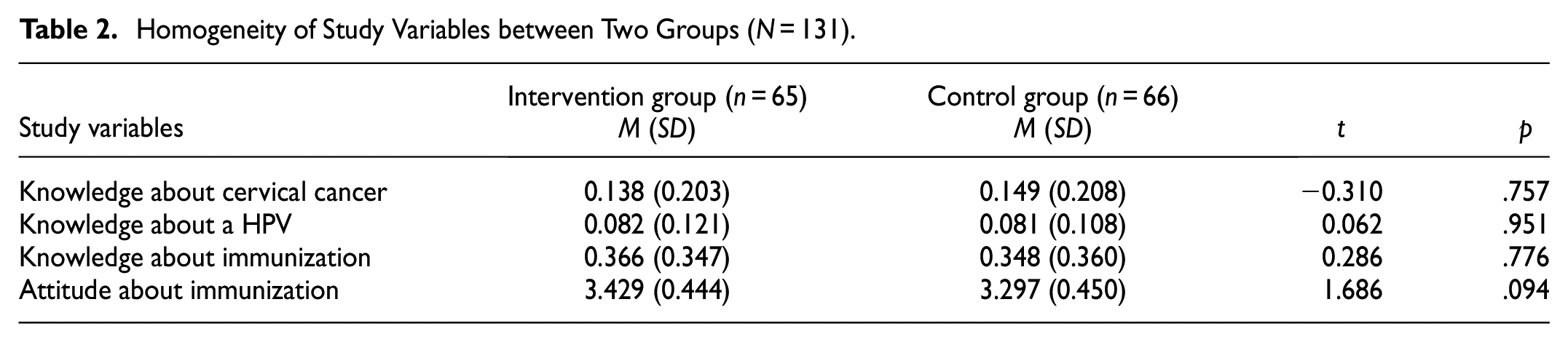
As for menarche, there were 58.0% of participants (Intervention: 56.9%, Control: 59.1%). As for boyfriend, 69.5% of the participants had a boyfriend (Intervention: 76.9%, Control: 62.1%). As for immunization information acquisition, most of the participants had no acquisition of immunization information (Intervention: 73.8%, Control: 77.3%). As for information acquisition route, most of the answer was family or relative (Intervention: 41.2%, Control: 57.1%). As for intervention group, 41.2% of the participants also obtained immunization information from school. As for the general characteristics of the participants between the two groups, as well as the study variables before the intervention, there were no group differences at baseline at a statistical significance level of p < .05 (Tables 1 and 2).
General Characteristics of the Study Participants and Homogeneity (N = 131).

Fisher exact test.
Homogeneity of Study Variables between Two Groups (N = 131).
Effects of Human Papillomavirus (HPV) Prevention Education
There were statistically significant differences in knowledge about cervical cancer (t = 9.712, p < .001), knowledge about HPV (t = 9.638, p < .001), knowledge about immunization (t = 5.178, p < .001), and attitude about immunization (t = 3.113, p = .002) between the groups. The knowledge score about cervical cancer of the intervention group was 0.605, the knowledge score about HPV of the intervention group was 0.333, the knowledge score about immunization of the intervention group was 0.747, and the attitude score about immunization of the intervention group was 3.635, which was higher than the control group (Table 3).
Effects of Human Papilloma Virus (HPV) Prevention Education (N = 131).

Discussion
As a general characteristic of this study, the information acquisition path of vaccination information learners was families and relatives in 46.5% (15 of 31 persons) and schools in 25.8% (8 of 31 persons). It is also consistent with the results of the previous studies showing that the recommendation of medical staff, friends, and family as a facilitator of personal knowledge acquisition and motivation for vaccination has an effect (Kwang et al., 2016; Odunyemi et al., 2018). Elementary school students are highly influenced by their peers and surrounding persons due to their developmental characteristics, while public relations and education for those around them can positively affect the subject’s motivation and perception of vaccination.
The knowledge related to HPV prior to the subject education was low, which means that the subjects had no experience in acquiring knowledge and information related to HPV. It is also consistent with the conversations with some students who had no experience in receiving HPV-related education, but expressed their interest in HPV vaccination in the analysis of learners conducted for this study. In addition, the frequency of responding that the students have heard of the vaccination in the general characteristics survey was as low as 26.2% in the intervention group (17 of 65 persons) and 22.7% in the control group (15 of 66 persons). This means that the students lack the knowledge about HPV-related vaccinations, and education and information need to be provided in order to raise awareness about vaccination. This is consistent with the results of the previous studies showing that education increases knowledge (Kwang et al., 2016; Liu et al., 2019; Odunyemi et al., 2018; Si et al., 2019). Most studies have reported that increasing knowledge has a positive effect on the practice of disease prevention behavior. Human papillomavirus has been found to be the main cause of anal cancer, oral cancer, pharyngeal cancer, genital cancer, cervical cancer, and genital warts. It is also effective in lowering the incidence of HPV-related cancer through a safe sex life, regular checkups, and vaccinations (Korea Centers for Disease Control and Prevention, 2019; National Healthcare Service, UK, 2019). Therefore, it is necessary to provide correct knowledge or information in order to promote safe sex life and vaccination practice.
E. J. Lee and Kim (2011) stated that knowledge affects human health attitudes for disease prevention, thereby increasing the rate of health behavior practice. The result of the HPV vaccination education for female college students showed that HPV-related knowledge, perceived severity, and perceived sensitivity effect lasted for 5 weeks. In addition, cervical cancer knowledge, HPV knowledge, HPV vaccination intention, and attitude scores were maintained high until 12 weeks, thereby showing that the educational effect continued (Bennett et al., 2015; Liu et al., 2019). However, after 12 weeks, the attitude toward Pap smear, the benefit of cancer prevention behavior, vaccination intention, and vaccination attitude scores decreased (Bennett et al., 2015; Kim, 2009). These results imply that re-education is necessary in order to sustain the educational effect.
Prior to the human papillomavirus (HPV) prevention education in this study, the average score for the vaccination attitude was 3.429 points for the intervention group and 3.297 points for the control group. After the education, it was 3.635 points for the intervention group and 3.356 points for the control group, thereby showing a significant difference in attitude scores after the education. This means that human papillomavirus (HPV) prevention education has a positive effect on vaccination attitudes. This is consistent with the results of the previous studies that education had a positive effect on HPV vaccination attitude (An, 2016; E. S. Lee, 2014), and that HPV-related education for female college students and female high school students was effective in improving cervical cancer prevention intention and attitude, and HPV vaccination intention (Choi & Choi, 2013; E. J. Lee & Kim, 2011).
When asked about fear for side effects in vaccination attitudes, 25 out of 131 respondents (19.1%) answered “agree” and “strongly agree,” which was lower than that of K. Y. Park’s (2018) study on 1st year middle school students. For the statement “I am not interested in HPV vaccine,” 32 out of 131 respondents (24.4%) answered “agree” and “strongly agree.” For the statement “HPV vaccination is bothersome,” 13 out of 131 respondents (9.9%) answered “agree” and “strongly agree.” For the statement “HPV vaccine is important in preventing cervical cancer,”, 62 out of 131 respondents (47.3%) answered “agree” and “strongly agree.” For the statement “HPV vaccine is important for preventing genital warts,” 60 out of 131 respondents (45.8%) answered “agree” and “strongly agree.” These results indicate that the students are aware of the necessity of vaccination for the prevention of cervical cancer and genital warts, and that they are more interested in the benefits of the effects rather than having fear for the side effects of vaccination. Based on the research that positive knowledge and attitude have a positive correlation (Jang, 2018; Shim & Ha, 2017), it is very important to provide the knowledge and information necessary for solving personal curiosity for vaccination attitude and vaccination practice behavior.
Limitations
Since this study was conducted on students from a single elementary school, it is necessary to be careful when generalizing the study results, and there is a limitation in extending the interpretation to all elementary schools. Therefore, it is necessary to repeat and expand the study in the future while taking into consideration the sampling of the subjects. In addition, any other association other than education that improved HPV knowledge could not be completely controlled in this study.
Implications
Based on the results of this study, the human papillomavirus (HPV) prevention education used in this study could be utilized as a health education material for sixth grade elementary school girls at the school setting. Further research is needed to implement various forms of school-based repetitive education that can increase the knowledge of the subjects, utilize educational methods and media capable of inducing participation, and maintain long-term effects of education. It would be worthwhile to conduct a larger study with more students and other schools in the country involved, and then it can be more definitely stated that this program could be considered for implementation.
The significance of this study is that the study provided the educational direction and basis for educational intervention studies for future school-based human papillomavirus prevention by verifying the effectiveness of human papillomavirus (HPV) prevention education.
Conclusion
In conclusion, the human papillomavirus (HPV) prevention education for sixth grade elementary school girls in this study had a positive effect on the increase of cervical cancer knowledge, HPV knowledge, and vaccination knowledge, as well as vaccination attitude. Therefore, the human papillomavirus (HPV) prevention education could be considered in order to improve the knowledge (cervical cancer, HPV, and vaccination) and vaccination attitude of sixth grade elementary school girls at the school setting.
Footnotes
Acknowledgements
The authors are very thankful to all the participants for their valuable contribution.
Data Availability Statement
The data that support the findings of this study are available from the corresponding author upon reasonable request.
Declaration of Conflicting Interests
The author(s) declared no potential conflicts of interest with respect to the research, authorship, and/or publication of this article.
Funding
The author(s) received no financial support for the research, authorship, and/or publication of this article.
Ethical Approval
Kyung Hee University Institutional Review Board (IRB No. KHSIRB-19-218(RA))
