




Abstract
The rapid urbanization in China has had a profound impact on religious practices of rural communities, but few study has explored the relevant dynamics. This study provides an overview of urbanization’s impact on rural religious spaces, and compares the changes of religious spaces before and after urbanization. It aims at improving the understanding of religion in urbanized communities. Phenomenological methods were employed to analyze our transcriptions of 16 interviews which were conducted in the religious spaces of 11 urbanized communities in Jiangsu, China. We also investigated the worship circle mentioned by the participants through field surveys and map analysis. Based on these, four similar themes were sorted out, namely, worship circle and environment, aging and feminizing agents, ritual and secular life, as well as religious well-being. And the results showed that: (1) passive change of worship circles would bring new sense of belonging and identity to elderly residents; (2) the new religious spaces contained a lot of local knowledge and traditional characteristics, which were evolving continuously with sites sacredness maintenance and secularization function expansion; (3) female agents were of great importance to religious spaces preservation.
Introduction
In the past seven decades, China’s urban population has undergone unprecedented changes. According to official statistics, from 1949 to 2019, the ratio of China’s urban population has increased from 10.6% to 59.7%, and this number is expected to reach about 80% in 2050 (Worldometers, 2020). Urbanization has changed urban and rural areas in two ways. Firstly, the advantages of urbanization in terms of employment opportunities have caused a large-scale migration of young rural populations to cities and city centers (J. Huang, 2014). The second phenomenon is the realization of urban expansion through the acquisition and conversion of rural land, including major changes in living conditions, occupations, and leisure activity types (Chen & Vermander, 2019; J. Huang, 2014).
China’s urbanization has objectively brought economic benefits to urbanized communities, through the government’s implementation of various urbanization policies to improve the living standards of community residents, including increasing employment and renting land opportunities (Bao et al., 2017; Zhu, 2018). The process of urbanization and modernization has also affected religious, cultural, and social aspects in China (Perry & Selden, 2003). For example, some rural residents, who are forced to enter the city, may not appreciate the benefits, due to the drastic social and economic changes, as it is difficult for them to adapt to their new social status as urban residents (J. Huang, 2014; Zhu, 2018). The stories shared among the local residents living at the cities’ borders reflect the anxiety related to urban invasion and modernization (Wu, 2015). Rapid social changes and unfamiliar living environments have affected the lives of many original rural residents. Many of them feel helpless and seek spiritual support by engaging in religious activities (Law, 2005). Since adopting the pragmatic Economic Reform and Opening policy in 1979, the Chinese government had gradually relaxed religion restrictions, and under the influence of urbanization, religious sites began to evolve into polarized institutions. In some religious places that have a significant value (e.g., religious cultural heritage or tourism spaces), national power and market attractiveness jointly shaped the revival of sacred spaces (Kang, 2009; Qian, 2019; Tam, 2019). Other religious sites that were considered worthless (e.g., temples and churches in the original rural areas) were demolished or relocated during the urbanization. These processes resulted in changes in sacred spaces and ritual traditions, but the religious spaces remained a key medium for maintaining contact between individuals and gods (Chen & Vermander, 2019; Kiong & Kong, 2000; Long, 2014). Even under administrative instructions and with the growing exchange value in the real estate market, migrants’ persistent will to maintain religion and identity could not be easily discouraged, as they demanded to enjoy their due status in modern society (M. M. Yang, 2004).
Many researchers of Chinese religion have studied the correlation between urbanization and flourishing religious activities (Laliberte & Palmer, 2011). For instance, Chen and Vermander (2019) studied the process of religious ritual revival in demolished villages that were relocated and integrated into urban life. Similarly, Sapitula (2016) analyzed the identity behaviors of villagers who intended to preserve their temples and maintain their religious identity in the process of urbanization. On another note, J. Huang (2014) studied how urban churches offered spiritual support to Christians who migrated from the rural areas, while Tam (2019) examined the possibility of developing Chinese rural historical temples as religious heritage sites in the process of urbanization. Some scholars contended that religion was thriving and resilient in modern society, and its secularization was also notable (Chau, 2003; Kong, 2010; Qian, 2019; M. H. Yang, 2007). Although these studies did explore the relationship between urbanization and religious practice, few researchers have focused on the Chinese religious communities of rural immigrants under the influence of urbanization, perhaps due to the fact that these studies combined urban and rural areas, and because of the dichotomy of tradition and modernity (Goh, 2009).
The study of Chinese religion was perpetually limited to the historical context and world outlook of agricultural societies (Chen & Vermander, 2019). Therefore, Chinese religious research mainly focused on Christian and Buddhist practices in traditional villages (Atsutoshi, 2011; Freedman, 1958; Granet, 1975; Kain, 1989; Laliberte & Palmer, 2011; Sun, 2014; Vincent, 2012) and modern cities (W. Huang, 2012; J. Huang, 2014; Jie, 2017; Tarocco, 2015; F. Yang, 2005; Zhuang, 2013). In urbanized villages, where the populations and society itself were experiencing tremendous changes, formal institutions paid little attention to the spiritual lives of urban and rural immigrants. However, religious spaces might be one of the few institutions in urbanized communities that provide religious activities and a gathering place for rural immigrants who have lost their land. Thus, the particularities of urbanized communities provide an interesting case for studying the impact of urbanization on religion (Niu & Zhao, 2018).
To fill the gaps within the literatures, this article explores urbanization’s influence on the changes that occurred in the religious spaces of original agricultural communities. The purpose of this article is to understand the profound impact of Chinese urbanization on the value and function of community religion by studying urbanized community religious spaces’ effect on neighborhood residents (local agricultural immigrants who have lost their land), territorial identity, and maintaining ritual life. The research result showed that the religious space in urbanized communities still provided the well-being in the anchoring of the sense of belonging, local identity for neighbors, religious rituals and daily life. In addition, the research had also discovered the important role of feminizing agents in maintaining the operation of religious space.
Methods
Research Design
We chose to employ a phenomenological method in order to obtain detailed, in-depth, and all-round objective conclusions about the religious practices of urbanized communities. Phenomenological methods were often used to explore complex cultural, social, and historical phenomena (Seamon, 1982), such as sense of place (Relph, 1976), religion (Sarbadhikary, 2019; Watts, 2019), and health and well-being (McNamara, 2005). A phenomenological method emphasizes the importance of researchers being aware of their own experiences, philosophical frameworks, and biases, in order to set-aside their own opinions during observations, interviews, and analyses. It also serves to explain behavioral preferences by uncovering the essential and underlying factors that unify phenomena stemming from lived experiences (Seamon, 1982). That is, the researcher puts aside his/her religious and academic views, and records the narratives and observations in the fieldwork as an outsider or observer.
Interviews
We conducted this research in Jiangsu, as it is one of the most urbanized areas in China, with rapid growth on the urbanized population ratio from 14% in 1979 to 70.61% in 2019 (National Bureau of Statistics of China NBSC [NBSC,], 2020). Urbanization first started in eastern China, where industry and commerce grew rapidly. After land acquisition, the farmers were offered economic compensation and moved from rural villages to modern apartments, the rural land was used to build factories or commercial facilities. Their living and economic conditions were improved significantly, and the original neighborhood relationship maintained; however, they lost their land and identity of farmers (Zhu, 2018). From May to September 2020, we performed observations and interviews on the changes in religious space in urbanized communities. The participants were chosen from a larger cross-sectional survey which we had explored the factors that influenced residents’ place dependence in urbanized communities. After completing the cross-sectional survey, we invited the respondents to participate in semi-structured interviews and 13 of the initial 279 agreed. Then, we continued to recruit participants through the snowball method until data saturation was reached and no new concepts were emerging. In the end, 16 older residents from urbanized communities with religious participation experience took part in the follow-up interviews (Table 1). The living environment of these community residents had been transformed into a city gradually since the beginning of urbanization.
Participant Characteristics.

Specifically, we conducted semi-structured interviews to collect information on the changes that occurred in the religious spaces of urbanized communities. We used an interview guide to obtain interviewees’ personal information and religious experience, and ensure that certain subject areas were covered. We began with the easiest questions, and progressively posed more difficult and sensitive questions (Dunn, 2000). The interviews initially collected participants’ background information, including age, religious beliefs, occupation, education level, economic situation, and distance from and visit frequency to the community’s religious space. Then, we posed more open questions related to the following factors: (1) place (e.g., “What has changed in the worship circle?” and “What has changed in the religious environment?”); (2) type of visitors (e.g., “Which people often visit this place?” and “Are there changes in the identities of the visitors?”); (3) behaviors (e.g., “How have the religious rituals changed?” and “Are there changes in individuals’ visit lengths and frequencies?”); (4) well-being (e.g., “What are the benefits of visiting this space?” and “Has the meaning associated with visiting the space changed?”).
In order to make the participants feel relaxed and comfortable, we conducted the interviews in their dialect, and within the religious places or other locations that they personally chose (e.g., participants’ homes). The interviewer tried to maintain an open and impartial attitude, and encouraged participants to describe their religious experiences as much as possible. Each interview was recorded, lasting between 30 and 120 min, and some participants received more than one interview. As our focus questions were open-ended, we aimed to understand the key information, rather than being concerned with the length or number of answers (Kvale, 1997). We informed the participants of the research purpose, as well as the rules we would follow to protect their privacy and confidential information. All participants were provided with an informed consent form and a participation subsidy of ¥50.00 (approximately $7.40). To protect their identities, we numbered the individuals and their cited data, instead of using their names.
Observation
Conducting a field survey was essential to understand and explain the role of marginalized communities (Potnis & Gala, 2020), as well as their spaces, rituals, and festivals (Dawson, 2010; Mazumdar & Mazumdar, 2012; Shepherd, 2011). From May to September 2020, we repeatedly took field trips to the religious sites that the 16 interviewees mentioned. The survey content included the elements of the religious spaces’ physical environments, especially the buildings, plants, roads, and religious objects. We also included the people and behaviors that occurred in the religious spaces in the observations. We recorded these nonverbal cues through on-site notes, sketches, and photos. The observation time ranged from 20 to 50 min in 11 religious spaces: seven Buddhist temples, three churches, and one Taoist temple). In addition, we often used a geospatial analysis of the off-site surveys to identify the pre- and post-urbanization spatial changes of religious places, using satellite maps (Chen & Vermander, 2019; Tam, 2019; Völker & Kistemann, 2013).
Analysis
By analyzing all transcribed interview texts, observation notes, records, and photos, we extracted and explained the themes reflecting the evolution of religious places in urbanized communities. First, we began the analysis with open coding. This involved reading the data, coding the interview and survey phrases, words, and photos, and establishing a series of focused coding discussions based on the initial information. Second, we used the frequency, importance, and relevance of the interview responses to determine the themes and categories. Third, through an in-depth analysis of the themes’ significance and interrelationships, we performed a literature review completed to place the topics and categories in their relevant theoretical environments, and have a deeper understanding of the research results. After several rounds of coding and analyses, we finally determined four themes. We incorporated triangulation techniques and grounded theory into the research design to ensure its rigor and reliability (Charmaz, 2006; Glaser et al., 1967; Guba & Lincoln, 1982). The strategies included cross-checking non-verbal clues (original audio files and photos, satellite images, etc.) to ensure information integrity, performing a reflective analysis to set-aside our own views in the process of data coding and interpretation, and repeatedly reading interview content and survey materials to ensure the reliability of the explanations. As the interviews were conducted in local oral dialect, and we chose to explain some terms stemming from the local context in Mandarin and expand their meaning in English (Table 2).
Local Terms and Their Meanings.

Findings
The self-report result showed that, half of the participants were Buddhism (n = 8), and the rest were Christian (n = 5) and Taoism (n = 3). Most of them were female (n = 13), above 60 years old (n = 11), and had lived in urbanized communities for at least 10 years (n = 14). They were all farmers before urbanization, nearly half of them finished their education in middle school. Their residence conditions were almost the same, namely, owned a rural house before urbanization and then it was replaced with two to three apartments. The majority of the participants (n = 12) lived close to the religious spaces (within 2 km), 10 of them arrived there on foot, and 15 of them attended four to five times per month.
Worship Circle and Environment
Before urbanization, one or several agricultural communities belonged to a worship circle and the residents regularly visited religious spaces (e.g., temples and churches). The participants tended to define their worship circles through community identity and village boundaries. For example, one participant said:
The
In the process of urbanization, not only did the original agricultural community residents move from their rural houses to modern apartments, but the community’s gods and sacred spaces also relocated. These changes in the location of temples or churches usually caused the merger of worship circles (Figure 1).
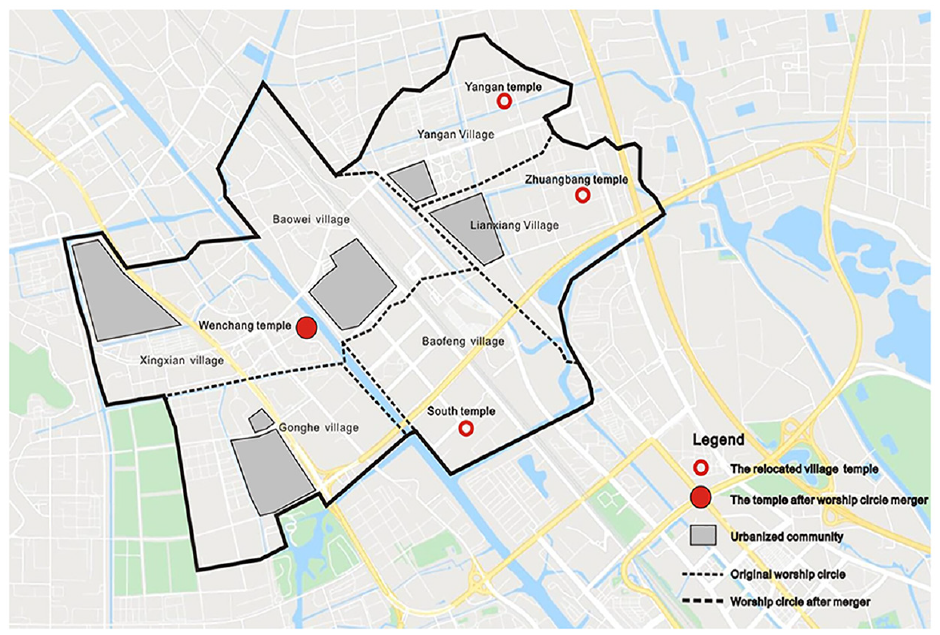
Worship circle merger after the urbanization of agricultural village temples.
Many participants mentioned changes in villager identity and feelings after the merger of community sacred spaces. For example, one participant described the impact of urbanization on their worship circle:
The territorial deity of
Although some participants expressed their dissatisfaction with their loss of the original villager identity, all participants described the changes in the religious environment of their new worship circle in a positive and detailed manner. They addressed the building scale’s expansion, the richness of the functions, and the transportation convenience. For example, one participant described the community churches’ changes in spatial scale after the urbanization:
Over the years, the church has changed a lot. It was on the side of the big food market before
Sacred buildings and specific landscape elements are carefully designed for religious ceremonies, as they are important aspects for forming a religious atmosphere. In the religious space of a particular urbanized community, the designer skillfully brought in local knowledge to enlarge or renovate the original community religious space to anchor the religious ideals, community identity, and restorative environment (Figure 2). The following field observation, conducted on September 12, 2020, represents a religious community space that receives many visitors from neighboring communities:
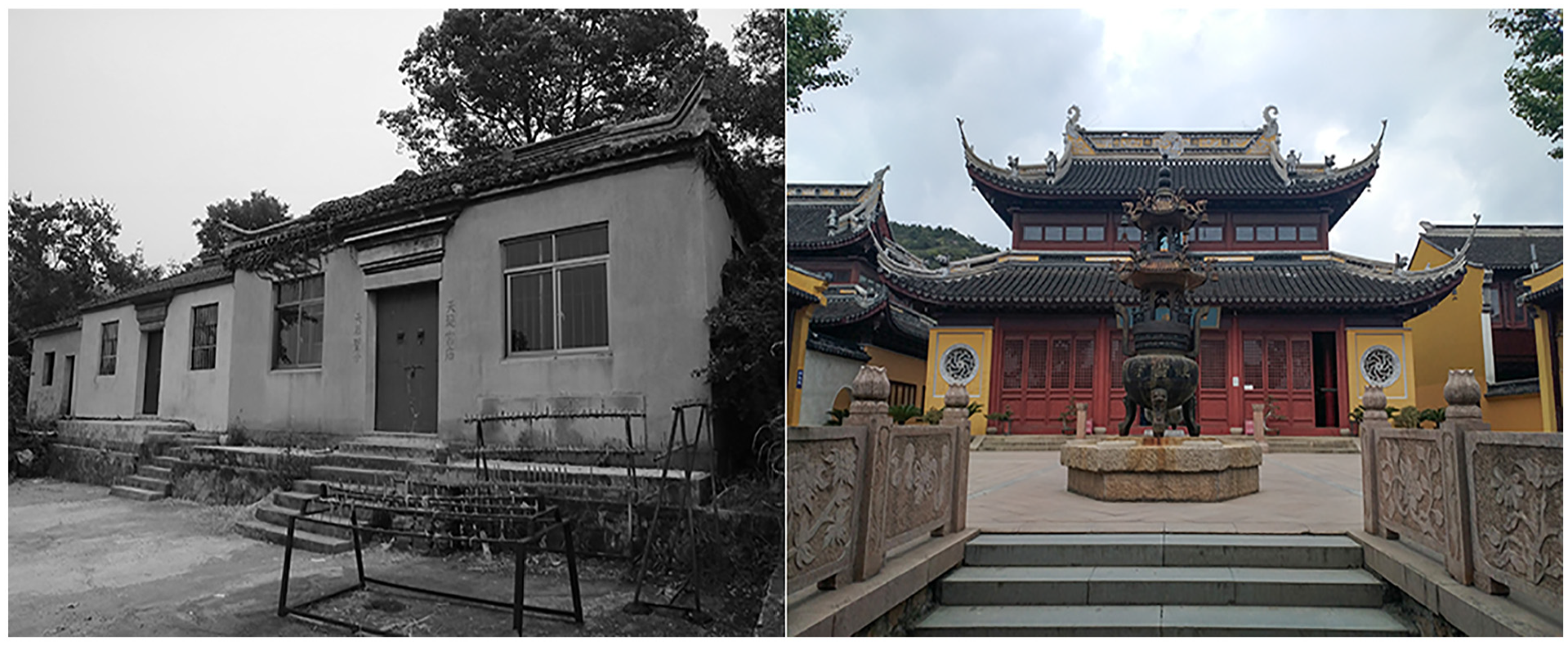
Community Buddhist space before (left) and after (right) urbanization.
The temple is located on a peninsula by the canal and is adjacent to a park. It has worshiped the Wenchang Emperor’s statue for more than 400 years (from 1595 to 2020). According to the construction records of the stone carvings in front of the temple, 10 years ago (during the urbanization process), the local government renovated and enlarged the building to accommodate more gods and visitors. All buildings have adopted the local traditional architectural forms. There was a stone tower and a small garden with dense trees all around. This temple is regularly opened to the residents from four nearby urbanized communities.
Although urbanization has brought about improvements in the physical environment of community religious spaces, it has also led to environmental problems (e.g., air pollution and noise). For example, one participant compared the church environment’s conditions before and after urbanization:
Before
Aging and Feminizing Agents
The elderly were the main religious space visitors in urbanized communities. When the original rural residents moved away from the land and became members of urbanized communities, they immediately realized that changes had occurred in the original living and working styles. The elderly or some middle-aged people who were out of work had a lot of leisure time, and they felt it convenient and comfortable to visit the religious space. For example, a Buddhist participant described it like this:
The visitors to the temple were mainly elderly people, some middle-aged people, rarely young people, and sometimes they would bring children. (P5, Woman/90)
Although the urbanized community residents were classified as “urbanites” in terms of household registration, they still distinguished themselves from these urbanites when participating in religious activities. For example, a participant talked about the differences in the distribution of visitors in a temple, in terms of different identity backgrounds, when visiting religious spaces:
There were two Buddhist halls established for religious ceremonies during special festivals. We went to the hall on the left to read Buddhist Sutras and burn joss sticks, but the city dwellers would go to the one on the right for prayer. (P3, Woman/83)
The women of every family were representatives of community religious activity participation, both before and after urbanization. For example, the oldest woman in the family, rather than the man, usually attended the seasonal religious ceremonies (Figure 3). In the local knowledge system, participating in religious ceremonies as the family representative is the housewife’s affair, no matter the religion (Christianity, Buddhism or Taoism). One participant described this role:

Elderly women as the main agents of religious spaces in urbanized communities.
The traditional arrangement of a family was the bread-winning husband and the homemaking wife. One of the housewife’s important duties is to worship the gods and pray for family members’ good health. The husband replaced the housewife only if she had health problems. Her husband would then follow the neighbors in burning joss sticks. (P13, Woman/62)
Incense chiefs (Xiangtou) are the organizers of community religious activities and spokespersons for the local gods. In addition, they are called “Bodhisattva’s daughters” in Buddhist followers’ local beliefs (Sapitula, 2016) and older female volunteers usually undertake this role. Before urbanization, each rural community had a permanent Xiangtou, and the majority of them were female. They were familiar with the detailed dates and methods of offering sacrifices to different gods inside and outside the community. They were also responsible for the organization of seasonal religious ceremonies. Some participants’ descriptions revealed the impact of these incense chiefs:
Before
Ritual and Secular Life
A community religious space provides members a public place to keep in touch, while its main function and primary purpose is to hold ceremonies. Most first generation residents in urbanized communities were previously engaged in agricultural or related work. Even if they no longer lived in an agricultural community, it was customary to follow local knowledge to perform sacrifices on regular dates, according to the lunar calendar. For example, one participant described a family’s sacrifice at a community territory temple:
Sacrifices usually occur on regular dates, including the 1st and 15th days of each month of the lunar calendar, as well as on Bodhisattva’s birthday. When a family moves to a new dwelling, before a child’s entrance exam, or when new members are added to a family, they must go to the temple to place fruits, cakes, and other offerings in front of the Bodhisattva statue for worship. Then, they burn incense, candles, and large amounts of paper money to appease the gods, and they retrieve the offerings after the worship. (P1, Woman/70)
In some urbanized communities, due to the merger of worship circles, several original agricultural communities share a new religious space. This change in the location of religious sites has obviously caused sacrificial obsessions in some community residents who were attached to the previous site. One participant described their sacrificial experience as follows:
The
Before urbanization, religious spaces in agricultural communities usually held large-scale festivals on the birthdays of gods, including parades in which they carried the statues of the gods, theater performances, temporary commercial activities, etc. These are usually held in winter when the farmers are free, in order to attract as many community residents as possible. However, the modern lifestyles introduced by urbanization have affected these festival ceremonies. One participant noted:
Before
Although urbanization reduces the functions of a community’s religious space, it also updates and creates new public service spaces to meet the needs of modern life. However, some updates seem irrelevant to religious ceremonies, such as adding citizen squares, installing fountains and seats, etc. One Christian participant described the secular changes in a sacred space:
The environment is pretty good, the flowers and trees are also beautiful. There are exercise facilities in the southeast corner of the church, and the elderly that live nearby like it and do physical exercises there every morning. The church has also added a children’s playroom, making it convenient to bring our children. (P8, Woman/68)
Religious Well-Being
Religious places are important spiritual shelters for urbanized community residents. They help people perceive pleasant, promote their spiritual experiences, as well as relieve stress stemming from medical problems, financial difficulties, or interpersonal difficulties. This feature is called religious well-being. The main motivation for frequently visiting the community religious sites is obtaining spiritual support in the sacred space to maintain personal peace of mind and family members’ health. All participants talked about the importance of community religious sites in promoting their mental health. For example, one participant described the spiritual well-being that people can acquire when visiting a religious space:
I always feel better when I go to the temple. After
The interviews revealed that regular visits to the community religious space could indirectly improve health self-assessment of most participants. The community religious space was a daily walking destination for most participants, taking them 5 to 20 min on foot. They argued that regular visits to community religious sites offered opportunities for better physical health. One participant described the physical health benefits:
The environment here is pretty good. Visiting the temple on foot is a leisure activity, and the walk between the community and the temple improves my health. Therefore, I feel energetic every day and my sleep quality has improved significantly. (P10, Woman/47)
The religious spaces in urbanized communities are places for the participants to socially interact, and many view them as indispensable for their habit and quality of life maintenance when they retire. These spaces help the old residents escape the urban living environment and lifestyle changes that they are unaccustomed to. Religious spaces and familiar neighborhoods are two important environmental elements that have minimally changed. In short, religious spaces in urbanized communities provide elderly residents with a sense of belonging. Accordingly, an urbanized community participant mentioned her impressions of the community church:
It’s better to be in church than at home. There is great love, hymns, and prayers, and you can meet more people. We are all brothers and sisters in the neighborhood. Sometimes I go with acquaintances and sometimes I go alone. Anyway, everyone will meet there and almost everyone in the church is familiar with each other. The church is like our home. (P9, Woman/45)
Discussion
Worship Circle Change and its Consequences
The religious spatial changes in urban communities were passive, which were different to the active changes caused by religious tourism development and religious cultural heritage protection (Kang, 2009; Tam, 2019), and the logic behind passive change was economic interests. The agricultural land was converted into industrial or commercial land after land acquisition and compensation. As a result, the government, enterprises and villagers all received corresponding economic benefits, meanwhile, the villagers and their worshiped gods had moved from rural land in resettlement. In the context of urbanization dominated by economic development, the investigation found that religious space in urbanization could help maintain the original religious identity of villagers, the result was similar to previous sociological studies.
The study also found that, caused by the urban development policies, older community residents hold different attitudes toward the merger of religious worship circles. Some of them reiterated their sanctity to regain a sense of place and belonging through repeated attendance to the new religious spaces. The interviews revealed that the religious spaces of urbanized communities had an important role in anchoring residents’ identities (especially the older adults) in the original agricultural community and protecting them from undergoing identity crises that could occur with this type of urbanization. This result was also consistent with previous findings (Chen & Vermander, 2019; Mazumdar & Mazumdar, 2004; Sapitula, 2016). For others, they needed longer time to absorb the fact that religious spaces had been resettled and damaged, and they still went to the original sites. Because religious space change also altered their villager identify which was usually classified by worship circle. Although studies have confirmed the religious contradiction between urbanization and community residents, this strong dependence on the original religious space remains unexplained (M. M. Yang, 2004).
Place Change and its Features
The study focused on the environmental change of religious places caused by urbanization. The interviews, field surveys, and spatial geographic analysis compared the change before and after urbanization. On the one hand, all inner environment of reserved community religious place had been improved, for instance, the upgrade of architectural style and the significant improvement of building space and its function. The core driving force for change was capital. Since in the process of urbanization, the government and enterprises invested sufficient funds in spatial migration of community residents and community god, while the construction and maintenance of community religious sites mainly came from voluntary donations before. Figures 2 and 3 showed the differences. In addition, the research found that the religious space environments which had been praised by residents typically had the following features: markers anchoring the residents’ self-identity (e.g., statues and local architectural styles), spatial boundaries that are different from the secular characteristics (e.g., fences, rivers, etc.), convenient accessibility, tall trees, rich functions, and sense of tranquility. This study confirmed and supplemented the findings of previous studies that found that individuals mainly focused on maintaining the historical features of religious spaces (Tam, 2019), preferred restorative environments (Kaplan, 2001; Ouellette et al., 2005; Ysseldyk et al., 2016), and appreciated sacred structures (Mazumdar & Mazumdar, 2004).
Visiting Group
Studies on the religious experiences of a specific group in the process of urbanization are few within the literature (Chen & Vermander, 2019; Long, 2014; Schwadel, 2011). Although this study did not analyze the correlation between demographic/group variables and urbanized communities’ religious spaces, the results showed that the elderly, especially elderly women, played a significant role in the maintenance, ritual organization, and participation of religious spaces in urbanized communities, whether they were Christian, Buddhist, or Taoist. The main reasons that can explain this result are the fact that work or studies occupied young people, and that men and women hold different responsibilities within their families, based on the local customs. This conclusion, again, confirmed the findings of a previous study (Chen & Vermander, 2019; Sun, 2014). However, another reason might be that the elderly found it more difficult to adapt to the alienation caused by lifestyle changes, while young people can integrate into modern urban life through work, social interactions, or leisure activities. In addition, some participants mentioned the differences in the population distribution of urban residents and urbanized immigrants within the same religious space. Although these differences were not important factors in the interviews, it objectively showed urbanized community residents’ attitudes and preferences for maintaining their original community identity in the rapid urbanization process.
The Maintaining and Change of Religious Function
Religious spaces in urbanized communities were places of culture, society, and life. In the local knowledge, a community’s religious space was connected with a specific religious significance through religious rituals, and it was the main source of residents’ spiritual sustenance and happiness (Chen & Vermander, 2019). This study found that the form, function, and meaning of a community religious space presented two sides. On the one hand, the religious spaces maintained their sacred nature through regular sacrificial rituals; on the other hand, urbanization brought about the secularization reconstruction of religious space function. Religious spaces were open to public (liked community parks or activity centers), and added more non-religious functions. In other words, although large-scale religious celebrations and recreational activities (e.g., religious processions, temple fairs) were no longer popular, new collective identity was given to religious spaces by community residents. The new identity could be described as new civic spaces reconstructed by grassroots organizations and local communities, it was quite different from the religious sites, heritage sites or tourist attractions dominated by local governments. The religious spaces had more characteristics of secular life and were closely related to the daily well-being of community residents. They became social centers or places for leisure time physical activities. To a certain extent, the religious spaces of urbanized communities, as sacred spaces, rationally responded to the modernity challenges brought about by urbanization, and continuously changed the interactions between religion, culture, and social evolution (Goh, 2009; Yao, 2007).
Limitations
Phenomenology is a method that can find basic underlying themes and provide insights into the human condition, such as our study’s assessment of urbanization’s impact on the religious space of communities. This research mainly focused on the similar urban changes in community religious samples (Buddhism, Christianity, and Taoism), despite the differences in religious doctrine, sacred spaces, and religious ceremonies. For the same reason, this article does not make a strict distinction between institutional religion elements (e.g., Buddhist, Christian, and Taoist ceremonies) and diffused religion elements (e.g., folk religion rituals). Due to space constraints, the research only included a small number of data references and no detailed comparison between different religions. Also, we only based our study on the religious spaces of urbanized communities in Jiangsu, China. Thus, future research should assess whether or not these research results could apply to other regions. In addition, the limited time in interviews might cause the failure of participants to provide more profound or conflicting topics. Lastly, due to the lack of commentary from young interviewees, we suggest that researchers focus on this demographic to examine the potential future changes in urbanized communities’ religious spaces.
Conclusions
To fill the research gaps within the literature, this study employed phenomenological methods to analyze the changes in Jiangsu’s urbanized communities’ religious spaces before and after urbanization. The participants spontaneously disclosed four common themes: worship circle change and place revival, aging and feminization, the secularization of religious places, and religious well-being. Studies have shown that the religious spaces of urbanized communities remain much of the local knowledge and traditional characteristics, and continue to change in the process of seeking spiritual and secular well-being. However, due to the lack of viewpoints from younger generation, future trends of religious spaces change in urban communities are still unclear.
Footnotes
Acknowledgements
We would like to thank the participants in our interviews.
Declaration of Conflicting Interests
The author(s) declared no potential conflicts of interest with respect to the research, authorship, and/or publication of this article.
Funding
The author(s) disclosed receipt of the following financial support for the research, authorship, and/or publication of this article: This research was funded by the National Natural Science Foundation of China (grant number 51778388), the Postgraduate Research & Practice Innovation Program of Jiangsu Province (grant number SJCX21_1430), the Landscape Architecture Discipline Construction Project of Suzhou University of Science and Technology, and Qing Lan Project of Jiangsu Province.
Ethics Statement
The study was approved by Suzhou University of Science and Technology Ethics Committee (IRB200415). All participants provided written informed consent.

References
