




Abstract
An accruing body of research suggests that urban environments negatively affect mental health and well-being. It is thought that some of this so-called “urbanicity effect” can be explained by the perceived quality of the living environment. The two studies reported here used online survey methods to explore changes to self-reported psychological mechanisms thought to underpin mental health and well-being before and after participants briefly contemplated urban/rural or desirable/undesirable residential images. Our findings demonstrate that even brief contemplation of places change how we consider our futures and that places deemed relatively undesirable appear to promote a threat-focused anticipatory set. Importantly, these changes were not found to be associated with perceived urbanity but rather with perceived desirability of place. These findings should be considered alongside increasing evidence that urban regeneration and place-making are matters of public health concern.
Introduction
The Urbanicity Effect
The phenomenon known as the “urbanicity effect” refers to the accruing body of evidence that living in urban areas has detrimental effects on mental health and well-being. This research began in earnest when Faris and Dunham (1939) reported a per capita linear decrease in rates of severe mental illness from densely populated, disorganized, inner-city regions, to affluent, residential areas on the outskirts. More recent research supports Faris and Dunham’s finding with one meta-analysis showing that urban environments confer a 2.37 times greater risk of schizophrenia than rural environments (Vassos, Pederson, Murray, Collier, & Lewis, 2012). While there has been some attempt to explain the relationship between psychosis and urban living in terms of downward social drift (Murali & Oyebode, 2004), dose-response evidence suggests that there is a more fundamental, causal relationship between urban living and psychosis (Krabbendam & Van Os, 2005; Pedersen & Mortensen, 2001; Van Os, 2004). Furthermore, although effect sizes are smaller, urban environments have been shown to increase risk of major depression and anxiety (Lederbogen et al., 2011; Peen, Schoevers, Beekman, & Dekker, 2010; Sundquist, Frank, & Sundquist, 2004; Wang, 2004). These analyses have used population density to define urbanity, and some researchers have commented that this tight epidemiological research focus limits our understanding of the specific effects of physical and social contexts on mental health (Weich, Twigg, & Lewis, 2006). These authors suggest a need to widen the focus of research into the urbanicity effect and to develop methods that enable the objective study of how people respond to different living environments.
The Physical and Socioeconomic Urban Context
In the United Kingdom, 98% of the most deprived areas are found in cities, tending to be areas where urban regeneration initiatives are focused (Department of Communities and Local Government [DCLG], 2011). However, research has continued to find urbanicity effects even when controlling for indices of deprivation (McKenzie, Murray, & Booth, 2013). Such findings indicate that some of the urbanicity effect may be attributed to the psychosocial stress associated with living in physical and social environments perceived to be impoverished (Ellaway, Macintyre, & Kearns, 2001; Ellaway et al., 2009; Kirkbride, Jones, Ullrich, & Coid, 2012; Weich et al., 2002). Furthermore, and linking to potential psychological and social mechanisms, Evans (2003) has proposed that the physical characteristics of place impact on mental health and well-being by influencing sense of control with aspects such as lack of community cohesion, perceived risk of crime, and sense of belonging all associated with worse mental health outcomes (Ellaway et al., 2001; Romans, Cohen, & Forte, 2011; Stafford, Chandola, & Marmot, 2007). The potential of certain transdiagnostic psychological mechanisms to explain the urbanicity effect is particularly compelling.
Psychological Mechanisms and Urbanicity
In terms of underlying information processing, depression, anxiety, and paranoia have much in common, including a heightened external locus of control (LoC), heightened anticipation and avoidance of social threat, and an underestimation of the likelihood of future positive events (Bird, Mansell, Dickens, & Tai, 2013; Bentall et al., 2009; Corcoran et al., 2006; Moutoussis, Williams, Dayan, & Bentall, 2007). These same psychological profiles are found, at attenuated levels, in nonclinical populations as shown in research adopting a mental health continuum approach (Freeman et al., 2008; Johns & Van Os, 2001; Van Os, 2003; Van et al., 2009; Verdoux & Van Os, 2002). LoC refers to the extent to which an individual believes that his/her life course is determined by themselves or by external forces such as luck or “powerful others” (Rotter, 1966). Robustly linked to depression, anxiety, and paranoia in both clinical and nonclinical samples, an external LoC has also been reported in association with more individualistic cultures and with ethnic minority status (Cheng, Cheung, Chio, & Chan, 2013; Harrow, Hansford, Astrachan-Fletcher, 2009; Johnson & Sarason, 1978; Moritz, Woodward, Burlon, Braus, & Andresen, 2007; Twenge, Zhang, & Im, 2004; Van Dijk, Dijkshoorn, Van Dijk, Cremer, & Agyemang, 2013).
A heightened attention to threat has been demonstrated in a number of ways, including attentional bias to negative and threatening stimuli and a tendency to overestimate the likelihood of future threatening events with findings associated with depression, anxiety, and paranoia (Bennett & Corcoran, 2010; Corcoran et al., 2006; Kaney, Bowen-Jones, Dewey, & Bentall, 1997; Kellough, Beevers, Ellis, & Wells, 2008; MacLeod, Mathews, & Tata, 1986).
As well as LoC and threat focus, low mental well-being is characterized by future orientation biases and deficits (Drake, Duncan, Sutherland, Abernethy, & Henry, 2008). Cognitive models of depression, anxiety, and paranoia all emphasize negative views about the future (Abler, Erk, Herwig, & Walter, 2007; Bentall et al., 2009; Paulus & Yu, 2012; Strunk & Adler, 2009). More generally, the extent to which people consider and plan for their futures (consideration of future consequences [CFC]) broadly predicts behavior, health, and well-being (Pepper & Nettle, 2014; Strathman, Gleicher, Boninger, & Edwards, 1994). Individuals with an attenuated future orientation are more focused on maximizing immediate benefits and therefore consideration of one’s future negatively correlates with impulsivity, a robust transdiagnostic feature of mental health and well-being (Whiteside & Lynam, 2001).
Lived experiences of victimization, discrimination, and powerlessness, linked to inner-city living, serve to confirm the beliefs associated with these mental health symptoms (Evans-Polce, Hulbert, & Latkin, 2013; Janssen et al., 2003; Mirowsky & Ross, 1983; Ross, Mirowsky & Pribesh, 2001; Schreier et al., 2009). Thus, the psychological processing styles and beliefs associated with depression, anxiety, and paranoid feelings are also associated with living in impoverished neighborhoods (Chen & Paterson, 2006; Ross & Mirowsky, 2009; Witt, 1989). Paál, Carpenter, and Nettle (2015) found that neighborhood socioeconomic status (SES) predicted individual levels of behavioral inhibition, a characteristic invariably associated with impulsive traits and future discounting. Furthermore, and directly relevant to the paradigm employed in this study, Liu, Feng, Suo, Lee, and Li (2012) explored how brief exposure to cues of poverty or affluence influenced the intertemporal choices made by their participants. These authors found that exposure to the images of poverty tended to increase participants’ impulsivity, making them prefer smaller immediate over larger future-based rewards. Thus, Liu et al.’s findings are indicative of a reduced consideration of the future in response to visual cues of poverty.
The Effects of Brief Exposure to Inner-City Areas on Mental Health and Well-Being
Recent research by Ellett, Freeman, and Garety (2008) has suggested that an “urbanicity effect” is measurable in nonresidents after a brief exposure to a deprived urban neighborhood. In a study in which individuals with persecutory delusions were briefly exposed to a deprived urban neighborhood during a walk, these authors reported that participants showed increased anxiety and paranoia alongside increased negative beliefs about others. Nettle, Pepper, Jobling, and Schroeder (2014) found similar results when students were exposed to an unfamiliar deprived urban neighborhood. These authors demonstrated that student visitors reported similar levels of paranoia and trust to that of the neighborhood residents after just brief exposure to the area.
The Current Research
The studies reported here extend the paradigm of Liu et al. (2012) to explore the effects on LoC, anticipation of threat (AoT), and CFC of a very brief, remote consideration of place photographs. We chose this method because a strong case can be made about the effects of sustained exposure to certain kinds of urban environments on mental health and well-being if changes to psychological variables can be demonstrated to follow very brief and indirect exposure to the same kinds of places.
As well as exploring the difference between perceived quality of areas, we aimed to assess the extent to which a so-called biophilic predisposition (Wilson, 1984,) may account for the urbanicity effect. The biophilic hypothesis is becoming increasingly influential in public health and urban planning (Mitchell & Popham, 2007; Thompson et al., 2012). However, a criticism of many studies reporting the positive effects of green space on health and well-being is that neighborhoods with green spaces are typically considered to be of generally higher desirability. We attempt to explore this criticism here using a methodology that can dissociate between the “green-ness” and the perceived desirability of residential places.
Aims and Hypotheses
This pair of studies aimed to explore whether very brief contemplation of place images can elicit changes in the self-reported psychological mechanisms associated with mental health and well-being. The images selected differed in degree of (a) urbanity (rural or urban) or (b) subjective desirability (rated high or low on the question, “How nice is this place?”).
It was anticipated that scores on measures of LoC, AoT, and CFC would change in response to the active contemplation of place images and that these changes would be related to the perceived urbanity (lack of green-ness) of the environments as well as their perceived desirability. Specifically:
In support of the biophilic hypothesis, we expected that the contemplation of urban but not rural images would lead to increased external LoC, enhanced AoT, and a reduction in CFC.
In support of suggestions that the urbanicity effect is associated with the quality of living environments, we expected that the contemplation of less desirable but not more desirable places would lead to increased external LoC, enhanced AoT, and a reduction in CFC.
We expected that any changes to LoC, AoT, and CFC related to contemplating the place images would be associated with elevated feelings of depression, anxiety, and/or paranoia.
Method
Pilot Studies: Image Selection
Study A: Urban versus rural
Ten aerial and 10 street view photographs of typical urban and rural neighborhoods, none showing people, were sourced from across the United Kingdom. Some were the teams’ own photographs and others were found on the Internet. The photos were selected to show residential areas and a similar numbers vehicles.
A sample of 25 participants (12 male, 13 female) aged 18 to 54 were asked to rate all 20 photographs (10 urban and 10 rural each with five aerial and five street view) on the extent to which they considered the neighborhoods as urban (0 = not urban, 100 = very urban) and the extent to which they considered the neighborhoods as rural (0 = not rural, 100 = very rural).
The participants were also asked to rate the photographs for perceived desirability using the question “How nice is this place?” rated using 0 to 100 scale. To control for any differences in perceived desirability of the places, only the photos with overall mean scores falling within the central quartiles (25-49 and 50-74) for the question “How nice is this place?” were considered for inclusion in the main study.
Eight images clearly regarded as urban (four images, two aerial and two street view) or rural (four images, two aerial and two street view) were selected for use as stimuli in the main study. An independent samples “t” test comparing the average urbanity ratings of the selected urban and rural photos confirmed that the selected urban images were rated significantly higher than the selected rural images for urbanity (urban: M = 70.03, SD = 10.50; rural: M = 30.70, SD = 9.67), t(6) = 5.51, p = .001, d = 3.90 (one-tailed).
Study B: Desirable versus undesirable
A set of 24 photographs representing typical residential neighborhoods in the United Kingdom were collected. Some were the teams’ own photographs and others were found on the Internet. None of the collected photographs showed extremely impoverished, run down, or derelict places. The images were selected to be similar in terms of amount of green space and vehicles shown and none included people. All images were street as opposed to aerial view to better capture the “desirability” of the residential area. A sample of 21 participants (10 male, 11 female) aged 18 to 58 were shown all 24 photographs and asked to respond to the following questions to rate the desirability of the environment (0-100 scale):
How “nice” is this place?” And “How much would you like to live in this place?
To select the most and least desirable urban residential photographs from the set of 24, a mean response score for each participant was calculated for the above questions. The top five highest and lowest ranked images were used in the main study as the more desirable and less desirable place images. An independent samples t test comparing the average desirability ratings of the five more desirable and five less desirable images confirmed that the more desirable images were rated significantly higher than the less desirable images (most desirable: M = 70.60, SD = 5.09; least desirable: M = 31.50, SD = 4.39), t(8) = −13.01, p < .001, d = 8.23 (one-tailed).
Participants
Data were provided by first-year undergraduate psychology students completing research studies in exchange for course credits.
Study A: Urban versus rural
A total of 173 participants completed the online survey that included the four urban photographs while a different sample of 183 completed the survey that included the four rural photographs. After filtering for incomplete data and excluding any participants who requested that their data be deleted, the final complete sample for analyses was 317 (urban: n = 162, rural: n = 155).
Study B: Desirable versus undesirable
A total of 186 participants completed the online survey that included the five photos of the more desirable urban neighborhoods while a different sample of 175 completed the survey that included the photos of the five less desirable neighborhoods. After filtering for incomplete data and excluding any participants who requested that their data be deleted, the final complete sample for analyses was 298 (more desirable: n = 141, less desirable: n = 157). Table 1 provides more detail of the participant demographics.
Participant Demographics.

The majority of participants in both studies were female aged between 18 and 24 years with each participant contributing data to only one of the four surveys. The sex ratio and age reflect the student population studying undergraduate psychology in the United Kingdom. It was very unlikely that participants knew the depicted neighborhoods as the photographs were of diverse UK areas.
The Online Survey Measures
The measures that made up the four surveys were presented in the fixed order below.
The Persecution and Deservedness Scale (PaDS persecution only; Melo, Corcoran, Shryane, & Bentall, 2009) is a 10-item measure of paranoid thinking designed for use in both nonclinical and clinical samples. Statements refer to direct or indirect intentional harm from others, and respondents are asked to rate the extent to which they agree with each statement on a 5-point scale. The scale has been shown to have high internal consistency in a nonclinical, student sample (α = 0.84).
Depression, Anxiety and Stress Scale (DASS 21; Henry & Crawford, 2005) is a 21-item self-report scale used to measure the severity of symptoms relating to depression, anxiety, and stress on a 4-point scale. Compared with other validated measures, DASS21 has high internal consistency (α = 0.93; CI95 = 0.93 to 0.94), and good convergent and discriminant validity in a nonclinical adult sample.
Locus of Control Scale (LoC; Rotter, 1966) is used to measure perceived control over one’s life. For each of 13 paired statements, respondents are asked to indicate which alternative best describes their attitude. A high score is indicative of a more external LoC. As LoC needed to be assessed before and after photo contemplation, the scale was split in half by randomly allocating the items to either pre- or poststimuli order. To equate the number of items pre and post, the paired statements “the idea that teachers are unfair to students is nonsense” and “most students don’t realize the extent to which their grades are influenced by accidental happenings” were removed. This pair was chosen for exclusion because it was felt that responses may be skewed in the student sample.
Anticipation of Threat (AoT; Corcoran et al., 2006) is a seven-item self-report scale, with acceptable internal reliability (α = 0.78) measuring the extent to which respondents anticipate encountering certain threatening acts over the next week using a 7-point scale. As AoT needed to be assessed before and after photo contemplation, the scale was split in half by randomly allocating the items to either pre- or poststimuli order. To equate the number of items pre and post photo contemplation, the item “Your mail is read without your permission” was removed.
Consideration of Future Consequences Scale (CFC; Strathman et al., 1994) is a 12-item scale used to measure the extent to which people regard immediate versus distant consequences of their behavior as more important. A high score indicates less consideration of the future. Respondents rate how characteristic of them each statement is using a 5-point scale. The authors report internal reliability ranging from α = 0.80 to 0.86. As CFC needed to be assessed before and after photo contemplation, it was split in half by randomly allocating the items to either pre- or poststimuli order.
Photo Contemplation Questions
The photograph contemplation task was undertaken after participants had completed the first half of the LoC, AoT, and CFC measures. Participants were asked to respond using 6-point Likert-type scales to the following five contemplation questions:
How “nice” is this place?
How much would you like to live in this place?
How much would you say that people who live in this place mix with each other on friendly terms?
How much antisocial behavior (e.g., smashed bus shelters, fly tipping, burnt out cars) would you expect to see in this area?
How poor or rich do you think the people who live in this place are?
Analysis Strategy
In both studies, the following three-step approach to data analysis was taken:
Pearson’s correlations were used to explore the relationship between the measures of paranoid ideation, depression, and anxiety (PaDS and DASS) and the pre-stimuli measures of LoC, AoT, and CFC to determine their level of association in these samples.
Paired samples t tests were used to compare pre- and postcontemplation levels of self-reported LoC, AoT, and CFC regardless of image type. For each of these measures, a pre–post stimuli difference score was computed. These new variables were subjected to independent samples t tests to establish whether contemplation of the different images was associated with greater or lesser difference scores.
Finally, depending on the outcome of Step 2, hierarchical regression would explore the extent to which the change in psychological mechanisms following the contemplation of images was independently related to DASS and PaDS scores and image type.
Results
Study A: Urban Versus Rural Places
The relationship between DASS and PaDS scores and prestimuli LoC, AoT, and CFC
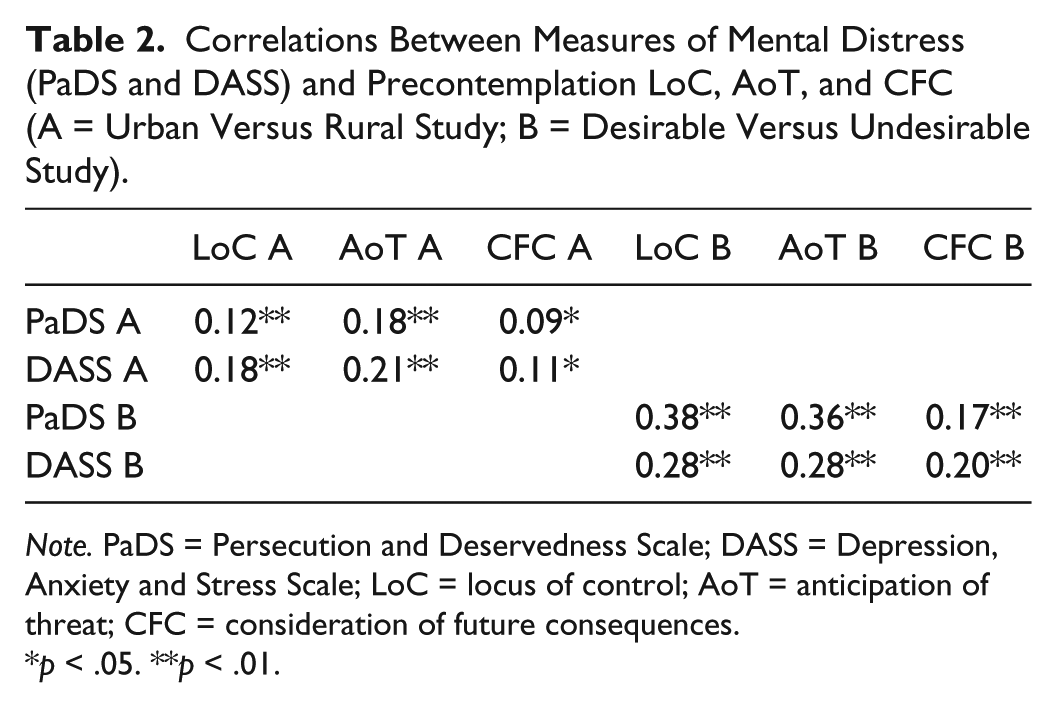
Confirming the established findings of previous literature, Table 2 shows the statistically significant correlations between the measures of paranoia, depression, and anxiety with prestimuli LoC, AoT, and CFC.
Correlations Between Measures of Mental Distress (PaDS and DASS) and Precontemplation LoC, AoT, and CFC (A = Urban Versus Rural Study; B = Desirable Versus Undesirable Study).
Note. PaDS = Persecution and Deservedness Scale; DASS = Depression, Anxiety and Stress Scale; LoC = locus of control; AoT = anticipation of threat; CFC = consideration of future consequences.
p < .05. **p < .01.
Photograph Contemplation Effects
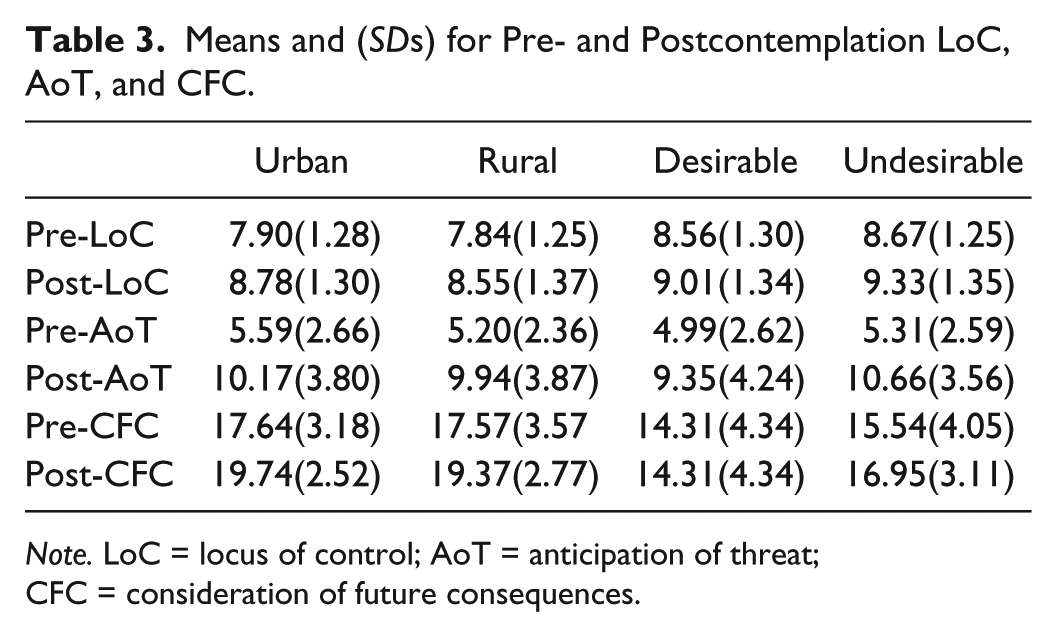
Table 3 shows the means (±SD) for the urban and rural images for pre- and poststimuli LoC, AoT, and CFC. Paired samples t tests demonstrated that all of these measures changed significantly after the contemplation of both types of photograph. Contemplating place photographs was associated with feeling significantly less in control of life, anticipating significantly more threat in the near future and reporting less consideration of the future, LoC: t(316) = −8.98, p < .001, one-tailed; AoT: t(316) = −22.36, p < .001, one-tailed, CFC: t(316) = −8.69, p < .001, one-tailed.
Means and (SDs) for Pre- and Postcontemplation LoC, AoT, and CFC.
Note. LoC = locus of control; AoT = anticipation of threat; CFC = consideration of future consequences.
Analyses of the mean difference scores demonstrated that the contemplation of the urban places did not augment external LoC, AoT, or reduce CFC significantly more than the contemplation of rural places (LoC: urban, M = .88, SD = 1.62; rural, M = .72, SD = 1.56), t(315) = .93, p = .176; d = .10, one-tailed; (AoT: urban, M = 4.58, SD = 3.92; rural, M = 4.74, SD = 3.49), t(315) = −.37, p = .355, d = .04, one-tailed; (CFC: urban, M = 1.83, SD = 3.55; rural, M = 1.81, SD = 3.92), t(315) = .06, p = .475, d = .01, one-tailed.
Figure 1 shows the mean difference scores between pre and post contemplation for both urban and rural residential images for LoC, AoT, and CFC. These nonsignificant differences between image type meant that Step 3 of the analyses was unnecessary.

Clustered bar graph to show mean difference scores pre and post contemplation for the urban and rural residential neighborhoods for LoC, AoT, and CFC.
Study B: Desirable Versus Undesirable Places
The relationship between DASS and PaDS scores and prestimuli LoC, AoT, and CFC
Confirming the established findings of previous literature and those from the urban versus rural study, Table 2 shows the statistically significant correlations between the measures of paranoid ideation, depression, and anxiety with preprime psychological processes (LoC, AoT, and CFC).
Photograph Contemplation Effects
Table 3 shows the means (±SD) for the more and less desirable images for pre- and postcontemplation LoC, AoT, and CFC. Paired samples t tests demonstrated that all of these measures changed significantly following the contemplation of both types of place image. Contemplating the photographs was associated with feeling significantly less in control of their lives, anticipating significantly more threat in the near future and reported considering the future significantly less, LoC: t(297) = −7.26, p < .001, one-tailed; AoT: t(297) = −22.21, p < .001, one-tailed; CFC: t(297) = −6.66, p < .001.
Analyses of the mean difference scores demonstrated that the contemplation of the less desirable neighborhoods did not increase external LoC significantly more than the contemplation of the more desirable neighborhoods (more desirable: M = .45, SD = 1.26; less desirable: M = .66, SD = 1.39), t(296) = −1.40, p = .082, d = −.16 (one-tailed). Furthermore, the less desirable neighborhoods did not significantly alter CFC more than the more desirable neighborhoods (more desirable: M = 1.35, SD = 3.61; less desirable: M = 1.41, SD = 3.56), t(296) = −.15, p = .443, d = −.02 (one-tailed). However, contemplation of the less desirable neighborhoods was associated with significantly greater change between pre- and post-contemplation AoT scores compared with the more desirable neighborhoods (more desirable: M = 4.36, SD = 3.73; less desirable: M = 5.35, SD = 3.80), t(296) = −2.26, p = .012, d = .26 (one-tailed).
Figure 2 shows the mean difference scores between pre and post contemplation for both the more and less desirable residential neighborhoods for LoC, AoT, and CFC.
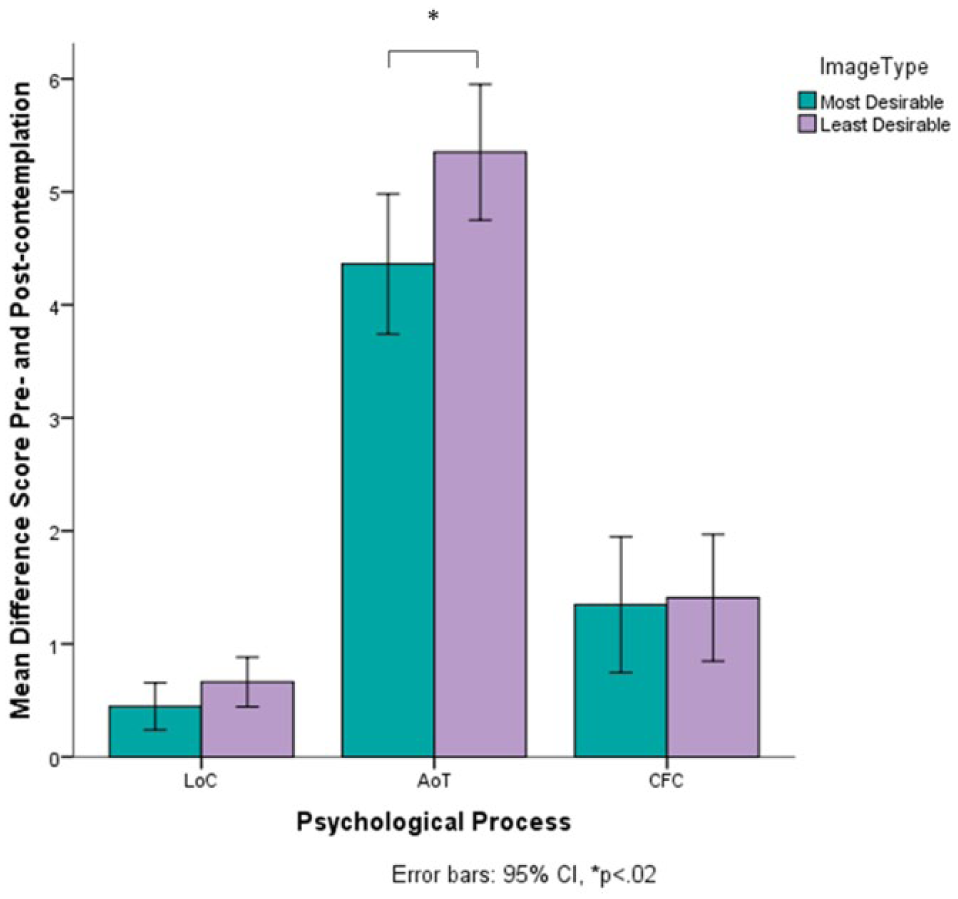
Clustered bar graph to show mean difference scores pre and post image contemplation for the most and least desirable residential neighborhoods for LoC, AoT, and CFC.
Exploring the Change in AoT: Mental Health and Image Type Effects
As no significant differences in change to LoC or CFC by image type were found, regression analysis exploring the effects of paranoid ideation, depression, and anxiety and image type on mean difference scores was limited to AoT.
A hierarchical regression with postcontemplation AoT score as the dependent variable explored the extent to which the relative change in AoT was independently predicted by participant’s underlying levels of depression/anxiety, paranoid ideation, and place type. Step 1 of the hierarchical regression included sex and precontemplation AoT scores. Step 2 added PaDS and DASS scores, and finally, Step 3 of the model added image type (more/less desirable residential neighborhoods). The overall regression model predicted approximately 30% of variance in postcontemplation AoT scores, R2 = .30, F(5, 292) = 25.56, p < .001. Sex and precontemplation AoT scores predicted approximately 16% of variance in postcontemplation AoT scores with precontemplation AoT but not sex having significant beta values. Independent of the significant effect of precontemplation AoT score, PaDS and DASS scores predicted an additional 14% of variance in postcontemplation AoT. Finally, image type (more/less desirable places) predicted a further 1% of variance of postcontemplation AoT. Table 4 provides full details of the hierarchical regression including individual beta values for each independent variable included stepwise.
Hierarchical Regression Analysis Showing Gender, Precontemplation AoT, PaDS, DASS, and Image Type (Desirable/Undesirable) as Predictors of Postcontemplation AoT.

Note. AoT = anticipation of threat; PaDS = Persecution and Deservedness Scale; DASS = Depression, Anxiety and Stress Scale.
p < .05. **p < .001.
Discussion
The research reported above agrees with the findings of studies conducted by Ellett et al. (2008) and Nettle et al. (2014) by showing that even very brief exposure to particular places is associated with changes to psychology that could underpin the urbanicity effect. Furthermore, it strengthens the argument about the rapidity of this psychological response by using the approach of Liu et al.(2012) where only photographs were used to elicit the effects of place contemplation on psychological mechanisms. Study A aimed to explore biophilic explanations of the urbanicity effect by examining whether very brief contemplation of neighborhoods perceived to be urban produced changes in LoC, AoT, and CFC while neighborhoods perceived to be rural did not. Unexpectedly, the results indicated that significant change to all the mechanisms occurred after contemplating both the rural and urban photographs with participants feeling significantly less in control of their lives, anticipating significantly more threat and reporting less consideration of the future. However, when comparing pre- and postcontemplation difference scores by photo type, no significant differences were found. These findings indicate that post-contemplation changes to these psychological mechanisms cannot be explained by the perceived urbanity of places and so are not consistent with biophilic interpretations of the urbanicity effect.
In Study B, we explored whether very brief contemplation of residential neighborhoods considered to be relatively undesirable would produce changes in LoC, AoT, and CFC while residential places considered to be relatively desirable would not. Replicating the urban versus rural findings, we found that all psychological mechanisms changed significantly following the contemplation of place images irrespective of type, with participants feeling significantly less in control of their lives, anticipating significantly more threat and considering the future significantly less. Of the three psychological mechanisms considered, only the change to AoT was significantly associated with the contemplation of less desirable places. Furthermore, in a hierarchical regression, image type was found to be a significant independent predictor of post-contemplation AoT after controlling for the other influential independent variables (i.e., pre-contemplation AoT, DASS, and PaDS scores). Thus, while the hypothesis that brief contemplation of urban photos would be associated with changes to self-reported psychological mechanisms to a greater extent than the contemplation of rural images was not supported, the hypothesis that brief contemplation of less desirable residential neighborhoods would be associated with changes in psychological mechanisms more than contemplation of more desirable residential neighborhoods was partially supported. Specifically, brief contemplation of relatively undesirable neighborhoods enhanced a sense of threat to the self in the future. Therefore, findings using this paradigm suggest that the perceived desirability of place is a better potential explanation of the urbanicity effect than the perceived urbanity of place.
We also predicted that the extent of post-contemplation changes to psychology would be related to higher self-reported levels of depression/anxiety and paranoid ideation. Full support for this hypothesis was found in relation to AoT in Study B. Consistent with previous literature showing that symptoms of depression, anxiety, and paranoia are associated with the anticipation of more negative and threatening events (Abler et al., 2007; Bennett & Corcoran, 2010; Bentall et al., 2009; Corcoran et al., 2006; Kaney et al., 1997; Kellough et al., 2008; MacLeod et al., 1986; Moutoussis et al., 2007; Paulus & Yu, 2012; Strunk & Adler, 2009), we found that higher levels of depression, anxiety, and paranoia predicted more change in AoT after image contemplation. However, it is important to stress that image type accounted for additional variance in post-contemplation AoT beyond the effects of preexisting levels of mental health symptoms. Thus, levels of self-reported mental health and perceived desirability are dissociable in terms of how they relate to individuals’ psychological response to places.
While the nonsignificant differences found between the contemplation of urban compared with rural residential neighborhoods do not support interpretations of the urbanicity effect that are premised upon biophilic preferences, the current findings do support research highlighting the deleterious effects of physical and social characteristics of place (Ellaway et al., 2001; Ellaway et al., 2009; Evans, 2003; Weich et al., 2006).
Contrary to expectations, we found in both studies that the prompted contemplation of all place images was robustly associated with the report of significantly less sense of control, the anticipation of significantly more threat, and the report of reduced consideration of the future. While unexpected, these general place contemplation findings might be explained by the effects of uncontrolled variables, such as SES and/or generic aspects of the study design. For example, it has been found that people with lower SES perceive more threat and less control generally (Chen & Paterson, 2006). Although it is unlikely to account for the findings in this study involving university students, future research should certainly take into account self-reported SES and area of residence to address criticisms premised upon “mere exposure” effects (Zajonc, 1968). In terms of generic aspects of study design, it is possible that the contemplation changes found across all photo types resulted from unavoidable order effects associated with measuring variables pre and post stimuli. However, we consider that the most likely explanation for this generic finding is related to the type of questions used to prompt active contemplation. These focused on specific judgments about the nature of the people who may live in these places. As such, these social-psychological prompts may have elicited negative changes in social self-perspective. Even so, the augmented contemplation effect of AoT associated with the less desirable residential images existed over and above these general place contemplation effects. Although we consider the active contemplation aspect of this research design to be a positive feature as it is likely to mimic an everyday consideration of places, future research could explore the overall explanatory role of the prompted contemplation by presenting the photographs without the questions in a pure priming methodology.
The educational status, age, sex, and ethnicity bias of our sample limits the generalizability of these findings. Most importantly, the predominantly undergraduate samples are likely to be socioeconomically skewed. The fact that females have been found to be more vulnerable to urbanicity effects (Sundquist et al., 2004) is also important to note but the hierarchical analyses conducted here did not find sex to be a significant predictor of postcontemplation AoT (see Table 4).
While this study is important because it demonstrates that even a brief simulated immersion in place can result in significant changes in self-reflection, the ecological validity of a lab-based study using static photographs of place is low. Future research could build ecological validity by tracking participant’s responses as they move through contrasting urban environments.
These studies have demonstrated that brief, simulated contemplation of place photographs can change the way we think about ourselves within the social world. Furthermore, it has shown that levels of mental health and well-being are related to specific psychological responses to different environments thus helping us to understand the urbanicity effect. This kind of research has potential to add an important dimension to the evidence base that informs the future development of our cities and neighborhoods with the aim of making them better living environments.
Footnotes
Declaration of Conflicting Interests
The author(s) declared no potential conflicts of interest with respect to the research, authorship, and/or publication of this article.
Funding
The author(s) disclosed receipt of the following financial support for the research, authorship, and/or publication of this article: Professor Rhiannon Corcoran is part funded by the National Institute of Health Research Collaborative Leadership in Applied Health Research and Care North West Coast (NIHR CLAHRC NWC). The views expressed are those of the authors and not necessarily those of the NHS, the NIHR or the Department of Health.