




Abstract
Preserving historical buildings is a very essential aspect as these buildings represent sociocultural indicators of the past. Historic buildings may lose their function during their life stages and become deserted. Adaptive reuse is a way to sustain a building by changing its function according to its area needs and current context. Qishla Castle is one of Koya, Iraq’s most important historical buildings. In addition to its historical and cultural status, it has an important geographic location in the city center. This paper aims to test the potentiality of reusing this historical building. The Adaptive Reuse Potentiality ARP model was applied to the Qishla Castle in Koya. To apply this model to the Qishla area, a working paper was prepared, including a set of questions to estimate building obsolescence attributes, these questions were answered based on a survey and interviews with experts. Results obtained from experts showed that the building was constructed solidly and to a high level of quality despite its obsolescence. Building physical life is estimated at 250 years, the building age is 152 years, the useful life is estimated at 161 years, ARP value is 62.24%, that is, the Qishla building has a high potential for adaptive reuse.
Introduction
More than 2,000 years ago, Vitruvius distinguished good architecture as that which achieves “firmitatis, utilitatis, and venustatis,” meaning: durability, utility, and delight, where durability refers to structural integrity, and utility includes function, usefulness, people’s needs; as for delight, not only it is esthetically and visually pleasing, but it also elevates the spirit and invigorates the senses (P. A. Bullen, 2007). The notion of “Adaptive Re-use of buildings” as a means to achieving buildings to subsist, supports the durability of a building and fulfills its usability. It also endorses the eternal quality of a building and its livability by increasing the life span of existing buildings and generating new life in abandoned structures.
The artistic procedure of adapting buildings to new uses while preserving their historical features is identified as adaptive reuse. By retaining all or the majority of the building system—including the structure, outside shell, and even internal materials—using the adaptive reuse concept, a building’s lifespan from construction to deconstruction can be extended. This kind of revival is not only appropriate for historically significant buildings; it may be used to improve both old and new structures. According to certain urban planners, adaptive reuse can effectively cut down on environmental impact and urban sprawl (Joachim, 2002). By “keeping neighborhoods occupied and vital” (Henehan, 2004), refreshing the existing physical fabric by giving ancient buildings a new use or purpose can be a great resource for the community. According to Yung and Chan (2012), “Adaptive reuse is a new type of city regeneration that can be preserved, as it covers the life of buildings and avoids destruction waste, promotes dynamic embodied recycling, and provides great social and economic benefits to the world.” Certain economical factors affect the reuse or dismantling of developed assets. These factors include market returns, development costs, investment costs, and project expenses. In fact, there is a claim which says that building a new construction is more economical than reusing an old one, and renovation is more expensive than constructing a new asset (Caves, 2004). Moreover, another opinion says that the reuse of buildings in general represents a saving of between 10% and 12% over the construction of new buildings (P. Bullen & Love, 2011b).
A reused building allows different interpretations by architects and users. Therefore, the successful applications of adaptive reuse of buildings can be perceived as support for the approach toward good architecture (Al-Ghamdi, 2011). Architects have recently successfully used historic buildings adaptively in many kinds of facilities such as airfields, defense estates, industrial buildings, and other governmental ones (Conejos et al., 2011; Farjami & Türker, 2021). In many countries all over the world, it is fundamental for solid governmental policies to reuse historical buildings adaptively within a general policy of sustainable development (C. Langston et al., 2008; Strumillo, 2016; Yung et al., 2014).
Chusid’s “urban ores” theory holds that structures that are already standing but are in danger of falling into disrepair or neglect are “a mine of raw materials for new projects” (Chusid, 1993). Based on this notion, Shen and Langston (2010) asserted that “adaptive reuse is a more effective solution than raw material recovery.” They have conducted research and found that “too much emphasis on economic factors alone has destroyed buildings that did not last long from their physical lives.”Shen and Langston (2010) compared case studies of an urban context and a non-urban setting to build an integrated model for evaluating adaptive reuse potential (ARP). According to the premise of this model, “the chance rises and falls within the limits of a negative exponential decay function associated with the life expectancy of a physical building.” Therefore, the point at which a building’s age and usable life are integrated or converged is the time at which the building has the greatest potential for adaptive reuse. By this time, it is possible to tell whether a building’s ARP will go up or down, indicating whether its potential is high, medium, or low. By considering several physical, economic, functional, technical, social, legal, and political factors, the ARP Calculator calculates a building’s “expected useful life.” The “annual obsolescence rate” and “environmental obsolescence” are calculated using these variables. These results are crucial for figuring out the ideal time for the adaptive reuse intervention.
The purpose of this paper is to identify the need and philosophy for an adaptive reuse rating tool that targets the sustainable conservation of existing buildings, particularly historic buildings, to support the potential of built-in adaptive reuse. To achieve this purpose, an Adaptive Reuse Potential (ARP) model (C. Langston & Shen, 2007) and its application to Qishla Castle (in Koya city, Erbil—Iraq) was used as a case study to help decide the reuse of this building (whether the reuse potential was high or low) depending on the ARP value. This requires an estimate of the expected physical life of the building as well as its current life. It also requires the assessment of physical, economic, functional, technological, social, legal, and political obsolescence, which is carried out using alternative estimation techniques according to the on-site survey and the opinion of experts from different fields, including architects, designers, specialists in the history and theory of architecture, archeologists, and decision-makers.
Literature Review
Recently there is a trend to reuse buildings and adapting them over the past decade. Buildings of historical interest often undergo adaptive reuse, although this can be a costly experience for owners and developers due to heritage and preservation requirements. Historical buildings offer a valuable insight into the past and personalize societies, and therefore must be preserved for future generations. In line with this, Povilaitytė (2016) discusses methods of preservation that would allow the discovery of deeper historical layers, construction evolution, and climatic and social changes, rarely taken into account in discussions of heritage management. Imitating and simulating the past is not always the best way to understand the ages of historical buildings. A visual presentation of the ruins can be more efficient than a complete reconstruction of the buildings. One of the major problems throughout history has been the lack of funding for conservation and preservation work. In this regard, P. A. Bullen and Love (2011a, P. Bullen and Love 2011b) investigated the view of those architects and building managers who have previously worked on such kind of adaptive reuse of heritage buildings. The 60 semi-structured interviews conducted in this study tried to examine the understanding of sustainability in conducting such reuse of heritage buildings. Capital investment, asset quality, and organizational structure were identified as the three key variables utilized to assess adaptive reuse decision-making. While financial factors like development and construction expenses were the main factors in determining whether to reuse an asset or demolish it, other factors including the asset’s physical condition and regulations were also taken into account. In addition, issues related to environmental, economic, and social principles of sustainability were identified as important but given lower priority when considering reuse.
On the other hand, Kurul (2007), Mısırlısoy and Günçe (2016a) have shown that the most successful adaptive reuse of heritage projects are those that respect and preserve the significance of the building besides the addition of a new layer that gives value to the future. The structure and the form of a building can be taken care of by adaptive reuse to optimize the use of its new function. Reducing materials, transportation, energy consumption, and pollution can be done by increasing the life of a building and thus making a significant contribution to sustainability. In a similar vein, Günçe and Misirlisoy (2014) showed that it is not enough to evaluate a museum solely in terms of conservation principles in questioning its success in a historical building. It is important also to have concerns about museology. The creativity of the designer is important in the solutions but the collaboration of the designer and museographer is the right approach.
Theoretically, Plevoets and Van Cleempoel (2011) pointed out important gaps in theories regarding the adaptive reuse of historic buildings. Their study distinguished three contemporary approaches to adaptive reuse: the technical approach, the typological approach, and the strategic approach. They notice that in describing the process of adaptive reuse, many authors give little attention to the genius loci of the building to be reused. However, general studies with a typological or technical approach deal less deeply with the genius loci than studies classified under the strategic approach. At the level of functional use, according to Misirlisoy and Günçe (2016b), castles are used as museums because of their physical properties. In Castles, the facades are solid with limited openings because they are usually built for protection purposes. Plan layouts generally have a courtyard in the middle with an introverted organization. However, museography and conservation aspects should be considered side by side even though the museum function is physically appropriate for castles. Adaptive reuse presents a more effective and efficient process of dealing with buildings from deterioration. It is considered a safer strategy as it decreases the amount of disturbance due to contaminated ground, hazardous materials, and the risk of dust and falling materials. In particular, the existing building provides a work enclosure that decreases downtime from inclement weather; therefore, site work is more suitable (P. A. Bullen & Love, 2011a; P. Bullen & Love, 2011b).
The process of converting an abandoned, outdated, or inefficient building into a new structure that can be used for a different purpose is known as adaptive reuse. In essence, it involves reusing a building in its current form in order to serve a new purpose and increase its lifespan. Currently, this idea is used all over the world, particularly when the structure is still in good condition and has a distinctive architectural character (P. A. Bullen, 2007). According to some, adaptive reuse is a challenging procedure. To ensure that the heritage building’s originality is preserved, it is necessary to study the existing fabric attached to it in addition to preserving the building itself so that it can serve a new purpose. By doing this, the adaptive reuse preserves the building’s character without sacrificing its historical significance or its modern setting (Mısırlısoy & Günçe, 2016a).
Despite the difficulties of adaptive reuse of historical buildings, extending their life cycle is a way to revitalize these buildings and avoid demolishing old buildings that still contain energy as demolition is a waste of resources and the cost of reconstruction is very high (Othman & Elsaay, 2018). Many artifacts, monuments, heritage sites, and historical buildings are subject to destruction and suffer from abandonment, demolition, and deterioration which leads to losses. When (or if) threats and causes of deterioration are identified, evaluated, and prioritized through the management planning process, their effects can be minimized or mitigated. When such an approach is defined, institutionalized, and implemented, the values and integrity of heritage sites can be better protected (Paolini et al., 2012). Adaptive reuse is a method of preserving priceless historic buildings that have gained popularity among local governments worldwide as a solution to this issue (Misirlisoy & Günçe, 2016b; Hanafi et al. (2018), Rodrigues and Freire (2017); Tan et al. (2018); Wong, 2016; Ariffin et al., 2020). The process of utilizing a historic structure or location for purposes other than those for which it was originally intended is known as adaptive reuse (Shipley et al., 2006).
The adaptive reuse of historic buildings is closely linked to conservation processes, as the use of heritage in planning has become very popular. In the context of cities with a rich historical legacy, the integration of historic buildings, landscape structures, and references to archeological finds are used to invest in new cities that have a little place with stories to tell and sites to visit (Renes, 2014). There are cases that, although justifying the need to engage with heritage using a historic urban landscape approach, focus more on how to analyze historical buildings in depth (Xie, 2019) and approach conservation as a creative or visual theme (Causevic et al., 2019; Chandler & Pace, 2020; Pastor Pérez et al., 2021; Rey-Pérez & Pereira Roders, 2020; Veldpaus & Szemző, 2021). In line with this aforementioned context, the Qishla building represents the past and identity of the entire city of Koya. Thus the adaptive reuse of this unique building is a perfect example to show the different facets of its historical layers.
Hence the current study came to contribute not only to the benefits of preserving historical buildings but also to the process of conservation, adaptive reuse, and the final appearance of heritage buildings locally and regionally. To accomplish this research endeavor, the Langston ARP model is used to determine the useful life of an existing heritage building of historical and symbolic value represented by Qishla Castle in the city of Koya, which was chosen as a case study. This approach can assist property stakeholders in transitioning from conventional decision-making processes to more sustainable practices, methods, and outcomes that give classification and identification of existing heritage buildings that are expected to have a high potential for adaptive reuse.
Materials and Methods
This paper consists of two methodological parts as follows:
The first part is a descriptive approach adopted to obtain information on the definition of adaptive reuse based on a review of the literature, beliefs, procedures, and experiences of investors involved in the decision-making process related to adaptive reuse, citing local experiences about reuse in particular in the citadels of Erbil and Kirkuk. The second part is divided into two steps:
Conducting a field study and visiting the site to collect information about the place and the building such as plans, dimensions, age of the building, photos…etc.
Applying Adaptive Reuse Potentiality (ARP) model on the Koya Qishla: conducting interviews with experts from different fields, including architects, designers, specialists in the history and theory of architecture, archeologists, and decision-makers) and filling out a form by them that includes a set of questions related to the physical life and the obsolescence of the building, and then entering it with three specialized mathematical equations to get the value of (ARP). The resulting value will be compared with the standard in the model to see if the building can be reused or not.
Adaptive Reuse
Over the past 10 years, the concept of building reuse and adaptation has grown in popularity. Adaptive reuse is a common practice for ancient buildings, however, due to preservation and heritage restrictions, it can be difficult and expensive for developers and owners. In some instances, adaptive reuse could be the only method to appropriately maintain, reveal, or interpret a building’s structure and form while maximizing the use of its new role. Reusing a building can extend its life and reduce its need for materials, transportation, energy, and emissions thus making a noteworthy and effective contribution to the sustainability of historic buildings and their preservation from deterioration and collapse (P. A. Bullen & Love, 2011a; P. Bullen & Love, 2011b). According to Langston & Shen (C. Langston & Shen, 2007), adaptive reuse refers to the process of reusing an old site or building for a purpose other than which it was built or designed for. It is regarded as a basic factor in the process of conservation the minimization of an urban extension. Yet, the distinction between renovation, facadism, and adaptive reuse is difficult and controversial. It can be considered a compromise between demolition and historic preservation. Adaptive reuse handles the issues of heritage and conservation policies. In this context, old structures, according to Zaitzevsky and Bunnell (1979), serve as a physical link to the past and contribute to our cultural legacy; as such, they should be conserved for their “architectural beauty” and the “character and scale they add to the built environment.” Existing buildings’ upkeep and rehabilitation cut down on the amount of resources, energy, water, and building supplies needed for new construction. Adaptive reuse addresses conservation and heritage-related challenges. Adaptive reuse emerges as a viable alternative for site reclamation as older structures become inadequate for their programmatic requirements and as developments in technology, politics, and economics outpace those in the built environment.
When considering the adaptive reuse of an existing heritage building, it is necessary to inspect the following issues (Shipley et al., 2006):
Building layout structure and its capacity to accommodate the required functions and spaces.
The energy efficiency of the building’s windows, walls, and roof.
Building capabilities to meet building, safety, health, and accessibility requirements.
The condition of the sanitary, mechanical, and electrical systems and their capacity for modification.
The presence of hazardous materials.
The ability of the site and the building to provide a safe and secure environment.
Convenience and safety of the building location.
Despite the evidence indicating that adaptive reuse has important long-term profits to be available to developers and owners, the decision-making process is tied to whether or not the building is reused.
Criteria for Adaptive Reuse
There are numerous advantages to the adaptive reuse of historic structures. First, it provides advantages for the environment, one of which is the conservation of “embodied energy,” or the energy required during all stages of building, manufacturing, and transportation. A second advantage is that heritage buildings can be utilized and appreciated through sympathetic reuse rather than being abandoned or undergoing dramatic, unrecognizable restoration, which would cause despair. If done correctly, adaptive reuse can maintain and extend a building’s heritage value. Third, it has a financial advantage: the adaptive reuse of a building can save embodied energy while also reducing the energy required to dismantle and dispose of the building’s materials. Fourth, it has a technological advantage: carefully repurposing a historic structure can conserve its historical significance while also fostering modernism and innovation (Iqbal & Van Cleempoel, 2020; RAIA, Royal Australian Institute of Architects, Australia, Department of the EnvironmentHeritage, 2004). One of the problems that will confront many building owners, designers, property developers, and planners will be the adaptation or demolition of existing buildings to meet changing economic and social needs and issues related to sustainability (P. A. Bullen & Love, 2010). The decision on whether to demolish a certain building due to economic reasons or to conserve and reuse it depends on some criteria including (Plevoets & Van Cleempoel, 2011; Shahi et al., 2020).
- The importance of using the site by residents or visitors. This importance reflects the societal value of such a site.
- The potentiality of reusing a specific site; the physical condition of the site and its suitability for future use, and the character of the existing site in terms of the suggested reuse.
- The historical significance of the site; in terms of the role of the site in the community’s understanding of the past and both the physicality of the area and the streetscape.
- The environmental conditions of the site; whether the site is appropriate climatically or suitable for the suggested environmental work required in the site.
Local Examples of Adaptive Reuse
Erbil Citadel
Erbil Citadel is located in the heart of the city, the capital of the Kurdistan Region, Iraq. It is about 70 km away from the city of Koya (the study area). Erbil Citadel is one of the oldest continuously inhabited urban sites in the world dating back more than 6,000 years. Over the centuries, it was considered a prominent stop on the ancient “Royal Way.” The Citadel occupies an area of 10.2 hectares on an oval-shaped earthen mound at a height of 32 m above ground level and is therefore a well-known landmark of the city of Erbil. The citadel, which includes a small town within, consists of traditional courtyard houses and a few public buildings that are accessed through narrow, winding alleys surrounded by neighboring houses that form its fortified perimeter wall (Al-Jameel et al., 2015) (Figure 1). It has been in steady decline since the beginning of the 20th century. The lack of services, the narrow and unsanitary alleys due to the inaccessibility of cars, and the growing impression of it being old-fashioned and uncomfortable prompted prominent wealthy families to live below the citadel, leaving their abandoned houses for later occupation by refugees and low-income people. In 2006, the Kurdistan Regional Government decided to depopulate the castle to make room for restoration and conservation. In 2007, the High Commission for Erbil Citadel Revitalization (HCECR) established the Erbil Citadel Revitalization Project in collaboration with UNESCO (High Commission for Erbil Citadel Revitalization [HCECR], 2016). The castle has been inscribed on the World Heritage List since June 21, 2014.

Erbil Citadel land use plan proposal.
Kirkuk Citadel
It is about 160 km away from Koya City (the study area). Numerous tablets and other artifacts from the Sumerian culture that dates back to 2600 BC were discovered in the city (Bakır & Sefer, 1965). Historically, Kirkuk only consisted of the Kirkuk Citadel fortified city area, and this identity has been upheld for a very long time. During the 14th century, the region’s hedges lost their significance as populations moved outside of them. Due to the lack of political and social stability, which resulted from the region being the site of protracted conflicts between the Ottomans and the Iranians, settlements started to spread outside the citadel in later periods (Saatçi, 2003; Saatçi & Uluengin, 2007).
The idea for the citadel sprang from the need to defend against enemy attacks, which is why it was encircled by substantial hedges. Hedgerows from the Kirkuk fortress no longer exist in modern metropolitan areas. Although the Kirkuk Department of Antiquities and Heritage excavated the two northern corners of the rectangular fortress, which were constructed of tuff, the silhouette of the citadel is made up of residential buildings. Under the homes that had been constructed over the citadel boundary to create the new basic shape of the elevation, further portions of the citadel may still have existed. The traditional fort wall was rendered useless by the development of gunpowder, particularly in the 15th century. As a result, the citadel wall was neglected during this time, which led wealthy individuals to construct their homes on top of the old wall to take advantage of the breathtaking views they would have from there.
Kirkuk Citadel came to look more like a residential area on a hill than a fortress with a defensive wall. Kirkuk Citadel has four gates, of which only the “Topkapi” gate, constructed in 1882, remains (Mokhtar & Korumaz, 2017; Saatçi, 2003). Mokhtar and Korumaz (2017) proposed that the first step to creating new functions for Kirkuk Citadel is to identify the reasons for its reuse. It is noted historically that the creation of new requirements and the consequential functional improvements make most of the citadel buildings weak against functional obsolescence. This is due to many cultural, historical, environmental, and economic factors. There is a need for a reconsideration of the building due to environmental changes. For example, the functions of some houses located in the commercial areas of Kirkuk should be changed in that the function of the surrounding area has become a commercial one while only these houses are residential such as the remaining “Khanaqa” house on the other side of the citadel (Figure 2).

Kirkuk Citadel general plan.
Based on the previous literature that dealt with Erbil Citadel and Kirkuk Citadel, it is concluded that the process of adaptive reuse of both took place as follows: as for Erbil Citadel, its revitalization has been approached through the concept of adaptive reuse as the primary strategy for culturally motivated revitalization (Al-Jameel et al., 2015; HCECR, 2009). The challenge of giving new use to each building and the citadel received the most attention during the adaptive reuse of the Erbil Citadel. In this project, the new use is emphasized to be consistent with the spirit of the original use to help identify the new use for each building, as well as its nature and value, its technical and practical suitability in terms of the space it offers, its ability to adapt, its location, its vehicular accessibility, and finally the sustainability of its management framework and the socioeconomic context. For the entire Citadel, the allocation of new uses is inspired by the divisions of the historic Citadel area, where the Saray area was allocated for cultural uses, while the Al-Takya area was allocated for tourism use, its center was allocated as a place for project management, and the Topkhana area was allocated for predominant residential use. Concerning Kirkuk Citadel, previous literature indicates that the appropriate approach to address it might be in linking it to the surrounding areas and pedestrian thoroughfares and new uses that draw locals and visitors to the Citadel benefit the entire city. The lack of the historical urban fabric of the citadel necessitates the need for its reconstruction to restore the original sense that is on the verge of atrophy. As for the adaptive reuse of the remaining parts and buildings, due to the small size of some buildings, they cannot meet various activities and functions, while others can be reused as shops, small museums, galleries, cafes…etc. Some of the existing mosques can be re-used as schools while others can maintain the same original functions.
Both examples are important sources of inspiration for dealing with heritage sites and buildings of symbolic and architectural value on a local scale. It is worth noting that the adaptive reuse strategy, according to previous literature, was considered the most effective way to deal with such existing heritage sites and buildings, prompting stakeholders and decision-makers to adopt it as a means to preserve them from deterioration.
Adaptive Reuse Potential (ARP) Model
The Adaptive Reuse Potential (ARP) model was developed by Professor Craig Langston in 2008 to help transform traditional ownership stake decision-making processes for more sustainable strategies, practices, and outcomes, by identifying and categorizing the adaptive reuse potential of existing buildings. The main requirements for this model are an estimate of the expected physical life of the building (in years), and the age of the current building (in years). It can be applied in all countries and all types of buildings (C. Langston & Shen, 2007; C. Langston et al., 2008, 2013). It also requires an assessment of the building’s obsolescence from multiple aspects such as (economic, physical, functional, social, technological, and legal). The useful life of a structure can be determined objectively by lowering the expected physical life using the appropriate procedure, which is provided. In the past, it was difficult to predict the useful (effective) life of a building (Cii-hk (2006), so this model uses the aforementioned types of obsolescence to predict the useful life of any building (C. Langston & Shen, 2007, pp. 195–197). Its application was first demonstrated in a real case study in Hong Kong. It provides a conceptual framework—at the level of strategic management—for assessing the potential for adaptive reuse in existing buildings. The concept of Adaptive Reuse Potential (ARP) provides a robust assessment of the useful life of a historic building, taking into account factors affecting obsolescence (C. Langston et al., 2013) and this explains why this research adopts this mechanism.
A percentage is produced and used to represent the reuse potentiality index. Buildings that are currently standing in a city or region, or within an organization’s portfolio, can be divided into groups based on their potential for adaptive reuse. The model determines that planning should start when the useful life of the current building is approaching or below it. Equations 1 to 3 are used in this study to calculate ARP’s value. The useful life can be calculated using Equation 1. Equation 1 uses the well-known discount method as its foundation and implements the idea that the useful life is the discounted physical life. The discount rate is taken as the sum of the obsolescence factors per year (i.e., the factors are divided by Lp). In most cases, these elements are rated on a scale of 0% to 20% and comprise physical, economic, functional, technical, social, and legal aspects. A line of growing ARP is presented by Equation 2, and a line of decreasing ARP is presented by Equation 3. The index used to rank buildings is based on their potential for adaptive reuse, which is expressed as a percentage. While structures with a zero index have no potential, those with a high index have the greatest potential. ARP values above 50 indicate a high potential for adaptive reuse, while values between 20 and 49 indicate a moderate potential, and values between 1 and 20 indicate a low potential. ARP 0 denotes the absence of potential. The maximum amount of ARP that can be created for that stage of the building life cycle is produced when ELu and ELb are equal.

Lp is the physical life, measured in years; Physical obsolescence is indicated by O1, economic obsolescence, O2, functional obsolescence, O3, technical obsolescence, O4, technical obsolescence, O5, social obsolescence, and O6 represents legal obsolescence. With this method, a building’s useful life will be calculated to be around one-third of its physical life and will receive the maximum reduction for each category of obsolescence. A multi-parameter “calculator” that considers the environment, a person’s job, and structural integrity determines the length of physical life. (C. Langston, 2011). Equations 2 and 3 provide, respectively, the line of rising adaptive reuse potential and the line of decreasing adaptive reuse potential.


Where: Elu = effective useful life in years, ELb for effective building age in years. A maximum x- and y-axis scale of 100 is obtained by multiplying Lu, Lb, and Lp by 100 and dividing by Lp. Lb is referred to as the building’s present age (in years).
Building Obsolescence Within a Historic Urban Landscape
An approach to managing historical resources in surroundings that are dynamic and constantly changing is called the Historic Urban Landscape (HUL). It is founded on the understanding and awareness of the stratification and interconnectedness of the international, local, tangible, intangible, and cultural assets present in every city. These values ought to be used as a springboard in the entire management and development of the city, in accordance with the HUL method (UNESCO, 2011, p. 3). The UNESCO Recommendation on Historic Urban Landscape (2011) defines HUL as an urban area understood as the result of historical layers of cultural and natural values and features, extending beyond the concept of a “historic center” or “ensemble” to include the broader urban context and geographical framework (Causevic et al., 2019; Renes, 2014; Rey-Pérez & Pereira Roders, 2020; Xie, 2019). Topography, geomorphology, natural features, the built environment—both historic and modern—and open spaces, land use patterns, spatial organization, and all other components of the urban structure are included in this broader context, along with social and cultural practices and values, economic processes, and intangible aspects of heritage. Thus, the importance of the current research comes as part of this broad landscape, as preserving and reusing historical buildings is one of the priorities highlighted by UNESCO recommendations.
Within this context, according to Australia ICOMOS (the Burra Charter) (1988), there are main categories of urban heritage values and significance that can be divided into more than 10 other subcategories, it is sufficient to own the building or the site under survey to include at least one of them in the local, national or international conservation list according to the level of that value and type. On the other hand, obsolescence in buildings includes 33 types, within 10 categories regarding their conceptual and causal aspects, most notably functional obsolescence and economic obsolescence (Diamantidis et al., 2018; Doratli, 2005; Pourebrahimi et al., 2020; Thomsen & Van der Flier, 2011a, 2011b). In light of the nature and limitations of the current research, functional and physical obsolescence was adopted as a determining and influential factor in the selected case study to be a sufficient incentive for the study while neutralizing the rest of the aspects and leaving them for further comprehensive future studies. Like other assets, buildings can become obsolete over time. Buildings deteriorate and become obsolete with age. The operational life of a building, which is a reflection of its structural adequacy, is greatly minimized by obsolescence causing a useful life less than the expected physical one.
Obsolescence rates are estimated between 0% and 20% across six categories. Increments of 5% are used to help arrive at appropriate estimates. The scores are meant to reflect the building’s life so far, not just its current status (C. Langston et al., 2013). Obsolescence can be described as constituting one or more of the following attributes (Conejos et al., 2011; C. Langston & Lauge-Kristensen, 2002; C. Langston et al., 2008; C. Langston & Shen, 2007; Seeley, 1983):
The Scale of Reducing the Useful Life of Buildings due to Physical Obsolescence.

The Scale of Reducing the Useful Life of Buildings due to Economic Obsolescence.

The Scale of Reducing the Useful Life of Buildings due to Functional Obsolescence.

The Scale of Reducing the Useful Life of Buildings due to Technological Obsolescence.

The Scale of Reducing the Useful Life of Buildings due to Social Obsolescence.

The Scale of Reducing the Useful Life of Buildings due to Legal Obsolescence.

Koya City (Study Area) and the Case of Qishla Castle
Koy Sanjaq, also called (Koya in Kurdish), is one of the ancient cities in the Iraqi Kurdistan region. It is a town and district about 70 km east of Erbil city, characterized by the terrain of its lands, as it is located between the two lofty mountains of Haibat-Sultan and Bawaji. The city has a long history, as it contains many archeological sites and heritage buildings, such as Koya Qaysari, which was built by Haji Abdullah Haji Mustafa Miskeen in 1904 AD in the city center, as well as its great mosque. After the Chaldyran War in 1514 AD, Kurdistan was divided between the Ottoman and Safavid states, and as a result, the city of Koya came under the rule of the Ottomans. Qishla Castle is located northwest of the city of Koya. There are two opinions about its history, the first indicates that it dates back to the Mamluk era, while the second says that it was built by Midhat Pasha, the Ottoman ruler of Baghdad (between 1869 and 1872 AD), who was interested in establishing fortresses and military schools in the mountainous regions of the Kurdistan Region of Iraq for defensive reasons against their Safavids opponents (Al-Bradosti, 2011; Al Qaisi, 2013; Al-Qaisi & Faraj, 2019) (Figure 3).

Qishla Castle (case study).
Description of the Qishla Castle (Case Study)
The word Qishla is originally Turkish, taken from the verb qishlaq, meaning the scarf in which soldiers stay in the winter. The castle is semi-square in shape and is built on a hill 22 m high from the city of Koya (Figure 4). The building houses the military factory which has four towers in the corners and is surrounded by high walls for better protection. 88 m × 90 m two-story plan layout; the ground floor now has a large square garden like the courtyard but in the past, it was a training area for soldiers, the first floor of the castle contains several rooms. The building is completely opened from the inside and connected to the outside by two entrances along with a large number of small openings for war purposes (Al-Bradosti, 2011).

The main gate of Qishla Koya (left); Qishla plan layout details (right) (Source: author).

Architectural drawings and details of Koya Qishla Castle (Source: author).
What distinguishes the Qishla Castle in Koya from the local castles in Kurdistan is that it was originally a defensive fortress used as a place in times of war to defend the city, in addition to military exercises for soldiers that were taking place there. Due to its small area, it does not include residential, administrative, or service facilities like the other local castles mentioned above. In simple words, Koya Qishla Castle is a defensive fortress, unlike the castles of Erbil and Kirkuk which were both cities or residential castles.
A Discussion on the Application of the ARP Model to Qishla Castle—Koya City
To apply the (ARP) model to the Qishla Castle of Koya, site surveys and interviews were conducted with 15 experts from different fields, including architects, designers, specialists in the history and theory of architecture, archeologists, and decision-makers to collect the information needed to implement this model. Figure 6 illustrates the main steps for calculating the ARP value of a Qishleh building.

The main steps for calculating the ARP value of the Qishla Building (by author).
To determine the ARP value according to the Langston model, an estimate of the physical life of the building and its annual rate of obsolescence needed to be used in Equations 1 to 3. To help predict the physical life of the Qishla (in years), an Excel calculation template was used (developed by C. A. Langston, 2008; C. Langston, 2011) which provides a series of questions to assess the longevity of a building according to three main criteria: location (environmental context), usage (occupational profile), design (structural integrity). All categories are weighted equally and each consists of 10 questions that require simple (yes/no) answers. An empty answer (no response) means that the information is unknown, and it will be ignored in the calculation. Under each primary criterion, there are three questions double-weighted according to their relative importance (C. A. Langston, 2008; C. Langston, 2011; A. A. Sharifi & Farahinia, 2020). Throughout the template, some questions are worded to have a positive score, while some are negative, and expectations are rounded off to one of the following: (25, 50, 75, 100, 150, 200, 250, or 300 years old). According to a worksheet in (Table 7), the physical life (Lp) of the Qishla is expected to be 250 years.
Physical Life Worksheet.

Note. Questions indicated (#) are double weighted; Physical life worksheet; Project name: Koya Qishlla; Suggested forecast (years) =250; Location: Koya city, Erbil, Kurdistan, Iraq; Construction material: stone. Adapted from C. A. Langston (2008); C. Langston (2011); A. A. Sharifi and Farahinia (2020).
To estimate the annual rate of obsolescence, a series of alternative estimation techniques were used based on tangible facts according to on-site surveys and interviews with 15 experts from different fields, including five (architects, designers, and specialists in the history and theory of architecture), 5 (archeologists), and five (decision-makers) as summarized in Table 8. Each factor is evaluated on a scale from 0 to 20, with 0 indicating no negative influence and 20 indicating a significant negative influence, using provisional scores of 5, 10, and 15 as appropriate (C. A. Langston, 2008; C. Langston, 2011).
Estimation of Obsolescence Attributes by Experts.
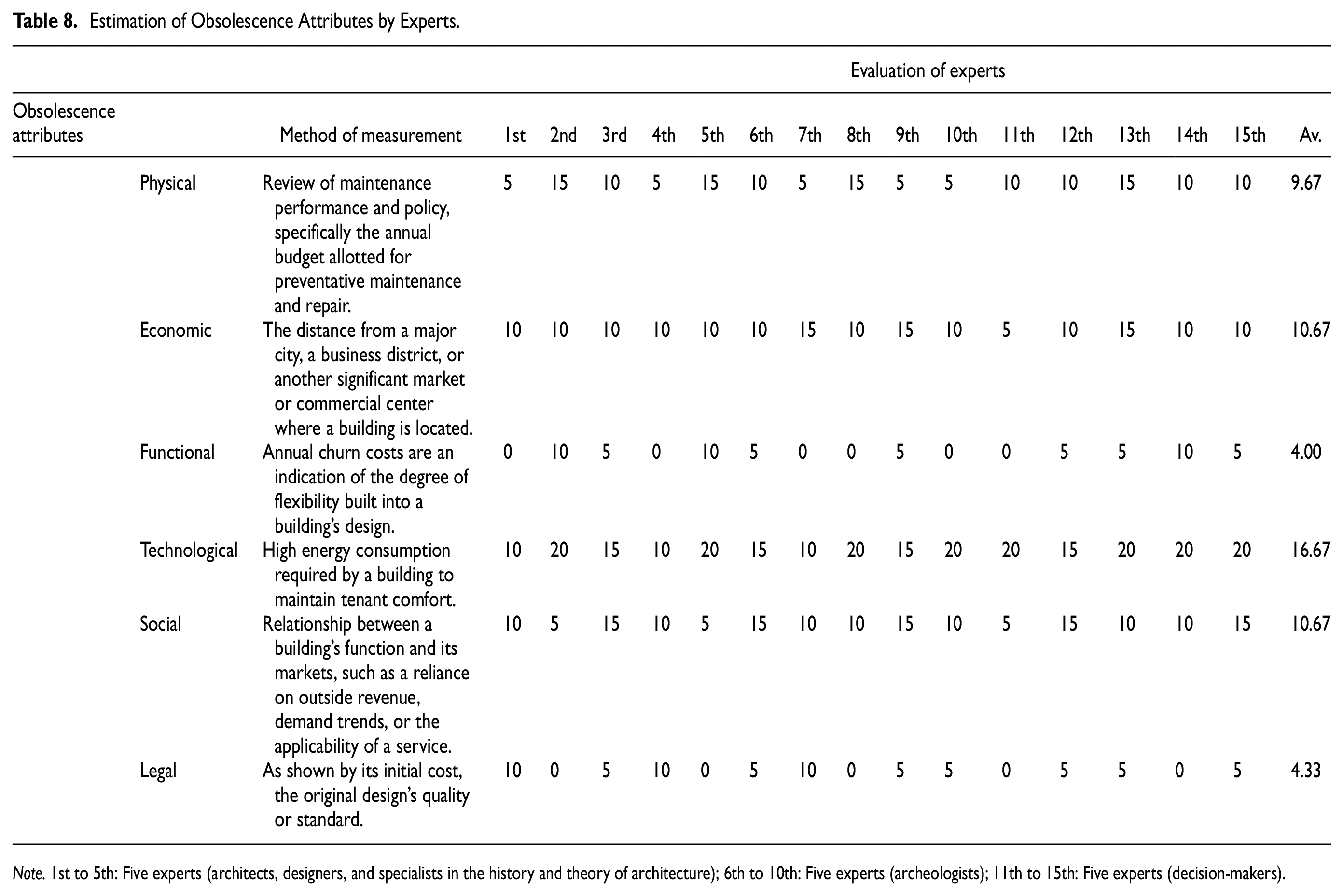
Note. 1st to 5th: Five experts (architects, designers, and specialists in the history and theory of architecture); 6th to 10th: Five experts (archeologists); 11th to 15th: Five experts (decision-makers).
Summary of Findings
The construction of Qishla Castle dates back to the year 1870, so the actual age of the building is 152 years, while its physical life is conservatively estimated at 250 years. The physical life of the structure is “discounted” by expected obsolescence, which takes into account physical, economic, functional, technical, social, and legal factors. Obsolescence characteristics of the Qishla building were estimated using the Langston model by preparing a worksheet consisting of a set of questions distributed to experts from different fields, including five (architects, designers, specialists in the history and theory of architecture), five (archeologists) and five (decision makers). The results obtained from the experts showed that the building was sturdily constructed and of a high level of quality, despite its age. A score of 9.67% was chosen to represent its physical obsolescence and a 10.67% reduction for its economic obsolescence due to its location near downtown Koya. A building with a large open design may attract a low cost of changes, thus a 4% reduction in functional obsolescence has been assumed. A value of 16.67% was chosen for technological obsolescence. While a 10.67% reduction is taken in cases of social obsolescence.
Finally, there is no doubt that the Qishla, which is still standing today, is solidly built and has a high level of quality and durability despite its real age of more than 150 years, so the reduction of 4.33% applies to its legal obsolescence. Using this data in an ARP model, the useful life (Lu) is calculated as 161 years (Equation 1) and the values of ELu (effective useful life) and ELb (effective building age) are determined by multiplying Lu and Lb by 100 and dividing by Lp, Lb is defined as the age of the current building (in years). Accordingly, ELu was calculated as 64 and ELb as 59, and by applying these values in Equation 2 the ARP was 62.24% (high). According to the model, the Qishla building has a high potential for adaptive reuse. Table 9 shows an overall calculation of items achieved regarding Qishla Castle applying the ARP model and experts’ feedback.
Overall Calculation Items of Qishla Castle Based on the ARP Model and Experts’ Feedback.

Table 9 shows the ranking of the annual rate of building obsolescence according to expert opinions as follows: technological obsolescence was recorded as the highest value with a weight of 0.167 (16.67%). Economic and social obsolescence held the same weight at 0.107 (10.67%), while physical obsolescence came in slightly lower at 0.097 (9.76%). As for legal obsolescence and functional obsolescence, it is the least with 0.0043 (4.33%) and 0.004 (4.00%), respectively.
Conclusions
Adapting the architectural heritage is a challenging process. The values, physical properties, and capabilities of the building must be well analyzed. This paper aimed to test the potentiality of reusing a historical building represented by Qishla Castle in Koya, Iraq using the Adaptive Reuse Potential ARP model. To apply this model to the Qishla area, a worksheet was prepared, including a set of questions to estimate the building obsolescence attributes. These questions were answered based on a survey and interviews with experts. The results obtained from the experts showed that the building was solidly constructed and of a high standard of quality despite its age. ARP outcomes revealed that the physical life of the building is estimated at 250 years, the building age is 152 years, the useful life is estimated at 161 years, and the most important output is the ARP value of 62.24%, meaning that the Qishla building has a high potential for adaptive reuse.
In terms of adaptive reuse, originally the Qishla Castle was built for military and protection purposes, its facades are solid with limited openings and the plan layout is an introverted organization with a courtyard in the middle. Therefore, the functions that can be suggested could include a museum, permanent and temporary exhibitions, a place to commemorate cultural events or any other function that takes advantage of the physical characteristics of the castle in addition to its historical value, to be usable by locals and tourists alike.
The value of ARP showed that the Qishla has a stable structure, high cultural and historical values, as well as a high potential for adaptive reuse. Discussion and analysis of the results proved that the adoption of the ARP model and experts’ opinions helps in determining the potentiality of reusing the building professionally and effectively. Moreover, by giving the industry a way to classify and identify existing buildings that have a high potential for adaptive reuse, the model used in this paper can help shift traditional decision-making processes by property stakeholders toward more sustainable practices, strategies, and outcomes.
This paper selects ARP as a model for performing the initial scan since it applies to any building type. The results obtained from this research are interesting and provide guidance on prioritization for the chosen case. Using the ARP model can be useful in ensuring that investing in adaptive reuse activities of the chosen case is an optimal solution. This, in turn, paves the way for further studies on similar cases to determine and diagnose conservative procedures in their regard. The outputs of the current research using the mechanism provided by this model are consistent with many studies on cases of other historical buildings (Arfa et al., 2022; Conejos et al., 2014, 2015, 2016; Hong & Chen, 2017; C. Langston et al., 2013; A. Sharifi, 2019; A. A. Sharifi & Farahinia, 2020; Shehata et al., 2022; Tam & Hao, 2019).
The methodology used, represented by ARP, with expert opinions, is limited to one type of building (Qishla castles) in one geographical area (Koya, Kurdistan Region, Iraq). More evidence is needed to determine whether these constructs are replicable in a wider range of contexts. The current research provides a starting point for future research on evaluating other buildings within architectural and urban contexts intended for adaptive reuse, particularly in the Middle Eastern context.
This research recommends more use of this model by stakeholders to help manage the daunting task of determining the best priorities for their resources to protect heritage. The scientific contribution of the current research is reflected in its main objective of presenting a working approach to redress the selected heritage building in reducing or preventing further deterioration by adopting previous global experiences as a first step in this conservation process. Moreover, continuing to work later with more specialized and comprehensive studies on this case study and similar ones due to its importance and architectural and urban uniqueness.
Research Contribution
Given the increased global interest in heritage protection, it’s critical to have the ability to quickly and accurately evaluate existing built assets in order to classify and prioritize them for prospective restoration initiatives. The early selection of properties appropriate for adaptive reuse can be guided by applying the ARP model in this regard. It can be adopted as an appropriate mechanism to deal with any existing building or heritage site to preserve it from the risk of deterioration. The notion of adaptive reuse potential (ARP) provides a rigorous evaluation of a historic building’s useful life while taking into consideration elements that contribute to its obsolescence. The approach can help decision-makers and planners prioritize the historic building inventory in order to determine when it would be best to engage in adaptive reuse and develop appropriate plans. By utilizing it in conjunction with other assessment approaches about adaptive reuse plans in more extensive future research, what may limit its application can be overcome.
Footnotes
Appendix
Declaration of Conflicting Interests
The author declared no potential conflicts of interest with respect to the research, authorship, and/or publication of this article.
Funding
The author received no financial support for the research, authorship, and/or publication of this article.
