




Abstract
Using the conservation of resource perspective, this study empirically tested the moderating role of follower proactive personality between servant leadership and follower positive outcomes (psychological resilience and ownership). Previous literature remained confined to the theories that highlights the positive impact of servant leadership on the followers, ignoring the contingency perspective. The positive outcomes of servant leadership may not be categorized as a generic remedy for every employee working under a servant leader as each individual perceived resource gain may vary. Data of 348 responses gathered from the higher education institute faculty members working in Pakistan’s public sector universities using a self-reported questionnaire. The results indicate that servant leadership along with follower proactive personality work as a key ingredient in developing positive follower resilience. This study also found that it is not servant leadership alone itself that is positive, but its influence on followers also affected by the proactive personality type of the followers.
Keywords
Introduction
In today’s competitive world, organizations across the globe are striving to attain sustainable competitive advantage. The current dynamic organizational environment compels the organizations to grow continuously to sustain (Jyoti & Bhau, 2015). In this continuous process of sustainability, employees play a critical driving role (Šlaus & Jacobs, 2011). Organizations must keep their focus on building and investing in human capital. Organizations relying on knowledge-intensive workers such as higher education institutes (HEIs) need to care for their employees a lot. Knowledge-intensive workers are far more sensitive in getting affected by the organizational environment (Horwitz et al., 2003). Because of educational globalization and competitive ranking race, higher education institutes are going through an extreme pressure phase. This pressure is trickled down to the employees (academicians). The academicians’ key performance indicators (KPI) are designed so that, along with quality teaching and administrative duties, they also need to meet the research goals. The higher education institutions, mainly in the developing nations, are having much worse conditions. They have limited resources and are unable to provide their employees with sufficient research funds. That is why academicians in developing countries such as Pakistan have high stress, burnout, low engagement, and high turnover issues (Zahra et al., 2013).
For the prevailing situation in the HEI, researchers such as Bolden et al. (2015) advised the potential use of the right leadership style. A suitable leadership style can fulfill the immense need to build psychological resilience and ownership among academicians to cope with the environmental adversities in the higher education sector. Cerit (2009) studied primary school principals and teachers and found that servant leadership behaviors lead to higher job satisfaction and commitment. The recent literature shows that positive leadership styles such as servant leadership can be a potential source of building the followers’ psychological capital in the non-profit sector (Herman et al., 2018; Newman et al., 2017). Furthermore, Yukl (2012) recommended that the researcher check empirically positive leadership styles such as servant leadership within the higher education sector.
Servant leadership style is a holistic leadership concept that states the focal purpose of the leader is to serve (Greenleaf, 1977). This approach of leadership stems from human beings’ innate need for intimacy and belonging. Van Vugt and Ronay (2014) argue that the need for belonging and personal identification dates back to the hunter-gatherer time. While the human self and contemporary leadership have evolved, the followers’ need to associate with the leader remained unfulfilled. During the tribal times, people had an intense personal association with the leader, and there was no difference in the private self and public portrayal of the leader (Van Vugt et al., 2008). Modern organizations have developed and evolved; however, they fail to provide the sense of team, belonging, and association that resembles tribal kinship. Servant leadership fills this gap by providing the base for belonging and association that offers a sense of identity to the followers (Chen, Zhu, et al., 2015). Servant leadership provides the base of co-creation where the followers and the leader work as a team to build the collective capacity. This highlights servant leadership as an approach that can help the organization meet the contemporary challenges of the workplace. At the same time, it provides the base for belonging and association (Yoshida et al., 2014).
This paper has attempted to depart from the conventional lens of looking at servant leadership from conservation of resource theory, which has solely been associated with negative consequences. This study also highlights the critical contingency under which servant leadership may cast a positive outcome on followers. The positive outcomes of servant leadership may not be categorized as a generic remedy for every employee working under a servant leader. There is a need to empirically test the boundary constraint role of follower proactive personality between a servant leader and followers’ positive outcomes.
The research in the past of servant leadership and its impact on followers lacks in defining the boundary constraints. Does servant leadership produce the same results across different types of followers? Or the follower personality type plays a moderating role in explaining the positive impact of servant leadership style on followers.
This study aims to uncover the positive psychological outcomes of servant leadership behavior on the followers and to discover the latent interacting mechanism that affects this relationship.
Theoretical Background and Hypothesis
Conceptual Model and Hypothesis
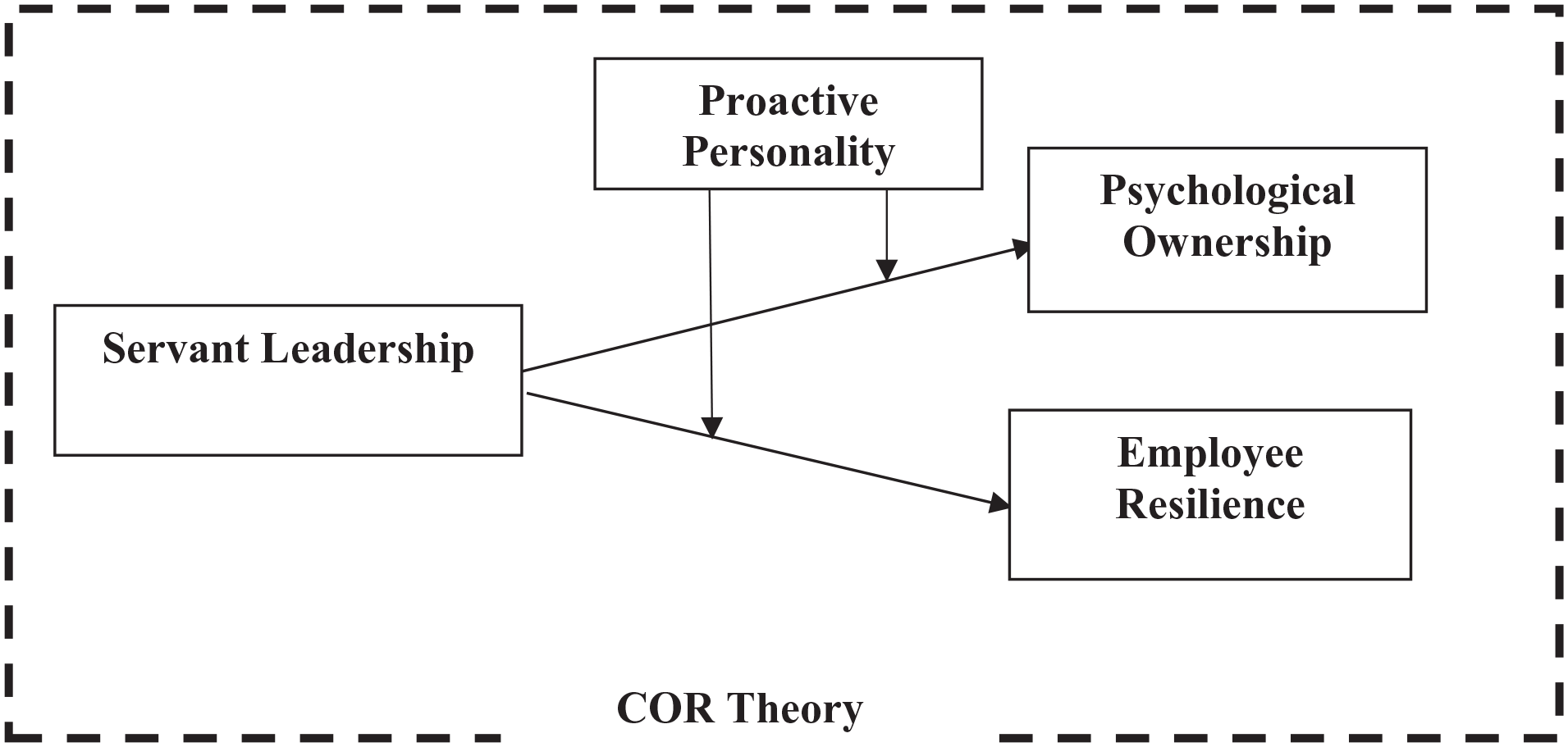
Conceptual model.
Conservation of Resource Theory
The COR theory has been used as a driving principle for explaining stressor and strain relationships. The conservation of Resource theory explains that when an employee is under a strain situation, it causes a negative outcome (Hobfoll et al., 2018). At the workplace, numerous factors can cause job strain and stress. The organizational leader may act as a significant predictor supporting employees to minimize valued resource losses. This can be achieved through better supervision, enhancing the employee resilience levels to fight and cope with the undesired events (Harris et al., 2008). In organizational settings, resource investment depends on two things: the availability of a collective pool of resources within the organizational environment and the group or individual’s ability to access these resources (Hobfoll et al., 2018). The resource caravan model explains that organizational ecologies such as support, stability, safety, and violence and safety to express ideas are essential for sustainable organizational growth and development (Chen, Westman, et al., 2015). These organizational ecologies ensure the passageways mechanism in which resources are supplied, transferred, protected, shared, fostered, and pooled. When organizations cannot guarantee such resource caravan (passageways mechanisms), employees become less productive or counterproductive (Bateman & Crant, 1993).
Eliot (2020) suggests that the servant leadership style is an ideal example of conserving and transferring resources from leader to followers. Servant leaders, by resource transfer, cast a positive outcome on the followers (Byrne et al., 2014). Servant leaders enhance the followers’ psychological capital (resource) by empowering followers, giving followers priority over the organizational goal, and focusing on followers’ growth and development. These transfers of resources from leaders toward followers build the coping mechanism and enhance employee immunity toward work-related stress (Southwick & Southwick, 2018). Once these resources are transferred to the followers, they invest more to gain new resources. This kind of resource caravans transfer further leads to resource accumulation, explained by Hobfoll (2012) as a gain spiral. The leader’s altruistic, empathetic, and authentic cues are transferred to followers in a resource caravan. However, the contingencies should be considered while understanding the resource transfers from leader to followers. As resource value valance is subjective and individual differences might play a role in defining the resource caravans (Hobfoll et al., 2018).
Servant Leadership and Employee Resilience
In literature, servant leadership is often linked with positive organizational and individual outcomes (Saleem et al., 2020). Followers under servant leadership tend to portray prosocial behavior focused on society, organizations, and the clients (Chen, Westman, et al., 2015). Servant leadership is linked with a positive performance at the individual, team, and organizational levels (Sousa & Van Dierendonck, 2016). Other employees’ outcomes positively related to servant leadership include empathy toward customers, customer co-creation, and humility within the workplace (Yang & Fry, 2018). Servant leadership is negatively associated with employee deviant behaviors (Lacroix & Pircher Verdorfer, 2017). The theory of conservation of resources (Hobfoll et al., 2018) explains that the transfer and conservation of resources from leader to followers plays a vital role in positive organizational and employee outcomes. Westman (2001) suggested that supervisor support can cause a positive resource crossover from leader to follower. For example, when a leader utilizes the resources at work, such as being supportive and empowering, employees have enhanced resilience. Employee resilience creates endurance for employees to deal with hostile forces at the workplace and harness their feelings to pursue alternative employment opportunities (Harris et al., 2008).
Windle (2011) defines employee resilience as the ability of an individual to sustain, maintain, or develop mental health under adversities. Herrman et al. (2011) there are three kinds of factors that cause resilience. (1) personality factors (personality traits, individual locus of control, self-efficacy, optimism, and demographics), (2) biological factors (genetics, brain structure, and development of brain and function), and (3) environmental factors (social supports, relationship with leaders, peers, and family, and schooling or community life). As per its properties, servant leadership can be a potential source of building followers’ psychological resilience so that employees can deal with adversity and hostile forces at the workplace (Chen, Westman, et al., 2015).
Spencer (2007) posits that only servant leaders can serve the followers to lead to better self-efficacy and resilience among current leadership styles. However, less is known empirically about the positive resource crossover and its vital contribution to enhancing resilience concerning the servant leadership style (Eva et al., 2019). Therefore, we have formulated the following hypothesis:
Servant Leadership and Individual Oriented Psychological Ownership
The literature on servant leadership has proved the role of a servant leader in equipping followers with autonomy. The servant leadership theory states that the leader’s primary motive involves devolving followers (Smith, 2005). The servant-leader empowers followers by putting trust in their abilities. Furthermore, the servant leader has an altruistic concern for the follower’s well-being. This gives the message to the followers that their leader is a firm believer in their abilities, and he/she is not there to direct them instead to help them physically and psychologically in their tasks. Such leadership behavior causes the subordinates to perceive higher psychological ownership at the workplace (Bernhard & O’Driscoll, 2011). Van Winkle et al. (2018) stated that servant leaders empower their employees by giving value to people, serving their needs, and building their confidence. The servant leaders typically utilize resources such as personal resources (e.g., assistance, encouragement), energy resources (e.g., time extensions), and empowerment to the employees to design their work activities layouts (Hobfoll, 2011; Lam et al., 2017). The resources sharing and transfer from a leader helps the followers in offsetting the workplace adversity and hostility.
The study conducted in organizational psychology found that a leader with emphatic and supportive behavior will induce optimistic perception among followers regarding the organization’s future success (Gardner & Schermerhorn, 2004). According to COR theory by Hobfoll (2011), When a leader shares or transfers power (resource) with followers, the follower feels the resource gain. The resource gain leads toward positive energy among the subordinates, thus enhancing their psychological ownership. A servant leader has shown a higher variance than any other leadership style for causing positive attitudinal change among the followers (Hoch et al., 2016). The servant-leader philosophy is first to serve the employees formerly the organization. The employee needs come ahead of organizational needs (Lapointe & Vandenberghe, 2018). Servant leadership style is a follower-oriented leadership style. Researchers argue that the follower-oriented leadership style effectively promotes psychological ownership. Such as under an empowering leader, the employees tend to perceive intense organizational loyalty to a point where the employees internalize the possession of the organization and identity the same as “Theirs” (Han et al., 2010). Empowering Leadership style through psychological ownership has many positive outcomes on followers such as performance, employee satisfaction, loyalty, affective commitment, and intention to stay (Kim et al., 2018).
The researchers believe that servant leaders continuously create a feeling of trust by consistently sharing resources to empower followers. Along with building trust and empowering followers, servant leaders also display accountability, high moral values, and ethics while serving followers. These behaviors cause followers to feel psychological ownership at the workplace (Barbuto & Wheeler, 2006; Joseph & Winston, 2005). The servant leaders’ altruistic concern for their subordinates causes them to take responsibility for the task and challenge organizational goals as their own. It leads employees to take responsibility for their work and pursue organizational goals as their personal goals. It will lead to a felt obligation like one has for their own business or work. Therefore, servant leaders can induce the perceived psychological ownership among the individual (Bernhard & O’Driscoll, 2011; Chiniara & Bentein, 2016; Sun, 2013).
In line with the review mentioned above of literature, this study proposes that if the supervisor shows these servant behaviors, it can build the perception among their followers regarding psychological ownership.
Therefore, the following hypothesis has been formulated,
Proactive Personality as a Boundary Condition for Servant Leadership and Employees’ Resilience and Psychological Ownership
Leadership style and its effectiveness depend on the unit’s performance. The contingency perspective of leadership theories suggests that leaders adjust their leadership style according to the followers’ characteristics (Hersey & Blanchard, 2012). The young employees believe to be more proactive than their older counterparts and demand leadership that gives them opportunities and challenging tasks. These contingencies need to be understood while opting for the right leadership style. The contingency perspective of leadership research suggests that for a leader to be effective; They must match their leadership style as per the prevailing situation (Hersey & Blanchard, 2012). There are apparent differences in today’s workers’ ideals, morals, and behavior, which have made the current leadership theories face the crisis of becoming less applicable to 21st-century organizations (Anderson et al., 2017). Anderson et al. (2017) further argued that rather than perceiving these differences among generational cohorts as a threat to leadership theories, researchers have to accept these contingencies as a source of new openings to add to the existing literature for leading employees in the organization. Generational theory bases its argument on the axiom that people’s birth, experiences, historical events, and formative experience constructs their personality and attitudes. So, people sharing such time slots collectively share their values, attitudes, and behavior to form a cohort.
Twenge et al. (2010) believes that social and personal factors in a person’s formative years constitute today’s decision-making. Twenge et al. (2010) also believes that even at the workplace, people born at the same time frame tend to share commonalities on values, attitudes, and behavior as they are exposed to more or less the same life experiences. Existing theories explaining the leader-follower relationship regarding followers’ type are limited to group-level variables such as age. The current study incorporates interindividual differences such as proactive personality traits as a boundary condition to identify if servant leadership can be effective across followers with different personality types.
The COR theory emphasizes that the importance and value given to a resource may vary across individuals. As the personality traits of individuals differ from one person to another, there is a need to apply a contingency perspective here concerning follower personality differences (Hobfoll et al., 2018). Since a servant leader’s prime objective is to fulfill subordinates’ needs (Ehrhart, 2004), in this regard, servant leadership might be valued more by those who have more proactive personalities than their counterparts (Ye et al., 2019).
The proactive followers are more prone to take full advantage of servant leader behavior than those who are less proactive (Harvey et al., 2006; Newman et al., 2017). The proactive personality is an employee’s tendency to explore and identify different opportunities. The employee having proactive personalities are adaptive to environmental changes. These employees are not passive relatively active in acquiring new knowledge and information (Li et al., 2010). They have an internal locus of control and treat the environment changes as opportunities, not as threats. These employees are in a continuous state of improving the workplace through their innovative ideas. Proactive employees demand more training and development opportunities to help them grow in their careers (Newman et al., 2017).
Last two decades, researchers have supported proactive personality to be conceptually independent of the “Big Five Personality factors.” This paper highlights the use of proactive personality as a construct to have insight into the follower type. “Proactive personality” variable is far better in explaining variance to measure the proactiveness in personality than Big Five Inventory (BFI; Major et al., 2006). Proactive personality incorporates and predicts personality behaviors that were not accounted for by the Big Five Personality Factors (Bakker et al., 2012). A study conducted by Major et al. (2006) has discovered that Big Five Personality Factors have shown only 26% of the variance for proactive personality.
Therefore, the current study proposes the role of follower proactive personality as a potential boundary condition. The perception of a servant leader would lead to higher psychological ownership and employee resilience for followers with high proactive personalities compared to those with low proactive personalities.
Methodology
The research follows a quantitative, positivist approach for empirically testing the proposed hypothesis. The cross-sectional data were collected using self-reported questionnaires. The questionnaires were distributed among faculty members of eight public sector universities located in Punjab and federal territories of Pakistan using the non-probability sampling technique. Out of the total 373 returned, 348 questionnaires were usable. The response rate was 43.5%. While collecting the data, the target was to go beyond the minimal requirement for the sample size. The required minimum sample size was 149, calculated using the G power sample calculator. However, Awang et al. (2015) suggested a minimal sample size of 200 to be used for covariance-based structural equational modeling. The study participants were lecturers, assistant professors, associate professors, and professors working in the public sector universities in Pakistan. Among the 348 usable responses, 59.8% (208) were male, and 40.2% (140) were female. 56.6% of the respondents were from the age group 25 to 39 years, whereas 37.9% were from the age group 40 to 55 years. Only 5.5% of respondents were from the age group above 55 years. According to the level of education, most of the respondents, that is, around 60% had the MPhil degree, 35.5% held the Doctoral degree, 3.2% held the Master degree, and only 1.7% had the Post-Doc. Regarding the designation, 52.6% were lecturers, 33.6% were Assistant professors, 10.9% were Associate professors, and 2.9% were professors.
Research Measures
This study has adopted the validated scales from previous studies to measure the variables. All the variables were measured using a 7-point Likert scale. According to Chomeya (2010), the 7-point Likert scale tends to provide values of discrimination and reliability that are greater and more accurate than the 5-points Likert scale.
Servant leadership
Servant leadership was measured by adopting Ehrhart (2004) 14-item global scale. This measure has established validity in prior studies (Hunter et al., 2013). Liden et al. (2015) argued that it is better to use a global scale than a multidimensional scale to measure servant leadership because it is not a higher-level construct. Example item “My supervisor spends the time to form quality relationships with department employees.”
Employee resilience
Resilience was measured using a 10-item validated shorter version scale developed by Campbell-Sills and Stein (2007). Example items “I can handle unpleasant feelings.”
Individual oriented psychological ownership
Psychological ownership contains basically “two dimensions, that is, Individual oriented psychological ownership (IPSO) and Collective oriented psychological ownership (CPSO).” This study focused on the IPSO dimension only. There exist a clear distinction between psychological ownership as an individual-oriented construct (“ I feel this is mine”) and a group level or team level collective-oriented construct (“ I feel this ours”; Pierce & Jussila, 2011). Henssen et al. (2014) argued that both dimensions of psychological ownership might covary; however, these two dimensions can exist independently. For example, an individual in a small company or family firm may experience a high level of collective-oriented psychological ownership without experiencing a high level of individual-oriented psychological ownership and vice versa when studying large public sector organizations with a significant number of employees under a departmental leader its preferable to use the individual oriented psychological ownership as employees don’t have team bonding and any specific collective group affiliations. Individual-oriented psychological ownership (IPSO) was measured by using a Likert scale of five items created by Van Dyne and Pierce (2004) and validated by Henssen et al. (2014).
Proactive personality
Proactive Personality was measured using the 10-item version developed first by Bateman and Crant (1993), which was later refined by Seibert et al. (1999) and was validated by Trifiletti et al. (2009).
Data Analysis
We have applied the covariance-based structural equational modeling technique to empirically test the hypothesis using Amos 24. The two-stage structural equation modeling technique is used as it decreases the interactional impact of measurement and structural models (Byrne, 2013). At the first stage, we examined the measurement model by applying confirmatory factor analysis to establish the convergent and divergent validity, composite reliability, and causal relationship between observed items and latent construct (Hair, Matthews, et al., 2017). Later, using the data imputation technique, a composite structural model was built from a measurement model. We examined the relationship between exogenous and endogenous variables at the second stage using the composite structural model. The study analyzed the moderation effect using the Amos 24, Johnson-Newman plot plugin with 5000 bootstrap samples and 95% confidence intervals.
Common Method Bias
The study data was collected at a single time using the self-reported questionnaire. There were chances of having the common method variance. In order to treat the common method bias, procedural and statistical remedies were used (Tehseen et al., 2017). Herman single factor and Common latent factor test were used to detect the bias. The common latent factor was retained while variable imputation to minimize the potential common method bias. Figure 2 shows that the common variance is estimated as the square of the common factor of each path before standardization. The common heuristic of our model CLF is 26% which is far less than the maximum threshold of 50% (Eichhorn, 2014).

Two common latent factor model with standardized estimates.
Therefore, we can say there is no critical issue of common method bias in our data.
Measurement Model
Figure 3 shows the measurement model of this study. The recommended cut-off values of Whiting and Kline (2007) for the model fit are taken as the benchmark. Table 1 shows the model fit values from the measurement model against the benchmark values. These values are the indicator for model fit, such as goodness of fit index (GFI), χ2 values to the degrees of freedom (χ2/df), comparative fit index (CFI), and root mean square error of approximation (RMSEA). All were under the ideal acceptable values for a good model fit.
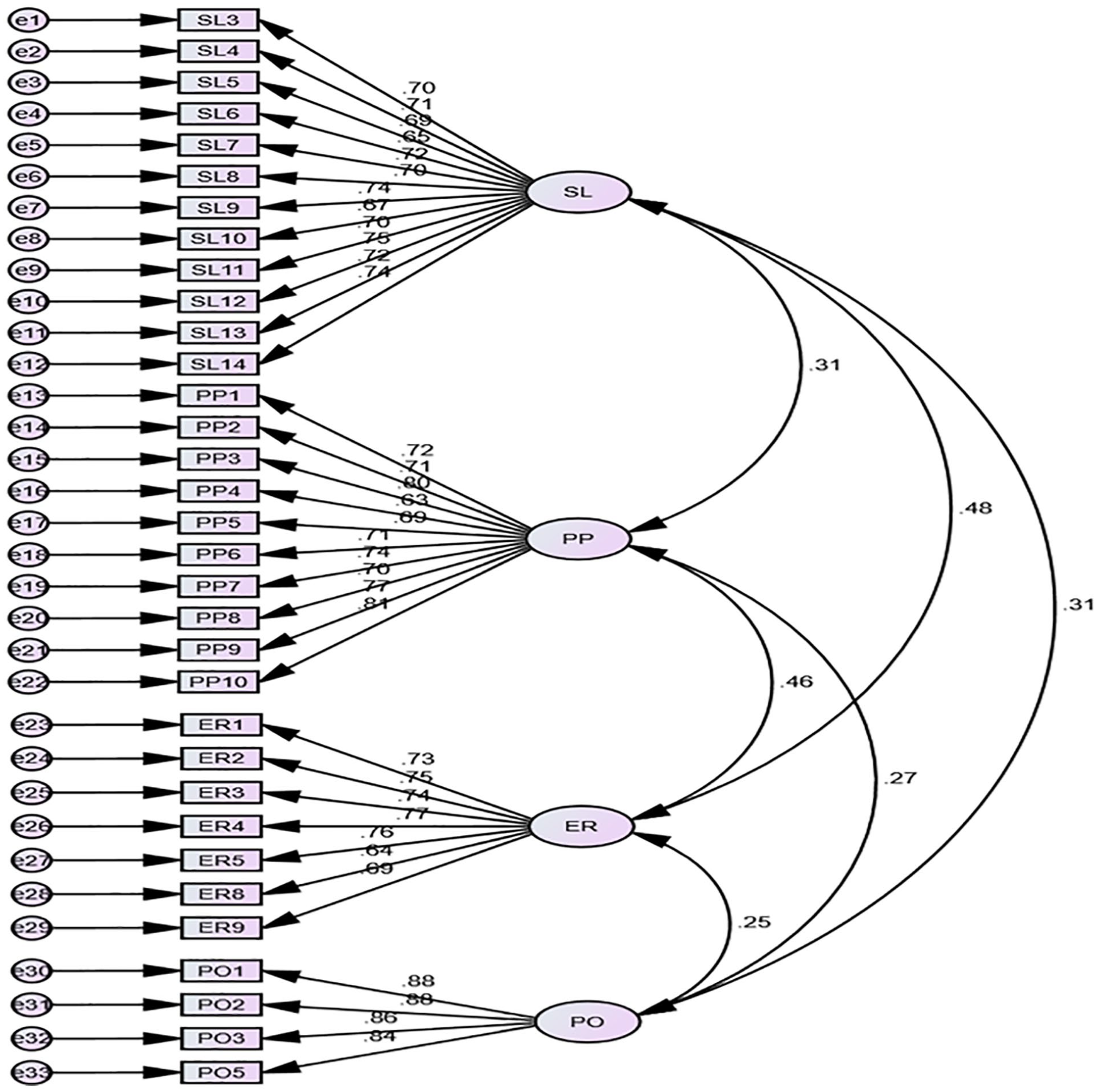
Measurement model.
Model Fit Measures.
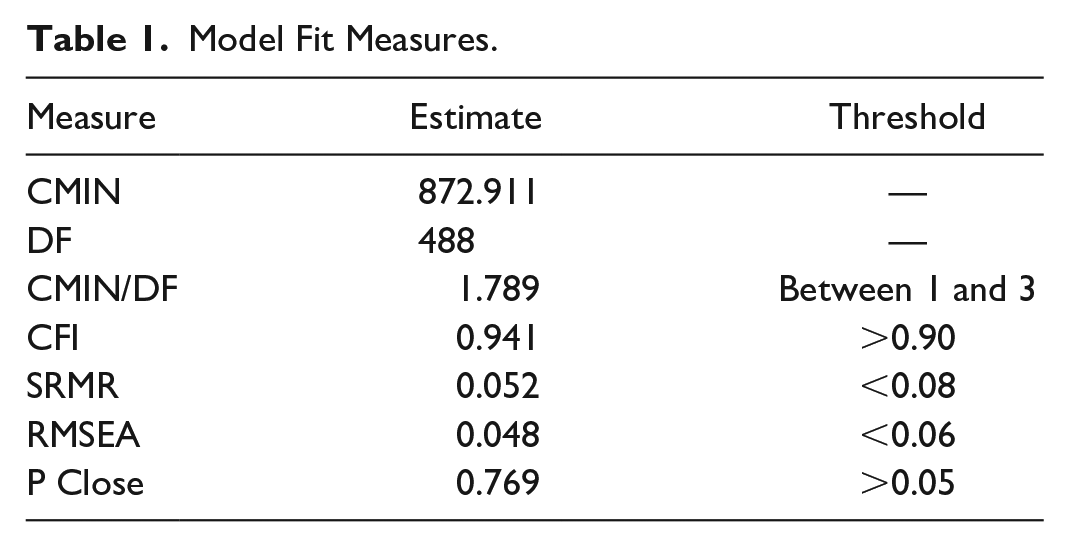
The confirmatory factor analysis (CFA) results shows good fit indices for our data. The χ2/df = 1.78, CFI = 0.94, SRMR = 0.052, RMSEA (Root mean square error of approximation) = 0.050, and PCLOSE = 0.769)
Convergent validity
The construct convergent validity depends on the convergence of the items which the Factor Loading reflects, Average Variance Extracted (AVE), and Composite Reliability (CR), respectively (Hair, Babin, et al., 2017). The item loading should be above 0.5 in order to establish convergence (Awang, 2014). All the items in the study had loading above 0.5 except items SL1 and SL2, ER6, ER7, ER10, and PO4 (see Appendix for factor loading table). These items were deleted. Furthermore, to establish the discriminant validity as suggested by Fornell and Larcker (1981), Average Variance Extracted (AVE) and composite Reliability (CR) were used. Table 2 shows that all the variables have (CR) and (AVE) values above 0.7 and 0.5 threshold values, respectively (Hair, Babin, et al., 2017).
Measurement Model Specification.

Note. Values in bold are the square root of AVE. The square root of AVE for each construct should be more than its correlation with other constructs. PP = proactive personality; SL = servant leadership; ER = employee resilience; PO = psychological ownership.
p < .05. **p < .001.
In addition to Fornell and Larcker criteria, we have also applied the HTMT criterion (Henseler et al., 2014) for discriminant validity (see Table 3). The HTMT establishes the discriminant validity by ensuring that all the reflective constructs have the most substantial relationship with their indicators. Because the discriminant validity assessment ensures that a reflective construct has the strongest relationships with its indicators, the HTMT for each construct should be less than the cutoff value of 0.85 (Kline, 2011). The outcome values of the constructs were under the desired range, therefore, establishing the convergent and discriminant validity.
HTMT.

Note. PP = proactive personality; SL = servant leadership; ER = employee resilience; PO = psychological ownership.
Hypothesis Testing
In order to test the hypothesis empirically, we constructed the composite structural equational model based on composite mean variables (see Figure 4). As predicted, the result (Table 4) explicitly indicated that servant leadership has a significant positive relationship with employee resilience (β = .49, p < .01). In addition to it, servant leadership also has a significant positive relationship with psychological ownership (β = .28, p < .01). Therefore, supporting H1 and H2.

Structural model.
Path Analysis.

Note. PP = proactive personality; SL = servant leadership; ER = employee resilience; PO = psychological ownership.
p < .05. ***p < .001.
The moderation analysis
To test the moderation effect as formulated in hypotheses H3a and H3b, we followed the Hayes (2017) approach. The interaction term was created by multiplying the standardized Independent variable and standardized moderator variable. Using the Amos with 5,000 bootstrap, 95% biased confidence interval, the IV, M, and both interaction terms were simultaneously regressed to the DV see Figure 4. The results (Table 5) show that the proactive personality had a significant positive moderating effect on the relationship between servant leadership and employee resilience (β = 26, p < .001), supporting H3a. In contrast, it had an insignificant moderating effect on the relationship between servant leadership and psychological ownership (β = .035, p = .41), lending no support to hypothesis H3b.
Results.

We have used the Johnson-Neyman moderation plot technique to depict the interaction effect using Amos 24 plugin and simple slope. Figure 5 shows the Johnson-Neyman plot, and it illustrates that moderation is present because Y does not equal zero for any values of X within the confidence intervals.

Johnson-Neyman plot.
To explicitly explain the moderating effect of proactive personality, we plotted the moderating effect and calculated the simple slopes by adopting the Toothaker et al. (1994) procedure. Figures 4 and 5 showed that followers’ proactive personality strengthens the effect of servant leadership on follower resilience. Figure 6 shows that at the high-level proactive personality, there is a higher impact of servant leadership on follower resilience than the lower level of proactive personality.
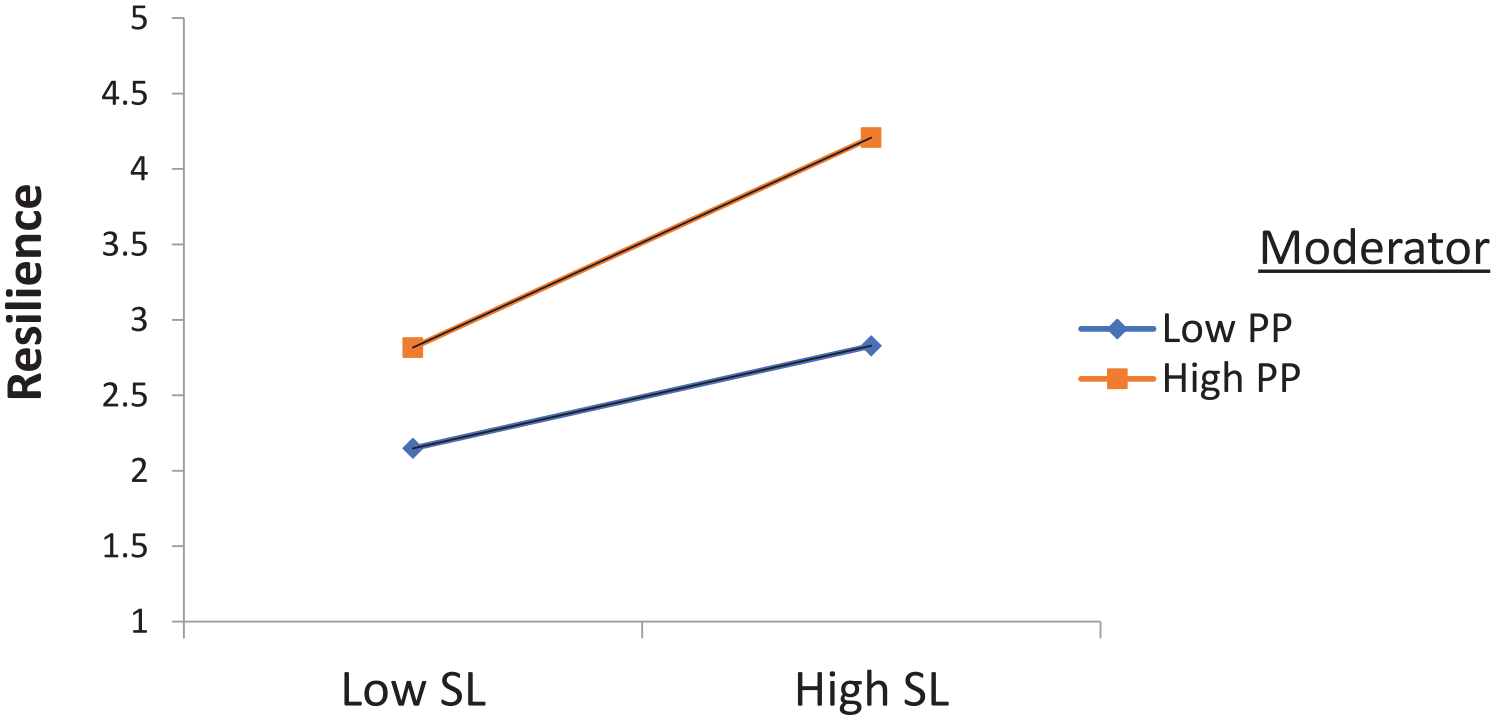
Plot of simple slopes.
Discussion and Conclusion
Hypothesis Results
The present study found that perceived servant leadership style significantly influences the follower’s psychological ownership and resilience. Those academicians who perceive their head of department as servant leaders feel more resilience and psychological ownership at the workplace. These findings are aligned with the previous studies on servant leadership and positive employee outcomes (Brohi et al., 2018; Hunter et al., 2013; Wu et al., 2013). Servant leaders trust their subordinates by transferring resources to followers, making them empowered hence building followers’ psychological ownership (Yildiz & Yildiz, 2015). Our finding suggests that servant leaders are more altruistic and empathetic toward followers, making employees more resilient. Chiniara and Bentein (2016) argue that servant leaders’ prime focus is on the followers’ interests rather than an organization. Servant leaders put followers’ needs ahead of organizational needs.
The result revealed that the followers’ proactive personality significantly strengthens servant leadership’s positive impact on followers’ resilience level. The finding suggests that academicians with strong proactive personalities have better resilience levels under a servant leader than academicians who are less proactive. The individuals who have proactive personalities are more welcoming toward opportunities, risks, and challenges (Seibert et al., 1999). Therefore, when such employees are under a servant leader, they utilize these positive resources transfer to enhance their resilience. For example, when a servant leader demonstrates empowerment, delegation, and supportive characteristics, the proactive individual takes these as a goodwill gesture from the leaders, and it enhances their resilience to workplace adversities.
On the other hand, employees with less proactive personalities are, in other words, reactive personalities; they prefer stability over change and avoid risk-taking behaviors. Therefore, employees with less proactive personalities are reluctant to gain responsibility and might perceive the delegation of authority and power as workplace adversity. These findings are consistent with the conservation of resource theory assumptions that employees’ perception does vary in assigning value to resources. The resources gain realization is contingent on individual traits (Bardoel et al., 2014; Chen, Westman, et al., 2015). The study findings are consistent with Newman et al. (2017), who found that individuals with proactive personalities respond more positively to servant leadership in enhancing organizational citizenship behavior. Therefore, we can say that proactive followers have better coping abilities to withstand organizational and job stressors under a servant leader than followers with low proactive personality types. The past studies have found a significant positive relationship between servant leadership and employee psychological capital (Khatri & Dutta, 2018). However, the psychological ownership of followers is not affected by the type of personality. The insignificant interaction effect of followers’ proactive personality indicates followers, irrespective of their high or low proactive personalities, feel psychological ownership under a servant leader. Therefore, servant leadership is a strong predictor of psychological ownership among academicians. Hence, this study determined that the proactive personality is a necessary boundary condition for identifying the effect of servant leadership on the follower’s psychological resilience. The servant-leader has a more substantial impact on enhancing the follower’s resilience when the followers have high proactive personalities. In other words, a high follower’s proactive personality strengthens the positive relationship between servant leadership and followers’ resilience.
This empirical study has uncovered the practical application of servant leadership by redefining it with follower personality types within the higher education sector. The significant theoretical contribution of this study also involves the use of conservation of resource theory to understand the resource transfer mechanism between leader and follower within the organizational setting. This study is a pioneer to introduce and empirically test follower resilience, an essential component of psychological capital as an outcome of servant leadership. Today’s higher education institutes need to build the employees’ psychological ownership and resilience. The findings suggest that servant leaders play a pivotal role in this regard. However, previous research on servant leadership has ignored the resource conservation point of view while studying the psychological impact of servant leaders on followers (Eva et al., 2019). This paper contributes to leadership literature by stimulating a broader investigation of servant leadership to the possible positive consequences with incorporating the potential boundary conditions, complementing existing approaches which mainly relied on the positive outcomes of servant leadership irrespective of the boundary conditions involved.
The current research findings benefit department leaders by giving helpful insight to understand the subordinate psychological perspective and suggesting an ideal leadership style to lead. Knowledge-intensive workers such as researchers are highly prone to workplace adversities. These employees are sensitive to the working environment. A slightly unfavorable condition can affect their psychological state. Their psychological health affects their outcome and organizational performance (Horwitz et al., 2003). The study findings highlight that psychological capital such as resilience act as a coping mechanism for the employees during adversities. A leader can facilitate the followers by sharing and transferring the resources and building followers’ ability to withstand the hardship at the workplace. The head of the department, demonstrating servant leadership characteristics such as empathy, humility, open communication, empowerment, listening, stewardship, developing followers, and supportive feedback, makes employees believe that their leader puts the follower’s interest above the institutions and self-interest. It makes the employees more resilient and builds their psychological ownership.
Limitations and Future Recommendations
The study uses the cross-sectional design with follower-reported measures. The self-reported measure and single-source data collection may cause common method bias. However, this limitation has been minimized using procedural and statistical measures(Chin et al., 2013). Future researchers should incorporate the time-lapse or wave design to measure the constructs. Also, it would be more effective to use a dyadic design for measuring leadership style and follower psychological ownership and resilience. To provide strong evidence of causal relationships between servant leadership and followers’ positive outcomes, the future researcher should design the experimental or quasi-experimental design. The causal relationship of servant leadership on follower outcomes can be examined by incorporating intervention such as servant leadership training and taking the employees’ response pre and post-intervention.
Footnotes
Appendix
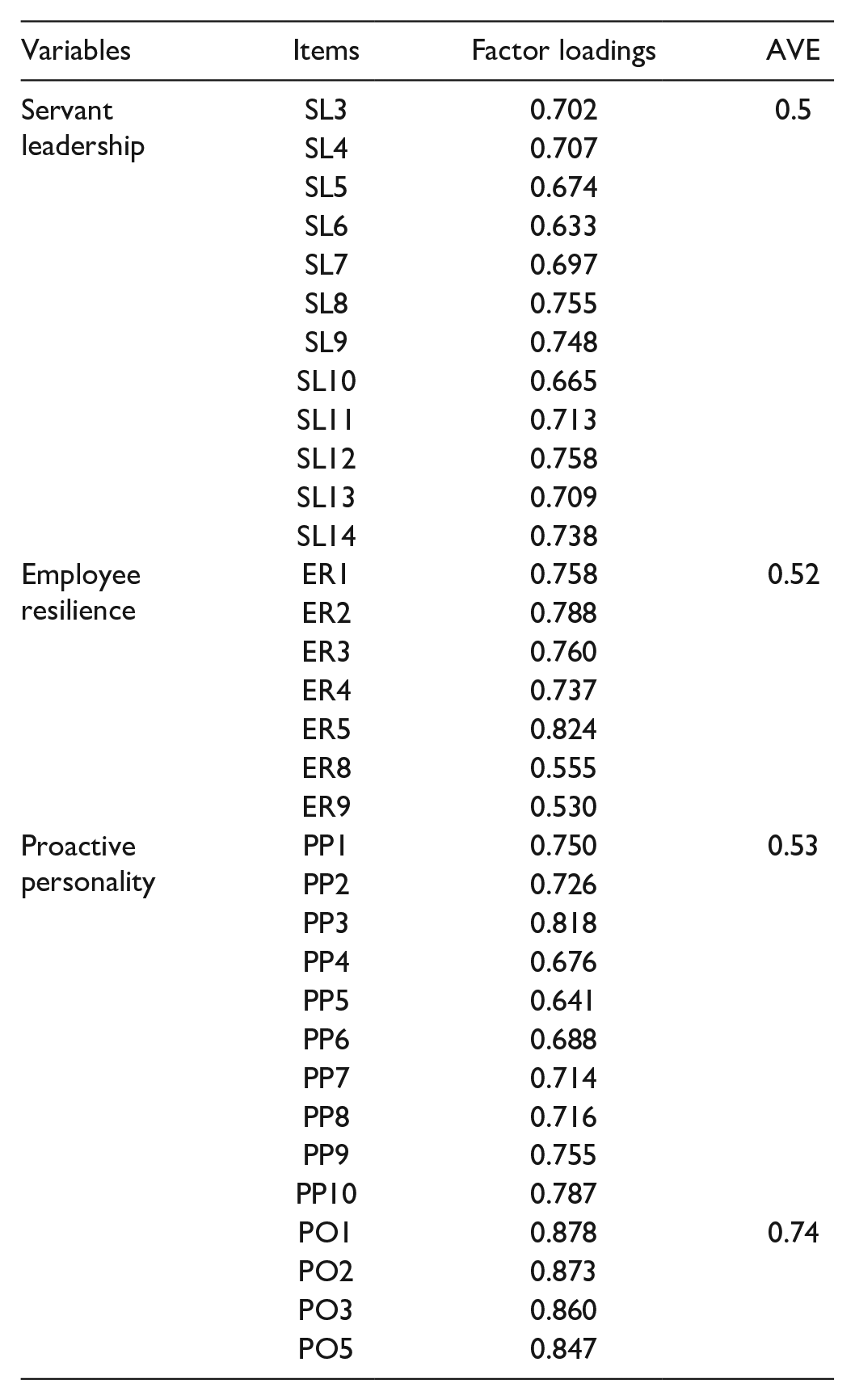
| Variables | Items | Factor loadings | AVE |
|---|---|---|---|
| Servant leadership | SL3 | 0.702 | 0.5 |
| SL4 | 0.707 | ||
| SL5 | 0.674 | ||
| SL6 | 0.633 | ||
| SL7 | 0.697 | ||
| SL8 | 0.755 | ||
| SL9 | 0.748 | ||
| SL10 | 0.665 | ||
| SL11 | 0.713 | ||
| SL12 | 0.758 | ||
| SL13 | 0.709 | ||
| SL14 | 0.738 | ||
| Employee resilience | ER1 | 0.758 | 0.52 |
| ER2 | 0.788 | ||
| ER3 | 0.760 | ||
| ER4 | 0.737 | ||
| ER5 | 0.824 | ||
| ER8 | 0.555 | ||
| ER9 | 0.530 | ||
| Proactive personality | PP1 | 0.750 | 0.53 |
| PP2 | 0.726 | ||
| PP3 | 0.818 | ||
| PP4 | 0.676 | ||
| PP5 | 0.641 | ||
| PP6 | 0.688 | ||
| PP7 | 0.714 | ||
| PP8 | 0.716 | ||
| PP9 | 0.755 | ||
| PP10 | 0.787 | ||
| PO1 | 0.878 | 0.74 | |
| PO2 | 0.873 | ||
| PO3 | 0.860 | ||
| PO5 | 0.847 |
Declaration of Conflicting Interests
The author(s) declared no potential conflicts of interest with respect to the research, authorship, and/or publication of this article.
Funding
The author(s) received no financial support for the research, authorship, and/or publication of this article.
Ethical Approval
The researchers have got the ethical clearance from the university of Malaya ethical committee (non-medical) approval prior conducting the data from the human participants (Reference Number: UM.TNC2/UMREC—791).
