




Abstract
Online learning platforms have become important learning tools, and online learning replaced face-to-face teaching as the primary learning method of students during COVID-19. However, there have been few systematic studies on learning effectiveness and its influential factors. This study was based on fuzzy-set qualitative comparative analysis (fsQCA) to explore the joint effects of multiple factors on online learning effectiveness for tourism and hospitality students from the dual perspective of the platform and individual. The results revealed five antecedent combinations that led to high-quality online learning, which were categorized into “platform-individual” internal and external promotion paths and “function-interaction” platform environment promotion paths. Moreover, there were substitution effects in the paths to high-quality online learning; specifically, perceived usefulness (PU) and perceived ease of use (PEU) were substitutable, and perceived playfulness (PP), learning attitude (LA), and self-efficacy (SE) could replace each other. Finally, self-efficacy was not a necessary condition for efficient online learning. Our findings highlight substitution relationships among the influencing factors of online learning effectiveness from a configuration perspective and further reveal the internal micromechanisms of achieving high-quality online learning.
Introduction
Online learning has become an important way for students to acquire knowledge and improve their learning abilities, it also can help them use time and space flexibly, and achieve personalized learning (Chou et al., 2019; Hao et al., 2019; Obeidat et al., 2020; Shen & Wu, 2020). Moreover, online learning has been recognized as an essential supplement to traditional face-to-face teaching (Chin et al., 2019; Gao et al., 2020). The outbreak of COVID-19 expanded the scope and scale of online learning (Guppy et al., 2023). To avoid health risks from close contact, face-to-face teaching has been forced to turn to distance learning through digital platforms (Amin et al., 2021; Lewis & Price-Howard, 2021; Qiu et al., 2020). Unlike regular online learning in noncrisis situations, online learning affected by COVID-19 is an emergency solution to ensure uninterrupted learning activities. Students and teachers in different spaces need to adapt to a new learning model in a short time, which has also been referred to as emergency distance teaching (Clemente et al., 2022; Dibra et al., 2022). It has become a key alternative to face-to-face teaching in special times and has shown significant relevance (Clemente et al., 2022). Consequently, it is necessary to explore the effectiveness of online learning as affected by COVID-19, which will aid in understanding distance teaching quality and promoting its high-quality development.
Tourism, as one of the industries most affected by COVID-19, emphasizes training practitioners and managers with extensive knowledge and skills (Bakar, 2020). It is crucial for tourism recovery and high-quality development under epidemic normalization (L. Qiu & Qi, 2020). Compared to other disciplines, tourism and hospitality students need to have a diverse and systematic knowledge base and professional skills (Kim & Jeong, 2018; Kırlar-Can et al., 2021). Online learning platforms, as powerful learning mediums with large knowledge bases and flexible styles, are beneficial for tourism and hospitality students’ learning planning and knowledge acquisition. They are not only critical learning pathways during COVID-19 but also represent future trends in tourism and hospitality education (Kim & Jeong, 2018; H. Qiu et al., 2020). Thus, it is important to discuss online learning effectiveness during COVID-19 for the overall development of tourism and hospitality students.
Learning effectiveness is regarded as a vital indicator of learning quality, and how to improve it has received continuous attention from scholars. In face-to-face teaching, scholars have systematically explored the effects of elements such as teaching style (Iterbeke et al., 2021), learning attitude (Liaw et al., 2007 ), and learning patterns (Sáiz Manzanares et al., 2017) on classroom learning effectiveness. With the emergence of online learning, in addition to individual factors (Mizani et al., 2022; Uslu & Durak, 2022; Yilmaz, 2017), scholars have paid extra attention to the influence of the platform environment on online learning effectiveness (Gao et al., 2020; Nkhoma et al., 2017). Previous studies have proven that high-quality learning platforms and system design contribute to achieving effective online learning (María et al., 2019). In conclusion, the factors influencing learning effectiveness have been extended with changes in learning tools and environments. However, current studies focus on the net effect from a single fact (Gao et al., 2020; María et al., 2019; Nkhoma et al., 2017), neglecting the linkage effect of multiple factors on online learning effectiveness. Factly, learning effectiveness is an interactive outcome of multifaceted factors from the environment and individual characteristics. In a word, existing findings cannot provide direct empirical evidence for tourism and hospitality students to achieve effective online learning.
In summary, we explored the learning effectiveness of tourism and hospitality students who have undergone the COVID-19 online learning experience to answer the following questions: (1) What are the paths to improve online learning effectiveness? (2) How do platform and individual factors together affect online learning effectiveness? (3) What are the key elements of high-quality online learning? To address these questions, we performed fuzzy-set qualitative comparative analysis (fsQCA) to assess the influencing mechanism of online learning effectiveness from a holistic perspective. We identified promotion paths and further expanded the research framework of online learning effectiveness. Our study may help to optimize online learning platform design and promote the development of high-quality online tourism education.
Literature Review
Learning effectiveness refers to students’ understanding, mastery, and application of knowledge after completing learning plans (González & Wagenaar, 2008). From a practical level, tourism and hospitality teachers generally examine students’ learning effectiveness through course reports, regular routine work, and final examinations. Generally, if students have deep memory and understanding of learning content, they will perform better on both homework completion and final exams, then receive higher GPAs accordingly. High learning effectiveness becomes students’ learning motivation and striving goal and provides guidance for curriculum design and teaching methods (Allgood & Bayer, 2017). It also contributes to the direction of teaching evaluation and management (Murtonen et al., 2017). Thus, how to improve learning effectiveness has long been valued by scholars. Some researchers have proven that environmental factors play important roles in learning effectiveness, such as playfulness (Gao et al., 2020; Teng et al., 2021), interactions (Blasco-Arcas et al., 2013; Luo et al., 2017). There are also some papers that discuss the effects from the perspective of individual characteristics, including learning motivation (Cheng, 2013), self-efficacy (Karabacak et al., 2019; Wallace & Kernozek, 2017), learning attitude (Prior et al., 2016), and so forth. In addition, how teachers’ teaching ability and curriculum design influence learning effectiveness have also been explored (Li et al., 2021; Fountoukidou et al., 2019). With the development and use of new technologies in learning, environmental, and individual factors have been identified as critical factors influencing online learning effectiveness (Deng et al., 2020; Du & Li, 2015; Panigrahi et al., 2018).
Constructivist learning theory (CLT) believes that both the learner and learning environment can influence learning effectiveness. The learner responds to the external environment by assimilating and adapting to enrich and develop the knowledge structure based on their own characteristics. It has been applied in online education research (Alismaiel et al., 2022; Donkin & Rasmussen, 2021). After the outbreak of COVID-19, various online platforms replaced the traditional classroom as an interactive learning environment to provide subject information and knowledge for students. In addition, teachers’ supervision was weakened because of spatial heterogeneity, and students’ individual characteristics played a crucial role in learning (Burcă-Voicu et al., 2022; Liaw, 2008). In other words, tourism and hospitality students have adapted to learning platforms based on their own characteristics. Consequently, we tried to explore the joint effects of the platform environment and individual factors on online learning effectiveness.
Platform Environment and Learning Effectiveness
The platform environment primarily refers to learning platforms’ design and technical features, and PU and PEU have proven to be the basic factors of the design (Chen & Yao, 2016; Gao et al., 2020; Khan et al., 2020). With the gradual improvement of learning platforms, perceived interaction (PI) and perceived playfulness are considered to be concerns in online learning (Luo et al., 2017; Shim & Shim, 2020). They are also regarded as highlights for examining online learning quality. Gao et al. (2020) directly take PU, PEU, PI, and PP as a comprehensive composition of the online learning environment. In particular, face-to-face interaction is hindered by COVID-19, and it is necessary to create an interesting and interactive online learning environment. Therefore, we referred to variable selection from Gao et al.’s (2020) suggestions.
PU is a key driver of users’ behaviors and intentions and significantly affects students’ willingness to use and learning effectiveness (Davis, 1989). If students think platforms are useful, they will have a stronger intention to use them (Al-Fraihat et al., 2020; Zhai & Shi, 2020). In addition, PU influences students’ emotional engagement (Gao et al., 2020). Useful learning platforms can increase students’ satisfaction and further encourage them to devote themselves to online learning and improve learning efficiency (Hsu & Chang, 2013).
PEU is a predictor of the intention to use e-learning systems, and students favor learning platforms that are easier to learn and use (Davis, 1989; Lin et al., 2011; Sarwar et al., 2018). Students need to devote themselves to adapting to new learning modes. If students perceive that learning, interaction, and submitting assignments on the learning platform is convenient, their intimidation and anxiety will be reduced (Dibra et al., 2022). In addition, easy-to-use platforms mean that students will spend less time and effort to get familiar with them, and contribute to focusing their limited attention on their learning tasks (Chen & Yao, 2016; Gao et al., 2020).
PI is a key element for achieving high-quality learning and influencing students’ learning results (Blasco-Arcas et al., 2013; Nkhoma et al., 2017). Students can ask questions and solve problems in interaction, which can improve students’ concentration and participation in class and train their thinking ability (Liaw, 2008). Furthermore, PI can affect students’ learning interests and trigger active learning behaviors, such as pre-class previews and after-class reviews (Caldwell, 2007). Studies have shown that social media can promote classroom interaction, increase students’ participation, and make them become knowledge producers (Liburd & Christensen, 2013; Nkhoma et al., 2017). In online learning, teachers and students are located in different spaces. Thus, proper interaction is critical to attract students’ attention in class.
PP refers to students’ tendency to interact spontaneously with online learning platforms (Shim & Shim, 2020). Interesting platforms can improve their learning quality and satisfaction, concentrate their attention and deepen their immersive experience (Cheng et al., 2017; Klock et al., 2019; Teng et al., 2021). When students find the online learning platform interesting, they can recognize the learning playfulness, and also helps their online learning positivity and effectiveness.
Individual Characteristics and Learning Effectiveness
CLT emphasizes that student initiative plays an active role. Students learn better and more effectively when they have good self-control and proper LA (Liaw, 2008; Zhang et al., 2006). In addition, SE, an assessment of one’s ability to complete learning tasks through online tools, has a direct impact on online learning effectiveness (Bandura, 1997). This study explored the online learning effectiveness promotion pathways of tourism and hospitality students from the perspective of attitudes and competencies.
LA reflects the students’ psychological tendency to favor or disfavor online learning (Eagly & Chaiken, 1993), and affects the learning process and result (Prior et al., 2016). Students with positive LA help to independently arrange the learning process and improve learning effectiveness (Liaw, 2008). Moreover, positive LA determines students’ efforts (Arrosagaray et al., 2019). In this way, they are willing to devote themselves to online learning activities and take assignments seriously.
SE is considered an individual’s ability perception to complete a task successfully (Bandura, 1997), that is, it is an ability judgment to solve problems. SE represents an important predictor of learning effectiveness (Panigrahi et al., 2021). Tourism and hospitality students with high SE are ready to participate in learning activities actively (Arrosagaray et al., 2019; Tsai et al., 2011), and believe that they have enough skills to complete learning tasks and obtain good grades (Karabacak et al., 2019). In addition, they can adjust their mentality to prevent anxiety for a long time, which contribute to controlling the learning pace and making reasonable plans (Heckel & Ringeisen, 2019; Sardegna et al., 2018).
Study Design
Research Methods
FsQCA was used in our study to explore how six factors (i.e., PU, PEU, PI, PP, LA, and SE) affect the online learning effectiveness of tourism and hospitality students. As a research method with both qualitative and quantitative characteristics (Zhang & Du, 2019), fsQCA was originally a case-oriented research method created by Ragin (1987). The method has strengths of conjectural causation, equifinality, and causal asymmetry (Zhang & Du, 2019). We adopted this method for the following reasons: First, fsQCA can be used to discover the configuration relationships among different factors. Second, fsQCA thinks that there may be multiple arrival paths for the same results. Finally, fsQCA considers the antecedents and outcomes to be asymmetric, that is, the role of a single antecedent is determined in conjunction with the other variables.
Questionnaire Design and Study Sample
The questionnaire design of our study included two parts—the sample characteristics and seven latent variables. The basic characteristics included gender, grade, and online learning times. In the design of latent variables, we adopted a 7-point Likert scale to design the questionnaire, with 1 indicating strongly disagree, 4 indicating neutral, and 7 indicating strongly agree. In terms of specific items, the items of PU, PEU, PI, and PP came from the scale designed by Gao et al. (2020). LA drew on the research design of Prior et al. (2016). SE adopted the research design by Rego et al. (2007). Online learning effectiveness items were based on the scale designed by Blasco-Arcas et al. (2013).
The subjects were tourism and hospitality students at University H in China with undergraduate, master’s, and doctoral degrees in tourism management, who quickly responded to the call of Chinese education authorities to promote online teaching in an orderly manner after the outbreak of COVID-19. These students all took online, theory-driven courses during the epidemic, such as tourism economics, tourism resources, and smart tourism. The course contents consisted of instructor-led lectures, student presentations, etc. The students were invited to complete a questionnaire after the course to evaluate their understanding of classroom knowledge. In this process, they were given the free choice to accept or reject the anonymous questionnaire, which is in line with research ethics. Our study used the convenience sampling technique commonly accepted in academia for data collection due to the sample homogeneity and advantages such as simplicity, efficiency, and ease of implementation (Bolar et al., 2022). Before administering the survey, we determined that the necessary number of questionnaires would be at least 310 because the ratio between the number of items and valid samples was 1:10 (Costello & Osborne, 2005). From December 7 to 27, 2020, a total of 642 questionnaires were distributed online and offline, and 601 questionnaires were returned. Ninety-eight incomplete and low-quality questionnaires were eliminated, and 544 valid questionnaires were obtained for an effective recovery rate of 84.74%. Among the respondents, 139 were male and 405 were female, accounting for 25.6% and 74.4% of the sample, respectively. The numbers of sophomores and juniors were the largest, accounting for 36.9% and 30.9% of the respondents, respectively, while the numbers of master’s and doctoral students were the lowest, accounting for 11% and 3.3%, respectively. The number of students who studied four times or more on online platforms was the highest, accounting for 90.8% of the sample.
Data Analysis
Reliability and Validity Analysis
Confirmatory factor analysis was performed with AMOS in our study. Reliability was evaluated by Cronbach’s alpha (Cronbach’s α) and combination reliability (CR), and validity was evaluated by factor loading (FL). As shown in Table 1. Cronbach’s α of all observed indices ranged from 0.749 to 0.934. The CR values ranged from 0.751 to 0.936. In addition, the FL was significantly higher than 0.6. This confirmed that the questionnaire quality was high.
Confirmatory Factor Analysis.
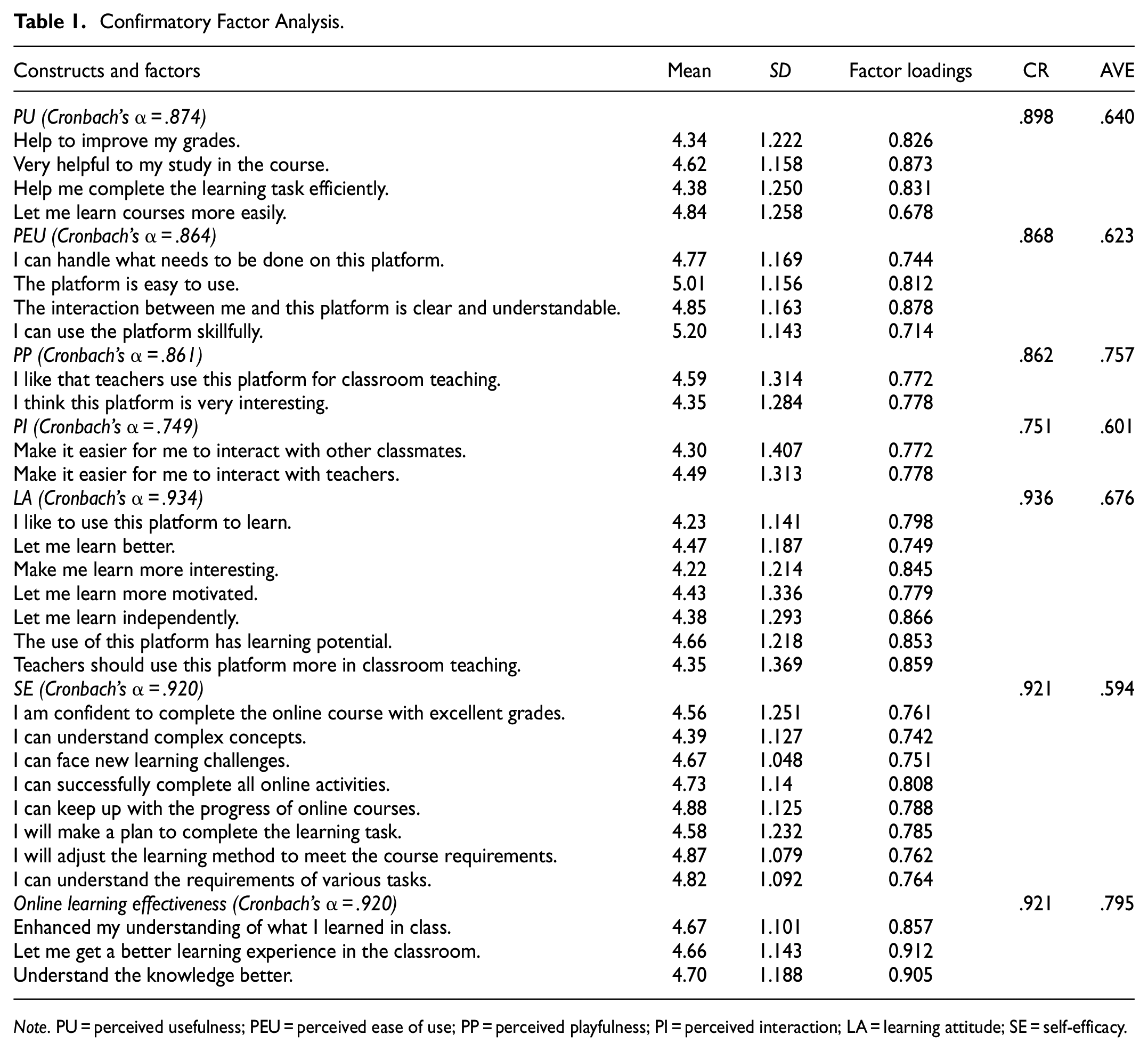
Note. PU = perceived usefulness; PEU = perceived ease of use; PP = perceived playfulness; PI = perceived interaction; LA = learning attitude; SE = self-efficacy.
Variable Calibration
Calibration is the process of assigning scores to cases by setting three anchor points of variables, namely, full membership (1), crossing point (0.5), and full nonmembership (0) (Schneider & Wagemann, 2012). There are three methods: direct calibration, indirect calibration, and direct assignment. Among them, direct calibration, using statistical models and logical functions, is the most common calibration method (Zhang & Du, 2019). By referring to the calibration ideas of Du and Jia (2017), the maximum value of variables was set as 1, the average value was set as 0.5, and the minimum value was set as 0. The specific variable calibration anchor points are shown in Table 2.
Variable Calibration Anchor Points.

Necessity Analysis
The prior identification of necessary conditions helps to make appropriate assumptions about the logical remainder in the logical minimization process. The necessary conditions constitute the superset of results. And without them, results cannot be generated. Previous studies usually used consistency score to identify the necessary conditions (Ragin, 2009). When the consistency scores of a condition is no less than 0.9, the condition can be considered to be necessary (Schneider & Wagemann, 2012). Table 3 summarizes the necessity analysis results. The results showed that all consistency scores were less than 0.9, which indicated that there was no necessary condition in our study.
Analysis of Necessary Conditions.
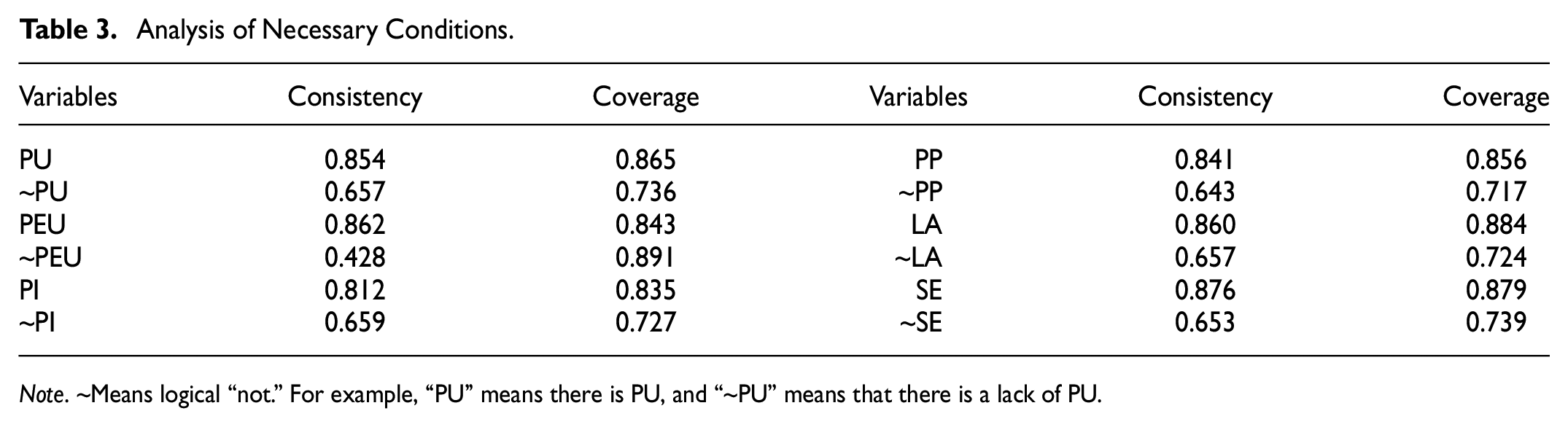
Note. ~Means logical “not.” For example, “PU” means there is PU, and “~PU” means that there is a lack of PU.
Truth Table Analysis
We set frequency and consistency to obtain configurations that offer sufficient explanations for the results. The setting of the frequency is usually determined by case number. When the case number is small, the frequency is generally set as 1. When it is large, the frequency should increase accordingly (Rihoux & Ragin, 2008; Schneider & Wagemann, 2012). Thus, the frequency was set as 5 in this study. Consistency refers to the probability that configurations lead to the result. Its numerical setting requires comprehensive consideration of the number of conditions and cases, data quality, and so forth. Generally, when the consistency is higher than 0.8, the combination is considered robust (Rihoux & Ragin, 2008). Considering this, we set the consistency as 0.95. Proportional reduction in inconsistency (PRI) is a method to prove that the consistency threshold is appropriate (Schneider & Wagemann, 2012; Zhang & Du, 2019). The higher the PRI value is, the lower the possibility of the existence of simultaneous subsets. Previous studies suggested that the PRI should be more than 0.75 for the conclusion to be accurate and reliable (Du & Jia, 2017). Thus, the PRI consistency threshold was set as 0.75.
Complex solutions, parsimonious solutions, and intermediate solutions were obtained through the truth table analysis. Among these, the comprehensive presence of parsimonious and intermediate solutions not only reflects the existence of variables but also highlights their importance in a particular path (Rihoux & Ragin, 2008). In this way, we combined parsimonious and intermediate solutions to present the final result. If a fact appears in parsimonious and intermediate solutions, it indicates that it is a core variable affecting online learning effectiveness. If a fact appears only in intermediate solutions, then the fact is an auxiliary variable. Finally, five combinations of high online learning effectiveness for tourism and hospitality students were obtained, as shown in Table 4. The consistency of every solution was higher than the threshold value of 0.8, indicating that the five combinations constitute sufficient conditions to explain the high effectiveness of online learning. In addition, the overall consistency was 0.944, and the overall coverage was 0.799. That is, the five configurations had strong explanatory power for the result and could explain 79.9% of the samples.
Antecedent Configurations of High-Efficiency Online Learning for Tourism and Hospitality Students.
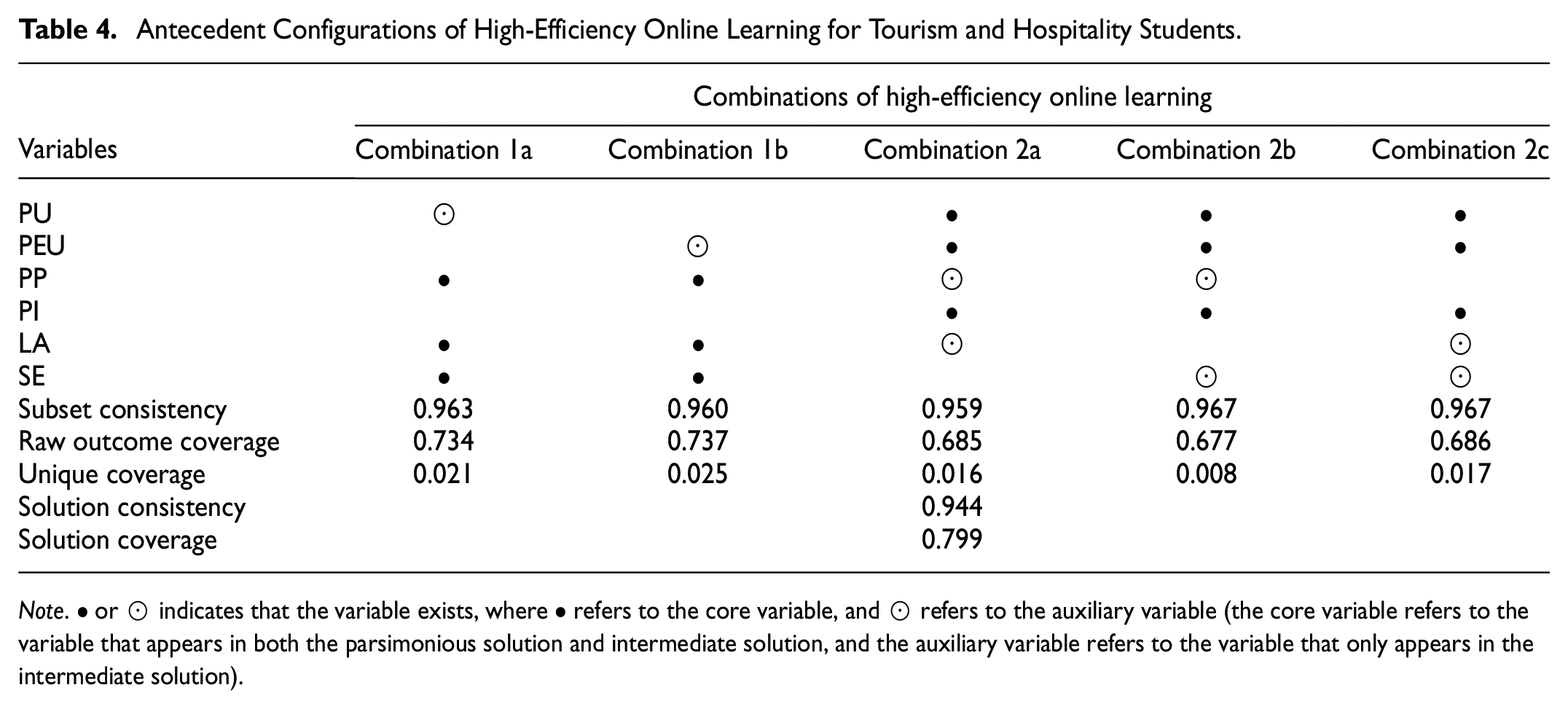
Note. • or ⊙ indicates that the variable exists, where • refers to the core variable, and ⊙ refers to the auxiliary variable (the core variable refers to the variable that appears in both the parsimonious solution and intermediate solution, and the auxiliary variable refers to the variable that only appears in the intermediate solution).
Robustness Test
The robustness test is a crucial link in QCA research (Schneider & Wagemann, 2012), and it can be conducted by adjusting of cross point, case frequency, and consistency threshold (Zhang et al., 2019). Our study adjusted case frequency and PRI consistency to perform a robustness test. First, when the frequency was changed to 3, the overall coverage increased from 0.799 to 0.812, but the overall consistency decreased from 0.944 to 0.940, and the newly generated configurations did not change substantially. Second, when the PRI consistency was decreased from 0.75 to 0.7, the overall coverage increased from 0.799 to 0.808, but the overall consistency decreased from 0.944 to 0.938, and the newly generated configurations did not change. As seen from these analyses, the results data are relatively robust and reliable.
Results
Longitudinal Analysis of Configurations
Based on different aspects of the platform environment (PU, PEU, PI, PP) and individual characteristics (LA, SE), we identified five online learning effectiveness promotion paths through fsQCA.
(1) “Platform-individual” internal and external promotion path. In configurations 1a and 1b, PP, LA, and SE were core factors in realizing efficient online learning. First, the more positive tourism and hospitality students’ LA is, the stronger their willingness to learn actively (S.-S. Liaw, 2008; Prior et al., 2016). They devote more time and effort toward achieving goals and make full use of rich learning resources inside and outside the classroom. Second, the combination of PP and SE can reduce students’ resistance to unfamiliar learning methods. Interesting learning platforms can attract students’ attention in a short time. It can improve learning engagement and extend effective learning time (Hamari et al., 2016). In addition, students with high SE tend to be more confident and independent. They believe that they can complete online learning tasks and achieve better learning effectiveness (Prior et al., 2016; D. Shen et al., 2013).
However, PP, LA, and SE are not sufficient to encourage tourism and hospitality students to achieve high learning effectiveness. There were differences in auxiliary variables between configurations 1a and 1b. In configuration 1a, PU was an auxiliary variable. When tourism and hospitality students think that online learning resources and courses are useful and interesting, their willingness to learn actively will be stronger. It also stimulates diverse knowledge exploration and classroom interaction behaviors and promotes students’ absorption and understanding of course knowledge (Gao et al., 2020; Hsu & Chang, 2013). In configuration 1b, PEU is an auxiliary variable. When online learning platforms are interesting and easy to use, students can concentrate more time and attention on learning (Chen & Yao, 2016). Especially for students with high SE, quickly becoming familiar with platforms can effectively improve their learning confidence and help them to devote themselves to adapting to new learning activities.
(2) “Function-interaction” platform environment promotion path. In configurations 2a, 2b, and 2c, PU, PEU, and PI are core factors for tourism and hospitality students to realize efficient online learning. PU and PEU are the main factors in students’ willingness to use online learning platforms. When students can acquire useful knowledge and skills in a short time, their learning willingness and emotions are improved (Gao et al., 2020). And this further influences learning dynamics and engagement behaviors (Prior et al., 2016). In addition, teachers cannot get close enough to observe students in online learning after the outbreak of COVID-19. Thus, proper interaction and communication are necessary, especially classroom communication between teachers and students. Effective communication between teachers and classmates can encourage students to engage in class discussion, and it also helps teachers understand students’ learning situations and solve their problems in time (Nkhoma et al., 2017).
In configuration 2, the core factors alone cannot encourage students to achieve efficient online learning, and the auxiliary variables are different. In configuration 2a, PP and LA are auxiliaries. Engaging learning platforms can quickly attract students’ attention and improve their classroom attention and interaction (Klock et al., 2019; Teng et al., 2021). Positive LA can affect learning cognition, emotion, and behavior (Prior et al., 2016). It encourages students to focus on learning opportunities and resources. They are also willing to use their free time after class to finish assignments on time and conduct additional learning to acquire more professional knowledge and skills (Arrosagaray et al., 2019).
In configuration 2b, PP and SE are important auxiliary variables. An interesting learning atmosphere can improve students’ learning interest and concentration. In addition, students with high SE have positive self-regulatory abilities and a good learning mindset (Heckel & Ringeisen, 2019; Sardegna et al., 2018). They can adjust their learning plan according to their learning status and psychological state in time to alleviate learning anxiety. In addition, they can effectively address the challenges posed by online learning through active learning and interaction and maximize the learning benefits from a useful and easy-to-use learning platform (Shen et al., 2013).
Comprehensive Analysis of Configurations
(1) Configuration 1 (a, b). By comparing configurations 1a and 1b, LA, SE, and PP were found to be the core factors, while PU and PEU were auxiliary variables that could replace each other. In the online learning mode during COVID-19, teachers’ on-site supervision and communication have been lacking, and positive LA is important in achieving high-quality learning (Arrosagaray et al., 2019; Zimmerman, 1990). Students with correct LA and high SE willingly interact and absorb more knowledge and skills. In this student-led learning mode, PU and PEU, as online learning environment factors, can improve learning effectiveness by impacting students’ LA and SE. Specifically, PU can actively improve students’ LA (Al-Fraihat et al., 2020), while PEU improves their learning confidence by reducing usage difficulty (Dibra et al., 2022).
(2) Configuration 2 (a, b, c). There were substitution phenomena in any two paths. Specifically, in configurations 2a and 2b, LA and SE could be substituted. Both students’ engagement and confidence in learning affect the learning platform function (Arrosagaray et al., 2019; Karabacak et al., 2019). In configurations 2a and 2c, PP and SE could be substituted for each other. Interesting platforms create a relatively active learning atmosphere, further amplifying the learning environment advantages. It can enhance students’ willingness to interact, learn and participate (Teng et al., 2021). SE can alleviate students’ fear of difficulties and enhance their PU and PEU (Karabacak et al., 2019). In configurations 2b and 2c, PP and LA could be substituted. PP can enhance students’ learning interests at the platform level (Teng et al., 2021). LA improves students’ input at the individual level (Arrosagaray et al., 2019). In summary, in the platform-dominated learning mode, the function and resources of the platform were key factors in determining learning effectiveness. PP, LA, and SE, as stimulus factors of students’ active learning intention and behavior, can improve learning effectiveness by strengthening the platforms’ advantages.
Conclusions and Discussions
Existing studies have largely ignored the joint effect of different factors on online learning effectiveness from a holistic perspective. Thus, we took tourism and hospitality students as subjects to reveal the promotion paths of online learning effectiveness from the platform and individual perspectives. The conclusions are as follows.
First, five promotion paths of online learning effectiveness were found, which can be divided into “platform-individual” internal and external promotion paths and “function-interaction” platform environment promotion paths. In the former path, LA and SE are key factors in improving online learning effectiveness. It is a student-led learning mode, and students have high awareness and strong ability to self-learn (Arrosagaray et al., 2019; Prior et al., 2016). Platforms are merely learning tools affecting students’ learning effectiveness to some extent. However, online platforms cannot become determinants of learning effectiveness. The latter path is a platform-dominated learning mode, and platform features are decisive factors affecting online learning effectiveness. In this way, students strongly depend on learning platforms. High-quality platforms can guide students’ positive learning emotions and encourage effective learning behaviors (Al-Fraihat et al., 2020; Shim & Shim, 2020). Furthermore, students’ characteristics help them understand the functions and advantages of online learning platforms.
Second, there are substitution relationships among the promotion paths of online learning effectiveness. In configurations 1a and 1b, PU and PEU have a substitution relationship. When LA, SE, and PP are core variables, students have high learning enthusiasm and can acquire useful knowledge from the external environment (Prior et al., 2016). Both PU and PEU regulate students’ willingness to use platforms and learning emotions (Gao et al., 2020). In the three paths of configuration 2, any two factors of PP, LA, and SE can be replaced. When the functions and interaction are core variables, the pairwise PP, LA, and SE can strengthen the platforms’ advantages and comprehensively improve learning effectiveness (Hamari et al., 2016; Sardegna et al., 2018).
Third, SE has not become an indispensable factor influencing the efficient online learning of tourism and hospitality students. In different learning modes, the effects of SE on students’ online learning are different. In a student-led learning mode, SE is critical in affecting students’ online learning effectiveness. When platform attributes have no obvious advantages, online learning is a challenge to students. However, students with high SE are willing to accept challenging learning tasks (Shen et al., 2013). They can adjust their negative mentality in a timely manner and actively explore positive and efficient learning behaviors (Heckel & Ringeisen, 2019; Sardegna et al., 2018). SE has little influence on students’ online learning effectiveness in terms of the environment-dominated learning mode. Learning platforms have obvious advantages, students’ dependence on the platform is greatly enhanced (Al-Fraihat et al., 2020; Gao et al., 2020; Zhai & Shi, 2020). In other words, quality platforms lead to the weakening of students’ dependence on individual characteristics, such as SE.
Theoretical Contributions
First, we explore the promotion paths of tourism and hospitality students’ online learning effectiveness from the dual perspectives of platform and individual.
Current studies have mostly explored the factors influencing online learning effectiveness from a single perspective (Gao et al., 2020; María et al., 2019; Nkhoma et al., 2017), and have not yet addressed the linkage effects of multiple elements on online learning effectiveness. In fact, CLT suggests that learning is jointly influenced by the environment and the individual (Alismaiel et al., 2022; Donkin & Rasmussen, 2021). Thus, this study integrated factors such as platform environment (PU, PEU, PI, and PP) and individual characteristics (LA and SE) to identify five promotion paths of online learning effectiveness from a holistic perspective, thereby offering an innovative research perspective on online learning effectiveness.
Second, we revealed substitution relationships among the factors from a configuration perspective and further confirmed the micro-mechanism of achieving high-quality online learning. PU, PEU, PP, LA, and SE are important factors to improve online learning effectiveness (Gao et al., 2020; Sarwar et al., 2018). However, recent studies mostly used structural equation models to explore the impact of a variable on learning effectiveness (Gao et al., 2020; Prior et al., 2016), and ignored the synergistic relationships among variables. Our results showed that PU and PEU have alternatives, PP, LA, and SE can replace each other. This finding deepened the interactive relationship among factors and clarified the synergistic effect in high-quality online learning, which expands current research contents on online learning effectiveness.
Third, SE is not a necessary factor for achieving high-quality online learning, and we reconceptualize the relationship between SE and learning effectiveness in different learning contexts. The relationship between SE and learning effectiveness has long been a concern, most studies have explored the net effect based on structural equation model (Panigrahi et al., 2021; D. Shen et al., 2013). Although Lu et al. (2021) pointed out that the influence mechanism of SE on learning effectiveness changes in different learning environments, the present studies have mostly shown that SE was a positive factor (Prior et al., 2016; D. Shen et al., 2013; Zimmerman, 1990). We introduced fsQCA to prove that SE does not always positively affect online learning effectiveness.
Managerial Implications
First, the online teaching section design should be engaging and easy to operate. The platforms’ operation interface should be simple and have clear functional classifications to prevent users’ resistance due to complex technical operations (Gao et al., 2020). Furthermore, the platform should create a personalized learning environment. For example, according to the practical nature of some tourism and hospitality courses, the platform should set up interesting and practical virtual courses. Students can increase their learning interest and emotional engagement by teaming up to participate in hotel marketing, sales, and service. In the above courses, teachers should pay attention to the matching of students’ personalities and interests with job characteristics and establish a reasonable evaluation system to maintain students’ learning confidence (Gong et al., 2017). Additionally, the platform should provide effective interaction (Liburd & Christensen, 2013; Nkhoma et al., 2017). The platform can design personalized pop-up windows according to knowledge type and complexity, which helps to give feedback about students’ learning status in time.
Second, the platform needs to provide massive knowledge and communication sections in the autonomous learning section. In this module, usability and ease of use are the first considerations for designers (Gao et al., 2020; Sarwar et al., 2018). The platform should tag the massive knowledge and form multicategory hierarchical classifications to enable students to find corresponding learning materials accurately. In addition, this section can provide a special communication platform, which is a significant way to set up special competitions, such as hotel design competitions. Students can apply knowledge through voluntary teamwork, which can not only deepen students’ knowledge and professional understanding but also deepen their sense of learning gain by communicating with other students (Nkhoma et al., 2017).
Limitations and Future Suggestions
Although we innovatively analyzed the promotion paths of online learning effectiveness from a holistic perspective, there were many limitations to be improved. First, SE was not a necessary condition for tourism and hospitality students to achieve high-quality online learning, which is different from most previous research results (Shen et al., 2013; Zimmerman, 1990). Furthermore, the dimensions of SE have different influences on learning effectiveness (Shen et al., 2013). Therefore, SE can be divided into multiple dimensions to further clarify the effects of SE in the future. Second, the study explored the promotion paths of online learning effectiveness based on platform environment and individual factors. However, studies have shown that the role of teachers in guiding and intervening with students cannot be ignored (Fountoukidou et al., 2019; Li et al., 2021). Therefore, the promotion path of online learning effectiveness can be further explored in combination with teacher factors in the future.
Footnotes
Acknowledgements
None.
Declaration of Conflicting Interests
The author(s) declared no potential conflicts of interest with respect to the research, authorship, and/or publication of this article.
Funding
The author(s) disclosed receipt of the following financial support for the research, authorship, and/or publication of this article: This work was supported by the 2023 Undergraduate Education Teaching Reform Research Project of Huaqiao University (Grant No.: HQJGYB2302).
