




Abstract
Technological advancements have triggered many lifestyle changes and indirectly created two important issues that must be addressed in Indonesia: the increase in non-communicable diseases and the rise of national health costs. One effort to curtail these problems involves consuming innovative food products with health benefits, commonly known as functional foods. The present study aims to identify and analyze the key success factors that companies in the functional food industry must consider to produce high-quality functional foods. To date, no previous study has paid close attention to this issue. Data collection was performed in a two-step process. First, interviews with academics, businesses, and the government were conducted. Second, surveys using a pairwise comparison questionnaire were completed. Data from the interviews were analyzed using thematic analysis, while survey data were assessed using the analytic hierarchy process. The results indicate the presence of five key success factors, including top management commitment (weight = 0.233), research resources and networks (0.077), food safety management systems (0.303), access to the required raw materials (0.218), and access to information on consumer needs (0.168). This research is believed to be the first to identify key company success factors in producing high-quality, innovative food products. This research fills the void of functional food literature related to producers.
Introduction
Background
In Indonesia, there are two critical issues. The primary issue is an increase in non-communicable diseases (NCDs). Basic health research performed by Indonesia’s Ministry of Health in 2018 found that the prevalence of NCDs has increased (see Table 1). The other important issue is the rise in national health costs. Indonesia’s national health insurance scheme (BPJS Kesehatan) has been in deficit since its first installment.
The prevalence of NCDs in Indonesia.

Source. (Kemenkes, 2018).
These two issues are closely related to lifestyles in general. Technological advances offer a more convenient life, thus triggering an instant lifestyle and unhealthy food consumption patterns (Kemenkes, 2018; Surjadi, 2013; Thaha et al., 2011), that eventually lead to a heightened risk of NCDs (Surjadi, 2013; Thaha et al., 2011), and national health costs. Moreover, the Industry 4.0 revolution provides more advanced technologies, resulting in “instant lifestyles” becoming even more embedded in society. Consequently, problems with NCDs and national health costs will only worsen over time.
One of the efforts to hamper NCDs and rising national health costs is encouraging the public to consume innovative food products that have health benefits beyond basic nutrition, commonly known as functional foods (Yamada et al., 2008). The consumption of functional foods can be a solution to the instant lifestyle because they are easy to consume and mostly in the form of ready-to-eat meals, though they still provide health benefits. In Japan, the use of functional food to reduce NCDs and national health costs has been done since 1984 (Yamada et al., 2008). In Canada, the consumption of functional food was proven to have a positive impact on reducing national health costs by at least US$20 billion annually (Holub, 2002).
Based on the aforementioned arguments, the sustainability of functional food companies has emerged as an essential issue. One of the challenges faced by functional food companies was that their products have a low probability of success in the market (Munene, n.d.). Based on the existing literature, a product must have good quality to be successful in the market (Magd et al., 2003; Valtorta, 2015). Many studies have proven the positive and significant impact of product quality on the success of companies (Sumaedi et al., 2012). Thus, to survive in the market, a functional food company must be able to produce high-quality foods. In Indonesia, producing high-quality functional food products is very challenging, considering that most industries, including the functional food industry, are micro, small and medium enterprises with limited access to strategic resources. Consequently, the key success factors for producing high-quality functional foods in Indonesia have become an important topic of discussion.
Previous Studies and Research Gaps
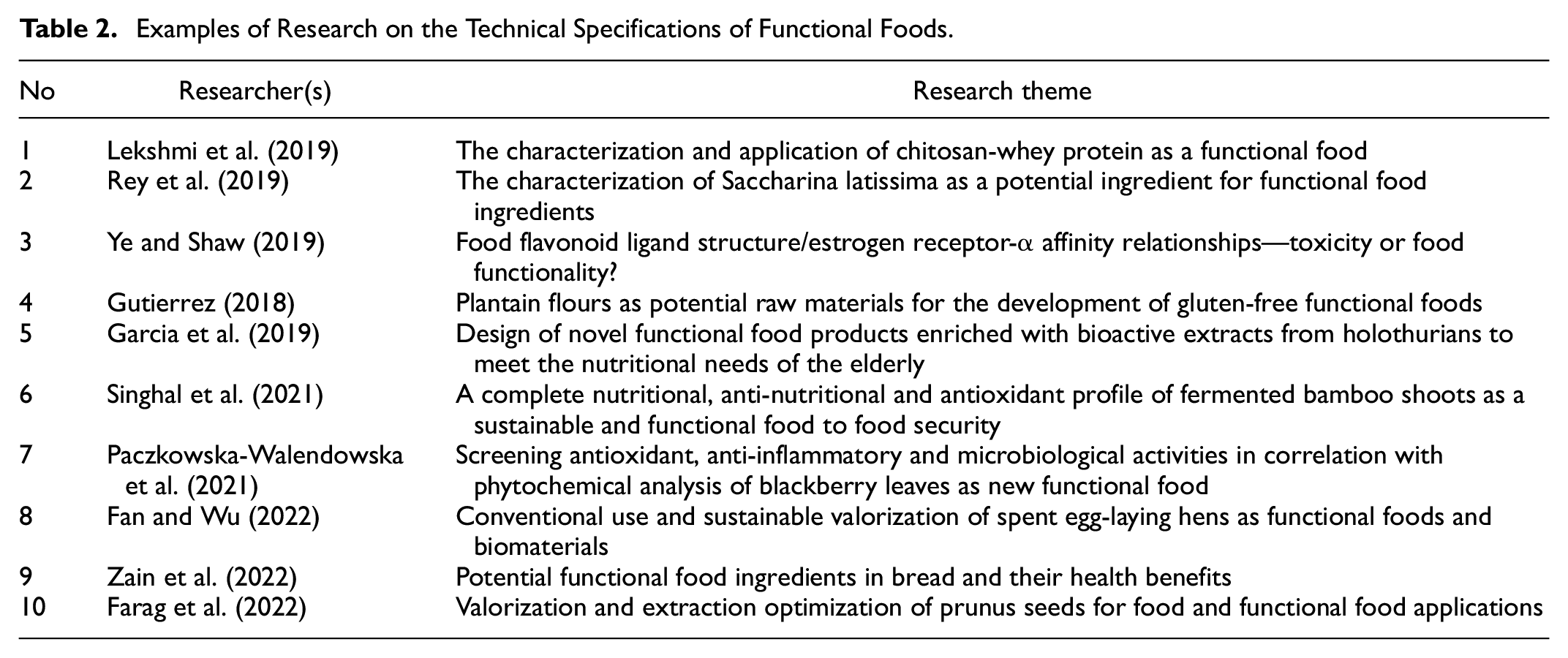
Functional food is a topic that has received considerable attention from scientists. However, previous studies have only focused on two research areas: the technical specifications of functional foods and consumers’ acceptance of functional food products. For example, Rutakhli et al. (2019) attempted to develop a nanocomposite of montmorillonite/nettle extract as a potential ingredient for functional foods. Table 2 presents additional examples of research focused on the technical specifications of functional foods.
Examples of Research on the Technical Specifications of Functional Foods.
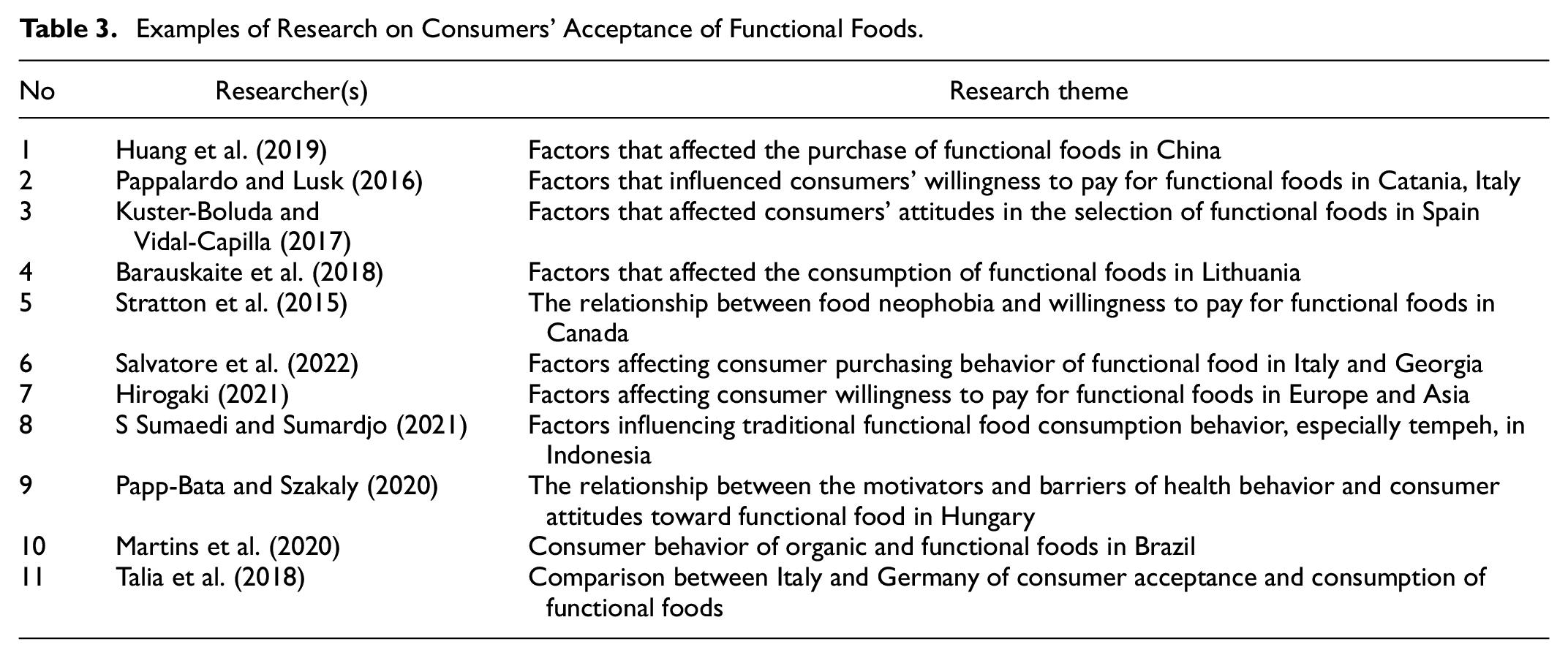
The second area of research relates to consumers’ acceptance of functional food products. Notably, researchers have attempted to identify factors that affect consumers’ acceptance of functional food products. For example, Szakály et al. (2019) studied the factors influencing consumers’ willingness to pay for functional food products in Hungary. Table 3 presents additional examples from the literature.
Examples of Research on Consumers’ Acceptance of Functional Foods.
Based on this explanation, previous research on functional foods has largely focused on the products and their consumers. On the other hand, research discussing aspects related to producers, specifically the key success factors for producing high-quality functional foods, remains limited. In fact, developing functional food products requires special competence of producers. This process is complex, expensive, and risky because functional food combines the concepts of food and health (Khan et al., 2013). Khan et al. (2013) conducted a literature review related to traditional practices of New Product Development (NPD) and Functional Food Product Development, then proposed critical factors for functional food development consisting of orientation toward innovation, knowledge generation, development of resource base of a company, collaborative networks and arrangements, and commercialization strategy.
Research Objectives
To fill the identified gap in the literature, the present research involved studying aspects related to functional food producers. Specifically, this research has two purposes:
(1) To identify the key success factors that companies in the functional food industry must consider to produce high-quality products in Indonesia,
(2) To identify the weight of each key success factor.
Theoretical Framework
Functional Food
The concept of functional food began to be recognized from 1984 in Japan (Yamada et al., 2008). The government of Japan conducted R&D projects related to food as part of an effort to face the health challenges brought on by the growth of the older population (Yamada et al., 2008). The result of the project was a functional food concept known as FOSHU (Yamada et al., 2008).
To date, there are many definitions of functional foods offered; however, there has not been a consensus on a single definition (Adadi et al., 2019; Siró et al., 2008). Nevertheless, researchers, experts, and institutions related to functional foods have developed the convergent opinion that functional food refers to foods with exceptional health benefits. This notion stemmed from Hippocrates: “Let food be thy medicine and medicine be thy food” (Hasler, 2002). Furthermore, if positioned, functional foods are somewhere along the spectrum between medicine and food (Neupane et al., 2021).Various functional foods exist, and they may be different in each region according to cultural values (Neupane et al., 2021). The perception of functional foods from one culture cannot be generalized to another because of cultural differences (Siegrist et al., 2015). However, according to (Siró et al., 2008), in general, functional foods have four categories: (1) foods that have been fortified with nutrition, (2) foods that contain added extra nutrition or components that are not commonly found in conventional foods, (3) foods that have been rid of their negative components (or their negative components have been replaced with healthier components), (4) foods with their beneficial natural components enhanced (i.e., enhanced commodities).
In this context, the present research defines functional food producers as companies that produce foods with “health benefits” as one of their main orientations. Functional food companies do not only consider the sensory aspects of food, such as taste. Furthermore, such companies produce functional foods by fortifying conventional foods, adding new beneficial nutrition or components, omitting or reducing harmful or negative components, and/or enhancing the natural components of certain commodities.
Product Quality
It is widely known that product quality is a prerequisite for successful product acceptance (Magd et al., 2003). Product quality has a positive influence on consumer satisfaction (Ghosh & Chakraborty, 2020). Not only affects consumer satisfaction, but several studies have proven that product quality also has a positive correlation to consumer desire to buy products, consumer loyalty, sales and market share (Ghosh & Chakraborty, 2020; Jasinskas et al., 2016; Leninkumar, 2016). It can be said that product quality is a critical success factor that must be considered in order to survive in market competition (Clemes et al., 2008; Ladhari, 2009; Zahari Wan Yusoff et al., 2010).
In the literature, many researchers have attempted to define product quality (Gede Mahatma Yuda Bakti & Sumaedi, 2013). Nevertheless, at this point, researchers generally agree that product quality must be seen through the consumer perspective (Gede Mahatma Yuda Bakti & Sumaedi, 2013) since consumers are the ones who eventually use products, thereby determining product sustainability in the market (Kotler & Keller, 2012; Sumaedi et al., 2012).
One researcher who attempted to define quality from the consumer perspective is (Parasuraman et al., 1985). They argued that quality was “a comparison between expectation and performance.” Notably, this definition has been referred to by many in the field (Kotler & Keller, 2012). Therefore, a functional food product’s quality represents the product’s ability to fulfill consumers’ needs and expectations regarding the level of its quality dimensions.
Key Success Factors
Based on the literature, key success factors are also often known as critical success factors (Amberg et al., 2005). Key success factors are defined as a limited number of causal factors to attain a certain level of performance (Amberg et al., 2005). To achieve high performance, these factors need to be considered (Adabre & Chan, 2019). The key success factors consist of factors that, if handled properly, will contribute to the company’s success and, if not, can cause the company’s performance to deteriorate (Korneta, 2019). Key success factors can also be defined as key elements needed to achieve goals (Yu et al., 2018). Thus, in this research, key success factors for a functional food company are the factors that must be closely considered for companies to deliver high-quality functional food products.
Key success factors can include many aspects. Previous studies have shown that the key success factors for a company to achieve a certain target could include a wide range of aspects, such as business management, resources, systems, and other capabilities that reside within the companies (Adabre & Chan, 2019; Ainul Azyan et al., 2017; Ali et al., 2022; Dewi & Dhewanto, 2012; Ghosh et al., 2001; Ho et al., 2008; Yu et al., 2018). Thus, the key success factors in producing high-quality functional foods can embrace more than one aspect. Figure 1 presents the theoretical framework of this research.

The theoretical framework of present study.
Methodology
Research Design
This research use a mixed method (qualitative and quantitative) approach. The research design is presented in Figure 2. The first stage of this research aimed to identify the key success factors for a company to produce high-quality functional food products. At this stage, a qualitative research method was employed using interviews to gather data from academics, practitioners, and government officials that oversee functional foods in Indonesia. This method was used for two reasons. First, previous studies regarding the key success factors of functional food producers remain limited. Therefore, a qualitative research method was suitable since it can facilitate a more in-depth understanding (Wahyuni, 2012). Second, the involvement of academics, practitioners, and government officials would promote a more comprehensive view of the key success factors of functional food producers.

Research design.
In the second stage, this research aimed to give weights to each key success factor identified in the first stage to establish priorities. The present study utilized the analytic hierarchy process (AHP) technique to achieve this purpose. This technique was chosen due to three main considerations. First, the AHP is advantageous in creating weights for factors that are abstract in nature, thus making it logical and systematic (Saaty, 2008). Second, the AHP can be performed with a small number of respondents (Saaty, 1999), so data collection costs will be relatively minor, which is consistent with the condition of Indonesia’s currently emerging functional food industry. Third, previous research on the key success factors has also used AHP (e.g., Chen & Wang, 2010; Sambasivan & Fei, 2008).
Data Collection
In the first stage, data collection was performed through interviews. The informants were two academics, two practitioners, and one government official (echelon 3) whose job was related to functional foods. Two informants were accompanied by their staff or colleagues. Several key questions were included in the interviews, which related to key success factors that must be closely considered for companies to deliver high-quality products, the characteristics of companies that can produce high-quality products, and production and non-production aspects that must also be considered. The research team explored each question deeper during the interview process. All interviews were recorded.
In the second stage, data were collected through a survey using a pairwise comparison questionnaire. The respondent pool consisted of one academic, one practitioner, and one government official. Our research’s number of respondents met the requirements of AHP (Saaty, 1999). It is well known that previous AHP studies used a small number of respondents (Astanti et al., 2020; Korfmacher, 1997; Shrestha et al., 2004; Ulkhaq et al., 2018). Due to its small number of respondents, the AHP study generally required expert as their respondents (e.g., Astanti et al., 2020; Korfmacher, 1997; Shrestha et al., 2004; Ulkhaq et al., 2018). Given this, our study respondents were three experts from practitioners, academics, and the government.
The questionnaire prompted the respondents to determine the level of importance of five key success factors identified from the previous stage. The level of importance was assessed using a one-to-nine scale (see Table 4).
Levels of Importance Used in the Research.

Data Analysis
Data analysis for the first stage was performed through thematic analysis. Thematic analysis is a method for identifying, analyzing, and reporting patterns (themes) in data (Castleberry & Nolen, 2018). This study used thematic analysis to reduce interview responses from several questions posed to specific themes, namely key success factors. Interview responses were categorized based on certain themes. Thereafter, the researchers formulated the key success factors based on emerging themes. To avoid bias and to ensure correct interpretation, the analysis was performed by one researcher and then further evaluated by other members of the research team.
In the second stage, the analysis was conducted using AHP. The data that has been collected from three informants through a questionnaire were analyzed to obtain the importance weight of the five key success factors. The researchers used Super Decisions software to calculate the weight and inconsistency ratio. The threshold for the inconsistency ratio was 10% or below (Cai, 2021; Forman & Selly, 2001).
Result And Discussion
The Result of Key Success Factors Identification
Based on interviews with academics, practitioners, and a government official, it can be concluded that there are five key success factors, which include management commitment, research resources and networks, food safety management systems, access to the required raw materials, and access to information on consumer needs. Explanations for each factor are presented in Table 5.
Key Success Factors to Produce High-Quality Functional Foods.

The first key success factor that companies in the functional food industry must consider to produce high-quality functional foods is management commitment. This factor can be categorized as a business management aspect. The critical role of management commitment was supported by many studies in the quality management literature. Notably, (Sampaio et al., 2009) revealed that management commitment has frequently been identified as a critical factor in quality management implementation. In their study, Ainul Azyan et al. (2017) also found that management leadership and commitment is one of the five success factors for implementing lean in the printing industry. Top management commitment was also revealed as a critical success factor for implementing green supply chain management in the electronics industry (Banik et al., 2022). In the food industry context, management commitment has also been proven to serve an important role in successful quality management implementation (Dora et al., 2013).
The second key success factor identified by this research is research resources and networks. This factor can be categorized as a resource aspect. Functional food products combine the concepts of food and health. Therefore, developing functional food products requires special competencies (Khan et al., 2013). Adequate resources are needed to support the production of high-quality functional food. This finding was supported by the existing literature. For example, Hirahara (2004) argued that research is a factor that determines the success of the functional food industry. The nature of functional food also supports this finding. Functional food differs from conventional food because it should have a bioactive/functional component that is scientifically proven to be beneficial for health (Siró et al., 2008). In other words, the functional food industry cannot be separated from research. Therefore, a company’s research resources and networks are essential in determining the quality of its functional food product.
The third key success factor is a food safety management system. This factor can be categorized as a system aspect. This finding was supported by a large volume of empirical evidence from the literature. For example, several researchers have revealed the benefits of food safety management systems (Dora et al., 2013; Karaman et al., 2012; Macheka et al., 2013).
The fourth key success factor identified by this research is access to the most suitable raw materials. The critical role of raw materials in determining the quality of food products can be inferred from the food quality standards. In Indonesia, raw materials are an element that is regulated by food quality standards. Furthermore, the critical role of raw materials in determining food product quality is also supported by previous research (Zugarramurdi et al., 2004). The selection of suitable raw materials is crucial to ensure food quality (Ruiz-Capillas & Herrero, 2019). This is related to raw materials containing certain compounds that are harmful to health and are very difficult to destroy by further processing (Ruiz-Capillas & Herrero, 2019). They will remain in the final product if they are present in the raw material. The selection of suitable materials can also balance production costs and the overall properties of the food (Lotfi et al., 2021).
The fifth key success factor is access to information on consumers’ needs. This finding is supported by the existing quality marketing literature, as it is well-known and proposed that consumers’ perspectives should be used in evaluating product quality (Kotler & Keller, 2012; Zairi, 1995). ISO 9001, an international standard for quality management systems, explains that quality management systems aim to fulfill consumer requirements (ISO, 2015). Information on consumer needs and preferences is useful both during new product development and after the product is marketed. Consumer needs and preferences are a source of new product ideas. They can positively impact the successful development of new products and consequently improve the company’s financial performance (Guiné et al., 2020). In addition, information about consumer needs and preferences is also useful for assessing the suitability of products to target consumers’ needs (Guiné et al., 2020). Once a product is marketed, because consumer needs and preferences change over time, it sometimes requires the food industry to redesign and reformulate its products (Guiné et al., 2020).
Weighted Key Success Factors
The results of the weighted importance data analysis for the key success factors are presented in Table 6. The highest-weighted factor was food safety management systems (0.303), followed by management commitment (0.233), access to raw materials (0.218), and access to information on consumer needs (0.168). The lowest-weighted factor was access to research resources and networks (0.077).
The Results of Key Success Factor Importance Based on Weighted Data Analysis.

The results presented in Table 6 indicate that the inconsistency ratio was 4.208%. Notably, this value is below the predetermined threshold, which implies that the weighted result is consistent.
Managerial Implications
The research results highlighted at least three major managerial implications. First, functional food companies must consider the five key success factors identified by this research: management commitment, research resources and networks, food safety management systems, access to a suitable supply of raw materials, and access to information on consumer needs. To manage these success factors, companies can determine their priorities based on weighted importance. In this case, the highest priority factor should be implementing a food safety management system since it has the highest weight.
To appropriately implement a food safety management system, companies can follow the available international standards, which provide guidelines on food safety management practices (e.g., GMP-HACCP and ISO 22000). Furthermore, to ensure the continuity of such a system, companies can undergo the certification process under GMP-HACCP and ISO 22000 schemes. Notably, certification involves continuous and regular surveillance from an independent third party.
Second, companies can place those factors as performance measures. In this case, companies must build performance indicators related to the key success factors. For example, regarding research resources and networks, a company can implement performance measures such as assessing the number of research collaborations with external parties or the number of qualified researchers in the company over time.
Third, the results of this research can be used as input to develop government policies to support the growth of the functional food industry. In this context, the government can use the five key success factors to develop an index of the functional food industry’s competitiveness. Second, the government can also utilize this research result to develop intervention priorities. Notably, the government must increase top management’s awareness of the importance of quality, facilitate the implementation of a food safety management system, facilitate research resources and networks, ensure the availability of suitable raw materials, and facilitate access to information on consumer needs.
Theoretical Implications
Theoretically, this study provides five factors that can explain the success or failure of a company in delivering high-quality products. The theoretical/conceptual framework model is based on stakeholders’ perceptions (academics, practitioners, and the government). This model uses a formative approach that allows it to be used in differentiated investigations of key success factors. This research provides an example of an exploratory study methodology to identify key success factors.
Conclusion
Alongside the lifestyle changes currently resulting in unhealthy food consumption patterns, the existence of functional food companies becomes essential. The present research identified the key success factors that functional food companies must consider to successfully produce and deliver high-quality functional foods. Based on the results and purpose of this research, it can be concluded that:
The key success factors in producing high-quality functional foods are management commitment, research resources and networks, food safety management systems, access to a suitable supply of raw materials, and access to information on consumer needs.
The weight of each factor was 0.233 for management commitment, 0.077 for research resources and networks, 0.303 for food safety management systems, 0.218 for access to suitable raw materials, and 0.168 for access to information on consumer needs. The highest-weighted factor was the food safety management system, while the lowest was research resources and networks.
This study is the first to identify the factors that need to be considered by functional food producers to deliver high-quality products to consumers. Previous similar research is still very limited. Most of the research related to functional food quality only focuses on the product side and consumer acceptance.
This study’s results contribute theoretically (science development) and practically (managerial). In addition to the contributions made, this research has limitations in terms of informants. This research only involves two academics, two practitioners, and one government official as informants. More informants will provide broader data. Further research is needed to prove and empirically validate the influence of the five key success factors in developing high-quality functional food products. In addition, similar research in other contexts, such as other countries, is needed to broaden the findings and explain the effect of country contexts on key success factors.
Footnotes
Declaration of Conflicting Interests
The author(s) declared no potential conflicts of interest with respect to the research, authorship, and/or publication of this article.
Funding
The author(s) disclosed receipt of the following financial support for the research, authorship, and/or publication of this article: This research is supported by the National Incentive Program (INSINAS) 2019 from Ministry of Research and Higher Education Republic of Indonesia.
