




Abstract
This article examined the intersection and interaction among positioning, communication modes, and culture by taking positioning theory as a theoretical framework. Data were collected from a WeChat discussion group where three Chinese international students engaged in a community of English as a second language (L2) literacies. A multimodal discourse analysis reveals that three WeChat group members creatively, freely, and deliberately used verbal language and graphicons along with their cultural beliefs and situational contexts to construct, negotiate, and sometimes reject positions. Findings also show that three types of self-other positioning were frequently constructed and negotiated through their discussions, such as the “Self-Agreed-to-Other,” “Self-Opposed-to-Other,” and “Self-Complained-to-Other” positioning. The “Self-Agreed-with-Other” positioning was explicitly conveyed, but the “Self-Opposed-to-Other” positioning was implicitly expressed, which can be attributed to one of the Chinese cultural values: face (mianzi). In addition, graphicons, such as emojis and stickers, were used to challenge first-order positioning and negotiate second-order positioning. Also, the semiotic sign @ used to specify WeChat message recipients performed illocutionary acts as including someone or excluding them from the discussion based on a specific interactional discourse. Graphicons, collectively and sometimes independently, were utilized to contribute to positions that not only provided or limited opportunities for L2 literacies practice but also invited or sometimes rejected community memberships. Future research on the incongruent verbal and nonverbal expression for different types of positioning is needed, especially when verbal language and graphicons are used collaboratively to design meaning.
Introduction
Mobile-assisted language learning (MALL) and computer-assisted language learning (CALL) have received considerable attention. Mobile-assisted and computer-assisted networking sites, such as Facebook, Twitter, Vkontakte, and the fan fiction writing community, provide spaces for second language (L2) learners’ identity construction (Black, 2009; H. I. Chen, 2013; Schreiber, 2015), literacies development (DePew, 2011; Sharma, 2012), and translanguaging (Canagarajah, 2011; Klimanova & Dembovskaya, 2013). WeChat, a relatively new instant messenger, has gained pedagogical value because of its various affordances, such as real-time one-to-one, one-to-many, and many-to-many communications (text and voice) (Ding, 2016; Xu et al., 2017), asynchronous, semi-synchronous, and synchronous collaboration and interaction (Y. Wang et al., 2016), and multimodal linguistic and semiotic resources (Jin, 2018), including graphicons (i.e., graphical icons, such as emoticons, emojis, stickers, and GIFs) (S. Herring & Dainas, 2017). The following is an example of multimodal communication in a WeChat English learning community:
@Chaflamingo as t[o] the question whether English will dominate the world, 这个真的不好说 (it is hard to say) .
.
In the previous sentence, two languages, a semiotic sign @, and a sticker are employed to make meaning, through which the message sender’s positioning acts are constructed and displayed. In other words, positions are discursively produced through multiple communicative modes. It is common to see combined modalities through the Internet and various apps in the context of CALL and MALL, for example, in the use of kineticons (Lyons, 2018). Scholars of pragmatics have also considered the role of multimodality in action and social interaction (Mondada, 2019). However, comparatively little research has focused on multimodal forms of communication and the roles they play in positioning (McVee et al., 2021). Therefore, it is timely and imperative to use a multimodal discourse analysis methods (Jewitt, 2011) to understand and reveal how positions are claimed, assigned, negotiated, or even rejected.
To address this gap in the literature, this paper explored different modes of communication as English learners engage in agentic activities in a WeChat community of L2 literacies. In addition, since one’s culture plays a significant part in positioning, this qualitative study examined the interaction and intersection between positioning, multimodality, and culture by analyzing WeChat discussions as data. Specifically, this research aimed to explore how the WeChat group members positioned themselves and others through graphicons and other modes of communication and how the interaction between culture and graphicons, along with other modes of communication, influenced positioning acts. Informed by Saura et al. (2023), this study strived to achieve the following objectives:
To identify different types of self-other positioning
To explore the intersection between modes of communication, positioning, and culture mediated situational contexts
To generate knowledge about English as a second language learners’ literacies practice using multiple modes and digital tools
To provide pedagogical and theoretical implications and suggestions for the future research
To address these objectives, we first reviewed relevant literature related to the pedagogical value of WeChat and studies of graphicons. We then introduced positioning theory as the theoretical framework that was applied using techniques from multimodal discourse analysis. These frameworks influenced how we carefully discussed segments for in-depth analysis by looking at linguistic text and graphicons, such as emojis, emoticons, and stickers, to uncover the complexity and dynamics of the interactions between the three participants. After presenting the methodology, including the participants, data collection, and data analysis, we presented our findings as types of self-other positioning. These included “Self-Agreed-to-Other,” “Self-Opposed-to-Other,” and “Self-Complained-to-Other” positioning as well as the analysis of how these positions can be attributed to Chinese cultural values. Lastly, the paper briefly discussed the significance of exploring the intersection between multimodalities, positioning, and culture. Future research directions are also indicated.
Literature Review
The Pedagogical Value of WeChat
WeChat, a popular social networking site, has been widely used in China and Chinese-speaking communities worldwide. WeChat has been recognized for its pedagogical value in language (both English and Chinese) learning and literacies (Ding, 2016; Fu & Wang, 2020 ). For example, WeChat can be used to help promote reading, writing, and speaking skills (H. Wang & Crosthwaite, 2021; W. Wang & Jiang, 2021; Yu, 2020). H. Wang and Crosthwaite (2021) reported that interaction through WeChat voice messaging not only facilitates Chinese EFL adult learners’ English fluency and pronunciation but also relieves their anxiety and bolsters speaking agency because learners can freely cancel or recall their voice messages when they find mistakes. After listening to the voice messages sent before and frequently self-correcting with the teacher’s guidance, learners demonstrated improved pronunciation, fluency, and grammar. In addition, Xu et al. (2017) found that oral or written feedback on EFL learners’ storytelling through WeChat enabled the students to engage actively in learning activities outside of class. From a psychological perspective, Yu (2020) pointed out that WeChat could also fortify English language learners’ self-esteem and foster conformity of learning behaviors since it is perceived as easy to use, helpful in learning English, and an enjoyable learning environment.
W. Wang and Jiang (2021) suggested that, WeChat-assisted English writing develop learners’ autonomy, provide L2 writers with richer exposure to language resources, and help construct an interactive learning and communication environment . L2 writers acknowledged feeling obliged to become good writers. Also, the WeChat Moment feature allows L2 writers to reach a wider audience and enables them to receive adequate feedback from diverse individuals or groups. In addition, WeChat-assisted English writing fosters a sense of ownership and creativity. Wang and Jiang, thus, concluded that writing in WeChat Moments triggers and fuel L2 writers’ agency.
Research has also shown that WeChat-assisted language learning not only creates language immersion but also motivates learners’ learning interests (Shi et al., 2017). For example, in the study of Shi and colleagues, 50 Chinese speakers of English participated in a one-semester program through a WeChat learning app at a Chinese university. All the participants accessed learning content via the subscription from an official account. The learning materials on WeChat included articles, pictures, and videos. Teachers also shared WeChat micro classes on the subscription account once a week. Additionally, participants were further divided into two groups. One group learned English with mobile applications (WeChat Learning Group), and the other learned English without assistance (Control Group). Five small chat groups were set up and focused on various aspects: vocabulary, grammar, listening, speaking, and writing. Every participant was welcome to join the small chat groups according to their interests, but with a maximum of joining three groups. They were encouraged to freely discuss the related topics in groups through text or voice messages while one foreign teacher checked the content and provided timely feedback on any mistakes. A pre-test and a post-test were given, and the scores were analyzed. The results showed that students in the WeChat learning group significantly improved in English proficiency, suggesting that mobile-assisted language learning help effectively motivate the learners by creating an immersive English environment. However, even though it indicated an overall improvement in students’ English performance, it failed to reveal the individual difference among one group due to a large number of participants. Since students’ language proficiency might vary from the beginning and the less active students were less likely to communicate with others actively, they benefited less than the others.
In the study of Tong et al. (2022), a mixed design involved fewer participants who were learning Chinese as a foreign language in an Australian university. Tong et al. mainly explored students’ engagement and authentic language used in WeChat class groups for instant interaction. Data was collected through weekly conversations over a semester and a student survey. No topics were assigned to students, so the communication was more authentic than the pre-designed chatting. Conversation episodes were analyzed quantitatively (by frequencies) and qualitatively (using a discourse approach). The study found that student engagement increased in frequency and complexity toward the end of the semester. Students used Chinese for various authentic purposes in the semi-formal context of class group chats.
Even though two studies targeted two different languages, English in the study of Shi et al. (2017) and Chinese learning in the study of Tong et al. (2022), similar findings supported the potential value of developing WeChat as a valuable language-learning platform.
Although WeChat has been proven pedagogically valuable, the existing research has mainly focused on how verbal language was used for language learning and literacy practices. However, it has become a new feature that both verbal and nonverbal language or semiotic symbols, also called graphicons (S. Herring & Dainas, 2017), are used for meaning-making in WeChat learning and other CALL and MALL communication. It is urgent to explore how different communicative modes might express different meanings and emotions, how different modes of communication shape positioning acts, and how positioning influences interactive participation and engagement. To unpack the complex relationship among the three, a review of literature on multimodal communication, such as the use of graphicons on social networking sites, will provide researchers with theoretical and analytical insights for their understanding. The following section reviews literature relevant to graphicons, including emoticons, emojis, and stickers, in online communication.
Emoticons, Emojis, and Stickers
It is believed that emoticons mainly express emotions (Derks et al., 2008; Dunlap et al., 2016). Collister (2015) considered emoticons as discourse particles that carry various feelings. Lo (2008) describe emotions as “quasi-nonverbal cues,” which are presented as verbal cues but perform nonverbal communication functions. Dresner and Herring (2010) held that emoticons do not always function as emotion icons but perform illocutionary acts in some situations. Like emoticons, emojis also convey emotion and playfulness. However, emojis have extended the functions of emoticons. They can facilitate communication by controlling a conversational thread, such as maintaining an ongoing conversation or encouraging playfulness, such as permitting play or creating shared uniqueness (Kelly & Watts, 2015). Kelly and Watts argued that the value of emojis is derived from recognizing users’ ability to select appropriate emojis to respond to the context of a relationship.
Emojis can also function as illocutionary markers, such as the thinking face emoji ( modifying the tone of textual utterances and softening their illocutionary force (both functions they share with emoticons), illustrating portions of text, expressing virtual actions, conveying private meanings, and opening and/or closing conversations. (S. C. Herring, 2018, p. 104) ), which can question something or someone disingenuously, sarcastically, and skeptically. This kind of emojis is called “pragmatic emojis” like “pragmatic gestures” (Kendon, 2004 ). Specifically, emojis fulfill pragmatic and interactional functions, such as
However, the meanings of emojis are pragmatically contextualized, not fixed, so they are flexible and ambiguous. The flexibility and ambiguity of emojis have become one of their charms (Pohl et al., 2017).
Compared to emoticons and emojis, stickers seem more expressive. Stickers are textual and pictorial. Most often, a sticker consists of a picture with a caption underneath, such as  . They also can be static or animated (De Seta, 2018). Since they are typically larger and more complex than emojis, stickers tend to express more complex ideas, represent more specific character traits, and express emotion more intensely (S. C.Herring, 2018). User-generated stickers in China that include customized faces and text have been widely used in WeChat (Ma, 2016). Although stickers might have more functions than emoticons and emojis, they have not been studied as much as emoticons and emojis (Tang & Hew, 2019). Table 1 below summarizes the literature on the pedagogical value of WeChat and the functions and performances of graphicons.
Literature on WeChat and Graphicons.

As the table above shows that WeChat has provided affordances to promote language learning, cognitive development, and psychological improvement. Also, with the increased use of graphicons on social networking sites, communication has become increasingly complex and dynamic. To explore the intertwined relationship between the use of verbal and nonverbal language (e. g., graphicons), positioning, and culture,the study used positioning theory and multimodal analysis as its theoretical framework and analytical tool.
Conceptual Framework and Research Questions
Positioning Theory
Founded in discursive psychology, feminism, and poststructuralism, positioning theory consists of three intertwined components: position/positioning, speech acts, and storylines (Davies & Harré, 1990; Harré & Van Langenhove, 1998). A position is “a cluster of rights and duties to perform certain actions” (Harré & Moghaddam, 2003, p. 5) in discursive practices, including “habitual ways of speaking and interacting” (Deppermann, 2015, p. 370). An individual might be constrained or allowed to perform certain actions when occupying a particular position (van Langenhove & Harré, 1999). Assigning positions to oneself and others is called positioning, through which individuals are positioned “as observably and subjectively coherent participants in jointly produced storylines” (Davies & Harré, 1999, p. 37). To highlight their dynamism, fluidity, and multiplicity, positions and positioning are treated similarly (Deppermann, 2015; Kayı-Aydar, 2019).
In positioning research, two relevant perspectives are fundamental: (a) reflexive positioning, also called self-positioning, and (b) interactive positioning or other-positioning. Interactive positioning means people assign others positions (Davies & Harré, 1990). Through discursive practices, speakers and listeners take on various positions and constantly offer or deny people opportunities to say or do certain things (Kayi-Aydar, 2014). Interlocutors may also refuse to take positions assigned by others and reposition themselves in a desired situation. This repositioning is called second-order positioning. First-order positioning is the original or initial positioning. When a person tells a story about the original interaction, they position themselves and others in and through a retrospective discussion. This positioning act accomplished through retelling is called third-order positioning. However, McVee et al.(2011) proposed that all positioning acts can be considered both self and other because positioning is featured as relational, which refers to one’s self-positioning in relation to others. They categorized this self-other positioning into the following four types:
(1) Self-AS-Other positioning (I am you, or I hold the same opinion as you do)
(2) Self-IN-Other positioning (I am like you)
(3) Self-OPPOSED-to-Other positioning (I am not like you or I hold a different opinion from you); and
(4) Self-ALIGNED-with-Other positioning.
In effect, categories (2) and (4) are similar. Thus, in this article, we treat them the same.
In addition, positioning is culturally embedded and varies widely with cultures (Harré, 2012 ; Kayı-Aydar, 2019; Tan & Moghaddam, 1995). One’s cultural values and beliefs have an impact on one’s positioning acts, and one’s cultural ideals guide their self-and other-positioning (M. Wang, 2020). Also, culture is a source of positioning because “[t]he context of the larger culture is always imported to immediate contexts” (Bomer & Laman, 2004 , p. 428). Society and culture are significant components of moral orders, which function as social guidance for interactions (van Langenhove, 2017). For example, Chinese people highly value their face (called mianzi in Chinese culture) because the face or mianzi is believed as a sense of dignity that should be honored (M. Wang, 2016). One’s loss of mianzi (i.e., loss of face) in public, especially in front of friends, family members, or professional superiors, can be very humiliating since losing mianzi in public can severely damage one’s self-esteem and reputation. Therefore, knowledge of cultural discourses is required to fully understand one’s positioning acts (Deppermann, 2013 ), and a cultural consideration must be included in positioning analysis (Moghaddam, 1999 ). Positioning has been applied to study numerous types of cultural interactions (Moghaddam & Harré, 2010 ) and digital spaces (Labben, 2022; Nadeem, 2021; Vuorsola, 2020), but there has been no work, as far as we are aware, combining analysis of cultural aspects of positioning and digital multimodality in the study of messaging apps used for pedagogical purposes.
Multimodal Discourse Analysis
Positioning theory has been used as a theoretical framework and as an analytical tool to examine positions, rights and duties, and storylines by mainly looking at speech acts or conversational interactions (Davies & Harré, 1990; Hirvonen, 2016; Kayı-Aydar, 2019). However, a focus on speech acts or conversational language per se cannot fully explore the richness, complexity, dynamics, and multiplicity of positioning acts in digital interactions (Saura et al., 2021). The “multimodal turn” (McVee et al., 2021; Kress, 2010) marks an era of innovative, complex, and diverse meaning-making through various features of digital technologies that combine (non)verbal language, audio, video, graphicons, and so forth. A multimodal discourse analysis approach is thus required to study positioning in digital contexts because “[m]oral orders shape and are shaped by the discourses or symbol systems (e.g., images, words, acts) that people employ in daily life and by structures existing within societies” (McVee et al., 2021, p. 194).
Since positions are not language-centric but multimodal, due attention to both (non)verbal language and other traditional and modern modes, such as symbolic and material artifacts, social and cultural representations, and graphicons that pertain to speech and other acts, can help reveal and interpret “a field of moral orders” (van Langenhove, 2017, p. 7). For example, Chinese people often use a selected and cherished keepsake, such as a photo of plum blossoms, as a material symbol to present their self-or other-positioning as resilient and determined (M. Wang, 2020). In the U.S., during the COVID-19 pandemic, some people refused to wear face masks, thus marking a moral order (i.e., “My body, my choice”) explicitly through a physical artifact (McVee et al.,2021). Using a particular emoji, such as a response to someone’s apology on Instagram, can show a forgivable position. A hijab may be a cultural representation of a moral order for an Iranian woman (Jaspal et al., 2016 ). A co-teacher’s physical location in the middle of the classroom, instead of sitting in the back or standing on the side of the classroom, signals her self-positioning as another teacher rather than a teaching aid (M. Wang & Ness, 2021).
By using multimodal discourse analysis to analyze a WeChat group discussion, this study aimed to answer two research questions, presented as the following:
RQ1. How do the WeChat group members position themselves and others through graphicons and other modes of communication?
RQ2. How does the interaction between culture, graphicons, and other communication modes influence positioning acts?
Methodology
The Setting and Participants
Three Chinese international students who participated in this study were conditionally enrolled in undergraduate programs at a large public university in the southeastern United States. Due to their limited English proficiency, it was mandatory for them to take English classes at the university’s English language institute (ELI) prior to their programs of study. The ELI offers programs for international students to practice and enhance English listening, speaking, reading, and writing skills. The ELI offers six levels of intensive English classes, from level 1 (low beginning) to level 6 (high advanced).
Also, the ELI and the university’s International Service Center offer extracurricular programs for ELI students to improve English proficiency, such as Coffee Hour (e.g., speaking practice) and workshops for iBT TOEFL, and IELTS. All the students in ELI were encouraged to use social networking sites or social media to socialize with native and non-native speakers to improve their English skills and enrich cultural knowledge. The ELI students came from all over the world, but Chinese students made up most of the population. Using WeChat to connect with family members, friends, and Chinese classmates became a daily activity for Chinese ELI students. When Min was collecting research data in the ELI as a Ph.D. student, she was invited to join the WeChat group to help them learn English. There were 12 WeChat group members, most of whom were ELI students whose mother tongue was Mandarin Chinese. Min provided students with guidance by sending web links (e.g., TED talks), recommending reading materials, and sharing her learning experiences. The involvement in this group triggered her research interest in investigating Chinese ELI students’ English learning experiences in a WeChat community of practice. All the ELI students were sent a WeChat message inviting them to join the research. Six students showed interest, but three signed the consent form and participated in the research from January to June 2016.
The three participants, Ligang, Chenhua, and Yifei (pseudonyms), were newly arrived male Chinese students aged 19 to 21. Ligang and Yifei came from middle-class families; Chenhua was from a working-class family. Ligang and Chenhua were friends and taking some classes together, but Yifei was an acquaintance to them. All the participants came to the US to further their higher education because they believed they would have more and better educational opportunities. Their English levels varied based on their placement tests when they arrived at ELI. When the study began, Yifei was taking level 6 classes for speaking, reading, and writing; Chenhua was taking level 5 classes for all three skills; but Ligang was taking level 4 classes for speaking and reading and level 5 for writing. They had to pass the level 6 lessons to start the program studies. Table 2 below summarizes the participants’ profiles.
Three Chinese ELI Students’ Profiles.

Researchers’ Positionality
Because “scholarly analyses are always (in part) political, value-laden, biased, and shaped by the worldviews, perspectives, positionalities, and subjectivities of researchers” (Cochran-Smith & Dudley-Marling, 2012, p. 237), it is essential to clarify researcher positionalities. Min was a Chinese international student pursuing a Ph. D. in multimodality and L2 literacies by the time when the study began. She was curious about how Chinese international students used WeChat as a platform to engage in language learning and identity construction. Although she was one of the WeChat group members, she was very different from them because they were digital natives, but she is a digital immigrant. The ways they communicated with each other were playful, interesting, and innovative. As an outsider and insider in this WeChat communication group, Min was shuttling between her learning and interaction with the participants to make her “personal and theoretical commitments visible” (Kleinsasser, 2000 , p. 155). She believes that researching the Chinese international students’ discussion in this WeChat group is to speak about them from her multiple positions instead of speaking for them. To mitigate potential bias, Min invited Mary to analyze the data with a pair of fresh eyes through an objective perspective. In addition, Mary is experienced in multimodal analysis, digital technology, and positioning theory. Additionally, she was an EFL teacher in China and has continued to work with many international students in the US, which has added a reasonable and valid understanding of the data. Jingjing is a digital native who has tremendous experience in using both verbal and nonverbal communicative modes for meaning-making and emotional expression. Also, she has read a lot of literature on English learning on WeChat and made contributions to one section of the literature review.
Data Collection
These three students formed a micro-WeChat discussion group to practice English weekly or biweekly, depending on their schedules. They took turns leading a topic. Chenhua led four discussions, Yifei three, and Ligang two. Their discussion topics varied and focused on diverse issues, such as sleeping, procrastination, the myth of human beings, education, testing, virtual reality, the dominance of language, the difference between American English and British English, and learning English daily. In total, the three participants produced 63 WeChat screenshots, serving as a predominant data source. With their permission, Min collected all the WeChat exchanges and selected one discussion for analysis, the dominance of English, which Chenhua led. This particular discussion was selected because all three participants not only used (non)verbal language but other modes of communication tools to engage in the community of literacies. There were 11 exchanges in total in this discussion, which provided data to analyze the intersections of multimodality and positioning.
Data Analysis
Although a multimodal discourse analysis has been utilized to examine positioning acts (McVee & Carse, 2016; M. Wang, 2020), the intersections of positioning, culture, and multiple modes have not been adequately explored (McVee & Carse, 2016; McVee et al., 2021). Therefore, this study paid particular attention to the intersections of positions, written languages, graphicons, and cultural components, including mianzi (face) and conformity, to understand three Chinese WeChat chatters’ interactions in a mobile discussion group. Table 3 below demonstrates an example of data analysis.
An Example of a Multimodal Discourse Analysis of WeChat Exchanges.

Analysis of Results
Findings revealed that the WeChat group members creatively, freely, and deliberately used a combination of language and graphicons along with reference to their cultural beliefs and situational conditions to construct, negotiate, and sometimes reject positions. In addition, the participants’ self-other positioning mainly featured the following three categories, including 1) “Self-Neutral-to-Other” positioning: “It is hard to say”—sitting on the fence, 2) “Self-Agreed-with-Other” positioning: “I am with you,” and 3) “Self-Complained-to-Other” positioning: “I am innocent,” so “Do not blame me.” Also, “Self-Agreed-with-Other” and “Self-Complained-to-Other” positioning acts were expressed explicitly; however, “Self-Opposed-to-Other” positioning was conveyed implicitly most often, and second-order positioning acts were implicitly constructed, which can be attributed to Chinese culture. The section below explains the findings through reporting a WeChat discussion on “The dominance of the English language” led by Chenhua.
Chenhua’s Introduction
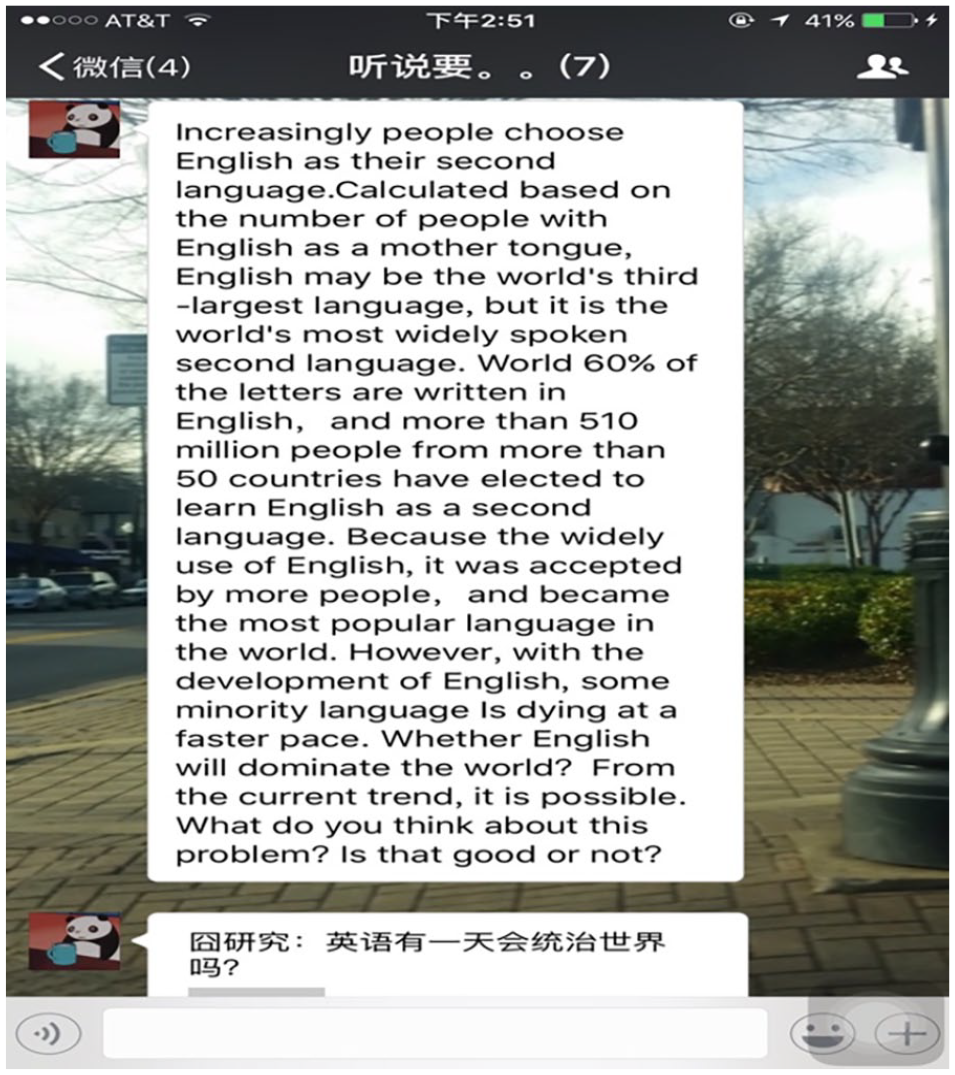
In the discussion, Chenhua introduced: . . .more than 510 million people from more than 50 countries have [s]elected to learn English as a second language. Because of the [wide] use of English, it (English) was accepted by more people and became the most popular language in the world. However, with the development of English, some minority language is dying at a faster pace [than before]. It is a question [w]hether English will dominate the world [.] From the current trend, it is possible. What do you think about this problem? Is that good or not? A Chinese hyperlink was attached to the main topic: 囧研究:英语有一天会统治世界吗? (An awkward study: Will English dominate the world?).
Chenghua’s topic originated from Sina (新浪), a popular Chinese website: 囧研究:英语有一天会统治世界吗(双语). He used English as a main communication tool to introduce the topic and invite his group members to join the discussion. He also sent his group members a hyperlink including both Chinese and English, as a complementary background, which can be helpful for his group members because they are bilinguals. The combination of different modes made Chenhua’s self-positioning visible and specific: a bilingual who is interested in English language, is concerned about the dominance of the language, and cares about his group members’ understanding of the topic.
Specifically, Chenhua used a series of lexical items, grammatical devices, indirect quotes, and a direct bilingual hyperlink to provide the necessary social and cultural context. For example, Chenhua presented specific numbers, “510 million” and “50 countries,” to illustrate the huge population of emergent L2 learners and their countries of origin to foreground the popularity of English. After providing information, Chenhua directly used the adjective “popular” to highlight his first point. The transitioning word “However” in the following sentence switched Chenhua’s old topic to the new one: “[S]ome minority language is dying at a faster pace [than before],” a topic which made a striking contrast between English and dying minority languages. He also pointed out that the popularity of English was the reason why minority languages were becoming extinct at a fast pace. He further claimed that it was possible that English would dominate the world, which he considered a “problem.” After presenting his second question (the main topic), Chenhua asked his group members for observations.
As part of Chenhua’s text, the bilingual link functioned as intertextuality (Fairclough, 2003) to provide background information for this topic. This link uses the emoticon 囧, a Chinese ideographic character that became an internet sensation about a decade ago. The character has been widely used to express embarrassment and gloom because of its resemblance to a depressed facial expression 囧. It seemed uncomfortable or awkward, then, for Chenhua to discuss this topic since he and his group members were three of the “510 million” L2 learners; their English learning has contributed to the dominance of English in this increasingly multicultural and multilingual society. This emoticon functions as a revelation, revealing a fact that more and more people learn English, including Chenhua and his group members, which has become one of the reasons for accelerating the death of minority language. In addition, this emoticon performs as a statement, stating a comparison and contrast: The dominance of English versus the dying minority languages. In this sense, this emoticon can also act as an expressive or a warning. In sum, Chenhua’s intertextual positioning (McVee et al., 2011) was realized through quoting and paraphrasing the information from the website. He also explicitly positioned himself as thoughtful and resourceful.
Yifei’s Interaction With Chenhua
Yifei responded to Chenhua’s text message by writing, Darwin said [, ]‘survival of the fittest.’ In my opinion, it’s suitable for not animals but language. If people find a kind of language[that] is easier to learn or has [an] advantage than another one, more and more people will turn to it.
In his response, Yifei cited Darwin’s theory as an opening for his argument. This direct quote was used as a scientific and supportive context for Yifei’s own stance. He brought “other voice” (Fairclough, 2003) to his text to authorize his account and substantiate his argument. This meaning-designing and text-making demonstrated Yifei’s strategic and rhetorical motivation as an author and message sender, who established authority and impression as knowledgeable because he knew how to use well-accepted discourse to invent new discourse for new exploration, discovery, and knowing (Davies, 1991), which formed his intertextual positioning and agency manifestation.
Seemingly, Yifei did not directly answer Chenhua’s questions. In fact, his answers were embedded within his representations in the text message. The common expression “In my opinion” foregrounded his statement based on his understanding and probably his experience. Yifei did not consider the dominance of English as a “problem” but as an advantage. He used an “if” clause to hypothesize the condition and consequence. Also, the lexical items, such as “advantage” and “easier,” indicated that English became popular because of its benefits. The generic deictic word “people” and the modal verb “will” demonstrated Yifei’s belief. The combination of scientific theory and common-sense knowledge featured Yifei’s proposition in this discussion, which constructed his self-positioning as logical and reasonable.
In effect, Yifei’s language displayed a “Self-Opposed-to-Other” positioning (McVee et al., 2011) by implicitly stating his opinion on English dominance because he considered it as an advantage, which is different from Chenhua’s position.
Chenhua responded to Yifei as follows: Yes, I agree with you, but from a cultural point of view, no one wants to see their culture invaded. Language always stands by the culture of a country, so it should not be abandoned because of the minority. The disappearance of language can destroy cultural diversity.
Chenhua overtly expressed his agreement with Yifei; however, he covertly stated his disagreement, as evidenced by the textual context “but.” What is interesting here is Chenhua explicitly constructed an ostensible “Self-Agreed-with-Other” positioning; in effect, he implicitly established “Self-Opposed-to-Other” positioning (i. e., implicitly using “but” [I don’t agree because] “no one wants to see their culture be invaded. . ..” Interestingly, Chenhua also positioned himself in a similar place to the “no one” in an empathetic position: “Self-as-Other” (McVee et al., 2011), where he takes on the position of others. Looking from within as that other, he commented that no one wants their culture/language to be destroyed. The first other is an immediate other individual (i.e., Yifei), but the second other refers to “no one,” which means a distant group. Actually, the “Self-Aligned-with-Other” positioning is a quasi “Self-Aligned-with-Other” positioning, which can be understood as a face-saving strategy. As a discussant, Chenhua could have made Yifei lose face by using explicit “Self-Opposed-to-Other” positioning. Therefore, Chenhua’s “Self-Agreed-with-Other” positioning not only functioned as face-saving strategy but also established a harmonious discourse in this discussion group.
Chenhua positioned himself as an advocate for cultural and language diversity and a logical, knowledgeable, and reasonable author and discussant who made his voice strong enough by articulating meanings, reasons, and desires. He also simultaneously and indirectly positioned Yifei as someone who, from Chenhua’s response, failed to recognize the danger of English dominance to language diversity. Chenhua’s other-positioning challenged Yifei’s first-order positioning as knowledgeable, reasonable, and persuasive.
Ligang’s Interaction With Chenhua
Ligang was the second group member to respond to Chenhua. He wrote, @Chaflamingo as t[o] the question whether English will dominate the world, 这个真的不好说 (It is hard to say) . In my opinion, some ancient language is the best like Greek or Hebrew. Compared with [those languages,] English is a simple language which has already lost many specific things[.]
Ligang specifically used the symbol “@” to refer to Chenhua (Chaflamingo is his WeChat name) as the message recipient; however, Ligang did not give a clear answer to Chenhua’s questions in the very beginning of his text; instead, he used a Chinese expression, “这个真的不好说,” (i.e., it is hard to say). This Chinese expression is oftentimes used to avoid giving a direct answer. In Chinese culture, it is customary to be cautious when giving opinions in public; lack of care, it is believed, can cause harm or danger (祸从口出). Accordingly, when people are asked to answer a tricky question, they always use this expression as implicit neutrality, which is an attempt not to take a position as a protection from possible conflict. This Chinese expression can be understood as Ligang’s intention to show his caution and concern, which reflected the common
Chinese value 中庸之道 (moderation). Ligang’s Chinese expression constituted a non-committal position, which is neither “Self-Agreed-with Other” nor is “Self-Opposed-to-Other” positioning. It is explicit “Self-Neutral-to-Other” positioning, sitting on the fence, which we believe, is culturally informed and mediated.
Ligang also attached a Crying Tears of Joy emoji to the expression. Based on its online explanation, this emoji shows happiness or humor (https://emojipedia.org/face-with-tears-of-joy/). This emoji can also mean joking or teasing. It seems that Ligang was joking about what he wrote by referring to the textual, interactional, and his relationship with Chenhua. Based on this understanding, the illocutionary force of the emoji was joking, and therefore Ligang performed as a joker.
Interestingly, Ligang did not stop there; instead, he continued to answer Chenhua’s questions in an implicit way. He believed that language goes through change, so it is natural that minority languages are extinguished. Ligang provided a positive evaluation of ancient languages but a slightly negative evaluation of English because it “already” lost some specific characteristics. The adverb “already” signified Ligang’s idea of embracing the change of language. Ligang positioned himself as a knower who had some knowledge about languages and a cautious Chinese person who used the cultural moral order to protect himself in conversation. Accordingly, Ligang’s response to Chenhua implicitly constructed “Self-Opposed-to-Other” positioning.
To respond to Ligang’s exchange, Chenhua wrote,
“[E]ach language has its own charm. You should learn to accept and appreciate it[.] @ Danny yo  ”
”
In the opening clause, Chenhua used the deictic term “each” instead of “every” or “all” and the possessive phrase “its own” to emphasize that each individual language was different, unique, and beautiful in its own way. The emphasis on the uniqueness of each individual language iterated Chenhua’s proposition for language diversity, which also emphasized his self-positioning as an advocate. The generic pronoun “You” in the second clause did not have a generic meaning in this context; it only referred to Ligang, evidenced by Chenhua’s multimodal communicational meaning-design. First, in his last exchange, Ligang made a comparison between some ancient languages, such as Greek and Hebrew, and English. The first clause in Chenhua’s text was a direct response to Ligang because “[E]ach language has its own charm.” Second, toward the end of Chenhua’s response, he used the semiotic sign @ to refer to Ligang “@Danny yo,” his WeChat name. Chenhua’s response carried implicit criticism because of the modal verb “should” in the second clause. It is also worth noting that Chenhua indicated that Ligang lacked knowledge about language and cultural diversity, suggesting he “should learn to accept and appreciate” language diversity. Although Chenhua’s verbal language indirectly expressed his attitude toward Ligang’s answer, his emoji explicitly showed his disagreement with Ligang. Different from Ligang’s emoji, the one in Chenhua’s text was a yellow face with a frown and a pinky finger pointing to the nose. Based on its online explanation, this emoji can be interpreted as “I despise you” or “I disapprove of what you said.” While a “Self-Opposed-to-Other” positioning act was indirectly constructed through verbal language, it was directly illustrated through an emoji. Also, Chenhua’s emoji use in this context seemed a return to Ligang’s emoji, which reflected one of the Chinese cultural discourses: 礼尚往 来, 来而不往非礼, which means that propriety suggests reciprocity. However, Chenhua used it in a sarcastic way because his emoji carried very negative connotations. This emoji made Chenhua’s implicit criticism of Ligang explicit, which also positioned Chenhua as a critic. The verbal language itself slightly expressed Chenhua’s blame for Ligang, but the emoji aggravated this negative connotation, which illustrated contempt, disdaining Ligang’s indifference toward language diversity. The incongruent verbal and nonverbal expression for self-other positioning needs further exploration.
In terms of interactive participation and community membership, Chenhua’s use of the @ sign specified Ligang as an invited interactive participant, also an included member at that particular moment, but at the same time, Yifei was positioned as a bystander, who was excluded from the discussion community temporally. In this sense, the @ sign not only pragmatically performed illocutionary acts, such as excluding and including but also positioned the group members either as insiders or outsiders. Therefore, a temporary community membership was granted or revoked.
Ligang’s subsequent response to Chenhua is short, which includes only one sticker and one word, as shown in the following:
“[M]aybe[.]”
In Ligang’s response, the sticker came first. It was a round human face with falling eyebrows that looked like the Chinese character “eight” ( “八”) and two short arms placed at the waist. There was also a Chinese caption under the face saying: “怪我咯,全部怪我咯!” which meant, “Are you blaming me? Is this all my fault?” The facial expression of this sticker referred to upset or unhappiness. The Chinese caption directly demonstrated an expressive based on the punctuation mark “!” However, referring to the textual, interactional, and situational context, Ligang actually expressed his grievance: “Do not blame me. It is not my fault. I am innocent.” In other words, the sticker functioned as a complaint, complaining about Chenhua’s criticism. This sticker was a direct response to Chenhua’s emoji, which also explicitly constructed “Self-Complained-to-Other” positioning. Specifically, Ligang recognized Chenhua’s intention, but he refused to accept Chenhua’s contempt, so Chenhua’s other-positioning was rejected, and Ligang’s second-order positioning as innocent was constructed.
Although he expressed his innocence, Ligang seemed to have changed his mind to some degree, as evidenced using the adverb “maybe.” This word was a direct response to Chenhua’s suggestion expressed by his verbal language, “[Y]ou should learn to accept and appreciate it.” It would be possible for him to agree with Chenhua’s statement about the importance of language diversity and accept his suggestion for learning to appreciate and embrace different languages. Although not completely assertive, this one word implied that Ligang was flexible and open to Chenhua’s suggestions. However, Ligang made his stance very clear by using the sticker: He should not be responsible for the death of languages because he was innocent. Interestingly, the verbal language was not aligned with the sticker, which complicated the understanding of the participants’ multimodal interactions. Again, this aspect needs further exploration.
It is also worth noting that Ligang did not specify Chenhua as the message recipient this time. He might have thought that his response to Chenhua was obvious. Or he might not want to cause Chenhua to lose mianzi. Had he done so, Ligang could have also caused danger for himself by losing mianzi, based on the golden principle of Chinese cultural value for mianzi, because causing others to lose mianzi can lead to a similar fate to oneself as well.
After Ligang’s reaction, Chenhua continued to write,
“As we all know, some ancient culture has already disappeared in Africa. Maybe we never know it, but it doesn’t mean [it] [did not] exist.”
In this text, Chenhua modified his argument to demonstrate a specific example as supporting evidence of his stance. He used a common expression, “As we all know,” as an opening to inform his group members, as a fact, that some ancient African cultures have disappeared permanently. The intensifier “already” emphasized the loss of ancient cultures and signaled Chenhua’s remorse about this loss. The adverbs “maybe” and “never” indicated that it did not matter whether people knew the specific cultures; they served as his emphasis that these disappeared cultures did exist. The verbs “disappeared” and “exist” formed a sharp contrast, which signified Chenhua’s intention that people should learn from history. The double negative expression “doesn’t” and “[did not]” functioned as a warning: We cannot deny the fact that the ancient cultures existed just because we did not know these cultures. Chenhua emphasized that people should not be blind to extinguished cultures and extinguishing minority languages. Chenhua consistently and seriously tried to convince his group members, especially Ligang, to realize the importance of preserving and saving minority languages. A persuasive and persistent self-positioning was established through Chenhua’s verbal language. Again, Chenhua implicitly and consistently constructed his “Self-Opposed-to-Other” positioning.
In his response to Chenhua, Ligang wrote, [B]ecause [of] the requirements of civilization developing, everything change[s]. Some products are the typical sign[s]. Because the first rule of creat[ion] is to let our life be more con[venient]than the past. So, we lost more and become lazy. May[be] we will meet more fat or plump[y] guys in the next four decades.
Unlike his proposition in his first response to Chenhua’s questions, Ligang directly presented his stance this time: “everything change[s].” This sounds similar to Yifei’s statement about the relationship between language and natural selection. Ligang also attributed the change to modern civilization. To strengthen his argument, Ligang used a series of adverbial clauses of cause and effect, through which he not only confirmed the advantages resulting from civilization but also pointed out the disadvantages. In fact, Ligang indirectly criticized modern civilization by using negative words, such as “lost,” “lazy,” “fat,” and “plump[y].” He admitted that everything changes, and so does language, but the clause, “we lost more. . .” indirectly showed his agreement with Chenhua’s argument on the dying of minority languages. Ligang’s changed attitude was aligned with his word “maybe” in his last text, which also corresponded to the Chinese expression, “这个真的不好说.” His text making became a process of discovering the truth, which was not yet known. Ligang took the subject position and wrote from that position to understand himself and make himself understood as an agent who was “shaken by, traversed by, vulnerable to, other views, other writings” and who attempted to “move through in the medium of language” (Cixous, 1981, pp, 238–239). Ligang continuously stated his “Self-Opposed-to-Other” positioning in an implicit way.
To respond to Ligang’s prediction that there would be more oversized people in the future, Chenhua wrote, “I’m already full of fat. . .” Chenhua seemed to express deprecatory humor, which was used to tone down intense feelings. It appeared that Chenhua changed his serious tone to a lighter one by using Ligang’s statement to “attack” Ligang: What Ligang said was incorrect because Chenhua was “already. . . fat.” The adverb “already” implied that Ligang’s statement was unreliable and untenable. Chenhua could have said, “I do not agree with you.” Or “Your prediction was baseless.” Instead, Chenhua implicitly expressed his disagreement to save Ligang’s mianzi and his own mianzi as well. However, Chenhua used Ligang’s logic to attack his reasoning by saying, “I am already full of fat,” to show an ostensible “Self-Agreed-with-Other” positioning, but actually displayed his “Self-Opposed-to-Other” positioning.
Yifei’s Interaction With Chenhua Again
Chenhua and Ligang interacted with each other a couple of times and left Yifei as an outsider and bystander. However, after Chenhua responded to Ligang the last time, Yifei joined the discussion again. He used the sign @ to direct Chenhua as the message recipient: “@Chaflamingo emoji emoji emoji” and three actual emojis:  , a yellow face with rolling eyes. Yifei might have thought that Chenhua was obdurate or belabored his argument, so he used three emojis instead of one to express his annoyance or boredom. He could have said, “Would you please stop?” However, he utilized both English words and emojis to represent his feelings directly and explicitly, which can be understood as a complaint in the hope of ending the interaction, namely a “Self-Complained-to-Other” positioning act. If Yifei had directly expressed his feelings through verbal language, he would have been considered disrespectful or apathetic toward Chenhua’s feelings. Again, Yifei’s message is also about saving one’s mianzi. It is frowned upon if one is considered disrespectful, ignorant, or philistine in public, especially in the context of social media or social networking sites. Yifei’s text-making not only presented his purpose but also saved his and Chenhua’s mianzi. His self-positioning as a complainer “voiced” his needs and made his “voice” visible and vivid through the emojis. In the meantime, his second-order positioning as a participant instead of a bystander was realized.
Chenhua responded to Yifei by sending out a sticker, a pig head with a human’s face and three Chinese characters “怪我咯,” which means “Are you blaming me?” under a pouting mouth. The facial expression of this sticker is different from that of Ligang’s in the previous message exchange ; however, it expresses a similar meaning: “Do not blame me. I am innocent.” Chenhua claimed that he was not responsible for Yifei’s tiredness. Similarly, Chenhua did not express his grievance through verbal language but through a sticker. As a self-defender, Chenhua also made his “voice” visible and impressionable through the sticker. Because of Yifei’s complaint, the discussion on the dominance of English was brought to a stop. Similar to Ligang’s sticker, this one rejected Yifei’s other-positioning, and Chenhua’s second-order positioning as innocent was made in sight through “Self-Complained-to-Other” positioning.
Discussion
The findings indicate that three WeChat chatters’ self- and other-positioning and first- and second-order positioning were constructed, negotiated, challenged, or sometimes rejected through multimodal communicative modes, including Chinese and English written words and graphicons, such as emojis, stickers, and the sign @. In addition, their cultural beliefs, interrelationships, and group membership also contributed to their positioning practices. The following section discusses the influence of the interaction between verbal and nonverbal language, especially graphicons, and culture on positioning acts.
Graphicons, Culture, and Positioning
Research shows that culture guides positioning acts (M. Wang, 2020), and positioning reflects culture (Warren & Moghaddam, 2018 ) because Culture dictates which storylines are acceptable or unacceptable and organizes the moral space in social interactions, such as gendered space between men and women or between religious or ethnic groups. Positioning theory helps explain how an act that is “rational” according to one cultural framework can be “irrational” from another, and how storylines depicting “rationality” and “irrationality” can change in an open-ended manner. (p. 19)
Positioning is culturally embedded and varies widely with cultures (Harré, 2012; Kayı-Aydar, 2019; Tan & Moghaddam, 1995).
For example, in Chinese culture, face (mianzi) is highly valued, which significantly shapes positioning, as the findings show. An open criticism, a challenge, or a disagreement with someone through verbal language can cause one to lose mianzi, which can lead to embarrassment or humiliation, so it is unacceptable to publicly confront each other. Chinese people carefully choose certain language components to give face, save face, or glorify face in discursive practices. In other words, protecting or giving face (mianzi) directs what linguistic components should be used and how they are used in a certain context to certain people. Saving face (mianzi) is a form of self-other, first-order, and second-order positioning that the three participants practiced this cultural norm in their discussions (see the Findings section). Their self-other positioning, including 1) “Self-Neutral-to-Other,” 2) “Self-Agreed-with-Other,” and 3) “Self-Complained-to-Other” positioning, was mediated and shaped by their understanding of and beliefs in face (mianzi). To save their own face (mianzi) and give another face (mianzi), they explicitly expressed their “Self-Agreed-with-Other” positioning, which is ostensible, but implicitly conveyed their “Self-Opposed-to-Other” positioning in the most interactional exchanges, so did second-order positioning acts. The participants often used emojis or stickers when necessary to indirectly express their disagreement or disapproval to protect their own and maybe others’ mianzi. Thus, the use of nonverbal expression afforded by WeChat has benefited these users to perform their positionings and express their agency through L2 literacies practice. In other words, the semiotic symbols, or graphicons, were particularly used to communicate negative meanings and/or emotions that verbal language might cause direct face losing or feeling shame. One possible explanation for the use of this communicative multimodality is that the meaning of graphicons is usually vague, dynamic, and context-dependent (S. C. Herring, 2018; Pohl et al., 2017). Therefore, graphicons can be used to avoid causing explicit public face threats.
Drawing on their shared cultural discourse, the value of mianzi, each participant took up subject positions available to them; in the meantime, they also referred to other cultural repertoires to position themselves and others. For instance, when Ligang used the Chinese expression “it is hard to say” to answer Chenhua’s questions, he positioned himself as a careful and thoughtful Chinese person who was cautious about what he said because the Chinese saying “祸从口出” (Careless talk leads to trouble) has been deep rooted into Chinese cultural discourse. In addition, it is possible that Ligang was concerned about his answers because he did not want to say anything that he construed as wrong or senseless, which might cause losing face (mianzi). In this sense, a cultural consideration should be included in the multimodal discourse analysis to understand the intention for positioning acts by saying and doing certain things because “individuals inhabit and are surrounded by culturally situated moral orders” (McVee et al., 2021) and one’s mind is inherently cultural (Christensen, 2019 ).
In addition, the participants’ choice of graphicons use and the way how they used graphicons were influenced by their cultural beliefs and value, also the group context and interrelationship among the three. For example, Ligang used this emoji to mitigate social awkwardness for face (mianzi) saving. As a return, Chenhua added emoji to his message emphasizing his “Self-Opposed-to-Other” positioning. Although this emoji performed criticizing, it did so in a vague and indirect manner (Pohl et al., 2017). Interestingly, all three used either emojis or stickers to explicitly express their “Self-Complained-to-Other” positioning, such as , and . The participants’ grievance was expressed through complaining, which is second-order positioning because they repositioned themselves as innocent. However, this second-order positioning is not as direct as it is constructed through written language because of the nature of ambiguousness and flexibility that graphicons carry. In this sense, although their “Self-Complained-to-Other” positioning was explicit, it could not be a face threat. Therefore, we argue that one’s culture informs their decision-making on language use and selection of graphions and subsequently reflects the purpose for self-other positioning acts and different orders of positioning. This perspective needs further investigation by addressing such questions as (1) What kind of graphicons are widely used among a certain group of people in a certain culture to construct a certain kind of self-other positioning? (2) How do different cultural components influence different orders of positioning? and, (3) To what extent do one’s cultural beliefs play a role in positioning?
Multimodal Discourse Analysis
Computer and mobile-mediated language learning have been increasingly multimodal, and so has been digital communication-mediated positioning acts. Research has demonstrated that meaning-making through various verbal language and nonverbal semiotic symbols has made language learning engaging and efficient (Ding, 2016; Fu & Wang, 2020; Shi et al., 2017; Tong et al., 2022; H. Wang & Crosthwaite, 2021; W. Wang & Jiang, 2021; Yu, 2020) and positioning complex (McVee et al., 2021; van Langenhove, 2017). As alluded to above, positioning is practiced and performed not only through written words but also graphicons, which complicate, temporize, and specify positions. The findings show that the graphicons not only interacted with each other but also interacted with written words and other modes of communication to perform pragmatic force as well as position the WeChat chatters in certain ways. For instance, Ligang carefully and strategically positioned himself as a bilingual who utilized his Chinese cultural repertoire to protect himself from being criticized or blamed. Positioned as a joker, the emoji he used saved his face. When he was blamed by Chenhua, Ligang used a sticker to not only defend himself but also reject Chenhua’s assigned positioning to reposition himself as innocent.
Like Ligang, Chenhua also used emojis and stickers to position and reposition himself in desired positions. For example, when he explained his stance on language diversity and suggested that Ligang should learn to cherish language diversity, Chenhua ended his response with a contempt emoji specifically to Ligang by using @ Danny yo. A critic position was visibly and vividly created through the graphicons. When he was complained by Yifei, Chenhua sent a sticker to challenge the complaint and repositioned himself as innocent as well. In sum, the combination of verbal language and graphicons heuristically constructed, reinforced, and sometimes challenged the WeChat chatters’ self- and other-positioning and first-order positioning.
Previous research has shown that emojis function semantically, grammatically, and pragmatically (Danesi, 2016; S. C. Herring, 2018; Kendon, 2004; Na’aman et al., 2017). In terms of pragmatic functions, emojis can perform speech acts, such as expressives, directives, and assertives (Ge & Gretzel, 2018). They also can function as other speech acts, including complaining, objecting, rejecting, confronting, and giving or saving mianzi. Like emojis, stickers perform speech acts as well. In addition, as the data shown in this study, both emojis and stickers were used to interact with other modes of communication most often to contribute to the WeChat chatters’ construction, negotiation, and sometimes rejection of first-order and other-positionings. It is important to use multimodal discourse analysis to analyze the complicated, dynamic, and multilayered positioning acts (McVee et al.,2021) to understand how and why certain positions are accepted or negotiated. As Norris (2004) suggested, a multimodal discourse analysis “permits the incorporation of all identifiable communicative modes, embodied and disembodied” (p. 101).
Emojis and stickers are emerging communicative modes with vague and complex connotations mediated by digital, social, cultural, and situational contexts. When they overlap with other modes, they make positioning acts more convoluted, powerful, and dynamic. In this sense, more research is needed to understand positioning theory in social networking sites while graphicons are used for communication.
This study further confirmed the suggestion of Saura et al. (2021) that multimodal discourse analysis has the advantage of unpacking the complexity and subtlety of interaction between positioning and the English language practice. Future research on multimodal discourse analysis needs to focus on: (1) how the intersection and interaction among different modes of communication influence patterns of positioning while English language learners engage in communication on social networking sites, such as WeChat, Twitter, or Facebook, (2) which graphicons are foregrounded or backgrounded for communication and positioning and how graphicons construct positions differently for different users in different situations, and (3) how certain positioning acts can promote or prevent English learning.
In addition, interrelationships between group members could also influence how language and graphicons are used to practice positioning. For example, because Ligang and Chenhua were friends, their language seemed to be more casual than Yifei’s. Also, they used the sign @ to include each other as group members, but Yifei was excluded from the group discussion most often. In addition, Ligang and Chenhua used graphicons often in each other’s WeChat messages. It is safe to observe that sometimes they joked with each other by using various semiotic signs and graphicons. Therefore, it is helpful to consider the interrelationship another mode for understanding the dynamic feature of positioning acts.
Graphicons, Emotion, and Positioning
Language expresses emotions (Ochs & Schieffelin, 1989 ), and so do graphicons (Derks et al., 2008; Dunlap et al., 2016), especially emoticons, emojis, and stickers. There is a close relationship between emotions and positioning because With positioning so basic to being, belonging, and becoming, it must be the case that people are likely to feel strongly about the way they are positioned in a situation, especially if that position contrasts with the ways they want to position themselves. Emotions, thinking, and power relations, then, are unified in an analysis of positioning. (Bomer et al. (2004, p. 428)
Walton et al. (2003) also suggest that the social functions of emotions “can be constructed as sequences of first and potentially second order tacit and intentional positioning” (p. 47). For example, all the participants used the @ sign to signify each other as the message recipient. Since this sign @ conveys illocutionary acts, such as excluding someone from or including into a conversation, it can hurt someone’s feelings if that person is excluded from a group discussion. The one who is included in a discussion might feel a sense of belonging. Either exclusion or inclusion affects positioning. As a result, learning opportunities might be provided or deprived. Learners who are emotionally influenced by graphicons might be discouraged or encouraged in interactions. Therefore, it is important for teachers who use social networking sites as teaching and learning platforms to consider teaching learners how to use graphicons and when to use them. Also, some other questions related to the intersection between graphicons, emotion, and positioning should be explored in future research, for example: What kinds of graphicons are selected for the desired or unwanted positioning? How are certain emotions expressed or highlighted through different types of positioning? How do different graphicons symbolize certain emotions? And, how do interactions among graphicons, emotions, and positions, plays a role in language learning decision-making and participation?
Conclusion
Modern technologies have changed, diversified, and complicated the landscape of communication and interaction. Especially when one uses digital devices to communicate with each other, they utilize a variety of communicative modes to make meanings, through which positions are constructed, completed, or negotiated. Since graphicons, such as emoticons, emojis, and stickers, have been found to perform illocutionary acts, it is necessary to examine how digital users position themselves and each other in different social network platforms through engaging in various communicative modes. The discursive constitution of these WeChat chatters was derived from one of the most recognized discourses used by the group: mianzi. By using various communicative modes, they saved mianzi for themselves and others as mianzi savers or mianzi givers, which were manifested as both explicit “Self-Agreed-with-Other” positioning and implicit “Self-Opposed-to-Other” positioning. However, in western cultures, digital users’ self-other positioning patterns might vary widely according to different cultural beliefs and values.
In addition, the use of graphicons and other semiotic signs, including @, can provide WeChat chatters with opportunities for L2 literacies practices. However, they can also limit learning opportunities for those users if they are positioned as outsiders. The interaction between graphicons and culture complicates positioning acts, so further investigation is needed to understand the complexity of different types and orders of positioning when graphicons and culture are involved in communication. Studies related to positioning theory have focused on how spoken language plays a role in positioning acts and practices ( Kayı-Aydar, 2019; McVee et al., 2021 ). However, to completely understand the richness, complexity, and dynamics of positioning, all communicative modes should be incorporated into data analysis.
This study addressed interaction and intersection among various communication modes, positioning, and culture in a WeChat discussion group and the types of self-other positioning, including “Self-Agreed-with-Other,” “Self-Opposed-to-Other,” and “Self-Complained-to-Other” positioning, were foregrounded. Other types of self-other positioning would surface if the genres of communicational interactions were storytelling, narratives, or casual conversations and are worth investigating for future research. Due to word limits, this study did not report the pedagogical value of the WeChat discussions for this article but investigated the intersection between positioning and multimodality. English learning and practices will be considered for future research endeavors.
Pedagogical Implications
This study addressed two research questions regarding how the WeChat discussion group members positioned themselves and each other through verbal and nonverbal linguistic components and how the interaction between culture and communicative modes influenced positioning acts. Although this article did not include how the WeChat group discussions improved the participants’ English performance and skills, the findings indicated pedagogical significance, which are presented as follows. First, certain communicative modes, such as graphicons, can position language learners in powerful and desired situations, promoting learning engagement and participation. Teachers should encourage learners to use stickers and emojis with positive meaning potential to help build a sense of belonging and gain community acceptance. For example, a handshake emoji performs greetings and express friendliness, which indicates an acceptance of group membership. A thumbs-up emoji not only signifies an encouraging gesture but also shows recognition, which can positively position learners. It is essential to guide learners on how to combine verbal and nonverbal language to not only design meaning and express emotions but also construct and negotiate positional identities, which can directly or sometimes indirectly shape learning participation and interaction. In addition, for learners with multilingual and multicultural backgrounds, teachers must teach them how cultures and languages, including verbal and nonverbal components, can play a part in positioning and further affect one’s emotions and feelings. It is also essential to explore more pedagogical implications for future research in this regard.
Theoretical Implications
The findings of this study also enriched existing research on positioning, multimodal discourse analysis, and the value of verbal and nonverbal communication on social networking sites. As mentioned in the Discussion section, researchers have suggested that it is necessary to analyze data using a multimodal discourse analysis approach. By taking the suggestion, this study demonstrated and explained why it is important to appropriate this approach. Taking the explanation of the semiotic sign @ as an example, weunpacked how sometimes the group members excluded each other from their discussion. Different from the usage of the @ sign, the “Citation” feature on WeChat has become a new favorite for WeChat chatters because of its different functions, meaning-making potential, and emotional components. Researchers might want to explore how the “Citation” feature is used and for what purpose or function. In addition, this study has found that when verbal and nonverbal communicative modes were used collaboratively, incongruent positioning types took place, such as explicit “Self-Agreed-with-Other” and “Self-Complained-to-Other” positioning, but implicit “Self-Opposed-to-Other” positioning. This new finding not only bridged the gap in the existing literature but also proposed further investigation. Another contribution this study has offered is that it expanded traditional types of self-other positioning by exploring additional categories based on a cultural perspective. In terms of communicative modes for positioning, graphicons were highlighted to show how they can complicate meaning designing and meaning-making, emotional expression, and positioning construction and negotiation. This study has added new perspectives in this regard.
Limitations
This study also has some limitations, such as limited data sources, the short duration of the study, and the homogeneity of gender. In addition, since the participants knew that their discussion was used for the research, they might have tried to use formal language to show their academic level, so language use was not as natural as daily conversations. For future research, we would like to include both WeChat exchanges and interviews as the primary data source to examine how and why certain communicative modes are used for interactions, positionings, and English language practice and how the intersections among the four impact learners’ agency. Also, the participants’ gender will be heterogeneous. A longitudinal research design will be considered for further study. In addition, the intersection between pedagogical practices, positioning acts, and multimodalities on the WeChat learning platform would be a new focus for further inquiries.
Index: Examples of WeChat Screenshots


Footnotes
Acknowledgements
We thank our participants for sharing their WeChat discussions with us. In addition, many thanks to the anonymous reviewers for their insightful feedback on the article.
Declaration of Conflicting Interests
The author(s) declared no potential conflicts of interest with respect to the research, authorship, and/or publication of this article.
Ethical Approval Statement
This study was approved by the IRB at the University of Alabama in 2016. IRB # is 15-OR-351.
Funding
The author(s) disclosed receipt of the following financial support for the research, authorship, and/or publication of this article: This article was funded by Internal Research Support Programs at Wenzhou-Kean University.
