




Abstract
Sustainable consumption can be a way to minimize the environmental impact of the rapidly growing consumption phenomenon. However, sustainable consumer behavior changes depending on many different factors and determining these factors is very important for many disciplines. This study aims to determine the sustainable consumption behavior of consumers and the factors affecting this behavior within the framework of Planned Behavior Theory, which is used in many fields in the literature. The research was conducted within the framework of attitude, subjective norms, and perceived behavior control as well as altruistic values variables added to the model. Research data survey method with Turkey/Kastamonu were collected from the consumers in the province. The questionnaire was adapted using previous studies, and its validity and reliability analysis were made. Research data were tested with Structural Equation Modeling, which is used frequently in social sciences and behavioral sciences. As a result; It has been revealed that the variables of Planned Behavior Theory, which are attitude, subjective norm, perceived behavioral control, and also the altruistic values dimension added to the model have a statistically significant effect on sustainable consumption intention, and intention has an effect on sustainable consumption behavior. It was concluded that perceived behavioral control has no direct effect on sustainable consumption behavior. These findings have important consequences for a large number of individuals and organizations such as policy makers, scientists, environmental organizations, health organizations, and businesses.
Introduction
Since the existence of the world, people have struggled with nature to meet their basic needs. As a result, they continued their lives by causing some changes in nature and environment. By using natural resources generously, they have achieved to reach more advanced civilizations. Although this generous use of resources enabled humanity to achieve positive gains, increases in economic output did not lead to continuous increases in prosperity. As many of these generously used resources could not be renewed and some resources were used unconsciously and in excessive amounts, these consumption behaviors caused damage on nature and the environment. New consumption patterns have become unable to meet our needs, not only because of their environmental impact, but also because they threaten our quality of life (Bener & Babaoğul, 2008, p. 2–3; Grabs et al., 2016, p. 99).
All these threats caused the concept of sustainable consumption to come to the fore. Sustainable consumption is consumption that aims to meet basic requirements by minimizing the use of natural resources, waste emissions, and environmentally harmful substances. It is defined as limiting the use of goods and services, taking into account the needs of future generations (Karalar & Kiraci, 2011, p. 65). The concept of sustainable consumption is an approach that addresses not only environmental concerns, but also many different areas such as protection of natural resources, fight against poverty, industrial efficiency, economic development, health, education, and quality of life.
From the consumer point of view, the number of environmentally sensitive individuals has gradually increased. Fogarassy et al. (2018) concluded in their research that having their own experiences with environmental problems worries consumers even more. According to the results of the authors, issues such as water (pollution of potable water, depletion of water reserves), air pollution, and food safety (new food processing technologies, Toxic heavy metals, Pesticides, Genetic manipulation) are the most important concerns. Environmentally conscious consumers have preferred frequently purchased consumer items such as organic food, environmentally friendly detergents and chemicals, and environmentally friendly durable products and services. However, sustainable consumer behavior changes depending on many different factors. For this reason, this study includes identifying these different factors within the framework of Planned Behavior Theory, which was developed to determine the causes of behaviors while examining environmentally sensitive purchasing behaviors. The Planned Behavior Theory model is one of the most frequently used models in the literature to explore environmental behaviors (Jackson, 2005, p. 50).
The reason why this study is based on Planned Behavior Theory is that this theory contributes to the process of behavior, behavioral intention and information, and offers a systematic approach to the researcher in terms of determining, measuring, and conceptualizing the determinants of behavior (Korkmaz & Sertoğlu, 2015, p. 133). In addition, in this study, the model was expanded by adding the altruistic values variable to the Planned Behavior Theory variables. Studies on altruistic behavior have focused on helping others voluntarily and doing things for them without expecting rewards (Topses, 2012, p. 61). When we look at the definitions of the concept of sustainable consumption, it is seen that a consensus is reached on social ideas such as taking into account the needs of future generations of this consumption, fighting against poverty, economic development, consuming less, and restricting consumption. Previous research has shown that altruistic value orientations provide strong support in explaining environmental behavioral intentions (de Groot & Steg, 2007; Singh & Pandey, 2018; Steg et al., 2014). However, no study has been found that combines altruistic values, attitudes, and other TPB variables to explain the sustainable purchasing intention of consumers in Turkey. Therefore, in this study on the determinants of sustainable consumption behavior, the model was developed by adding the altruistic values variable along with the Planned Behavior Theory variables. Therefore, two questions arise regarding the study:
Question 1: What are the effects of Planned Behavior Theory variables (personal attitude, subjective norm, and perceived behavior control) on the sustainable consumption behavior of consumers?
Question 2: What are the effects of altruistic values variable on sustainable consumption behavior?
Literature Review
Consumption
In general, consumption is the selection, purchase, use, maintenance, repair, and disposal of any product or service (Campbell, 1995, p. 102). According to another definition, consumption is the act of using goods and services that directly meet the needs of all individuals in the society (Alkin, 1992, p. 164).
Consumption is a phenomenon that has been discussed in various dimensions in different disciplines of social sciences and has been the subject of a series of social scientific studies. Consumption as an economic activity has been examined within the scope of different models within the discipline of economics, and various consumption theories have been put forward in the process. In addition, topics such as social strata, consumption patterns, consumption trends that emerge under various social dynamics have been included in sociological research with various contexts (Demirci, 2008, p. 6).
When looking at these issues, Keynes, Absolute Income Hypothesis (Keynesian Consumption Function) was put forward in 1936, and consumption was assumed to be a stable function of real income (Fisunoğlu & Köksel Tan, 2009, p. 36). In the Friedman permanent income hypothesis, a theoretical explanation of consumption behavior is put forward in that consumption depends on the current disposable income of the consumers as well as the income they hope to achieve in the future. Permanent income is the factor that changes individuals’ consumption. At the end of the 18th century, Adam Smith, one of the most important economists of the period, considered consumption only economically and defined it as the ultimate goal of production (Smith, 1991). During this period, people were encouraged to consume more, as consumption was seen as a causal factor of production. While people buy goods and services in free markets in order to meet their unlimited needs, they consume them to maximize their short-term satisfaction (Wilk, 2002, p. 6).
Contrary to today’s definition, the effects of desires and desires on preferences are ignored; It is conceived as a concept that meets basic needs such as food, clothing, and housing. Consumption is considered as a final process that shapes all economic activities (Nişanci, 2013, p. 7). From the 19th century onwards, authors such as Simmel (1957), Veblen (1965), Douglas and Isherwood (1979) have analyzed consumption in terms of lifestyle, personality, status, and cultural characteristics. Veblen (2005, p. 61) explains consumption as an action that individuals take not only to meet their needs, but also to draw attention, to appear superior in their group or to be included in a higher group. Otherwise, a lack of quantity and quality in consumption is a sign of inferiority and worthlessness. Veblen argued that the purpose of consumption is not only the satisfaction of biological needs.
In every society, consumption has another function that is equally important, such as showing the social status of the consumer. The 19th century, in which consumption peculiar to certain social classes gradually decreased, was the period in which today’s consumption characteristics emerged with the acceleration of industrial production and the quantitative increase of consumption goods (Başar, 2016, p. 5). When it comes to the 21st century, it is observed that societies that “consume for living” are replaced by societies that literally “live to consume.” So much so that, as a result of this, people have now come to work in developed societies not only to survive but also to afford consumer goods. (Bocock, 2005, p. 57). Researchers have examined the concept of consumption, especially the driving forces behind consumption, from various angles. In this context, Røpke (1999, p. 417) presented a comprehensive review of the driving forces for consumption based on economic (macro level), socio-psychological (micro level) and everyday life categories. In essence, Røpke’s (1999) classification shows that today’s consumption trend progresses not only through human psychological development but also through social, economic, technological, and historical developments over a long period of time. So much so that today consumption is not just an economic process, and the biological, sociological, and psychological qualities of people also have a determining effect on consumption behavior. This phenomenon of consumption, which has changed with postmodernism, has gotten out of being an economic factor and entered social theory and gained a cultural identity including various signs and symbols (Aydin et al., 2015, p. 24).
Social consumption theories consumption; a group phenomenon that draws attention to the structure of the groups and group members sees it as a collective behavior pattern. When the social structure changes, needs, and consumption increase (Wilk, 2002, p. 6). For this reason, most of the research on consumption focuses on individual changes in the values, attitudes, and behaviors that cause consumer culture, while talking about the structural changes that make up the mass consumption system in the economy, infrastructure, and society (Zukin & Maguire, 2004, pp. 174–175). When trying to change consumption patterns and make them more sustainable, it becomes important to understand consumption drivers correctly. In order to understand consumption drivers, it is necessary to answer the questions “Why do people act in a behavior? Why do they prefer one behavior type to another?” (Madjar & Ozawa, 2006, p. 106). This research aims to answer the question of why people prefer sustainable consumption intention and sustainable consumption behavior within the framework of planned behavior theory.
Sustainability and Sustainable Consumption
Many definitions of sustainability are made. The word “sustainable” was first applied in forestry activities in Germany in the 1840s and was brought to the United States by Gifford Pinchot et al. While the concept has historically been first applied to natural resources, it has been used to mean some techniques that allow resources to be consumed and maintained at certain rates. The term was later applied to agriculture and applied to describe a developing paradigm (Behm, 2011, p. 6). The first of the ideas put forward within the economic framework regarding sustainability is that the changes in consumer behavior should include some thoughts about the future (Hicks, 1939). The idea has arisen that consumers consuming so much today can be considered “unreasonable” in order to sustain future well-being. At this point, the necessity of determining the current consumption of consumers without making them impoverished in the future by calculating their income has emerged.
The word “sustainability” came to the fore as a normative concept when it was first used in the context of the future of the human being in Goldsmith’s (1972) book (Kidd, 1992, p. 2). Sustainability, which was also brought to the agenda at the United Nations Conference on Human Environment held in Stockholm (Pelit et al., 2015, p. 4), was defined as an approach that aims to meet today’s needs in a way that will ensure the satisfaction of people and to realize these by protecting natural resources by considering the interests of future generations. (Kuter & Ünal, 2009, p. 147) According to the Brundtland Report, which provides a widely accepted definition, it is defined as “meeting the needs of the day without compromising the ability of future generations to meet their own needs” (WCED, 1987, p. 2).
In later periods, the definition of sustainability was expanded in various ways. Ruckelshaus (1989, p. 167) defined sustainability as a view that economic growth and development within the broadest boundaries of ecology will be achieved by mutual interaction and maintained over time. At the Oslo symposium in 1994, sustainable consumption, “By minimizing the use of natural resources, toxic materials, waste emissions, and environmental pollutants throughout the life of the product or service, and that meets the basic needs without jeopardizing the needs of future generations and bringing a better quality of life and use of services” (Oslo Roundtable, 1994). In addition, the breadth of the term sustainability allows people with different perspectives to find a common ground, and when the literature is looked historically, it shows that academic circles are mainly targeted to the environment (Newport et al., 2003, p. 360). Researchers have tried to find solutions by examining material problems such as pollution and waste (Ramsey & Rickson, 1976), concerns about acid rain, recycling (Vining & Ebreo, 1990), greenhouse gas emissions (Bin & Dowlatabadi, 2005; Lenzen, 1998). At the same time, while a series of studies in the international literature discuss various components under the umbrella of sustainability, it is rare to see studies in which sustainability is clearly framed (Bunker, 1985; Burns et al., 2003; Chase-Dunn & Hall, 1997; Dixon & Boswell, 1996; Jorgenson, 2009; Kentor & Boswell, 2003; York et al., 2003).
From the consumer point of view, the rapidly developing technology and production possibilities in the 21st century, on the one hand, reduce natural resources, increase the damage to the environment, and humanity becomes more and more damaged from this situation, and environmental awareness has increased thanks to communication channels that make consumers more sensitive to social issues and started to shift to products or services that do not harm nature and humanity (Ergen, 2014, p. 8). The concept of sustainable consumption is an approach that addresses not only environmental concerns, but also many different areas such as protection of natural resources, fight against poverty, industrial efficiency, economic development, health, education, and quality of life (Karalar & Kiraci, 2011, p. 65). However, despite the importance of this approach, there are very few studies focusing on the development of new models on this subject (Tseng et al., 2016, p. 257). Some of these studies are; Similarly, on the determinants of environmental behavior (Armitage & Conner, 2001; Biswas & Roy, 2015; Dean et al., 2008; Hines et al., 1987; Stern et al., 1999; Tarkiainen & Sundqvist, 2005) as a determinant of materialism (Burroughs & Rindfleisch, 2002; Dermody et al., 2015; Richins & Dawson, 1992) and to raise awareness in the context of sustainable behavior (Kim & Damhorst, 1998; Meyers, 2006; Ramsey, 1993; Scott, 1999; Starrett, 1996) are the studies that have been done. There is a need for useful and comprehensive studies to help understand the forces created by increasing consumption and to develop policies and programs that can lead to more stable and sustainable consumption levels.
Planned Behavior Theory
Planned Behavior Theory, which is structured to explain all behaviors that people can control themselves, started as the Causative Action Theory to predict an individual’s intention to engage in behavior at a particular time and place. Caused Action Theory, which was first put forward by Ajzen and Fishbein (1977, p. 918), is known as one of the best expectation value models. Causative action theory is a theory of attitude-behavior relationships that combines attitudes, subjective norms, behavioral intentions, and behaviors in a fixed causal order (Ajzen & Fishbein, 1977).
Regarding the causative action theory, some of the researchers stated that the model is a strong predictor of intention but not the organizer of real behavior (Bagozzi & Warshaw, 1990, p. 127; Boyd & Wandersman, 1991, p. 1830; Vallerand et al., 1992, p. 109). In addition, some researchers have revealed that intention is actually an effective predictor of behavior (Ajzen & Fishbein, 1980, p. 260; Manstead et al., 1983, p. 670). The causal theory of action has also been criticized on the basis of its application to behaviors that are only and wholly controlled at will. Situational factors such as time, opportunity, and dependence on others can also affect control of a person based on a particular behavior. Individuals perceive control over their behavior (Perceived behavior control) to the degree that they feel they can control these various internal and external factors and it is recommended that they follow their intentions. The concept of perceived behavioral control has been added to the basic framework of the justified action theory by Ajzen (1985, p. 38).
This theoretical extension is called planned behavior theory (Smith, 1994, p. 22). Ajzen (1985, p. 38) introduced Planned Behavior Theory, which adds a measure for behavior control to the existing Causal Action Theory structure. The “Planned Behavior Theory” introduced was expanded by adding the perceived behavior control variable. By adding the perceived behavioral control-induced action theory, it is possible to deal with elements such as time, ability, opportunity, and skill that may affect the ability to perform a certain behavior. The addition of perceived behavior control was designed to extend the causal action theory to include behaviors that are not entirely under the control of the individual. Perceived behavioral control refers to a person’s control over the resources, opportunities, and support he / she has to perform a certain behavior (Ajzen, 1991). Perceived behavioral control; It is the belief that the individual who will perform the behavior has about how easy or how difficult it will be to exhibit this behavior, and includes the belief that there are opportunities and opportunities to perform this behavior. Perceived control can have a direct effect on behavior, and it can also indirectly influence behavior through its effect on intentions. The model states that the success of behavior depends on motivation (intention) and ability (behavioral control) (Ajzen, 1991, p. 188).
Planned Behavior Theory is one of the most frequently used and empirically tested social psychology theories that best measure the relationship between attitude and behavior. It is also one of the most frequently used models in the literature. Various attempts have been made in previous research to use Planned Behavior Theory to explore environmental behavior, understand or predict recycling behavior, travel choice, energy consumption, water savings, food choice, and ethical investments (Stern, 2000). Some studies have been conducted to determine general attitudes on purchasing behaviors of environmentally sensitive products (Ajzen, 1991; Ajzen & Fishbein, 1980; Bamberg, 1996; Cook et al., 2002; Han et al., 2010; Vermeir & Verbeke, 2008). Again, this theory has been used in the environmental behavior literature to explain different usage behaviors. Some of these studies focus on environmentally friendly transportation preferences (Abrahamse & Steg, 2009; Bamberg et al., 2003; Gardner & Abraham, 2008; Heath & Gifford, 2002) and home energy use (Abrahamse & Steg, 2011; Armitage & Conner, 2001).
Based on these researches, research hypotheses for determining the sustainable consumption intention of consumers within the scope of planned behavior theory are as follows:
H1: The Attitude of Consumers toward Sustainable Consumption Behavior has an impact on the Sustainable Consumption Intention.
H2: Subjective norms owned by consumers have an effect on the Sustainable Consumption Intention.
H3: Behavioral Control Perceived by Consumers has an effect on Sustainable Consumption Intention.
H4: Behavioral Control Perceived by Consumers has a direct effect on Sustainable Consumption Behavior.
H5: The Sustainable Consumption Intention of Consumers has an impact on the Sustainable Consumption Behavior.
Ajzen (1991, p. 199) explains that “Planned Behavior Theory, in principle, has shown that they capture a significant proportion of the intention or behavior variance given the current variables of the theory, but it is open to the addition of additional predictors.” This situation leads to the conclusion that the model can be expanded by supporting with various additional variables. In this study, altruistic values were included as an additional variable to the Planned Behavior Theory variables.
Considering the definitions of sustainable consumption behavior, which is the subject of research, it is seen that values and choices based on ethical principles are also an inevitable part of the concept of sustainability. Overall, long-term environmental concern is a central part of all concepts about sustainability. The long-term concern described means concern for the well-being of future generations, and the weight that will be placed on the well-being of future generations is also a matter of value (Kidd, 1992, p. 213). For this reason, altruistic values have been emphasized to explain the motivation foundations that determine the sustainable consumption intention. When the definitions of altruism are reviewed, it is seen that it is based on the motive to help others, making some sacrifices for those who perform a certain behavior, and no expectation of any reward from outside. Studies on altruistic behavior have focused on people’s intentions of helping others with their own will and doing things for others without expecting rewards (Topses, 2012, p. 61).
In this research, the following hypothesis was created to determine the effect of altruistic values on the sustainable consumption intention together with the variables of planned behavior theory:
H6: The Altruistic Values of Consumers have an impact on the Sustainable Consumption Intention.
Methodological approach
In this study, which aims to determine the sustainable consumption intentions of consumers within the scope of Planned Behavior Theory, a questionnaire method, which is widely used in social sciences and educational sciences, was used to collect data. This study constitutes the general population of all consumers living in Turkey. According to Karasar (1998), the general universe defined as the universe of the research is the universe that is easy to define but difficult to reach. The researcher can identify a more accessible model of the research universe as the universe, which is called the study universe. In this case, the general universe of the research should be determined first, and then the study population that will allow the determination of the sample that will represent this defined universe should be determined (Özen & Gül, 2007, pp. 395–396). Based on this information, the study universe of the research has been limited to the province of Kastamonu, which will enable the research to be carried out more economically, and at the same time represent the general universe. The researcher study represents the study universe with the data obtained from a part of the universe that can represent the universe in cases where it is not possible to reach the whole universe (such as economic, time, and inaccessibility). It has been decided to determine a sample size that will represent the population of Kastamonu, which is 372,373 compared to 2017, because it saves time, is economical, and accessible.
According to Saunders et al. (2009), the number of samples required to obtain an accurate result at 95% confidence interval in population populations over 100,000 is 384 people or more. Convenience sampling is easy to access and economical to research, probably the most common sampling strategy (Patton, 2002). For this reason, the convenience sampling method was preferred as the sampling method because it saves time and can reach economic and accessible results. The advantage of convenience sampling is that it is the easiest, least time consuming, and least expensive to implement of all sampling strategies. The disadvantage of the results obtained from the convenience sampling is the estimation of the differences between the sociodemographic subgroups (Bornstein et al., 2013). Since the sample should represent the main population well, care was taken to reach individuals with different socio-economic characteristics. Kinnear and Taylor (1996) stated that the rate of use of convenience sampling method in practice is 53%. Future studies may use random sampling. The survey was conducted between May 2018 and August 2018. Within the scope of the final research, 500 questionnaires were distributed considering the return rates. Of these, 471 questionnaires were returned, 57 of them were found to be incomplete and incorrectly filled, and were not included in the analysis.
The questionnaire form used to reach primary data in the study consists of two parts. In the first part, there are six items aiming to reach demographic information of consumers. These are the variables of age, marital status, gender, educational status, household income, and the number of people in the household that were frequently encountered in previous studies that were studied to determine the sustainable consumption intention in the literature (de Leeuw et al., 2015; Emekçi, 2017; Korkmaz & Sertoğlu, 2015; Roberts, 1996). In the second part of the questionnaire, 36 items adapted from the scales used in previous studies in the literature to determine the final sustainable consumption behavior of consumers were included in the study (Dean et al., 2012; Fishbein & Ajzen, 2010; Onel, 2014; Paul et al., 2016; Roberts, 1996; Smith et al., 1994; Stern et al., 1999; Tanner & Kast, 2003; Thøgersen, 2006). Table 1 provides all the variables and items for this study.
Variables and Items of This Study.

Using SPSS and Lisrel package programs, the measurements were subjected to a confirmatory factor analysis (CFA) to evaluate the convergent and discriminating validity of each construct.
Table 2 contains the item statistics findings obtained as a result of the CFA analysis conducted to test the factor structure of the sustainable consumption behavior scale.
Item Statistics on CFA Findings of Sustainable Consumption Behavior Scale.

It can be said that the factor structure of the sustainable consumption scale obtained as a result of EFA is confirmed by CFA findings in terms of item statistics. Accordingly, the factor loading values of the items vary between 0.69 and 0.98. These values can be considered as high factor loadings. On the other hand, the values for the multiple correlation square (R2) vary between .48 and .96. In this context, it can be stated that the R2 value is also in high and medium context (Kline, 1994). The t values, which are the expressions of the statistical significance level of the relationships between the items and latent variables, were found to be significant at the p < .01 level, and all values were found to be greater than 2.56. When the relationship between the factors was examined, it was determined that the highest relationship was between the relationship coefficient of .72 and the Intention Toward Attitude and Behavior.
As can be seen in Table 3, the fit index criteria obtained as a result of CFA have been determined to meet the acceptable fit index criteria (Schermelleh-Engel & Moosbrugger, 2003).
Goodness-of-Fit Indices.

AVE and CR values within the framework of separation and combination validity are presented in Table 4.
AVE and CR Table for the Sustainable Consumption Behavior Scale.

Note. The diagonal values (a) are the square root values of the explained mean variance (AVE). SCB = sustainable consumption behavior, A = attitude, IB = intention to behavior; SN = subjective norm, PBC = perceived behavioral control, AV = altruistic values; CR = composite reliability, AVE = average variance explained.
The necessary condition for unification validity is that the AVE value of each latent variable is greater than 0.5 and the CR value is greater than 0.7 (Fornell & Larcker, 1981, pp. 45–46; Hair et al., 1998, p. 612). When Table 4 is examined, it is seen that the lowest AVE value calculated for latent structures is 0.55 and the lowest calculated CR value is 0.83. These results mean that the convergent validity is provided for all latent structures within the measurement model.
The necessary condition for decomposition validity is that the square root value of the AVE of a latent variable is greater than the correlation values of that variable with other variables (Fornell & Larcker, 1981, pp. 45–46; Hair et al., 1998, p. 612). When the square root values of the AVE in Table 4 and the correlations between variables were examined, it was found that the discriminant validity was also provided for all latent structures. Scale-wide reliability analysis result is (α = .947). The reliability results at the factor level are higher than .8 for each factor.
Results
In this section, in order to examine sustainable consumption behavior within the scope of Planned Behavior Theory, which is expanded by adding altruistic values variable, results regarding the following problem situations and hypotheses developed depending on these problem situations are presented. The hypotheses developed within the scope of the research aim were tested with the Structural Equation Model.
For a model to be acceptable as a whole, the reported goodness of fit indices must be within acceptable limits. It is seen that the values of the fit index obtained as a result of the established model fall within acceptable and perfect fit indices. As seen in Table 5, the most important fit index value, χ2/df, has a perfect fit range of 2.086, an acceptable fit range of 0.051 with an RMSEA value, an acceptable fit range of 0.980 with a CFI value of 0.910, an acceptable fit range of 0.910. It was determined that 0.860 was the acceptable fit range, the NNFI value fell to the perfect fit range with 0.980, the NFI value to the perfect fit range with 0.970, the RMR value to the acceptable fit range with 0.080, and the SRMR value to the perfect fit range with 0.050.
Goodness of Fit Values for the Research Model.

For the research model, the path diagram of the SEM analysis obtained with LISREL 8.7 is given in Figure 1, and the analysis results are summarized in Table 6.
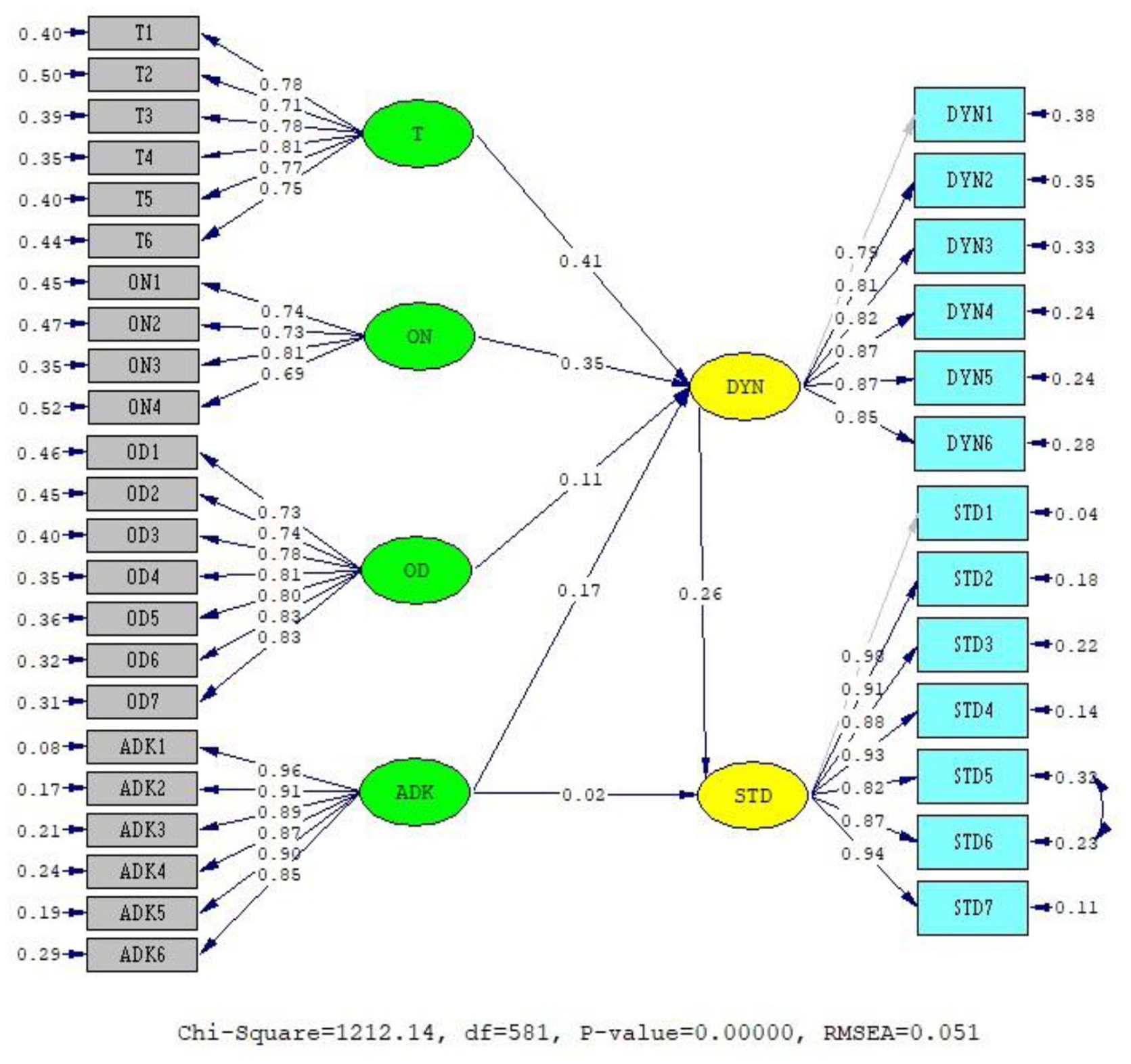
Path diagram of the research model.
SEM Results of Research Hypotheses.

p < .01.
When Table 6 and Figure 1 are examined;
The effect of the Attitude factor on Intention was found to have a statistically significant positive effect. This result implies that a one-unit increase in attitude will cause an increase of 0.41 units in behavioral intention.
It was found that the effect of subjective norm factor on Intention had a statistically significant positive effect. This result indicates that one unit increase in subjective norm will cause 0.35 unit increase in behavioral intention.
The effect of the altruistic values factor on Intention was found to have a statistically significant positive effect. This result indicates that one unit of increase in altruistic value will cause an increase of 0.11 units in behavioral intention.
The effect of the perceived behavioral control factor on Intention was found to have a statistically significant positive effect. This result indicates that a one unit increase in perceived behavioral control will cause an increase of 0.17 units in behavioral intention.
The effect of behavioral intention on sustainable consumption behavior was found to have a statistically significant positive effect. This result implies that a one-unit increase in behavioral intention will cause an increase of 0.26 units in sustainable consumption behavior. It was determined that the effect of perceived behavioral control on sustainable consumption behavior was not statistically significant.
T = Attitude, ON = Subjective Norm, OD = Altruistic Values, ADK = Perceived Behavioral Control, DYN = Intention to Behavior, STD = Sustainable Consumption Behavior
Discussion
According to the results of the research hypotheses; It has been noticed that consumers’ attitudes toward sustainable consumption behavior have a significant effect on sustainable consumption intention. The results show that increase in attitude will cause increase behavioral intention. Previous research confirms that attitudes and beliefs are powerful determinants of sustainable consumption (Gardner & Stern, 1996; Onel & Mukherjee, 2017; Schlossberg, 1991). Vermeir and Verbeke (2008) investigated the determinants of sustainable food consumption behavior in Belgium. According to the results of the research, the high positive correlation detected between attitudes and intentions reveals that there are few participants with high attitudes and low intentions. Yay and Çalışkan (2016) used Planned Behavior Theory to determine the intention of customers to eat at environmentally friendly hotel restaurants, and as a result of the research, it was emphasized that the attitude affects the intention to eat in the environmentally friendly restaurant. Öztürk et al. (2015) investigated the consumers’ buying behavior of halal products within the scope of Planned Behavior Theory variables. As a result of the research, it was revealed that attitude determines the intention to behavior variable. Korkmaz and Sertoğlu (2015) contributed to the literature with a study that considers the variables of Planned Behavior Theory as well as the variables of trust and personal value in order to predict the sustainable food purchasing behavior of young consumers. According to the results they obtained, attitude was observed as the most important determinant of behavioral intention. Mainieri et al. (1997) suggested that consumers’ attitudes predict environmentally sensitive consumer behavior more accurately than general environmental concerns.
It has been concluded that subjective norms for sustainable consumption behavior have a significant effect on sustainable consumption intention. Some of the previous studies emphasize that the intention for environmentally conscious consumption is driven by subjective norms (Armitage & Conner, 2001; Beck & Ajzen, 1991; Conner & Armitage, 1998; Emekçi, 2017; Hopper & Nielsen, 1991; Onel & Mukherjee, 2017; Stern & Dietz, 1994; Thøgersen & Ölander, 2002). Vermeir and Verbeke (2008) stated that subjective norms have an additional positive effect on purchase intention. While Chan (1998) argues that social influences and subjective norms are particularly important for environmental behavior, Godin and Kok (1996) found that the subjective norm component is the weakest predictor of intentions. In addition, some studies (Korkmaz & Sertoğlu, 2015; Paul et al., 2016; Tarkiainen & Sundqvist, 2005) suggested that the subjective norm is not a significant predictor of sustainable purchasing intention. Maichum et al. (2017) developed a research model with an expanded Planned Behavior Theory to investigate the consumption intentions and behaviors of consumers toward organic food. Their studies show that subjective norms do not affect the intention of organic food consumption among the study group in Thailand. Arguing this adverse situation, these researchers concluded that consumers do not see the approval of those who are important to them as an important factor when purchasing sustainable products. They observed that their friends / family members / peer group could not provide consumers with a positive impulse to buy green products (Paul et al., 2016). Erten (2002), on the other hand, aimed to determine whether there is a difference in energy saving behaviors of male and female students in terms of Planned Behavior Theory variables in terms of attitude, subjective norm, perceived behavior control, and purpose (intention) for behavior. According to the results of the research, for the subjective norm dimension that affects energy saving intention, a difference was found between female students and male students.
It has been noticed that the perceived behavioral control toward sustainable consumption behavior has a significant effect on sustainable consumption intention. It has been noticed that the perceived behavioral control toward sustainable consumption behavior does not have a significant direct effect on sustainable consumption behavior.
In previous studies, it was concluded that the perceived behavioral control variable is an important variable in predicting the intention toward sustainable consumption behavior (Dean et al., 2008; Grob, 1995; Onel & Mukherjee, 2017; Roberts, 1996; Taylor & Todd, 1995). Roberts (1996) emphasized in her research that in order to motivate consumers’ behavioral changes, they must be convinced that their behavior affects the environment or will be effective in combating environmental degradation. Because if individuals have weak beliefs about the ability to perform the behavior and the consequences of their behavior, they may not have a positive intention to perform that behavior. For example, Terry and O’Leary (1995), in their study on predicting exercise intention, support the view that the perceived behavior control variable should be used in the Theory of Planned Behavior. Perceived behavioral control emerged as a significant (positive) predictor of actual behavior. There was also evidence that the effects of intentions on behavior are governed by the perceived level of behavioral control. Vermeir and Verbeke (2008) stated in their study that perceived behavioral control and perceived readiness variables have an additional positive effect on purchase intention. Godin and Kok’s (1996) studies revealed that perceived behavioral control contributes 13% additional variance to intention prediction and 12% additional variance to behavior prediction. In the study conducted by Öztürk et al. (2015), it was emphasized that perceived behavioral control has an effect on actual behavior. In some of the previous studies, they reached the conclusion that perceived behavioral control did not have a direct effect on behavior (Özer & Yilmaz, 2010; Sheeran et al., 2003; Vallance et al., 2011). According to Özer and Yilmaz (2010), if the individual does not have sufficient knowledge about behavior or if the resources required to perform the behavior vary, or if the behavior is constantly affected by other factors, the power of perceived behavioral control to affect the behavior will be low. In this study, while the effect of perceived behavioral control variable on intention was revealed, no direct effect on behavior was found.
Research results show that consumers’ environmentally friendly consumption values positively affect their intention to consume environmentally friendly (Wang et al., 2020). In addition to the Planned Behavior Theory variables, the effect of altruistic values variable on intention is another situation examined in this study. According to the results of the research, it was found that altruistic values have a statistically significant positive effect on intention. In previous studies, no conclusion was reached to determine the effect of altruistic values on intention within the scope of Planned Behavior Theory.
Studies investigating altruistic values within the scope of sustainable consumption are available in the literature (Guagnano et al., 1995; Schwartz, 1977; Stern & Dietz, 1994). Stern and Dietz (1994) concluded that values called altruistic values, which focus beyond the individual’s own social environment, are powerful in explaining environmental concerns and behaviors. Hopper and Nielsen (1991), as a result of their research, revealed that recycling behavior is affected by altruistic values, and also emphasized that this behavior is also affected by social norms, personal norms, and awareness of consequences. Schultz and Zelezny (1999) concluded that a person with social-altruistic concerns should engage in pro-environmental behavior in the form of helping other people who do not have direct personal benefits (such as volunteering in cleanup after an oil spill). Vicente-Molina, Fernandez-Sainz, and Vicente-Molina et al. (2013) emphasized that environmental behaviors are mainly linked to altruistic motivations. In addition, some studies have also highlighted changes in the value system to suit environmental problems. For example, de Groot and Steg (2008) proposed a value tool adapted to distinguish egoistic, altruistic, and biospheric value orientations toward environmental behaviors in their study. According to the results of the research, it was concluded that altruistic value items are related to biospheric value orientation and altruistic value oriented biospheric value elements. It is supported by the conclusion that altruistic and biospheric value orientations provide a basis for different environmental beliefs and behavioral intentions. Ay (2017), in the study that explains the environmental consumption behaviors of consumers with the Value-Belief-Norm theory, revealed that individuals with altruistic values think that people behave badly to nature. The researcher put forward the idea that exhibiting behaviors that are in the interest of others rather than their own interests will lead to environmentalist product purchasing behavior, and thus act for the benefit of both nature and other people.
The results of this study make important contributions to the literature in terms of understanding the reasons for the sustainable consumption behavior of consumers. The concept of consumption has differences between cultures. The concept of sustainable consumption also comes up differently in different cultures. It is of course very important to determine the motivations of consumers for sustainable consumption in our country and to identify the driving reasons for consumers to gain this consumption habit. For this reason, these research results have made important contributions to different disciplines.
The results of this study have beneficial results for public and business policies. Because it has been concluded that individuals’ attitudes have an effect on sustainable consumption behavior. Individuals’ attitudes can be changed through education and knowledge transfer. It is clear that individuals whose attitudes toward sustainable consumption change will exhibit more sustainable consumption intention, and intention will guide behavior. Again, the effect of perceived behavioral control of individuals in terms of whether they can realize sustainable consumption-oriented behaviors on sustainable consumption intention was revealed. In this respect, it is concluded that sustainable consumption awareness will become widespread when it is supported by environmental trainings and other policies to be developed for environmental consumption and behavior.
Subjective norms have an impact on sustainable consumption intention. In this case, it can indirectly contribute to increased purchases through subjective incentives. In addition, according to the research results, it was concluded that the perceived behavioral control variable had an effect on intention but not on behavior. The reason for this situation was previously interpreted by Özer and Yilmaz (2010) as that the individual did not have sufficient knowledge about behavior. Based on this result, it can be suggested that it may be beneficial to increase the beliefs of individuals that they can achieve sustainable consumption behavior through education and information transfer. Businesses also play an important role in promoting sustainable consumption behavior. Businesses can communicate the harmful consequences of consumption behavior to consumers in various ways in order to promote sustainable consumption behavior. Thus, consumers will be aware of the consequences of their behavior and this will help them make decisions based on their environmental concerns (Onel & Mukherjee, 2017).
In addition to its contributions to the literature, this research has some limitations as well. This research was conducted on consumers living in Kastamonu province. Kastamonu is between yl emerging in Turkey. Consumers do not have too much trouble in accessing locally produced, unprocessed, environmentally friendly products with fewer additives. By working with a sample of consumers in large cities, future researchers can compare the results of the research, which can give more meaning to those results. It is known that the consumers are tired of filling the questionnaire items and they are not willing to fill the questionnaire. In the future, working within the framework of different methods can be strengthened. In this research, sustainable consumption behavior was investigated within the scope of Planned Behavior Theory. Other studies on sustainable consumption behavior can be conducted on the basis of other theories that allow to predict the causes of the behavior.
Conclusion
Environmental pollution and destructions of nature have gradually increased as a result of the modern consumption habits of our age. Individuals have also started to feel the damages of these damages and have started to approach the environment more responsibly. Environmentally conscious consumers, whose number is increasing day by day, prefer frequently purchased consumer items such as organic food, environmentally friendly detergents and chemicals, and environmentally friendly durable products and services. However, sustainable consumer behavior varies widely, depending on many different factors. Therefore, this study includes identifying these different factors within the framework of Planned Behavior Theory, which was developed to determine the causes of behaviors while examining environmentally friendly purchasing behaviors.
This study extends the existing literature on environmental behavior in Turkey. The results of this study make important contributions to the literature in terms of understanding the reasons for the sustainable consumption behavior of consumers. In addition, the results of this study have beneficial results for public and business policies. Because it has been concluded that individuals’ attitudes have an effect on sustainable consumption behavior. Individuals’ attitudes can be changed through education and knowledge transfer. It is clear that individuals whose attitudes toward sustainable consumption change will exhibit more sustainable consumption intention, and intention will guide behavior. Again, the effect of perceived behavioral control of individuals in terms of whether they can realize sustainable consumption-oriented behaviors on sustainable consumption intention was revealed. Governments should support consumers’ attitudes toward sustainable consumption through mass awareness campaigns aimed at improving consumer environmental awareness and values (Nduneseokwu et al., 2017). In this respect, it is concluded that sustainable consumption awareness will become widespread when it is supported by environmental trainings and other policies to be developed for environmental consumption and behavior.
Subjective norms have an impact on sustainable consumption intention. In this case, it can indirectly contribute to increased purchases through subjective incentives. In addition, according to the research results, it was concluded that the perceived behavioral control variable had an effect on intention but not on behavior. The reason for this situation was previously interpreted by Özer and Yilmaz (2010) as that the individual did not have sufficient knowledge about behavior. Based on this result, it can be suggested that it may be beneficial to increase the beliefs of individuals that they can achieve sustainable consumption behavior through education and information transfer.
One of the practical measures that governments can implement is related to sustainable procurement in public procurement. One of the situations that governments should be sensitive about in order to promote sustainable consumption is public procurement. The adoption and development of green public procurement can be supported by governments. If green public procurement can be implemented effectively, not only can environmental goals be achieved, but also efficiency and economic recovery (Cheng et al., 2018). The same is true for private sector companies. The increase in environmentally conscious customers has had a significant impact on the environmental purchasing activities of companies. While making a purchase decision, customers have started to behave according to the environmental reputation of the companies (Appolloni et al., 2014).
This research covers consumers living in only one city in Turkey. Future research can be done in a wider area. At the same time, convenience sampling method was used in this study, and generalizations can be made by using probabilistic sampling methods in future studies.
Footnotes
Author Note
This publication uses data collected within the framework of the İlknur AYAR’s PhD thesis entitled “Stating consumer’s intentions of sustainable consumption within the context of theory of planned behaviour,” Karabuk University, Karabuk/Turkey, 2019.
Declaration of Conflicting Interests
The author(s) declared no potential conflicts of interest with respect to the research, authorship, and/or publication of this article.
Funding
The author(s) received no financial support for the research, authorship, and/or publication of this article.
Ethical Statement
Karabük University Social Sciences Research Ethics Committee.
