




Abstract
The COVID-19 pandemic has changed consumers’ purchasing behavior from contact to intact consumerism. By integrating the protection motivation theory and the theory of planned behavior, this study investigates factors that motivate consumers to purchase online. Data were collected from an online survey among 481 consumers using self-administered questionnaires. The findings suggest that consumers may link protection motivation factors to attitude toward online purchasing. Further, attitude toward online purchasing, internal subjective norms, perceived behavioral control, and social distancing have significant relationships with intention to purchase online. Additionally, social distancing is a significant moderator in the relationship between attitude and intention to purchase online; indicating that consumers’ adherence to social distancing moderates the relationship negatively.
Plain Language Summary
The purpose of this study is to examine how consumers perceived online purchasing as an adaptive behavior to respond to the highly contagious coronavirus through the combination of Protection Motivation Theory (PMT) with Theory of Planned Behavior (TPB). Data were collected from an online survey among 481 consumers using self-administered questionnaires. The research found different factors that influence consumers’ attitudes toward online purchasing and their intention to purchase online. The inclusion of social distancing adoption provides a unique comprehension of how much this situational factor affects consumers’ intention to purchase online during a health crisis. The outcomes offer valuable insights for e-commerce marketers to better understand how to modify their offerings to address the most critical concerns of customers. In addition, recognizing that online purchasing can serve as an adaptive behavior for preventing virus infection can aid policymakers in enhancing their campaigns aimed at promoting the adoption of preventive behaviors.
Keywords
Introduction
The COVID-19 pandemic hit many industries hard, especially in terms of financial standing (Rababah et al., 2020). Consumers’ favored channel for shopping was impacted by unforeseen regulations such as social distancing. For that, many businesses tilted their operations by adopting online business platforms to survive, and some even flourished. While the last decade witnessed stable growth in online shopping (Sharma, 2021), it has increased substantially during the COVID-19 pandemic (X. C. Wang et al., 2021). The digital shopping platform has even attracted older and less digital-savvy consumers such as Baby Boomers due to the safe environment offered (Eger et al., 2021). Despite the obstacles brought by the pandemic, the availability of online commerce platforms enables consumers to fulfill their own and their family’s consumption requirements.
Online shopping becomes the center of consumers’ purchasing behavior, particularly during pandemics not only due to its convenience and speed but also because it can guarantee safety from getting infected by the virus (Pejić-Bach, 2021). While the existing studies acknowledged the importance of e-commerce to ensure economic growth during the pandemic (e.g., Alsolamy, 2022; Young et al., 2022), little attention has been put to investigate why consumers purchase online during a pandemic and how this changing behavior can be regarded as an adaptive behavior to avoid coronavirus infection.
For that, the current study used two theoretical lenses – protection motivation theory (PMT) and the theory of planned behavior (TPB). First, PMT considers the influence of threat and coping appraisals related to COVID-19 on performing adaptive behavior of online purchasing (R. W. Rogers, 1975). The potential dangers associated with going out to buy things can lead consumers to turn to online methods to carry out this activity. Therefore, performing online purchasing can be perceived as a coping behavior to avoid coronavirus infection. Second, TPB provides a theoretical framework to understand consumers’ motivation to purchase online as a result of threat and coping appraisals through factors - attitude toward behavior, subjective norms, and perceived behavioral control (Ajzen, 1985). The integration of these two theories was novel to understand that during a pandemic, consumers perform online purchasing not only due to the influence of TPB’s motivational factors (i.e., from TPB point of view) but also as an adaptive behavior to reduce the risk of infection (i.e., from PMT point of view). Therefore, the combination of PMT’s cognitive factors along with TPB’s motivational factors, forms a unique theoretical framework that impacts consumer attitude and intention toward the adoption of online shopping platforms during a pandemic. Recognizing that online purchasing can serve as an adaptive behavior for preventing virus infection can aid policymakers in enhancing their campaigns aimed at promoting the adoption of preventive behaviors.
Throughout the COVID-19 pandemic, many countries have mandated social distancing to limit people’s mobility as a measure to curb the spread of the virus. This policy has affected consumers’ shopping decisions. Moore (2020) reported that consumers have reduced the time spent in physical stores significantly during the pandemic and that social distancing has stimulated consumers to discover online shopping experiences. Therefore, it is necessary to understand the effect of social distancing implementation during the COVID-19 pandemic on consumers’ transformation toward online purchasing. Previous consumer behaviors research conducted during the COVID-19 pandemic have investigated different factors that drive consumers to participate in online shopping (e.g., S. Ali et al., 2021; Prasetyo & Fuente, 2020; Rout et al., 2022), the role of social distancing which is a critical situational factor during the pandemic, has received little attention. Therefore, this study examined the influence of social distancing on consumers’ decision to adopt online purchasing behavior. Furthermore, consumers’ online purchasing experiences may vary due to the different levels of social distancing adoption by individuals. This study should provide explanations of how social distancing moderated the relationship between attitudes toward online purchasing and intention to purchase online. To the best of our knowledge, this is the first study to investigate the moderating role of social distancing adoption in understanding consumers’ online purchasing behavior during COVID-19. The presented research contributes to the understanding of consumers’ attitudes and behavior regarding online purchasing under social distancing implementation during the COVID-19 pandemic. Thus, the study provides a unique comprehension of how much social distancing adoption affects consumers’ intention to purchase online. It offers valuable insights for e-commerce marketers to better understand how to modify their offerings to address the most critical concerns of customers.
Overall, this study has three objectives, firstly we wanted to know how consumers perceived online purchasing as an adaptive behavior to respond to the highly contagious coronavirus through PMT. Secondly, we want to test the distinct effects of each factor presented in TPB with the extension of social distancing and external subjective norms over intention to purchase online, and lastly how social distancing modifies the link between attitude and intention to purchase online.
Theoretical Background
The theoretical framework to understand consumers’ intention toward online purchasing during the COVID-19 pandemic was built based on two underpinning theories. PMT is suitable to explain how consumers respond to the coronavirus threat and assess online purchasing as a coping behavior against the threat. TPB provides a deep explanation of consumers’ attitudes and beliefs toward online purchases during the pandemic. Additionally, external subjective norms and social distancing constructs were augmented to the research framework to improve the explanatory power of the model.
Protection Motivation Theory (PMT)
The protection motivation theory (PMT) was initially developed to explain individuals’ motivation to respond to health-threatening events. PMT assumes that individuals determine their behavior to adopt or not to adopt protective behavior based on two cognitive appraisal processes of the threatening events: threat and coping appraisals (R. W. Rogers, 1975). Threat appraisal refers to the evaluation of risk based on perceived severity and perceived vulnerability. Perceived severity implies how harmful and dangerous the event is to a person, while perceived vulnerability denotes the probability of a person being exposed to the threat. Next, coping appraisal refers to the assessment of adaptive behavior to cope with the potential danger based on response efficacy and self-efficacy. Response efficacy refers to the effectiveness of the coping behavior to avoid the threat, while self-efficacy refers to whether an individual can perform the coping behavior. The threat appraisal process will initiate coping process. When one believes that performing the coping process will avoid the threat and the person has the ability to perform it, the recommended coping behavior will be adopted. The protection motivation will be formed by developing a positive attitude toward the recommended actions, which consequently led to performing the action. PMT has been applied to explain cognitive and psychological effects that motivate individuals to perform protective behavior in different situations such as skin cancer prevention (Sotoudeh et al., 2020), mitigating the risk of credit card consumption (S. T. Wang, 2019), and reducing smoking health risk (Sabzmakan et al., 2018). During COVID-19, researchers have used PMT to understand people’s behavior in coping with the spread of the virus. For instance, Ding et al. (2022) examined the willingness to purchase masks against COVID-19, Huang et al. (2021) assessed people’s willingness to get COVID-19 vaccine, and Okuhara et al. (2020) measured the intention to stay at home during the pandemic. In this study, the adoption of online purchasing during COVID-19 pandemic can be understood as the coping behavior to protect individuals from the virus. Performing online purchasing let individuals to stay at home while making necessary purchases. Therefore, PMT is suitable to be used to explain consumers’ positive attitudes toward online purchases, which influence their intention to adopt this service during the COVID-19 pandemic.
Theory of Planned Behavior
The theory of planned behavior (TPB) was introduced by Ajzen (Ajzen, 1985) as an extension of theory of reasoned action (TRA) (Fishbein, 1975) to predict and explain human behavior. According to the theory, behavioral intention captures the motivational factors that lead humans to perform a specific behavior. Attitude toward behavior, subjective norms, and perceived behavioral control are the determinants of behavioral intention. Attitude toward behavior is the feeling of whether the behavior in question is favorable or unfavorable. Subjective norms refer to the social pressure felt by an individual in relation to the intended behavior. Perceived behavioral control is the individual perception of the ability to perform the behavior. TPB is one of the most used models in understanding consumer behavior and has received substantial empirical support in the context of online purchasing behaviors (e.g., Han et al., 2018; Mainardes et al., 2020; H. Tang et al., 2021).
This study augmented two new constructs to the TPB: external subjective norms and social distancing. In addition to subjective norms that consist of close social networks such as family and friends (thereinafter internal subjective norms), external subjective norms capture the influences of external sources such as experts and media (E. M. Rogers, 2003). Media plays an important role in disseminating information during the pandemic, which includes information related to recommended protective behavior by experts such as medical practitioners and public health authorities (Mat Dawi et al., 2021). Thus, both internal and external subjective norms influence predicting individuals’ behavior during the COVID-19 pandemic. Social distancing was proven effective to reduce the transmission of severe acute respiratory syndrome coronavirus 2 (SARS-CoV-2) (Manipis et al., 2021). It has also helped to decrease the number of patients in critical care units (Ferguson et al., 2020). The restriction of conventional face-to-face interactions led consumers to amend their purchasing behavior by adopting technology-based alternatives (e.g., online purchasing) to continue the consumption of their product.
Hypotheses Development
A research model was developed to understand consumers’ intention to purchase online. Combining PMT and TPB, the model proposes possible relationships for several latent variables related to the two theories. The model also augmented two new constructs: external subjective norms and social distancing. Hence, the conceptual model consists of all hypothesized links of PMT and TPB as well as links for the new constructs.
The adoption of information technology during a health crisis should be considered and distinguished from other situations. Many human behaviors including working, learning, and shopping have shifted from offline to online not only to meet the COVID-19 mandate such as social distancing and quarantine, but also to prevent from getting infected. Therefore, it is believed that integrating PMT into the research model has better explanatory power than other technology adoption theories. Research in preventive behavior adoption during the COVID-19 pandemic showed that when individuals perceive the severity of, and their vulnerability to, the virus, they evaluate the preventive behavior more favorably (Ezati Rad et al., 2021; Lahiri et al., 2021). Perceived severity is defined as an individual’s perception of the degree of harm that may be caused by the COVID-19 pandemic, while perceived vulnerability refers to an individual’s perception that he or she is exposed to COVID-19 infection (Bashirian et al., 2020). When consumers are concerned about COVID-19 severity and how vulnerable they were to it, they will likely have positive attitudes toward online purchases as a coping action to purchase products and services during the pandemic. Pang et al. (2021) point out that consumers who are aware of the vulnerability of a threat are more likely to have positive attitudes toward the coping behavior. It was found that perceived severity of the pandemic and consumers’ perceived vulnerability to it positively affect consumers’ attitudes toward online purchasing (S. Y. Youn et al., 2021). Therefore, the following hypotheses were proposed:
H1: Perceived severity of COVID-19 is positively related to attitude toward online purchasing during the COVID-19 pandemic.
H2: Perceived vulnerability of COVID-19 is positively related to attitude toward online purchasing during the COVID-19 pandemic.
Coping appraisal factors, that is, self-efficacy and response efficacy were found to influence individuals’ behavioral and attitudinal changes toward preventive measures during a health crisis (Al-Hasan et al., 2020; Nerini et al., 2022). For example, Timpka et al. (2014) found out that coping appraisal improved people’s intention to carry out non-pharmaceutical health actions such as avoiding public transportation and washing hands during influenza outbreaks. In the current study, response efficacy refers to the degree to which an individual believes that performing online purchasing can eliminate the COVID-19 threat, while self-efficacy is defined as an individual’s perception of his/her ability to perform online purchasing as the recommended coping behavior (Liu et al., 2021). Consumers who believe that performing online purchasing is useful in preventing COVID-19 infection are likely to have a positive attitude toward this behavior. Additionally, consumers who evaluate themselves as having the ability to perform online purchasing are more likely to have favorable attitudes toward the behavior. S. Youn et al. (2022) found both self-efficacy and response efficacy positively influence consumers’ attitudes to online shopping during COVID-19. Therefore, the following hypotheses were proposed:
H3: Perceived response efficacy of online purchasing is positively related to attitude toward purchasing online during the COVID-19 pandemic
H4: Perceived self-efficacy of online purchasing is positively related to attitude toward purchasing online during the COVID-19 pandemic
Past research conducted in the context of online shopping has consistently found that consumer attitude is a strong factor to increase behavioral intention (e.g., Dakduk et al., 2017; Ha, 2020; H. Tang et al., 2021). In this study, attitude is defined as the degree to which a person has a favorable or unfavorable evaluation of online purchasing during the COVID-19 pandemic. Ong et al. (2022) found that a positive attitude toward the behavior positively affects purchase intention during a pandemic. When consumers have favorable attitudes toward online purchasing during the COVID-19 crisis, they are likely to have greater intention to purchase things online. The following hypothesis was proposed:
H5: Attitude toward online purchasing is positively related to intention to purchase online during the COVID-19 pandemic.
Consumers have been exposed to a lot of information and stories throughout the COVID-19 outbreak, which could come from internal sources such as close acquaintances of family and friends, as well as external sources such as media and expert authorities (Koch et al., 2020). Since many have never or have little experience dealing with such exceptional circumstances, it is anticipated that consumers rely upon both internal and external subjective norms in making decisions to perform online purchases during the pandemic. Other than that, perceived behavioral control also is a strong factor that affects behavioral intention. Consumers are more likely to purchase things online when they know how to do it and have the facilities such as the Internet and computers. Moon et al. (2021) found that perceived behavioral control has a positive influence on the intention to perform online shopping during COVID-19. Based on the arguments, the following hypotheses were proposed:
H6: Internal subjective norm is positively related to intention to purchase online during the COVID-19 pandemic.
H7: External subjective norm is positively related to intention to purchase online during the COVID-19 pandemic.
H8: Perceived behavioral control is positively related to intention to purchase online during the COVID-19 pandemic.
Social distancing adoption has altered the way consumers do their activities outside the home. Minimizing physical interactions has consistently proven to be one of the most effective non-pharmaceutical approaches in curbing the spread of the COVID-19 virus and reducing the rate of fatalities (Moosa, 2020). Adherence to recommended social distancing and the limitation of face-to-face interaction to remain virus-free have influenced consumers to seek digital platforms to get services (Hollebeek et al., 2021). As such, businesses have revolutionized their operations by including e-commerce touchpoints such as websites and mobile apps to cater the consumers’ demand (CapGemini, 2020). We hypothesized that during the COVID-19 pandemic, consumers practicing higher levels of social distancing will be more inclined to purchase online to limit physical interaction. The following hypothesis was proposed:
H9: Social distancing adoption is positively related to intention to purchase online during the COVID-19 pandemic.
Past research indicates that attitudinal and behavioral consequences will vary according to certain adaptability conditions caused by the COVID-19 pandemic (S. Youn et al., 2022). Given the potential shift toward social distancing as a prevailing aspect of consumer shopping behavior, we tested how social distancing adoption may have a moderator role over attitudes toward online shopping and their influence on behavioral intention. When the authority mandated social distancing and consumers must adhere to it while making purchases, the positive influence of attitude on intention to adopt online purchasing weakens. The impact of attitude toward online shopping on the intention to purchase online would diminish for consumers who adopt higher levels of social distancing measures. The following hypothesis was proposed.
H10: The positive relationship between attitude toward online purchasing and intention to purchase online during the COVID-19 pandemic is weaker when social distancing adoption is high.
Methodology
Data Collection and Sampling
An online survey was conducted in Malaysia in May 2021. We confirmed that the online survey was appropriate to be conducted during this time as the COVID-19 cases reached 600,000 and COVID-19 measures are fully implemented by the authority during this time. Respondents were employed based on non-probability sampling technique of purposive. This method is considered more appropriate as the population is unknown and it is challenging to acquire responses from the complete sampling frame (Reynolds et al., 2003). Survey invitations were sent through emails and the link also was placed on social media sites. The targeted respondents were consumers who had experienced online purchasing during the COVID-19 pandemic. To ensure eligibility and to verify that the respondents would provide valid information based on their prior online purchasing experience during COVID-19, a screening question (Did you make any online purchasing during the COVID-19 pandemic?) was asked. The questionnaire was divided into two main parts. The first part consists of demographic questions, while the second part includes questions related to the constructs of interest. Five-point Likert scale (1 = totally disagree to 5 – totally agree) was used in the second part of the questionnaire. After eliminating incomplete responses, 481 valid samples were used for data analysis. As the study adopted partial least squares structural equation modeling (PLS-SEM) method for analysis, the appropriate sample size can be determined by multiplying the number of independent variables in the study by 10 (Barclay et al., 1995). The sample size collected in this study was more than the required sample size of 90, which is adequate for the data analysis. In addition, a sample size between 200 and 500 is recommended in consumer studies (Churchill & Iacobucci, 2006). Table 1 summarized the demographic profile of the respondents.
Respondents’ Demographic Profile.

Measures
The questionnaire comprises of 39 items, which were adapted from previous research. Items for perceived severity of COVID-19, perceived vulnerability of COVID-19, and social distancing were adapted from Itani and Hollebeek (2021). Perceived response efficacy and perceived self-efficacy of online purchasing were measured using a scale developed by S. Y. Youn et al. (2021). Measures of internal and subjective norms were adopted from Koch et al. (2020). To assess perceived behavioral control and attitude toward online purchasing, measures from Fortes and Rita (2016) were adapted. Lastly, online purchasing intention measurements were adapted from Limayem et al. (2000). The questions were inspected by three experts in the field of marketing and information systems to demonstrate face and content validity.
Data Analysis
This study tested the proposed conceptual framework based on partial least squares structural equation modeling (PLS-SEM) method. PLS-SEM was suitable to be used in the current study due to its predictive power in analyzing complex research models with non-normal data and small sample sizes (F. Ali et al., 2018). As suggested by Hair et al. (2017), a two-stage procedure was conducted in the analyses. First, the reliability and validity of the constructs were tested in a measurement model. Second, the structural model of relationships among the constructs were examined using bootstrapping approach to generate path coefficients, t-values, and p-values.
Results
Assessment of Measurement Model
The measurement model was assessed in terms of internal reliability, convergent validity, and discriminant validity. Cronbach’s α for all constructs is greater than 0.7 while composite reliability (CR) ranges from 0.817 to 0.967, indicating strong internal consistency reliability. Convergent validity was evaluated through factor loadings and average variance extracted (AVE). The results show that the value of factor loadings ranges from 0.632 to 0.948, while AVE for each construct exceeded 0.5, confirming convergent validity (Hair et al., 2017) (see Table 2 and Figure 1). Fornell-Larcker criterion and Heterotrait-monotrait ratio (HTMT) were assessed to measure discriminant validity. As reported in Table 3, the squared correlation value for each construct was highest than other indicators’ values and the HTMT ratios are below .9, indicating an acceptable level of discriminant validity (Hair et al., 2017).
Reliability and Convergent Validity.

Note. ATT = attitude toward online purchasing; ESN = external subjective norm; INT = intention to purchase online; ISN = internal subjective norm; PBC = perceived behavioral control; PRES = perceived response efficacy; PSELF = perceived self-efficacy; PSERV = perceived severity; PVUL = perceived vulnerability; SOCD = social distancing.
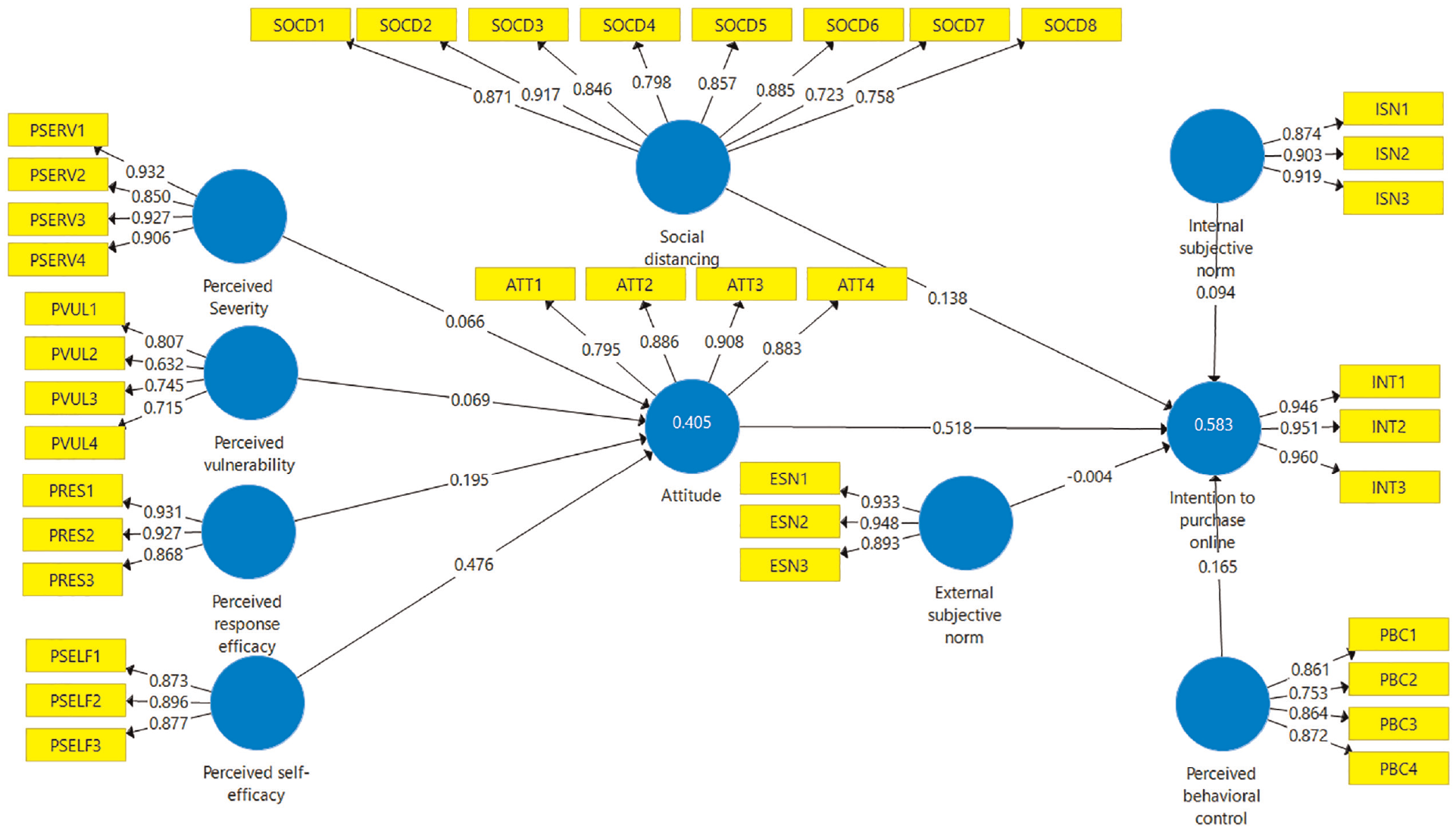
Measurement model (Partial least square (PLS)-algorithm).
Analysis of Discriminant Reliability.

Note. ATT = attitude toward online purchasing; ESN = external subjective norm; INT = intention to purchase online; ISN = internal subjective norm; PBC = perceived behavioral control; PRES = perceived response efficacy; PSELF = perceived self-efficacy; PSERV = perceived severity; PVUL = perceived vulnerability; SOCD = social distancing.
Assessment of Structural Model
Before examining the structural model, collinearity was assessed based on the variance inflation factor (VIF) values. As shown in Table 4, the VIF scores for all independent variables are below the threshold of 5, indicating that there is no multi-collinearity issue in the structural model (Hair et al., 2017).
Summary of Hypotheses.

Note. ATT = attitude toward online purchasing; ESN = external subjective norm; INT = intention to purchase online; ISN = internal subjective norm; PBC = perceived behavioral control; PRES = perceived response efficacy; PSELF = perceived self-efficacy; PSERV = perceived severity; PVUL = perceived vulnerability; SOCD = social distancing.
To test the structural paths of the proposed model, bootstrapping technique was performed. Table 4 provides a summary of the structural modeling. It was found that perceived vulnerability (β = .069; p < .05), perceived response efficacy (β = .195; p < .001), and perceived self-efficacy (β = .476; p < .001) had positive effects on attitude toward online purchases, while perceived severity (β = .066; p > .001) did not. Thus H2, H3, and H4 were accepted and H1 was rejected. In addition, attitude toward online purchasing (β = .508; p < .001), internal subjective norms (β = .093; p < .05), perceived behavioral control (β = .160; p < .001), and social distancing (β = .103; p < .001) had positive effects on intention to purchase online, while external subjective norms (β = .001; p > .001) did not. Thus, H5, H6, H8, and H9 were accepted and H7 was rejected.
Next, the R2 value was assessed to measure the predictive power. The R2 value for attitude toward online purchases is .405, while intention to purchase online is .588, which are relatively high and acceptable for behavioral research standards (Hair et al., 2017). In addition, effect size (f2) was examined to understand the amount of effect the independent variable had on the dependent variable. According to Cohen (1977), values of 0.02, 0.15, and 0.35 represent small, medium, and large effects. Results show that perceived self-efficacy has the largest effect on attitude toward online purchases (f2 = 0.295), while attitude toward online purchases has the largest effect on online shopping intention (f2 = 0.312). The predictive relevance (Q2) value of the path model was found to be 0.301 for attitude toward online purchases and 0.522 for intention to purchase. Q2 value above zero indicates that the model has predictive relevance (Henseler et al., 2009).
The moderating effect of social distancing is examined by determining its interaction effect on the relationship between attitude toward online purchasing and intention to purchase online. As can be seen in Table 4 and Figure 2, the results demonstrate that social distancing significantly moderates the relationship between attitude toward online purchasing and intention to purchase online (β = −.053; p < .05). The moderating effect of social distancing decreased the β value between attitude toward online purchasing and intention to purchase online from 0.518 to 0.508. The result suggested that the positive effect of attitude toward online purchasing on intention to purchase online is reduced by the effect of social distancing. Thus, H10 was supported.
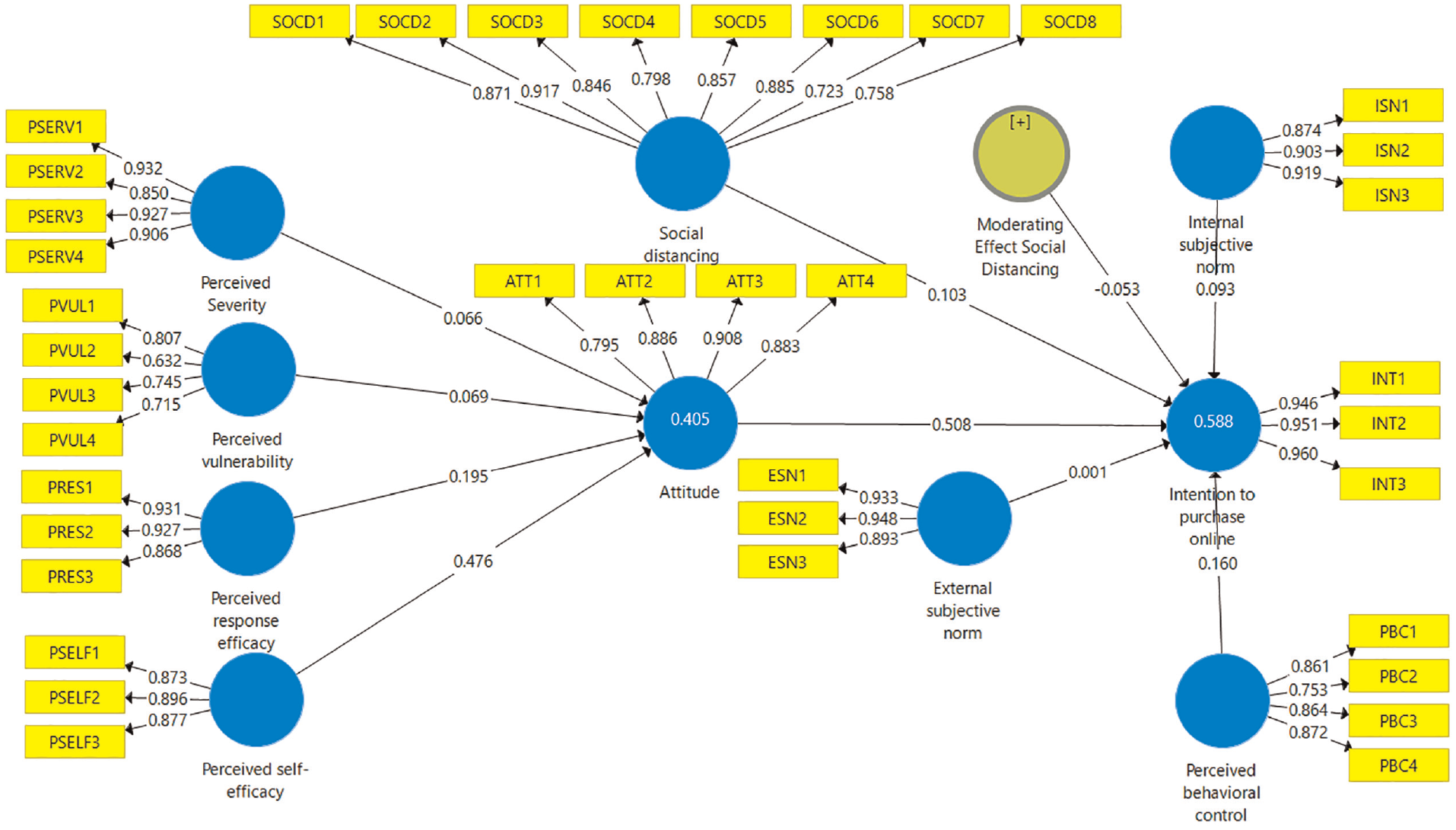
Moderating effect model (PLS-algorithm).
Discussion
This research uncovers several factors that influence consumers’ attitudes toward online purchasing as well as intention to purchase online during the COVID-19 pandemic based on two theoretical perspectives. PMT explains how consumers view online purchasing as a coping strategy to eliminate COVID-19 threats as the result of threat and coping appraisals, while TPB describes consumers’ motivation to purchase online based on beliefs and social pressures.
The outcomes confirmed that perceived vulnerability of COVID-19 explained consumers’ attitudes about online purchasing. This implies that improving the perception related to the vulnerability of the virus through risk communication improves individuals’ attitudes toward online purchasing during the pandemic (Lahiri et al., 2021). On the other hand, perceived severity of COVID-19 had a negligible impact on attitude toward online purchasing. This discovery can be explained by the fact that although the COVID-19 virus is highly transmissible, it is not highly lethal (Thacker, 2020). This is attributed to the lower mortality rate in Malaysia than in other countries (A. Tang, 2020). With respect to coping appraisals, the results found that consumers’ perception of self-efficacy and response efficacy explained their attitudes toward online purchases. This implies that when consumers perceived online purchasing as an effective way to prevent themselves from COVID-19 and that they have the ability and resources, they are more likely to adopt it. This is supported by other studies demonstrating that coping appraisal factors improve a favorable evaluation of consumers’ coping behaviors during COVID-19 pandemic (Kursan Milaković & Miocevic, 2023; Soon et al., 2022). While other research discovered comparable outcomes examining non-pharmaceutical preventive behavior adoption to combat COVID-19 such as hand washing and face covering (Higuchi et al., 2021; Kim & Crimmins, 2020; Mortada et al., 2021), our study expands upon their findings by exploring online purchasing behavior as a coping strategy. Furthermore, the results highlight the significance of understanding the role of protection motivation in shaping consumers’ shopping behavior during health crisis.
Further, we found that consumers’ attitudes, internal subjective norms, and perceived behavioral control positively explain their intention to purchase online during the COVID-19 pandemic. The results show how consumers’ intention to purchase online is influenced by their own beliefs about the behavior and social pressure. Consumers who hold more favorable attitudes toward online purchasing are more likely to express intention to purchase online during the pandemic. The direct influence of internal subjective norms on intention to purchase online suggests that individual’s perceptions of what significant others (e.g., family, friends) think about online purchasing play a role in shaping their intention. The significant relationship between perceived behavioral control and intention to purchase online implies that in the context of online purchasing during the pandemic, individuals who believe they have the necessary resources, skills, and control over their actions are more likely to express the intention to engage in online purchasing. These results are aligned with other studies conducted during the pandemic in different settings such as purchasing flight tickets (Aleksić et al., 2022), healthy foods (Hung & Dung, 2022), and ride sharing (Nguyen-Phuoc et al., 2022). With respect to the new constructs that were augmented to the TPB to better understand consumers’ behavior during COVID-19 pandemic, the first construct, external subjective norms did not affect individuals’ intention to shop online. This finding indicates that during the COVID-19 crisis, internal pressures seem to outweigh outside forces such as media and economic experts in influencing consumers’ decisions to purchase online. This attributed to the explanation of the significant effect of internal subjective norms on intention to purchase online. During the pandemic, people are concerned to protect their loved ones from getting infected by the COVID-19 virus. Therefore, they would encourage the adoption of protective behavior, which in this context referred to online purchasing.
Our findings revealed a dual effect of social distancing on online purchasing behavior. Firstly, we observed a positive effect of social distancing on individuals’ intention to purchase online. This suggests that when individuals engage in social distancing measures, they are more inclined to consider online shopping as a viable option for fulfilling their purchase intentions. During the COVID-19 outbreak, social distancing practice significantly affects online purchasing intent because consumers are aware that engaging with people while doing in-person shopping during the pandemic exposes them to potential health risks. This finding is aligned with Sumarliah et al. (2022) demonstrating that social distancing enhances the adoption of online shopping platforms during the COVID-19 pandemic. Interestingly, we also discovered a negative moderation effect of social distancing on the relationship between individuals’ attitudes toward online shopping and their intention to purchase online. This suggests that the impact of individuals’ attitudes toward online shopping on their intention to purchase online is weakened in the presence of higher levels of social distancing. Specifically, when individuals practice social distancing to a greater extent, their intention to purchase online is less impacted by their favorable attitudes toward online purchasing. This distinct situation can be explained by the connection between social distancing adoption and trust (Brodeur et al., 2021). Individuals who engage in more social distancing are inclined to believe that this measure is effective in ensuring their safety. As individuals prioritize their health and adhere to social distancing guidelines, their reliance on online shopping may decrease, regardless of their positive attitudes toward it. These findings highlight the complex interplay between social distancing, attitude toward online shopping, and intention to purchase online. They contribute to a deeper understanding of consumer behavior during times of health threats and emphasize the need to consider situational factors such as social distancing when studying online purchasing intention.
Theoretical Implications
The present study offers several theoretical lenses to understand consumers’ online shopping behavior during a pandemic. First, the integration of PMT and TPB emphasizes the importance of considering cognitive factors (threat and coping appraisals) and motivational factors (attitudes, subjective norms, perceived behavioral control) in predicting consumer behavior during the pandemic. While previous research has utilized PMT and TPB to examine behavioral changes during the COVID-19 pandemic, the focus of PMT studies has primarily been on coping strategies related to public health measures such as mask-wearing and social distancing. Further, not many studies have used TPB to measure what influence consumers’ attitudes and behavior related to online purchasing during the pandemic.
Second, the outcome adds to the body of knowledge on how COVID-19 social distancing measures affect consumers’ behavior when they shop online. Previous literature during the pandemic has hugely focused on the effects of social distancing on virus prevention among individuals (Du et al., 2020). Little attention has been put on examining the impact of social distancing on consumer behavior. We provide insights on how social distancing adoption play dual roles in understanding consumers’ online purchasing behavior. The direct effect of social distancing on intention to purchase online suggests that social distancing serves as a trigger that influences consumers to adopt a new behavior - online purchasing. The indirect effect explains how social distancing can weaken the relationship between attitudes and intention to purchase online. These findings emphasize the importance of considering specific situational factors when studying consumer behavior during health threats.
Practical Implications
The research findings also provide practical insights for online purchasing providers, practitioners, and marketers. First, our study revealed that consumers’ perception of threat and coping appraisals regarding online purchasing during the pandemic can improve their favorable attitudes toward online purchasing adoption. Marketing strategies can leverage this knowledge by emphasizing the potential risks of in-person purchasing during health threats and highlighting online purchasing as a safer alternative. By addressing consumers’ concerns and providing information on effective coping strategies, organizations can encourage a more positive attitude toward online purchasing and increase its adoption. Second, we found that attitude, internal subjective norm, and perceived behavioral control are positively related to consumers’ intention to purchase online. These findings provide practical lenses to encourage and support consumers in adopting online purchasing as a preferred mode of consumption. Organizations should focus on improving the consumer experience of online purchasing platforms. For instance, marketers can shape consumers’ attitudes toward online purchasing by emphasizing the benefits of online purchasing such as safety, convenience, and access to a wide range of products. Additionally, creating a sense of community and trust through customer reviews, ratings, and social media engagement can strengthen the internal subjective norm and foster a sense of belonging among consumers. Furthermore, ensuring a seamless and satisfying online purchasing experience can reinforce consumers’ perceived behavioral control and lead to increased online purchase behavior. Third, we found that social distancing plays dual roles in online purchasing behavior. With the direct influence of social distancing on the intention to purchase online, organizations can emphasize the benefits of reducing physical interactions and promoting the adoption of online purchasing to protect oneself and others. The finding of negative moderation effect of social distancing necessitates an adjustment in marketing strategies. Instead of focusing on improving favorable attitudes toward online purchasing, marketers should recognize the impact of social distancing on consumers’ decision-making and tailor their marketing campaigns. They should emphasize how online purchasing enables individuals to maintain physical distancing while fulfilling their consumption needs. This will resonate with consumers and encourage their intention to purchase online.
Apart from that, the result offers practical insights for health authorities to promote public health during a pandemic. Understanding the interplay between PMT and TPB psychological factors can inform the development of targeted interventions and strategies to promote online shopping as a preventive behavior. Health authorities can use PMT framework to tailor risk communication messages related to online shopping during a health crisis. They can effectively convey the importance of adopting online purchasing as a preventive behavior by providing information on the health risk associated with in-person purchasing and promoting the efficacy of online purchasing in reducing exposure to infectious diseases. In addition, by aligning PMT and TPB principles, health authorities can collaborate with e-commerce providers to provide educational resources and offer assistance to help consumers overcome perceived barriers and increase their perceived control to perform online purchasing. Such collaborations can contribute to building consumer trust and confidence to adopt online purchasing as a preventive behavior to mitigate the COVID-19 outbreak.
Limitations and Future Studies
The research has some limitations, which suggests future research. The first limitation concerns the scope of this study. Given that the data was gathered in Malaysia, it might be difficult to directly extrapolate the findings to other cultural or geographic contexts. According to Stroebe et al. (2022), the likelihood to adopt COVID-19 recommended health protective behaviors differs depending on the unique demographic profile of the respondents. For instance, different political orientations would affect public perceptions of risk and the effectiveness of protective behavior adoption. To ensure equivalent representations of diverse demographic characteristics, future research should gather responses from multiple countries. Moreover, a big proportion of the participants were young, which is arguable in its representation of the sampled population. Future studies employing underrepresented age groups may be conducted to validate the current findings. Another limitation is that although we have identified several important predictors of intention to purchase online, we only considered factors from PMT and TPB in the research model. In future studies, we suggest incorporating other factors that might influence consumers’ behavior during a health crisis such as perceived risk (Thi Mai et al., 2022), health anxiety (Liu et al., 2021), and feeling disconnected (S. Youn et al., 2022).
Footnotes
Appendix
This research was conducted while Norazryana Mat Dawi, Ha Jin Hwang, and Nasir Abdul Jalil were at Sunway University Business School, Sunway University, Selangor, Malaysia. They are now at Brookes College, Calgary, Canada; School of Creative Industries, Astana IT University, Kazakhstan; Department of Management and Humanities, Universiti Teknologi Petronas, Malaysia. and may be contacted at
Declaration of Conflicting Interests
The author(s) declared no potential conflicts of interest with respect to the research, authorship, and/or publication of this article.
Funding
The author(s) disclosed receipt of the following financial support for the research, authorship, and/or publication of this article: This work has been supported in part by the project (2023/2206), Grant Agency of Excellence, University of Hradec Kralove, Faculty of Informatics and Management, Czech Republic.
Ethics Statement
Ethical approval was obtained from Monash University Human Research Ethics Committee (Project ID: 28481).

Data Availability Statement
Data sharing not applicable to this article as no datasets were generated or analyzed during the current study.