




Abstract
Sports marketing is a branch of marketing that focuses on promoting sporting events and teams and advertising other products and services concerning sports. This study employs a bibliometric analysis of sports marketing based on Biblioshiny, a web interface for bibliometric analysis. Through a bibliometric examination of the existing literature in sports marketing, this study analyses the literature by addressing existing and emerging areas and advocating for more attention to the thriving sports sector. Results are interpreted under different sections like dataset, sources, authors, documents, clustering, conceptual structure, intellectual structure, and social structure. It is reported that sports marketing had piqued the interest of various marketing publications since its widespread adoption. The majority of the criteria and collaboration were found to be led by the USA. However, there was seldom any coordination among the several continents. More cooperation between continents is required to take advantage of sports marketing tactics around the world as there are numerous top leagues taking place in sports like football, cricket, and so on. It is suggested that to increase the visibility of sports marketing initiatives, more work is required in niche areas like sponsorship, attitude, image, sports knowledge, and so on. The limitations, implications, and future search areas are also suggested in the paper.
Introduction
To its strong association with revenue-generating activities such as a ticket, item sales, and television coverage, marketing is one of the first areas to catch the interest of sports academics. As a result, sports marketing was first considered a tool to help sports organizations and individuals raise sales and assist in their commercial activities. Parkhouse and Ulrich (1979) wrote about a fresh, engaging, and original potential cross-discipline that needed theoretical development and scientific study and well-informed and skilled professionals to put this new knowledge into practice. Sports marketing was portrayed in its article alongside marketing and sales as an emerging sport-oriented topic that is still considered as a purely profitable marketing tool. A couple of years after Parkhouse and Ulrich published their article, Meenaghan (1983) recommended broadening the marketing communication mix. According to the author, marketing sponsorship could be considered one of its components. Sports marketing was reorganized to a broader umbrella of promotional elements encompassing commercial sponsorship, advertising, and publicity rather than a commercial instrument. Numerous researches have been carried out on sports marketing such as consumer behavior and brand attachment toward sports marketing (Vieira & Sousa, 2020), marketing intelligence, and planning for sports marketing (Ratten, 2016), sports marketing analytics (Mumcu & Fried, 2017), sports marketing and perceived value (De Souza Dias & Monteiro, 2020), strategic sports marketing (Shilbury et al., 2015), retro marketing with sports marketing (Scola & Gordon, 2019), cause-related sports marketing (Yuksel et al., 2016), contemporary aspects in sports marketing (Kabus, 2016), sports marketing and brand love (Monteiro et al., 2019), and augmented reality in sports marketing (Goebert, 2020)
Mullin (1983) unmistakably put the marketing of sports at the forefront. He covered the importance of sports marketing in depth. The author suggested three forms of marketing the sports. The first form aimed to create interest in fans. The second is marketing activities set to promote participation in sports, and the third form was to encourage the consumption of products/brands through sports. Even though studies have focused on the last two forms, Mullin emphasized that the stimulation of fan interest is the most important form of marketing. He also suggested that a better examination of psychological, societal, and cultural factors affecting sports marketing is equally important. Mullin’s arguments were highly influential, and extensive research followed in the subsequent years. Sports marketing is rooted in appreciating and understanding the fan’s interest, passion, engagement, experience, characteristics, and consumption.
Discussion on sports branding started a couple of years after Mullin’s study. Authors like Aaker and Keller (1993) began discussing brands, equity, and components. Even though sports branding has been previously used in academia, particularly in sports sponsorship and sport advertisements (Gardner, 1985), the idea of brand equity to sports such as the Indian Premier League, Major League Base ball, and so on, is a novel approach. The study of sports branding was merely the beginning of 1985. Since then, many studies have been published that look into sports branding and various dimensions (Cortsen, 2014; Jankovic & Jaksic-Stojanovic, 2019; Kylasov & Gureeva, 2017). Two decades later, the discussion on sporting personalities, organizations, and branding events is still happening (Cortsen, 2014; De Vries, 2020; Jankovic & Jaksic-Stojanovic, 2019; Kang et al., 2016; Kylasov & Gureeva, 2017; Mitsis & Leckie, 2016; Stadler Blank et al., 2018; Tsiotsou, 2012). This implies that the marketing practices have yet to rise up with the topic.
Current technological advancements and the massive usage of social media (Shekhar, 2021) have also aroused the interest of sports marketers. An enormous amount of literature (Mangold & Faulds, 2009) is available concerning the communication mix of marketing. Academics like Williams and Chinn (2016) investigated social media’s implications, prospects, and constraints for sports marketing shortly after they were invented and even before they were widely acknowledged within the sports sector. Sponsorship in sports, fans’ interaction, sports branding, and so on, were all studied social media use and related behavior. The advancement and research of sports marketing will not slow down in the near future, with new technology developments being offered and embraced by the sport sector virtually on a daily basis (Yang et al., 2009).
Regrettably, the sports industry’s quick rise and prosperity also have a dark side with a slew of misconduct, scandals, and corruption surfacing worldwide. Manoli et al. (2019) claimed that corruption has always been a component of the sport. The corruption (match-fixing) in sports even dates back to 338 BC Olympic games. Corruption is thought to be an increasing threat to the sports sector, one that is difficult to manage, limit, or defeat, ranging from individual misbehavior to organizations’ intentional or unintentional transgression. As a result, the consequences of this corruption in sports marketing have begun to pique academic interest. This debate is unlikely to end unless sports corruption is addressed and its repercussions for sports marketing are investigated.
Like the sports industry, sports marketing has been changing and evolving for nearly four decades. Parkhouse and Ulrich (1979) spoke on the need for theoretical expansion, technical research, and professionalization of sports management. It’s difficult to dismiss sports marketing research’s astonishing evolution from a simple strategic management tool to a broader and quickly evolving subject with distinct characteristics, encompassing everything from branding to Corporate Social Responsibility initiatives to service quality and fan engagement. As a result, and in light of the wide range of concerns under this umbrella field of study, this study examines several key research avenues. This study examines the sports marketing literature by addressing existing and emerging problems and asking for more attention to the flourishing sports business through a bibliometric analysis of the existing literature in sports marketing. The study will examine the following avenues
In marketing, what are the most important features of sports marketing?
What are the main trends and key themes discovered while researching sports marketing?
What comprehensive lessons can we glean from previous literature to plan for the future, and what future agendas can be set?
Materials and Methods
This article selected Web of Science (WoS) database as the data source. “Sports marketing” was the keyword used to extract the data. The search was also limited to “Business” category and “Research articles” in WoS. The reason for choosing WoS data over other databases was its robustness, authenticity, quality, and nature of indexing the papers (Farooq et al., 2021; Zhu & Liu, 2020). Bibliometrix analysis helps to complete the entire scientific literature analysis and data processing procedure. Biblioshiny is an online R-based data analysis framework that captures the basic bibliometrix algorithm (Aria & Cuccurullo, 2017). Biblioshiny, an R-based online tool, was used to analyze the result. A total of 83 documents were retrieved from WoS using the keyword. Each publication’s records were transformed to a WoS BibTex document and fed into Biblioshiny for further analysis. The research showed bibliometric indicators such as authors’ contribution, articles, citations, keywords, and so on, using the biblioshiny software. The article then analyzed the figures and maps such as a three-fold analysis, source, and word growth diagrams, word cloud map, co-concurrence network, co-citation network, thematic mapping, thematic evolution diagram, dendrogram, collaboration network, and so on to identify hot spot areas in research, research position, and the nuances of the sports marketing literature through time. The period of analysis was from 2001 to 2021.
Result and Discussion
Dataset
The documents used in the study fell between 2001 to 2021.Data were retrieved from 51 sources (journals, books, etc.). Out of the 83 papers (76 articles, 3 book chapters, 2 early access articles, and 2 proceedings paper) used for the study, average years from publication (6.93), average citations per documents (18.63), average citations per year per document (1.996), and 4068 references were reported. Three hundred twenty-three keyword plus and 285 authors’ keywords described the document contents. Coming to authors, 194 authors and 212 author search appearances were also observed. There were 16 single-authored documents and 178 multi-authored documents. Papers per author were found to be 0.428 and authors per document to be 2.34. Co-authors per document were found to be 2.55, and a collaboration index of 2.66 was also reported. The annual growth rate of sources publishing sports marketing papers was found to be 3.93%.The maximum number of documents related to sports marketing were published in 2011. Average citation per year was maximum in 2001(20), followed by 2002 (19) and 2004 (17). A Three field plot using countries, sources, and keywords plus (Garfield & Sher, 1993) indicated the USA at the top of the list. The USA had published papers in several top journals. Keywords such as model, identification, satisfaction, impact, and so on, were the most commonly used words associated with this country. The next significant contribution was from Brazil and Australia (Figure 1).

Three fold analysis
Sources
The most relevant sources out of 84 documents were the Journal of Business Research, Marketing Intelligence and Planning, and Revista Brasileira De Marketing. Six documents each were found in these journals (Figure 2). Top local cited sources from the reference list were Journal of Marketing (193), Journal of Consumer Research (140), and Journal of Marketing Research (129). Journal of Sports Management (123) was found to be in fourth spot (Figure 3). According to Bradford’s law (Neelamma & Gavisiddappa, 2016), a field’s journals can be classified into three zones, each containing roughly one-third of all articles: a) a core with a few journals, b) a second zone with additional journals, and c) a third zone with the majority of journals. 1: n : n2 is the number of journals. Source clustering using Bradford’s law indicated six journals (Journal of Business Research, Marketing Intelligence and Planning, Revista Brasileira De Marketing, Journal of Business & Industrial Marketing, Asia Pacific Journal of Marketing and Logistics, and Journal of Marketing) in Zone 1. There were no sports marketing journals in zone 1. The remaining journals were falling in zone 2 and zone 3.

Most relevant sources.

Most local cited sources.
Examining source impact (Table 1) revealed that the Journal of Business Research had the highest global citation, followed by the Journal of Advertising Research and the Journal of Marketing. However, examining local citations indicated that the journal Marketing Intelligence & Planning shared the highest h index. This journal shared the highest g index with the Journal of Business Research as well (Table 1). Source growth (Figure 4) indicated journals like Marketing Intelligence & Planning, Revista Brasileira De Marketing, Sports Marketing Quarterly were having reasonably reasonable growth rates.
Source Impact.

Note. TC = total citation; NP = number of publications; PYstart = production year start.
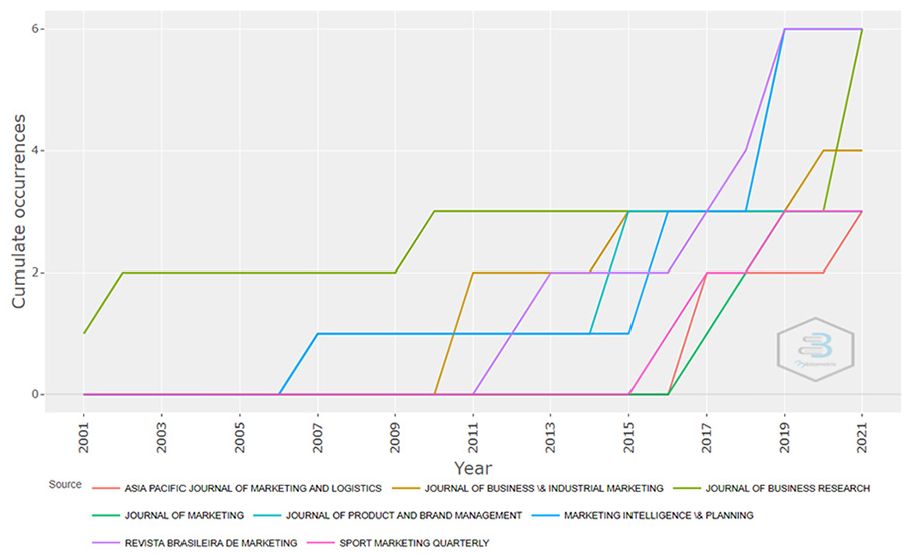
Source growth.
Authors
Yang Yupin was the most relevant author. He had published three articles out of the total documents retrieved for the study. The local h index (3) and g index (3) was also the highest for this author. Dionísio P and Ratten H had maximum local citation. These authors had at least six local citations. Figure 5 shows the top authors’ production over time. But for Rateen V, who had produced two papers on sports marketing in the same year (2011), none of the authors had two documents in the same year in the Web of Science. Author productivity supported the Lotka’s law (Kumar, 2020). As per Lotka’s law, the percentage of authors who make n contributions to those who make one contribution is roughly 1/na, where a is mostly near 2. As per Lotka’s law, the proportion of authors who had written one document on sports marketing were reported as 0.912. This value dropped to 0.082 and 0.005 concerning the second and third papers. Comparing top global citations, Hightower R topped the spot with 297 citations, followed by Bush AJ (189) and Kelley SW (116). The top three relevant affiliations were Simon Fraser University (eight articles), University of Oregon (seven articles), and Newcastle University (six). Corresponding authors’ country analysis (Figure 6) indicated the USA (28 articles) at the top of the list, followed by Brazil (eight) and Australia (six).USA had maximum multiple country publications.It was also observed that countries like Brazil, India, Belgium, Ecuador, Finland, France, and Ireland mainly were into single-country publications. Countries like New Zealand, Portugal, Chile, Germany, Japan, and Kuwait were falling into multiple country publications (Figure 6). Data of country scientific production indicates USA at the top spot with 91 articles, followed by Brazil (31) and the UK (20). The USA was also the most cited country with 881 global citations, followed by Canada (153) and Portugal (118).

Author’s production over time.

Corresponding author’s country.
Documents
The top globally cited document were the works done by Hightower et al. (2002). This work had 297 global citations. Second top global citation (189) were reported for the work conducted by Bush et al. (2004), followed by 116 citations for Kelley and Turley (2001). Paper by Ratten and Ratten (2011) topped the local citation followed by Moutinho et al. (2007) and Dionísio et al. (2008). These documents had six, four, and three local citations, respectively. A word cloud analysis (Figure 7) using keyword plus indicated words like model (12), impact (11), satisfaction(7), and so on, as frequently used words by the authors. Further, word growth patterns indicated words like model, impact, and satisfaction as fastest growing words.
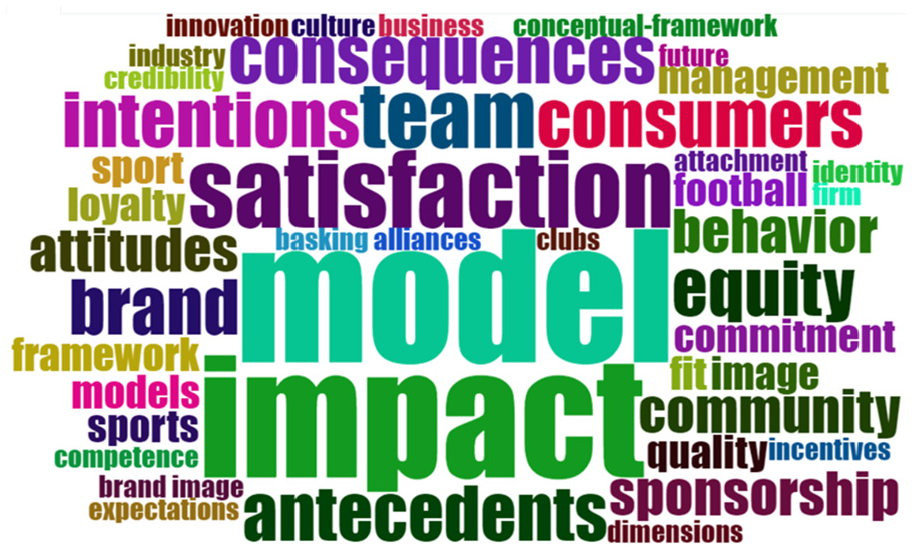
Word cloud.
Clustering map
Clustering map by source coupling with coupling measured by keywords plus and impact measured on local citation score indicated the formation of two clusters (Aria & Cuccurullo, 2017). International Journal of Consumer Studies, Marketing Intelligence and Planning, and Journal of Business Research formed the first cluster. Journal of Business & Industrial Marketing, Sport Marketing Quarterly, and Journal of Product and Brand Management formed the second cluster. Cluster 1 had low centrality but high impact. Cluster 2 had low impact but high centrality. The clustering algorithm used in this visualization is based on the coupling of sources, which measures the degree to which two sources (clusters) share common references. Sources that share many references are considered to be tightly coupled, while sources that share few or no references are considered to be loosely coupled. Cluster 1 was tightly coupled sources whereas cluster 2 had loosely coupled sources.
Conceptual Structure
Co-occurrence networks are graphs that show how frequently variables appear together. We can use a co-occurrence network to look at numerous pairs of co-occurring variables at the same time. Each variable is represented as a node or point in a co-occurrence network. The co-occurrence of two variables is represented by an edge, or link, linking two nodes. The size of the circles (Figure 8) shows the number of existences of the terms. The size of the circles grows as the number of co-selected writers’ keywords plus in the sports marketing literature grows. The distance between the elements of individual pairings represents the similarity of the topic and its comparative strength. Individual clusters are given different circle colors. Figure 8 depicts a network of five unique clusters, each representing a subfield of sports marketing study. Cluster 1 (red) were studies related to identification, team, social identity, attitudes, commitment, football, loyalty, sports, and incentives. Model, satisfaction, consumers, intentions, and involvement formed the second cluster (blue). Cluster 3 (green) pointed to impact, brand, equity, behavior, community, sports, credibility, and industry. Cluster 4 (purple) is directed to consequences, antecedents, customer satisfaction, quality, and culture. Cluster 5 (orange) pointed to the conceptual framework and management decisions.
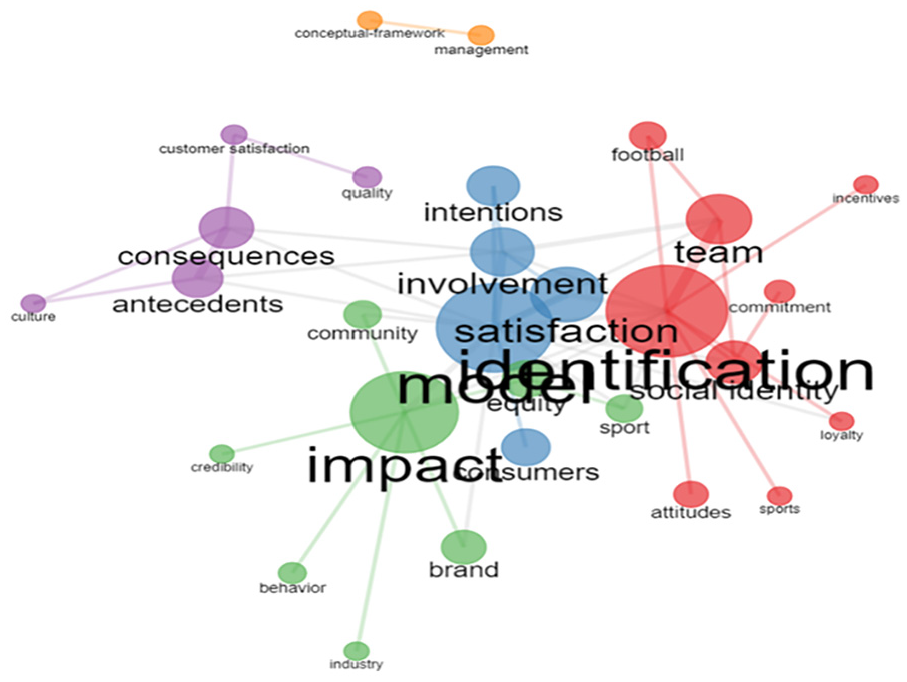
Co concurrence network.
Thematic maps focus on a specific topic. It compiles pertinent subject information and visualizes it spatially to comprehend the relationship between these themes and their places. Thematic map based on keyword plus indicated keywords localization into four quadrants as shown in Figure 9. Keywords such as identification, model, satisfaction, impact, brand, behavior, community, football, and management formed the basic themes. Antecedents, consequences, and customer satisfaction formed the motor theme. Equity, attitudes, image, sponsorship, attachment, basking, determinants, and sports knowledge formed the niche themes. There were no entries in emerging themes. Further thematic evolution (using keywords plus) with time sliced into two cutting points (2012 and 2017) indicated keywords like impact having no change during evolution. Words like “identification” evolved to “model,”“equity” to “impact,” and “corporate social responsibility” to “model”(Figure 10).
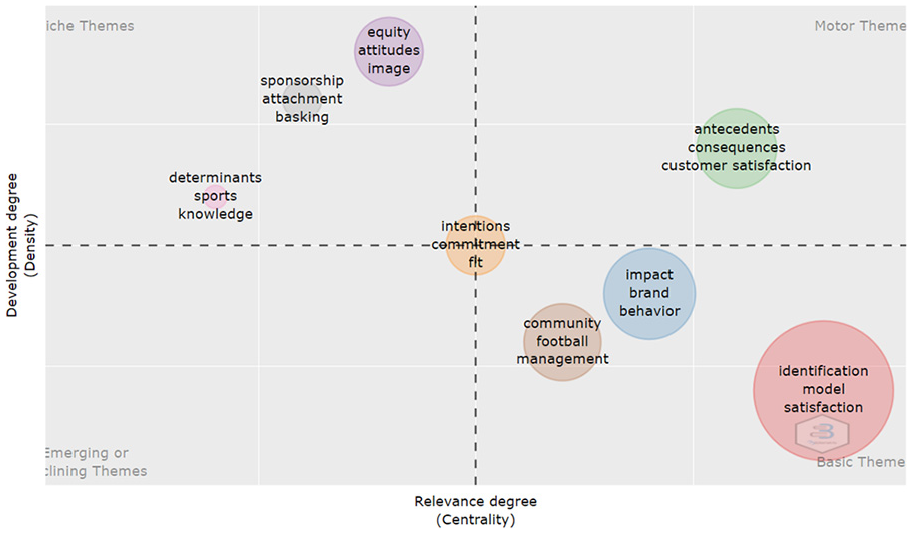
Thematic map.

Thematic evolution.
Factorial analysis is a statistical method for describing variability among associated variables in terms of fewer unobserved variables known as factors. Factorial analysis (Figures11 and 12) using multiple correspondence analysis and keyword plus as fields indicated the formation of two factors. Factor 1 (red) was inclined to sports marketing determinants and related consumer patterns. Factor 2 (Blue) was related to corporate social responsibility and related business and management decisions.
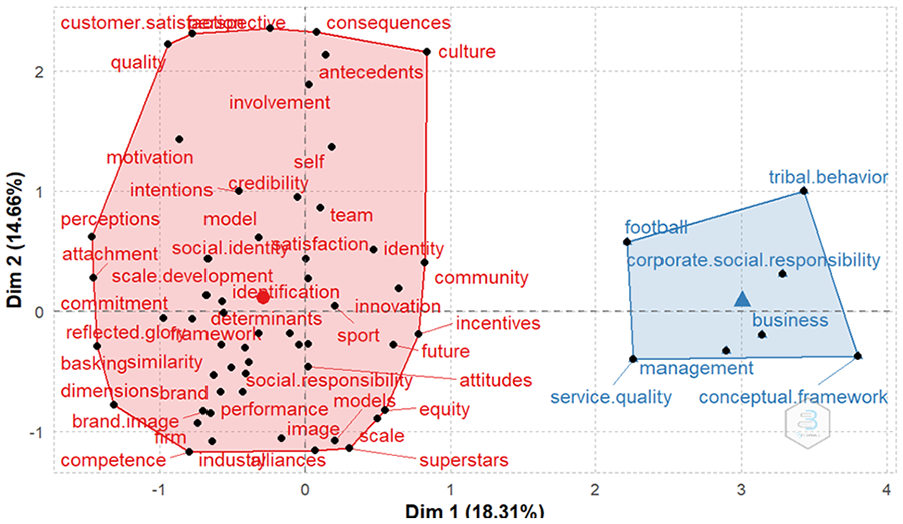
Multiple correspondence analysis.

Dendrogram.
Intellectual Structure
Co-citation is a semantic similarity metric for documents that uses citation relationships, akin to Bibliographic Coupling. The frequency with which two texts are mentioned jointly by other documents is known as co-citation. Co-citation analysis is shown in Figure 13, with each circle showing an item in the sports marketing literature. The circle size reflects the citation volume (the bigger is the circle, the more writer’s papers are cited), and the closeness of the circles suggests a close association between the co-cited documents. Co-citation analysis indicated major marketing journals like Journal of Marketing, Journal of Consumer Research and Journal of Marketing Research forming one cluster (red). Cluster 2 (blue) was mainly sports marketing journals such as Journal of Sports Management, Sports Marketing Quarterly, International Journal of Sports Marketing and Sponsorship, and so on. There was also an isolated cluster (green) pointing to the Journal of Sport and Social Issues.

Co-citation network.
Social Structure
Collaboration network or collaborative data analysis are methods in which two or more researchers work together to focus on and discuss a shared set of data to come up with a consensus interpretation. The country partnership of the major producing countries is depicted in Figure 14. A connecting line connects two countries, reflecting the status of their collaboration. The thickness of the line represents the degree of collaboration.

Collaboration network.
Theoretical Implications
The Biblioshiny app was used to conduct a bibliometric analysis of journal articles on sports marketing that were indexed by the Web of Science database. Since its widespread adoption, sports marketing has captivated the interest of a wide range of marketing journals. The literature on sports marketing has been mainly published in business and marketing journals, not as expected in sports journals. This is in line with the studies conducted by Shilbury (2011). According to the findings, various sources and writers have extensively published sports marketing research, covering a broad range of specialist topics. The highest number of citations was also falling in marketing journals which were also in line with the studies conducted by Shilbury (2011). The three fields plot displayed the quantity of each element and the country with the most publications on various research areas and the most productive affiliations. Surprisingly, the most relevant source from the Web of Science search was marketing journals. This supported the study conducted by Salgado-Barandela et al. (2021). A majority of the publication affiliations were related to the USA. This supports the study conducted by Shannon (1999). Sports is one of the largest (Sports is a significant industry in the United States, both in terms of participation and economic impact) in the USA, and sports sponsorship was the central theme of most papers published in the USA. The top three journals in terms of total citation index from the references list were Journal of Business Research, Journal of Advertising Research, and the Journal of Marketing. The Journal of Business Research thus exceeded other journals in terms of the number and significance of research on the theme of sports marketing, allowing it to act as a resource for academics looking for references on this topic. Hightower R and Yang Y topped the list in terms of global and local citations, respectively. The USA was found to be a leader in collaboration and most of the criteria. However, there was very little cooperation between various continents. With many premier leagues happening in football, cricket, and so on, more collaboration among continents is needed to leverage sports marketing strategies across the globe. To promote collaboration in sports across continents and overcome challenges such as lack of funding and expertise, some practical suggestion may include creating international sport partnerships, fostering communication and information sharing among sports organizations and individuals from different continents, leveraging technology to overcome the challenges of distance and lack of resources, encouraging sponsorship and funding, developing educational programs to train sports professionals and administrators on how to foster collaboration and develop effective marketing strategies across different continents.
Word cloud, factorial analysis, and concurrence analysis using keywords plus provided some interesting insights. These analyses have shown different avenues of research in the field of sports marketing. Hence more research in these areas has the potential to influence policymakers. Alike word cloud, factorial and concurrence analysis, thematic mapping and evolution revealed the same pattern. Thematic mapping revealed much work on identification, model, satisfaction, impact, brand, behavior, community, football, and management. These places appeared to be less viable for additional investigation. Areas like antecedents, consequences, and customer satisfaction were found to have a high level of relevance and development. These regions, which are also referred to as motor themes, provide an ideal chance for researchers to learn about the pattern of accessible literature in sports marketing and provide guidance for doing Systematic Literature Reviews. Areas like sponsorship, attitude, image, sports knowledge, and so on, were underserved (niche areas), and more effort is needed to raise the profile of sports marketing efforts. Esports (Gawrysiak et al., 2020) is an emerging field with a lot of potential for future research. This arena may be explored in future research. Co-citation analysis may also aid curious scholars in focusing on articles written by a group of writers on a single topic.
Managerial Implications
Sports organizations should use expert marketers to develop unique marketing initiatives to garner interest in sports. Marketers might rely on themes such as brand equity, team loyalty, fan culture, and so on, and blend these themes in their marketing strategies. Such strategies may freshen consumers’ life and strengthen bonds with the organization when creating sports commercials. The marketers may also look at the leading authors and papers listed in the study to get an idea of various trends in sports marketing. Scanning the papers published in the top journals will help the marketers to devise strategies in tune with the pulse of the fans. Considering the present pandemic, sports marketers can do responsible social marketing. Social marketing initiatives benefit individuals and society (Lee & Kotler, 2008). At times of crisis, a brand must consider the customers’ sentiments. Sports marketers can position their brand, win the public’s trust, and become socially responsible. For example KFC stopped its slogan “finger licking” (BBC News, 2020). More specifically, as part of their social responsibility campaign, the renowned fast food chain KFC stopped using the catchphrase “Finger-Lickin’ Good” due to the coronavirus outbreak. Fortune oil came up with an advertisement addressing heart ailment when its brand ambassador and BCCI chief Sourav Ganguly suffered cardiac arrest (Saumya Tewari, 2021). Various sports marketing firms may join hands with the government and effectively use their communication channels to yield aid, spread COVID awareness, distribute ventilators, oxygen cylinders, PPE kits, face shields, and provide medical support to consumers. In a way, such gestures will make the fans happy and keep sporting activities in business in the post COVID world. Companies like F1, Nike are using this tactic (Elmagd, 2020). It is suggested that the themes that may be trendy may lay in an underserved niche. Collaborating with practitioners, publishing in high-impact journals, participating in international events, leveraging the best use of social media, seeking funding opportunities, and fostering interdisciplinary collaborations may elevate niche themes to motor themes by increasing awareness, interest, and relevance of the niche theme within the field, industry, or market.
Conclusion
Sports marketing is still a relatively new topic of study, but it has spawned a heterogeneous academic sector that is both theoretical and practical (López-Carril et al., 2019). This research provided a detailed bibliometric analysis of the papers identified in sports marketing for the articles published in WoS. Over time, bibliometric studies have incorporated several approaches and technologies that can be combined to improve the studies’ robustness and consistency (Cobo et al., 2011). Overall, the findings show that the literature on this study has significantly grown in recent years. According to the bibliometric analysis conducted in this study, the scientific production in this field is topped by countries such as the USA and the UK. These findings are also supported by scientific mapping. However, both methodologies agree that the United States is the most influential of these countries, as measured by the number of citations and the various indices. This outcome is not unexpected. In truth, the United States boasts both Universities and writers with a long track record of publishing in the most prestigious publications dedicated to this field of study. Several countries, however, have paid considerable focus to this research area in the previous few years. According to the journal analysis, the literature on sports marketing has been published in number of journals. Given the subject, it stands to reason that the journals devoted to marketing was found to be the most productive and vital.
Finally, the findings of this research may be significant for several stakeholders. For starters, motivated researchers, this study would benefit from knowing the prominent scientific players publishing on sports marketing. Furthermore, knowing this information may be useful for profiling and recognizing new research areas (Ferreira, 2018) and assisting in constructing research links (Mulet-Forteza et al., 2019). A research grid would aid in the expansion and strengthening of this intriguing study area. Second, the output of the study can be used to make decisions in the political and institutional sectors about which projects to prioritize or fund concerning this research.
Limitation and Future Research
This research has a few limitations. First, it was restricted to articles published in the Web of Science database on themes related to sports marketing. Second, data extraction was a one-time event. The data may change over time, revealing different trends and outcomes. The data interpretation cannot be generalized because the study was limited to the Web of Science database. Because of the restricted number of author keywords, this study relied solely on keywords plus to generate numerous subjects, which is another limitation. The present study highlights leading authors, top-cited documents, leading affiliations, and countries contributing to sports marketing. These findings may build a robust structure for future research on sports marketing by exploring the pattern and trends given by leading authors and their work. The study also details that there isn’t much collaboration between European and African countries. Africa is a major contributor to sports. Collaborative work between developing and developed nations will help bridge the gaps in sports marketing in developing countries and allow marketers to leverage their marketing strategies in these nations. The importance of sports sponsorship and brand equity is growing as listed in niche themes of thematic analysis. These themes may be scrutinized into various sub-themes, and more research is needed on these promising niche themes. Future research may also focus on exploring different databases to explore various trends in sports marketing. Collaboration with key authors, affiliations, and understanding of internationally referenced articles can help create high-quality future research Identifying the knowledge gaps, prioritizing the research questions, considering interdisciplinary collaborations and staying up to date with emerging trends researchers can develop a comprehensive research plan that addresses the knowledge gaps and challenges related to the motor themes or topics. This can help advance the field and contribute to practical applications that benefit the industry, market, and other stakeholders.
Footnotes
Declaration of Conflicting Interests
The author(s) declared no potential conflicts of interest with respect to the research, authorship, and/or publication of this article.
Funding
The author(s) received no financial support for the research, authorship, and/or publication of this article.
