




Abstract
The proliferation of urban informal settlements indicates a failure in housing delivery. Stipulations in the SDGs for better affordable housing for all toward eradicating the heinous housing inequality in society seem to be lacking in a deeper understanding of why housing inequality prevails. Debates on housing inequality were mostly concerned with market transition, changing the order of social stratification, and transitions from a centrally planned economy to a market economy; hence the emphasis on the need for a better understanding of the role of housing in social-spatial equity and justice. This study, therefore, aims to fill this research gap by examining the nature of the relationship between informal and formal neighborhoods of the Enugu metropolis, Southeast Nigeria to make an evidence-based contribution to the body of knowledge on this subject. A cross-sectional survey using a quantitative approach was adopted and 24 informal settlements were identified and studied. The data were analyzed using descriptive analysis and Chi-square. Findings showed the nature of housing inequality in the area as a product of spatially inherent symbiotic relationships embedded in social exclusion, deprivation, and dependency between the formal and informal settlements situating in juxtaposition to one another. At a Chi-square value of 42.643, p = .317 significant at 0.01; residents perceived significant differences in access/availability of decent housing and housing facilities/utility. Interestingly, these informal settlements accommodated over 361,785 unaccounted spill-over populations representing over 60,298 households, constituting 34.69% of the city population not captured in official census records, including over 72.58% of migrants claiming to have relatives residing in these settlements.
Keywords
Introduction
Given the mandate in the SDGs for better and affordable housing for all toward eradicating the heinous housing inequality in society, there is a need to address the seeming lack of deeper understanding of why urban housing inequality and proliferation of informal settlements prevail particularly in developing countries like Nigeria. Incidentally, debates on housing inequality have been mostly concerned with market transition, changing the order of social stratification, and transitions from a centrally planned economy to a market economy (Fang et al., 2020). Moreover, Nwachi et al. (2012) have also observed that the nature and form of informal settlements and slums in most cities in developing countries like Enugu, Nigeria, and its environs have not been clearly understood by urban researchers. This also suggests that there is yet a lack of understanding of the underlying issues of persistence in the dynamics of formation, growth, and expansion of informal settlements and the nature of their relationship with the formal settlements. Given the foregoing, this study argues that to address the issue of housing inequality and to check the proliferation of informal settlements in cities, especially in the global South, there is a need for an adequate understanding of the nature of the relationship between informal settlements and formal neighborhoods. This aspect appears not to have been properly articulated in the body of literature (Fang et al., 2020; Li & Li, 2022; Nwachi et al., 2012).
It is against this background that this research examined housing inequality and the nature of the relationship between formal and informal settlements in the Enugu metropolis, Nigeria, to contribute to knowledge on this subject. The specific research objectives pursued were (1) to identify the pattern of formation of informal settlements and the nature of the relationship between formal and informal settlements in Enugu Metropolis and (2) to compare the cost of rent and land in the informal settlements and the adjoining formal settlements in this city, and (3) to examine the housing situation in the identified informal settlements in the study area. The significance of this research in addressing urban housing problems such as housing shortage, poor housing quality, housing inequality, and informal and shanty settlements lies in its aim of filling the research gap as indicated by Fang et al. (2020) who emphasized on the need for a better understanding of the role of housing in social-spatial equity and justice in the society.
It is expected that the findings of this research will deepen our understanding of housing issues for better informed inclusive public policy and program designs targeted at minimizing inequality and the rate of proliferation of informal settlements and improving the housing situations for residents in the city of Enugu, Nigeria, and beyond. This is also given the emphasized need for a better understanding of the role of housing in social-spatial equity and justice (Fang et al., 2020). In identifying the specific nature of the relationships between formal and informal urban neighborhoods, the study is also geared toward contributing to the current discourse on urban development strategies for the attainment of the Sustainable Development Goals (SDGs) which seek to improve the living conditions of a majority of urban residents and ensure a better society by the year 2030.
Review of Related Literature
Formal Settlements Versus Informal/Slum Settlements in Urban Areas
The review of the literature reveals that human settlements have been classified as formal or informal based on the level of planning, provision, and access to basic social amenities for the residents, and the extent of state control in their physical development and operations. A formal settlement can be defined as a settlement recognized and approved by the government for housing and infrastructural facilities planning and provisions as well as for physical development, while informal settlements are those neither recognized nor approved for such by the state (Glossary of Environment Statistics, 1997; UN-Habitat, 1996). Informal settlements have also been referred to as marginal settlements with the housing units lacking basic amenities and not considered fit for human habitation due to the inherent health risk posed by the poor environmental quality that makes inhabitants vulnerable to a wide range of diseases (United Nations [UN]-Habitat, 1996). In policy and literature, terms such as unplanned settlements, squatter settlements, marginal settlements, unconventional dwellings, non-permanent structures, inadequate housing, slums, and others have also been associated with informal settlements (Grant, 2006; UN-Habitat, 1996; World Bank, 1993).
In other words, perceptions that conceptualized the concept of formal and informal settlements seem facilitated by urbanization and amenable to the deprivation issues of basic needs and the social inclusion theories hence, the need for a deeper understanding of the interplay. Urbanization is a global phenomenon associated with both positive and negative consequences hence, the stipulations of the Millennium Development Goals (MDGs) in 2000 and the agenda 2030 Sustainable Development Goals (SDGs) for concerted efforts toward eradicating the heinous housing inequality in society and by extension, the associated proliferation of urban informal settlements as well. One of the adverse effects of rapid urbanization is the escalation of urban housing inequality and proliferation of informal settlements and slums as witnessed in many developing nations, particularly in sub-Saharan Africa (Abubakar & Aina, 2019; Edward, 2014; Federal Ministry of Housing and Urban Development, 2012; UN-Habitat, 2013). This is because the rate of urbanization has not been matched with the needed provision of decent housing and basic social infrastructure, especially in developing countries like Nigeria. Consequently, millions of urban residents in the global South have been forced to find their homes in informal settlements where housing and infrastructure provision are based on self-help efforts and limited state interventions (Grant, 2006; Opoko & Ibem, 2019; UN-Habitat, 2007, 2010b). This is thus, an exhibition of deprivations, social exclusion, and dependency. However, the African experience might not be similar to the situations in some other regions of developed and developing countries. For instance, N. Li and Li (2022) indicated that China in the Asia region has administration as a special factor affecting the housing situation above the other economic, social, and environmental factors. These were regardless of the centrally planned economic system and direct government housing interventions including government investment and macro-control in the country (N. Li & Li, 2022). As such, housing inequality was seen as a consequence of the transition from a centrally planned economy to a market economy associated with changing the order of social stratification and redistributive powers over resources including land and housing in the country (Bian & Logan, 1996; Fang et al., 2020; Logan & Bian, 1993).
Furthermore, the UN-Habitat (2007) has revealed that residents of urban informal settlements in sub-Saharan Africa are among the most deprived as over 80% of them experience at least one form of housing-related deprivations due to inequality in access to decent housing and basic social amenities. Such deprivations as housing needs entrench social exclusion and dependency. Informal settlements represent situations where houses have been constructed in unplanned and poorly serviced areas, and such houses do not comply with the existing planning and building regulations as residents have inadequate access to basic social amenities (UN-Habitat, 1996). Informal settlements in urban areas are characterized by haphazard developments, and overcrowded neighborhoods with a poor supply of basic amenities (Opoko & Ibem, 2019). In contrast, formal settlements are usually well-planned and with serviced neighborhoods having decent houses. Based on this, the key distinguishing features between formal and informal neighborhoods are disparity in housing quality and access to basic social amenities. This disparity most often gives rise to housing inequality which has been described as a product of spatial exclusion of certain categories of urban residents resulting from a wide disparity in access to land, affordable housing, and infrastructure (UN-Habitat, 2010a; World Bank, 2015).
Moreover, the Centre for Affordable Housing Finance in Africa (2017) captured the prevailing situation in most African cities by noting that whereas the high-income people who are the minority have access to decent housing in well-planned and serviced neighborhoods, the less-privilege, low-income, and poor people, who incidentally constitute a majority of the population live in the informal settlements and neighborhoods where poor quality housing and inadequate access to basic social amenities exist. This means that the proliferation and expansion of informal settlements in most cities in Africa is an indication of housing inequality and such settlements readily provide housing for the marginalized teeming population.
Research has established that the housing shortage experience contributes immensely to the formation and growth of informal settlements, particularly in many Nigerian cities (Opoko et al., 2015). In the Enugu metropolis, for example, a previous study by Ononugbo et al. (2010) revealed that most low-income households and individuals could not afford decent accommodation in well-planned neighborhoods due to the acute shortage of decent housing units and the rising cost of such units, strict government regulation of the land and housing markets which has forced them to live in poorly-serviced neighborhoods. Given these, it is pertinent to also look into the conceptual framework for housing inequality and informal settlements in the body of literature.
Formation of Informal Settlements and the Nature of the Relationship With Formal Settlements, and Housing Situation in Developed and Developing Countries
The report by the UN-Habitat (2006) indicated that as of 2005 Asia had the greatest number of informal or slum settlements accounting for about 27% of the global number with variations within the sub-region where the eastern and southern parts harbor 80% of the total and largely spread across China and India that are the most populous countries in the world and India alone hosting 17%. Despite pioneering many policies in recent years, the expected impact has not been felt particularly in the informal or slum settlements where residents still suffer under servicing and deprivations due to neglect and inadequate attention. The same pattern of proliferation of informal settlements was also observed across other countries despite the Grameen Bank initiatives of Bangladesh, the Turkey decentralization policy, the Orangi project of Pakistan, the low-cost housing schemes of China, and the Thailand strategic planning, Cambodia, and Lao among others (UN-Habitat, 2006).
Although Europe was not found to be notorious for informal or slum settlements, there are still the Canada Real in the Madrid region of Spain, which is the largest shanty town in Europe, and the Gorbals in Scotland among others (UN-Habitat, 2007). In Africa, Cairo has 70% of its inhabitants in informal or squatter settlements, while about 40% of Johannesburg’s residents live in Soweto, an informal or squatter settlement, Old Fadama in Ghana are the largest informal or slum settlements and one of the biggest e-waste dumping grounds in the world, West Point is the largest informal or slum settlements with a population of about 75,000 people in Monrovia, Liberia, and Ajegunle in Lagos host the largest squatter or slum settlements in Nigeria.
From the foregoing review, we found that across the different regions, the informal, squatter, or slum settlements have common features. The housing units lacking basic amenities are not considered fit for human habitation due to the inherent health risk posed by the poor environmental quality. The cost of rent and living is relatively lower than the formal planned areas or neighborhoods. This is because of the low level of bestiality in these areas due to a massive lack of social amenities and infrastructural facilities, short supply of decent housing, high occupancy ratio of the existing dwelling units mostly made of non-permanent materials, and high prevalence of poverty and lack of secured land titles (UN-Habitat, 2007). Despite differences in government policy formulations and applications in different countries and regions, these common features of informal settlements are strong indications that there are underlying issues like the relationship with the settlement that needs to be investigated.
The Nexus Between Housing Inequality and the Proliferation of Informal Urban Settlements
According to UN-Habitat (2010a), housing inequality is an aspect of spatial exclusion resulting from high disparities between residents of urban formal and informal neighborhoods to unequal access to land, housing, and infrastructure. The report by the Centre for Affordable Housing Finance in Africa (2017) indicated that a significant disparity exists between the housing situations and the environmental quality in formal and informal settlements, especially in urban Africa resulting in widespread poor housing conditions and a deteriorating physical environment in major cities in the continent (Livingston et al., 2010; Manzo, 2014; Wu, 2012). This situation has been attributed to several factors including migration and the inability of individuals or households in informal settlements to buy or rent decent housing based on their income status, and the poor state of the housing delivery system, which is often skewed toward the few high-income earners as against the low-income people who constitute a majority of urban dwellers, especially in Nigeria (Aduwo et al., 2016, 2017; Efobi & Anierobi, 2014).
One factor that has contributed and still contributing to growing urban housing inequality in urban areas in sub-Saharan Africa is an inadequate supply of housing units. This is so because housing demand exceeds its supply as there is currently an estimated housing supply deficit of between 12 million and 15 million housing units in Nigeria (Akinmoladun & Oluwoye, 2007; Federal Ministry of Housing and Urban Development, 2012; Ibem, 2011). Despite private and public sector investments in housing, an annual housing cost of $650 billion was estimated to bridge the global gap in affordable housing provision (UN, 1996; UNCHS-Habitat, 1995a, 1995b; World Bank, 1993). The current situation suggests that this gap is still growing unabated especially in many developing countries, including Nigeria. Abubakar and Aina (2019). According to Aduwo et al. (2016), the lack of access to land for housing development has partly contributed to housing issues in urban Nigeria. This also agrees with Olayiwola et al., (2005), UN-Habitat (2006), Ibem (2011), and Ibem et al. (2011), as regards the failure of government efforts in addressing the deplorable housing situation of low-income people in urban areas. However, studies (Federal Ministry of Housing and Urban Development, 2014; Ibem, 2011; Olayiwola et al., 2005) have shown failures and major setbacks in the implementation of housing policies. These were also associated with corruption and politicization of housing programs and the insincerity of government in public housing policy formulation and implementation (Ademiluyi, 2010; Akinmoladun & Oluwoye, 2007; Efobi & Anierobi, 2014; UN-Habitat, 2006).
Furthermore, a specific observation is that some of the conceptual assumptions in urban public housing policies might be untrue. They include the following: (1) the solution to the housing problem is to build housing more cheaply; (2) mortgages for more/poorer households are a large part of the solution; (3) affordable housing is possible through formal sector private investments; (4) establishment of a National Housing Trust Fund will help many households own their own home (5); housing affordability depends upon household income, and (6) every household should become an owner of housing among others. These are seen as being generally untrue and work against the effective provision of appropriate housing affordable by the majority of households in sub-Saharan Africa (Graham, 2015). This is because any ill-conceived opinion of policymakers about the socio-economic constituents of the urban population that need affordable housing could be blamed for the failure of the government in addressing urban housing inequality and issues of the proliferation of informal settlements. More so are the inherent inconsistencies and inefficiencies in the housing policy direction and actions of most governments, especially in sub-Saharan African countries like Nigeria. However, the African situation differs from those of other regions like Asia and with a centrally planned economy. As such the situation differs from some other countries like China where administration appeared as a special factor that affected the housing price above the economic, social, and environmental factors despite the planned economic system and direct government housing interventions including government investment and macro-control in the country (Li & Li, 2022).
Housing inequality has also been viewed in urban China and was argued from the sociological theory perspective to be largely an effect of market transition with the associated changing order of social stratification during the transition from a centrally planned economy to a market economy of the country (Fang et al., 2020). It was averred that the market mechanism undermines the redistributive power of political elites by shifting power, opportunities, and incentives toward players in the market sector, thereby favoring those who control the capital over those who control the political power (Nee, 1989). Moreover, the power persistence theory perspective argued that persistent political order is the core mechanism of social inequality in transitional urban China thus, gradual market transition reinforces political privileges systematically thereby enabling an enduring influence of redistributive power on people’s access to resources including land (Bian & Logan, 1996; Logan & Bian, 1993). Despite these perspectives, Fang et al. (2020) were however optimistic about sustaining equitable housing access though with new barriers regarding the legacies and transitions from the old system of communism. It follows therefore that urban planning has an onerous task of promoting social equity and justice and thus requires further reforms capable of reducing and eliminating existing institutional divisions and engendering a hybrid housing system such as the hukou reform.
Summarily, debates on housing inequality were mostly concerned with market transition, focusing on changing the order of social stratification and transitions from a centrally planned economy to a market economy; thus the emphasis on the need for a better understanding of the role of housing in social-spatial equity and justice (Fang et al., 2020). This study, therefore, aims to fill this research gap by examining the nature of the relationship between informal and formal neighborhoods in the context of the Enugu metropolis, southeast Nigeria, to make an empirical intellectual contribution to the body of literature. From the foregoing review of the literature, it is evident that there is a dearth of published literature on the nature of the relationship that exists between formal and informal settlements in cities (Bian & Logan, 1996; Fang et al., 2020; Li & Li, 2022; Logan & Bian, 1993; Nee, 1989; Nwachi et al., 2012; UN-Habitat, 2007). Therefore, this work sought to fill the research gap, and this underscores the significance of the study.
Theoretical Framework
Housing is one of the basic needs of life, and as such, any experience of housing inequality can never be pleasant to any society. The housing inequality between formal and informal settlements can conceptually be said to have a “lack” or “deprivation” dimension as the underpinning feature. To ensure a deeper understanding of the relationship between formal and informal settlements, this work, therefore, draws a conceptual framework for housing inequality from the nexus between housing inequality and the proliferation of informal urban settlements as well as from the social inclusion theory.
The Social inclusion theory draws heavily from the concept of social inclusion, which emerged as a result of incidences of social exclusion. Social inclusion is an ideology for the social protection of the poor in society. It encompasses equity, social, economic, and the proactive protection of human rights as propagated by the United Nations against social exclusion (Morgan, 2018). Although social inclusion has no universally accepted definition, it entails an ideology for the social protection of the poor in society. It is seen as a tool for addressing human rights deprivation (Krishna & Kummitha, 2017; Morgan, 2018) and as a set of policies and institutions in support of pro-poor growth and equity in society (Anierobi & Obasi, 2021; Obasi & Anierobi, 2021; Silver, 2015). Such social inclusion and pro-poor policies include the United Nations Millennium Development Goals (MDGs) 2000, the Agenda 2030, and the Sustainable Development Goals (SDGs). For instance, these were indicated with the stipulated emphases on housing for the poor by the United Nations Millennium Development Goals (MDGs) 2000 and the Agenda 2030 and most specifically the Sustainable Development Goals (SDGs) strategy 7 with the provision of “Indicators 7.10: to reduce the proportion of the urban population living in slums.” These are aimed toward re-directing government responsibility to inclusive housing provision without discrimination nor neglecting the poor who are often pushed to shelter in the informal settlement.
The Study Area: The Housing Situation in the City of Enugu
Enugu is a colonial city that started as a small settlement covering a land area of 243 km2 (151 miles) initially occupied by indigenous people of Nike, Amaechi Awkunanaw, and Ugwuaji, among others. Enugu, fondly called the coal city takes its origin from coal mining activities of the colonial era. It is presently the capital of Enugu State and situated between latitude 06021′N and 060 30′N and longitude 070 26′E and 070 37′E in a tropical rainforest vegetation zone with derived savannah. Enugu is on land area estimated at 72.8 km2 and experiences a humid climate with a mean daily temperature of 26.7°C (Enugu State Government, 2010). Enugu metropolis comprised three Local Government Areas: Enugu North, Enugu South, and Enugu East (see Figure 1).

Map of Enugu metropolis.
Enugu attained a township status under the late Lord Luggard’s Township Ordinance of 1917 and has since then served as an administrative center in various capacities (Enugu State Government Handbook, 2010). For example, in 1929 when Enugu had a population of about 3,170 people, it became the capital of the now-defunct Southern Province. It subsequently served as the administrative capital of the now-defunct Eastern Province in 1939, Eastern Region in1951, the Republic of Biafra in 1966, the East Central State in 1970, and old Anambra State in 1976 (Enugu State Government Handbook, 2010). It is presently the capital of Enugu State. The spatial and demographic growth of the city is evident in the various national population census figures and from a single neighborhood settlement camp of coal miners to the present day 19 formal neighborhoods of various sizes and densities. For example, Enugu recorded a population of 62,764 in 1952; 462,514 in 1991, and 722,664 with over 159,306 houses in 2006 (NPC, 2006). With an annual population growth rate of between 2.55% and 2.85%. After the national population census in 1991, the population of Enugu was shown to have grown to 505,280 (NPC, 1991), and to update this figure, the projected human population of the city was put at 902,374 in 2012 and 1,042,908 in 2017. Table 1 shows the population distribution of the city by neighborhoods.
Projected Population of Enugu Metropolis.

Source. 1991Census Figures of Enugu from National Population Commission, Projected to 2014, 2015, 2016, and 2017 by Researchers.
This is true for other urban areas in Nigeria. Research has shown that government interventions in housing from colonial times to date have been in the forms of direct construction, site- and -services schemes, and or housing financing (Ibem et al., 2011). Specifically, the account by UN-Habitat (2006) reveals that the colonial government was responsible for creating formal residential neighborhoods such as government reservation areas (GRAs) in colonial towns in Nigeria. The goal was to provide housing for the European staff based on the “garden city planning concept” and the other housing schemes to accommodate natives. These, therefore, gave rise to two types of housing neighborhoods in colonial cities which have persisted and extended to post-independent Nigeria despite successive 5-year National Development Plans that existed from 1970 to 1985. This situation differs from some other countries like China with a planned economy and direct government housing interventions including government investment and macro-control for housing price determinant issues (Li & Li, 2022). However, that study has shown that administration was a special factor that affected the housing price in China due to the planned economic system and being far ahead of the economic, social, and environmental factors in the country (Li & Li, 2022).
In Enugu, Nigeria in particular, due to the early presence of government in the city during and after the colonial era, most of the formal residential areas such as Ogbete, Government Reserved Area (GRA), Achara Layout, Uwani, Abakpa, and others were planned and built according to the grid-iron pattern of the colonial era. Enugu has witnessed rapid spatial and demographic growth over the past 50 years (Efobi & Anierobi, 2014; Nigeria Demographic Profile, 2013; NPC, 2013). However, as is true for most cities in Africa in general and Nigeria in particular, the demographic and spatial growth in Enugu has not been accompanied by a commensurate increase in the provision of affordable housing and other basic infrastructural facilities due to migration, wrong perceptions of housing shortage, the orientation of quick returns on investments and the ad-hoc nature of housing programs (Ibem & Odum, 2011; Mba, 1992; Odum, 2015; Okonkwo, 2003; Ononugbo et al., 2010). Consequently, Enugu, like other large cities in Nigeria is challenged by the proliferation of informal settlements owning to prevailing housing inequality.
Research Methods and Procedure
This study was based on a survey research design and utilized both secondary and primary data. A cross-sectional survey using a quantitative approach was adopted. The secondary data were sourced from a population and housing survey of the National Population Commission (NPC, 1991) census figures which are outdated. Thus, this is recognized as one of the limitations of this study. However, to mitigate this, a population projection was carried out to update the data of neighborhoods in the city. Other secondary sources of data were the official gazette of the Enugu State Housing Authority, the register of urban neighborhood watch of the informal settlements, and relevant online resources. The primary data were sourced through the administration of copies of the questionnaire, direct physical observations of housing conditions and environment, and structured interviews of residents. These methods helped generate data on the demographics of residents and housing characteristics in the neighborhoods. This method was also applied in previous studies by Li et al. (2019) and Li and Li (2022).
The household heads, and residents in the informal settlements were the respondents. The stratified random sampling technique was used to select the formal urban neighborhoods and identified informal settlements therein. The sample size of 361 from the 24 identified informal settlements within the 19 formal neighborhoods was determined using the infinite population formula by Cochran (1963). However, 36 which is 10% of the calculated minimum sample size were added to make up for the no-response rate thereby translating to 397 as the minimum sample size for the survey.
The questionnaire was randomly administered by hand to the household heads across the 24 identified informal settlements in the study area. The survey was conducted between February and July 2017. The physical observations made during the survey were recorded using photographic materials. The data gathered using the questionnaire were analyzed using descriptive statistics and the results were presented using text and tables, while those collected via physical observations were analyzed using content analysis and the results were presented with some illustrations in photographs.
Results and Discussion
Demographics of the Respondents in the Informal Settlements Within the Formal Neighborhoods of Enugu Metropolis
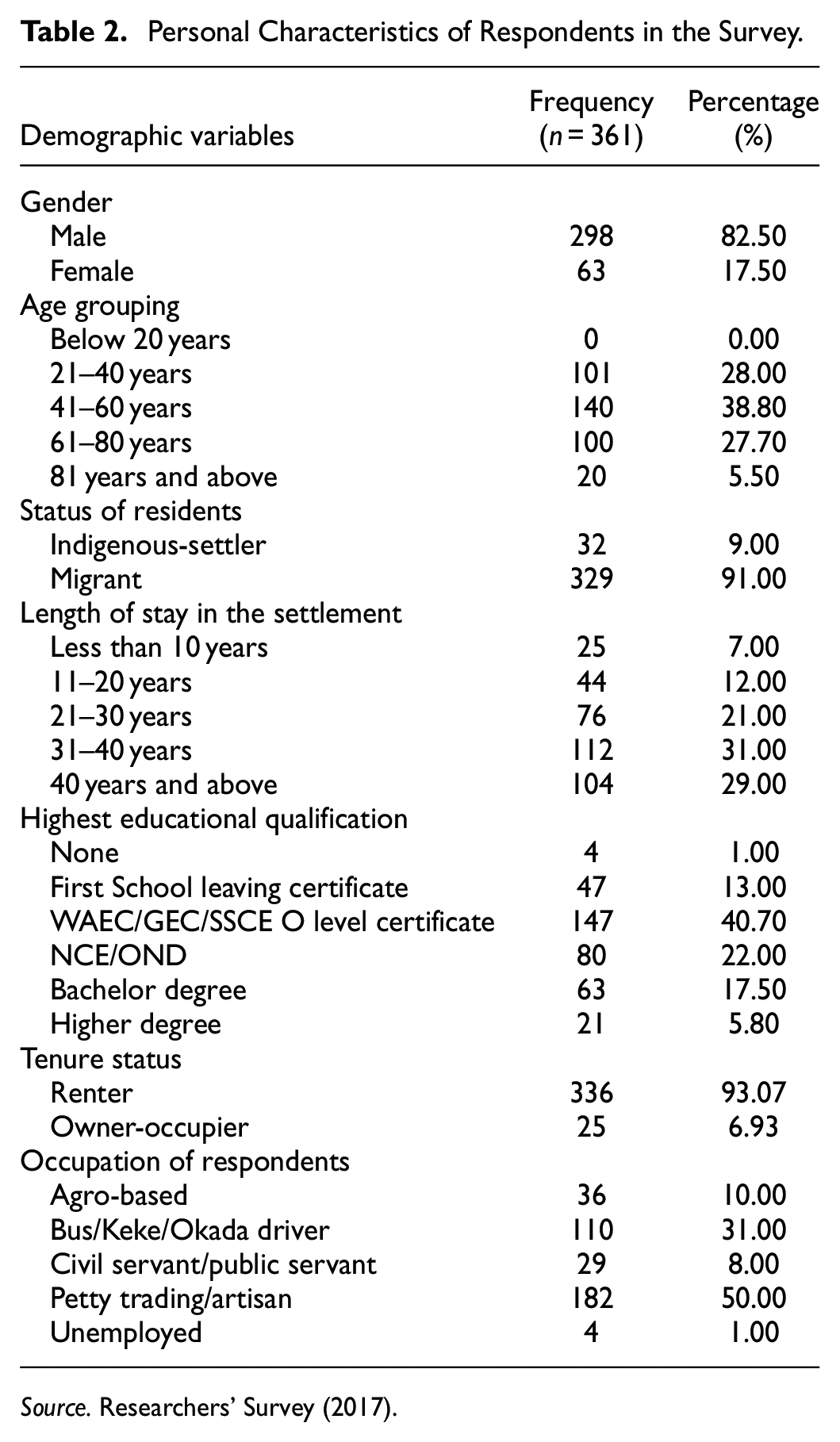
The results on the personal characteristics of respondents revealed that the informal settlements were of a heterogeneous population of many migrants with diverse social status. The tenure status in the informal settlements indicated that 231 (64.00%) rented their houses/land from indigenes of the area, while 105 (29.09%) rented from non-indigenes and 25 (6.93%) claimed they purchased their house/land. A majority (82.50%) of the respondents were male household heads, while the remaining few (17.5%) were female household heads. Most (66.80%) of the household heads were within active age of between 21 and 60 years of age and 91.0% of them were migrants. Also (81.0%) have lived in the settlements for over 20 years (Table 2). Furthermore, residents were found to have acquired some level of education with 54.7% having an ordinary level certificate while 50% were engaged in petty trading/artisans. This means that the participants are reasonably informed, able to eke out a living in the informal settlements, and establishing relationships that are better described as “symbiotic” meted with social exclusion and deprivation. These agree with the notions about the characteristics of informal settlement dwellers in different regions as advanced by N. Li and Li (2022), Fang et al. (2020), Grant (2006), UN-Habitat (2007, 2010a, 2010b), Opoko and Ibem (2019), and World Bank (2015). In this case, most of the residents of the informal settlement were also migrants; hence, an indication of discrimination and negligence in the area.
Personal Characteristics of Respondents in the Survey.
Source. Researchers’ Survey (2017).
Identified Informal Settlements, Patterns of Formation, and the Nature of Their Relationship With Formal Settlements in the Enugu Metropolis
The results revealed the existence of an inherent symbiotic relationship between the formal and informal settlements in a peculiar dependency nature. This is because the 24 informal settlements were identified to be in juxtaposition (i.e. within, around, and side by side) to the existing 19 formal neighborhoods. Table 3 shows informal settlements such as Ugbo-Oghe located within Abakpa formal neighborhood (see Figure 2) and Ugwu-Aaron informal settlement is located close to the GRA/Iva-valley, while Ugbodogwu is near Trans-Ekulu (Figure 3), Ugwu Alfred, Ikiriki, Ngenevu, bunker among others are situated near Trans-Ekulu, Iva Valley, Idaw River, and Coal Camp/Ogbete formal neighborhoods and others, respectively, with some extending toward the city periphery. Furthermore, about 50% of the informal settlements were within the formal high-density residential neighborhoods, while 14% were in the medium-density and 36% were in-between the medium-and high-density neighborhoods. Thus the formal high-density neighborhoods meant for low-income residents have the highest number of informal settlements juxtaposed in them. Moreover, the majority of residents in the informal settlements were found to be migrants and most of the respondents claimed to have relatives residing in these formal and informal neighborhoods. This is an indication of a social tie for a symbiotic relationship between the neighborhoods in the city as depicted in Table 3, Figure 1, and Plate 1 also showing the nature of physical development in a typical informal settlement in Enugu. These collaborate with the evidence in the literature (Fang et al., 2020; Grant, 2006; N. Li & Li, 2022; Opoko & Ibem, 2019; UN-Habitat, 2007, 2010a, 2010b; World Bank, 2015). This is because the market forces play out in the choice of residential location where welfare policy interventions of government are not duly applied and pro-poor measures are not adequately considered in governance as in this area.
Informal Settlements and Adjourning Formal Neighborhoods in Enugu Metropolis.

Source. Researchers’ Survey (2020).
1US$= ₦383 as at the second week of October 2020; the average annual income in the metro area being ₦339,000 (US$885) for the formal neighborhoods and ₦113,000 (US$295) for the informal settlements.

Satellite image of Ugbo-Oghe informal settlement adjoining Abakpa formal neighborhoods in Enugu.

Aerial view of Ugwu-Aaron informal settlement adjoining GRA formal neighborhood.
Comparison of Rent and Land Cost in the Informal Settlements and Adjoining Formal Settlements in the Enugu Metropolis
The data in Table 3 also showed the average rent and cost of land in each of the 24 informal settlements and the adjoining formal neighborhoods in the study area. Meanwhile, the average annual income in the Enugu metropolis is the average annual income in the metropolitan area is ₦339,000 (US$885) in formal neighborhoods and ₦113,000 (US$295) in informal settlements.
The results reveal that in each of the 24 informal settlements, the least average rent/room is ₦12,000.00 (US$31.3) like Akpumkpirishi informal settlement near Emene formal neighborhood where the average yearly rent is ₦120,000 (US$313) and the average cost of land/plot is around N5million (US$13055). ₦42,000.00 (US$109.7) is the highest rent in the Onuato informal settlement adjoining Asata formal neighborhood where the average yearly rent is ₦240,000 (US$627) and the average cost of land is about ₦7million (US$18277). Similarly, the least average cost of land, of N0.5million (US$1305) is in Ugwu Aaron informal settlement adjoining the old GRA/Iva valley formal neighborhood where the average annual rent is ₦240,000 (US$627) and an average cost of land is about ₦7million (US$18277). These results clearly showed that compared with the average annual income of residents, there is a huge disparity between the average annual rent and cost of land between the informal settlements and adjoining formal neighborhoods in the Enugu metropolis.
A quick inference that can be drawn from these results is that rents and the cost of land in the formal neighborhoods are beyond the reach of most low-income earners in the study area. Low-income groups, therefore, rely on informal settlements for shelter while keeping social ties in a symbiotic manner with residents of the formal neighborhoods despite situations of denial and exclusion. This shows the skewed effect of the housing market in favor of the formal neighborhoods to the detriment of the low-income groups as collaborated by N. Li and Li (2022), Fang et al. (2020), Grant (2006), UN-Habitat (2007, 2010a, 2010b), Opoko and Ibem (2019), and World Bank (2015). This scenario could be the reason behind the increasing informal housing market and the proliferation of informal settlements in the area.
Housing Situation, Types, and Conditions in the Informal Settlements in the Study Area
The housing units identified were about 63.0% detached, one and two-bedroom bungalows with 43.77% constructed with non-permanent materials (wood and galvanized iron roofing sheets (zin), while the rest were constructed with permanent materials (see Table 4, Figures 1–7). Also, while most (72.02%, 93.07%, and 71.75%) of the residences had some facilities such as toilets, bathrooms, and kitchens, respectively, some other residences lacked these facilities. Meanwhile, only 28.25%, 11.36%, 28.25%, and 32.13% of respondents claimed to have access to power supply, refuse disposal facilities, security, and telecommunication services, respectively. However, there were no indications of access to good roads, potable water supply, health care, and recreational and educational facilities in the neighborhoods as shown in Table 4, Figures 1 to 7.
Summary of Housing Conditions of Participants in the Survey on Ease of Access/Availability Across Neighborhoods in the City.

Source. Researchers’ Survey (2017).

Environmental quality of Ugwu-Aaron informal settlement adjoining the GRA formal settlement in Enugu Metropolis.

A typical street view in Trans-Ekulu formal neighborhood in Enugu.

Reasons for the choice of residence in the Settlement.
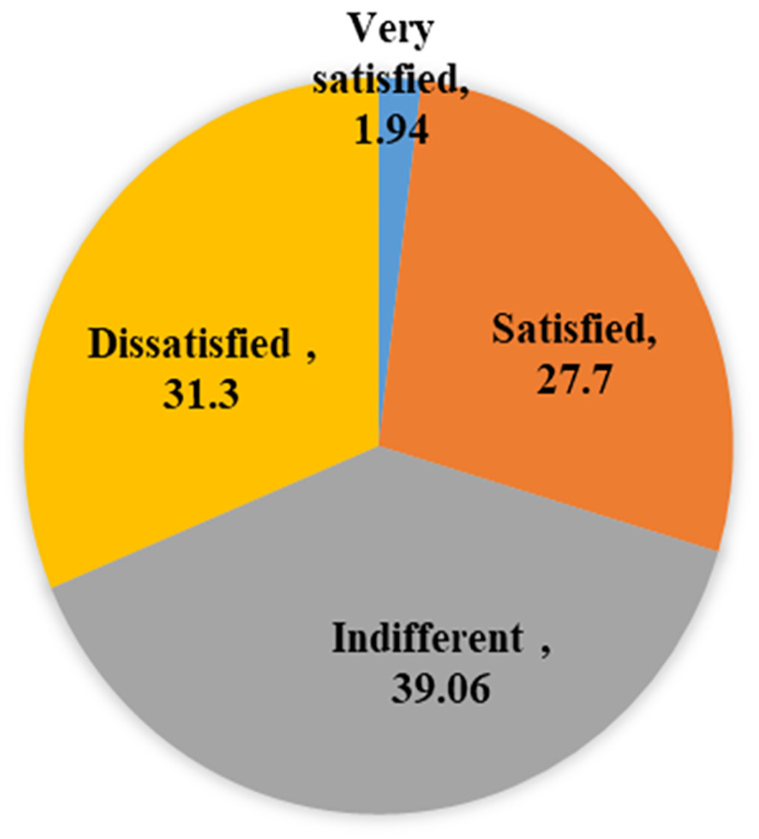
Satisfaction with the location of residence in the informal neighborhood.
Given the observations, the inferential statistics test was done at a chi-square value of 42.643 and p = .317 significant at .01; showing that residents perceived a significant difference in the availability/access to decent housing. The perceptions of housing inequality were thus indicated in the responses on ease of access/adequacy to housing infrastructure, facilities, amenities, utilities, and services in the city as a measure of housing inequality. These calls for appropriate policy measures that can eradicate all the perceived and unperceived urban housing inequality across the neighborhoods in the city. These are similar to some of the issues of housing conditions in N. Li and Li (2022), Fang et al. (2020), Grant (2006), UN-Habitat (2007, 2010a, 2010b), Opoko and Ibem (2019), and World Bank (2015). This has implications for the association between formal and informal settlements in the city.
Regarding the various reasons why respondents in the survey choose to live in the informal settlements, the results reveal that most (72.58%) of them lamented that the high cost of rent in the adjoining formal neighborhoods was the main reason, followed by 16.9% who blamed it on the heavy tax/levy/toll burden in the formal neighborhoods while 5.54% and 3.88% claimed that it was due to social ties and nature of their work, respectively (Figures 1–7).
The study also investigated the respondents’ levels of satisfaction with having their homes in informal settlements. The results indicate that whereas 39.06% of them were not sure of this, 31.3% claimed they were dissatisfied while 29.64% expressed satisfaction with the location of their residence in the informal settlements (Figures 1–7).
Conclusion and Study Implications
In conclusion, the results generally showed that there were more informal (24) than formal (19) settlements in Enugu Metropolis and these were grossly lacking good housing, infrastructural facilities, amenities, and services. As such, a majority of the residents were not satisfied with the physical conditions therein. Figures 1 to 7 and Table 4 revealed that most of the houses were constructed with poor non-permanent walling materials and had irregular connections and erratic supply of electricity, lack of water, and inadequate access to basic neighborhood infrastructural facilities and services compared with formal settlements (see Table 4, Figures 1–7). However, most respondents affirmed the existence of social ties among residents in the formal neighborhoods of the city.
The findings also showed that while benefiting from services from residents of the informal settlements, most of whom are educated, the low-density residential areas emitted intolerance, nonchalance, seclusion, and poor social ties with the informal settlements. Moreover, there was a despicable disparity in the cost of housing and land between the informal settlements and adjoining formal neighborhoods such that residents preferred to rather pay the highest rent of about N42,000.00 (US$109.7) in the informal settlement than pay the cheapest annual rent of N120,000 (US$313) in the formal settlements (see Table 3). This escalates the housing crisis among low-and medium-income groups and the urban poor, and hence the informal settlements are seen as areas of refuge and survival for the urban poor.
Furthermore, the 24 informal settlements accommodated an unaccounted spillover population of about 361,785 people with over 60,298 households amounting to about 34.69% of the total urban population of Enugu. Most of these residents are migrants engaged in the informal sector economy (see Table 4) and contributing to the GDP but were not captured in the official population records of the city (see Tables 1–4 and Figures 1–7).
The nature of the relationships between formal and informal settlements identified in the current research is better described as a symbiotic relationship meted with social exclusion, deprivation, and dependency. This is even though the residents of the informal neighborhoods perceived a significant difference in the availability/access to decent housing and other vital facilities, amenities, utilities, and services in the city. The symbiotic nature of the relationship between the settlement types being meted with deprivation and dependency as unraveled in this work is a pointer toward appropriate policy targeting strategy for inclusiveness. As such, the limitations of inadequate outdated data, and lack of inclusive pro-poor policy formulation and application has implications for a comprehensive policy implementation strategy. These calls for appropriate policy measures that can eradicate all the perceived and unperceived urban housing inequality across neighborhoods of the city. Following this, this study recommends the recognition of this identified existing nature of the relationship between the formal and informal settlements toward leveraging on it to bridge the supply gap in housing, land, infrastructural facilities, amenities, and services in the study area.
Also, enhancing the use of standard local building materials such as mud/laterite bricks, and bamboo among others should be encouraged in the provision of affordable housing for the low-income urban residents in the area. Moreover, the government should collaborate with the existing social ties in the area such as Residents’ Community Development Associations (RCDAs) and/or Unions, and Cooperative Societies among others, and also formalize the informal settlements for effective contribution to the actualization of goal 11 of the SDGs Agenda by 2030. To this end, an inclusive pro-poor intervention policy for urban land and housing access in cities is strongly recommended for entrenching sincerity in governance and eliminating all forms of housing inequality in the Enugu metropolis and beyond.
Scope for Future Research Direction
Given the scope of the current study, it becomes pertinent to indicate the scope for future research direction on this subject matter. This study has looked into the issue of housing inequality from the perspective of the relationships between formal and informal settlements using the case of Enugu metropolis, Nigeria, and found the existence of what it described as a symbiotic relationship between these two settlement types. The existence of social exclusion, deprivation, and dependency in this milieu seems to question the efficacy of the strategies engaged in an attempt to achieve the SDGs, especially goal 11 of the SDGs Agenda 2030 in the study area. Therefore, further research needs to focus on exploring the nature of relationships that will foster inclusivity and equity in access to decent housing and basic social amenities in informal settlements. This entails research on the appropriate policy framework and effective implementation strategy for inclusive housing and infrastructure programs.
In addition, given the nutty nature of housing inequalities and the associated consequences, future research should be directed toward the eradication of informal settlements, squatters settlements, slums, and shanty settlements among other issues that emanate from housing inequality. More research attention should be directed at unearthing the factors responsible for the abysmal performance of notable pro-poor housing and infrastructure programs such as the United Nations Millennium Development Goals (MDGs) 2000 and Shelter for All by 2000, just mention these two in addressing housing and basic infrastructure supply deficits in urban areas in a developing country like Nigeria. In line with this, research on how to re-direct government efforts in promoting inclusive housing in a depressed economy would be a worthwhile research agenda in the global South.
Footnotes
Acknowledgements
This research did not receive any special research assistance, data, or information.
Declaration of Conflicting Interests
The author(s) declared no potential conflicts of interest with respect to the research, authorship, and/or publication of this article.
Funding
The author(s) received no financial support for the research, authorship, and/or publication of this article.
