




Abstract
Research exploring the benefits of Mindfulness-Based Interventions (MBIs) with youth is emerging and promising for the improvement of resiliencies. We developed an arts-based mindfulness intervention to make learning mindfulness accessible for children who had experienced trauma. Arts-based methods are engaging, enjoyable, and developmentally relevant. Previously, we found benefits of participating in this MBI for children aged 8 to 12 years. Herein we discuss research in which we explored the benefits of this MBI for adolescents who were experiencing challenges with schooling; 146 youth completed the program. Our research question asked whether the MBI was beneficial and/or effective for these youth and, if so, what were these benefits and how did these benefits assist youth to cope? Benefits were explored via reflexive thematic analysis (TA) of pre/post-intervention, and follow-up individual interviews with youth. Effectiveness was assessed by analyzing pre- and post-intervention scores on youth self-report inventories measuring mindfulness and resilience, as well as responses from caregiver assessments of behavior/coping. To assess if there were changes in responses across timeperiods, a series of repeated measures ANOVA were employed. Quantitative findings were mixed in that the youths’ self-report scores measuring resilience showed limited improvement while mindfulness showed no significant change. However, parents’ perceptions regarding their child’s behaviors indicated significant improvements in social competence and both internalizing/externalizing behaviors. Similarly, the thematic analysis suggested improvements in youths’ self-awareness, self-judgment, thinking, mood, ability to make choices, social skills, coping, and emotion regulation. The results are promising and warrant further investigation of arts-based approaches to facilitating mindfulness with youth.
There is a robust research literature (Baminiwatta & Solangaarachchi, 2021) showing the effectiveness of Mindfulness-Based Interventions (MBIs) for adults with a variety of challenges such as anxiety, depression, and stress (Goldberg et al., 2022). Research exploring the benefits of MBIs with young people can be characterized as emerging and growing considerably over the past decade, heterogeneous in nature, and encouraging regarding the improvement of well-being (Kostova et al., 2019; Semple & Burke, 2018). The goals of MBIs usually include becoming more aware of one’s moment-to-moment stream of consciousness and to accept these experiences without judgment. There is emphasis on improving attention and empathy, as well as building emotion regulation and self-awareness (D'Alessandro et al., 2022). MBIs with young people show a wide range of promising benefits ranging from emotion regulation (Schussler et al., 2021; Zhang et al., 2022), enhancing executive functioning (Lu et al., 2021), lowering feelings of anxiety (Borquist-Conlon et al., 2019; Moyes et al., 2022), and improving social competence, emotional resilience (Culang et al., 2021), mood, and relationships (Dai et al., 2022; Van Vliet et al., 2017).
Our research aims to understand how MBIs can assist youth to build resilience and well-being. The Resilience Research Centre’s (2019) definition of resilience promotes a relational understanding of well-being embedded in a social-ecological framework, which fits with our own work. Thus, resilience has to do with both youths’ capacities to engage with resources that build well-being, and our abilities to offer relevant resources and supports to youth. With the aim of developing an accessible and meaningful MBI for young people suffering trauma, loss, and family dysfunction, an arts-based MBI called Holistic Arts-Based Program (HAP) was created approximately 12 years ago. HAP is a strengths-based program to develop both mindfulness skills and resilience. Program goals include learning mindfulness, developing self-compassion and empathy, and shoring up strengths; a session by session description of the intervention is available (Coholic, 2019). In HAP, mindfulness is conceptualized in accordance with Kabat-Zinn’s (1990) definition: Activity that encourages awareness to emerge through paying attention on purpose, non-judgmentally, in the present moment. We understand that with increased understanding of one’s feelings and thoughts (self-awareness), a child can make better choices regarding their emotional expression, which can lead to improved coping and functioning (Boxmeyer et al., 2021). Practicing mindfulness can also help children view negative thoughts as passing events rather than valid reflections of reality, and it can promote flexible responses as opposed to becoming stuck in anxiety or ruminating (Ciarrochi et al., 2011).
HAP was originally developed from research with children aged 8 to 12 years who lived in foster care (Coholic & Eys, 2016; Coholic et al., 2012). More traditional MBIs emphasize mindful meditation that requires abilities to pay attention and sit still. To make learning and practicing mindfulness accessible for children who had experienced trauma and loss and/or had mental health challenges, we grounded HAP in arts-based methods, which are highly engaging, enjoyable, developmentally relevant, and effective for emotional expression (Bokoch & Hass-Cohen, 2021; Ermis-Demirtas et al., 2023). In a recent scoping review, we found that researchers justified using arts-based methods in MBIs for young people both because of their characteristics and the benefits of using creative methods (Coholic et al., 2020). Additionally, in a recent debate, Burrows (2022) noted that mindfulness for young people needs to be facilitated as something that is enjoyable and accessible so that they will be drawn to engaging with it. With respect to resilience, art therapists and others have long pointed out the connections between using art and arts-based methods and improved resilience and well-being (Malchiodi, 2007; Pearson & Wilson, 2008), especially in adolescents and young adults (Jang & Choi, 2012; Macpherson et al., 2016; Roghanchi et al., 2013). As a result, the activities of HAP have the dual targets of improving mindfulness and resilience.
In a previous study where we compared outcomes of participating in HAP with an arts and crafts group, we reported preliminary findings that children, with an average age of 10 years and who were involved with child welfare and/or mental health systems, had lower scores on emotional reactivity post-intervention (Coholic et al., 2012). In a subsequent paper, we reported results from the qualitative analysis of post-intervention interviews. Children participating in HAP felt that the program was helpful to improve their emotion regulation, mood, coping and social skills, confidence and self-esteem, empathy, and ability to pay attention. Also, we found partial support for our hypothesis that their self-concept would improve (Coholic & Eys, 2016). In the current paper, we discuss the final results of a 3.5-year project in which we studied the benefits of HAP participation for youth aged 11 to 17 years old who were experiencing challenges with schooling. Youth who drop out of school have few prospects for gainful employment and often end up living in poverty, which has serious ramifications for individuals, families, communities, and society as a whole. Through our research, we hoped to assist youth who were experiencing self-reported emotional and behavioral challenges such as anxiety, trouble paying attention, poor peer relationships and mood, social exclusion, and emotional reactivity that can hamper the ability to engage with learning. We hoped that these young people could learn skills and develop strengths that could assist them to engage with schooling and better cope with daily life. Some youth need to learn how to focus and sustain attention over time before they can fully engage in learning, and MBIs are proving effective in developing these skills (Broderick, 2013).
Method
Research Design
Overall, we were guided by a constructivist framework, which understands the researcher’s role as active in forming alliances, pursuing local goals, and advancing interests (Fine, 1996). A constructivist paradigm places attention on the meaning participants attribute to their experiences (Crotty, 2011). Given that we had not previously studied HAP with youth aged 11 to 17 years, our research question was: Is HAP beneficial and/or effective for youth experiencing challenges with schooling and, if so, what are these benefits and how do these benefits assist youth to cope and learn? Based on previous research results with children (Coholic & Eys, 2016; Coholic et al., 2012), we hypothesized that adolescents would also benefit from HAP participation and increase their scores on measures of resilience and mindfulness. Perceived benefits were explored via qualitative thematic analysis of pre- and post-intervention, and follow-up individual interviews with the youth. Effectiveness was assessed by quantitatively analyzing pre- and post-intervention scores on participant self-report inventories measuring mindfulness and resilience, as well as perceptions from caregiver assessments of behavior/coping.
The project was a mixed methods design aimed to explore the suitability, benefits, and effectiveness of HAP with youth aged 11 to 17 years. Using both quantitative and qualitative methods can produce in-depth understanding of youths’ experiences, and qualitative data must be considered valuable information that can be used to better understand and inform implementation of MBIs (Ager et al., 2015; McKeering & Hwang, 2019). Standardized measures were completed by the youth pre-intervention during the intake interview, post-intervention when HAP was completed, and again in a follow-up 12-weeks later. At the same time periods, a brief individual interview was conducted with the youth participants. In the intake interview (approximately 20 min), the youth were asked (1) Have you ever heard about mindfulness and, if so, what do you think it is and how do you think it could help you?; (2) What is resilience?; and (3) What are some of your daily life challenges? In the post-intervention interview (approximately 30 min), they were asked: (1) What did you like about HAP (if anything)?; (2) What did you find challenging (if anything)?; (3) How would you describe HAP and mindfulness to other youth?; (4) How could we improve HAP ?; (5) What were some of your favorite activities (if any)?; (6) What did you learn in HAP (if anything)?; and (7) Do you think HAP helped you? If so, how? In the follow-up interview held 12 weeks after the post-intervention interview (approximately 30 min), the youth were asked (1) What do you remember about taking part in HAP ?; (2) Are there any activities from HAP that you have continued to use?; (3) Do you think taking part in HAP has helped you in the time since you took part and, if so, how?; (4) How could we improve the HAP experience? Caregivers also completed a standardized measure at the same three time points.
Participants
The flowchart in Figure 1 illustrates that 188 youth were initially referred to HAP and 146 youth completed the program; 26 different 12-week intervention groups were facilitated. Attrition rates remained low with 13 youth dropping out for reasons such as moving, seeking other services, or being too busy with other activities to attend. Youth were referred mostly by the local child welfare and youth mental health organizations, schools/teachers, and parents. Inclusion criteria were inclusive as HAP can accommodate youth with diverse challenges, and included youth aged 11 to 17 years old experiencing self-reported challenges that impacted schooling. These challenges included anxiety, poor peer relationships, trouble paying attention, and other mental health challenges. Youth had to be willing to participate in a group with peers and could not be experiencing a serious crisis such as a psychosis that would hamper their ability to participate. Participation was strictly voluntary. Referrals were ongoing throughout the life of the project and were made by telephone or email to the first author. Once a referral was received, a research team member who was a graduate student contacted the youth’s caregiver to set up an intake meeting. At this meeting, the youth’s interest in attending was confirmed, informed consent to participate was gained, the pre-intervention interview was conducted, and the self-report inventories were completed by both the caregiver and the youth.

Flow of participants through the study.
Thematic analysis of the pre-intervention interviews (the analysis process is described in the qualitative analysis section) resulted in identifying three main areas of challenge: anxiety; relationships; and being distracted and having trouble focusing and paying attention. Anxiety manifested when youth had to speak in front of peers at school, meet and communicate with peers, and some youth also described feeling low mood; five stated they had previously felt suicidal. Many of the youth described having poor relationships with parents and siblings, being bullied at school, and having trouble making friends. The lack of good emotion regulation seemed to underpin many of these challenges. For instance, being highly reactive can make it difficult to interact with others in a calm logical manner. Also, many of the youth expressed feeling a lack of confidence that interfered in their ability to socially engage with peers. Youths’ reasons for wanting to participate in HAP included wanting to feel calmer, develop self-understanding, improve coping, and for self-expression. All of the youth were more familiar with the term mindfulness compared to resilience, although very few could define either term pre-intervention. No youth were excluded, so all 188 youth were assigned to a HAP group matched by age and gender; 159 youth started the program. Each group was small and comprised of 4 to 8 youth so that they could meaningfully engage and participate in the program.
Standardized Measures
Resilience
The Resiliency Scales for Children and Adolescents (RSCA) is based on developmental theory and previous research in resiliency (Prince-Embury & Courville, 2008a). It consists of three stand-alone global self-report scales [sense of mastery (20 items), sense of relatedness (24 items), and emotional reactivity (20 items)]. Items are presented in Likert-type format ordered on a 5-point scale from 0 (never) to 4 (almost always). Research supports the use of the RSCA for identifying vulnerability that does not rely on the presence of an identified disorder, making it an appropriate tool for our study (Prince-Embury, 2008). Evidence for the RSCA three-factor structure has been demonstrated for both girls and boys, the internal consistency values for the scales are excellent, and its construct validity is supported (Prince-Embury, 2008; Prince-Embury & Courville, 2008a, 2008b). Responses to the items in each dimension are summed and subsequently converted to standardized t-scores. Higher scores on the sense of mastery and relatedness scales are indicative of greater resilience while higher scores on emotional reactivity are indicative of greater vulnerability.
Mindfulness
The Children’s Acceptance and Mindfulness Measure (CAMM) (Greco et al., 2011) consists of 10 items and participants respond on a 5-point Likert-type scale ranging from 0 (never true) to 4 (always true). All items all framed negatively (e.g., “I think about things that happened in the past instead of thinking about things that are happening right now”). The CAMM is unidimensional and participants’ self-reported mindfulness scores are computed by reverse scoring and summing responses to all items giving a possible range of scores from 0 to 40. Thus, higher scores are indicative of greater mindfulness awareness. Greco and colleagues (Greco et al., 2011) provided evidence of the CAMM’s reliability and validity, and previous research found that responses were positively correlated with quality of life, social skills, and academic performance (de Bruin et al., 2011).
Child Behavior Checklist
The Child Behavior Checklist (CBCL) (Achenbach & Rescorla, 2001) is an assessment tool that is completed by caregivers regarding problem symptoms exhibited by their child(ren). The initial seven questions ask for descriptive information pertaining to the child’s social competencies related to (1) activity (e.g., sport involvement), (2) social involvement (e.g., how well he/she gets along with others), and (3) academics. In the present study, we obtained t-scores from the responses for an overall social competence score for each child. The remaining 113 items are responded to on a 3-point scale regarding the child’s behavior now or over the past 6 months; 0 = Not True (as far as you know), 1 = Somewhat or Sometimes True, 2 = Very True or Often True. These items describe a series of internalizing (e.g., “daydreams or gets lost in his/her thoughts”) and externalizing behaviors (e.g., “argues a lot”); therefore, two dimensions are created from guardians’ responses with higher scores indicative of greater problem symptoms. This is an extensively used instrument in both applied and research settings, and evidence regarding the validity and reliability of participant responses has been demonstrated (Reising et al., 2013; Schroeder et al., 2010).
Procedures
HAP was co-facilitated in the first author’s university research lab, which was equipped for arts-based group work. Co-facilitators were 9 graduate and 11 undergraduate social work and health students (five of these undergraduate students later conducted their graduate projects in the research program and became experienced program facilitators). Four of the graduate students were core members of the team conducting most of the pre- and post-intervention interviews and helping to train the other students. To build capacity and ensure reliability of HAP facilitation, we followed a train-the-trainer model so that experienced program facilitators co-facilitated the groups with students learning the program. All of the co-facilitators engaged in bi-weekly group supervision meetings where we discussed the content, progress, and process of each group, and any challenges that arose. Each facilitator followed the weekly session outline of HAP as described in Coholic (2019). It was expected that all facilitators had or were developing a mindfulness-based practice in their own lives.
HAP is a 12-week program and it was facilitated in weekly 2-hr small group sessions. The overarching goal of this program is to help youth develop mindfulness, resilience, and well-being. Specifically, HAP encourages teaching mindfulness-based concepts and practices in enjoyable and accessible ways, and aims to help youth develop self-awareness and encourage self-expression, improve self-compassion and empathy, and shore up strengths. An example of how arts-based activities are used to teach mindfulness-based practices and concepts, and resilience, is Painting on a Line (Coholic, 2019). The purpose of this activity is not to focus on the final product but on the creative process. A line of string is hung in the room and one piece of paper for each group member is attached to the line with clothespins. The participants are encouraged to all paint something at the same time without holding the paper with their hands (the paper moves as everyone paints). A discussion about the challenges of the activity follows that is connected with mindful concepts. For instance, some participants felt frustrated because they could not paint what they had in their imagination. Connections can be made with the mindfulness concepts of acceptance and adapting your expectations in a challenging situation, control and letting go, and non-judgment. Descriptions of other activities can be found in Coholic (2019).
Results
Qualitative Analysis and Results
A reflexive thematic analysis (TA) was used to analyze 133 pre-intervention interviews, 119 post-intervention interviews, and 29 follow-up interviews held 12 weeks after the post-intervention interviews. Due to the size of the data set, the TA was conducted collaboratively over a 1-year period by the first, third, and fourth authors. In recent work, Braun and Clarke (2021) explained that TA methods are diverse but that reflexive TA is subjective and focuses on theme development across cases following coding of all of the interviews. Themes denote patterns of shared meaning based on a central organizing concept. The coding process requires reflexivity and is structured around six phases: familiarization; coding; generating initial themes; reviewing and developing themes; refining, defining and naming themes; and writing up. A thorough discussion of researcher reflexivity and the TA process is beyond the scope of this paper but we note that our TA was influenced by our knowledge of the theory and practice underpinning our work (mindfulness, resilience, strengths-based approach, social group work, child development, trauma-informed practice), our long-term experiences in facilitating HAP, and our previous research in this area. For example, all of the youth discussed HAP as supportive, non-judgmental, and fun, which we connected with the social group work concepts of normalization and mutual aid that program facilitators purposefully foster. We also used Braun and Clarke’s (2013) 15-point TA checklist to assess our analytic process.
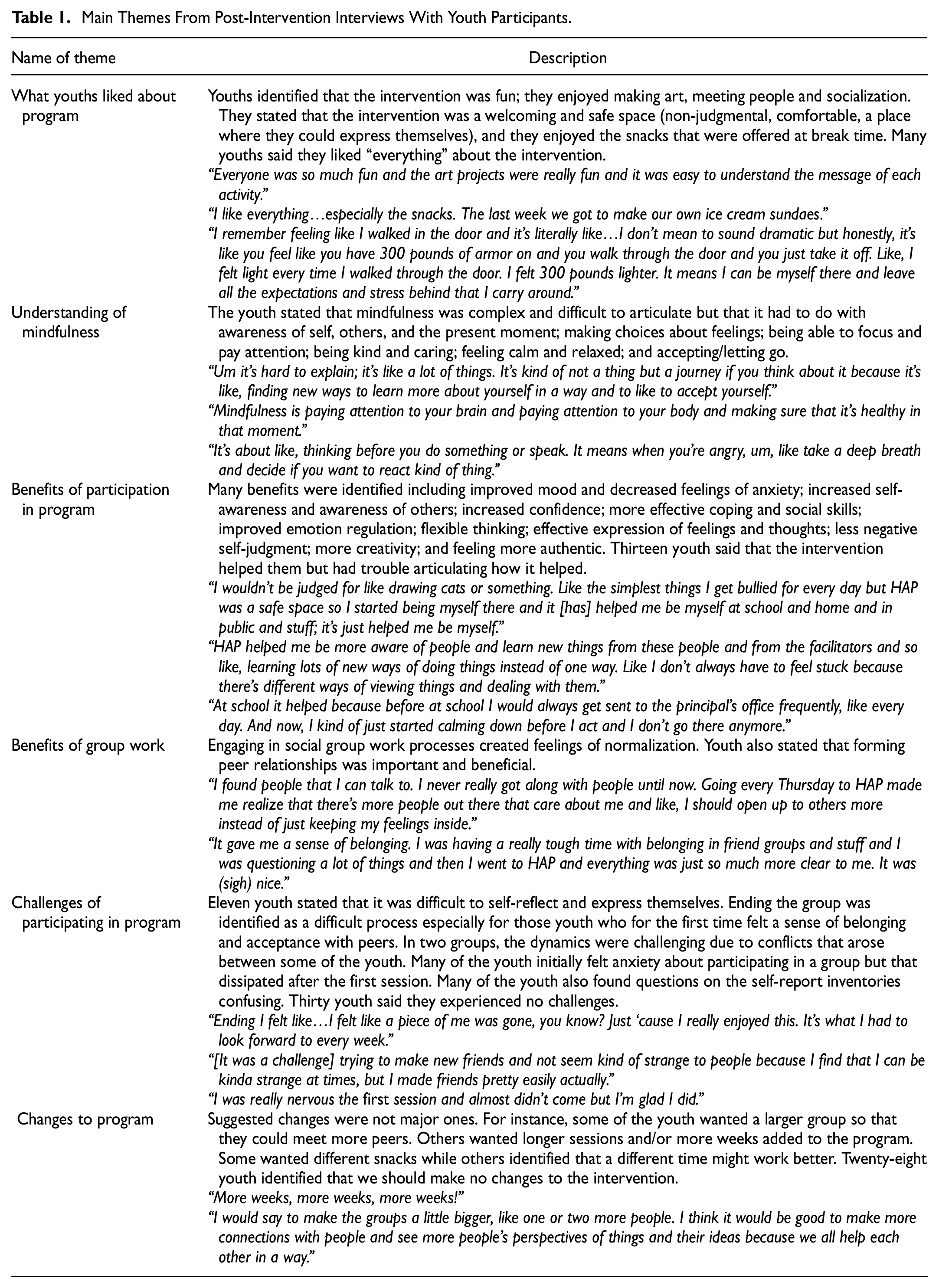
The TA was made easier by the consistency across the youths’ experiences even though we always looked for differences as we coded the transcripts. The numerous post-intervention data codes were eventually organized into six main themes that are described in Table 1, which includes participant quotes (the pre-intervention data analysis was presented earlier in the section describing the participants). The theme of “benefits” had the greatest number of codes; for example, approximately 97 initial codes captured how the youth thought HAP helped them and what they thought they learned in the program. In comparison, 30 initial codes depicted challenges they experienced that included getting along with other youth, and feeling initially nervous about attending the program. In a TA, to refine the analysis, it is necessary to explore relationships in and between the themes to provide a coherent developed narrative about the data. We focused on understanding the benefits of participating in HAP given our study’s focus and that this theme encompassed most of the data (only two youths said “no” such that the intervention did not help them and/or they were “not sure” if it did, but then both went on to share how they benefited from the program). For instance, if youths stated that they felt better about themselves, we wondered about what led to this change. Figure 2 illustrates a map of the relationships we identified between the benefits and helps to explain how the skills the youth learned in HAP led to perceived changes in abilities. For example, developing self-awareness helped the youth identify and challenge their negative thoughts about themselves. Self-awareness of their thoughts and thinking patterns also helped them to develop more flexible thinking so that they realized they have options. In turn, these abilities led to improved mood and the ability to make choices about feelings, which encouraged emotion regulation, and improved coping and relationships. Similarly, in exploring the mechanisms of change in adolescents who participated in a school-based MBI, Zhang et al. (2022) reported that self-regulation enables the development and practice of self-compassion within a mindfulness practice.
Main Themes From Post-Intervention Interviews With Youth Participants.

Map of benefits derived from thematic analysis.
We attempted to re-interview the youth 12 weeks after the post-intervention interview. Twenty-nine youth agreed to take part. Although the youth reported the same benefits as those mentioned above from the post-intervention interviews, we noted some differences. What was memorable to the youth from their experience in the program stemmed from the social group work and strengths-based aspects of HAP. For instance, they emphasized the importance of meeting new people, creating relationships that they maintained after the program, and how the program was a safe place they could express themselves without judgment. Thus, they were better able to articulate the components of the program that they appreciated compared with reporting that they liked “everything” (a common response post-intervention). Also, the youth were better able to articulate their understanding of mindfulness and apply it to their experiences beyond their participation in the program. For example, they reported recognizing when they were experiencing feelings of anxiety and decided to do breathing activities learned in HAP to cope. They were able to explain that mindfulness had to do with making choices, being aware of the present moment, self-awareness, and/or about feelings and improving one’s mental health. The youth reported an increase in feelings of trust and decreased suicidal ideation.
Although interviewing caregivers was not part of the original project design, depending on youth preference (older youth often preferred to be interviewed without their caregivers present), the caregivers sometimes sat in on the interview. We understood that the presence of a caregiver could influence a youth’s responses but it was important to support the youth’s comfort with the interviewing process. If an adult was present, at the end of the interview, the interviewer asked them if they had feedback for us and if they noticed changes in their child. Twenty-three parents, one aunt, and two child welfare workers reported comments that we transcribed and analyzed using the same TA process as described above. The caregivers expressed that the youth enjoyed attending the program. The four main themes were that youth were more expressive and communicative; demonstrated greater responsibility at home; had improved mood, emotion regulation, and confidence; and were more active and creative. For example, one parent stated “I think he’s more open. I find at home, we talk a lot more and stuff. I’m glad he did this program.” Another parent shared “I noticed it made her happier coming out after the group…I think she has been able to manage her anxiety a little better because of it and expand her mindfulness, and meditation has now become a practice for her.” Yet another parent said “Before she would fly off the rails and lose her cool at me and just yell and scream. Now she is not so much like that. Things have gotten better. She will take that moment and take the white board and start to draw, and I have seen her do her figure eight [breathing activity] on the table; I don’t even think she knows that she does that.” Finally, a fourth parent shared that their child “is motivated in his self-help where he wasn’t before. And he’s helping out more around the house.” We note that in response to a question regarding if they had noticed any differences in their child, one parent said “not really” while another parent said “kind of” but was not sure if change was due to HAP participation. Regarding the follow-up (third) interview, only seven parents shared feedback, which was consistent with the analysis described above.
Quantitative Analysis and Results
Data Description
Several issues arose regarding the collection and analysis of survey-based responses. First, given the volunteer nature of participation in the study, 118/146 participants (youth and/or their parent/guardian) completed a pre-intervention survey to provide baseline data. Second, the pre-post design resulted in an attrition rate of approximately 17% such that data from 98 participants were able to be used across the two timepoints (23 male youth, 75 female youth; Mage = 12.57 ± 1.98 years). Third, differences in the source (i.e., youth completing the resilience and mindfulness surveys; parents/guardians completing the Child Behavior Checklist) yielded varied response rates across surveys (see Table 2).
Means (and Standard Deviations) for Participants Pre- and Post-Intervention.

Note.a,bAll raw scores were converted to standardized scores (t-scores) based on instructions from survey authors. aRSCA (Prince-Embury & Courville, 2008a/b). bCBC (Achenbach & Rescorla, 2001). cCAMM (Greco et al., 2011).
Significant difference (p < .05).
Pre-Post Intervention Responses
Descriptive statistics for all study variables are presented in Table 2. To assess if there were changes in responses across timeperiods, a series of repeated measures ANOVA were employed. Time was the independent variable while responses to standardized tools described in the measures section were the dependent variables. For the resilience measures, perceptions of Relatedness improved over time (MT1 = 39.85, MT2 = 42.42), F(1,92) = 5.76, p < .05, η2 = .059, though differences across time were not observed for perceptions of Mastery and Emotional Reactivity.
As it pertains to parents’ responses to the Child Behavior Checklist, differences across time were observed. First, perceptions regarding children’s overall social competence grew more positive over the intervention period (MT1 = 39.62, MT2 = 41.42), F(1,88) = 5.17, p < .05, η2 = .055. Further, parents’ perceptions of both internalizing, (MT1 = 66.51, MT2 = 63.23), F(1,92) = 15.094 p < .001, η2 = .141, and externalizing behaviors of their children, (MT1 = 60.14, MT2 = 57.66), F(1,92)= 8.213, p<.01, η2=.082, significantly improved (i.e., decreased in value).
Finally, self-ratings of acceptance/mindfulness via the CAMM did not change pre- to post-intervention (MT1 = 21.04, MT2 = 21.66), F(1,94) = 0.651, p > .05, η2 = .007.
Discussion
The purpose of the present study was to examine the final results of a 3.5-year project in which we studied the benefits of HAP participation for youth aged 11 to 17 years old. Our findings were mixed in that analysis of the youths’ self-report scores measuring resilience and mindfulness demonstrated limited improvement (i.e., responses relevant to the resilience dimension of Relatedness increased), though parents’ observations of their child’s behaviors pre- to post-intervention indicated significant improvements in social competence, internalizing, and externalizing behaviors. Consistent with parents’ reports, the qualitative analysis of the youths’ pre- and post-group interviews indicated improvements in self-awareness, self-judgment, flexible thinking, mood, ability to make choices about feelings and thoughts, social skills, coping, and emotion regulation; factors that can be connected with Relatedness (comfort with others, trust in others, perceived access of support from others) (Prince-Embury, 2008). The qualitative findings are consistent with ongoing reports of the benefits of mindfulness for young people as described in the introduction.
Self-report scores measuring mindfulness did not improve after participation in the intervention. However, in the post-intervention interviews, many of the youth discussed how they felt more mindful and how learning mindfulness had helped them. In a review of measures used to assess mindfulness in youth, Goodman et al. (2017) noted that the direct measurement of mindfulness is faced with a number of challenges including conceptual and developmental issues (e.g., youth are in the process of developing abilities to self-reflect). They pointed out that self-report bias might be especially problematic in mindfulness research: “As an individual cultivates mindfulness, he or she will be more likely to notice that their “mind has wandered” or that they are “judging.” Consequently, changes in mindfulness change not only the reliability of self-report over time, but may actually reverse expected outcomes” (p. 1410). Thus, one solution for researchers might be to inform youth about mindfulness using a standardized youth-appropriate definition before they complete a self-report inventory for the first time, which may provide for more accurate self-assessments.
Pallozzi et al. (2017) also discussed challenges with using mindfulness measures with youth. We understand that mindfulness practice develops over time. Thus, especially when working with young people, improvements in mindfulness might be demonstrated further along in time, and future research may want to extend the measurement period. Also, although the choices for a self-report inventory for measuring mindfulness were limited when we originally designed this study, we anticipate that as research in this area advances, abilities to measure mindfulness in youth will improve. Regarding the resilience measure, perhaps developmental challenges for self-reflection were also a factor. However, as Jackson et al. (2010) reported, self-report measures provide a reading of resilience at a particular point in time that could be affected by events occurring in the youth’s life at that moment. Certainly, the mixed methods approach enabled us to more fully understand the young people’s experiences of the intervention, and their voices are crucial in helping us understand the types of MBIs that can provide benefits for them (D'Alessandro et al., 2022).
Limitations and Future Directions
It was challenging to collect self-report data from youth and their caregivers, which is a problem shared by many researchers conducting research in uncontrolled conditions. Families have busy lives and it is not always convenient and/or a priority to attend a meeting for a research interview (Butler et al., 2009). We were not able to obtain a full data set due to missed/canceled appointments (we attempted to contact caregivers a maximum of three times), inventories that were not fully completed, and attrition. As a research team, we were limited with resources for incentives but we agree that incentives might have helped achieve a more full collection of data. Also, one of the unexpected outcomes of the COVID-19 pandemic is that we have become more effective with our use of online platforms to communicate with others. We anticipate that in the future, being able to offer an online meeting will prove more convenient for some participants. We also wonder if we used the most appropriate self-report inventories to measure outcomes in our study. For example, many of the youth complained about the questions (e.g., finding them unclear). In the future, we will be more likely to use a self-report inventory that measures general mental health and wellbeing, which Bentley et al. (2019) indicated have specific advantages such as being applicable for diverse mental health challenges, and measuring a broad range of common challenges experienced by youth. Also, in future research, designing a study with a control group will enable us to better attribute measured improvements to HAP.
Some researchers have begun to note that MBIs might be more effective for older adolescents’ mental health, and thus approaches might have to be adapted more precisely for younger adolescents (Carsley et al., 2018; Gómez-Odriozola & Calvete, 2021). In future studies, it would be helpful to have enough participants so that analyses could compare outcomes across different age ranges. As research continues to develop in this area, we may be able to determine what types of MBIs are most effective for children and youth at different developmental stages, and with different types of challenges and needs. This being said, the youth in our study had a variety of mental health challenges, which reflects the reality of many youths’ lives. That is, most youth seeking supports and services have more than one problem and need a transdiagnostic helping approach (Weisz & Bearman, 2020).
Our findings were consistent with previous research exploring the benefits of the arts-based mindfulness intervention with children, and thus are promising and warrant further research investigating arts-based approaches to facilitate mindfulness with adolescents. An arts-based approach was engaging and enjoyable for the youth in our study, which is reflected in our low attrition rates from the program. The youth appreciated the intervention approach that helped them express themselves and develop coping skills. Anecdotally, many of the youth expressed wanting to participate in another HAP group when they completed the program. Engaging and maintaining the interest of young people in an MBI is vital to its feasibility, suitability, and ability to help create change. Arts-based approaches may be especially relevant for marginalized and culturally diverse young people (Jones & Lee, 2022). In general, our region, like many others in Canada, lacks relevant supports and services for youth. Given the needs of young people today for beneficial helping supports and interventions, especially in light of the COVID pandemic that created many challenges for young people (Ellis et al., 2020), we are encouraged to further study the benefits of an arts-based approach to mindfulness and resilience.
Footnotes
Declaration of Conflicting Interests
The author(s) declared no potential conflicts of interest with respect to the research, authorship, and/or publication of this article.
Funding
The author(s) disclosed receipt of the following financial support for the research, authorship, and/or publication of this article: This research was supported by a grant from the Social Sciences and Humanities Research Council of Canada (ref # 435-2016-0718).
Ethical Approval
Ethical approval for this research project was obtained from the first author’s University Research Ethics Board (ref # 2016-05-19).
Informed Consent
Informed consent to participate was obtained from every youth and their parent/guardian.
