



Abstract
During the school years many contextual and academic scenarios demand students to mobilise their coping abilities to overcome them without undermining their emotional wellbeing. During the teenage years, these situations play a primary role in their personal and academic development and in their transition to adulthood. This study aims to analyse the relationship between self-esteem and self-efficacy and the possible mediating role of resilience in secondary school students. The study comprised 1,968 participants with ages ranging from 12 to 18 years (M = 14.52; SD = 1.59), both male (N = 1,066; 54.16%) and female (N = 902; 45.83%) from nine secondary schools. The instruments used were the Academic Self-Efficacy Scale (ASES), the Brief Resilience Scale (BRS), and the Rosenberg Self-Esteem Scale (RSES). The results revealed significant correlations between self-efficacy, resilience, and self-esteem, in line with adaptive behaviours; no significant differences by gender were found. Resilience was found to play a mediating role between self-efficacy and self-esteem. The study reveals the important role played by resilience as mediating variable between the constructs under consideration, as well as in the promotion of adaptive behaviours, leading to the student’s personal and psychological development and academic wellbeing.
Introduction
The action of educators is a key factor in the learning process at all stages of students’ school life, intervening a series of psychological variables such as those studied in this manuscript that can improve the personality development of adolescent students as well as their academic life (Díez et al., 2020). In this process, the students face academic and contextual situations that not only affect their academic performance but also their personal development and the multiple psycho-educational variables involved in learning processes (Coelho & Menezes, 2021).
The role played by psychoeducational variables in school settings is currently a hot topic, because these are crucial factors for the behaviour of students and greatly contribute to forging their adult personality (A. García & Meira, 2019). Adolescence constitutes a critical developmental stage during which students are required to actively deploy coping strategies to foster both personal growth and academic achievement (Palacios, 2019). While the majority of adolescents navigate this period without significant difficulties, a subset of students may experience challenges that manifest as diminished academic motivation, reduced commitment to the educational institution, low engagement with academic tasks, and weakened social integration. In the most severe cases, these factors can culminate in school dropout (Barreno et al., 2019).
As such, the interrelated study of the different psychological variables, at a time of change, like adolescence, is extremely important for the personal and academic development of students (Wang et al., 2021) regardless of the gender of the students, refers to the personal perception that an individual has of himself/herself as to his/her gender, which may or may not coincide with his/her anatomical characteristics (Hermoso et al., 2024), on which we will also focus in the study.
Self-Efficacy in Academic Context
One of the most widely studied variables in adolescents is self-efficacy, defined as the ability of a person to judge their own aptitudes and thus organise their actions to better achieve their academic goals (Zimmerman, 1995). Bandura (2006) defined self-efficacy as the individual’s belief in their capacity to attain favourable outcomes in educational contexts. This construct involves the activation of anticipatory cognitive processes that enable individuals to project potential scenarios and consequences, thereby guiding behaviour in a goal-directed manner.
In this regard, individuals with high self-efficacy are capable of autonomously managing their personal and academic time (Cordeiro et al., 2018), monitoring their learning processes through the use of metacognitive strategies, engaging in reflective evaluation of their intellectual accomplishments (Nissen, 2019), and proactively regulating their own skills and competencies (Ardura & Galán, 2019).
In academic contexts, self-efficacy refers to the belief in one’s capacity to achieve educational objectives and is shaped by factors such as self-regulation, vicarious experiences, social persuasion, and physiological states associated with anxiety, as well as by familial and instructional support (López & Hernández, 2023). It plays a key role in the development of symbolic learning processes that foster self-confidence (Domínguez-Lara & Fernández-Arata, 2019). In this sense, the enhancement of social, cognitive, behavioural, and emotional competencies contributes to strengthening self-efficacy, which, in turn, influences the likelihood of success or failure in academic endeavours (Rosal & Bermejo, 2017).
Empirical studies have consistently demonstrated a strong association between self-efficacy and various psychoeducational variables, including academic engagement, motivation, and commitment to learning tasks (Kryshko et al., 2022; Tossavainen et al., 2021). Moreover, academic self-efficacy has been identified as a significant predictor of academic performance (Honicke & Broadbent, 2016). Generally, students with high levels of self-efficacy report greater subjective well-being and academic satisfaction (Eakman et al., 2019). In contrast, low self-efficacy is linked to maladaptive behaviours in educational contexts, such as reduced engagement and diminished commitment to academic responsibilities (Arslantas, 2021), as well as lower academic achievement (J. Mao et al., 2019). These difficulties may further contribute to the development of psychological issues, including anxiety, stress, and, in more severe cases, depression (Peltier et al., 2022; Ye et al., 2018).
Resilience in Adolescent Students
On the other hand, resilience is understood as the ability to adapt to adverse conditions, overcome them, and successfully move on (Gínez et al., 2019). As such, resilience can be understood as the set of personal features that help us to grow and develop in the face of adversity and the ability to continue our progress undaunted (Contreras & Contreras, 2023). Currently, resilience is understood as a dynamic process directly related to the ways people interact with and adapts to, the conflicts unfolding around them (Ponte, 2017). Resilience comprises two main components: resistance to unfavourable conditions and the ability to rebuild oneself. In the teeth of a traumatic event, resilient persons hold their psychological balance without their everyday life being affected. In contrast to people who demand a more or less long period of time to recover, resilient people remain functional despite the trauma suffered (Gínez et al., 2019).
Empirical evidence has been presented to demonstrate that some human strengths can act as protection against unfavourable conditions and mental disorders in adolescents. The scientific literature relates resilience with personal and academic self-efficacy (Lin et al., 2020); engagement with school tasks (Ayala & Manzano, 2018); emotional regulation (Fernández-Berrocal et al., 2018); and subjective happiness (Kim, 2020). On the other hand, low resilience has been related to high anxiety and stress (Devi et al., 2021), emotional exhaustion (Eaves & Payne, 2019), and even mental disorders (Wu et al., 2020). In general, resilience is related to life satisfaction and student commitment to school tasks (A. Rodríguez, Ramos, et al., 2016) although, generally speaking, resilience encompasses more than just academics.
Academic interest in resilience in students is growing because it is a significant construct for the adoption of adaptive behaviours that can contribute to their psychological and personal development and to their social integration in the school setting (González, 2018).
Self-Esteem in Young Academic Students
Self-esteem is conceptualised as the evaluative judgement individuals make about themselves, which results in a subjective perception of their abilities and personal characteristics, leading to self-approval or self-rejection (Galimberti, 2018). During adolescence, self-esteem is particularly susceptible to both internal and external influences (Schoeps et al., 2019). According to Lars and Ferguson (2020), self-esteem encompasses two primary dimensions: self-worth and perceived competence. The former pertains to an individual’s self-concept or sense of intrinsic value, while the latter involves the individual’s expectations regarding their capacity to effectively manage responsibilities and tasks.
Self-esteem is among the most widely examined self-referential variables in adolescents, and one of the most significant for learning processes (Villarreal & Medina, 2024). Adolescence is the period in which self-evaluation faces the greatest difficulties, and attention is required to promote the students’ personal and academic development (Batsiou et al., 2020).
Research has related self-esteem to other psychological and/or academic variables, such as motivation and academic commitment (Wheeler, 2020); academic performance (Scherrer & Preckel, 2019); engagement (Lavy & Naama-Ghanayim, 2020); performance (Tus, 2020); intra-familiar relationships (Hañari et al. 2020); bullying (Pajuelo & Noé, 2017), and other intrapersonal psychological variables relevant for social skills in academic settings (Kang et al., 2020).
Literature Review
The scientific literature on the relationship between these variables in school and adolescent contexts provides us with various studies that approach our study in different ways. On the one hand, resilience has been significantly correlated with self-efficacy and self-esteem, as demonstrated by studies showing that more resilient adolescents tend to have higher self-esteem (Ayesha et al., 2024; Gao et al., 2019). Thus, resilience could be considered a key psychological resource that allows adolescents to better manage stress and adverse factors, which, in turn, reinforces their perception of self-efficacy and self-esteem, although, following an opposing view, there are also studies that show the ineffectiveness of resilience to other psychological and academic variables in school context such as academic anxiety, academic performance or improvement of self-concept (Aliyev et al., 2021; Cui et al., 2023).
On the other hand, gender differences play a key role in these variables in which female adolescents tend to show lower self-efficacy and self-esteem than boys, especially in academic and social domains (Bleidorn et al., 2016; Fekry et al., 2023). Regarding resilience, the findings are more nuanced: while some studies suggest that girls show greater emotional resilience, others indicate that boys demonstrate greater problem-focused coping, suggesting that gender moderates how resilience manifests itself (Morales-Rodríguez & Pérez-Mármol, 2019; Song, 2023) so there is no consensus within the scientific community on this.
Finally, studies suggest that resilience may mediate the relationship between self-efficacy and self-esteem, acting as a protective mechanism that reinforces the impact of internal beliefs on positive self-esteem (Jankowiak et al., 2021; Liu et al., 2023). Adolescents with high self-efficacy are more likely to show resilient responses to stress, which in turn promotes higher self-esteem (Sagone, 2020).
Therefore, the study of the three variables is relevant because it delves into the psychological mechanisms that strengthen the well-being of adolescents in school contexts as one of the key aspects for the proper personal and academic development of students (Yuen & Wu, 2024) offering a holistic view of how these factors interact to promote adaptive behaviours in the classroom and to understand these relationships in order to guide more effective educational interventions (Cann et al., 2024).
Objectives and Hypotheses
The interrelated study of these three variables in adolescents will help to understand their mutual relations and explain adolescent behaviour in academic settings. The main aim of this study is to analyse the mutual relationships between self-efficacy, resilience, and self-esteem in secondary school students.
The following three hypotheses are set forth:
(a) Self-efficacy, resilience, and self-esteem are affected by gender.
(b) Resilience significantly correlates with self-efficacy and self-esteem, in line with adaptive behaviours.
(c) Resilience plays a mediating role in the relationship between self-efficacy and self-esteem.
Method
Sample
The study comprised 1,968 adolescent students with ages ranging from 12 to 18 years (M = 14.52; SD = 1.59), both male (N = 1,066; 54.16%) and female (N = 902; 45.83%) from nine secondary schools in the city of Zaragoza (Spain) selected through simple random sampling from among all those in the city to represent the sample of the investigation. Among the inclusion criteria, priority was given to the ability to read and understand the text of the questionnaires in perfect Spanish in order to complete them satisfactorily, as well as belonging to the different grades of Compulsory Secondary Education. The exclusion criteria were incomplete and unaccounted questionnaires (26) as well as students unable to understand them due to different reasons. The response rate of the questionnaire was 98.68%, while those not counted amounted to 1.32%.
Measurement Scales
Data collection was conducted using three standardised questionnaires, each corresponding to one of the three psychological constructs under examination. All instruments were administered in paper format.
First, academic self-efficacy was assessed using the Academic Self-Efficacy Scale (ASS), validated for Spanish adolescents by J. M. García et al. (2016). This unidimensional instrument consists of ten items that evaluate perceived self-efficacy in academic contexts (e.g., “I consider myself able to successfully undertake any academic task”). Responses are recorded on a five-point Likert scale ranging from strongly disagree (1) to strongly agree (5). The translated and validated version demonstrated high internal consistency, with a Cronbach’s alpha of .91, and .88 in the present study.
Resilience was measured using the Brief Resilience Scale developed by Smith et al. (2008), and later translated and adapted for Spanish adolescents by R. Rodríguez, Alonso, and Hernansaiz (2016). This unidimensional scale comprises six items (e.g., “It does not take me long to recover from a stressful situation”), rated on a five-point Likert scale from strongly disagree (1) to strongly agree (5). The validated version yielded a Cronbach’s alpha of .88, with a reliability coefficient of .89 in our study.
Finally, self-esteem was assessed using the Rosenberg Self-Esteem Scale (RSE; Rosenberg et al., 1995), validated and adapted for Spanish adolescent populations by Martín et al. (2007). This unidimensional instrument includes ten items (e.g., “In general, I am happy with myself”), with responses provided on a 5-point Likert scale ranging from strongly disagree (1) to strongly agree (5). The scale has demonstrated reliable psychometric properties in academic contexts, with a reported Cronbach’s alpha of .79, and .81 in our study.
Procedure
The study was conducted in collaboration with secondary schools and the students’ parents or legal guardians, all of whom provided informed consent prior to participation. Data collection took place in classroom settings, where students completed the questionnaires under the supervision of both academic tutors and members of the research team. All parents or guardians were fully informed about the objectives and procedures of the study, and student participation was entirely voluntary, in accordance with the ethical guidelines established by the Research Ethics Committee of the Autonomous Community of Aragon (CEICA) (C.I. PI23/424). The questionnaires were administered anonymously, and participants were informed of their right to withdraw from the study at any point without consequence.
Data Analysis
Descriptive statistics were conducted to characterise the sociodemographic profile of the sample, including variables such as gender, age, academic year, and grade repetition status. Additionally, descriptive analyses of self-efficacy, resilience, and self-esteem were performed to examine potential gender differences within these constructs. Correlations between constructs were calculated using IBM SPSS v27.0. Structural equation modelling was used to analyse the direct and indirect (mediated) effects of self-efficacy on self-esteem via resilience. A fully saturated model was tested, which does not have degrees of freedom and thus model fitting indexes cannot be evaluated. Mediation analysis was undertaken using the SPSS v27.0’s MACRO tool by bootstrapping (10,000 runs). For all the operations, a p ≤ .05 level of significance was adopted, with a 95% confidence level.
Results
Demographic Variables
Methods
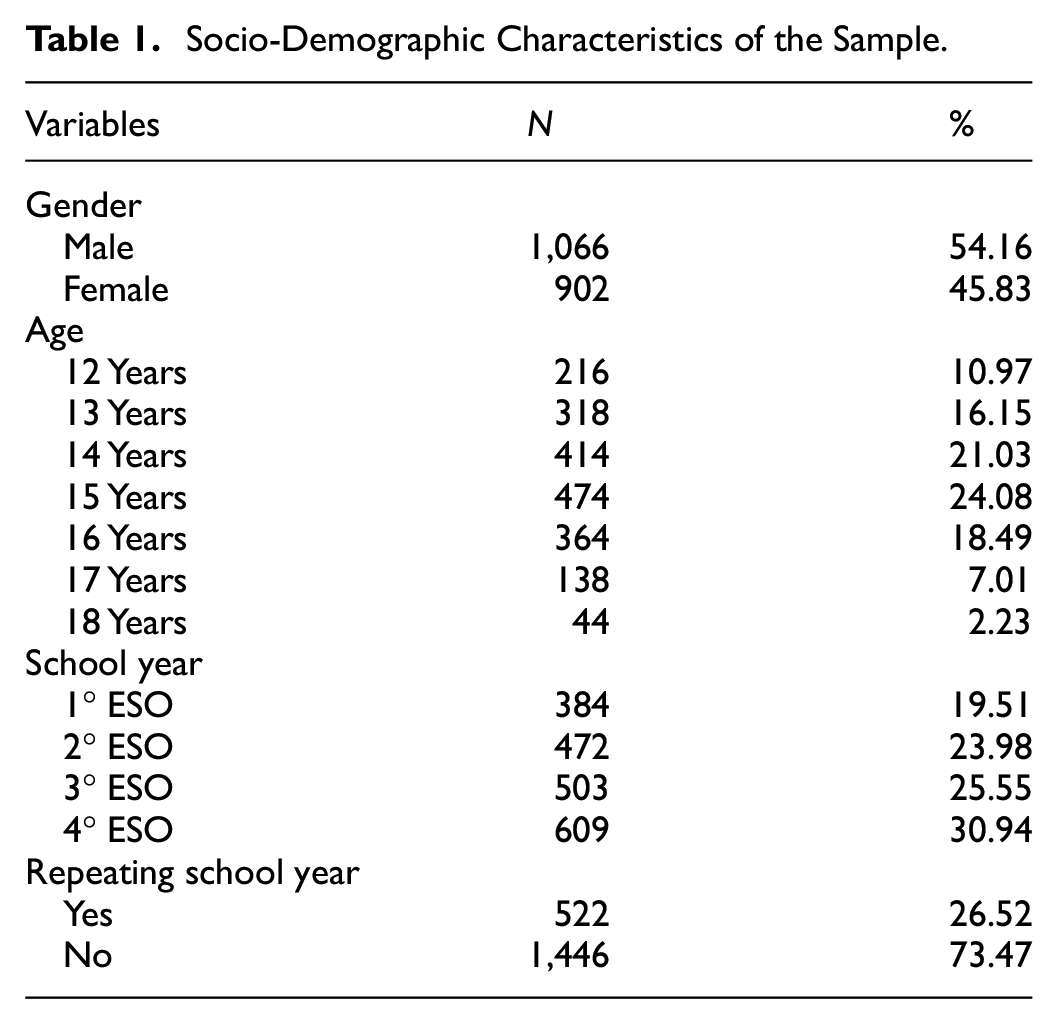
The study comprised 1,968 participants with ages ranging from 12 to 18 years (A = 14.52; SD = 1.59), both male (N = 1,066; 54.16%) and female (N = 902; 45.83%) from nine secondary schools (Table 1).
Socio-Demographic Characteristics of the Sample.
Differential Analysis Among Gender
The results for self-efficacy, resilience, and self-esteem were similar for males and females. As shown in Table 2, females yielded slightly higher scores in resilience, while males yielded slightly higher scores in self-efficacy and self-esteem, but these differences were not statistically significant.
Results by Descriptive Variables: Self-Efficacy, Resilience and Self-Esteem.

Correlational Analysis Between Self-Efficacy, Resilience, and Self-Esteem
The correlations between variables are presented in Table 3. They all correlate with one another but to a different extent. Resilience strongly correlates with self-efficacy (r = .725) and much less strongly with self-esteem (r = .184), while self-efficacy and self-esteem are also correlated (r = .234).
Correlational Analysis Between Self-Efficacy, Resilience, and Self-Esteem.

Correlation significant at .05 level (two-tailed).
Correlation significant at .01 level (two-tailed).
Mediation Effects of Self-Esteem in the Relationship Between Self-Efficacy and Self-Esteem
In order to establish whether resilience plays a mediating role in the relationship between self-efficacy and self-esteem, mediation analysis was undertaken, using Hayes’s (2018) MACRO tool in Process 3.0 de SPSS (v. 27), following Tal-Or et al. (2010).
As illustrated in Figure 1, self-efficacy (VI) was found to have a statistically significant positive effect on resilience (B = 0.65, p ≤ .001), and resilience on self-esteem (VD; B = 0.23, p ≤ .001). The indirect effect of self-efficacy on self-esteem also was positive and statistically significant (B = 0.15, SE = 0.03, 95% CI [0.08, 0.22]), which confirms the hypothesis that resilience plays a mediating role in the relationship between self-esteem and self-efficacy in adolescents.

Mediating Role of Resilience in the Relationship Between Self-Efficacy and Self-Esteem.
Finally, self-efficacy did not show a statistically significant direct effect on self-esteem (B = 0.02, p < .10). The proportion of the variance explained by model R2 = 0.18***, which again proves the mediating role that resilience plays in the relationship between self-efficacy and self-esteem and the importance of the construct.
Discussion
This study aimed to study the relationship between self-efficacy, resilience and self-esteem in a sample of secondary school students.
Gender Differences in Self-Efficacy, Resilience, and Self-Esteem
The first hypothesis argued that resilience, self-efficacy, and self-esteem are affected by gender. This hypothesis was partially confirmed. The average results reveal differences by gender, but they were less significant than expected. While males yielded slightly higher scores in terms of self-efficacy and self-esteem, females yielded slightly higher scores in terms of resilience.
The existing literature approaches the issue in different ways. Some studies argue for greater self-efficacy and self-esteem among males. Minev et al. (2018) reported significantly higher scores for males in terms of self-esteem, linked to better academic performance; Marshman et al. (2018) present similar arguments with regard to self-efficacy in relation to scientific subjects and Mikkelsen et al. (2020) argue that females yield lower scores in terms of self-efficacy and self-esteem vinculated to higher scores in terms of loneliness, stress, and quality of life. On the other hand, some studies have pointed out that self-efficacy is greater in female than male adolescents (Ardura & Galán, 2019; Cordeiro et al., 2018; Nissen, 2019), while other studies argue the same for self-esteem (Gauthier et al., 2022; Magee & Upenieks, 2019).
Therefore, our study attempts to provide relevant data on the prevalence of the three variables studied in terms of the gender in the school context although, according to Beckwith et al. (2024), there may be more variables that influence the development and evolution of the frequencies in terms of gender, being an inherent aspect of the singular educational context examined (Zentner & von Aufsess, 2022).
On the other hand, concerning resilience, the scientific literature generally agrees with our results, reporting higher scores among females, both in adolescents and students (Iimura & Taku, 2018; Jeong, 2019; Zhang et al., 2018) and in adult population (Gínez et al., 2019; Laufer & Shechory, 2021). These findings suggest that females may develop greater emotional resilience, potentially due to higher social connectedness or more frequent use of emotional coping strategies (Konaszewski et al., 2021). However, it is important to consider cultural and contextual factors that may influence these differences, as gender roles and expectations vary across societies (Zentner & von Aufsess, 2022). Moreover, the observed resilience in females does not necessarily translate into higher self-efficacy or self-esteem, which in our study showed distinct patterns. This highlights the complexity of the interplay between these constructs and reinforces the importance of examining them jointly rather than in isolation (Avedissian & Alayan, 2021). Future research should further explore these gendered dynamics using longitudinal and cross-cultural designs.
Relationships Between Resilience, Self-Efficacy, and Self-Esteem
The second hypothesis argued that resilience, self-esteem, and self-efficacy are significantly correlated in adolescents, in line with adaptive behaviours. The hypothesis was fully confirmed, as the results yielded a positive correlation between resilience and the other two constructs. Although few studies have analysed these variables in adolescents, some studies approach the issue, considering also other variables. In a longitudinal study with adolescents, Marcionetti and Rossier (2021) correlate these three variables with satisfaction with life; Y. Mao et al. (2020) argue that self-efficacy and self-esteem play a significant role in building resilience in students; Çelik et al. (2015) relate these three variables with a higher locus of control and academic performance; Salvi (2017) argues that resilience can play a significant role in building self-efficacy and self-esteem in adolescents; and Morales et al. (2020) put forth similar arguments, also taking into account emotional intelligence and empathy.
As such, we can conclude that there is a pattern of adaptive adolescent behaviour characterised by high levels of self-efficacy, resilience, and self-esteem; it is important to curate these constructs towards the students’ personal and academic development (Morán et al., 2019).
Mediating Role of Resilience Between Self-Efficacy and Self-Esteem
The third hypothesis argued that resilience plays a mediating role between self-efficacy and self-esteem in adolescents. The hypothesis was fully confirmed, as it was found an indirect effect of self-efficacy on self-esteem mediated by resilience, but not a direct effect.
Based on the results of mediation analysis, self-efficacy was not found to predict self-esteem; that is, the direct effect of the former over the latter was not statistically significant. However, it was found that resilience plays a significant mediating role in the relationship between self-esteem and self-efficacy. These results emphasise the importance of resilience as a psychological variable in adolescents. This has numerous practical implications for academic settings.
No previous work has been found to directly examine the mediating role played by resilience in the relationship between self-efficacy and self-esteem, but there are a few that explore the mediating role of resilience on other important psychological variables for the personal and academic development of adolescents.
In this way, Moke et al. (2020) establishes the mediating role of resilience in the relationship between self-efficacy and competitiveness in students; Arslan and Asici (2016) alludes to the mediating role that resilience plays, in relation to self-efficacy, in students with behavioural and emotional disorders; Wang et al. (2022) argues that resilience plays a mediating role between self-efficacy and social support; and Yildirim (2019) points to the role of resilience in the relationship between happiness and life satisfaction in adolescents. Other studies approach resilience in students from the point of view of adaptability, in order to develop a mediation model towards better self-learning and wellbeing (Zarrinabadi et al., 2021) and self-efficacy (D’Mello et al., 2018). Concerning less adaptive behaviour patterns, resilience has been used to explain the relationship between certain personality traits and symptoms of depression in adolescents (Gong et al., 2020); academic anxiety and stress (Fiorilli et al., 2020); and even substance abuse (Yang et al., 2019).
Therefore, from the point of view of educators, the importance of fostering resilient attitudes in students on a personal and academic level can be appreciated (Moke et al., 2020), which together with other psychological variables such as self-efficacy and self-esteem can contribute to more resilient students in their school tasks, leading to didactic strategies and actions of educators not only to promote their academic development but also the harmonious development of the students’ personality (Marcionetti & Rossier (2021).
Conclusions
These results emphasise the importance of the constructs under analysis for adolescents’ personal and academic development. The effects of resilience stress the need to foster resilient behaviours, not only to help students overcome more or less positive situations in academic settings but in their everyday life more broadly, encouraging them to improve intrapersonal skills in such a crucial period in the life cycle as adolescence. On the other hand, the significant impact of resilience on self-determined variables such as self-efficacy and self-esteemed strongly recommends the promotion of adaptive behaviours, leading to greater personal and academic wellbeing of students, which, in turn, may prevent lack of motivation and even school dropout. The promotion of self-determined behaviours, therefore, reveals itself as a primary duty of education professionals, which in this way will greatly contribute to increase life satisfaction and subjective happiness in their students.
The principal limitation of this study is its cross-sectional design, as data were collected at a single point in time. The variables of resilience, self-efficacy, and self-esteem in adolescents may fluctuate over time, both across academic years and within the same school year, due to changes in contextual, personal, and familial factors. Additionally, although the secondary schools included in the study were selected randomly, the sample is not representative of the broader economic, social, educational, and family contexts.
Future studies should widen the lens, examining the effect of resilience on other psychological variables beyond self-efficacy and self-esteem. Similarly, it would be interesting to carry out longitudinal studies to examine the evolution of the target constructs over time, and also to include the variable academic performance. Similar studies should be undertaken in other educational levels, such as primary school and university, so that the constructs under analysis can be compared across academic stages. Finally, it is interesting to consider other sociodemographic variables, such as academic year or stage, and cultural and social factors.
The practical implications of this research involve the development of strategies aimed at fostering more adaptive behaviours in students, including the enhancement of effort and motivation to increase their academic self-efficacy, resilience, and self-esteem. Such interventions may contribute to reducing school dropout rates, improving academic performance, and promoting overall well-being. Additionally, targeted programmes implemented by psychology professionals can play a vital role in achieving these outcomes. These findings represent an initial step, motivating further research into adolescent psychology and the creation of effective strategies to support their personal, social, and emotional development.
Footnotes
Acknowledgements
The authors would like to thank the Ibercaja Foundation and University of Zaragoza (JIUZ2022-CSJ-22) and TEA Ediciones Chair.

Ethical Considerations
All procedures performed in studies involving human participants were in concordance with the ethical standards of the institutional and/or national research committee and with the 2000 Helsinki declaration and its later amendments or comparable ethical standards. The procedure adhere to the ethical standards set by the Research Ethics Committee of the Autonomous Community of Aragon (CEICA) (C.I. PI23/424) which included obtaining written informed consent from all participants, right to withdraw and a full debriefing at the end of the study in accordance with the Declaration of Helsinki.
Author Contributions
All authors made substantial contributions to the conception or design of the work; or the acquisition, analysis, or interpretation of data for the work. All authors agree to be accountable for all aspects of the work in ensuring that questions related to the accuracy or integrity of any part of the work are appropriately investigated and resolved. More specifically: P.U.S.: Conceptualisation, Writing an original draft, Data collection, Validation. E.U.L. and J.L.A.L.: Writing – Review and Editing for important intellectual content, Revision and Data analysis. C.S.B.: Data collection, Validation, Investigation, APA format. All authors read and approved the final manuscript version.
Funding
The authors disclosed receipt of the following financial support for the research, authorship, and/or publication of this article: This study has been carried out by the OPIICS Research Group (S46_23R), University of Zaragoza (Zaragoza, Spain), and has been supported by research funds provided by the Department of Science and Technology of the Government of Aragon (Spain) and the European Social Fund.
Declaration of Conflicting Interests
The authors declared no potential conflicts of interest with respect to the research, authorship, and/or publication of this article.
Data Availability Statement
Data sharing not applicable to this article as no datasets were generated or analysed during the current study