



Abstract
Workplace harassment affects both men and women globally, with male ethnic harassment receiving limited attention. Few national or international studies have explored the issue from the perspective of male ethnic harassment. This study examines the influence of leadership styles, specifically ethical and destructive leadership, on the incidence of ethnic harassment among male employees in Karachi, Pakistan. Using a quantitative, survey-based approach, data were collected from 374 male employees across ethnically diverse districts (Lyari, Baldia, and Korangi) through purposive sampling. Partial Least Squares Structural Equation Modelling (PLS-SEM) was employed for analysis. The study reveals that, contrary to expectations, ethical leadership may inadvertently contribute to ethnic harassment by reinforcing hierarchical structures, while destructive leadership predictably increases harassment. The findings suggest that ethnic harassment mediates the relationship between leadership styles and moral disengagement, where harassed employees become morally detached, rationalising unethical behaviour and engaging in further harassment. Moreover, collective moral identity was found to significantly moderate this relationship, reducing the proclivity for harassment among morally aligned groups. These results contribute to the literature on moral identity and provide empirical evidence on the effects of ethnic harassment in politically charged environments, such as Karachi. This data can inform future organisational policies to address ethnic tensions and promote ethical leadership practices.
Introduction
Women’s sexual harassment has gained much attention from both researchers and practitioners over the years. However, ethnic harassment among men has not gained much attention, even though it prevails in societies. A global pattern of incidents has emerged in which men have been targeted by ethnic harassment both in the workplace and in a broader social context (Albert et al., 2023; Lea et al., 2022). For instance, a recent survey on Anti-Asian incidents in the United States found that one-third of respondents attributed the COVID-19 pandemic to Asians. Additionally, hundreds of physical assaults have been reported, and the prevalence of hate speech has risen to 69% (Cheung et al., 2020). In this incident, both males and females are targeted. Various incidents of ethnic harassment have also been reported in India and Pakistan. (Jamil, 2023). Moreover, in their research study, Nandi and Luthra (2017) found that 10% of men experienced ethnic harassment. For instance, Petter (2019) Reported that one in four employees from ethnic minorities in the United Kingdom’s workplace experience harassment. Despite anti-ethnic harassment policies, the author argued that incidents persist because fewer than 45% of organisations have actively investigated such cases. This suggests a lack of commitment from leadership, as leaders in these organisations have not rigorously enforced or monitored the effectiveness of the policies. Consequently, this presents a compelling area for further study.
Ethnic harassment is not confined to public life but is also prevalent in the workplace (Nisar et al., 2023). These conflicts often stem from societal imbalances based on an individual’s ethnic background (Jamil, 2023). Karachi, Pakistan’s largest city and former capital, plays a crucial role in the nation’s economy, contributing approximately 25% of the gross domestic product. As a result, people from other provinces, such as Punjab, Balochistan, and Khyber Pakhtunkhwa, have migrated to Karachi for employment, transforming the city into an industrial and ethnically diverse hub. However, this influx has also led to various ethnic conflicts in Karachi, resulting in the loss of numerous lives (Shamim & Hameed, 2018). Further, they noted that the Urdu-speaking Mohajirs and the Sindhis primarily shape Karachi’s ethnic dynamics. A study by Shoukat et al. (2010) identified the Punjabi, Pathan, Sindhi, Balochi, and Urdu-speaking communities as major ethnic groups in Karachi, with representation across various societal levels, including streets, bureaucratic positions, and assemblies. However, male ethnic harassment in Karachi has received relatively less attention, with few studies exploring it as a critical factor in testing hypotheses related to other constructs.
Previous research has predominantly focused on workplace harassment of women, with insufficient attention given to harassment of men (Lakshminarayanan & Košir, 2024; Zeng et al., 2020). While sexual harassment has been analysed across cultures and populations, resulting in a wealth of evidence, ethnic or racial harassment has not been widely studied. Consequently, there is a notable lack of published literature on the mental health impacts of ethnic harassment. Although ethnic harassment is pervasive, there is limited research on its effect on male employees. Raj et al. (2021) They also argue that comprehensive support and interventions are essential to minimise ethnic harassment and its adverse mental health outcomes, such as moral disengagement. Furthermore Page and Pina (2018) While some studies have examined the antecedents of harassment proclivity, none have adequately explored the role of leadership in the prevalence of harassment and the propensity for such behaviour.
The prevalence of ethnic harassment in workplaces in Karachi highlights an urgent need for research focused on understanding and mitigating such behaviours. This study aims to explore the role of leadership styles, specifically ethical and destructive leadership, in influencing the occurrence of harassment. Despite extensive research on the effectiveness of ethical leadership, a significant gap remains in understanding its impact through a process-oriented approach, particularly in achieving positive outcomes (Mohi Ud Din et al., 2025; Zeng et al., 2020). By examining the influence of both destructive and ethical leadership styles on the prevalence of ethnic harassment among male employees, this study seeks to fill existing research gaps and provide valuable insights into effective organisational interventions. In addition to exploring leadership style, this study examines the broader consequences of male ethnic harassment by considering it as a precursor to employee moral disengagement. This moral disengagement, in turn, increases the propensity for male harassment within the workplace. This study is grounded in Social Cognitive Theory (SCT), which posits that behaviour is shaped through interactions between individuals and their social environments (Jeanty, 2008). Applying SCT helps explain how leadership styles can directly and indirectly influence harassment behaviours and moral disengagement through social learning mechanisms. From both theoretical and practical perspectives, this study offers several implications that will be elaborated upon in later sections. The research is structured as follows: a Literature review and methods employed, followed by a discussion, conclusion, and future research areas. To guide this investigation, the following research questions are proposed based on the identified theoretical gaps and hypotheses:
How do ethical and destructive leadership styles influence male ethnic harassment in ethnically diverse workplaces in Karachi, Pakistan?
Does male ethnic harassment mediate the relationship between leadership styles and moral disengagement, and subsequently, harassment proclivity?
Can collective moral identity moderate the effect of moral disengagement on harassment proclivity, thereby reducing the likelihood of further harassment?
Theoretical Background
Social cognitive theory (SCT), as articulated by Bandura (1978), emphasises the importance of observational learning, social interaction, and reciprocal determinism in shaping behaviour. SCT suggests that individuals develop and sustain their behaviour through a dynamic interplay of psychological, behavioural, and environmental factors (Bandura, 1986). This theory emphasises the influence of others’ actions, the outcomes of those actions, and an individual’s perceptions of the consequences of their own behaviours. Bandura (1986) Posits that direct experience, vicarious experiences, and the broader social environment shape behaviour. In the context of SCT, ethical leaders serve as positive role models, influencing their followers through observational learning and indirect experiences (Zeng et al., 2020). By modelling and reinforcing appropriate behaviours, ethical leadership can foster a culture of respect and integrity, thereby reducing the likelihood of male harassment (Brown et al., 2005; Mohi Ud Din & Zhang, 2025). Conversely, destructive leadership can foster negative behaviours, contributing to a toxic social climate that may increase the propensity for male harassment (BİÇER, 2020). SCT suggests that individuals tend to adopt and replicate their leaders’ behaviours.
SCT also highlights the roles of personal and social factors in the development and persistence of behaviours. Male ethnic harassment can be a precursor to moral disengagement, a process by which individuals rationalise or justify unethical behaviours (Bandura, 1999). Moral disengagement allows individuals to engage in harmful behaviours, such as harassment, without experiencing guilt or remorse. Collective moral efficacy serves as a moderator of males’ propensity to engage in harassment. According to SCT, the social environment and group identity influence individual behaviours. A strong collective moral identity can amplify the positive effects of ethical leadership by reinforcing shared ethical standards and behaviours within the group (Aquino & Americus, 2002). In line with SCT, it is argued that the environment shaped by leaders, whether favourable or hostile, profoundly influences followers’ behaviours. Conversely, a positive environment cultivated by ethical leaders can enhance collective moral identity, reduce harassment proclivity, and promote positive behaviours among employees (Joplin et al., 2021).
Ethical Leadership and Male Ethnic Harassment
Ethical leadership is characterised by fairness, integrity, and a commitment to upholding ethical standards, which are crucial in preventing harmful behaviour, such as ethnic harassment. Leaders who demonstrate these traits will likely establish a code of conduct that explicitly prohibits harassment and promotes inclusivity. Moreover, ethical leaders actively monitor their teams to ensure adherence to ethical standards and take corrective actions when violations occur, thereby reducing the likelihood of ethical harassment (Heymann et al., 2023). Understanding the link between ethical leadership and male ethnic harassment is vital for fostering an inclusive and respectful workplace, especially in Karachi, Pakistan, where ethnic diversity and rigid hierarchies are prevalent. Previous studies have explored the relationship between ethical leadership and various forms of workplace harassment, including ethnic harassment. Ethical leadership is generally associated with fostering a positive work environment, where moral behaviour is encouraged and negative behaviours, such as harassment, are discouraged. For instance, Gill et al. (2016) highlighted that ethical leadership cultivates an ethical climate that discourages negative behaviour among employees. Similarly, Bissing-Olson et al. (2012) emphasised that ethical leadership fosters sociability and positive outcomes, thereby indirectly reducing the likelihood of workplace harassment. The findings of previous studies have been essentially unanimous in indicating that ethical leadership is associated with lower levels of workplace harassment, including ethnic harassment. However, there is some variation in the strength of this relationship across different organisational contexts. For example, Liu et al. (2012) found that ethical leadership was effective in reducing harassment behaviours, while other studies have suggested that the effectiveness of ethical leadership in curbing such behaviours may depend on additional factors, such as organisational culture and the specific nature of the workforce (Buchan et al., 2023). In the context of ethical leadership, SCT suggests that leaders’ ethical standards create an environment that discourages negative behaviours, such as ethnic harassment. Employees observe and internalise the ethical behaviour modelled by their leaders, which, in turn, influences their behaviour. When leaders consistently demonstrate ethical behaviour and hold others accountable for violations, it reinforces a culture where harassment is less likely to occur. Therefore, SCT provides a strong theoretical foundation for understanding how ethical leadership can reduce workplace ethnic harassment against men. Based on the discussion above, the following hypothesis is proposed:
Destructive Leadership and Male Ethnic Harassment
Authoritarian tendencies, a lack of empathy, and a disregard for ethical standards often characterise destructive leadership. These traits directly contribute to an environment where harassment, including ethnic harassment, can thrive. Leaders who exhibit these behaviours fail to establish a culture of respect and ethical conduct. This not only emboldens employees to engage in harassment but also normalises organisational behaviour (Xiao et al., 2024). Previous studies have explored the relationship between destructive leadership and various forms of workplace harassment, including ethnic harassment. Destructive leadership, characterised by behaviours that dehumanise and belittle others, has been linked to increased instances of ethnic harassment in organisations. For instance, Buchanan et al. (2014) found that in a military context, leaders who fail to address harassment contribute to a culture where ethnic harassment is more likely to occur. Similarly, Erentzen et al. (2022) highlighted that leaders who do not foster a culture of respect inadvertently promote unethical behaviours, including ethnic harassment. The findings of previous studies are generally consistent, suggesting that destructive leadership is positively associated with ethnic harassment. However, there is some variation in how this relationship is expressed across different contexts. For example, Sadler et al. (2018) emphasised that destructive leaders model inappropriate behaviour that employees then replicate, creating a harassment-prone environment. On the other hand, while some studies focus on specific environments, such as the military, others, like Tai et al. (2021), argue that the impact of destructive leadership may vary depending on organisational culture and existing power dynamics. In the context of destructive leadership, SCT posits that employees will likely imitate the negative behaviour modelled by leaders. When leaders engage in or tolerate harassment, it sends a signal to employees that such behaviours are acceptable, perpetuating a cycle of harassment within the organisation. This is particularly relevant in the case of ethnic harassment, where destructive leadership can create an environment that tacitly endorses or fails to punish discriminatory behaviours (Bandura, 2012). Based on the discussion thus far, we proposed that:
Male Ethnic Harassment and Moral Disengagement
Male ethnic harassment, characterised by discriminatory behaviour and unfair treatment based on ethnicity, is linked to adverse psychological outcomes such as anxiety, depression, and moral distress. Moral disengagement refers to the cognitive process by which individuals justify unethical behaviour by minimising the moral implications of their actions (M. Wu et al., 2022). When employees experience ethnic harassment, they may detach from their ethical beliefs to cope with the hostile work environment, leading to moral disengagement. The traits of ethnic harassment, such as exclusion, derogation, and stereotyping, directly contribute to creating a toxic environment that fosters moral disengagement among victims (Frankena, 1973; Haniefa & Riani, 2019). Several studies have explored the relationship between ethnic harassment and its psychological effect, moral disengagement. Nandi and Luthra (2017) found that men report higher ethnic harassment than women, and those who experience such harassment are more likely to suffer from mental health issues, leading to moral disengagement. Haniefa and Riani (2019) further supported these findings by highlighting that individuals from minority groups are more vulnerable to harassment, which in turn leads to disengagement from normal moral and ethical behaviours in the workplace. The findings of previous studies have been largely consistent, indicating a significant link between ethnic harassment and moral disengagement. Researchers agree that experiencing ethnic harassment increases the likelihood of moral disengagement as a coping mechanism. For instance, the Equal Employment Opportunity Commission (2019) reported that individuals who experience ethnic harassment are more likely to disengage morally as a means of surviving the hostile environment. However, the context and intensity of this relationship vary depending on factors such as the severity of harassment and the organisational culture. In the context of ethnic harassment, SCT suggests that individuals who experience harassment may adopt moral disengagement as a coping strategy influenced by the negative environment around them. The hostile environment created by ethnic harassment can lead individuals to justify unethical behaviour as a way to alleviate their psychological distress. This theory provides a framework for understanding how the experience of harassment can disrupt an individual’s ethical framework, leading to moral disengagement. Thus, it is hypothesised that:
Moral Disengagement and Harassment Proclivity
Moral disengagement is a psychological mechanism that enables individuals to rationalise unethical behaviour, thereby allowing them to engage in actions that typically conflict with their moral standards (Gotowiec, 2019). The dimension of moral disengagement, such as minimising the consequences of harmful behaviour, dehumanising the victim, and displacing responsibility, directly contributes to harassment proclivity. Morally disengaged employees are more likely to justify their aggressive or harassing behaviour as a response to perceived wrongs and injustices they have experienced. This rationalisation reduces their sense of personal accountability and increases their susceptibility to harassment (Bandura, 1999; Hu et al., 2024; Liu et al., 2012). Previous studies established a connection between moral disengagement and an increased likelihood of engaging in harassment. For instance, Page and Pina (2018) found that morally disengaged individuals are more likely to engage in sexually harassing behaviour because they do not view their actions as morally wrong. Similarly, Antecol et al. (2009) reported that employees who experience harassment are subsequently disengaged morally and are more likely to develop a proclivity for harassing others, particularly as a form of retaliation or to regain a sense of control. The findings in this area are essentially unanimous, with studies consistently showing that moral disengagement increases the likelihood of proclivity to harassment. However, the extent to which moral disengagement influences this behaviour can vary depending on individual differences and the specific organisational context. For example, while Liu et al. (2012) observed a strong link between moral disengagement and proclivity for harassment in hierarchical and competitive work environments, other studies suggest that the relationship may be moderated by factors such as organisational culture and the presence of ethical leadership (Page & Pina, 2018). According to SCT, behaviour is influenced by the interaction between personal factors, behaviour, and environmental conditions. When individuals morally disengage, they are more likely to engage in harassment because they have cognitively restricted their understanding of the behaviour to align with their current environment and experiences. For instance, if an individual feels that harassment is justified or routine within their workplace, they are more likely to adopt these behaviours, particularly if they have disengaged from their moral compass (Bandura, 2012). Based on the discussion, we proposed that:
Mediation of Male Ethnic Harassment and Moral Disengagement
Studies have explored how leadership styles impact workplace behaviours through mediation mechanisms. For example, Buchanan et al. (2014) found that ethical leadership reduces ethnic harassment by promoting a favourable climate. In contrast, destructive leadership is associated with increased harassment due to a lack of ethical guidance. Research consistently supports the notion that ethical leadership reduces the likelihood of harassment and moral disengagement, while destructive leadership has the opposite effect. For instance, Page and Pina (2018) confirmed that moral disengagement acts as a mediator between the experience of harassment and the perpetration of harassment, supporting the idea that leadership styles indirectly influence harassment proclivity through these mediators. Furthermore, ethical leadership may reduce male ethnic harassment, thereby lower moral disengagement and decreasing the propensity for harassment. This sequential mediation process highlights how initial leadership behaviours can trigger a chain of events that influence employee behaviour. Conversely, destructive leadership may increase male ethnic harassment, which in turn heightens moral disengagement and ultimately increases the likelihood of harassment proclivity. Based on SCT and discussion, we hypothesised that:
Collective Moral Identity as a Moderator
Collective moral identity refers to the shared moral values and ethical standards that members of a group or organisation internalise (Zeng et al., 2020). Ethical leaders foster an environment where ethical norms are emphasised and rewarded, thereby enhancing the group’s collective moral identity (Kuenzi et al., 2020). Ethical leadership is expected to have a positive effect on moral identity. As a leader consistently models ethical behaviour and reinforces ethical standards, employees within the organisation internalise these behaviours, resulting in a shared sense of moral identity. This collective moral identity serves as a guiding force for behaviours across the organisation, thereby reducing the likelihood of unethical actions, including harassment (Mohi Ud Din & Zhang, 2023). Collective moral identity is a crucial moderating factor in the relationship between moral disengagement and harassment proactivity within organisations. The presence of a collective moral identity within an organisation can significantly weaken the relationship between moral disengagement and proclivity towards harassment. When a collective moral identity is well-established, it represents a shared commitment to ethical standards and values throughout the organisation. The collective moral identity shapes the social norms and expectations regarding behaviour, creating a moral framework that all organisation members internalise. In such an environment, individuals are less likely to morally disengage because doing so would conflict with the pervasive ethical norms of their peers and leaders. Given the moderating and direct role of collective moral identity, the relationship between moral disengagement and harassment proclivity can be hypothesised as follows:
Below is Figure 1, which presents the conceptual framework of the study

Conceptual framework of study.
Methodology
The study investigates the influence of various leadership approaches on addressing workplace male harassment. Additionally, it explores how male harassment leads to moral disengagement among male employees and their subsequent inclination to harass others. The study employed a quantitative methodology to achieve this objective, using a self-administered questionnaire to gather participants’ responses. The quantitative research approach was selected based on its ability to cater to a diverse audience and accommodate larger sample sizes through a scale questionnaire. A methodical strategy was taken to ensure the questionnaire’s content validity. The questionnaire was initially developed by extracting items from validated scales in the literature (Gavora et al., 2015), assuring its foundation in existing research. Subsequently, a team of experts was established to examine and improve the items, using their knowledge to increase the questionnaire’s relevance and legibility (Regmi et al., 2017). Finally, a pilot study was undertaken, enabling the practical evaluation of the items in question. Based on the feedback received during the pilot testing, additional modifications were made to ensure that the questionnaire was precise and successful in measuring the targeted concept (In, 2017). The final questionnaire consisted of items specifically developed to assess the constructs of leadership styles, male harassment, moral disengagement, and collective moral identity. The survey targeted the working population of Karachi, specifically focusing on three districts: Lyari, Baldia, and Korangi. This district was chosen as it represents a broad cross-section of Karachi’s ethnic diversity and has historically been home to various ethnic communities. Lyari is predominantly inhabited by Baloch and Katchi communities, Baldia is mainly populated by Pashtuns, while Korangi is a heterogeneous area with significant Sindhi and Urdu-speaking populations (Sayeed et al., 2019). The author distributed an online questionnaire via email and social media, ensuring that only English-proficient employees were included. Multiple follow-ups and reminders were issued to enhance response rates. The data collection instrument was a structured questionnaire with a 5-point Likert scale to measure the constructs under study. Respondents rated their agreement with various statements on a scale ranging from 1 (strongly agree) to 5 (strongly disagree). Data were collected through purposive sampling from employees of government organisations in the selected districts. The sample size for the study was determined using G*power, which indicates a minimum requirement of 138 respondents. To account for potential non-response, 600 questionnaires were distributed. Of these, 374 valid responses were collected and used for data analysis. It is essential to note that 122 questionnaires completed by female employees were excluded from the analysis, as this study focused on male harassment. The analysis strategy involved an initial analysis of demographic factors using SPSS (see Table 1), followed by SmartPLS to test the hypothesised model.
Demographic Profile of Respondents (n = 252).

The demographic analysis of the respondents (n = 252) reveals a diverse representation across various age groups, employment types, and tenure of service. Most respondents fall within the 26 to 45 age group (49.6%), indicating that the sample is predominantly comprised of young to middle-aged individuals. The remaining respondents are almost evenly split between those aged 20 years or younger (15.1%) and those aged 56 years or older (15.1%), with a smaller yet significant portion aged 46 to 55 years (19.8%). In terms of education, however, the sample is highly homogeneous, with nearly all respondents holding advanced degrees (50% hold a master’s degree, 49.2% PhD), and only 0.8% reporting a bachelor’s degree. This skew toward highly educated respondents limits diversity on this dimension and should be considered when interpreting the generalizability of the findings (see Limitations). Regarding employment, a plurality of respondents (38.9%) hold permanent positions, while the remainder are either in contractual roles (28.6%) or other types of employment (32.5%). This distribution suggests a relatively balanced representation of different statuses. Regarding the length of service, the workforce is predominantly experienced, with 37.7% having 5 to 10 years of service and 22.6% having more than 10 years of service. However, a notable portion of respondents are relatively new to their positions, with 21.4% having up to 1 year of service and 20.2% having 2 to 5 years of service. Overall, the data indicate a predominantly highly educated, middle-aged workforce with a mix of employment types and varying tenure levels.
Ethical Consideration
The study was conducted in strict adherence to ethical standards to ensure the rights, confidentiality, and well-being of the research participants. All procedures involving human participants were reviewed and approved by the Institutional Review Board (IRB) at the School of Management, Harbin Institute of Technology (Approval Number: 2023-16) and were conducted in accordance with the ethical principles outlined in the Declaration of Helsinki and the APA Ethical Guidelines (Section 8.05). The study involved an anonymous online survey, and no personally identifiable information was collected. Participation was entirely voluntary, and participants were informed about the study’s purpose, methodology, and their right to withdraw at any time before starting the questionnaire. As the research posed minimal risk and did not collect sensitive personal data, formal written informed consent was not required under ethical review guidelines. The questionnaire was designed to be respectful and non-intrusive, especially given the sensitive nature of topics such as moral disengagement and harassment. Participants were provided with contact details for support services in case of emotional discomfort. The data were securely stored with restricted access, and findings were presented in a way that preserved participant anonymity. No incentives were offered, ensuring participation was free from coercion. This approach is consistent with ethical standards for minimal-risk research, in which participant identities are protected and no deception is used. The study reflects a strong commitment to upholding participant care, privacy, and research integrity.
Scales
The questionnaires used in this study were adapted from well-established scales in previous research. Destructive leadership was measured using a five-item scale adapted from Mitchell and Ambrose (2007). Brown et al. (2005) developed a seven-item scale to assess ethical leadership. Moral disengagement was measured using a six-item scale adapted from Gómez Tabares and Landinez-Martínez (2021). Male ethnic harassment was evaluated using a three-item scale adapted from Schneider et al. (2000), while harassment proclivity was measured with a four-item scale (Page et al., 2016). Finally, collective model identity was measured using a four-item scale (Aquino & Americus, 2002). Respondents provided demographic information, including age, education, and job experience, along with the variables of interest. The collected data were analysed using PLS-SEM to examine the relationships among the study variables.
Data Analysis and Procedures
PLS-SEM was selected as the primary data analysis technique for several reasons that align with the objectives and nature of this study. PLS-SEM is particularly well-suited for research focusing on prediction and theory development rather than theory testing (J. F. Hair et al., 2021). Given that our study aims to explore the relationships between leadership styles, male ethnic harassment, and moral disengagement, PLS-SEM provides the necessary flexibility to model complex relationships and test the hypothesised paths. Additionally, PLS-SEM is advantageous when dealing with small to medium sample sizes and complex models with multiple constructs and indicators (J. F. Hair et al., 2021). Our study involves a relatively complex model with multiple constructs, including leadership styles, moral disengagement, and proclivity toward harassment. PLS-SEM allows for the simultaneous estimation of these relationships, which is crucial for understanding the direct and indirect effects within our hypothesised model. Another key reason for choosing PLS-SEM is its ability to handle non-normal data distributions effectively (Sarstedt et al., 2021). Given the sensitive nature of the data collected on male harassment, there was potential for non-normality in the data distribution. PLS-SEM’s robustness against such issues made it an appropriate choice for our analysis. For model assessment, this study used the Smart PLS 4 software (J. Hair, Hollingsworth, et al., 2017). Quantitative data are examined using partial least squares structural equation modelling (PLS-SEM). PLS-SEM involves a two-phase analysis: measurement model assessment and structural model assessment (Hu et al., 2025). The formulation of the measurement model commits to advancing the constructs by ensuring strong indicator loadings, convergent validity, composite reliability (CR), and discriminant validity for further investigation. Structural model assessment evaluates the importance of path coefficients and determines whether they are statistically significant.
Data Analysis and Results
Measurement Model Assessment
The measurement model is evaluated according to the criteria established by J. Hair, Hollingsworth, et al. (2017) and Hair (2006) to confirm the dependability and accuracy of the constructs and their dimensions. A confirmatory factor analysis was conducted to assess the measurement model following data confirmation. Table 2 shows that most factor loadings for the variables above 0.6 indicate high item reliability, with only a few exceptions. More precisely, two items, DL5 and EL7, had low factor loadings on the destructive leadership and ethical leadership constructs, respectively. As a result, these items were excluded from the analysis. Removing these factors increased the Average Variance Extracted (AVE), enhancing the model’s overall validity. This change strengthened the measurement model’s accuracy and resilience by ensuring that the AVE met the acceptable threshold suggested by J. Hair, Hollingsworth, et al. (2017). The factor loadings demonstrate strong relationships between the observed variables and their underlying constructs. The loading ranges from 0.75 to 0.799 for CM, indicating reliable measurement. DL has strong loadings, particularly for DL1 (0.88) and DL2 (0.825), while DL3 (0.621) is slightly lower but acceptable. EL shows consistently high loading between 0.701 and 0.878, confirming the reliability of the measurement. MD also exhibits strong loadings, ranging from 0.745 to 0.829. MEH and MHP constructs exhibit robust loadings, with MEH from 0.797 to 0.876 and MHP from 0.756 to 0.902. The interaction term CM × MD shows a perfect loading of 1.000, reflecting its composite nature. Overall, the high loading affirms the reliability and validity of the measurement model.
Confirmatory Factor Analysis, Reliability, and Validity.

Note. Factor loadings (Cronbach’s alpha, Composite reliability, Average variance extracted).
The confirmatory factor analysis results in Table 2 indicate that the constructs exhibit good reliability and validity. The Cronbach’s alpha values for all constructs exceed the minimum threshold of 0.70, as recommended by J. F. Hair et al. (2021). Specifically, Destructive leadership has a Cronbach’s alpha of .835; Ethical leadership, .916; Male ethnic harassment, .883; Moral disengagement, .917; Collective moral identity, .839; and Male harassment proclivity, .898. The composite reliability (rho_C) values for all constructs are also above the acceptable limit of 0.70 (Fornell & Larcker, 1981), further confirming the measurement model’s reliability. The CR values range from 0.838 to 0.917. Additionally, the average variance extracted (AVE) for each construct is well above the recommended threshold of 0.50, indicating good convergent validity (J. F. Hair, Matthews, et al., 2017). The AVE values are 0.591 for destructive leadership, 0.646 for ethical leadership, 0.714 for male ethnic harassment, 0.648 for moral disengagement, 0.565 for collective moral identity, and 0.692 for male harassment proclivity. These results affirm that the constructs are reliable and valid for further analysis.
Further validating the measurement model, the Heterotrait-Monotrait Ratio (HTMT) was used over the traditional Fornell-Larcker criterion for assessing discriminant validity, as recent research has shown that HTMT is more reliable and robust, particularly in detecting issues of discriminant validity in complex models (Henseler et al., 2015). The Fornell-Larcker criterion has been criticised for its limitations in accurately identifying discriminant validity, especially when constructs are highly correlated. Therefore, the HTMT values presented in Table 3 indicate the discriminant validity among the constructs in this study. HTMT values below 0.85 indicate that the constructs are distinct, a crucial requirement for discriminant validity (Henseler et al., 2015).In the table, most HTMT values are below this threshold, indicating acceptable discriminant validity. For example, the HTMT values between CMI and other constructs, such as DL (0.387), EL (0.512), and MD (0.590), are well within an acceptable range. However, some HTMT values are slightly higher, such as between MD and MHP (0.839), which approaches the threshold but still suggests acceptable discriminant validity. The highest HTMT value observed between MEH and MD was 0.814, which is below the strictest threshold of 0.90, indicating that these constructs are distinct yet closely related.
Discriminant Validity Heterotrait-Monotrait Ratio.

Note. EL = ethical leadership, DL = destructive leadership, MEH = male ethnic harassment, MD = moral disengagement, CMI = collective moral identity; MHP = male harassment proclivity.
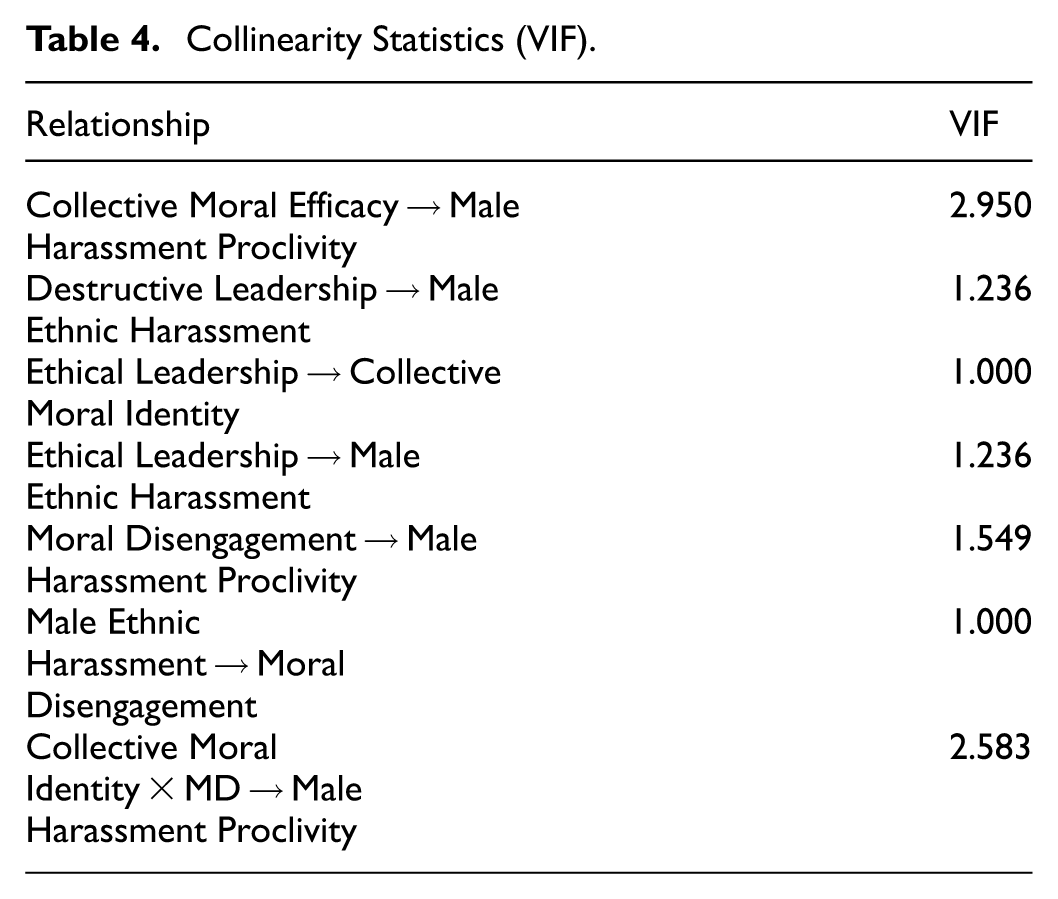
The Variance Inflation Factor (VIF) analysis is essential to validating the inner model, which is closely connected to the overall measurement model. The VIF values in Table 4 provide insights into the potential multicollinearity issue within the inner model. Multicollinearity occurs when predictor variables are highly correlated, leading to inflated standard errors and unreliable regression estimates. A VIF value above 5 indicates a problematic level of multicollinearity, while values between 1 and 5 are generally considered acceptable (J. F. Hair, Matthews, et al., 2017; Kock, 2015). This model’s values range from 1.000 to 2.950, all of which are below the critical threshold of 5. This suggests that multicollinearity is not a significant concern in our analysis, and the predictor variables are sufficiently independent. Specifically, the highest VIF was observed for the relationship between CMI and MHP (2.950), followed by the interaction term CM × MD predicting MHP (2.583). These values, while relatively higher than others, still indicate that multicollinearity is within acceptable limits and does not threaten the validity of the model’s estimates.
Collinearity Statistics (VIF).
Structural Model Assessment
Before moving to path analysis, Table 5 displays the Coefficient of Determination (R2), Predictive Relevance (Q2), and F-square (f2) values for each construct, providing essential details about the explanatory strength and predictive capacity of the structural model. The Coefficient of Determination (R2) measures the proportion of the dependent variable’s variability that the independent variables in the model explain. The R2 value for Collective Moral Identity (CMI) is 0.263, indicating that its predictors explain 26.3% of the variability in CMI. The R2 value for Moral Disengagement (MD) is 0.665, indicating that the model can explain 66.5% of the variation in MD. The R2 values for Male Ethnic Harassment (MEH) and Male Harassment Proclivity (MHP) are 0.514 and 0.812, respectively. These values indicate that the model has a solid ability to explain the variation in MHP, particularly. The Q2 values also evaluate the model’s capacity to predict the endogenous constructs. A Q2 value above 0 implies that the model possesses predictive relevance (Zait & Bertea, 2011). The Q2 values obtained in this research 0.192 for CMI, 0.395 for MD, 0.401 for MEH, and 0.435 for MHP indicate that the model can make accurate predictions, especially for MHP and MD. The F-square (f2) values offer valuable insights into the strength of the correlations between constructs. Cohen (2004) categorises a f2 value of 0.02 as ‘petite’, 0.15 as ‘medium’, and 0.35 as ‘substantial’. The relationship between Collective Moral Identity (CMI) and Male Harassment Proclivity (MHP) in this model has an f2 value of 0.589, indicating substantial influence. The impact of Destructive Leadership (DL) and Ethical Leadership (EL) on Male Ethnic Harassment (MEH) is moderate, as indicated by their effect sizes of 0.301 and 0.303, respectively, as measured by f2 values. The relationships between Moral Disengagement (MD) and Male Harassment Proclivity (MHP), as well as Male Ethnic Harassment (MEH), are characterised by strong effects, with f2 values of 1.717 and 1.995, respectively. The interaction term CMI
Coefficient of Determination and Predictive Relevance.

Note. EL = ethical leadership; DL = destructive leadership; MEH = male ethnic harassment; MD = moral disengagement; CMI = collective moral identity; MHP = male harassment proclivity; R2 = coefficient of determination; Q2 = predictive relevance; f2 = F-square.
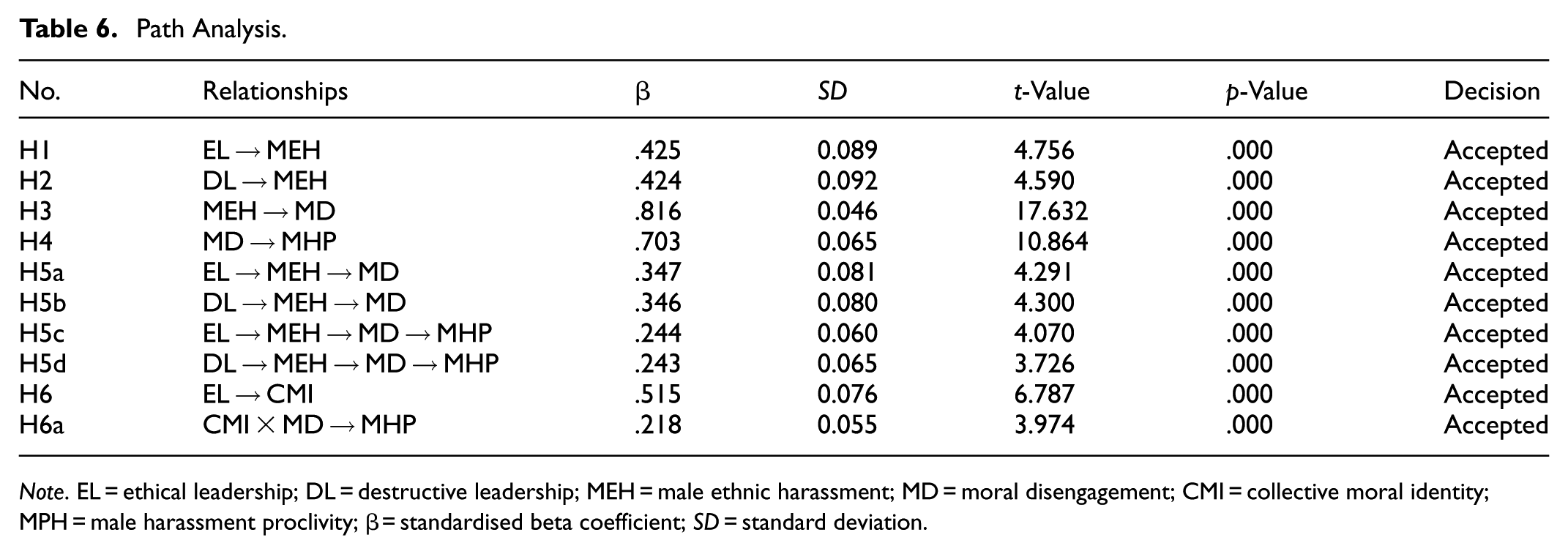
Upon evaluating the predictive relevance measurement model, the structural model was assessed. The examination primarily examined crucial indicators, including path coefficients, t-values, and p-values (Table 6). A bootstrapping approach thoroughly examined the direct and indirect impacts of the variables. The bootstrapping procedure involved 5,000 resamples utilising SmartPLS software. The hypothesis (H1) hypothesised that there is a significant and negative correlation between ethical leadership (EL) and male ethnic harassment (MEH). The results, shown in Table 6, demonstrate a substantial positive correlation with a standardised beta coefficient (β) of .425, a standard deviation (SD) of 0.089, and a t-value of 4.756, which is statistically significant at p < .001. The findings suggest a notable correlation between ethical leadership and male ethnic harassment. However, contrary to expectations, the correlation is positive rather than negative. Therefore, H1 was not supported, as the effect occurred in the opposite direction to the hypothesised negative association. This may suggest that, in specific organisational settings, ethical leadership inadvertently intensifies scrutiny and reporting of harassment, reflecting complex, context-specific dynamics of leadership (Brown & Treviño, 2006; Walumbwa et al., 2011). Hypothesis 2 (H2) posited a significant, positive correlation between destructive leadership (DL) and male ethnic harassment (MEH). The findings, as stated in Table 6, validate this hypothesis by demonstrating a substantial positive correlation with a standardised beta coefficient (β) of .424, a standard deviation (SD) of 0.092, and a t-value of 4.590, which is statistically significant at p < .001. The findings suggest that destructive leadership has a notable and favourable effect on male ethnic harassment, confirming the predicted pattern. This outcome is consistent with the knowledge that destructive leadership, which is defined by hostile, abusive, or undermining actions, can lead to a harmful work climate that worsens problems such as ethnic harassment, especially among male workers (Joseph & Shetty, 2022).
Path Analysis.
Note. EL = ethical leadership; DL = destructive leadership; MEH = male ethnic harassment; MD = moral disengagement; CMI = collective moral identity; MPH = male harassment proclivity; β = standardised beta coefficient; SD = standard deviation.
The hypothesis (H3) suggested that there is a significant association between male ethnic harassment (MEH) and moral disengagement (MD). The findings, presented in Table 6, provide strong evidence in favour of this hypothesis, demonstrating a significant and positive correlation with a standardised beta coefficient (β) of .816, a standard deviation (SD) of 0.046, and a t-value of 17.632, which is statistically significant at a p-value of less than .001. The results indicate that male ethnic harassment strongly predicts moral disengagement. This suggests that individuals subjected to or witnessing harassment are more likely to defend or rationalise unethical actions by employing moral disengagement mechanisms. This result is consistent with other research suggesting that exposure to unethical or harmful activities, such as harassment, may lead to cognitive processes that reduce the tendency to punish oneself for engaging in unethical actions (Bandura, 1999). Hypothesis 4 (H4) posits a significant and positive correlation between moral disengagement (MD) and harassment proclivity (MHP). The findings validate this hypothesis by demonstrating a robust positive correlation with a standardised beta coefficient (β) of .703, a standard deviation (SD) of 0.065, and a t-value of 10.864, statistically significant at a p-value of less than .001. The results suggest that when individuals morally detach, they are more likely to engage in harassment, which supports the expected trend. This result aligns with prior studies indicating that moral disengagement can enable unethical conduct, such as harassment, by enabling individuals to detach themselves from the moral consequences of their acts (Koay & Lim, 2022; Zeng et al., 2020).
Hypotheses H5a and H5b assessed the mediating role of male ethnic harassment (MEH) in the relationship between leadership styles (ethical and destructive leadership) and moral disengagement (MD). H5a: The findings suggest that male ethnic harassment plays a significant role in mediating the relationship between ethical leadership (EL) and moral disengagement (MD), with a standardised beta coefficient (β) of .347, a standard deviation (SD) of 0.081, and a t-value of 4.291, which is statistically significant at p < .001. This indicates that, whereas ethical leadership was anticipated to decrease moral disengagement, the natural process, including male ethnic harassment, leads to an escalation in moral disengagement. Thus, H5a was not supported as hypothesised; the mediation was significant but in the opposite direction. This may suggest that in environments where harassment occurs, ethical leadership can indirectly contribute to moral disengagement rather than mitigate it. This study suggests that workplace harassment can weaken the beneficial impact of ethical leadership on moral attitudes (Brown & Treviño, 2006; Mohi Ud Din et al., 2023). H5b: The findings indicate that male ethnic harassment plays a significant role in mediating the connection between destructive leadership (DL) and moral disengagement (MD). The standardised beta coefficient (β) is .346, the standard deviation (SD) is 0.080, and the t-value is 4.300, which is statistically significant at p < .001. This finding provides evidence for the theory that destructive leadership is positively associated with greater moral disengagement, which is, in turn, mediated by increased harassment. Destructive leadership actions can create a toxic climate that encourages harassment and supports moral disengagement (Irie, 2021; Walumbwa et al., 2011). H5c: The findings suggest that male ethnic harassment (MEH) and moral disengagement (MD) act as sequential mediators in the connection between ethical leadership (EL) and harassment proclivity (MHP). The serial mediation is supported by a standardised beta coefficient (β) of .244, a standard deviation (SD) of 0.060, and a t-value of 4.070, which is statistically significant at p < .001. This indicates that ethical leadership has an indirect effect on the likelihood of engaging in harassment. This effect occurs through a series of steps: ethical leadership increases the likelihood of male ethnic harassment. This, in turn, leads to increased moral disengagement, ultimately increasing the likelihood of engaging in harassment. Accordingly, H5c was not supported as hypothesised; the serial mediation was significant but in the opposite direction. This suggests that ethical leadership may indirectly exacerbate the proclivity for harassment when harassment and moral disengagement are present in the process. This complex procedure demonstrates that even when guided by ethical leadership, unresolved instances of harassment can result in adverse consequences, such as a heightened tendency to engage in harassment (Nkobi et al., 2021; Zeng et al., 2020). H5d: The findings also indicate that male ethnic harassment (MEH) and moral disengagement (MD) act as sequential mediators in the link between destructive leadership (DL) and harassment proclivity (MHP). The existence of this pathway is supported by a standardised beta coefficient (β) of .243, a standard deviation (SD) of 0.065, and a t-value of 3.726, which indicates statistical significance at p < .001. The results indicate that when leaders exhibit destructive behaviour, it results in a rise in male ethnic harassment. This, in turn, leads to a disengagement from moral values, and when combined, these factors enhance the likelihood of engaging in harassment. The serial mediation process highlights the substantial and detrimental effect of destructive leadership on creating a harassment-friendly workplace, through harassment and moral disengagement (Brown et al., 2005; Walumbwa et al., 2011).
The hypotheses H6 and H6a investigate the correlations among ethical leadership (EL), collective moral identity (CMI), moral disengagement (MD), and harassment proclivity (MHP). H6: The findings strongly connect ethical leadership and collective moral identity (CMI). The relationship is substantiated by a standardised beta coefficient (β) of .515, a standard deviation (SD) of 0.076, and a t-value of 6.787, statistically significant at a p-value of less than .001. The findings suggest that ethical leadership positively influences the development of a robust collective moral identity within an organisation. Ethical leaders play a crucial role in fostering a shared moral identity among employees by promoting moral principles and ethical norms. This, in turn, fosters a collective dedication to behaving ethically (Brown & Treviño, 2006). H6a: Furthermore, the findings suggest that collective moral identity (CMI) plays a crucial role in moderating the association between moral disengagement (MD) and proclivity for harassment (MHP). The moderating effect is demonstrated by a standardised beta coefficient (β) of .218, a standard deviation (SD) of 0.055, and a t-value of 3.974, statistically significant at a p-value less than .001. This discovery suggests that collective moral identity moderates the relationship between moral disengagement and proclivity for harassment. However, the simple slope analysis revealed that the effect was in the opposite direction to that hypothesised, with the MD–MHP relationship being stronger at high CMI. Therefore, H6a was only partially supported. However, when businesses have a strong collective moral identity, the influence of moral disengagement on the likelihood of engaging in harassment is decreased. The moderation effect highlights how a strong collective moral identity can buffer against the harmful effects of moral disengagement, thereby reducing the risk of engaging in harassing behaviours (Aquino & Americus, 2002; Bandura, 1999). A simple slope analysis was conducted to examine further the moderating effect of Collective Moral Identity (CMI) on the relationship between Moral Disengagement (MD) and Male Harassment Proclivity (MHP). The interaction plot shows that the relationship between MD and MHP is stronger when CMI is high (+1 SD) and weaker when CMI is low (–1 SD). Specifically, individuals with higher levels of CMI exhibited a steeper positive slope, indicating that, under high collective moral identity, increases in moral disengagement are more strongly associated with a greater proclivity toward harassment. Conversely, when CMI is low, the slope remains positive but much flatter, suggesting that low CMI buffers the strength of the MD–MHP relationship. This indicates that the moderation effect was significant, but, contrary to our hypothesis, the MD-MHP relationship was stronger under high CMI than under low CMI. Therefore, H6a was only partially supported.
Discussion
This study investigated the relationships between leadership styles, male ethnic harassment, moral disengagement, and harassment proclivity among employees in Karachi, Pakistan. The findings suggest that both ethical and destructive leadership have a significant effect on male ethnic harassment, which subsequently influences moral disengagement and the tendency to engage in harassment. The study also found that collective moral identity moderates the relationship between moral disengagement and the propensity for harassment, highlighting the importance of a shared moral framework within organisations. The rationale behind this study was to investigate the complex relationships between leadership styles and unethical behaviours in the workplace, particularly within the framework of social cognitive theory. The findings reveal a complex interplay where ethical leadership, contrary to initial expectations, is positively correlated with male ethnic harassment. This unexpected result suggests ethical leadership may unintentionally exacerbate harassment by reinforcing hierarchical structures. One alternative interpretation is that ethical leadership may cultivate an environment of psychological safety and transparency, which, although aimed at diminishing unethical conduct, might result in heightened reporting of ethnic harassment incidents rather than actual increases in harassment behaviour (Detert & Burris, 2007; Liang et al., 2012) . This distinction is crucial, since the association may not indicate an increase in harassment itself, but rather a greater propensity among employees to report encounters in workplaces where ethical leaders are seen as accessible and responsive. From a social identity standpoint, ethical leadership may be perceived differently among ethnic communities in Karachi. Due to the city’s intricate socio-political and ethnic makeup (Gayer, 2007; W. L. Wu, 2021), minority personnel may regard ethical leaders as supporting allies, while majority group members may view these leaders as undermining established power structures, thereby intensifying intergroup conflicts. Furthermore, the elevated power distance culture in Pakistan (Hofstede, 1980; Malik et al., 2021) suggests that ethical leadership, rather than diminishing inequalities, may unintentionally validate authority in ways that exacerbate status-based disparities.
In addition to power distance, Pakistan’s collectivist cultural orientation is also highly relevant. Collectivism emphasises loyalty to in-groups and prioritisation of group harmony over individual concerns (Refslund & Sippola, 2022). In workplace contexts, this may lead employees to suppress personal grievances or tolerate harassment to avoid disrupting group cohesion, while simultaneously aligning with prejudices or biases embedded in the dominant groups. Such dynamics could explain why ethical leadership, which often stresses group integrity and shared moral values, may paradoxically reinforce intergroup tensions when ethnic boundaries overlap with organisational hierarchies. Integrating this perspective with prior South Asian organisational behaviour research suggests that leadership outcomes are profoundly shaped by cultural contexts where collectivism and hierarchy remain strong determinants of workplace behaviour (Farh et al., 2007; Haak-Saheem & Darwish, 2021).
On the other hand, destructive leadership was predictably linked to higher levels of harassment, consistent with previous literature. The study also found robust evidence that moral disengagement serves as a mediator between harassment and the propensity to engage in it. These findings suggest that exposure to unethical activities, including harassment, can lead to cognitive processes that facilitate the engagement in more unethical actions. This aligns with Bandura’s (1999) notion of moral disengagement. The results of this study are consistent with those of other studies, specifically regarding destructive leadership and its adverse effects on workplace behaviour. The correlation between destructive leadership and male ethnic harassment validates the current research base that emphasises the adverse impact of toxic leadership on corporate culture (Joseph & Shetty, 2022). Nevertheless, the study diverges from specific previous findings about ethical leadership. However, ethical leadership is generally associated with favourable outcomes, such as decreased unethical behaviour (Brown & Treviño, 2006; Walumbwa et al., 2011). This research discovered a positive connection between male ethnic harassment and ethical leadership. This paradox suggests that the specific circumstances in which leadership is practiced significantly impact its outcomes, underscoring the need for further investigation into these intricacies. In light of these interpretations, it is crucial to approach this finding with caution. Future research should employ longitudinal or qualitative methods to disentangle whether the observed relationship stems from cultural dynamics, reporting behaviours, or unintended consequences of ethical leadership practices in high-diversity, high-power-distance contexts, such as Karachi. Future research in South Asian organisational settings should also examine the interactive role of collectivist norms and ethnic identities, as these may intensify or buffer the impact of leadership styles on harassment outcomes.
In practical terms, these findings underscore the critical need for human resource (HR) departments in ethnically diverse South Asian organisations to integrate culturally responsive leadership development and anti-harassment initiatives. HR policies should prioritise leadership training that sensitises managers to ethnic dynamics, implicit biases, and the risks of reinforcing hierarchical authority through moral rhetoric. Specifically, organisations should establish diversity-oriented mentorship and grievance mechanisms that provide safe, confidential reporting channels for employees across ethnic lines. Furthermore, embedding collective moral identity within HR practices, such as inclusive team-building programs, shared ethical codes, and cross-ethnic collaboration frameworks, can help mitigate the moral disengagement processes identified in this study. In regions like Karachi, where ethnic affiliations often intersect with organisational hierarchies, HR departments must adopt proactive, equity-centred strategies to foster a climate of fairness, psychological safety, and inclusion.
H1: The hypothesis suggesting a negative correlation between ethical leadership and male ethnic harassment was not verified. Contrary to expectations, the study revealed a direct connection, suggesting that in specific workplace cultures, ethical leadership may unintentionally promote harassment by strengthening power dynamics. The finding here challenges the traditional perspective on ethical leadership as universally advantageous and highlights the complex nature of leadership interactions (Brown & Treviño, 2006). H2: The study supported the hypothesis that there is a positive correlation between destructive leadership and male ethnic harassment. This finding aligns with prior research that has established a connection between destructive leadership and negative organisational consequences (Joseph & Shetty, 2022). This confirms that destructive leadership fosters an environment conducive to the proliferation of harassment and other unethical behaviours. H3 and H4: The significant positive associations between male ethnic harassment and moral disengagement, as well as between moral disengagement and harassment proclivity, respectively, are consistent with Bandura’s social cognitive theory. The results indicate that harassment leads to cognitive reasons that decrease moral self-control, consequently increasing the likelihood of engaging in further immoral actions. The study found support for the mediation role of male ethnic harassment in the relationship between both ethical and destructive leadership styles and moral disengagement, specifically in the context of H5a and H5b. The findings suggest that the presence of harassment may weaken the beneficial impact of ethical leadership and intensify the detrimental effects of destructive leadership, in line with the conclusions of Irie (2021). The study confirmed that collective moral identity moderates the connection between moral disengagement and the inclination to engage in harassment. This evidence suggests that a robust shared moral identity can act as a protective barrier against the harmful consequences of moral disengagement, hence decreasing the probability of engaging in harassment (Aquino & Americus, 2002; Reed & Aquino, 2003). The positive association between ethical leadership and collective moral identity (H6) suggests that ethical leaders can play a pivotal role in fostering shared moral values and ethical norms across teams, thereby reinforcing earlier research on collective moral identity (Brown & Treviño, 2006). The positive association between ethical leadership and collective moral identity (H6) suggests that ethical leaders can play a pivotal role in fostering shared moral values and ethical norms across teams, thereby reinforcing earlier research on collective moral identity (Brown & Treviño, 2006). However, the moderation analysis (H6a) produced results contrary to expectations. Instead of buffering the effect of moral disengagement on proclivity toward harassment, collective moral identity amplified this relationship. This suggests that a strong collective identity, while often beneficial, may sometimes intensify in-group pressures and inadvertently strengthen the connection between disengagement and tendencies towards harassment.
Theoretical and Practical Implications
Theoretical Implication
This study provides valuable insights into the theoretical understanding of moral identity and workplace harassment. Firstly, this study contributes to the existing body of knowledge on moral identity by providing empirical evidence of the significance of collective moral identity as a contextual factor within the work unit. Previous research has commonly regarded moral identity as a personal characteristic. However, this study presents evidence of its existence as a collective phenomenon, specifically about ethnic harassment in the workplace. The transition from an individual to a collective perspective enhances research on ethical organisational climates, emphasising the influence of collective moral identity on workplace behaviours and interactions. Moreover, the study focuses on a significant gap in the existing literature on harassment. The existing body of research has primarily concentrated on the harassment encountered by women, specifically sexual and general harassment, which may have resulted in a potential bias in the literature. This study offers a novel perspective on the discussion by examining ethnic harassment, particularly among males, thereby shedding light on a relatively underexplored issue. This emphasis is especially pertinent in Karachi, Pakistan, where ethnic divisions are well-established and carry substantial socio-political consequences. This research expands the knowledge of harassment in male communities and places it within a distinct socio-political context, creating opportunities for further investigation. Furthermore, the study offers valuable insights into the boundaries and limitations of leadership influence. The literature extensively discusses the relationship between ethical leadership and its influence on employee outcomes (Bedi et al., 2016; Naeem et al., 2020). However, there is a lack of empirical evidence on how leadership influences employee behaviours, such as the tendency to engage in harassment. This study addresses the lack of knowledge by examining the intermediary and moderating mechanisms that link ethical leadership to reduced ethnic harassment, reduced moral disengagement, and reduced tendencies to engage in harassment. As a result, it provides a more detailed comprehension of leadership dynamics in organisational environments.
Practical Implications
Building on the HR-oriented insights discussed earlier, the following section elaborates on the broader theoretical and practical implications of these findings. This study provides valuable insights for executives in organisations and policymakers from a practical perspective. The results highlight the importance of firms reassessing their leadership approaches to improve employee outcomes, particularly in ethnically diverse settings such as Karachi, where workplace dynamics often intersect with political affiliations. The study recommends that firms cultivate a culture characterised by acceptance and a shared moral identity to reduce the negative impact of workplace ethnic divisions. Given the socio-political environment of Karachi, it is especially crucial to consider that ethnic tensions are frequently intensified by political parties that endorse and exploit these divisions. The study also emphasises the significance of dealing with male ethnic harassment, a matter that has received less attention compared to the emphasis on women’s harassment. The findings reported in this research highlight the need for increased focus on the frequency of ethnic harassment experienced by males in companies. It strongly supports the implementation of targeted treatments and policies to address this problem effectively. NGOs and government agencies combating workplace harassment should broaden their scope to encompass the male population as a critical demographic for anti-harassment initiatives. Furthermore, the study suggests that it is necessary to restrict all types of ethnic political activity in corporate settings to prevent the reinforcement of cultures that foster divisions. Organisations can foster a more inclusive and cohesive work environment by actively opposing such acts, thus eliminating the harmful impact of ethnic bias and harassment. Furthermore, it is strongly recommended that political parties reevaluate their conduct and refrain from exploiting ethnic divisions to gain votes, acknowledging the broader consequences of such practices for workplace unity and employee welfare. The results serve as an encouragement for organisations, legislators, and political figures to tackle the intricate relationship between ethnicity, leadership, and harassment in the workplace, especially in areas where ethnic tensions are significant.
Limitations and Future Research
This study, although providing valuable insights, is not without limitations, which also create possibilities for future research. A significant constraint is the use of purposive sampling, which may affect the generalizability of the results. While the study attempted to mitigate common technique bias, using data from only one source remains a potential limitation. Given the self-report survey design, the possibility of common method bias (CMB) cannot be ruled out entirely. To minimise this concern, procedural remedies such as ensuring respondent anonymity, counterbalancing question order, and using established, validated scales were employed. Future research could incorporate multi-source or time-lagged data collection to mitigate potential CMB effects further and enhance the robustness of causal inferences, thereby providing a more comprehensive understanding of the fundamental variables. In addition, adopting a longitudinal approach would enable the examination of behavioural changes over time, offering a deeper understanding of the dynamics of ethical leadership and its impact on employee morale. Future studies should also employ mixed-method or qualitative approaches, such as in-depth interviews, focus groups, or ethnographic observations, to distinguish between increased reporting of ethnic harassment and actual changes in harassment incidence. Integrating qualitative insights with follow-up or repeated-measure surveys would allow researchers to disentangle whether variations in reported harassment reflect genuine behavioural shifts or greater openness in disclosure within ethically led workplaces.
Although this study used a process-oriented approach, it still has limitations in understanding how ethical leadership affects employee moral behaviour. Prior studies have emphasised the importance of understanding the process or mechanism by which ethical leadership influences followers’ moral actions (Zhang et al., 2018). It is recommended that future research take a more complete approach by considering additional variables that mediate and moderate the effects of ethical leadership on moral behaviour in businesses. Another constraint is the study’s cultural setting, conducted in Pakistan, a nation with unique cultural attributes that may limit the applicability of the results to other areas. Despite the notable power inequalities observed in Pakistani companies, this study did not consider the impact of cultural aspects, such as power distance. Subsequent investigations could explore the role of cultural characteristics, such as power distance, as moderators, potentially yielding a more comprehensive understanding of how these factors influence the correlations analysed in this study.
Another critical limitation concerns the sample’s educational profile. Nearly all respondents (99.2%) held master’s or doctoral degrees, creating a highly educated sample that does not accurately reflect the broader working population in Karachi or Pakistan. This homogeneity may have influenced participants’ perceptions of ethical leadership, harassment, and reporting behaviour, as individuals with advanced education are often more familiar with organisational norms and more willing to articulate or disclose sensitive experiences (Podsakoff et al., 2024). Consequently, the findings may not fully generalise to organisations with more educationally diverse workforces. Future studies should aim to replicate this research with samples that include employees across a broader range of educational backgrounds to assess whether the observed relationships hold consistently in less-educated or more heterogeneous settings.
In addition, although this study specifically examined ethnic harassment in Karachi, conducting a comparative analysis across various provincial capitals in Pakistan could provide more comprehensive insights into the frequency and mechanisms of ethnic harassment in the workplace. For instance, analysing whether the patterns observed in Karachi align with those in other ethnically diverse cities, such as Lahore, could yield interesting comparative data. The study did not investigate the possible influence of feelings such as guilt and shame on the relationship between moral disengagement and the tendency to engage in harassment, as proposed by the theory of moral self-regulation (Bandura, 2012). Further research could explore these emotional mediators to better understand how harassing tendencies evolve among morally disengaged personnel.
Conclusion
Based on social cognitive theory, this study provides valuable insights into the dynamics of workplace ethnic harassment, specifically among male employees in Karachi, Pakistan. The results emphasise the dual effect of different leadership styles, namely, destructive and ethical, on the occurrence of male ethnic harassment and its subsequent influence on moral disengagement and propensity for harassment. The study shows that destructive leadership significantly increases male ethnic harassment, creating a harmful working environment where abusive and bullying behaviours become more prevalent. A hostile working environment leads employees to experience heightened moral disengagement, which in turn rationalises or justifies immoral behaviour. Consequently, their likelihood of engaging in harassment increases. On the other hand, although ethical leadership was expected to decrease ethnic harassment, the results indicate a more nuanced effect. Within specific workplace cultures, ethical leadership may unintentionally reinforce hierarchical systems, potentially leading to an increase in reported instances of harassment. This contradictory result highlights the complex nature of leadership dynamics. It underscores the need for further investigation to understand the circumstances under which ethical leadership can either alleviate or exacerbate workplace harassment. Furthermore, the study highlights the importance of collective moral identity in promoting a workplace environment characterised by respect. A robust shared moral identity serves as a safeguard, reducing the likelihood of harassment by fostering mutual respect and ethical conduct in the workplace. This study makes significant contributions to both theoretical and practical aspects by expanding our understanding of the mechanisms by which leadership styles impact workplace behaviour, especially in ethnically diverse and politically volatile settings such as Karachi. The results of this study provide support for investigating the complex relationships between leadership, moral identity, and workplace harassment. This study also suggests that future research should expand its focus to encompass various cultural and organisational settings.
Footnotes
Acknowledgements
We would like to express our sincere gratitude to Professor Li Zhang for her invaluable guidance and support throughout the research process. Professor Li Zhang and Yao Zhang have played pivotal roles in shaping the direction of our study.

Ethical Considerations
All procedures involving human participants were reviewed and approved by the Institutional Review Board (IRB) at the School of Management, Harbin Institute of Technology (Approval Number: 2023-16), and adhered to the ethical principles outlined in the Declaration of Helsinki and the APA Ethical Guidelines (Section 8.05). The study involved an anonymous online survey, and no personally identifiable information was collected. Participation was entirely voluntary, and participants were informed about the study’s purpose, topics, and their right to withdraw at any time before beginning the questionnaire. As no sensitive personal data was collected and participation posed minimal risk, formal written informed consent was not required under ethical review guidelines. This approach is consistent with ethical standards for minimal-risk research, in which identities are protected and deception is not used.
Funding
The authors disclosed receipt of the following financial support for the research, authorship, and/or publication of this article: This work was supported by the National Natural Science Foundation of China (Grant No. 72272043) and the Heilongjiang Province Philosophy and Social Sciences Research Planning Project (Grant No. 22JYB221).
Declaration of Conflicting Interests
The authors declared no potential conflicts of interest with respect to the research, authorship, and/or publication of this article.
Data Availability Statement
The data sharing policy does not apply to this article. The dataset associated with this research is not publicly available due to commitments of privacy and confidentiality made to the study participants. Ensuring the protection of respondent privacy was of the utmost importance in this research. As such, the raw data cannot be made openly accessible, although it can be requested from the first author upon a reasonable request.