




Abstract
Extant research on service operations has called for investigating the link between e-retailers’ e-business operations and e-business performance. In addition to investigating this link, this study examined whether such links are moderated by an e-retailer’s responsiveness to the supplier. Since, as previous studies have shown, web store suppliers play an essential role in e-retailers’ value creation, it is important to study how the cooperation between the parties works. The data were collected from Finnish e-retailers through a survey, and the results revealed that one component of e-business operations, namely customer orientation, significantly impacts both the e-retailer’s financial and operational performance, while service maintenance and customization do not affect e-business performance. Responsiveness to the supplier, it was also found, exerts a statistically significant positive moderating effect on the relationship between the e-retailer’s customer orientation and financial performance. Moreover, to boost e-business performance, web store suppliers could take a more active part in e-retailers’ business operations. By focusing on the link between web store suppliers and e-retailers, this study brings awareness to the less-studied role of web store suppliers in e-retailers’ performance and offers a new perspective.
Keywords
Introduction
Markets have become more dynamic, and uncertainty in customer demand has increased due to continuous technological developments and the globalization of services and products (Cheung et al., 2010; Hussain et al., 2022). Organizations are responding to the rapid digitalization of operation environments by developing their e-business operations, with e-commerce and e-retailing playing significant roles (Hussain et al., 2022; Jean & Tan, 2019; Krishnakumar et al., 2022). Moreover, the rapid development of technologies and digital services and solutions have empowered customers: they are now better informed and can access a wider range of services and goods that emerge at an ever-faster pace more easily than before (Cheung et al., 2010). This is why the topic of the effectiveness of different information technologies (ITs) and digital solutions for customer service and value creation has been receiving increasing interest from practitioners and academic research (Krishnakumar et al., 2022; Setia et al., 2013). The rapid expansion of e-business is shaping businesses in many different industries and providing organizations with opportunities to develop their businesses and operations. However, the expansion of e-business not only generates benefits—in many cases, organizations must adapt and adjust their operations in response to the changing business environment (Hussain et al., 2022; Popa et al., 2018), which makes it important to understand how different e-business components affect an organization’s performance (Alsheyadi, 2022; Krishnakumar et al., 2022). According to Crisafulli and Singh (2017), service failures pose continuous problems for e-retailers, leading to customers demonstrating their unwillingness to forgive companies for providing poor service. According to the authors, the growth of the e-retail industry has been shown to drive a surge in complaints. In addition, the digital era has enabled dissatisfied customers to easily express their complaints about products, brands, or companies through public digital channels, such as social media platforms (Weizl & Hutzinger, 2017). Thus, service maintenance in digital services affects e-retailers’ ability to solve customer issues electronically (Oliveira & Roth, 2012). Since Yoon et al. (2008) demonstrated that e-retailers continuously face the challenge of enhancing customer trust and building relationships with customers, e-retailers must understand what determines customer orientation in the e-retail environment. Yoon et al. (2008) found that, in the e-retail context, customers seem to prefer engaging and interactive websites that also demonstrate how committed companies are when it comes to investing in customer relationships. However, the authors stated that further research is needed to comprehensively understand the impact of customer relationship management operations on the online environment. In addition, the e-retail industry’s digital nature has enabled e-retailers to collect and analyze customer data quickly and cost-effectively and offer customers unique and relevant content (Ho & Bodoff, 2014; Oberoi et al., 2017). According to Oberoi et al. (2017), e-retailers employ different technologies to implement website personalization and experience substantial heterogeneity in market performance. Customization is thus considered an important dimension of e-retailers’ e-business operations.
Despite the increasing number of studies on companies’ e-business operations and their effects, and despite recent literature having significantly advanced the understanding of the impact of e-business systems on company performance, according to Krishnakumar et al. (2022), the literature can be considered fragmented on both sides of this relationship. From the perspective of e-business, previous studies have, for example, explored how e-business capabilities affect various company performance dimensions (Jean & Tan, 2019) or contextual mechanisms that provide possibilities for customer integration or collaborative e-business efforts (Alsheyadi, 2022). However, the individual components of e-business operations’ effects on companies’ e-business performance remain unexplored—in particular, empirically tested conceptualizations of e-business operations’ components and their effects on e-business performance are lacking. From the perspective of company performance, previous studies have, for example, explored the effects of e-business on sales growth (cf. Krishnakumar et al., 2022) and international performance (Jean & Tan, 2019). Less attention, however, has been paid to the impact of e-business on organizations’ financial or operational performance, or the focus of the studies has not been on e-business but, for example, on supply chains (Yu et al., 2013).
Current research also demonstrates the importance of cooperation throughout the supply chain. For example, So and Sun (2010) highlighted information sharing’s positive effect on integration with suppliers. Although company performance improves through better supplier relationship management (Lambert & Schwieterman, 2012), only a few studies (e.g., Setia et al., 2013; Yu et al., 2013) have attempted to understand supply chain cooperation’s role in the e-retail setting. However, according to Krishnakumar et al. (2022), it is difficult to determine whether the systems that enable supply chain integration in the e-business context impact company performance. Furthermore, previous studies have mostly focused on the direct relationship between e-business and company performance, whereas the variables that mediate or moderate this relationship have not been identified (Popa et al., 2018). According to Popa et al. (2018), research models to analyze the connection between e-business use, facilitating factors, and company performance must be developed. Thus, the moderating influence of e-retailers’ responsiveness to their suppliers demands further investigation. In the present study, supplier refers to a company supplying a web store to an e-retailer.
This study contributes to the abovementioned research gap by examining which e-business operations affect e-business performance and whether such effects are moderated by an e-retailer’s responsiveness to the supplier. The empirical results are based on a survey conducted among e-retailer companies located in Finland. The initial sample comprised 109 Finnish e-retailer companies. The study contributes to the current e-business literature by presenting e-retailer companies’ operations related to service maintenance, customer orientation, and customization that explain e-business performance. As its main theoretical contribution, the study increases awareness of the less-studied role of web store suppliers in the financial and operational performance of small e-retailers. Although there exists a theoretical understanding about the connections in supply chains between e-retailers and suppliers, previous studies focused on the perspective of goods suppliers and ignored software suppliers. Furthermore, this study highlighted the role of responsiveness to the supplier in the relationship between e-business operations and e-business performance.
The rest of this paper is structured as follows: after the introduction section, the theoretical framework is introduced, followed by a section in which the research hypotheses are developed and justified. The research model is also introduced. The methodological choices are then discussed, followed by a discussion of data collection and analysis. The last two sections present the results and conclusions and highlight the study’s theoretical and practical contribution. Finally, important and interesting avenues for future research are presented.
Theoretical Framework
Complexities in implementing e-commerce has forced companies learning how to adopt new technologies efficiently and restructure their operating models and processes accordingly (Attia, 2022; Kabrilyants et al., 2021). Previous research has stated that the company’s capability to develop customer service in the customer interface and to take advantage of the technical features of the web store directly affects company’s performance (Attia, 2022; Valtakoski & Witel, 2018). Thus, the study adopted the resource-based view (RBV) in studying the effect of e-business operations on e-business performance. RBV builds on the presumption that companies utilize unique resources that will enable sustainable competitive advantage (Barney, 1991). In e-business, previous studies have indicated, operational and financial performance evaluations should be used to comprehensively measure sustainable competitive advantage (Barua et al., 1995; Chuang & Lin, 2015). If a company can utilize these resources in its operations, it can result in repeatable operational patterns to create company-specific offerings to the necessary environment (Aydiner et al., 2019). In this study, building on the RBV, e-business operations are considered essential means to attain sustainable competitive advantage. E-business operations utilize e-commerce in their operations and processes in a way that creates value. A company that uses internet to manage order fulfillment and the delivery process is considered an e-business. The main concerns that might cause some difficulties for an e-businesses are operations’ functionality in managing business processes and a mismatch between business and operations strategies (Barnes et al., 2004). There is thus a need to manage e-business operations based on three perspectives: service maintenance, customer orientation, and customization.
Service maintenance refers to a company’s ability to operate in a way that solves customers’ issues electronically (Oliveira & Roth, 2012). Based on previous research, a lack of order fulfillment is the main reason customers leave a specific e-retailer for another (Rabinovich & Bailey, 2004). Thus, the order fulfillment and service delivery processes create customer satisfaction (Barnes et al., 2004). Customer orientation refers to a company’s competency in managing customer relationships, with the aim of creating and retaining loyal customers (Oliveira & Roth, 2012). It is based on two perspectives. The first is the functional perspective, which focuses on solving business issues, while the second, the relational perspective, concentrates on establishing strong relationships with customers (Homburg et al., 2011). Consequently, customer orientation can be developed by creating a culture and settling into a routine in which the company’s strategy is based on its customers’ needs (Setia et al., 2013). Customization refers to how much a company monitors its customers’ preferences and responds to their requests individually based on the received information (Oliveira & Roth, 2012). In e-business, customization is based on various criteria, including price, guarantees, availability, payment methods, and delivery time. Its main focus is thus to personalize customers’ experiences based on their desires (Thirumalai & Sinha, 2011). From the customers’ perspective, customization can quickly satisfy their needs, in the event that their needs shift, by changing processes and employing customized tools and assets to meet customer requests (Devaraj et al., 2012). The exploration of e-business operations presented in this study improves the understanding of financial performance (such as overall financial performance) and operational performance (such as product quality and delivery service quality).
Although prior research suggests that e-business operations can substantially influence business performance (Kabrilyants et al., 2021; Putra & Santoso, 2020), these influences might not be evident without considering the supplier input. Cheung et al. (2010) noted that if companies understand the changes in customer value propositions better, it will be easier for them to identify the changes in their supply chain from multiple links downward, which, in turn, will allow more time for strategic and operational planning and modifications. Thus, responsiveness toward the supplier becomes an important factor in gaining a sustainable competitive advantage—a perspective that can also be described as viewing the “supplier as a customer” (Cheung et al., 2010). The factors that define responsiveness to the supplier include willingness to assist the supplier, the efficiency with which problems are solved, and the speed at which the supplier queries are answered (Huang et al., 2015). Long-term cooperation, Ukko and Saunila (2020) demonstrated, encourages the associated companies to reduce information asymmetries, facilitate trust development, and share private information. The suppliers, therefore, also play a central role in e-business performance.
Hypothesis Development
E-Business Operations as an Antecedent of E-Business Performance
A successful e-business requires regular maintenance of the e-service in use. For example, suppliers’ infrastructures (technologies and knowledge) benefits flexibility, which, in turn, positively affects customers’ contentment (Jie et al., 2015). Providing accurate and timely information is also crucial for a successful e-business. One of the attributes identified by Oliveira and Roth (2012) for a successful e-business is information richness, which entails features such as interactivity, currency, relevance, completeness, and scope—all of which refer to the quality of the information provided on the website. On the other hand, Ziaie et al. (2021) identified nine value elements as significant strategic sources of value in the pursuit of a positive customer experience in digital business. These elements emphasize the aspects related to service maintenance, such as information availability, vividness, mobility, and telepresence. Moreover, Xu, Zeng, and He (2017) found that customers’ willingness to pay depends on the information provided on the e-retailer’s website and the product condition. Subramanian et al. (2014) found similar results in a study of Chinese e-retailers and confirmed that reliability—for instance, in the accuracy of the records and goods provided—is important and increases an e-retailer’s competitiveness; the authors also found that an e-retailer’s responsiveness—for instance, satisfying customer requirements and solving the errors that occur—considerably influences customer satisfaction. The extant literature posits that service maintenance—including, for example, the provision of accurate and timely information and the fulfillment of promises—entails an alignment between operation and performance. It is indeed an operation that aims to accomplish higher performance by meeting customers’ service requirements. Evidently, service maintenance directly and positively impacts e-business performance.
H1: Service maintenance positively influences e-business performance.
Customer orientation affects the success of e-business (Oliveira & Roth, 2012) because the provision of offering the best customer service possible and prioritizing customers’ interests are positively associated with financial performance in terms of sales growth, profitability, and market share (J. Zhang, 2010). Moreover, Zhu et al. (2020) found that the delivery of high quality online customer services can positively influence a company’s business value. One perspective for studying customer orientation is by using the notion of service quality capabilities (Cruz-Ros & Gonzalez-Cruz, 2015), which relate to the processes that enable the provision of secure, fast, and reliable services (Ponsignon et al., 2011). Cruz-Ros and Gonzalez-Cruz (2015) found that these service quality capabilities affect company performance, which includes financial performance and other aspects, such as competitive positioning, sales, and wealth creation. Therefore, good customer orientation directs e-business toward the adoption of exceptional service quality, which leads to better performance. In addition, Tsironis et al. (2017) found that customer orientation in e-business affects a company’s ability to evolve, ultimately leading to enhanced organizational competitiveness and increased stakeholder satisfaction. Also important in e-business is the returns-management process (Griffis et al., 2012; Ramanathan et al., 2017). Faster returns processing correlates with increased customer purchase frequency and volume as well as customer retention (Griffis et al., 2012). Similarly, Ramanathan et al. (2017) found a link between customer service (in terms of ease of returns and customer support) and customer behaviors, such as visiting a retail store again and recommending it to others. The authors also observed that customer behavior influenced retail sales. Since customer orientation involves multiple service quality improvement actions, such as easing returns and secure and real-time customer service, it assists in acknowledging different customer confluence situations. We thus hypothesized the following:
H2: Customer orientation positively influences e-business performance.
Customization improves customers’ online experiences, including transaction efficiency (Oliveira & Roth, 2012). Customization aims to enhance customer impact in terms of customer satisfaction, sales, and new customer acquisition (Oliveira & Roth, 2012). It thus introduces factors that partly explain the success of e-business, as customer cumulative ratings for e-retailers increase with customized website designs (Xu, Munson, & Zeng, 2017). Fuller et al. (2022) found that e-commerce capabilities that reflect different web shop functionalities can contribute to business value creation and that their impact on performance can be short-term, delayed, or persistent. The positive outcomes that arise from web shop customization functionalities persist over time, which makes them highly significant. Thirumalai and Sinha (2011) found that transaction customization is connected to customer contentment with e-retailers’ online buying process. A customized transaction process—one that includes interactivity, personalization, and convenience—positively impacts customer satisfaction (Thirumalai & Sinha, 2011). To accomplish customer satisfaction, customization in terms of the personalization and malleability of the online experience is necessary. This is based on the perception that customization can make a website more user friendly in terms of navigation and communication (Xu, Munson, & Zeng, 2017). Customer satisfaction, in turn, is likely to result in better e-business performance. Thus, customization is likely to enhance e-business success.
H3: Customization positively influences e-business performance.
The Moderating Effect of Responsiveness to the Supplier
E-business operations, in terms of service maintenance, customer orientation, and customization, can influence e-business performance, as they build the foundations for managing an e-business. When e-retailers establish a relationship with resources outside the company, such as suppliers, they interact with those resources to achieve a sustainable competitive advantage. An e-retailer’s responsiveness to the supplier is realized by their willingness to support the supplier with problem solving, information needs, knowledge integration, joint meaning-making, and so on (Huang et al., 2015). Thus, one critical factor in the service delivery process is co-creation between suppliers and e-retailers, through which e-retailers can influence the development of the e-business (Ngo & O’Cass, 2009). The co-creation between suppliers and customers is crucial for the successful development of IT solutions, a fact that has been recognized in the IT industry for some time (Rahmati et al., 2021; J. Zhang & Zhu, 2019). This requires contributions from both parties, especially information sharing, which, research shows, is the foundation of effective collaboration (Aarikka-Stenroos & Jaakkola, 2012; Zou et al., 2021). In addition, e-business performance is affected by one specific attribute of service maintenance: e-service recovery (Oliveira & Ruth, 2012; Subramanian et al., 2014; Xu, Munson, & Zeng, 2017), which is greatly dependent on the supplier’s input, just like privacy issues, which Rita et al. (2019) identified as a crucial component of overall e-service quality. Based on the current understanding, e-retailers can improve their e-business if they are willing to co-create with their suppliers. Co-creation demands responsiveness to each other. We thus hypothesized that an e-retailer’s responsiveness to their supplier enhances the link between service maintenance and e-business performance.
H4: The higher the responsiveness to the supplier, the greater the influence of service maintenance on e-business performance.
Regarding customer orientation, customer preferences on time of delivery, an order’s correctness and quality, and the delivery method (Setia et al., 2013)—together with convenience level and user-friendliness concerning the ease and flexibility of payment methods, returns processing, and customer support—result in higher perceived value among customers in e-business (Boyer et al., 2002; Ramanathan et al., 2017). However, customers’ needs related to these dynamic issues change rapidly, and a more sophisticated analysis of customer information is needed (Setia et al., 2013). In this case, responsiveness to the supplier, demonstrating a willingness to cooperate with the supplier to perform a more sophisticated analysis of customer information (Huang et al., 2015), and learning from this relationship through information exchange, knowledge integration, and joint meaning creation may have a crucial impact on performance (Cheung et al., 2010). Based on the current understanding, practicing customer orientation requires meeting changing customer preferences. However, not all these preferences can be met by the organization alone. For example, secure and real-time customer service—factors that impact the overall e-service quality (Rita et al., 2019)—involves input from the supplier side as well. We hypothesized that an e-retailer’s responsiveness to a supplier enhances the connection between customer orientation and e-business performance.
H5: The higher the responsiveness to the supplier, the greater the influence of customer orientation on e-business performance.
Companies can charge higher prices to boost profits by providing appropriate customization and delivery of services (Chen & Tsou, 2012). Customization also enables retailers to collect customer information, including their desires, which, in turn, helps them tailor their products and services to customers’ preferences (Thirumalai & Sinha, 2011). To employ these operations, customized tools and assets that meet customers’ requests are needed (Devaraj et al., 2012). Ziaie et al. (2021) argue that enabling customers to customize the used digital environment (web store) to align with their unique preferences and offering them the opportunity to participate in real-time modifications of the form and content of that environment—that is, malleability—are likely to positively impact customer experience. Accomplishing customer satisfaction with customization by means of personalization and malleability of the online experience is likely to require supplier input. The intensity of responsiveness in demonstrating a willingness to cooperate with the supplier in creating customized tools and assets (Huang et al., 2015) and learning from this relationship (Cheung et al., 2010) can benefit performance. We hypothesized that an e-retailer’s responsiveness to a supplier enhances the connection between customization and e-business performance.
H6: The higher the responsiveness to the supplier, the greater the influence of customization on e-business performance.
Table 1 presents the variables used along with corresponding references in the related literature.
Variables Used in the Study and the Corresponding References in the Related Literature.

Research Model
The theoretical review discussed above led to the development of the research model shown in Figure 1. The research model shows that e-business operations—comprising service maintenance, customer orientation, and customization—impact e-business performance. Furthermore, responsiveness to the supplier, we argued, enhances the effect of e-business operations on e-business performance.
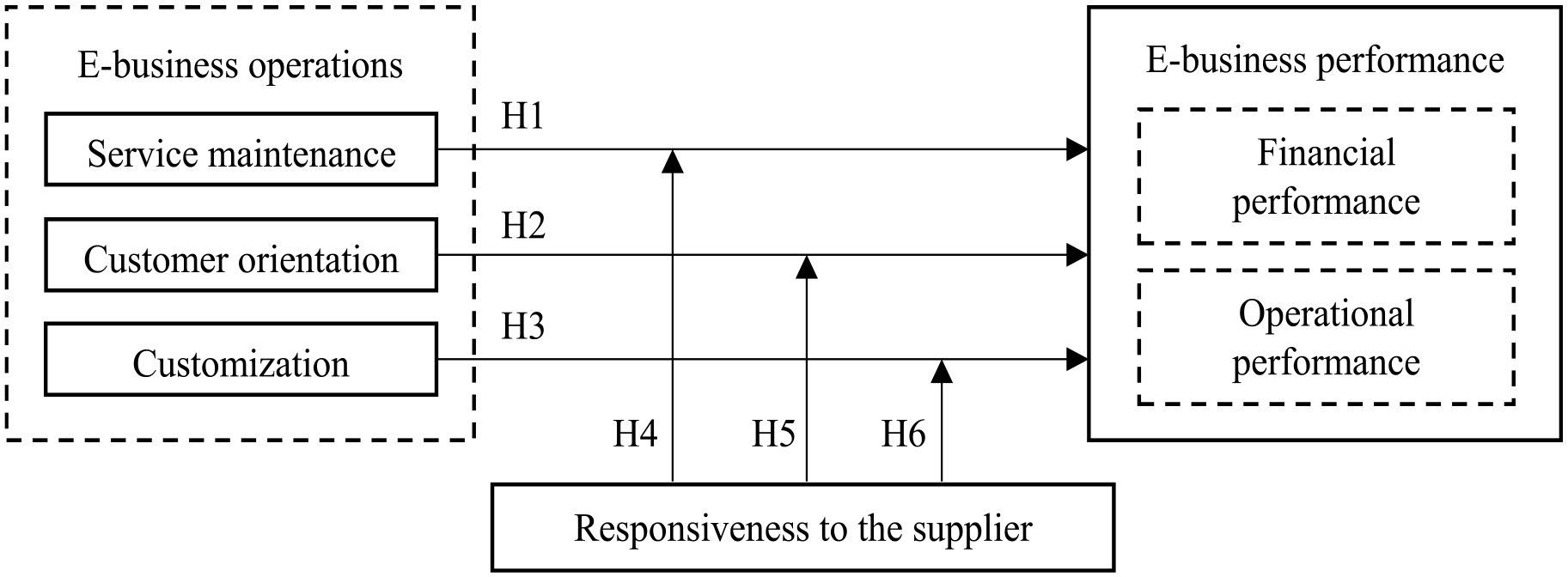
Research model and hypotheses.
Methodology
Sample and Data Collection
The data were collected through a survey conducted with Finland-based e-retailers. The questionnaire was sent to those respondents with the background and work experience to respond to a survey that investigated the companies’ e-business operations: individuals in managerial positions responsible for customer service and business tasks. There are round 7,500 Finnish e-retailers nationwide (calculated by a service provider that provides a variety of data from companies). An initial sample of 2,541 e-retailers (among the e-retailers with active operations and up-to date information provided in the service provider’s database) was randomly selected. Of these, 229 had invalid contact information in the system, so the total was reduced to a potential 2,312 respondents. Altogether, 109 valid responses from 107 e-retailers were received, which equaled a response rate of about 4.7%. The established 109 valid responses were considered sufficient with respect to the response rate (Saunders et al., 2007) and sample size (Krejcie & Morgan, 1970) in a study like this one. The response rate ignores the unifying effect of coverage and sampling errors, so it may not always be the best measure of the survey results’ accuracy. The respondents’ representativeness should also be evaluated. In this study, the sample represents a large part of the target group, as the original sample included about 30% of the total number of Finnish e-retailers. The responses thus represent the target group adequately. The data were analyzed using the SPSS software.
The study demographics were analyzed based on company size and the web store age. Most respondents (roughly 73%) represented micro-companies (less than 10 employees), while 9% represented small businesses. About 17% did not answer the question about the number of employees. Half the companies had web stores for more than 5 years, while less than half (48%) had had one for less than 5 years; 2% of the respondents did not answer this question.
Measures
The hypotheses were tested utilizing a survey-based approach, which aimed to collect data on the managerial view of a company’s e-business performance, responsiveness to the supplier, and e-business operations. The pertinent constructs and formerly operationalized scale items were identified with the support of a literature review. All the scales were tested and adapted for this study in collaboration with experienced researchers. The items used are listed in the appendix.
The independent variables included e-business operations, which have three sub-dimensions, including 14 items that measured company-level e-business operations: service maintenance, customer orientation, and customization. These items were adapted from past studies, such as Zeithaml et al. (2002), Oliveira and Roth (2012), and Huang et al. (2015). A 5-point Likert scale was used to measure all the 14 items. A three-item scale was used to measure the moderator variable: the e-retailer’s responsiveness to the supplier. The reference sources for the responsiveness items were Cheung et al. (2010) and Huang et al. (2015). A 5-point Likert scale was also used for this moderator variable.
The e-business performance measures—adopted from Barua et al. (1995), Cheung et al. (2010), and Chuang and Lin (2015)—included financial and operational performance. A 4-point Likert scale was used for this variable. Subjective performance measures are commonly used in operations management research, as reliable objective performance data are rarely available and are often not directly comparable between companies or industries. They are thus considered suitable because managers generally prefer to offer subjective information rather than objective data. Moreover, subjective measures correlate positively with objective measures (see Venkatraman & Ramanujan, 1987).
The survey included two controls: company size (measured by the number of employees) and web store age (measured by the number of years a store has been in existence). Small companies are more resource-constrained than large companies, which could affect their possibilities for e-business success. In addition, web store age could influence results, as companies with more e-business experience can succeed more than companies with less experience.
Bias
Non-response bias was examined through an analysis of variance (ANOVA) test. The early respondents were compared with later respondents on several items: company size measured by the number of employees, return on investment, and e-business performance (both financial and operational). The early respondents replied to the first email within approximately a week of its delivery. The later respondents responded after several reminders, and they closely resemble non-respondents (Armstrong & Overton, 1977). No statistically significant differences in the variables between early and later respondents were found; non-response bias was thus not deemed a problem.
Common method bias problems can ensue when using only one respondent from one company. In this study, both statistical and procedural methods were used to control these potential problems (Podsakoff et al., 2003). Furthermore, anonymity and confidentiality were ensured. The questionnaire was designed in such a way that the respondents were unable to establish cause-and-effect relationships between the independent and dependent variables. The items related to the dependent and independent variables were examined with unrotated factor analysis (Harman’s one-factor test) to determine whether a single factor emerged and whether one general factor accounted for most of the covariance in the variables. The analysis revealed five distinct factors, and the maximum variance explained by a single factor was 34.37%. No general factor emerged in the results, so common method bias did not appear to be a problem.
Results
Validity and Reliability Testing
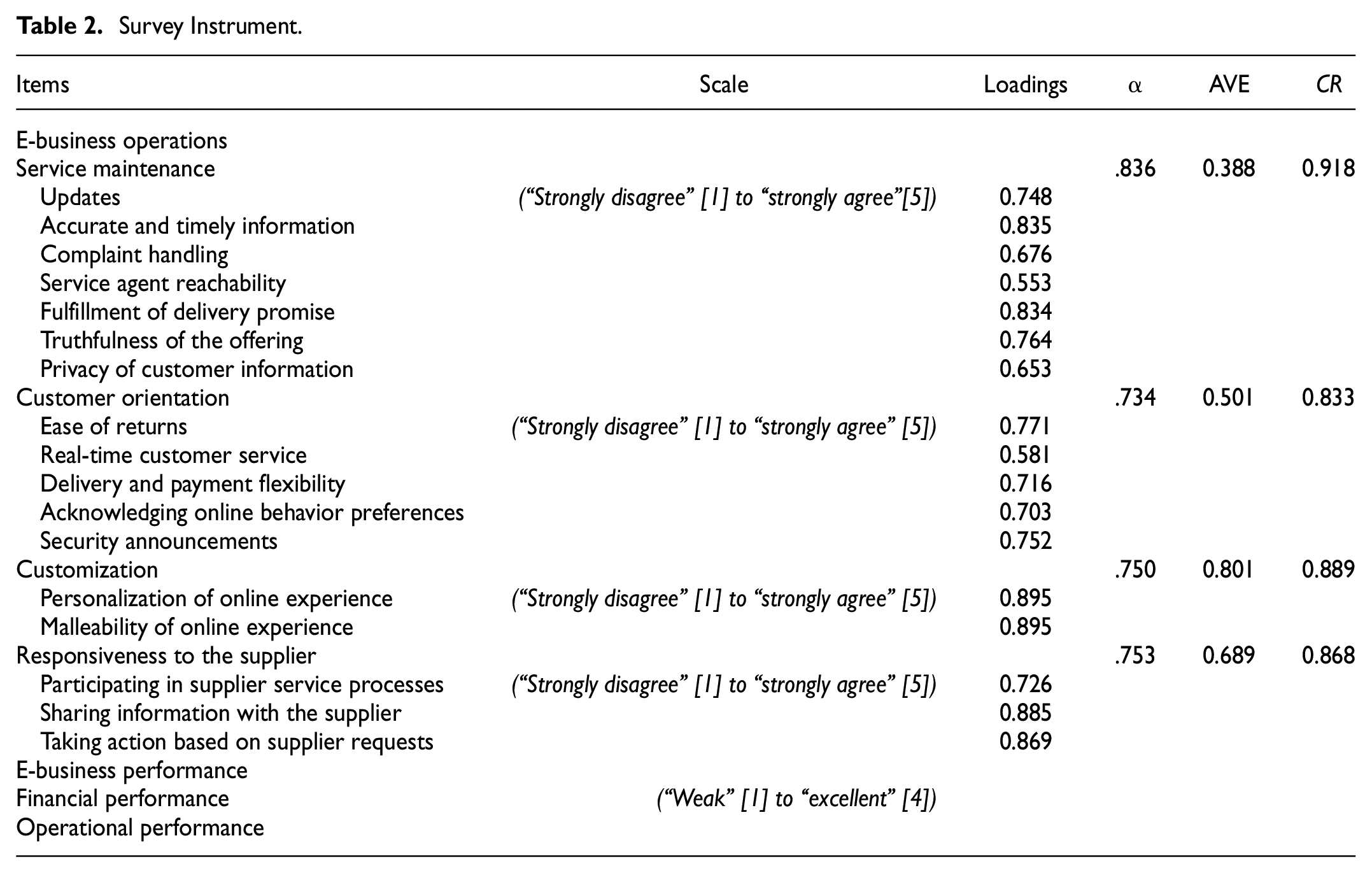
We evaluated the validity and reliability before we tested the hypotheses. The measurement model’s factor loadings, correlations, validity, and reliability are shown in Tables 2 and 3. Cronbach’s α was used to test the scales’ reliability (Table 2). All the measures were found to have adequate reliability levels, as all the values were greater than 0.7 (Hair et al., 1998). The CR values were significantly higher than the cutoff of 0.70 (Fornell & Larcker, 1981). The AVE values for customer orientation, customization, and responsiveness to the supplier were higher than the cutoff of 0.50, but the AVE value for the service maintenance scale was slightly below the cutoff. However, the AVE value was at an acceptable level, as the CR value was above the threshold (Fornell & Larcker, 1981), thus supporting convergent validity. The factor structure’s discriminant validity was tested using principal component analysis with varimax rotation. This analysis eliminated items that simultaneously showed high loadings in multiple factors. In addition, the unidimensionality of the sub-dimensions of the e-business operations scale was revealed through exploratory analysis. As presented in Table 2, the loadings were at an acceptable level, and no significant cross-loadings occurred. In addition, Table 3 confirms the discriminant validity of the construct, as each value of the construct correlation is less than the square root of AVE (Fornell & Larcker, 1981), thus supporting discriminant validity. The extent of multicollinearity was checked by calculating the variance inflation factors (VIFs) and tolerance values. The VIFs were in the 1.019 to 1.911 range, which is lower than the suggested threshold of 5, and the tolerance values were greater than 0.2. Multicollinearity was thus not a major problem in this study. The inter-correlations showed that all three sub-dimensions of e-business operations are positively and statistically significantly related to financial and operational performance. Responsiveness to the supplier was positively related to financial and operational performance. These results provided initial support for the hypotheses.
Survey Instrument.
Correlation Analyses.

Square root of AVE, Sign.
≤.001. **.001 < p ≤ .01.
Statistical Analyses and Results
We used multiple regressions to test the hypotheses. Table 4 summarizes the results from the regression analysis for testing hypotheses 1 to 3 (e-business operations are related positively to e-business performance) and hypotheses 4 to 6 (the moderating effect of responsiveness to the supplier on the link between e-business operations and e-business performance). We entered the control variables (web store age and company size) in Step 1, e-business operations (service maintenance, customer orientation, and customization) and responsiveness to the supplier in Step 2, and the interaction terms between responsiveness to the supplier and e-business operations in Step 3.
Regression Analyses Results.

Note. N = 109; Unstandardized coefficients and standard errors (in parentheses) are reported.
p ≤ .001. **.001 < p ≤ .01. *.01 < p ≤ .05. +.05 < p ≤ .1.
Hypotheses 1 to 3 predicted that e-business operations (service maintenance, customer orientation, and customization) influence e-business performance. We studied the influence on financial and operational performance separately. Control Models 1 and 4 show that company size does not affect financial or operational performance, but web store age did affect financial performance, though not operational performance. The results from the main effect Models 2 and 5 showed a statistically significant main effect from customer orientation on financial performance (model 2) and on operational performance (model 5). Companies with high customer orientation were more likely to achieve high financial (β = .301, p = .050) and operational (β = .341, p = .013) performance. The effect was not statistically significant on the path from service maintenance or customization in financial and operational performance. Hypothesis 2 was thus supported, but hypotheses 1 and 3 were rejected.
Hypotheses 4 to 6 predicted the moderating effects of responsiveness to the supplier on the link between e-business operations and e-business performance. As the results for Model 3 demonstrate, responsiveness to the supplier exerts a statistically significant interaction effect on the path from customer orientation to financial performance (β = .472, p = .026). Therefore, from these findings, we can interpret that the impact of customer orientation on financial performance increases as the e-retailer’s responsiveness to the supplier increases. However, the interaction effect of responsiveness to the supplier on the path from customer orientation to operational performance was not statistically significant. In addition, the interaction effect was not statistically significant on the path from service maintenance or customization on financial and operational performance. Hypothesis 5 was thus partly supported, and hypotheses 4 and 6 were rejected.
Conclusions
Theoretical Implications
By building on the RBV, this study contributes to the research on web store suppliers’ role in e-retailers’ performance. It investigated the aspects of e-retailers’ e-business operations that affect their e-business performance. In addition to the direct effects of e-business operations on e-business performance, we investigated the moderating effect of responsiveness on web store suppliers. We examined e-business operations according to three dimensions: service maintenance, customer orientation, and customization. Although the connections in supply chains between suppliers and e-retailers have been widely studied, previous researchers mainly focused on the link between goods suppliers and e-retailers. Additionally, this study offers a new perspective by focusing on the link between web store suppliers and small e-retailers. The study contributes to the discussion about the value creation of the buyer-supplier relationship in e-business. The study also responds to the challenges raised in previous studies (Attia, 2022; Kabrilyants et al., 2021), where, with the complexity of implementing e-commerce, companies are required to focus more on the introduction of new technologies and the reorganization of operating models. The main contributions of the study are as follows.
First, the results show that customer orientation exerts a statistically significant effect on e-retailers’ financial and operational performance. Furthermore, we discovered that service maintenance and customization do not directly affect e-retailers’ operational or financial performance. Thus, the study supports the findings from previous studies by showing that customer orientation—which is related to the set of processes that enable the provision of secure, fast, and reliable services (Cruz-Ros & Gonzalez-Cruz, 2015; Ponsignon et al., 2011; Xu et al., 2017) as well as the ease of returns and customer support (Griffis et al., 2012; Ramanathan et al., 2017)—exerts a statistically significant positive impact on various types of performance. Furthermore, as pointed out by Zhu et al. (2020), high quality online services can positively influence a company’s business value. In addition, Tsironis et al. (2017) found that customer orientation in e-business can ultimately improve organizational competitiveness. The study builds on previous research that indicated that focusing on customer preferences in terms of time, order correctness and quality, and delivery method (Setia et al., 2013), as well as ease of online banking transactions and flexibility of payment methods, leads to higher value for customers (Boyer et al., 2002). Although many previous studies highlighted service maintenance’s role—in terms of accurate and timely information, infrastructure and technologies, or service agent reachability (Jie et al., 2015; Oliveira & Roth, 2012; Omar et al., 2021; Rita et al., 2019; Ziaie et al., 2021)—they did not demonstrate its direct impact on e-business performance. The result was the same when the impacts of customization were studied in terms of the personalization and malleability of online experience (Oliveira & Roth, 2012; Rita et al., 2019; R. Zhang et al., 2021; Ziaie et al., 2021). It may be that service maintenance and customization are elements that are learned and realized during the implementation phase of e-commerce, and that their effects are not strongly reflected in actual use.
Second, the results indicate a statistically significant and positive moderating effect of the e-retailer’s responsiveness to the supplier on the link between the e-retailer’s customer orientation and financial performance. Customer orientation is related to flexibility, ease of use, continuous monitoring of customers’ needs, and learning (Boyer et al., 2002; Ramanathan et al., 2017; Setia et al., 2013). It is also a continuous activity that requires sophisticated analyses. This result is also in line with Setia et al. (2013), who stated that dynamic issues change rapidly; therefore, a more sophisticated analysis of customer information is needed. In this context, a solid and close relationship with the supplier can be decisive. Such a relationship relies on the customer’s willingness to share relevant business information (Aarikka-Stenroos & Jaakkola, 2012; Zou et al., 2021) with the supplier, who can then modify the customer’s web store features to better meet the needs and desires of end-users while offering support to ensure a customer-oriented approach to the effective implementation of these features. Furthermore, the results did not support the moderating effect of responsiveness to the supplier on the relationships between service maintenance and e-business performance and between customization and e-business performance. This could be the result of the simple implementation of service maintenance and customization in current advanced e-business solutions. In these cases, it is likely that suppliers cannot provide additional value when aiming for higher performance.
Managerial Implications
From the perspective of managerial implication, the results of the study provide important and interesting information for e-retailers by highlighting the elements of the web stores that are visible to customers. The results of the study show that to achieve higher performance, both financial and operational, e-retailers should focus on the ease of returns, real-time customer service, delivery and payment flexibility, acknowledged online behavior preferences, and security announcements. In this study, these items were used to measure customer orientation, and they directly and positively influenced e-retailers’ performance—meaning that small e-retailers should pay careful attention to customer orientation. Further, the results of the study show that although customization is generally considered an important feature of web stores, and current digital solutions offer continuously growing possibilities for web store customization, it does not seem to directly impact e-retailers’ performance. E-retailers should be aware of this result. In addition to customization, the service maintenance of web stores is an important part of e-retailers’ e-business operations. However, similar to customization, service maintenance does not seem to directly impact e-retailers’ performance. Service maintenance is an operation that e-retailers and web store suppliers handle and is invisible to customers. Thus, customer orientation seems to reflect, and customers seem to appreciate, the actions and elements that are visible and available to them while they spend time at web stores.
Further, the results, which reveal a positive moderating effect of responsiveness to web store suppliers on the connection between customer orientation and e-retailers’ financial performance reveal that instead of only providing suitable web store platforms and maintaining them when needed, web store suppliers could participate more actively in e-retailers’ operations related to customer orientation. Thus, e-retailers should develop closer and more open relationships with web store suppliers and let web store suppliers support their attempts to be more customer-oriented. This could provide competitive advantages to both parties.
Limitations and Further Research
This study has limitations that provide opportunities for further studies. First, the data were gathered from one country, and the country specific characteristics as well as the demographics may limit the findings’ generalizability. Even though web store suppliers as well e-retailers operate worldwide, the results may include some context specific characteristics from northern European country. For that reason, it would be reasonable to conduct further studies in different countries and areas to provide wider understanding about the explored phenomenon. Second, the data’s cross-sectional nature might cause some limitations. As such, for the future research it would be valuable to gather longitudinal data to gain a thorough understanding how e-business operations affect organizations’ performances. It has also been argued that it is not possible to reveal causal effects using only statistical analysis techniques, and this can be considered another research limitation. Third, the dependent variables included only financial and operational performance. Therefore, other performance measures can be used as dependent variables in future studies to further investigate this study’s theoretical model. Some well-suitable alternatives can be market performance and sales performance. Future research might address the aforementioned limitations and build on this study’s results. For example, as the responsiveness of the supplier seems to facilitate the relationship between customer orientation and financial performance, future research should investigate the mechanisms of responsiveness in depth. This could be accomplished with in-depth case studies to determine how responsiveness toward the supplier in e-business is realized in practice. Additionally, the role of trust in the relationship between a web store supplier and an e-retailer requires further investigation, as this relationship differs from that between a goods supplier and an e-retailer. Understanding what is required to build trust in an e-business setting would be highly beneficial.
Footnotes
Appendix
Declaration of Conflicting Interests
The author(s) declared no potential conflicts of interest with respect to the research, authorship, and/or publication of this article.
Funding
The author(s) received no financial support for the research, authorship, and/or publication of this article.

Availability of Data and Material
From authors with request.
Code Availability
None.