




Abstract
Over the past two decades, marketing literature has classified market orientation’s nature, antecedents, and consequences as intra-organizational phenomena. Most studies focus on market orientation at the organizational level, concentrating on managers’ views of their companies. Another school of thought contends that customer perception of company offerings is critical. This research provides empirical data on the effect of a customer-defined market orientation on consumer satisfaction, with brand image functioning as a mediator. The study focused on South Asian ethnic restaurants in Malaysia. Data was collected from 301 respondents and analyzed using the PLS-SEM technique. Results reveal that customer-defined market orientation has a positive impact on consumer satisfaction. Furthermore, brand image mediated the link between customer-defined market orientation and customer satisfaction to a lesser extent. Finally, researchers addressed managerial implications, limitations, and future directions.
Keywords
Introduction
Market orientation (MO) has been the primary focus of study during the last few decades. Marketing researchers have recently focused on the degree to which MO as an intra-organizational phenomenon determines the nature, antecedents, and effects (Kohli & Jaworski, 1990; Narver & Slater, 1990). MO is an overarching corporate value system (Kohli & Jaworski, 1990). Furthermore, researchers have examined the MO on an organizational level by focusing on the perceptions of marketing managers of their organizations (Chikerema & Makanyeza, 2021; Masa’deh et al., 2018; Zhou et al., 2008). MO is considered an essential constituent in defining business performance. Therefore, several studies have exemplified MO as a critical component in achieving business profitability (Narver & Slater, 1990), knowledge sharing (Wang, Ling et al., 2021), learning organization (Rhee et al., 2010), short and long-run sales & profit (Kumar et al., 2011), new product performance (Najafi-Tavani et al., 2016), innovative performance (Wahyuni & Astawa, 2020), strategic performance (Dobni & Luffman, 2005), and corporate performance (Crick, 2021). Previous research has examined MO and business performance as an organizational-level construct. Thus, this study highlights the different facets of the construct that customers identify in terms of value recognition and response to business efforts. However, there has been research extracting the opinions of customers about the need to fulfill business efforts rather limited to managers (Deshpande et al., 1993).
Kotler (1991) suggested that MO should also be examined from the customer perspective, as the value offered by businesses should be used by the customers, who are the actual users and critics. From this view, customers are in a better position to share an opinion about the businesses’ efforts to fulfill their needs. Osterwalder et al. (2014) specified that businesses should try to give customers what they expect. Similarly, Webb et al. (2000) also proposed a new perspective on MO. Researchers predicted that considering customer insights on firm-level MO would result in a new strategic advantage. Research also shows that the customer-defined market orientation (CDMO) concept is important and has an effect (Krepapa et al., 2003; Webb et al., 2000).
Customer decisions help marketers understand the customer’s mind when they are deciding on food, other products, or services. During the past decades, many ethnic foods have gained preference in the food industry globally. Karizaki (2017, p. 204) defined ethnic food as “the cuisine of a country, which is socially and culturally accepted by people that live outside of that country.”Kwon (2017) says that human culture is a big part of how ethnic food has changed over time and that human biology has a big effect on social-cultural value. Hence, these factors are the fundamental conception of human value. When a person’s experience goes beyond his or her own culture, ethnic foods offer a variety of tastes and a sense of adventure. Customers care so much about what they eat that the quality of the food could affect how useful they are to the business. The inclination for ethnic cuisine as an essential eating alternative or even a consolidation of their gastronomic procedures and ingredients into customary mealtime is probably going to be exceedingly reliant on the inspiration of individual consumers to adopt fusion in sustenance. Bardi and Schwartz (2003) used individual preferences and values as a rationale to explain why specific actions are taken. Consumers’ reactions to ethnic food aren’t just based on the food’s features. Instead, they are influenced by things like the sense of adventure, the food’s versatility, and the experience of eating it (Ting et al., 2017).
Malaysia is a Southeast Asian country with many different ethnic groups. According to Malaysian National Census 69.4% of Malaysians are Bumiputera, which includes Malays and native people like the Ourang Asli, Dayak, and Anak Negeri, while the Chinese and Indian ethnicities make up less than 30% (DOSM, 2020). Malaysia’s multiculturalism has made it a great place to eat and a place with many colorful festivals (Tourism Malaysia, 2019). The Government of Malaysia is putting a lot of effort into the tourism industry and promoting Malaysia around the world (Saeed et al., 2000). Subsequently, Malaysian restaurants have to deal with resident and foreign customers having inexorably different ethnic and cultural backgrounds. There is a dearth of studies that examine the effect of MO in the hospitality sector, such as restaurants, from the point of view of consumers of various ethnicities.
Therefore, this research examines the adoption of CDMO in Malaysian small-to-medium ethnic cuisine restaurants. In this context, researchers investigate impact of CDMO with its sub-dimensions (i) customer orientation (CO), (ii) competitor orientation (COM), and (iii) inter-functional coordination (IFC) on customer satisfaction (CS). Furthermore, we investigate the function of brand image (BI) as a mediator in the above identified relationships. MO tends to give a unifying focus to individual and departmental initiatives within the organization, which leads to better performance (Kohli & Jaworski, 1990). Consequently, in this study BI and CS are included in research model to evaluate the MO theory from the customer perspective.
Literature Review
As the idea of MO has developed, it has prompted a number of scholars to examine the potential for a new perspective to evaluate business. Shapiro (1988) defined MO as an organizational strategic approach from gathering information to execution of the process in all aspects of management. Numerous research attempted to conceptualized MO in the organizational perspective (Kohli & Jaworski, 1990; Narver & Slater, 1990).
MO notion was tangentially examined in the earlier papers, for example, determining the role of marketing functions in business whilst managing the financial constraints in creating customer value (Blois, 1980; McNamara, 1972; Ruekert & Walker, 1987). Afterward, the researchers of MO in pre-1990 coined the marketing concept as a business ideology concomitant with building a greater customer value provision than competitors (e.g., Dickinson et al., 1986; Felton, 1959). Based on some of the research done before, Kohli and Jaworski (1990) and Narver and Slater (1990) looked at MO through a quantitative lens and found its dimensions.
MO mainly focus on providing higher value to customer (Narver & Slater, 1990). Researchers stated that managers use the concept of MO to create value by putting the interests of the customer first while also considering other important stakeholders, who are necessary for a successful corporate operation (Deshpande et al., 1993). MO is embraced with the view that management precludes the fundamental role of consumers in value recognition (Webb et al., 2000).
MO is defined as “the set of cross-functional processes and activities directed at creating and satisfying customers through continuous needs assessment” (Deshpandé & Farley, 1998, p. 213). CO is one of the dimensions of MO (Narver & Slater, 1990; Slater & Narver, 1998), which is also the prime focus of the researchers. In addition to the following context CO is conceptualized as organizational ability to identify the prospective customers and build superior customer value by visualizing from the customer’s perspective (Foss & Stone, 2001; Narver & Slater, 1990). The information gathered from CO may be redundant if businesses do not possess the capabilities, weaknesses, and key activities of their competitors, that is, a COM. Similarly, IFC is the third dimension of the construct, which refers to the degree of coordination among functional departments to build positive customer value by collecting substantial information from marketing activities and customer experiences (Akbarov, 2018; Danziger, 2005; Hussain et al., 2016).
Customer-Defined Market Orientation and Customer Satisfaction
In MO literature, providing customer value is positioned as a core organizational purpose (Kohli & Jaworski, 1990; Narver et al., 1998). To increase CS, businesses strive to give value to their customers. CS is also believed to be at the center of the marketing strategy (Patterson et al., 1996), as organizations aim to enhance CS in order to grow in the face of fierce competition. According to researchers, CS relates the inherent connection between MO and business performance.
Organizations must satisfy customers to develop long-term relationships (Grönroos, 1995; Shehu & Mahmood, 2014). In order to create long-term relationships, customers not only evaluate CDMO, but also set expectations for customer-defined marketing practices. The consumers’ evaluation of the provider’s CDMO seems to have an effect on CS (Webb et al., 2000). Thus, the customers’ contributions aid the organization in comprehending the market demands and provide a route for augmenting CS (Ahmad & Zhang, 2020; Khan & Ghouri, 2018).
MO represents the organization’s culture by concentrating on providing better competitive value to consumers as well as identifying trends in target markets to fulfill consumers’ increasing demands (Akroush & Mahadin, 2019). MO is considered a distinct process that focuses on CS and is positioned as an organizational culture in the central business operation (Roach et al., 2014), thereby creating superior customer value and improving business performance (Kohli & Jaworski, 1990; Wahyuni & Astawa, 2020).
Singh and Ranchhod (2004) suggest organizations should not only be customer-oriented but also have information about competitors to meet customer expectations. Similarly, with a focus on MO, organizations can devise resources and capabilities to maximize customer value over their rivals (Crick, 2021). Additionally, MO must integrate with internal knowledge of organizational processes and initiatives to accumulate market information (Wang, Ling et al., 2021). Kotler (1997) stated that CS lies within the marketing department. Furthermore, organizations should administer their business processes through IFC to fulfill CS.
Webb et al. (2000) investigated the impact of CDMO on CS and quality in the service sector from the customer perspective. Scholars compared the offered service to the consumer’s perception of MO and its impact on CS (Krepapa et al., 2003). Researchers argued that companies might influence the CO of the sales force, and it is anticipated that the sales force will respond to the demands of customers in accordance with the MO of the company (Siguaw et al., 1994). Thus, it may be asserted that consumer orientation greatly influences MO.
The empirical findings by researchers pinpoint a significant positive relationship between MO and CS (Boles et al., 2001; Yukse, 2010). As a result, MO practices enable organizations to provide superior customer value (Kibbeling et al., 2013), improve CS (Deshpandé & Farley, 1998), and encourage repeat purchases (Lamb et al., 2010). Moreover, researchers suggested that CDMO directly influences CS (Khan & Ghouri, 2018). Ghouri et al. (2019) also reported a positive effect of CDMO on CS in the Malaysian context. Thus, this study projected the following hypotheses:
H1a: Customer orientation positively influences customer satisfaction.
H1b: Competitor orientation positively influences customer satisfaction.
H1c: Inter-functional coordination positively influences customer satisfaction.
Mediation Role of Brand Image
According to Keller (1993), consumers’ perceptions of a brand are formed by the ideas and emotions they associate with that brand. BI is assumed to be an imperative factor in the establishment of positive customer perception. In this context, marketing practices ought to be concentrated toward guarding the image of the brand (Duncan & Moriarty, 1997). A company’s BI is a big part of what sets it apart, and marketing research is built around it (Park & Park, 2019).
BI has been a fascinating topic in the marketing literature (Park & Park, 2019; Seyyedamiri et al., 2021). BI has assisted customers in distinguishing the brand from its competitors and, subsequently, has increased the probability of purchasing products or services from the brand (Benhardy et al., 2020). Surely, a company or its products or services that have always had a good public image would get a better position in the market, keep a competitive edge, and experience growth in market share and performance (Rybaczewska et al., 2020).
Recently, CS metrics have achieved popularity with the support of factors like globalization and servitization (Birch-Jensen et al., 2020). Customer-based metrics can be used to predict how well a business will perform in the future. These evaluations have significantly predicted consumer orientation, equal distribution of income, and the effective use of resources in different areas of society. Other research in the field (Anwar et al., 2019; Eklof et al., 2020; Khan & Ghouri, 2018; Khan, Ul Abedin et al., 2021) found that a positive BI is linked to a high level of CS, which increases customer loyalty and protects market share.
MO confers significance on the BI (Urde et al., 2013). Companies that recognize and react to customer needs, and then offer valuable goods or services, are more likely to lower operating expenses and, as a result, increase performance. In this way, MO is positively link with BI (Pitt et al., 1996). Researchers proposed that MO leads to brand orientation, which improves a brand’s performance (Adam & Tabrani, 2016). Further, Khan, Khan et al. (2021a, 2021b) suggest that CDMO significantly influences BI.
According to Duncan and Moriarty (1997), messages sent to customers and other stakeholders within departments should be consistent with protecting the BI. The BI was found to be a predictor of CS and to have a positive influence on CS (Anwar et al., 2019). Martenson (2007) posited that BI is the essential factor that significantly affects CS. Chun et al. (2005) reported a positive effect of BI on CS, and other scholars have identified a positive relationship between BI and CS (Dash et al., 2021). Thus, this study proposed the following hypotheses:
H2a: Brand image mediates the effect of customer orientation on customer satisfaction.
H2b: Brand image mediates the effect of competitor orientation on customer satisfaction.
H2c: Brand image mediates the effect of inter-functional coordination on customer satisfaction.
Research model
The current study’s research model is shown in Figure 1. In line with the research objective of this study, the constructs of CDMO (i.e., customer, competitor, and IFC) were hypothesized to perform positive effects on CS. Moreover, BI was also hypothesized to perform mediating role between CDMO and CS. The rationale behind the research model is discussed below.

Research model.
In business contexts, customers are not only in a good position to assess the degree of MO, but they may also establish expectations about the level of MO in the relationship, which is a precondition for the formation of a long-term relationship. Satisfaction has been proven to be impacted by customers’ perceptions of an organization’s commitment to the MO (Webb et al., 2000). In addition, researchers argued that BI serves as the foundation for an organization’s connection with its consumers and, therefore, should be based on MO (Urde, 1999). Noble et al. (2002, p. 28) suggested that “the necessary understanding of customers, competitors, and organizational processes associated with successful branding suggests a tie to the MO.” In addition to these hypotheses, Reid et al. (2005) provided a conceptual model of the links between MO and BI, claiming that stronger MO is associated with a stronger BI, which in turn has a positive effect on CS (Anwar et al., 2019).
Method
The data was collected from 317 customers via a convenient sampling approach from eight ethnic food restaurants from two provinces (Selangor and Perak) that offer Pakistani food. The appropriate sample data for conducting data analysis were 301 (M = 37.65). The responses were collected after the completion of lunch by the respondents at a particular restaurant. Data collection lasted for 6 days. Each restaurant has its own food menu, rules, procedures, marketing plans, prices, and tools for delivering food. Hence, variations in BI and CS can be expected. The survey posed questions about demographic information such as gender, ethnicity, age, and each level of CS with aspects of CO, COM, IFC, and BI. The respondents’ details are: Gender: male = 214, female = 87, Ethnicity: local Malaysian = 54, Pakistani national residence in Malaysia = 211, other Malaysian residence (Bangladesh, etc.) = 36, Age: <25 = 24, 25 to 35 = 143, 36 to 45 = 96, >45 =38.
The questionnaire was self-administrated and consisted of closed-ended questions. In this study, CO, COM, IFC, BI, and CS are gaged with 6, 6, 5, 13, and 3 indicators, respectively. All constructs are reflective indicators, which are measured on a 5-point Likert scale. Table 1 presents a summary of the constructs used in this study.
Description of Constructs.

This research employed the Harman One Factor Test, suggested by Podsakoff and Organ, to analyze common method variance since the data were gathered using a questionnaire throughout the same time frame (Podsakoff & Organ, 1986). All variables were included in the exploratory factor analysis, which used unrotated principal component factor analysis and forcing to extract a single factor. The combined factor explained less than 50% of the variation (41.269%). Therefore, no general component is evident (Podsakoff et al., 2003). While the findings of this study do not rule out the potential of common method variance, they do indicate that it is not a great concern and is thus unlikely to affect the interpretations of the results. Further, in order to identify non-response bias, the first and last 25 responses were compared using an independent t-test (Armstrong & Overton, 1977; Khan, Khan et al., 2021a, 2021b). The findings revealed a non-significant difference between early and late 25 responses, indicating non-response bias.
The descriptive statistics of dependent and independent variables are shown in Table 2. CO, COM, IFC, and CS all had average values of 4.5819, 4.5399, 4.5282, and 4.6545, respectively, as shown in Table 2. These high-end mean values demonstrate that most ethnic cuisine restaurants use a customer-centric marketing strategy to keep their consumers satisfied. The average score for the BI was 4.6829, indicating that ethnic cuisine restaurants were effective in building associations in the minds of target consumers. CO, COM, IFC, CS, and BI each had standard deviations of 0.47290, 0.67087, 0.65690, 0.44805, and 0.52373. These standard deviation values indicate that data is clustered around the mean, demonstrating data consistency.
Descriptive Statistics of Sample.

Results
The collected data were analyzed using measurement model tests and structural model tests by the partial least square structural equation modeling (PLS-SEM) technique using ADANCO 2.0.1 (Henseler & Dijkstra, 2015; Yousuf et al., 2022). PLS is suitable for theory building and testing studies (Hulland, 1999; Khan, Khan et al., 2021a, 2021b). PLS-SEM enables simultaneous automated corrections for measurement errors while handling independent and dependent latent variables (Hair et al., 2014; Khan, Khan et al., 2021a, 2021b). PLS path modeling is used in this research to analyze the reliability (rho), Cronbach’s alpha (α), convergent validity (AVE), and discriminant validity (HTMT) (Hair et al., 2019; Henseler et al., 2015). Afterward, we examine the correlation (Rodgers & Nicewander, 1988) between variables for further analysis. In the end, SRMR (Henseler et al., 2015), R square (Hair et al., 2019), and standard bootstrap with direct effects, indirect effects, and total effects (MacKinnon et al., 2002) tests were run to gage model fit, strength, and mediation effect.
Assessment of Measurement Model
The reliability (Jöreskog’s rho), convergent validity (AVE), and discriminant validity (HTMT) of the models are shown in Table 3. In the model, Jöreskog’s rho values of all five constructs were between 0.7922 and 0.9322, greater than the required threshold of 0.70 (Henseler et al., 2014), indicating that all constructs were reliable. The obtained AVE values of all constructs were between 0.6522 and 0.9122. According to Fornell and Larcker (1981), an AVE greater than 0.5 indicates the unidimensionality of reflective constructs; thus, all constructs were unidimensional. The HTMT values of all constructs were <0.85. HTMT values smaller than one (i.e., a cutoff value of 0.85) showed that the reflective construct has the strongest relationship with its indicators compared to any other construct (Henseler et al., 2015). Thus, all constructs in the model fulfill reliability and discriminant validity requirements.
Validity and Reliability.

Assessment of Structural Model
The correlation analysis to find the association between all constructs was performed. Table 4 displays the association between individual constructs. All associations were significant and appropriate for further analysis. After that, the final analysis with random imputation (seed = −525,040,865), bootstrapping (seed = 1,250,345,402), and access model fit were run. Table 5 illustrates standardized root mean square residual (SRMR) and structural model evaluation analysis (R2, path coefficients, and t-value). According to Hu and Bentler (1999), an SRMR value <0.08 depicts the goodness of fit. SRMR value of the model was 0.0554, which was appropriate for model fit. R2 indicates the explanatory power of the model. The R2 value of 0.227 revealed that the model explains 22.7% of the variance in CS in the presence of a mediator (Hair et al., 2019). The R2 value of 0.227 is acceptable in consumer behavior research, while the path coefficient results are significant. The R2 value depends on how research is conducted (Hair et al., 2014). Moreover, the R2 value can be improved by adding meaningful exogenous constructs, which add value to the model (Hair et al., 2014).
Correlation Results.

Results of Direct Effects.
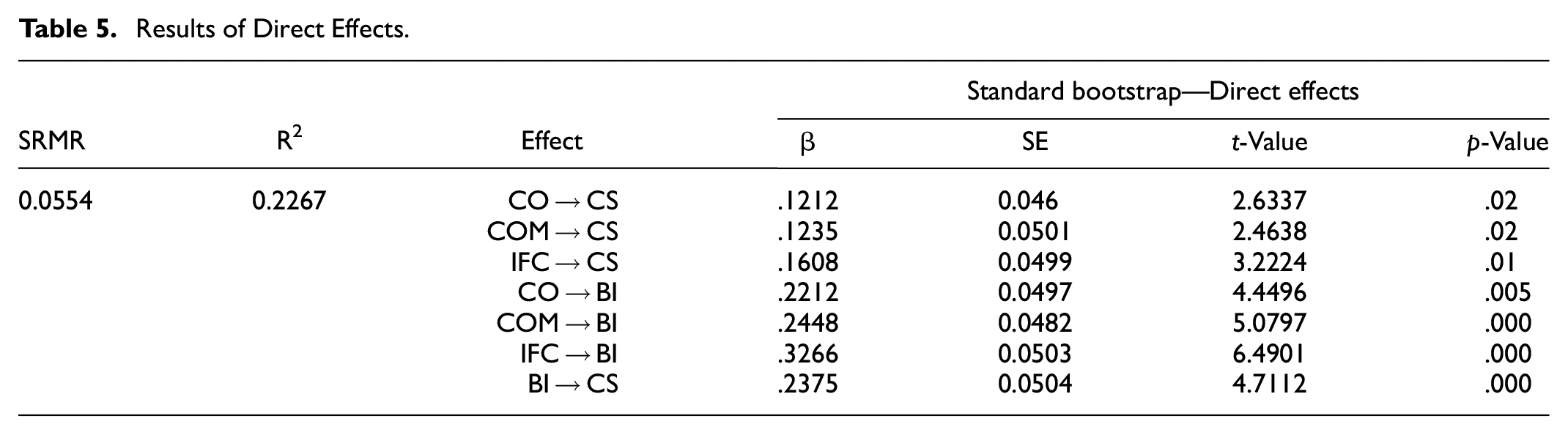
Results of the structural model revealed the existence of a positive relationship between CO (b = 0.1212, t-value = 2.6337), COM (b = 0.1235, t-value = 2.4638), IFC (b = 0.1608, t-value = 3.2224) with CS, which is in support of H1a, H1b, and H1c. Further, results revealed that CO (b = 0.2212, t-value = 4.4496), COM (b = 0.2448, t-value = 5.0797), IFC (b = 0.3266, t-value = 6.4901) significantly linked with BI, and BI (b = 0.2375, t-value = 4.7112) is significantly linked with CS.
Mediation Analysis
The three mediation effects of BI in a model with (i) CO to CS, (ii) COM to CS, and (iii) IFC to CS were tested. As per Wong (2016) guidelines, once the significance of the indirect effect is established, the strength of the mediator can be examined by using a Variance Accounted For (VAF). According to Hair et al. (2016), a VAF of <0.2 indicates no mediation, a VAF of >0.2 to 0.8 indicates partial mediation, and a VAF of >0.8 indicates full mediation. The results of the model explain that CO, COM, and IFC remain significant after the application of the mediator variable, as shown in Table 6. The β value of CO to CS was 0.1212 (direct effect) and.1,738 (total effect) in the presence of a mediator. CO value of 0.3020 or 30% effect on CS explained via the BI 0.0525 (indirect), and the magnitude is considered partial mediation, which supported H2a. Subsequently, the β value of COM to CS was 0.1235 (direct effect) and 0.1817 (total effect) in the presence of a mediator. COM value of 0.3197 or 32% effect on CS explained via the BI 0.0581 (indirect), and the magnitude is considered to be partial mediation, hence supported H2b. Moreover, the β value of IFC to CS was 0.1608 (direct effect) and 0.2384 (total effect) in the presence of a mediator. IFC value of 0.3255 or 33% effect on CS explained via the BI 0.0776 (indirect), and the magnitude is considered partial mediation, which supported H2c.
Results of Indirect Effects and Total Effects.

Significant at p < .05.
Discussion
The purpose of the study was to observe the relationships between CO, COM, IFC, BI, and CS. Previous studies mainly focused on MO from an organizational perspective (Crick, 2021; Najafi-Tavani et al., 2016; Urde et al., 2013; Wahyuni & Astawa, 2020). However, this study examines MO from a customer’s perspective since MO is not constrained to the organizational level dimension (Deshpande et al., 1993).
The outcomes of the research indicated that the hypothesized relationship between the CDMO (i.e., CO, COM, and IFC) and CS was backed by significant statistical results. Moreover, the results revealed that CDMO is positively related to CS. The research findings are also supported by previous studies (e.g., Deshpande et al., 1993; Khan & Ghouri, 2018; Najafi-Tavani et al., 2016; Wahyuni & Astawa, 2020; Wang, Ling et al., 2021), in which it is suggested that CO, COM, IFC are significantly related to superior business performance. These findings inferred that restaurants could increase CS by improving customer value using the components of MO, that is, CO, competitive fairness, and functional demands of the customers (Crick, 2021).
Further, this study proposed BI as a mediator between CDMO and CS. The finding revealed that BI partially mediates the relationship between CO, COM, IFC, and CS. These findings are similar to previous studies, which asserted that CDMO maintains a positive BI (Khan, Khan et al., 2021a, 2021b), which leads to a high degree of CS (Anwar et al., 2019; Eklof et al., 2020; Khan & Ghouri, 2018; Khan, Khan et al., 2021a, 2021b), provides favorable market position and ultimately improve business performance (Rybaczewska et al., 2020). The potential clarification for these findings is that once all three dimensions of MO were effectively implemented by ethnic food businesses, it helped to create a BI in the minds of customers, which led to CS. Hence, the BI allowed customers to create an association in their minds about what the brand stands for and implies promises.
Our findings revealed that CO, COM, and IFC exerted a positive effect on CS via BI. Thus, our study inferred that managers of ethnic food businesses should pay more attention to CO and BI, which ultimately contribute to enhancing CS. The theoretical contributions of this research confirmed Webb et al. (2000) CDMO applicability in small-medium enterprises, specifically ethnic food restaurants. Given the growing attention to small-medium enterprises and the food industry, this study offered real-world implications to enhance CS.
The objective of an organization is to build long-term relationships through CS. Based on past research findings, the substantial effect of CDMO on CS is evident (Webb et al., 2000). The overview of the literature intended to highlight the significance of CDMO, its effect on CS, and the mediating role of BI. However, more empirical observations are required to support this contention rationally. Furthermore, the applicability of MO in small-medium enterprises (Webb et al., 2000), specifically ethnic food restaurants, is confirmed by the theoretical contributions of this research. Hence, the observation from the restaurants in Malaysia inferred that managers of ethnic food businesses should pay more attention to CO and BI, which ultimately contribute to enhancing CS.
Managerial Implications
The competition in the hospitality industry has become fierce, and the practices of CDMO can facilitate businesses to attain a competitive advantage by creating superior customer value. Businesses can achieve long-term benefits by effectively applying the practices of CDMO through exploring market activities to perceive customer needs and using the information to deliver products and services following customer requirements. Simultaneously, by interpreting competition, swiftly responding to competitors’ strategies, and timely circulating customer information with the staff and departments to work collaboratively to create great value for the customer. Hence, it will assist in building a perennial relationship with content and satisfied customers. This study also extended Slater and Narver (1994) thought about the MO that it is a particular form of business culture. It is proposed that this MO construct not only provides information about the internal environment of the businesses and also provides customer input about it. The practical evidence provided by this study suggested that businesses that carry out customer-defined MO practices effectively were likely to acquire CS and commitment. It is further revealed that ethnic food businesses tend to enhance their BI with continuous efforts to observe their customers, competitors, and internal functions. Businesses can gain ideas from their consumers’ feedback, which helps them develop innovative ideas for their goods or services and serve customers with unique creations, thereby increasing CS and loyalty.
Limitations and Future Directions
The findings of this study are limited to the metropolitan cities of two major provinces, Selangor and Perak, Malaysia. Hence, future researchers are recommended to replicate the study in other regions as well because we do not have generalized results so far. Furthermore, to observe the steadiness of CS, longitudinal data analysis may also be conducted in the future. The implications of the given scale of the outcomes, the opinions, and the respective responses of other stakeholders in the ethnic food business might contribute to a crucial insight. The current research examined the link between CDMO, BI, and CS and it is suggested to utilize other variable(s) in the current model to explore new directions.
Footnotes
Declaration of Conflicting Interests
The author(s) declared no potential conflicts of interest with respect to the research, authorship, and/or publication of this article.
Funding
The author(s) received no financial support for the research, authorship, and/or publication of this article.
