




Abstract
This study discusses the impact of the external factors in tourism locations on the environmental conduct of students as sightseers; takes the rural destinations in Indonesia as the case-study place based on 325 questionnaire survey samples of tourists; and adopts the method of structural equation model-multiple group analysis to explore the moderating role of levels of education on the relationship between students’ intention to behave environmental responsibility and their responsible behavior toward the environment. Students’ factors include PBC (Perceived Behavioral Control), AE (attitude to behave toward the environment), SN (subjective norms), and IR (intention to behave with environmental responsibility). Results indicate that among students’ factors, PBC and SN have no significant effect on students’ IR; PBC affects students’ RBE positively, and students’ IR affects their RBE positively. Through analysis of survey data collected from rural sightseers on an island in Indonesia, we conclude that it is important to encourage favorable community formation and good behavioral norms by external factors to support responsible environmental behavior in sightseeing places.
Keywords
Introduction
New tourism venues are being developed in response to increased tourist interests in natural destinations. Although this is positive news for the tourism industry, the environmental impact of these developments also needs to be considered; therefore, there is a need for good education on the topic of the environment so that all participants have a good understanding of the benefits and drawbacks of these endeavors to encourage environmentally responsible behaviors. The quality of the environment is very much dependent on human behavior patterns, and the understanding of the environmental impacts of human behavior is usefully illuminated by research. According to Shafiei and Maleksaeidi (2020), the youth community like students bear the burden of being responsible toward the environment. Studying students’ responsible toward the environment is important because they are the guards, planners, policymakers, and future educators of the environmental issues. Students are in the age range that can be convinced that the environment is in an unfavorable situation (Shafiei & Maleksaeidi, 2020).
Various studies have been carried out on this topic, including studies to determine whether students from different educational backgrounds differ toward the environment and to find out activities and knowledge related to nature and the environment (Tikka et al., 2000). They concluded that the role of one’s academic field of study was significant, with the most negative attitudes shown by engineering students and the most positive attitudes toward the environment shown by biology students. In addition, other research found that student attitudes and behavior are not only influenced by the form of the lesson, but also by the school environment (Runhaar et al., 2019). The more secondary education students become aware of environmental problems, the greater their willingness to participate in environmental education programs. These findings provide relevant insights for the design of environmental education implementation policies (Zachariou et al., 2019).
According to Ntanos et al. (2018), most students care about the environment, although more solid environmental education and motivation is needed from social opportunities outside of school includes family or public outreach (Ntanos et al., 2018). Environmentally responsible behavior is associated with strong environmental attitudes, such as those that arise when people believe that the environment should be protected. Economic characteristics of pro-environmental behavior are positively correlated with education and age (Casaló & Escario, 2018). Research on student behavior in tourism destinations is still very under-researched, especially regarding sightseeing destinations in rural areas which are commonly visited by tourists. Therefore, the present study focuses on students as sightseers and examines the factors that influence their behavior toward the environment in rural sightseeing places by also considering the level of education of the students. Individuals who attain more education are different in unobservable ways which lead them to also care more about environmental issues. Education level causes individuals to be more concerned with social welfare and to accordingly behave in a more environmentally friendly manner (Meyer, 2015). Gao (2018) found significantly positive correlations between environmental education and environmental attitude; environmental attitude and environmental behavior; and environmental education and environmental behavior (Gao, 2018).
The behavioral analysis model using the theory of planned behavior (TPB) aims to explain and predict people’s behaviors. TPB stipulates that people’s behaviors are based on behavioral intentions and the concept of behavioral control; and that intentions are influenced by subjective norms, perceived behavioral control, and behavioral attitudes (Ajzen, 2019). Several researches have used the TPB model in the research area of peoples’ environmental behavior (Assaker, 2011; Assaker et al., 2011; Bronfman et al., 2015). The present study employs an extension of TPB to find out the factors affecting sightseers’ intention and responsible environmental behavior in coastal sightseeing places of rural areas. Many TPB studies in the tourism sector focus on the relationship and influence on tourists’ behavior; for instance, estimating tourists’ decisions of their tourism activities (H. Han, 2015; H. Han, Jae, & Hwang, 2016; J. H. Han, Lee, & Hwang, 2016; Japutra et al., 2019; Pan & Truong, 2018). However, research on tourists’ responsible environmental behavior in sightseeing places is still lacking. Human interaction with the environment affects their responsible behavior toward the environment (RBE). C. Wang et al. (2018) explored tourist behavior toward the environment in terms of the environmental situation aspect in a mountain sightseeing locale (C. Wang et al., 2018). More studies must find empirically whether there are differences in tourists’ responsible environmental behavior in different types of sightseeing places, as well as whether individuals’ responsible environmental behavior varies in different countries or cultures.
The nature of the relationship between individuals’ socio-demographic characteristics and responsible environmental behavior were calculated. Factors such as gender, employment status, sector of employment and social class were found to be positively correlated with responsible environmental behavior in certain countries, in agreement with the results stemming from previous studies. On the other hand, for the data pertaining to South Africa, education, income and environmental organization membership were negatively related to responsible environmental behavior (Ifegbesan et al., 2022). Other results have shown that South African peoples revealed significant differences in their responsible environmental behavior according to education. This might be the impulse for a change in thinking about the relevance of environmental education (Mikuła et al., 2021). Another previous study of the environmental attitude measures in the 28 European countries found that the environmental attitudes of people with low, moderate, and high propensities for responsible environmental behavior differed systematically in the countries which were explored. These findings provide support for the theoretically expected association between people’s environmental attitudes and their protective engagement (Urban & Kaiser, 2022). People’s general environmental considerations were positively related with recycling and environmental activism. General environmental considerations are related to responsible environmental behavior beyond Western Europe and the United States (Balundė et al., 2019). Previous study also has presented the results of a study of the differences in terms of environmental values, attitudes and behaviors among university students from England, Germany, Portugal and Spain. It included the study of variables such as man-nature orientation, generativity, environmental concern, perceived consumer effectiveness, conservation behavior. The results obtained indicate that all variables, when considered individually, are significant for differentiating the groups of students (do Paço et al., 2013).
This study discusses the impact of the external factors in tourism locations on the environmental conduct of sightseers. Tourism activities could yield significant economic benefits but eventually destroy the sightseeing places. The development of tourism destinations and the travel experience of sightseers are influenced by the condition of the sightseeing places (H. Han, Jae, & Hwang, 2016; J. H. Han, Lee, & Hwang, 2016). Irresponsible environmental behavior that is common in tourism activities includes damaging ecology such as plants and trees (C. Wang et al., 2018). Previous studies on tourists’ responsible behavior toward the environment (RBE) focused on tourist characteristics while excluding consideration of the impact of the situational variables of tourism places (Mentrikoski et al., 2019; Miller et al., 2015). However, according to Imran et al. (2014), the ecological conduct of sightseers is the aftereffect of the association of situational factors and their components (Imran et al., 2014). The external factors in tourism places significantly influences tourists’ environmental behavior (Bronfman et al., 2015). Factors of the bad environmental conditions of the coastal sightseeing places in the rural area tend to give rise to irresponsible environmental behavior of tourists and can influence the natural and ecological quality. In other words, the environmental behavior of tourists is influenced by their variables just as explicit situational components of these tourism places.
The external factor (EF) of the tourism places in this study focuses on the environmental interpretation which can have an important influence on students’ RBE. Suppose tourists initially intend to throw garbage everywhere but if they see a sign that says, “Do not throw garbage,” then they are probably going to understand that flighty ecological conduct will disregard certain principles at tourist spots and even that they might receive a punishment. Indeed, the awareness of these consequences can discourage them from taking destructive actions. Therefore, this study was conducted to analyze the environmental behavior of tourists from internal factors based on TPB and situational factors at tourist attractions. This study has significance for the management of the environment and the development of sustainable sightseeing places. Environmental interpretation is a significant situational factor in tourism places; therefore, it can affect sightseers’ intention to behave with environmental responsibility (IR) and RBE.
Many studies use TPB (Alam et al., 2018; Bird et al., 2018; Champahom et al., 2020; Daxini et al., 2019; Yang et al., 2018) to investigate ecological and environmental behaviors (Deng et al., 2016; Dewberry & Jackson, 2018; Dunn et al., 2018; Lee et al., 2016), tourism activities (H. Han, Jae & Hwang, 2016; Japutra et al., 2019), and environmental literacy (Sanz-Blas et al., 2019; Tanwir & Hamzah, 2020). This study takes the external factor (EF) of the tourism places into the study of tourist RBE, using TPB to construct the models, testing whether external factors also influence tourists’ IR and their RBE.
A person’s evaluation of his behavior, which is being considered, whether it is beneficial or detrimental, is a reference for his attitude toward his behavior (Ajzen, 2019). This term states the assessment of the persons perspective as to whether the behavior is pleasant or unpleasant, beneficial or harmful, good, or bad. Behavioral beliefs can affect individuals’ attitudes toward any behavior (Ajzen, 2019).
Subjective norms (SN) refer to the social pressure a person feels to perform or not perform a behavior toward the environment (Ajzen, 2019). This is caused by people’s motivation or their normative beliefs (Ajzen, 2019). A normative belief is a single belief that is recognized by a particular individual or group and determines whether it is appropriate to behave in a certain way. People’s motivation to comply is related to the significance they place on the perspectives of others when playing out certain environmental behaviors. The individual’s perception of difficulty or ease of performing certain environmental behaviors is a reference for the perceived behavioral control (PBC). An individual’s behavioral intention is affected by his/her perceived behavioral control.
Intentions of responsible behavior toward the environment predict RBE directly. These intentions also have a mediating effect on the relationship between attitude to behave toward the environment, PBC, subjective norms, and RBE (C. Wang et al., 2018).
Personal behavior may also be influenced by factors in many conditions such as the system implemented in place, regulation in practice, and people’s culture as external factors. These contextual factors influence the person’s environmental behavior unconsciously. However currently, most studies have not included these factors (Imran et al., 2014). The effect of external factors (EF) on RBE has been investigated by related research. Previous studies show that the sightseeing places environmental regulation has a positive effect on RBE. They suggested that the administrator implement environmental policies more effectively and enhance individual RBE by strengthening education of responsible environmental behaviors (C. Wang et al., 2018).
Individual behavior in many conditions is not completely independent but is influenced by factors of educational level. Individual environmental behavior is often subconsciously influenced by this factor (Zhang & Ma, 2011). The relationship between student IR and RBE may be moderated by students’ education level. The influence of the level of knowledge and education on RBE have been found. That is the educational level of individuals is correlated with their behavior (Zhang & Ma, 2011). Generally, educational background seems to affect students’ activity levels (Tikka et al., 2000). Besides, education is positively related to green behavior, such as recycling, proper garbage disposal and planting trees (Hoffmann & Muttarak, 2015). In the primary school level, it is determined that students who received environmental education, gain enthusiastically and reflecting environmental awareness and empathized with nature (Yeşilyurt et al., 2020). Since environmental problems vary among various communities, the environmental education curriculum has been developed in Indonesia in every educational level based on local needs (Sarbaini et al., 2022). The problem of environment needs a solution, for it has a connection to the sustainability of human life. (Sarbaini et al., 2022). The economic literature provides ample evidence of the connection between education and numerous beneficial social, economic, and health outcomes. Education might influence ecological ways of behaving in more than one way. First and foremost, individuals acquire knowledge and skills primarily through formal education. Second, education assists individuals with acquiring admittance to additional sources and kinds of data, which further works with information securing. People’s awareness of environmental issues and knowledge may increase their sense of environmental responsibility (Q. Wang et al., 2022). Besides, education causes individuals to be more concerned with social welfare and to accordingly behave in a more environmentally friendly manner (Meyer, 2015).
Using propensity score methods, Hoffman and Muttarak found that an additional year of schooling significantly increases the probability of pro-environmental actions (Hoffmann & Muttarak, 2020). Syafiei and Maleksaeidi analyzed the environmental behavior of students at the university level and found that the university environment can provide a climate for them to learn and discuss environmental issues and thus encourage good environmental behaviors in the community (Shafiei & Maleksaeidi, 2020). Contrary to these findings, other studies have shown that in certain cases, there is no relationship between knowledge level and waste management habits (Mufaridah & Handayani, 2014).
Responsible behavior toward the environment is not only influenced by personal factors as decision makers but also by external factors. Therefore, this study employed an extension of the theory of planned behavior to understanding students’ RBE by using the external factor (see Figure 1). Our model takes sightseers’ RBE as the final variable which includes five pre-variables: AE, SN, PBC, intention to behave with environmental responsibility (IR), and an external factor in coastal sightseeing places.
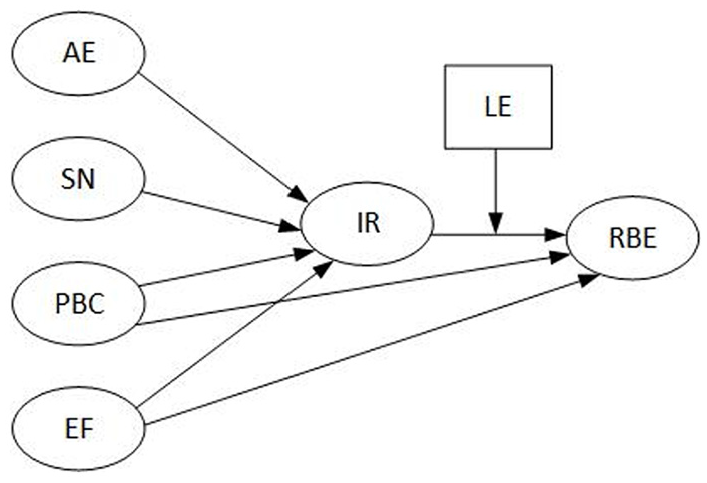
The model of study.
Methods
An Overview of the Study Area
The sightseeing locations investigated in this study are Kolbano beach and Oetune beach which are the new tourism destinations located in Timor Tengah Selatan (TTS) regency, East Nusa Tenggara province of Indonesia (see Figure 2). In the Kolbano beach area, there is a local industry in the collection of colored stones. The stones which come in a range of attractive shapes and sizes are sold to local companies. The Kolbano beach area overlooks the expanse of the Indian Ocean. The main characteristic of this beach is a stretch of slippery rocks with unique and beautiful color patterns. These beautiful pebbles are a substitute for the sand of Kolbano beach. This stretch of a pebble of Kolbano beach is very rarely found in other coastal areas in the world. The distinctive texture of these rocks is not only beautiful but also becomes another source of income for residents. Manual mining of these rocks is another source of income for the people of Kolbano village. These stones are widely used as a stretch of garden decoration, both in housing and in hotel facilities. Oetune beach also offers not only beautiful views but also a very fine desert. Oetune beach is located in Oetune village, Kualin district. It is unique in the form of a stretch of sand which is considered very wide for the size of the beach. Many couples choose to do pre-wedding photos in this place (see Figure 3).
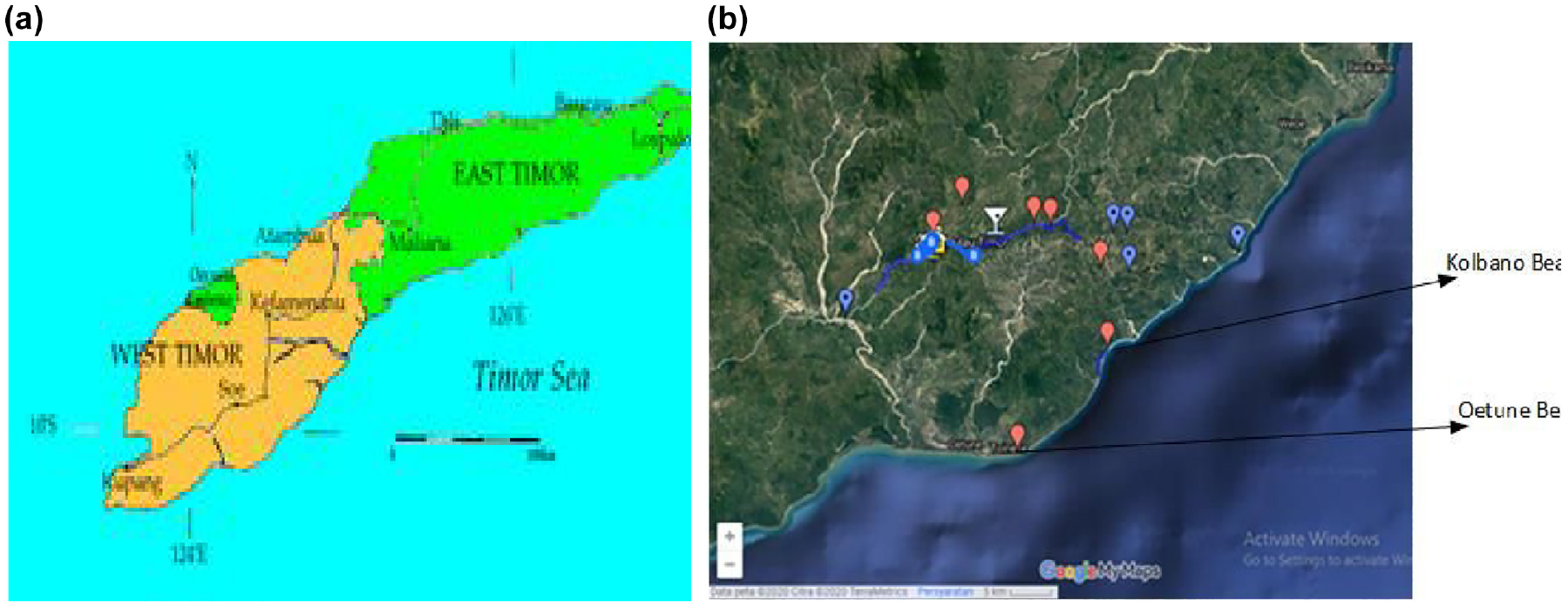
Map of Kolbano beach and Oetune beach: (a) Timor’s map (https://id.wikipedia.org/wiki/Timor_Barat) and (b) Kolbano and Oetune position in the map of Timor island Indonesia.

A point of view in the sightseeing places of Kolbano and Oetune beach. (a) Kolbano beach (http://ttskab.go.id/2016/03/18/pantai-kolbano/) and (b) Oetune beach (http://ttskab.go.id/2020/01/08/2342/).
Based on the data from the tourism administrator of the TTS regency, the number of sightseers to Kolbano and Oetune beaches is increasing continuously. In 2019 before the COVID-19 pandemic, more than 10 thousand tourists from outside TTS regency visited Kolbano and Oetune as the new tourism destinations in TTS regency. More than 60% of visitors were students that ranged from elementary students to university students (www.ttskab.go.id). The increasing number of tourists can give a negative impact on the environmental management of Kolbano and Oetune sightseeing places due to the irresponsible environmental behavior of some tourists that damage these environments.
Measurement Scale Design
Based on the previous studies, we used the instruments of the internal and external factors that influence tourists’ RBE by Wang et al. (2018) shown in Table 1. Measurement of AE, SN, IR, EF, and PBC were assessed using the 5-point Likert scale.
Scale Items.

Note. AE = attitude to behave toward the environment; SN = subjective norms; PBC = perceived behavioral control; EF = external factor; IR = intention to behave environmental responsibility; RBE = responsible behavior toward the environment.
Research Hypotheses
Social convictions allude to a person’s abstract assessment of their ecological practices. In view of the TPB insightful structure, perspectives toward ecological conduct are legitimate predictive factors that impact the intention of responsible behavior toward the environment (IR). Correlational analyses have affirmed that tourists’ perspectives toward environmental conduct can predict their IR (Bronfman et al., 2015; C. Wang et al., 2018). Thus, we proposed this hypothesis:
H1: The attitude of students toward environmental behavior (AE) positively influences their IR.
People are probably going to comply with the recommendations or assessments of others to perform certain environmental behaviors and will behave in certain ways according to the circumstances. Thus, we proposed this hypothesis:
H2: Students’ subjective norms have a positive effect on their IR.
On the other hand, this perceived behavioral control could predict a certain behavior directly (Ajzen, 2019). Previous studies found that tourists’ PBC correlate with their IR and RBE (Bronfman et al., 2015; C. Wang et al., 2018). Thus, we proposed these hypotheses:
H3: Students’ IR is positively affected by their perceived behavioral control.
H4: Students’ perceived behavioral control positively affects their RBE.
Previous studies have found that personals’ intention of responsible behavior toward the environment may predict their behavior toward the environment directly (Imran et al., 2014; Liobikiene et al., 2016). Thus, we proposed this hypothesis:
H5: Students’ IR has a positive effect on their RBE.
In addition, management systems and the regulations affect tourists’ RBE directly (Imran et al., 2014). Therefore, the proposed hypotheses:
H6: External factors in sightseeing places positively affects students’ IR
H7: External factors in sightseeing places positively affects students’ RBE
Therefore, the level of education in this study is used as a moderating variable to observe the effect of moderating levels of education in tourist attractions on the relationship between tourist IR and RBE. Accordingly, this hypothesis is put forward:
H8: Students’ education level moderates the relationship between their IR and RBE, so that the IR-RBE pathway is stronger when the student’s education level is higher.
Data Collection and Processing
Researchers gave questionnaires on site to tourists by simple random sampling in Kolbano and Oetune sightseeing places from June to August 2020. First, we asked if the sightseers were students who could participate in this survey. We distributed 325 questionnaires using an online Google form and/or printed form in two locations (Oetune and Kolbano). All questionnaires were answered and returned. We found 318 questionnaires were valid and used them in this analysis. We employed SPSS 23.0 statistical software to conduct the descriptive, reliability, and validity analyses. A Concurrent validity test is conducted to compares against a validated test by C. Wang et al. (2108) to measure the same or similar constructs, and allow to validate existing scale and accepted ones (C. Wang et al., 2018).
In order to assess hypothetical relationships and to evaluate the overall goodness of fit of the proposed model, the structural equation modeling (SEM) was conducted using AMOS 21.0 software. For the purpose of testing the effect of the level of education of students as a moderator variable, multiple group analysis of AMOS was used. This grouping method can be used to test the role of moderator variables (Connell, 1987). For the purpose of this analysis, the low education group was defined as senior high students or below, and the high education group was defined as junior college to undergraduate students. In this analysis we imported the data of both groups and set up different conditions: unconstrained and constrained model (Collier, 2020).
The Participants
Descriptive analysis of 318 students in this study are shown in Table 2 with the following observations: (1) the number of males is approximately the same as the number of females; (2) the number of students in the age range of 19 to 22 is greater than that of any other age group; (3) the students of high school or technical high school was the most commonly represented level of education; (4) more visitors were from outside TTS than from inside TTS; and (5) the majority came to sightseeing places for the first time.
Descriptive Data of Students.

Results
Validity and Reliability Analysis
Wang’s scale is intended to be adapted in this study (C. Wang et al., 2018). Pearson’s orrelation was employed to asses construct validity and was found that the significance value of each item tested by correlation analysis was below .05, indicated that all items are valid (Table 3). The results of the new test correlate with the existing validated measure by C. Wang et al. (2018). Because of the linear relationship between the criteria presented, a Pearson correlation analysis was carried out (Ahrens et al., 2020). The instrument’s reliability was verified through Cronbach’s alpha, calculating the existing correlation between each item of the test and the remaining items or the total score (Ahrens et al., 2020). All of Cronbach’s alpha coefficients for the item scales were between .78 and .91 (Table 3), above the standard of .7 (Connell, 1987) which indicates the reliability of the instrument.
Correlations and Reliability Statistics.

Structural Equation Modeling
The complete SEM model with variables’ indicators of this study is shown in Figure 4. Exploratory factor analysis (EFA) was conducted to analyze the models’ construct and obtained that all variables have one dimension. Confirmatory factor analysis (CFA) were also employed to analyze the models’ constructs and obtained goodness of fit of the model analysis as shown in Figure 5.

Structural equation modeling of EF-TPB.

Model of goodness-of-fit.
The goodness-of-fit of the model overall is indicated by the values of p, χ2 / df, RMSEA, PGFI, CFI, SRMR, and NFI. According to Collier (2020), to gain the goodness-of-fit, the model must meet a p-value greater than .05; the range value of χ2/df is 1.0 to 3.0; CFI, IFI, and NFI must be at least 0.9, besides the value of PGFI must be greater than 0.5, the value of SRMR must be less than 0.05, and the value of RMSEA must be less than 0.08. The value of these indicators of this study is shown in Table 4 which indicates that the model fit was good. Table 5 and Figure 6 show the results of the hypotheses testing of the model. Consistent with our hypotheses 1, 4, 5, 6, and 7, the t-value is greater than 1.96 with a p-value less than .05.
Testing Values of the Goodness-of-Fit Model.

Hypotheses Testing by Using Path Analysis of the SEM.
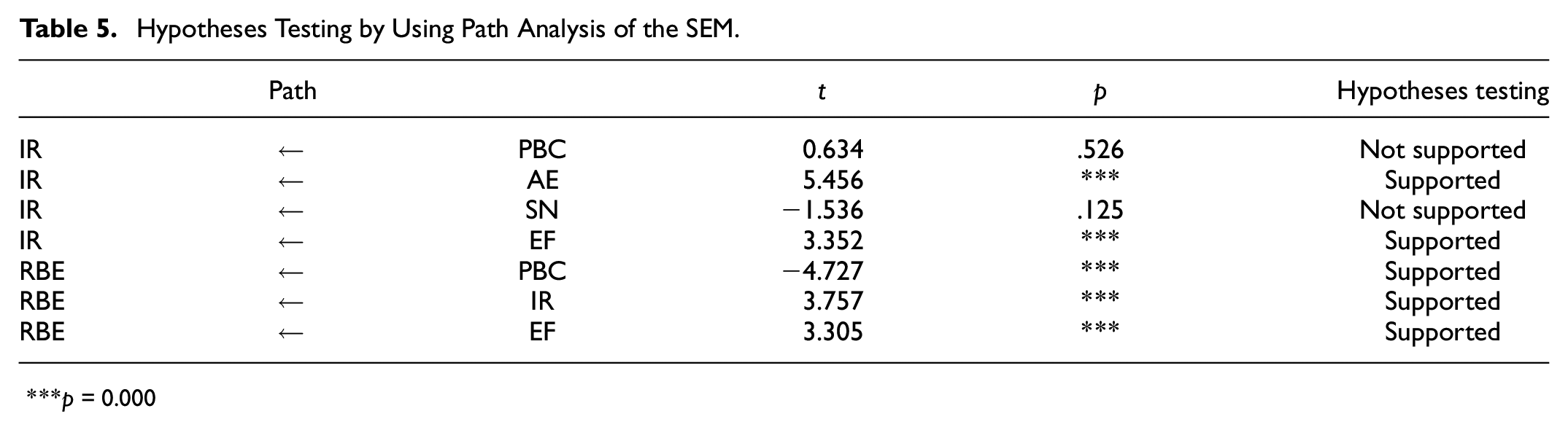
p = 0.000
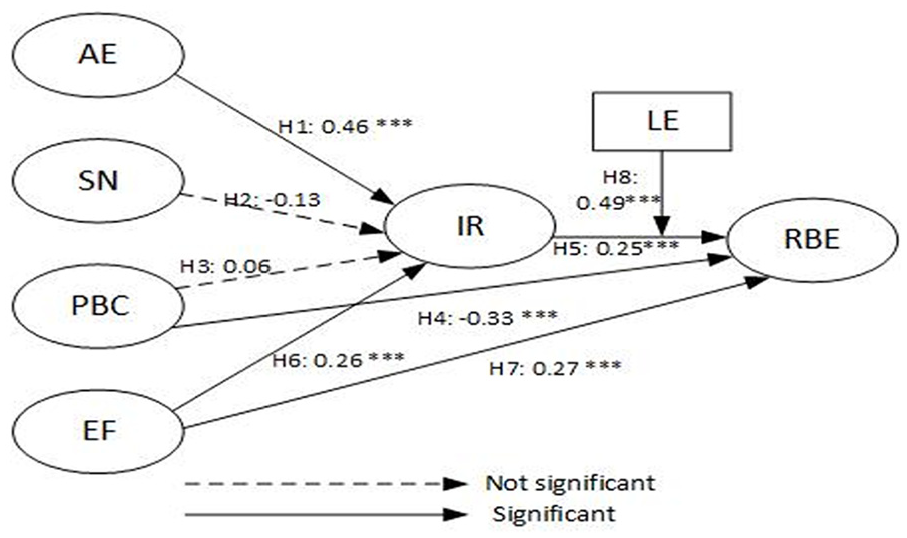
Paths of the standardized coefficients.
MGA: The Testing of the Moderating of the Level of Education
As mentioned in the previous section, the level of education was divided into senior high students or below as the low-level group junior college students or above as the high-level group. Based on the stated criteria, the model was fit for both groups. The indices of all tested models is described in Table 6.
Results of Moderating Variable Test for Low Education Group Data.

The difference in Chi-Square value between the constrained and unconstrained model was greater than 3.84 indicated that the moderation is significant (Connell, 1987).
Based on the results as shown in Tables 6 and 7, it was found that the two groups’ coefficients differ. Thus, the results supported for the hypothesis that the relationship between IR and its corresponding latent endogenous construct RBE is moderated by the level of education. The effect of IR on RBE is more pronounced in “Higher Education Group” then “Low Education Group.”
Results of Moderating Variable Test for High Education Group Data.

Figure 6 shows the paths of the standardized coefficients of the attitude to behave responsibly toward the environment—IR, path of the SN—IR, the PBC—IR path, the PBC-RBE path, the external factor-IR path, the external factor-RBE path, and the IR-RBE path moderated by LE. This figure shows that SN and the PBC have no significant effect on tourists’ IR—contrary to the previous studies that found the SN and the PBC have a positive effect on tourists’ IR (C. Wang et al., 2018). Therefore, hypotheses 1 and 3 are not supported. The perceived behavioral control and subjective norms do not affect tourists’ IR. But our findings are consistent with hypotheses 2, 4, 5, 6, and 7. Tourists’ IR are positively affected by their attitude to behave responsibly toward the environment; tourists’ IR are positively affected by external factors; external factors positively affect their RBE; tourists’ RBE are positively affected by their perceived behavioral control, and tourists’ IR positively affect their RBE.
Discussion
We have identified the relationship between students as sightseers’ factors on the issue of environmental responsibility. This finding is similar to existing studies (H. Han, 2015; Imran et al., 2014; Li et al., 2018; Mainzer & Luloff, 2017; Mak et al., 2019; C. Wang et al., 2018). First, students’ attitudes to behave responsibly toward the environment positively influence their IR; therefore, to gain students realizing and lead them to consciously implement their RBE, the publicity of any environmental policy or regulations and education should be enhanced by the administrative departments. Second, we found that the subjective norms of students do not affect their IR; thus, students’ IR is more influenced by the attitudes toward environmental behaviors than by stimuli such as families, universities, schools, related government departments related to tourism and environments, communities, tourism industry or practitioners, friends, and work units. Third, students’ RBE is positively affected by their perceived behavioral control; therefore, the administrators of the sightseeing places must enhance their infrastructure to reduce the cost of taking irresponsible behavior and improve the perceived control of taking RBE. Most of the previous studies on tourist RBE emphasize the personal factors, while the effect of external factors in the tourism places on tourist RBE is not included. This study takes the external factor of tourism places that is the environmental interpretation into a study of students as sightseers’ RBE.
By conducting an empirical study we found that it is important to encourage a favorable community formation and good behavioral norms by external factors that support responsible environmental behavior in sightseeing places. The RBE performance of students also needs to be improved by the contribution of having external factors. The relevant external factors must be carefully considered to encourage responsible behavior toward the environment by students as sightseers. Furthermore, highlighting the effect of external factors and adding regulations regarding students’ RBE and the categories or the scope of sightseers’ irresponsible behavior toward the environment must be clearly defined. In addition, some specific regulations can encourage mutual supervision of sightseers to make them aware of the responsible behavior toward the environment.
The tourism and environment administrative department should make more signs to encourage sightseers to have responsible behavior toward the environment activities and considering any rewards to sightseers who consciously actualize their RBE. This study also examines the effect of an external factor in the sightseeing places on students’ RBE. Future researchers could add some external factors into the research framework such as the quantity of environmental protective facilities, environmental quality in the sightseeing places, and the position of the tourism places to investigate their effects on sightseers’ RBE. Future research also may focus on certain other types of sightseeing places to explore the effect of individuals’ factors and situational factors on students’ RBE and clarify the mechanisms of the relationship model of individual factors and situational factors to students’ responsible environmental behaviors.
This study also has confirmed that there are differences in terms of the effect of individual factors and situational factors on students’ IR and their RBE in different types of sightseeing places. SN and PBC have a positive effect on IR for tourists at mountain tourism sites (C. Wang et al., 2018) but SN and PBC have no significant effect on tourists’ IR at coastal tourism locations. Besides, based on the descriptive analysis, the fact that 49.69% of students were no older than 18 years and they gave low scores of every item in the SN and PBC scale may indicate that age range may affect the responsible environmental behavior of this age group.
These findings also confirmed that the level of education moderates the relationship between IR and its corresponding latent endogenous construct RBE. The influenced of IR on RBE is more prominent on the students of the higher education levels then students of the low education levels. This finding also is in line with the notion that people with more education tend to gain more technical knowledge essential for advancing suitable solutions to change environmental behavior. Therefore, increasing students’ knowledge that inspires them to behave responsibly toward the environment is one of the important and significant areas of concern for a sustainable environment in the future (Shafiei & Maleksaeidi, 2020).
Environmentally responsible behavior is associated with strong environmental attitudes, and by improving their education, people believe that the environment should be protected. Economic characteristics of responsible environmental behavior are positively correlated with education and age (Casaló & Escario, 2018). Therefore, further research may examine the effects of age and socio-economic status of students on their responsible behavior toward the environment. Also, environmental education in daily life could play an important role in improving sightseers’ responsible behavior toward the environment.
Conclusions
This study takes the level of education of students to analyze the relationship between students’ intention to behave with environmental responsibility and their actual responsible behavior toward the environment (RBE). In addition, this study takes the external factors of rural sightseeing places—namely, the environmental interpretation and the individual factors of students as sightseers—to examine their effect on sightseers’ RBE; uses an extension of TPB to build models; and examines the effect of EF on sightseers’ RBE. Students’ RBE is influenced by personal behavior and external factors of rural sightseeing places. Students’ factors include PBC (Perceived Behavioral Control), AE (attitude to behave toward the environment), SN (subjective norms), and IR (intention to behave with environmental responsibility). Among students’ factors, PBC and SN have no significant effect on students’ IR; PBC affects students’ RBE positively, and students’ IR affects their RBE positively. The external factors of rural sightseeing places positively affects students’ IR and their RBE. Finally, we have shown that students’ level of education moderates the relationship between IR and students’ RBE.
Footnotes
Declaration of Conflicting Interests
The author(s) declared no potential conflicts of interest with respect to the research, authorship, and/or publication of this article.
Funding
The author(s) received no financial support for the research, authorship, and/or publication of this article.
