




Abstract
This study explored the communication strategies of college students majoring in one of five modern foreign languages (i.e., English, French, German, Japanese, and Spanish) and their relation to communication confidence. It also explored the association between their strategy use and the difficulty regarding the speaking components, and students’ feedback on pedagogical tasks to improve their speaking ability. A questionnaire survey of communication strategy was distributed to 538 college students in Taiwan, and semi-structured interviews were conducted with 20 students. The results showed that there was a statistically significant difference between the majored language and the use of communication strategies. Specifically, a one-way between-groups MANOVA revealed that the participants adopted the message reduction/alteration and fluency-oriented strategies frequently and equally, regardless of the language they studied. English and Spanish learners employed social affective, phonological awareness, and negotiation for meaning while speaking strategies more frequently than German learners. Students who reported difficulties in fluency, lexical resources, grammatical accuracy, and pronunciation while speaking the major language employed social affective strategies less frequently. Finally, students’ preferences for particular tasks reflected the speaking components they wished to foster. It is concluded that lexical and grammatical knowledge should be emphasized first to build communication confidence and strengthen fluency.
Plain language summary
This research looked into how college students who are studying different foreign languages (like English, French, German, Japanese, and Spanish) communicate and how confident they feel about it. It also checked if the strategies they use relate to how difficult they find speaking, and what they think about tasks meant to improve their speaking skills. I gave a survey about communication strategies to 538 college students in Taiwan, and interviewed 20 of them in more depth. The finding was that the language students were studying made a difference in the strategies they used. For example, students tended to use certain strategies, like simplifying their message or focusing on fluency, no matter which language they were learning. However, those learning English and Spanish used strategies related to social interaction, pronunciation, and understanding the meaning of what’s being said more often compared to those learning German. Students who struggled with fluency, vocabulary, grammar, and pronunciation tended to use social interaction strategies less often. Also, the tasks students preferred for improving their speaking skills matched up with the aspects of speaking they wanted to get better at. In conclusion, it seems like building up vocabulary and grammar knowledge first can help students feel more confident in their communication and improve how fluently they speak.
Introduction
Speech production is a highly complex skill that relies on communicative competence and interrelated processes to express form, structure, and meaning in appropriate contexts (Goh & Burns, 2012). Each language has its peculiar phonological, morphological, and syntactic characteristics. Thus, speaking a foreign language (FL) can be effortful when one’s cognitive processing involves comprehending, retrieving, processing, producing forms and structures, and maintaining fluency during real-time communication (Bachman & Palmer, 1996; Goh & Burns, 2012). These language components and communicative competence are essential to FL speaking as they contribute to effective communication, intercultural understanding, confidence building, and overall speaking proficiency. When FL learners encounter linguistic difficulties in expressing meaning, they may adopt oral communication strategies (CSs) to cope with speaking problems or communication breakdowns (Cohen & Henry, 2020; Goh & Burns, 2012; Nakatani, 2006). Nevertheless, which speaking difficulties that learners majoring in different modern FLs report and the extent to which those difficulties are associated with the use of a particular type of strategy require exploration.
In response to the effects of increased globalization and economic development, senior high schools have promoted learning a second FL, in addition to English as the first FL (Ministry of Education, 2023). According to the Ministry of Education in Taiwan, the top four second FLs that students learned from 2003 to 2023 were Japanese, French, German, and Spanish (Ministry of Education, 2023). In Taiwan, FLs are learned in the classroom usually, where speaking tasks are developed for instructional purposes and given to students so that they can practice using the target language. While the majority of previous research has examined learners’ performance through different speaking tasks (Crowther, 2020; Pang & Skehan, 2021; Suzuki et al., 2022), what FL learners think about the effect of speaking tasks on their speaking development has not been investigated fully. Consequently, the purposes of this study are to investigate (a) the CSs that college students majoring in one of the five modern FLs (i.e., English, French, German, Japanese, and Spanish) adopted, (b) the relationship between communication confidence and use of CSs, (c) the difficulties regarding the speaking components they reported in the major language and their association with the use of CS, and (d) the students’ feedback on pedagogical tasks to improve their speaking ability. In doing so, it seeks to contribute to our understanding of the speaking difficulties reported and the CSs adopted by learners of different FLs, and the relation between tasks and speaking components.
Foreign Language Communicative Competence, Confidence, and Communication Strategies
In teaching and assessment contexts, different researchers have described an individual’s communicative competence in speaking an L2 or a FL similarly. In 1980, Canale and Swain identified four components—grammatical, discourse, sociolinguistic, and strategic competence—that constitute communicative competence. Goh and Burns (2012) stated that a learner’s communicative competence consists of the knowledge of language and discourse (i.e., grammatical, phonological, lexical, and discourse knowledge), core speaking skills (i.e., pronunciation, speech function, and interaction management), and communication strategies (i.e., cognitive, metacognitive, and interaction strategies). In language learning, communicative competence is at the core of intercultural communication because the delivery of spoken messages needs to promote understanding, reduce misunderstandings, and foster positive relationships across diverse linguistic and cultural contexts (Byram, 2009; Fantini, 2020; Kazemian et al., 2023). From the language testing perspective, Bachman and Palmer (1996) noted that communicative competence involves five components: language knowledge, topical knowledge, personal characteristics, strategic competence, and affective factors. The speaking assessment criteria in the International English Language Testing System (IELTS) consist of four components: fluency and coherence, lexical resource, grammatical range and accuracy, and pronunciation (IELTS, 2023). Although defined differently, these criteria used to assess speaking ability correspond closely to the components of communicative competence.
Lexical knowledge, including lexical richness, is the most fundamental component in speaking, and numerous studies have found that it influences speaking fluency, accuracy, and proficiency (Chou, 2018, 2021; Enayat & Derakhshan, 2021; Gan, 2013; Goh & Burns, 2012; Nation, 2013; Qian & Lin, 2019). Another crucial aspect of lexical resource in speaking performance is language learners’ knowledge of collocation, multiword units, and formulaic expressions, where lexis and grammar are intertwined. One of the difficulties that many language learners have is that they do not have sufficient words, or lexicogrammatical knowledge, with respect to the way to use specific words or expressions to deliver their message precisely, even though they may recognize these words when reading. One’s lexical resource is associated closely with his/her quality of speaking in terms of fluency, accuracy, and complexity (Goh & Burns, 2012; Skehan, 2003). Speaking a FL under time pressure demands learners’ cognitive capacity to process and express meaning (fluency) and form (accuracy) simultaneously. Although they have learned the grammatical rules, accuracy is often compromised to maintain fluency and avoid communication breakdowns. If not fully developed and operationalized, this knowledge of language and discourse would cause considerable difficulties in oral communication. As a result, it is worth exploring which speaking components that Chinese speakers who majored in five FLs reported give them difficulty during communication.
When learners encounter difficulties in speaking the target language, such as limited lexical resource or uncertainty/unfamiliarity with using a specific grammatical structure, they may adopt communication strategies (CSs), which are verbal and nonverbal communication aids, to convey the target language, address problems or breakdowns, or avoid speaking too much. The study of CSs has received increasing attention to investigate the effects of (a) speaking tasks on CSs’ use (e.g., Barkaoui et al., 2013; Chou, 2021) and (b) strategy instruction on enhancing speaking ability and willingness to communicate in the language classroom (e.g., Goh & Burns, 2012; Milliner & Dimoski, 2022; Mirsane & Khabiri, 2016). Researchers have found that students’ employment of CSs varied depending upon speaking tasks. Moreover, strategy instruction has a significant and positive effect on students’ overall speaking performance, willingness to communicate, use of problem-solving, interaction, and CSs.
Another psychological factor that affects speech production is communication confidence. A student who is highly confident in communicating has low communication anxiety and high perceived confidence in speaking a target language. The literature is replete with discussions of the positive relation between learners’ communication confidence and willingness to communicate (Elahi Shirvan et al., 2019; Peng & Woodrow, 2010). However, relatively little is known about the extent to which language learners’ communication confidence is related to their use of particular CSs. Although much work on CSs has been conducted to data, the literature is less clear about (a) speaking difficulties that different FL learners report, (b) the association between students’ communication confidence and their use of CSs, and (c) the relation between students’ speaking difficulties and CSs.
Speaking Tasks
The main purpose of using speaking tasks is to offer learners opportunities to practice and use the target language, and ultimately, strengthen their fluency, accuracy, and complexity while producing speech. Speaking tasks are also constructed for instructional and testing purposes to elicit and evaluate learners’ language performance. Speaking tasks are categorized into various forms: (a) communication-gap tasks; discussion tasks, and monologic tasks (Goh & Burns, 2012), (b) open-ended tasks (e.g., communicative functions that simulated real-world contexts) and structured tasks (e.g., reading aloud and sentence completion; Luoma, 2004), and (c) independent and integrated tasks (English Testing Service, 2023).
A great deal of work has been conducted in recent years on (a) the influence of different tasks that non-native speakers performed on native speakers’ comprehension (e.g., Crowther, 2020; Crowther et al., 2015), (b) language learners’ motivation and engagement in different tasks (e.g., Aubrey et al., 2022; Bao & Du, 2015; Ruan et al., 2015), and (c) the task type’s effect on speech production (e.g., Pang & Skehan, 2021; Suzuki et al., 2022). The findings have shown that, in the IELTS long-turn speaking task, native speakers’ comprehensibility was related to phonology (rhythm and stress) and fluency (speech rate). However, in the TOEFL iBT integrated task, which exerts a greater cognitive load, their comprehensibility was associated with phonological, lexical, grammatical, discourse, and fluency variables. In Pang and Skehan’s (2021) study, Chinese learners of English in Macao exhibited greater lexical sophistication and syntactic complexity with fewer pauses and repair in the narrative tasks, but showed higher lexical diversity and accuracy in the decision-making tasks. Finally, intrinsic motivation, tasks integrated with cultural elements, or familiar tasks, were found to be related positively to learners’ engagement in speaking.
While most of the literature on speaking tasks has focused on examining learners’ linguistic features of speech production, fewer empirical studies have investigated language learners’ opinions and feedback about the speaking tasks that they receive in the classroom and to what extent (and in what aspect) they believe that specific tasks help them improve their speaking abilities. Thus, this study asked the following four research questions:
Do learners of the five major languages (i.e., English, French, German, Spanish, and Japanese) differ in their use of CSs?
Is there an association between communication confidence and different types of CSs?
Which components do learners find difficult when speaking the five languages? Are these speaking components related to their use of CSs?
What are learners’ opinions and feedback about the speaking tasks (i.e., read aloud, prepared monologue, and tasks that use the communicative approach and task-based approach) that they have received in the classroom and to what extent do they believe that specific tasks help them improve their speaking abilities?
Method
Participants
The participants were 538 five-year college students (375 females and 163 males) from a university in Taiwan. A 5- year college program is for students aged 16 to 20. In this study, the participants were all native speakers of Chinese aged from 19 to 20 years old. Each participant majored in one of the five FLs: English (N = 183), French (N = 91), German (N = 88), Spanish (N = 90), and Japanese (N = 86). A graduation benchmark of CEFR B1 is required at this university. In this study, more than half of the Japanese majors had passed the Japanese Language Proficiency Test N2 level. Approximately half of the French (Test de Connaissance du Français), German (Goethe-Test PRO), and Spanish (Diplomas de Español como Lengua Extranjera) students had passed exams at the CEFR B1 level. According to the regulation of the 5-year college program in this university, English major students are required to minor in a modern FLs, usually French, German, Spanish, or Japanese. Students who are majoring in any one of the four modern FLs are required to minor in English.
Instrument and Data Collection
A mixed methods research design that used both quantitative (questionnaire survey) and qualitative (semi-structured interview) methods was adopted in the study. The questionnaire survey, which consisted of a total of 35 items, was distributed to the participants who had completed consent forms. The questionnaire comprised four sections: (a) 32 items from Nakatani’s (2006)Oral Communication Strategy Inventory (OCSI): Strategies for Coping with Speaking Problems, (b) one item with a six-point rating scale of self-perceived communication confidence from 1 (lowest) to 6 (highest), (c) one item asking students’ speaking difficulty in relation to four speaking components, and (d) one item asking students’ preference from four speaking tasks. The reason for using Nakatani’s (2006) OCSI was because it provides a comprehensive set of speaking strategies.
Before the survey, one teacher of each language (five teachers in total) was invited to check the 32 items to ensure that no CS failed to correspond to the specific language. A pilot study was conducted with another group of students of similar ages who were also majoring in the five FLs, and no problems concerning wording in the questionnaire were reported. The Cronbach’s α of the questionnaire was .86, which showed good internal reliability. Next, four potential difficulties in speaking, based upon the four components of IELTS speaking assessment criteria (i.e., fluency and coherence, lexical resource, grammatical range and accuracy, and pronunciation) were provided (IELTS, 2023). The participants could choose more than one difficulty that they encountered while communicating in target language. Finally, the researcher consulted several teachers from the five language departments about the speaking tasks they used frequently in class. Four types of speaking tasks emerged: (a) reading aloud, (b) prepared monologue (i.e., oral presentation on a specified topic), (c) tasks involving the communicative approach (i.e., tasks requiring students to describe, compare/contrast, explain, or argue for or against a topic), and (d) tasks involving the task-based approach (i.e., role-play simulation tasks). These four speaking tasks (with explanations and examples provided to aid comprehension) were given in the questionnaire.
To recruit interviewees, an invitation for an interview was included at the end of the questionnaire survey. Those who were interested left their contact information, and they were randomly selected by the researcher afterward. The face-to-face, semi-structured interviews were conducted with 20 participants (four from each language). The interview questions followed Research Questions 3 and 4, and follow-up prompts were given during the interview.
Data Analysis
Exploratory factor analysis (EFA) was first used to refine and reduce a large number of individual questionnaire items to form a smaller number of coherent and interrelated variables (Pallant, 2020). After the data were refined, a one-way between-groups MANOVA was performed to examine the five independent variables’ (i.e., major languages) effect on the composite (overall) dependent variables reduced from the EFA. Next, the relation between communication confidence and CSs was explored using the Pearson product-moment correlation. A Chi-square test for independence was conducted to investigate whether there was an association between the major language and preferred speaking tasks. Finally, the interview data were coded and analyzed according to the research questions. To ensure the qualitative interview data’s credibility, excerpts from the interviewees’ interviews were translated from Chinese to English and confirmed by them.
Results
To perform EFA, a total of 32 items in the Strategies for Coping with Speaking Problems were subjected to principal components analysis (PCA) first using SPSS v. 27. To refine the scale and increase the total variance explained (Pallant, 2020), items with communality values below .5 were deleted. As a result, ten questions were deleted, which left 22 items for the second round of the PCA with varimax rotation. Inspection of the correlation matrix revealed the presence of many coefficients of .3 and above. The PCA showed the presence of six components with eigenvalues that exceeded 1, and the five-component solution explained a total of 66.09% of the variance. The interpretation of the five components followed Nakatani (2006): “Social affective strategies” (Factor 1); “Phonological awareness strategies” (Factor 2); “Message reduction and alteration strategies” (Factor 3); “Negotiation for meaning while speaking strategies” (Factor 4), and “Accuracy-oriented strategies” (Factor 5; Supplemental Appendix 1).
RQ1: Do Learners of the Five Major Languages Differ in Their Use of CSs?
A one-way between-groups MANOVA was performed to investigate language majors’ differences in the use of CSs. Five dependent variables from the five components extracted from the EFA were used. The independent variable was the five major languages. There was a statistically significant difference in the five languages’ effect on the combined variables, F (5, 529) = 3.56, p < .0005; Wilks’λ = .88; partial η2 = .03. When the results for the five dependent variables were considered separately, Factors 1, 2, and 4 reached statistical significance (using a Bonferroni adjusted alpha level of .01) with a small to medium effect size (Table 1).
One-way Between-groups MANOVA Results of CSs.

Post-hoc comparisons using the Tukey HSD test indicated that, in Factor 1, the statistically significant mean scores showed that English major students (M = 3.51, SD = .78) encouraged themselves to express what they wanted to say, took risks, relaxed, and took their time to express themselves more frequently than German majors (M = 3.08, SD = .75). In Factor 2, Spanish major students (M = 3.93, SD = .78) paid more attention to rhythm, intonation, pronunciation, and conversation flow during speaking than German (M = 3.54, SD = .81) and Japanese majors (M = 3.58, SD = .87). In addition, English major students (M = 3.83, SD = .77) adopted phonological awareness strategies more frequently than German students (M = 3.54, SD = .81). With respect to Factor 4, German major students (M = 3.25, SD = .74) tended to make comprehension checks, repeat what they said, and give examples during communication less frequently than English (M = 3.66, SD = .69), French (M = 3.59, SD = .65), and Spanish students (M = 3.64, SD = .78). In addition, as shown in Table 1 and Figure 1, message reduction and alteration strategies and phonological awareness strategies were the top two strategies adopted frequently.

Use of CS by the college students majoring in the five foreign languages.
RQ2: Is There a Relation Between Communication Confidence and CSs?
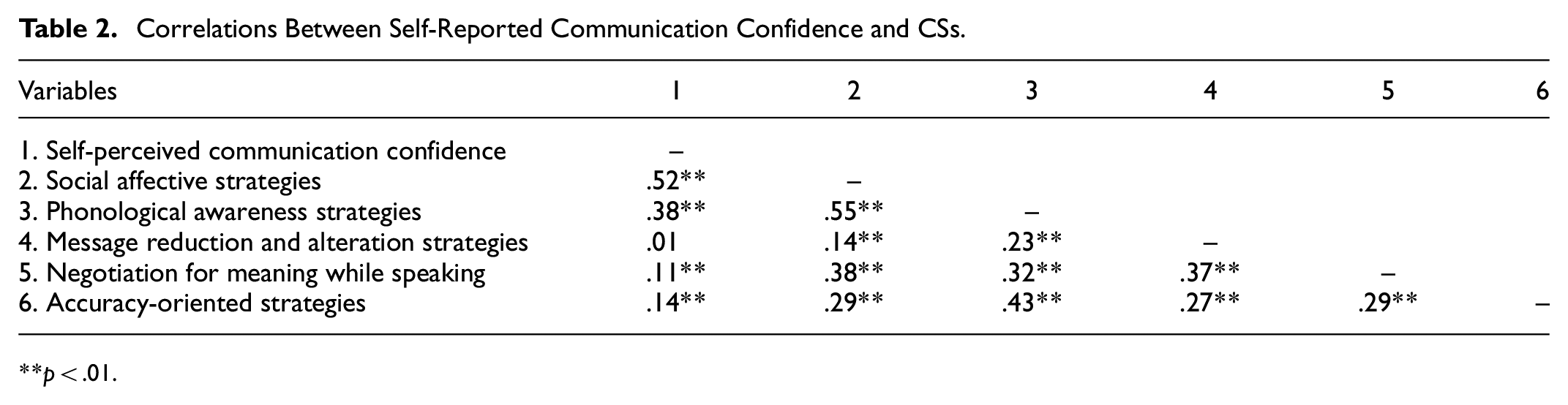
The relation between students’ self-reported communication confidence and the five types of CS extracted from the EFA was investigated using a Pearson product-moment correlation coefficient. The results revealed weak to strong and positive correlations among the CSs (r = .14–.55, p < .01; Table 2). Moreover, the participants’ self-reported communication confidence was related strongly and positively to social affective strategies (r = .52, p < .01), moderately to phonological awareness strategies (r = .38, p < .01), weakly to negotiation for meaning while speaking and accuracy-oriented strategies (r = .11 and .14, p < .01), but unrelated to message reduction and alteration strategies. Regardless of their perceived communication confidence, the participants adopted reduction and alteration strategies while speaking the major languages.
Correlations Between Self-Reported Communication Confidence and CSs.
p < .01.
RQ3: Which Components Do Learners Find Difficult in Speaking the Five Languages? Are These Reported Difficulties Related to Their Use of CSs?
Of the four speaking components, 71.6% to 86.8% of the participants reported that lexical resource was most difficult, followed by fluency and coherence (51.9% to 64.0%) and grammatical accuracy (38.8% to 57.8%; Figure 2). On the other hand, pronunciation did not appear to be a difficulty for the majority of them (11.0% to 17.5%). Further, Chi-square tests for independence indicated no significant association between students’ major language and the four difficulties in speaking the language, respectively. This suggested that regardless of the five language majors, the participants reported similar linguistic difficulties in the spoken languages.

Difficulties regarding speaking components in the major languages.
In the case of lexical resource, English and Japanese learners attributed their communication failure largely to limited vocabulary size. On the other hand, in addition to limited lexical resource, French, German, and Spanish majors reported that they had difficulty with the inflections of verbs (i.e., conjugations) and nouns with gender and number. The following two excerpts illustrated the participants’ points: The spelling of French and English words is very similar and I get confused. Sometimes there is an English word, but there’s no such word in French. So, sometimes when speaking French, I use English words that are not in French. It’s like a literal translation. Besides, I’m not good at memorizing words. So, I end up using simple French words in conversation. It’s hard for me to talk about topics in specific areas using technical words. (Interviewee 8; French major; translation) The challenging parts of German words are gender and their plural forms. I don’t know why, but I forget German words easily. It’s like I know what a noun is, but I don’t know how to inflect the determiner that accompanies the word. If I don’t practice regularly, I will forget some difficult words. German adjectives that have strong, mixed, or weak endings are also challenging. There are too many forms to consider while speaking German. (Interviewee 13; German major; translation)
Secondly, lack of practice outside the language classroom and linguistic knowledge, such as vocabulary and syntactic structure, were reported to be the main culprits in maintaining fluency and coherence in speaking. It’s because I don’t speak English outside the classroom, and I seldom talk to foreigners. I had taken courses where teachers are native speakers of English, but I don’t think my fluency has improved. I think I need to speak English spontaneously because I care about how others think about my spoken English. (Interviewee 19; English major; translation) I expect that I can speak like native speakers of Japanese, very smoothly and with good intonation. But when I forget words or grammatical structures, I pause, and this undermines fluency and coherence. (Interviewee 7; Japanese major; translation) There is no environment for us to speak Japanese outside the classroom. I don’t think I can improve my fluency just by watching and reading aloud from lines in Japanese TV drama. (Interviewee 10; Japanese major; translation)
The inflection of verbs, nouns, and adjectives also influenced the participants’ grammatical accuracy considerably. French, German, and Spanish major students specifically pointed out that verb conjugations in conjunction with first, second, or third person and/or singular or plural number demanded their cognitive capacity greatly when forming grammatical structures in speaking. As the two following excerpts showed: The Spanish verbs are complicated and different from the English ones. There are six potential forms for each tense, plus first, second, or third person, and we have to consider if it’s singular or plural, not to mention that there are masculine and feminine nouns. It’s very easy for me to make mistakes while speaking Spanish. To avoid making mistakes, I usually speak Spanish in the present tense, but I know I can’t express myself very well. (Interviewee 2; translation) In some circumstances, German verbs are placed at the end of the sentence, which is very different from English. I find this a major obstacle when speaking German and it’s easy for me to make mistakes. I don’t think this mistake would prevent comprehension, but it’s true that the grammatical structure is wrong. (Interviewee 16; translation)
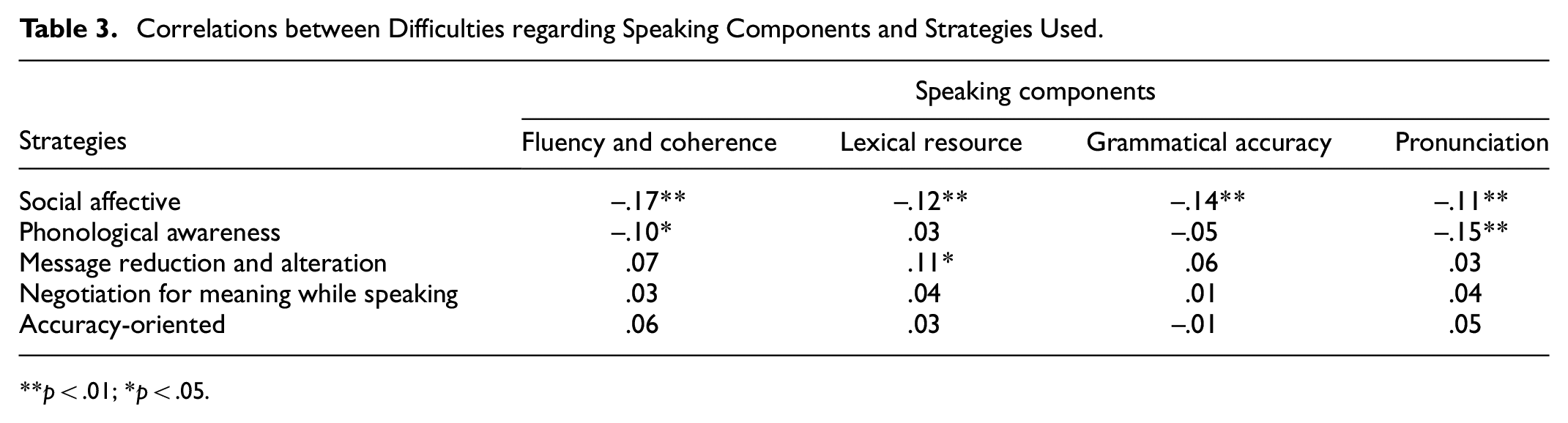
In addition, Table 3 shows that there were negative correlations between social affective strategies and the four difficulties in speaking (r = –.11 and –.17, p < .01). The greater the difficulties in fluency and coherence, lexical resource, grammatical accuracy, and pronunciation that the students reported in speaking the major language, the less frequently they encouraged themselves to express what they wanted to say or take risks of making mistakes during the conversation. Specifically, when students had limited lexical resource, they tended to adopt message reduction and alteration strategies more frequently (i.e., use familiar and simple expressions, abandon messages, or use gestures and facial expressions; r = .11, p < .05). Finally, the students who had speaking difficulties in pronunciation and fluency and coherence were less likely to adopt phonological awareness strategies (i.e., pay attention to rhythm, intonation, pronunciation, and conversation flow).
Correlations between Difficulties regarding Speaking Components and Strategies Used.
p < .01; *p < .05.
RQ4: What are Learners’ Opinions of the Speaking Tasks That They Have Received in the Classroom and to What Extent Do They Believe That Specific Tasks Help Them Improve Their Speaking Abilities?
Before moving on to the interview data, a Chi-square test for independence indicated no significant association between major language and speaking tasks, χ2 (12, n = 538) = 5.34, p = .94. Of the four task types, 53.2% of the participants (286/538) across the five language majors believe that practicing speaking via tasks that use the communicative approach (e.g., tasks that require students to describe, compare/contrast, explain, or argue for or against a topic) was helpful. As the following interview excerpt illustrated: I prefer to have some language inputs first, such as reading Spanish news, and discuss with our partners for about ten minutes, and sharing opinions in class. I don’t like memorizing notes. Though I agree that memorization facilitates speaking fluency, I still believe that spontaneous talks can really show what you’ve learned, even though I haven’t been able to speak too many sentences at one time. (Interviewee No. 20; Spanish major; translation)
Another 21% of the participants (113/538) favored the task-based approach in which structured tasks with propositional content and pragmatic communicative meaning were primary, and then followed by linguistic form and semantic meaning. As one of the interviewees said specifically: I had a Japanese lesson where role-play simulation tasks were used. The teacher first assigned a topic or provided a scenario, each pair of students needed to create a conversation based upon the topic or scenario, and each pair would talk in front of all students. It’s good because we students need to be forced to speak Japanese, otherwise we wouldn’t speak the language outside the classroom. And I think it’s important not to emphasize grammar; there is no need to be afraid of making mistakes. (Interviewee No. 10; Japanese major; translation)
While the majority of the participants preferred speaking tasks with communication-oriented approaches, only 20.8% (112/538) of them considered prepared monologues in the form of an oral presentation on a pre-determined topic beneficial for lexical richness and grammatical accuracy. The following two excerpts illustrated: Oral presentations allow me to use a variety of advanced vocabulary because I can prepare beforehand. I usually practice speaking and memorizing from my notes during preparation. So, when I stand on the stage and face everyone, I feel confident. (How about the other three speaking tasks?) Uh… for reading aloud, I just read passages in English aloud without thinking. As for tasks using communicative and task-based approaches, I think I can still improve my speaking ability, but only to a very limited extent. (Why?) These tasks demand spontaneous language use. If I suddenly forget precise words, I will use simple ones. That’s why the improvement is limited. (Interviewee No. 18; English major; translation) There is usually a topic or theme associated with oral presentations, so I learned a lot of vocabulary and phrases during preparation. Since I can memorize words and phrases relevant to the topic, I know what and how to say it while talking to native speakers in the future. (Interviewee No. 16; German major; translation)
Finally, reading aloud from texts was the least preferred task for them to practice speaking, as only 5.0% of the participants (27/538) chose this. The advantage of reading aloud activities was given below. I was suggested by a French teacher to listen to on-line audiobooks. I listened to and imitated the pronunciation and intonation, and then spoke out loud. After practice, my teacher told me that my spoken French was more natural than my classmates. (Interviewee No. 6; French major; translation)
In summary, more than three-quarters of the participants reported that tasks that use communicative and task-based approaches provided them with opportunities to ask, answer, initiate, and respond in pairs or groups. The participants were encouraged to communicate effectively, which involved using CSs to negotiate meaning and repair communication breakdowns, rather than simply produce grammatically correct forms of the target language.
Discussion
Major Language, Speaking Difficulties, and CSs
The findings in this study showed that the use of certain CSs differed between the major languages. In particular, English major students were found to employ the social affective, phonological awareness, and negotiation for meaning while speaking strategies more frequently. In addition, Spanish majors adopted phonological awareness and negotiation for meaning while speaking strategies more frequently than students who majored in the other three modern FL. To cope with linguistic problems or breakdowns in real-time communication, English and Spanish majors, who had the same L1 background in this study, appeared to adopt CSs more frequently than French, German, and Japanese majors. Studies have shown that Chinese students studying the Spanish language frequently adopted listening strategies or general language learning strategies (Chou, 2023; Feng et al., 2020; Lancho Perea, 2019). In addition to listening and general language learning strategies, the results of the present study enhance previous findings, indicating that not only Spanish but also English major students employed speaking strategies more frequently than learners studying other FLs.
With respect to the relation between CSs and speaking difficulties, insufficient lexical richness was found to be associated positively with the use of message reduction and alteration strategies, which forced the participants to use familiar or simple expressions. The findings also showed that difficulties in lexical variety, grammatical accuracy, fluency and coherence, and pronunciation were related negatively to the use of social affective strategies that entail one’s willingness to communicate. This aligns with findings from previous research, indicating that students with limited vocabulary size and fluency problems tended to adopt speaking strategies less frequently and avoid speaking the target language (Chichon, 2019; Chou, 2018; Goh & Burns, 2012; MacIntyre et al., 1998). One interesting finding in this study was that, regardless of the participants’ degree of communication confidence and major language, all of them adopted message reduction and alteration strategies equally and frequently. The most probable explanation is that these students were still beginning learners (approximately half of the participants have reached the CEFR B1 level) whose morphological and syntactic accuracy had not been developed sufficiently. This is supported by Hsieh (2014), who discovered that when learning Chinese as a FL, novice-high proficiency students used message reduction, alteration, and abandonment strategies more frequently than intermediate-proficiency students.
Researchers have found that effective speaking and higher-level speaking proficiency depend upon language learners’ lexical richness (i.e., lexical frequency, variation, and sophistication), collocation accuracy, and use of formulaic expressions (Bygate, 2009; Qian & Lin, 2019; Saito et al., 2016). Two intertwined speaking difficulties that the five language major students reported were lexical resource and grammatical accuracy, including limited vocabulary size, conjugations of verbs, and declensions of nouns, adjectives, and articles to indicate gender and number. In particular, Grüter et al. (2012) noted that an L2 learner can experience difficulties in gender assignment (lexical knowledge), gender agreement (syntactic knowledge), or accessing and/or deploying gender knowledge at the lexical and/or syntactic level during real-time communication. In their study of difficulties with grammatical gender that Spanish learners experienced, the authors discovered that although highly proficient to near-native, Spanish learners experienced more persistent difficulties with gender assignment (but not gender agreement) during speech production compared with L1 speakers. They stressed the point that L1 speakers have developed tight linguistic associations between gender-marked determiners and nouns at early stages, so their strong L1 lexicon regarding inflections and declensions has remained a powerful, well-practiced mechanism for fast processing in the native language.
Researchers have suggested that L2 learners can use distributional cues (i.e., linguistic regularities and patterns) or metalinguistic knowledge (i.e., one’s ability to focus attention on, reflect on, and evaluate linguistic form, function, and meaning) to facilitate word segmentation, notice phonological patterns, track word meanings, and reorganize information across situations (Cenoz, 2013; Grüter et al., 2012; Jessner, 1999; Kover, 2018). In their study of language transfer, Arıbaş and Cele (2021) discovered that strong L2 proficiency is beneficial to positive morphosyntactic transfer from L2 to L3. In this study, English can be considered an L2 that is taught formally from primary to tertiary education in Taiwan. Modern FL learners, L3 for example, may strengthen their English proficiency, accumulate speaking skills and strategies, and gain experiences from learning English, and these skills and strategies can be reactivated and adapted to new challenges in learning a modern foreign language.
Speaking Tasks and Language Development
The questionnaire and interview data for Research Question 4 showed that more than three-quarters of the participants believed that tasks that emphasize fluency training rather than accuracy (grammar) were more favorable ways to develop their speaking proficiency. Studies have shown that speaking tasks in the forms of picture description, narration, and role-play simulation all helped improve learners’ speech fluency and lexical use (Albino, 2017; Chou, 2021; Pang & Skehan, 2021). Chou’s (2021) study that evaluated EFL university learners’ speaking performance through role-play simulation tasks in an 18-week English course demonstrated that students’ vocabulary use was correlated strongly with fluency. Although developing fluency in speaking FLs was a substantial difficulty for most of the participants, “fluency and coherence” was also reported as the second speaking difficulty in addition to “lexical resource,” which is the cause of inarticulate, hesitant speech. Bygate (2009) noted that two important dimensions related to speaking production are fragmentation/integration and involvement/detachment. Speech production that involves the characteristics of low-density information content, low-complexity language, and more parataxis (high level of fragmentation) is related to shorter turns and frequent turn-taking to convey personal opinions to interlocutors (i.e., high level of personal involvement), as in the tasks that use communicative approaches and role-play simulations in this study. By contrast, the students who favored improving speaking abilities through oral presentation emphasized the value of lexical variety and grammatical accuracy in speech production. Prepared monologues, with high levels of content integration and a low level of interpersonal involvement, allow the students to increase lexical richness and sophistication.
Finally, Ratcliff et al. (2002) noted that speech naturalness, which refers to the extent to which a listener perceives that speech output is normal or natural, is related to speech flow (i.e., fluency). As one interviewee pointed out strikingly, reading French aloud from audio books while paying attention to intonation and pronunciation, reinforced speech naturalness and this may potentially (or indirectly) have improved his fluency. Pedagogically, it is suggested that communicative and role-play simulation tasks, as well as reading aloud can be adopted to improve FL learners’ fluency and pronunciation. On the other hand, prepared monologues can help increase learners’ lexical richness and grammatical accuracy in the target language.
Communication Confidence and CSs
The correlation table shows that communication confidence was related more strongly to the use of social affective (willing to communicate, take risks, and enjoy speaking the language) and phonological strategies (pronunciation, intonation, and fluency) than negotiation for meaning while speaking and accuracy-oriented strategies (lexical choice and grammatical structure). As an antecedent of one’s willingness to communicate, communication confidence was found to be influenced by a number of internal factors, such as personality, communicative competence, motivation, and achievement goal orientations (Chou, 2022; Forbes & Fisher, 2018; MacIntyre et al., 1998; Su, 2021). Researchers have highlighted the point that once the process of lexical retrieval becomes automatic or proceduralized, it can reduce cognitive-processing demands and enhance the accuracy and complexity of learners’ language use (Goh & Burns, 2012; Oxford, 2017). Although using CSs can enhance speaking performance (Goh & Burns, 2012; Milliner & Dimoski, 2022; Mirsane & Khabiri, 2016), it is suggested that lexical and grammatical knowledge should be emphasized and practiced first to help learners build communication confidence and strengthen fluency.
Conclusion
The objectives of the study were to explore the communication strategies employed by college students majoring in one of the five modern FLs and to examine the relationship between communication confidence and the use of communication strategies. Additionally, it investigated the difficulties they reported regarding the speaking components and their association with the use of communication strategies. Finally, the study explored students’ feedback on pedagogical tasks designed to improve their speaking ability. The results showed that students majoring in English and Spanish tended to employ social-affective and phonological awareness strategies more frequently than those majoring in French, German, and Japanese. Communication confidence was positively correlated with the majority of strategy use. Regardless of their majors, participants reported lexical resource, fluency, and grammatical accuracy as their main speaking problems. Students experiencing the four speaking difficulties refrained from using social-affective strategies. Lack of lexical resource led to more frequent use of message reduction and alteration strategies. Communicative and read-aloud tasks were found to benefit students’ fluency and pronunciation, while prepared monologues helped increase lexical richness and grammatical accuracy in speaking.
Although this research offered practical insights into the association among CSs, speaking difficulties, and tasks in speaking five modern FLs, it had some limitations. The first concerns the participants’ L1 background (Mandarin Chinese) and language proficiency (CEFR B1). Thus, the ability to generalize the results on the use of CS and speaking difficulties reported in other populations or other FLs with different proficiency is limited. Next, other individual variables such as students’ experiences of living or studying abroad or having family members speaking the majored language, may potentially influence their use of communication strategies, communicative competence, and communication confidence. Perhaps future research could provide more detailed results. Third, it is important to emphasize that methodological problems involved in using a self-reported questionnaire survey and semi-structured interviews limit the interpretations. Future research on speaking abilities and strategy use in modern FLs is obviously required, but this is an exciting first step.
Supplemental Material
sj-docx-1-sgo-10.1177_21582440241266324 – Supplemental material for Communication Strategies, Difficulties, and Speaking Tasks in Foreign Language Learning
Supplemental material, sj-docx-1-sgo-10.1177_21582440241266324 for Communication Strategies, Difficulties, and Speaking Tasks in Foreign Language Learning by Mu-Hsuan Chou in SAGE Open
Footnotes
Author Contribution
The author confirms sole responsibility for the following: study conception and design, data collection, analysis and interpretation of results, and manuscript writing.
Declaration of Conflicting Interests
The author declared no potential conflicts of interest with respect to the research, authorship, and/or publication of this article.
Funding
The author(s) disclosed receipt of the following financial support for the research, authorship, and/or publication of this article: This work was supported by the National Science and Technology Council: Grant Number MOST 112-2410-H-160-011.
Ethical Approval
To ensure the research was ethical, an informed consent form, including the purpose of the research, anonymity, required completion time, and confidentiality, was provided to the participants. In other words, voluntary participation was guaranteed.

Supplemental Material
Supplemental material for this article is available online.
Data Availability Statement
Data sharing not applicable to this article as no datasets were generated or analyzed during the current study.
References
Supplementary Material
Please find the following supplemental material available below.
For Open Access articles published under a Creative Commons License, all supplemental material carries the same license as the article it is associated with.
For non-Open Access articles published, all supplemental material carries a non-exclusive license, and permission requests for re-use of supplemental material or any part of supplemental material shall be sent directly to the copyright owner as specified in the copyright notice associated with the article.
