




Abstract
The influx of international students pursuing academic degrees in China in recent years has posed several challenges for educators who must cope with cultural and linguistic plurality. This qualitative dominant mixed-methods study explores how the engagement through partnership builds on and caters to cultural diversity. For one semester, seven international doctoral students of a course Frontiers of the Learning Sciences took on the role of course co-creators and discussion leaders. Classroom videos, student surveys, interviews, weekly reflection journals, and social media chatlogs were collected and analyzed. Results showed that engaging students as course co-creators was responsive to cultural diversity. Three interrelated factors emerged that defined the effectiveness of students’ engagement within multicultural settings: language proficiency, academic ability, and personal attitude to the differences. Moreover, the study revealed four interconnected factors (time, challenge, competency, support) that should be considered in designing effective culturally responsive learning environments for international doctoral students.
Keywords
Introduction
China’s fast economic growth, stable political system, increasing global influence, the quality of higher education, and an attractive environment for foreigners have made it a new destination for international students. According to the statistics released by the MSF (2018b), the number of foreigners in China keeps increasing. The changes have occurred not only in the number of international students but also in the academic goals they pursue. More international students are coming to China to get a master’s or doctoral degree in an increasing spectrum of academic disciplines. Thus, China has made its way to the top three host destinations for international students after the United States and the United Kingdom (Institute of International Education, 2019). Despite the COVID-19 Pandemic, China is still in one of the leading positions (Institute of International Education, 2020). Against this background, the MSF (2018a) released the first Quality Assurance Standards for Higher Education of International Students. The document emphasized the need for a systematic quality enhancement of courses and program development that “adapt to the learning characteristics of international students” (p. 16) and preparation of teaching staff competent to work with such students. Thus, the rapidly changing and complex educational landscape that students and teachers face nowadays puts forward the urgent demand to construct learning environments responsive to cultural diversity (Popov et al., 2014). Therefore, there is a clear need to study how to develop learning environments that would build on and cater to cultural diversity in international higher education. The study aimed to investigate how the “students as course co-creators” design approach applies to a culturally diverse environment. The research questions that guided this study were as follows:
To what extent can students as course co-creators design be culturally responsive?
What are the challenges of designing a culturally responsive course within a partnership learning environment?
How do international students perceive the cultural responsiveness of students as course co-creators design?
How do the differences in students’ perceptions affect their performance?
Conceptual Framework
Students as Course Co-Creators
The concept of “students as co-creators” was introduced by Bovill (2013) to describe the students’ engagement in their learning through partnership. Such engagement through partnership implies a reciprocal and collaborative interaction. Thus, all sides involved in this process have a chance to make an equal but not always similar contribution “to curricular or pedagogical conceptualization, decision-making, implementation, investigation, or analysis” (Cook-Sather et al., 2014, pp. 6–7). In other words, “students as co-creators” is about a balanced relationship when all contributors are involved and benefit from working and learning together. It encourages students to act as co-producers, co-designers and co-creators of knowledge and learning (Healey et al., 2016). The approach is rooted in the theory of social constructivism, which assumes that human learning and knowledge are constructed through social interaction and represent a shared rather than an individual experience (Vygotsky, 1978). Partnerships can take many shapes and forms since it is “multi-faceted and has a number of different meanings and purposes dependent on context” (Dunne & Owen, 2013, p. 616). Students as partners approach can resort to various pedagogical practices built around changing the roles of educators and students in the learning endeavor. In this study, students took on the roles of co-creators, that is, shared responsibilities for designing teaching, learning and assessment (Bovill et al., 2016); evaluators, that is, offered feedback, views and opinions (Dunne & Zandstra, 2011); co-researchers and co-teachers, that is, collaborated on research (this paper is the result of this collaboration) and delivered classes (Healey et al., 2014).
A recent systematic review of 65 empirical studies on engagement through partnership (Mercer-Mapstone et al., 2017) reported various positive outcomes for educators and students. They range from positive learning impacts and improved sense of responsibility, leadership, and motivation to a changed perception of self and self-awareness. Within the Chinese context, engagement through a partnership approach deviates from traditional teacher-centered rote learning (Watkins, 2014). Instead, teachers tend to be knowledge transmitters, while students adopt a passive role of knowledge consumers. Recognizing the benefits of engagement through partnership, Chinese scholars also have conducted longitudinal design-based studies that involved Chinese university students in constructing participatory learning environments (Cao et al., 2014) and implementing students as co-creators of curricular approach (Zhang et al., 2017).
However, it is still unclear how the partnership approach applies to culturally diverse settings and to what extent it is culturally responsive. Therefore, this study aims to illuminate how engagement through partnership translates across culturally diverse environments.
Culturally Responsive Teaching (CRT)
Culture is a complex and challenging concept to define. Consequently, it is one of the most difficult “units” for researchers to identify and operationally describe (Mason, 2014). According to UNESCO Universal Declaration for Cultural Diversity (2001), culture is defined as “the set of distinctive spiritual, material, intellectual, and emotional features of society or a social group, and that it encompasses, in addition to art and literature, lifestyles, ways of living together, value systems, traditions and beliefs” (p. 12). To narrow down such a broad notion of culture, in this study, we followed Hofstede (1984), who argued that culture manifests in our beliefs, attitudes, and skills. Thus, even without people’s conscious awareness, “culture determines how we think, believe, and behave, and these, in turn, affect how we teach and learn” (Gay, 2010, pp. 8–9). Therefore, the construction of a learning environment should be culturally responsive and consider students’ cultural identities and backgrounds.
The term “culturally responsive teaching” has been around for decades, but it seems to have received more attention in recent years (Gonzales, 2017). It emerged conceptually as an asset-based pedagogy in the USA in the 1980s as a response to the social injustice that manifested in the school performance gap between the students of the majority culture and their low-income, minority peers (Nieto & Bode, 2018; Vavrus, 2008). The idea of cultural responsiveness in education draws on the belief that students’ culture influences learning. According to Ladson-Billings (2009), the essence of this approach is the empowerment of learners “intellectually, socially, emotionally, and politically by using cultural referents to impart knowledge, skills and attitudes” (p. 20). However, CRT has been mainly used and studied in the context of primary and secondary schools (Gay, 2010; Hammond, 2014; Ladson-Billings, 2009), while as Tripp and Collier (2020) noted in the university setting, “discussions have remained largely silent” (p. 83). Currently, the focus of research on CRT is shifting toward higher levels of education. Thus, Alhanachi et al. (2021) investigated how to improve CRT in Dutch pre-vocational schools. Furthermore, with the rapid internationalization of higher education in China, culturally responsive pedagogy also receives more scholars’ attention. For instance, Liao et al. (2021) investigated how teacher educators in an internationalized doctoral course learned to be culturally responsive.
In the literature, culturally responsive/relevant teaching has been recently discussed along with a more evolved term of culturally sustaining pedagogy (e.g., McCarty & Brayboy, 2021; Smith et al., 2022). The fusion of the concepts even resulted in a new merged approach called Culturally Responsive-Sustaining Education (Marciano et al., 2020). However, in our study, we purposefully used the concept of culturally responsive teaching. Culturally sustaining pedagogy, as Paris and Alim mentioned, “exists wherever education sustains the lifeways of communities who have been to continue to be damaged and erased through schooling” (p. 1). In other words, it seeks to use schooling to sustain youth students’ linguistic and cultural identities and communities (Coulter & Jimenez-Silva, 2017). However, we believe such an approach is challenging to apply to international education where no dominant culture and minority communities exist. Instead, we deal with a highly diverse setting, including instructor/home country culture, students’ diverse backgrounds and the culture of international academia. Therefore, CRT is a more favorable approach for this study since it is about responding to the demands of multicultural education and using cultural experiences as a scaffold for achieving academic success. Thus, our study intended to explore the implementation of CRT within a higher education environment from an instructional design perspective. It studies how to recognize, respect, and use international students’ backgrounds and identities to create an effective learning environment and construct instructional practices which are motivational and culturally respectful. The current study adopted Ginsberg and Wlodkowski’s (2009) motivational framework for culturally responsive teaching. This model helps explore to what extent students as course co-creators design can be culturally responsive in the context of higher education. The framework fits this study because it provides culturally responsive lenses to look at an international doctoral course since it puts forward four necessary conditions for CRT:
Engendering competence: helping students understand effective ways of learning something of authentic value to them;
Enhancing meaning: creating challenging and engaging learning experiences that reflect students’ values and views;
Developing disposition: creating a positive attitude to the learning experience drawing on choice and personal relevance;
Establishing inclusion: constructing a learning environment that promotes connectedness and mutual respect.
Figure 1 summarizes the literature review and represents the conceptual framework of an empirical investigation into culturally responsive learning environment construction.

Conceptual framework of an empirical investigation into international doctoral students’ perceptions of culturally responsive teaching within a partnership learning.
Method
Context and Participants
The current work employed a case study research design that took a 13-week-long elective course, Frontiers of the Learning Sciences, as a case. The course was delivered as a part of the international doctoral program at the Shaanxi Normal University (a top-tier normal university which, as a part of the state’s “211” Project, is directly administered by the Ministry of Education of the People’s Republic of China). The language of instruction was English. Seven international students from five countries attended the course. The course instructor, Chinese by nationality, studied and taught in the US and Singapore for 12 years before returning to China. Thus, he has experience teaching in Chinese, English, or bilingually. Table 1 offers the basic demographics of each participant.
The Basics Demographics of Participants.

Note. All participants were assigned pseudonyms.
The course design followed a model of active student participation in curriculum design proposed by Bovill and Bulley (2011) and consisted of four steps (see Table 2). Such gradual release of responsibilities aimed at providing the students with the possibility to gain a deeper understanding of the content and a sense of ownership of their learning process. The basic principle of the course design was about acknowledging “students’ voices” (Bovill et al., 2011) and implementing them into the development of the pedagogical design. It was done by inviting students to be partners in instructional planning, deepening engagement in teaching and learning and facilitating new relationships between instructor and students, thus challenging traditional roles.
The Level of Student Participation as a Discussion Leader Over Time and Associated Cognitive Apprenticeship Teaching Methods.

The course followed six teaching methods associated with cognitive apprenticeship: modeling, coaching, scaffolding, articulation, reflection, and exploration (Collins & Kapur, 2014, see Table 2). Therefore, there were three major components of the course: in-classroom discussion (based on compulsory reading), technology-facilitated online discussion in and outside the classroom (using a popular Chinese social media platform called QQ), and reflective journals completed and submitted by each student within 24 hours after each class. Discussions and reflections were at the core of the course since the former is an essential collaborative strategy for CRT when each learner can make a vital contribution to everyone’s learning (Ginsberg & Wlodkowski, 2009) and the latter facilitates critical thinking, metacognition, and engagement (Draissi et al., 2021).
The course instructor, the corresponding author, prepared classes and led classroom discussions in the first three steps. Then, he adjusted his teaching based on students’ feedback from reflective journals and online discussions (reflection). He set up an example of discussion leader practice (modeling): managed QQ group discussions, reminded students about their homework, and uploaded each lesson’s PPT slides in pdf format right after the class. He also introduced a framework of a discussion session, moving from anchoring events (drawing on students’ background knowledge and experiences, see Krajcik & Shin, 2014) to a series of guiding, thought-provoking discussion questions (see King, 1994) related to the topic of the lesson. From the beginning, the course instructor started to build a partnership with the students by sharing responsibilities and involving them in course design (articulation). For example, he initially introduced the course syllabus based on the Cambridge Handbook of the Learning Sciences (Sawyer, 2014). The students were free to choose 13 topics and the order in which they should be covered in the classroom. Based on their interests, they also identified the topics they would like to work on more closely as discussion leaders (see Supplemental Appendix A for the complete list of topics covered and associated discussion leaders).
The last step started when the students were already familiar with the foundations of the field. At this stage, they had an opportunity to take on the role of a discussion leader, thus acting as a course co-creator, sharing responsibility for designing learning experiences (exploration). As a discussion leader and course co-creator, every student was expected to accomplish three things: prepare for the class (design a PowerPoint presentation), facilitate an online discussion, and lead a classroom discussion. Therefore, as future teachers/university instructors, the students were involved in apprenticeship learning. Though students were encouraged to work individually, drawing on their beliefs, attitudes, and skills, the course instructor, the corresponding author, also supported them when necessary (coaching, scaffolding). For example, he shared the materials on the topic chosen by a discussion leader and provided prompt feedback on their progress in face-to-face meetings and a QQ messenger. As a primary researcher and one of the students, the first author assisted the course instructor and worked in a dyad with each participant supporting them in their lesson preparation (coaching, scaffolding). Close cooperation in the process of co-creating course design gave a chance to observe their beliefs and attitudes toward such practices and evaluate their skills. He wrote all observations and thoughts in his reflective journals as analytical memos that became one of the types of data collected throughout the course.
Research Design
The study employed a qualitative dominant convergent mixed method design (quan + QUAL) (Creswell & Plano Clark, 2018; Johnson et al., 2007). The intent of the design was to converge the results for enhanced understanding, triangulation and complementarity (Greene et al., 1989). According to Creswell and Plano Clark (2011), a solid and persuasive mixed methods design should address four types of decisions: “the level of interaction between the [qualitative and quantitative] strands, the relative priority of the strands, the timing of the strands, and the procedures for mixing the strands” (p. 64).
The following subsections will discuss these four decisions by outlining and explaining the specific design adopted for this study.
Level of interaction
The study employed an interactive level of interaction when a direct interaction exists between the quantitative and qualitative strands. For instance, the qualitative strand drew on the initial descriptive quantitative results. Additionally, quantitative data was converted to qualitative and was used to guide qualitative analysis. It means that some questionnaire items that received the most agreement/disagreement provided specific directions and concepts to look for during the qualitative data analysis.
Priority
The study utilized a qualitative priority where a greater emphasis is placed on the qualitative methods while the quantitative one was used in a secondary role. The study adopted a qualitative dominant approach that Johnson et al. (2007) defined as “the type of mixed research in which one relies on a qualitative, constructivist-poststructuralist-critical view of the research process, while concurrently recognizing that the addition of quantitative data and approaches are likely to benefit most research projects” (p. 124).
Timing
The study used a concurrent temporal relationship between the quantitative and qualitative strands implemented during a single research study phase. Qualitative data (interviews, videos and documents) were collected throughout the course, and quantitative data (questionnaire) were collected at the end of the course.
Mixing procedures
The mixing of the strands occurred during data analysis. The two sets of data were initially analyzed separately and later merged by converting quantitative data to qualitative as discussed in the level of interaction. The quantitative data were analyzed employing descriptive statistics. The primary purpose was not to highlight the statistical significance of the results or make statistical inference to the population; instead, as Given (2008) mentioned, it provided a “richer picture or enhanced representation” (p. 209). The use of the questionnaire was due for the following reasons. First, it is strongly linked to the study’s conceptual framework of culturally responsive teaching. Second, it provided participants’ general attitude and perception of the course regarding its cultural responsiveness. At last, it pinpointed certain aspects of culturally responsive teaching (items with the most agreement/disagreement) that were elaborated, illustrated and clarified using the qualitative data set by employing cross-references to questionnaire items while presenting qualitative results.
Data Collection
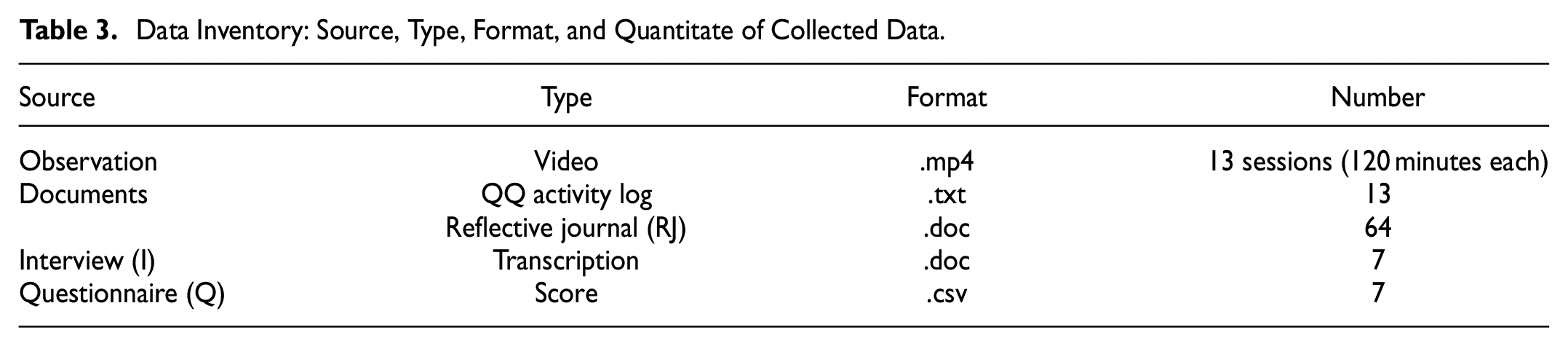
Multiple types of relevant data were collected and analyzed throughout the course (see Table 3).
Data Inventory: Source, Type, Format, and Quantitate of Collected Data.
Participant observation
In this study, the first author adopted a participant as an observer stance. It means that his observer activities, which were known to the group, were subordinate to his role as a participant. After receiving participants’ consent, the classes were recorded using two video cameras and saved in .mp4 format on a portable hard drive. Observations happening inside the classroom and outside (informal communication) were also recorded in the form of field notes/analytical memos or reflective comments that “included the researcher’s feelings, reactions, hunches, initial interpretations, speculations, and working hypotheses” (Merriam & Tisdell, 2015, p. 151). Observational data were used to keep track of student performance as discussion leaders in and outside the classroom during their preparation. Videos were used to supplement participant observation for the purpose of validating and extending the interpretations of in-person observations.
Documents
Two sets of documents were collected during this study. The first set is QQ Activity Logs, which recorded the activity and contributions of each participant in an online learning environment based on a group in a Chinese messenger QQ. The log was extracted each week; it was saved in a .txt format on a portable hard drive. The second set consisted of reflective journals each student submitted within 24 hours after each class. Before collecting reflective journals, the participants signed a consent form to give their permission to use reflective journals in research. The documents helped us capture the learning process in motion and observe how participants responded to and performed in a partnership learning environment.
Interview
Interview data were collected via semi-structured interviews using an instrument consisting of broad, open-ended questions; the questions were designed to investigate participants’ experiences as discussion leaders and their attitudes toward such practice. The interviews ranged from 20 to 30 minutes, in person, face-to-face—they were arranged as debriefing sessions after discussion leader activities. With the participants’ consent, interviews were recorded using two devices (voice recorder and laptop) and transcribed verbatim using the Google Talk feature. The course instructor also was interviewed at the end of the course. The questions of his semi-structured interview aimed at investigating the students as course co-creators’ design, implementation and evaluation (see Supplemental Appendix B for Interview Guides).
Questionnaire
The survey was used to understand better individual students’ perceptions of the course design in terms of its cultural responsiveness. The instrument was designed drawing on the Ginsberg and Wlodkowski’s (2009) Motivational Framework of Culturally Responsive Teaching discussed above and consisted of four sub-scales: Inclusion—14 items (EI 1–14); Attitude—12 items (DA 1–12); Meaning—8 (EM 1–8); Competence—12 (EC 1–12) (see Supplemental Material). For all questions, we used a classical five-point Likert scale ranging from Strongly Disagree to Strongly Agree. The questionnaire was distributed at the end of the course after getting participants’ consent. The results were recorded using SPSS software.
Data Analysis
Drawing on mixed-methods study tradition (Creswell, 2011; Yin, 2003), both qualitative analysis (of interviews, observations, and document data) and quantitative analysis (of questionnaire data) were conducted, with both analyses informing each other.
Qualitative data analysis
An overall inductive and comparative analysis strategy was used to analyze transcribed interviews, observation notes, activity logs and reflective journals (Merriam & Tisdell, 2015). The constant comparative method was employed for data coding. Drawing on Creswell (2011), the coding process included labeling the segments with codes, examining codes for overlap and redundancy, and collapsing these codes into themes. Following Saldaña (2012), three coding methods were employed: descriptive, values, and evaluation coding (see Table 4). The descriptive coding decision was based on the conceptual framework for the study: conditions of culturally responsive teaching (inclusion, meaning, disposition, and competency).
Qualitative Data Coding Sample.

The values coding was used to capture participants’ values, attitudes, and beliefs. By values, we understand the importance people attribute to someone or something, attitudes—the way people think and feel about someone or something, beliefs are part of a system that includes attitudes and values, plus personal opinions, knowledge, experiences, and prejudices. The evaluation coding was used to capture participants’ evaluation of discussion leader experiences. It consisted of magnitude coding (to note whether the participant makes a positive [+] or negative [−] comment) and in Vivo or thematic coding (for specific qualitative evaluative comments). NVivo qualitative analysis software was used to analyze video data. The analysis was done after each lesson. Videos were coded using a descriptive coding method discussed in this section (see Figure 2). The results of video analysis were used for validating and extending the interpretations of in-person observations. It also guided the follow-up interviews by providing probe questions related to participants’ in-classroom discussion management.

Video data analysis sample using NVivo: codes and annotations (lesson on computer-supported collaborative learning)
Quantitative data analysis
Quantitative data (questionnaire) were analyzed employing descriptive statistics that provided students’ overall evaluation of cultural responsiveness of the course. There are two competing views on the nature of Likert scales in the literature. One camp of scientists drawing on theoretical assumptions argues that Likert scales are ordinal; thus, using mean (standard deviation) and other parametric tests is inappropriate (e.g., Jamieson, 2004; Kuzon et al., 1996; Stevens, 1946). However, empirical evidence validates the robustness of parametric statistics for Likert scales that produce empirically interval data (e.g., Carifio & Perla, 2008; Pell, 2005; Sullivan & Artino, 2013; VanderStoep & Johnston, 2009; Wadgave & Khairnar, 2016). It is also true for the sample size as small as five per group (Murray, 2013; Norman, 2010). Thus, this study combines two approaches and reports the median (standard deviation) for central tendency and mode to indicate the most frequently provided responses.
Validity and Reliability
Following Merriam and Tisdell (2015) and Patton (2001) validity and reliability of the study have been addressed in four ways: data triangulation, investigator triangulation, methodological triangulation, and member check and peer-review. For data triangulation, several different data sources were used: course instructor, students and participant researcher. For investigator triangulation, two researchers were involved in the analysis process. Coding was conducted independently, and the findings were compared and discussed to develop a broader and deeper understanding. For methodological triangulation, this mixed study employed qualitative and quantitative methods of data collection (observation, interviews, documents, questionnaire) and analysis (coding, descriptive statistics). Finally, for member checks and interpretive validity, interpretations and findings were introduced to the participants who were asked to check their plausibility.
Results
Quantitative Results
Despite the small sample size, descriptive statistics of four culturally responsive teaching domains showed that the participants agreed that the course was culturally sensitive (see Table 5, Supplemental Appendices C–F). Among these four domains, Engendering Competence turned out to be the most prominent, which means the course helped the participants understand that they became more effective in learning. Talking about individual items, participants particularly noticed the practical nature of the course (EC12, M = 4.43, SD = 0.535), its relevance to the real world (EC8, M = 4.43, SD = 0.535) and the freedom to choose the most appealing content (DPA7, M = 4.29, SD = 0.488). They also stressed the sense of connectedness in the learning community when the members have opportunities to learn about each other (EI2, M = 4.43, SD = 0.535) and help each other (EI12, M = 4.29, SD = 0.488). The least prominent items belong to two domains: establishing inclusion and developing a positive attitude. First of all, the expectations from the students were not conveyed clearly: the rules the participants should follow (EI4, M = 3.29, SD = 0.756), the consequences for violating it (EI5, M = 2.86, SD = 690) and the ways of their learning assessment (DPA10, M = 3.29, SD = 756). Another two items represent a divided opinion on whether the teacher interacted respectfully with all the students (EI8, M = 3.14, SD = 1.069) and directed his attention equally (EI7, M = 3.29, SD = 1.254). These items have the highest standard deviation from the whole set. Moreover, against the background of the prevailing mode of agree, EI7 is the only item with the mode of disagree. Therefore, despite the overall positive results, each domain represented a range of opinions and attitudes that were sometimes rather contradictive. Below, we analyze each area in detail and draw on debriefing interviews, classroom observations, and students’ reflective journals to present the most important findings related to each domain of culturally responsive teaching.
Culturally Responsive Teaching Domains Descriptive Statistics.

Qualitative Results
Establishing inclusion domain
Discussion-based approach promoted inclusion and contributed to the growth of a community of learners who felt connected and respected by others
All the participants attached great importance to teamwork and collaboration in overcoming challenges and achieving success. This section illustrates two questionnaire items with the most agreement: how participants learned about each other (Q, IE2) and helped each other (Q, EI12). Being a part of a multicultural community of learners was a “wonderful” (RJ6, Ebo), “positive” (I, Ali), “productive” (RJ7, Zara), and “effective” (RJ1, Gul) learning experience as Gul stated, “I have learned how to work collaboratively. Because mostly we worked as a team. I wasn’t capable of doing all these things. But you [primary researcher] worked with me and cooperated, so I accomplished this task” (I, Gul).
In-classroom discussions were “very interactive” (RJ1, Gul) and “involved every student to participate” (RJ1, Ilma). Thus, students and the course instructor had opportunities to get to know each other better (RJ4, Ebo; RJ1, Ali; RJ7, Ilma). Besides, the connectedness was strengthened by establishing a respectful learning environment (RJ1, Ebo). Furthermore, the course instructor set an example by showing a “positive attitude” (RJ10, Gul) to students’ work and appreciating their efforts (RJ6, Ebo; QQL11, QQL7) and demonstrating “empathy toward each class member” (RJ12, Zara).
Differences in attitudes toward cultural diversity defined students’ performance and engagement in the course
Despite the overall positive evaluation of cooperative experiences, students held different opinions about the group’s cultural diversity. For example, the success of collaboration was defined by “cultural compatibility” as Asli, a Pakistani female student who preferred to work with her compatriots and use Urdu, noted, “it depends who your partner is. If it’s not balanced, you can lose your time and energy, it may be difficult to come to an agreement” (I, Asli). Such disbalance or “differences in the initial levels and experiences” (RJ10, Dima), especially in terms of academic abilities when “you can see the difference in the level of knowledge” (I, Ilma), were quite apparent and shaped the learning environment where people behaved differently based on their attitude.
The course instructor perceived such stratification in a positive way when “opinion leaders” were supposed to be “the role model” (I, Yifu). Similarly, some participants (I, Ilma; I, Gul; RJ1, Gul) also viewed differences as learning opportunities. For instance, Gul, a Pakistani female student who admitted personal drawbacks and was open to working with classmates from different cultures, noted, “I tried to learn from people who are above me, and I tried to learn from people who are below me” (I, Gul). However, some participants (Ali from Yemen and Asli from Pakistan) perceived it as a threat that affected their self-esteem, so they felt “jealous” (I, Ilma) and “gave up and didn’t improve themselves, because they felt that they were behind” (I, Gul). So, students’ identities and how they saw and positioned themselves within a diverse community defined the level of engagement in the course. For example, talking about online interaction, Gul, who was not only open to new learning experiences but also was sincere and straightforward during the interview, noticed
I think some students have a fear of sharing knowledge. They don’t want to show that they don’t understand something, so they won’t take the initiative. They think some students dominate in the classroom; they are better and have more knowledge. It should be their responsibility to share knowledge on QQ. (I, Gul)
Interestingly, people from the same culture (Gul, Asli, and Ebo were from Pakistan) responded differently to the abovementioned situation. Therefore, as some participants mentioned, “culture doesn’t matter” (I, Ilma; I, Ebo), and it “can be a misconception of the students that create some tensions” (I, Gul). So they tend to perceive the teacher’s overall high academic demands as if he directed attention unequally among students (Q, EI7) or didn’t interact respectfully with all students (Q, EI8). However, it may be partially true since the course instructor wanted to give students “the feeling of high standards that Chinese professors also have quality and can graduate students with high standards” (I, Yifu). Therefore, he set “higher [academic] targets for the students who were lagging behind” while their inner conflicts and hidden misconceptions remained unaddressed. Unfortunately, as a result, these issues affected students’ performance and attitude toward the course experience discussed above.
Online platform extended inclusion outside the classroom
Inclusion was also established by employing an online learning environment based on a Chinese messenger QQ. The QQ group became a place for exchanging ideas and opinions (RJ7, Ebo), motivating each other (I, Ilma), as well as holding online discussions (RJ4, Zara). In addition, it was a tool for sharing resources, links, and materials. (RJ4, Ebo; RJ8, Ali). The platform extended the learning environment so that “learning does not merely occur in the classroom” (RJ7, Gul), and students could “interact and communicate after the class” (RJ5, Gul). For instance, incorporating the online dimension as an essential part of the learning environment gave Zara, who was absent due to health issues, an opportunity to participate in and contribute to classroom discussion via QQ (RJ1, Gul; RJ1, Dima).
Technology literacy and cultural values affected the quality of online discussion (interaction)
Despite the benefits of using an online platform, “managing” (I, Ali) and participating in online discussions was a “difficult” (I, Asli) and “challenging” (I, Zara) task for the participants who were “struggling with the QQ activity” (I, Ebo). The social media chat logs analysis showed that the intensity of online activity and the quality of online discussions were not satisfactory. Students mainly shared their part of an assignment and didn’t interact or engage in conversation with their classmates (RJ3, Zara). Interviews revealed two reasons for low online activity. The first was around personal attributes such as “technology sometimes needs skills” (I, Ebo) or “personal learning ability” (RJ3, Zara). However, other participants (Asli and Gul, two female Pakistani students) argued that digital competency is rooted in cultural background. For example, Asli noted that in her country, “people don’t think it’s a good thing to use social media. Especially for girls. People don’t know that we can use it for good, in a positive way” (I, Asli).
Developing a positive attitude domain
Discussion leader learning experience developed positive attitude by resorting to learners’ volition and promoting personal relevance
By taking on a teacher’s role, students were encouraged to make real choices. They had “freedom to manage the class” (I, Ebo) and prepared and delivered classes based on their “personal thinking and abilities” (I, Asli). Each discussion leader chose a “useful” (RJ1, Ali), “challenging” (RJ11, Gul) topic that was the most “relevant to his/her interests” (RJ5, Ebo) and “important” (RJ6, Zara) for their future career as teacher educators. Thus, the participants put lots of value on the freedom to choose the most appealing content (Q, DPA 7) and how to present it. As course co-creators, students followed the course instructor’s example and tried to personalize the relevance of course content through anchoring experience routine (I, Ebo). They checked the students’“background knowledge and their expectations” (RJ1, Gul) and promoted “sharing of personal experience” (I, Asli). As the course instructor described, the main objective of the learning sciences course was to “change perspectives, paradigm change” (I, Yifu) of students so that they could start looking at teaching, learning and education from students’ perspectives and hear their voices. So, the course design not only encouraged students to “develop and express different points of view” (RJ1, Ilma) but also led to a more profound understanding of others (I, Ali). Discussion leaders realized that within a diverse environment, every person has a “different meaning, different perception, different thinking” (I, Asli). So it was necessary to “consider all these differences in the activity design” (I, Ebo), “adjust your style” (I, Ali) to “encourage people from a different culture” (I, Gul) and “connect others personal experience to the topic” (I, Zara).
Enhancing meaning domain
Engagement into challenging learning took students out of their comfort zone
Discussion leader learning experience engaged participants in challenging, “tough” (I, Gul) learning that sometimes was “beyond their expectation” (I, Ebo) and stood out from other approaches students experienced before (RJ9, Gul, I, Ilma). As Gul noted
Some people ask me what the professor teaches you. I say that he teaches nothing, but he involves us to dig for knowledge, construct knowledge. He is not a typical type of teacher. His teaching is totally different. (I, Gul)
All participants must appropriately prepare to learn, apply, create, and communicate knowledge (I, Ali; I, Ebo; I, Ilma, I, Zara). Rigorous preparation involved asking themselves high-order questions (I, Ali; I, Gul), “searching and consulting additional sources” (RJ1, RJ9, Gul) and choosing the most relevant information (RJ3, RJ7, Zara). So, the course turned out to be a challenging endeavor and a “big responsibility” (I, RJ5, Ilma) since students had to “act like a teacher” (I, Gul). As Zara, a Moroccan female student who did not have any actual teaching experience, noted at first for her “designing a course was something related only to professors.” So, she was afraid that she “couldn’t prepare appropriately in a scientific and academic way” (I, Zara). However, not everyone was ready for such learning, that “turned out to be quite difficult” (I, Ilma) and “overwhelming” (I, Ali). So, it positioned some students outside their “explain more and ask less” (I, Asli) comfort zone. Therefore, in-classroom discussions sometimes remained “very general, not to the point or specific context” (I, Ilma), “too shallow and not rigorous” (I, Ebo). Observations recorded by the primary researcher in the process of cooperation with discussion leaders (RJ8, RJ9, Dima) as well as debriefing interviews (Ali, Gul, Asli, Ilma and Zara) revealed that the level of proficiency of the language of instruction was the main factor of poor preparation. Some students even struggled with compulsory reading because of language issues (I, Zara). Lack of language proficiency coupled with the professor’s high demands and expectations (I, Gul) when he didn’t have “a full understanding of each class member’s language capability” (I, Yifu) also affected the way in-classroom discussions were held. As Asli, a Pakistani female student who avoided intercultural interaction and preferred a passive consumption of knowledge to active participation in knowledge construction, described
I’m not too fluent in English, and my vocabulary is limited. Sometimes I have an idea or knowledge, but I don’t know how to convey it. It’s challenging to present my point of view in front of my teacher or classmates. (I, Asli)
Another decisive factor that hindered students’ performance within a challenging learning environment was time (RJ7, Ali; I, Gul). It affected and students’ preparation for the class, for example, “complete compulsory reading” (I, Ali) or “look for extra materials” (RJ9, Zara), and in-classroom discussions where time was “limited and was not effectively managed” (RJ11, Zara). Engagement in challenging learning not only “requires more time” (I, Ebo) but also a “strict time management plan” (RJ2, Ebo) or, in other words, good time management skills.
Acknowledging the students’ difficulties, the course instructor provided support to ensure their success. He shared extra materials with them (I, Ali) and took on the leading role in the classroom when necessary (RJ9, Gul). At the same time, such an attitude was perceived by some students as extra caring, as Ebo, a mature and experienced Ethiopian teacher, noted
Sometimes people need to manage some issues independently. We are doctoral students. Because we are international students, teachers are not too strict with us, but it shouldn’t be like that it’s a PhD level program. We’re going to be Doctors of Philosophy; it’s a big rank. (I, Ebo)
To sum up, four factors influenced students’ performance within a high-demand learning domain of culturally responsive teaching: time constraints, challenging practice, actual students’ competency (needs on different levels, e.g., language), and the level of support provided (from students’ autonomy to direct guidance).
Engendering competence domain
Authentic discipline practices promoted learning effectiveness and developed students’ professional identity
Being a co-creator of the course, first of all, was associated with “putting theory into practice” (RJ1, Ilma) and the ways of “applying theories and concepts to solve real-world problems” (RJ5, Ebo). It corresponded to the questionnaire items with the most agreement that highlighted the practical nature of the course (Q, EC12) and its relevance to the real world (Q, EC8). As Zara mentioned, “it was so practical. So, the core thing I’ve learned from this course is that you need to go to practical things rather than theory” (I, Zara). It reflects the course instructor’s intentions, who stressed that “we are not just learning theories we are feeling these theories” (I, Yifu). Besides, the course design created opportunities for students to explicitly connect their learning experiences to the authentic reality (RJ2, Ilma, I, Gul, RJ8, Zara) and their future academic careers (RJ2,10, Ebo). Such opportunities occurred during class discussions (RJ1, Ebo; RJ1, Ilma) but mainly through reflective journals that were used to self-assess learning as a part of a learning community (RJ3, Zara) or to reflect on their development as learners (I, Gul; RJ8, Gul). Apart from students’ reflections, the course instructor also helped them to realize their accomplishments by continually providing “timely” (RJ8, Gul), “interesting” (RJ7, Zara) and “constructive” (RJ2, Ebo) feedback on individual growth and progress through the channel of reflective journals or via the online platform, so students “compared to themselves were making progress” (I, Yifu). Discussion leader experience enhanced students’ professional practical skills and developed their identities as “instructors” (RJ9, Ilma), “teacher educators” (RJ7, Zara), and “educational leaders” (RJ3, Zara) since the course design “simulated a faculty member’s responsibility” (I, Yifu). As Ilma, a mature female Pakistani student who before was involved only in academic management but planned to go for teaching after graduation, mentioned, “I think it would help me to improve my style as an instructor or leader. I’ve learned a lot of practical points from the course I will apply them in my practical life” (I, Ilma).
Discussion and Conclusion
The study results showed that students as co-creators course design might be responsive to multicultural educational contexts. In addition, the discussion leader learning experience contributed to developing a community of learners, promoted personal relevance, engaged participants in challenging learning and brought authenticity into the process.
Regarding course design, four factors framed culturally responsive teaching within a partnership learning environment: time constraints, challenging practice, actual students’ competency and the level of support provided. Among them, “time” was assumed in previous studies (Bovill et al., 2011) as “the most important element in the success” (p. 136) of co-creators course design. However, our results highlighted the interconnectedness of factors that should be considered while designing a culturally responsive learning environment (see Figure 3). The interplay of four factors should guide teachers in developing the most effective culturally responsive learning environments. Moreover, the involvement of students in course design requires fine-tuning the parameters mentioned above. Thus, we propose that further research should investigate how to find boundaries of individual students’ capabilities to set reasonable demands and how it relates to the program’s minimum requirements (for instance, the threshold level of performance expected from international doctoral students). That all leads to the need to improve the student recruitment procedures and establish better student selection mechanisms.

Four interconnected factors to consider in designing culturally responsive teaching within a partnership learning environment.
Regarding the differences in international students’ perceptions of the course, our study revealed that international students’ programs bring together people who are different in terms of culture and across a range of other aspects. And sometimes other factors prevail over cultural differences, as Ebo mentioned in her interview, “culture doesn’t matter.” Therefore, our results differ to some extent from those of Popov et al. (2014), who argued that individualist–collectivist cultural background plays a critical role in collaborative learning. So our study contributes to the existing discussion of the appropriateness of using Hofstede’s national cultural framework within an educational context (e.g., Dennehy, 2015; Ess & Sudweeks, 2005). As Hofstede (1984) warned himself, researchers should be careful not to confuse national culture with other levels of culture. So, it is essential, especially in international education, to understand the difference between culture, individual character, and human nature. It could be one of the potential directions for future research since, as Hofstede et al. (2010) noticed, “where the borders lie between nature and culture, and between culture and personality, is a matter of discussion among social scientists” (p. 6). Thus, it seems that “personal” culture is central to designing culturally responsive courses and programs for international doctoral students. The study revealed three interrelated factors that defined the effectiveness of collaboration within a multicultural environment: language proficiency, academic ability, and personal attitude. Students’ perceptions of and performance in the course were rooted in these three areas (see Figure 4). These findings are consistent with other studies on various culturally diverse groups within higher education. Previous works emphasized language abilities and academic readiness as crucial factors that could challenge the implementation of CRT (e.g., Hutchison & McAlister-Shields, 2020; Kimmel & Volet, 2012; Trice, 2004). However, our study additionally advocates that it’s not only the differences in language proficiency and academic competency in itself that determine how students perform within a partnership learning environment but their attitude to such differences and personal positioning within a diverse environment.

Three interrelated factors that define the effectiveness of collaboration within a culturally responsive learning environment.
Therefore, students falling behind in one of these aspects require skillful pedagogical practices that would encourage and support their development and foster their autonomy. Walking the talk is not always enough to provide a framework/guidance for independent work. It requires more explicit explanations and more clearly designed criteria. Students often need direct instruction and scripts to develop and apply collaboration skills and become active learning community members. Therefore, the dilemma between students’ personal needs and expected requirements must be addressed within China’s international degree programs.
Our research only focused on a few international doctoral students in China. So, it might be essential to cover a variety of postgraduate programs and include other degree students as well. It would lead to a greater understanding of the phenomena of culturally diverse education context in China. Nevertheless, as mentioned in the introduction, the current study is one of the first to respond to the challenges of the fast internalization and change of the educational landscape in China when instructional designers and educators must design learning environments responsive to cultural diversity. The study showed the effectiveness of students as co-creators course design in catering to cultural differences and enhancing learning outcomes based on socio-constructivist principles. The results of this study would benefit other degree programs and could be applied to course design and curriculum development for international degree students.
Supplemental Material
sj-docx-1-sgo-10.1177_21582440221145914 – Supplemental material for Students as Co-Creators: Bringing Culturally Responsive Teaching into a Doctoral Course for International Students in China
Supplemental material, sj-docx-1-sgo-10.1177_21582440221145914 for Students as Co-Creators: Bringing Culturally Responsive Teaching into a Doctoral Course for International Students in China by Alexey Androsov and BaoHui Zhang in SAGE Open
Supplemental Material
sj-docx-2-sgo-10.1177_21582440221145914 – Supplemental material for Students as Co-Creators: Bringing Culturally Responsive Teaching into a Doctoral Course for International Students in China
Supplemental material, sj-docx-2-sgo-10.1177_21582440221145914 for Students as Co-Creators: Bringing Culturally Responsive Teaching into a Doctoral Course for International Students in China by Alexey Androsov and BaoHui Zhang in SAGE Open
Supplemental Material
sj-docx-3-sgo-10.1177_21582440221145914 – Supplemental material for Students as Co-Creators: Bringing Culturally Responsive Teaching into a Doctoral Course for International Students in China
Supplemental material, sj-docx-3-sgo-10.1177_21582440221145914 for Students as Co-Creators: Bringing Culturally Responsive Teaching into a Doctoral Course for International Students in China by Alexey Androsov and BaoHui Zhang in SAGE Open
Supplemental Material
sj-docx-4-sgo-10.1177_21582440221145914 – Supplemental material for Students as Co-Creators: Bringing Culturally Responsive Teaching into a Doctoral Course for International Students in China
Supplemental material, sj-docx-4-sgo-10.1177_21582440221145914 for Students as Co-Creators: Bringing Culturally Responsive Teaching into a Doctoral Course for International Students in China by Alexey Androsov and BaoHui Zhang in SAGE Open
Supplemental Material
sj-docx-5-sgo-10.1177_21582440221145914 – Supplemental material for Students as Co-Creators: Bringing Culturally Responsive Teaching into a Doctoral Course for International Students in China
Supplemental material, sj-docx-5-sgo-10.1177_21582440221145914 for Students as Co-Creators: Bringing Culturally Responsive Teaching into a Doctoral Course for International Students in China by Alexey Androsov and BaoHui Zhang in SAGE Open
Supplemental Material
sj-docx-6-sgo-10.1177_21582440221145914 – Supplemental material for Students as Co-Creators: Bringing Culturally Responsive Teaching into a Doctoral Course for International Students in China
Supplemental material, sj-docx-6-sgo-10.1177_21582440221145914 for Students as Co-Creators: Bringing Culturally Responsive Teaching into a Doctoral Course for International Students in China by Alexey Androsov and BaoHui Zhang in SAGE Open
Supplemental Material
sj-docx-7-sgo-10.1177_21582440221145914 – Supplemental material for Students as Co-Creators: Bringing Culturally Responsive Teaching into a Doctoral Course for International Students in China
Supplemental material, sj-docx-7-sgo-10.1177_21582440221145914 for Students as Co-Creators: Bringing Culturally Responsive Teaching into a Doctoral Course for International Students in China by Alexey Androsov and BaoHui Zhang in SAGE Open
Footnotes
Acknowledgements
The authors are very grateful to all the participants who cooperated in all the stages of this research.
Declaration of Conflicting Interests
The author(s) declared no potential conflicts of interest with respect to the research, authorship, and/or publication of this article.
Funding
The author(s) received no financial support for the research, authorship, and/or publication of this article.

Supplemental Material
Supplemental material for this article is available online.
Data Availability Statement
The data that support the findings of this study are available from the authors upon reasonable request.
References
Supplementary Material
Please find the following supplemental material available below.
For Open Access articles published under a Creative Commons License, all supplemental material carries the same license as the article it is associated with.
For non-Open Access articles published, all supplemental material carries a non-exclusive license, and permission requests for re-use of supplemental material or any part of supplemental material shall be sent directly to the copyright owner as specified in the copyright notice associated with the article.
