




Abstract
The purpose of the present study was to identify the effect of different variables on the locus of control of secondary school students. About 520 students participated in the study. Brown Locus of Control Scale (BLOCS) was used to assess the internal, external social, and external other loci of control of students. The t-test and ANOVA were applied to find out the difference in locus of control of students of different gender, age, grade level, subjects, and family income. Results revealed that external social and external other loci of control of female students were significantly higher than the male students. External other locus of control of younger age group (12-to-14-year) and lower grade level (9th) students was significantly higher than the students of older age groups (16-to-17 and 18-to-19-year-old) and higher grade level (10th) students. Internality and other externality of arts group students were significantly higher than the science group students. Family income was found to have significant effect on external social locus of control. However, the effect was not decisive as social externality of students of only one low-income group was significantly higher than the students of a high family income group.
Keywords
Introduction
The degree to which a person perceives personal control over his or her life events is known as locus of control. This concept is derived from the Rotter’s Theory of Social Learning.
Researchers from psychology and teacher education study this personality dimension. Rotter (1966) categorized locus of control as internal or external. Those who attribute outcomes to their own effort or other internal factors, feel a personal control over life events, and believe that their actions and behaviors determine outcomes have internal locus of control. On the contrary, those who attribute the results to the situation, fortune, or other external factors, and believe that chance, fate, or powerful others are responsible for the events or outcomes, have external locus of control. Internality refers to the belief that the rewards are under the persons’ control, while externality refers to the belief that rewards are determined by luck and not in one’s control (Rotter, 1966). Internals believes in their efforts, actively seek knowledge and information regarding the situation, do control their behavior and affect other people as well (UKEssays, 2015). They engage in healthy and deliberate activities and behaviors to get desirable results. Individuals with an external locus of control cannot perceive the connection between their actions and the consequences, so they engage in maladaptive behavioral patterns that become self-fulfilling (Rotter, 1966).
Locus of control represents a dynamic continuum from internal to external. It is a stable psychological construct. When individuals pass through novel situations, they behave in a consistent manner with respect to their locus of control (Rotter, 1966). Brown (1990) divided external locus of control into further two categories: External social and external others. Hence, in addition to internality and powerful others externality, Brown introduced conceptually a new dimension referred to as external social locus of control, which means that the individual feels controlled by friends, work, and other social groups and interactions. External other locus of control means that the person feels controlled by chance, luck, or any other abstract authority (Brown, 1990).
Academic success, and effective study habits and attitudes are positively related with internal locus of control (Prociuk & Breen, 1974). Students who attribute their success to internal factors rather than external factors demonstrate better academic achievement (Crandall, Katkovsky, & Crandall, 1965; Kaiser, 1975). Furnham and Cheng (2017) found a strong relationship between intelligence and internal locus of control. More intelligent children of age 10 have more instrumental internal locus of control at age 16, which is a strong predictor of educational success. Locus of control is also a predictor of adult financial well-being for both genders (Furnham & Cheng, 2017). According to Sayın (2000), persons with internal locus of control are creative, more effective in reaching their goals, and are more successful in academics and interpersonal relations. Locus of control and cognitive development are also related with each other. Abstract cognitive reasoning is related to internal and concrete cognitive reasoning is related to external locus of control (Shute, Howard, & Steyaert, 1984). Pannells and Claxton (2008) found happiness and internal locus of control to be positively related. On the other hand, persons who attribute outcomes to the external factors are more likely to experience depression (Costello, 1982; Rotter, n.d.).
Locus of control is significantly affected by various variables like family status, education, and professional activity. Most retirees, persons on high positions, employees, and workers were found to have internal loci of control whereas the jobless, self-employed, university students, and secondary school students were found to have external loci of control (Angelova, 2016).
The dispositions of internal and external loci of control are developed during childhood (Lynch, Hurford, & Cole, 2002). Previous studies regarding the internal and external loci of control of boys and girls have inconsistent findings. Serin, Serin, and Sahin (2010) found that the male students have a higher internal locus of control whereas Ghazvini and Khajehpour (2011) found that the females have a higher internal locus of control. No significant difference in the external locus of control of boys and girls was found by Ghazvini and Khajehpour. However, Sherman, Higgs, and Williams (1997) found that females are more external than males and attribute interpersonal relationships and life experiences to external factors.
Sagone and De Caroli (2014) found that the late adolescents have more internal locus of control than the middle adolescents, and the middle adolescents have more external locus of control than the late adolescents. Hence, internality of the adolescents is improved and externality is reduced as they move from middle to late adolescence.
Level of education also changes the locus of control. Education helps the persons to identify their potential and responsibility, and they learn to believe in themselves. External locus of control was found in people with elementary and secondary level whereas internal locus of control was found in persons with college and higher education (Angelova, 2016). Sagone and De Caroli (2015) found that the mean scores of internal locus of control of university students were greater than those of external locus of control, and they believe that the life events are under their control rather than under the effect of luck.
Persons who have external locus of control see the money as a source of power and use the money as a tool for evaluation than the persons who have internal locus of control (Lim, Teo, & Loo, 2003). Previous findings regarding the locus of control of people of various income groups are inconsistent. Tayfun (2005) did not find a meaningful relationship between monthly expenditure of the students and their locus of control. Maqsud and Rouhani (1991) found socioeconomic status and internality to be significantly positively associated with each other. They found that the students with high income level have more inner control than the students with low- and middle-income level. Serin et al. (2010) found that the students with medium socioeconomic level have external and students with high socioeconomic level have internal loci of control.
Objectives of the Study
The present study aimed at identifying the effect of gender, age, grade level, subjects, and family income on the internal, external social, and external other loci of control of secondary school students.
Hypotheses
Method
The population of the study was the secondary school students. The sample of the study was 520 secondary level students selected from three public sector schools of Lahore. Brown Locus of Control Scale (BLOCS; Brown, 1990) was used in the study. BLOCS comprises 25 items, nine assessing internal, nine assessing external social, and seven assessing external other loci of control. Reliabilities of the subscales reported by Brown (1990) were 0.74 for internal, 0.71 for external social, and 0.66 for external other factor of the scale. Data were collected on a 6-point Likert scale.
Results
Mean scores and standard deviation of the statements related to internal, external social, and external other loci of control are presented in Table 1.
Internal, External Social, and External Other Loci of Control of Students.
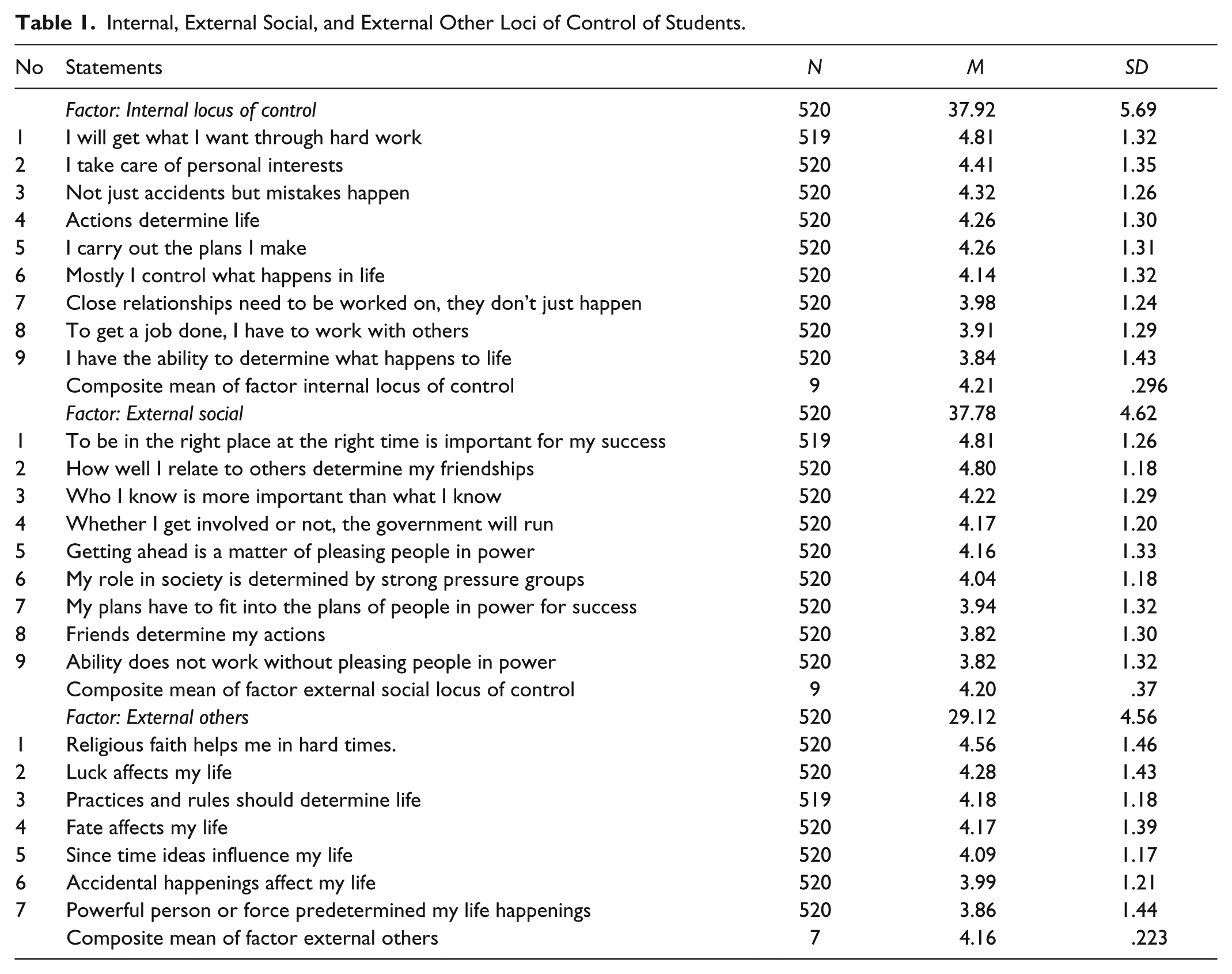
Table 1 shows that the secondary school students have fairly good level of internal (M = 4.21, SD = .296), external social (M = 4.20, SD = .37), and external other (M = 4.16, SD = .223) loci of control. In the present study, it may be seen that internality, social externality, and other externality are almost at the same level for the sample selected.
Independent sample t-test was administered to identify the effect of gender, grade, and subjects. Table 2 presents the effect of these three variables on the internal, external social, and external other loci of control.
Internal, External Social, and External Other Loci of Control of Students of Different Gender, Grade, and Subjects.

Note. *p < .05, **p < .01 and ***p < .001.
Table 2 shows that the females have significantly higher external social (M = 37.97, SD = 4.48) and external other (M = 29.34, SD = 4.55) loci of control as compared to the external social (M = 35.58, SD = 5.64), t(518) = 3.178, p = .002, and external other (M = 26.52, SD = 3.82), t(518) = 3.798, p < .001 loci of control of boys. Boys and girls were not found to be significantly different on the internal locus of control (t(518) = 1.203, p = .229) . Table 2 also reveals that the students of Grade 9 have significantly higher external other locus of control (M = 29.33, SD = 4.84) than the students of Grade 10 (M = 28.48, SD = 3.50), t(297.595) = 2.148, p < .05, which shows that the other externality is being reduced with the progress in grade. Table 2 also shows that the arts group students have significantly higher scores in internal (M = 38.76, SD = 5.32) and external other (M = 29.93, SD = 4.78) loci of control than the internal (M = 37.08, SD = 5.93), t(517) = 3.387, p = .001 and external other (M = 28.30, SD = 4.16), t(502) = 4.140, p < .001 loci of control of science group students.
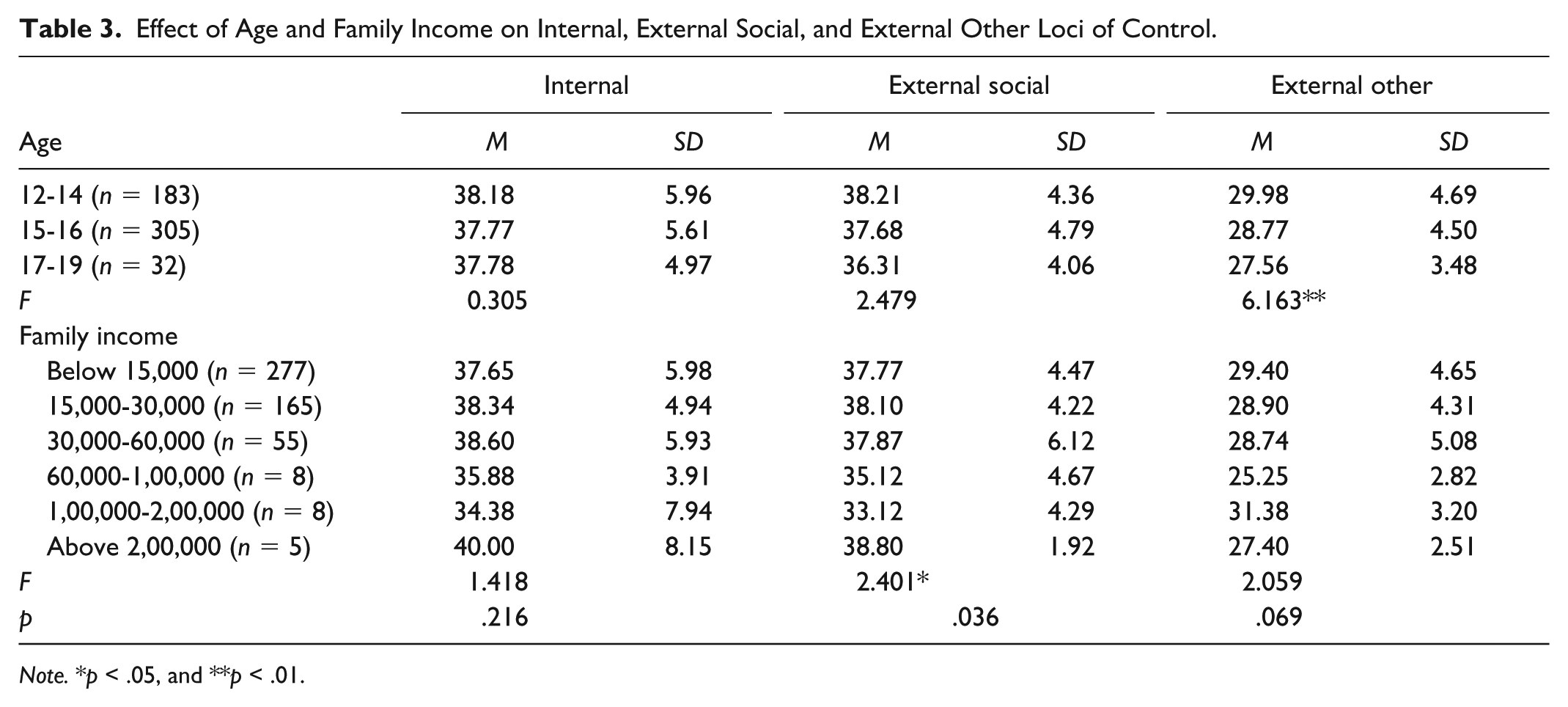
ANOVA was applied to identify the effect of age and family income on the internal, external social, and external other loci of control of students. Table 3 shows the results regarding the effect of age and family income on the three types of loci of control of students.
Effect of Age and Family Income on Internal, External Social, and External Other Loci of Control.
Note. *p < .05, and **p < .01.
Table 3 shows that age has an effect on the external other locus of control of students. The Tukey HSD post hoc test revealed that the students of age group 12-to-14 (M = 29.98, SD = 4.69) have significantly higher external other loci of control than the students with age group 15 to 16 (M = 28.77, SD = 4.50) and 17 to 19 (M = 27.56, SD = 3.48), F (2, 517) = 6.163, p < .01.
Table 3 shows that family the income significantly affected the external social locus of control of students. Tukey HSD post hoc test revealed that the students with family income Rs. 15,000 to 30,000 have significantly higher external social loci of control (M = 38.10, SD = 4.22) than the students with family income Rs. 100,000 to 200,000 (M = 33.12, SD = 4.29), F (5, 512) = 2.401, p < .05.
Discussion
Results of the present study showed that there was no significant effect of gender on the internal locus of control. However, gender significantly affected the external social and external other loci of control. External social and external other loci of control of female students were significantly higher than those of the male students, which shows that the female students are more external. They are more inclined to please others and to get social approval as compared with male students. Moreover, they consider luck and fortune more important than the male students. Results of the present study regarding the external locus of control are in line with findings of Sherman et al. (1997), who found that the females are more external than males.
Results showed that there was no significant effect of age and grade level on the internal and external social loci of control. However, age and grade level have significant effect on External other locus of control. External other locus of control of younger age group 12-to-14-year-old students was significantly higher than that of the students of older age groups 16-to-17 and 18-to-19-year-old. Similarly, external other locus of control of the students of younger grade level 9 was significantly higher than that of the higher grade level 10, which shows that the younger students and students in lower grade level give more importance to the external other factors such as luck than the elder students and students of higher grade level. Other externality is decreased with the progress in grade level and age. These results support the finding of Sagone and De Caroli (2014) that externality is reduced as middle adolescents move to late adolescents.
Results showed that there was no significant effect of subjects on the external social locus of control. However, subjects have significant effect on the internal and external other loci of control. Internal and external other loci of control of arts group students were significantly higher than the science group students. It shows that arts group students consider both internal factors like ability as well as external other factors like luck and situation responsible for their life events may be including subjects’ selection. However, both groups were not significantly different with respect to the susceptibility of the social pressures.
Results showed that family income did not significantly affect the internal and external other loci of control. However, it has a significant effect on external social locus of control. Student who belong to the families whose income is Rs. 15,000 to 30,000 have significantly higher external social locus of control than the students who belong to the families whose income is Rs.100,000 to 200,000. Serin et al. (2010) found that students with medium socioeconomic level have more external loci of control. In the present study, students belonging to a low income group have significantly more social externality than those belonging to a high income group. With respect to family income, there were six groups, and significant difference was found only in one pair, so this finding was not decisive.
Conclusion
The study was aimed at identifying the effect of gender, age, grade level, subjects, and family income on the internal, external social, and external other loci of control of secondary school students. Results showed that the gender significantly affects the external social and external other loci of control, age and grade significantly affect external other locus of control, subjects significantly affect internal and external other loci of control, and family income significantly affects external social locus of control. External social and external other loci of control of female students were significantly higher than those of the male students. Hence, the female students were more susceptible to social pressures and they also considered fate and luck more important than the male students. Other externality was significantly decreased from younger age group 12-to-14-year-old students to older age groups 16-to-17 and 18-to-19-year-old students and from lower grade level 9 to higher grade level 10 showing that the younger students and the students in lower grade level consider external other factors like luck and situation more important for their success and failure, and as they get older and move to the next grade level, they consider external other factors less important. Students of arts group were found to have significantly more internality and other externality. Thus, they consider that both internal factors like ability and external other factors like fate and situation determined their life events. Significant effect of family income was found on social externality. It was found that students belonging to the low family income Rs. 15,000 to 30,000 group have significantly more social externality compared with the students belonging to the higher family income Rs.100,000 to 200,000 group. However, there were six groups of family income, and the significant difference was found only in one pair, so this finding was not decisive.
Footnotes
Declaration of Conflicting Interests
The author(s) declared no potential conflicts of interest with respect to the research, authorship, and/or publication of this article.
Funding
The author(s) received no financial support for the research, authorship, and/or publication of this article.
