



Abstract
Climate change, hazards to productive assets, social-related shocks, and land productivity reduction are all likely to make poor households less resilient. In Ethiopia’s highlands, the ability to deal with household resilience against poverty in the face of uncertainty is minimal. In the Goncha district of Ethiopia’s Northwest highlands, the study attempts to identify factors of household resilience to livelihood insecurity under crop-livestock mixed agricultural systems. Face-to-face interviews with 280 households were conducted using a structured questionnaire to acquire primary data. The data were analyzed using descriptive statistics, and structural equation modeling. The results revealed that household resilience to livelihood insecurity was significantly influenced by perceptions of sustainable farming practices, the cultivation of more fertile farmland, savings performance, diversification of income-generating activities, intensification of livestock husbandry practices, access to irrigation practice, and familiarity with practical technologies. Hence, scaling up sustainable farming systems and practical technologies, improving saving habits, increasing income diversification, and intensifying agroforestry are perceived to be significant to increase smallholder household resilience to livelihood insecurity over agroecologies.
Keywords
Introduction
Anthropogenic activities have transformed world ecosystems more widely and exacerbated land degradation in the last 50 years than at any other time in history (Resilience Alliance, 2010). Due to the emission of soil carbon and nitrous oxide into the atmosphere, land degradation is one of the most significant contributors to climate change. It decreases the effectiveness of adaptation choices and makes agroecological systems more vulnerable to climate change (Webb et al., 2017). Millions of subsistence farmers in underdeveloped nations are threatened by land deterioration (Stocking, 2003). This is especially true in Sub-Saharan Africa (SSA), where rapidly rising human populations are reliant on natural resources (soil, water, and vegetation) and face rain-fed agriculture (Pimentel, 2006). The livelihoods of rain-fed agricultural activities are threatened by yield, market, institutional, asset, and financial threats (Chuku & Okoye, 2009). Smallholder families’ livelihood vulnerability in Sub-Saharan Africa is high due to creative investments that aren’t focused on adapting to land degradation and climate variability-induced uncertain production. In many areas of Eastern Africa, the food security and climate resilience of local communities are greatly impacted by severe soil degradation and diminishing land productivity (Kiteme & Ehrensperger, 2015).
The consequences of common disturbance shocks and risks, such as land degradation, climate variability, and drought, are destructive of natural resources-based livelihoods through the crop-livestock mixed farming system (Sagara, 2018). In Ethiopia’s highlands, the rapid rate of land degradation harms soil productivity, threatens subsistence farmers’ livelihoods and food security, and exacerbates poverty. Furthermore, institutional risks resulting from ineffective policies and regulations hurt farmers’ adaptive capacity and resilience by increasing their susceptibility (T. Frankenberger & Nelson, 2013). To address this, efforts should be undertaken to increase land productivity through appropriate agroecological-based management programs, which could help to ensure the long-term utilization of natural resources while also increasing household resilience for livelihood security. The ability to deal with shocks, enhance adaptive capability, and obtain enough food is referred to as household resilience (Biggs et al., 2015). It is the ability to keep households from falling below an acceptable level of food security, poverty, and happiness despite having high competence in a risky situation (Barrett & Constas, 2014; Constas et al., 2014).
Developing household resilience necessitates a multifaceted strategy. The interplay between risks, assets, and socio-institutional context influences household resilience to poverty and food insecurity (Speranza et al., 2014). It is defined as increased revenue and wealth growth from a variety of sources through new self-organization methods. Major strategies that contribute to household resilience include integrating land and water resource management, developing a more diverse asset base, engaging in farm diversification, practicing risk-tolerant varieties, augmenting people’s adaptive capacity, and participating in formal and informal social safety nets (van Ginkel et al., 2013). Openness to sustainable agriculture, value-added practices, and technological innovation, as well as improved human capital, participation in diverse social networks, access to information, and openness to sustainable agriculture, value-added practices, and technological innovation, are all important factors for achieving household resilience (T. Frankenberger & Nelson, 2013). Numerous research on livelihood susceptibility to climate change-induced hazards (Abeje et al., 2019; Asfaw et al., 2021; Dendir & Simane, 2019; Maru et al., 2021; Mekonen & Berlie, 2021) and household resistance to food insecurity (Abebe, 2020; Kasie et al., 2018; Tefera et al., 2017) have been done across Ethiopia’s various livelihood zones. Household food insecurity resilience refers to a household’s ability to sustain a specific degree of food security in the face of agricultural drought and other shocks (Myeki & Bahta, 2021). Institutional, social, economic, and natural enabling circumstances can all influence it (Béné et al., 2012). Food security is one of the most important aspects of livelihood security.
A household’s ability to have appropriate and sustained access to income and resources to meet fundamental needs, such as adequate food, health, shelter, income, basic education, personal safety, and community involvement, is defined as livelihood security (T. R. Frankenberger et al., 2001). Poverty is exacerbated by the insecurity of one’s livelihood (Devereux, 2001). Climate change, the hazards of productive assets, social-related shocks, and the decline in land production in Ethiopia’s northwest highlands make poor farm households more vulnerable to livelihood insecurity. In Ethiopia’s highlands, the ability to deal with household resilience levels against poverty in the face of uncertain risks is minimal. As a result, this research aims to find out what factors influence household livelihood security in crop-livestock mixed farming systems in the Goncha district, Northwest highlands of Ethiopia. Why do perceived determinants affect household resilience to livelihood insecurity brought on by declining agricultural yields and shocks related to the socioeconomic system?
Review of Related Literature
Disturbance and Risks of Smallholder Household Livelihood
Any disturbance that disrupts a system could put a smallholder household at risk (Resilience Alliance, 2010). Drought, climate variability, soil degradation, and societal problems are all frequent risks to the household and sources of shocks (Nelson et al., 2016; Sagara, 2018). Crop-livestock mixed farming under rain-fed systems is highly susceptible to the effects of land degradation, climate variability, and drought (T. Frankenberger & Nelson, 2013). Seasonal rainfall variability exacerbates the risk-averse livelihood in areas where rainfall is the sole supply of moisture for crop and pasture development. The problem is commonly observed in densely populated undulating areas cultivated by subsistence farmers (Kiteme & Ehrensperger, 2015). In densely populated areas, institutional risks due to disabled policies and weak regulation affect smallholders’ adaptive capacity and resilience by increasing vulnerability (T. Frankenberger & Nelson, 2013). Moreover, a shortage of one or more types of livelihood assets may increase the risks associated with shocks and changes.
Household Resilience to Livelihood Insecurity
The ability of a household to avoid poverty over the long term in the face of a variety of stressors and the wake of a variety of shocks is known as resilience (Barrett & Constas, 2014). Living in poverty is a cause of uncertainty in one’s livelihood, not just one of its symptoms. Because vulnerability and a lack of assets are linked, every developmental program that increases poor people’s control over their assets would indirectly improve the security of their way of life. A household can handle or recover from shocks and pressures with supportive social, institutional, and environmental conditions by adapting, learning, and inventing to lessen the effects of shocks in the future (Speranza et al., 2014). To achieve livelihood resilience at the household level, it is essential to be able to react quickly and effectively to changing environmental conditions including drought, climate variability, and yield reduction (T. Frankenberger & Nelson, 2013). The capacities, possessions, and activities required for a style of life that does not degrade the natural resource base are referred to as a sustainable livelihood (Scoones, 2000). Crop-livestock mixed farming is the main source of income; therefore access to natural, physical, human, financial, and social assets is essential for livelihood strategies. Livelihood resilience is the ability to learn, organize oneself, and retain and grow one’s assets (Speranza et al., 2014). By maintaining or changing living standards, a household can eventually overcome poverty (Barrett & Constas, 2014) or manage change in the face of shocks or strains (DFID, 2011) without endangering its long-term prospects. Livelihood resilience necessitates an integrated strategy and long-term commitment to developing absorptive capacity with durable outcomes, adaptive skills at incremental adjustment, and avoiding chronic poverty through improved governance and enabling conditions (Béné et al., 2012). In this study, livelihood resilience is defined as the capacity of households to maintain livelihood stability in the face of agricultural yield risk and associated shocks and risks without jeopardizing long-term prospects. To offer enough food, health, nutrition, income, education, and shelter without encountering sporadic scarcity, one must be able to pursue secure and long-term solutions (Speranza et al., 2014).
Conceptual Framework
The four latent factors’ framework for resilient livelihoods served as the conceptual foundation to examine perceived household resilience to livelihood insecurity. Latent factors of household resilience are adaptive capacity, access to basic services, asset possession, and social safety nets (Boukary et al., 2016; FAO, 2016; T. Frankenberger & Nelson, 2013). Four latent factors and 19 indicators were incorporated into the framework by considering the local condition (Figure 1). The framework shows how the degree of perceived resilience-building varies from one household to the next. The perceived determinants might influence how resilient households are to livelihood insecurity.

The framework of perceived household resilience consists of four latent variables and 19 indicators.
A basic service being present and accessible is an essential coping technique in difficult conditions (Alinovi et al., 2010). The basic services component in this study includes access to drinking water, savings institutions, education, health extension, market & transportation, and irrigation practice (van Ginkel et al., 2013). A household is said to have “access to clean drinking water” if it gets its water from a nearby source. Ensuring healthy and access to clean water may influence a farm household’s resilience to insecure livelihood. The ability of a person to receive credit and savings account services are referred to as access to a saving institution (Tariku, 2018). The farmers’ ability to save money and have access to loans at a nearby financial institution may assist in the security of their livelihood. Students from farm households who have access to education may impact the development of human capital, which in turn may increase household resilience to unstable sources of income. Obtaining access to primary healthcare via an extension package may have a positive impact on the farm household’s well-being and livelihood security. Transport and market access for farmers’ products could contribute to improved financial assets and therefore more secure livelihoods. Through the use of motor pumping and channel diversion techniques, farmers who possess irrigated cultivated land can engage in vegetables, fruit and cereal crops, and livestock forage production to improve their income and security of livelihood (Jambo et al., 2021).
Asset possession indicators include prudent saving practices, intensified animal husbandry, tree plantations, and cultivated adequate fertile croplands (Figure 2). Prudent financial management practice refers to a method for creating wealth or value that necessitates wise financial choices (Haile et al., 2021). Productive saving practice is considered to boost the security of one’s livelihood. It permits the practice of planting both native and exotic trees in the form of woodlots (Asmamaw et al., 2019). On a permanent site, a tree seedling is planted to produce building materials, fuel, and forage for livestock and then more likely secure livelihood. Tree branches and leaves could be utilized to feed livestock. Gaining cash income and reducing expenses through plantation practices are thought to have an impact on livelihood security. Intensified livestock farming, which produces more goods and services overall as a result of increased livestock yield, may affect household resilience. By applying compost, intensified livestock management may help to enhance the fertility status of cropland (Etana et al., 2021). A holding of enough fertile cropland combined with sustainable soil management is referred to as ensuring adequate fertile cropland, which is perceived to help increase agricultural yield and secure livelihood.
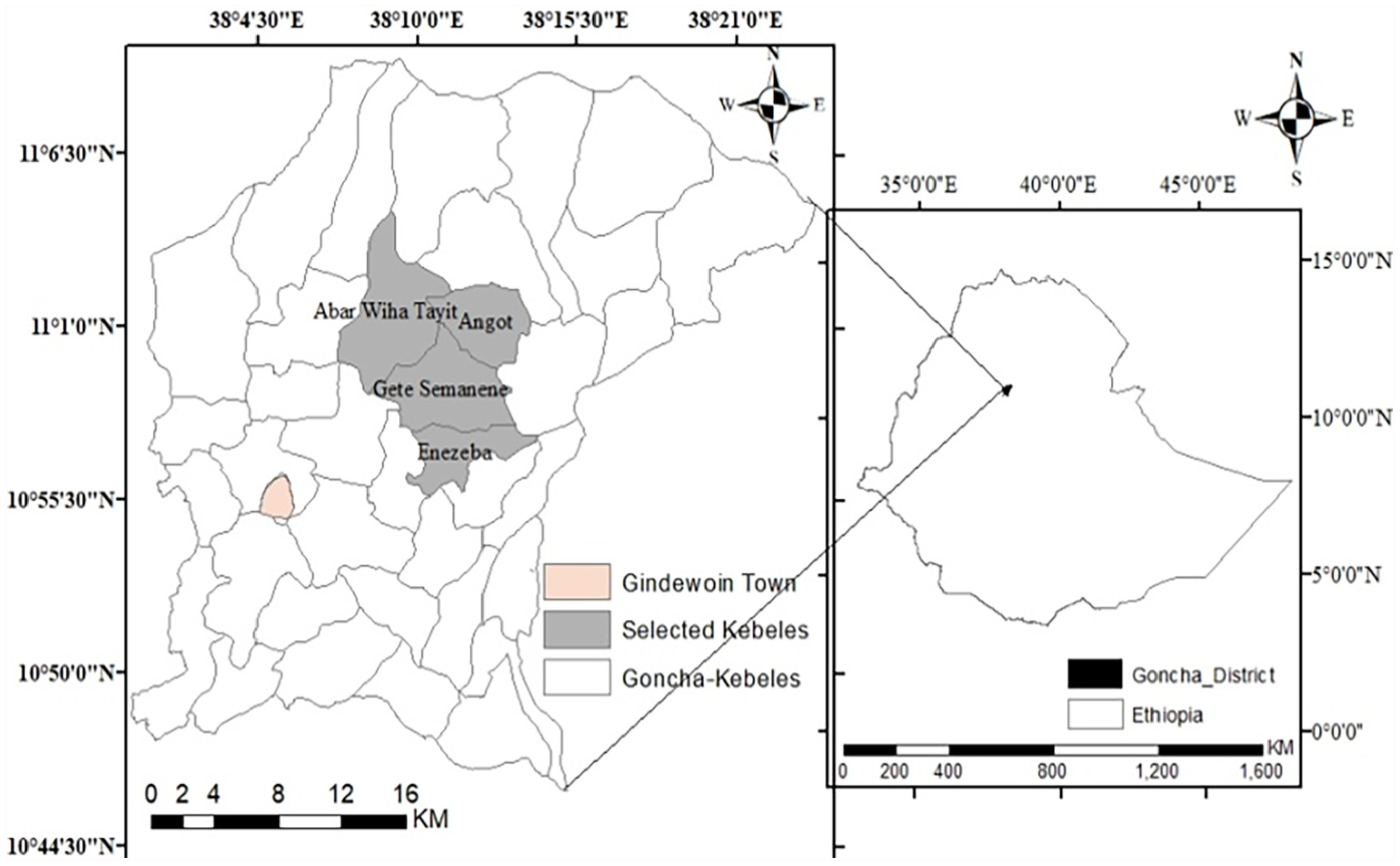
Location map of Goncha district, Northwest Ethiopia.
The ability of a household to cope with and adjust to particular shocks and dangers is referred to as adaptive capacity (Boukary et al., 2016). It is assessed using variables, such as risk awareness and ability to respond, educational attainment, labor productivity, farming system sustainability, acquaintance with practical and adaptable technologies, and income diversification (Boukary et al., 2016; Vallury et al., 2022). The development of knowledge about hazards, potential repercussions, and methods of adaptation is referred to as risk awareness and adaptability. The education level of the household head could impact risk awareness and adaptability performance (Mutisya et al., 2016). The educational level that a person has attained could perceive to influence household resilience. Education level could contribute to increasing labor productivity at the household level (Kampelmann et al., 2018). A rise in real production per hour of labor is referred to as an increase in labor productivity. The security of a household’s livelihood may be impacted by rising labor productivity. A productive work and sustainable farming system could help people have secure livelihoods. A sustainable farming system can produce adequate food, as well as other goods and services, cost-effectively while simultaneously enhancing the environment over time (Muller et al., 2017). A cost-effective agricultural system requires an understanding of new technologies in a way that makes it simple for the system. Knowing flexible and useful technologies refers to comprehending new technologies in a way that makes it simple for the system to adjust to changes (Kiteme & Ehrensperger, 2015). Knowledge of adaptable and practical technology is perceived to have an impact on the security of household livelihood. It is possible to boost income diversification by comprehending cost-effective technology in the sustainable agricultural system. The improvement of income sources to increase a household’s overall earning potential is referred to as income diversification (Kassie et al., 2017). Increased income diversity could perceive to improve household resilience.
The development of social networks, participation in formal safety net programs, and couple knowledge and honesty in decision-making and management are additional factors used to quantify the social safety net factor. Couples can make sensible decisions by being open and honest with one another. The process through which a family establishes a network of links and interactions is perceived to contribute to household resilience. Participation in both formal and informal social safety net programs, sometimes known as “participation in social safety net programs,” can shield a household from the consequences of economic shocks and stress (F. Mengistu & Assefa, 2019).
Materials and Methods
Location
This research was carried out in the Goncha district of Amhara Region, Northwest Ethiopia. The district lies between 10°46′14.45″N_11°9′30.37″N latitude and 38°0′11.669″E _38°23′43.514″E longitude (Figure 2).
Farming System
The topography of the study district is varied, including notable landforms. Gently sloping to somewhat dissected plains and plateaus are among the landforms. The climatic condition is predominantly sub-humid. Cool-moist highlands, tepid-moist mid-highland, and warm-moist lowland agro-ecological zones are analogous to the Ethiopian traditional agro-ecological zones of dega, woina-dega, and kola, respectively.
Crop-livestock mixed farming is a type of agriculture. Mixed farming systems are the most common means of subsistence in all agroecological zones with elevations ranging from 1295 to 3,488 m above sea level. The community’s most valuable natural assets are its lands and animals. Forests, shrublands, marshes, and grasslands are examples of communal resources that are typically maintained by the local community and administration unit. The watershed’s hilly and steep-slope communal lands are jeopardized by vegetation degradation and gullies as a result of unregulated overgrazing and deforestation, as well as insufficient institutional systems. Cropland and settlement units are the most extensive land-use systems that a farmer owns and manages. The most popular method of agricultural production is conventional tilling with a hand press and traditional ox-pulling techniques. Barley (Hordeum vulgare) and potato (Solanum tuberosum) are the main crops grown in the dega agroecological zone (above 2800 meters elevation of cool-moist highlands). In the hills, erosion and soil acidity are major issues. Tef (Eragrostis tef), barley (Hordeum vulgare), wheat (Triticum Vulgare), horse beans (Vicia Faba), and other crops are cultivated in the woina-dega agro-ecological zone. Among the most commonly farmed crops are tef (Eragrostis tef) and wheat (Triticum Vulgare). Sorghum is a major crop in the kola agroecological zone. Unpredictable rains and severe environmental deterioration are wreaking havoc on agricultural production. Farmers can supplement their income with local labor and firewood/charcoal sales to cover their food demands. Cut-and-carry and open-grazing systems are used to raise cattle, sheep, goats, donkeys, and horses.
Research Design
How resilient are smallholder households to the deteriorating agricultural productivity and societal shocks that cause unstable economic conditions? To answer this research question, a cross-sectional survey approach was utilized to identify the perceived factors affecting smallholder farmers’ resilience to insecure livelihoods. Understanding the factors that affect livelihood security is necessary for agricultural extension agents to intervene in smallholder farmers’ efforts to create sustainable livelihoods. Using a structured questionnaire and in-person interviews with randomly chosen household heads, quantitative data was acquired. Both descriptive statistics and structural equation modeling were used to analyze the data.
Sampling
Goncha district, in the northwest highlands of Ethiopia, was specifically picked out as a representative area for crop-livestock mixed farming systems across a range of agroecologies. This research is significant in the larger region since the findings derived from this study area ensure that the findings would pertain to other regions. Get-Semanen from the woina-dega agroecology zone, Enezeba from the dega agroecology zone, and Angot and Abarwuha-Tayit from the kola agroecology zone were chosen at random. To establish the sample size from the selected Kebeles, the intended confidence level (1-α), degrees of variability from the mean (σ2), desired precision (d), and design effect (DE) were taken into account. As a result, the sample size (n) was calculated using the following formula (Cochran, 2007; Snijders, 2005):

By considering the 90% confidence interval (zα/2 = 1.64), 5% margin of error, estimated design effect of 1.105, and variance of household resilience index of 0.941 from a pilot study, the sample size was determined at 280 household heads. The systematic sample is dispersed more equitably across the population, the cross-section is better, and unit selection is simpler. As a result, the household heads were identified using a systematic sampling technique from several agroecologies, including woina-dega, dega, and kola. Lists of the respondents were collected from the offices of the Kebele Development Agents (KDA). The first farm household head was randomly chosen from the first interval group after alphabetizing a list of respondents, and further samples from the specific agroecology population were chosen at regular intervals.
Data Collection Method
A household survey was carried out with the use of a structured questionnaire. Face-to-face interviews were done with all of the farmers that were sampled. The interview was conducted by enumerators under the direct observation of the researchers. The informants used survey weights to assign ranks to each indicator based on their perceptions of its relative importance to their household’s resilience. Ranks were assigned according to the following five Likert scales points, such as 1 = very low importance, 2 = low importance, 3 = moderate importance, 4 = high importance, and 5 = very high importance (Stark et al., 2018). Informants assigned the actual scores to each indicator performance in line with the perceived/ desired condition of household resilience. The scoring was assigned as 1 = very weak, 2 = poor, 3 = acceptable or average, 4 = very favorable, and 5 = outstanding.
Methods of Analysis
The weighted score method was used to identify the relative importance of indicators for perceived household resilience to livelihood insecurity. The relative weight of each indicator was calculated by dividing its weight by the total of all weights of the indicators under the latent variable (Ananda & Herath, 2017).

where: Wi is the relative weight of each indicator, “wi” is the weight of each indicator, and “Σwi” is the total of all weights of the indicators under the latent variable.
The performance score of pillar “Pi” can be calculated using the equations of the weighted score method (Noble et al., 2015):

where: under the “Pi”= is the weighted score of “i” pillar; wi= the relative weight of indicator “i” estimated from Equation 1; xi = actual score of the indicator “i”.
The principal component analysis (PCA) was conducted to construct the household resilience index (HRI). The HRI was calculated using the following equation (Noble et al., 2015).

where “HRI” is an individual household’s resilience to livelihood insecurity; “Pj” is the weighted score of the “j” pillar; “n” is the number of pillars or latent variables, and “hi” is the individual household.
The elements that determine household resistance to livelihood insecurity were identified using a structural equation model (SEM). It refers to the general links between the latent variables and several theoretical notions (Fan et al., 2016; Grace et al., 2010). A model is a strong tool for testing multivariate causal linkages that varies from the previous modeling in that it examines both direct and indirect impacts on pre-assumed causal relationships (Fan et al., 2016). It uses confirmed factor analysis to measure latent components using observed variables. Confirmatory component analysis has the potential to minimize data dimensions, standardize the scale of numerous indicators, and account for the dataset’s intrinsic relationships. Based on the correlation variations of datasets, a latent variable is derived as a common factor of observable variables (association or causal relationship). The following equation was used to calculate the model.

Where; ABS—is access to basic services, AC—implies adaptive capacity; AP—asset possession; and SSN—is a social safety net.
The Kruskal-Wallis H test was performed to determine whether perceived household resilience to livelihood insecurity differed significantly between agroecologies. The complete statistical analysis was carried out with the STATA statistical program (version 14).
Results
Respondents’ Socioeconomic Characteristics
Table 1 shows a brief overview of the respondents’ socioeconomic characteristics. The respondents were made up of 81.43% male-headed families and 18.57% female-headed households. Due to the lesser ability of female-headed households for asset accumulation, male-headed households were more effective in agricultural production (Gebre et al., 2021). Because of their limited adaptive capability, lack of assets, and vulnerability, female-headed households are less resilient than male-headed households (Boukary et al., 2016; Maru et al., 2021). The study takes age and farming experience into account as continuous factors. The responders were 44.27 years old on average. Farmers’ experience in farming tasks is predicted to increase as they get older. The household’s average farming experience was 25.44 years. One of the most essential human capital for rural farm households’ livelihood security is farming expertise.
Socio-economic Characteristics of the Respondents (n = 280).

Family size, productive household size, educational level, agroecology, wealth status, and land ownership status are all essential characteristics in the research district for the rural household’s sustainable agricultural system. In total, 47.14% had read and written education, with 9.29% of agricultural households having received secondary or higher education. The household head’s educational position has a positive and considerable impact on the household’s food and livelihood security (D. D. Mengistu et al., 2021). The household’s wealth position could be linked to education level. Approximately 69.29% of the farmers were classified as having a low wealth status, while 7.14% were classified as having a high wealth position (Table 1).
The amount of a farmer’s land holdings is one of the most crucial indications of his or her wealth position. About 54.43% cultivate both owned and rented lands, while 42.14% cultivate their farms. Labor is one of the human capital needed to develop a farm household’s livelihood. The bulk of respondents (54.29%) made up three to four productive labor sizes. At the household level, a larger productive labor size was substantially associated with increased income and livelihood development (Maru et al., 2021; D. D. Mengistu et al., 2021). As a result, approximately 53.57% of responders were made up of 5 to 6 family members. Ethiopia’s average family size is 4.5 members.
Farmers’ Perspectives on the Relative Importance of Household Resilience Indicators
Adaptive capacity is defined as a household’s ability to adapt to climate change, risks to productive assets, social-related shocks, and productivity reduction due to severe land degradation in this study. Adaptive capacity was the first factor contributing to perceived household resilience, as shown in Figure 3. When compared to the average value of the resilience capacity index (2.88), the average value of adaptive capacity improved by 0.15. Enabling institutional arrangements can help to develop adaptive capacity.

The average score of pillars, and resilience capacity of household (n = 280).
Table 2 shows that, among adaptive capacity measures, farmer knowledge and ability to respond to risk were ranked top (RW = 0.182) for smallholder farmers’ household resilience capability. Understanding the hazards that nature poses, indigenous environmental knowledge, and the ability to learn from productive technology may be the most essential factors in coping with shocks and household insecurity. The weighted score (WS) results in Table 2 show that the main and second most important elements for perceived household resilience to livelihood insecurity, respectively, were sustainable farming system management (0.584) and farmers’ knowledge and ability to respond to risk (0.557).
Description of the Indicators Based on the Ranking Method of Relative Weights (Importance) (n = 280).

Note. AS = actual score; SD = standard deviation; RW = relative weight; WS = weighted score.
According to the results in Figure 3, asset ownership was the second most important determinant of perceived household resilience. When compared to the average value of the resilience capacity index, the average value of asset possession increased by 0.1. The most important measure of household resilience capacity among asset possession variables was precautionary saving performance (RW = 0.267 & WS = 0.863) (Table 2). When compared to other indicators of the asset possession factor, it had the greatest average value for household resilience. Better saving performance may lead to more diverse revenue activities and, as a result, higher income during the post-shock recovery period (Du-Pont et al., 2020). The second major indicator, intensified livestock farming (RW = 0.246 & WS = 0.74), had a higher average value and contributed to the perception of strong household resilience capacity.
Table 2 shows that from social safety-net indicators, a couple of mutual understanding and agreement on decision-making (RW = 0.378 & WS = 1.17) was assigned as the first perceived contributing factor. Next to this, social network development (RW = 0.363 & WS = 1.05) was the second most important to the household resilience capacity of smallholder farmers. Access to irrigation practice (RW = 0.21, WS = 0.6), followed by access to transportation and market (RW = 0.2, WS = 0.497) were perceived to be the most essential basic services for more households’ resilience capacity (Table 2). These services could help smallholder farmers improve their ability to generate revenue from assets while also lowering their risk exposure (Du-Pont et al., 2020). When compared to other basic service factors, access to irrigation practice had the highest average value of the resilience index.
Household Resilience Across Agroecologies
Across agroecologies, the household resilience index varied (Table 3). Woina-dega and dega had considerably more resilient households than kola, with a p < .001 difference. This may indicate that, when compared to households from kola agroecology, farm household heads in the woina dega agroecology had a more favorable perception of their ability to maintain a livelihood. This can be because kola agroecology has more incidences of erratic rainfall patterns, dry spells, and drought during the growing stage of crop and livestock forage production, which are thought to have an impact on livelihood security. Crop failure and productivity decline could occur in lowland agroecology due to unpredictable rainfall and high temperatures during the growing season, as well as invasive crop pests, indicating more sensitive agroecology (Maru et al., 2021). Due to a lack of access to fundamental services and technology, the lowland or kola agroecological zone is perceived to be less resilient to climate variability (Dendir & Simane, 2019; Maru et al., 2021). In comparison to other agro-ecologies, kola agroecology has minimal asset possession, resulting in the highest exposure and sensitivity, the lowest adaptive ability, and the most vulnerable livelihood (Maru et al., 2021; Tessema & Simane, 2019). In comparison to other agroecologies, kola agroecology had the highest frequency of food insecurity (Alemu et al., 2017).
Comparison of Resilience Index Across Agro-ecologies (n = 280).

Perceived Determinants of Household Resilience to Livelihood Insecurity
Based on the study of the eigenvalues, four components were identified (Table 4). These variables account for 79.94% of the total variation. The latent factors’ multicollinearity was examined, and the variance inflation factor (VIF) results in Table 5 depict that there was no multicollinearity problem in the analysis, proving that the latent variables are independent of one another. Factor loading adaptive capacity, followed by asset possession, had the most impact on household resilience to livelihood insecurity. The Kaiser-Meyer-Olkin (KMO) sampling adequacy measure is 0.84 (higher than the suggested value of 0.5), indicating that the sample is adequate and the variables are meaningful for principal components analysis. The variables are significantly correlated, according to Bartlett’s test of sphericity, which is significant at p < .001 and chi-square = 816.53, showing that the variables are strongly linked enough to offer a reasonable basis for principal components analysis. Basic services, adaptive capacity, assets, and the social safety net were all positively connected with household resilience to livelihood insecurity (Table 4).
Correlation Matrix Used for Household Resilience Index (HRI).

Eigenvalue variances (%) = 79.94.
Kaiser-Meyer-Olkin(KMO) measure of sampling adequacy = 0.84.
Bartlett’s test of Sphericity, Chi-Square = 816.53, p-value = .000.
Extraction method: principal component analysis.
Represents correlation at a p ≤ .001 significant level.
Structural Equation Modeling Results (Aggregated).
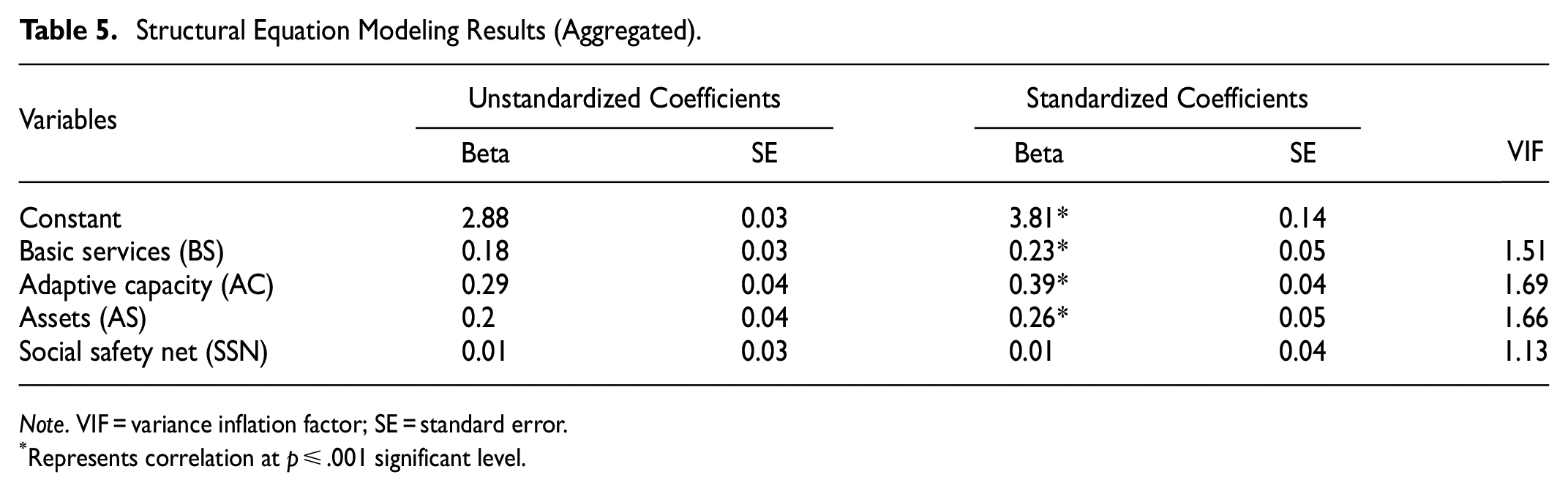
Note. VIF = variance inflation factor; SE = standard error.
Represents correlation at p ≤ .001 significant level.
Based on the result presented in Table 4, Equation 5 is rewritten to estimate HRI:

The household resilience index was regressed against the explanatory factors at the aggregate (Table 5) and disaggregated (Table 6) levels using the structural equation model. The perceived household resilience to livelihood uncertainty was positively influenced by adaptive capacity, assets, and basic services (at p < .001). The beta coefficient of adaptive capacity (beta = 0.39) was the most important dimension, followed by asset possession (beta = 0.26), in determining household resilience to livelihood insecurity. This means that the greater a household’s adaptive capacity and the more assets it holds, the greater the perception of its capacity for household resilience.
Structural Equation Modeling Results (Disaggregated).
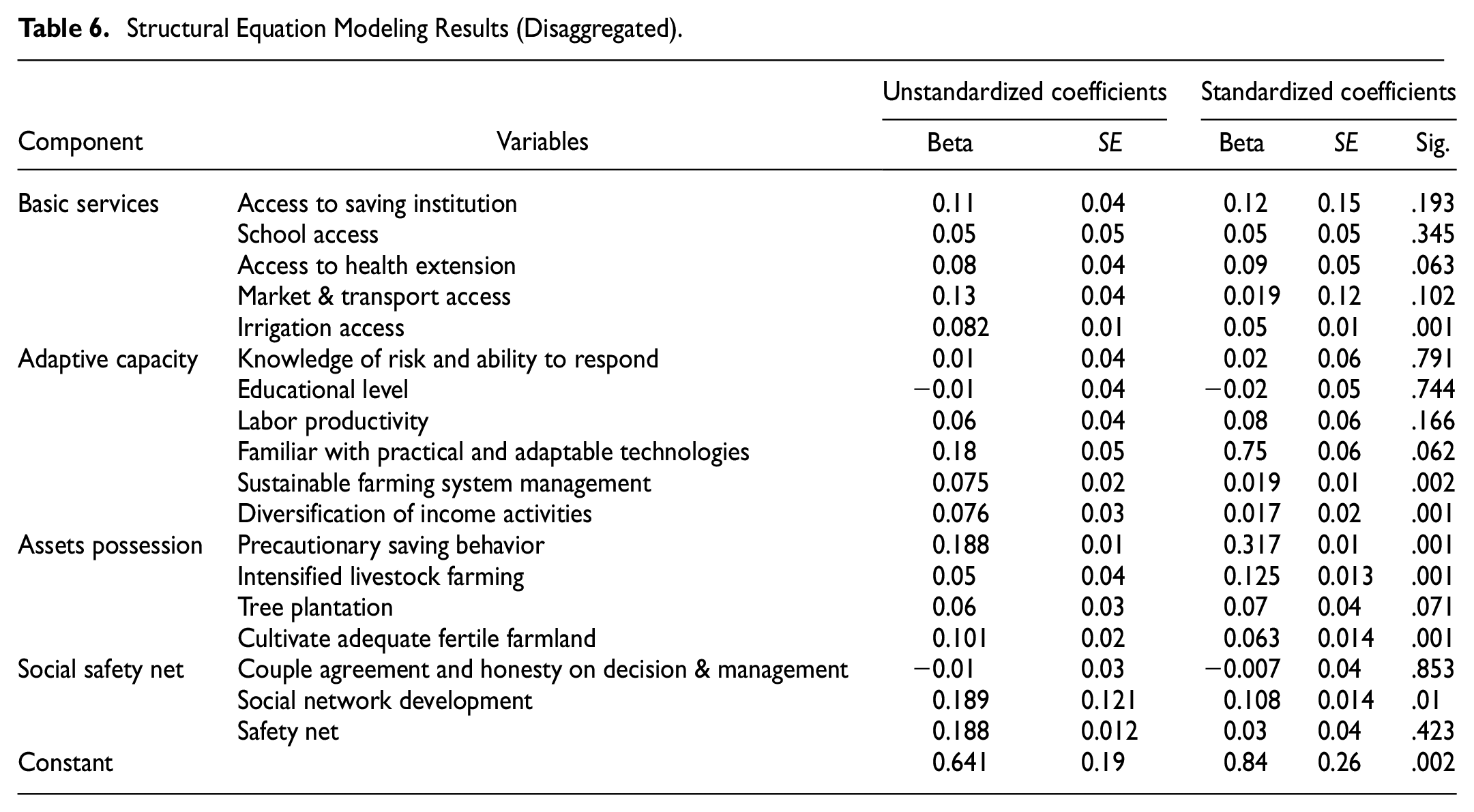
The adaptive capacity was measured using six indicators (Table 2). Household resilience to livelihood insecurity was significantly influenced by three adaptive capacity indicators: sustainable farming system management, diversification of income activities, and acquaintance with practical technology (Table 6). Household resilience to livelihood insecurity was found to be significantly (at p ≤ .001) influenced by sustainable farming system management and diversification of income-generating activities. This reveals that when it was perceived that farming systems were managed sustainably and household income sources were varied, the capacity for adaptation and crop productivity for livelihood security were more likely. Household resilience to livelihood insecurity was explained at a p < .1 significant level by familiarity with practical technology. Knowledge of practical skills in cropland management, yield harvesting, animal grazing, beehive management, plantation operations, and horticulture management significantly increases the perception of farmers’ household resilience.
The second factor that boosted the perception of household resilience was the condition of asset ownership. Three asset indicators, including the cultivation of sufficient fertile farmland, precautionary saving behavior, and intensified livestock husbandry, explained household resilience to livelihood insecurity at the p ≤ .001 significant level (Table 6). This reveals that improved livestock management, an adequate amount of arable land, and the development of saving habits might all affect how resilient households are perceived to be.
One of the most effective ways to address asset growth and livelihood security is to save in the form of cash and liquid assets in various institutions and groupings. Savings enables you to handle illness and disasters while also enabling you to engage in profitable ventures for a steady income (Chakma, 2013). More animals and larger farms are positively and significantly related to the dynamics of creating resilience for livelihood security (Asmamaw et al., 2019). Besides, plantation assets significantly (at p < .1) explained perceived household resilience for livelihood security (Table 6). The planting of trees at the household level ensures the stability of livelihood through increased monetary income, use in building, cow feeding, and firewood.
Household resistance to livelihood insecurity at the p ≤ .01 level was significantly influenced by access to irrigation. This demonstrates that farmers who have access to irrigated land are perceived to be more resilient in sustaining their livelihoods than farmers who do not. In the dry-subhumid environment, where fluctuating rainfall patterns are typical, irrigation access is essential to the production of a variety of crops, vegetables, and fruits, as well as cattle fodders. Irrigation farming provided farmers with access to more fields, which was likely to result in greater crop-livestock diversification (Mekuria & Mekonnen, 2018). Effective irrigation practices can benefit from the development of social capital. Social network development influenced the perception of household resilience for livelihood security significantly (at p < .01) from the social safety net variable (Table 6). Access to labor exchange, physical assets, and microcredit schemes are mediated by social networks.
Discussion
The findings indicate that adaptive capacity, followed by asset ownership, had a significant impact on perceived household resilience to livelihood insecurity in Ethiopia’s northwest highlands’ Goncha district. This indicates that a household with a high level of adaptive capacity and possession of more assets appears to be more resilient to food insecurity. The adaptive capacity of a household is determined by the number of assets it possesses (Bekele et al., 2020). Livelihood insecurity was less of a problem for those with greater assets and adaptive capacity (Boukary et al., 2016). The most important component in household resilience to food insecurity (Bekele et al., 2020; Dhraief et al., 2019; Etana et al., 2021; Gebre & Rahut, 2021; Kassie et al., 2017) and multidimensional poverty reduction (Haile et al., 2021) was adaptive capacity. Sustainable farming system practice, diversification of income activities, and familiarity with practical technology were perceived as the most important indicators determining adaptive capacity in the Goncha district of northwest Ethiopia highlands (Table 6).
The practice of a sustainable farming system is perceived to be the most important variable to determine household resilience to livelihood insecurity in the Goncha district. This is because a sustainable farming system through integrated land management could help to lower input costs, enhance soil fertility, boost crop and livestock yield, and in due course ensure the security of one’s livelihood. Because agricultural livelihood and land are interconnected, ensuring the long-term productivity of farmland is a necessity for sustaining multifunctional agriculture and resilient livelihoods in rural communities (Ehrensperger et al., 2015; Etana et al., 2021). To ensure livelihood security for the growing population, it is critical to maximizing the productivity of existing agricultural land through sustainable management approaches (Boukary et al., 2016;). Agronomic, physical, and vegetative methods are frequently combined in the management of farming systems for livelihood security and long-term sustainability. In fields where terraces are well constructed, stabilized with vegetative methods, correctly maintained, and complemented with appropriate drainage ditch practices, nutrient use efficiency and water use efficiency are well-protected (Debie et al., 2019; Gathagu et al., 2018). Planting multipurpose grasses and trees on unused soil bunds for fodder or fuel-wood harvesting (both of which are in short supply in Ethiopia’s highlands) could compensate for agricultural production loss due to bunds (Adimassu et al., 2017; Debie et al., 2019). As a result, integrating agronomic, vegetative, and structural techniques into a sustainable farming system should help increase cropland and animal yield, allowing for a broader diversity of revenue activities at the family level.
In the study district, diversification of earning activities is perceived as the most important factor of household resilience to insecure livelihoods. This demonstrates how rising income diversification efforts have enhanced household resilience. Diversification of income activities is the most viable technique for ensuring smallholder farmers’ long-term viability (Awoke, 2019; Etana et al., 2021). Household income, landholding size, extension contact exposure, and agroecological appropriateness are all linked to the possibility of smallholder income diversification (McCord et al., 2015). The ability to adapt productive technology can influence the diversification of earning activities.
The livelihood security of smallholder farmers in the study district was perceived as significantly improved by farmers’ knowledge of applicable technology for sustainable farming systems, crop production, tree planting, and livestock raising. The development of a more adaptable capacity to shocks and dangers that have been defined by the ability to adapt productive technologies and talents. Farmers’ willingness, motivation, and ability to adapt to value-added methods and new technology were critical to a more resilient household (Sharma et al., 2005). Farmers’ knowledge and experience with recurrent drought, as well as the deployment of climate-smart technology such as drought-tolerant crop and livestock types, all, contribute to household resilience (Asmamaw et al., 2019). Experience and local knowledge of prior responses to major events or shocks can help to understand how the system responds to change and apply suitable adaptation measures (Chakma, 2013).
In the study district, one of the most perceived crucial factors influencing household resilience to insecure livelihood was precautionary saving behavior (Table 6). This implies that a household develops a practice of more cautious saving and reducing expenses considered to help with livelihood security. In northwest Ethiopia, households’ risk-management practices, such as ex-ante precautionary saving, are more likely to increase resilience to shocks affecting livelihood security (Asmamaw et al., 2019; Haile et al., 2021). The frequency of extension contacts, availability of market information, and distance from saving institutions had a substantial impact on household saving behavior (Asare et al., 2018). In Gojam, Northwest Ethiopia (Tariku, 2018), a considerable proportion of households lack long-term saving motivations, and their saving behavior is influenced by expensive cultural events and a lack of understanding. Smallholder farmers’ economic dilemma is exacerbated by socio-cultural activities such as Tezkar, Mahiber, and Senbete, as well as early marriage ceremonies in the winter season (Adigeh, 2017). Unexpected expenditures of cash and other resources are typical in the study district’s local communities and other parts of northwest Ethiopia. Farmers have demonstrated that avoiding harmful socio-cultural activities is one of the most important factors in increasing household savings. Through coordinated efforts of religious, institutional, and legal frameworks, awareness creation and development on saving behavior and avoiding excessive socio-cultural activities should be supported (Adigeh, 2017; Asare et al., 2018; Tariku, 2018). Short- and long-term planning can help farmers manage their crops more effectively. Farmers concurred that improving livelihoods requires both short- and long-term planning and effective management of agricultural yield. A household with increased cash income has improved its abilities and capabilities to manage disasters, generates human capital through education, and diversifies its livelihoods away from farming (Awoke, 2019). More savings would allow for more intensive livestock management and the acquisition of more fertile cultivated land.
In the Goncha district of northwest Ethiopia, increasing animal husbandry was the major factor influencing perceptions of household resilience to livelihood insecurity (Table 6). This indicates that improved livestock husbandry includes poultry, apiaries, fattening practices (for cattle, sheep, and goats), and transportation with horses and donkeys considered to contribute to livelihood security. Because it produces more returns and has fewer variable costs, intensified livestock husbandry might be promoted as a preferable source of income (Ashley et al., 2018). Livestock husbandry contributes more to total household revenue (selling milk and fattened livestock to meat), serves as a vital safety net during times of economic hardship, provides draught power for farming, and produces dung for household energy and organic fertilizer (Ashley et al., 2018; Du-Pont et al., 2020). According to Stark et al. (2018), a higher intensity of crop-livestock integration flow enhances the system’s efficiency, while a more complex and homogeneous flow network improves the system’s resilience. The likelihood of a household creating a sustainable livelihood is found to be highly associated with the value of productive livestock husbandry (Asmamaw et al., 2019; Liniger & Critchley, 2008). Livestock farming is more likely to contribute to household resilience in kola agroecology than in woina-dega and dega agroecologies. When a crop-livestock mixed agricultural system is combined with a plantation, more agro-biodiversity is produced, resulting in a more diverse living and income (Córdova et al., 2018).
Results in Table 6 show that the perception of the plantation of exotic and native plants has had a substantial impact on household resilience to livelihood insecurity. Plantation growth may secure a livelihood by generating short-term economic benefits, providing employment opportunities for those without access to land, and enabling farmers to diversify their sources of income (Wondie & Mekuria, 2018). In the face of the rapidly rising price per tree for construction materials in metropolitan areas, farmers typically decide to convert unproductive agricultural fields into eucalyptus tree plantations. In a variety of climatic and soil conditions, exotic eucalyptus and acacia species are the most dominating and fast-growing plants for woodlot forestry (harvest 4–6 years after planting) providing excellent financial benefits to rural households (Bayle, 2019; Wondie & Mekuria, 2018). The plantation system greatly enhanced household income, generated job opportunities, improved social lives, improved damaged soils (Nigussie et al., 2021), and contributed to farm household sustainability (Zerihun, 2021). By combining fast-growing trees with annual crops, you may be able to maximize both ecological and economic benefits. Planting trees for firewood replace bovine dung, and maize straw can be utilized as organic manure to increase agricultural field production (Bayle, 2019). In Ethiopia’s northwest highlands, acacia plantations on degraded hillsides could help landless farmers survive under the burden of a rising rural population (Nigussie et al., 2020). Bylaws should be strengthened to promote plantation multifunctional vegetation on the structural conservation segment of croplands and enclosure of communal areas for smallholder farmers’ livelihood security (Adego et al., 2018). For long-term mixed agricultural production, a combination of total closure, cut-and-carry grazing, and multifunction plantation on the communal property is strongly recommended (Debie & Singh, 2021). Because of the efficient market accessibility, croplands are converted into plantations of eucalyptus and acacia species, particularly in locations with adequate access to transportation (Alinovi et al., 2010).
In the study district, access to irrigated land accounted for a significant influence on perceived household resilience to livelihood insecurity (Table 6). This could be explained by the fact that households’ incomes, daily caloric intake, and growth of livelihoods are all increased by traditional irrigation for the cultivation of cereal crops, vegetables, and fruit (Jambo et al., 2021). It is one of the most important adaptation strategies for limiting the harmful effects of climate change (Etana et al., 2021). The distance between an irrigable farm plot and a water supply, as well as the distance from a market, has a detrimental impact on irrigation access (Maxwell et al., 2015).
Access to irrigated land was found to be significantly supported by the development of social networks through cooperative membership, urban connection, labor-sharing groups, savings, and credit associations (Awoke, 2019). Enhanced social network development is thought to be a key element in securing the livelihood of smallholder farmers (Table 6). The number of social networks determines the capacity to carry out and maintain labor-intensive land management techniques for increasing animal husbandry, crop yield, and plantation activities (F. Mengistu & Assefa, 2019; Tefera et al., 2017).
Conclusion
The increasing rate of land degradation in Ethiopia’s highlands reduces soil productivity, jeopardizes the livelihoods and food security of subsistence farmers, and makes poverty worse. Poor farm households are susceptible to livelihood insecurity due to climate variability, the risks associated with productive assets, socially-related shocks, and the loss of land output in Ethiopia’s northwest highlands. The study aimed to identify factors that farmers felt influenced household resilience to livelihood insecurity in crop-livestock mixed farming systems in the Goncha district of Ethiopia’s Northwest highlands. The results revealed that adaptive capacity, followed by asset ownership, was perceived to have significant effects on household resilience to livelihood insecurity. The most important factors seen as contributing to adaptive capacity were sustainable farming systems, diversification of economic activities, and acquaintance with practical and adaptable technologies. Intensified livestock husbandry, cultivation of fertile farmland, enhanced saving behavior, and tree planting were all seen as asset indicators that strongly and positively influenced asset possession. Furthermore, household resilience was perceived as strongly influenced by access to irrigation practices and the development of social networks. To address household resilience to livelihood insecurity of smallholder farmers across diverse agro-ecologies, Goncha farmers appear to be amenable to agricultural extension packages that scale up the adoption of sustainable management of the farming systems, saving behavior, means of income diversification, adaptable technologies, and agroforestry.
Limitations of the Study
The research’s data collection did not take into account how rural livelihoods change over time. There was no attempt made to distinguish between households participating in non-farm activities as well as herdsmen households; the study solely took into account farm households that engaged in crop-livestock mixed farming activities. The study did not take into account material variables and only attempted to address perceived determinants of smallholder household resilience to livelihood insecurity. In light of these constraints, the study recommends that additional research be conducted.
Footnotes
Declaration of Conflicting Interests
The author(s) declared no potential conflicts of interest with respect to the research, authorship, and/or publication of this article.
Funding
The author(s) disclosed receipt of the following financial support for the research, authorship, and/or publication of this article: The author(s) received financial support for the research from Debre Markos University, Ethiopia.
Ethics Approval and Consent to Participate
The study design was fully explained to the respondents for gaining consent. Data generated from a participant were kept confidential and all informants are acknowledged.
Consent for Publication
Not applicable.

Availability of Data and Materials
The data are available from the corresponding author.