




Abstract
Strategic flexibility is deemed to be an important organizational capability for enhancing innovation and improving organizational performance (OP) in uncertain, turbulent, and ever-changing business environments. Many studies have investigated the impact of strategic flexibility on innovation and OP in various contexts and found that strategic flexibility enhances innovation and improves OP. Other studies have found negative association or no association between strategic flexibility and OP. Therefore, it is not much clear whether strategic flexibility improves OP directly or through innovation. Especially, the mediating role of innovation in the association between strategic flexibility and OP in engineering project-based organizations has not been fully grabbed in prior literature and Pakistan remained unexplored. This study has strived to examine the mediating role of innovation in the association between strategic flexibility and OP in this context. Drawing upon resource based and dynamic capability views, an explanatory model was developed and tested by applying PLS-SEM higher order component modeling approach using sample data from 184 organizations in Pakistan. The results revealed that strategic flexibility is positively associated with innovation and OP. Innovation is positively associated with OP. The association between strategic flexibility and OP is partially mediated by innovation. The study promotes academic rigor and provides a new theoretical model. Mangers, decision-makers, and policy-makers can utilize the results to update their plans to achieve sustainable OP. The other organizations in various countries operating under similar conditions can also take the advantage of this study.
Keywords
Introduction
Due to escalating dynamism, turbulence, uncertainty, risk, complexity, and irregularity in modern business environments, sustained organizational performance (OP) has become a major challenge for many contemporary organizations. Conventional measures of OP are struggling to sustain performance due to increased competition, market fluctuations, rapid technological advancements, and post pandemic scenario (COVID-19). Therefore, organizations must have abilities to adapt to prevalent environmental changes to adjust their strategies to achieve performance goals. Consequently, organizational adaption has obtained an ongoing and sustained interest among researchers (Dermonde & Fischer, 2021; Goncalves & Bergquist, 2022; Stieglitz et al., 2015).
Many researchers argued that strategic flexibility is paramount for organizational adaption (e.g., Aaker & Mascarenhas, 1984; Herhausen et al., 2020). Strategic flexibility is defined as “ability of the organization to adapt to substantial, uncertain and fast occurring (relative to the required reaction time) environmental changes that have a meaningful impact on the organization’s performance” (Aaker & Mascarenhas, 1984). It is an organizational capability to be proactive and respond to rapidly changing business conditions through various internal and external options (Sanchez, 1995). Strategic flexibility leads toward enhanced innovation (Mohammed et al., 2022) and improved OP (Wang et al., 2021).
Nevertheless, the literature is much fragmented and provides several divergent views regarding theoretical perspectives and conceptual underpinning to strategic flexibility (Herhausen et al., 2020). Several conflicting results have emerged regarding antecedents of strategic flexibility. For example, learning orientation that is considered as an organizational level activity to generate and utilize knowledge may either promote strategic flexibility (Santos-Vijande et al., 2012) or constrain strategic flexibility (Nadkarni & Herrmann, 2010). Moreover, some researchers argued that younger organizations are more flexible (Nadkarni & Herrmann, 2010) while others contended that flexibility is independent of the age of the organization (Brinckmann et al., 2019). Furthermore, some researchers found that environmental variables promote strategic flexibility (Brozovic, 2016), but limited empirical evidence is presented to support this argument.
Prior literature also provides contradictory results regarding the linkage of strategic flexibility with performance. For example, the study conducted by Das (1995) revealed that seeking strategic flexibility results into increased costs, enhanced stress, and decreased focus. However, Nadkarni and Herrmann (2010) established that strategic flexibility enhances performance. Other researchers found mixed linkages (Grewal & Tansuhaj, 2001), no linkage (Brews & Hunt, 1999), or negative linkage (Covin et al., 1997). These conflicting results are due to different strategic flexibility and performance measures used under different contexts (Herhausen et al., 2020). For instance, contingency theory promotes that strategic flexibility is relevant and effective in dynamic environments rather than unwavering environments (Claussen et al., 2018). However, there is limited empirical evidence in prior literature that different environmental facets determine performance effects of strategic flexibility (Brozovic, 2016).
Innovation is also an organizational capabilty to identify new ideas and transform these ideas into new or improved products, services, or processes which benefit the organizations (Aas & Breunig, 2017). Many researchers utilized innovation as a dependent variable and employed various perspectives of innovation. For example, Yi et al. (2021) investigated the effect of capital venture on open innovation in enterprises of China and found that capital venture significantly enhances open innovation. Lyu et al. (2022) examined the impact of temporal leadership on team innovation performance with team reflection as a moderator and transactive memory systems as a mediator. The results revealed that temporal leadership positively affects team innovation performance and this effect is mediated by transactive memory systems and moderated by team reflection. Other researchers utilized innovation as an independent variable and employed other perspectives of innovation and found that innovation leads toward improved OP (Bowen et al., 2010; Tuan et al., 2016). Researchers also employed different perspectives of innovation as mediators and moderators with wide variety of independent and dependent variables (AlAnazi et al., 2021; Ali et al., 2021; R. Li et al., 2020).
There is sufficient evidence in literature that strategic flexibility enhances innovation and OP and innovation enhances OP as described above. However, the mediating role of innovation in the association between strategic flexibility and OP has been investigated by a very few researchers. These researchers have employed different perspectives of flexibility such as planning flexibility (Dibrell et al., 2014), organizational flexibility (Ni et al., 2020), and strategic agility (AlTaweel & Al-Hawary, 2021) Moreover, they employed different perspectives of innovation such as innovativeness, technological and management innovation, and innovation capability in terms of process and product innovation.
Overall, prior literature on strategic flexibility, although provides many valuable contributions, does not clearly resolve the theoretical and conceptual differences within and across the discipline (Herhausen et al., 2020). Although there are conflicting results to indicate that strategic flexibility improves OP, only a few empirical studies examined innovation as a mediator in the association between strategic flexibility and OP and Pakistani engineering project-based organizations remained unexplored. Hence, it is less understood whether OP can be improved effectively by strategic flexibility and whether innovation can mediate the association between strategic flexibility and OP in this context.
This study fills these research gaps by investigating the following research questions:
This study attempts to answer these four research questions and identify the mediating effect of innovation in the relationship between strategic flexibility and OP. For this, the study sets-up an explanatory model and formulates hypotheses based on theoretical background and tests the model taking sample data from Pakistani engineering project-based organizations using the standard paradigm of empirical research.
Theoretical Background and Hypotheses
Organizational resources and capabilities and how these resources and capabilities are utilized to develop other capabilities are crucial for achieving business performance. Resource based view asserts that superior business performance can only be achieved when an organization has valuable, scarce, inimitable, and non-substitutional resources and capabilities available for sustainable competitive advantage (Camisón & Villar López, 2010; Miller, 2019). Capabilities are the source of extreme value and the most significant source for organizational success (Teece, 2018). Focusing and capitalizing on organizational capabilities can create value for customers and other stakeholders (Srivastava et al., 1998). Dynamic capability view can be a good supplement of resource based view in a dynamic environment (Wang et al., 2021). This view argued that organizations are required to have ability to build, integrate, and reconfigure their internal and external resources quickly to response to a rapidly changing environment (Teece, 2018). Strategic flexibility is considered as an important dynamic organizational capability that improves OP in a complex and dynamic environment (Wang et al., 2021). This dynamic capability facilitates several other capabilities and innovation is one of these capabilities (Xiao et al., 2021; Xiu et al., 2017). This is also supported by Tidd (2012) who argued that dynamic capabilities are pivotal for innovation. However, organizations are required to build new skills and develop new knowledge to enhance innovation in a dynamic and uncertain business environment. Organizations must have ability to be flexible and adaptable and this adaption is often related to new product/services and processes in order to improve OP (Hill et al., 2002). Therefore, it can be assumed that strategic flexibility facilitates innovation which further enhances OP. Applying a combined approach to cover strategic flexibility, innovation, and performance disciplines and based on resource based and dynamic capability views, we theorize that innovation mediates the association between strategic flexibility and OP in engineering project-based organizations in Pakistan. In other words, strategic flexibility as a dynamic capability that can improve OP when it is used in combination with innovation capability. Now, we discuss strategic flexibility, innovation, and OP in more detail.
Strategic Flexibility
Strategic flexibility as a dynamic organizational capability can enable organizations to completely utilize its main resources in combination (Brozovic, 2016) and provide competitive advantage in uncertain conditions (Eisenhardt & Martin, 2000). Strategic flexibility helps the organization to adapt to environmental turbulences through positive changes and generally treats as an independent variable to influence innovation and organizational effectiveness (Wei et al., 2013). Organizations should have such capabilities for rapid knowledge diffusion to reallocate their resources according to changing conditions to fulfill market demands (K. Z. Zhou & Wu, 2010). Strategic flexibility covers not only the scope, but also the speed and object of variation (de Toni & Tonchia, 2005) within and across businesses. Scholars have found that strategic flexibility promotes innovation (Kamasak et al., 2016; Mohammed et al., 2022) and OP (J. Li et al., 2018; Wang et al., 2021).
The concept of strategic flexibility is polymorphous in its nature (de Toni & Tonchia, 2005). Prior literature provides many dimensions of strategic flexibility. Herhausen et al. (2020) described that an organization can demonstrate strategic flexibility through reactive and/or proactive approach by choosing an appropriate strategic option and/or chasing the speed of strategic option. The organization can also respond internally by deploying resources and/or externally by competitive actions. Strategic flexibility emphasizes on three interrelated concerns: resources, processes, and strategic options (Pauwels & Matthyssens, 2004). According to Beraha et al. (2018), strategic flexibility can be represented by three dimensions: production, marketing, and human resource flexibility. Hoeft (2022) identified three dimensions in automotive industry: product, process customer flexibility. Sanchez (1995) categorized it into two types: resource and coordination flexibility. This categorization covers both the flexibility of organizational resources and the flexibility in coordinating these resources. Resource flexibility involves the inherent flexibility of organizational disposable resources whereas coordination flexibility deals with the organizational ability to utilize these resources (Sanchez, 1995). Planning flexibility is also an important aspect of strategic flexibility. It deals with an organization’s ability to adjust its formal strategic plan or organizational strategy in response to the evolving opportunities or threats due to environmental changes (Barringer & Bluedorn, 1999; Dibrell et al., 2014). However, this study used three dimensions: planning, resource, and coordination flexibility to represent the concept of strategic flexibility.
Innovation
Innovation as an organizational capability primarily covers the “creation” or “adoption” of new ideas, materials, or practices (O’Toole, 1997). It is a process that is designed and managed to create value and comes out in the form of “products/services,”“processes,”“technologies,” and “business systems.” Organizations utilize resources and capabilities for creation of innovation. The resources and capabilities required for innovation activities vary among organizations. Some organizations may be better than others to reproduce innovation success and organizational capability to do this is referred to as innovation capability. Innovation capability may overlap with dynamic capability view as it is related to renewal and performance of the organization in changing market conditions for which the organization is required to be flexible and adaptable for offering new or improved products/services (Aas & Breunig, 2017). However, innovation capability emphasizes more on organizational ability to change its offering whereas dynamic capability focuses more on environmental fitness. Empirical research found that innovation activities are positively related with future performance (Bowen et al., 2010).
Aas and Breunig (2017) described that innovation capabilities are context dependent (e.g., organizational level and culture, technological complexity, and configurations) and contingency dependent (e.g., industry, region, and innovation type). However, the focus of this study is on innovation types. Camisón and Villar López (2010) used three innovation types: product/service, process, and organizational innovation. Ni et al. (2020) used two types of innovation: technological and management innovation in construction project-based organizations. Product/service innovation encompasses new or significantly improved product/service in terms of its features or envisioned use (OECD, 2005). This type of innovation is created or adopted at product/service level. Technological innovation deals with the transformation of an idea for a new product/service or process into reality (Evan, 1966). Technological innovation is usually created and adopted at process level. Management innovation covers the adoption of management structures, processes, methods, practices, and rules and regulations to obtain organizational goals (Birkinshaw et al., 2005). This type of innovation is often created or adopted at business unit level or organizational level. However, this study used three types of innovation: product/process, technological, and management innovation to represent the concept of innovation due to their well-recognition in the relevant literature.
Organizational Performance
OP is an organizational ability to obtain its planned objectives through efficient and effective use of available resources (Muthuveloo et al., 2017) and is crucial to determine the results due to which stakeholders are able to address deficiencies (S. S. Zhou & Zhou, 2017). It is obtained by formulating and implementing a strategy that is supported by organizational capabilities, resources, and competencies to achieve organizational goals like profit, market share, increased sales, productivity, competitiveness, customer satisfaction, quality, and competitiveness (Abuzaid, 2018; Dibrell et al., 2014; Ni et al., 2020; Sariwulan et al, 2020). Richard et al. (2008) described that OP covers financial or non-financial performance or a combination of both. Wiklund (1999) argued that OP should be assessed through both financial and growth measures. Therefore, this study assessed OP in terms of financial and non-financial performance. Moreover, subjective measures of OP are applied when secondary financial data for objective measures are not available (Dibrell et al., 2014). This study used subjective measures to assess OP as suggested by Teeratansirikool et al. (2013) due to lack of secondary financial data for objective measures.
Strategic Flexibility and Organizational Performance
Strategic flexibility can be deemed as an important dynamic organizational capability that helps organizations to utilize the full potential of their flexible management skills and resources and consequently enhances OP in uncertain conditions (J. Li et al., 2018). This makes the organizations more proactive to exploit emerging opportunities, reduce risks and costs, and enhance growth and profit in fluctuating and changing business environments. Strategic flexibility in terms of planning, resource, and coordination flexibility has profound effect on OP. Researchers have mentioned that enhanced organizational efficiency and effectiveness can be obtained by improving planning, resource, and coordination flexibility (Dibrell et al., 2014; Umam & Sommanawat, 2019). Planning flexibility that deals with flexible policies, plans, and approaches is a major factor to cope with uncertainties and market risks in turbulent business environments (Umam & Sommanawat, 2019) and organizational ability to respond to fluctuating market conditions enhances OP (Eckstein et al., 2014). Planning flexibility as an important dimension of strategic flexibility helps organizations to pursue “not-planned-for” opportunities due to environmental changes and enables them to quickly adjust their plans to exploit these opportunities (Dibrell et al., 2014) and resultantly contributes to OP. Titus et al. (2011) investigated the association between strategy formation modes and organizational growth and found that flexible strategy formation mode contributes to organizational growth in terms of sales growth rate. Planning flexibility further facilitates resource and coordination flexibility if these dimensions of strategic flexibility are properly addressed through flexible planning. Resource flexibility also enhances OP. This dimension is helpful for organizations to make strategic choices as intellectual capital is pivotal to transform market strategy quickly and cost-effectively, reduce market risks, and enhance environmental adaptability (Wang et al., 2021). These multiple skills are paramount to cope with unknown challenges and provide new opportunities in a turbulent environment and hence increase profitability (Wang et al., 2021). Ahmadi, Mohd and Osman (2018) found that resource-reconfiguring flexibility positively contributes to SMEs’ performance. Coordination flexibility also leads toward improved OP. It helps to reconfigure internal and external resources which reduces time, cost, and effort to deploy resources (Umam & Sommanawat, 2019) and hence contributes to operational and financial performance. Through coordination flexibility, resources are accommodated in a dynamic competition to exploit resource effectiveness that not only saves operating costs but also provides opportunity to increase number of new products/services and response to market competition in a timely manner and hence improves OP (Wang et al., 2021). In conclusion, strategic flexibility in terms of planning, resource, and coordination flexibly helps organizations to quickly determine and adapt to the environmental changes and provides more strategic opportunities which are crucial to improve OP. Thus, we can hypothesize that:
H1: The degree to which strategic flexibility is exhibited positively affects OP in engineering project-based organizations in Pakistan.
Strategic Flexibility and Innovation
Strategic flexibility can also promote innovation capability in organizations. Strategic flexibility emphasizes on attracting human resources with diversified skills who can provide new ideas, thoughts, and solutions to acquire and deploy emerging technologies and solutions which are crucial to improve innovation performance (Wei et al., 2013). Martínez-Sánchez et al. (2019) revealed that external human resource flexibility positively affects innovation. However, both internal and external human resource flexibility is essential to enhance innovation activities in organizations. Resource flexibility shrinks resource rigidity, expands resource usage, and facilitates changes and modifications (Han & Zhang, 2021) which are paramount for developing innovation capability. Organizations with higher resource flexibility can innovatively response to market competition. Organizations in which higher resource flexibility exists, more innovation activities are cultivated (Vem et al., 2022). Planning flexibility is also vital for innovation as it provides space to modify/update policies, plans, and procedures, according to the changed market demands. Dibrell et al. (2014) revealed that strategic planning process and planning flexibility are positively associated with innovativeness. Coordination flexibility enables organizations to quickly integrate the existing resources and adapt to the environmental changes and hence promotes innovation (Han & Zhang, 2021). Coordination flexibility provides strategic choices to the path of innovation (Vem et al., 2022). Brozovic (2016) argued that resource and coordination flexibility not only nurture organisational change and renewal, but also creates conditions for product innovation. Sanchez (1995) revealed both resource and coordination flexibility overcome organizational inertia and positively associated with product innovation. Therefore, it is reasonable to believe that strategic flexibility in terms of planning, resource, and coordination flexibility provides product/service, technological, and management innovation. Hence, we can hypothesize that:
H2: The degree to which strategic flexibility is exhibited positively affects innovation in engineering project-based organizations in Pakistan.
Innovation and Organizational Performance
Innovation enables organizations to establish conditions for structural, processes, management systems, and product/service improvements (Ali et al., 2021) and therefore, enhances productivity and financial outcomes in organizations (Ni et al., 2020). Innovation is beneficial to organizations at various organizational levels. For example, innovation can enhance productivity and client satisfaction at project level and corporate image, technical and management capability, and experience at organizational level (Ozorhon et al., 2016). Prior literature suggests that innovation in terms of product/process, technological, and management innovation positively influences OP. Many researchers argued that product/service innovation positively influence OP. For instance, Su et al. (2020) argued that service innovative behavior has become critical for organizations’ survival and success. Similarly, Ferreira et al. (2020) described that organizations which always strive to keep pace with the change in customer desires by relying on unique offers of products/services have a greater market share than their competitors, achieve high financial returns, and their customers are loyal to their products. This means that organizations which continuously provide innovative products/services are more likely to achieve financial and non-financial performance. Researchers also argued that technological innovation positively influences OP. For instance, Wen et al. (2020) advocated that technological innovation provides economic benefits to organizations. Similarly, J. Zhang et al. (2018) asserted that technological innovation as a source of economic growth. The positive influence of management innovation on OP has also been discovered by many researchers. For instance, Tuan et al. (2016) revealed that organizational innovation (management innovation) and other types of innovation have positive effect on OP. The role of management innovation in enhancing OP has also been confirmed by Kraśnicka et al. (2017). In a study of 34 Portuguese hospitals,
Moreira et al. (2017) found that operational performance is positively influenced by service and process innovation and financial performance is positively influenced by the overall innovation process. Y. Zhang et al. (2019) revealed that technological and management innovation positively influences OP. In conclusion, innovation in terms of product/service, technological, and management innovation contributes to improve OP. Thus, we can hypothesize that:
H3: The degree to which innovation is exhibited positively affects OP in engineering project-based organizations in Pakistan.
Strategic Flexibility, Innovation, and Organizational Performance
Prior studies also suggest that the association between strategic flexibility and OP is not direct rather than an indirect relationship exists between them through some other organizational capabilities such as innovation, technological configuration, and total market orientation. The role that strategic flexibility plays in employing new and improved methods for products/services and emerging technologies for change in structures and processes have greater influence in sales growth, profitability, productivity, efficiency, and effectiveness. Various researchers argued that strategic flexibility enhances OP through innovation. For instance, Dibrell et al. (2014) revealed that innovativeness mediates the association between formal strategic planning process, planning flexibility, and OP. Moreover, Xiu et al. (2017) found that the association between strategic flexibility and OP is mediated by innovative HR practices. Furthermore, the study of Camisón and Villar López (2010) demonstrated that the relationship between manufacturing flexibility and OP is mediated by process, product, and organizational innovation. This justifies the role of innovation as a mediator between strategic flexibility and OP. This also makes sense because strategic flexibility as a dynamic organizational capability can strengthen other organizational capability such as innovation that can provide more sustainable OP. This is also in line with dynamic capability and resource based views that provides strong theoretical basis for this assumption. As discussed earlier in introduction section that the direct effect of strategic flexibility on OP is not much clear in prior literature and full of contradictions. So, it can be assumed that strategic flexibility provides sustainable OP through innovation. Hence, we can hypothesize that:
H4: Innovation mediates the association between strategic flexibility and OP in engineering project-based organizations in Pakistan.
Research Model
A research model was developed based on the theoretical background and hypotheses described in the previous section. The research model is shown in Figure. We adopted hierarchical component modeling approach to construct the research model. Strategic flexibility and innovation are second order variables which are represented by their dimensions (first order variables) whereas OP is first order variable.

Research model.
Methodology
Measures
The items of the variables were adapted from previous studies. Consequently, a questionnaire was developed after taking advice of two academicians and three industry experts regarding the suitability and localization of the questionnaire.
Organizational Performance (OP)
The first order dependent variable OP is operationalized as the measurement and analysis system to determine the extent to which an organization obtains its planned objectives and stakeholders are able to overcome deficiencies. It comprises of both financial and non-financial measures such as returns on sales, returns on investment, and customer satisfaction etc. OP was measured through nine items adapted from AlTaweel and Al-Hawary (2021). They reported AVE = .54, CR = .91, and McDonald’s omega coefficients >.70 of this scale. The participants were requested to rate change in each of the items during the last 2 years on a Likert scale from “1 = decreased tremendously” to “5 = increased tremendously.” The example statements were “My organization’s shares value significantly improved in the last two years” and “My organization has a good reputation in comparison with the competitors.”
Strategic Flexibility (SFlex)
The second order independent variable SFlex was represented by three first order variables, that is, planning flexibility (PFlex), resource flexibility (RFlex), and coordination flexibility (CFlex). PFlex is operationalized as the ability of an organization to exploit new opportunities emerged by environmental changes and timely adaptation of its strategy to response to the changed conditions. This involves responding to new competition, new technology, and changed customer needs and preferences, due to opportunistic shifts. PFlex was assessed through four items adapted from Dibrell et al. (2014). They reported AVE = .40, and coefficient alpha = .80. The participants were asked to rate items on a Likert scale from “1 = not at flexible or trigger” to “5 = very flexible or a definite trigger.” The example items were, “Opportunistic shifts in economic conditions” and “The emergence of a new technology that adversely affects existing business.” RFlex is operationalized as the ability of an organization to make strategic choices as intellectual capital to change market strategy quickly and cost-effectively, reduce market risks, and enhance adaptability. It deals with having a large range of alternatives to develop, allocate, and switch major resources quickly according to the changed conditions. RFlex was assessed through four items adapted from Sanchez (1995). Han and Zhang (2021) used this scale and reported AVE = .70, Cronbach’s alpha = .87 of this scale. The participants rated each of the items on a Likert scale from “1 = strongly disagreed” to “5 = strongly agreed.” The example statements were “There is a large range of alternative uses to which our major resources can be applied” and “The major resources can be allocated to develop, produce and deliver a diverse range of products/services.” CFlex is operationalized as the ability of an organization to adjust resource allocation in a dynamic and competitive environment to exploit resource effectiveness to save operating costs and provide opportunity to increase number of new products/services in a timely manner. It involves breaking normal procedures, having smooth communication mechanism, and having capacity to change strategies and structures according to the changed circumstances. CFlex was assessed through four items adapted from Sanchez (1995). Han and Zhang (2021) used this scale and reported AVE = .63, Cronbach’s alpha = .80 of this scale. The participants replied each of the statements on a Likert scale from “1 = strongly disagreed” to “5 = strongly agreed.” The sample statements were, “Our organization allows each unit to break normal procedures in order to maintain flexibility and dynamics,” and “Our organization’s ways of management can be adapted according to different employees and circumstances.”
Innovation (INV)
The second order mediating variable INV was represented by three first order variables, that is, product/service innovation (PINV), technological innovation (TINV), and management innovation (MINV). PINV is operationalized as the creation of new products/services or significantly improving existing ones in terms of design, use, and number. PINV was measured through five items adapted from Camisón and Villar López (2010). They reported AVE = .54, and CR = .85. Every item was rated by the participants on a 7-point Likert scale from “1 = much worse” to “7 = much better.” Example statements were, “My organization is able to replace obsolete products/services” and “My organization is able to extend the range of products/services.” TINV is operationalized as the utilization of new production and management techniques and tools with different technological characteristics or significantly improving existing ones. MINV is operationalized as the adoption of new management structures, processes, methods, practices, and rules and regulations to obtain organizational goals or significantly improving existing ones. TINV and MINV were measured through five items each adapted from Ni et al. (2020). For TINV, they reported AVE = .73, CR = .93, and Cronbach’s alpha = .94. For MINV, they reported AVE = .78, CR = .95, and Cronbach’s alpha = .95. The participants rated each of the items on a Likert scale ranged from “1 = strongly disagreed” to “5 = strongly agreed.” The sample statements for TINV were “My organization has implemented technological innovation independently or cooperatively” and “My organization has obtained a number of patents or unique technologies.” The sample statements for MINV were, “My organization has adjusted development strategy” and “My organization has innovated organizational structure.
Population and Sample
The study population consisted of engineering project-based organizations registered in Pakistan Engineering Council (PEC). The sampling frame was PEC directory of registered firms which provided names and contacts of the engineering organizations. It is worthy to mention that all the engineering organizations registered in PEC are not project-based organizations. The selection criteria was that the organization must possess project-based organizational structure (hierarchy), must adopt some formal project management methodology, must have program/project annual budget, and must work on at least three engineering projects at a time for inclusion in this study. Other engineering organizations which were not registered in PEC were excluded. Following the selection criteria and consultation with a PEC representative, 184 organizations were finalized. These organizations were mainly belonged to civil/construction, electrical/electronic, mechanical/industrial, systems/software, chemical/petroleum, and energy/environmental. Senior managers, program directors/managers, project directors/managers, project coordinators/officers, and project team leads were among the participants. This resulted conceptually into expert sampling technique (a sub-type of purposive sampling technique). Expert sampling technique is useful to access high quality participants for obtaining meaningful data (Lavrakas, 2008). The unit of analysis was organization.
Data Collection
Due to nature of the study, survey questionnaire technique was applied to collect the data. This technique is an effective way to obtain a large volume of data in an efficient and economic manner. A single informant (respondent) from each organization was selected to obtain the data. In this way, 184 structured questionnaires were sent to the participants through mail, email, and by hand. The data was collected between June 2022 and July 2022.
Data Analysis
PLS-SEM is a widely-used data analysis approach in disciplines like strategic management, operations management, marketing, and management information systems etc. This approach is capable to estimate extremely complex models with large number of variables without meeting distributional requirements or enforcing normality assumptions on the collected data due to its nonparametric nature (Hair et al., 2019). This approach is more suitable for small sample sizes where data is usually non-normal (Marcoulides & Saunders, 2006). Therefore, we applied PLS-SEM for data analysis in this study. Specifically, we used Smart PLS due to its ease of use.
Results
Sample Characteristics
As discussed above, a single informant (respondent) strategy was adopted to gather data from the selected engineering project-based organizations in Pakistan. In the first round (without reminder), 78 participants/organizations replied. In the second round (after reminder), 107 more participants replied. In this way, a total of 184 questionnaires were returned (one from each organization). The sample characteristics are shown in Table 1 which indicate that majority of the organizations participated from civil/construction (42.39%) followed by systems/software engineering (29.35%). However, less number of the organizations participated from electrical/electronic (07.61%), chemical/petroleum (06.52%), mechanical/industrial (05.98%), and energy/environmental engineering (05.43%). Table 1 also shows that most of the participants were project director/managers (34.24%), followed by program/project/PMO directors/managers (24.46%), and program/project coordinators/officers (17.39%). The participation of chief executives officers (CEOs) or equivalent personnel was 15.22% and the participation of project team leads was 8.70%. The average (median) experience of the participants was 18 years. Most of them hold master degree (45.11%), followed by bachelor degree (34.78%) and PhDs (14.67%). Majority of the participants belong to 41 to 50 years age group (44.57%) followed 31 to 40 years age group (29.36%), and above 50 years age group (25.0%). As for as the gender of the participants was concerned, most of the participants were males (85.33) and less number of participants were females (14.67%). The small representation of females might be due to the fact that less number of females adopt engineering profession as a career than males in engineering organizations in Pakistan.
Sample Characteristics (N = 184).

In order to ensure the credibility of the collected data, it is highly recommended that the “sample size,”“multivariate normality,”“non-response bias (NRB),” and “common method bias (CMB)” should be analyzed prior to perform PLS-SEM analysis (Hair et al., 2017; Peytchev, 2013; Podsakoff et al., 2003). We analyzed the sample size using criterion given by Peng and Lai (2012). They suggested that sample size should follow “10 times rule.” This rule states that sample size must be at least 10 times higher than number of indicators of a variable(s) in the model with the highest number of indicators. As OP has nine indicators in our model which are the highest number of indicators, the sample size must be greater than 90. However, our actual sample size is 184 that is pretty larger than 90. This indicates that there is no issue of sample size in this study. We analyzed multivariate normality by applying “Mardia’s test” and obtained “multivariate skewness” (β = 17.476, p < .001) and “multivariate kurtosis” (β = 78.841, p < .001) which violates normality assumption (Hair et al., 2017). This indicates that our data is non-normal. For non-response bias (NRB), we used “Levene’s Test for Equality of Variances” to estimate the variance between “early and late responses.” We achieved p > .05 of all principal variables which are non-significant (Peytchev, 2013). This shows that both types of participants were selected from the same population and can be treated as equal. Thus, NRB is not present in the data sets. In order to analyze common method bias, we used two techniques. First we applied “Harman’s single factor test” and found 36 unique factors explaining total variance of 78.422% and total variance explained by one common factor is 42.330% which is below the suggested limit of 50% (Podsakoff et al., 2003). Second, correlation matrix procedure was applied. The results are shown in Table 2 which show that correlation is not considerably larger, that is r < .9 which is the suggested limit (Bagozzi et al., 1991). Hence, CMB is not an issue in the data sets.
Variables Correlation.

Analyzing the Measurement Model of First Order Variables
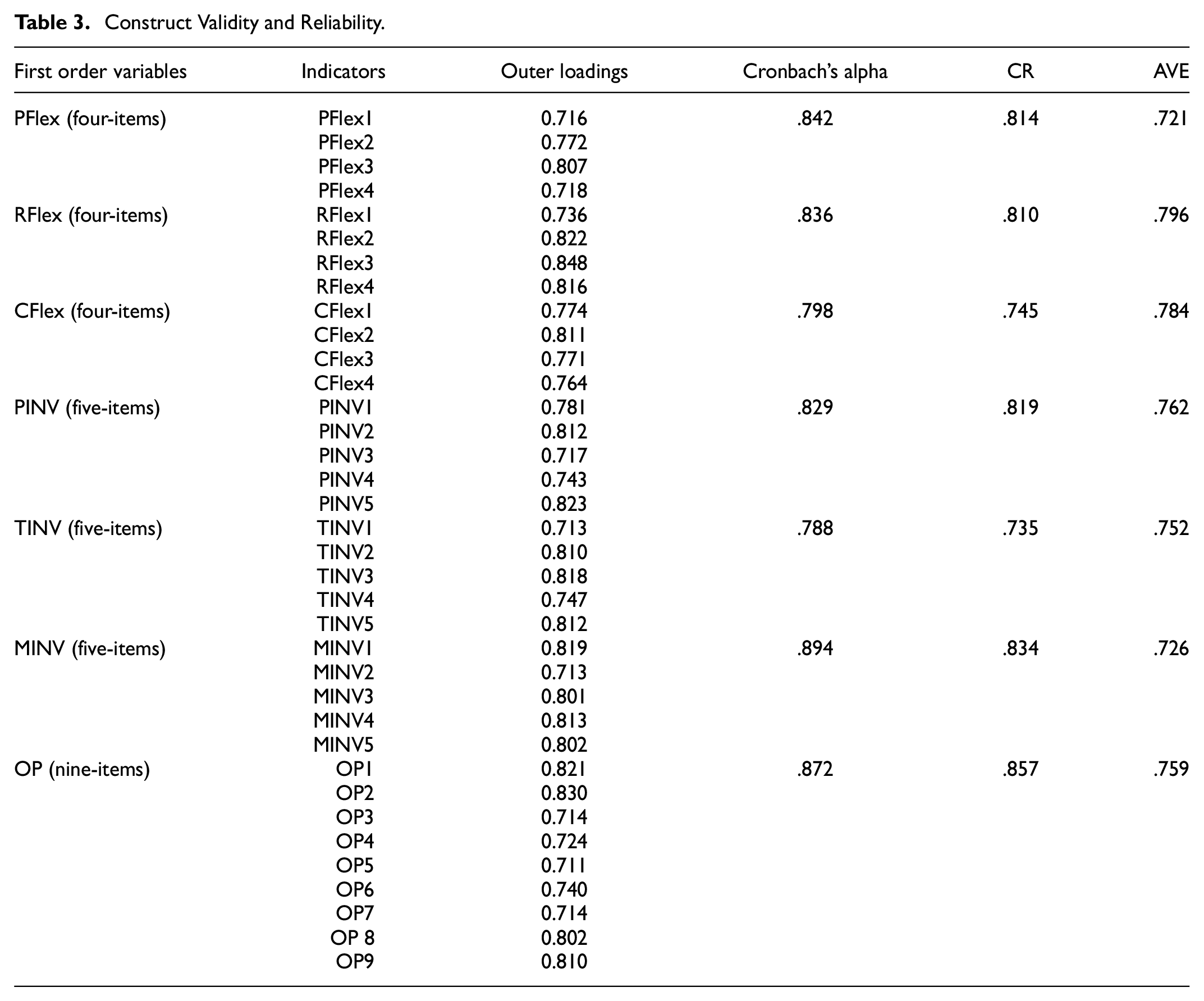
The “reliability,”“internal consistency reliability,”“convergent validity,” and “discriminant validity” are analyzed using measurement model. This model contains first order variables and their indicators (manifest variables). In this study, first order variables are reflective ones. These are estimated by “outer loadings,”“Cronbach’s Alpha,”“composite reliability (CR),” and “average variance extracted (AVE) “to ensure the “reliability,”“internal consistency reliability,” and “convergent validity” (Hair et al., 2017). Table 3 presents the results of PLS algorithm performed at 5,000 maximum iterations. The results reveal that the first order variables have outer loading ranges from 0.711 to 0.848, Cronbach’s alpha ranges from .788 to .904, CR ranges from .735 to .857, and AVE ranges from .721 to .796 which are above the cut-off values of these parameters (outer loading > 0.7, Cronbach’s alpha > .7, CR > .7, and AVE > .5) as mentioned by Hair et al. (2017). Hence, the “reliability,”“internal consistency reliability,” and “convergent validity” are established. We applied HTMT criterion to ensure “discriminant validity.” According to this criterion, “discriminant validity” is establsihed if all values of HTMT are less than 0.85 and confidence interval (CI) does not contain 1 (Henseler et al., 2014). Table 4 presents the results of HTMT criterion. The results demonstrate that all values of HTMT are less than 0.85. Moreover, the results of bootstrapping indicated that CI did not contain 1. Hence, discriminant validity is established.
Construct Validity and Reliability.
HTMT Criterion.

Analyzing the Measurement Model of Second Order Variables
The measurement model of second order variables is composed of second order variables and their indicators (first order variables). As the second order variables are also reflective variables, the criterion to ensure their “reliability,”“internal consistency reliability,”“convergent validity,” and “discriminant validity” is same as applied for first order reflective variables. Table 5 provides the results of PLS algorithm. The results reveal that the second order variables SFlex and INV have Cronbach’s alpha .854 and .826, CR .814 and .801, and AVE .656 and .598 respectively which are above the cut-off values of these parameters (Cronbach’s alpha > .7, CR > .7, and AVE > .5) as recommended by Hair et al. (2017). Hence, the “reliability,”“internal consistency reliability,” and “convergent validity” are established. Table 6 shows the results of HTMT criteria. The results indicate that all values of HTMT are less than 0.85 and does not include a value of 1. This means that discriminant validity is also established.
Construct Validity and Reliability.

HTMT Criterion.

Analyzing the Structural Model
The hypotheses are tested by analyzing the structural model. Tables 7 and 8 provide the results of PLS bootstrapping. Table 7 shows that 52.3% variance in INV (R2 = .523) is explained by SFlex and 66.2% variance in OP (R2 = .662) is explained by both SFlex and INV. This shows that the values of R2 in both cases are above the minimum threshold provided by Chin (1998). Table 8 reflects that SFlex positively affects OP (β = .424, t = 3.427) and INV (β = .643, t = 10.503). This endorses that hypotheses H1 and H2 are supported. Similarly, INV positively affects OP (β = .475, t = 4.312). Thus, this provides evidence that hypothesis H3 is supported. In addition to that SFlex exerts indirect positive effect on OP via INV (β = 0.447, t = 4.332) but this information is not enough to ensure that hypothesis H4 (related to mediating effect) is supported or otherwise. In order to estimate the mediating effect of INV, we applied the method suggested by Hair et al. (2017). Using that method, we estimated direct and indirect effects of SFlex on OP. The results indicate that SFlex has direct positive effect on OP (β = .565, t = 11.231) as well as indirect positive effect on OP via INV (β = .447, t = 4.332). According to Hair et al. (2017), when both of the effects are significant, as in our case, then partial mediation may exist. However, they clarified that “variance accounted for (VAF)” determines the strength of mediation. No mediation exists if VAF is from 0 to 0.20, partial mediation exists if VAF is higher than 0.20 and below 0.80, and full mediation exists if the VAF is higher than 0.80 (Hair et al., 2017). The formula to calculate VAF is: “VAF = Indirect effect/Total effect,” where “Total effect = direct effect + indirect effect.” In this study, VAF = 0.447/(0.347 + 0.565) = 0.4417. This shows that 44.17% effect of SFlex on OP is transferred through INV. It means, partial mediation exists in our model. Hence, hypothesis H4, although partial mediation exists, is also supported.
Results of Coefficient of Determination (R2).

Path Coefficient Strength (β) and Significance (t-value).

p < .001 (two-tailed test)
Discussion
Because of critical role of strategic flexibility for organizational adaption in response to substantial, uncertain, and rapidly changing business environments and its ability to offer circumstances for innovation to take place and consequent OP, we examined the mediating role of innovation in the association between strategic flexibility and OP in engineering project-based organizations in Pakistan. The study revealed some crucial results. First, the study revealed that strategic flexibility positively affected OP in this context. This seems to be logical given that the ability of an organization to modify/update its strategies, deployment of resources, and coordination of these resources provides the opportunities to effectively manage resources according to the changed conditions to obtain operational efficiency, productivity, growth, and competitive advantage. This result supports the findings of previous empirical studies under other contexts (J. Li et al., 2018; Nadkarni & Herrmann, 2010; Wang et al., 2021). Second, the study found that strategic flexibility positively affected innovation. This might be due to the fact that strategic flexibility facilitates changed practices, adapted resources, revised internal, and external relations which result into innovative products/services, innovative use of technology, and innovative management style. This result is also in line with the findings of prior studies (e.g., Fan et al., 2013; Wei et al., 2013; K. Z. Zhou & Wu, 2010). Third, the study demonstrated that innovation positively affected OP. This makes sense because new and improved ways of developing, designing, and delivering products/services and versatility in products/services enhance customer base and saves operational costs. Innovative use of technology provides competitive advantage (Ni et al., 2020) and innovative management styles, tools, methods, and techniques improve productivity, market share, sales growth, and internal and external relations (Camisón & Villar López, 2010). This result is also supported by previous studies (e.g., Moreira et al., 2017; Ozorhon et al., 2016). The study also found that innovation partially mediated the association between strategic flexibility and OP. This also makes sense because strategic flexibility provides conditions for innovation to take place which further leads toward improved OP. This also supported by previous studies (e.g., Xiao et al, 2021; Xiu et al. 2017). In summary, the results indicated that strategic flexibility in terms of planning flexibility, resource flexibility, and coordination flexibility has a vital potential to enhance OP in relation to financial and non-financial measures. However, strategic flexibility indirectly contributes to OP. This applies that the organizations should strive for innovation to take place in terms of product/service, technological, and management innovation to obtain the desired outcomes. Thus, innovation must be the preference of engineering project-based organizations even though adequate level of strategic flexibility is present in these organizations. Management of these organizations should not simply emphasize on enhancing flexibility rather they should strive for innovation to take place. Nevertheless, strategic flexibility improves OP when product, technological, and management innovation take place in engineering project-based organizations of a developing country.
Contribution to Theory
The study adds into the existing literature on strategic flexibility, innovation, and OP in several ways. First, it demonstrates that strategic flexibility enhances OP through innovation in engineering project-based organizations of a developing country. Previous literature has established that strategic flexibility improves OP, but this study has developed a new insight that it depends on organizational capability to innovate. Therefore, this study is a first attempt to investigate the association between strategic flexibility, innovation, and OP in engineering project-based organizations of a developing country. Second, by considering strategic flexibility and innovation as second order variables, the study provides a broader view of these concepts. Third, many prior studies considered innovation as part of strategic flexibility or performance. This study discerns innovation concept from strategic flexibility and performance. Thus, the study covers the theoretical flaws of the previous studies and presents a theoretical base to update the existing frameworks and approaches.
Contribution to Practice
The study largely contributes to practice and provides several implications for managers and practitioners working in engineering project-based organizations. First, the study develops an understanding that both strategic flexibility and innovation are essential for improving OP, but a combination of both is more effective for performance enhancement. The engineering managers and leaders in project-based organizations can utilize the results for the survival and prosperity of their organizations in turbulent business environments. Through strategic flexibility and innovation, they can keep the projects on track and can gain process efficiency and product effectiveness. Based on the results, they can make strategies and policies to enhance innovation and ultimately obtain sustainable OP. The results can inspire the policy-makers and decision-makers in engineering project-based organizations in Pakistan.
Conclusion
Engineering project-based organizations in Pakistan are experiencing immense pressure due to various uncertainties and complex external environmental changes. Leaders and managers are highly concerned for promoting innovation and improving OP in these organizations. This study investigated mechanisms of OP emphasizing on strategic flexibility and innovation in this context. More specifically, the mediating role of innovation in terms of product, technological, and management innovation was investigated in the association between strategic flexibility in terms of planning, resource, and coordination flexibility and OP. Higher order (second order) component modeling approach was adopted to model strategic flexibility and innovation. PLS-SEM analysis was performed using data from 184 organizations. The results revealed that strategic flexibility positively influences OP and innovation. Innovation positively influences OP. In addition to that innovation partially mediates the linkage between strategic flexibility and OP. Therefore, organizations which aim to strive for strategic flexibility should accumulate innovation in order to achieve OP.
Although the study was carefully conducted by adopting crucial variables and approach to enhance the knowledge of strategic flexibility and innovation but at the same time, it possesses some limitations. First, we applied a single informant strategy for every organization to collect the data. This may reflect some inherent bias in the data. Although, we tested major types of biases before performing actual analysis, the credibility of data can be enhanced by providing triangulation, that is, collection of data from different sources. Secondly, the data was collected from engineering project-based organizations of one country, that is, Pakistan. Future researchers can extend it to other countries to enhance the generalizability of the results. Third, future researchers should investigate the effect of strategic flexibility on other economic or managerial variables which lead toward organizational development and performance. Fourth, the study is cross-sectional and quantitative only. More in-depth insights can be gained through qualitative responses and longitudinal approach. Lastly, the study was restricted to engineering project-based organizations. More organizations from other sectors should be involved and organization type can be used as a control variable for the purpose to enhance the utility of the model under other settings.
Footnotes
Correction (August 2023):
The article has been updated for minor changes in the content.
Declaration of Conflicting Interests
The author(s) declared no potential conflicts of interest with respect to the research, authorship, and/or publication of this article.
Funding
The author(s) received no financial support for the research, authorship, and/or publication of this article.
