




Abstract
The innovation characteristic studies are deemed to be significant as consumers’ behavior are influenced by how they perceive these product characteristics. As the innovation characteristics continue to grow, these characteristics are observed to be cognitively centric in nature with significant overlapping in meanings and terms. To overcome this gap, this study intends to develop a cognitive-affective-balanced higher-order adoption model upon key constructs in the innovation adoption and diffusion literature. Five broad higher-order constructs namely information, compatibility, relative advantage, perceived risk, and brand trust are concluded and categorized into cognitive, affective, and conative components based on the “think-feel-do” process of Hierarchy-of-Effects model. Contrary to the diffusion literature, this study has empirically proven brand trust (β = .3638) to be the most influential characteristic to adoption intention compared to relative advantage (β = .2144), compatibility (β = .2142), and perceived risk (β = −.1669). The empirical support of brand trust as the affective-mediator contributes to justifying the significance of emotional-based characteristic to the adoption of innovation.
Introduction
Companies that introduce new products to the global market generally put in efforts to study factors that affect how quickly consumers accept their products in various markets. Due to the intense competition and unpredictable consumer responses toward a new product, companies today tend to be careful in examining every aspect of consumer reaction to new products. However, an imperative yet commonly overlooked factor in determining how quickly a product diffuses throughout a market is the characteristics carried by the new products (Rogers, 2003). These new product characteristics are deemed to be significant as consumers’ behavior is influenced by how they perceive these product characteristics (Moore & Benbasat, 1991). Consumers have diverse perceptions on these characteristics, which causes them to behave differently: some perceive these characteristics positively which lead to an improved rate of diffusion whereas others see them as obstacles to adopting the new products. As a result, the capability to assess how people react to the characteristics of a new product is crucial for identifying: (1) issues that could hinder its success and (2) ways to solve those issues, especially as managers introduce products across diverse and highly localized cultures (Flight et al., 2011).
The new product characteristic is then called as the “characteristics of innovation” by Rogers (1958, 1962) and classified as one of his key research typologies in the theory of Diffusion of Innovation (hereafter, DOI). Five universal innovation characteristics were named by Rogers (1995): relative advantage, compatibility, complexity, trialability, and observability, where these characteristics contribute 49% to 87% to the rate of innovation adoption. The initial characteristic framework of Rogers (1958) has been expanded over the past 50 years to become one of the richest in marketing literature (Flight et al., 2011). The sixth characteristic, perceived risk was then introduced by Bauer (1960) and Ostlund (1974). Holloway (1977) had then suggested the seventh dimension- status conferral, which was later parked under dimension relative advantage as a sub-dimension in most diffusion theories (Rogers, 2003). Numerous innovation characteristics are then supplemented into the initial framework include cost, communicability, divisibility, perceived cost, social approval, and profitability (Tornatzky & Klein, 1982); image or social approval and voluntariness (Moore & Benbasat, 1991); perceived usefulness and perceived ease of use (Davis, 1986); and purchase context, supplier characteristics, and product usage (Dickson, 1982; Leigh & Martin, 1981; Shaw et al., 1989). Given the huge number of criteria for describing an innovation, the description of innovative characteristics is said to be conceptually overlapping and lack of consistency (Flight et al., 2011).
This study intends to make two novel contributions to the DOI literature. First, this study aims to integrate this substantial body of knowledge and develop a unified framework that detains the key constructs in the innovation adoption and diffusion literature. To achieve so, a hierarchical component model (hereafter, HCM) is developed upon existing innovation characteristics, with newly formed higher-order constructs (HOCs) formatively measured by existing innovation characteristics, or methodologically known as latent variables (named lower-order constructs or LOCs). This HCM model summarizes overlapping innovation characteristics to higher-order constructs, which help to: (1) achieve model parsimony with the reduction of the number of path model relationships (Polites et al., 2012); (2) obsolete the linkages between the dependent constructs and the LOCs in the model (Sarstedt et al., 2019); (3) increase information fidelity instead of information bandwidth (Cronbach & Gleser, 1957, p. 100); and (4) reduce collinearity among formative indicators (Sarstedt et al., 2019).
Second, this study intends to highlight the absence of affective-based innovation characteristic in DOI literature. The existing innovation characteristics, as summarized in Flight et al. (2011), indicate a cognitive orientation in the innovation characteristic studies (see Komiak & Benbasat, 2006; Parthasarathy et al., 1995). Consumer decision-making appears to be unquestionably dependent on “affective” characteristics where: (1) the human experience has both the cognitive and emotional components (Komiak & Benbasat, 2006); (2) consumers’ conscious choices often entail both reasoning and feeling as according to the Rational Choice Theory; (3) consumer decision-making is less cognitively dominant due to unfamiliarity toward the innovation (Z. Jiang & Benbasat, 2004); and (4) the adoption of innovation may not be a purely cognitive decision because consumers’ affective reaction resulted from the innovation have impacts on their choices (Derbaix, 1995). To overcome this gap, brand trust is supplemented as the new affective-based innovation characteristic into the higher-ordered adoption model. The subsequent sections cover the conceptualization of innovation characteristics into cognitive and affective dimensions, discuss the construction and testing of HOCs which built upon prior studies in DOI literature, and justify private labels (hereafter, PLs) as the innovation object of this study.
Research Model and Construct Conceptualization
The Diffusion of Innovation (DOI) is a well-established social science theory that aims to explain how new ideas are adopted, how and why they spread among people, and how quickly they do so within a community (Rogers, 2003). Rogers (1958, 1962) is credited with writing the foundational literature, which outlines five primary characteristics of an innovation that can speed up or slow down the market adoption. Succeeding DOI studies were then focused on examining the roles played by these characteristics and exploring new constructs that influence the adoption rate of innovation. As the innovation characteristics continue to grow, these constructs are observed to be overlapping in meanings and terms (Flight et al., 2011) and cognitively centric in nature (Komiak & Benbasat, 2006; Parthasarathy et al., 1995).
Our study groups similar and overlapping constructs into a set of HOCs upon the most identified innovation characteristics in DOI literature and proposes five broad HOCs, which are illustrated in Figure 1 as: information, compatibility, relative advantage, perceived risk, and brand trust. These HOCs are then categorized into cognitive, affective, and conative components based on the “think-feel-do” process of Hierarchy-of-Effects model: (1) information construct as primary-level characteristic which works as trait that universally recognized across all potential users; (2) compatibility, relative advantage, and perceived risk conceptualized as the cognitive-based constructs that explain the mental or rational state of innovation assessment; (2) brand trust conceptualized as affective-based construct for the emotional or feeling state of innovation assessment; and (3) adoption intention conceptualized as conative construct that works as the target behavior of this study. Three factors underlie the idea of brand trust as an affective construct. First, brand trust is commonly seen as a form of “consumer’s feeling of security” when interacting with the brand (Delgado-Ballester et al., 2003). Second, brand trust is defined as a form of emotional assessment that measures consumers’ willingness to depend on a brand to carry out the promised benefits (Anwar et al., 2021; Komiak & Benbasat, 2006). Third, brand trust is described as an “emotional condition” that includes a willingness to be aware of vulnerability in the face of another party’s intentions or actions (Afzal et al., 2010; Anwar et al., 2021; Caruana & Chircop, 2021; Hoque & Uddin, 2021; Yim et al., 2021).
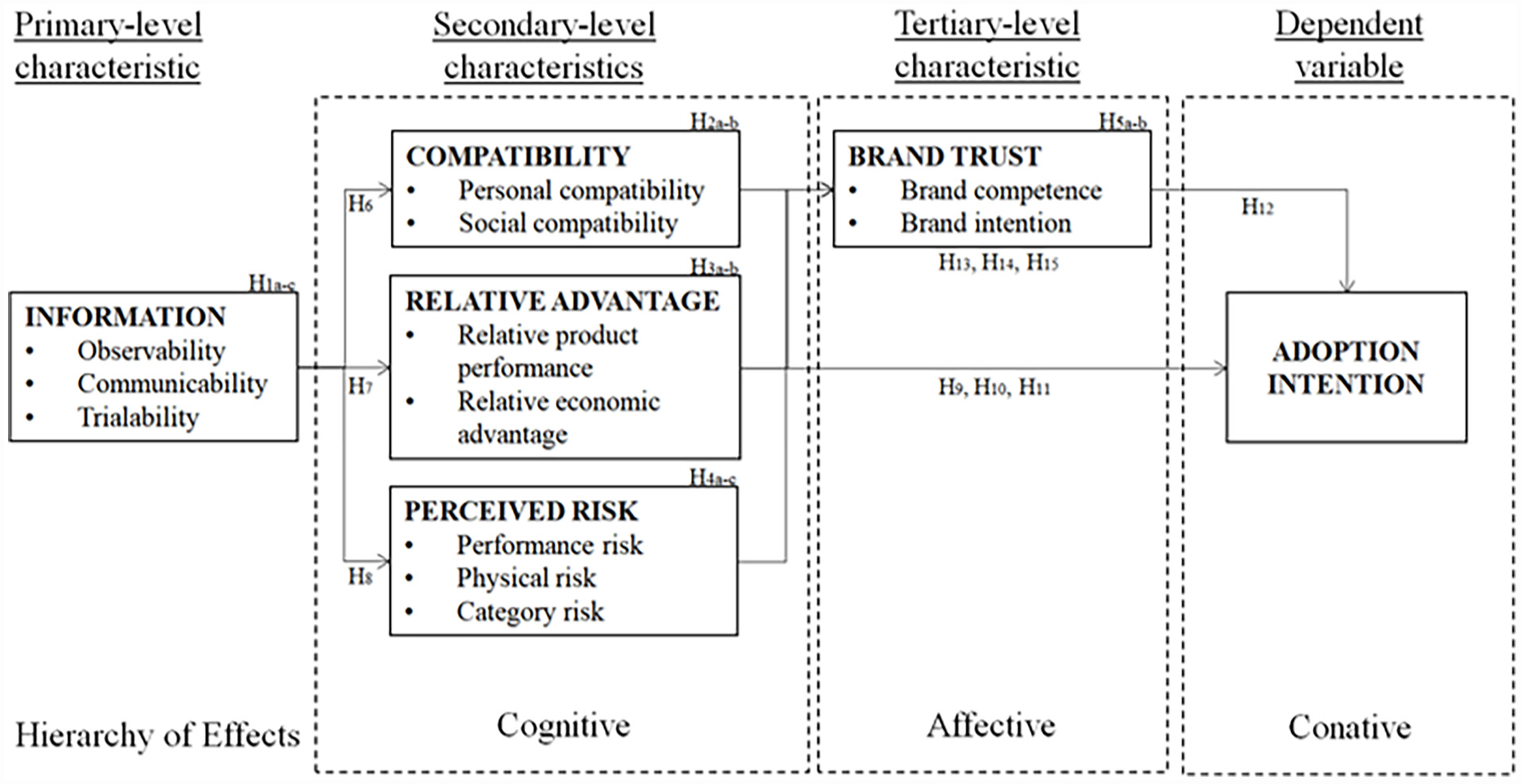
Hierarchical component model for characteristic-adoption model.
The Information Construct
Traditionally, customers rely on commercial sources to learn about innovations where this source of information is mainly controlled by marketers. However, commercial sources today are deemed to be less effective than personal sources because most consumers depend on interpersonal communications before deciding to adopt (Rogers, 1983; Yapa & Mayfield, 1978). Compared to marketers’ recommendation or experts’ technical reviews, the sharing of friends and family members’ wonderful experiences of using an innovation is deemed to be more persuasive. Thus, originated from the trialability, communicability and observability characteristics, this HOC is centered on the innovation’s traits that allow or aid the diffusion of its information, instead of the sources of information that commonly discussed in marketing literature. The information construct of this model is defined as the innovation characteristics that enable or facilitate the flow of information to potential innovation adopters (Flight et al., 2011).
Observability is defined as the visibility of an innovation as it is being used by consumers in a social system (Chen, Li et al., 2021; Rogers, 2003). It is sometimes described as the degree to which potential adopters observe the innovation as being noticeable (Hsu et al., 2007), and this includes the dissemination of new product information through visible consumption (Jaakkola & Renko, 2007). Observability helps to reduce uncertainty by demonstrating how noticeably an innovation is being adopted or used (Flight et al., 2011), delivering information to overcome perceptual barriers of accepting the innovation, and increases their sense of assurance that the innovation will work for them (Tornatzky & Klein, 1982).
Communicability is defined as the degree of visibility for the result of innovation to potential adopters (Jaakkola & Renko, 2007; Kim & Lee, 2021; Moore & Benbasat, 1991). Communicability can be further explained as the easiness with which the advantages of innovation may be communicated to others, which causes the innovation to require less marketing and advertising to sell (Tornatzky & Klein, 1982). Communicability is also seen as a type of result demonstrability in which the degree of describing the innovation benefits to the others is taken into account (Hsu et al., 2007; Kim & Lee, 2021; Kotler & Amstrong, 2016).
Trialability refers to the opportunity to try, consume, or experiment with the innovation on a limited basis (Chen, Li et al., 2021; Hsu et al., 2007; Rogers, 2003). According to Beneke et al. (2012), potential adopters employ two methods to learn about the features of an innovation. One can choose to “search” information about the product from external sources, whereas other can “experience” the product by himself. In the DOI context, trialability is associated to the “experience” characteristic.
With the support of literature, this study proposes three hypotheses to recommend that the information HOC to be formatively measured by three LOCs in the model: observability, communicability, and trialability:
H1a: Observability is positively related to the information construct.
H1b: Communicability is positively related to the information construct.
H1c: Trialability is positively related to the information construct.
The Compatibility Construct
Innovation compatibility is defined as how well the innovation fits into potential adopters’ personal and social structure (Flight et al., 2011; Kim et al., 2021). When compatible, the innovation is said to cause lesser uncertainty for adopters and normally fits well with the conditions of potential adopters (Rogers, 2003). This situational fit is further associated to: (1) the compliance of an innovation with the cultural norms of the social system that the potential adopter belongs to (Kim et al., 2021; Sitorus et al., 2019) and (2) the fit to potential adopter’s needs and previously adopted ideas (Jaakkola & Renko, 2007; Kim et al., 2021; Rogers, 2003).
Personal compatibility refers to the fit of the innovation to the adopters’ current habits and lifestyles, with the adoption of innovation having little impact on the adopters’ daily routines (Alzahrani & Kim, 2020; Flight et al., 2011). To ensure the innovation fits to the adopters at personal level, the innovation must: (1) fulfill the identified needs of the adopters (Rogers, 2003); (2) have certain level of similarity with the initial idea being replaced (Rogers, 2003), and (3) match with adopters’ existing lifestyle and self-concept (Flight et al., 2011). The innovation is deemed to be less compatible at the personal level when potential adopters are obligated to break their habit and lifestyle in order to adopt the innovation (Alzahrani & Kim, 2020; Rogers, 2003).
Social compatibility refers to the degree of fit of the innovation to the social structure of the adopters (Chen, Liu et al., 2021; Flight et al., 2011). Parthasarathy et al. (1995) associated social compatibility to the normative form of interpersonal influence, particularly when there is a strong social norm in the society surrounding a product. This normative influence can be evidenced in those who purchase products to plead others without caring whether the innovation can fulfill his or her needs. The said decisions are heavily influenced by subjective norms and closely related to the innovation’s observability (Chen, Liu et al., 2021).
This study proposes two hypotheses to recommend that the compatibility HOC to be formatively measured by two LOCs in the model: personal compatibility and social compatibility:
H2a: Personal compatibility is positively related to the compatibility construct.
H2b: Social compatibility is positively related to the compatibility construct.
The Relative Advantage Construct
Relative advantage, which is well-known in adoption literature, is often cited as the most significant factor influencing the rate of adoption (Rogers, 2003). Relative advantage is the value perception that the innovation can offer to the adopter in relation to the current alternatives, or how the innovation is perceived as superior to the idea it replaces (Black et al., 2011; Hansen, 2005; Rogers, 2003). It is assessed based on the advantages that an adopter will obtain from an innovation compared to the current product used. Commonly, the nature of the innovation determines the specific type of relative advantage that potential adopters would concentrate on, such as the advantages of economic, social, and so forth (Rogers, 2003). This study measures the dimensions of relative advantage according to Flight et al. (2011), where they compare “the value perceived from the innovation versus the product being replaced.” This “value of product” is often measured according to two basic blocks in the marketing context, namely the perceived product benefits obtained versus the cost to obtain (Kotler & Amstrong, 2016). This proposed measurement of relative advantage is also deemed to be consistent to PL literature where previous studies suggest that the key relative advantage of PL as economic advantage (e.g., Beneke et al., 2012) and products’ performance and consistency (e.g., Richardson et al., 1996).
The first dimension of relative advantage is relative product performance, which is defined as the perception of benefit that an innovation can bring to the adopter compared to the current alternatives (Iqbal et al., 2021). This dimension is commonly measured based on the superiority of the physical and technical attributes, where these attribute-based benefits represent a significant improvement over existing products, making it better at satisfying needs (Iqbal et al., 2021; Rogers, 2003).
The second dimension, relative economic advantage, is defined as the perception of cost savings that an innovation can bring to the adopter compared to the current alternatives. Commonly in DOI, this dimension takes the price and operating costs of innovation into consideration (Flight et al., 2011; Rogers, 2003, p. 230; Saeed et al., 2021) and often associated to the innovation’s capability for superior efficiency of operation (Flight et al., 2011). This dimension is also supported by Rogers (2003) and Saeed et al. (2021) where an innovation may be designed based on a more advanced degree of technology, which lowers the cost of producing a new product.
With the support of literature, this study proposes two hypotheses to suggest that the relative advantage HOC to be formatively measured by two LOCs in the model: relative product performance and relative economic advantage:
H3a: Relative product performance is positively related to relative advantage construct.
H3b: Relative economic advantage is positively related to relative advantage construct.
The Perceived Risk Construct
Perceived risk in the DOI context is defined as the anticipated failure of the innovation in fulfilling the needs of consumers and the outcome that diverges from the expected result (Hirunyawipada & Paswan, 2006). Consumers usually assess the likelihood that an idea would fail when collecting and interpreting information about ideas that they are not familiar with (Ong et al., 2022; Wan & Zhang, 2021). With positive experience, consumers may be more familiar with a certain product and this experience reduces their risk when making future purchases (Mieres et al., 2005). However, in the context of DOI, innovation appears to be unique and new to potential consumers, which reflects low familiarity with the innovation. This study denotes perceived risk to Rogers (2003) complexity characteristic, where this innovation characteristic is centered at “the uncertainty created from the physical product,” such as the performance risk, physical risk, and risk from the product category.
Performance risk, also known as functional risk or complexity in-use, is the degree of uncertainty of whether an innovation will fulfill the consumer expectations (Agarwal & Teas, 2001; Beneke et al., 2012; Cheng et al., 2021; Shimp & Bearden, 1982). It is also commonly defined as the challenges faced by the user when using the innovation to acquire the value they are looking for (Flight et al., 2011). Performance risk is also seen as a form of fear that the innovation’s functions may fail to deliver the promised benefits. It demonstrates consumers’ concerns about the innovation’s reliability and trust-ability of the quality (Beneke et al., 2011; Mieres et al., 2005; Mitchell, 1998).
Physical risk, on the other hand, is often associated to the innovation’s safe use. In this study physical risk is defined as the possibility that the innovation will physically harm the consumer and those nearby (Beneke et al., 2012; Nair et al., 2021). In DOI, it is common to see innovations introduced with improved new features, where these features are deemed to be novel to consumers and often associated to the safety of the innovation (Hirunyawipada & Paswan, 2006). Therefore, it is anticipated that the physical risk will create worries among consumers (Hirunyawipada & Paswan, 2006), especially about their physical well-being (Flight et al., 2011), and further retard the adoption of the innovation.
Category risk, or also known as global risk, is defined as the uncertainty associated with the adoption of a product within its category, where the perceived risk originates from the category as a whole rather than from a specific product version (Flight et al., 2011; Ren et al., 2021; Zhang et al., 2021). Category risk appears to be critical to innovation adoption as consumers’ risk assessment may be relying on the health and legal consequences related to the use of an entire innovation category (Ren et al., 2021).
Three hypotheses are proposed in this study to suggest that the perceived risk HOC to be formatively measured by three LOCs in the model: performance risk, physical risk, and category risk:
H4a: Performance risk is positively associated to perceived risk construct.
H4b: Physical risk is positively associated to perceived risk construct.
H4c: Category risk is positively associated to perceived risk construct.
The Brand Trust Construct
Trust has long been acknowledged in psychological literature as a type of connection where one believes in another with things they value (LaFollette, 1996). It is frequently connected to interpersonal trust as a general attitude of being able to trust the other person (Moorman et al., 1992; Zucker, 1986). In the business market, brand trust plays a crucial role to consumers in formulating expectations and judging a product’s quality (Candra et al., 2020; Lassoued & Hobbs, 2015). A brand’s credibility is believed to play a part in a consumer’s trust in a brand when there is limited information available about an innovation. This study defines brand trust as a “consumer’s feeling of security” during contact with the brand that perceives the brand as reliable and responsible for consumers’ interest and welfare (Delgado-Ballester et al., 2003). Brand trust is seen as a form of “confidence expectation” which is associated to consumers’ anticipation of the reliability and intentions of a brand (Delgado-Ballester et al., 2003). In this study, the dispositional characteristics of brand trust are discussed from the ’technical-ability’ and “intentional” perspectives, which are consistent with the two-dimensional paradigm of marketing and management literature (see Delgado-Ballester & Luis Munuera-Alemán, 2005; Doney & Cannon, 1997; Ganesan, 1994; Li et al., 2008; Morgan & Hunt, 1994).
The first “technical ability” dimension, brand competence, is related to the company’s technical abilities and competitive advantages to provide great value to their consumers (Balaji & Khong, 2021; Im et al., 2021). Brand competence is defined as “the consumer’s feeling of security and confidence in the brand’s ability to deliver superior value and create satisfaction.” This dimension is linked to “what the brand can do,” including the abilities and expertise the brand can offer to its consumers. From a marketing point of view, a superior value is determined by the firm’s ability to provide the consumer with greater benefits compared to the price that the customer pays (Balaji & Khong, 2021; Im et al., 2021; Kotler & Amstrong, 2016).
On the other hand, the “intentional” dimension, brand intention, is related to “what the brand is willing to do.” It is defined as “consumer’s feeling of security and confidence on the brand’s willingness to deliver superior value and create satisfaction,” which comprises the brand’s willingness, intention, and sincerity to serve the interests and welfare of consumers (Lertwannawit & Mandhachitara, 2021). Brand intention is seen as a type of sacrifice on the part of the company in that it puts the interests of its customers ahead of its own (Gurviez & Korchia, 2002) and demonstrates reliability, honesty, and integrity in dealing with its customers (Afzal et al., 2010; Lertwannawit & Mandhachitara, 2021). Brand intention mirrors an organization’s intentions to their consumers, in which benefits are perceived to be gained and no major harm from purchasing and consuming the organization’s products (Lassoued & Hobbs, 2015).
As the result, two hypotheses are proposed to recommend that the brand trust HOC to be formatively measured by two LOCs in the model: brand competence and brand intention:
H5a: Brand competence is positively related to brand trust construct.
H5b: Brand intention is positively related to brand trust construct.
The Higher-Order Constructs and Hypotheses
The evaluation of innovation is said to depend on the dissemination of information as it influences consumers’ awareness and consideration on whether it is worthwhile to try the new product (Flight et al., 2011; Manca et al., 2021). As the consumers learn more about the innovation, the processing of acquired information provides assurance to the consumers that: (1) the innovation may be fit to their current lifestyles, both personally and socially (Manca et al., 2021), (2) consider the advantages of innovation over the current used product Manca et al., 2021), and (3) dismiss the negative uncertainties toward the innovation (Hammedi & Ghazali, 2020). Therefore, this study presumes that:
H6: Information is positively related to compatibility.
H7: Information is positively related to relative advantage.
H8: Information is negatively related to perceived risk.
The influence of compatibility, relative advantage, and risk to adoption intention is hypothesized based on the idea that innovation will only be adopted if it has higher suitability, superiority, and lower uncertainty (Manca et al., 2021; Rogers, 2003). In considering compatibility, innovations that are discovered to be incompatible with the existing lifestyles and social norms of the potential adopters are less likely to cause behavioral adjustments that prevent the new idea from being adopted (Holak & Lehmann, 1990; Kim et al., 2021). Relative advantage, which is often quoted to be the most significant influence on adoption, is hypothesized based on the argument that any innovation is comparatively evaluated to the existing idea (Kim & Lee, 2021; Rogers, 2003). The decision to adopt is seen as a type of switching decision, where the decision depends on how superior the innovation is compared to the current product consumers are using (Cornescu & Adam, 2013). Perceived risk, on the other side, is deemed to retard the innovation adoption decision when consumers see high ambiguity of receiving the promised benefits from innovation usage (Hammedi & Ghazali, 2020; Wan & Zhang, 2021). Therefore, this study presumes that:
H9: Compatibility is positively related to adoption intention.
H10: Relative advantage is positively related to adoption intention.
H11: Perceived risk is negatively related to adoption intention.
Since consumers are unfamiliar with the fundamental properties of the innovation, such as features, quality, and performance, they are frequently compelled to rely on the innovation’s brand to assess the quality of the innovation and make adoption decisions (Chocarro et al., 2009; Speed, 1998). Brand names frequently serve as the evaluation standard and quality indicator when unfamiliar buyers are unable to estimate the quality of an innovation (Boulding & Kirmani, 1993). The reputation of the seller is frequently indicated by the brand of the innovation (Lassoued & Hobbs, 2015), which gives consumers the confidence to take the risk and rely on it (Y. Jiang et al., 2021; Lewis & Weigert, 1985). Brand trust is one of the frequently studied psychological elements that contributes to satisfaction and loyalty, which results in a desire to make another purchase or an emotional attachment (Delgado-Ballester & Luis Munuera-Alemán, 2001; Y. Jiang et al., 2021). Thus, this study presumes that:
H12: Brand trust is positively related to adoption intention.
Lastly, brand trust is conceptualized as an affective-based innovation characteristic (Anwar et al., 2021; Caruana & Chircop, 2021; Hoque & Uddin, 2021; Yim et al., 2021) in mediating compatibility, relative advantage, and perceived risk to adoption intention. This conceptualization is justified as when consumers perceived higher compatibility and relative advantage in the innovation, consumers tend to feel assured about the brand of the innovation, which lastly lead to the formation of adoption intention. On the other hand, the lower perceived risk will create a higher trust of consumers toward the brand of the innovation, which then leads to positive adoption intention among the potential adopters. Thus, three indirect relationships are proposed in the model of this study:
H13: Brand trust mediates compatibility to adoption intention.
H14: Brand trust mediates relative advantage to adoption intention.
H15: Brand trust mediates perceived risk to adoption intention.
Research Methodology
Private Label as the Innovation Object of Study
PLs are the names or symbols of retailers that can be seen on the packaging of products that are sold at a certain chain of retail stores (Jaafar & Lalp, 2012; PLMA, 2022). PLs are commonly branded under store-brand and separate-brand strategies (Chou & Wang, 2017; Sarkar et al., 2016). In a store-brand strategy, the PL is typically named after the real name of the retailer; in this case, it may be called a store brand, umbrella brand, own brand, or house brand. The vice-brand or sub-brand strategy, on the other hand, employs a new brand name different than the retailer’s to become a stand-alone brand (Sarkar et al., 2016). The PL idea originated from retailers’ aggressive response to expensive national brands (Fitzell, 1982). PLs usually charge less than national brands to directly compete with them under the same roof (Sharma et al., 2020). However, because of fierce competition from national brands in the early 1920s, many dealers started to place a higher priority on price than PL quality (Fitzell, 1982). This price-driven marketing strategy diluted PL into a low-cost image that was associated with a low-quality image (Chou & Wang, 2017; Sarkar et al., 2016) and did not significantly threaten national brands at retail outlets (Sutton-Brady et al., 2017).
Although PLs have improved to a level of quality that is almost on par with national brands (Sansone et al., 2021), consumers, particularly those in developing economies, continue to stereotype PLs as having inferior quality (Chou & Wang, 2017; Sarkar et al., 2016). They believe that while the low costs of PL products may be alluring, they also indicate a potential lack of quality in the products that may have discouraged people from buying them (Fan, 2014). PL products are perceived as having a high level of risk because consumers do not want to bear the financial risks of trying PLs, face physical risk associated with using them, or due to the lack of discretionary income to try new products (Mostafa & Elseidi, 2018; Nielsen, 2014). The replication of the Europe PL model to the Asia market is thought to be the root of PL’s failure in developing countries, particularly in Asia (Nielsen, 2014). The existing PL literature is seen to be over-accentuated on consumers’ loyalty and purchase intention (Aw & Chong, 2019). To enhance PL’s market share in a developing market, retailers need a more in-depth understanding of how to persuade non-PL users to adopt PL products. Thus, in contrast to most PL prior research, our study investigates PLs as innovations from the DOI perspective and tries to comprehend how consumers evaluate the attributes of PLs as an innovation.
Conceptually, PL complies with the DOI context definition of innovation provided by Rogers (2003). According to Rogers (2003), the determinant of an innovation depends on the potential adopters’ perceived novelty, not by the duration of time since the innovation is introduced. In retailing, PL is seen as something novel or unusual, especially in developing markets where its average volume share is still below the threshold of 5% (Oracle, 2020). This low market share demonstrates PL’s non-adoption in most developing markets, where PL is perceived as an unfamiliar new idea with little understanding and information among the local communities. Conceptually, this supports the idea that PL as an innovation in developing market.
Sampling Plan and Data Collection
This study contributes to the methodology of DOI studies by highlighting the need for novelty of the innovation to the respondents of the study. To fulfill the novelty criteria, the DOI’s target respondents must be non-adopters, who are further interpreted as: (1) individuals who are not aware of the existence of the innovation, or (2) individuals who are aware and have little or no information about the innovation, or (3) individuals who have interest and sufficient information about the innovation but have yet to adopt it. This contribution is consistent with Rogers’ (2003, p. 227) belief that the information on innovation characteristics is only meaningful when it is gathered before or concurrently with the respondents’ adoption decisions. The exclusion of existing adopters is also justified with: (1) The respondent’s “self-reported recall data,” where experienced respondents may forget how they first learned about the innovation, how they gathered the information of innovation, or even what is the behavioral as a result (Rogers, 2003, p. 127); (2) Methodological limitations, where respondents tend to explain prior adoption behavior with the current attributes of new product (Brand & Huizingh, 2008); and (3) The difficulty in observing respondents’ patterns of usage or repeat usage of an innovation (Lau & Lee, 1999).
To gather the data required for analysis, a quantitative approach was adopted. 270 Malaysian respondents were surveyed using a questionnaire as the primary data collection tool. The sample size of 270 is deemed to be above the recommended minimum sample size by Cohen’s (1992) statistical power analyses with the requirements of: (1) The commonly used statistical power of 80% in PLS-SEM; (2) The minimum requirement of detected R2 values at 0.75; (3) Significance level of 5%; and (4) The maximum number of four arrows pointing at the endogenous construct. As for sampling procedure, it starts with two rounds of multi-stage cluster sampling. The first stage of multi-stage cluster sampling involves choosing three samples of states from Malaysia’s total of 15 states (the sampling frame)—Pulau Pinang, Selangor, and Johor. The second stage of multi-stage cluster sampling involves choosing three hypermarkets from the three chosen states. Finally, a convenience sampling methodology is used to choose a sample of shoppers from the chosen hypermarkets (mall intercept contact method).
Data Analysis
A solid foundation in measurement theory must be established for the conceptualization and definition of the HOCs in HCM, which includes two decisions to fix: (1) the measurement model specification of the LOCs, and (2) the relationship between HOCs and its LOCs, both of which can be formative or reflective in nature (Jarvis et al., 2003; Wetzels et al., 2009). Research has therefore suggested four types of measurements of HOC: reflective-reflective, reflective-formative, formative-reflective, and formative-formative (see Becker et al., 2012; Cheah et al., 2019; Ringle et al., 2012). In this study, the measurement of HOCs is fixed to “reflective-formative” structure where all 12 LOCs are reflectively measured by its indicators and five HOCs formatively measured by its respective LOCs. This proposition of reflective-formative measurement structure is somehow consistent with the rule of thumb of Hair et al. (2017): (1) each LOC contributes comparatively to a HOC, and the flow of causality in the model goes from the LOCs to their respective HOCs; (2) the HOC is made up of its LOCs, with the HOC being a latent aggregate construct that is represented by an algebraic composition of LOCs; (3) the LOCs are not interchangeable, even if they are all separate and address various facets of each HOC; (4) dropping a LOC could alter the makeup and significance of HOC; (5) there is no restriction on correlation between LOCs; and (6) the model’s LOCs are anticipated to have an influence similar to that of their corresponding HOCs.
This study applies the embedded two-stage approach in forming the HOCs of the model. In the first stage, all LOCs’s indicators are assigned to the HOC, which is equivalent to the standard repeated indicator approach. Latent scores of all LOCs in the model are introduced as additional variables to the dataset rather than being used to interpret the model predictions (Sarstedt et al., 2019). Then, in the second stage, the latent scores of all LOCs are employed as indicators in the measurement model of HOCs. The latent score for each construct from the first stage of the embedded two-stage technique is captured by a single item in this stage, together with any other single-order constructs (if any). To be effective, this approach calls for consideration of two basic assumptions (Hair et al., 2014, p. 230): (1) The number of indicators should be consistent across all the LOCs in the model in order to prevent the dissimilarity in the number of indicators across each LOC from significantly influencing the relationship between the HOC and LOC, and (2) the HOC and other constructs in the PLS path model must be evaluated using the same measurement model evaluation criteria. Furthermore, the HOC is anticipated to fully mediate both the LOCs and the dependent variable in the PLS path model when the relationship between the HOC and the LOCs is formative.
With the objective of developing a characteristic-adoption model with five HOCs, the creation of multi-item scale began with a list of 65 items to measure the constructs of the study (60 items for 12 lower-ordered constructs and 5 items for intention to adopt). These items were then reviewed with researchers and industrial experts for potential problem identification purpose. Therefore, 56 items were retained and then formally screened with a pilot test of 30 actual retail consumers intercepted in mall. Items with mean response below the construct composite and variance greater than the average variance of construct items were removed. As a result, 6 items were removed, leaving 50 items for the following data collection and data analysis.
Empirical Illustration
Data collected from 270 respondents has been screened through and keyed into SmartPLS 3.3.3 statistic analytical tool for the purpose of data analysis. The subsequent sections illustrate the demographic profiling of the respondents, empirical measures of the relationships between the construct and its measurement indicators (called the measurement models), the relationships between constructs (called structured model), and the discussion of results.
Respondent Profiling
The responses were equally collected from nine selected hypermarkets in Penang, Selangor, and Johor, with each mall contributes 30 valid responses. All 270 respondents meet the “novelty” requirement and reported to be non-regular user to the PL brands under study (do not use the PL on a regular basis and had not repurchased any PL products). Participating respondents are majority found to be married (71.48%) with male respondents (58.15%) are recorded more than female respondents (41.85%). Most of the respondents fall within the age group of 31 to 40 years old (27.04%), followed by 41 to 50 years old (24.44%), 61 years old and above (16.67%), 51 to 60 years old (15.56%), 21 to 30 years old (12.22%), and below 21 years old (4.07%). As for monthly personal income, 53 respondents (19.63%) have income lesser than RM1000 per month, which believed to be contributed by 20.74% of respondents aged below 21 and above 61 years old. Eighteen respondents (6.67%) are reported with monthly income in range RM1000 to RM1999, 29 respondents (10.74%) in range RM2000 to RM2999, 49 respondents (18.15%) in range RM3000 to RM3999, 57 respondents (21.11%) in range RM4000 to RM4999, 27 respondents (10.00%) in range RM5000 to RM5999, 8 respondents (2.96%) in range RM6000 to RM6999, 10 respondents (3.70%) in range RM7000 to RM7999, 8 respondents (2.96%) in range RM8000 to RM8999, 9 respondents (3.33%) in range RM9000 to RM9999, and 2respondents (0.74%) with income RM10000 and above.
Measurement Model
Under the stage 1 assessment of reflective measurement model, all LOCs of the model have been reported achieve the assessment criteria for measurement model. Table 1 summarizes the results for internal consistency reliability, indicator reliability, and convergent validity and it shows all evaluation criteria stated above have been met: (1) The internal consistency reliability has been achieved with the composite reliability of trialability (0.8342), observability (0.8660), communicability (0.8589), personal compatibility (0.8266), social compatibility (0.8445), relative product performance (0.9006), relative economic advantage (0.8583), performance risk (0.8967), physical risk (0.9298), category risk (0.9376), brand competence (0.9168), brand intention (0.9363), and adoption intention (0.9441) all recorded above the 0.7 threshold (Hair et al., 2017); (2) The indicator reliability has been attained with outer loading values for all 50 indicators of 12 LOCs and dependent variables recorded greater than the 0.5 threshold (Byrne, 2010); (3) The convergent validity is also attained with all average variance extracted (AVE) scores of trialability (0.5577), observability (0.6182), communicability (0.6043), personal compatibility (0.6155), social compatibility (0.6451), relative product performance (0.6939), relative economic advantage (0.6027), performance risk (0.7431), physical risk (0.8153), category risk (0.8336), brand competence (0.6881), brand intention (0.7463), and adoption intention (0.7718) above the 0.5 threshold (Fornell & Larcker, 1981; Hair et al., 2014); and (4) discriminant validity is also attained with loadings of all indicators are the highest for their designated constructs (as highlighted in Table 2), square root of AVE of construct is larger than the correlations between the construct and other constructs in the model (as highlighted in Table 3), and HTMT values are below 0.90 threshold as suggested by Gold et al. (2001) (refer to Table 4).
Result Summary for Stage 1 Reflective Measurement Model.

Cross Loadings Criterion for Stage 1 of Reflective Measurement Model.

Fornell and Larcker’s Criterion for Stage 1 of Reflective Measurement Model.

HTMT Criterion for Stage 1 of Reflective Measurement Model.

As for the stage 2 assessment of formative measurement model, all LOCs of the model have been reported to achieve the assessment criteria for measurement model. Table 5 summarizes the results for convergent validity, collinearity assessment, and significance and relevance of outer weights and it shows all evaluation criteria stated above have been met. The convergent validity has been achieved with the path coefficient of information (0.720), compatibility (0.781), relative advantage (0.707), perceived risk (0.918), and brand trust (0.906) recorded above the threshold of 0.7 (Hair et al., 2017). There is no collinearity issue in the model as the 12 LOCs of 5 HOCs have achieved the desirable level of VIF values as suggested by Hair et al. (2017). Lastly, all 12 LOCs of the model are deemed to be absolute important to the formation of 5 HOCs of the model: trialability (t = 4.9029, p < .01), communicability (t = 6.7750, p < .01), observability (t = 5.5443, p < .01), personal compatibility (t = 5.5011, p < .01), social compatibility (t = 7.4141, p < .01), relative product performance (t = 15.0037, p < .01), relative economic advantage (t = 4.0434, p < .01), performance risk (t = 2.9327, p < .01), physical risk (t = 2.5278, p < .05), category risk (t = 2.0171, p < .05), brand competence (t = 2.3057, p < .05), and brand intention (t = 6.0704, p < .01). Thus, hypotheses H1a-c, H2a-b, H3a-b, H4a-c, and H5a-b are supported at the significant level of 0.05 and all LOCs are detained in the model for further analysis and implementations.
Result Summary for Stage 2 Formative Measurement Model.

Structural Model
As illustrated in Table 6, the criteria for structural model’s collinearity assessment fulfilled with all HOCs’ VIF values below the 5.0 threshold indicating no lateral multicollinearity concern in the model (Ramayah et al., 2016): compatibility VIF = 1.6210, relative advantage VIF = 1.8936, perceived risk VIF = 1.0910, brand trust VIF = 1.6968) and to brand trust (compatibility VIF = 1.5589, relative advantage VIF = 1.5511, and perceived risk VIF = 1.0355). To assess the significance level of relationships, t-statistics for the seven paths of the model have been generated using SmartPLS 3.3.3 bootstrapping function. Based on the path coefficient values shown in Table 7 and Figure 2, only six relationships are recorded t-value with equal or greater than the 1.96 threshold, thus significant at 0.05 level of significant. The six significant relationships paths are: (1) Information to compatibility, with the t-value recorded as 11.663 (p < .01); (2) Information to relative advantage, with the t-value recorded as 9.195 (p < .01); (3) Compatibility to adoption intention, with the t-value recorded as 3.461 (p < .01); (4) Relative advantage to adoption intention, with the t-value recorded as 3.164 (p < .01); (5) Perceived risk to adoption intention, with the t-value recorded as 3.320 (p < .01); and (6) Brand trust to adoption intention, with the t-value recorded as 5.674 (p < .01). However, the information to perceived risk relationship path (t = 0.886) in the model recorded with t-value lesser than the 1.96 threshold. Thus, the following relationship path is reported as not significant at 0.05 level of significance. Therefore, it is reported that hypotheses H6, H7, H9, H10, H11, and H12 of the study are supported, whereas H8 is not supported.
Hypotheses Testing.

Significance Analysis of Direct and Indirect Effects of Brand Trust.


Structural Model.
Lastly, the proposed mediations effects are analyzed and the three mediation hypotheses stated on Table 7 and Figure 2 are answered with: (1) Hypothesis H13 supported with complementary mediation for compatibility to adoption intention, where the t-values of the indirect effect reported as 2.264 (p < .05) and direct effect reported as 3.461 (p < .05); (2) Hypothesis H14 supported with complementary mediation for relative advantage to adoption intention, where the t-values of the indirect effect reported as 3.514 (p < .05) and direct effect reported as 3.164 (p < .05); and (3) Hypothesis H15 is supported with competitive mediation for perceived risk to adoption intention, where the t-values of the indirect effect reported as 2.406 (p > .05) and direct effect reported as 3.320 (p < .05).
Result Discussion
Overall, the novel contribution of this study to DOI literature has been supported with all 12 LOCs reported to be absolute important to the formation of the 5 HOCs of the model. The empirical results of this study have underlined several important findings that set apart this HCM adoption model from the conventional adoption models. Brand trust (β = .3638) is empirically proven to be the most influential characteristic to adoption intention compared to relative advantage (β = .2144), compatibility (β = .2142), and perceived risk (β = −.1669). This finding is somewhat in contrast to most DOI literature where non-adopters of this study are seen to be putting more attention on the “affective-based” brand-characteristic than the conventional “cognitive-based” characteristics (relative advantage, compatibility, and perceived risk). In addition, the empirical support of brand trust in mediating compatibility (β = .0696), relative advantage (β = .1635), and perceived risk (β = −.0658) to adoption intention has supported the conceptualization of brand trust as the “affective” characteristic and highlighted the significance of affective-based characteristic to the adoption of innovation.
However, the proposed negative relationship between the information and perceived risk HOCs has a negative coefficient (β = −.074) but is not strong enough to indicate a significant linkage (t = 0.886; p > .05). Although this result is fairly unpredicted as past literatures support for a significant negative relationship (Conchar et al., 2004; Holak & Lehmann, 1990), this study discovers one important finding where this insignificant relationship is more likely to be observed in studies that have fulfilled the “novelty” criteria of DOI studies, such as Flight et al. (2011) and Hirunyawipada & Paswan (2006). In their studies, respondents were validated as unfamiliar to the innovation object and were asked to respond to instruments based on products that they are not consuming. As the adoption decision involves unfamiliar innovations, this novelty is believed to create insecurity in consumers. Even with the presence of information and knowledge, consumers are somehow believed to have psychological stress due to the uncertainties surrounding the innovation (Kwon et al., 2008). This psychological stress is also causing consumers to neglect the information they own to assess the innovation technically (Kwon et al., 2008). Therefore, search-based information such as advertisements, word-of-mouth, or short-term trial results (Vengrauskas, 2012) is found to be ignored until they receive trust experience-based information, which is post-adoption information gained from actual product usage (Vengrauskas, 2012).
Recommendation and Conclusion
Managerial Implications for PL Products Adoption
The negative perception of PL is rooted from the past marketing activities of retailers which cause PLs to be labeled second rated options and inferior compared to national brand goods (Beneke et al., 2012). With its low acceptance rate in most countries, it is rational to suggest to retailers to understand how consumers perceive the characteristics of PL products as an innovation and identify which characteristics that encourages them to commit. With the empirical results obtained, this study ought to suggest several implications that may be applied by retailers to strategize their PL products. Firstly, retail managers must be aware of the complication in which PL may be assessed by a consumer. With certain level of newness to consumers, the decision to adopt PL may rely on the perceived reliability of the seller, which is the brand of the retailer. Such specificity may help retailers to outline their PL pre-launch campaign, where retail managers possibly will invest in brand name capital through branding policies and ethical protocol. Marketing activities and decisions are also advised to be executed based on brand instead of product line to build strong brand reputation and image. As a result, these pre-launch efforts are expected to increase consumers’ confidence toward PL products which finally lead to consumer long-term commitment.
Secondly, retail managers are also advised to kick start their PL product offerings with low complexity products. With brand trust mediates compatibility and relative advantage to adoption intention, these simple-features PL will allow consumers to easily assess its compatibility and relative advantage, which lastly direct to higher trust toward the PL brand. In addition, these simple-features PL will not only lower the risks perceived by consumers, but it will also encourage better communicability of the benefits of PL to others. As the acceptance of PL improves, retailers may then venture into higher complexity products in their PL offerings. Lastly, this study calls for the attention of retailers to carefully manage the information flow of their PL products. The promotional campaign of PL should emphasize more on showing how these products fit into the community lifestyle and their superiority compared to other brands of product in their store. Besides that, as perceived risk is empirically proven not influenced by information, retail managers can aim to reduce consumers’ perceived risk with “risk-reduction activities” instead of “risk-reduction promotion.” Activities like satisfaction guarantees, product warranties, and after sales service may help to reduce consumers uncertainty.
Research Limitation and Recommendation for Future Study
Due to Malaysia’s retailers’ varied PL offerings, PL has been generalized as the regularly purchased fast-moving-consumer goods (FMCG) and grocery items which are commonly found on the shelves of traditional hypermarkets. This classification of PL as an low-involvement purchase has somehow limited the direct application of this new adoption model to higher-involvement products. In addition, the emphasis of this study is on the “characteristics of innovation” and has excluded factors that are unrelated to the innovation (the product) itself, such as adopter and social system characteristics are thought to be critical to the diffusion of new ideas. This product characteristic-adoption model may only apply to non-adopters in developing markets where this model is believed to be poor at forecasting the adoption of ex and current consumers with prior consumption experience.
There is a need for continued research in innovation characteristics. In order to give practitioners the advantage of knowing which characteristics most influence the innovation’s diffusion curve, researchers can further define innovation characteristics using the scales developed here. This will allow them to model and test theories of perceived innovation characteristics and adoption. The real dissemination of various products and services can then be better understood considering perceived innovation features. With this knowledge, practitioners might more accurately predict the course of an innovation’s spread and, as a result, make better marketing judgments. Considering the future expansion of PL products to other higher-involvement product categories, future research can look into consumer trust toward the name of the manufacturer. Products like pharmaceutical items are often considered as riskier purchase where the name of the manufacturers may play a role in create confidence among the consumers. Besides adopting non-adopters as the subject of study, future research can also examine the impact of subject’s adoption experience in perceived risk evaluation. Knowing this information can help diffusion scholars to further recognize the root cause of uncertainty, which often claimed as one of the obstacles to innovation adoption. Lastly, as this study contend that extrinsic and affective innovation characteristics has struggled to keep up with the overall adoption diffusion literature because to the absence of an extensive and reliable scale of perceived innovative characteristics. With the inclusion of brand trust as the new HOC into the research framework, this attempt will encourage further study in this crucial field.
Overall Conclusion
This study contributes to the DOI literature by validating a reflective-formative HCM for the characteristic adoption model to measure the adoption decision of non-adopters in developing markets. In the research framework, five (5) extensive HOCs and twelve (12) LOCs are confirmed and verified in terms of content, criterion validity as well as reliability. The proposed model here integrates the DOI characteristic-adoption models and the HOE model in an unprecedented way, where it serves as a guide for academics, particularly diffusion scholars, to consider both cognitive and affective-based constructs whilst assessing consumers’ adoptions decisions. Given that brand trust is said to affect customers’ purchasing decisions, supplementing brand trust to DOI’s characteristic adoption model is thought to improve the model’s ability to forecast adoption decisions.
Footnotes
Declaration of Conflicting Interests
The author(s) declared no potential conflicts of interest with respect to the research, authorship, and/or publication of this article.
Funding
The author(s) disclosed receipt of the following financial support for the research, authorship, and/or publication of this article: This study was supported by Ministry of Higher Education (MOHE) under the Fundamental Research Grant Scheme (FRGS) with project code: FRGS/1/2020/SS01/MMU/03/11.
