




Abstract
Education–job mismatch is an indicator that describes the quality of an individual’s occupational achievements, with socio-familial background being one of the most influential factors in attaining these achievements. In this study, we aim to identify the extent to which the educational level attained by parents influences the education–job mismatch of university graduates. The analysis, deploying binary logistic regression models, is based on the Spanish Survey on the Labor Insertion of University Graduates 2019, with more than 30,000 cases. Main results are that parents’ educational level largely determines the education–job mismatch of university graduates, acting through the intergenerational transmission of opportunities. In this sense, variables such as the field of study or those related to educational investment while at university are highly influential. When we analyze the persistence of mismatch, the influence of these variables is more decisive, so it is considered that there is an indirect influence of social background on occupational attainment through the variables linked to it. Recommendations are made for educational administrations that should favor equal opportunity measures and enhance the effectiveness of educational guidance services.
Plain Language Summary
This study aimed to identify the extent to which the educational level attained by parents influences the education–job mismatch of university graduates. To explore this, we used the Spanish Survey on the Labor Insertion of University Graduates 2019, analyzing more than 30,000 cases using binary logistic regression models. The results of the analysis indicated that parents’ education level is a key factor in determining graduates’ education–job mismatch. This works via the intergenerational transmission of opportunities, with variables such as field of study or those related to educational investment while at university being influential in this process. The influence of social background on graduates’ occupational attainment through associated variables was also seen to be more decisive when considering persistent mismatch. Overall, this study suggests that educational administrations should focus on equal opportunity measures and improving educational guidance services. Doing so, they could help ensure that everyone has an equal opportunity to succeed in their chosen field and occupation, regardless of background. Limitations of the study are that, due to the complexity of the topic, there is more to explore in terms of education–job mismatch. There are also other factors that influence education–job mismatch that were not explored in this particular study.
Introduction
Technological development and especially the increased supply of skilled workers resulting from the expansion of higher education during the last decades of the 20th century (OECD, 2014) have turned the relationship between training and employment into an essential topic of debate and research (Salas-Velasco, 2021). Alongside the “traditional” employability indicators, focusing primarily on labor market insertion rates and labor market transition processes, the study of the match between training and employment has been incorporated as one of the criteria for assessing the efficiency of the education system (OECD, 2015). The mismatch can be seen as an inefficient use of public and private resources invested in education, and its analysis should serve to maximize the return on this investment (Serikbayeva & Abdulla, 2022).
Taking into account the processes of social stratification, the expansion of higher education, mentioned in the previous lines, should favor the upward mobility of the most disadvantaged groups, since an increase in their educational level will make them less dependent on their social origin (Braziene, 2020; Fachelli et al., 2014). Nevertheless, the transition processes to the labor market and job quality are still conditioned mainly by different factors related to the individual’s social background (Braziene, 2020; Capsada-Munsech, 2019; Hojda et al., 2022), including the parents’ educational level (Erdsiek, 2016; Fachelli et al., 2014; Iriondo, 2022). The mechanisms through which the family context exerts this influence are varied. Financial support is a determining factor, not only because it reduces opportunity costs by allowing the individual to remain longer in the search for a quality job (Vergolini & Vlach, 2017), but because it contributes to a greater investment in education in factors that improve employability, such as language or ICT training or the completion of other studies. Moreover, the individual makes labor market decisions based on the information received from their closest environment (Turmo-Garuz et al., 2019). Social capital, especially the quality and quantity of social networks possessed by the individual and their family, is therefore an important factor (Blau & Duncan, 1967; Bourdieu, 1986; Lin, 1999). Influence is also visible in terms of expectations and interests (Iwaniec, 2018). Ruta (2020) found that parents with higher education levels showed greater expectations of their children’s educational and occupational achievements.
This study describes the influence of this social background on the occupational attainment of university graduates in Spain, considering job match as a critical indicator of occupational attainment that defines job quality.
The Education–Job Match
The increase in skilled jobs and the technical progress in recent decades has not been sufficient to absorb the high number of people with higher education entering the labor market. This reality has led to job mismatches (Albert et al., 2021; Aleksynska & Kolev, 2021; Capsada-Munsech, 2019; Hur et al., 2019; Pholphirul, 2017). Job mismatch refers generically to the mismatch between the education a worker receives, and the education required to perform his or her job (Somers et al., 2019). Although there is literature that has considered different types of mismatches (see the classification made by Flisi et al., 2014), usually the main types described are two (Banerjee et al., 2019). On the one hand, vertical job match is defined as the degree of fit between the level of qualification attained and job requirements. Within this concept, the phenomenon of overqualification, which occurs when a worker has a higher level of education than the academic requirements of the job, has been widely described (Capsada-Munsech, 2019; Delaney et al., 2020; Garcia-Mainar & Montuenga, 2019; McGuinness et al., 2017, 2018). On the other hand, horizontal match is described as the fit between the field of study to which the degree obtained belongs and the characteristics of job performance (Rodríguez-Esteban et al., 2019; Serikbayeva & Abdulla, 2022). The incidence of this phenomenon is high (Delaney et al., 2020), with Spain being one of the countries with the highest rates of mismatch (Fundación CyD, 2022; Garcia-Mainar & Montuenga, 2019). This high rate is due to some characteristics of the Spanish labor market: an excessive dependence on sectors that require low-skilled jobs, such as construction or tourism (Baquero & Ruesga, 2019), high youth unemployment rates (INE, 2022), and high job turnover together with high labor market segmentation (Albert et al., 2021; Garcia-Mainar & Montuenga, 2019).
Studies on job mismatch have predominantly focused on its consequences for the individual, especially in terms of wages and job satisfaction. For example, overqualification relates to a significant wage penalty (Banerjee et al., 2019; Hur et al., 2019; McGuinness et al., 2018; Serikbayeva & Abdulla, 2022; Varona & Cooper, 2022). The effects on job satisfaction have been less consistent. While Chuang and Liang (2022) found a reduction in job satisfaction for overqualified workers, McGuinness et al.’s (2018) study showed no such effect. In the case of horizontal mismatch, the results are similar (Hur et al., 2019). The fact that these mismatches, especially horizontal mismatch, can be a voluntary choice (Chuang & Liang, 2022; Robst, 2007; Varona & Cooper, 2022) may explain to a large extent the lack of consistency in these results, especially regarding job satisfaction (Garcia-Mainar & Montuenga, 2019).
In contrast to the broad line of research that has analyzed mismatch effects, the literature on analyzing the factors that predict mismatch is scarce. The influence of demographic variables, such as gender or age (Baquero & Ruesga, 2019; Capsada-Munsech, 2019); academic variables, such as the completion of mobility programmes (Ghosh & Grassi, 2020), the completion of a university master’s degree (Baquero & Ruesga, 2019) or the practical nature of the study programme (McGuinness et al., 2018); and employment variables, such as the type of work schedule and working hours (Baquero & Ruesga, 2019) or the type of contract (Delaney et al., 2020), have been analyzed. However, the field of study has provided the most consistent results. Degrees in health sciences or engineering offer the lowest mismatch figures, especially horizontal mismatches (Iriondo, 2022; McGuinness et al., 2018; Rodríguez-Esteban et al., 2019; Salas-Velasco, 2021; Turmo-Garuz et al., 2019).
Any analysis of the effects of mismatch must consider its persistent or transitory nature. Theoretical approaches, such as career mobility theory (Sicherman & Galor, 1990), consider that mismatch, especially overqualification, can be transitory and not necessarily negative. Mainly in the early stages of careers, many workers may need more skills for effective job performance and will use initially mismatched jobs to acquire these skills through on-the-job learning. In another sense, the job competition theory (Thurow, 1975) considers labor mismatches, especially those of a vertical type, as permanent phenomena, since individuals need to maintain their positions in the queue for access to jobs. The evidence suggests that mismatch tends to be a persistent phenomenon, both in Spain (Capsada-Munsech, 2019; Sánchez-Sánchez & Fernández, 2020) and in an international context (McGuinness et al., 2018), with vertical mismatch being the least persistent (Albert et al., 2021).
Family Status as a Predictor of Quality of Labor Market Entry
The influence of social structure is largely associated with individuals’ occupational attainment (Braziene, 2020; Capsada-Munsech, 2019; Hojda et al., 2022), although this association weakens as the individual’s educational level increases (Carabaña & Blanco, 2016; Fachelli et al., 2014; Torrents & Fachelli, 2015; Triventi, 2013). The democratization and expansion of higher education in recent decades have offered individuals more educational opportunities and, according to this approach, less dependence on social background (Braziene, 2020; Fachelli et al., 2014). However, the influence of this social and family background is still present through different channels. On the one hand, despite the so-called democratization of higher education (Ministerio de Universidades, 2020), there is still a social selection in the previous educational stages that affects the most disadvantaged groups, which have more difficulties in accessing or succeeding in higher education (Torrents & Fachelli, 2015).
In addition, there are indirect effects of social structure that make up the so-called horizontal dimension of higher education (Erdsiek, 2016; Vergolini & Vlach, 2017). Granovetter (1973) refers, in this sense, to mechanisms that involve the use of relational capital (family contacts and access to labor market information). Along the same line, Erdsiek (2016) states that family background affects the individual’s educational and occupational achievements through social capital and the choice of area of study or degree. The approach of social capital assumes that these achievements are linked to social background, which includes the educational level and occupation of the parents, and to the individual’s trajectories in which their studies and initial access to labor market are captured (Blau & Duncan, 1967; Lin, 1999).
Thus, differences are observed in the social background of students according to the different choices of study. Children tend to choose degrees similar to their parents’ occupations more frequently (Amani & Mkumbo, 2018). Other mechanisms of intergenerational transmission of opportunities hinder to a large extent social mobility (Braziene, 2020). Among these, the influence of social contacts and access to information are particularly significant (Triventi, 2013). More advantaged social classes possess better labor market information (Amani & Mkumbo, 2018; Tocchioni & Petrucci, 2020) and links to more influential people (Assaad et al., 2018). Vacchiano et al. (2018) has noted that 60% of young people find jobs thanks to personal contacts, reinforcing this association between social capital and access to the best career options.
In this analysis of the link between social background and occupational attainment, job match as an indicator of occupational attainment has been less studied. Most of the literature has shown the influence of parental socioeconomic status on job mismatch (Barone & Ortiz, 2011; Campbell et al., 2019; Wiedner & Schaeffer, 2020). When explicitly considering parental educational attainment, empirical evidence of this influence has also been found. In Spain, Martínez García (2017) found a lower probability of overqualification, using data from the Spanish sample of the Programme for the International Assessment of Adult Competencies (PIAAC), when the father’s educational attainment increases. This relationship also holds when describing graduates with a university degree (Iriondo, 2022; Turmo-Garuz et al., 2019). In the international context, Morsy and Mukasa (2021) reached a similar conclusion by analyzing data from the International Labor Organization in 10 African countries. However, Hojda et al. (2022) found that parental educational attainment improves wage returns but does not predict mismatch in Polish university graduates. It should also be noted that family status can also affect the persistence of the misalignment since graduates from families with better status could remain longer in the search for suitable employment (Erdsiek, 2016).
Aim of This Study and the Research Questions
Based on the above, the main objective of this study is to analyze whether the educational level reached by the parents, together with other educational variables, influences the horizontal and vertical match of university graduates.
The following primary research questions are addressed:
Research Question 1 (Q1): To what extent does the educational level of parents affect, either directly or through intergenerational transmission mechanisms of opportunities, the probability of graduates obtaining a matched initial job?
Research Question 2 (Q2): What is the pattern of influence of the educational level and of the mechanisms of intergenerational transmission of opportunities in the subsequent labor trajectory?
Our hypothesis is that both educational level and intergenerational transmission mechanisms of opportunities predict the quality of employment (job fit) of university students, being the intergenerational transmission mechanisms more relevant and sustained over time.
In the following lines, the analysis model used will be presented, as well as the justification and interrelation of the variables that comprise it. The results section is organized to answer the two research questions.
Methods and Data
Design
This study is cross-sectional, correlational-predictive, with an ex post facto design that uses survey data.
Data and Participants
The data collected by the Spanish National Institute of Statistics (INE) in the Survey on the Labor Insertion of University Graduates 2019 (INE, 2020) have been used. This survey aims to collect information on the employment situation and other aspects of the labor market outcomes of bachelor’s and master’s degree graduates in the 2013 to 2014 academic year. The data collection was carried out between July and December 2019 as it was considered that “it takes around 3 years from the completion of studies to stabilize in the labor market so that at the time of the survey, at least 3 years should have passed since the completion of studies” (INE, 2020, p. 4). The final database comprised 31,651 graduates, 57.0% female and 43.0% male.
Model and Variables
Blau and Duncan (1967) proposed a model of stratification which suggests that an individual’s occupational attainment can be analyzed by decomposing the direct and indirect effects of their social origin. Our proposal builds upon this model by considering direct effects of social origin, operationalized through the parents’ educational level, on education-job match, and indirect effects operationalized through a set of proxy variables which make up the mechanisms of intergenerational transmission of opportunities. According to this, the following analysis model is proposed (Figure 1).
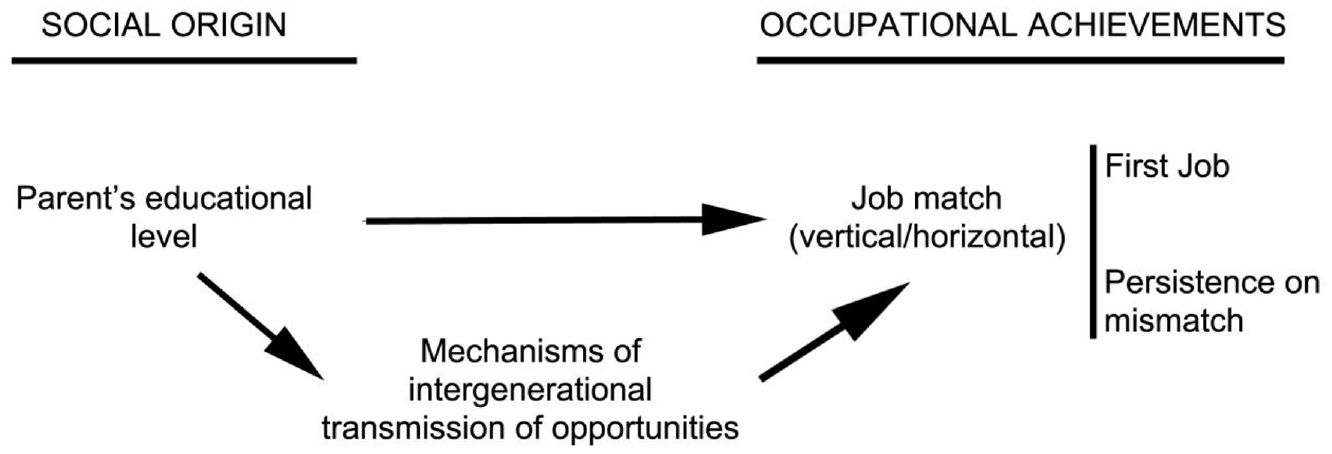
Analysis model.
Dependent Variable: Education–Job Match
For the measurement of education–job match, and following the proposal of Verhaest et al. (2017), who performed a subjective measurement of this concept, we used the answers given by the respondents to the following questions: E21 (vertical match) What do you think was the most appropriate level of education for that job?, and E22 (horizontal) What was the most appropriate field of study for that job? Regarding vertical match, the variable PR_LEVEL was recoded into two categories: matched (=1), which included those workers who responded that the most appropriate level of training for their first job obtained after graduation was a university degree; and overqualified (=0), which included those workers who expressed, as most appropriate, a level of qualification lower than a university degree. To measure horizontal match, the original variable PR_FIELD was recoded into the categories matched (=1), which included those workers who indicated that the most appropriate field of study for the first job was the field of study of their degree or a related one; and mismatched (=0), where the options “a totally different field” or “no particular field” were selected.
The process followed to measure the persistence of mismatch was as follows: those individuals mismatched in their first job were selected and their situation in their last or current job was assessed (variables TR_D19 and TR_D20). For both vertical and horizontal matches, the fact of remaining in a situation of mismatch in both moments was coded as persistent (=0); on the contrary, the situation in which a worker who indicated access to a first mismatched job which has been adjusted in the current job was coded as non-persistent (=1).
Table 1 summarizes the coding of the selected variables and the number and percentage of individuals in each category.
Variables and Categories to Measure Education–Job Match.

Direct Effects: Social Origin—Parents’ Educational Level
For the measurement of social origin, we followed the proposal of authors such as Iriondo (2022), Erdsiek (2016), Braziene (2020), Fachelli et al. (2014), Hojda et al. (2022), and Bonacini et al. (2021), who consider the parents’ educational level as one of the most relevant indicators of social origin.
The variables used from the database were Father_Studies and Mother_Studies, and three categories were selected: no studies or primary education (=0), secondary education (=1), and higher education (university or higher vocational training) (=2). The educational level of parents has been shown to be a significant factor in predicting vertical (Turmo-Garuz et al., 2019) and horizontal (Iriondo, 2022) match.
Indirect Effects: Mechanisms of Intergenerational Transmission of Opportunities
Two groups of variables were used for the analysis of the mechanisms of intergenerational transmission of opportunities: the area of study in which the worker graduated (original variable FIELD) and educational investment.
Regarding to area of study, research into social stratification processes points out that completing studies in certain areas is a factor that conditions opportunities for social mobility. For example, Erdsiek (2016) found, for the German case, that the choice of degree is related to the status. McCowan and Bertolin (2020) found, for the case of graduates in Brazil, not only greater economic benefits for medical graduates than for other graduates, but also a greater presence of parents with higher educational level in this group. The results have also consistently shown a clear influence of this variable on the likelihood of education-job match (McGuinness et al., 2018; Rodríguez-Esteban et al., 2019; Salas-Velasco, 2021), even above the direct influence of the graduate’s socio-economic environment (Iriondo, 2022).
The second group refers to educational investment. As established by the human capital theory (Becker, 1964), individuals (and their families) make educational investments in order to obtain future benefits but the amount of resources invested in human capital depends on social origin (Bourdieu, 1986). Educational investment has been measured through four proxy variables. The first is the completion of other university studies, a variable generated from the original variables EST_B11_1 (degree/diploma/bachelor’s degree or equivalent), EST_B11_2 (university master’s degree) and EST_B11_3 (university doctorate). The second is the completion of extracurricular internships (original variable HL_E1). Rodríguez-Esteban et al. (2019) found that both variables were predictors of better horizontal match for graduates. Finally, the level expressed in two employability-relevant skills, foreign languages (variable generated from the original variable NIV_ID) and ICT skills (original variable ICT) were considered. The possession of a language title (English) reduced the probability of overqualification in a sample of graduates in Spain 4 years after finishing their studies (Boto-García & Escalonilla, 2022). It is not only evident that children from families with a higher socio-economic level have a higher likelihood of access to this complementary training, but also, according to Iwaniec (2018), the educational level of parents affects the motivation to study languages.
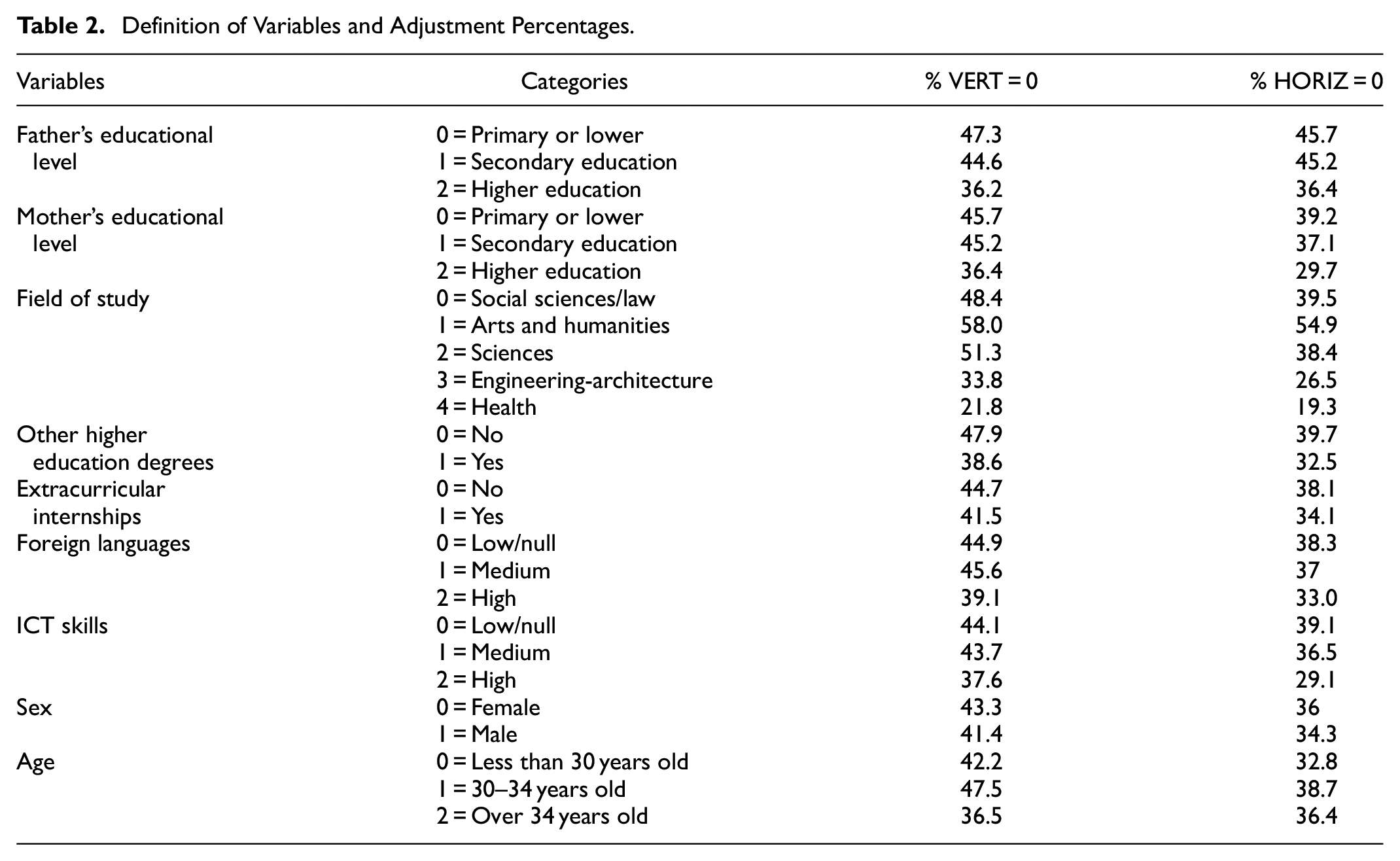
Finally, two demographic variables, sex and age, were included as control variables. Table 2 shows the coding of the variables and the adjustment percentages for each variable.
Definition of Variables and Adjustment Percentages.
Data Analysis
Contingency analysis and multiple correspondence analysis were carried out to describe the association between the parents’ educational level and the variables that make up the mechanisms of intergenerational transmission of opportunities. These previous descriptive analyses will provide relevant information to identify the stratification mechanisms that characterize university graduates’ social structure and help to explain the results obtained in the subsequent analyses.
In order to determine the predictive value of the variables relating to social origin (parents’ educational level) and the mechanisms of intergenerational transmission of opportunities (area of study and educational investment) on the dependent variables relating to education–job match and the persistence of mismatch, binary logistic regression models were used. As noted by Tillmanns and Krafft (2022), logistic regression is an appropriate multivariate analytical technique when working with dichotomous variables. In addition, unlike other similar techniques such as discriminant analysis, it does not use information about the distribution of the independent variables.
These models fit the following equation:

In this equation, π is the probability that the graduate develops an adjusted job (vertically or horizontally) or that the graduate does not persist in the mismatch situation 4 years after graduating, and β n each of the coefficients of the regression equation that is associated with each predictor variable xn.
For each analysis, two regression models were developed. The first included only the variables relating to the parents’ educational level. The second model included all variables. Assuming the 10% rule in changes of the Odds Ratio (OR) (Bliss et al., 2012), if the variation in the coefficients exceeds this percentage when controlling for all variables (2nd model), it can be considered that the effect of parental educational attainment on mismatch is not direct but mediated by demographic variables or by indicators reflecting the intergenerational transmission of opportunities.
All analyses were carried out using the statistical analysis software SPSS v.26.
Results
Descriptive Profile of the Composition of the Social Structure
In order to describe the composition of the social structure of university graduates, we present the results on the association between the variables on social origin (parents’ educational level) and the variables selected to describe the mechanisms of intergenerational transmission of opportunities (area of study and educational investment).
Figure 2 shows the distribution of parents’ educational level according to the area of study of the graduates’ degree. In each case, the percentage of parents with higher education were selected.
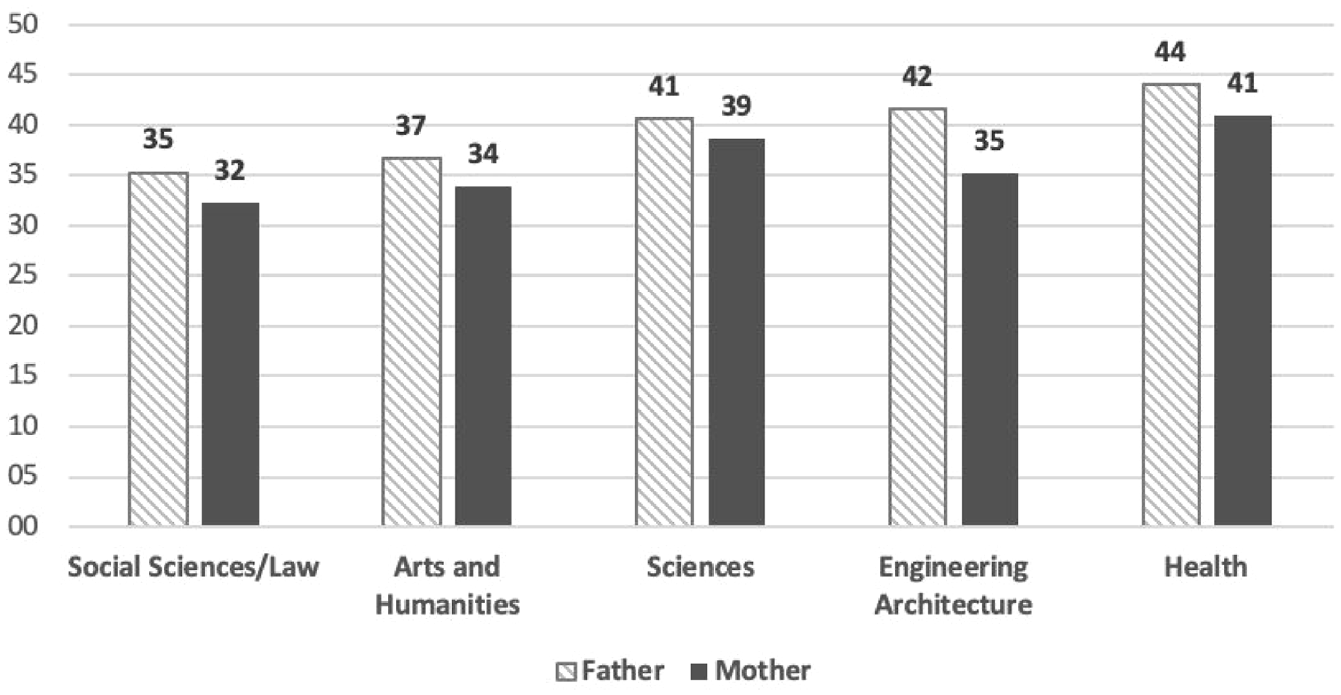
Percentage of graduates with parents with higher education.
Although the differences are not extensive, the lowest percentages of parents with higher education studies were found in the areas of social sciences/law, and arts and humanities. The differences were more evident in the case of the father, 35% of the fathers of graduates in social sciences/law pursued higher education studies. The percentage was similar in the case of graduates in arts and humanities. However, this percentage increased to 44% in the case of graduates in the area of health sciences.
In the case of the mothers, the fact that the percentages of mothers with higher education were lower than fathers in all areas stands out. The response pattern concerning the distribution by degree was similar to the previous case. The lowest percentages were found in graduates in social sciences/law (32%) and in arts and humanities (34%). On the other side are the mothers of graduates in health sciences (41%) and sciences (39%).
Figure 3 shows the associations between the categories of parents’ educational level variables and those relating to an educational investment in the education of their sons and daughters. The figure shows the final solution of two dimensions that together explain 54% of the inertia. It shows a group of items (highlighted with a circle) around dimension 1, formed by the categories of higher education of both parents (FTH_Higher_Education and MTH_Higher_Education) and those referring to the graduates on a high level of foreign languages (LAN_High), high ICT skills (TIC_High), other higher education degrees (OTH_Yes) and extracurricular internships (INT_Yes).

Map of correspondences.
On the other side of the same dimension, there is another group, although with lower proximity of the categories, formed by parents’ low educational level (MTH_Primary or lower and FTH_Primary or lower) and low level of ICT skills (TIC_Low_Null) or foreign languages skills (LAN_Low).
Research Question 1 (Q1): To what extent does the educational level of parents affect, either directly or through intergenerational transmission mechanisms of opportunities, the probability of graduates obtaining a matched initial job?
Determinants of Vertical Education–Job Match in the First Job
Table 3 presents the estimation results to identify the variables that predict vertical education–job match in the first job. Two models were designed. The first one includes only the variables relating to the educational level of both parents. In the second, the rest of the variables are incorporated. Both were globally significant, with values χ2 = 236.604, p < .001 and χ2 = 2,079.510, p < .001, respectively. The second model, with all variables, correctly classified 63.7% of the subjects.
Regression Models for the Determinants of Vertical Education–Job Match in the First Job.

Note. β (standard error).
*p < .05, **p < .001.
The first model showed that parents’ educational level was a determinant in the prediction of overqualification. Graduates whose parents had higher education were 46% more likely to have a job matched to their degree level than graduates whose parents had primary education or lower (β = 0.382, p < .001). When the father had attained secondary education, the respondent increased the probability of adjustment by 14% (β = 0.129, p < .001). The mother’s level of education was also determinant. Having a mother who has completed higher education increased the probability of adjustment by 15% (β = 0.141, p < .05), always in relation to the reference category (mother with primary education or lower). On the other hand, having a mother with secondary education predicted a higher probability of overqualification (β = −0.110, p < .05), increasing this probability by 10%.
In the second model, which included all the variables, the field of study showed significant predictive power. Compared with the reference category (workers with degrees in social sciences/law), those with degrees in arts and humanities or in sciences had a greater probability of overqualification as revealed by the negative signs associated with both coefficients (β = −0.505, p < .001, and β = −0.211, p < .001). Graduates in the field of engineering-architecture reduced this probability of mismatch (β = 0.542, p < .001). Finally, workers who had studied a degree in the field of health sciences presented more than three times the probability of developing a job adjusted to their level of studies (β = 1.251, p < .001). Regarding educational investment variables, both having completed other university studies and having completed extracurricular internships in companies increased the probability of vertical adjustment (β = 0.413, p < .001, and β = 0.160, p < .001, respectively). The two informational competences analyzed, foreign language and ICT skills, were only significant at high values: β = 0.207, p < .001 for language skills, and β = 0.116, p < .05 for ICT skills.
Regarding the demographic variables, only age was statistically significant. While the probability of vertical mismatch increased for respondents aged 30–34 (β = −0.180, p < .001), it decreased for those aged 35 and over (β = 0.395, p < .000).
In this model, the father’s educational level maintained its predictive power with values very similar to the initial model: β = 0.144, p < .001 for the secondary education category, and β = 0.314, p < .001 for the higher education category. In the case of the mother’s level of education, only the higher education category retained statistical significance. Thus, once the rest of the variables were controlled, having a mother with higher education reduced the probability of overqualification (β = 0.149, p < .05).
Determinants of Horizontal Education–Job Match in the First Job
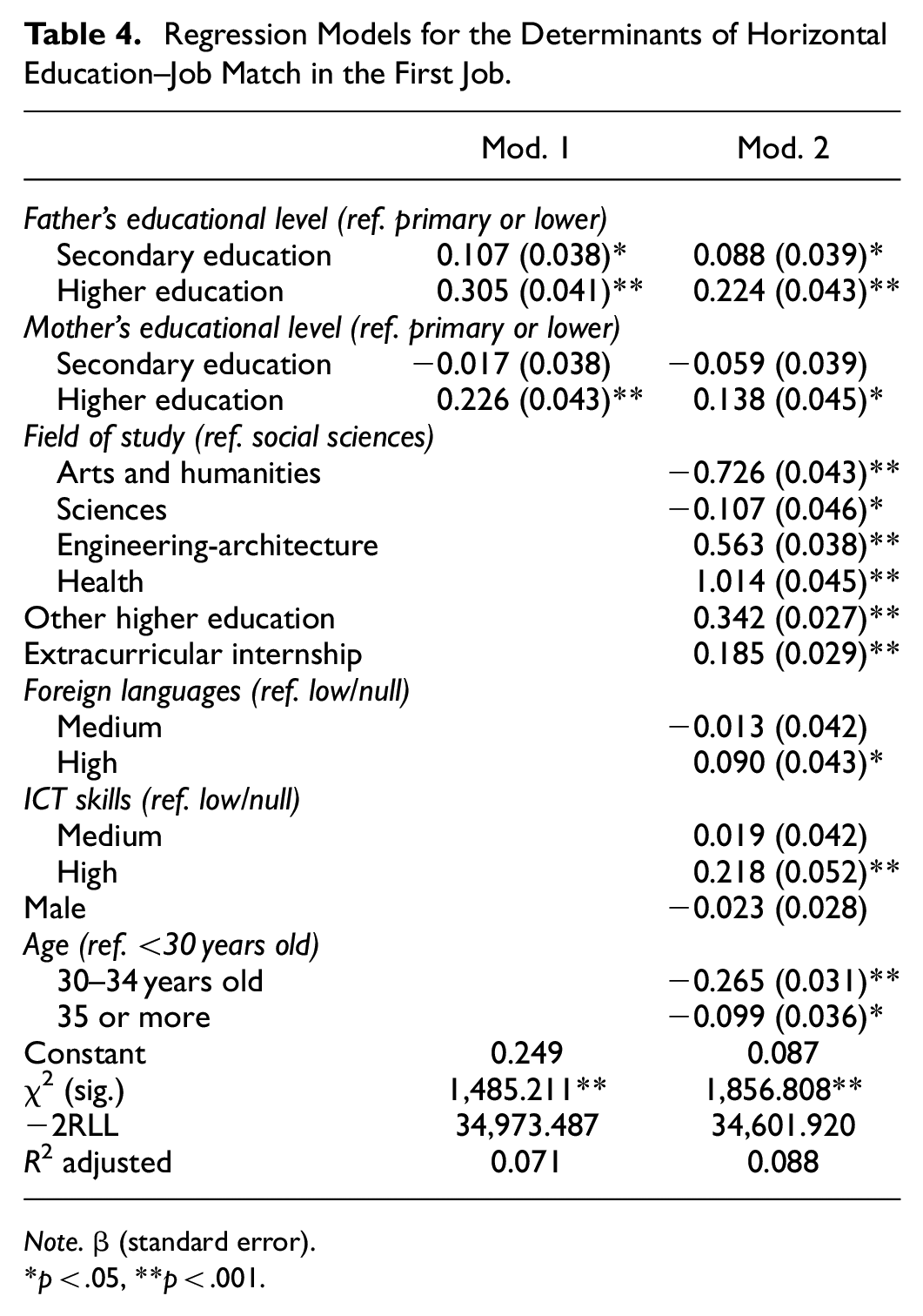
Table 4 presents the results of the estimation to identify the variables that predict horizontal education–job match in the first job. Similar to the previous analysis, two models were developed. Both were globally significant with values of χ2 = 1,485.211, p < .001 and χ2 = 1,856.808, p < .001. The percentage of correct classification of the model that incorporates all the variables was 66.9%.
Regression Models for the Determinants of Horizontal Education–Job Match in the First Job.
Note. β (standard error).
*p < .05, **p < .001.
In the first model, the level of education obtained by the father had predictive value. In the case of having a father with higher education, the probability of obtaining a job adjusted to the field of study increased by 36% (β = 0.305, p < .001), always for the reference category. When the level attained by the father was secondary education, the probability of adjustment increased by 11% (β = 0.107, p < .05). The mother’s level of studies variable only had predictive power when the mother had completed higher education, in which case the probability of horizontal education–job match increased by 25% (β = 0.226, p < .001).
Regarding the estimation results for the second model, which included all the variables, the table shows that the graduates in arts and humanities (β = −0.726, p < .001) and the graduates in sciences (β = −0.107, p < .05) presented a greater probability of mismatch in comparison to the graduates in social sciences/law. For their part, the graduates in the fields of engineering-architecture significantly increased their probability of developing employment related to their field of study (β = 0.563, p < .001). Particularly relevant was the predictive power in the case of graduates in health sciences, who increased this probability by more than double (β = 1.014, p < .001). The pattern of influence of the variables related to educational investment was similar to that obtained for the vertical adjustment. Both completing other higher education degrees (β = 0.342, p < .001) and having undertaken extracurricular internships (β = 0.185, p < .001) increased the probability of developing a job adjusted to the field of studies. In the case of the level of foreign languages or ICT skills, only those respondents who expressed a high level of these skills increased the probability of adjustment regarding those who expressed a low or null level of these skills (β = 0.090, p < .05, and β = 0.218, p < .000, respectively).
Considering demographic variables, the sex variable did not show any predictive power, but age did. Older workers had a higher risk of developing a job not adjusted to their field of studies (β = −0.265, p < .001, for respondents between 30 and 34, and β = −0.099, p < .05 for those over 34).
The pattern of influence of the variables related to the parents’ educational level was maintained with respect to the initial model. The level of education of the father improved the probability of adjustment in the two categories described (β = 0.088, p < .05, and β = 0.224, p < .000), while, in the case of the mother, her level of education was only a determinant in the higher education category (β = 0.138, p < .05).
Research Question 2 (Q2): What is the pattern of influence of the educational level and of the mechanisms of intergenerational transmission of opportunities in the subsequent labor trajectory?
Persistence of Education–Job Vertical Mismatch
Table 5 presents the regression results to predict the persistence of education–job vertical mismatch (overqualification) according to the selected variables. Both models were globally significant, with χ2 = 95.805, p < .001 in the first case and χ2 = 727.988, p < .001 in the second case. The resulting final model correctly classifies 64.1% of the graduates.
Regression Models for the Determinants of Persistence of Education–Job Vertical Mismatch.

Note. β (standard error).
*p < .05, **p < .001.
The first model showed that the father’s level of education was only significant in the case of higher education. Having a father with tertiary education increased the probability that the graduate would “exit” the overqualified situation by 30% (β = 0.267, p < .000). When the mother had higher education, this probability increased to 51% (β = 0.414, p < .000). Also, having a mother with secondary education increased this probability (β = 0.266, p < .000).
The second model showed that studying a degree in arts and humanities or science increased the probability of persisting in overqualification in the current job compared to having a degree in social sciences/law (β = −0.916, p < .001, and β = −0.478, p < .001). Having a degree in the field of engineering-architecture (β = 0.527, p < .001) or in the area of health sciences (β = 0.713, p < .001) increased the probability of obtaining a job adjusted to the graduate’s level of qualification 4 years after obtaining their degree in relation to the first mismatched job. In the case of graduates in the latter area, the increase in probability was more than double. All the variables related to educational investment allowed us to predict this persistence of vertical mismatch. Finishing other university studies increased the probability of “getting out” of the mismatch situation by more than 66% (β = 0.509, p < .001). This probability also increased by more than 12% when extracurricular internships were undertaken (β = 0.120, p < .001). Information skills also predicted this change in trajectory but only at the highest levels, with values of β = 0.602, p < .001 in the case of high foreign language skills and β = 0.191, p < .05 in the case of high ICT skills.
Demographic variables were also predictors. Being male (β = −0.214, p < .001) or being over 30 years old (β = −0.150, p < .001, and β = −0.783, p < .001 for the two categories described) increased the probability of persisting in a job for which one is overqualified.
Once all variables are controlled for in the final model, parental educational level did not predict the persistence of vertical mismatch in any of the cases.
Persistence of Education–Job Horizontal Mismatch
Regarding the persistence of horizontal mismatch, Table 6 shows the results of the two models. Both were globally significant with values of χ2 = 45.281, p < .001 and χ2 = 673.274, p < .001. The percentage of correct classification of the final model was 62.8%.
Regression Models for the Determinants of Persistence of Education–Job Horizontal Mismatch.

Note. β (standard error).
*p < .05, **p < .001.
According to the first model results, only the variable educational level of the mother reduced the probability of persisting in the mismatch. Having a mother with secondary education did so by 32% (β = 0.275, p < .001), while when the mother had completed higher education, the probability increased by 55% (β = 0.439, p < .001).
The final model showed that the variables related to the field of study maintained their predictive power in the same sense as in the previous case. The negative signs associated with the coefficients of the variables arts and humanities (β = −0.636, p < .001) and sciences (β = −0.163, p < .05) indicated that the graduates in these areas presented a greater probability of remaining 4 years after graduation in employment unrelated to their field of studies than the graduates in social sciences/law. Compared to this field, the graduates in engineering-architecture (β = 0.162, p < .05) or in health sciences (β = 0.582, p < .001) reduced their probability of persisting in the employment mismatch. Similarly to what happened in the analysis of overqualification, having completed other university studies (β = 0.419, p < .001) or having completed extracurricular internships (β = 0.237, p < .001) increased the probability of developing a job adjusted to the field of studies even though the initial job placement was in a mismatched job. A high level of foreign language skills produced the same positive effect (β = 0.249, p < .001). The level expressed in ICT skills had no predictive power on the persistence of horizontal mismatch.
Being male (β = −0.217, p < .001) or being over 30 years old (β = −0.226, p < .001, and β = −1.083, p < .001) were two categories that increased the probability of persisting in a mismatch situation.
Once all variables were controlled for, only in the case of the father having higher education was there a slight influence on the persistence of mismatch (β = 0.249, p = .039).
Discussion
This research has focused on analyzing the influence of family origin on the occupational achievements of individuals using as an indicator education–job match. We have used the information provided by the Survey on the Labor Insertion of University Graduates-SLIU 2019 (INE, 2020), which collects data on the labor market insertion and labor market trajectory of more than 30,000 university graduates in Spain.
From a descriptive point of view, the data on vertical and horizontal education–job mismatch in the first job indicate that Spain continues to be a country with high mismatch rates, confirming the findings of previous studies (Barone & Ortiz, 2011; Delaney et al., 2020; Fundación CyD, 2022; Garcia-Mainar & Montuenga, 2019). Moreover, contrary to the theory of career mobility (Sicherman & Galor, 1990) and in line with Capsada-Munsech (2019), this mismatch is presented in Spain as a persistent phenomenon; a phenomenon that is more visible in the case of horizontal mismatch. Almost 60% of respondents who entered the labor market in a job unrelated to their field of study continue in a situation of horizontal mismatch in their current job. Albert et al. (2021) have referred, in this sense, to the possible lack of extra incentives for these workers to move to other jobs, even if theirs are less related to their initial training.
Regarding the first research question (Q1), our data have confirmed the results of previous studies (Campbell et al., 2019; Capsada-Munsech, 2019; Carabaña & Blanco, 2016; Morsy & Mukasa, 2021; Wiedner & Schaeffer, 2020), which have indicated that parents’ educational level is a predictor of the level of adjustment in terms of access to the labor market. According to the model of analysis proposed, a direct effect of family context is found, as the influence is maintained even when controlling for demographic variables or variables related to the field of studies and educational investment. In addition, indirect mechanisms related to the intergenerational transmission of opportunities seem to have an influence (Braziene, 2020). Firstly, and considering that the family is one of the factors that influence the selection of a field of study (Pholphirul, 2017), a certain stratification in the social composition of these areas is maintained, in the same sense as found by Triventi (2013). Disciplines with a higher percentage of parents with tertiary studies, especially in the case of the father, are engineering-architecture or health sciences. These areas offer the lowest unemployment rates (Ministerio de Universidades, 2020) and the highest adjustment figures between education and job (Rodríguez-Esteban et al., 2019; Salas-Velasco, 2021). As Erdsiek (2016) states, these data point to the importance of the horizontal dimension of education.
Secondly, this transmission of opportunities is reflected in the influence that specific achievements derived from more significant educational investment have on education–job match. The completion of other university studies, the completion of extracurricular internships, or a high level of skills, such as foreign language or ICT skills, are factors that predict a higher probability of horizontal and vertical adjustment. Previous analyses have identified a clear association between families whose parents have higher levels of education and graduates with these educational achievements. When considering these indirect mechanisms, the influence of other factors, such as social and family contacts and access to labor market information, are critical (Amani & Mkumbo, 2018; Assaad et al., 2018; Hur et al., 2019; Tocchioni & Petrucci, 2020; Vacchiano et al., 2018). Families with higher socio-educational status possess better labor market information and can help their sons and daughters to make career decisions more effectively (Campbell et al., 2019).
To answer the second research question (Q2), the persistence of this mismatch was analyzed. The effect of educational attainment, visible especially in the case of the mother when demographic and educational variables are not considered, disappears when these variables are controlled for. The fact that there is not a significant effect of the variables relating to the parents’ educational level, especially in the case of over-qualification, but there is an effect of the variables relating to the field of study or educational investment, confirms the idea that the family can continue to be a determining factor through certain factors that facilitate a more successful employment trajectory.
Previous studies indicate that opportunities such as having career guidance about studies with better labor prospects (Carabaña & Blanco, 2016; Pholphirul, 2017; Triventi, 2013) and a greater possibility of additional training (Assaad et al., 2018; Hojda et al., 2022; Tocchioni & Petrucci, 2020; Vacchiano et al., 2018) contribute to improving the employment success of graduates. We should not forget the increased economic demands that come with certain educational investments. The acquisition of certain skills such as foreign languages and ICT skills, which are useful in today’s labor market and are usually acquired through non-formal training mechanisms, have an impact on the probability of leaving the education–job mismatch situation but only when the skill levels achieved are higher. This is undoubtedly the situation in which discrimination based on social origin is most evident.
Conclusions and Implications
The main conclusion of this study is that the socio-family context continues to be a factor that conditions the quality of employment of university students, measured through one of its indicators, namely education–job match. Our initial hypothesis regarding the direct and indirect influence of the family background is confirmed.
The so-called “democratization of the university” has to a large extent corrected inequalities in access to higher education (Fachelli et al., 2014). However, although this increase in educational attainment undoubtedly results in the reduced influence of social background on occupational attainment, the intergenerational transmission of opportunities (Braziene, 2020) is still present, affecting aspects such as career choice decisions or favoring educational investments that improve employability. We can say that the relationship between the characteristics of the university system and the influence of the socio-educational status of the family generates a paradoxical effect in Spain. Thus, in countries such as Germany, characterized by a greater selection and filtering of students in the educational stages prior to university (Triventi, 2013), the influence of parents’ educational level on the type of occupation that graduates enter is insignificant. In Spain, however, with easier access to higher education, the influence of parents’ educational level is much greater, channeled through certain “employment advantages,” such as additional language or ICT skills, further higher education studies, or extracurricular internships, and even the choice of degrees with better job prospects.
This study has allowed to update and delve into the analysis of some of the social capital factors (Blau & Duncan, 1967; Lin, 1999) that can be mobilized by the individual to achieve a more successful job insertion. Opportunities and benefits derived from the social and family networks in which the individual is inserted, such as better information about the labor market, greater influences and hiring opportunities, and greater access to economic resources, can be explanatory factors of the indirect influence of the parents’ level of education in the initial labor adjustment. This line of research should be further developed in order to promote equal opportunities for an inclusive labor environment.
Implications
There are several implications for education policy that follow from this conclusion.
Based on comparative studies, such as those carried out by Delaney et al. (2020) and McGuinness et al. (2017), who have described the influence of variables related to the socioeconomic context and the structure of the labor market in explaining the differences in the education–job mismatch between different countries, we consider that, on the one hand, economic measures should be promoted that favor for the most disadvantaged groups access to additional training in certain skills valued by the labor market, such as foreign languages or ICT. From this perspective, increasing adjustment figures for disadvantaged groups will not only contribute to favoring social mobility, but also to improving productivity due to a better allocation of the human capital resources of these groups (Erdsiek, 2016).
On the other hand, job searching through university career guidance and placement services has proven to be effective in gaining access to matched jobs (Albert & Davia, 2023). Considering this fact, administrations should make up for the lack of access to information that the most disadvantaged families may have by promoting effective support and guidance systems for students, which, based on the knowledge generated by the theories of career development (Brown & Lent, 2021; More & Rosenbloom, 2022), provide advice and useful information on the characteristics and functioning of the labor market, helping students to make decisions both in the pre-university stage and in their journey through university.
Literature has also evidenced that a higher family status generates greater occupational expectations in children (Zewude & Habtegiorgis, 2022). Counselling and psychological support services, both from secondary education and the university system, must work with students from more disadvantaged contexts to reduce this gap that is produced in terms of interests and expectations and that affects both educational and labor decisions. This fact is especially relevant when considering the situation of women in STEM disciplines, not only because of their lower presence in these areas, but because a mismatch between expectations and the characteristics of the job market can be one of the reasons for a worrying phenomenon in this area: greater regret about the choice of these qualifications by women compared to men (Rodríguez-Esteban & Vidal, 2022).
Research Limitations and Future Directions
This study has several limitations. On the one hand, in order to measure the persistence of the mismatch, a period of 4 years has been considered, which is the data provided by the EILU 2019. It would be interesting to study this phenomenon in greater depth with longitudinal studies that consider a longer period of time. Secondly, although educational level has widely been considered as an indicator of family status, it would be relevant to consider also the family’s economic level. Our dataset did not allow us to obtain this information. Finally, the information collected by the survey does not allow us to identify those cases in which the mismatch is a voluntary choice. Also, individual unobserved heterogeneity should be taken into account in other studies. Variables such as differences in abilities, motivations, or expectations can be relevant factors. These reasons for mismatch need to be further explored as they may hide different determinants and consequences. Currently, the systems most commonly used by students to raise this type of situation are informal social networks. These channels thus become important sources of information for identifying the personal and contextual reasons that lead an individual to choose or remain in a mismatched job. The sheer amount of data flowing through these channels, together with the characteristics of the language used, makes it very difficult to manage this information by computer-assisted qualitative data analysis software systems, such as MAXQDA and NVivo (Chang et al., 2021). We propose the use of artificial intelligence techniques, especially those based on natural language processing, as a useful resource for analyzing these large amounts of information in open text. These tools not only allow us to identify response patterns from the co-occurrence of words in large volumes of information, but also to identify latent themes in texts (Towler et al., 2022).
Footnotes
Declaration of Conflicting Interests
The author(s) declared no potential conflicts of interest with respect to the research, authorship, and/or publication of this article.
Funding
The author(s) received no financial support for the research, authorship, and/or publication of this article.

Data Availability Statement
Data sharing not applicable to this article as no datasets were generated or analyzed during the current study.