




Abstract
In the virtual realm, also referred to as the metaverse, users generally communicate using avatars. This metaverse is viewed as a prospective tool in different industry types, and in this regard, researchers have examined its significance in education owing to its increasing reach. In fact, it has been widely accepted that Information System (IS) model assessments in light of user’s reactions and their use of the metaverse systems is a worthwhile research branch. This is because metaverse adoption can open several avenues of enhanced student engagement in terms of collaboration, accessibility, new opportunities, personalization, creativity, and future preparedness of students. Therefore, in this study, the Diffusion of Innovation (DOI) model is employed to explain the successful adoption of the metaverse. The study tested the model using Partial Least Squares-Structural Equation Modeling (PLS-SEM) on data obtained from 1,700 students, respondents from Saudi Arabia, Yemen, and Libya, through an online survey questionnaire. Based on the findings, all the extended variables positively affected trust, relative advantage, and behavioral intention toward metaverse adoption. The study revealed that adopting metaverse technologies positively enhances students’ engagement by providing immersive, interactive, and personalized learning experiences. This positive impact underscores the potential of metaverse technologies to transform educational environments, making learning more engaging and effective. The findings highlighted the contribution of the study to practice and theory, particularly to developers, designers, and decision-makers in promoting metaverse use. More importantly, the study enables institutions of higher learning to adopt metaverse by integrating it into other tools like mobile learning in blended learning technologies.
Plain language summary
This study uses the Diffusion of Innovation (DOI) model to understand how the metaverse can be successfully adopted in education. The study surveyed 1,700 students from Saudi Arabia, Yemen, and Libya to examine their attitudes toward using the metaverse for learning. The results showed that the metaverse can improve student engagement through interactive, personalized, and immersive learning experiences. The research found that key factors like trust, perceived advantages, and positive attitudes toward the metaverse significantly influenced its adoption. The study offers valuable insights for developers, designers, and decision-makers to promote metaverse technologies in education. It also helps higher education institutions integrate the metaverse with other learning tools, such as mobile learning, to enhance blended learning approaches.
Keywords
Introduction
The virtual environment has flourished with the help of the Internet and social media, and along with this, artificial intelligence (AI) developments have made it attractive for people to carry out their daily activities online, like banking, shopping, and socializing, with the bonus of managing to save time (Lim et al., 2024; I. Sharma et al., 2024; S. Sharma et al., 2025). As a result, 3D virtual environments have been introduced to improve digital content, with the belief that a change in ICT takes place every decade – in the current one, the metaverse is deemed the new paradigm (Arpaci et al., 2022; Lim, Das, et al., 2025).
The emergence of the metaverse, a virtual realm where users interact through avatars, has garnered significant attention across various industries. The metaverse presents a novel platform for enhancing student engagement and educational learning experiences. The importance of this topic lies in its potential to revolutionize educational practices by offering immersive and interactive learning environments (Abdulmuhsin et al., 2024; Alkhwaldi, 2024a, 2024b; Lim, Bansal, et al., 2025). As technology evolves, understanding the adoption and impact of the metaverse in education becomes crucial for educators, developers, and policymakers (Al-Sharafi et al., 2024; Kraus et al., 2023; Maghaydah et al., 2024).
Therefore, several universities and higher education institutions have been actively researching the metaverse in academic surroundings through a problem-based approach. Such efforts are directed toward enabling educators and learners to resolve issues within a simulated 3D environment while using the virtual realm with their avatars (Akour et al., 2022), keeping in mind that the main objective of education is to provide students with the required knowledge, skills, and training for a successful introduction to their career in their societies and their transformation into responsible citizens within them (Wittich et al., 2017).
Previous research has explored various aspects of the metaverse, including its technological infrastructure, user experience, and potential applications in different fields. However, there is a lack of comprehensive studies examining the adoption of the metaverse in education, particularly from students’ perspective (Arpaci & Bahari, 2024; Maghaydah et al., 2024). Our research aims to fill this gap by providing empirical evidence on the factors that influence metaverse adoption in higher education settings and examine how trust and perceived relative advantage affect such adoption and, eventually, students’ engagement. Trust and perceived relative advantage were chosen for this study due to their foundational roles in adopting new technologies. Trust is essential for reducing uncertainties and fostering a positive attitude toward using new systems. Without trust, students may hesitate to engage with the metaverse despite its potential benefits. Perceived relative advantage is a key determinant of adoption as it reflects the perceived benefits and improvements the metaverse offers over conventional learning methods. Technologies that provide clear advantages are more likely to be adopted and integrated into regular use. The objective is to establish the relationship between the satisfaction level of users and metaverse system adoption, with an emphasis on compatibility, observability, trialability, and complexity (Koohang et al., 2023; Ooi et al., 2023).
The study makes several key contributions to both theory and practice. Theoretically, it extended the DOI model by incorporating variables specific to the metaverse, such as trust and relative advantage. This enhances the model’s applicability to modern technological innovations. Practically, the study findings provide insights for developers, designers, and decision-makers to promote the effective use of the metaverse in educational contexts. Additionally, the research offers valuable implications for higher education institutions seeking to integrate the metaverse with other learning tools, such as mobile learning, in blended learning environments. The study addresses the literature gap through the proposed model that focuses on the perceptions of the students of the metaverse system.
Accordingly, the paper is organized in the following way: the metaverse and its relationship to student engagement is discussed in the second section. This is followed by the third section, which contains a review of relevant literature, and the fourth one, which explains the development of the model and hypothesis formation. The adopted methods are presented in the fifth section, while the sixth section is dedicated to delivering the obtained results, which are further explained in detail in the seventh section. The eighth section deals with the study’s implications, while the ninth one enumerates the limitations of the research and recommendations for future studies. Finally, the paper is concluded in the 10th section.
Past Related Works on Metaverse
The metaverse is a concept in science fiction and futurism that reflects a virtual shared space developed by converging virtually improved physical reality and physically persistent virtual reality. In such a realm, interaction among users and virtual objects in the environment in real-time, as well as participation in different activities, like gaming, socializing, and shopping. Experts are of the opinion that metaverse development will influence various societal aspects (economics, culture, and politics; Akour et al., 2022; Arpaci et al., 2022; Han & Noh, 2021).
Furthermore, the metaverse has different uses in various fields; for instance, it has been evidenced in health, banking, finance, social platforms, and virtual stores developed by exhibitions, museums, companies, and even tourism companies. More importantly, in the face of the Covid-19 pandemic, travel restrictions were made accessible through a 3-dimensional and realistic image of the metaverse ecosystem regarding tourism activities (Zaman et al., 2022).
The metaverse appears to be the next best thing to an actual universe encapsulating several social, play, shopping, training and teaching, cultural interaction, working, and new society creation activities. However, despite being expressed as a new technology product, it is a change process reflecting how people can leverage technology in their day-to-day lives. Also, the metaverse introduces concepts of time perception that are different from real life in the sense that the users lose awareness of their bodies while in the virtual world. The virtual universe, in what seems like an establishment of a second life, could lead to social and psychological concerns, although it is vided as a new world reality that followed the digital advancements. Staying clear of the metaverse may hinder opportunities to go forward and take advantage of further opportunities, as evidenced by past literature (Akour et al., 2022; Alfaisal et al., 2024; Arpaci et al., 2022; Kye et al., 2021), and this holds true for the education field.
In the past, university lectures were presented to a small group of students by a lecturer, who acted as a lone resource – through metaverse, this academic work method in universities can be modified, benefiting students from cyber-physical learning experiences, facilitating the convergence between virtual and physical realms. The metaverse can enable students to shift between online sites and lecture rooms with an avatar. In this regard, specific conventional university teaching types may contribute to the metaverse development – in fact, many individuals are inclined toward availing of cyber-physical institutions rather than being stuck in traditional brick-and-mortar institutions. This is attributed to the fact that the metaverse can provide knowledge using virtual experiences from different universities all over the globe (Alfaisal et al., 2024).
In the UAE, Almarzouqi et al. (2022) examined the students’ perceptions regarding the metaverse application for educational purposes. The authors obtained data from 1,858 students to test the model. Meanwhile, in Misirlis and Munawar (2022) study, the authors developed and proposed a study framework to explain the metaverse technologies in university students’ education in light of their acceptance and use intention.
Moving on to another study in the Middle East, Mostafa (2022) adopted TAM to determine the factors influencing new technologies (e.g., metaverse) among users in Egypt. The authors focused on the intention to accept and use technology. Similarly, Fussell and Truong (2022) looked into the intentions of students toward using Virtual Reality (VR) use in training, also through the use of TAM, with the addition of two factors relevant to the use of the system in a learning environment.
Furthermore, the metaverse system techniques can assist in developing related qualities in educational settings, including self-reflection, responding to complex questions, problem resolution, and choice-making skills. Past studies have been dedicated to examining the metaverse role in the field of education, with the stress on its contribution o suitable models, research models, and language skills, particularly in enhancing the learner’s productivity and performance (Akour et al., 2022; Almarzouqi et al., 2022; G. Wang & Shin, 2022).
In the same findings, learning engagement, inclination toward communication, acquisition of knowledge, and classroom interaction are the central factors influencing metaverse adoption. Also, the participants’ characteristics may contribute to these effects, including their critical thinking ability and problem-solving skills. Based on past studies, the metaverse’s effective use in the educational environment could shift the government’s attitude toward its implementation. Implementation effectiveness and use may influence the perceptions of teachers and learners about their learning styles and strategies, enriching the learning process (Park & Kim, 2022).
Despite its growing relevance, the adoption of the metaverse (Jafar et al., 2025; S. Sharma et al., 2025) in educational settings is still in its nascent stages. A significant research gap exists in understanding the frameworks that facilitate the adoption of the metaverse in education. Current literature predominantly focuses on the technological capabilities and user experiences within the metaverse, but there is a notable absence of comprehensive frameworks that explain the adoption process, particularly from the perspective of students. Furthermore, research on the impact of the metaverse on student engagement is limited, leaving educators and policymakers without clear guidelines on how to implement and leverage this technology for educational purposes effectively (Al-Adwan et al., 2024; Al-Kfairy et al., 2022; Al-kfairy, Alomari, et al., 2024; Al Yakin & Seraj, 2023; Bulut & Delialioğlu, 2022).
The perceptions of the teachers of the metaverse and their ability to use and accept the metaverse have been examined in past literature (Han & Noh, 2021; G. Wang & Shin, 2022). The studies determined teachers’ experiences in schools that have implemented the system applications, with one of the significant factors highlighted being the trust and relative advantage of using the system that enhanced its adoption.
Model Development and Hypotheses Formulation
Developing the technology adoption model is crucial to explaining the adoption of new technologies among individuals, assisting in designing and implementing new technologies, and ensuring their effective adoption and usage (Al-Emran et al., 2023; Alshahrani et al., 2023; Balhareth et al., 2024; Misra et al., 2023). The following sub-sections elaborate on the study model development, beginning with the main theory of the model, followed by the formulation of the hypotheses and operational variables, and culminating with the underpinning model of the study.
Diffusion of Innovation (DOI) Theory
The metaverse is a relatively new technology innovation that provides institutions and organizations with the ability to develop virtual environments to collaborate, communicate, and conduct business activities, with the major characteristics of the system being a relative advantage, compatibility, complexity, trialability, and observability. These characteristics are employed to attract users to adopt the metaverse and increase the adoption rate. Thus, the appropriate use of DOI to explain metaverse adoption owes itself to the major elements that play main roles in adopting new technologies at the individual and institutional levels. DOI adoption indicates that the focus is directed toward the relative advantage of technology in the face of adoption potential. Past studies have largely steered clear of the way institutional forces affect the metaverse adoption among entities (Tu & de Castro e Silva, 2025). Thus, such effect and the stakeholders’ adoption of the metaverse system is lacking, particularly in the field of education. A study has yet to be carried out to examine the interconnections between the factors of innovation diffusion theory and macro-level factors in light of their influence over innovation adoption (Almaiah et al., 2022). Thus, in this research, the hypotheses are formulated and tested to examine the perceptions of academicians toward metaverse system adoption in higher learning institutions (HLIs).
However, like other theories, DOI has its limitations, with the top being its lack of focus on additional dimensions (e.g., in the environment and organization). Hence, this study includes factors of technology adoption in the study framework to explain macro-level elements.
Overall, the DOI adoption in this study is justified in light of the metaverse adoption and use in HLI, providing insight into the innovation characteristics, adopters’ characteristics, and the communication channels utilized for innovation dissemination that can influence the adoption level.
Hypotheses Formulation and Operational Variables
Eight operational variables concerning DOI are examined in this paper and presented in detail in the constructed model in the following section. The first part explains the exogenous variables, namely perceived compatibility, perceived observability, perceived trialability, and perceived complexity, while the second part is dedicated to explaining the endogenous variables, namely trust and relative advantage. The last part presents behavioral intention to adopt metaverse and perceived engagement as the dependent variables.
The Exogenous Variables
The top variable in the DOI is perceived compatibility, which refers to society’s level of compatibility with technology and application use – the level of consistency with present values, experience, and potential needs. The higher the compatibility level with the users’ requirements and experience, the more they will be inclined toward its adoption (Nehme et al., 2016; Menzli et al., 2022). This study thus describes the variable as the level of the institutions and the users’ belief that the metaverse can work toward enhancing IS potential and, in turn, their intention toward its adoption.
Additionally, compatibility is a significant innovation characteristic that can affect innovation adoption – as it is the fit between innovation and present norms, values, and practices of the potential users (Almarzouqi et al., 2022). Compatibility was examined by Akour et al. (2022) as a factor of metaverse technologies, assuming that the perceived compatibility of new technology is a determinant of the intention toward its use. The study shows that if the perception of the individual of the latest technology is compatible with his/her work practices and values, and beliefs, there is a higher likelihood of adoption.
In the same line of study, Almaiah et al. (2022) investigated compatibility in the AI context, and based on DOI, perceived compatibility is one of the adoption determinants, and thus, the higher the compatibility of the innovation with the norms, values, and practices of the potential users, the higher will be the adoption likelihood. Therefore, in this study, the following hypotheses are proposed;
H1: Perceived compatibility has a positive relationship with trust.
H2: Perceived compatibility has a positive relationship with relative advantage.
Moving on to the following exogenous variable, which is observability – it is referred to as the level to which the metaverse is viewed as visible to the users and non-users, with visibility indicating its potential assistance with peer discussion of new ideas as institutional learners look toward discussing and negotiating about the innovation (Almarzouqi et al., 2022).
As a metaverse variable, observability is the understanding of the level of visibility of the results of metaverse use and its influence on its adoption; for instance, in past studies, others can observe the metaverse use outcome, including enhanced collaboration and productivity and thus, increased adoption likelihood (Akour et al., 2022; Alfaisal et al., 2024).
Another similar past study by Jaung (2022) illustrated the advantages of metaverse platform usage, including enhanced collaboration and communication via technology and online videos, which can all increase the adoption likelihood. Studies of the like have supported observability and its positive influence over the metaverse adoption, benefiting users via technology demonstrations, online videos, and other methods, which enhanced the adoption inclination and instances (Mundy et al., 2019; Park & Kim, 2022). The following hypotheses are proposed;
H3: Perceived observability has a positive relationship with trust.
H4: Perceived observability has a positive relationship with relative advantage.
In addition to the above two factors, trialability is an innovation characteristic that reflects the level of the innovation’s experimentation within limits, and it may affect the innovation adoption based on the DOI theory. It is the level to which society trusts innovation to the extent that they are willing to test-drive it for heightened usage of technology, like metaverse, in the future (Almaiah et al., 2022).
In enterprises, Van et al. (2022) examined metaverse trialability, and the findings supported its positive relationship with metaverse adoption, enabling users to test the system in low-risk surroundings and evaluate it before full implementation. Similarly, Park and Kim (2022) and (Almaiah et al., 2022) examined Metaverse and AI trialability in the education field and found it to have a positive relationship with technology adoption, enabling the testing of the technology in a suitable environment, after that highlighting its advantages before its full implementation.
In the context of metaverse applications, when students can try virtual environments, simulations, or collaborative features in a low-risk setting, they may be more likely to perceive them as advantageous than traditional learning tools. Therefore, trialability is expected to positively influence the perceived relative advantage of metaverse technologies in higher education.
It is, in fact, perceived trialability one of the significant factors that affect metaverse adoption that contributes to its enhanced adoption, and thus, this study proposes that;
H5: Perceived trialability has a positive relationship with trust.
H6: Perceived trialability has a positive relationship with relative advantage.
The last examined exogenous variable is complexity, the user’s perception of the effort needed to understand and use technology. The difficulty level that users need to use the metaverse system may influence their performance (Okour et al., 2021).
In Rospigliosi (2022), complexity hindered metaverse technology adoption in education. Specifically, complexity technology, which covers its setup, hardware and software configuration, and the lack of educators’ expertise, was the underlying factor preventing effective VR adoption in education.
In literature, complexity is a significant factor influencing metaverse adoption, and thus, it needs to be considered, particularly when it comes to the need for specialized hardware and software. Added to this, the need for technical expertise and training opportunities among employees exist for adoption and implementation success, and as such, this study proposes that;
H7: Perceived complexity has a negative relationship with trust.
H8: Perceived complexity has a negative relationship with relative advantage.
The Endogenous Variables
Several past studies concerning metaverse examined the trust factor and its relationship with the system’s adoption. Based on the studies’ findings, trust is a significant determinant of adopting metaverse among individuals and organizations. Specifically, Dwivedi et al. (2022) revealed that trust in the metaverse and organization providing it had a positive relationship with its intention to use. Also, trust in the metaverse significantly predicts its actual usage (Salloum & Al-Emran, 2018).
Moreover, trust in the metaverse has a positive relationship with the user’s inclination to use it in different activities like communication, collaboration, and entertainment. The variable has a positive relationship with the inclination toward personal information sharing and perceived security as well as privacy of the system, and thus, this study proposes the following hypothesis for testing;
H9: Trust has a positive relationship with behavioral intention to adopt metaverse.
Another endogenous variable examined in this study is a relative advantage, which is the level to which the users believe that innovation use is better than traditional methods (Almaiah et al., 2022; Okour et al., 2021). This research defines relative advantage as the level to which learners are convinced that metaverse use is better than traditional methods because of its positive influence over future performance.
In a related study, Al Breiki et al. (2023) revealed that the relative advantage of the metaverse significantly influenced virtual reality adoption in education. The respondents were educators who were surveyed about their teaching use of VR, and it was revealed that those who perceived high VR relative advantage had a higher likelihood to adopt it in their teaching. In conclusion, VR’s relative advantage enhances the experience in learning processes and is a significant adoption factor (Al Breiki et al., 2022).
Also, in education, Y. Wang et al. (2023) looked into the significance of relative advantage. The authors found a relative advantage to be the ability to enhance communication and collaboration and significantly influence system adoption among organizations. The metaverse relative advantage positively correlated with intention toward its adoption among students. Past studies on relative advantage-metaverse relationships supported the former’s enhancement of user experience and the facilitation of immersive, interactive, and personalized experiences, which shows its significance in system adoption. As such, this study proposes the following hypothesis for testing;
H10: Relative advantage has a positive relationship with behavioral intention to adopt metaverse.
Dependent Variable
The dependent variable examined in this study is behavioral intention toward adopting the metaverse, which is the likelihood of the individual intending to adopt the metaverse. This variable is a significant predictor of actual behavior and is affected by trust and relative advantage (Rogers, 2003).
Moreover, behavioral intention is significant in predicting actual behavior, and in this study, where the focus is on the engagement of students, it can be viewed as a predictor of the students’ likelihood to engage in the metaverse and to understand their perception of the system and the possibility of its adoption in their learning process (Mukred et al., 2024).
The present study examines behavioral intention to use the metaverse as a major predictor of the actual engagement of the students in metaverse as proposed in the research model within which other influencing factors include relative advantage and trust.
According to past studies (Bedenlier et al., 2020; Di Natale et al., 2024; J. Wang & Chia, 2022), engagement refers to the level of interest and participation of students in their learning, and it has various types. More specifically, behavioral engagement is the observable actions of students like attendance, assignment completion, and class discussion participation (Chen et al., 2020; Y. Wang et al., 2019). On the other hand, cognitive engagement is the level of mental effort and focus that the students exert on their learning, which may include deep reading, problem-solving, and critical thinking (Sahni, 2019), while emotional engagement is the level of investment that the students place on their learning through their emotions, which could encompass motivation, curiosity, and interest in the curriculum (Jagers et al., 2019). Lastly, social engagement is the interaction and collaboration level among students, which covers working in groups, peer feedback, and class discussions (Al-kfairy et al., 2023; Di Natale et al., 2024; Ozkal, 2019).
Some past literature on the subject indicated the contribution of metaverse use in enhancing the engagement of students, but these studies largely steered clear of the relationship between metaverse technology adoption and actual engagement (Mystakidis, 2022; Tlili et al., 2022; Yang et al., 2022). Therefore, this study proposes that;
H11: Behavioral intention to adopt metaverse has a positive relationship with the perceived engagement of students in HLIs.
This hypothesis is based on the premise that when students have a solid intention to adopt metaverse technologies, they are more likely to perceive higher engagement levels due to the anticipated benefits and immersive experiences the metaverse offers (Teng et al., 2022). Intention to adopt reflects a positive attitude toward using the metaverse, which can translate into a greater willingness to engage with its features once implemented. By anticipating the innovative and interactive nature of the metaverse, students who intend to adopt it are likely to be more motivated and enthusiastic about its potential, thereby perceiving higher engagement (Pan et al., 2023).
Proposed Metaverse Adoption Model
The study model comprises four independent variables: perceived compatibility, perceived observability, perceived trialability, and perceived complexity. There are two endogenous variables, namely trust and relative advantage, and two dependent variables, namely behavioral intention and perceived student’s engagement in the metaverse. The following table enumerates the formulated hypotheses concerning metaverse adoption among students in HLIs.
Figure 1 shows the proposed model with the hypothesis.

Proposed model with hypothesis.
Methodology
The study employed a quantitative research approach, which is well-suited for examining the relationships between variables and testing hypotheses in a systematic manner. The quantitative approach allows for collecting and analyzing numerical data, providing objective measurements and the ability to generalize findings across larger populations. This is particularly important for our study, which aims to understand the adoption behavior of a large and diverse sample of students. To analyze the complex relationships between key variables such as trust, relative advantage, and behavioral intention, we utilized structural equation modeling (SEM). SEM is an advanced statistical technique that enables us to assess the structural relationships between latent constructs and ensures the reliability and validity of our findings. This methodological choice enhances the robustness of our study and allows us to draw meaningful conclusions that can inform both theory and practice.
This section is dedicated to explaining and presenting the adopted study methodologies.
Survey Development and Validation
This study developed a survey questionnaire to collect data for hypothesis testing. Accurate measurements are required to measure the eight constructs in the questionnaire, and such measurements were adopted from the existing literature (refer to Table 1 for the constructs and Table A1 in the Appendix A for the questionnaire items).
Constructs Sources.

There are 40 items within the survey were amended to suit this study’s objectives (refer to Table A1 in the Appendix A).
The validity of the questionnaire was done using face validity by a team of experts – this process confirmed the ability of the instrument to measure what it is intended to; based on Hair et al. (2016), face validity, informal or formal, is needed before the actual study. The items’ validity was ensured by adopting them from past literature that had already tested such validity in the original studies. However, owing to the scope and context differences, formal face validity was still required. This was made possible through the experts’ feedback, which was used to adjust and modify the items in the questionnaire.
This was followed by translating the original English questionnaire version into Arabic following strict procedures. Furthermore, to ensure the validity and reliability of the Arabic-translated questionnaire, a rigorous translation and back-translation process was followed. The original items were translated into Arabic by bilingual experts and then independently back-translated into English to ensure consistency and conceptual equivalence. A panel of academic reviewers fluent in both languages verified the accuracy of the translated items. Additionally, a pilot test was conducted with a small group of students to assess clarity, cultural appropriateness, and internal consistency, leading to minor refinements before full distribution. These steps have been detailed in the revised methodology section of the manuscript.
The study sample consisted of Saudis, Yemenis, and Libyans whose mother tongue is Arabic, and thus, a Saudi translator was chosen to translate the questionnaire items to Arabic as recommended by (Hendricson et al., 1989).
This study was conducted using an anonymous online survey to ensure participant confidentiality and reduce any potential risk of harm. No personally identifiable or sensitive information was collected. Participation was entirely voluntary, and respondents were informed of their right to withdraw at any time without consequence. Ethical approval was obtained (SUREC 2024/035) prior to the data collection. Informed consent was obtained electronically before participants proceeded with the survey.
Sampling and Data Collection
A purposive sampling strategy was employed to target university students who are more likely to be familiar with digital platforms and emerging technologies, including the metaverse. The inclusion criteria required respondents to be current students enrolled in higher learning institutions and to have at least basic exposure to digital learning environments.
Online surveys were distributed to different universities in Yemen, Libya, and Saudi Arabia to collect data over a period spanning from July 2022 to November 2022. Specifically, the research team sent 3,000 survey invitations with questionnaire links through email, online groups, and WhatsApp, and 1,000 invitations were sent to each country. From these, 1,700 responses were retrieved, representing an overall response rate of 56.7%. The distribution of responses was as follows: 480 responses from Yemen (48% response rate), 227 responses from Libya (22.7% response rate), and 993 responses from Saudi Arabia (99.3% response rate). Saudi Arabia was chosen due to its rapid digital transformation in education and high technology adoption rates. Yemen and Libya were included to provide insights from less technologically advanced and economically constrained environments, offering a broader understanding of how contextual factors affect metaverse adoption in higher education. These countries were chosen to provide a diverse sample that captures a wide range of experiences and perspectives on metaverse adoption in higher education. This selection helps to enhance the generalizability of the findings across different educational contexts.
Missing values in the online survey occurred due to incomplete responses where participants skipped specific questions or did not finish the survey. Despite implementing mandatory fields for critical questions, some non-essential questions were left optional, leading to occasional incomplete data entries. After excluding 400 incomplete surveys, we retained 1,700 usable responses for analysis. This final sample size of 1,700 is justified as it is sufficiently large to provide reliable and generalizable findings. It allows for more accurate parameter estimates and increased statistical power, which is essential for the SEM used in our analysis. This large sample size helps ensure the results are robust and representative of the population studied, providing a solid foundation for testing the research hypotheses and drawing meaningful conclusions.
Analysis Strategy
The PLS-SEM was employed through Smart PLS V 3.2.8 to analyze the obtained data. There are several reasons behind this selection, which are mentioned throughout the paper. For instance, past studies dedicated to PLS (e.g., Hair et al., 2011; Henseler et al., 2009; Ringle et al., 2012) emphasized its practical use in exploratory studies and others (e.g., Hair et al., 2011) evidenced its usefulness in existing theory development. As such, this study, being an extension of Western theories and aiming to explore the use of technology in the Middle East, selected PLS analysis for analysis. According to Chin (1998), PLS is even appropriate to use regardless of the relationship absence/presence, and it confirms relationships between latent and manifest variables, posing a critical issue in model validation among exploratory studies (Julien & Ramangalahy, 2003) and (Mahmood et al., 2004), which supports its use in the present paper.
Results
This section is appropriate for the presentation of analysis results and findings and is divided into three sub-sections, namely findings from the demographic characteristics of respondents, findings from the measurement model, and findings from the structural model.
Demographic Findings
As mentioned, the demographic characteristics of the students, as respondents, were obtained, mainly their gender, age, marital status, level of status, faculty, and country – all presented in the following sections and shown in Table 2.
Demographic Findings of the Respondents.

The distribution of gender based on the obtained results shows that 953 of the respondents (56%) were male students, while 747 (44%) were female students, which shows a male-dominated sample.
On the other hand, the respondents’ ages were pre-categorized into three: 17 years or less, 18 to 27 years old, and 28 years and over. A total of 237 fall under the first category, constituting 13.94%; 1,427 fall under the second one, constituting 83.94%, and 36 fall under the third category, comprising 2.12%. Most respondents were 18 to 27 years old, while the minimum was 28 years and over.
As for marital status, there were 399 married respondents (23.47%) and 1,301 married ones (76.53%). The majority of the students were single.
The respondents’ experience in using metaverse applications was also obtained, and from Table 2, 36 respondents have been using metaverse tools and applications for less than a year (2.12%), 78 have been using them for 1 to 2 years (4.95), 945 for 2 to 3 years (55.59%), and 387 have been using them for 3 to 4 years (22.24%). The remaining 263 respondents have been using Metaverse for 4 years and over, constituting 15.74% of the respondents, indicating that most were familiar with the app.
On the other hand, the respondents’ university-type question was divided into a diploma, professional education, and bachelor’s degree. From the data, 266 of the respondents were obtaining their diploma, 317 were obtaining professional education, and 1,117 were obtaining bachelor’s degrees, constituting 15.65%, 18.65%, and 65.70%, respectively.
As for their year of study was divided into six segments: first-year students, second-year students, third-year students, fourth-year students, fifth-year students, and sixth-year students. There were 374 students in their first year of studies, 259 in their second year of studies, 612 in their third year of studies, 428 in their fourth year of studies, 15 in their fifth year, and 12 in their sixth year of studies, which make up 22%, 15.24%, 36%, 25.18%, 0.88%, and 0.71% respectively. Notably, the respondents’ numbers were spread throughout the categories, albeit those in their third year comprised most of the participants, while those in their sixth year were the least.
The distribution of the respondents based on the faculty they study in was pre-categorized into 6, which includes the Faculties of Economics, Administration, Computer Science, Medicine, and Engineering. Based on the data obtained, 77 respondents were from the Faculty of Economics, 203 were from Administration, 450 were from Computer Science, 120 were from Medicine, and 450 from Engineering; these constitute 11.94%, 26.47%, 7.06%, and 26.47% respectively. As for the remaining 400 (23.53%) students, they were studying in other faculties.
The type of metaverse tool was also included in the demographic characteristics, and the response needed a Yes or No categorical answer. Participants who used VR headsets were 375 in number, while those who did not were 1,325, constituting 22.06% and 77.94%, respectively. Headsets for Augmented Reality were used by 230 respondents (13.53%), while the remaining 1,470 (86.47%) were non-users. Moving on to Desktop and Laptop computers, 1,060 respondents (62.35%) used them, while 640 (37.65%) did not. In addition, 1,581 (93%) were smartphone and tablet users, while the remaining 119 (7%) were not. Finally, 270 (15.88%) respondents used game controllers and input devices, compared to their non-user counterparts (1,430, 84.12%). Based on the results, most respondents were desktop and laptop computers, smartphones, and tablet users.
This study’s respondents hail from Middle Eastern countries, namely Yemen, Libya, and Saudi Arabia. These countries were chosen to provide a diverse sample that captures a broad range of experiences and perspectives on metaverse adoption in higher education. This selection helps to enhance the generalizability of the findings across different educational contexts. Such factors can be useful for metaverse designers and implementers in the respective countries. The three countries vary in their technological development and internet penetration levels related to the metaverse applications and services market. Adopting a metaverse in the selected countries can shed light on the state of the markets and their growth potential, and the students’ engagement with the system can direct the educators to develop curricula that best suit the requirements of the students in terms of their engagement and learning.
The majority of the respondents appear to be Saudi students (993, 58.41%), with the remaining divided between Yemen, with 480 respondents (28.24%), and Libya, with 227 respondents (13.35%)
Assessment of Normality and Common Method Bias
To evaluate the normality of our data, we conducted statistical tests using the Shapiro-Wilk test and the Kolmogorov-Smirnov test, both widely recognized for assessing data distribution. The results of the Shapiro-Wilk test indicated that the p-values for several key variables were below .05, suggesting deviations from normality. Similarly, the Kolmogorov-Smirnov test also showed significant p-values for these variables. Given our large sample size of 1,700 respondents, these tests can detect even minor deviations from normality. Therefore, we also considered skewness and kurtosis values. The skewness values ranged between −1.5 and +1.5, and kurtosis values ranged between −3 and +3, which are within the acceptable range for SEM. These values suggest that while some variables show minor deviations, the data approximate a normal distribution sufficiently for our analytical purposes.
To assess the presence of common method bias (CMB), we employed both Harman’s single-factor test and the marker variable technique. All items from the survey were subjected to an exploratory factor analysis (EFA) with an unrotated factor solution. The results indicated that the first factor accounted for only 31% of the total variance, well below the 50% threshold, suggesting that common method bias is not a significant issue in this study. Additionally, the marker variable technique was applied using a theoretically unrelated construct included in the survey to serve as a marker. The correlations between the marker variable and the main study constructs were low and non-significant, and controlling for the marker variable did not materially affect the structural relationships in the model. Together, these tests provide robust evidence that common method bias does not seriously threaten the validity of the findings.
Measurement Model
In Smart PLS, the measurement model is generally assessed through factor loadings, which indicates the relationship between observed and latent variables in light of strength and direction. The reliability and validity of the measurement model are other criteria involving tests that extract composite reliability and average variance. In addition, multicollinearity and data outliers are also tested. The measurement model testing aims to highlight the underlying theoretical construct and the observed variables’ suitability in explaining the latent variables (Hair et al., 2013, 2016; Henseler et al., 2009). Therefore, this study assessed the measurement model’s indicator reliability, internal consistency reliability, and convergent reliability.
Model Fit Indicators – Goodness of Fit
Literature abounds with studies on goodness-of-fit in PLS-SEM; for instance, PLS-SEM, according to Hair et al. (2016), lacks an established global goodness-of-fit measure to test and confirm theories, whereas Bentler and Huang (2014) contended that PLS-SEM has only begun to develop goodness-of-fit measures. On the other hand, the standardized root means square residual (SRMR) was proposed by Henseler et al. (2014) to gauge the squared discrepancy between the observed correlations and those implied by the model for validation. A good match exists if the value is lower than 0.08. In this regard, the model fit in this study was confirmed to have an SRMR value of 0.07 (lower than 0.08), confirming the model’s good fit.
Measurements Construct Validity Through Confirmatory Factor Analysis
Construct validity reflects how a set of items encapsulates the ideas they were intended to. In this regard, the questionnaire items were adopted from past studies that have already confirmed their validity in their studies (Hair et al., 2017).
The items with their corresponding loadings are tabulated in Table 3, and from the table, it is evident that all the items are loaded on their corresponding constructs as recommended by (Chow et al., 2012). Moreover, the table also shows that the composite reliability values exceed .70, which is within the range of acceptable values (from .848 to .916). Furthermore, Cronbach’s α values ranged from .842 to .885, which meets the criterion for acceptability, and the AVE values exceeded 0.50 (from 0.658 to 0.912). CFA results are presented in Table 3.
Constructs, Items, and Confirmatory Factor Analysis Results.

The Discriminant Validity—Heterotrait-Monotrait (HTMT)
The discriminant validity of the constructs was assessed using the Heterotrait-Monotrait (HTMT) ratio. According to the HTMT criterion, the HTMT values between constructs should be lower than 0.90 to establish discriminant validity. The HTMT values for all pairs of constructs in this study were below the threshold of 0.90, confirming sufficient discriminant validity of the constructs. The findings of HTMT are shown in Table 4.
Discriminant Validity Heterotrait-Monotrait (HTMT).
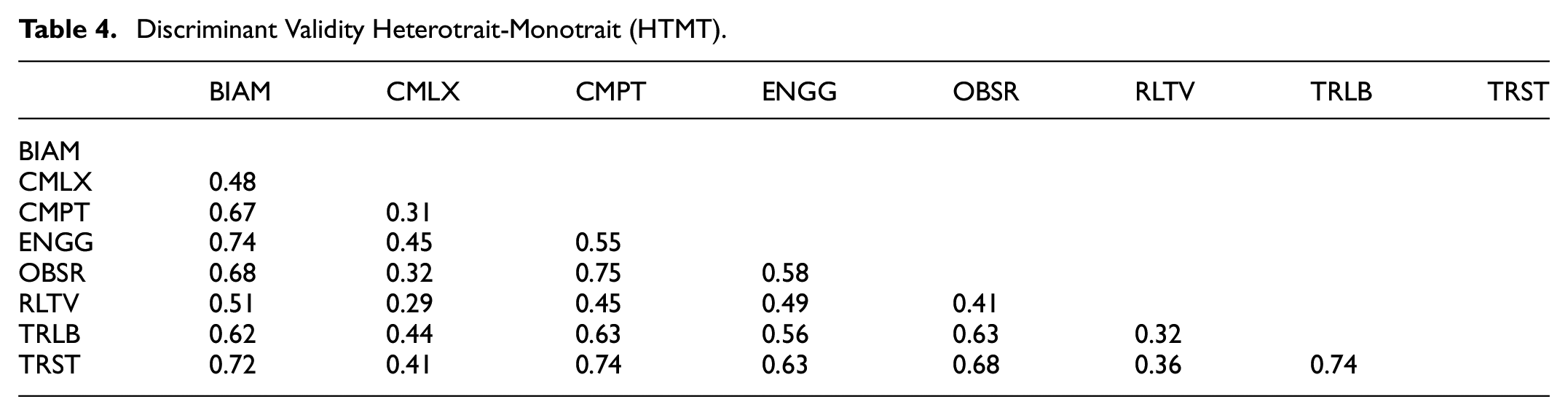
These results indicate that the discriminant validity of the constructs is acceptable, confirming that the constructs in the model are distinct from each other.
Structural Model and Hypotheses Testing
The structural model testing primarily aims to ensure that the relationships between the latent variables are data-supported, with significant path coefficients and solid assumptions regarding the structural model (Hair et al., 2016). In other words, this phase is characterized by testing hypotheses about the constructs’ relationships. In this study, all hypotheses were significant, except for the sixth one, which concerns the relationship between perceived trialability and relative advantage (insignificant relationship). Notably, the lack of significance does not mean that the two constructs are not linked together but that their linkage is not strong enough to be statistically significant. This would require more research and analysis to provide insight into their relationship.
The path coefficient values concerning the hypotheses findings are displayed in Table 5 and Figure 2.
Hypotheses Testing Results.


The structural model of the study (PLS bootstrapping (T statistics)).
The external latent construct’s level of influence on the endogenous latent construct was further tested through the impact size (f2) following Gefen et al. (2011) suggestion. Accordingly, the relative change in (R2) was examined as per Hair et al. (2016), and the size of the impact established by Cohen (2013) was followed; specifically, (f2) value of 0.35 is considered big, that of 0.15 is considered medium, and lastly, that of 0.02 is considered small. Table 6 presents the values obtained (f2).
Effect Size f2.

While constructs like perceived complexity and observability showed small effect sizes, indicating limited practical influence, trialability and compatibility demonstrated more substantial effects, particularly on trust. Trust and relative advantage had the most considerable effects on behavioral intention, and behavioral intention itself greatly affected perceived student engagement. These results suggest that building trust and clearly communicating the benefits of metaverse tools are more impactful for adoption and engagement than reducing perceived complexity alone.
Additionally, both the Variance Inflation Factor (VIF) and Tolerance values are measurements that reflect the level of multicollinearity, and they can be used in combination of individually to identify the multicollinearity level (O’brien, 2007). More specifically, the tolerance values gauge the amount of variation in a single indicator of a construct that is unaccounted for because of the variations in the remaining indicators in the block. At the same time, VIF is a collinearity measure that is the inverse of the tolerance value (Hair et al., 2016).
Concerning the above, it is cause for concern when the highest VIF value exceeds 10 (Hair et al., 2016), although it should be worrisome even if it exceeds 5. Regarding the Tolerance value, a critical issue arises if it is lower than 0.1, and if it is lower than 0.2, then a potential problem should be considered (Hair et al., 2016). This study found no indication of significant multicollinearity among the predictor variables based on the multicollinearity test results in Table 7, with the entire VIF values remaining lower than 5. This indicates that the contribution of the predictor variables to the dependent variable’s variance are not overlapping.
Multicollinearity Test via Variance Inflation Factor (VIF).

Discussion and Interpretations
This study’s major objective was to evaluate the adoption of metaverse applications in the field of education, and accordingly, the study specified two major variables, namely trust and relative advantage, to direct the research project. Both factors were examined for their influence on the adoption of metaverse applications, along with other independent factors. The underpinning theory, DOI, consists of independent variables influencing such adoption. Based on the obtained findings, trust and relative advantage directly and significantly influence metaverse adoption, and this is aligned with the results reported by past literature, particularly concerning the great effect of trust on technology adoption (Al-Sharafi et al., 2024; Dwivedi et al., 2022). Trust obliterates the environment primed to improve new technologies, and the potential users’ readiness to accept new innovations like the metaverse is enhanced (Hernández-Tamurejo et al., 2025).
Added to the above, four factors have the potential to correlate with trust and relative advantage, and they are complexity, compatibility, trialability, and observability. Based on the statistical analysis findings, a significant relationship exists between the conceptual model’s variables. To begin with, there are significant correlations between complexity, compatibility, trialability observability, and trust, indicating that HLIs’ effective functioning depends on the satisfaction of trust when it comes to new technology. The lack of complexity in using the applications indicates a higher adoption level and effectiveness. This is supported by previous literatures too (Çelik & Ayaz, 2025; Kumar et al., 2024; E. Park, 2024; Park & Kim, 2022).
Interestingly, the hypothesized relationship between perceived trialability and relative advantage (H6) was not supported. This result suggests that, within the sample studied, the ability to experiment with metaverse technologies did not significantly alter students’ perceptions of their relative advantage. One possible explanation is that many students may not have had sufficient prior exposure to metaverse tools, making the concept of trialability less relevant or impactful. Moreover, students may form opinions based more on peer influence, institutional promotion, or perceived outcomes rather than limited trial experiences. This finding contrasts with several prior studies (Choubey et al., 2025; E. Park, 2024) emphasizing the importance of trialability in adoption decisions and may reflect the early-stage nature of metaverse implementation in these regions. Future research should explore whether the impact of trialability evolves as institutional usage of metaverse tools becomes more widespread and familiar.
Another implication is that based on the viewpoint of education, HLIs need to focus on the relative advantage when attempting to adopt new technology like a metaverse (Al-kfairy, Ahmed, & Khalil, 2024). In this regard, environments can reflect and evaluate the benefits brought on by technology, and thus, HLIs can benefit from different methods through platform offerings for students, staff, and faculties to interact. Such a platform should be flexible, devoid of classroom limitations, and an effective alternative to traditional classrooms. Students’ communication with lecturers must be digitally accessible by pressing a button. This indicates the capability of the metaverse to use actual HLIs by transforming the virtual world into a hybrid and collaborative environment wherein students, teachers, and learning models can interact (Illi & Elhassouny, 2025).
As per the findings, the behavioral intention to adopt the metaverse positively influenced perceived student engagement. This suggests that students willing to adopt metaverse technologies are more likely to engage deeply with their learning materials. The metaverse’s ability to create engaging and interactive environments can lead to higher student motivation and participation levels, ultimately enhancing learning outcomes (Nguyen et al., 2024; Phutela & Grover, 2023). Notably, the metaverse is still a new addition to the education field, with continuous and ongoing research being conducted on the way student engagement and learning outcomes can be improved by it. The metaverse enables high-level interactivity and immersion, exploration of virtual realms, virtual tests and experiments, and interaction in real-time, promoting a more engaging and dynamic learning experience. It also enables increased collaboration and teamwork, which motivates working together to complete projects and to learn from one another naturally.
Lastly, the metaverse opens up avenues for learning and practice of this century’s required skills, including but not limited to problem-solving, critical thinking, and collaboration, which are indispensable in the dynamically changing world we are all living in (Charles, 2023; MacCallum & Parsons, 2019).
There are many ways that studies dedicated to the metaverse can contribute to student engagement, with some of them enumerated as follows;
Enhancement of student’s collaboration – in the metaverse, virtual classrooms and collaborative spaces can be created to facilitate working together to complete assignments and projects.
Improving the students’ accessibility – access to the metaverse is possible anywhere there is an internet connection, which makes it possible for students who live remotely in underserved areas.
Increasing the students’ engagement – the metaverse aims to serve as a more immersive and engaging learning experience that can enhance students’ engagement and motivation.
Opening up new opportunities – new opportunities can be availed by students in their learning and exploration (e.g., field trips and simulations).
Supporting students’ personalization – the metaverse is useful in increasing personalized learning experiences, enabling students to work at their pace and interests.
Fostering students’ creativity – in the virtual metaverse environments, creativity and experimentation are promoted for new skills development and knowledge.
Readying students for their future careers – the metaverse is considered significant to the future of work and communication, and thus, it prepares the students for their future.
Institutions should also invest in faculty development and training to ensure instructors are well-prepared to use metaverse platforms effectively (Yeganeh et al., 2025). This can be achieved through workshops, pilot programs, and collaborative learning communities where educators can share best practices and co-develop innovative content. Moreover, curriculum designers should work alongside IT and instructional design teams to develop engaging, student-centered learning experiences that leverage the strengths of the metaverse – such as real-time interaction, gamification, and personalized learning paths.
However, implementation is not without challenges. Technological infrastructure remains a major concern, especially in regions with limited internet bandwidth, hardware availability, or technical support (Agrawal & Wankhede, 2025). To address this, institutions can start with lightweight, browser-based or mobile-compatible metaverse tools that require minimal infrastructure. Collaborative partnerships with tech providers or government bodies may also help offset costs and ensure broader access.
Additionally, student readiness (Akour et al., 2022) and digital literacy (Subaveerapandiyan & Sardar, 2024) levels can vary widely. Institutions should offer onboarding programs to familiarize students with metaverse environments and provide ongoing technical support to reduce learning barriers. Accessibility should also be a key consideration to ensure that students with disabilities are not excluded; this includes integrating assistive technologies and following universal design principles.
By addressing these challenges proactively and aligning metaverse integration with pedagogical goals, higher education institutions can create more inclusive, engaging, and future-ready learning environments. The insights from this study can serve as a foundation for developing scalable and sustainable strategies for metaverse adoption across diverse educational settings.
It is essential to remember that the metaverse is a virtual universe extended from real-time interaction, enabling users to go through different experiences. It is an imagined virtual world equipped with realistic digital spaces, facilitating a dynamic learning environment for education. The industrial sector and corporations demand a workforce to resolve issues mimicked in the metaverse environment, which calls for new management and operational leadership paradigms. The environment reflects and studies human conduct in the educational environment to determine its variations in the real world. Thus, this study aims to define and synthesize the adoption of the metaverse system and its influence on student engagement.
Although this study focused on examining the direct effects of key innovation characteristics on the adoption of metaverse technologies, future research may consider exploring the mediating roles of constructs such as Trust, Relative Advantage, and Behavioral Intention. These variables may serve as potential pathways through which perceptions influence engagement and adoption outcomes. Including mediation analysis in future studies could offer deeper insights into the underlying mechanisms of metaverse adoption in higher education contexts.
Conclusion
The integration of emerging technologies in education has consistently influenced student engagement and institutional performance. Among these, the metaverse presents a transformative yet underutilized opportunity in higher learning institutions. Its immersive capabilities offer new dimensions for interaction, personalization, and learning flexibility. However, successful adoption depends on building trust in the platform, achieved through data security, system reliability, and effective instructional design. Guided by the DOI theory, this study confirms the relevance of factors like relative advantage, compatibility, and trialability in shaping adoption. The proposed adoption model serves as a strategic tool for educators, policymakers, and stakeholders to understand, implement, and scale metaverse applications in education.
Implications of the Study
This study has various implications for both theory and practice. To begin with, based on the viewpoint of theory, this study extends the literature by supporting the DOI and its variables by confirming the positive influence over trust and relative advantage and, in turn, the metaverse adoption. This indicates that students in HLIs can adopt the metaverse and develop a positive attitude toward it regarding their learning engagement. This study also extends the literature by revealing findings similar to those of past studies on DOI efficiency. Another implication of the theory is the high level of trust in the metaverse that HLIs need to cultivate in their environment so that new technology adoption remains smooth and effective.
By collecting and analyzing data from a large and diverse sample of 1,700 students across Saudi Arabia, Yemen, and Libya, our study provides robust empirical evidence on the factors influencing metaverse adoption in higher education. This cross-cultural perspective adds depth to the existing literature and highlights the universal and contextual factors in different educational settings.
Moving on to the implications to practice, the education sector’s success can be achieved by developing services. This is possible by using metaverse and promoting trust in it for better business and technology export, which can enhance the inclination toward metaverse adoption. Both trust and relative advantage were supported in their positive correlations to adopt metaverse, which shows that enhanced adoption is possible if the application developers and designers ensure its features compatibility, reliability, and trialability. It is crucial for application developers and programmers to increase engagement tools and steer clear of being stuck using traditional tools, particularly for HLI usage. With this, the positive metaverse-engagement adoption enhances the instructors’ and practitioners’ awareness of how to improve its adoption. Specifically, the system can provide detailed information concerning the implementation process via official websites, advertisements, and the like. Training may also be provided for effective and successful future adoption of the innovative system. The proposed study model offers knowledge and information on how metaverse technology can be successfully and accurately adopted with ease. It can also be used as a guide to the significant factors influencing adoption success.
The positive relationship between behavioral intention to adopt the metaverse and perceived student engagement offers new insights into how emerging technologies can enhance educational outcomes. This adds to the theoretical discourse on student engagement and interactive learning environments.
The study underscores the potential for integrating metaverse technologies with other educational tools, such as mobile learning, to create blended learning environments. This highlights the versatility of the metaverse in enhancing traditional and digital learning methods, providing a pathway for innovative educational practices.
Additionally, educational institutions should prioritize building trust through transparent communication and robust cybersecurity measures to facilitate metaverse adoption. Highlighting the unique benefits of the metaverse, such as immersive learning experiences and enhanced collaboration, is crucial for driving acceptance. Adoption strategies should include pilot programs, workshops, and training sessions for students and faculty to ensure comfort and proficiency with the new technology. These practical steps can accelerate the integration of metaverse technologies in educational settings, ultimately enhancing learning outcomes and student engagement.
From a managerial and policy perspective, university leaders and decision-makers play a crucial role in the successful integration of metaverse technologies. Institutions must develop clear implementation frameworks and allocate appropriate resources – both technological and human – to support this digital transition. Policies that foster digital inclusion, safeguard user data, and ensure platform accessibility for all students, including those with disabilities, are essential.
Moreover, while the potential of metaverse adoption is high, practical challenges such as infrastructure limitations, digital literacy gaps, and resistance to change must be addressed proactively. Institutions in low-resource environments should consider phased or hybrid adoption strategies, leveraging browser-based platforms or mobile-compatible tools that reduce dependency on high-end hardware.
Cross-functional collaboration among educators, IT departments, instructional designers, and administrative leadership is necessary to ensure alignment with academic goals. By tackling these challenges with targeted solutions and inclusive practices, HLIs can foster an equitable and future-ready digital learning environment through the effective deployment of metaverse technologies.
Limitations of the Study and Future Studies
This research has limitations, with the first being that the proposed study model contains a distinct group of factors used to examine the metaverse adoption. Future studies are recommended to increase the number of factors to serve extensive goals and objectives. Another limitation is the focus on the education sector without specifications, and thus, future studies may address this concern by extending the study to include education, health, and banking sectors when examining the influencing factors on the metaverse. Future studies may also compare and validate the present findings. The study sheds light on the DOI theory and its effective explanation of metaverse adoption in the education sector in developing nations. Thus, future studies may adopt other adoption theories and compare and validate findings.
Notably, this study is one of the pioneering ones of its kind concerning metaverse adoption in HLIs and is still under experimentation and investigation. As a result, evidence of its advantage cannot be fully conceived, although it has great potential. The study focused exclusively on higher education students. As such, the findings may not directly apply to learners in primary or secondary education, vocational training, or professional development settings, where digital readiness and instructional strategies may differ significantly.
While this study provides valuable insights into the factors influencing metaverse adoption in higher education, future research should consider conducting a cross-sectional study and multi-group analysis to compare the results across different cultural contexts. Given the diverse sample from Saudi Arabia, Yemen, and Libya, understanding cultural-specific factors can offer deeper insights into the adoption process. Such an analysis would help identify potential variations in perceptions and behaviors influenced by cultural contexts, providing a more nuanced understanding of metaverse adoption globally. This approach would also enhance the generalizability of the findings and inform tailored strategies for promoting metaverse use in diverse educational environments.
This study did not specifically address the unique needs and challenges that disabled students face in adopting metaverse technologies. Future research should explore how metaverse platforms can be designed and implemented to be inclusive and accessible, ensuring that students with disabilities have equal opportunities to benefit from these innovations.
Building on the limitations identified, future research should explore several key areas to deepen understanding of metaverse adoption in education. Longitudinal studies are recommended to examine how students’ perceptions and usage patterns evolve over time and how metaverse technologies impact long-term learning outcomes. Additionally, cross-cultural comparative research could offer valuable insights into how cultural norms, values, and technological readiness influence adoption behavior across different regions. Expanding the scope of research beyond higher education to include primary and secondary education, vocational training, and professional development contexts would help assess the broader applicability and effectiveness of metaverse technologies.
Qualitative approaches such as interviews, case studies, or focus groups should also be considered to uncover in-depth user experiences, barriers to adoption, and contextual factors that quantitative data alone may not capture. Furthermore, future studies should pay particular attention to accessibility and inclusivity, investigating how metaverse platforms can be designed to support students with disabilities and accommodate diverse learning needs. These directions will enrich the current understanding of the metaverse’s role in education and support its thoughtful and equitable integration into learning environments.
Footnotes
Appendix A
Questionnaire Items.

| No | Factor | Item | Question |
|---|---|---|---|
| 1 | Perceived compatibility (CMPT) | CMPT1 | Metaverse technologies are compatible with the current educational system |
| 2 | CMPT2 | Metaverse technologies are compatible with the learning styles and teaching strategies | |
| 3 | CMPT3 | Metaverse technology is not consistent with the current educational platform | |
| 4 | CMPT4 | Metaverse is consistent with our organization culture. | |
| 5 | CMPT5 | Metaverse is compatible with our information technology infrastructure. | |
| 6 | Perceived observability (OBSR) | OBSR1 | Metaverse is viewed as being informative and successful by other institutions |
| 2 | OBSR2 | Metaverse is considered as a useful tool in developing teaching-learning environments by academic staff | |
| 3 | OBSR3 | Metaverse users can customize the technology to fit their needs. | |
| 4 | OBSR4 | Metaverse technology provides feedback to users about their works | |
| 5 | OBSR5 | In Metaverse technology, quickly and easily users can learn to use the technology | |
| 1 | Perceived trialability (TRLB) | TRLB1 | Metaverse is innovative because it provides chances to have rich content in educational settings |
| 2 | TRLB2 | Metaverse users have a high level of control over the technology | |
| 3 | TRLB3 | Metaverse users have a high level of familiarity with the technology | |
| 4 | TRLB4 | Metaverse technology helps in assessing future educational tasks | |
| 5 | TRLB5 | Metaverse technology provides chances for future usage | |
| 1 | Perceived complexity (CMLX) | CMLX1 | Metaverse technology is more complicated than usual technologies in daily usage |
| 2 | CMLX2 | Metaverse technology is harder to follow, as compared to the old technology | |
| 3 | CMLX3 | Metaverse technology has a low level of interdependence with other systems or technologies | |
| 4 | CMLX4 | The level of scalability or ability to handle increasing or changing loads or demands in Metaverse is high | |
| 5 | CMLX5 | Metaverse technology has complicated features that cannot be implemented in educational settings | |
| 1 | Trust (TRST) | TRST1 | I trust Metaverse technology to work correctly |
| 2 | TRST2 | I feel safe using Metaverse technology | |
| 3 | TRST3 | I would be more likely to use Metaverse technology if it’s safe | |
| 4 | TRST4 | I would be more likely to use Metaverse technology if my privacy is not violated | |
| 5 | TRST5 | Security is a measure to decide whether I will use it or not | |
| 1 | Relative advantages (RLTV) | RLTV1 | Metaverse technology provides more educational features than old ones |
| 2 | RLTV2 | Metaverse technology simplifies my jobs or tasks | |
| 3 | RLTV3 | Metaverse technology is not consistent with the current educational platforms | |
| 4 | RLTV4 | Metaverse technology helps me to save time and effort, as compared with the old system | |
| 5 | RLTV5 | Metaverse technology improves my communication and collaboration at the work | |
| 1 | Behavioral intention to adopt metaverse (BIAM) | BIAM1 | I would use a metaverse system to gather information. |
| 2 | BIAM2 | I would use the services provided by the Metaverse. | |
| 3 | BIAM3 | I would not hesitate to provide information to a metaverse system. | |
| 4 | BIAM4 | I would use a metaverse system to inquire about online services. | |
| 5 | BIAM5 | I strongly recommend that others use Metaverse and its services. | |
| 1 | Perceived engagement (ENGG) | ENGG1 | When I use Metaverse technology, I feel actively involved in class discussions. |
| 2 | ENGG2 | When I use Metaverse technology, I feel that I can express my ideas and perspectives in class. | |
| 3 | ENGG3 | When I use metaverse technology, I feel that the feedback I receive on my work helps improve my understanding of the material. | |
| 4 | ENGG4 | When using metaverse technology, I feel the class has a positive and supportive learning environment. | |
| 5 | ENGG5 | When I use metaverse technology, the teacher and my classmates value and respect my class participation. |

Ethical Considerations
This research has been conducted in accordance with the ethical principles outlined by the Sunway University Research Ethics Committee (SUREC). The study received approval under the reference number SUREC 2024/035.
Consent to Participate
Additionally, the informed consent was obtained from all participants involved in the study. Participants were provided with comprehensive information regarding the nature and purpose of their involvement and potential risks and benefits. They were assured of the confidentiality of their data and had the opportunity to ask questions before providing written consent.
The potential benefits of this research – such as enhancing understanding of metaverse adoption in higher education and improving future digital learning strategies – were deemed to outweigh any minimal risk to participants.
Funding
The authors disclosed receipt of the following financial support for the research, authorship, and/or publication of this article: This work is supported by Universiti Kebangsaan Malaysia under Grant GUP 2024 045, and by the Ongoing Research Funding Program (ORF-2025-244), King Saud University, Riyadh, Saudi Arabia.
Declaration of Conflicting Interests
The authors declared no potential conflicts of interest with respect to the research, authorship, and/or publication of this article.
Data Availability Statement
Data generated and utilized for analyses of results presented in this manuscript are available from the corresponding author upon reasonable request.