




Abstract
This study investigated the effect of educational board games and the creative thinking spiral teaching strategy (CTSTS) on the learning outcomes of beginner-level Chinese language learners. Two dimensions were measured: learning outcome and writing ability. A total of 82 learners from one university in Taiwan participated in this study. Participants were non-randomly selected using convenience sampling. The participants were divided into the control group (40 participants) and experimental group (42 participants). In the control group, the teacher used the board game “Conveyance GO” as a teaching tool; in the experimental group, both Conveyance GO and CTSTS were used to teach the Chinese language. The results indicate no significant difference in learning outcomes between the groups. However, the experimental group exhibited a significantly larger improvement in writing abilities than did the control group, especially in terms of cohesion, coherence, and grammatical accuracy.
Keywords
Introduction
In second language teaching, writing is a difficult skill for learners to develop. Few studies on Chinese characters and writing have examined the relationship between teaching methods and writing ability. Wong et al. (2011) investigated the relationship between Chinese input methods and writing ability. In terms of technology-based tools, the use of an iPad in writing workshops was observed to eliminate barriers encountered by Chinese language learners while learning to write (Eubanks et al., 2018). Teaching tools, including animation (Y. Xu et al., 2013) and three-dimensional (3D) immersion (Lan et al., 2019), have been reported to enhance learners’ writing ability. H. Zhang and Roberts (2019) investigated the role of phonological awareness and phonetic radical awareness in acquiring Chinese literacy skills. Chai and Ma (2022) demonstrated the relationship between Chinese writing and reading acquisition. The correct use of connectives considerably affects writing ability. L. Zhang et al. (2022) identified the types of errors in the Chinese writing made by English-speaking learners, the possible causes of those errors, and the learners’ learning strategies, which all affect writing ability. This study investigated the effect of an innovative teaching method combining board games and creative thinking spiral teaching strategies (CTSTSs) on the learning effectiveness and writing ability of Chinese language learners at the beginner level.
Educational board games are used as a learning tool in many fields, including physical chemistry (Brydges & Dembinski, 2019; Dziob, 2020), mathematics (Skillen et al., 2018), medical care (M. F. Chen et al., 2022; Gibson & Douglas, 2013), agroecosystems (Orduña Alegría et al., 2020), and nutrition and health at the primary school level (Sen et al., 2018; Viggiano et al., 2018). In English language teaching classrooms, educational board games are mainly used to enhance language communication skills and review structure and vocabulary (T. Y. Liu & Chu, 2010; Poole et al., 2019; Treher, 2011; Łodzikowski & Jekiel, 2019). Playing board games is a social activity that can facilitate the development of social and emotional skills and participation (Hromek & Roffey, 2009). In addition, board games can improve learners’ creativity and problem-solving skills (S. Y. Chen et al., 2021; Mercier & Lubart, 2021).
The CTSTS is another learning tool used in various fields. The CTSTS can help learners reflect on principles, knowledge, and problem-solving skills (Feng, 2011; C. H. Lin et al., 2009). In addition, the CTSTS can improve learning motivation and outcomes (Chang, 2017; Resnick, 2007; Romeike, 2008) as well as strengthen computational thinking and creativity (Noh & Lee, 2020). However, whether the CTSTS is effective in Chinese teaching remains unknown. Board games benefit the study of foreign languages, including Chinese. Thus, the combination of board games and the CTSTS can be effective in Chinese teaching. The CTSTS consists of five stages: imagine, create, play, share, and reflect. This study divided participants into control and experimental groups. In the control group, only board games were integrated into teaching activities. In the experimental group, both board games and the CTSTS were used. This study examined differences in learning outcomes and writing ability between the control and experimental groups.
Literature Review
Board Games for Language Learning
According to Reinhardt (2019), play is often a highly social, collaborative, and communicative activity. The role of play in language use, interaction, and learning should be acknowledged; play improves both language form and communication. In language teaching, a previous learning experience may affect later learning experiences. The primary responsibility of teachers is to enable learners to naturally learn a language in the classroom and apply it to their daily life (Krahnke et al., 1985). Although practical learning is a solution to achieve these goals, methods through which the learning context can be built remains unclear. Board games can provide a learning context that enables learners to learn while playing a game (Wen et al., 2019).
In terms of research on the effectiveness of board games in second language acquisition, Smith (2006) evaluated the performance of English learners in terms of grammar. The learners were asked to play a board game in which they had to place a verb in the correct position in each sentence and then practice using the verb by modifying the sentence. The results indicated that peers supported each other’s second language acquisition by interacting while playing the board game. Paris and Yussof (2012) used the board game “Chutes and Ladders” to teach English grammar over the course of 7 weeks. In each week, learners were required to attend two classes, with each class lasting for 2 hr. In each class, the learners in the experimental group received grammar instruction for 1 hr and played board games for 1 hr, whereas the learners in the control group received only grammar instruction throughout the 2-hr period. The results revealed that the experimental group performed significantly more satisfactorily than did the control group in a posttest.
Poole et al. (2019) developed an educational board game to improve learners’ mathematical skills and Chinese literacy. They used text mining to analyze the dialogs of 40 students and divided them into six groups. The board games provided a bilingual environment in which students could learn without worrying about failing. The participants exhibited a willingness to use the target language. In addition, when playing board games, they learned from peers and thus improved their math and Chinese skills. Łodzikowski and Jekiel (2019) reported that learning topics through board games led to a higher level of in-class engagement and post class quiz scores than did learning without board games among university-level English learners in Poland.
A New Strategy for Chinese Language Education
Resnick (2008) proposed the creative thinking spiral model (Figure 1), suggesting that individuals first imagine and create a project by using their ideas, then play and share their ideas and creations with others, and finally reflect on their experience and receive feedback before returning to the imagine stage to generate new ideas and work on new projects.

Creative thinking spiral model.
Chang (2017) indicated that doing, thinking, and creating are core steps that learners must undergo to gain experience. In this process, learners can reflect on principles, knowledge, and problem-solving skills (Noh & Lee, 2018). To achieve goals, learners should focus on improvement and innovation. Subsequently, they can generate new creative themes and exhibit increased motivation for learning. Implementation and experience help improve learning motivation and outcomes.
Numerous empirical studies on the CTSTS have been conducted. Romeike (2008) applied the creative thinking spiral model to computer teaching based on three phases: challenge, problem management, and implementation. A study reported that the integration of the CTSTS into LEGO robot teaching effectively improved the learners’ problem-solving abilities (C. H. Lin et al., 2009). Feng (2011) used the creative thinking spiral model as the design framework in a robot-based teaching course. Through this framework, learners maintained their imagination and reflection and exhibited high motivation. E. Z. F. Liu et al. (2013) taught kindergarten students to use the creative thinking spiral strategy by asking them to assemble robots. This teaching strategy effectively improved the students’ problem-solving ability. Chung (2017) demonstrated that the application of the CTSTS in a small natural science class for primary school students improved their learning motivation and creative thinking. Studies on the CTSTS have evaluated its effectiveness by examining the outcomes of students, including the final product and problem-solving ability (E. Z. F. Liu et al., 2013). The effectiveness of the CTSTS in foreign language teaching can be determined by evaluating the learning outcomes of students in terms of their language skills.
This study investigated whether the combination of the CTSTS and board games leads to positive learning outcomes among Chinese language learners. Board games are effective for teaching and learning language (Hromek & Roffey, 2009; Hsu & Liang, 2021; T. Y. Liu & Chu, 2010; Poole et al., 2019; Treher, 2011; Łodzikowski & Jekiel, 2019). However, whether they are beneficial when combined with the CTSTS remains unclear. Both qualitative and quantitative data were analyzed to strengthen the findings and interpret performance in learning Chinese in the control group (only board games) and experimental group (both board games and the CTSTS).
Method
Participants
We included 82 Chinese language learners from one university in Taiwan. Participants were divided into groups through convenience sampling. The control group consisted of 40 learners (33 men and 7 women) with an average age of 26 years. These learners were from Vietnam, India, Iran, Malaysia, France, Indonesia, the United States, Egypt, Dominican Republic, Sweden, Russia, and Myanmar. The experimental group consisted of 42 learners (23 men and 19 women), with an average age of 24 years. These learners were from Vietnam, India, Indonesia, France, Germany, Sweden, and Czech Republic. On the basis of scoring criteria of the Test of Chinese as a Foreign Language (TOCFL), all these participants were at the beginner level in terms of their Chinese literacy. Generally, learners at the beginner level know fewer than 300 words. They were all taught by the same Mandarin teacher who had 6 years of teaching experience was familiar with game-based Chinese teaching.
Instruments
This study used questionnaires to collect data. The collected data were analyzed using descriptive statistics, an independent sample t test, and dependent sample t test. All statistical analyses were performed using SPSS. Qualitative data were collected to help interpret the results.
Learning Outcome Test
The writing test consists of 26 questions related to five dimensions, and the total score was 100. The 26 questions included 10 questions on tone (30%), 6 on pinyin (18%), 4 on Chinese measure words (12%), 5 on reading (15%), and 1 on writing (25%). Learners’ writing ability was examined on the basis of two dimensions, namely task achievement and literary expression, which were subdivided into appropriateness and richness of content; cohesion, coherence, and grammatical accuracy; and lexical resources. The scoring scale ranged from 0 to 5. A score of 3 indicated that the learner had reached the intermediate level, and this is the threshold for passing the course (P. H. Lin et al., 2011). A clear grading criterion was provided to increase the reliability of the questionnaire.
We developed a learning outcome test and examined its content validity by inviting two other Chinese language teachers to evaluate the test. These two teachers had an average of 6 years of experience teaching Chinese. In addition, we conducted a content validity test to ensure the comprehensiveness, representativeness, appropriateness, and content coverage of the writing test. We conducted a face validity test by inviting two beginner-level students to examine the transparency, ease of understanding, and comprehensiveness of the test. These two students had the same level of Chinese literacy and did not participate in the main experiment. After examining the content and face validity of the writing test, we administered it to the participants before the experiment (pretest) and after the experiment (posttest).
Interview Form
This study adopts semi-structured interviews to gain a deeper understanding of the impact of this innovative teaching method on learners through interviews. The question for the control group was “What do you think is the impact of educational board games on learning Chinese?” The interview question for the experimental group was “What do you think is the impact of CTSTS method on learning Chinese?.” In order to protect the privacy of learners, the learners are coded. The coding method is as follows: the code of the control group is C, the code of the experimental group is E, the learner number is sorted from 1, for example: the 10th learner of the control group is coded C10.
Course Design
The course was Chinese Conversation at the Beginner Level. This course was designed to be offered during one academic semester over a period of 18 weeks (2 hr per week) for a total of 36 class hours. The course covered six topics. Each topic required 2 to 3 weeks, with 1 week for vocabulary and grammar and the following weeks for reading passages from the textbook and exercises. The experiment was conducted between Weeks 15 and 17 of the semester, during which time the topic of environmental protection was covered. A board game called “Conveyance GO” modified to suit the research objective was integrated into the CTSTS, and this involved administering writing tasks to the learners during the experiment.
Educational Board Game
In this study, authors used an educational board game named “Conveyance GO” to explore its effectiveness in teaching Chinese language. Conveyance GO was developed by E. Z. F. Liu and Chen (2013) and used in our previous study (2020) to compare its effectiveness with that of flashcards for learning Chinese. The rules were the same as those used in the previous study, except for the use of the cards “?” and “!” that contained questions for players. These questions were modified to include subjects that learners were taught previously (Appendix 1).
The board game included a story related to environmental protection (Wen et al., 2020). The number of players ranged from two to five, and the game time was approximately 30 min. This game simulated transportation; players used different modes of transportation (marine, land, and aviation) to travel across land and sea. Each mode of transportation required a different number of steps in the game and a different amount of energy. Players were required to develop their own strategy to use their transportation and energy cards to reach the endpoint and achieve the highest score. Players could negotiate with each other and exchange cards during the game.
Research Design
Conceptual Framework
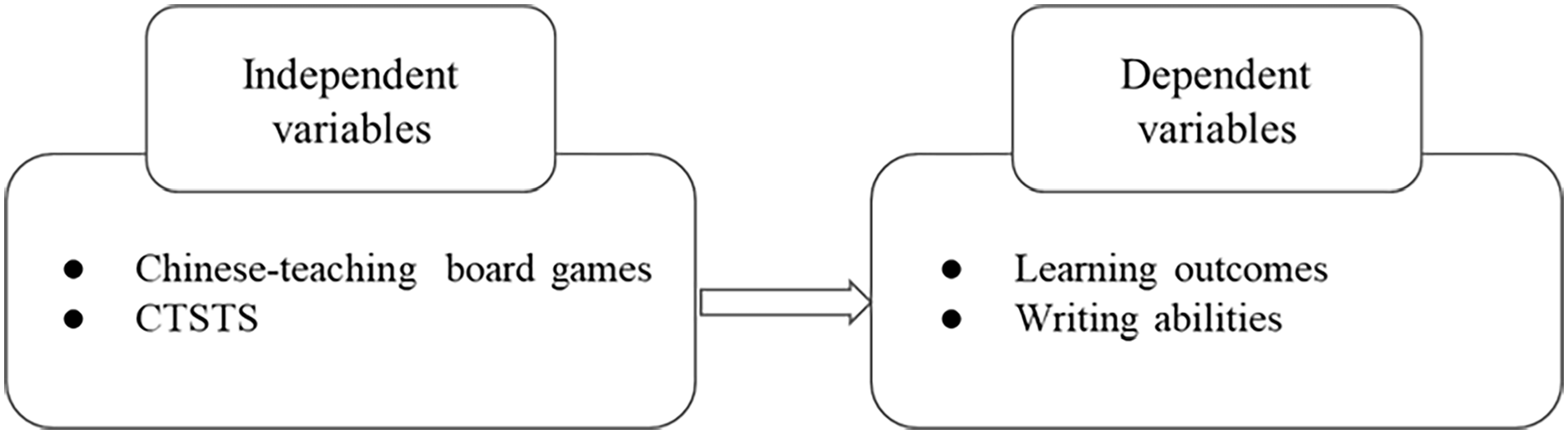
This study investigated the effects of two independent variables, namely the board game modified for teaching Chinese and the CTSTS combined with the board game, on two dependent variables, namely learning outcomes and the writing ability. Figure 2 presents the conceptual framework and illustrates the relationship between the variables.
Conceptual framework.
Procedures
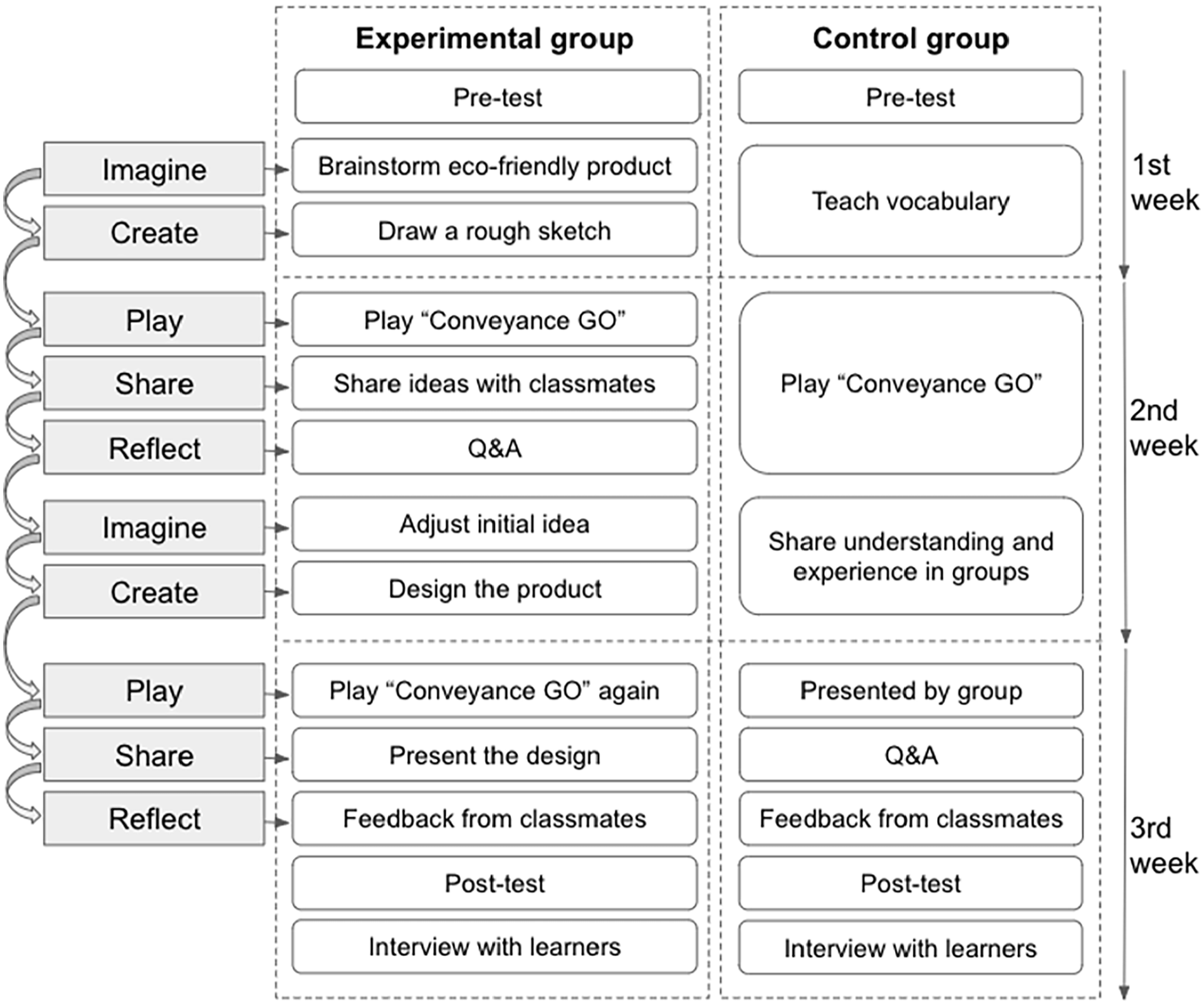
In the first week, the pretest was administered to both the groups. In the experimental group, each learner was provided a transportation and energy resource card. Subsequently, learners were assigned into groups of three or four to explain the cards to other members and motivate them to think about ecofriendly products. Learners were required to draw a sketch of their own ideas for an ecofriendly product and then present the product. Learners in the control group were taught vocabulary that appeared on the board game cards during the first week.
In the second week, both groups played Conveyance GO. In the experimental group, after playing the game, learners were asked to present their ideas regarding ecofriendly products to other group members and ask each other questions. Each learner received feedback from the other members. Later, they revised their designs and then drew new products. Learners in the control group played the game and then shared their experience with other members.
In the third week, the experimental group played the game once more and then presented their improved ideas for an ecofriendly product to the class. They then received feedback from their classmates. The control group presented their experience with Conveyance GO in their groups, which was followed by a question-and-answer session and feedback from other classmates. The posttest was then administered to both groups, and the teachers interviewed each learner to obtain data. In the part of the interview, the interview data are analyzed by coding, the control group is coded as C, the experimental group is coded as E, and the learners are coded from 1 according to the interview sequence, for example: the first respondent in the control group is coded as C1, or the third respondent in experimental group is coded as E3, and so on. Figure 3 presents the flowchart of the experiment.
Flowchart of the experiment.
Results
No Significant Difference in Overall Learning Outcomes Between Control and Experimental Groups
No significant difference in pretest scores was noted between the control and experimental groups (t = −1.58, p = .11 > .05), indicating that the initial language ability of the learners did not significantly differ between the groups (Table 1). No significant difference in posttest scores was noted between the groups (t = −1.60, p = .11 > .05), suggesting that the combination of the CTSTS and board games did not lead to significantly more favorable learning outcomes than did the board game alone (Table 2). The addition of the CTSTS was not effective when combined with the board game.
Independent Sample t test Analysis of Pretest Outcomes of Both Groups.

Note. Cohen (1988)d = 0.2, d = 0.5, and d = 0.8 indicate low, medium, and high effect sizes, respectively.
Independent Sample t test Analysis of Posttest Outcomes of Both Groups.

Note. Cohen (1988) d = 0.2, d = 0.5, and d = 0.8 indicate low, medium, and high effect sizes, respectively.
The CTSTS Improved Writing Skills
Because we did not observe significant differences in overall learning outcomes between the groups, we examined the pretest and posttest scores of the two groups.
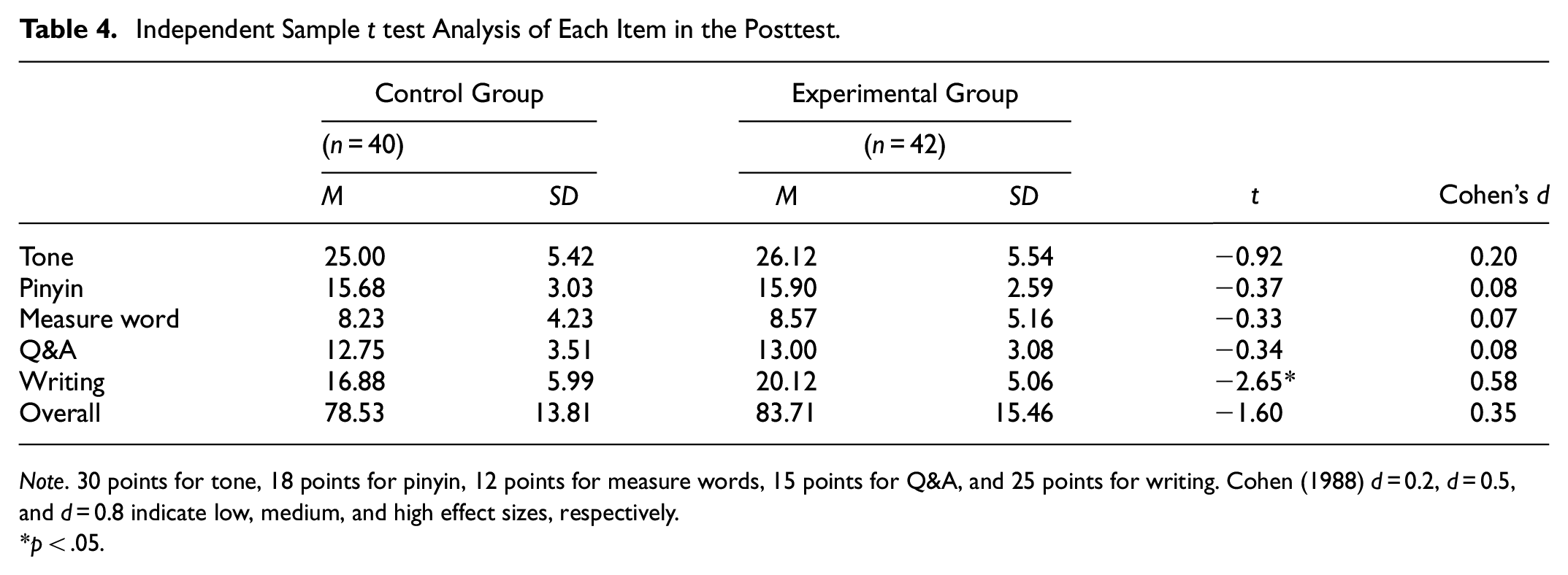
No significant difference in the pretest score for writing was noted between the groups, indicating that the groups had the same writing skills prior to the experiment (Table 3). However, after the experiment, the mean writing score of the experimental group was significantly higher than that of the control group, indicating that the addition of the CTSTS enhanced writing abilities (Table 4).
Independent Sample t test Analysis of Each Item in the Pretest.

Note. 30 points for tone, 18 points for pinyin, 12 points for measure words, 15 points for Q&A, and 25 points for writing. Cohen (1988) d = 0.2, d = 0.5, and d = 0.8 indicate low, medium, and high effect sizes, respectively.
p < .05. **p < .01.
Independent Sample t test Analysis of Each Item in the Posttest.
Note. 30 points for tone, 18 points for pinyin, 12 points for measure words, 15 points for Q&A, and 25 points for writing. Cohen (1988) d = 0.2, d = 0.5, and d = 0.8 indicate low, medium, and high effect sizes, respectively.
p < .05.
The addition of the CTSTS improved only writing skills. This finding is attributable to the significant improvement in the speaking ability of learners in the control group. We observed significant differences in the initial ability of learners in the aspects of tone and pinyin, which are crucial for speaking Chinese (Table 3). The experimental group originally had significantly stronger abilities in terms of tones, with t = 2.91 and a medium effect size (d = 0.64), and pinyin, with t = 2.48 and a medium effect size (d = 0.54). However, after the experiment, significant differences in tone and pinyin were not observed (Table 4). The tone and pinyin scores in both the groups increased, but the gap in the scores between the two groups significantly decreased after the experiment. This finding indicates that the participants learned tones and pinyin more efficiently with the board game alone than with the CTSTS.
To determine the learners’ writing ability, we extracted elements from their writing to carefully evaluate all dimensions. We used the TOCFL writing criteria developed by the Steering Committee of the Test of Proficiency-Huayu. The scoring methods of the TOCFL writing test are based on two dimensions: task achievement and literary expression. To determine the improvement in the learners’ writing ability, these two dimensions were subdivided into appropriateness and richness of content; cohesion, coherence, and grammatical accuracy; and lexical resource. The scoring scale ranged from 0 to 5. A score of 3 indicated that the learner has reached the intermediate level, and this is the threshold for passing the evaluation.
The appropriateness and richness of content (d = 0.57, t = −2.57, p = .01 < .05); cohesion, coherence, and grammatical accuracy (d = 0.74, t = −3.35, p = .00 < .01); and lexical resources (d = 0.53, t = −2.42, p = .01 < .05) exhibited a medium effect size (Table 5). The experimental group significantly outperformed the control group in all the three dimensions of writing, and the difference in cohesion, coherence, and grammatical accuracy was the largest. This finding indicates the advantage of the CTSTS combined with board games, which helped learners to develop spiral thinking and connect elements in their writing.
Independent Sample t Test Analysis of Writing Scores in Both Groups.

Note. Cohen (1988) d = 0.2, d = 0.5, and d = 0.8 indicate low, medium, and high effect sizes, respectively.
p < .05. **p < .01.
Appropriateness and richness of content: The control group focused on transportation modes in their writing, whereas the experimental group wrote not only about transportation modes but also environmental protection.
Cohesion, coherence, and grammatical accuracy: The level of confusion regarding two grammar terms, namely “
Lexical resources: The experimental group naturally learned the subjects by constantly reflecting, discussing with peers, and receiving feedback from peers and teachers; this enabled them to use the words they learned more correctly. This factor helped improve their writing ability.
Most learners in the control group used individual sentences, such as “I like bicycles” (C12), “Cars are expensive” (C18), and “I don’t have a car” (C22). Connections between sentences were not observed in the writing of learners in the control group. However, the CTSTS enables learners to think more creatively and deeply. Therefore, when writing, learners can use the target language and different sentence patterns to express their views on environmental protection. For example, they wrote “Cars are fast but cause a lot of pollution. I think solar energy is good and causes no pollution” (E29), “I think bicycles are very cheap. Although motorcycles are also cheap, they cause pollution, whereas bicycles do not. I like solar energy, but it is very expensive.” (E26), “Cars are faster than bicycles, but pollution is not cheap.” (E32) “I like airplanes, but I don’t own an airplane because I don’t have enough money. Solar-powered airplanes are good because they create no pollution.” (E42) In addition, in terms of grammar, no problems were noted with the use of “
Learners’ responses in the interview conducted after the experiment indicated that the board games were more advantageous. Learners in the control group expressed that playing board games promoted communication with classmates. Some of the responses were as follows: The game is fun, easy to understand, and easy to play. It gives me an opportunity to talk to others. (C4) This is a good game. I felt so happy when I won. This game helps people improve their Chinese skills and communicate with friends. (C24) I think this course helped me learn some basic words and how to communicate. The game is interesting and boosts self-confidence. (C25) The game allows me to communicate and improve my speaking skills. It made it easy to speak Chinese and remember Chinese characters. My Chinese is better than before. Playing a game lets everyone communicate with each other. (C27)
The CTSTS was disadvantageous when combined with the board games.
The game was cool, I liked it very much. But, I have a problem remembering things in a short time, so I need some sheets with vocabulary. Playing for the second time was easier than the first time. I really liked the game. (E23) I think I learned many new words in the game. In the beginning, it was confusing because I did not recognize the words. It was difficult to communicate with other players prior to learning some words. The paper containing all the words was helpful. It was a fun way of learning. (E22)
The more complicated teaching method involving the CTSTS limited the effectiveness of the board games because learners experienced difficulties and confusion remembering Chinese words. The CTSTS enables learners to focus more on thinking but not speaking to others. Learners in the control group indicated that performing this activity improves their oral skills and self-confidence. Self-confidence results from not only winning the competition but also from the sense of accomplishment in activities in which they can use Chinese.
Discussion, Suggestions and Conclusion
Discussion
The writing ability of the experimental group was stronger than that of the control group. The main findings are as follows:
CTSTS creates opportunities for brainstorming and collaboration. Teaching writing involves three stages: prewriting, drafting, and revision. In the prewriting stage, learners must generate ideas through brainstorming. In the CTSTS, the first task is to develop an idea, and the second task is to revise the idea. Both tasks can lay the groundwork for the drafting and revising phases. Creation is a strategy for drafting, whereas reflection is a strategy for revising. The CTSTS is highly interactive, which helps students perceive writing as a group activity, similarly to process writing. CTSTS provides a break for students in the learning process. Students are often busy and have classes back to back. Some may also work immediately after the class. Therefore, students have a limited amount of time to digest lessons. The CTSTS enables students to enjoy the spiral learning process through reflection and feedback, which help students learn.
CTSTS improves writing ability through peer feedback. In the last two stages of the CTSTS, students share their ideas with their classmates and then reflect on feedback from their peers, which is crucial. In both physical and online courses, peer feedback can improve learners’ writing abilities (Harris & Leeming, 2022; Paul Sun & Jun Zhang, 2022; Z. Xu et al., 2022). Birjandi and Hadidi Tamjid (2012) reported that the combination of self-assessment, teacher feedback, and peer feedback improved the English writing ability of Iranian students. An empirical study examining the English writing ability of Chinese college students indicated that peer feedback increased the learners’ autonomy. In addition, peer feedback can improve the logical thinking abilities of foreign language learners (Shen et al., 2020; Yu, 2019). T. Zhang (2021) demonstrated that in addition to group discussions, written peer feedback reduced anxiety in learners and thus enhanced their writing ability. The positive effect of the CTSTS on writing skills observed in this study are consistent with the results of studies on peer feedback.
Suggestions
Clarifying teaching objectives through suitable teaching methods. Teachers should clarify the teaching objectives and select a teaching method accordingly. If the teaching goal is to improve writing ability, then the CTSTS should be used. If the class focuses more on speaking ability, then a board game alone would be appropriate. Educational board games should match the topics of lessons to improve learning outcomes. In this study, the activity’s theme was environmental protection. Conveyance GO enabled the learners to explore various sources of energy, which demonstrates how learners can study a topic while learning Chinese. A time restriction should also be added to the CTSTS to determine whether it can increase the frequency and efficiency of discussion and improve learning outcomes.
Conclusion
Board games are a social activity that can enhance communication, social, and emotional skills (Hromek & Roffey, 2009; T. Y. Liu & Chu, 2010; Poole et al., 2019; Treher, 2011; Łodzikowski & Jekiel, 2019). The combination of the CTSTS and board games for teaching Chinese did not improve overall learning outcomes. The CTSTS is suitable for teaching writing skills because it can enhance learners’ writing ability significantly by training learners to develop spiral thinking and connect elements in their writing. In this study, the CTSTS was observed to be effective in improving cohesion, coherence, and grammatical accuracy, which are crucial in writing. In the experimental group, learners constantly reflected on each phase of learning, and they learned from reflection and repeated practice. In spiral learning, learners must brainstorm and create ideas for writing; this improves writing skills. In conclusion, the CTSTS is favorable for developing writing skills, but it should be used separately for specific classes instead of in tandem for one general class.
The teaching method involving the CTSTS improve learners’ writing ability because the topic of environmental protection was the main axis. Thus, learners first thought about solving environmental protection problems, created environmentally friendly vehicles, and played board games related to environmental protection. During the board game, they learned the words in the target language related to the environment and exchanged ideas by communicating with their peers and sharing their designs. Learners can exchange information with each other or with teachers. Feedback from teachers and peers not only helps learners revise their eco-friendly vehicle designs but also provides opportunities to practice the target language. The CTSTS improved the learners’ writing abilities significantly.
Limitations
This study used writing ability as the only indicator of learning outcomes. A more comprehensive research design would include listening and reading skills. Studies should investigate the effects of the CTSTS and board games on all dimensions of learning outcomes, namely writing, speaking, reading, and listening.
Footnotes
Appendix
List of Questions in Problem Cards.

| No | Question | Learning target | Vocabulary | Grammar |
|---|---|---|---|---|
| 1 |
What’s your name? |
Ability to ask and answer questions about names |
You, name |
|
| 2 |
What country are you from? |
Ability to ask and answer questions about nationality |
Country, person |
|
| 3 |
Where is your home? |
Ability to ask and answer questions about countries and nationalities |
home |
|
| 4 |
How many people are there in your family? |
Ability to ask and answer questions about family members |
Family, person |
|
| 5 |
What is your cell phone number? |
Ability to ask and answer questions about phone numbers |
Mobile phone, number |
|
| 6 |
What time is it now? |
Ability to ask and answer questions about time |
Now |
|
| 7 |
When is your birthday? |
Ability to ask and answer questions about birthdays |
Birthday |
|
| 8 |
What do you think about Taiwan? |
Ability to ask others about their opinions on Taiwan |
Taiwan |
|
| 9 |
What type of energy does a motorcycle/car/train/high-speed train/bicycle use? |
Vocabulary related to land transportation Ability to ask and answer questions about energy used for land transportation |
|
|
| 10 |
What type of energy does a canoe/speed boat/sailboat/ cruise ship use? |
Vocabulary related to land transportation Ability to ask and answer questions about energy used for marine transportation |
Canoe, speedboat, sailboat, cruise ship, |
|
| 11 |
What type of energy does an airplane use? |
Ability to ask and answer questions about air transportation |
Airplane |
|
| 12 |
What mode of transportation does not have wheels? |
Ability to use the sentence structure “A-not-A” to answer questions |
Wheel |
|
| 13 |
Can you pick a card showing a pollution-free source of energy? |
Ability to follow instructions and speak clearly |
Display, pollution, card |
|
| 14 |
A speed boat costs US$3,000. Do you think this is expensive? Why? |
Ability to use the sentence structure “A-not-A” to ask others about their opinions |
Expensive |
A-not-A |
| 15 |
Do you think local trains or high-speed trains are faster? |
Ability to use comparative questions to ask others about their opinions and answer questions |
Quick, slow |
|
| 16 |
If you had the money, would you buy a cruise ship or a sailboat? Why? |
Ability to use “ |
Buy, money |
|
Declaration of Conflicting Interests
The author(s) declared no potential conflicts of interest with respect to the research, authorship, and/or publication of this article.
Funding
The author(s) received no financial support for the research, authorship, and/or publication of this article.
