




Abstract
The present study examined the instructional outcomes of the use of Reading Circles (RC) in first year English-Mediated Instruction (EMI) College of Education classes at a university in Korea using a mixed method approach using independent samples t-tests and correlations of survey data and thematic analysis of semi-structured interview data. Thirty-nine first-year students participated in the survey examining engagement, usefulness, and outcomes, and interviews. While students who perceived their English as proficient had lower apprehension, students with previous RC experience showed less apprehension than those without RC experience. More engaged students were found to be less anxious, more positive, and claimed the RC approach to learning was more useful. The results of the interviews showed that RC lessened anxiety and increased learner autonomy and opportunities for collaborative learning. The study recommended EMI class instructors incorporate RC in EMI classes, as well as presented implications for the online EMI learning environment.
Introduction
English-Mediated Instruction (EMI) at university where the L1 is not English is defined as the use of English to teach academic subject-matter (Dearden & Macaro, 2016). EMI differs from ESL/EFL/EAP as EMI instructors teach content, not language skills. English language classes, however, could support students to achieve some level of English proficiency prior to EMI classes (Alhassan et al., 2021). For EMI classes, the primary goal is to have students achieve their course objectives in the L2(English) (Dearden & Macaro, 2016). This means EMI aims to teach content and does not (necessarily) have the objective of language. The majority of the students in EMI class are non-L1(English) speaking students taking EMI classes as requisite or elective courses in which content is delivered in English, which intrinsically involves culture and globalization (Dearden, 2014). EMI courses are allocated in each academic discipline and unlike language-trained instructors, instructors of non-English language teaching areas such as English Literature, Economics, and Physics are unlikely to be skilled language teachers, and expecting them to be is unrealistic. Also, typically students in EMI class are non-L1(English) speaking students taking EMI classes as compulsory courses and may not have higher levels of satisfaction due to language difficulties, but those taking EMI classes as elective courses might be better prepared due to having higher English proficiencies or actual overseas training in English speaking countries (N. Kim, 2018).
Studies have found satisfaction with and helpfulness of EMI classes among students are generally high (Fernández-Costales, 2017; Huang, 2015). However, even though students may report satisfaction with EMI, research has also found that this satisfaction is higher than their actual ability to comprehend EMI classes (Kym & Kym, 2014). Typically, apprehension in EMI classes, which is often linked with insufficient proficiency, is associated with whether EMI class students: (a) understand the class topic or content, (b) feel behind others in content comprehension, or (c) miss some important announcements (Dalton-Puffer, 2011; A. Kang & Cho, 2020). Research analyzing students’ perceptions of and attitudes toward EMI classes has also pointed out impediments to learning such as: (a) hindering specialty learning, (b) students having difficulties understanding instructors or class content, and (c) students claiming the textbook was difficult to read. These impediments might influence students’ willingness to participate or register for additional EMI classes (Chun et al., 2017; G. J. Lee, 2014). Research has also found concerns with the instructional strategy of code-switching in university EMI classes (Michaelan, 2016; Tang, 2020). For instance, code-switching could become problematic in EMI classes if university EMI policy rules dual language use unacceptable (Dearden, 2014), and code-switching could underrate the speech behavior of bilinguals as well as (international) students who are not poor L2(English) speakers (Ariffin & Husin, 2011). Another instructional strategy is to provide dual language supplementary hand-outs and additional examples, but this increased the workload of instructors compared to an L1 class (Flowerdew et al., 2000). Then, adopting Reading Circles, hereinafter RC, could be less stressful and more socially facilitative without violating EMI policies or overtaxing the lecturers.
For much of their school learning, Korean students are taught English through the medium of Korean and practice English reading tasks aimed at success on school tests and on the annual university entrance Scholastic Ability Test. However, once accepted to university, Korean students often register for EMI classes. At colleges of secondary education in Korea, the primary focus of education in EMI classes, even specialized academic department EMI classes within a college of education such as Mathematics, History, or English, is educational content rather than language. These EMI classes, like their L1 class counterparts, require EMI students to do a lot of course readings.
Comprehending university texts is demanding for all students. In L1(English) classes, Seburn (2016) pointed out that university students must read a lot of texts, a large portion of which may be nonfiction, so there can be difficulties as the reading and understanding of nonfiction differs from that of literature. Zeivots (2021,) reported that L1(English) university students today read slowly and comprehend less. Non-L1(English) students look up unknown words rather than focus on the meaning of a text (Seburn, 2016). Moreover, they have reported that: (a) reading in English becomes boring and time-consuming; (b) comprehension is limited, and (c) neither pleasure, nor a good grade is significantly gained. There is a considerable amount of L2(English) reading in higher education EMI classes, and research pointed to the need to address content understanding difficulties, as well as increase in-class participation incentives (Chern & Lo, 2017). RC, a self-directed reading practice centered around the reading of texts outside the classroom and participating in group discussion in class that has been developed and used in both L1and language-learning contexts, has not received much attention as a viable pedagogical strategy in the EMI context.
RC is not teacher-fronted or lecture-based but student-centered and structured to maximize student interaction, which encourages student self-discovery. Research on RC has found a number of advantages: (a) improved comprehensions skills, (b) more confidence and participation, (c) enhanced motivation and collaborative discussion, (d) more oral proficiency, (e) enriched scaffolding opportunities, and (f) reinforced writing skills (Elhess & Egbert, 2015). For education major EMI class students, in addition to these recognized benefits of RC, incorporating RC in class offers a current pedagogy to secondary school pre-service teachers.
Theoretical Framework
Sociocultural Theory, which argues that cultural context, as well as social, material, and learning environments mediate human cognition and behavior, supports RC (Lantolf et al., 2015). Su and Wu (2016) found that RC created a low-risk, comfortable setting that motivated university students to read independently and then explore the texts in collaborative discussions. RC are also supported by the Reader-Response Theory, which affirms the importance of the reader and argues that different readers interpret the same text differently. Daniels (2002) explained that RC move students from refining and sharing reactions to analysis. Also, for the L2 context, the Willingness to Communicate, which originated from studies on the unwillingness to communicate, refers to a willingness to communicate in L2 (MacIntyre et al., 1998). RC were found to motivate Turkish education pre-service teachers’ desire to communicate with each other (Karatay, 2017). Supporting WTC in the L2 context, Hsu and Huang (2017) found that the more positive relationships with the teacher and class peers, the more likely students were to communicate in the L2(English). That is, students are more confident and willing to use an L2 in a supportive and positive group.
Literature Review
Despite criticism as being less effective, education at a large number of universities is traditionally, and still today, largely textbook-based, and lecture-based and employs passive transactions of learning (Flowerdew et al., 2000; Querol-Julián & Camiciottoli, 2019; Ramos, 2014). The degree of participation in EMI classes at universities has also been found to be low; notably lower than in classes taught in the domestic L1 (Cho, 2012; Flowerdew et al., 2000). Floris (2014, p. 53), examining Indonesian EMI students, claimed the reason for low participation was “because most of them [students] were passive and were accustomed to sitting in traditional classrooms where the teacher was supposed to be in the front to lecture, while students were sitting quietly and following their teacher’s instructions.” Examining Japanese EMI class students, Igawa and Forrester (2016) found that low participation rates were linked to low speaking confidence levels. Moreover, examining EMI lectures in Spain, Milne and García (2013) found the most common student talk elicitation questions by the instructor were confirmation checks, self-answered, and display. EMI class students then are typically either not provided or unwilling to participate in opportunities for verbal language communications, and as such, they have little or no autonomy over their learning. However, learning is social as well as individual (Milne & García, 2013). Kerr and Frese (2017, p. 30) found that “well-structured cooperative learning activities with clear agendas not only engage students but also allow the instructor to witness how students synthesize new information.”
Unlike RC use in EMI classes, RC use has been researched extensively in nations offering language classes. For instance, in a language-based learning class that employed a reading pedagogical practice, students were found to better understand the text, make text inferences, and gain knowledge. The same study found positive engagement affects efficacy, irritability, avoidance, class behaviors, and retention (S. I. Choi & Choi, 2018). Likewise, Chen and Ho (2018) argued that as an alternative reading instruction, RC in the university EFL classroom promoted active learning and supported literacy learning among Taiwanese students. Also, Avcı (2019) found similar results in university English reading classes in Turkey: use of RC helped students (a) develop positive attitudes toward reading, (b) increase their understanding of literature, and (c) use the readings meaningfully.
Why RC for EMI Classes?
Research on EMI class comprehension revealed that large numbers of students have difficulty understanding the EMI lecture (Ali, 2020; Querol-Julián & Camiciottoli, 2019; Yıldız et al., 2017). For instance, more than a third of Icelandic students said they had difficulties comprehending English academic texts at university even though 65% reported they were well-prepared (Ingvarsdóttir & Arnbjörnsdóttir, 2015). Just as other colleges at Korean universities offer classes in English, colleges of education also offer some EMI courses. EMI education majors in Korea, similar to Icelandic and other nations’ EMI students, have difficulty comprehending English texts. The use of RC in EMI classes, however, could reduce apprehension associated with a lack of English proficiency, and unwillingness to participate and register in further classes (Dafouz et al., 2014; A. Kang & Cho, 2020) as well as increase comprehensibility of content by empowering students. It is expected that RC would replicate findings of H. Choi et al. (2015) in which flipped learning in an EMI nursing class resulted in students’ positive perceptions toward the approach and enhanced understanding. In other words, it is expected that students in EMI classes will take on more autonomy and responsibility for their own learning as well as think critically and deeply about the texts using RC. Such autonomous participation could go beyond the instructor’s transmitted ideas.
Moreover, RC usage is expected to: (a) increase EMI learners’ autonomy, self-directed authentic learning, understanding of lecture content, and collaborative discussion, and (b) decrease one-directional lecturing, code-switching in the classroom, and the extra instructional workloads of EMI instructors when Academic Reading Circles (ARC) are adapted to the EMI context. ARC center on “developing skills for the intensive, deep comprehension needed to use ideas from the text intelligently in their output” (Seburn, 2016, p. 10). ARC are based on the concept that students (a) learn more deeply, (b) improve engagement, (c) understand academic concepts better, and (d) learn to identify different types of information when they work together to understand the meaning of a text (Seburn, 2016). One study found that compared to independent reading, the use of ARC at L1 tertiary education was effective, resulting in improved reading achievement and textual connections (Thomas, 2013). Another L1 study found that when ARC are properly utilized, they are an essential element of a text-centric flipped-learning approach at university (McCollum et al., 2017).
Investigation of RC use in EMI classes found two EMI studies. First, instructors at a co-educational secondary school in Hong Kong, reflecting on the use of RC in English reading lessons, claimed that they resulted in meaningful outcomes: (a) teacher-student interactions, (b) livelier lessons, (c) peers helping peers learn, (d) well-elaborated ideas by pupils, (e) critical readers, and (f) students’ willingness to speak in English (Chui, 2013). Graham-Marr and Pellowe (2016) examined Japanese university EMI engineering students’ perceptions of using RC with non-fiction materials. Students in the study said that among the four RC roles, the role of summarizer was the most difficult (90% of study participants), claiming that while they understood the content, it was difficult to summarize the text in their own words. Nonetheless, participants said it helped them improve their English the most.
Perceptions of RC in EMI Classes
A good teaching environment affects students’ logical interpretations, perceptions of studying and outcomes, both directly and indirectly, as well as academic achievement and qualitative learning outcomes (Lizzio et al., 2002). Students’ perceptions of outcomes, then, are crucial in motivating students to study or read in English. J. H. Kim and Chon (2016) found: (a) the low-level student group in the study was less engaged, and (b) reading efficacy and competition were associated with students’ reading ability. Exploring higher education and reading, Aldridge (2019) argued for engagement that is directed toward the subject matter, not the educational interaction in itself. Moreover, positive engagement and reading could be achieved by reducing—at least reducing overt—competition through a positive and collaborative learning environment (Fredricks, 2011). As much of the “competition” in the class is eliminated once students begin to interact and integrate in RC activities, EMI class students could start to recognize classmates as being resources for learning and enjoy higher levels of content comprehension and overall understanding in the class.
Attitude in EMI Class and Usefulness of a Reading Strategy
“The relationship between attitudes and motivation is close so that it is impossible to see the two separately . . . but it is influenced by attitudes” (Getie, 2020, p. 6). Then, attitude, an individual’s subjective emotions and feelings, shapes their motivation, which “drives us to study new things, and motivation encourages us to try again when we fail” (Tileston 2010, p. 4). In J. H. Kim and Chon’s (2016, p. 221) investigation “to the [Korean] university learners, it was not for pleasure, enjoyment or personal well-being, but rather for instrumental purposes that they wanted to read.” Evidence from a study on Taiwan EMI class students, who had “a moderate level of learning motivation for EMI courses,” found the students felt EMI classes were beneficial by helping them form habits of reading authentic literature and learning materials in English (Huang, 2015, p.77). The use of RC, then, could capitalize on this beneficial habit creation. Kojima and Yashima (2017) found perceived confidence was important for helping EMI students become intrinsically motivated and argued that students must feel competent at EMI. According to McEwan (2004, p. 3), reading or strategic reading requires “extraction and construction of meaning from text by teachers and students individually or by teachers and students jointly through the skillful and situational use of a repertoire of cognitive strategies,” and it occurs when students learn how to use them independently, confidently, and strategically. Then, in addition to improving students’ motivation and self-learning skills, RC might help with comprehending texts as well as expanding content knowledge.
To contribute to EMI research and the bettering of EMI classes, the following research queries were investigated:
(1) What are EMI class students’ perceptions—logical interpretation—and apprehension of RC?
(2) What are EMI class students’ attitudes—subjective emotions—toward the usefulness of RC?
(3) What is the influence of RC on EMI class students’ engagement?
Method
Participants
All 39 students registered in two EMI education classes offered in the department of English education were formally asked and agreed to participate in the study. The sample included: 11 males (28.2%) and 28 females (71.8%). Participants’ age ranged from 18 to 30, and participants were in either first (n = 37, 94.9%) or fourth (n = 2, 5.1%) year at university. Participants in the EMI classes were of mixed English language proficiency. All except three responded that they were Korean nationals, two held dual citizenships, and one claimed an Asian nationality other than Korean. However, all participants stated English was not their native tongue. In terms of prior overseas living experience, a large number of respondents had 0 to under 6 months experience (n = 30, 76.9%). Also, more than half of the participants had had no prior RC experience (n = 22, 56.4%) or little exposure (i.e., one to three isolated RC activities).
Course Description
During the first semester of first-year, students registered for a compulsory reading and writing education class. The class utilized a variety of literature and academic papers written in English to introduce them to secondary school English reading and writing strategies as current pedagogy and to improve students’ individual reading and writing skills. In terms of reading, the class aimed at nurturing cultural content and engaging students with a foundation of knowledge of the field by focusing on content, knowledge acquisition, and development, but also supported language production and reading proficiency. At the start of the semester, the instructor explained RC as a student-autonomy approach that would not only satisfy but reinforce and develop cognitive reading strategies. Students were told that: (a) through collaborative discussion, they would be able to create new knowledge beyond what was presented by the instructor; and that (b) it was hoped they would enjoy the class. The instructor also told students that prior to implementing RC, students would be presented with reading background such as complex theories or ideas. Students were provided with context and additional information to prevent difficulties or confusion.
After detailing RC and its implementation in the class to all participants, informed verbal consent was obtained from each participant. All students read the same text(s), within a stipulated reading timeframe (1–3 weeks), but students had control over content amount read per session and assigned roles, with which students quickly familiarized themselves after instruction and experience with each role. As students were not confined by roles, if they wished, they could offer supplementary ideas during the RC activities.
For this study, four roles that the instructor could adopt were employed. Roles were blended from roles used in typical literature circles and from four adapted ARC roles: highlighter, leader, contextualizer, and connector as presented by Seburn (2016) who also recommended that classes incorporating ARC be divided into groups of four or five to maximize role usage. RC instruction, explanation, and training were provided at the onset of the class, and the roles were blended to match the learning environment needs of students in the non-L1(English) country: (a) discussion director, (b) vocabulary enricher, (c) literary luminary, and (d) checker. Additionally, it was conjectured that groups of four, with each member responsible for a single role, might lead to more interaction during class. Time in class, which was approximately 15 minutes of each class, was reserved for the activity. The discussion director proposed questions that increased comprehension and encouraged personal connections while the vocabulary enricher researched and clarified words, expressions, and contextual references. The literary luminary highlighted links and relations among concepts, passages, or the real world. The checker assessed and aided role completion, led and monitored talks, and summarized ideas during the activity.
During the RC activities, the instructor acted solely as a facilitator, circulating from circle to circle to support learning as students discussed the text(s). At the end of an allotted timeframe for a particular reading(s), the students were provided with a list of various factual or inferential class discussion questions to: (a) review the reading and (b) ensure a minimum level of learning across all students. They were also requested and given opportunities to challenge both instructors’ and ideas from the assigned readings.
From the readings and discussions, once a text timeframe had been completed, first-year students were expected to be familiar with, and discussed fundamental ideas of an instruction method, approach, and style, which is prerequisite to advanced methodology and pedagogy courses in upper years. Moreover, students were expected to (a) acquire understanding of cultural context, (b) form views toward various instructional interventions, (c) have exposure to analytical academic writing, and (d) enhance individual reading literacy skills.
Readings, two of which are detailed here, were completed one at a time or in combination. For first-year students, the text How Teachers Make Children Hate Reading (Holt, 1969) is at an English reading level considered “just-beyond.” By examining Holt’s account of how teachers make children hate reading, students could reflect on their own English class reading experiences (e.g., why they (dis)like reading or why they felt their former teachers were responsible for their (dis)like of reading). They could also consider whether Holt’s approach would work in a non-L1 (English) teaching-learning environment and what kinds of reading strategies Holt could have incorporated for better student learning. The text Coming Home Again (C.-R. Lee, 1995), which is approximately 4600 words, is an “ambitious” reading level for first-year university EMI education students. In addition to exploring the Korean-American author’s memoir, the reading allowed EMI education class students to explore life in an increasingly multicultural environment. This story is about a family in the US, but it also reflects the developing multiculturalism of Korea. It encouraged students to reflect on the ideas that outside of the classroom; for instance, some students may not have L2(English) proficient parents who can help them, and some students may feel distant from their parents. Moreover, the reading encouraged students to reflect on their relationship with their family and particularly to reflect on school and school pressures as well as how they may have learned to like or dislike reading.
Perceptions of Academic Experience and Adopted Methods
Hammersley and Woods (2020) argued that effective change at school and classroom levels requires understanding of how students perceive their total academic experience. Self-reported methods are widely used and ask study participants about their feelings and attitudes through questionnaires and interviews. Reviewing mixed method research in education, Ponce and Pagán-Maldonado (2015) found that in the mixed method design researchers could measure: (a) effects of the teaching strategies, (b) students’ perceptions of teaching strategies, and (c) factors that allow learning. Kukuczka (2021) conducted mixed method research on tertiary STEM students in the UK learning an EAP unit, and Dogan et al. (2020) conducted a study on third year education majors who were L1(Turkish) pre-service teachers using a mixed method. Because RC is a relatively new pedagogical strategy for the EMI context, the present study investigates the use of RC in EMI. As such, the study survey gathered data on EMI students’ self-reported perceptions of RC in an EMI education class. Moreover, semi-structured interviews (a) are considered a useful adjunct to supplement questionnaires, and (b) allowed for open-ended questioning and extended probing (Adams, 2015) about the RC instructional intervention.
Survey Instrument
Informed verbal consent was obtained from each participant prior to survey distribution. The survey was administered during Week 8 of the 15-week semester, and responses were made on a 5-point Likert-type scale. The survey used in this study was not a piloted data collection instrument. At the time of this study, it was difficult to find appropriate papers targeting university students. The survey used in this study was not a piloted data collection instrument, but adapted valid, reliable, and well-established instruments. Items were reconstructed and adapted from or created by the authors based on pertinent studies on class participation (Duncan & McKeachie, 2005; Freeman et al., 2007; Han, 2004; W. H. Kang, 2004; E. S. Kim & Park, 2005; H. W. Lee, 2003). Survey items of interest were combined to create four investigative constructs: (a) student perception, (b) student apprehension, (c) student engagement, (d) usefulness. Negative items were reversed, and constructs were checked for internal consistency by calculating Cronbach’s alpha values.
Semi-Structured Interviews
All students voluntarily gave informed verbal consent to participate in semi-structured interviews that invited personal views on the EMI class and its use of RC. The semi-structured interviews aimed at obtaining students’ views after participating in several RC activities were conducted from Week 15, the final week of the semester, to the week immediately following to offer flexibility in scheduling for the interviewees. The interviews were conducted in both English and Korean with all 39 students by an unbiased, thematic analysis trained, bilingual L1 (Korean)-English speaker research assistant, and each interview took approximately 10 minutes.
The open-ended questions, created in advance based on class observation and informal conversations with students, were aimed at obtaining the perspectives of participants’ experiences, attitudes, and beliefs and the impact of participating in RC on their learning. The questions were:
(1) Tell me about your previous and current experiences in EMI classes with assigned readings.
(2) What advantages or disadvantages do you see to the use of RC in EMI classes?
(3) To what degree did you enjoy the EMI class using RC?
(4) What are your feelings toward the use of RC?
Data Analyses
The present study examines EMI class students’ (a) perceptions of RC, (b) perceived usefulness of RC, and (c) engagement influenced by RC. Means and standard deviations were computed to objectively measure EMI students’ opinion on RC roles. An independent samples t-test examined RC apprehension differences between students with and students without prior experience. Correlation analysis examined the degree to which engagement, apprehension, perceptions, and English proficiency are related. Finally, semi-structured interviews identified students’ views of the strengths and weaknesses of RC.
Results
Role Satisfaction
Participant satisfaction with RC roles was as follows: discussion director (M = 3.94, SD = 0.80), vocabulary enricher (M = 3.75, SD = 0.87), literary luminary (M = 3.94, SD = 0.75), and checker (M = 4.03, SD = 1.0).
Constructs of Interest
Table 1 presents constructs and the coefficients of internal consistency. As the constructs showed consistency, the mean value of the variables within the construct were used for analysis purposes. The construct of interest, perception, included 8 items and had a reliability coefficient of .85. The construct engagement included 6 items, apprehension included 7 items, and usefulness included 6 items. Internal consistency reliability coefficients (i.e., Cronbach’s alphas) were .86, .89, and .81, respectively. As a measure of internal consistency, coefficient α values indicate acceptable to very good consistency.
Investigative Constructs.

Note. Items were derived and reconstructed from pertinent studies (Duncan & McKeachie, 2005; Freeman et al., 2007; Han, 2004; W. H. Kang, 2004; E. S. Kim & Park, 2005; H. W. Lee, 2003).
Denotes items largely adapted from Duncan and McKeachie (2005).
Denotes items largely adapted from Freeman et al. (2007).
Except for the statistically significant correlation found between apprehension and RC experience, among the four investigative constructs, investigation analysis did not yield statistically significant correlations with the collected demographic variables: sex, age, school year, RC experience, overseas experience, nationality, and native speaker of English. First time RC participants showed more apprehension toward RC than students who had had prior RC experiences. An independent-samples t-test indicated that students who had never had RC experience showed greater apprehension (M = 2.60, SD = 0.95) than did student who had RC experience (M = 2.01, SD = 0.61), t(36) = 2.34, p = .035.
Positive correlations were found between discussion director and perception (r = 0.42, p = .013), and usefulness (r = 0.52, p = .001). Students who took the role of discussion director tended to show less apprehension (r = −0.36, p = .031). Students who took the role of vocabulary enricher role tended to show greater degree of engagement (r = 0.48, p = .003) and usefulness (r = 0.43, p = .008). They were also likely to be less apprehensive (r = −0.36, p = .033). Students who took literary luminary tended to view RC as useful (r = 0.354, p = .032), and literary luminary also associated with checker (r = 0.37, p = .024).
Correlation Coefficients among Student Engagement, Apprehension, Perceptions, and English Proficiency
Table 2 shows a negative correlation between perceived English proficiency and apprehension, indicating that students who perceived their English as proficient or fluent had lower apprehension. Engagement was negatively correlated with apprehension and positively correlated to usefulness and perception, which suggest that students who were more engaged in class were less anxious about RC, more positive, and felt the RC learning approach to be more useful. Participants with high levels of apprehension, however, showed higher negativity toward RC and viewed RC as less useful.
Correlations Among Constructs.

p < .05. **p < .01 (2-tailed).
Semi-Structured Interviews
As it is outlined in Braun and Clarke (2006), thematic analysis was performed on collected semi-structured interview responses. This involved (a) transcribing verbal communications into written form, (b) generating a list of ideas and codes from the data, (c) sorting coded data extracts into potential themes, (d) refining themes and confirming coherence among data within the themes, (e) defining and refining themes and analyzing the data within them, and (f) finalizing analysis and writing up results. The response transcripts are verbatim and highlighted clear differences between typical EMI class learning and this study’s EMI class RC approach. Students’ comments also provided information that identified students’ perceptions of strengths and weaknesses of RC, and their responses also enlightened educators on the need for, and the reality of employing, RC in EMI classes.
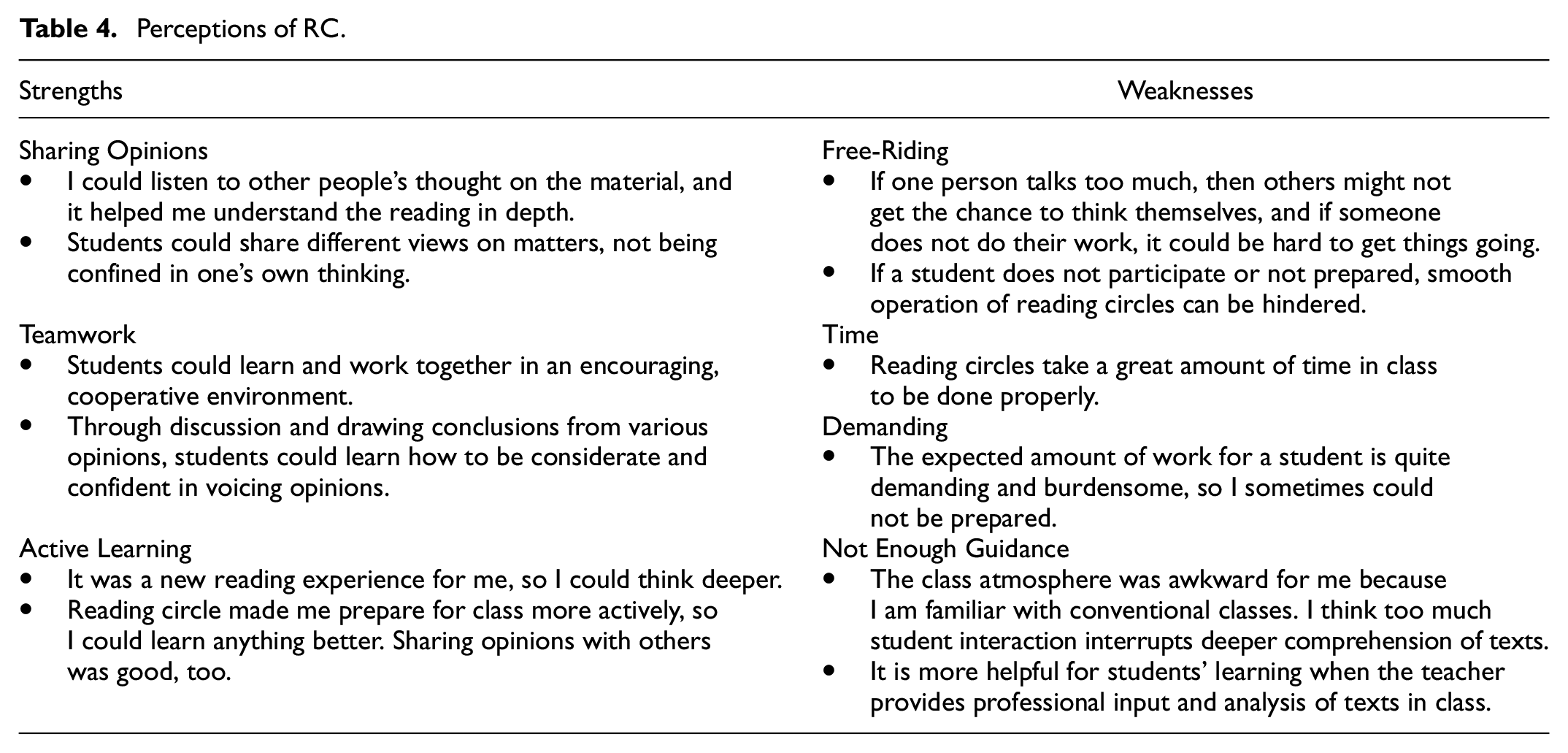
Tables 3 and 4 suggest RC is an overall positive experience for the EMI class students: (a) collaborative teamwork, (b) opportunities for opinion sharing, (c) lessened anxiety, (d) increased learner autonomy and active learning. However, RC may have weaknesses such as one student dominating a discussion and making it difficult for others to participate. Students also said RC required more student work than typical lectures, and some students wanted more teacher input on the “right” answers and interpretation of the readings. Last, students mentioned that the student-to-student interaction felt unhelpful without structured guidance and explanation.
Differences Between EMI Classes.

Perceptions of RC.
Discussion
Research Query (1): Perceptions and Apprehension
Findings on student perceptions toward RC suggest a “good” teaching environment, as purported by Lizzio et al., was established. RC provided EMI class students with a social approach that offered them autonomy and motivated them to actively persist in the class. That is, unlike studies in which EMI classes were found to have low participation and offered students little or no autonomy over their learning (Floris, 2014; Igawa & Forrester, 2016; Milne & García, 2013), engaged students had positive perceptions of RC in the EMI class, implying that the class pedagogy of promoting: (a) individual understanding, (b) internal contemplation, and (c) consideration of facts increased student engagement in the EMI class and active participation in content.
Research has found students struggle to understand EMI content (Ali, 2020; Querol-Julián & Camiciottoli, 2019; Yıldız et al., 2017). However, the instructor, competent in the domestic L1(Korean) language, selected reading materials with consideration of students’ background and cultural knowledge. The instructor also considered text difficulty level. The levels were at times ambitious, but they were not overly challenging texts (i.e., specialist lexicon) for an introductory first-year education class offered in the medium of English. As such, positive perceptions towards RC indicate students had a chance to: (a) think critically, logically, and deeply to explore text understanding, (b) formulate new concepts, (c) view the EMI environment in a new way, and (d) sidestep teacher-centered and test-based learning.
Though possible apprehension was anticipated, overall, RC reduced apprehension and stress in EMI class, concerns discussed in A. Kang and Cho (2020). This finding may help resolve the EMI class student concern: “When I’m reading an English textbook, there are so many words I don’t know that it takes too much time to look them up” (Byun et al., 2011, p. 440). RC collaborative work reduced nervousness and discomfort with engaged students being less anxious and students expressing reduced anxiety in interviews. Students were not excessively concerned about expressing themselves in front of peers and the instructor, nor did they worry about being singled out for their text interpretations. As such, there was reduced (overt) competition and the creation of a positive, collaborative learning environment as argued for by Fredricks (2011).
Along with these findings, apprehension was also lower among students with prior RC experience. Further studies need to consider adopting measures that investigate causal relations. Nonetheless, lowering apprehension among EMI class students could be achieved through continued implementation of RC strategy. However, in nations where teacher-fronted lecturing at university still dominates, this could be both difficult and slow to implement. For instance, in Korea, H.-J. Kim (2016) found that although there is belief that activities such as collaborative learning and project-based assignments help students develop more autonomy over their learning, fixed curriculums and assessments standards or requirements have prevented teachers from encouraging students to be more autonomous learners. Therefore, continued promotion and practice of RC in university EMI classes could lead to more accepting views.
Research Query (2): Attitudes Toward Usefulness
The use of RC allowed for the sharing and discussing of opinions thereby building a dynamic cooperative learning environment. This setting allowed students to not only express their ideas and opinions, but also incorporate and/or counter others’ ideas and opinions as they re-evaluated their own perspectives. That is, students learned to see their peers not as competitors but as resources for learning, paralleling (a) the argument of Kojima and Yashima (2017) that EMI students should feel competent with EMI and (b) the findings of Mark (2007) who found that Japanese university students’ attitude toward reading became more positive after participating in RC.
Role associations seem in line with the results of Hsu and Huang (2017) and consistent with Ryan and Deci (2000) who argued for contexts that support and satisfy three psychological needs among people: autonomy, competence, and relatedness. Associations of: (a) discussion director with RC perceptions and usefulness, (b) vocabulary enricher with engagement and usefulness, and (c) literary luminary with usefulness suggest promotion of self-discovery and supporting autonomy. That is, these roles enabled students to set personal agendas for individual and collaborative group learning. Moreover, with both roles inversely associated with apprehension, they could be leading to increased motivation and confidence.
Because the instructor acted as a facilitator, dissatisfaction with (a) the lack of teacher-centered instruction and guidance and (b) the demanding workload was expressed. The responses parallel those in Pitton (2005, pp. 91–92), who concluded that educators should consider that some students may feel pressured to participate more in RC “because they can’t ‘hide’ like they can in a large class discussion” and that some students may perceive RC negatively “because they are expected to read more and think more critically than they may in a whole group setting.” The aversion, however, could be largely due to students’ prior learning experiences. Tanglen (2017) claimed she found RC promoted “intellectual autonomy with college students who far too often look to their professor for the ‘right’ answers instead of learning to develop ideas for themselves.” Continued exposure to RC strategy, then, is needed.
Research Query (3): Influence on Engagement
Engagement is good for a multitude of reasons (Fredricks et al., 2016), but the key idea is that it is malleable. That is, it can be effectively and efficiently changed, and it encourages various positive outcomes, unlike other factors such as family income, social class, and access to “good” schools. Findings on engagement suggest that despite challenges, students were absorbed in RC and considered them beneficial, pleasurable, and stimulating. As such, passive transactions of learning found in another university study were reduced (Querol-Julián & Camiciottoli, 2019). Consistent with the findings of Kerr and Frese (2017), students were also actively engaged. In other words, findings indicated maximized learning, achieving what Darling-Hammond (2016, p. 85) described as “‘the advancement of teaching’ . . . teaching that goes far beyond dispensing information, giving a test, and giving a grade.” In response to the perception of time passing in class, a number of students indicated they felt time passed too slowly. Although it could equate to boredom and could have negative consequences for class, this outcome needs further investigation because the idea of time passing too slowly (cognitive) may not always be associated with disinterest. Future studies on students’ perceptions of time are needed.
Findings from semi-structured interview comments parallel those in Chui’s (2013) study on the use of RC in EMI classes such as livelier lessons, peers viewing each other as learning resources, and gaining various perspectives on content. Given McCollum et al.’s (2017) argument that ARC are an essential component for text-centric university flipped-learning and recent interest in flipped-learning in university EMI classes (Ancliff & Kang, 2017), RC offers supportive EMI instructors another methodological skill favorable for the EMI environment.
EMI Classes: With RC, and Without
Semi-structured interview comments highlighted the benefits of having EMI class students engage in RC. Students claimed they were passive in other EMI classes. Moreover, students claimed their EMI class learning frequently centered around: (a) translating texts, (b) listening to the instructor’s perspective or opinions on the material, or (c) summarizing the text. Use of RC, however, motivated students to read and helped them learn the importance of reading (Kerr & Frese, 2017). That is, similar to Pitton (2005, p. 92) who found positive reactions to collaborative reading, RC created an active EMI environment, wherein students (a) took responsibility for their learning, (b) had more autonomy over that learning, (c) engaged in interpretative talk critically and deeply, and (d) enhanced their ability to communicate their ideas accurately and effectively on ideas from the readings and class content.
Conclusion and Implications
In recent years, education curricula at universities offering EMI classes have begun to introduce and promote more various student-centered instructional approaches and methods for reasons that include the unique EMI class enrollee demographics. Korea, like other nations offering an EMI learning environment, has had steady annual rises in the number of overseas students at its universities (Nam, 2018), and like other non-English speaking nation universities, it is promoting the idea that domestic students can attain a global education without going abroad (Palmer & Cho, 2011). RC usage by instructors at universities offering EMI classes offers the instructors a pedagogy strategy for accomplishing those objectives.
This study contributes to EMI research, especially to countering impediments such as poor content understanding. It offers investigative findings on EMI class students’ perceptions of and attitudes towards RC, as well as the influence of RC on engagement.
Despite a few dissatisfactions, EMI class students largely found RC: (a) beneficial for current and new knowledge learning, (b) bettering their 21st century competencies, and (c) providing more control over their own learning. In other words, because EMI classes focus on content, EMI class students must be able to navigate complex information on their own. Collaborative student-centered learning focused on relevant assigned texts using productive roles seemed to have given them the tools, information, autonomy, and confidence to understand assigned texts.
Positive active classroom learning outcomes, more awareness of the benefits, and increased awareness of RC among university EMI instructors could lead to understanding of RC effectiveness, both by the instructors and the students. Also, with the number of EMI classes rising rapidly at universities in non-L1(English) speaking countries around the world (Dearden, 2014), the requirement to read and understand English texts is essential and engaged confident learners will learn more. Students familiar with RC had lowered apprehension. As they had less apprehension, they seemed comfortable with going beyond simply wrong or right answers. Moreover, RC is inclusive, and at its core is collaboration. Consequently, the approach bridges a way for both domestic and international students.
Code-switching in the classroom by EMI instructors to assist domestic students’ content comprehension, discounts more proficient L2(English) domestic students and international students in the class, who likely are not L1 speakers of either English or the national local language. Fruitful EMI class pedagogy should acculturate the student enrollment body, capitalizing on having international students learn and expand on content knowledge from domestic students and vice versa. With plenty of interaction opportunities, RC allows EMI class students to take on more active roles and cultivate more positive learning attitudes and perceptions of the EMI environment. Moreover, RC also provides opportunities for all students to create and expand social relations with peers and the instructor in a friendly, non-competitive environment.
Compared to the past, instructors’ concern for their methodological skill repertoire has become prevalent, particularly for those working in the EMI environment. EMI instructors teach their specialty through English, but the instructor may not be a native speaker of the language. Moreover, the student body may consist solely of nationals whose L1 is not English or a combination of nationals and internationals, so English must be the lingua franca for communication in EMI content classes. Additionally, the unusual circumstances of 2020 brought about major change to the teaching-learning environment around the world; both traditional L1 and EMI classrooms were transformed into e-learning classrooms. Along with traditional EMI class concerns, EMI instructors—many of whom may have never contemplated e-teaching—had to teach their specialty in English as well as overcome the extra challenge of teaching in the new online environment. Despite being savvy social media users, some EMI class students may have had little e-learning experience. With findings from this study favoring RC use in EMI classes, awareness and use of the strategy: (a) offers EMI instructors of all specialties one additional pedagogical skill that lessens their preparatory workload, (b) promotes active learning of required content, and (c) makes learning student-centered. In a non-face-to-face classroom environment, a heavier burden is on the instructor to encourage students to persist and contribute through collaborative efforts. To avoid centering learning on individual knowledge, the strengths of RC in EMI classes are an effectual pedagogy alternative that ensures collaborative skill development and learning success. Furthermore, RC as a collaborative learning method could help students develop social and community competencies and contribute to the development of democratic citizens.
Limitations
Some may raise a concern about the sample size of the present study, but annual admissions to departments within colleges of education typically ranges on average from 20 to 40 (Korean Council for University Education, 2021). To supplement qualitative analysis, researchers of the present study employed semi-structured interviews with students as a single cohort study to supplement the study’s qualitative analysis. Thematic analysis may have disadvantages (Nowell et al., 2017), but researchers conducted a concise and thorough analysis using the six phases suggested by Braun and Clarke (2006). Student engagement in this study (a) functioned with a clear definition of engagement as it pertains to RC, (b) assessed such engagement based on students’ self-reporting, and (c) found positive outcomes. However, Fredricks et al. (2016) pointed out that: (a) definitions of engagement differ; (b) there is overlap between motivation and engagement; (c) engagement does not always lead to positive outcomes; and (d) adults and their peers respond differently than children to engagement. Therefore, future studies that measure additional scales of both engagement and continued engagement are needed. The study is correlational and exploratory, and researchers acknowledge that correlation results do not indicate causality. Nevertheless, results shed light on the use of RC in EMI classes. As the study is correlational, future studies need to consider adopting experimental studies that examine the improvement of reading comprehension and other variables (using a pre-post design).
Footnotes
Declaration of Conflicting Interests
The author(s) declared no potential conflicts of interest with respect to the research, authorship, and/or publication of this article.
Funding
The author(s) disclosed receipt of the following financial support for the research, authorship, and/or publication of this article: This work was supported by the Hongik University new faculty research support fund.
