




Abstract
The paper provided an empirical analysis of the numerical proportions of women academics in the Nigerian University system. It assessed the challenges confronting women academics as a result of the numerical proportions and it examined their responses and reactions to the challenges that arises as a result of the numerical proportions. It focused on two universities namely Umaru Musa Yar’adua University and Federal University Gusau in Katsina State and Zamfara State of Nigeria respectively. The study was an exploratory research design. It was conducted using Key Informant and In-depth Interview. The data collected were analyzed using Nvivo, version 10. The study found that women also contribute to their numerical proportions in the Nigerian University system. The study suggested the need to encourage women generally to apply for academic career. It also suggested that the Nigeria universities’ management should prioritize the incorporation and recruitment of women in the Nigeria University system.
Introduction
The impression that women are adequately represented in a work place by hiring one or two women against eight or ten in a university department shows largely the symbolic efforts made to give the appearance of gender equality within a workforce (Merrill, 2019).
There is no doubt that the numerical proportions of women in a work place may in one occasion serve as advantage; and in other, serve as disadvantage to some (McDowell, 2011). The former usually takes place in situations that are favorable and the latter in situations that are not favorable. Taking a look at many Nigerian work places, the university system inclusive, the obvious is the presentation of men’s dominance and women’s underrepresentation (Adisa et al., 2020).
University seeks to advance knowledge through teaching and community service which are basically to enhance national development (Stensaker et al., 2019). The aforementioned function is achievable through the recruitment and selection of capable and competent academic staff. The process of recruitment and selection of academic staff in the Nigerian university is mostly through placing of advertisement for vacant positions on the print media for the interested candidates to apply (Odor et al., 2019). The two sources of recruitment in the Nigerian universities are either the internal or external. The internal source permits filling vacant positions with staff that are already in the university. External source refers to the process of attracting prospective candidates from outside the university (Ejumudo, 2011). Those processes are assumed to attract adequate individuals with appropriate qualifications on a timely basis. The processes, from all indications should include women in all ramifications. Many studies have shown that in Nigeria, the rates of females with higher university qualification and also competent in all ramifications are at close quarter with their male counterpart (Garba et al., 2013). Some of the available statistics indicated that female are viable and capable to compete with men in the Nigeria University system; yet, they are not well represented (Fapohunda, 2012). However, few numerical proportions are found representing women in Nigerian universities (Eboiyehi et al., 2016). The resilient nature of some women seems to be responsible for their survival in some of the Nigeria work places, including universities where you are likely to have two or three women in the entire faculty (Adebayo & Akanle, 2014). It has been noted that occupational context (the centralization; formalization; the specialization; the hierarchical and the personnel ratio among others) have apparent influences on how employees’ numerical proportion processes operate in a work place (Tolbert & Hall, 2015). Therefore, potential exhibiting of differences between or among gender may largely depends on the numerical proportions of each gender and work place characteristics. It seems there are perfunctory recruitments of women in the Nigerian working place, including university (Ajayi et al., 2019). Now, the questions that arise from the curiosity are: What is responsible for the few numerical proportions of women academics in the Nigeria university system? What are the challenges confronting women academics as a result of their numerical proportions in the Nigeria university system? What are the responses and reactions of women academics to the challenges that arises as a result their numerical proportions in the Nigeria university system?
Conceptual Clarification
Objectives of the Study
The study examined the numerical proportions of women academics in selected Nigerian university system. It assessed factors responsible for the few numerical proportions of women academics in the Nigerian university system; it examined challenges confronting women academics in the Nigerian university system as a result of their numerical proportions and it examined their responses and reactions to the situations.
Literature Review
The literature review has been subdivided into: Factors responsible for the few numerical proportions of women in the work place; challenges confronting women in the work place as a result of their numerical proportions and women’s responses and reactions to the situations.
Factors Responsible for the Few Numerical Proportions of Women in the Work Place
It may seem that there are increases in the number of women to men in the work place or occupations especially with the rising numbers of women in some occupations that seems traditionally male, such as medicine, engineering and law (Stier & Herzberg-Druker, 2017). However, the fact remained that women are still lagging behind the male in all occupational spheres, even in the recruitment and selection into the academic occupations (Ogbogu & Bisiriyu, 2012). There are obvious challenges confronting women working in many organizations, not only in terms of numerical representation but also in terms of opportunity for upward mobility within the organizations (Crompton and Lyonette (2011). Few numerical proportions of women to men in many work place may not be farfetched from the fact that many professions within the organizational system are male-dominated in terms of their traits and mostly organized by men for the purpose of men (L. Smith, 2013). Similarly, it has been observed that successful career in a work place, including academics largely depends on the ability to exhibit some masculine features like aggressiveness; competitiveness and ability to separate family challenges from the work without role conflict (Berdahl et al., 2018). The notion about the masculine features in a place of work seems to be responsible for the few numerical proportions of women to men in academics as well (Wilson & Altbach, 2017). It has been observed that it may be difficult for the womenfolk to fulfill some of the traits and importantly, there are tendencies for role conflict as regards combining family together with work (Sánchez-Vidal et al., 2020).
Similarly, it has been noted that despite the fact that women are committed to obtaining higher degree, their numerical proportions in academic work is not commensurate in the university system (Ceci et al., 2014). This is conversely observed that, there are increasing proportions of women leaving academic work (Chen et al., 2020). The numerical proportions of women in the academics seem to have fulfill some requirements that seem masculine and these are apparent in some of the visions and missions enacted by the universities system; some of which may include: attending of conferences and workshops within and outside the countries as well as other activities that involves long hours in work place (Potvin et al., 2018). These rigors involved in some of the academic activities may not be acceptable to some of the spouses, in the northern part of Nigeria (Sinai et al., 2017)). These factors identified continuously depicted women as unreliable and subsequently affected their numerical proportions in academic work. It has also been opined that women will maintained and sustained their place in work and they will also be regarded as competent when they violated some prescriptive gender requirements that mostly resulted in people perceiving them as “not too good wife” and or “not caring mother” (McRobbie, 2013). The implication is that in as much as a woman is married or intends to marry, people assumed that much of her time and energy should be invested for the husband and children. In some case where she acted differently, she may be regarded as too forward and exhibiting appropriate behavior that goes contrary to the ideals. The fact remained that many women may not be able to deviate or violate the prescriptive gender requirements which would continue to be factors affecting the numerical proportions of women academics in the Nigeria universities (Jeong & Harrison, 2017).
In a study conducted by Fiske et al. (2002), it has been found that employers and colleagues expect better and superior performances from men as compared to women in every workplace responsibility. The implication of the finding is that much are not expected from the women folks. This is an indication that their numerical proportions may be affected right from the time of recruitments, since the assumptions was that much are not expected from them. This largely reinforces status distinctions through self-fulfilling processes which involved stereotyping, double standard and biased evaluations. In another study by King et al. (2010) it has been found that in some cases, there are inconsistencies in women representation in low and high status. While they are overrepresented in low status positions they are underrepresented in high-status positions. Their rates of job advancement in organization are less than that of men. The findings of the study may be interpreted to imply that in a bid to have women representation, low status positions are used to compensate them, since much are not expected from the low status positions (Figure 1).

Showing numerical proportion of women to men in the Federal University Gusau and Umaru Musa Yar’adua University, Katsina with the depiction of 70% to 30% of women to men in the two Universities.
Challenges Confronting Women as a Result of Their Numerical Proportions
There are some challenges confronting women as a result of their numerical proportions in the work place. In a study conducted, it has been opined that because of the few numerical proportions of women in work place, women are confronted with what is called, gender inappropriateness (Stroshine & Brandl, 2011). Gender inappropriateness has been described as a form of gender stereotyping which resulted to women experiencing isolation, performance pressures, and role encapsulation as well as perceived as “intruders.” In a related argument, it has been noted that women might be confronted with challenges as a result of their few numerical proportions because of the fact that there are preconceived notions that an increase in their numerical proportions will be a threat and subsequently being discriminated against in place of work (Andersson & Harnois, 2020).
It has been observed in another study that ascribed characteristic like gender may be responsible for status expectations where by superior performance are expected from men as compared to women (Eagly, 2009). This imply that men are valued and perceived to have superior performances more than women and more considerations are given to them. The numerical proportions of women; their competencies and their performance may not be important in a work place because of the status expectation (Auspurg et al., 2017). Similarly, a study showed that in a process that seems reducing the proportions of women in work places; it has been observed that when there are increases in the numerical proportions of women beyond some percentages, there are tendencies for undisguised discriminatory treatment by male colleagues which may be through blocked opportunity, harassment, harming women’s career prospect, etc.
Longo and Straehley (2008) in their analysis of challenges confronting women as a result of their few numerical proportions in work place stated that women numerical representation in a work place should not be seen as an interpretation of gender equality. The emphasis should also include the extent to which women are included in work place decision making. This imply therefore that challenges of women as a result of numerical proportions should not only be seen from the perspective of gender representations but also from the interactional advantages that women do not enjoyed in an occupational setting.
Kanter (1977), who has been highly recognized in her study of tokenism, analyzed challenges confronting women as a result of their few numerical proportions in a work place. She was of the view that “high visibility” remained one of the most obvious effects of few numerical proportions of women in work place. This is because it revealed the few membership numbers of women in a work place. She emphasized that women will be under visual and verbal scrutiny than the male in work place because of their smaller group membership. The major challenge she pointed to was the fact that women representation rather than their achievement in a work place has been the concern of many people. She pointed that the consequences many failed to put into consideration is that it would be responsible for their direct feeling of isolation. She reiterated that women status, which she described as “tokens” may give them what she described as “attention-getting edge” and this is not too good. This is because women accomplishments could easily be recognized because they are “token” members. Male workers with similar achievement may not receive the same treatment and this is because it is expected of them. In other way round, she emphasized that if it turns out to be a major mistake then women would be reprimanded as if she had been making mistakes all her life. She therefore stated that, in a bid to avoid what she called “hyper-positive or hyper-negative attention” while under visual and verbal scrutiny, women should only do “well” rather than exceptionally well. The findings of this study may, however, be responsible for why some women might likely be discouraged from been too dedicated and committed in their workplace, since it is assumed that they are easily noticed criticized and appraised.
In another study conducted by Zhang and Morand (2014), it has been observed that one of the challenges of the few numerical proportions of women in a work place is the fact that women’s success in a work place has not stopped the act of “status leveling” and this implied looking down on their achievement. It does not matter even if it is obvious that they are performing exceptionally, they are treated like an inferior minority. This has been seen as the consequence of the status expectation of women; their gender status is regarded as fulfilling an “unappreciated” role in society.
Similarly, study conducted by King et al. (2010), showed some of the challenges confronting women as a result of their few numerical proportions in work place. It pointed out that one of the salient themes of few numerical proportions of women in work places are the issues of social contrast, isolation, and the exaggeration of differences between women and men. This is said to be observed when men who are mostly the dominant members outwardly demonstrate that they are not the same with “few” populations who are mostly the women. This is basically responsible for what is refer as the “boundary heightening” where women are excluded and they are not allowed to cross unless they demonstrate loyalty to the male dominant population. The “boundary heightening,” is a continual process and it reproduces inferiority for the women folks.
It has also been observed in another study that some women numerical representation in some work places is basically to fulfill occupational designation which is mostly described as “women’s slots” (Wallace & Kay, 2012). This is said to be largely responsible for women’s role encapsulation because women only filled in the “women slots” not basically to replace or fill a position traditionally held by men. It is also described as “assimilation,” which fills “limited and caricatured roles” (Wallace & Kay, 2012).
Similarly, another finding shows that it is obvious that women would be confronted with challenges in many working places as a result of their few numerical proportions. Some of which may include challenges of upward mobility within the work settings (Glass & Cook, 2020). The challenges may come when there are no encouragements from colleagues on how to improve on their career for upward mobility. This imply that since women have few numerical proportions in work place, there might be challenges of having category of those who will advise objectively on how to move forwards in career (Grover, 2018).
Responses and Reactions of Women to Their Numerical Proportions in Work Place
In a study conducted by Roth (2004) gender and race are seen as ascribed characteristics that encourage homophily preference in an organization. Homophily preference has been referred to the tendency for people to be attracted to work with those who share similar characteristics with them. The implication is that those who share different characteristics are likely to experience isolation, discrimination and subjective treatments. Gender as observed enhances homophily, however, it has been noted that although women have homophily preferences for other women, but their preferences are not apparent in workplace (Roth, 2004). In fact, it has been observed that it served as an advantage for men who do not share similar characteristics with them (Ruef et al., 2003). This implied that women homophily are not of much advantage for women as it has always been for men. The implication of the observation is that women do not act collectively to fight for themselves, especially in work place as regard their numerical proportions.
In an empirical research conducted by King et al. (2010), they examined the psychological climate of gender inequity to understand how women experience the work place contexts. The term psychological climate refers to the meaning and importance of occupational contexts for individual workers. Psychological climate described how individuals perceived their work environment in terms of the structures, procedures and processes. They assessed how women at individual level perceived the gendered nature of their work place characteristics in terms of the hierarchical structure, policies, procedures etc. They focused on whether individual women perceived work place context favorable to men or not. They found that the few numerical proportions of women in work place has a relation with the context that individual women perceived and that it is an important predictor of their attitudes and behaviors in an organization. It also found that women in their work place are attuned to the numerical representation and the subjective experience has led to the perceptions of an asymmetry gender climate. The implication of which include lack of job satisfaction, poor commitment to work, job stress and turn over intention. This implied that women might not be comfortable with their few numerical proportions in work place but they have become accustomed to the situation. The study also implied that the consequences of the situation is that there will be a form of lack of commitments and satisfactions from the women workers.
Justification for the Study
Several articles have examined women’s numerical proportions in work place in various ways. This paper has done the same; however, it further examined the challenges confronting women as a result of the numerical proportions in occupational setting and it also examined their responses to the numerical proportions. The paper in this respect proffers explanations to women’s numerical proportions in the academic setting, it focuses on two universities in Nigeria, namely: Federal University Gusau and Umaru Musa Yar’adua University, Zamfara and Katsina state, Nigeria respectively.
Theoretical Framework
This study was anchored on the Rosabeth Moss Kanter’s theory of proportional rarity which was adopted in her chapter titled: “Some Effects of Proportions on Group Life: Skewed Sex Ratios and Responses to Token Women” in her book “Men and Women of the Corporation” (1977), Kanter examined the implications of interactions within a work place and how they are affected by the different numbers of people from different social types. She focused on the groups with fewer gender ratios (less than 15% member of the organization); higher numerical proportions of men and smaller numerical proportions of women who she described as the tokens. She was of the view that the numeric imbalances between groups are responsible for the negative effects of tokenism and the negative effects will diminish if the number is balanced. The proportions according to her should be considered as less extreme when women have a representation of 16% to 45% of the membership in a work place as opposed to when they have a representation of 15% or less (which she called transition from skewed to tilted). She stated that because of the fact that women were numerically few, they experienced the followings: heightened visibility; performance pressures, isolation by the majority who exaggerated things to the detriment of women. She was of the view that the structural condition of the occupational context is responsible for the “fear of success of women” or “women-prejudice-against-women” not gender traits that embedded in themselves. She argued that numerical balance in work place would be an instrument for gender equality in an occupational setting.
Other research conducted are similar to Kanter’s findings where they established that underrepresentation of women in occupations leads to the experience of much prejudice and discrimination for those women as compared to those in a more balanced gender numerical proportional (Hewstone et al., 2006; Pazy & Oron, 2001). Other researches have supported Kanter’s claims on the implications of low proportions of women in work place in different argument (Pazy & Oron, 2001; Stichman et al., 2010). It has also been suggested that the low proportions of women in work place by Kanter could be responsible for homophily processes that define “in-group” and “out-group” members (Roth, 2004). The theory of homophily stated the tendency of individuals to be attracted to those who have similar characteristics with them (McPherson et al., 2001). This preference, however, has the implication of excluding those who do not share the similar characteristics and by extension leading to their isolation and out of place (Roth, 2004). The fact that some individuals are homophily may be responsible for dismissal and devaluation of the efforts of those who do not share their characteristics (Westphal & Milton, 2000).
The theory has however been criticized on the basis that gender is a matter of power and not of quantity equal numerical representation in a work place may fall short in the face of resistance which may also reproduce inequality. It has also been criticized that the low numerical proportions of women in work place may threatens the majority. Although, it may increase resistance by the majority group and further heightens the barrier to the achievement of women goals but the presence of the numerical proportions may threaten the actions of the majority (R. A. Smith & Elliott, 2002). It has also been criticized by Zimmer (1988) on the basis that not all minorities may experience disadvantage, depending on the social status of their distinguishing characteristics.
Study Setting and Methods
Federal University Gusau and Umaru Musa Yar’adua University are both located in the North West of Nigeria. While the former is located at Gusau Local Government Area and the capital of Zamfara State, the latter is located in Batagarawa local government in Katsina Area of Nigeria. They have an area of 3,364 km2 and a population of 450,000 an area of 433 km2 and a population of 350,000 respectively. Zamfara and Katsina are states located in the north western of Nigeria and are predominantly Hausa and Fulani language spoken people.
The study was conducted among the academic staff of both Universities. Exploratory research design and a qualitative method (In depth Interview [IDI] and Key Informant Interview [KII] were used to collect primary data from the respondents) of data collection were adopted. In depth interview involves engaging 15 purposively selected academic staff each from the two universities. The Key Informant Interview involves engaging five Head of department and five Human Resources staff who were purposively selected from each of the two Universities. The qualitative methods give an opportunity to interact with both the male and female academic staff. It was an opportunity to have face to face interaction with some of the Head of departments and some of the Human Resources staff on the numerical proportions of women in academic environment. These are the questions that were posed to the respondents:
(a) What are the numerical proportions of women academics?
(b) What are the factors responsible for the numerical proportions of women academics?
(c) What are the challenges confronting women academics as a result of their numerical proportions?
(d) What are the responses of women to the situations?
The researcher is an academic staff, this facilitates responses from the respondents and it enhances the research validity as well as its credibility. Many of the respondents required no much persuasion because they were aware of the purpose of the research and they don’t need to be convinced that the study was basically for academic purpose and it was clear to them that participating in the research does not attract financial or material compensation. The respondents determined the time, the day and the venue.
The data that were generated from the recorded interview were transcribed, patterns identified and organized according to objectives. It was also recorded verbatim and converted into written form. Data were enumerated and thematic analysis and categorization were provided. The researchers thereafter provided highlighted quotes that were coded and then sorted into themes based on the patterns that were generated. In a bid to differentiate between respondents, the following coding method was adopted Sani//IDI/Female/FUG. Spurious names such as, Sani, KII 1, 2, 3 were used to identify the participants; KII as the type of interview; Female (F) or Male (M) as the type of respondent and FUG or UMYU as the University of the respondent
Findings and Discussion
The findings of the study have been sub divided into four: the numerical proportions of women academics; factors responsible for the numerical proportion of women academics; the challenges confronting women academics as a result of their numerical proportions and the responses of women to the situations
In a bid to maintain confidentiality, interviewee from the IDI and KII were disguised with the following numerical value and supported with the relevant literature:
Participant from the In-depth Interview (IDI)
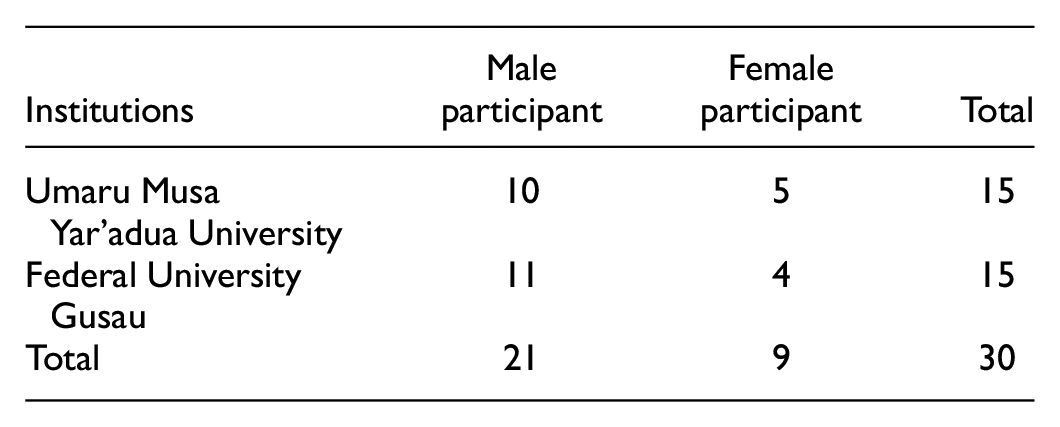
Participant from the Key Informant Interview (KII)

Above participants for the IDI and KII are consistent with the assertion that numerical proportions of women in academic work is not commensurate in the university system (Ceci et al., 2014). It is also similar to the arguments that few numerical proportions are found representing women in Nigerian universities (Eboiyehi et al., 2016).
The Numerical Proportions of Women Academics
This study found that there are few numerical proportions of women academics. Women academics have a representation of 10% to 20% of the membership in the two Universities. The percentages of women academics in the universities show unequal representation of the genders. This study found that the proportions of women academics to men in the two universities are not good representation of women academics in the Nigerian universities. The percentages show that women academics need to be specifically recruited to fill in the gaps. This is consistent with Ogbogu and Bisiriyu (2012) whose observation shows that women are still lagging behind the male in all occupational ramifications. This is also consistent with Dencker (2008) who observed that numerical proportions of men in a work place are more the females. Men have as a result of their numerical proportions attained higher leadership roles in occupational settings far more than women.
The numerical proportions of women academics according to some of the participants are as follow: The numerical proportions of women academics are quite incomparable to that of men. This is obvious because you will see in many of the departments, there are either no woman at all or you will see one or two women as academic staff. The faculty as a whole may have four or five women as academic staff (Ali/M/IDI/FUG)
In another session with some other participants, there was a further reiteration that the proportion of women academics to men are quite low. The following illuminated the discussion further: There are few numerical proportions of women academics and it is almost like that in many Universities, especially in the northern Nigeria. You may go to some universities and discover that there are only four or five women in the entire faculty. (Binta/F/IDI/FUG)
The participants from the other university were of the same opinion that the numerical proportion of women academics to men cannot be compared because it is obvious that women are underrepresented. Some of the participants summarized it as thus We cannot compare the numerical proportions of women academics to men because there are very few women in many of the department and faculty as a whole (Lemo/M/IDI/UMYU)
Key Informant Interview conducted with some of the Heads of Department and some of the HR illuminate the discussion further as thus: Women academics are not adequately represented in many of the departments. There is nothing to hide about the fact. It is obvious that in many of the departments what we see are representatives of women and they are usually two or three in the departments. (HOD/M/KII/FUG). The proportions of women academics to men are incomparable and the truth remained that women are not properly represented in many of the departments as academic staff (HOD/M/KII/UMYU)
It is obvious that in many departments of the university, men are the dominant. Men occupied all department more than the females (HR/F/KII/FUG)
The IDI and the KII interview revealed that the proportions of women academics to men in some of the universities are incomparable. It shows that there are higher numerical proportions of men academics than women.
Factors Responsible for the Numerical Proportions of Women Academics in the Nigerian Universities
The study found that there are few numerical proportions of women academics. The study found that factors responsible for the few numerical proportions of women academics to men in the university include the notion that women may not have the aggressiveness, courage and tenacity to separate family responsibilities from the challenges and the demand of academic profession. Women who have acquired the academic qualification to compete in the academic environment are on many occasion distracted with the demand of getting married and having a family which is the requirement of the immediate society. This is in line with the findings of Berdahl et al. (2018) who opined that successful career largely depends on the ability to exhibit masculine features like aggressiveness; competitiveness and ability to separate family challenges from the work without role conflict. It is also similar to the opinion of Wilson and Altbach (2017) who pointed that the notion about the masculine features may be responsible for the numerical proportions of women to men in a work place and that there are tendencies for women to have role conflict as regards combining family together with work. It is consistent with the finding of McRobbie (2013) who opined that women who are successful in workplaces and mostly regarded as competent are those who have violated some prescriptive gender requirement that mostly resulted in people’s perceiving them as “not too good wife” and or “not caring mother.”
The following discussions illuminate the view of some of the participants: Some women actually have the credentials to present for the purpose of been recruited as academic staff. However, they are either not interested or have some other social commitment distracting them from applying for the job. (Kamu/M/IDI/UMYU) There are various challenges hindering women from getting academic profession. It is apparent that many of them are intelligent at the first degree. However, sometimes the minimum requirement for academic job is to have Masters. The financial and time involvement hinders so many women from obtaining the Masters or proceeding with their educations after the first degree. It may be the reason why there are many women at the non-teaching sector than the academic profession. This is also reason why there are few women in the academics. (Mula/M/IDI/FUGUS) Women have various challenges hindering them been in the academics. The fact that there are societal expectations such as the need to get married at a particular time of life; the need to raise a family and the need to adhere strictly with the rules and regulations of their husbands. Those expectations are norms that women want to conform to. The academics requirement sometimes may not be favourable to women based on the value requirements of the society (especially in the northern part of Nigeria) (Lami/F/IDI/FUGUS)
The following represents the responses of some of the Heads of department from the KII: The applications for the academic positions that most of the time come to the office are usually from male applicant. There are usually few female applicants. Whenever there are needs for academics’ staff, everyone is encouraged to apply for the position without gender discrimination. (HOD/M/KII/UMYU) All the applications that come to the department are treated with the utmost objectivity. There are no special considerations for the male applicant. There is no subjectivity in selecting those to be given the job. It is only when women apply that their applications can be treated. (HOD/M/KII/FUGUS) Many of the applications that comes to the university are from the male. It is on a rare occasions that women submit applications to be recruited for academic job. It is not that the managements are not interested in the recruitment of women or that women are been discriminated against. (HR/M/KII/UMYU)
When the university call for the submission of applications, it is common knowledge that out of the applications, women’s application are either 20% or 25%. Their applications are very few and eventually men are employed to fill in the vacancies (HR/M/KII/FUG)
The above IDI and the KII interview revealed that factors responsible for few women academics in the universities has nothing to do with the universities not wanting to employ women but can be traceable to factors ranging from women not applying for the job; women seems to be applying for non-teaching job more than the academic jobs; societal expectation of the need for women to get marry and raise a family.
Challenges Confronting Women as a Result of the Numerical Proportions
The study found that women are confronted with various challenges as a result of their numerical proportions in the University. It was found that women experience a kind of isolation and role encapsulation. It has also been found that some of the responsibilities are not giving to them because there are pre-conceived notions against them. This is consistent with the findings of Stroshine and Brandl (2011) who stated that because of women numerical proportions in the work places, women are confronted with gender inappropriateness which refers to a gender stereotyping. It is also similar to the findings of Pazy and Oron (2001) who argued that few women numerical proportions in work places may resulted in discrimination against women. It is also consistent with the findings of Andersson and Harnois (2020) who pointed that women are excluded in occupational opportunities. The study also found that few women numerical proportions in the work places has resulted in the need to or attempts to fill in women quota. Many departments have therefore concluded that there are needs to fill in the quota in terms of having some numbers of women as a representative for women. This is consistent with the findings of Aguirre (2000) and Wallace and Kay (2012) who discovered that some women numerical representation in a work place is basically to fulfill occupational designation which is mostly described as “women’s slots.” It is also similar to Shonbeck (2009) and Wallace and Kay (2012) who stated that few women numerical proportions in work places is responsible for women’s role encapsulation because women only filled in the “women slots” not basically to replace or filled a position traditionally held by men. The situation which is described as “assimilation,” which fills “limited and caricatured roles”
The following discussions illuminate the participants’ views:
It somehow become necessary for many of the department to have a woman representative in the department. It seems to be the reason why some women are shortlisted even though they are not as qualified as other men. But basically to have a woman representative in the departments
(Ayi/M/IDI/UMYU) There are some occasions where some roles or responsibilities would not be given to women because it is clear that family commitment may not permit their complete dedication. That should not be regarded as discrimination or isolation but the need to have the best and committed hands for the job. (Buba/M/IDI/FUGUS) It seems that on several occasions men are considered for many responsibilities. This may be as a result of the fact that they are assumed to be capable of doing it better in terms of committing their time and efforts. (Anti/F/IDI/FUGUS)
The following represents the responses of some Heads of department from the KII: It might seem men are considered more than women in terms of designation of responsibilities. However, the fact is that, men are the available hands who capable of doing the task. Men are the available human resources that will not be distracted or complain. The department can easily rely on them when the need arises or when important tasks are to be performed. (HOD/M/KII/UMYU) The responsibility of those in authority is to guide and protect the dignity of the department. It is pertinent that the right things are done at the right time. This implied that responsibilities of the department should be given to those who are available and willing to give their time and commitment. These are the qualities that many considered in given out responsibilities. Responsibilities are not given with the intention of isolating or discriminating. (HOD/M/KII/FUGUS) It is obvious that few women that were employed might find it difficult to cope among the male counterpart. This is because the numerical proportions of women to men is wide and it may be a challenge to the few women. (HR/W/KII/FUGUS) Some of the employed women might feel isolated because the environment is that of male environment and that may not permit some women to be fully participatory. (HR/M/KII/UMYU)
The above IDI and the KII interview revealed that responsibilities are given to men academics more than women. This basically has to do with the few numerical proportions of women. The available numerical proportions of women may not be effective, or efficient or may not necessarily capture some of the desired qualities required for a particular responsibility.
Responses and Reactions of Women to Their Numerical Proportions
The study found that responses and reactions of women to their few numerical proportions in work place seems to further encourage the situations. This can be depicted in their responses and reactions to the situation; where it was discovered that many of the women in the academic profession have perceived the status quo as the normalcy. This may also be corroborated with the findings of King et al. (2010) who attributed psychological climate to how individual woman perceived their work environment in terms of the structures, procedures and processes. This is a confirmation that women have acclimatized themselves to the numerical representation and the subjective experience of “tokenism” which implied few women representing their numerical proportions in the work place. The study also found that women do not have the same solidarities that are found among men, in terms of the concern whether there are adequate women in the occupational settings or not. This is also similar to the discovery of Roth (2004) who was of the view that, although, women have homophily preferences for other women; but their preferences are not apparent in workplace. This implied that the responses and reactions of women to their few numerical proportions in work place might have been encouraging the act.
The following discussions illuminate the view of some study participants:
It has become normal to see men academics to have high numerical proportions than women. This has become so normal to the rationality of both men and women academics. It has become so pervasive situation in many of the universities, especially in the northern Nigeria.
(Gero/F/IDI/UMYU) It is not a new thing that women cannot equal the proportion of men numerically in many of the universities (especially the northern Nigeria universities). The assumption is that this is not achievable and it is not attainable. Women have also not helped the situations because those who are qualified among them may decide not to apply for the job. Those who apply among them may not be absolutely committed and dedicated. It is certain that if they are interested and committed they would have been considered for an appointment. (Nero/F/IDI/FUGUS) The few numerical proportions of women in universities is not new. It has been like that for a long period of time. It may be difficult to change the situation overtime. But when women themselves step up, certainly things shall improve. (Nero/F/IDI/FUGUS) Women are the ones to change situations of things. If they refused to change their attitudes towards the requirement of work place and that of the universities specifically, definitely, the situation will continue the way they were (Bili/F/IDI/UMYU).
The above IDI interview shows that the responses and reactions of women to their numerical proportions in the work place seems indifferent. Women are not much concerned as to whether there are increase in the numerical proportions or not. It shows that women in the academic profession have perceived the situation as normal. It also shows that women have acclimatized themselves to the numerical representation and the subjective experiences which they might be facing thereof.
Conclusion
The study assessed factors responsible for the few numerical proportions of women academics in the Nigeria University; it examined challenges confronting women academics as a result of their numerical proportions in the Nigerian university. It also assessed responses and reactions of women academics to the challenges that arises as a result of their numerical proportions in the Nigeria university system.
The study presented proportions of women academics to men in the two universities. It shows apparent display of few representations of women academics in the two universities. The study shows that factors responsible for the few numerical proportions of women academics in the Nigerian universities include the notion that woman may not have the aggressiveness, courage and tenacity to separate family responsibilities from the challenges and the demand of academic profession. The study also found that women experience a kind of isolation and role encapsulation. It also found that responses and reactions of women to their few numerical proportions in the universities are indifferent. The study shows that numerical proportions of women academics in the universities may be responsible for why less responsibilities are allocated them, because there are notions that they may not perform it effectively and efficiently. It has therefore been concluded that there are needs to increase the numerical proportions of women in the Nigerian Universities. It is pertinent that women should be encouraged to apply for the academic jobs. This is because there is every tendency of getting competent and able hands among women who will fill in the missing gap left by women. There is no particular gender that would not appreciate to have the feelings of inclusiveness in any social settings. Women may not be comfortable with their numerical proportions, however, it seems they have accepted the status quo.
It is worthwhile, therefore to conclude this study that numerical proportion of women to men in Nigeria Universities are not same. Men have as a result of their numerical proportions attained higher leadership roles in occupational settings far more than women. Women are also not helping the situation and this can be depicted in their responses and reactions; where it was discovered that many of the women in the academic profession have perceived the status quo as the normalcy.
Recommendations
Based on the findings the researchers have proffered the following suggestions
There should be a special advertisement for the purpose of recruiting women academics into the universities. This is a right step in the right direction that may help increase or equal the proportions of women to men in the Nigeria Universities system.
The fact that there are societal expectations that seems to be hindering women from achieving and attaining their goals. Universities should distinguish itself by encouraging women to apply for the academic job. Women should be made to feel that they are needed and they are important in the university system.
There are intelligent women who can contribute positively to the development of Nigeria universities. It is therefore vital that those who are already employed in the Universities system should be used to entice those whose spirit have been dampen as a result of one societal expectations or the other.
There should be an element of equality in assigning responsibilities to all academic staff. This is because what is good for the goose is good for the gander. Women should not be giving the impressions that they are been isolated or discriminated against;
Women should stop discouraging themselves; they are part and parcel of the society. They are also stake holders and there is no need for anyone to treat them as token.
The expectation is that women who are in the university system would be writing against the numerical proportions of women. However, they are silent and it is an indications that they are satisfy with the status quo.
There is also need for universities management to give special consideration for the peculiarities of women when recruiting academic staff.
Implications of the Study
The study provides the policy makers information on the need to increase the numerical proportion of women in the Nigeria Universities. It highlighted the implication of token women in the Nigeria Universities. It gave an insight on the isolation that may possible emanated from the token situation. It also presented the fact that women are viable human resources that should be utilized to improve and provide support for universities. This is for the purpose of improving and taking Nigeria universities to the greatest height.
Footnotes
Declaration of Conflicting Interests
The author(s) declared no potential conflicts of interest with respect to the research, authorship, and/or publication of this article.
Funding
The author(s) received no financial support for the research, authorship, and/or publication of this article.
