




Abstract
New technologies are changing the way we see and understand university education, with the advent of new, more flexible organization methods capable of reaching people via class formats like Small Private Online Courses (SPOCs). However, studies which have analyzed these types of courses have focused on their implementation and not on the cognitive and emotional processes of students. Therefore, the present study aims to examine the teacher’s influence on emotions, dispositional flow, motivation, and metacognitive strategies among university students. There were 1,347 participants in this study (678 men and 669 women), ranging from 18 to 26 years of age (M = 21.43; SD = 2.64). The results were evaluated using a descriptive statistics analysis, a reliability analysis, and a structural equations model which explains the causal relationships between the study variables. In this sense, autonomy support exerted a positive influence on positive emotions and a negative influence on negative emotions. In contrast, psychological control by the teacher positively influenced negative emotions and negatively influenced positive emotions. Moreover, positive emotions exerted a positive influence on dispositional flow, whereas negative emotions exerted a negative influence on dispositional flow. In addition, dispositional flow exerted a positive influence on autonomous motivation, metacognitive strategies, and academic performance. Finally, autonomous motivation exerted a positive influence on academic performance and metacognitive strategies. These results reveal the influence of emotions, motivation, and perception of SPOCs on the adoption of adaptive habits and academic performance among university students.
Introduction
In recent years we have witnessed a technological revolution which is bringing about changes in the way we live and interact with others (Bauman, 2015). In this regard, the academic community has not been immune to said revolution; a series of profound changes have taken place in the academic and educational field, such as new methods of organizing subjects, the reduction of course hours, the decrease in the ratio of class time and, especially, greater emphasis on self-learning among students (López et al., 2018). Consequently, new learning environment began to emerge in the form of the MOOC (Massive Open Online Course) which allows anyone to access any course remotely via the Internet without any limit on the number of participants. Based on this platform, both in the university and private sectors, new learning environment began to emerge in the form of SPOCs (Small Private Online Courses). These new tools allow students to access all course information from anywhere, and the communicative process itself favors their participation as well as their individual work, thereby decentralizing control of teaching-learning processes (Lou et al., 2016). However, there are hardly any studies that have analyzed the role of the teacher or of the cognitive, emotional, motivational, and psychological processes among students participating in these types of educational programs.
Role of the Teacher
Self-Determination Theory (SDT) suggests that students can be influenced by the teachers through two personal interaction styles: controlling versus autonomy supportive style (Cheon et al., 2019). Autonomy support refers to the promotion of individual initiative and people’s mental and physical self-development (Ricard & Pelletier, 2016). In contrast, the controlling style is based on external pressures, the use of intimidating methods and obligations, among others, that people perceive as for the cause of their actions, which undermines their own proposal, determination, and self-knowledge (Ricard & Pelletier, 2016).
Several studies have shown that coercive styles undermine students’ functioning and positive outcomes because it induces in them a perceived external locus of causality, a sense of pressure and towards one’s own negative emotion; an autonomy-supportive style promotes students’ outcomes because it supports in them a perceived internal locus of causality, an experience of volition and a sense of choice (Reeve et al., 2003). When students engage in learning activities without autonomy support, their engagement lacks a motivational basis, personal interest, task involvement, and positive feelings, which portends negative outcomes. Therefore, the present study aims to analyze the effect of teaching styles on emotions, as studies currently focus essentially on cognitive aspects despite the fact that student engagement is a multidimensional construct consisting of three relatively equally weighted indicators (behavioral, emotional, and cognitive) (Wong & Liem, 2021).
Motivation
Motivation is what explains why people initiate, continue or terminate a certain behavior at a certain point in time. Motivational states are commonly understood as forces acting within the agent that create a disposition to engage in goal-directed behavior (Schunk & DiBenedetto, 2020). According to SDT, different types of motivation are situated along a continuum of internalization that reflects the degree to which behavior is integrated with the self (Ryan, 1995). On the internalization continuum the extremes would be intrinsic motivation and demotivation. Intrinsic motivation represents the most autonomous form of motivation, which is related to behaviors based on the capacity for self-decision and personal initiative. In contrast, demotivation represents the complete absence of motivation. Between the two extremes is external motivation, which refers to participation in events as a result of external pressures or acquired obligations. Thus, demotivation and external motivation can lead to a decrease in the capacity for self-regulation at the adaptive level, causing people to abandon or avoid activities due to a lack of incentives or social prestige. In contrast, intrinsic motivation promotes adaptation as it favors the self-regulation of behavior, allowing people to persist because of the satisfaction they derive from a given activity (Ryan & Deci, 2017).
However, studies that have focused on teacher influence have focused only on students’ motivation (Hoskins & Van Hooff, 2005; Li & Tsai, 2017; Xie & Huang, 2014). For this reason, the present study seeks to analyze, in the university context, the influence of the teacher on students’ emotions, considering that motivation and emotion are closely interconnected processes which are activated during educational interaction and, therefore, can be managed by the teacher’s actions (Kember, 2016).
Emotions
As for other aspects, emotions explain and describe the events caused through the analysis of specific life situations, how they are interpreted, the expression of the emotion, the preparation of the reaction and lastly, the modifications at a cognitive and physiological level that arise from the entire process (Nakamura & Csikszentmihalyi, 2014). However, the emotional response is subject to three aspects which organize all the emotional states (Zhao et al., 2018): arousal (refers to the intensity of the emotional response, in relation to the stimulus), valence (positive or negative nature of the emotion, which motivates a person to avoid or approach a stimulus) and, finally, power (which ranges from absolute control of a situation to being controlled by a situation). Therefore, emotions possess a social adaptation and personal adjustment function, as they are an energizing element that favors the arousal of adaptive or maladaptive behaviors (Schutz & Pekrun, 2007).
Likewise, Fredrickson (2001) suggests that positive emotions can broaden an individual’s awareness and encourage new and varied thoughts and actions. Over time, these behaviors will lead to the development of skills and resources that will help the individual adapt to various environmental situations. In contrast, negative emotions provoke a series of behaviors oriented towards the survival of the individual (e.g., fight or flight). Thus, when a maladaptive event occurs, people often have a limited range of possible responses or impulses. Having a limited number of impulses, called specific action tendencies, speeds up a person’s response time to these situations. While negative emotions experienced during an event reduce an individual’s repertoire of thoughts and actions, positive emotions present new possibilities, providing the individual with a wider range of thoughts and actions to overcome the disruptive event. Despite the wide range of influences that emotions have on students, studies to date have mainly focused on the influence of emotions on motivation and/or behavior. In this sense, the present study aims to examine the relationship of emotions on dispositional flow as emotions have a direct influence on the perception of time (Gallagher, 2012).
Dispositional Flow
In recent years several studies have explored the Flow Theory (González-Cutre et al., 2009; Ovington et al., 2018). Such theory focuses on the alteration of the individual’s perception of time due to an event he or she has experienced and his or her state of concentration. Thus, flow appears to be the result of the interaction of internal states (e.g., concentration, arousal, motivation, confidence, thoughts, and emotions), external factors (e.g., environmental and situational conditions, i.e., weather, or a course that suits the athlete), and behavioral factors (e.g., preparation). Similarly, Csikszentmihalyi (2014) suggested that achieving flow depends on external (e.g., contextual and social) and internal factors (e.g., ability to pay attention, fear of ridicule). Previous studies (Csikszentmihalyi, 2014; Csikszentmihalyi & Nakamura, 2014; Ersöz, 2016), have pointed out that the perceived emotional state is one of the contextual elements that positively and/or negatively affect the flow experience experienced by the individual. Although studies in the educational setting that have related negative and positive emotions are quite scarce.
The present study aims to address how dispositional flow influences the motivation of university students and how both of these factors influence metacognitive strategies and academic performance. Various studies, in the fields of both university and secondary education have shown that dispositional flow is positively predicted the intrinsic motivation and autonomous motivation (Cermakova et al., 2010; Hamari & Koivisto, 2014; Park, 2009; Urh et al., 2015). However, we have not found studies that analyze how dispositional flow and autonomous motivation influence students’ metacognitive strategies. In this sense, metacognitive strategies are those actions that students take before, during and after learning processes take place in order to optimize their learning. Therefore, some planning by the learner and self-involvement in their learning process is required, aspects linked to self-initiative and therefore to internal motivation.
Objective and Hypothesis
To date, scientific literature on the study of MOOCs and SPOCs, which is the context we are herein concerned with, is still in its early stages. Thus, in a vast context such as education, research has sought to determine how students’ motivation affects their ability and decision-making, without considering the possible effect of emotional and dispositional flow (Kaplan & Haenlein, 2016; Wang et al., 2016). With the goal of extending the line of research examining the use of the SPOC teaching method in the university academic setting, the present study aims to examine the associations between teacher influence, emotional state, dispositional flow, and motivation of university students and academic performance. Taking these considerations into account, we propose the following hypotheses: (1) Autonomy support from teachers will positively associated with positive emotions and, in turn, negatively predict negative emotions; (2) Teacher dominance will negatively associated with positive emotions and, in turn, positively predict negative emotions; (3) Positive emotions will positively associated with dispositional flow, while the latter will be negatively predicted by negative emotions; (4) Dispositional flow will positively associated with autonomous motivation, metacognitive strategies and academic performance; (5) Autonomous motivation will positively associated with academic performance and metacognitive strategies; and (6) Metacognitive strategies will positively associated with academic performance.
Method
Participants
A total of 1,347 university students participated in this study (678 men and 669 women), ranging in age from 18 to 26 (M = 21.43; SD = 2.64). At the time of the study, the students were enrolled in the Primary Degree program at the University of Almeria (Spain). The distribution of participants per course was as follows: 28.15% first grade; 22.56% second grade; 23.53% third grade; 26.28% fourth grade. The sampling method was non-probabilistically incidental.
According to the last report for the academic year 2019/2020, the number of students enrolled in the University of Almeria was 12,612. Based on the precepts established by Krejcie and Morgan (1970) where taking into account the maximum margin of error admitted of 5%, the minimum representative sample would be 373 students, this number representing a 95% confidence level interval.
The participation criteria in the research was the completion of an informed consent form and the completion of each of the questionnaires in full.
Instruments
Perceived Autonomy Support
In order to measure students’ perception of autonomy support from the teacher the present study utilized an abridged form of the Teacher as Social Context Questionnaire (Belmont et al., 1988). This questionnaire is comprised of eight items (e.g., my teacher listens to my ideas) which evaluate a unique factor of autonomy support (α = .81). It is a Likert instrument ranging from 1 (totally disagree) to 7 (totally agree).
Perceived Psychological Control
The tool used was the version of the Psychologically Controlling Teaching Scale (Soenens et al., 2012), specifically the Spanish version by Trigueros, Aguilar-Parra, González-Santos, and Cangas (2020). The scale is comprised of seven items (e.g., My teacher react harshly if I have disappointed him/her) with only one factor. The participants in the study had to respond according to a Likert scale (1; strongly disagree, to 5; strongly agree). This scale has been used in the university context before (Trigueros, Aguilar-Parra, Cangas, & Álvarez, 2019; Trigueros, Padilla, et al., 2020).
Emotions
These measurements were made using the Emotional State Questionnaire by Trigueros, Aguilar-Parra, Cangas, and Álvarez (2019). This questionnaire is comprised of 34 items (e.g., I feel proud when I able to meet challenges), distributed in eight factors, of which four relate to positive emotions (α = .85) and the remaining four to negative (α = .83). The participants in the study had to respond according to a Likert scale (1; totally disagree, to 7; totally agree). This scale has been used in the university context before (Méndez-Aguado et al., 2020; Trigueros, Aguilar-Parra, Lopez-Liria, et al., 2020).
Dispositional Flow
This aspect was measured using the Dispositional Flow Scale, developed by Jackson et al. (1998) and validated and adapted to Spanish by García-Calvo et al. (2008). This scale is comprised of 36 items (e.g., I was really clear that I was doing well) divided among nine factors which seek to measure how frequently students experience flow during classes. Students had to respond using a Likert scale (1; never, to 5; always). Dispositional flow makes it possible to obtain an overall flow score by measuring the nine dimensions.
Motivation
The instrument used in this case was the Academic Motivation Scale for Learning validated for the Spanish context by Trigueros, Aguilar-Parra, Méndez-Aguado, and Fernández-Campoy (2020). The scale is organized into six factors with four items each (e.g., I enjoy learning new things). The participants in the study had to respond according to a Likert scale (1; not true at all, to 7; totally true).
In the present study, the Self Determination Index was calculated (SDI; Vallerand, 2007). This index is calculated from the following formula: ((3 × intrinsic motivation) + (2 × integrated regulation) + 1 × identified regulation)) − ((−1 × introjected regulation) + (−2 × external regulation) + (−3 × demotivation)). This index has been used in several studies that used it to quantify the level of self-determination.
Learning Approach
Metacognition strategy was measured using the Motivated Strategies for Learning Questionnaire (MSLQ; Pintrich et al., 1991). Specifically, the Spanish version validated by Roces et al. (1995) was used. However, just the 12 items (e.g., I ask myself questions to make sure I understand the material I have been studying in this class) from the metacognition strategies were used (α = .79). The participants in the study had to respond according to a Likert scale (1; not true at all, to 5; totally true).
Academic Performance
This was assessed using the average mark obtained by the students in the course work and the final examination of the subject. The grades were grouped from: 1 (failure), 2 (pass), 3 (good), and 4 (Excellent).
Procedure
Firstly, we contacted teachers who were applying SPOC methodology to request authorization to have access to their students. It was explained to the teachers that data collection would be conducted by means of questionnaires, and that the latter would be administered at the end of the 2019/2020 academic year. Later, universities students were informed that they were engaging in a study of research on classes applied SPOC methodology. The questionnaires were filled out anonymously, while respecting all ethics procedures in conformity with the American Psychology Associations. This study got the approval of the Bioethics Committee (Ref. 18-19-1-09).
Data Analysis
First, the statistical program SPSS 25 was used to analyze the descriptive statistics, reliability analyses, bivariate correlations. Then, average variance extracted (AVE; Fornell & Larcker, 1981) was calculated. The AVE considers the amount of variance that is captured by the construct in relation to the amount of variance caused by the measurement error. AVE values below .50 do not support the convergent validity of the factor. In addition, a structural equations model (SEM) was created (AMOS 20).
CFA, and structural equation modelling (SEM) were performed via maximum likelihood estimator, which considers the non-normality distribution of the data, and is considered to be more appropriate for Likert scales (Beauducel & Herzberg, 2006). The model fit indices were used to define good models: the chi-square/degree freedom, the Root Mean Square Error of Approximation (RMSEA) with its 90% confidence interval (CI), the Comparative Fit Index (CFI), Incremental Fit Index (IFI), and Tucker–Lewis Index (TLI). The adjustment rates taken into account for the previous CFAs and SEM were those considered by Hair et al. (2010) (see Table 1).
SEM Adjustment Rates.

In addition, in the SEM model, the 95% bias-corrected bootstrap CIs (95% CIBC) were calculated for each of the proposed pathways with 6,000 bootstrap samples (Hayes & Scharkow, 2013). Nevertheless, these fit rates must be considered with some caution, since when excessively complex models are analyzed, these fit rates are very restrictive (Marsh et al., 2004).
Furthermore, it is important to note that two alternative models were previously tested and compared with the retained model proposed in Figure 1.

Hypothesized model, where all the variables are connected. All parameters are standardized and are statistically significant.
Results
Preliminary Findings
Before performing the main analyses, a CFA was performed on the study variables, all of which showed acceptable fit indices. These are detailed below:
CFA model of autonomy support (one factor): Mardia’s coefficient = 211.23; χ2/df = 3.29 (p < .001); CFI = .95; IFI = .95; TLI = .95; RMSEA = .066 (90% CI = [0.062, −0.069]); SRMR = .045; AVE = .84. The values of the residual errors ranged between: .23 to .34.
CFA model of perceived psychological control (one factor): Mardia’s coefficient = 211.23; χ2/df = 2.78 (p < .001); CFI = .96; IFI = .96; TLI = .96; RMSEA = .064 (90% CI = [0.051, −0.075]); SRMR = .036; AVE = .78. The values of the residual errors ranged between: .21 to .37.
For theoretical and parsimony reasons, a two-factor higher-order CFA (positive and negative emotions) was performed for the emotion model: Mardia’s coefficient = 311,41; χ2/df = 2.91 (p < .001); CFI = .97; IFI = .97; TLI = .97; RMSEA = .066 (IC 90% = [0.058, −0.070]; SRMR = .041; AVEPostive emotions = .79 and AVENegative emotions = .82. The correlation across standardized weights was: rpositive-negative = −.41, p < .001. The values of the residual errors ranged between: .23 to .35. In support of the above agreement, pride (r = .83, p < .001), confidence (r = .82, p < .001), relaxation (r = .79, p < .001), and fun (r = .81, p < .001) were positively correlated with the joint score of positive emotions. In support of the above agreement, embarrassment (r = .81, p < .001), boredom (r = .78, p < .001), hopelessness (r = .80, p < .001), and anxiety (r = .85, p < .001) were positively correlated with the joint score of negative emotions.
For theoretical and parsimony reasons, a factor higher-order CFA was performed for dispositional flow: Mardia’s coefficient = 277,65; χ2/df = 2.87 (p < .001); CFI = .96; IFI = .96; TLI = .96; RMSEA = .063 (IC 90% = [0.055, −0.069]); SRMR = .038; AVE = .73. The values of the residual errors ranged between: .20 to .39. In support of the above agreement, challenge-skill balance (r = .77, p < .01), merging of action and awareness (r = .86, p < .001), clear goals (r = .75, p < .01), unambiguous feedback (r = .80, p < .001), concentration on the task (r = .83, p < .001), sense of control (r = .76, p < .001), loss of self-consciousness (r = .83, p < .001), transformation of time (r = .83, p < .001), and autotelic experience (r = .85, p < .001), were positively correlated with the joint score of negative emotions.
CFA model of Motivation: Mardia’s coefficient = 277,65; χ2/df = 3.12 (p < .001); CFI = .96; IFI = .96; TLI = .96; RMSEA = .061 (CI 90% = [0.052, −0.067]); SRMR = .041; AVEIntrinsic Motivation = .85; AVEIntegrate Regulation = .85; AVEIdentified Regulation = .85; AVEIntrojected Regulation = .85; AVEExternal Regulation = .85; AVEDemotivation = .85. The correlation across standardized weights was: rIntrinsic-Integrate = .57, p < .001; rIntrinsic-Identified = .41, p < .001; rIntrinsic-Introjected = −.17, p < .01; rIntrinsic-External = −.27, p < .001; rIntrinsic-Demotivation = −.61, p < .001; rIntegrate-Identified = .38, p < .001; rIntegrate-Introjected = −.20, p < .01; rIntegrate-External = −.39, p < .001; rIntegrate-Demotivation = −.46, p < .001; rIdentified-Introjected = .22, p < .001; rIdentified-External = −.33, p < .001; rIdentified-Demotivation = −.39, p < .001; rIntrojected-External = .10, p < .01; rIntrojected-Demotivation = .48, p < .001; rExternal-Demotivation = .63, p < .001. The values of the residual errors ranged between: .24 to .41.
CFA model of learning approach (one factor): Mardia’s coefficient = 277,65; χ2/df = 3.14 (p < .001); CFI = .95; IFI = .95; TLI = .95; RMSEA = .061 (IC 90% = [0.057, −0.063]); SRMR = .041. AVE = .88. The values of the residual errors ranged between: .27 to .33.
Descriptive Analysis
Table 2 shows the standard deviation and mean, reliability analysis (Cronbach’s α and Omega’s coefficient), AVE and bivariate correlations between all the variables of autonomy support, psychological control, negative and positive emotions, dispositional flow, SDI, metacognitive strategies, and academic performance.
Descriptive Statistics and Correlations Between All Variables.
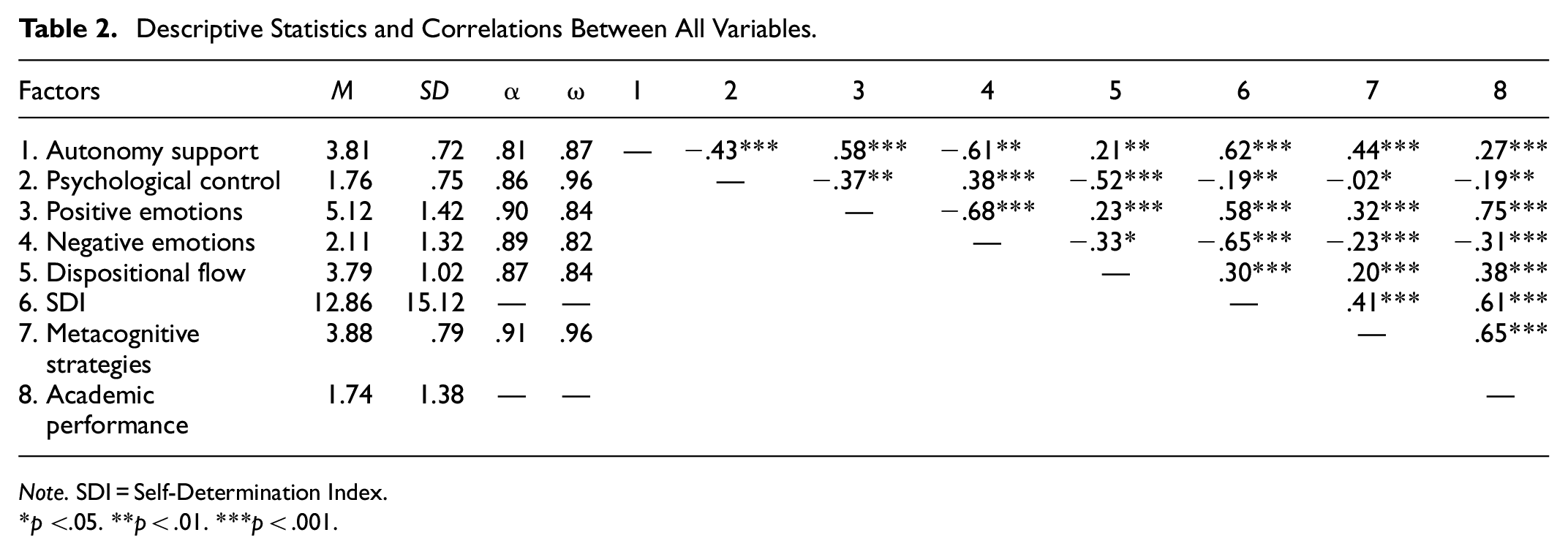
Note. SDI = Self-Determination Index.
p <.05. **p < .01. ***p < .001.
Structural Equations Model Analysis
Concerning the correlation analyses, the findings shown a positive association between autonomy support, positive emotions, dispositional flow, autonomous motivation, metacognitive strategies, and academic performance. Furthermore, they also revealed positive correlations between psychological control and negative emotions. It was also found that both psychological control and negative emotions displayed negative correlations in relation to autonomy support, positive emotions, dispositional flow, autonomous motivation, metacognitive strategies, and academic performance.
Prior to conducting SEM, Anderson and Gerbing (1988) stressed the importance of testing a measurement model with all predictors, process and outcome variables to provide evidence of convergent and discriminant validity of the key constructs of the study (Table 3).
Convergent and Discriminant Validity.

Note. The diagonal represents Average Variance Extracted (AVE). While the upper part represents the correlations.
p < .01. ***p < .001.
Model fit indices were adequate: χ2 (249) = 715.25, χ2/df = 2.88, p < .001, TLI = .96; IFI = .96, CFI = .96, RMSEA = .050. (90% CI = [0.046, −0.058]), SRMR = .057. For convergent validity, the AVE was used, while for discriminant validity, the correlation between variables was examined with respect to the correlation between variables being less than ±1.0.
An SEM was used to analyze the hypothesized model. However, due to their complexity, the latent variables were reduced to at least two indicators for theoretical and parsimony reasons (McDonald & Ho, 2002). More specifically, the latent variables utilized were: positive emotions included four indicators (relaxation, enjoyment, pride, and confidence, Trigueros, Aguilar-Parra, Cangas, & Álvarez, 2019); negative emotions had four indicators (embarrassment, anxiety, frustration, and boredom, Trigueros, Aguilar-Parra, Cangas, & Álvarez, 2019); dispositional flow included nine indicators (balance between the level of ability and the challenge, union of action and thought, clarity of objectives, clarity of feedback, total concentration, feeling of control, loss of self-awareness, distortion of time, and autotelic experience, García-Calvo et al., 2008); and, finally, autonomy support. With regard to the latter, it was necessary to divide the eight items on the scale into two indicators, as occurred with the seven items of psychological control and the 15 items of metacognitive strategies. The aspects detailed were required to correctly identify the model (see, McDonald & Ho, 2002).
The relationships obtained between the different factors that make up the model (Figure 1) are described as follows:
(a) The correlation was negative, being β = −.59 (p < .001) between perceived autonomy and psychological control.
(b) The relationship between perceived autonomy and positive emotions (β = .71, p < .001) was positive but negative emotions (β = −.29, p < .001) was negative. On the other hand, the relationship between psychological control and positive emotions (β = −.23, p < .01) was negative but negative emotions (β = .51, p < .001) was positive.
(c) The relationship between positive emotions and dispositional flow (β = .76, p < .001) was positive. On the other hand, the relationship between negative emotions and dispositional flow (β = −.26, p < .001) was negative.
(d) The relationship between dispositional flow with SDI (β = .81, p < .001), metacognitve strategies (β = .38, p < .001), and academic performance (β = .24, p < .001) was positive.
(e) The relationship between SDI with metacognitve strategies (β = .31, p < .001) and academic performance (β = .65, p < .001) was positive.
(f) The relationship between SDI and academic performance (β = .26, p < .001) was positive.
Discussion
This study has attempted to examine how an interpersonal style of the teacher influences the emotional state, dispositional flow, motivation, metacognitive strategies, and academic performance of university students in the context of SPOC. This study addresses for the first time the role of the teacher in terms of the duality between autonomy support and psychological control, and relates both styles to the emotional state of university students. This dual role of the teacher proves relevant given the role of teachers in the emotional, social, and psychological development of students (Ricard & Pelletier, 2016), as well as in the development of emotions, considering they play a key role in students’ adoption of adaptive behaviors (Simonton et al., 2019). For this purpose, this study considers for the first time the influence of emotional state on the dispositional flow of university students. Furthermore, it is worth mentioning that the present study, also considers dispositional flow and autonomous motivation of SDT, and the influence of both on metacognitive strategies and academic performance. In this regard, autonomous motivation and dispositional flow constitute an optimal adaptive psychological state that facilitates carrying out different tasks, allowing students to immerse themselves in the activity at hand and pay attention to what is happening (Moreno et al., 2005; Nakamura & Csikszentmihalyi, 2014). Finally, we would like to highlight that this study is one of the first to be focused on SPOC methodology, as this teaching method is relatively new and studies on it have thus far been concerned with the design of educational proposals and not with the psychological, emotional or social processes among the students who take part in this type of program.
The results show that autonomy support positively predicts positive emotions and negatively predicts negative emotions. In contrast, perceived control negatively predicts positive emotions and positively predicts negative emotions. These findings can be related to other studies in the university context which demonstrated that autonomy support is positively linked to positive emotions (Oriol-Granado et al., 2017) and negatively to negative emotions (Tze et al., 2014). However, hardly any studies exist in the university context which link psychological control exerted by the teacher to the positive and/or negative emotional state of students. Similar studies can only be found in the context of secondary education, where several works carried out by Reeve (2009) and Reeve et al. (2014) demonstrated that the controlling teaching style is positively linked to negative emotions and negatively to positive emotions. Therefore, these studies present certain limitations that this paper has tried to consider by presenting a model in which both interpersonal approaches of the teachers are linked to the positive and negative emotional state of the students. In this way, the results of this study are related to previous research in the educational field and to the postulates of the SDT. The results included in the present study regarding the relationship between the dual role of the teacher and the emotions of students can be described with the idea that if students feel a degree of independence to execute and a capacity for self-decision-making, they will experience positive emotions as they will be able to self-manage their effort. Such a scenario will affect their relaxation; they will be able to set their own limits, increasing their pride and confidence, which will have an impact on their self-knowledge; and, finally, the possibility to choose exercises and how to execute them will affect enjoyment. However, if the teacher displays autocratic or restrictive behavior or pressures students, the latter will feel repressed, inept and refused, tending to increase their negative emotions.
On the other hand, the results indicate that positive emotions positively predicted dispositional Flow, while the latter was rejected by negative emotions. These results are shown to be close to earlier studies in the non-university context. For example, a study conducted by Marin and Bhattacharya (2013) with 75 piano students showed that a positive emotional state induced by the music the participants played favored experiencing dispositional flow. In contrast, music with connotations of negative emotions played by the students impeded experiencing dispositional flow. Likewise, a study conducted by Cermakova et al. (2010) with secondary school students demonstrated that the positive emotion of enjoyment favored students’ experience of dispositional flow, while negative emotions like anxiety and boredom negatively correlated to dispositional flow. The results obtained by the present study regarding the relationship between the emotions and dispositional flow of students reveal that this group will not experience dispositional flow if there is no high situational demand or a set of equally high abilities among the students. Such a scenario occurs because, for example, when the abilities of students’ are much greater than those required by the circumstances, students become bored, and when the demands are too high for his/her abilities, students experience anxiety. In contrast, in the case of low situational demand and deficient abilities, students experience apathy.
As for other aspects, the results showed that dispositional flow positively predicted autonomous motivation, metacognitive strategies, and academic performance among students. In addition, autonomous motivation positively predicted metacognitive strategies and academic performance. These findings can be compared not only with those of similar studies in the university context, but also with others involving compulsory secondary education in the context of sports. In this regard, a study by Stormoen et al. (2016) with 155 secondary school students between 17 and 19 years of age showed that dispositional flow positively predicted autonomous motivation. Similarly, a study conducted by Ersöz (2016) with 612 young people who engaged in physical activity revealed that dispositional flow positively predicted autonomous motivation. With regard to the relationship between autonomous motivation and dispositional flow as relates to academic performance and metacognitive strategies, the findings of the present study are similar to other previous works (Borkowski, 1996; Cermakova et al., 2010; González-Cutre et al., 2009). In this respect, a study carried out by Trigueros and Navarro (2019) with secondary school students showed that autonomous motivation positively predicted academic performance and metacognitive strategies. Furthermore, another study by Trigueros, Aguilar-Parra, Cangas, Bermejo, et al. (2019) with secondary school students showed that autonomous motivation predicted assiduous physical activity and an improved academic record. Regarding dispositional flow, a study conducted by Cermakova et al. (2010) with 240 university students demonstrated that dispositional flow positively predicted metacognitive strategies, while a study by Vinothkumar et al. (2016) with 250 university students showed that dispositional flow positively predicted academic performance. The results presented herein with respect to the relationship between dispositional flow and autonomous motivation, as well as their link to metacognitive strategies and students’ academic performance, can be explained according to the postulates established by SDT and Flow Theory. In this regard, both theories state that dispositional flow and autonomous motivation have a direct impact on subjective well-being because they foster positive experiences in the here and now, and they also have an equally important indirect effect on subjective well-being as they foster coping and control of increasingly difficult tasks. Thus, organic growth is promoted over the course of life, which requires the use of strategies and adaptive behaviors that help to reach goals (Csikszentmihalyi, 1990; Ryan & Deci, 2000), which in the case of the present study are metacognitive strategies and academic performance. Therefore, in local academic contexts, such as the classroom, and general contexts, such as the educational center, they must foster close experiences among their pupils that lead to growth in the pupils. In order for them to obtain a series of tools that allow them to adapt and overcome the vicissitudes that they face throughout their academic life.
Despite these results obtained by the model, several limitations of this study should be highlighted. First, the present study is based on the use of self-reported measures. Second, this is a correlational and cross-sectional study, which means that the results obtained in this study may give rise to different interpretations. Furthermore, the relationship established between different variables should be more thoroughly analyzed by researchers, perhaps by incorporating new variables that allow a deeper analysis of said relationships and by using comparable and/or dissimilar study groups. Although the model appears to display good robustness and capacity for generalization towards different cultures or ages, in the future an ethnographic study should be established with the objective of deepening and better comprehending the psychological characteristics of students. In addition, future studies should verify how friends and families can influence students’ development of flow, adoption of metacognitive strategies and motivation, and to what extent said influence is stable across time.
Footnotes
Declaration of Conflicting Interests
The author(s) declared no potential conflicts of interest with respect to the research, authorship, and/or publication of this article.
Funding
The author(s) disclosed receipt of the following financial support for the research, authorship, and/or publication of this article: Teaching Innovation Projects of the University of Almeria (Ref: 24/25-1-41C) and Projects to Strengthen Research Groups FEDER-UAL (Ref: P_FORT_GRUPOS_2023/05)

Data Availability Statement
The datasets generated during and/or analyzed during the current study are not publicly available due to the fact that we do not have the consent of the study participants but are available from the corresponding author on reasonable request.