




Abstract
The main purpose of this study is to investigate the attitude of students toward Arabic and English textbooks in communication and media. The study used a survey questionnaire to collect data. A total of 157 university students, consisting of 95 females and 62 males, participated in the study. English textbooks received the highest satisfaction from male students, students specialized in journalism, students of the age group of 18 to 25 years, and third-year students. Arabic textbooks received the highest satisfaction from female students, students specializing in public relations, and fourth-year students. However, the overall results indicate that the English textbooks outperformed the Arabic textbooks in terms of easy access and use, the quality of print and design, provision of visual and graphic images, provision of activities and exercises, and quality of contents. The article suggests major changes and improvement in writing and publishing Arabic textbooks. Findings of the study suggest needs of major changes and improvement in writing and publishing Arabic textbooks.
Introduction
Despite the existence of various teaching and learning resources in print and electronic format, textbooks remain the major source for teaching and learning. Textbooks, if used properly, are not as problematic as critics claim and can be a useful tool in teaching and learning (Roberts, 2014). This is because quality textbooks contain the core elements of the subject curriculum with teaching and learning strategies. They are carefully prepared and designed in such ways that facilitate teaching and learning process.
Textbooks help teachers and learners to understand the concepts and apply them in the work-related profession. According to Tyson and Wookdward (1989), a textbook represents a knowledge in a discipline with reasonable accuracy. This accuracy should include the quality of printing and design, easy access and use, support concepts’ explanations and presentations with required visual and image materials, use a variety of activities and exercises, and ensure the quality of contents.
Prior researches have been conducted on textbooks in the United Arab Emirates (UAE; Abosalem, 2016; Al-Qatawneh et al., 2019; Khine & Yang, 2017). However, most of these studies reported different issues related to school textbooks and not to the textbooks used by higher education institutions. The authors could identify, through the Scopus database, ERIC database, and Google Scholar, a few studies that reported the issues of textbooks in higher education institutions in UAE (Eltahir et al., 2019; Fantazy & Madichie, 2015; Yousef, 2017). Unfortunately, none of these studies investigated and compared Arabic and English textbooks in Communication and Media. There is a need for more studies to be conducted on textbooks of higher education institutions in UAE. Such studies could contribute to the improvement of textbooks and help instructors, head of programs, and the departments to select appropriate textbooks and contribute to the quality of education.
In 2015, Al Ain University (AAU) launched the College of Communication and Media in Al Ain and Abu Dhabi, UAE. The College emphasizes on active learning, scientific research, and information technologies, and allows students to select journalism, advertising, or public relations as major specialization. The courses are a mixture of academic and industry-focused studies, using both Arabic and English textbooks. This study reports findings of the investigation about students’ attitude toward the Arabic and English textbooks used in college. The results of the study could help us to identify the strength and weakness of these textbooks and contribute to the improvement of textbooks in the Arab world.
Review of Literature
It is important to ensure that the textbook has quality printing and design. Textbooks with poor- and low-quality printing and design affect the accuracy of contents, the process of teaching and learning, and discourage users from using the book. Therefore, the textbooks should have attractive covers, attractive layout and design, and good quality of paper. This section reviews and summarizes related studies that investigated textbooks with a special focus on the quality of easy access and use, printing and design, visual and graphic materials, provision of activities and exercises, and quality of contents.
According to Joint (2009), the quality of printing is essential for effective communication. A study by Price (2012) compared the attitude of teachers toward open textbooks and non-open textbooks with regard to the quality of print media design. Findings of the study showed that, participants using the non-open textbooks or traditional textbooks indicated that the books use more useful graphics than those using the open textbooks. The traditional books had higher mean scores in all the four statements than the open textbooks. However, a recent study found that students rated the quality of the print format of the open textbook to be significantly superior to the commercial textbook (Jhangiani et al., 2018).
In addition to the quality of printing and design, quality textbooks should be equipped with tools that facilitate easy access and use. The tools include, among others, the provision of a clear and coherent table of contents, the provision of clear and accurate headings and subheadings, and the provision of a glossary and definition of key concepts used in the book. An investigation by McGowan et al. (2009) compared print and electronic textbooks and indicated that students were more satisfied with print textbooks than electronic textbooks with regard to the ease of access and use. Similarly, Jhangiani et al. (2018) found that the print format of the open textbook was rated significantly higher than the commercial textbook on writing clarity, writing engagement, and helpful study aids.
Modern and contemporary teaching and learning techniques and strategies require authors and publishers to make use of relevant visual and graphic images and materials. These materials are used by the authors and publisher to make communication, between the book and learner, quicker and simpler, aid better comprehension, act as stimulators for emotions, and drive motivation (Jandhyala, 2017). According to Sheen and Luximon (2015), visual images are very important and can be used to improve students’ problem-solving skills. A study by Canning-Wilson (2001) at UAE University showed how visual materials can support and enhance the learning process. Likewise, an investigation by Drobot (2015) on the effectiveness of images and visual materials in learning foreign language proved how important the use of these materials are in textbooks.
Another important feature of good textbooks is the provision of activities and exercises. Activities and exercises encourage collaboration among students, promote analytical and critical thinking, and act as practical applications of concepts and skills. According to Wakefield (1998), activities represent strategic solutions to teaching problems. Therefore, effective activities and exercises motivate students and help them to learn (Zohrabi, 2011). Lepik et al. (2015) found 45% of the teachers using textbooks for activities and exercises. A study by Rodríguez and Paiva (2017), which investigated learning difficulties in textbooks, found that the activities and exercises presented in textbooks in Portugal do little to help students in understanding the concepts.
A textbook should have quality contents. An important work by Mahmood (2009) identified 11 indicators for a quality textbook. The indicators include scope coverage, reliability and accuracy, critical and creative learning, and text that is bias free. Unfortunately, not all textbooks are able to fulfill the requirements of these indicators. In his article dedicated to the quality of textbooks, Oliveira (1995) explained how the U.S. government and special interest groups constrain the quality of textbooks. Price (2012) believed that the potential problem with open textbooks is low-quality content and the use of inappropriate resources. Similarly, an analysis of seven textbooks in North America by Gurung et al. (2012) indicated significant differences between the books in terms of quality and helpfulness.
The review of literature has highlighted the importance of investigating and analyzing textbooks. The current study investigates and reports the attitude of students toward Arabic and English textbooks in communication and media studies. Findings of the study should contribute to the improvement of textbooks in the Arab countries.
Research Method and Procedure
The main objective of this study is to investigate the attitude of students toward English and Arabic textbooks in communication and media. The study is guided by the following research questions:
These questions are important in understanding the attitude of students toward English and Arabic textbooks in Communication and Media. More specifically, the analysis and findings of the study related to these questions should help us to understand the differences between Arabic and English textbooks in relation to the quality of printing and design, easy access and use, provision of visual and graphic images, provision of activities and exercises, and provision of quality content.
The study population is students from the College of Communication and Media, AAU, UAE. The researchers randomly selected a sample of 500 students affiliated to the college to participate in the study. The sample consists of male and female students specializing in different programs at different levels. However, the researchers excluded the first-year students from the sample. This is because, at this level, the students have insufficient time and experience in using English and Arabic textbooks in communication and media courses. Finally, the researchers received 157 valid responses, representing a 31.40% response rate for the selected sample of 500 students.
Data were collected through a survey questionnaire after receiving approval from a relevant authority of the university. The instrument was designed in English using Google Form. The English language was preferred to avoid confusion of technical terms and to be in line with the language of the research report. The participants were invited to participate in the survey through email and WhatsApp in March 2019. The instrument collected data about the respondents’ demographic characteristics and attitude about the Arabic and English textbooks in general without specifying particular textbooks. Of the collected data of 23 statements about attitude toward Arabic and English textbooks, three questions were related to the quality of printing and designing textbooks, four related to easy access and use, three related to the quality of the visual and graphic images, four targeted activities and exercises, and eight centered on the quality of the contents.
Moreover, a 5-point Likert-type scale of agreement and disagreement was used in measuring and determining the attitude of participants toward the textbooks. Prior to the distribution of the questionnaire, the researchers approached two professors to review the questionnaire. The professors were from the College of Communication and Media, and College of Education. The feedback received from these two experts allowed us to establish face and content validity of the instrument. In addition, the reliability test recorded .926 of Cronbach’s alpha, which confirms the internal consistencies and correlation of the items used in measuring the attitude of the participants. The collected data were coded and analyzed through SPSS software.
Findings
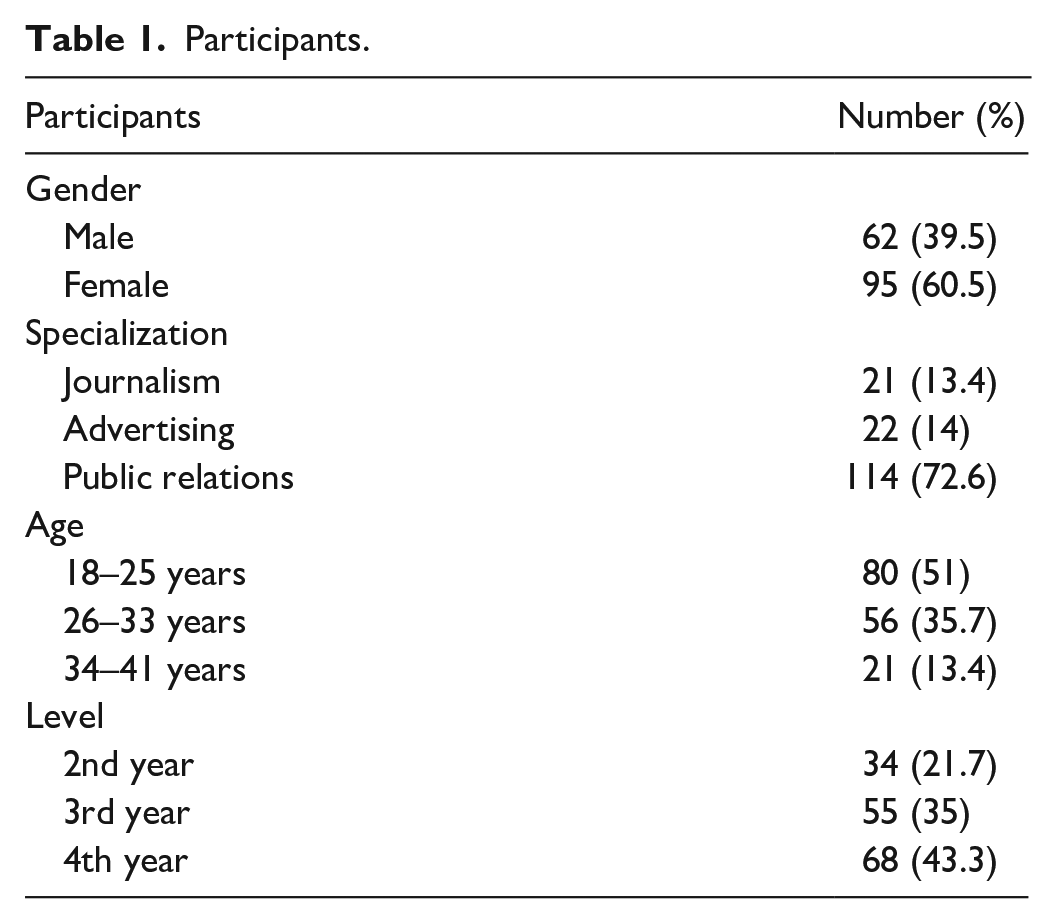
This section reports the findings and results of students’ attitude toward English and Arabic textbooks in communication and media. As illustrated in Table 1, 157 students participated in the study, including 95 (60.5%) females and 62 (39.5%) males. A total of 114 (72.6%) of the participants are specializing in public relations, 22 (14%) in advertising, and 21 (13.4%) in journalism. Furthermore, 68 (43.3%) of them are fourth-year students, 55 (35%) are third-year students, and 34 (21.7%) are second-year students. With regard to the age group, the majority of the students (80, 51%) are of the age group of 18 to 35 years, 56 (13.4%) are of the age group of 26 to 33 years, and only 21 (13.4%) are of the age group of 34 to 41 years. The following analysis and discussion present findings related to (a) print and design of textbooks, (b) easy access and use, (c) supporting texts with visuals and graphic displays, (d) supporting texts with activities and exercises, and (e) the quality of contents.
Participants.
Print and Design
The participants were asked through the survey instrument to express their attitude on three statements about the quality of printing and design of textbooks. As presented in Table 2, the findings of the study indicate that the English textbooks have a better attractive cover (mean score = 4.19) than that of Arabic textbooks (mean score = 3.11). Similarly, the results of the study indicate that respondents are more satisfied about the layouts of English textbooks (mean score = 4.15) as compared with the Arabic textbooks (mean score = 2.87). They also believe that the quality of paper for English Textbooks (mean score = 4.29) is better than that of Arabic textbooks (mean score = 3.09).
The Mean Scores of Textbooks on Print and Design.

Further analysis of demographic means presented in Figure 1 illustrates that the English textbooks received the highest satisfaction from students who specialized in journalism (mean score = 10.76), followed by male students (mean score = 10.25), and both third-year students and students of the age group of 23 to 33 years (mean score = 10). On the contrary, the Arabic textbooks received the highest satisfaction for print and design from both the fourth-year students and students specializing in public relations (mean score = 7.37), followed female students (mean score = 7.31), and students in the age group of 34 to 41 years (mean score = 7.26).

Demographic characteristics on print and design.
Access and Use
Respondents were required to determine their attitude about four statements related to the easy access of contents and use. As reported in Table 3, the findings of the study show that the English textbooks have clear headings and subheadings (mean score = 4.22) than that of the Arabic textbooks (mean score = 3.26) and have a clear, coherent table of contents (mean score = 4.19) than the Arabic textbooks (mean score = 3.34). In addition, the respondents agreed that most of the English textbooks are equipped with a glossary and definitions of key words (mean score = 4.11) than the Arabic textbooks (mean score = 3.13).
The Mean Scores of Textbooks on Easy Access and Use.

Meanwhile, the analysis of demographic characteristics against access and easy use of textbooks (Figure 2) show that the English textbooks recorded the highest positive attitude among students who specialized in journalism (mean score = 14.88), followed by male students (mean score = 13.95), third-year students (mean score = 13.89), and students in the age group of 26 to 33 years (mean score = 13.85). For the Arabic textbooks, the highest satisfaction on access and easy use is reported by students from the age group of 18 to 25 years (mean score = 11.01), followed by fourth-year students (mean score = 10.89), students who specialized in public relations (mean score = 10.87), and female students (mean score = 10.77).

Demographic characteristics on access and easy use.
Visual and Graphic Display
Respondents were asked to indicate their attitude on three statements related to the provision of visual and graphic items by English and Arabic textbooks. As reported in Table 4, the findings of the study show that respondents believe that the English textbooks are richer in visual images (mean score = 4.19) than the Arabic textbooks (mean score = 2.76) and have higher quality of pictures and images (mean score = 4.23) than the Arabic textbooks (mean score = .66). Furthermore, respondents agreed that the English textbooks provide more tables and flowcharts (mean score = 4.13) than the Arabic textbooks (mean score = 2.85).
The Mean Scores of Textbooks on Visual and Graphic Display.

Furthermore, the analysis of demographic characteristics (Figure 3) revealed that the English textbooks received the highest positive attitude from both students specializing in journalism and students of the age group of 18 to 25 years (mean score = 10.89). The two groups are followed by male students (mean score = 10.21) and third-year students (mean score = 9.99). For the Arabic textbooks, the highest satisfaction is observed from the fourth-year students (mean score = 6.85), followed by both students in the age group of 34 to 41 years and students specializing in public relations (mean score = 6.71, and female students (mean score = 6.65).

Demographic characteristics on visual and graphic display.
Activities and Exercises
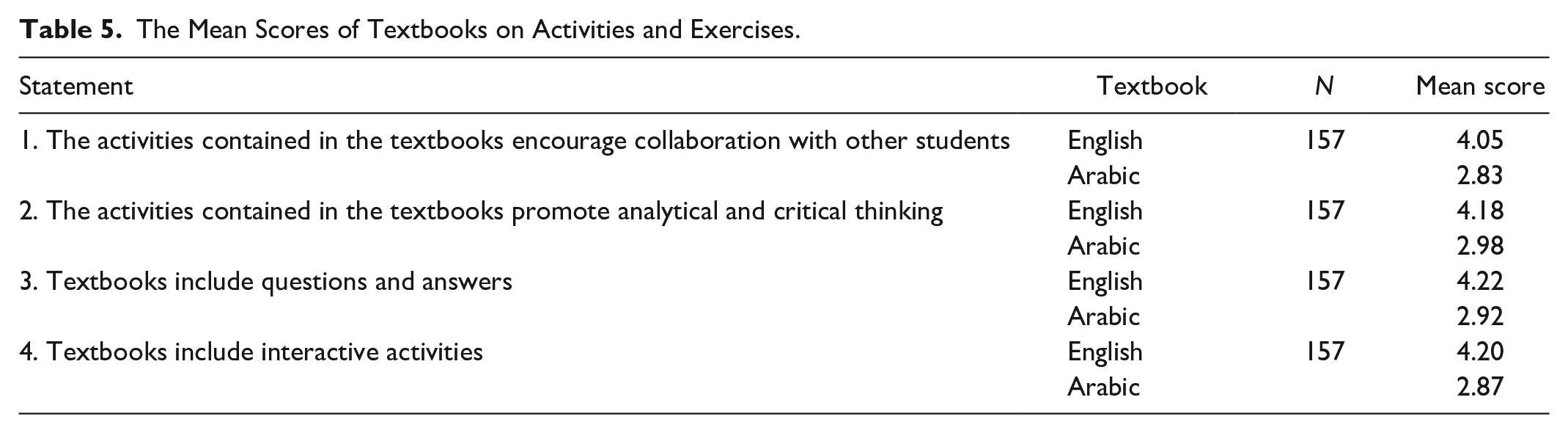
Respondents were asked to indicate their attitude on four statements related to the inclusion of activities and exercises in textbooks. As presented in Table 5, the English textbooks provide more questions and answers (mean score = 4.22) than the Arabic textbooks (mean score = 2.92), and include more interactive activities (mean score = 4.20) than the Arabic textbooks (mean score = 2.87). Similarly, the English textbooks appeared to promote analytical and critical thinking (mean score = 4.18) more than the Arabic textbooks (mean score = 2.98) and they are also equipped with activities that encourage collaboration with other students (mean score = 4.05) than the Arabic textbooks.
The Mean Scores of Textbooks on Activities and Exercises.
Moreover, the results of the demographic analysis (Figure 4) show that the English textbooks received the highest positive attitude from students specializing in journalism (mean score = 14.93), followed by male students (mean score = 14.02), the students in the age group of 26 to 33 years (mean score = 13.79), and both second- and third-year students (mean score = 13.60). Regarding the Arabic textbooks, the highest satisfaction is observed among students specializing in public relations (mean score = 9.98), followed by students of the age group of 18 to 25 years (mean score = 9.88), female students (mean score = 9.57), and fourth-year students (mean score = 9.44).

Demographic characteristics with activities and exercises.
Quality of Contents
Respondents were asked to determine their level of agreements on eight statements related to the quality of the contents in the textbooks. As presented in Table 6, respondents believe that the English textbooks provide more practical and real-life examples (mean score = 4.25) than the Arabic textbooks (mean score = 3.02). Likewise, they agreed that the titles of English textbooks reflect the contents (mean score = 4.21) more than the titles of Arabic textbooks (mean score = 3.38). According to them, the English textbooks are written in a more easy and understandable manner (mean score = 4.16) than the Arabic textbooks (mean score = 3.01) and use a greater variety of examples from different contexts (mean score = 4.15) than the Arabic textbooks (mean score = 3.04).
The Mean Scores of Textbooks on the Quality of Contents.

Moreover, the English textbooks appeared to have more case studies (mean score = 4.15) than the Arabic textbooks (mean score = 3.08) and include enough examples for explaining theoretical concepts (mean score = 4.15) compared with the Arabic textbooks (mean score = 2.96). In addition, the English textbooks follow a logical sequence (mean score = 4.14) compared with the Arabic textbooks (mean score = 3.39) and their contents are easier to understand (mean score = 4.10) than the Arabic textbooks (mean score = 3.39).
On the other hand, the analysis of demographic characteristics (Figure 5) indicate that the English textbooks recorded the highest positive satisfaction from students specializing in journalism (mean score = 32.77), followed by male students (mean score = 30.64), the students in the age group of 26 to 33 years (mean score = 30.39), and third-year students (mean score = 30.08). For the Arabic textbooks, the highest satisfaction is recorded from the students of the age group of 18 to 25 years (mean score = 23.69), followed by students specializing in public relations (mean score = 23.65), fourth-year students (mean score = 23.02), and female students (mean score = 22.97).
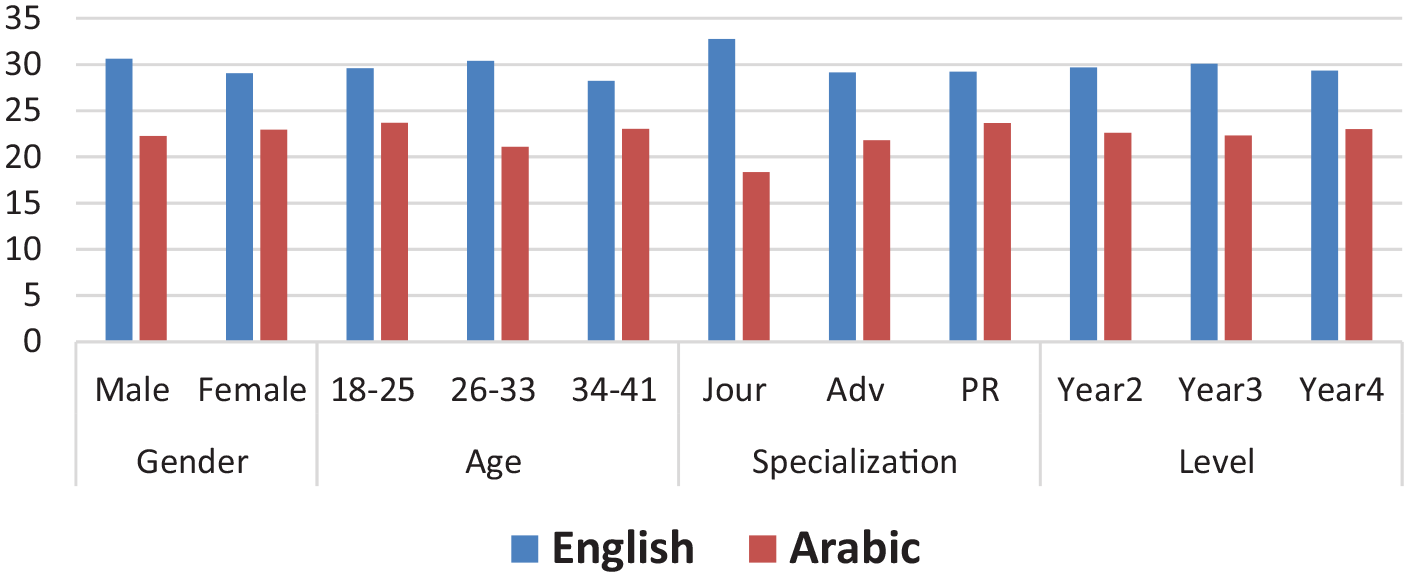
Demographic characteristics with activities and exercises.
Discussion
This study has investigated the attitude of students toward the English and Arabic textbooks in communication and media. Findings of the study indicate that the English textbooks received the highest positive attitude among students than the Arabic textbooks. The textbooks in English appeared to have higher quality of printing and designing than the Arabic textbooks. Although there are thousands of printing and publishing industries in the Arab world, their quality of printing and designing is lower than that of publishers in the Western countries (Alqasimi, 2017). One possibility for this low quality is due to making profits, avoiding loss, and disappointment in printing business. Therefore, Arabic books, in general, are cheaper than the English books. Another possibly is the lack of knowledge and skills to design and produce quality textbooks in Arabic. This is because the employees of printing and publishing industries in the Arab world are not trained enough to produce quality textbooks that can compete with the English textbooks. Therefore, the owners of printing and publishing industries in the Arab countries should recruit professionals who are specialized in this area to improve the quality of printing and designing Arabic textbooks.
In addition, the findings of the study showed that the English textbooks are designed in such a way that ensures easy access and use of information and contents than the textbooks in Arabic. Similar findings are reported by McGowan et al. (2009) and Jhangiani et al. (2018). Easy access and use include glossaries, clear headings and subheadings, and a coherent table of contents. In fact, until today, some Arab authors provide the table of contents at the end of textbooks rather than at the beginning. Similarly, the authors of the Arabic textbooks hardly provide glossaries in the textbooks. Surely, the provision of the contents page at the beginning of books and provision of glossaries will facilitate easy access and use. Therefore, Arab authors should include these elements while producing textbooks.
Moreover, participants expressed high positive perception toward English textbooks than the Arabic textbooks in relation to the provision of visual and graphic materials. They believe that the textbooks in English are richer in visual images and pictures, and include more tables and flowcharts than the textbooks in Arabic. This issue can be solved through sharing of responsibilities between Arab authors and the publishing industries. The first group needs to identify and provide visual and graphic images and materials wherever needed in the book; the publishers should ensure the production of quality images, tables, and flowcharts as required.
In line with the previous studies (Abosalem, 2016; Alhasant, 2016), the findings of the current study indicate that the English textbooks provide more activities and exercises than the Arabic textbooks. Arabic textbooks do not provide sufficient activities and exercises that encourage collaboration among students, activities and exercises that promote analytical and critical thinking, or include interactive activities and exercises, and questions and answers. Activities and exercises of textbooks are designed to help students to understand the concepts and perform self-evaluation and assessment. Therefore, we highly recommend the inclusion of a sufficient amount of activities and exercises in the Arabic textbooks.
As reported by a prior study (Gurung et al., 2012), a large majority of respondents perceive English textbooks as the source of the quality content than the Arabic textbooks. They believe that titles of English textbooks represent the content than the Arabic textbooks. In addition, they agreed that the authors of English textbooks are equipped with sufficient case studies, real-life examples, logical sequences, and use understandable and clearer language than the Arabic textbooks. This issue could be related to many factors, including lack of knowledge, lack of honesty and commitment, lack of resources, and lack of time for producing high-quality textbook contents. Nevertheless, authors are responsible for ensuring that their books contain fundamental elements that support learning among students.
Conclusion
English textbooks in communication and media are far better than the Arabic textbooks. Textbooks in English are equipped with attractive covers, attractive layouts, and higher quality paper than the Arabic textbooks. In addition, the use of a coherent table of contents, glossaries, and headings and subheadings make the English textbooks more user friendly than the Arabic textbooks. Unlike the Arabic textbooks, English textbooks use higher quality of images and pictures, and tables and flowcharts to support concept explanations and discussions. They also use more interactive activities and exercises that encourage collaboration and analytical and critical thinking among students. Likewise, English textbooks outperformed the Arabic textbooks with regard to the connection between the titles and the contents of the books, provision of case studies and examples, easy understanding, the logical sequence of the contents, and quality of language. Accordingly, the authors and publishers of Arabic textbooks in communication and media need to consider and follow contemporary methods and techniques of writing and publishing textbooks for university students. This can be achieved by identifying the areas for improvement and benchmarking with the best English textbooks. This should result in improving the quality of Arabic textbooks and improving the level of satisfaction among students.
Footnotes
Appendix
Declaration of Conflicting Interests
The author(s) declared no potential conflicts of interest with respect to the research, authorship, and/or publication of this article.
Funding
The author(s) received no financial support for the research, authorship, and/or publication of this article.
